EP0485592B1 - Appareil et procede reduisant au minimum l'enroulement serre de bandes pendant le deroulement de rouleaux de matieres en bandes de longueur indeterminee - Google Patents
Appareil et procede reduisant au minimum l'enroulement serre de bandes pendant le deroulement de rouleaux de matieres en bandes de longueur indeterminee Download PDFInfo
- Publication number
- EP0485592B1 EP0485592B1 EP91912565A EP91912565A EP0485592B1 EP 0485592 B1 EP0485592 B1 EP 0485592B1 EP 91912565 A EP91912565 A EP 91912565A EP 91912565 A EP91912565 A EP 91912565A EP 0485592 B1 EP0485592 B1 EP 0485592B1
- Authority
- EP
- European Patent Office
- Prior art keywords
- support member
- brake force
- movement
- web
- range
- Prior art date
- Legal status (The legal status is an assumption and is not a legal conclusion. Google has not performed a legal analysis and makes no representation as to the accuracy of the status listed.)
- Expired - Lifetime
Links
- 238000000034 method Methods 0.000 title claims abstract description 28
- 239000000463 material Substances 0.000 title claims abstract description 26
- 230000003247 decreasing effect Effects 0.000 claims abstract description 7
- 230000007423 decrease Effects 0.000 claims description 4
- 230000010354 integration Effects 0.000 claims description 3
- 230000004044 response Effects 0.000 claims description 2
- 230000002463 transducing effect Effects 0.000 claims 1
- 230000008569 process Effects 0.000 description 13
- 238000004886 process control Methods 0.000 description 3
- 101150091539 SQE1 gene Proteins 0.000 description 1
- 230000009471 action Effects 0.000 description 1
- 230000003466 anti-cipated effect Effects 0.000 description 1
- 230000008859 change Effects 0.000 description 1
- 238000010276 construction Methods 0.000 description 1
- 239000012530 fluid Substances 0.000 description 1
- 230000005484 gravity Effects 0.000 description 1
- 230000005389 magnetism Effects 0.000 description 1
- 238000012544 monitoring process Methods 0.000 description 1
- 230000002093 peripheral effect Effects 0.000 description 1
- 238000006748 scratching Methods 0.000 description 1
- 230000002393 scratching effect Effects 0.000 description 1
- 238000011144 upstream manufacturing Methods 0.000 description 1
- 238000004804 winding Methods 0.000 description 1
Images


Classifications
-
- B—PERFORMING OPERATIONS; TRANSPORTING
- B65—CONVEYING; PACKING; STORING; HANDLING THIN OR FILAMENTARY MATERIAL
- B65H—HANDLING THIN OR FILAMENTARY MATERIAL, e.g. SHEETS, WEBS, CABLES
- B65H20/00—Advancing webs
- B65H20/30—Arrangements for accumulating surplus web
- B65H20/32—Arrangements for accumulating surplus web by making loops
- B65H20/34—Arrangements for accumulating surplus web by making loops with rollers
Definitions
- This invention concerns apparatus and methods for unwinding rolls of web materials of indeterminate length. More particularly, the invention includes unique features for minimizing cinching of the web material on its supply roll during unwinding.
- FIG. 1 A known system for unwinding web materials of indeterminate length is illustrated in Figure 1.
- Web material such as photographic film
- stock rolls 10,12 which are mounted for rotation with shafts 14,16.
- Electrically actuated brakes 18,20 are associated with each shaft for controlling its speed of rotation.
- Indeterminate lengths 22,24 of web material are drawn from stock rolls 10,12 and threaded past guide rollers 26, 28 to a means 30 for receiving and accumulating web, from which the web is withdrawn by a subsequent process apparatus such as a spooler in the case of photographic film, not illustrated.
- the function of means 30 is to permit a temporary difference between the upstream and downstream speeds of the web material coming from the stock roll and leaving to the subsequent process apparatus, respectively.
- the web material from one stock roll is threaded through means 30 and the illustrated apparatus is operated until the stock roll is exhausted, after which web material from the other stock roll is spliced to the tail end of the web from the preceding stock roll and operation continues.
- Means 30 comprises a substantially rectangular frame 32 on whose upper member is mounted at least one guide roller 34, though typically a plurality of such rollers are mounted in an essentially horizontal row as illustrated.
- a support member 36 typically in the form of an elongate bar, is mounted slidably on a pair of parallel guide rods 38,40, which extend between the upper and lower members of frame 32.
- Support member 36 thus is permitted to move substantially vertically relative to frame 32, toward and away from the row of guide rollers 34.
- Support member 36 carries at least one further guide roller 42, though typically a plurality of such further rollers are mounted in an essentially horizontal row as illustrated.
- Web material 22,24 is threaded alternately over one of rollers 34, then under one of rollers 42 until all rollers are guiding the web, after which the web passes from means 30 to the subsequent process apparatus.
- the known system includes a pair of limit switches 44,46 mounted on a side member of frame 32 where they can be actuated by support member 36 as it passes.
- the outputs of the limit switches are connected to a brake control 48 which applies or releases electrically actuated brakes 18,20 as a function of the vertical position of support member 36.
- brake control 48 applies or releases electrically actuated brakes 18,20 as a function of the vertical position of support member 36.
- movement of support member 36 above upper limit switch 44 causes brake control 48 to release the electrically actuated brake of the running stock roll, thus permitting the stock roll to accelerate to match the demand of the subsequent process apparatus.
- the length of web material accumulated within means 30 should be sufficient to meet the largest anticipated demand from the subsequent process apparatus, without causing support member 36 to contact the upper member of frame 32.
- brake control 48 applies the electrically actuated brake with a force known to be sufficient to stop the heaviest, fastest rotating stock roll before support member 36 reaches the lower member of frame 32.
- the dot-dash line illustrates the application of brake force in the known system as a function of the position of support member 36, also known as the float frame.
- support member 36 When support member 36 is below its upper limit, essentially no brake force is applied.
- upper limit switch 44 When upper limit switch 44 is passed as support member 36 moves downward, control 48 initially sends a rather high voltage to the electrically actuated brakes to overcome their inertia, after which the voltage is reduced quickly to apply a medium range brake force. Should support member 36 continue to fall past limit switch 46, a higher voltage is applied to the electrically actuated brakes to ensure that the stock roll stops before support member 36 reaches the lower member of frame 32.
- This known mode of braking the stock rolls causes very rapid deceleration which can cause cinching of the material on the stock roll as the hub of the stock roll is braked more quickly than the web material departing the edge of the roll, particularly during the high voltage application required to overcome the inertia of electrically actuated brakes. This is particularly so for larger rolls where the unwinding force is applied at a larger diameter. Such cinching can cause undesirable scratching and other damage to the web material, particularly if photographic film is being unwound.
- Stock rolls are wound with a certain winding force or tension and may be quite tightly coiled or more loosely coiled when delivered to such an unwinding system.
- the tightness of the roll will determine how much torque the roll can transmit by friction among its convolutions, without further tightening or cinching. If an unwinding force is applied to the free end of a stationary or moving roll, the convolutions will tighten or cinch if the applied force causes the roll to transmit a torque greater than that which can be resisted by friction among its convolutions. If the medium brake force is reduced so that partially emptied rolls will not stop too quickly, then full rolls may not stop even when the high brake force is applied.
- a primary object of this invention is to provide an apparatus and method for unwinding web material from a stock roll for delivery to a process apparatus, without causing cinching of the web material on the stock roll.
- Another object of this invention is to provide such an apparatus and method which can be readily and inexpensively adapted to existing systems for unwinding web materials.
- Still another object of the invention is to provide such an apparatus and method in which brake application and release can be precisely controlled without overshoot in applied brake force or residual brake force following release.
- a rotatable shaft for a stock roll of web material of indeterminate length, along with means for braking rotation of such shaft.
- Web from the stock roll is directed to a means for receiving and accumulating a variable length of such web which comprises a frame; at least one guide roller supported by the frame; a support member; means for permitting the support member to move substantially vertically relative to the frame, toward and away from the at least one guide roller; and at least one further guide roller mounted on the support member between a minimum brake force zone close to the first guide roller and a maximum brake force zone spaced from the first guide roller.
- the web is threaded alternately around the at least one guide roller and the at least one further guide roller.
- Web is withdrawn from the means for receiving and accumulating by a subsequent process apparatus, such as a spooler in the case of photographic film.
- Means or a method step is provided for sensing the position of the support member within the frame and producing a signal.
- Means or a method step responsive to this signal applies the braking means with sufficient increasing brake force as the support member moves downward past each of a plurality of levels away from the first guide roller; and releases the braking means with sufficient decreasing brake force as the support member moves upward past each of the plurality of levels toward the first guide roller, to maintain a desired level of tension in the web and to prevent cinching of the web on the stock roll.
- the brake force is increased or decreased, preferably, as the support member falls past or rises above, respectively, each of a plurality of levels during movement relative to the frame.
- no brake force is applied in a first, uppermost range of movement of the support member, but a gradually increasing brake force is applied as the support member moves downward through a second, lower range of movement until a preselected maximum brake force is reached for such second range of movement.
- the brake force is gradually increased in each range of movement beyond that for the preceding range of movement as the support member moves downward through successive, lower ranges of movement, until further preselected maximum brake forces are applied for each successive, lower range.
- the brake force is gradually decreased until the preselected maximum brake force of the next higher range of movement is reached; but the brake force is reduced to zero when the support member moves into the first, uppermost range of movement.
- the means for braking is pneumatically actuated, to permit smoother application of the brakes.
- the signal from the means for sensing is directed to a comparator where it is compared to preset values corresponding to location of the support member within each of the ranges of movement and control signals are produced of increasing magnitude as the support member moves downward through the ranges of movement.
- the control signals are integrated for each range of movement to produce an actuation signal which is applied to a voltage to pressure transducer connected to the means for braking.
- the control signal for each range of movement is added to the control signal for the preceding range of movement prior to integration. As the support member rises relative to the frame into the next higher range of movement, the actuation signal and the pressure applied to the brake decrease accordingly.
- Figure 1 illustrates a prior art system for unwinding a stock roll of web material of indeterminate length.
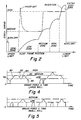
- Figure 2 shows a graph of applied brake force versus float frame position, illustrating certain differences in the modes of operation of the prior art system and the present invention.
- Figure 3 shows a schematic of the improvements to a system for unwinding a stock roll according to the present invention.
- Figure 4 shows a graph of brake force versus time for the present invention when a large or nearly full stock roll is being unwound.
- Figure 5 shows a graph of brake force versus time for the present invention when a small or nearly emptied stock roll is being unwound.
- the invention comprises means 50 for sensing the position of support member 36 as it moves relative to frame 32 and for producing a proportional output signal.
- An ultrasonic detector such as Model PCU made by Agastat Electro Corporation is acceptable for this purpose; however, any convenient sensor may be used within the scope of the invention.
- the output of sensor 50 is directed to a comparator 52, which may be of the general construction of the comparator used in the system and method of commonly assigned U.S. Patent 4,924,419 with minor changes as described herein.
- the overall range of movement of support member 36 is divided into several smaller ranges. In the example illustrated in Figures 2 and 3, five ranges have been chosen; however, those skilled in the art will appreciate that the number of ranges and their vertical height may be varied without departing from the scope of the invention.
- the braking force preferably is zero; however, in each successively lower range or zone, the brake force increases gradually until a preselected maximum for that range is reached, as illustrated schematically in the graph of Figure 2.
- Comparator 52 is provided with dial in set points corresponding to the range of values of the signal from sensor 50 as support member 36 moves within the low brake force range or zone, the medium brake force range or zone, the high brake force range or zone or, in unusual circumstances, the extra high brake force range or zone.
- comparator 52 produces an output via contact 54. If support member 36 falls into the medium zone, an additional output is produced via contact 56 which adds to that of the preceding range or zone. Similarly, if control member 36 falls into the high zone, an additional output is produced via contact 58 which adds to that of the preceding two zones.
- control member 36 rises relative to frame 32, the control signal for each range or zone is subtracted from the total as control member 36 leaves that zone.
- control signals from contacts 54 to 60 are applied to separate inputs of a summer 64, the remaining input of which comes from process control 62 in the form of an auxiliary signal which also disables comparator 52.
- a summer 64 the remaining input of which comes from process control 62 in the form of an auxiliary signal which also disables comparator 52.
- comparator 52 when comparator 52 is disabled, only the auxiliary signal, when selected, passes to summer 64.
- comparator 52 will neither be enabled by an enable signal nor disabled by an auxiliary signal from control 62, in which case no signals are applied to summer 64 and the brakes are fully released.
- the output from summer 64 is directed to an integrator 66 of conventional design, whose integration time constant preferably is selected to be the same for each range of movement of support bar 36 but which may vary from range to range without departing from the scope of the invention.
- the integrated signal increases until a preselected maximum value is reached, as determined by the magnitude of the signals from contacts 54 to 60 and the characteristics of integrator 66, primarily the time constant of its resistance and capacitance, after which the signal remains essentially constant while support member 36 remains within a given range of movement.
- the signal from integrator 66 is directed to a driver amplifier 68 of conventional design which is operatively connected to a voltage to pneumatic pressure transducer 70 of conventional design.
- a transducer such as Model PV1 made by ISI Fluid Power Inc. is acceptable for this purpose.
- valve 72 may be a Model SQE1 made by Humphrey Valve Company, which will transmit pneumatic pressure to caliper 74 so long as the pressure remains above a preselected limit of, say, zero psi; but will vent caliper 74 when the transmitted pressure falls below this limit.
- Caliper 74 may be a Model P10DAR made by Tol-O-Matic, Inc., which includes an internal spring to bias the braking pads away from disk 76 until a certain minimum pressure of, say, 10 psi is applied, after which increases in the applied pressure cause the braking pads to move into contact with the disk with increasing force, thus permitting a very gradual, controllable and soft application of the brakes as a function of the integrated signal received produced by integrator 66.
- Figures 4 and 5 show typical graphs of applied brake force versus time, using the improvements of the invention as shown in Figure 3.
- the brake force is initially zero, which indicates that support member 36 is in the uppermost range of movement.
- brake force is applied gradually along curve segment 78 until the predetermined maximum for that range of movement is reached. If support member 36 drops further into the medium zone or range, the brake force again increases gradually along curve segment 80 until the predetermined maximum for that range is reached. Later, when support member 36 begins to rise and again enters the low zone or range, the signal from comparator 52 drops and the brake force decreases gradually along curve segment 82 until the predetermined maximum for the low zone is reached again.
- transducer 70 produces a pressure at quick release valve 72 which causes valve 72 to vent caliper 74 so that the brake force drops abruptly to zero along curve segment 88.
- quick release valve 72 may have a release pressure of zero psi.
- the brake force continues to vary in this general manner, as indicated on the right side of Figure 4.
- the brake force versus time curves become similar to those shown in Figure 5, where it is shown that the smaller roll will rotate freely in the zero zone or range more often than the larger one. This is due primarily to the smaller inertia of the smaller roll and the need for higher peripheral roll velocities on a smaller roll to match the demand for web material.
- Figure 2 shows a single curve of brake force as support element 36 falls through its entire range of movement, including the extra high zone or range.
- the problems of the prior art system are solved by the present invention.
- the initially high brake force of the prior art system is eliminated by using precisely controllable pneumatic brakes and by applying the brakes in a gradual fashion.
- Residual braking force is eliminated by the use of a quick release valve which totally releases the brakes when the support member enters the upper range of its motion.
- cinching of stock rolls is virtually eliminated.
Landscapes
- Controlling Rewinding, Feeding, Winding, Or Abnormalities Of Webs (AREA)
- Advancing Webs (AREA)
Abstract
Claims (8)
- Dispositif d'amenée d'une bande (22,24) d'un matériau de longueur indéterminée, du type comprenant un arbre (14,16) monté de manière à pouvoir tourner; des moyens pour supporter un rouleau (10,12) dudit matériau en forme de bande pour qu'il tourne conjointement avec ledit arbre; des moyens (18,20) pour freiner ledit arbre; des moyens (30) pour recevoir une bande délivrée par ledit rouleau et accumuler une longueur variable de ladite bande, lesdits moyens de réception et d'accumulation comprenant un cadre (32), au moins un premier rouleau de guidage (34) pour ladite bande, supporté par ledit cadre, un élément de support (36), des moyens (38,40) pour permettre audit élément de support de se déplacer verticalement dans ledit cadre de manière à se rapprocher et à s'écarter dudit premier rouleau de guidage entre une zone, où la force de freinage est minimale et qui est proche dudit premier rouleau de guidage, et une zone, où la force de freinage est maximale, qui est distante dudit premier rouleau de guidage, et au moins un second rouleau de guidage (42) disposé sur ledit élément de support, ladite bande pouvant être enroulée alternativement autour desdits premier et second rouleaux de guidage lorsqu'elle traverse lesdits moyens de réception et d'accumulation; des moyens pour tirer ladite bande à partir desdits moyens de réception et d'accumulation; des moyens (44,46,50) pour détecter la position dudit élément de support dans ledit cadre et produire un signal; et des moyens aptes à répondre audit signal pour appliquer auxdits moyens de freinage une force de freinage suffisante, graduellement croissante, lorsque ledit élément de support passe en descendant devant chacun d'une pluralité de niveaux à partir dudit premier rouleau de guidage et pour libérer lesdits moyens de freinage avec une force de freinage suffisante, graduellement décroissante, lorsque ledit élément de support passe en remontant devant chacun de ladite pluralité de niveaux en direction du premier rouleau de guidage, lesdits moyens d'application et de libération n'appliquant aucune force de freinage dans une première gamme de déplacement dudit élément de support et augmentant graduellement ladite force de freinage lorsque ledit élément de support descend en s'écartant dudit premier rouleau de guidage, dans une seconde gamme de déplacement dudit élément de support jusqu'à ce qu'une première force de freinage maximale présélectionnée soit atteinte, caractérisé par :
des moyens d'application et de libération (52 à 72), qui (a) maintiennent ladite première force de freinage maximale présélectionnée sur le reste de la seconde gamme, (b) augmentent graduellement la distance de freinage au-delà de la force de freinage maximale présélectionnée de la gamme précédente de déplacement, lorsque ledit élément de support descend à partir dudit premier rouleau de guidage sur des gammes successives de déplacement dudit élément de support jusqu'à ce que d'autres forces de freinage maximales présélectionnées soient atteintes, et (c) maintiennent chaque force de freinage maximale successive sur le reste de chaque gamme successive, afin d'empêcher un serrage de ladite bande sur ledit rouleau lorsque ledit rouleau se déplace pendant ledit tirage, alors que ledit élément de support se déplace entre lesdites zones, où la force de freinage est minimale et où elle est maximale. - Dispositif selon la revendication 1, dans lequel lesdits moyens d'application et de libération (52 à 72) réduisent graduellement ladite force de freinage jusqu'à ce que la force de freinage maximale présélectionnée de la gamme suivante de déplacement soit atteinte lorsque ledit élément de support remonte en direction du premier rouleau de guidage depuis une gamme de déplacement à la gamme suivante de déplacement, mais réduit ladite force de freinage à zéro lorsque ledit élément de support remonte pour pénétrer dans ladite première gamme de déplacement.
- Dispositif selon la revendication 2, caractérisé en outre en ce que lesdits moyens de freinage sont actionnés pneumatiquement (74); et que lesdits moyens d'application et de libération comprennent des moyens comparateurs (52), connectés de façon opérationnelle auxdits moyens de détection, pour comparer ledit signal à des valeurs préréglées correspondant à un emplacement dudit élément de support dans chacune desdites gammes de déplacement et pour produire de signaux de commande (54 à 60) d'amplitude croissante lorsque ledit élément de support descend en s'écartant dudit premier rouleau de guidage dans lesdites gammes de déplacement; les moyens (66,68) pour intégrer ledit signal de commande dans chaque gamme de déplacement de manière à produire un signal d'actionnement de freinage; des moyens formant transducteur tension-pression (70) pour recevoir ledit signal d'actionnement et pour appliquer une pression pneumatique auxdits moyens de freinage.
- Dispositif selon la revendication 3, caractérisé en outre par des moyens (64) pour additionner le signal de commande pour chaque gamme de déplacement au signal de commande pour les gammes précédentes de déplacement de manière à produire un signal de commande combiné pour l'intégration par lesdits moyens d'intégration.
- Procédé d'amenée d'une bande (22,24) d'un matériau de longueur indéterminée, du type incluant les étapes consistant à prévoir un arbre (14,16) monté de manière à pouvoir tourner; monter un rouleau (10,12) dudit matériau en forme de bande pour qu'il tourne conjointement avec ledit arbre; prévoir des moyens (18,20) pour freiner ledit arbre; prévoir des moyens (30) pour recevoir une bande depuis ledit rouleau et accumuler une longueur variable de ladite bande, lesdits moyens de réception et d'accumulation comprenant un cadre (32); au moins un premier rouleau de guidage (34) pour ladite bande supportée par ledit cadre; un élément de support (36); des moyens (38,40) pour permettre audit élément de support de se déplacer verticalement dans ledit cadre en se rapprochant et en s'écartant dudit premier rouleau de guidage entre une zone, dans laquelle la force de freinage est minimale et qui est proche dudit premier rouleau de guidage et une zone, dans laquelle la force de freinage est maximale et qui est espacée dudit premier rouleau de guidage; et au moins un second rouleau de guidage (42) disposé sur ledit élément de support, ladite bande pouvant être enroulée alternativement autour desdits premier et second rouleaux de guidage lorsque ladite bande traverse lesdits moyens de réception et d'accumulation; tirer ladite bande desdits moyens de réception et d'accumulation; détecter la position dudit élément de support dans ledit cadre et produire un signal; et appliquer auxdits moyens de freinage, en réponse audit signal, une force de freinage suffisante, qui augmente graduellement, lorsque ledit élément de support passe en descendant devant chacun d'une pluralité de niveaux en s écartant dudit premier rouleau de guidage, et libérer lesdits moyens de freinage avec une force de freinage suffisante, qui diminue graduellement, lorsque ledit élément de support passe en remontant devant chacun de ladite pluralité de niveaux en direction dudit premier rouleau de guidage, ladite étape d'application comprenant les étapes consistant à n'appliquer aucune force de freinage dans une première gamme de déplacement dudit élément de support et à augmenter graduellement ladite force de freinage lorsque ledit élément de support s'écarte dudit premier rouleau de guidage dans une seconde gamme de déplacement dudit élément de support jusqu'à ce qu'une première force de freinage maximale présélectionnée soit atteinte, caractérisé par les étapes consistant à :(a) maintenir ladite première force de freinage maximale présélectionnée pendant le reste de ladite seconde gamme; (b) augmenter graduellement ladite force de freinage au-delà de la force de freinage présélectionnée de la gamme précédente de déplacement lorsque ledit élément de support descend en s'écartant dudit premier rouleau de guidage, sur des gammes successives de déplacement dudit élément de support, jusqu'à ce que d'autres forces de freinage maximales présélectionnées soient atteintes, (c) maintenir chaque force de freinage maximale successive pendant le reste de chaque gamme successive pour empêcher un serrage de ladite bande sur ledit rouleau lorsque ledit rouleau se déplace pendant ledit tirage, alors que ledit élément de support se déplace entre ladite zone, dans laquelle la force de freinage est minimale, et ladite zone, dans laquelle la force de freinage est maximale.
- Procédé selon la revendication 5, caractérisé en outre par les étapes consistant à réduire graduellement ladite force de freinage jusqu'à ce que la force de freinage maximale présélectionnée de la gamme suivante de déplacement soit atteinte lorsque ledit élément de support remonte en direction dudit premier rouleau de guidage depuis une gamme de déplacement jusqu'à la gamme de déplacement suivante, mais à réduire ladite force de freinage à zéro lorsque ledit élément de support remonte dans ladite première gamme de déplacement.
- Procédé selon la revendication 6, selon lequel lesdits moyens de freinage sont actionnés pneumatiquement, caractérisé en outre en ce que ladite étape d'application et de libération comprend les étapes consistant à comparer ledit signal à des valeurs préréglées correspondant à un emplacement dudit élément de support dans chacune desdites gammes de déplacement; produire des signaux de commande d'amplitude croissante lorsque ledit élément de support descend en s'écartant dudit premier rouleau de guidage, dans lesdites gammes de déplacement; intégrer ledit signal de commande pour chacun des déplacements pour produire un signal d'actionnement de freinage; et convertir ledit signal d'actionnement en une pression pneumatique pour actionner lesdits moyens de freinage.
- Procédé selon la revendication 7, caractérisé en outre par les étapes consistant à additionner ledit signal de commande pour chaque gamme de déplacement audit signal de commande pour les gammes précédentes de déplacement pour produire un signal de commande combiné pour ladite étape d'intégration.
Applications Claiming Priority (3)
| Application Number | Priority Date | Filing Date | Title |
|---|---|---|---|
| US531983 | 1983-09-14 | ||
| US07/531,983 US5098029A (en) | 1990-06-01 | 1990-06-01 | Apparatus and method for minimizing web cinching during unwinding of rolls of web materials of indeterminate length |
| PCT/US1991/003762 WO1991018817A1 (fr) | 1990-06-01 | 1991-05-30 | Appareil et procede reduisant au minimum l'enroulement serre de bandes pendant le deroulement de rouleaux de matieres en bandes de longueur indeterminee |
Publications (2)
| Publication Number | Publication Date |
|---|---|
| EP0485592A1 EP0485592A1 (fr) | 1992-05-20 |
| EP0485592B1 true EP0485592B1 (fr) | 1995-10-25 |
Family
ID=24119908
Family Applications (1)
| Application Number | Title | Priority Date | Filing Date |
|---|---|---|---|
| EP91912565A Expired - Lifetime EP0485592B1 (fr) | 1990-06-01 | 1991-05-30 | Appareil et procede reduisant au minimum l'enroulement serre de bandes pendant le deroulement de rouleaux de matieres en bandes de longueur indeterminee |
Country Status (5)
| Country | Link |
|---|---|
| US (1) | US5098029A (fr) |
| EP (1) | EP0485592B1 (fr) |
| JP (1) | JPH05500791A (fr) |
| DE (1) | DE69114103T2 (fr) |
| WO (1) | WO1991018817A1 (fr) |
Families Citing this family (6)
| Publication number | Priority date | Publication date | Assignee | Title |
|---|---|---|---|---|
| IT1258092B (it) * | 1992-12-03 | 1996-02-20 | Magazzino-polmone perfezionato per materiale fotografico a striscia continua | |
| US7007883B2 (en) * | 2003-02-05 | 2006-03-07 | Adalis Corporation | Apparatus and method for dispensing elongated material |
| US7104493B2 (en) * | 2003-02-05 | 2006-09-12 | Adalis Corporation | Dispensing apparatus and method |
| DE102006047053B4 (de) * | 2006-10-05 | 2010-04-01 | A. Monforts Textilmaschinen Gmbh & Co. Kg | Hotflue |
| ITTO20130896A1 (it) * | 2013-11-05 | 2015-05-06 | Nuova Poliver S R L | Dispositivo di alimentazione di nastro in materiale sintetico ad un apparato di produzione di sacchi per rifiuti monouso con fettuccia di chiusura. |
| EP3237188B1 (fr) * | 2014-12-24 | 2021-07-07 | Pirelli Tyre S.p.A. | Installation pour la collecte ou la distribution d'un élément allongé pour la construction de pneumatiques et procédé pour la collecte ou la distribution d'un élément allongé enroulé en bobines |
Family Cites Families (30)
| Publication number | Priority date | Publication date | Assignee | Title |
|---|---|---|---|---|
| US1286331A (en) * | 1916-01-11 | 1918-12-03 | Henry Vincent James | Paper-web-control device for reel-fed rotary printing-machines. |
| GB551106A (en) * | 1942-03-02 | 1943-02-08 | Asea Ab | Arrangement for the driving of printing presses in order to maintain a constant stress in the web |
| GB871759A (en) * | 1958-08-11 | 1961-06-28 | Fuller Electric Ltd | Improvements in electric regulator control systems |
| GB995874A (en) * | 1961-04-25 | 1965-06-23 | Asea Ab | Means for regulating the tension in webs, bands, sheets, tracks or the like |
| US3258214A (en) * | 1962-01-31 | 1966-06-28 | Potter Instrument Co Inc | Motor driven tension arm release |
| GB1020640A (en) * | 1963-12-17 | 1966-02-23 | British Insulated Callenders | Means for controlling the tension in elongated flexible material |
| US3278100A (en) * | 1964-03-20 | 1966-10-11 | Armstrong Cork Co | Web accumulator including means for modifying tension in web passing therethrough |
| US3249316A (en) * | 1964-04-22 | 1966-05-03 | Schriber Company | Web tension control |
| US3330457A (en) * | 1965-02-11 | 1967-07-11 | Mount Hope Machinery Ltd | Total tension monitor and control system |
| GB1088513A (en) * | 1965-03-04 | 1967-10-25 | W H A Robertson And Company Lt | Improvements in or relating to spooling mechanisms |
| FR1540010A (fr) * | 1966-09-02 | 1968-09-20 | Appareil à guirlande servant à régler le dévidage d'une bande vers une machine l'utilisant | |
| US3414208A (en) * | 1966-09-02 | 1968-12-03 | Jr Richard A Butler | Apparatus for controlling the unwinding of web |
| GB1307524A (en) * | 1969-03-21 | 1973-02-21 | Kodak Ltd | Web or strip material handling apparatus |
| US3672596A (en) * | 1969-07-03 | 1972-06-27 | Gerrard & Co A J | Feeding device for strapping machine |
| CA931985A (en) * | 1971-03-09 | 1973-08-14 | Dominion Engineering Works | Web tension sensing |
| US3822838A (en) * | 1972-03-20 | 1974-07-09 | Butler Automatic Inc | Web handling apparatus |
| US3811637A (en) * | 1972-08-24 | 1974-05-21 | Faustel Inc | Pneumatic tension control system |
| US3796360A (en) * | 1972-09-27 | 1974-03-12 | Alexeff Snyder Ets | Combination storage festoon and compensator |
| US3836089A (en) * | 1973-03-19 | 1974-09-17 | Procter & Gamble | Web splicing, unwinding and forwarding apparatus |
| US4000865A (en) * | 1975-08-27 | 1977-01-04 | Batson-Cook Company | Controlled tension let-off for unwinding rolls of material |
| DE2939607C2 (de) * | 1979-09-29 | 1983-10-27 | Maschinenfabrik Stromag Gmbh, 4750 Unna | Regeleinrichtung für den Antrieb eines Kettablasses einer Webmaschine |
| US4437619A (en) * | 1981-05-06 | 1984-03-20 | Hall Cary | Catenary controller |
| US4411393A (en) * | 1981-06-05 | 1983-10-25 | Dennison Manufacturing Company | Web tension control apparatus |
| JPS5855112A (ja) * | 1981-09-29 | 1983-04-01 | Mitsubishi Electric Corp | 複数ル−パ駆動制御装置 |
| GB2185241A (en) * | 1986-01-10 | 1987-07-15 | Benz & Hilgers Gmbh | Method and device for feeding a web of material from a roll |
| DD252360A1 (de) * | 1986-08-27 | 1987-12-16 | Polygraph Leipzig | Vorrichtung zum regeln des abrollens in abwickeleinrichtungen |
| DE3734433A1 (de) * | 1987-10-12 | 1989-04-20 | Sucker & Franz Mueller Gmbh | Verfahren zum steuern der wickelspannung einer fadenschar beim bilden eines wickels |
| SE463667B (sv) * | 1987-11-03 | 1991-01-07 | Profor Ab | Avrullningsanordning foer banformigt material innefattande en bromsanordning styrd av banspaenningen |
| US4838498A (en) * | 1988-02-22 | 1989-06-13 | Rockwell International Corporation | Web tensioning system |
| JPH0252845A (ja) * | 1988-08-13 | 1990-02-22 | Fuji Photo Film Co Ltd | ウエブ巻き戻し方法及び装置 |
-
1990
- 1990-06-01 US US07/531,983 patent/US5098029A/en not_active Expired - Fee Related
-
1991
- 1991-05-30 DE DE69114103T patent/DE69114103T2/de not_active Expired - Fee Related
- 1991-05-30 JP JP3511733A patent/JPH05500791A/ja active Pending
- 1991-05-30 EP EP91912565A patent/EP0485592B1/fr not_active Expired - Lifetime
- 1991-05-30 WO PCT/US1991/003762 patent/WO1991018817A1/fr not_active Ceased
Also Published As
| Publication number | Publication date |
|---|---|
| EP0485592A1 (fr) | 1992-05-20 |
| DE69114103T2 (de) | 1996-05-30 |
| JPH05500791A (ja) | 1993-02-18 |
| US5098029A (en) | 1992-03-24 |
| DE69114103D1 (de) | 1995-11-30 |
| WO1991018817A1 (fr) | 1991-12-12 |
Similar Documents
| Publication | Publication Date | Title |
|---|---|---|
| US4909878A (en) | Tire reinforcing member winding apparatus | |
| US3822838A (en) | Web handling apparatus | |
| US3836089A (en) | Web splicing, unwinding and forwarding apparatus | |
| US5671895A (en) | System and method for controlling the speed and tension of an unwinding running web | |
| US5516058A (en) | Method and apparatus for taking up narrow sheet member | |
| JPH0146427B2 (fr) | ||
| US4838498A (en) | Web tensioning system | |
| US4565334A (en) | Electrohydraulic drive for process line winders, unwinders and other equipment | |
| CN217417784U (zh) | 复合材料收放卷装置 | |
| US5098029A (en) | Apparatus and method for minimizing web cinching during unwinding of rolls of web materials of indeterminate length | |
| WO1995018762A1 (fr) | Procede de regulation du freinage d'une bobine de papier | |
| US6874723B2 (en) | Control method for winding | |
| US4281803A (en) | Splicer control | |
| JPH0648627A (ja) | 張力制御装置及びその方法 | |
| JP2003221163A (ja) | ボビン繰り出し線材の張力制御方法及びその装置 | |
| US6405098B1 (en) | Control arrangement for unwinding equipment for webs | |
| US2563660A (en) | Constant tension drive for web reels | |
| JPH0151422B2 (fr) | ||
| US3625446A (en) | Fabric dispenser | |
| EP0107959A2 (fr) | Entraînement électro-hydraulique pour bobinoirs, dérouleurs et autres arrangements équipant des chaînes de production | |
| JP3522868B2 (ja) | 巻取り・巻戻し制御装置 | |
| JP3288758B2 (ja) | 緊急停止装置及びその方法 | |
| JP2617568B2 (ja) | スプライサーの張力制御装置 | |
| US3512692A (en) | Tape handling apparatus | |
| US3520485A (en) | Method of and apparatus for damping tensile stress variations of webs |
Legal Events
| Date | Code | Title | Description |
|---|---|---|---|
| PUAI | Public reference made under article 153(3) epc to a published international application that has entered the european phase |
Free format text: ORIGINAL CODE: 0009012 |
|
| AK | Designated contracting states |
Kind code of ref document: A1 Designated state(s): BE DE FR GB IT NL |
|
| 17P | Request for examination filed |
Effective date: 19920514 |
|
| 17Q | First examination report despatched |
Effective date: 19940214 |
|
| GRAA | (expected) grant |
Free format text: ORIGINAL CODE: 0009210 |
|
| AK | Designated contracting states |
Kind code of ref document: B1 Designated state(s): BE DE FR GB IT NL |
|
| PG25 | Lapsed in a contracting state [announced via postgrant information from national office to epo] |
Ref country code: IT Free format text: LAPSE BECAUSE OF FAILURE TO SUBMIT A TRANSLATION OF THE DESCRIPTION OR TO PAY THE FEE WITHIN THE PRE;WARNING: LAPSES OF ITALIAN PATENTS WITH EFFECTIVE DATE BEFORE 2007 MAY HAVE OCCURRED AT ANY TIME BEFORE 2007. THE CORRECT EFFECTIVE DATE MAY BE DIFFERENT FROM THE ONE RECORDED.SCRIBED TIME-LIMIT Effective date: 19951025 Ref country code: NL Free format text: LAPSE BECAUSE OF FAILURE TO SUBMIT A TRANSLATION OF THE DESCRIPTION OR TO PAY THE FEE WITHIN THE PRESCRIBED TIME-LIMIT Effective date: 19951025 Ref country code: BE Effective date: 19951025 |
|
| REF | Corresponds to: |
Ref document number: 69114103 Country of ref document: DE Date of ref document: 19951130 |
|
| ET | Fr: translation filed | ||
| NLV1 | Nl: lapsed or annulled due to failure to fulfill the requirements of art. 29p and 29m of the patents act | ||
| PLBE | No opposition filed within time limit |
Free format text: ORIGINAL CODE: 0009261 |
|
| STAA | Information on the status of an ep patent application or granted ep patent |
Free format text: STATUS: NO OPPOSITION FILED WITHIN TIME LIMIT |
|
| 26N | No opposition filed | ||
| PGFP | Annual fee paid to national office [announced via postgrant information from national office to epo] |
Ref country code: GB Payment date: 19990406 Year of fee payment: 9 |
|
| PGFP | Annual fee paid to national office [announced via postgrant information from national office to epo] |
Ref country code: FR Payment date: 19990504 Year of fee payment: 9 |
|
| PGFP | Annual fee paid to national office [announced via postgrant information from national office to epo] |
Ref country code: DE Payment date: 19990531 Year of fee payment: 9 |
|
| PG25 | Lapsed in a contracting state [announced via postgrant information from national office to epo] |
Ref country code: GB Free format text: LAPSE BECAUSE OF NON-PAYMENT OF DUE FEES Effective date: 20000530 |
|
| GBPC | Gb: european patent ceased through non-payment of renewal fee |
Effective date: 20000530 |
|
| PG25 | Lapsed in a contracting state [announced via postgrant information from national office to epo] |
Ref country code: FR Free format text: LAPSE BECAUSE OF NON-PAYMENT OF DUE FEES Effective date: 20010131 |
|
| REG | Reference to a national code |
Ref country code: FR Ref legal event code: ST |
|
| PG25 | Lapsed in a contracting state [announced via postgrant information from national office to epo] |
Ref country code: DE Free format text: LAPSE BECAUSE OF NON-PAYMENT OF DUE FEES Effective date: 20010501 |