EP0486380A1 - Konservierungszustandsmelder für gekühlte und gefrorene Produkte - Google Patents
Konservierungszustandsmelder für gekühlte und gefrorene Produkte Download PDFInfo
- Publication number
- EP0486380A1 EP0486380A1 EP91403030A EP91403030A EP0486380A1 EP 0486380 A1 EP0486380 A1 EP 0486380A1 EP 91403030 A EP91403030 A EP 91403030A EP 91403030 A EP91403030 A EP 91403030A EP 0486380 A1 EP0486380 A1 EP 0486380A1
- Authority
- EP
- European Patent Office
- Prior art keywords
- case
- frozen
- envelope
- conservation
- indicator according
- Prior art date
- Legal status (The legal status is an assumption and is not a legal conclusion. Google has not performed a legal analysis and makes no representation as to the accuracy of the status listed.)
- Withdrawn
Links
- 238000004321 preservation Methods 0.000 title description 2
- 239000007788 liquid Substances 0.000 claims abstract description 17
- 230000001681 protective effect Effects 0.000 claims abstract description 13
- 239000000126 substance Substances 0.000 claims abstract description 11
- 230000008014 freezing Effects 0.000 claims abstract description 10
- 238000007710 freezing Methods 0.000 claims abstract description 10
- 230000008018 melting Effects 0.000 claims description 21
- 238000002844 melting Methods 0.000 claims description 21
- 239000000203 mixture Substances 0.000 claims description 20
- 230000005496 eutectics Effects 0.000 claims description 11
- XSQUKJJJFZCRTK-UHFFFAOYSA-N Urea Chemical compound NC(N)=O XSQUKJJJFZCRTK-UHFFFAOYSA-N 0.000 claims description 10
- 239000000463 material Substances 0.000 claims description 10
- 229920003023 plastic Polymers 0.000 claims description 10
- 239000011521 glass Substances 0.000 claims description 9
- 238000010257 thawing Methods 0.000 claims description 9
- 239000000374 eutectic mixture Substances 0.000 claims description 8
- 235000013305 food Nutrition 0.000 claims description 7
- 239000004033 plastic Substances 0.000 claims description 7
- XLYOFNOQVPJJNP-UHFFFAOYSA-N water Substances O XLYOFNOQVPJJNP-UHFFFAOYSA-N 0.000 claims description 7
- 239000004202 carbamide Substances 0.000 claims description 6
- PXHVJJICTQNCMI-UHFFFAOYSA-N Nickel Chemical compound [Ni] PXHVJJICTQNCMI-UHFFFAOYSA-N 0.000 claims description 5
- 235000013877 carbamide Nutrition 0.000 claims description 5
- 230000004927 fusion Effects 0.000 claims description 5
- WPYMKLBDIGXBTP-UHFFFAOYSA-N benzoic acid Chemical compound OC(=O)C1=CC=CC=C1 WPYMKLBDIGXBTP-UHFFFAOYSA-N 0.000 claims description 4
- 238000004519 manufacturing process Methods 0.000 claims description 4
- 239000002253 acid Substances 0.000 claims description 3
- 229910017052 cobalt Inorganic materials 0.000 claims description 3
- 239000010941 cobalt Substances 0.000 claims description 3
- GUTLYIVDDKVIGB-UHFFFAOYSA-N cobalt atom Chemical compound [Co] GUTLYIVDDKVIGB-UHFFFAOYSA-N 0.000 claims description 3
- 229910052500 inorganic mineral Inorganic materials 0.000 claims description 3
- 239000011707 mineral Substances 0.000 claims description 3
- 229910052759 nickel Inorganic materials 0.000 claims description 3
- 230000000007 visual effect Effects 0.000 claims description 3
- 239000005711 Benzoic acid Substances 0.000 claims description 2
- BPQQTUXANYXVAA-UHFFFAOYSA-N Orthosilicate Chemical compound [O-][Si]([O-])([O-])[O-] BPQQTUXANYXVAA-UHFFFAOYSA-N 0.000 claims description 2
- 235000010233 benzoic acid Nutrition 0.000 claims description 2
- 230000003111 delayed effect Effects 0.000 claims description 2
- 230000008034 disappearance Effects 0.000 claims description 2
- 238000000465 moulding Methods 0.000 claims description 2
- 150000007524 organic acids Chemical class 0.000 claims description 2
- 229910052596 spinel Inorganic materials 0.000 claims description 2
- 239000011029 spinel Substances 0.000 claims description 2
- 230000000694 effects Effects 0.000 claims 2
- 150000004645 aluminates Chemical class 0.000 claims 1
- 239000000047 product Substances 0.000 claims 1
- 239000000155 melt Substances 0.000 abstract description 3
- 238000007493 shaping process Methods 0.000 abstract 1
- 238000004806 packaging method and process Methods 0.000 description 5
- 238000002425 crystallisation Methods 0.000 description 4
- 230000008025 crystallization Effects 0.000 description 4
- 235000013611 frozen food Nutrition 0.000 description 4
- 230000008859 change Effects 0.000 description 3
- 150000001875 compounds Chemical class 0.000 description 3
- 239000002667 nucleating agent Substances 0.000 description 3
- 238000004026 adhesive bonding Methods 0.000 description 2
- 229910000323 aluminium silicate Inorganic materials 0.000 description 2
- 239000000470 constituent Substances 0.000 description 2
- HNPSIPDUKPIQMN-UHFFFAOYSA-N dioxosilane;oxo(oxoalumanyloxy)alumane Chemical compound O=[Si]=O.O=[Al]O[Al]=O HNPSIPDUKPIQMN-UHFFFAOYSA-N 0.000 description 2
- 239000007791 liquid phase Substances 0.000 description 2
- 238000000034 method Methods 0.000 description 2
- -1 polypropylene Polymers 0.000 description 2
- 238000003860 storage Methods 0.000 description 2
- UXHQLGLGLZKHTC-CUNXSJBXSA-N 4-[(3s,3ar)-3-cyclopentyl-7-(4-hydroxypiperidine-1-carbonyl)-3,3a,4,5-tetrahydropyrazolo[3,4-f]quinolin-2-yl]-2-chlorobenzonitrile Chemical compound C1CC(O)CCN1C(=O)C1=CC=C(C=2[C@@H]([C@H](C3CCCC3)N(N=2)C=2C=C(Cl)C(C#N)=CC=2)CC2)C2=N1 UXHQLGLGLZKHTC-CUNXSJBXSA-N 0.000 description 1
- BSYNRYMUTXBXSQ-FOQJRBATSA-N 59096-14-9 Chemical compound CC(=O)OC1=CC=CC=C1[14C](O)=O BSYNRYMUTXBXSQ-FOQJRBATSA-N 0.000 description 1
- 241000251468 Actinopterygii Species 0.000 description 1
- 206010016952 Food poisoning Diseases 0.000 description 1
- 208000019331 Foodborne disease Diseases 0.000 description 1
- 239000004743 Polypropylene Substances 0.000 description 1
- 241001639412 Verres Species 0.000 description 1
- 239000002671 adjuvant Substances 0.000 description 1
- 230000002528 anti-freeze Effects 0.000 description 1
- 230000008901 benefit Effects 0.000 description 1
- 239000002775 capsule Substances 0.000 description 1
- 230000015556 catabolic process Effects 0.000 description 1
- 238000004040 coloring Methods 0.000 description 1
- 238000010276 construction Methods 0.000 description 1
- 238000006731 degradation reaction Methods 0.000 description 1
- 230000001627 detrimental effect Effects 0.000 description 1
- CRHLEZORXKQUEI-UHFFFAOYSA-N dialuminum;cobalt(2+);oxygen(2-) Chemical compound [O-2].[O-2].[O-2].[O-2].[O-2].[Al+3].[Al+3].[Co+2].[Co+2] CRHLEZORXKQUEI-UHFFFAOYSA-N 0.000 description 1
- FMQXRRZIHURSLR-UHFFFAOYSA-N dioxido(oxo)silane;nickel(2+) Chemical compound [Ni+2].[O-][Si]([O-])=O FMQXRRZIHURSLR-UHFFFAOYSA-N 0.000 description 1
- 239000003814 drug Substances 0.000 description 1
- 230000005611 electricity Effects 0.000 description 1
- 230000002349 favourable effect Effects 0.000 description 1
- PCHJSUWPFVWCPO-UHFFFAOYSA-N gold Chemical compound [Au] PCHJSUWPFVWCPO-UHFFFAOYSA-N 0.000 description 1
- 239000010931 gold Substances 0.000 description 1
- 229910052737 gold Inorganic materials 0.000 description 1
- 230000036541 health Effects 0.000 description 1
- 235000015243 ice cream Nutrition 0.000 description 1
- 230000008676 import Effects 0.000 description 1
- 230000002427 irreversible effect Effects 0.000 description 1
- 235000013372 meat Nutrition 0.000 description 1
- 230000000813 microbial effect Effects 0.000 description 1
- 230000002906 microbiologic effect Effects 0.000 description 1
- 244000005700 microbiome Species 0.000 description 1
- 230000004048 modification Effects 0.000 description 1
- 238000012986 modification Methods 0.000 description 1
- 150000002894 organic compounds Chemical class 0.000 description 1
- 239000000825 pharmaceutical preparation Substances 0.000 description 1
- 229940127557 pharmaceutical product Drugs 0.000 description 1
- 239000012071 phase Substances 0.000 description 1
- 229920001155 polypropylene Polymers 0.000 description 1
- 230000008569 process Effects 0.000 description 1
- 150000003839 salts Chemical class 0.000 description 1
- 239000007787 solid Substances 0.000 description 1
- 239000007790 solid phase Substances 0.000 description 1
- 238000004781 supercooling Methods 0.000 description 1
- 229920002554 vinyl polymer Polymers 0.000 description 1
Images

Classifications
-
- G—PHYSICS
- G01—MEASURING; TESTING
- G01K—MEASURING TEMPERATURE; MEASURING QUANTITY OF HEAT; THERMALLY-SENSITIVE ELEMENTS NOT OTHERWISE PROVIDED FOR
- G01K11/00—Measuring temperature based upon physical or chemical changes not covered by groups G01K3/00, G01K5/00, G01K7/00 or G01K9/00
- G01K11/06—Measuring temperature based upon physical or chemical changes not covered by groups G01K3/00, G01K5/00, G01K7/00 or G01K9/00 using melting, freezing, or softening
-
- F—MECHANICAL ENGINEERING; LIGHTING; HEATING; WEAPONS; BLASTING
- F25—REFRIGERATION OR COOLING; COMBINED HEATING AND REFRIGERATION SYSTEMS; HEAT PUMP SYSTEMS; MANUFACTURE OR STORAGE OF ICE; LIQUEFACTION SOLIDIFICATION OF GASES
- F25D—REFRIGERATORS; COLD ROOMS; ICE-BOXES; COOLING OR FREEZING APPARATUS NOT OTHERWISE PROVIDED FOR
- F25D2400/00—General features of, or devices for refrigerators, cold rooms, ice-boxes, or for cooling or freezing apparatus not covered by any other subclass
- F25D2400/36—Visual displays
-
- F—MECHANICAL ENGINEERING; LIGHTING; HEATING; WEAPONS; BLASTING
- F25—REFRIGERATION OR COOLING; COMBINED HEATING AND REFRIGERATION SYSTEMS; HEAT PUMP SYSTEMS; MANUFACTURE OR STORAGE OF ICE; LIQUEFACTION SOLIDIFICATION OF GASES
- F25D—REFRIGERATORS; COLD ROOMS; ICE-BOXES; COOLING OR FREEZING APPARATUS NOT OTHERWISE PROVIDED FOR
- F25D29/00—Arrangement or mounting of control or safety devices
- F25D29/008—Alarm devices
Definitions
- the present invention relates to a device which makes it possible to immediately recognize, by a simple visual examination, whether a cold and especially frozen product is suitable for consumption or not.
- Frozen foods are safe products, produced with extreme rigor, presenting undeniable interests on the microbiological level (below -18 ° C, microorganisms no longer develop), however food poisoning is possible, especially in the case where frozen foods are accidentally thawed and then refrozen.
- the present invention relates both, on the one hand, to new and improved practical embodiments of the device of the prior art and, on the other hand, also to the particular mixture of substantially eutectic constitution introduced inside the device according to the invention: this mixture, by changing the nature of the eutectic liquid, makes it possible to obtain storage indications not only for frozen products but also for less cold products, such as ice cream for consumption on the spot.
- gold can use mixtures capable of controlling temperatures of the order of 0 ° C, - 5 ° C, - 12 ° C, -16 ° C, -18 ° C-21 ° C.
- the case does not fracture.
- the eutectic mixture forms an ice cube. If the frozen or frozen food product (or other) accidentally undergoes a thawing phenomenon, the device ice melts and reveals the support on which it was molded.
- the eutectic-based mixture undergoes freezing which causes the case which contains it to fracture. Then, if, by accident, the food product (or other), frozen or frozen then undergoes a thawing phenomenon, the ice cube of the device melts and reveals the support on which it has been molded.
- the apparatus with its eutectic-based liquid includes a temperature integrator which takes into account not only the temperature variation, but also its duration. It can be used for negative cold and positive cold. This simple and inexpensive process, of the order of a few tens of French cents per package of frozen product, has the advantage of having an irreversible and reliable operation.
- the present invention relates in particular to a device intended to be added pan fixing (gluing or stapling) inside or outside the protective packaging of a refrigerated product of an industrial, medical or pharmaceutical food nature.
- This liquid includes a melting indicator materialized by a geometric volume obtained by freezing a liquid substance which is preferably colored in its mass, in order to make it more visible from the outside of the protective packaging in which it is placed.
- This liquid can be luminescent, fluorescent, phosphorescent depending on the case; it consists of the freezing of a liquid to which various adjuvants are mixed (coloring products, fluorescent luminescent, phosphorescent, antifreeze) so as to predetermine the thermal or refrigerating image of the refrigerated product to which it is added.
- the invention also relates to the preferred nature of such a liquid as will be described below.
- the fusion indicator is placed in the geometric center of an airtight enclosure which can consist of a simple sachet or case.
- the sachet is made of polypropylene or polyvinyl, at least partially transparent when external mechanical protection against impact is ensured, or of a rigid hermetic envelope less transparent, partly impact resistant when external mechanical protection is not guaranteed.
- the bag or case (cylinder, bulb, ring, prism, sphere, parallelepiped - cube in particular - etc.) are fitted with centering indexes in their internal parts, so that the fusion indicator can be placed in the geometric center of their cavity; they are sealed by construction after inclusion of the fusion witness.
- the internal part of the sachet or of the case not occupied by the witness is sufficient to collect the liquid generated by the melting of the witness during a cycle of thawing.
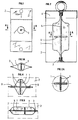
- the device shown in Figure 1 comprises a flexible transparent thin glass bag 1 mm thick provided with two fixing bands (2); the part intended to receive the melting witness constitutes an envelope with a square surface, for example 3 centimeters on a side, the distance of which at the center of each wall is for example of the order of 20 mm; at the center of one of the walls of the envelope is welded perpendicularly thereto an axis (3) (shown in section along the axis AA) intended to center the melting witness (I); the envelope is obtained by folding down one of the surfaces constituting one of the sides which is welded or glued on its periphery after the melting witness represented by a frozen sphere (for example 18 mm in diameter) perforated in its center has been deposited on the index located at the geometric center of the sachet cavity.
- a frozen sphere for example 18 mm in diameter
- Figure 2 shows the status indicator (1) in a cylindrical housing (2) made of transparent rigid plastic.
- FIG. 2 thus represents a thin glass case of a fragmentary nature.
- the preferred nature of the liquid constituting the filling will be described below.
- the glass bulb-shaped case (thin glass) is placed in a case, for example of cylindrical shape (the case can have any suitable shape: cylinder, parallelepiped, sphere, etc.).
- This case must be waterproof, at least partly transparent, and made from a material that does not spoil food.
- This box is particularly suitable for conservation status indicator intended for a packaging of frozen or frozen product.
- the device in FIG. 2 comprises a melting indicator (1) consisting of said substantially cylindrical bulb (or case), the diameter of which by way of example can be of the order of 5 to 30 mm and the height of which example is between 15 to 50 mm, more particularly of the order of 20 to 40 mm.
- the orthogonal axes (5) can for example be made of PVC, possibly colored.
- the melting indicator (1) is placed inside a hermetic hollow cylinder (2) (cylindrical case) which, for example, is made of transparent rigid plastic.
- This housing also shown in section in FIG. 2 (axis A-A) may, for example have a diameter of the order of 20 to 40 mm in diameter and a height of 40 to 80 mm.
- This cylindrical housing is generally provided with fixing lugs (3) arranged on its outer casing. It has a cover (4) on one of its bottoms which is disposed, for example by interlocking by clip and possible bonding, which makes it possible to seal it after the melting indicator (1) has been deposited in the geometric center. from the inner cavity of the cylinder.
- the melting indicator (1) is generally molded and frozen around a support device (5) (orthogonal axes for example) which predetermines the geometric center of the cavity in which it is to be placed.
- FIG. 3 represents a temperature integrator of cylindrical shape placed inside a protective capsule made of transparent plastic, the assembly being intended for the packaging of a frozen product.
- the device represented in FIG. 3 comprises a particular melting indicator (1) constituted by a case of cylindrical shape (but which could for example be of spherical shape) filled with a colored frozen substance, the case being placed inside of a hermetic hollow tube (2) or casing, for example of transparent plastic material, of small thickness having the shape of a parallelepiped and in particular of a cube and provided with at least one fixing lug (3).
- This case has a cover on one of its bottoms, cover which is disposed by interlocking and gluing after the melting indicator has been placed in the geometric center of the parallelepiped.
- Figure 3 gives a representation of the profile with the section of the package (6) of the frozen product (9) and also a front view.
- Figures 4, 5 and 6 show various types of cases or indicators of state of conservation at a temperature below 0 ° C intended to be introduced into a suitable casing either of cylindrical shape as in Figure 2 or of parallelepiped shape. as in figure 3.
- the reference numbers of these figures are those of figures 1 to 3.
- the case is prismatic, in figure 6, this case is a flat cylinder (or cylindrical ring): (7) is the eutectic mixture.
- the material which constitutes the envelope of these cases can be glass, plastic (one can be breakable and biodegradable in the case of the said second variant).
- the condition of the choice of the envelope implies that its coefficient of cubic expansion is lower than that of the liquid which fills it, so as not to cause its rupture during the freezing of food (or other products such as pharmaceuticals) to which it is added.
- the condition of the choice of the envelope implies that its coefficient of cubic expansion is greater than that of the liquid which fills it, so as to cause it to rupture during the freezing of the food to which it is added.
- the envelope breaks (or self-destructs in the case of a biodegradable material) so as to promote the flow of the liquid or the material.
- a biodegradable material for example, glass or plastic which can also be produced using a biodegradable film, with delayed effect, filled with a eutectic liquid.
- the physical characteristics of the material constituting the case are such that in a freezing environment the expansion of the liquid pro voque its rupture or its degradation so as to favor during a thawing the liquefaction of the control volume obtained inside the case.
- the latter preferably consists of one or more eutectic mixtures judiciously associated.
- a eutectic is a mixture of two or more constituents: during the change of liquid-solid or solid-liquid phase by variation of the temperature, the composition of the solid phase remains the same as that of the liquid phase (no demixing). Furthermore, this phase change takes place at constant temperature.
- the eutectic mixture 67.5% by water + 32.5% by weight carbamide (or carbonyl diamide: CON H) is one of the preferred mixtures according to the invention: its crystallization point is 11.5 ° C. If this mixture is placed in a freezer at a temperature of - 25 ° C, the mixture will crystallize at a temperature of - 11.5 ° C.
- the mixtures contain 65-70% water and 30-35% carbamide to be used, preferably 67-68% water and 32-33% carbamide, these proportions depending on the temperatures to be reached. , for example - 12 ° C.
- the content of this nucleating agent is preferably from 0.1 to 5% by weight relative to the eutectic mixture described above.
- this eutectic water-carbamide mixture it is preferable to add, in addition to this nucleating agent, 0.1 to 2% by weight of a compound of the organic acid type, for example benzoic acid, acetylsalicylic acid, acid acetic whose essential role is to keep the pH of the mixture below 7 (preferably 3 to 6).
- a mineral acid can also be used in the same proportions.
- the state of conservation indicator for frozen or refrigerated products of industrial or food type is therefore characterized by the use of a melting indicator represented by a geometric volume of a frozen substance, molded on a support device (case) placed inside an outer protective envelope made of preferably transparent plastic (housing).
- the conservation status indicator comprises a plastic envelope, preferably transparent, the internal part of which receives or is equipped with a support device which determines its geometric center.
- the conservation state indicator is characterized by the use of a support device (case) which, depending on the type of external protective casing or envelope selected, may be an axis or a set of axes contributing to the geometric center of the '' protective casing or the use of centering indices from molding during the production of the protective casing and serving to position the volume of the frozen substance constituting the melting witness so that the geometric centers of the witness volume and of the internal part of the envelope are preferably combined.
- a support device (case) which, depending on the type of external protective casing or envelope selected, may be an axis or a set of axes contributing to the geometric center of the '' protective casing or the use of centering indices from molding during the production of the protective casing and serving to position the volume of the frozen substance constituting the melting witness so that the geometric centers of the witness volume and of the internal part of the envelope are preferably combined.
- the conservation status indicator will preferably contain any liquid produced or mixture made fluorescent, necessary to obtain by cryogenics, a volume of frozen or refrigerated substance, molded on a support device or not, the temperature of which predetermined melting corresponds to an unacceptable ambient temperature value of good preservation for the product to which it is added.
- This conservation status indicator is also preferably characterized by its operation in all positions, with the disappearance of the witness during thawing, and the highlighting of the support device on which it has been molded, or the setting in evidence of the device consisting of centering index, and of a colored bottom cavity in which it was placed, thus providing an essential element of visual observation allowing to conclude that the device is operating in all or nothing.
- Such a state of conservation indicator is characterized by its technical design which allows independent manufacture, in order to constitute sets of different products whose functioning corresponds to predetermined ambient temperatures of thawing, or of conservation, below or above zero degree. centigrade.
- the present invention is interesting for example in the following fields, and in this non-limiting way:
Landscapes
- Physics & Mathematics (AREA)
- General Physics & Mathematics (AREA)
- Measuring Temperature Or Quantity Of Heat (AREA)
- Cold Air Circulating Systems And Constructional Details In Refrigerators (AREA)
Applications Claiming Priority (4)
| Application Number | Priority Date | Filing Date | Title |
|---|---|---|---|
| FR9014341 | 1990-11-15 | ||
| FR9014341A FR2669425B1 (fr) | 1990-11-15 | 1990-11-15 | Indicateur d'etat de conservation pour produits refrigeres ou congeles. |
| FR9100101A FR2671402B1 (fr) | 1991-01-04 | 1991-01-04 | Indicateur d'etat de conservation pour produits refrigeres ou congeles. |
| FR9100101 | 1991-01-04 |
Publications (1)
| Publication Number | Publication Date |
|---|---|
| EP0486380A1 true EP0486380A1 (de) | 1992-05-20 |
Family
ID=26228337
Family Applications (1)
| Application Number | Title | Priority Date | Filing Date |
|---|---|---|---|
| EP91403030A Withdrawn EP0486380A1 (de) | 1990-11-15 | 1991-11-08 | Konservierungszustandsmelder für gekühlte und gefrorene Produkte |
Country Status (2)
| Country | Link |
|---|---|
| EP (1) | EP0486380A1 (de) |
| JP (1) | JPH04307341A (de) |
Citations (6)
| Publication number | Priority date | Publication date | Assignee | Title |
|---|---|---|---|---|
| US3122921A (en) * | 1964-03-03 | Condition responsive devices | ||
| US3965848A (en) * | 1973-10-26 | 1976-06-29 | Becton, Dickinson And Company | Fever indicator |
| US4191125A (en) * | 1978-07-03 | 1980-03-04 | Akzona Incorporated | Freeze indicator |
| GB2119511A (en) * | 1982-04-28 | 1983-11-16 | Luigi Bolla | Sensor for signalling that a preselected temperature has been exceeded |
| FR2613069A1 (fr) * | 1987-03-25 | 1988-09-30 | Rame Pierre | Dispositif controleur de niveau de froid, notamment pour les aliments conserves au froid |
| FR2626072A1 (fr) * | 1988-01-20 | 1989-07-21 | Toporenko Yves | Indicateur d'etat de conservation pour produits refrigeres ou congeles |
-
1991
- 1991-11-08 EP EP91403030A patent/EP0486380A1/de not_active Withdrawn
- 1991-11-15 JP JP29948591A patent/JPH04307341A/ja not_active Withdrawn
Patent Citations (6)
| Publication number | Priority date | Publication date | Assignee | Title |
|---|---|---|---|---|
| US3122921A (en) * | 1964-03-03 | Condition responsive devices | ||
| US3965848A (en) * | 1973-10-26 | 1976-06-29 | Becton, Dickinson And Company | Fever indicator |
| US4191125A (en) * | 1978-07-03 | 1980-03-04 | Akzona Incorporated | Freeze indicator |
| GB2119511A (en) * | 1982-04-28 | 1983-11-16 | Luigi Bolla | Sensor for signalling that a preselected temperature has been exceeded |
| FR2613069A1 (fr) * | 1987-03-25 | 1988-09-30 | Rame Pierre | Dispositif controleur de niveau de froid, notamment pour les aliments conserves au froid |
| FR2626072A1 (fr) * | 1988-01-20 | 1989-07-21 | Toporenko Yves | Indicateur d'etat de conservation pour produits refrigeres ou congeles |
Also Published As
| Publication number | Publication date |
|---|---|
| JPH04307341A (ja) | 1992-10-29 |
Similar Documents
| Publication | Publication Date | Title |
|---|---|---|
| US20030047477A1 (en) | Package for keeping goods in a temperature-deccreased, preservative state and a temperature indicator therefor | |
| FR2458801A1 (fr) | Procedes et dispositifs pour detecter les processus de decongelation, meme temporaires | |
| FR2671402A1 (fr) | Indicateur d'etat de conservation pour produits refrigeres ou congeles. | |
| FR2669425A1 (fr) | Indicateur d'etat de conservation pour produits refrigeres ou congeles. | |
| JP5259027B1 (ja) | 感熱インジケーター | |
| EP0545274A1 (de) | Konservierungszustandmelder für gekühlte oder gefrorene Produkte sowie Verfahren zur Anwendung dieses Indikators | |
| EP0545276B1 (de) | Konservierungszustandsmelder für gekühlte oder gefrorene industrielle medizinische Produkte sowie für Lebensmittel | |
| FR2805337A1 (fr) | Reserve de rafraichissement | |
| EP1206397B1 (de) | Verpackungsanordnung | |
| EP0501880A1 (de) | Konservierungszustandmelder für gekühlte und gefrorene Produkte | |
| JPH01116421A (ja) | 冷蔵品及び冷凍品の温度を監視するための方法及び装置 | |
| FR2626072A1 (fr) | Indicateur d'etat de conservation pour produits refrigeres ou congeles | |
| WO2003101861A2 (fr) | Caisse de conditionnement de produits biologiques et analogues | |
| FR2935471A1 (fr) | Coque creuse pour matiere refrigerante et dispositif refrigerant utilisant cette coque | |
| FR2584816A1 (fr) | Temoin de controle de rupture de la chaine du froid d'un produit | |
| JPH04307341A (ja) | 冷蔵または冷凍製品の保存状態のインジケータ | |
| FR2662798A1 (fr) | Detecteur de decongelation. | |
| EP0165857B1 (de) | Gerät zur Kältespeicherung durch Verwendung von Latentwärme | |
| EP0553008A1 (de) | Konservierungszustandsmelder für gekühlte und gefrorene Produkte | |
| FR2611042A1 (fr) | Procede de fabrication d'un indicateur pour surveiller la temperature d'une preparation refrigeree ou congelee et utilisation de cet indicateur | |
| FR2678373A1 (fr) | Indicateur d'etat de conservation pour produits refrigeres ou congeles. | |
| BE1013049A5 (fr) | Recipient de stockage. | |
| FR2529669A1 (fr) | Indicateur de depassement de temperature critique | |
| FR2678372A1 (fr) | Indicateur d'etat de conservation pour produits refrigeres et congeles. | |
| FR2676278A1 (fr) | Indicateur d'etat de conservation pour produits refrigeres ou congeles. |
Legal Events
| Date | Code | Title | Description |
|---|---|---|---|
| PUAI | Public reference made under article 153(3) epc to a published international application that has entered the european phase |
Free format text: ORIGINAL CODE: 0009012 |
|
| AK | Designated contracting states |
Kind code of ref document: A1 Designated state(s): AT BE CH DE GB IT LI LU NL |
|
| 17P | Request for examination filed |
Effective date: 19921116 |
|
| STAA | Information on the status of an ep patent application or granted ep patent |
Free format text: STATUS: THE APPLICATION HAS BEEN WITHDRAWN |
|
| 18W | Application withdrawn |
Withdrawal date: 19930923 |