EP0486423B1 - Mélanges des oligomères de composés triphènedioxazine, procédé pour leur préparation et leur utilisation - Google Patents
Mélanges des oligomères de composés triphènedioxazine, procédé pour leur préparation et leur utilisation Download PDFInfo
- Publication number
- EP0486423B1 EP0486423B1 EP91810814A EP91810814A EP0486423B1 EP 0486423 B1 EP0486423 B1 EP 0486423B1 EP 91810814 A EP91810814 A EP 91810814A EP 91810814 A EP91810814 A EP 91810814A EP 0486423 B1 EP0486423 B1 EP 0486423B1
- Authority
- EP
- European Patent Office
- Prior art keywords
- substituted
- sulfo
- unsubstituted
- methyl
- chlorine
- Prior art date
- Legal status (The legal status is an assumption and is not a legal conclusion. Google has not performed a legal analysis and makes no representation as to the accuracy of the status listed.)
- Expired - Lifetime
Links
- 239000000203 mixture Substances 0.000 title claims description 67
- 150000001875 compounds Chemical class 0.000 title claims description 43
- 238000000034 method Methods 0.000 title claims description 10
- 238000002360 preparation method Methods 0.000 title claims description 3
- -1 methoxy, N-methylamino Chemical group 0.000 claims description 278
- 125000002496 methyl group Chemical group [H]C([H])([H])* 0.000 claims description 84
- 229910052739 hydrogen Inorganic materials 0.000 claims description 54
- 239000001257 hydrogen Substances 0.000 claims description 54
- 125000001997 phenyl group Chemical group [H]C1=C([H])C([H])=C(*)C([H])=C1[H] 0.000 claims description 51
- 125000000020 sulfo group Chemical group O=S(=O)([*])O[H] 0.000 claims description 51
- 229910052801 chlorine Inorganic materials 0.000 claims description 39
- 239000000460 chlorine Substances 0.000 claims description 39
- 125000002887 hydroxy group Chemical group [H]O* 0.000 claims description 38
- ZAMOUSCENKQFHK-UHFFFAOYSA-N Chlorine atom Chemical compound [Cl] ZAMOUSCENKQFHK-UHFFFAOYSA-N 0.000 claims description 37
- 125000001797 benzyl group Chemical group [H]C1=C([H])C([H])=C(C([H])=C1[H])C([H])([H])* 0.000 claims description 31
- 239000000975 dye Substances 0.000 claims description 27
- 125000003178 carboxy group Chemical group [H]OC(*)=O 0.000 claims description 23
- 125000004435 hydrogen atom Chemical group [H]* 0.000 claims description 23
- 125000001495 ethyl group Chemical group [H]C([H])([H])C([H])([H])* 0.000 claims description 22
- 229910052736 halogen Inorganic materials 0.000 claims description 22
- 150000002367 halogens Chemical class 0.000 claims description 22
- UCFFGYASXIPWPD-UHFFFAOYSA-N methyl hypochlorite Chemical compound COCl UCFFGYASXIPWPD-UHFFFAOYSA-N 0.000 claims description 19
- 125000000956 methoxy group Chemical group [H]C([H])([H])O* 0.000 claims description 17
- 229920000742 Cotton Polymers 0.000 claims description 16
- 238000004043 dyeing Methods 0.000 claims description 15
- UFHFLCQGNIYNRP-UHFFFAOYSA-N Hydrogen Chemical compound [H][H] UFHFLCQGNIYNRP-UHFFFAOYSA-N 0.000 claims description 14
- 125000004093 cyano group Chemical group *C#N 0.000 claims description 14
- 125000000113 cyclohexyl group Chemical group [H]C1([H])C([H])([H])C([H])([H])C([H])(*)C([H])([H])C1([H])[H] 0.000 claims description 14
- 125000000843 phenylene group Chemical group C1(=C(C=CC=C1)*)* 0.000 claims description 14
- 239000000835 fiber Substances 0.000 claims description 13
- XTHPWXDJESJLNJ-UHFFFAOYSA-N sulfurochloridic acid Chemical group OS(Cl)(=O)=O XTHPWXDJESJLNJ-UHFFFAOYSA-N 0.000 claims description 13
- 125000004573 morpholin-4-yl group Chemical group N1(CCOCC1)* 0.000 claims description 12
- 125000002490 anilino group Chemical group [H]N(*)C1=C([H])C([H])=C([H])C([H])=C1[H] 0.000 claims description 11
- XSCHRSMBECNVNS-UHFFFAOYSA-N quinoxaline Chemical compound N1=CC=NC2=CC=CC=C21 XSCHRSMBECNVNS-UHFFFAOYSA-N 0.000 claims description 11
- 125000004957 naphthylene group Chemical group 0.000 claims description 10
- 125000002924 primary amino group Chemical group [H]N([H])* 0.000 claims description 9
- 125000000217 alkyl group Chemical group 0.000 claims description 8
- 229920000728 polyester Polymers 0.000 claims description 8
- 125000004956 cyclohexylene group Chemical group 0.000 claims description 7
- 125000000449 nitro group Chemical group [O-][N+](*)=O 0.000 claims description 7
- 125000001424 substituent group Chemical group 0.000 claims description 7
- 125000001637 1-naphthyl group Chemical group [H]C1=C([H])C([H])=C2C(*)=C([H])C([H])=C([H])C2=C1[H] 0.000 claims description 6
- 125000001622 2-naphthyl group Chemical group [H]C1=C([H])C([H])=C2C([H])=C(*)C([H])=C([H])C2=C1[H] 0.000 claims description 6
- JUJWROOIHBZHMG-UHFFFAOYSA-N Pyridine Chemical group C1=CC=NC=C1 JUJWROOIHBZHMG-UHFFFAOYSA-N 0.000 claims description 6
- 125000000738 acetamido group Chemical group [H]C([H])([H])C(=O)N([H])[*] 0.000 claims description 6
- 125000000043 benzamido group Chemical group [H]N([*])C(=O)C1=C([H])C([H])=C([H])C([H])=C1[H] 0.000 claims description 6
- 125000003917 carbamoyl group Chemical group [H]N([H])C(*)=O 0.000 claims description 6
- 239000000986 disperse dye Substances 0.000 claims description 6
- 125000003161 (C1-C6) alkylene group Chemical group 0.000 claims description 5
- WKBOTKDWSSQWDR-UHFFFAOYSA-N Bromine atom Chemical compound [Br] WKBOTKDWSSQWDR-UHFFFAOYSA-N 0.000 claims description 5
- 125000003668 acetyloxy group Chemical group [H]C([H])([H])C(=O)O[*] 0.000 claims description 5
- GDTBXPJZTBHREO-UHFFFAOYSA-N bromine Substances BrBr GDTBXPJZTBHREO-UHFFFAOYSA-N 0.000 claims description 5
- 229910052794 bromium Inorganic materials 0.000 claims description 5
- 125000001511 cyclopentyl group Chemical group [H]C1([H])C([H])([H])C([H])([H])C([H])(*)C1([H])[H] 0.000 claims description 5
- 125000003506 n-propoxy group Chemical group [H]C([H])([H])C([H])([H])C([H])([H])O* 0.000 claims description 5
- PXGOKWXKJXAPGV-UHFFFAOYSA-N Fluorine Chemical compound FF PXGOKWXKJXAPGV-UHFFFAOYSA-N 0.000 claims description 4
- PENGHVVNPVWBMD-UHFFFAOYSA-N OS(=O)(=O)Cl[N+]([O-])=O Chemical group OS(=O)(=O)Cl[N+]([O-])=O PENGHVVNPVWBMD-UHFFFAOYSA-N 0.000 claims description 4
- 125000003754 ethoxycarbonyl group Chemical group C(=O)(OCC)* 0.000 claims description 4
- 229910052731 fluorine Inorganic materials 0.000 claims description 4
- 239000011737 fluorine Substances 0.000 claims description 4
- 238000007639 printing Methods 0.000 claims description 4
- CZPWVGJYEJSRLH-UHFFFAOYSA-N Pyrimidine Chemical compound C1=CN=CN=C1 CZPWVGJYEJSRLH-UHFFFAOYSA-N 0.000 claims description 3
- 125000002777 acetyl group Chemical group [H]C([H])([H])C(*)=O 0.000 claims description 3
- 125000004397 aminosulfonyl group Chemical group NS(=O)(=O)* 0.000 claims description 3
- 125000002529 biphenylenyl group Chemical group C1(=CC=CC=2C3=CC=CC=C3C12)* 0.000 claims description 3
- 239000000982 direct dye Substances 0.000 claims description 3
- KKQMEQZNUNEBKP-UHFFFAOYSA-N ethoxy-methoxy-nitro-lambda3-chlorane Chemical group COCl([N+](=O)[O-])OCC KKQMEQZNUNEBKP-UHFFFAOYSA-N 0.000 claims description 3
- 125000002816 methylsulfanyl group Chemical group [H]C([H])([H])S[*] 0.000 claims description 3
- 125000004170 methylsulfonyl group Chemical group [H]C([H])([H])S(*)(=O)=O 0.000 claims description 3
- QJGQUHMNIGDVPM-UHFFFAOYSA-N nitrogen group Chemical group [N] QJGQUHMNIGDVPM-UHFFFAOYSA-N 0.000 claims description 3
- 125000000951 phenoxy group Chemical group [H]C1=C([H])C([H])=C(O*)C([H])=C1[H] 0.000 claims description 3
- UMJSCPRVCHMLSP-UHFFFAOYSA-N pyridine Natural products COC1=CC=CN=C1 UMJSCPRVCHMLSP-UHFFFAOYSA-N 0.000 claims description 3
- 125000004979 cyclopentylene group Chemical group 0.000 claims description 2
- 125000004178 (C1-C4) alkyl group Chemical group 0.000 claims 21
- 125000000229 (C1-C4)alkoxy group Chemical group 0.000 claims 10
- 125000005647 linker group Chemical group 0.000 claims 2
- 239000000463 material Substances 0.000 claims 2
- 125000006273 (C1-C3) alkyl group Chemical group 0.000 claims 1
- 125000001567 quinoxalinyl group Chemical group N1=C(C=NC2=CC=CC=C12)* 0.000 claims 1
- 229920002994 synthetic fiber Polymers 0.000 claims 1
- 150000003254 radicals Chemical group 0.000 description 21
- 150000002431 hydrogen Chemical class 0.000 description 18
- 229910052757 nitrogen Inorganic materials 0.000 description 14
- 0 Cc1nc(C)nc(*)n1 Chemical compound Cc1nc(C)nc(*)n1 0.000 description 12
- HEMHJVSKTPXQMS-UHFFFAOYSA-M Sodium hydroxide Chemical compound [OH-].[Na+] HEMHJVSKTPXQMS-UHFFFAOYSA-M 0.000 description 12
- 239000004744 fabric Substances 0.000 description 8
- XLYOFNOQVPJJNP-UHFFFAOYSA-N water Substances O XLYOFNOQVPJJNP-UHFFFAOYSA-N 0.000 description 8
- 239000002657 fibrous material Substances 0.000 description 7
- VEXZGXHMUGYJMC-UHFFFAOYSA-N Hydrochloric acid Chemical compound Cl VEXZGXHMUGYJMC-UHFFFAOYSA-N 0.000 description 6
- 239000000047 product Substances 0.000 description 6
- 239000004753 textile Substances 0.000 description 6
- 239000004952 Polyamide Substances 0.000 description 4
- FAPWRFPIFSIZLT-UHFFFAOYSA-M Sodium chloride Chemical compound [Na+].[Cl-] FAPWRFPIFSIZLT-UHFFFAOYSA-M 0.000 description 4
- 238000001035 drying Methods 0.000 description 4
- 229920002647 polyamide Polymers 0.000 description 4
- RYHBNJHYFVUHQT-UHFFFAOYSA-N 1,4-Dioxane Chemical compound C1COCCO1 RYHBNJHYFVUHQT-UHFFFAOYSA-N 0.000 description 3
- SGHZXLIDFTYFHQ-UHFFFAOYSA-L Brilliant Blue Chemical compound [Na+].[Na+].C=1C=C(C(=C2C=CC(C=C2)=[N+](CC)CC=2C=C(C=CC=2)S([O-])(=O)=O)C=2C(=CC=CC=2)S([O-])(=O)=O)C=CC=1N(CC)CC1=CC=CC(S([O-])(=O)=O)=C1 SGHZXLIDFTYFHQ-UHFFFAOYSA-L 0.000 description 3
- WMFOQBRAJBCJND-UHFFFAOYSA-M Lithium hydroxide Chemical compound [Li+].[OH-] WMFOQBRAJBCJND-UHFFFAOYSA-M 0.000 description 3
- 125000004414 alkyl thio group Chemical group 0.000 description 3
- 125000002947 alkylene group Chemical group 0.000 description 3
- 125000003118 aryl group Chemical group 0.000 description 3
- 238000006243 chemical reaction Methods 0.000 description 3
- 238000004040 coloring Methods 0.000 description 3
- 125000000753 cycloalkyl group Chemical group 0.000 description 3
- QWPPOHNGKGFGJK-UHFFFAOYSA-N hypochlorous acid Chemical compound ClO QWPPOHNGKGFGJK-UHFFFAOYSA-N 0.000 description 3
- LXEJRKJRKIFVNY-UHFFFAOYSA-N terephthaloyl chloride Chemical compound ClC(=O)C1=CC=C(C(Cl)=O)C=C1 LXEJRKJRKIFVNY-UHFFFAOYSA-N 0.000 description 3
- 125000001140 1,4-phenylene group Chemical group [H]C1=C([H])C([*:2])=C([H])C([H])=C1[*:1] 0.000 description 2
- DXTBDXVFQCIYII-UHFFFAOYSA-N 5-amino-2-(2-aminoethylamino)benzenesulfonic acid Chemical compound NCCNC1=CC=C(N)C=C1S(O)(=O)=O DXTBDXVFQCIYII-UHFFFAOYSA-N 0.000 description 2
- CSCPPACGZOOCGX-UHFFFAOYSA-N Acetone Chemical compound CC(C)=O CSCPPACGZOOCGX-UHFFFAOYSA-N 0.000 description 2
- QGZKDVFQNNGYKY-UHFFFAOYSA-N Ammonia Chemical compound N QGZKDVFQNNGYKY-UHFFFAOYSA-N 0.000 description 2
- LFQSCWFLJHTTHZ-UHFFFAOYSA-N Ethanol Chemical compound CCO LFQSCWFLJHTTHZ-UHFFFAOYSA-N 0.000 description 2
- KFZMGEQAYNKOFK-UHFFFAOYSA-N Isopropanol Chemical compound CC(C)O KFZMGEQAYNKOFK-UHFFFAOYSA-N 0.000 description 2
- PMZURENOXWZQFD-UHFFFAOYSA-L Sodium Sulfate Chemical compound [Na+].[Na+].[O-]S([O-])(=O)=O PMZURENOXWZQFD-UHFFFAOYSA-L 0.000 description 2
- 125000001309 chloro group Chemical group Cl* 0.000 description 2
- 238000006482 condensation reaction Methods 0.000 description 2
- 230000007935 neutral effect Effects 0.000 description 2
- 239000008363 phosphate buffer Substances 0.000 description 2
- ORFSSYGWXNGVFB-UHFFFAOYSA-N sodium 4-amino-6-[[4-[4-[(8-amino-1-hydroxy-5,7-disulfonaphthalen-2-yl)diazenyl]-3-methoxyphenyl]-2-methoxyphenyl]diazenyl]-5-hydroxynaphthalene-1,3-disulfonic acid Chemical compound COC1=C(C=CC(=C1)C2=CC(=C(C=C2)N=NC3=C(C4=C(C=C3)C(=CC(=C4N)S(=O)(=O)O)S(=O)(=O)O)O)OC)N=NC5=C(C6=C(C=C5)C(=CC(=C6N)S(=O)(=O)O)S(=O)(=O)O)O.[Na+] ORFSSYGWXNGVFB-UHFFFAOYSA-N 0.000 description 2
- 239000011780 sodium chloride Substances 0.000 description 2
- 229910052938 sodium sulfate Inorganic materials 0.000 description 2
- 235000011152 sodium sulphate Nutrition 0.000 description 2
- 238000003756 stirring Methods 0.000 description 2
- 125000000547 substituted alkyl group Chemical group 0.000 description 2
- 239000000725 suspension Substances 0.000 description 2
- DVKJHBMWWAPEIU-UHFFFAOYSA-N toluene 2,4-diisocyanate Chemical compound CC1=CC=C(N=C=O)C=C1N=C=O DVKJHBMWWAPEIU-UHFFFAOYSA-N 0.000 description 2
- 210000002268 wool Anatomy 0.000 description 2
- JYEUMXHLPRZUAT-UHFFFAOYSA-N 1,2,3-triazine Chemical group C1=CN=NN=C1 JYEUMXHLPRZUAT-UHFFFAOYSA-N 0.000 description 1
- 125000004955 1,4-cyclohexylene group Chemical group [H]C1([H])C([H])([H])C([H])([*:1])C([H])([H])C([H])([H])C1([H])[*:2] 0.000 description 1
- 125000004958 1,4-naphthylene group Chemical group 0.000 description 1
- SLRMQYXOBQWXCR-UHFFFAOYSA-N 2154-56-5 Chemical compound [CH2]C1=CC=CC=C1 SLRMQYXOBQWXCR-UHFFFAOYSA-N 0.000 description 1
- WGIIPKIDLAUILI-UHFFFAOYSA-N CC(c(cc1)ccc1[NH+](C)[O-])[NH+](C)[O-] Chemical compound CC(c(cc1)ccc1[NH+](C)[O-])[NH+](C)[O-] WGIIPKIDLAUILI-UHFFFAOYSA-N 0.000 description 1
- CXOZQHPXKPDQGT-UHFFFAOYSA-N CC1C=CCC1 Chemical compound CC1C=CCC1 CXOZQHPXKPDQGT-UHFFFAOYSA-N 0.000 description 1
- XAZKFISIRYLAEE-UHFFFAOYSA-N CC1CC(C)CC1 Chemical compound CC1CC(C)CC1 XAZKFISIRYLAEE-UHFFFAOYSA-N 0.000 description 1
- MEMSTQPMSDVUND-UHFFFAOYSA-N C[NH+](c1ccc([NH+](C)[O-])[o]1)[O-] Chemical compound C[NH+](c1ccc([NH+](C)[O-])[o]1)[O-] MEMSTQPMSDVUND-UHFFFAOYSA-N 0.000 description 1
- 244000025254 Cannabis sativa Species 0.000 description 1
- 235000012766 Cannabis sativa ssp. sativa var. sativa Nutrition 0.000 description 1
- 235000012765 Cannabis sativa ssp. sativa var. spontanea Nutrition 0.000 description 1
- 229920003043 Cellulose fiber Polymers 0.000 description 1
- VPLHHUICIOEESV-UHFFFAOYSA-N O=S(c(cc1)cc(cc2)c1cc2S(Cl)(=O)=O)(Cl)=O Chemical compound O=S(c(cc1)cc(cc2)c1cc2S(Cl)(=O)=O)(Cl)=O VPLHHUICIOEESV-UHFFFAOYSA-N 0.000 description 1
- ALIQZUMMPOYCIS-UHFFFAOYSA-N O=S(c1cc(S(Cl)(=O)=O)ccc1)(Cl)=O Chemical compound O=S(c1cc(S(Cl)(=O)=O)ccc1)(Cl)=O ALIQZUMMPOYCIS-UHFFFAOYSA-N 0.000 description 1
- BCXWMIMRDMIJGL-UHFFFAOYSA-N O=S(c1cccc2c1cccc2S(Cl)(=O)=O)(Cl)=O Chemical compound O=S(c1cccc2c1cccc2S(Cl)(=O)=O)(Cl)=O BCXWMIMRDMIJGL-UHFFFAOYSA-N 0.000 description 1
- 229920000297 Rayon Polymers 0.000 description 1
- 150000008044 alkali metal hydroxides Chemical class 0.000 description 1
- 150000001412 amines Chemical class 0.000 description 1
- 229910021529 ammonia Inorganic materials 0.000 description 1
- 125000003710 aryl alkyl group Chemical group 0.000 description 1
- 150000005840 aryl radicals Chemical class 0.000 description 1
- 239000002585 base Substances 0.000 description 1
- 238000009835 boiling Methods 0.000 description 1
- 235000009120 camo Nutrition 0.000 description 1
- 150000004649 carbonic acid derivatives Chemical class 0.000 description 1
- 235000005607 chanvre indien Nutrition 0.000 description 1
- 239000003795 chemical substances by application Substances 0.000 description 1
- 150000001805 chlorine compounds Chemical class 0.000 description 1
- 238000009833 condensation Methods 0.000 description 1
- 230000005494 condensation Effects 0.000 description 1
- 238000009967 direct dyeing Methods 0.000 description 1
- 239000012065 filter cake Substances 0.000 description 1
- 239000011487 hemp Substances 0.000 description 1
- 239000000976 ink Substances 0.000 description 1
- 238000007641 inkjet printing Methods 0.000 description 1
- 125000000959 isobutyl group Chemical group [H]C([H])([H])C([H])(C([H])([H])[H])C([H])([H])* 0.000 description 1
- 125000002462 isocyano group Chemical group *[N+]#[C-] 0.000 description 1
- 125000001449 isopropyl group Chemical group [H]C([H])([H])C([H])(*)C([H])([H])[H] 0.000 description 1
- 239000010985 leather Substances 0.000 description 1
- 238000004519 manufacturing process Methods 0.000 description 1
- 125000004108 n-butyl group Chemical group [H]C([H])([H])C([H])([H])C([H])([H])C([H])([H])* 0.000 description 1
- 125000004123 n-propyl group Chemical group [H]C([H])([H])C([H])([H])C([H])([H])* 0.000 description 1
- 239000000123 paper Substances 0.000 description 1
- 229910000028 potassium bicarbonate Inorganic materials 0.000 description 1
- 235000015497 potassium bicarbonate Nutrition 0.000 description 1
- 239000011736 potassium bicarbonate Substances 0.000 description 1
- TYJJADVDDVDEDZ-UHFFFAOYSA-M potassium hydrogencarbonate Chemical compound [K+].OC([O-])=O TYJJADVDDVDEDZ-UHFFFAOYSA-M 0.000 description 1
- 229940086066 potassium hydrogencarbonate Drugs 0.000 description 1
- USHAGKDGDHPEEY-UHFFFAOYSA-L potassium persulfate Chemical compound [K+].[K+].[O-]S(=O)(=O)OOS([O-])(=O)=O USHAGKDGDHPEEY-UHFFFAOYSA-L 0.000 description 1
- 239000002964 rayon Substances 0.000 description 1
- 239000011541 reaction mixture Substances 0.000 description 1
- 125000002914 sec-butyl group Chemical group [H]C([H])([H])C([H])([H])C([H])(*)C([H])([H])[H] 0.000 description 1
- 238000010186 staining Methods 0.000 description 1
- 125000005717 substituted cycloalkylene group Chemical group 0.000 description 1
- 239000000758 substrate Substances 0.000 description 1
- 210000004243 sweat Anatomy 0.000 description 1
- 125000000999 tert-butyl group Chemical group [H]C([H])([H])C(*)(C([H])([H])[H])C([H])([H])[H] 0.000 description 1
- UGNWTBMOAKPKBL-UHFFFAOYSA-N tetrachloro-1,4-benzoquinone Chemical compound ClC1=C(Cl)C(=O)C(Cl)=C(Cl)C1=O UGNWTBMOAKPKBL-UHFFFAOYSA-N 0.000 description 1
- 239000000080 wetting agent Substances 0.000 description 1
Classifications
-
- C—CHEMISTRY; METALLURGY
- C07—ORGANIC CHEMISTRY
- C07D—HETEROCYCLIC COMPOUNDS
- C07D498/00—Heterocyclic compounds containing in the condensed system at least one hetero ring having nitrogen and oxygen atoms as the only ring hetero atoms
- C07D498/02—Heterocyclic compounds containing in the condensed system at least one hetero ring having nitrogen and oxygen atoms as the only ring hetero atoms in which the condensed system contains two hetero rings
- C07D498/04—Ortho-condensed systems
-
- C—CHEMISTRY; METALLURGY
- C09—DYES; PAINTS; POLISHES; NATURAL RESINS; ADHESIVES; COMPOSITIONS NOT OTHERWISE PROVIDED FOR; APPLICATIONS OF MATERIALS NOT OTHERWISE PROVIDED FOR
- C09B—ORGANIC DYES OR CLOSELY-RELATED COMPOUNDS FOR PRODUCING DYES, e.g. PIGMENTS; MORDANTS; LAKES
- C09B19/00—Oxazine dyes
- C09B19/02—Bisoxazines prepared from aminoquinones
-
- C—CHEMISTRY; METALLURGY
- C09—DYES; PAINTS; POLISHES; NATURAL RESINS; ADHESIVES; COMPOSITIONS NOT OTHERWISE PROVIDED FOR; APPLICATIONS OF MATERIALS NOT OTHERWISE PROVIDED FOR
- C09B—ORGANIC DYES OR CLOSELY-RELATED COMPOUNDS FOR PRODUCING DYES, e.g. PIGMENTS; MORDANTS; LAKES
- C09B67/00—Influencing the physical, e.g. the dyeing or printing properties of dyestuffs without chemical reactions, e.g. by treating with solvents grinding or grinding assistants, coating of pigments or dyes; Process features in the making of dyestuff preparations; Dyestuff preparations of a special physical nature, e.g. tablets, films
- C09B67/0033—Blends of pigments; Mixtured crystals; Solid solutions
- C09B67/0034—Mixtures of two or more pigments or dyes of the same type
-
- D—TEXTILES; PAPER
- D06—TREATMENT OF TEXTILES OR THE LIKE; LAUNDERING; FLEXIBLE MATERIALS NOT OTHERWISE PROVIDED FOR
- D06P—DYEING OR PRINTING TEXTILES; DYEING LEATHER, FURS OR SOLID MACROMOLECULAR SUBSTANCES IN ANY FORM
- D06P3/00—Special processes of dyeing or printing textiles, or dyeing leather, furs, or solid macromolecular substances in any form, classified according to the material treated
- D06P3/58—Material containing hydroxyl groups
- D06P3/60—Natural or regenerated cellulose
- D06P3/62—Natural or regenerated cellulose using direct dyes
-
- D—TEXTILES; PAPER
- D06—TREATMENT OF TEXTILES OR THE LIKE; LAUNDERING; FLEXIBLE MATERIALS NOT OTHERWISE PROVIDED FOR
- D06P—DYEING OR PRINTING TEXTILES; DYEING LEATHER, FURS OR SOLID MACROMOLECULAR SUBSTANCES IN ANY FORM
- D06P3/00—Special processes of dyeing or printing textiles, or dyeing leather, furs, or solid macromolecular substances in any form, classified according to the material treated
- D06P3/58—Material containing hydroxyl groups
- D06P3/60—Natural or regenerated cellulose
- D06P3/66—Natural or regenerated cellulose using reactive dyes
-
- D—TEXTILES; PAPER
- D06—TREATMENT OF TEXTILES OR THE LIKE; LAUNDERING; FLEXIBLE MATERIALS NOT OTHERWISE PROVIDED FOR
- D06P—DYEING OR PRINTING TEXTILES; DYEING LEATHER, FURS OR SOLID MACROMOLECULAR SUBSTANCES IN ANY FORM
- D06P3/00—Special processes of dyeing or printing textiles, or dyeing leather, furs, or solid macromolecular substances in any form, classified according to the material treated
- D06P3/82—Textiles which contain different kinds of fibres
- D06P3/8204—Textiles which contain different kinds of fibres fibres of different chemical nature
- D06P3/8223—Textiles which contain different kinds of fibres fibres of different chemical nature mixtures of fibres containing hydroxyl and ester groups
-
- Y—GENERAL TAGGING OF NEW TECHNOLOGICAL DEVELOPMENTS; GENERAL TAGGING OF CROSS-SECTIONAL TECHNOLOGIES SPANNING OVER SEVERAL SECTIONS OF THE IPC; TECHNICAL SUBJECTS COVERED BY FORMER USPC CROSS-REFERENCE ART COLLECTIONS [XRACs] AND DIGESTS
- Y10—TECHNICAL SUBJECTS COVERED BY FORMER USPC
- Y10S—TECHNICAL SUBJECTS COVERED BY FORMER USPC CROSS-REFERENCE ART COLLECTIONS [XRACs] AND DIGESTS
- Y10S8/00—Bleaching and dyeing; fluid treatment and chemical modification of textiles and fibers
- Y10S8/916—Natural fiber dyeing
- Y10S8/917—Wool or silk
-
- Y—GENERAL TAGGING OF NEW TECHNOLOGICAL DEVELOPMENTS; GENERAL TAGGING OF CROSS-SECTIONAL TECHNOLOGIES SPANNING OVER SEVERAL SECTIONS OF THE IPC; TECHNICAL SUBJECTS COVERED BY FORMER USPC CROSS-REFERENCE ART COLLECTIONS [XRACs] AND DIGESTS
- Y10—TECHNICAL SUBJECTS COVERED BY FORMER USPC
- Y10S—TECHNICAL SUBJECTS COVERED BY FORMER USPC CROSS-REFERENCE ART COLLECTIONS [XRACs] AND DIGESTS
- Y10S8/00—Bleaching and dyeing; fluid treatment and chemical modification of textiles and fibers
- Y10S8/916—Natural fiber dyeing
- Y10S8/918—Cellulose textile
-
- Y—GENERAL TAGGING OF NEW TECHNOLOGICAL DEVELOPMENTS; GENERAL TAGGING OF CROSS-SECTIONAL TECHNOLOGIES SPANNING OVER SEVERAL SECTIONS OF THE IPC; TECHNICAL SUBJECTS COVERED BY FORMER USPC CROSS-REFERENCE ART COLLECTIONS [XRACs] AND DIGESTS
- Y10—TECHNICAL SUBJECTS COVERED BY FORMER USPC
- Y10S—TECHNICAL SUBJECTS COVERED BY FORMER USPC CROSS-REFERENCE ART COLLECTIONS [XRACs] AND DIGESTS
- Y10S8/00—Bleaching and dyeing; fluid treatment and chemical modification of textiles and fibers
- Y10S8/92—Synthetic fiber dyeing
- Y10S8/922—Polyester fiber
-
- Y—GENERAL TAGGING OF NEW TECHNOLOGICAL DEVELOPMENTS; GENERAL TAGGING OF CROSS-SECTIONAL TECHNOLOGIES SPANNING OVER SEVERAL SECTIONS OF THE IPC; TECHNICAL SUBJECTS COVERED BY FORMER USPC CROSS-REFERENCE ART COLLECTIONS [XRACs] AND DIGESTS
- Y10—TECHNICAL SUBJECTS COVERED BY FORMER USPC
- Y10S—TECHNICAL SUBJECTS COVERED BY FORMER USPC CROSS-REFERENCE ART COLLECTIONS [XRACs] AND DIGESTS
- Y10S8/00—Bleaching and dyeing; fluid treatment and chemical modification of textiles and fibers
- Y10S8/92—Synthetic fiber dyeing
- Y10S8/924—Polyamide fiber
Definitions
- the present invention relates to new oligomer mixtures of triphendioxazine compounds, processes for their preparation and their use for dyeing and printing fiber materials, in particular textile fiber materials.
- the present invention thus relates to oligomer mixtures containing at least two compounds of the formula wherein R 1 is hydrogen, unsubstituted or substituted by hydroxy, sulfo, sulfato, chlorine, cyano, or acetoxy and / or with the exception of methyl optionally interrupted by a group -O- C 1 -C 4 -alkyl, unsubstituted or by 1 to 3 Cyclopentyl or cyclohexyl substituted by methyl groups, unsubstituted or by sulfo, nitro, chlorine, methyl, methoxy, N-methyl- or N-ethylamino, N, N-dimethyl- or N, N-diethylamino, acetylamino, propionylamino, benzoylamino, methoxycarbonyl, ethoxycarbonyl , Carboxy or methylsulfonyl substituted phenyl, unsubstituted or
- alkyl radicals R 1 are thus methyl, ethyl, n-propyl, isopropyl, n-, iso-, sec- or tert-butyl, ⁇ -chloroethyl, ⁇ -hydroxyethyl, ⁇ -hydroxybutyl, ⁇ -cyanoethyl , Sulfomethyl, ⁇ -sulfoethyl, ⁇ -sulfatoethyl, ⁇ -acetoxyethyl, ⁇ -sulfatopropyl, ⁇ -sulfatopropyl or the rest of the formula -CH 2 CH 2 OCH 2 CH 2 OH or -CH 2 CH 2 OCH 2 CH 2 OSO 3 H .
- R 1 stands for a C 1 -C 4 -alkyl radical which is unsubstituted or substituted by hydroxy, sulfo, sulfato, chlorine, cyano or acetoxy and / or, with the exception of methyl, optionally interrupted by a group -O-.
- R 1 as alkyl is particularly preferably the meaning of an unsubstituted C 1 -C 4 -alkyl radical, and in particular the meanings are methyl and ethyl.
- R 1 represents unsubstituted or by 1 to 3 methyl groups substituted cyclopentyl or cyclohexyl and particularly preferably for cyclohexyl.
- R 1 as aryl is particularly preferably the meaning of an unsubstituted or substituted by sulfo, chlorine, methyl and / or methoxy phenyl radical.
- R 1 as an aralkyl radical is particularly preferably the benzyl radical.
- R 1 particularly preferably denotes hydrogen, C 1 -C 4 -alkyl, cyclohexyl, unsubstituted or substituted by sulfo, chlorine, methyl and / or methoxy or phenyl or benzyl and particularly preferably hydrogen, methyl or ethyl.
- R 1 represents hydrogen.
- R independently has one of the meanings given above for R 1 , this includes the preferences mentioned previously for R 1 .
- R stands for a heteroaryl radical, this is a pyridine, pyrimidine, quinoxaline or triazine radical which is optionally substituted by non-fiber-reactive substituents.
- Non-fiber-reactive substituents on the heteroaryl radical R are hydroxy, C 1 -C 4 -alkyl, phenyl, C 1 -C 4 -alkoxy, C 1 -C 4 -alkylthio, amino, unsubstituted or in the alkyl part by hydroxy, carboxy, cyano, sulfo , Sulfato or C 1 -C 4 alkoxy substituted N-mono- or N, N-di-C 1 -C 4 alkylamino, cyclohexylamino, unsubstituted or in the phenyl part by C 1 -C 4 alkyl, C 1 -C 4 -Alkoxy, phenoxy, carboxy, sulfo and / or halogen-substituted phenylamino or NC 1 -C 4 -alkyl-N-phenylamino, morpholino or 3-carboxy- or 3-carbamoy
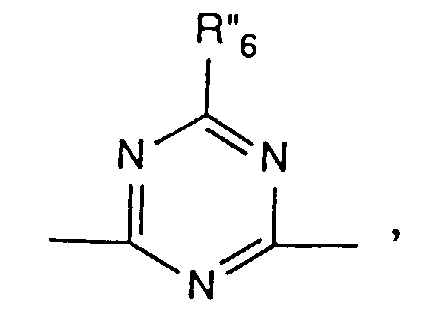
- R as the heteroaryl radical is preferably a triazinyl radical of the formula wherein R 6 and R 7 each independently represent one of the aforementioned non-fiber-reactive substituents; the radicals R 6 and R 7 may be the same or to be different.
- R 4 represents optionally substituted alkyl, cycloalkyl, aryl or aralkyl, the meanings and preferences given above for R 1 apply.
- R 4 as a heteroaryl radical is a quinoxaline or pyrimidine radical.
- R is preferably hydrogen, C 1 -C 4 -alkyl, unsubstituted or substituted by methyl, methoxy, chlorine and / or sulfo, phenyl, benzyl or a radical of the formula wherein R 4 is methyl, ethyl or unsubstituted or substituted by sulfo, chlorine, methyl and / or methoxy phenyl; particularly preferred meanings of R are methyl, ethyl, benzyl, acetylamino, benzoylamino and in particular hydrogen.
- a as an optionally substituted alkylene radical is an unsubstituted or substituted and / or optionally substituted by hydroxy, sulfo, sulfato, C 1 -C 4 alkoxy, carboxy, cyano, halogen, phenyl, sulfophenyl or C 2 -C 5 alkoxycarbonyl by 1-2 groups -O-, -N (R 8 ) -, in which R 8 is C 1 -C 4 alkyl, acetyl or in particular hydrogen, -S- or -SO 2 - interrupted C 2 -C 6 alkylene radical .
- alkylene radicals A are 1,2-ethylene, 1,2- and 1,3-propylene, 1-ethyl-1,2-ethylene, 2-hydroxy-1,3-propylene, 2-sulfato-1,3 -propylene, 1- and 2-phenyl-1,3-propylene, 2- (4'-sulfophenyl) -1,3-propylene, 1,4-, 2,3- and 2,4-butylene, 1,2 -Dimethyl-1,2-ethylene, 1-phenyl-1,2-ethylene, 2-methyl-1,3-propylene, 2,2-dimethyl-1,3-propylene, 1-chloro-2,3-propylene , 1,5- and 2,4-pentylene, 2-methyl-2,4-pentylene, 1-carboxy-1,5-pentylene, 2,3-diphenyl-1,4-butylene, 1-methoxycarbonyl-1, 5-pentylene, 1,6 and 2,5-hexylene, 2-carboxy-1,3-propylene, 2-me
- a as the alkylene radical is particularly preferably an unsubstituted or substituted by hydroxyl, sulfo, sulfato, methoxy, carboxy or sulfophenyl C 2 -C 4 alkylene radical or -CH 2 -CH 2 -Z'-CH 2 -CH 2 -, in which Z 'is -O-, -S-, -SO 2 -, -NH- or -N (CH 3) - means, in particular an unsubstituted or substituted by hydroxyl, sulfo, sulfato, methoxy, carboxy or sulfophenyl C 2 -C 4 Alkylene radical and particularly preferred for an unsubstituted or substituted by hydroxy or sulfato 1,2-ethylene or 1,2- or 1,3-propylene radical.
- A is 1,2-ethylene, 1,2- or 1,3-propylene or 2-sulfato-1,3-propylene radical
- a as optionally substituted cycloalkylene is cyclopentylene or cyclohexylene which is unsubstituted or mono- or polysubstituted by C 1 -C 3 -alkyl; A particularly preferably stands for cyclohexylene which is unsubstituted or substituted by 1 to 3 methyl groups.
- Suitable cycloaliphatic radicals A are: 1,3- and 1,4-cyclohexylene, 4-methyl-1,3-cyclohexylene, 2-methyl-1,3-cyclohexylene, 5,5-dimethyl-1,3-cyclohexylene, 2-methyl-1,4 -cyclohexylene, 4,6-dimethyl-1,3-cyclohexylene and 4-methyl-1,2-cyclohexylene.
- A stands for a bivalent aryl radical, this is an unsubstituted or substituted by C 1 -C 4 alkyl, C 1 -C 4 alkoxy, sulfo, halogen or carboxy phenylene, biphenylene or naphthylene.
- arylene radicals A are: 1,3- and 1,4-phenylene, 2-sulfo-1,4-phenylene, 4-sulfo-1,3-phenylene, 2-methyl-1,4-phenylene, 2-carboxy -1,4-phenylene, 2-methoxy-1,4-phenylene, 4,8-disulfo-2,6-naphthylene, 8-sulfo-2,6-naphthylene, 1,4-naphthylene and 1,1'- Biphenyl-4,4'-diyl.
- a as the arylene radical is preferably an 1,3- or 1,4-phenylene radical which is unsubstituted or substituted by sulfo, methyl, methoxy or carboxy or an unsubstituted or sulfo-substituted naphthylene radical.
- a as the arylene radical is particularly preferably unsubstituted or sulfo-substituted 1,3- or 1,4-phenylene.
- A is an optionally substituted aralkylene radical
- this is a C 1 -C 6 alkylene-phenylene, a phenylene-C 1 -C 6 alkylene-phenylene, a C 1 -C 3 alkylene-phenylene-C 1 -C 3 -alkylene or a methylene-naphthylene-methylene radical, where in these aralkylene radicals the phenylene and naphthylene optionally 1 or 2 substituents selected from the group sulfo, carboxy, sulfamoyl, carbamoyl, Can carry methyl, ethyl, methoxy, ethoxy, nitro, chlorine, amino, N-methyl and N-ethylamino, N, N-dimethyl and N, N-diethylamino and phenylamino.
- a as the aralkylene radical is preferably a C 1 -C 3 -alkylene-phenylene or C 1 -C 2 -alkylenephenylene-C 1 -C 2 -alkylene radical which is unsubstituted in the phenyl part or is substituted, for example, by methyl, methoxy, chlorine or sulfo .
- A is preferably an unsubstituted or substituted by hydroxyl, sulfo, sulfato, methoxy, carboxy or sulfophenyl C 2 -C 4 alkylene radical, -CH 2 -CH 2 -Z'-CH 2 -CH 2 - wherein Z '-O- , -S-, -SO 2 -, -NH- or -N (CH 3 ) - means an unsubstituted or substituted by 1 to 3 methyl groups cyclohexylene, an unsubstituted or sulfo-substituted 1,3- or 1,4-phenylene or a C 1 -C 3 alkylene-phenylene or C 1 -C 2 alkylene-phenylene-C 1 -C 2 alkylene radical, in which the phenylene is in each case unsubstituted or substituted by methyl, methoxy, chlorine or sulfo.
- R 5 stands for an optionally substituted alkyl, cycloalkyl, aryl or aralkyl radical, the meanings and preferences given above for R 1 apply independently.
- R 5 preferably denotes hydrogen, C 1 -C 4 alkyl, cyclohexyl, unsubstituted or through Sulfo, chlorine, methyl and / or methoxy substituted phenyl or benzyl.
- R 5 are hydrogen and C 1 -C 4 alkyl, in particular hydrogen, methyl and ethyl and very particularly hydrogen.
- X preferably represents a group -N (R 5 ) -, wherein R 5 has the meanings and preferences given above.
- Y is preferably sulfo, C 1 -C 4 alkyl, C 1 -C 4 alkoxy or chlorine and particularly preferably methoxy, methyl, chlorine or sulfo.
- variable n preferably stands for the number 0.
- Z preferably represents methyl or ethyl and particularly preferably hydroxyl.
- p is preferably the number 1.
- R 2 and / or R 3 are optionally substituted phenyl, benzyl, benzoylamino or phenoxy
- the phenyl ring is in each case unsubstituted or by C 1 -C 4 alkyl, C 1 -C 4 alkoxy, acetylamino, halogen, nitro and / or Sulfo substituted; it is preferred in each case that the phenyl ring has no further substituents or is further substituted by chlorine, methyl, methoxy, acetylamino and / or sulfo.
- the radicals R 2 and R 3 can be different or preferably identical.
- R 2 and R 3 preferably represent hydrogen, fluorine, chlorine, bromine, methyl, methoxy, acetylamino, phenoxy or cyano and particularly preferably bromine or chlorine.
- a preferred embodiment of the invention relates to oligomer mixtures of compounds of the formula (1) in which R 2 and R 3 each represent chlorine.
- E as the alkylene radical is preferably C 1 -C 4 alkylene which is unsubstituted or substituted by hydroxyl, sulfo, sulfato, methoxy, carboxy, phenyl or sulfophenyl and particularly preferably methylene, 1,2-ethylene or 1,2- or 1,3 Propylene.
- Preferred as organic bridge member B are the radicals of the formula (3 '), in which Q' is a group means, E 'for the direct bond, unsubstituted or substituted by hydroxy, sulfo, sulfato, methoxy, carboxy, phenyl or sulfophenyl, C 1 -C 6 alkylene or C 2 -C 6 alkenylene, unsubstituted or substituted by 1 to 3 methyl groups Cyclohexylene or C 1 -C 2 alkylene-cyclohexylene, piperazine-1,4-diyl, thiophene-2,5-diyl, biphenyl-4,4'-diyl, stilbene-4,4'-diyl, unsubstituted or by C 1 -C 4 alkyl, C 1 -C 4 alkoxy, sulfo, halogen or carboxy substituted phenylene or naphthylene or for unsubstitute
- bivalent bridge members B correspond to the formula wherein R 11 is sulfo, methyl, methoxy, chlorine, carboxy or preferably hydrogen.
- a particularly preferred embodiment of the present invention relates to oligomer mixtures of compounds of the formula (1), in which B is a radical of the formula is.
- R " 6 are hydroxy, chlorine, methyl- or ethylthio, methoxy, ethoxy, n- or iso-propoxy, amino, methylamino, ethylamino, ⁇ -hydroxyethylamino, N, N-di- ⁇ -hydroxyethylamino, ⁇ -Sulfoethylamino, cyclohexylamino, o-, m- or p-methylphenylamino, o-, m- or p-methoxyphenylamino, o-, m- or p-chlorophenylamino, o-, m- or p-sulfophenylamino, 2,4- or 2,5-disulfophenylamino, o-carboxyphenylamino, N-ethyl-N-phenylamino, N-methyl-N-phenylamino and morpholino, o-car
- Another group of usable bridge members B includes those of the formulas and
- Bridge links B correspond to the formula Q'-E'-Q '(3'), or where Q 'is a group means, E 'for the direct bond, unsubstituted or substituted by hydroxy, sulfo, sulfato, methoxy, carboxy, phenyl or sulfophenyl, C 1 -C 6 alkylene or C 2 -C 6 alkenylene, unsubstituted or substituted by 1 to 3 methyl groups Cyclohexylene or C 1 -C 2 alkylene-cyclohexylene, piperazine-1,4-diyl, thiophene-2,5-diyl, biphenyl-4,4'-diyl, stilbene-4,4'-diyl, unsubstituted or by C 1 -C 4 alkyl, C 1 -C 4 alkoxy, sulfo, halogen or carboxy substituted phenylene or naphthylene or for unsub
- the radicals of the formula are particularly preferred as the bivalent bridge member B. or wherein R 11 is sulfo, methyl, methoxy, chlorine, carboxy or preferably hydrogen and R " 6 is hydroxy, chlorine, methyl or ethylthio, methoxy, ethoxy, n- or iso-propoxy, amino, methylamino, ethylamino, ⁇ -hydroxyethylamino, N, N-di- ⁇ -hydroxyethylamino, ⁇ -sulfoethylamino, cyclohexylamino, o-, m- or p-methylphenylamino, o-, m-, or p-methoxyphenylamino, o-, m- or p-chlorophenylamino, o-, m- or p-sulfophenylamino, 2,4- or 2,5-disulfophenylamino, o-car
- n is preferably any number from 1 to 3.
- R 1 is hydrogen, unsubstituted or substituted by hydroxyl, sulfo, sulfato, chlorine, cyano, or acetoxy and / or, with the exception of methyl, optionally by a group -O- interrupted C 1 -C 4 -alkyl, unsubstituted or substituted by 1 to 3 methyl groups, cyclopentyl or cyclohexyl, unsubstituted or by sulfo, nitro, chlorine, methyl, methoxy, N-methyl- or N-ethylamino, N, N-dimethyl- or N, N-diethylamino, acetylamino, propionylamino, benzoylamino, methoxycarbonyl, ethoxycarbonyl, carboxy or methylsulfonyl-substituted phenyl,
- Oligomer mixtures of the compounds of the formula are of particular importance because of their good coloring properties wherein R 1 is hydrogen, C 1 -C 4 alkyl, cyclohexyl, unsubstituted or substituted by sulfo, chlorine, methyl and / or methoxy or phenyl, R represents hydrogen, methyl, ethyl, benzyl, acetylamino or benzoylamino, A represents an unsubstituted or substituted by hydroxy, sulfo, sulfato, methoxy, carboxy or sulfophenyl radical C 2 -C 4 alkylene, R 5 represents hydrogen, methyl or ethyl, and B for a residue of the formula or wherein R 11 is sulfo, methyl, methoxy, chlorine, carboxy or preferably hydrogen and R " 6 is hydroxy, chlorine, methyl or ethylthio, methoxy, ethoxy, n- or iso-prop
- a particularly preferred embodiment of the present invention relates to oligomer mixtures of the compounds of the formula wherein R is methyl, ethyl, benzyl, acetylamino, benzoylamino or in particular hydrogen, A is an unsubstituted or substituted by hydroxy or sulfato 1,2-ethylene or 1,2- or 1,3-propylene radical and B is a radical of the formula or is.
- the oligomer mixtures of the compounds of the formula (1) can be obtained, for example by a) a compound of the formula with a compound of the formula TBT (10), condensed and optionally b) the product obtained according to a) with a compound of the formula R * -T (11), in which A, B, R 1 , R 2 , R 3 , X, Y, Z, p and n each have the meaning given above, R * has the meaning given for R with the exception of hydrogen and T is halogen, preferably Chlorine, is.
- Preferred oligomer mixtures contain the three compounds of the formula (1) in which m is 1, 2 and 3.
- the condensation reactions a) and b) are advantageously each carried out in an aqueous or aqueous-organic medium at a temperature of e.g. 0 to 100 ° C, preferably 0 to 50 ° C, performed. It is expedient to work at a neutral to alkaline pH, i.e. at a pH of e.g. 7 to 13 and preferably 8 to 12; the pH can be adjusted by adding bases, e.g. Alkali metal hydroxides or carbonates, ammonia or organic amines are adjusted and kept constant during the condensation reactions.
- bases e.g. Alkali metal hydroxides or carbonates, ammonia or organic amines are adjusted and kept constant during the condensation reactions.
- an oligomer mixture consisting of different compounds of the formula (1) which differ in the value of m is obtained.
- Another object of the invention is the use of the oligomer mixtures containing various compounds of formula (1), which differ in the value of m, as dyes for dyeing or printing nitrogen-containing and in particular hydroxyl-containing fiber materials.
- mixtures according to the invention of various oligomeric compounds of the formula (1) are therefore suitable for dyeing and printing nitrogen-containing or, in particular, cellulosic fiber materials, preferably textile fiber materials, of silk, wool or synthetic polyamides, and preferably of cellulosic fibers, such as rayon, cotton or hemp.
- direct dyes C.I. direct dyes
- Textile fiber materials made from mixed fibers e.g. wool / cotton, polyamide / cotton, polyacrylic / cotton or in particular polyester / cotton mixed fibers can be dyed by a single bath dyeing process and in the presence of dyes for the other types of fibers.
- the textile fiber materials can be in a wide variety of processing states, e.g. as fiber, yarn, woven or knitted fabric.
- leather and paper can also be dyed with the dye mixtures according to the invention.
- Level dyeings are obtained in blue shades with good general fastness properties, in particular good rub, wet, wet rub, sweat and light fastness. If necessary, the wet fastness properties, in particular the wash fastness, of the direct dyeings and prints obtained can be significantly improved by post-treatment with so-called fixing agents.
- the mixtures according to the invention of various oligomeric compounds of the formula (1) can be easily combined with other dyes, in particular disperse dyes.
- the dye mixtures according to the invention have sufficient high-temperature stability and can thus be used under the dyeing conditions for polyester fibers, i.e. dye at temperatures in the range from about 100 to 150 ° C., preferably from 100 to 130 ° C., from an aqueous liquor and at a pH from 4 to 7.5, preferably 5 to 7.
- the dyeing of textile mixed fibers e.g. simplify those made of polyester and cellulose fibers.
- the usual dyeing of each type of fiber in a fiber blend in a separate operation using different dyeing conditions is no longer necessary.
- mixtures according to the invention of various oligomeric compounds of the formula (1) are also suitable for the production of aqueous inks for ink-jet printing.
- Parts and percentages are by weight unless otherwise specified. Parts by weight and parts by volume are related in the same way as kilograms and liters. The temperatures are given in degrees Celsius.
- the product is then filtered off and dried; it is a mixture of oligomeric compounds of the formula (1), in which R and R 1 are each hydrogen, A 1,2-ethylene, X -NH-, n 0, Z hydroxy, p 1, R 2 and R 3 are each chlorine and B is a radical of the formula mean, and which dyes cotton in a blue shade with good general fastness properties.
- Example 2 to 11 The procedure of Example 1 is followed, except that in step a) of Example 1, instead of 96 parts of 4- (2-aminoethylamino) aniline-3-sulfonic acid, an equimolar amount of one of those in Table 1 below is used Column 2 indicated anilino compounds, analog mixtures of dyes are obtained which dye cotton in a brilliant blue shade with good general fastness properties.
- Examples 12 to 23 The procedure is as described in Example 1, but in step c) of Example 1, instead of 10.4 parts of terephthalic acid dichloride, an equimolar amount of one of the dicarbonyl chloride or disulfonyl chloride compounds indicated in column 2 below in Table 2 is used analog mixtures of dyes are obtained which dye cotton in a brilliant blue shade with good general fastness properties.
- Example 24 9.74 parts of the compound of the formula (102) obtainable as indicated in Example 1 are suspended in 100 parts of water and adjusted to a pH of 11.5 to 12 with 4-normal lithium hydroxide solution. The mixture is cooled to a temperature of 15 ° and 0.93 parts of 2,4-tolylene diisocyanate, dissolved in 10 parts of dioxane, are added dropwise with thorough stirring. When the reaction has ended, the mixture is acidified by adding hydrochloric acid, the precipitated product is filtered off with suction and washed with aqueous sodium chloride solution.
- R and R 1 are each hydrogen, A 1,2-ethylene, X -NH-, n 0, Z hydroxy, p 1, R 2 and R 3 each chlorine and B is a radical of the formula mean, and which dyes cotton in a blue shade with good general fastness properties.
- Examples 25 to 30 The procedure is as described in Example 24, but instead of 0.93 parts of 2,4-tolylene diisocyanate, an equimolar amount of one of the isocyano or isothiocyano compounds given in column 2 below in Table 3 is used, this gives analogous mixtures of dyes which dye cotton in a brilliant blue shade with good general fastness properties.
Landscapes
- Chemical & Material Sciences (AREA)
- Organic Chemistry (AREA)
- Engineering & Computer Science (AREA)
- Textile Engineering (AREA)
- Chemical Kinetics & Catalysis (AREA)
- Coloring (AREA)
- Nitrogen And Oxygen Or Sulfur-Condensed Heterocyclic Ring Systems (AREA)
- Organic Low-Molecular-Weight Compounds And Preparation Thereof (AREA)
Claims (24)
- Procédé de préparation de mélanges d'oligomères contenant au moins deux comnosés de formule
 R1 représente un atome d'hydrogène, un groupe alkyle en C1-4 non substitué ou portant un substituant hydroxy, sulfo, sulfato, chloro, cyano ou acétoxy et/ou pouvant être interrompu, sauf en ce qui concerne le groupe méthyle, par un groupe -O-, un résidu cyclopentyle ou cyclohexyle non substitué ou portant 1 à 3 substituants méthyle, un résidu phényle non substitué ou portant un substituant sulfo, nitro, chloro, méthyle, méthoxy, N-méthylamino ou N-éthylamino, N,N-diméthylamino ou N,N-diéthylamino, acétylamino, propionylamino, benzoylamino, méthoxycarbonyle, éthoxycarbonyle, carboxy ou méthylsulfonyle, un résidu 1-naphtyle ou 2-naphtyle non substitué ou portant un substituant sulfo, nitro et/ou chloro, ou encore un groupe benzyle non substitué ou portant un substituant méthyle, méthoxy, sulfo et/ou chloro, R a indépendamment la signification de R1 ou représente un résidu pyridine, pyrimidine, quinoxaline ou triazine, ces résidus pouvant être non substitués ou porter un substituant hydroxyle; alkyle en C1-4; phényle; alcoxy en C1-4; alkylthio en C1-4; amino; N-mono- ou N,N-di(alkyle en C1-4)-amino dont le ou les groupes alkyle portent un substituant hydroxy, carboxy, cyano, sulfo, sulfato ou alcoxy en C1-4; cyclohexylamino; phénylamino ou N-(alkyle en C1-4)-N-phénylamino portant sur le noyau phényle un substituant alkyle en C1-4, alcoxy en C1-4, phénoxy, carboxy, sulfo et/ou halogéno; morpholino; ou 3-carboxy- ou 3-carbamoylpyridine-1-yle,ou R représente un résidu de formule
R4-C(=O)-
dans laquelle R4 représente un résidu quinoxaline ou pyrimidine ou a la signification indiquée ci-dessus pour R1, mais n'est pas un atome d'hydrogène,
A représente un résidu alkylène en C2-6 non substitué ou portant un substituant hydroxy, sulfo, sulfato, alcoxy en C1-4, carboxy, cyano, halogéno, phényle, sulfophényle ou (alcoxy en C2-5)-carbonyre et/ou pouvant être interrompu par 1 à 2 groupes -O-, -N(R8)-, où R8 représente un résidu alkyle en C1-4, acétyle ou en particulier un atome d'hydrogène, -S- ou -SO2-; un résidu cyclopentylène ou cyclohexylène non substitué ou portant un ou plusieurs substituants alkyle en C1-3, un résidu phénylène, biphénylène ou naphtylène non substitué ou portant un substituant alkyle en C1-4, alcoxy en C1-4, sulfo, halogéno ou carboxy, ou un résidu (alkylène en C1-6)-phénylène, phénylène-(alkylène en C1-6)-phénylène, (alkylène en C1-3)-phénylène-(alkylène en C1-3) ou méthylène-naphtylène-méthylène, la partie phénylène et naphtylène de ces résidus aralkylène pouvant porter 1 ou 2 substituants choisis dans le groupe formé par les résidus sulfo, carboxy, sulfamoyle, carbamoyle, méthyle, éthyle, méthoxy, éthoxy, nitro, chloro, amino, N-méthyl- et N-éthylamino, N,N-diméthyl- et N,N-di-éthylamino et phénylamino,X représente un groupe -O-, -S- ou -N(R5)- où R5 a la signification indiquée ci-dessus pour R1, ou dans lequel le groupe Y est un résidu alkyle en C1-4, alcoxy en C1-4, halogéno, sulfo, carboxy, carbamoyle, N-mono- ou N,N-di(alkyle en C1-4)-carbamoyle, N-phényl- ou N,N-diphénylcarbamoyle, sulfamoyle, N-mono- ou N,N-di-(alkyle en C1-4)-sulfamoyle ou N-phényl- ou N,N-diphénylsulfamoyle,Z représente un groupe hydroxy ou alkyle en C1-4,R2 et R3 représentent, indépendamment l'un de l'autre, un atome d'hydrogène, un atome d'halogène, un groupe cyano, alkyle en C1-4 alcoxy en C1-4, sulfo, carboxy, carbamoyle, phénylcarbamoyle, (alcanoyle en C2-5)amino, ou un résidu phényle, benzyle, benzoylamino ou phénoxy éventuellement substitués par un groupe alkyle en C1-4, alcoxy en C1-4, acétylamino, halogéno, nitro ou sulfo,B représente un chaînon pontant de formule
Q'-E'-Q' (3'),


 E représente une liaison directe, un groupe alkylène en C1-6 ou alcénylène en C2-6 non substitué ou portant un substituant hydroxy, sulfo, sulfato, méthoxy, carboxy, phényle ou sulfophényle, un résidu cyclohexylène ou (alkylène en C1-2)-cyclohexylène non substitué ou portant de 1 à 3 substituants méthyle, un résidu pipérazine- 1 ,4-diyle, thiophène-2,5-diyle, biphényl-4,4'-diyle, stilbène-4,4'-diyle, phénylène ou naphtylène non substitué ou portant un substituant alkyle en C1-4, alcoxy en C1-4, sulfo, halogéno ou carboxy, ou un résidu (alkylène en C1-3)-phényléne ou (alkylène en C1-2)-phénylène-(alkylène en C1-2) non substitué ou portant sur le noyau phénylène un substituant méthyle, méthoxy, chloro ou sulfo, R"6 représente un atome de chlore, un groupe hydroxy, alcoxy en C1-4, alkylthio en C1-2, amino, N-mono- ou N,N-di(alkyle en C1-4)-amino non substitué ou portant sur le ou les résidus alkyle un substituant hydroxy, sulfo ou sulfato, un groupe cylohexylamino, un groupe phénylamino ou N-(alkyle en C1-4)-N-phénylamino non substitué ou portant sur le noyau phényle un groupe méthyle, méthoxy, carboxy, sulfo ou chloro, ou un groupe morpholino, etR'13 représente un groupe sulfo, méthyle ou méthoxy,m est un nombre compris entre 1 et 6, etn et p représentent, indépendamment l'un de l'autre, un nombre égal à 0 ou1, les différents composés de formule (1) se distinguant uniquement par la valeur que prend la variable m,caractérisé en ce que l'ona) effectue la condensation d'un composé de formule
(10) T-B-T
et b) en ce que l'on fait réagir éventuellement le produit obtenu dans a) avec un composé de formule
(11) R*-T
où A, B, R1, R2, R3, X, Y, Z, p et n ont la signification indiquée ci-avant, R* a la signification indiquée précédemment pour R, à l'exception d'un atome d'hydrogène, et T représente un atome d'halogène, de préférence un atome de chlore. - Procédé conforme à la revendication 1, caractérisé en ce que l'on utilise un composé de formule (9) dans lequel R1 représente un atome d'hydrogène, un groupe alkyle en C1-4, cyclohexyle, ou phényle ou benzyle non substitué ou portant un substituant sulfo, chloro, méthyle et/ou méthoxy.
- Procédé conforme à une des revendications 1 et 2, caractérisé en ce que l'on utilise un composé de formule (9) dans lequel R1 représente un atome d'hydrogène.
- Procédé conforme à une des revendications 1 à 3, caractérisé en ce que l'on fait réagir un composé de formule (9) avec un composé de formule (10) et en ce que l'on fait réagir éventuellement le produit obtenu avec un composé de formule (11) où R* représente un groupe alkyle en C1-4, phényle ou benzyle non substitué ou portant un substituant sulfo, chloro, méthyle et/ou méthoxy ou un groupe de formule
R4-C(=O)-
où R4 représente un résidu méthyle, éthyle ou phényle non substitué ou portant un substituant sulfo, chloro, méthyle et/ou méthoxy. - Procédé conforme à une des revendications 1 à 4, caractérisé en ce que l'on fait réagir un composé de formule (9) avec un composé de formule (10) et en ce que l'on fait réagir éventuellement le produit obtenu avec un composé de formule (11) où R* représente un groupe méthyle, éthyle, benzyle, acétylamino ou benzoylamino, il étant recommandé de faire réagir seulement le composé de formule (9) avec le composé de formule (10).
- Procédé conforme à une des revendications 1 à 5, caractérisé en ce que l'on utilise un composé de formule (9) dans lequel A représente un résidu alkylène en C2-4 non substitué ou portant un résidu hydroxy, sulfo, sulfato, méthoxy, carboxy ou sulfophényle, un groupe -CH2-CH2-Z'-CH2-CH2- où Z' est un chaînon -O-, -S-, -SO2-, -NH- ou -N(CH3)-, un résidu cyclohexylène non substitué ou portant de 1 à 3 résidus méthyle, un résidu 1,3-phénylène ou 1,4-phénylène non substitué ou sulfoné, ou un résidu (alkylène en C1-3)-phényléne ou (alkylène en C1-2)-phénylène-(alkylène en C1-2) dans lesquels le noyau phénylène peut être non substitué ou porter un résidu méthyle, méthoxy, chloro ou sulfo.
- Procédé conforme à une des revendications 1 à 6, caractérisé en ce que l'on utilise un composé de formule (9) dans lequel A représente un résidu alkylène en C2-4 non substitué ou portant un substituant hydroxy, sulfo, sulfato, méthoxy, carboxy ou sulfophényle.
- Procédé conforme à une des revendications 1 à 7, caractérisé en ce que l'on utilise un composé de formule (9) dans lequel A représente un résidu 1,2-éthylène ou 1,2-propylène ou 1,3-propylène non substitué ou portant un substituant hydroxy ou sulfato.
- Procédé conforme à une des revendications 1 à 8, caractérisé en ce que l'on utilise un composé de formule (9) dans lequel X représente un résidu -N(R5)- où R5 représente un atome d'hydrogène, un groupe alkyle en C1-4, cyclohexyle, ou un groupe phényle ou benzyle non substitué ou portant un substituant sulfo, chloro, méthyle et /ou méthoxy.
- Procédé conforme à la revendication 9, caractérisé en ce que l'on utilise un composé de formule (9) dans lequel R5 représente un atome d'hydrogène ou un groupe alkyle en C1-4, en particulier un atome d'hydrogène.
- Procédé conforme à une des revendications 1 à 10, caractérisé en ce que l'on utilise un composé de formule (9) dans lequel n vaut 0.
- Procédé conforme à une des revendications 1 à 11, caractérisé en ce que l'on utilise un composé de formule (9) dans lequel p vaut 1 et Z représente un groupe hydroxy ou alkyle en C1-4, en particulier un groupe hydroxy.
- Procédé conforme à une des revendications 1 à 12, caractérisé en ce que l'on utilise un composé de formule (9) dans lequel R2 et R3 représentent chacun un atome d'hydrogène, un atome de fluor, de chlore ou de brome, un résidu méthyle, méthoxy, acétylamino, phénoxy ou cyano.
- Procédé conforme à une des revendications 1 à 13, caractérisé en ce que l'on utilise un composé de formule (9) dans lequel R2 et R3 représentent chacun un atome de chlore.
- Procédé conforme à une des revendications 1 à 14, caractérisé en ce que l'on utilise un composé de formule (10) dans lequel B représente un chaînon pontant de formule


- Procédé conforme à une des revendications 1 à 15, caractérisé en ce que l'on utilise un composé de formule (10) dans lequel B représente un résidu de formule


- Procédé conforme à la revendication 1, caractérisé en ce que l'on fait réagir un composé de formule (9) dans lequel R1 représente un atome d'hydrogène, un groupe alkyle en C1-4 non substitué ou portant un substituant hydroxy, sulfo, sulfato, chloro, cyano ou acétoxy et/ou pouvant être interrompu, à l'exception du groupe méthyle, par un groupe -O-, un groupe cyclopentyle ou cyclohexyle non substitué ou portant de 1 à 3 substituants méthyle, un groupe phényle non substitué ou portant un substituant sulfo, nitro, chloro, méthyle, méthoxy, N-méthylamino ou N-éthylamino, N,N-diméthylamino ou N,N-diéthylamino, acétylamino, propionylamino, benzo-ylamino, méthoxycarbonyle, éthoxycarbonyle, carboxy ou méthylsulfonyle, un groupe 1-naphtyle ou 2-naphtyle non substitué ou portant un substituant sulfo, nitro et/ou chloro, ou encore un résidu benzyle non substitué ou portant un résidu méthyle, méthoxy, sulfo, et/ou chloro,A représente un groupe alkylène en C2-4 non substitué ou portant un substituant hydroxy, sulfo, sulfato, méthoxy, carboxy ou sulfophényle, un groupe -CH2-CH2-Z'-CH2-CH2- où Z' représente un groupe -O-, -S-, -SO2-, -NH- ou -N(CH3)-, un résidu cyclohexylène non substitué ou portant de 1 à 3 substituants méthyle, un résidu 1,3-phénylène ou 1,4-phénylène non substitué ou portant un groupe sulfo ou un résidu (alkylène en C1-3)-phénypène ou (alkylène en C1-2)-phénylène-(alkylène en C1-2) non substitué ou portant, sur leur noyau phénylène, un substituant méthyle, méthoxy, chloro ou sulfo,X représente un groupe -N(R5)- où R5 représente un atome d'hydrogène, un groupe alkyle en C1-4, cyclohexyle, phényle ou benzyle non substitué ou portant un substituant sulfo, chloro, méthyle et/ou méthoxy, ou dans lequel le groupe
 Y est un groupe méthoxy, méthyle, chloro ou sulfo,n vaut 0 ou 1,Z représente un groupe hydroxy, méthyle ou éthyle,p vaut 1,R2 et R3 représentent chacun un atome d'hydrogène, un atome de fluor, de chlore ou de brome, un résidu méthyle, méthoxy, acétylamino, phénoxy ou cyano,avec un composé de formule (10), et en ce que l'on fait réagir éventuellement le produit obtenu avec un composé de formule de formule (11) dans lequel R* représente un un résidu alkyle en C1-4, phényle ou benzyle non substitué ou portant un substituant méthyle, méthoxy, chloro et/ou sulfo, ou un résidu de formule
R4-C(=O)-
dans laquelle R4 représente un groupe méthyle, éthyle ou un résidu phényle non substitué ou portant un résidu sulfo, chloro, méthyle et/ou méthoxy, m étant, dans le mélange d'oligomères obtenu, un nombre compris entre 1 et 3. - Procédé conforme à la revendication 1 caractérisé en ce que l'on fait réagir un composé de formule
 R1 représente un atome d'hydrogène, un groupe alkyle en C1-4, cyclohexyle, un groupe phényle ou benzyle non substitué ou portant un substituant sulfo, chloro, méthyle et/ou méthoxy,A représente un résidu alkylène en C2-4 non substitué ou portant un résidu hydroxy, sulfo, sulfato, méthoxy, carboxy ou sulfophényle,R5 représente un atome d'hydrogène, ou un groupe méthyle ou éthyle, avec un composé de formule (10) dans lequelB est un résidu de formule


- Procédé conforme à la revendication 1, caractérisé en ce que l'on fait réagir un composé de formule


- Utilisation des mélanges de différents oligomères de formule (1) obtenus conformément à la revendication 1 en tant que colorants pour la teinture et l'impression de matériaux fibreux contenant des atomes d'azote et en particulier des matériaux fibreux cellulosiques.
- Utilisation conforme à la revendication 20, caractérisée en ce que l'on teint des mélanges de fibres contenant des fibres synthétiques et des matériaux fibreux cellulosiques, en particulier des tissus mixtes polyester/coton, en présence d'un colorant de dispersion pour les fibres de polyester dans des conditions de teinture du polyester.
- Procédé de teinture de tissus mixtes polyester/coton avec des colorant directs et des colorants de dispersion, caractérisé en ce que l'on utilise dans un procédé à bain unique et étape unique, en tant que colorants, en plus des colorants de dispersion, des mélanges de différents composés oligomères de formule (1) obtenus conformément à la revendication 1, et en ce que l'on effectue la teinture dans un bain aqueux à des températures comprises entre 100 et 150 °C, de préférence entre 120 et 130 °C et à un pH compris entre 4 et 7,5.
Applications Claiming Priority (2)
| Application Number | Priority Date | Filing Date | Title |
|---|---|---|---|
| CH3442/90 | 1990-10-30 | ||
| CH344290 | 1990-10-30 |
Publications (2)
| Publication Number | Publication Date |
|---|---|
| EP0486423A1 EP0486423A1 (fr) | 1992-05-20 |
| EP0486423B1 true EP0486423B1 (fr) | 1997-01-22 |
Family
ID=4256044
Family Applications (1)
| Application Number | Title | Priority Date | Filing Date |
|---|---|---|---|
| EP91810814A Expired - Lifetime EP0486423B1 (fr) | 1990-10-30 | 1991-10-22 | Mélanges des oligomères de composés triphènedioxazine, procédé pour leur préparation et leur utilisation |
Country Status (5)
| Country | Link |
|---|---|
| US (1) | US5223000A (fr) |
| EP (1) | EP0486423B1 (fr) |
| JP (1) | JPH04285668A (fr) |
| DE (1) | DE59108499D1 (fr) |
| ES (1) | ES2099150T3 (fr) |
Families Citing this family (9)
| Publication number | Priority date | Publication date | Assignee | Title |
|---|---|---|---|---|
| TW208012B (fr) * | 1990-10-30 | 1993-06-21 | Ciba Geigy Ag | |
| EP0639237B1 (fr) * | 1992-11-27 | 1997-06-04 | Basf Aktiengesellschaft | Colorants, leur preparation et leur utilisation dans la coloration de substrats |
| TW293029B (fr) * | 1993-05-17 | 1996-12-11 | Ciba Geigy Ag | |
| DK68593D0 (da) * | 1993-06-11 | 1993-06-11 | Nkt Res Center As | Elektroaktive materialer, fremgangsmaade til deres fremstilling samt anvendelse heraf |
| DE4415779A1 (de) * | 1994-05-05 | 1995-11-09 | Bayer Ag | Verfahren zum Färben oder Bedrucken von hydroxylgruppenhaltigen Fasermaterialien |
| TW406117B (en) * | 1995-06-14 | 2000-09-21 | Ciba Sc Holding Ag | Fibre-reactive dyes containing two triazinyl radicals which are linked via an aliphatic bridge member |
| US6406525B1 (en) | 1998-04-18 | 2002-06-18 | Clariant Finance (Bvi) Limited | Organic compounds |
| US20040108083A1 (en) * | 2002-12-09 | 2004-06-10 | Specialty Minerals (Michigan) Inc. | Filler-fiber composite |
| US20040108082A1 (en) * | 2002-12-09 | 2004-06-10 | Specialty Minerals (Michigan) Inc. | Filler-fiber composite |
Family Cites Families (10)
| Publication number | Priority date | Publication date | Assignee | Title |
|---|---|---|---|---|
| FR2328728A1 (fr) * | 1975-10-23 | 1977-05-20 | Ugine Kuhlmann | Procede de preparation de copolyesters colores |
| GB8312210D0 (en) * | 1983-05-04 | 1983-06-08 | Ici Plc | Acid dyes |
| DE3344254A1 (de) * | 1983-12-07 | 1985-06-20 | Bayer Ag, 5090 Leverkusen | Triphendioxazinfarbstoffe |
| DE3410236A1 (de) * | 1984-03-21 | 1985-10-03 | Bayer Ag, 5090 Leverkusen | Triphendioxazin-farbstoffe |
| GB8619914D0 (en) * | 1986-08-15 | 1986-09-24 | Ici Plc | Reactive dyes |
| DE3635312A1 (de) * | 1986-10-17 | 1988-04-21 | Bayer Ag | Aminoalkoxy-triphendioxazin-reaktivfarbstoffe |
| EP0356014B1 (fr) * | 1988-08-17 | 1994-11-30 | Zeneca Limited | Colorants réactifs |
| DE3832531A1 (de) * | 1988-09-24 | 1990-03-29 | Bayer Ag | Direktfarbstoffe |
| DE3833864A1 (de) * | 1988-10-05 | 1990-04-12 | Hoechst Ag | Verfahren zum einphasigen bedrucken von cellulosefasern mit triphendioxazin-reaktivfarbstoffen |
| GB2228738B (en) * | 1989-02-24 | 1992-06-17 | Sandoz Ltd | Anionic dioxazine compounds |
-
1991
- 1991-10-22 ES ES91810814T patent/ES2099150T3/es not_active Expired - Lifetime
- 1991-10-22 EP EP91810814A patent/EP0486423B1/fr not_active Expired - Lifetime
- 1991-10-22 DE DE59108499T patent/DE59108499D1/de not_active Expired - Fee Related
- 1991-10-28 US US07/784,200 patent/US5223000A/en not_active Expired - Fee Related
- 1991-10-30 JP JP3284809A patent/JPH04285668A/ja active Pending
Also Published As
| Publication number | Publication date |
|---|---|
| ES2099150T3 (es) | 1997-05-16 |
| JPH04285668A (ja) | 1992-10-09 |
| DE59108499D1 (de) | 1997-03-06 |
| US5223000A (en) | 1993-06-29 |
| EP0486423A1 (fr) | 1992-05-20 |
Similar Documents
| Publication | Publication Date | Title |
|---|---|---|
| EP0719838B1 (fr) | Colorants azoiques | |
| EP0348344B1 (fr) | Colorants azo | |
| EP0260227B1 (fr) | Colorants réactifs de la série des dioxazines, leur préparation et leur emploi | |
| EP0101665A2 (fr) | Colorants réactifs de la série des dioxazines, leur préparation et leur utilisation | |
| EP0826743B1 (fr) | Mélanges de colorants, leur procédé de fabrication et leur utilisation | |
| EP0486423A1 (fr) | Mélanges des oligomères de composés triphènedioxazine, procédé pour leur préparation et leur utilisation | |
| EP0625551B1 (fr) | Mélanges de colorants, procédé pour leur préparation et leur utilisation | |
| EP1061105B1 (fr) | Colorants réactifs, procédé pour leur préparation et leur utilisation | |
| EP0485329B1 (fr) | Composés de triphènedioxazine, procédé pour leur préparation et leur utilisation | |
| DE2455615A1 (de) | Reaktivfarbstoffe | |
| EP0794234B1 (fr) | Mélanges de colorants, leur procédé de fabrication et leur utilisation | |
| EP0514330B1 (fr) | Colorants azo | |
| EP0235521B1 (fr) | Composés azoiques solubles dans l'eau, procédé pour leur préparation et leur emploi comme colorants | |
| DE19541985A1 (de) | Verfahren zur Herstellung von beidseitig amidierten Triphendioxazinfarbstoffen und neue Triphendioxazinfarbstoffe | |
| EP0681055B1 (fr) | Procédé pour teindre ou imprimer des matériaux fibreux ayant des groupements hydroxyl | |
| EP0697443B1 (fr) | Colorants triphéndioxazines réactifs | |
| EP0794233B1 (fr) | Colorants acides anioniques, procédé pour leur fabrication et leur utilisation | |
| DE4226045A1 (de) | Phthalocyaninreaktivfarbstoffe | |
| EP0889098A2 (fr) | Colorants azoiques, procédépour leur préparation et leur utilisation | |
| EP0486429B1 (fr) | Composés, triphènedioxazine, leur procédé de fabrication et leur utilisation | |
| DE3822850A1 (de) | Triphendioxazin-farbstoffe | |
| EP0474596A1 (fr) | Colorants réactifs, procédé de leur préparation et leur utilisation | |
| EP0798413A1 (fr) | Procédé de teinture de matériaux fibreux à base de polyamide naturel ou synthéthique | |
| DE1644611C3 (de) | Anthrachinon-Reaktivfarbstoffe | |
| EP0969051A1 (fr) | Mélanges de colorants réactifs et leur utilisation |
Legal Events
| Date | Code | Title | Description |
|---|---|---|---|
| PUAI | Public reference made under article 153(3) epc to a published international application that has entered the european phase |
Free format text: ORIGINAL CODE: 0009012 |
|
| 17P | Request for examination filed |
Effective date: 19911024 |
|
| AK | Designated contracting states |
Kind code of ref document: A1 Designated state(s): BE CH DE ES FR GB IT LI |
|
| 17Q | First examination report despatched |
Effective date: 19941208 |
|
| GRAG | Despatch of communication of intention to grant |
Free format text: ORIGINAL CODE: EPIDOS AGRA |
|
| GRAH | Despatch of communication of intention to grant a patent |
Free format text: ORIGINAL CODE: EPIDOS IGRA |
|
| GRAH | Despatch of communication of intention to grant a patent |
Free format text: ORIGINAL CODE: EPIDOS IGRA |
|
| GRAA | (expected) grant |
Free format text: ORIGINAL CODE: 0009210 |
|
| RAP1 | Party data changed (applicant data changed or rights of an application transferred) |
Owner name: CIBA SC HOLDING AG |
|
| AK | Designated contracting states |
Kind code of ref document: B1 Designated state(s): BE CH DE ES FR GB IT LI |
|
| REG | Reference to a national code |
Ref country code: CH Ref legal event code: EP |
|
| ET | Fr: translation filed | ||
| REF | Corresponds to: |
Ref document number: 59108499 Country of ref document: DE Date of ref document: 19970306 |
|
| RAP4 | Party data changed (patent owner data changed or rights of a patent transferred) |
Owner name: CIBA SPECIALTY CHEMICALS HOLDING INC. |
|
| GBT | Gb: translation of ep patent filed (gb section 77(6)(a)/1977) |
Effective date: 19970310 |
|
| ITF | It: translation for a ep patent filed | ||
| REG | Reference to a national code |
Ref country code: ES Ref legal event code: FG2A Ref document number: 2099150 Country of ref document: ES Kind code of ref document: T3 |
|
| REG | Reference to a national code |
Ref country code: ES Ref legal event code: PC2A |
|
| PLBE | No opposition filed within time limit |
Free format text: ORIGINAL CODE: 0009261 |
|
| STAA | Information on the status of an ep patent application or granted ep patent |
Free format text: STATUS: NO OPPOSITION FILED WITHIN TIME LIMIT |
|
| 26N | No opposition filed | ||
| PGFP | Annual fee paid to national office [announced via postgrant information from national office to epo] |
Ref country code: FR Payment date: 19990830 Year of fee payment: 9 Ref country code: CH Payment date: 19990830 Year of fee payment: 9 |
|
| PGFP | Annual fee paid to national office [announced via postgrant information from national office to epo] |
Ref country code: DE Payment date: 19990910 Year of fee payment: 9 |
|
| PGFP | Annual fee paid to national office [announced via postgrant information from national office to epo] |
Ref country code: GB Payment date: 19990922 Year of fee payment: 9 |
|
| PGFP | Annual fee paid to national office [announced via postgrant information from national office to epo] |
Ref country code: ES Payment date: 19991019 Year of fee payment: 9 |
|
| PGFP | Annual fee paid to national office [announced via postgrant information from national office to epo] |
Ref country code: BE Payment date: 19991221 Year of fee payment: 9 |
|
| PG25 | Lapsed in a contracting state [announced via postgrant information from national office to epo] |
Ref country code: GB Free format text: LAPSE BECAUSE OF NON-PAYMENT OF DUE FEES Effective date: 20001022 |
|
| PG25 | Lapsed in a contracting state [announced via postgrant information from national office to epo] |
Ref country code: ES Free format text: LAPSE BECAUSE OF NON-PAYMENT OF DUE FEES Effective date: 20001023 |
|
| PG25 | Lapsed in a contracting state [announced via postgrant information from national office to epo] |
Ref country code: LI Free format text: LAPSE BECAUSE OF NON-PAYMENT OF DUE FEES Effective date: 20001031 Ref country code: CH Free format text: LAPSE BECAUSE OF NON-PAYMENT OF DUE FEES Effective date: 20001031 Ref country code: BE Free format text: LAPSE BECAUSE OF NON-PAYMENT OF DUE FEES Effective date: 20001031 |
|
| BERE | Be: lapsed |
Owner name: CIBA SPECIALTY CHEMICALS HOLDING INC. Effective date: 20001031 |
|
| GBPC | Gb: european patent ceased through non-payment of renewal fee |
Effective date: 20001022 |
|
| REG | Reference to a national code |
Ref country code: CH Ref legal event code: PL |
|
| PG25 | Lapsed in a contracting state [announced via postgrant information from national office to epo] |
Ref country code: FR Free format text: LAPSE BECAUSE OF NON-PAYMENT OF DUE FEES Effective date: 20010629 |
|
| PG25 | Lapsed in a contracting state [announced via postgrant information from national office to epo] |
Ref country code: DE Free format text: LAPSE BECAUSE OF NON-PAYMENT OF DUE FEES Effective date: 20010703 |
|
| REG | Reference to a national code |
Ref country code: FR Ref legal event code: ST |
|
| REG | Reference to a national code |
Ref country code: ES Ref legal event code: FD2A Effective date: 20011113 |
|
| PG25 | Lapsed in a contracting state [announced via postgrant information from national office to epo] |
Ref country code: IT Free format text: LAPSE BECAUSE OF NON-PAYMENT OF DUE FEES;WARNING: LAPSES OF ITALIAN PATENTS WITH EFFECTIVE DATE BEFORE 2007 MAY HAVE OCCURRED AT ANY TIME BEFORE 2007. THE CORRECT EFFECTIVE DATE MAY BE DIFFERENT FROM THE ONE RECORDED. Effective date: 20051022 |