EP0486543B1 - Method for producing an electrosuspension of micronised particles - Google Patents
Method for producing an electrosuspension of micronised particles Download PDFInfo
- Publication number
- EP0486543B1 EP0486543B1 EP90911890A EP90911890A EP0486543B1 EP 0486543 B1 EP0486543 B1 EP 0486543B1 EP 90911890 A EP90911890 A EP 90911890A EP 90911890 A EP90911890 A EP 90911890A EP 0486543 B1 EP0486543 B1 EP 0486543B1
- Authority
- EP
- European Patent Office
- Prior art keywords
- particles
- electrode
- bed
- electrosuspension
- electrodes
- Prior art date
- Legal status (The legal status is an assumption and is not a legal conclusion. Google has not performed a legal analysis and makes no representation as to the accuracy of the status listed.)
- Expired - Lifetime
Links
- 239000002245 particle Substances 0.000 title claims abstract description 73
- 238000004519 manufacturing process Methods 0.000 title claims abstract description 7
- 150000002500 ions Chemical class 0.000 claims abstract description 13
- 239000004020 conductor Substances 0.000 claims abstract description 5
- 238000000034 method Methods 0.000 claims description 29
- 230000005684 electric field Effects 0.000 claims description 8
- 239000000463 material Substances 0.000 claims description 5
- 230000001678 irradiating effect Effects 0.000 claims description 2
- 239000004065 semiconductor Substances 0.000 claims description 2
- 239000011236 particulate material Substances 0.000 abstract description 3
- 239000000843 powder Substances 0.000 description 25
- 239000000428 dust Substances 0.000 description 11
- 239000000725 suspension Substances 0.000 description 10
- 239000002184 metal Substances 0.000 description 6
- 229910052751 metal Inorganic materials 0.000 description 6
- 230000008569 process Effects 0.000 description 6
- 239000011248 coating agent Substances 0.000 description 5
- 238000000576 coating method Methods 0.000 description 5
- 239000006185 dispersion Substances 0.000 description 5
- 230000000694 effects Effects 0.000 description 5
- 230000009467 reduction Effects 0.000 description 4
- 229920006362 Teflon® Polymers 0.000 description 3
- 239000003054 catalyst Substances 0.000 description 3
- 239000000919 ceramic Substances 0.000 description 3
- 230000007246 mechanism Effects 0.000 description 3
- 239000007787 solid Substances 0.000 description 3
- 230000003068 static effect Effects 0.000 description 3
- 239000000126 substance Substances 0.000 description 3
- XLYOFNOQVPJJNP-UHFFFAOYSA-N water Substances O XLYOFNOQVPJJNP-UHFFFAOYSA-N 0.000 description 3
- CIWBSHSKHKDKBQ-JLAZNSOCSA-N Ascorbic acid Chemical compound OC[C@H](O)[C@H]1OC(=O)C(O)=C1O CIWBSHSKHKDKBQ-JLAZNSOCSA-N 0.000 description 2
- FAPWRFPIFSIZLT-UHFFFAOYSA-M Sodium chloride Chemical compound [Na+].[Cl-] FAPWRFPIFSIZLT-UHFFFAOYSA-M 0.000 description 2
- 230000009471 action Effects 0.000 description 2
- 239000000443 aerosol Substances 0.000 description 2
- NDAUXUAQIAJITI-UHFFFAOYSA-N albuterol Chemical compound CC(C)(C)NCC(O)C1=CC=C(O)C(CO)=C1 NDAUXUAQIAJITI-UHFFFAOYSA-N 0.000 description 2
- 208000006673 asthma Diseases 0.000 description 2
- 230000015572 biosynthetic process Effects 0.000 description 2
- 229920002678 cellulose Polymers 0.000 description 2
- 239000001913 cellulose Substances 0.000 description 2
- 238000011161 development Methods 0.000 description 2
- 230000018109 developmental process Effects 0.000 description 2
- 239000003989 dielectric material Substances 0.000 description 2
- 238000005367 electrostatic precipitation Methods 0.000 description 2
- 238000007667 floating Methods 0.000 description 2
- 238000005755 formation reaction Methods 0.000 description 2
- 239000007789 gas Substances 0.000 description 2
- 230000002829 reductive effect Effects 0.000 description 2
- 230000029058 respiratory gaseous exchange Effects 0.000 description 2
- 238000005507 spraying Methods 0.000 description 2
- 239000000758 substrate Substances 0.000 description 2
- PXHVJJICTQNCMI-UHFFFAOYSA-N Nickel Chemical compound [Ni] PXHVJJICTQNCMI-UHFFFAOYSA-N 0.000 description 1
- DFPAKSUCGFBDDF-UHFFFAOYSA-N Nicotinamide Chemical compound NC(=O)C1=CC=CN=C1 DFPAKSUCGFBDDF-UHFFFAOYSA-N 0.000 description 1
- 229920001131 Pulp (paper) Polymers 0.000 description 1
- 229910000831 Steel Inorganic materials 0.000 description 1
- 239000004480 active ingredient Substances 0.000 description 1
- 239000011149 active material Substances 0.000 description 1
- 239000013543 active substance Substances 0.000 description 1
- 239000000654 additive Substances 0.000 description 1
- 230000000996 additive effect Effects 0.000 description 1
- 238000013019 agitation Methods 0.000 description 1
- PNEYBMLMFCGWSK-UHFFFAOYSA-N aluminium oxide Inorganic materials [O-2].[O-2].[O-2].[Al+3].[Al+3] PNEYBMLMFCGWSK-UHFFFAOYSA-N 0.000 description 1
- 239000010425 asbestos Substances 0.000 description 1
- 229960005070 ascorbic acid Drugs 0.000 description 1
- 235000010323 ascorbic acid Nutrition 0.000 description 1
- 239000011668 ascorbic acid Substances 0.000 description 1
- 230000004888 barrier function Effects 0.000 description 1
- 239000011324 bead Substances 0.000 description 1
- 239000003795 chemical substances by application Substances 0.000 description 1
- 239000011362 coarse particle Substances 0.000 description 1
- 238000010276 construction Methods 0.000 description 1
- 238000010924 continuous production Methods 0.000 description 1
- 238000001816 cooling Methods 0.000 description 1
- 239000013078 crystal Substances 0.000 description 1
- 230000003247 decreasing effect Effects 0.000 description 1
- 238000000151 deposition Methods 0.000 description 1
- 238000001035 drying Methods 0.000 description 1
- -1 electrons Chemical class 0.000 description 1
- 229910001651 emery Inorganic materials 0.000 description 1
- 238000005516 engineering process Methods 0.000 description 1
- 238000002474 experimental method Methods 0.000 description 1
- 238000001914 filtration Methods 0.000 description 1
- 238000009413 insulation Methods 0.000 description 1
- 230000003993 interaction Effects 0.000 description 1
- 230000000670 limiting effect Effects 0.000 description 1
- 239000007788 liquid Substances 0.000 description 1
- 210000004072 lung Anatomy 0.000 description 1
- 239000012528 membrane Substances 0.000 description 1
- 150000002739 metals Chemical class 0.000 description 1
- 229910052755 nonmetal Inorganic materials 0.000 description 1
- 239000013618 particulate matter Substances 0.000 description 1
- 239000000049 pigment Substances 0.000 description 1
- 229910052573 porcelain Inorganic materials 0.000 description 1
- 230000001376 precipitating effect Effects 0.000 description 1
- 238000001556 precipitation Methods 0.000 description 1
- ZUFQODAHGAHPFQ-UHFFFAOYSA-N pyridoxine hydrochloride Chemical compound Cl.CC1=NC=C(CO)C(CO)=C1O ZUFQODAHGAHPFQ-UHFFFAOYSA-N 0.000 description 1
- 235000019171 pyridoxine hydrochloride Nutrition 0.000 description 1
- 239000011764 pyridoxine hydrochloride Substances 0.000 description 1
- 230000004044 response Effects 0.000 description 1
- 230000002441 reversible effect Effects 0.000 description 1
- 229910052895 riebeckite Inorganic materials 0.000 description 1
- 230000000630 rising effect Effects 0.000 description 1
- 230000009291 secondary effect Effects 0.000 description 1
- 238000000926 separation method Methods 0.000 description 1
- HBMJWWWQQXIZIP-UHFFFAOYSA-N silicon carbide Chemical compound [Si+]#[C-] HBMJWWWQQXIZIP-UHFFFAOYSA-N 0.000 description 1
- 229910010271 silicon carbide Inorganic materials 0.000 description 1
- 238000005245 sintering Methods 0.000 description 1
- 239000011780 sodium chloride Substances 0.000 description 1
- 239000012798 spherical particle Substances 0.000 description 1
- 239000010959 steel Substances 0.000 description 1
- 150000003431 steroids Chemical class 0.000 description 1
- 238000004381 surface treatment Methods 0.000 description 1
Images

Classifications
-
- C—CHEMISTRY; METALLURGY
- C23—COATING METALLIC MATERIAL; COATING MATERIAL WITH METALLIC MATERIAL; CHEMICAL SURFACE TREATMENT; DIFFUSION TREATMENT OF METALLIC MATERIAL; COATING BY VACUUM EVAPORATION, BY SPUTTERING, BY ION IMPLANTATION OR BY CHEMICAL VAPOUR DEPOSITION, IN GENERAL; INHIBITING CORROSION OF METALLIC MATERIAL OR INCRUSTATION IN GENERAL
- C23C—COATING METALLIC MATERIAL; COATING MATERIAL WITH METALLIC MATERIAL; SURFACE TREATMENT OF METALLIC MATERIAL BY DIFFUSION INTO THE SURFACE, BY CHEMICAL CONVERSION OR SUBSTITUTION; COATING BY VACUUM EVAPORATION, BY SPUTTERING, BY ION IMPLANTATION OR BY CHEMICAL VAPOUR DEPOSITION, IN GENERAL
- C23C24/00—Coating starting from inorganic powder
-
- B—PERFORMING OPERATIONS; TRANSPORTING
- B05—SPRAYING OR ATOMISING IN GENERAL; APPLYING FLUENT MATERIALS TO SURFACES, IN GENERAL
- B05B—SPRAYING APPARATUS; ATOMISING APPARATUS; NOZZLES
- B05B5/00—Electrostatic spraying apparatus; Spraying apparatus with means for charging the spray electrically; Apparatus for spraying liquids or other fluent materials by other electric means
- B05B5/08—Plant for applying liquids or other fluent materials to objects
Definitions
- This invention relates to producing electrosuspensions of micronized particles.
- Electrosuspension also known as electrodispersion, is a technique for suspending fine particulate matter within closed or open containers and is usually produced by applying high DC-potential to appropriately configured stationary electrodes fixed within a dispersing chamber. The suspension effect is produced by the interaction between the applied electric field and the particles.
- the suspensions are typically in the form of a dust-cloud which partially fills the container above a static powder bed. Concentration of the cloud may be adjusted by raising or lowering, as required, the voltage that is applied to the electrodes.
- a typical but not exclusive electrode configuration is one where an electrode is embedded within the static powder bed, while the other is positioned some 20-30 mm above the surface of the powder.
- the embedded electrode is at earth potential. While the applied voltage necessary to cause suspensions is determined by factors such as the relative spacing of the electrodes, the weight, size and shape of particles, it is mostly well above 10 kV and can be as high as 30-40 kV. Particle sizes are typically in the range of from a few microns to several hundred microns.
- particles easily polarized by the electric field such as contained by many crystalline dielectrics (e.g.: KC1, NaCl, sugar, ascorbic acid, nicotinamid), tend to align themselves with the field and with each other, forming chains, filaments or needles in the process.
- crystalline dielectrics e.g.: KC1, NaCl, sugar, ascorbic acid, nicotinamid
- these formations attach themselves to one of the electrodes and act as field-concentrators, giving rise to intermittent and later continuous ionization of air within the dispersing space.
- ionized air is electrically conducting, this mechanism can collapse the high voltage field, resulting in the sharp reduction of the suspended cloud.
- the formation of filaments can be especially prevalent in case of fibrous dust, such as asbestos and cellulose, and it is often the case that these type of powders form solid bridges extending between the electrodes, while voltage is applied.
- micronised particles are often referred to as micronised particles and as used herein this term refers to particles having a size of less than 30 ⁇ m. Hitherto, it has not been possible to effectively generate an electrosuspension of many types of micronised powders.
- US-A-4 440 800 discloses a method comprising the pre-characterising features of claim 1.
- a method for producing an electrosuspension of micronised particles comprising: providing a container which receives a bed of said particles; generating an electric field by at least two electrodes disposed within said container to establish said electrosuspension, a first of said electrodes being disposed in contact with said bed of particles and a second of said electrodes being spaced apart from said bed of particles, characterised in that the method comprises generating ions and irradiating the surface of said bed of particles with ions of opposite polarity to said first electrode by electric field concentrating means connected with said second electrode,
- said second electrode has an open configuration to allow for the passage therethrough of said electrosuspension of particles.
- the second electrode can, for example, have a drum like configuration formed by a plurality of circumferentially spaced conductors extending substantially parallel to and equidistant from an axis of rotation.
- the second electrode In the case of the second electrode being mounted for rotation, it may be electrically charged to a value in the range 10 kV to 40 kV.
- the rotational axis in the case of a rotatable second electrode is substantially parallel to the surface of the bed of particles but it will be appreciated that many other configurations are possible.
- a second electrode In the case of a second electrode, it can be constructed from any suitable known material or combination of materials for example, dielectric materials in combination with metals. In some applications the materials are selected to ensure a smooth operation in a dusty environment.
- micronised particles In the particular case of micronised particles, a method according to the present invention has been found to allow the effective electrosuspension of particles not capable of electrosuspension in the prior art.
- the inability of the prior art to successfully create electrosuspensions of many micronised particles is thought to be a consequence of the high electrical resistivity such particles exhibit in bulk.
- contact resistance between dielectric surfaces is non-ohmic, i.e. current is not in proportion to the applied voltage.
- This is further illustrated by the non-ohmic resistance of bulk powder, so that electrical resistance depends on the applied voltage, rather than being an independent constant determined only by the electrical properties of the material.
- With decreasing sizes the number of inter-particle contacts are known to multiply, which can lead to volume resistivities well in excess of 10 12 ohm-cm for ultra-fine powder, thereby preventing the continuous and regular passage of charge needed to maintain a suspension.
- micronised powders which do not exhibit the above properties.
- a sample of free-running nickel powder, consisting of 3-5 ⁇ m spherical particles was found to disperse quite freely, while other more cohesive metal powders show some reduced activity.
- ultrafine non-metal powders such as micronised pyridoxin hydrochloride, which does show some dispersion after appropriate surface-treatment of the powder, though particles tend to disperse as 30 ⁇ m agglomerates rather than individuals. Theoretically, the ability to disperse a few ultrafine powders is probably due to a presently little understood mechanism which regulates the contact resistance between particles.
- the present invention enables the conduction charging of particles (made difficult by the high electrical resistance of a powder bed) to be circumvented by providing an alternative or additional mechanism that relies upon the secondary phenomenon of back-ionization.
- Back-ionization is an electrostatic effect rarely encountered in high voltage practice other than electrostatic precipitation, where it represents an unwanted side effect which reduces the efficiency of the precipitation process and is one to be eliminated as much as possible.
- the particles when performing the present invention, may be charged by the secondary ionization of air or gases within the particle bed, which secondary ionization occurs in response to spraying the bed with primary ions preferably produced by a corona-discharge within the electrosuspension container.
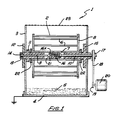
- an apparatus 1 for the electrosuspension of the particles which includes an electrode 2 mounted for rotation within an insulating container 3.
- a second electrode 4 is fitted within the bottom of container 3 below a bed of particulate material 5.
- the rotatable electrode 2 comprises a drum like rotor formed by circumferentially spaced conductors 6 extending substantially parallel to and equally distant from a hollow cylindrical tube 7. The conductors 6 are joined to respective disk shaped end portions 8 secured to the tube 7.
- the rotatable electrode 2 is mounted by shafts 9 and 10 above the particle or powder bed 5. Shaft 9 is disposed within a Teflon® bearing 11 about which the rotor rotates.
- the assembly comprising the shaft 9 and bearing 11 is fixed to a wall of container 3 by an insulating retaining ring 12.
- the outer end of the shaft 9 is surrounded by further insulation 13 to form an electrical contact 14.
- Shaft 10 is rotatably mounted within a further Teflon® bearing 15 which is fixed to the side of container 3.
- One end of shaft 10 is fixed by means of an insulating bush 16 to the cylindrical centre tube 7 of electrode 2.
- the other end of shaft 10 protrudes from container 3 and is fitted with a pulley 17.
- a belt 18 extends between pulley 17 and a like pulley 19 on an electric motor 20. In this way, the electric motor can be energised to rotate electrode 2.
- shaft 9 Electrical connection between shaft 9 and the electrode 2 is maintained by means of a steel ball 21 disposed in a recess within a conducting portion 16A of bush 16.
- the ball 21 effectively provides a bearing between the stationary end of shaft 9 and the bush portion 16A whilst the insulating remainder of bush 16 prevents electrical contact with shaft 10.
- Dust sleeves 22 are fitted between the Teflon® bearings 11, 15 and the respective ends 8 of electrode 2 to exclude dust from the bearing surfaces.
- an electrical potentional is applied between electrodes 2 and 4 and electrode 2 is rotated by means of a current supplied to electric motor 20.
- the electrode 2 has an open configuration and due to the turbulence caused by the rotation the electrosuspension rises into the area above the electrode 2. From this area the suspension can be readily removed by any suitable known means.
- container 3 has an open top fitted with a grid 23 to provide for the filtering out of any coarse particles in the electrosuspension.
- FIG 2 the arrangement illustrated is similar to that described in relation to Figure 1 above.
- a number of thin wires 24 are symmetrically positioned about the periphery of electrode 2.
- Each wire 24 extends arcuately between the ends 8 of the electrode and is weighted at its centre by means of a porcelain bead 25.
- the Figure 2 arrangement includes a solid semi-conducting layer 26 covering electrode 4.
- the apparatus of Figure 2 is particularly designed for use with micronised particles which do not under normal circumstances readily form an electrodispersion.
- the operation of the device is generally similar as that described above in that a potential is applied between the electrodes and electrode 2 is rotated at a relatively high speed by motor 20.
- the thin wires 24 attached to electrode 2 extend outwardly under the action of centrifugal force and act as field concentrators to produce a corona-discharge. This results in an ionization of the air or other gas within the container 3.
- Such corona-ionization is an effect well known to those familiar with electrostatics and has wide application in areas such as Electrostatic Precipitation, where it is usually produced by a static pair of electrodes using a point/plane or thin wire/plane construction.
- the ions are generated by the rapidly rotating positive electrode 2.
- the resulting negative ions are immediately re-absorbed by the electrode, whilst positive ions are sprayed onto the surface of the particles 5, as a result of electrostatic attraction and by the aerodynamic forces to which the electrode 2 gives rise.
- Due to the high electrical resistance of the bed 5, these ions do not immediately dissipate but form a positive charge-layer on the surface of the bed 5, the underside of which is at the opposite potential, caused by electrical contact with the lower electrode 4,26. In turn, this gives rise to a high potential drop across the particle bed 5 causing the ionization of air within the interstitial space between particles.
- An optional feature of the invention is the provision of means for adjusting the electrical potential across the particle bed. This may be achieved by adjustable vertical positioning of the upper electrode, which allows bed-thickness to be varied as required as schematically illustrated in Fig. 2 at 27. This can also be achieved using an appropriate semi-conductor substrate for the bed, as illustrated at 26 in Fig.2 is provided, through which electrical contact can be made with the lower electrode.
- a miss-match of resistances between the interelectrode space and the layer of particles can result in either of the following two unwanted conditions: (1) insufficient potential difference across the bed to give rise to secondary ionization and (2) the potential difference across the bed is too high relative to the interelectrode voltage, so that when the potential across the bed is suddenly added to the former as charges begin to flow, then the combined potential exceeds the sparking voltage for the system, causing electrical sparks and discharges in place of the continuous secondary ionization which is required.
- One example for using the invention is in producing coated pharmaceutical powders for controlling the release rate of the active ingredient through a semi-permeable membrane covering each particle.
- the electrosuspension of particles is well suited for the continuous production of such surface-treated powders, as the particles are separate from each other and in continuous agitation while in dispersion, thus allowing the coating to be applied by a suitable technique, e.g. by spraying them with fast-drying aerosol.
- the main difficulty is to produce satisfactory electrosuspensions, since many pharmaceutical substances contain easily polarized crystals which tend to form filaments under the action of the electric field.
- Paper is usually formed by the process of floating individual paper fibres (originating from treated wood-pulp) in large vats of water and allowing the fibres to settle on a suitable substrate, e.g. a moving wire-mesh strip, from where the paper is removed and dried.
- a suitable substrate e.g. a moving wire-mesh strip
- the electrostatic suspension of cellulose dust is one such possible technique, but due to the earlier mentioned tendency of fibrous dust to form long chains and filaments when subjected to a high voltage field, cannot be used in practice.
- a suspension of fibrous dust can be maintained as a result of the mechanical disruption of the filament-forming process by the rotatable electrode, thereby eliminating the problem with adapting this technique to dry paper-making.
- a further example for the use of the present invention is in coating of solids.
- the invention makes it possible to produce electrostatically coated abrasive, such as belts, disks and paper to which fine silicon carbide, emery, etc., is glued using grit-sizes much finer than presently possible. It also becomes possible to 'weld' ceramics to metal by depositing ultra-fine ceramic dust on a heated metal surface, which minimises the cooling of the surface by large heat capacity grains, so that direct sintering of the grains may be achieved both to the metal surface and to each other.
- the bonding of ceramics to metal is an important technological problem occurring in modern automotive engineering as well as in aviation and the space industry and has not yet been solved in an economically viable manner.
- Another example for the use of the invention is for producing aerosols of ultrafine medically active substances, such as salbutamol sulphate, pentamadin and steroids, suitable for the treatment of various forms of asthma, aids, etc., by directly inhaling them into the lungs.
- ultrafine medically active substances such as salbutamol sulphate, pentamadin and steroids
- Present inhalers of dry ultrafine powders in the 1-3 ⁇ m size range typically based on compressed CFC delivery of the dust, for which breathing must be co-ordinated with the bursts of powder generated by the device. In most cases, this is a difficult requirement, especially for children.
- Devices which rely on a suction generated when the patient inhales deeply are also known. However, deep inhalation can be difficult or impossible for an asthmatic and these devices are therefore of limited use.
- the present invention has the capacity for overcoming the problem, as demonstrated for salbutamol sulphate which was dispersed from an apparatus, as shown in Figure 2, producing a slowly rising cloud of
- a further example for the use of this invention is in making new surface-active catalysts, by coating the micronised catalyst onto the individual grains of an 'inert' carrier, such as a 30 ⁇ m alumina powder, to which the micronised particles can stick due to natural adhesion forces.
- the technique could be used to replace present less economical methods for manufacturing such surface-active catalysts, where the active material is spread over the carrier grains by precipitating them from a liquid.
Landscapes
- Chemical & Material Sciences (AREA)
- Chemical Kinetics & Catalysis (AREA)
- Engineering & Computer Science (AREA)
- Materials Engineering (AREA)
- Mechanical Engineering (AREA)
- Metallurgy (AREA)
- Organic Chemistry (AREA)
- Physical Or Chemical Processes And Apparatus (AREA)
- Magnetically Actuated Valves (AREA)
- Electrically Driven Valve-Operating Means (AREA)
- Braking Arrangements (AREA)
- Disintegrating Or Milling (AREA)
- Electrostatic Separation (AREA)
- Seeds, Soups, And Other Foods (AREA)
- Glass Compositions (AREA)
- Two-Way Televisions, Distribution Of Moving Picture Or The Like (AREA)
- Food-Manufacturing Devices (AREA)
Applications Claiming Priority (3)
| Application Number | Priority Date | Filing Date | Title |
|---|---|---|---|
| AU5702/89 | 1989-08-10 | ||
| AUPJ570289 | 1989-08-10 | ||
| PCT/AU1990/000339 WO1991002394A1 (en) | 1989-08-10 | 1990-08-09 | Producing electrosuspensions |
Publications (3)
| Publication Number | Publication Date |
|---|---|
| EP0486543A1 EP0486543A1 (en) | 1992-05-27 |
| EP0486543A4 EP0486543A4 (en) | 1992-08-05 |
| EP0486543B1 true EP0486543B1 (en) | 1997-10-22 |
Family
ID=3774106
Family Applications (1)
| Application Number | Title | Priority Date | Filing Date |
|---|---|---|---|
| EP90911890A Expired - Lifetime EP0486543B1 (en) | 1989-08-10 | 1990-08-09 | Method for producing an electrosuspension of micronised particles |
Country Status (10)
| Country | Link |
|---|---|
| US (1) | US5463524A (da) |
| EP (1) | EP0486543B1 (da) |
| AT (1) | ATE159622T1 (da) |
| AU (1) | AU657257B2 (da) |
| CA (1) | CA2065399C (da) |
| DE (1) | DE69031624T2 (da) |
| DK (1) | DK0486543T3 (da) |
| ES (1) | ES2111540T3 (da) |
| SG (1) | SG43845A1 (da) |
| WO (1) | WO1991002394A1 (da) |
Families Citing this family (6)
| Publication number | Priority date | Publication date | Assignee | Title |
|---|---|---|---|---|
| US6890861B1 (en) | 2000-06-30 | 2005-05-10 | Lam Research Corporation | Semiconductor processing equipment having improved particle performance |
| US6506254B1 (en) | 2000-06-30 | 2003-01-14 | Lam Research Corporation | Semiconductor processing equipment having improved particle performance |
| RU2229905C2 (ru) * | 2002-08-08 | 2004-06-10 | Российский научный центр восстановительной медицины и курортологии | Способ оздоровления часто болеющих детей |
| AU2002952683A0 (en) * | 2002-11-15 | 2002-11-28 | Commonwealth Scientific And Industrial Research Organisation | Apparatus for delivering dry aerosols to the respiratory tract |
| BE1015883A3 (fr) * | 2004-06-08 | 2005-10-04 | Occhio | Procede et dispositif de dispersion de poudres seches. |
| DE602005026837D1 (de) * | 2004-10-21 | 2011-04-21 | Basell Polyolefine Gmbh | 1-buten-polymer und herstellungsverfahren dafür |
Family Cites Families (18)
| Publication number | Priority date | Publication date | Assignee | Title |
|---|---|---|---|---|
| US3233156A (en) * | 1961-06-07 | 1966-02-01 | Eastman Kodak Co | Electrostatic charging methods and apparatus |
| US3670699A (en) * | 1970-06-24 | 1972-06-20 | Minnesota Mining & Mfg | Electrostatically charged fluidized bed apparatus |
| CA976599A (en) * | 1971-04-08 | 1975-10-21 | Senichi Masuda | Electrified particles generating apparatus |
| US3958162A (en) * | 1975-01-17 | 1976-05-18 | Coulter Information Systems, Inc. | Method and apparatus for charging an electrophotographic member |
| US4161765A (en) * | 1977-01-04 | 1979-07-17 | Onoda Cement Co., Ltd. | Powder material processing apparatus |
| JPS54157630A (en) * | 1978-04-24 | 1979-12-12 | Coulter Systems Corp | Corona generating element |
| US4240125A (en) * | 1979-04-11 | 1980-12-16 | Coulter Systems Corp. | Corona generating element |
| DK150068C (da) * | 1978-06-02 | 1987-06-29 | Pfizer | Analogifremgangsmaade til fremstilling af aminothiazoler |
| CA1154694A (en) * | 1980-03-06 | 1983-10-04 | Tsuneo Uchiya | Electrostatic particle precipitator |
| US4440800A (en) * | 1980-04-24 | 1984-04-03 | Unisearch Limited | Vapor coating of powders |
| DE3017752C2 (de) * | 1980-05-09 | 1984-08-23 | Sapco Systemanalyse und Projektcontrol GmbH, 4000 Düsseldorf | Verfahren und Vorrichtung zur Herstellung eines pulverförmigen Gemisches aus thermoplastischem Kunststoff und mineralischem oder organischem Füllstoff |
| US4389225A (en) * | 1981-03-26 | 1983-06-21 | Peabody Process Systems, Inc. | Electrostatic precipitator having high strength discharge electrode |
| JPS58155983A (ja) * | 1982-03-12 | 1983-09-16 | Ricoh Co Ltd | インクシ−ト再生方法 |
| JPS60500884A (ja) * | 1983-02-08 | 1985-06-06 | コモンウエルス サイエンテイフイツク アンド インダストリアルリサ−チ オ−ガニゼイシヨン | 放射線ソ−ス |
| SU1161181A1 (ru) * | 1983-05-25 | 1985-06-15 | Иркутский Ордена Трудового Красного Знамени Политехнический Институт | Дезинтегратор |
| JPS6092834A (ja) * | 1983-10-26 | 1985-05-24 | Sankyo Dengiyou Kk | 活性化装置 |
| JPS60140699A (ja) * | 1983-12-28 | 1985-07-25 | 小嶋 久夫 | 電界カ−テン素子 |
| US4737885A (en) * | 1986-01-21 | 1988-04-12 | Nippon Paint Co., Ltd. | Plasma generator |
-
1990
- 1990-08-09 ES ES90911890T patent/ES2111540T3/es not_active Expired - Lifetime
- 1990-08-09 US US07/834,521 patent/US5463524A/en not_active Expired - Lifetime
- 1990-08-09 DK DK90911890T patent/DK0486543T3/da not_active Application Discontinuation
- 1990-08-09 AT AT90911890T patent/ATE159622T1/de not_active IP Right Cessation
- 1990-08-09 DE DE69031624T patent/DE69031624T2/de not_active Expired - Fee Related
- 1990-08-09 CA CA002065399A patent/CA2065399C/en not_active Expired - Lifetime
- 1990-08-09 WO PCT/AU1990/000339 patent/WO1991002394A1/en not_active Ceased
- 1990-08-09 AU AU61534/90A patent/AU657257B2/en not_active Ceased
- 1990-08-09 EP EP90911890A patent/EP0486543B1/en not_active Expired - Lifetime
- 1990-08-09 SG SG1996002076A patent/SG43845A1/en unknown
Also Published As
| Publication number | Publication date |
|---|---|
| AU6153490A (en) | 1991-03-11 |
| EP0486543A4 (en) | 1992-08-05 |
| DK0486543T3 (da) | 1998-07-20 |
| CA2065399A1 (en) | 1991-02-10 |
| AU657257B2 (en) | 1995-03-09 |
| ATE159622T1 (de) | 1997-11-15 |
| WO1991002394A1 (en) | 1991-02-21 |
| EP0486543A1 (en) | 1992-05-27 |
| SG43845A1 (en) | 1997-11-14 |
| DE69031624T2 (de) | 1998-05-14 |
| DE69031624D1 (de) | 1997-11-27 |
| ES2111540T3 (es) | 1998-03-16 |
| CA2065399C (en) | 2001-07-31 |
| US5463524A (en) | 1995-10-31 |
Similar Documents
| Publication | Publication Date | Title |
|---|---|---|
| US7632533B2 (en) | Method and apparatus for producing uniform small portions of fine powders and articles thereof | |
| US4141698A (en) | Method of cleaning particle bearing gas | |
| US4797201A (en) | Electrostatic free-fall separator | |
| JPS6344007B2 (da) | ||
| AU657257B2 (en) | Producing electrosuspensions | |
| JPS6031547B2 (ja) | 異なる物理性を有する粒子の静電分離法及び装置 | |
| US11305295B2 (en) | Method and device for the electrostatic separation of granular materials | |
| CN114514341A (zh) | 用于借助于电活性固体颗粒对金属表面进行干式处理的方法和设备 | |
| US5075257A (en) | Aerosol deposition and film formation of silicon | |
| US11935669B2 (en) | Method for dispersing conductive particles, and electrostatic adsorption device | |
| US6723938B1 (en) | Electrostatic conductive induction separator | |
| JP3300894B2 (ja) | 帯電浮遊粒子の製造 | |
| JPH0763032B2 (ja) | 物体の静電的処理装置 | |
| JP2671009B2 (ja) | 超微粒子の回収方法及びその回収装置 | |
| AU546948B2 (en) | Improvements in high tension electrostatic separators | |
| JPS6320187B2 (da) | ||
| JP2021167459A (ja) | 成膜装置 | |
| JPH08252482A (ja) | 電気集塵方法及び電気集塵装置 | |
| JP3850960B2 (ja) | 静電粉体塗着法 | |
| JPH08108106A (ja) | 静電塗装方法及び静電塗装機 | |
| RU2136382C1 (ru) | Способ сепарации мелкодисперсных порошков и устройство для его осуществления | |
| JP2001276674A (ja) | 静電粉体塗装装置 | |
| JPS6058252A (ja) | 分級方法 | |
| JPS59109263A (ja) | イオン衝撃型粒子分離器 | |
| JPH08252480A (ja) | 電気集塵方法及び電気集塵装置 |
Legal Events
| Date | Code | Title | Description |
|---|---|---|---|
| PUAI | Public reference made under article 153(3) epc to a published international application that has entered the european phase |
Free format text: ORIGINAL CODE: 0009012 |
|
| 17P | Request for examination filed |
Effective date: 19920305 |
|
| AK | Designated contracting states |
Kind code of ref document: A1 Designated state(s): AT BE CH DE DK ES FR GB IT LI LU NL SE |
|
| A4 | Supplementary search report drawn up and despatched |
Effective date: 19920612 |
|
| AK | Designated contracting states |
Kind code of ref document: A4 Designated state(s): AT BE CH DE DK ES FR GB IT LI LU NL SE |
|
| 17Q | First examination report despatched |
Effective date: 19940518 |
|
| GRAG | Despatch of communication of intention to grant |
Free format text: ORIGINAL CODE: EPIDOS AGRA |
|
| GRAH | Despatch of communication of intention to grant a patent |
Free format text: ORIGINAL CODE: EPIDOS IGRA |
|
| GRAH | Despatch of communication of intention to grant a patent |
Free format text: ORIGINAL CODE: EPIDOS IGRA |
|
| GRAA | (expected) grant |
Free format text: ORIGINAL CODE: 0009210 |
|
| AK | Designated contracting states |
Kind code of ref document: B1 Designated state(s): AT BE CH DE DK ES FR GB IT LI LU NL SE |
|
| REF | Corresponds to: |
Ref document number: 159622 Country of ref document: AT Date of ref document: 19971115 Kind code of ref document: T |
|
| REG | Reference to a national code |
Ref country code: CH Ref legal event code: EP |
|
| REF | Corresponds to: |
Ref document number: 69031624 Country of ref document: DE Date of ref document: 19971127 |
|
| ITF | It: translation for a ep patent filed | ||
| ET | Fr: translation filed | ||
| REG | Reference to a national code |
Ref country code: ES Ref legal event code: FG2A Ref document number: 2111540 Country of ref document: ES Kind code of ref document: T3 |
|
| REG | Reference to a national code |
Ref country code: CH Ref legal event code: NV Representative=s name: PATENTANWAELTE SCHAAD, BALASS, MENZL & PARTNER AG |
|
| REG | Reference to a national code |
Ref country code: DK Ref legal event code: T3 |
|
| PLBE | No opposition filed within time limit |
Free format text: ORIGINAL CODE: 0009261 |
|
| STAA | Information on the status of an ep patent application or granted ep patent |
Free format text: STATUS: NO OPPOSITION FILED WITHIN TIME LIMIT |
|
| 26N | No opposition filed | ||
| PGFP | Annual fee paid to national office [announced via postgrant information from national office to epo] |
Ref country code: LU Payment date: 20010808 Year of fee payment: 12 |
|
| PGFP | Annual fee paid to national office [announced via postgrant information from national office to epo] |
Ref country code: AT Payment date: 20010813 Year of fee payment: 12 |
|
| PGFP | Annual fee paid to national office [announced via postgrant information from national office to epo] |
Ref country code: CH Payment date: 20010815 Year of fee payment: 12 |
|
| PGFP | Annual fee paid to national office [announced via postgrant information from national office to epo] |
Ref country code: BE Payment date: 20010927 Year of fee payment: 12 |
|
| REG | Reference to a national code |
Ref country code: GB Ref legal event code: IF02 |
|
| PG25 | Lapsed in a contracting state [announced via postgrant information from national office to epo] |
Ref country code: AT Free format text: LAPSE BECAUSE OF NON-PAYMENT OF DUE FEES Effective date: 20020809 Ref country code: LU Free format text: LAPSE BECAUSE OF NON-PAYMENT OF DUE FEES Effective date: 20020809 |
|
| PG25 | Lapsed in a contracting state [announced via postgrant information from national office to epo] |
Ref country code: CH Free format text: LAPSE BECAUSE OF NON-PAYMENT OF DUE FEES Effective date: 20020831 Ref country code: BE Free format text: LAPSE BECAUSE OF NON-PAYMENT OF DUE FEES Effective date: 20020831 Ref country code: LI Free format text: LAPSE BECAUSE OF NON-PAYMENT OF DUE FEES Effective date: 20020831 |
|
| BERE | Be: lapsed |
Owner name: *AUSPHARM INTERNATIONAL LTD Effective date: 20020831 Owner name: *COMMONWEALTH SCIENTIFIC AND INDUSTRIAL RESEARCH O Effective date: 20020831 |
|
| REG | Reference to a national code |
Ref country code: CH Ref legal event code: PL |
|
| PGFP | Annual fee paid to national office [announced via postgrant information from national office to epo] |
Ref country code: DK Payment date: 20080815 Year of fee payment: 19 Ref country code: NL Payment date: 20080803 Year of fee payment: 19 Ref country code: DE Payment date: 20080821 Year of fee payment: 19 Ref country code: ES Payment date: 20080922 Year of fee payment: 19 |
|
| PGFP | Annual fee paid to national office [announced via postgrant information from national office to epo] |
Ref country code: IT Payment date: 20080827 Year of fee payment: 19 Ref country code: FR Payment date: 20080818 Year of fee payment: 19 |
|
| PGFP | Annual fee paid to national office [announced via postgrant information from national office to epo] |
Ref country code: GB Payment date: 20080820 Year of fee payment: 19 |
|
| PGFP | Annual fee paid to national office [announced via postgrant information from national office to epo] |
Ref country code: SE Payment date: 20080807 Year of fee payment: 19 |
|
| REG | Reference to a national code |
Ref country code: NL Ref legal event code: V1 Effective date: 20100301 |
|
| REG | Reference to a national code |
Ref country code: DK Ref legal event code: EBP |
|
| GBPC | Gb: european patent ceased through non-payment of renewal fee |
Effective date: 20090809 |
|
| REG | Reference to a national code |
Ref country code: FR Ref legal event code: ST Effective date: 20100430 |
|
| PG25 | Lapsed in a contracting state [announced via postgrant information from national office to epo] |
Ref country code: DE Free format text: LAPSE BECAUSE OF NON-PAYMENT OF DUE FEES Effective date: 20100302 Ref country code: FR Free format text: LAPSE BECAUSE OF NON-PAYMENT OF DUE FEES Effective date: 20090831 Ref country code: DK Free format text: LAPSE BECAUSE OF NON-PAYMENT OF DUE FEES Effective date: 20090831 Ref country code: NL Free format text: LAPSE BECAUSE OF NON-PAYMENT OF DUE FEES Effective date: 20100301 |
|
| REG | Reference to a national code |
Ref country code: ES Ref legal event code: FD2A Effective date: 20090810 |
|
| PG25 | Lapsed in a contracting state [announced via postgrant information from national office to epo] |
Ref country code: GB Free format text: LAPSE BECAUSE OF NON-PAYMENT OF DUE FEES Effective date: 20090809 |
|
| PG25 | Lapsed in a contracting state [announced via postgrant information from national office to epo] |
Ref country code: IT Free format text: LAPSE BECAUSE OF NON-PAYMENT OF DUE FEES Effective date: 20090809 |
|
| PG25 | Lapsed in a contracting state [announced via postgrant information from national office to epo] |
Ref country code: SE Free format text: LAPSE BECAUSE OF NON-PAYMENT OF DUE FEES Effective date: 20090810 |
|
| PG25 | Lapsed in a contracting state [announced via postgrant information from national office to epo] |
Ref country code: ES Free format text: LAPSE BECAUSE OF NON-PAYMENT OF DUE FEES Effective date: 20090810 |