EP0487744B1 - Lineare unterwassertransportvorrichtung - Google Patents
Lineare unterwassertransportvorrichtung Download PDFInfo
- Publication number
- EP0487744B1 EP0487744B1 EP91910839A EP91910839A EP0487744B1 EP 0487744 B1 EP0487744 B1 EP 0487744B1 EP 91910839 A EP91910839 A EP 91910839A EP 91910839 A EP91910839 A EP 91910839A EP 0487744 B1 EP0487744 B1 EP 0487744B1
- Authority
- EP
- European Patent Office
- Prior art keywords
- vehicle
- linear
- induction motor
- force
- rail track
- Prior art date
- Legal status (The legal status is an assumption and is not a legal conclusion. Google has not performed a legal analysis and makes no representation as to the accuracy of the status listed.)
- Expired - Lifetime
Links
Images



Classifications
-
- B—PERFORMING OPERATIONS; TRANSPORTING
- B60—VEHICLES IN GENERAL
- B60L—PROPULSION OF ELECTRICALLY-PROPELLED VEHICLES; SUPPLYING ELECTRIC POWER FOR AUXILIARY EQUIPMENT OF ELECTRICALLY-PROPELLED VEHICLES; ELECTRODYNAMIC BRAKE SYSTEMS FOR VEHICLES IN GENERAL; MAGNETIC SUSPENSION OR LEVITATION FOR VEHICLES; MONITORING OPERATING VARIABLES OF ELECTRICALLY-PROPELLED VEHICLES; ELECTRIC SAFETY DEVICES FOR ELECTRICALLY-PROPELLED VEHICLES
- B60L13/00—Electric propulsion for monorail vehicles, suspension vehicles or rack railways; Magnetic suspension or levitation for vehicles
- B60L13/10—Combination of electric propulsion and magnetic suspension or levitation
-
- B—PERFORMING OPERATIONS; TRANSPORTING
- B61—RAILWAYS
- B61B—RAILWAY SYSTEMS; EQUIPMENT THEREFOR NOT OTHERWISE PROVIDED FOR
- B61B13/00—Other railway systems
- B61B13/08—Sliding or levitation systems
-
- B—PERFORMING OPERATIONS; TRANSPORTING
- B63—SHIPS OR OTHER WATERBORNE VESSELS; RELATED EQUIPMENT
- B63G—OFFENSIVE OR DEFENSIVE ARRANGEMENTS ON VESSELS; MINE-LAYING; MINE-SWEEPING; SUBMARINES; AIRCRAFT CARRIERS
- B63G8/00—Underwater vessels, e.g. submarines; Equipment specially adapted therefor
- B63G8/08—Propulsion
-
- B—PERFORMING OPERATIONS; TRANSPORTING
- B63—SHIPS OR OTHER WATERBORNE VESSELS; RELATED EQUIPMENT
- B63H—MARINE PROPULSION OR STEERING
- B63H19/00—Marine propulsion not otherwise provided for
- B63H19/08—Marine propulsion not otherwise provided for by direct engagement with water-bed or ground
-
- B—PERFORMING OPERATIONS; TRANSPORTING
- B60—VEHICLES IN GENERAL
- B60L—PROPULSION OF ELECTRICALLY-PROPELLED VEHICLES; SUPPLYING ELECTRIC POWER FOR AUXILIARY EQUIPMENT OF ELECTRICALLY-PROPELLED VEHICLES; ELECTRODYNAMIC BRAKE SYSTEMS FOR VEHICLES IN GENERAL; MAGNETIC SUSPENSION OR LEVITATION FOR VEHICLES; MONITORING OPERATING VARIABLES OF ELECTRICALLY-PROPELLED VEHICLES; ELECTRIC SAFETY DEVICES FOR ELECTRICALLY-PROPELLED VEHICLES
- B60L2200/00—Type of vehicles
- B60L2200/26—Rail vehicles
Definitions
- This invention relates to an underwater-linear-transport system which can be used in water and in other liquid.
- JP-A-48 14015 which corresponds to the preamble of claim 1 discloses an underwater transport system comprising a track provided in the water and a vehicle having a hermetically sealed structure.
- a levitating force and a driving force for a mobile or movable element are supplied by separate elements, respectively.
- the movable element is supported by an attracting force of an electromagnet, while it is driven by the linear motor.
- Patent Abstracts of Japan, [7895 M 77] and JP-A-52 149712 disclose a magnetic floating and propelling device wherein the magnetic field generated in a moving magnetic field generating part is utilized for propelling and floating in common.
- the object of this invention is to obtain a driving force using the linear motor based on the consideration that, when the vehicle runs in water or in the sea, most of its weight will be subdued by the buoyant force of the water.
- the linear-transport-system according to the invention has a linear motor which can simultaneously produce the driving force and the supporting or levitating force.
- a gap sensor for measuring the gap length between a secondary side conductor of the linear induction motor and the rail track, and a control means for supplying current so that the gap length is kept constant, together with the driving force produced by the primary side and the secondary side of the linear induction motor.
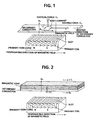
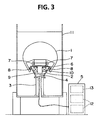
- the magnetic repelling force and the magnetic attracting force in the linear induction motor will be schematically described.
- Fig. 1 shows the principle of magnetic repelling force according to this invention.
- a three-phase alternating current is supplied to the coil of the primary side of the linear induction motor so that an eddy current is caused in a secondary conductor formed of non-magnetic conductive material.
- a magnetic repelling force Fz and a driving force Fx are produced in a vertical direction and a propagating direction with respective to the moving magnetic field.
- the magnetic repelling force Fz and the driving force Fx can be represented as a function of current I, number of turns of the primary coil N, area of air gap s, length of gap g, and slip s.
- the magnetic repelling force Fz is used as the levitating force to the vehicle, while the driving force Fx is used to drive the vehicle.
- the magnetic repelling force is too small to levitate the vehicle in the air, if the weight of the vehicle is set to be a little larger than the buoyant force of water, it is possible to levitate the vehicle in water.
- a control device is used to control the current instruction in feedback manner to keep the gap length g constant.
- the weight of the vehicle is designed and manufactured to be less than the buoyant force of water and the difference in force between the weight of the vehicle and the buoyant force of water can be offset by the attracting force Fz', the apparent weight of the vehicle will become zero, and thus the vehicle will be supported magnetically.
- the gap is controlled so that the weight of the vehicle is made less than the buoyant force of water and the difference in the force between the weight of the vehicle and the buoyant force of water can be offset by the attracting force Fz', then the apparent weight of the vehicle will again become zero, thereof the vehicle can be run in the levitated state along the rail track.
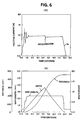
- Fig. 3 is a cross-sectional view of an experimental unit of the underwater linear-transport-system utilizing the magnetically levitated force provided by the magnetic repelling force as shown in Fig. 1.
- the underwater linear motor includes a vehicle 1 which is so designed and manufactured that its weight is slightly greater than the buoyant force of water, flame-type rail track 2, a pillar 3, and a controller 5 for supplying a current to the coil of the primary side of the linear induction motor 4 installed inside of the frame of the rail track.
- the secondary side of the linear induction motor 6 is formed of non-magnetic conductive material such as copper plate or aluminum plate and fixedly installed on the vehicle 1 so as to face the primary side of the linear induction motor 4.
- the vehicle 1 equips the wheels 7 serving to support the vehicle when the vehicle is not levitated and wheels 8 serving to prevent the vehicle from slanting or swinging and to guide the vehicle when it runs in levitated state.
- the size of the vehicle is designed in construction and adjusted so that, in comparison with the buoyant force of water acting on the vehicle, its weight is slightly greater than the buoyant force of water.
- the wheels 8 are adjusted to two inclined planes of the rail track 2.
- the rail track 2 may be formed with a vertical portion and a horizontal portion and, in this case, the wheels 8 may be separated into vertical and horizontal wheels to be set on the vertical portion and horizontal portion of the rail track 2, respectively.
- An iron core 9 having slots into which a three-phase coil 10 is wound to serve as the primary side of the linear induction motor 4 is fixedly installed in the rail track 2 disposed therein from water or other liquids. Further, the rail track 2 has water-tight construction to protect the primary side of the linear induction motor 4.
- the pillar 3 serves to support the rail track 2, and has a chamber therein, so as to the current supporting. Wires for the linear induction motor and signal wires for sensors can go though the chamber of the pillar 3.
- the controller 5 includes an inverter 12 for supplying current to the primary coil of the linear induction motor 10 installed in the rail track 2 and a control circuit 13 therefor.
- Fig. 4 shows the control circuit 13 for the inverter 12.
- the control circuit 13 comprises a frequency control unit 20 and an output current control unit 30.
- a frequency instruction signal having a constant frequency is inputted to the frequency control unit 20.
- a two-phase alternating current signal having a frequency corresponding to the input frequency instruction is generated in a two-phase voltage controlling oscillator (VOC) 21, and supplied to a current amplitude regulator 22.
- VOC voltage controlling oscillator
- the two-phase alternating current signal is converted into a three-phase alternating current signal through a two-phase to three-phase converter 23, thereafter the three-phase alternating current signal is modulated to a pulse in a pulse width modulation amplifier (PWMA) 24, and then supplied to the inverter 12, then exciting current is supplied to each phase of the linear induction motor, as a result and an open-loop control is performed.
- PWMA pulse width modulation amplifier
- the current control unit 30 a voltage corresponding to the amplitude of the primary current vector of the linear induction motor is calculated by a current amplitude calculating circuit 31, the difference between the calculated value and the current instruction being inputted to a proportion/integral controller (PIC) 32, and then the amplitude control is performed in the current-amplitude regulator 22.
- PIC proportion/integral controller
- the power supply for the primary coil of the linear induction motor is carried out as follows.
- the primary coil of the linear induction motor is separated into plural blocks, and thus plural inverters 12-1...12-m are prepared for each block, as shown in Fig. 5.
- the position detectors (not shown) detect the block on which the vehicle 1 is located, and then the inverter is selected by switches 14-1...14-m to supply the exciting current to the primary coil of the linear induction motor.
- the frequency of the inverter 12 is fixed to a certain value, in this condition, the wheels 7 contact with the rail track 2, thereafter, increasing the exciting current for the coils 10 until the gap between the wheels 7 and the rail track 2 reaches a certain instruction value, the vehicle 1 is gradually levitated, a current-instruction pattern by a simulation is shown in Fig. 6(a).
- the control circuit supplies a frequency and a current instruction to the inverter 12.
- the current flows along the primary coil of the linear induction motor 4 from the inverter 12, and the driving force and levitating force simultaneously act upon the vehicle 1 levitating the vehicle in a certain gap length.
- Fig. 6(b) shows the relationship between levitating force, velocity, moving distance of the vehicle 1 and time.
- the primary side of the linear induction motor is provided so as to face the lower surfaces of the rail track 2, moreover the secondary side of the linear induction motor is installed at a still lower position so as to face the primary side, and the weight of the vehicle is adjusted slightly less than the levitating force acting on the vehicle, so that when the vehicle is driven, the attracting force is performed in the lower side to act on the vehicle and pull it downward.
- Fig. 7 shows an experimental unit according to the second embodiment.
- a gap sensor 16 is equipped in the unit shown in Fig. 3, and measure the gap between the conductor of the secondary side of the linear induction motor and the rail track 2.
- This gap sensor 16 may be used of an electromagnetic induction type, an inductance measuring type, or so on.
- Fig. 8 is a block diagram showing the control system according to this embodiment.
- a signal corresponding to the gap measured by the gap sensor 16 is converted to the length of the gap by means of a signal processing circuit 41, and then compared with a gap instruction.
- the difference between the gap length and the gap instruction is input into a PID controller 42, and a current corresponding to the difference is then output. Thereafter, the current value and a current instruction pattern are added to the current, and then input into the inverter control circuit 13.
- the frequency of the inverter 12 is fixed to a certain value, the wheels 7 loaded with the vehicle 1 are in contact with the rail track 2 in this condition, thereafter increasing the exciting current for the coil 10 until the gap between the wheels 7 and the rail track 2 reaches a certain instruction value, the vehicle 1 is gradually levitated, a pattern of a current instruction value by a simulation is shown in Fig. 6(a). According to this result, the inverter control circuit 13 supplies a frequency and a current instruction to the exciting coils 10 of the linear induction motor.
- the exciting current flows along the primary coil of the linear induction motor 4 from the inverter 12, and vehicle 1, the driving force and the levitating force simultaneously act upon the vehicle, whereby the vehicle is levitated in a certain gap length and driven forward.
- Fig. 6(b) shows the relationship between levitating force, velocity, moving distance of the vehicle 1 and a time. If there are variations in the gap length, the control system would perform feedback control to keep the difference between the gap length and the gap instruction down to zero.
- a differential compensating circuit 43 as shown in Fig. 8 is installed to process the signal from the signal processing circuit 41, and subject a negative feedback to the output of the PID controller 42 using the differential signal.
- Fig. 9 is a cross-sectional view for showing another experimental unit of an underwater linear-transport-system utilizing the magnetic attracting force shown in Fig. 2.
- a magnetic yoke 15 serving as a secondary iron core is equipped at an upper portion of the secondary side of the linear induction motor 6, and the vehicle 1 is so designed and manufactured that its weight is slightly less than the buoyant force of water. This will allow the wheels 8 to be ordinarily in contact with the rail track 2 but, when the vehicle is driven forward, the apparent weight of the vehicle will become zero by the magnetic attracting force and run by the driving force. Since the absolute value of magnetic attracting force of this occasion is larger than that of magnetic repelling force of the occasion shown in Fig. 1, it is possible to reduce the apparent weight of the vehicle 1 to zero with only a small amount of power.
- the other construction and the control circuit of this unit are the same as those of the embodiment described above, and thus the description thereof is eliminated here.
- Fig. 10(a) The current instruction pattern of this system is shown in Fig. 10(a), and an example of the relationship between levitating force, velocity, moving distance of the vehicle 1 and time is shown in Fig. 10(b).
- the primary side of the linear induction motor is installed so as to face the lower surfaces of the rail track 2, and the secondary side of the linear induction motor is installed in a still lower position so as to face to the primary side, so that the weight of the vehicle is a little larger than the levitating force acting on the vehicle, and when the vehicle is driven, the vehicle can be levitated while held up from the lower side.
- all of the above embodiments are dependent on the magnetic repelling or attracting force of the linear induction motor to offset the difference in force between the weight of the vehicle and the buoyant force of water acting on the vehicle.
- the linear induction motor serves only as means for supplying a driving force
- the difference in force between the weight of the vehicle and the buoyant force of water may be supported by wheels.
- This kind of transport system can be fully expected to achieve the same working effect as the above embodiments and, in addition, the control device can be remarkably simplified.
- Fig. 11 is a cross-sectional view for showing more another experimental unit of an underwater linear-transport-system utilizing the magnetic attracting force shown in Fig. 2.
- a magnetic yoke 15 serving as a secondary iron core is installed at an upper portion of the secondary side of the linear induction motor 6, and the vehicle 1 is designed and manufactured so that its weight is a little less than the buoyant force of water acting on it to allow the wheels 8 to be ordinarily in contact with the rail track 2.
- the vehicle is controlled so that the gap measured by the gap sensor 16 is coincident with the gap instruction. Since the absolute value of the magnetic attracting force of this occasion is larger than that of magnetic repelling force of the occasion shown in Fig. 1, it is possible to reduce the apparent weight of the vehicle 1 to zero with only a small amount of power.
- the other construction and the control circuit of this unit are the same as those of the embodiment as shown in Fig. 9, and thus the description thereof is eliminated here.
- the linear transportation of the vehicle can be performed with light load contacting or non-contacting on the rail track in the water. There is no energy loss due to friction in this transportation, and the transportation can be very efficiently performed.
- control of the gap enables the linear transportation of the vehicle to be performed without contacting the rail track in the water. There is no energy loss due to friction in this transportation, and the transportation can be very efficiently performed.
- This invention can be utilized in industrial fields of transportation in the sea.
Landscapes
- Engineering & Computer Science (AREA)
- Mechanical Engineering (AREA)
- Transportation (AREA)
- Chemical & Material Sciences (AREA)
- Combustion & Propulsion (AREA)
- Ocean & Marine Engineering (AREA)
- Physics & Mathematics (AREA)
- Electromagnetism (AREA)
- Power Engineering (AREA)
- Aviation & Aerospace Engineering (AREA)
- Control Of Vehicles With Linear Motors And Vehicles That Are Magnetically Levitated (AREA)
- Non-Mechanical Conveyors (AREA)
Claims (4)
- Lineares Unterwassertransportsystem, welches umfaßt:
eine im Wasser vorgesehene Gleiseinrichtung (2); und ein Fahrzeug (1) mit einer hermetisch abgedichteten Struktur;
dadurch gekennzeichnet, daß
das lineare Transportsystem weiterhin umfaßt: einen linearen Induktionsmotor (4), dessen Primärseite in der Gleiseinrichtung (2) vorgesehen ist und dessen Sekundärseite an bzw. in dem Fahrzeug (1) vorgesehen ist; eine Steuer- bzw. Regeleinrichtung (5), welche einen Inverter (12) zum Liefern von Strom zu einer primären Windung bzw. Spule des linearen Induktionsmotors (4) bereitstellt; und Räder (7, 8);
wobei das Gewicht des Fahrzeugs (1) etwas größer hergestellt ist, als die Auftriebskraft des Wassers; wobei das Fahrzeug (1) durch die magnetische, abstoßende Kraft (Fz) levitiert, welche durch die Reaktion bzw. Wechselwirkung zwischen dem bewegten Magnetfeld und den indizierten Wirbelstrom verursacht ist; und wobei die Räder (7) das Fahrzeug (1) tragen, wenn das Fahrzeug (1) nicht levitiert;
oder wobei das Gewicht des Fahrzeugs (1) etwas kleiner hergestellt wird als die Auftriebskraft des Wassers; wobei das Fahrzeug (1) durch die magnetische, anziehende Kraft (Fz') angezogen ist, welche durch die Wechselwirkung zwischen einem bei einem oberen Abschnitt der Sekundärseite des linearen Induktionsmotors installierten Magnetjoch (15) und der Gleiseinrichtung (2) verursacht ist; und wobei die Räder (8) mit der Gleiseinrichtung (2) in Kontakt sind, wenn das Fahrzeug (1) nicht angezogen wird. - Lineares Unterwassertransportsystem gemäß Anspruch 1, wobei die Regel- bzw. Steuereinrichtung (5) eine Regel- bzw. Steuerschaltung (13) für den Inverter (12) aufweist, welche eine Frequenzregeleinheit bzw. -steuereinheit (20) und eine Stromregeleinheit bzw. -steuereinheit (30) umfaßt.
- Lineares Unterwassertransportsystem gemäß Anspruch 1, wobei der lineare Induktionsmotor (4) in eine Vielzahl von Blöcken (12-1, ... 12-m) geteilt ist, und der Inverter (12) für jeden der Blöcke (12-1, ... 12-m) vorgesehen ist, wobei eine Vielzahl von Schaltern (14-1, ... 14-m) vorgesehen ist zum Selektieren bzw. Auswählen des Inverters (einer von 12-1, ... 12-m), und zwar zum Liefern des Anregungsstromes zu dem Block des linearen Motors, wo das Fahrzeug (1) angeordnet bzw. befindlich ist.
- Lineares Unterwassertransportsystem gemäß Anspruch 1 oder 2, wobei die Gleiseinrichtung (2) einen Spalt- bzw. Lückensensor (16) aufweist, welcher den Spalt bzw. die Lücke zwischen dem Leiter der Sekundärseite des linearen Induktionsmotors (4) und der Fläche bzw. Oberfläche der Gleiseinrichtung (2) mißt bzw. nachweist, wobei die Regel- bzw. Steuereinrichtung (5) aufweist: einen PID-Regler (42), eine differential- bzw. ausgleichkompensierende Schaltung (43) und eine Signalverarbeitungsschaltung (41), welche den Ausgang des Spaltsensors (16) zu einem Spalt- bzw. Lückenbefehl konvertiert, und zwar um die Spalt- bzw. Lückenlänge derartig zu regeln bzw. steuern, daß sie konstant gehalten wird.
Applications Claiming Priority (5)
| Application Number | Priority Date | Filing Date | Title |
|---|---|---|---|
| JP163475/90 | 1990-06-20 | ||
| JP16347690 | 1990-06-20 | ||
| JP2163475A JP2986854B2 (ja) | 1990-06-20 | 1990-06-20 | 水中リニア輸送システム |
| JP163476/90 | 1990-06-20 | ||
| PCT/JP1991/000831 WO1991019621A1 (fr) | 1990-06-20 | 1991-06-20 | Systeme de transport lineaire sous l'eau |
Publications (3)
| Publication Number | Publication Date |
|---|---|
| EP0487744A1 EP0487744A1 (de) | 1992-06-03 |
| EP0487744A4 EP0487744A4 (en) | 1992-12-02 |
| EP0487744B1 true EP0487744B1 (de) | 1995-09-06 |
Family
ID=26488901
Family Applications (1)
| Application Number | Title | Priority Date | Filing Date |
|---|---|---|---|
| EP91910839A Expired - Lifetime EP0487744B1 (de) | 1990-06-20 | 1991-06-20 | Lineare unterwassertransportvorrichtung |
Country Status (2)
| Country | Link |
|---|---|
| EP (1) | EP0487744B1 (de) |
| WO (1) | WO1991019621A1 (de) |
Families Citing this family (3)
| Publication number | Priority date | Publication date | Assignee | Title |
|---|---|---|---|---|
| DE4413899A1 (de) * | 1994-04-21 | 1995-10-26 | Magnetbahn Gmbh | Linearmotorfahrzeug mit permanentelektromagnetischer Regelung |
| CN101394908B (zh) | 2006-03-03 | 2013-03-27 | 哈姆游乐设施股份有限公司 | 直线电机驱动的游乐设施及方法 |
| WO2013000090A1 (en) | 2011-06-30 | 2013-01-03 | Hm Attractions Inc. | Motion control system and method for an amusement ride |
Citations (1)
| Publication number | Priority date | Publication date | Assignee | Title |
|---|---|---|---|---|
| JPS6377305A (ja) * | 1986-09-19 | 1988-04-07 | Fujitsu Ltd | リニアモ−タカ−の走行制御方式 |
Family Cites Families (4)
| Publication number | Priority date | Publication date | Assignee | Title |
|---|---|---|---|---|
| FR1497555A (fr) * | 1966-08-02 | 1967-10-13 | Cabine sous-marine guidée par monorail | |
| JPS50122627A (de) * | 1974-03-16 | 1975-09-26 | ||
| JPS5918923B2 (ja) * | 1976-06-09 | 1984-05-01 | 株式会社東芝 | 磁気浮上推進装置 |
| EP0224617A1 (de) * | 1985-10-25 | 1987-06-10 | Fuji Electric Co., Ltd. | Schiene zur Anwendung bei einer magnetischen Trag- und Vortriebsvorrichtung |
-
1991
- 1991-06-20 EP EP91910839A patent/EP0487744B1/de not_active Expired - Lifetime
- 1991-06-20 WO PCT/JP1991/000831 patent/WO1991019621A1/ja not_active Ceased
Patent Citations (1)
| Publication number | Priority date | Publication date | Assignee | Title |
|---|---|---|---|---|
| JPS6377305A (ja) * | 1986-09-19 | 1988-04-07 | Fujitsu Ltd | リニアモ−タカ−の走行制御方式 |
Also Published As
| Publication number | Publication date |
|---|---|
| EP0487744A4 (en) | 1992-12-02 |
| WO1991019621A1 (fr) | 1991-12-26 |
| EP0487744A1 (de) | 1992-06-03 |
Similar Documents
| Publication | Publication Date | Title |
|---|---|---|
| EP0169983B1 (de) | Fördersystem vom Typ mit schwebendem Träger | |
| US5467718A (en) | Magnetic levitation transport system with non-contact inductive power supply and battery charging | |
| EP0216452B1 (de) | Transportsystem mit schwebenden Transporteinheiten | |
| US4972779A (en) | Transporting system of floated carrier type | |
| US4838172A (en) | Transporting system of floated carrier type | |
| JP3235708B2 (ja) | リニアモータ利用の搬送設備 | |
| JP3278200B2 (ja) | エレベータのデータ伝送装置 | |
| JP2553043B2 (ja) | 浮上式搬送装置 | |
| US5163546A (en) | Ac magnetic floating conveyor and operation method thereof | |
| CN113119740A (zh) | 单磁轨永磁电磁混合悬浮装置 | |
| US5980193A (en) | Magnetically levitated robot and method of increasing levitation force | |
| US5058505A (en) | Carrying apparatus driven by linear motor with weight calculation to control driving force of motor | |
| EP0487744A1 (de) | Lineare unterwassertransportvorrichtung | |
| KR101999790B1 (ko) | 에너지 하비스터를 포함하는 자기 부상 열차 및 자기 부상 열차가 주행하는 인프라시스템 | |
| JP3092723B2 (ja) | 水中リニア輸送システム | |
| JP2625717B2 (ja) | 磁気浮上搬送装置 | |
| EP0239231B1 (de) | Gerät zum Stoppen eines Wagens an einer programmierten Haltestelle | |
| JP3072297B2 (ja) | 同期形リニアモータによる軌道車両の推進方法 | |
| US4908577A (en) | System for monitoring the gap between, and relative position of, relatively movable elements | |
| JP2986854B2 (ja) | 水中リニア輸送システム | |
| JP2563912B2 (ja) | 浮上式搬送装置 | |
| JPH11215614A (ja) | 浮上式搬送装置 | |
| JPS62166706A (ja) | 磁気浮上式のリニアモ−タ利用の搬送設備 | |
| JPH01255405A (ja) | 磁気浮上搬送装置 | |
| JPH101904A (ja) | 交流電磁石式磁気吸引浮上リニアモータ搬送装置 |
Legal Events
| Date | Code | Title | Description |
|---|---|---|---|
| PUAI | Public reference made under article 153(3) epc to a published international application that has entered the european phase |
Free format text: ORIGINAL CODE: 0009012 |
|
| AK | Designated contracting states |
Kind code of ref document: A1 Designated state(s): GB |
|
| RAP1 | Party data changed (applicant data changed or rights of an application transferred) |
Owner name: KABUSHIKI KAISHA YASKAWA DENKI |
|
| 17P | Request for examination filed |
Effective date: 19920625 |
|
| A4 | Supplementary search report drawn up and despatched |
Effective date: 19921009 |
|
| AK | Designated contracting states |
Kind code of ref document: A4 Designated state(s): GB |
|
| 17Q | First examination report despatched |
Effective date: 19940124 |
|
| GRAA | (expected) grant |
Free format text: ORIGINAL CODE: 0009210 |
|
| AK | Designated contracting states |
Kind code of ref document: B1 Designated state(s): GB |
|
| PLBE | No opposition filed within time limit |
Free format text: ORIGINAL CODE: 0009261 |
|
| STAA | Information on the status of an ep patent application or granted ep patent |
Free format text: STATUS: NO OPPOSITION FILED WITHIN TIME LIMIT |
|
| 26N | No opposition filed | ||
| REG | Reference to a national code |
Ref country code: GB Ref legal event code: 732E |
|
| REG | Reference to a national code |
Ref country code: GB Ref legal event code: IF02 |
|
| PGFP | Annual fee paid to national office [announced via postgrant information from national office to epo] |
Ref country code: GB Payment date: 20020619 Year of fee payment: 12 |
|
| PG25 | Lapsed in a contracting state [announced via postgrant information from national office to epo] |
Ref country code: GB Free format text: LAPSE BECAUSE OF NON-PAYMENT OF DUE FEES Effective date: 20030620 |
|
| GBPC | Gb: european patent ceased through non-payment of renewal fee |
Effective date: 20030620 |