EP0487922A2 - Ultraschnelle elektronische Schaltungseinrichtung - Google Patents
Ultraschnelle elektronische Schaltungseinrichtung Download PDFInfo
- Publication number
- EP0487922A2 EP0487922A2 EP91118551A EP91118551A EP0487922A2 EP 0487922 A2 EP0487922 A2 EP 0487922A2 EP 91118551 A EP91118551 A EP 91118551A EP 91118551 A EP91118551 A EP 91118551A EP 0487922 A2 EP0487922 A2 EP 0487922A2
- Authority
- EP
- European Patent Office
- Prior art keywords
- high speed
- channel portion
- superconductive
- transistor
- superconductor
- Prior art date
- Legal status (The legal status is an assumption and is not a legal conclusion. Google has not performed a legal analysis and makes no representation as to the accuracy of the status listed.)
- Granted
Links
Images




Classifications
-
- H—ELECTRICITY
- H10—SEMICONDUCTOR DEVICES; ELECTRIC SOLID-STATE DEVICES NOT OTHERWISE PROVIDED FOR
- H10D—INORGANIC ELECTRIC SEMICONDUCTOR DEVICES
- H10D64/00—Electrodes of devices having potential barriers
- H10D64/60—Electrodes characterised by their materials
- H10D64/608—Electrodes characterised by their materials being superconducting
-
- G—PHYSICS
- G11—INFORMATION STORAGE
- G11C—STATIC STORES
- G11C2211/00—Indexing scheme relating to digital stores characterized by the use of particular electric or magnetic storage elements; Storage elements therefor
- G11C2211/56—Indexing scheme relating to G11C11/56 and sub-groups for features not covered by these groups
- G11C2211/561—Multilevel memory cell aspects
- G11C2211/5614—Multilevel memory cell comprising negative resistance, quantum tunneling or resonance tunneling elements
Definitions
- the present invention generally relates to high speed switching electron devices and, more particularly, to a high speed switching electron device such as a superconductor transistor, a resonance tunnel effect transistor or the like and to a high speed memory device utilizing such high speed switching electron device.
- FIG. 1 shows an example of such superconductor transistor according to the prior art.
- a superconductor transistor 1 is comprised of a single crystalline silicon substrate 2, a source portion 3 and a drain portion 4 deposited on one major surface of the single crystalline silicon substrate 2 with a predetermined spacing L and a gate electrode 6 formed on the other major surface of the above silicon substrate 2 through an insulating film 5.
- reference numeral 7 depicts an insulating film.
- a superconductive current is turned on and off by controlling the areas of semi-superconductive portions 9S, 9D formed by the spread of superconductive electron pairs 8 (see FIG. 1) from the source portion 3 to the drain portion 4 of the superconductor through the silicon substrate 2 by a gate voltage. That is, under the condition that, as shown in FIG. 2A the semi-superconductive portions 9S, 9D extended from the source portion 3 and the drain portion 4 cross each other, the superconductive electron pairs 8 from the source portion 3 are flowed through the semi-superconductive portions 95, 9D to the drain portion 4 (i.e., a so-called superconductive current is flowed), thereby the superconductor transistor 1 being turned on.
- Semiconductor elements according to the prior-art technique are mainly based on the classical physical operation theory.
- the thickness of the potential barrier is reduced and becomes substantially equal to the length of the wavelength of electron (i.e., about less than 100 ⁇ ), which unavoidably gives rise to a quantum tunnel effect.
- a variety of high speed switching electron devices utilizing the quantum tunnel effect that is, so-called resonance tunnel effect in which only electrons of particular wavelengths can tunnel through double potential barriers have been proposed so far.
- the channel length L between the source portion 3 and the drain portion 4 is very short, that is, less than 0.2 ⁇ m.
- the distance L space between the source portion 3 and the drain portion 4 by utilizing the present fine manufacturing technology.
- the portion in which the semi-superconductive portions 9S, 9D extended from the source portion 3 and the drain portion 4 are constructed on one side in the lateral direction according to the above-mentioned conventional structure, operation of the channel portion to which the superconductive current is flowed is poor and the high speed switching electron device itself cannot be miniaturized without difficulty.
- Another object of the present invention is to provide a high speed memory device which can be operated at small power and at ultra-high speed and which can be highly integrated.
- a further object of the present invention is to provide a high speed switching electron device, particularly, a resonance tunnel effect diode which can be densified, highly integrated and manufactured with ease.
- a yet further object of the present invention is to provide a high speed switching electron device, particularly, a resonance tunnel effect transistor which can be densified, highly integrated and manufactured with ease.
- a high speed switching electron device is comprised of a semiconductor channel portion, superconductive source and drain portions formed on upper and lower surfaces of the semiconductor channel portion, and a gate electrode formed on a side surface of the channel portion through an insulating film.
- a high speed switching electron device is comprised of a semiconductor columnar-shaped channel portion, superconductive source and drain portions formed on upper and lower surfaces of the semiconductor columnar-shaped channel portion, and a gate electrode formed on an upper surface of the columnar-shaped channel portion through an insulating film.
- a high speed memory device is comprised of a superconductor transistor in which superconductive source and drain portions are formed on both side surfaces of a semiconductor columnar-shaped channel portion, and a gate electrode is formed on an upper surface of the columnar-shaped channel portion through an insulating film, and a capacitance which is formed of a superconductor provided outside the drain portion through a dielectric film.
- a high speed switching electron device is comprised of a region constructing a quantum well, insulating thin films having thicknesses of about wavelength of electron formed at both sides of the region, the insulating thin films constructing potential barriers, and terminal portions respectively provided at outsides of the two insulating thin films.
- a high speed switching electron device is comprised of a region constructing a quantum well, insulating thin films having thicknesses of about wavelength of electron formed at both sides of the region, the insulating thin films constructing potential barriers, and source and drain portions respectively provided at outsides of the two insulating thin films, and a gate electrode formed on the region through an insulating film.
- the superconductor transistor of this embodiment is formed by effectively utilizing the features of a semiconductor on insulator (SOI) structure.
- SOI semiconductor on insulator
- a drain portion 13 of a predetermined width formed of a superconductive material is formed on an insulator 12 formed of an SiO2 or the like, and a first conductivity type semiconductor thin film of predetermined impurity concentration forming a channel portion, that is, p type single crystalline silicon thin film 14 having a impurity concentration of about 1019 cm ⁇ 3 is formed on the drain portion 13.
- a superconductive source portion 15 is formed on the upper surface of this silicon thin film 14 so as to oppose the drain portion 13.
- the width of the silicon thin film 14 forming the channel portion in the lateral direction becomes wider than those of the source portion 15 and the drain portion 13.
- p type or n type silicon thin films of low resistance that is, in this embodiment, p type high concentration impurity regions 17 and 18 forming one portion of gate electrodes are respectively formed on both outer side surfaces of the silicon thin film 14 forming the channel portion through an insulating film 16 made of, for example, SiO2 or the like.
- Al electrodes 19, 20 forming gate electrodes are respectively formed on the high concentration impurity regions 17, 18, thereby a superconductor transistor 21 being constructed.
- the film thickness of the silicon thin film 14 forming a channel length L is less than 0.1 ⁇ m.
- the outer surfaces of the high concentration impurity regions 17, 18 are encircled by the SiO2 insulator 12.
- the above superconductor transistor 21 may be constructed by effectively utilizing a manufacturing method of an SOl substrate of, for example, bonding type.
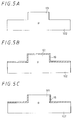
- a single crystalline silicon substrate 102 of first conductivity type (e.g., p type) in which a convex-shaped portion 101 is formed on one major surface by some suitable process such as a selective etching process or the like is formed, and then the surface of this silicon substrate 102 is oxidized to form the SiO2 film 16 (see FIG. 5B). Then, only the SiO2 film 16 on the convex-shaped portion 101 is removed by the selective etching process as shown in FIG. 5C. Then, as shown in FIG.
- p type high concentration impurity regions 17, 18 made of polycrystalline silicon forming one part of gate electrode are respectively formed on both sides of the convex-shaped portion 101 through the SiO2 film 16, and the drain portion 13 formed of superconductive material is formed on the convex-shaped portion 101 as shown in FIG. 5D.
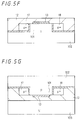
- the insulating film 12 made of SiO2 or the like is deposited on the entire surface of the silicon substrate 102 so as to cover the convex-shaped portion 101 as shown in FIG. 5E, the surface of the insulating film 12 is made flat by the planarization process as shown in FIG. 5F.
- other silicon substrate 103 is bonded to the upper surface of the insulating film 12 as shown in FIG. 5G, and FIG.
- 5G shows the condition such that the product is inverted after the silicon substrate 103 is bonded to the insulating film 12 by the bonding-process.
- one silicon substrate 102 is ground and polished so as to expose the p type high concentration impurity regions 17, 18 which become gate electrodes, whereby the convex-shaped portion 101 is presented as the silicon thin film 14 of channel length L as shown in FIG. 5H.
- the superconductive source portion 15 is formed on the upper surface of the silicon thin film 14 and the Al electrodes 19, 20 forming the gate electrodes are formed on the upper surfaces of the p type high concentration impurity regions 17, 18, thereby the target superconductor transistor 21 shown in FIG. 3 being obtained.
- the superconductive source and drain portions 15 and 13 are formed on the upper and lower surfaces of the p type silicon thin film channel portion 14, owing to the superconductive proximity effect, superconductive electron pairs from the superconductive source and drain portions 15, 13 are extended to the upper and lower sides in the channel portion 14 to thereby form semi-superconductive portions 22S, 22D which are expanded in an opposing relation to each other as shown in FIG. 4.
- the semi-superconductive portions 22S, 22D are controlled by a gate voltage supplied to the high concentration impurity regions 17, 18 formed at both sides of the channel portion 14 so that the superconductive current is turned on and off. Accordingly, since this transistor 21 is operated in a superconductive fashion, the power consumption thereof is considerably small and the electric resistance thereof is substantially zero, thereby achieving the ultra-high speed operation of the transistor 21.
- the features of the SOI structure are effectively utilized such that the opposing source and drain portions 15 and 13 are formed on the upper and lower sides of the silicon thin film 14 which forms the channel portion and the semi-superconductive portions 22S and 22D at the sides of the source and drain portions 15 and 13 are extended over the whole widths of the source and drain portions 15 and 13 in contact with the silicon film 14 by the gate voltage in an opposing fashion, the two semi-superconductive portions 22S and 22D can be overlapped sufficiently by the small area, thereby facilitating the control of the superconductive current flowing between the source and drain portions 15 and 13.
- the film thickness of the silicon thin film 14 can be reduced to less than 0.1 ⁇ m, which can realize with ease the channel length L of less than 0.2 ⁇ m that is one of the requirements as the superconductor transistor.
- the superconductive operation can be controlled satisfactorily and this kind of superconductor transistor can be densified and highly integrated.
- FIG. 6 shows a second embodiment of the superconductor transistor according to the present invention.
- a p+ type silicon columnar-shaped channel portion 25 of a predetermined width L is integrally formed on one major surface of a semiconductor substrate of a first conductivity type, for example, p type silicon substrate 24, and superconductive source and drain portions 26 and 27 are formed on both side surfaces of the columnar-shaped channel portion 25.
- a gate electrode 29 made of Al semiconductor or the like is formed on the upper surface of the columnar-shaped channel portion 25 through an insulating film 28 made of SiO2 or the like, thereby a superconductor transistor 30 being constructed.
- the channel portion 25 is formed of a p+ type silicon of proper impurity concentration (e.g., about 1019 cm ⁇ 3 ) and the channel length L is less than 0.2 ⁇ m.
- an impurity diffusion region 24a of impurity concentration of about 1019 cm ⁇ 3 is formed on one major surface of a p type single crystalline silicon substrate 24, and a polycrystalline silicon film 33 treated by the patterning-process is formed on one major surface of the impurity diffusion region 24a through an insulating film 32 formed of SiO2 or the like.
- An SiO2 film 34 is deposited on the whole surface thereof by, for example, the chemical vapor deposition (CVD) process.
- the whole surface of the SiO2 film 34 is etched by the anisotropy etching process (e.g., reactive ion etching (RIE) process or the like) to thereby form an SiO2 side wall portion 34a on an end face of the polycrystalline silicon film 33 as shown in FIG. 8B.
- the polycrystalline silicon film 34 is removed, the impurity diffusion region 24a on the silicon substrate 24 is removed by the etching-process using the side wall portion 34a as a mask, and then the side wall portion 34a is removed, thereby forming the columnar-shaped channel portion 25 of 0.1 ⁇ m wide as shown in FIG. 8D.
- the superconductive source and drain portions 26 and 27 are formed on both side surfaces of the columnar-shaped channel portion 25. Further, the SiO2 film 28 is formed on the whole surface and the gate electrode 29 is formed on the upper surface of the columnar-shaped channel portion 25, thereby the superconductor transistor 30 shown in FIG. 8E being formed.
- the opposing source and drain portions 26 and 27 are formed on both side surfaces of the columnar-shaped channel portion 25 so that the semi-superconductive portions 35S and 35D on the sides of the source and drain portions 26 and 27 are extended over the whole areas of the source and drain portions 26 and 27 in contact with the columnar-shaped channel portion 25 by the gate voltage in an opposing fashion, the two semi-superconductive portions 35S and 35D can be overlapped sufficiently by the small area, thereby facilitating the control of the superconductive current flowing between the source and drain portions 26 and 27. Furthermore, since the width of the columnar-shaped channel portion 25 can be reduced to less than 0.1 ⁇ m, which can realize with ease the channel length L of less than 0.2 ⁇ m that is one of the requirements of the superconductor transistor. Also in accordance with this embodiment, the superconductor transistor can be densified and highly integrated.
- FIG. 9 shows a third embodiment of the superconductor element according to the present invention which is suitably applied to a dynamic RAM cell.
- This embodiment makes effective use of the superconductor transistor 30 of the columnar-shaped channel structure of FIG. 6.
- like parts corresponding to those of FIG. 6 are marked with the same references and therefore need not be described in detail.
- the p type silicon columnar-shaped channel portion 25 having a channel length L of less than 0.2 ⁇ m is integrally formed on one major surface of the semiconductor substrate of first conductivity type, for example, the p type silicon substrate 24, and the superconductive source and drain portions 26 and 27 are formed on both sides of the columnar-shaped channel portions 25.
- the gate electrode 29 made of Al or the like is formed on the upper surface of the channel portion 25 through the insulating film 28 to thereby form the superconductor transistor 30.
- a superconductive electrode 37 is formed on the outside of the drain portion 27 of the superconductor transistor 30 through a dielectric film 38 made of SiO2 or the like so as to oppose the drain portion 27.
- the superconductive drain portion 27, the dielectric film 38 and the superconductive electrode 37 constitute a capacitance 39.
- the superconductive electrode 37 and the silicon substrate 24 are electrically insulated from each other by means of an insulating film or the like, though not shown.
- a superconductive dynamic RAM cell 40 of so-called one transistor and one capacitance type is constructed in this fashion.
- the interconnection of ordinary metal wires is utilized in the portion in which a current need not be flowed, that is, the portion in which the voltage is turned on and off (e.g., gate portion).
- FIG. 10 shows a diagram of an equivalent circuit of the dynamic RAM cell 40 shown in FIG. 9.
- the dynamic RAM cell 40 of the present invention is composed of the superconductor transistor 30 and the capacitance 37 having the superconductor electrode 37, the power consumption of the dynamic RAM cell 40 is very small and the electric resistance thereof is substantially zero, thereby the ultra-high speed operation of the dynamic RAM cell 40 being made possible. Further, since the superconductive electrode 37 is directly formed on the insulating film which covers the drain electrode 27 of the columnar-shaped channel type superconductor transistor 30 from a structure standpoint, the dynamic RAM cell 40 can be manufactured with ease, densified and highly integrated.
- FIG. 11 shows a fourth embodiment of the high speed switching electron device according to the present invention which is applied to a diode effectively utilizing a resonance tunnel effect.
- a region which constructs a quantum well for example, a silicon semiconductor region 52 is formed on a substrate 51, and insulating thin films constructing double potential barriers, for example, SiO2 thin films 53, 54 are formed on both sides of the silicon semiconductor region 52. Terminals 55 and 56 are formed on the outsides of the SiO2 thin films 53, 54 and thus a resonance tunnel effect diode 58 is completed.
- the silicon semiconductor region 52 forming the quantum well is formed of a first conductivity type (n+ or p+ type) region having a high impurity concentration and its length l is selected to be about a quantum dynamics wavelength of electron, for example, approximately, 50 ⁇ .
- Film thicknesses T1 and T2 of the SiO2 thin films 53 and 54 formed across this quantum well are selected to be about quantum dynamics wavelength of electron, for example, about 20 ⁇ .
- the terminals 55 and 56 can be made of, for example, n+ or p+ type silicon region of high impurity concentration.
- the substrate 51 can be formed by, for example, the silicon substrate and at that time, the substrate 51 and the silicon semiconductor region 52 constructing the quantum well can be formed as one body with each other.
- the substrate 51 and the terminals 55, 56 are electrically isolated by an insulating layer 57 made of SiO2 or the like.
- the region 52 constructing the quantum well and the terminals 55, 56 are not limited to the silicon-based semiconductor material and may be formed of metal or other semiconductor material (including a compound semiconductor material).
- the resonance tunnel effect diode 58 As shown in FIGS. 12A to 12C forming the diagrams of energy bands presented under the application of the voltage, if the terminals 55, 56 have zero voltage therebetween and a quantum level 62 within the quantum well 52 is higher than that of a conduction band 61 at the terminal 55 side (see FIG. 12A) or if an applied voltage (i.e., so-called trough voltage) is high and the level of the conduction band 61 at the terminal 55 side corresponds to a level between the quantum levels 62 within the quantum well 52 (see FIG. 12C), then the resonance tunnel effect does not occur so that no electron is flowed.
- an applied voltage i.e., so-called trough voltage
- this resonance tunnel effect diode 58 since slightly different two gate voltages cause quite different responses to occur, the switching of the semiconductor element can be controlled precisely. Further, since this resonance tunnel effect diode 58 is operated as electron wave, the high speed operation becomes possible. Furthermore, this resonance tunnel effect diode 58 can be densified and highly integrated in accordance with the requirements of the future devices. Also, since this resonance tunnel effect diode 58 is densified, this diode 58 can be operated at low voltage and its power consumption can be reduced. In addition, since the quantum well in this resonance tunnel effect diode 58 is formed of the silicon-based semiconductor, metal or compound semiconductor etc., the resonance tunnel effect transistor 58 can be manufactured with ease.
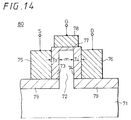
- FIG. 14 shows a fifth embodiment of the superconductor transistor according to the present invention which is also applied to the transistor utilizing the resonance tunnel effect.
- a semiconductor region constructing a quantum well for example, a silicon semiconductor region 72 is formed on a substrate 71, and insulating films constructing double potential barriers, for example, SiO2 thin films 73, 74 are formed at both sides of the silicon semiconductor region 72.
- Source and drain portions 75 and 76 formed of silicon semiconductor materials (n+ or p+ type) of, for example, high impurity concentration are formed on the outsides of the SiO2 thin films 73 and 74, and a gate electrode 78 formed of a silicon semiconductor material (n+ or p+ type) of, for example, high impurity concentration is formed on the upper surface of the silicon semiconductor region 72 through an insulating film 77 formed of SiO2 or the like, thereby a resonance tunnel effect transistor 80 being constructed.
- the silicon semiconductor region 72 constructing the quantum well is formed of a first conductivity type (n+ or p+ type) and its width m is selected to be about a quantum dynamics wavelength of electron, for example, about 50 ⁇ .
- film thicknesses T3 and T4 of the SiO2 thin films 73 and 74 formed across the silicon semiconductor region 72 are also selected to be about quantum dynamics wavelength of electron, for example, about 20 ⁇ .
- the substrate 71 can be formed of, for example, the silicon substrate and at that time, the substrate 71 can be integrally formed with the silicon semiconductor region 72 constructing the quantum well.
- the substrate 71 and the source and drain portions 75, 76 are electrically isolated by an insulating film 79 formed of SiO2 or the like.
- the region 72 constructing the quantum well, the source portion 75, the drain portion 74 and the gate electrode 78 are not limited to the silicon-based semiconductor material and may be formed by metal or other semiconductor material (including compound semiconductor material).
- the quantum level of the quantum well 72 is controlled by the gate voltage supplied to the gate electrode 78 formed on the upper surface of the quantum well 72, thus this transistor 80 being operated.
- the resonance tunnel effect transistor 80 since very slightly different gate voltages cause the perfectly different responses to occur, the switching of the semiconductor element can be controlled at high accuracy. Further, since this transistor 80 is operated as the electron wave, the transistor 80 can be operated at high speed. Further, since the resonance tunnel effect transistor 80 is formed as the three-terminal electron device, this transistor 80 can be operated efficiently and is easy to handle. Furthermore, this resonance tunnel effect transistor 80 can be densified in accordance with the requirements of the future electron device and highly integrated. Also, since the resonance tunnel effect transistor 80 is densified, this transistor 80 can be operated at low voltage and its power consumption can be reduced. In addition, since the quantum well of the resonance tunnel effect transistor 80 is formed of the silicon-based semiconductor, metal or compound semiconductor or the like, this resonance tunnel effect transistor 80 can be manufactured with ease.
- the ultra-high speed operation becomes possible and the superconductor operation at the channel portion can be controlled satisfactorily. Further, the channel length of less than 0.2 ⁇ m can be realized with ease. Thus, it is possible to provide the high speed electron device which can be suitably densified and highly integrated.
- the power consumption thereof can be reduced considerably and the ultra-high speed operation becomes possible.
- the high speed memory device of the present invention can be manufactured with ease, the memory device can be densified and highly integrated.
- this high speed electron device can be operated at very high speed, manufactured with ease, densified and highly integrated.
Landscapes
- Superconductor Devices And Manufacturing Methods Thereof (AREA)
- Thin Film Transistor (AREA)
- Semiconductor Memories (AREA)
Applications Claiming Priority (2)
| Application Number | Priority Date | Filing Date | Title |
|---|---|---|---|
| JP02338350A JP3092160B2 (ja) | 1990-11-30 | 1990-11-30 | 高速素子及び高速メモリ素子 |
| JP338350/90 | 1990-11-30 |
Publications (3)
| Publication Number | Publication Date |
|---|---|
| EP0487922A2 true EP0487922A2 (de) | 1992-06-03 |
| EP0487922A3 EP0487922A3 (en) | 1992-10-21 |
| EP0487922B1 EP0487922B1 (de) | 1997-01-29 |
Family
ID=18317325
Family Applications (1)
| Application Number | Title | Priority Date | Filing Date |
|---|---|---|---|
| EP91118551A Expired - Lifetime EP0487922B1 (de) | 1990-11-30 | 1991-10-30 | Ultraschnelle elektronische Schalteinrichtung |
Country Status (5)
| Country | Link |
|---|---|
| EP (1) | EP0487922B1 (de) |
| JP (1) | JP3092160B2 (de) |
| KR (1) | KR920010985A (de) |
| DE (1) | DE69124476T2 (de) |
| TW (1) | TW303514B (de) |
Family Cites Families (1)
| Publication number | Priority date | Publication date | Assignee | Title |
|---|---|---|---|---|
| KR910002311B1 (ko) * | 1987-02-27 | 1991-04-11 | 가부시기가이샤 히다찌세이사꾸쇼 | 초전도 디바이스 |
-
1990
- 1990-11-30 JP JP02338350A patent/JP3092160B2/ja not_active Expired - Fee Related
-
1991
- 1991-10-22 KR KR1019910018553A patent/KR920010985A/ko not_active Ceased
- 1991-10-30 EP EP91118551A patent/EP0487922B1/de not_active Expired - Lifetime
- 1991-10-30 DE DE69124476T patent/DE69124476T2/de not_active Expired - Fee Related
- 1991-11-25 TW TW080109242A patent/TW303514B/zh active
Also Published As
| Publication number | Publication date |
|---|---|
| KR920010985A (ko) | 1992-06-27 |
| DE69124476T2 (de) | 1997-08-14 |
| EP0487922B1 (de) | 1997-01-29 |
| EP0487922A3 (en) | 1992-10-21 |
| JPH04206975A (ja) | 1992-07-28 |
| DE69124476D1 (de) | 1997-03-13 |
| TW303514B (de) | 1997-04-21 |
| JP3092160B2 (ja) | 2000-09-25 |
Similar Documents
| Publication | Publication Date | Title |
|---|---|---|
| JP3111985B2 (ja) | 電界効果型トランジスタ | |
| US5834793A (en) | Semiconductor devices | |
| US5097311A (en) | Semiconductor device | |
| US3514676A (en) | Insulated gate complementary field effect transistors gate structure | |
| EP4371160A1 (de) | Dünnfilm-halbleiter-schaltvorrichtung | |
| JP2015144295A (ja) | 金属トランジスターデバイス | |
| US5640346A (en) | Electrically programmable memory cell | |
| EP0160456A2 (de) | Supraleitende Anordnung | |
| US5164804A (en) | Semiconductor device having high breakdown voltage and low resistance and method of fabricating the same | |
| EP0718894B1 (de) | Coulomb-Blockade-Element und Verfahren zur Herstellung | |
| JPH11354756A (ja) | 半導体装置及びその製造方法 | |
| US4153984A (en) | Method of fabricating an MNOS memory device | |
| US6774451B2 (en) | Mos transistor for high density integration circuits | |
| EP0487922A2 (de) | Ultraschnelle elektronische Schaltungseinrichtung | |
| JP3402905B2 (ja) | 半導体素子 | |
| JPH07211913A (ja) | 半導体装置及びその製造方法 | |
| JPS595663A (ja) | 半導体装置 | |
| US4635084A (en) | Split row power JFET | |
| KR100434813B1 (ko) | 실리사이드막을 이용한 단전자 트랜지스터의 구조 및 그제조 방법 | |
| JPS58145162A (ja) | 半導体装置の製造方法 | |
| JP2641978B2 (ja) | 超電導素子および作製方法 | |
| JP2911159B2 (ja) | 半導体装置 | |
| JPS61208279A (ja) | 超伝導三端子素子及びその製造方法 | |
| JP2621819B2 (ja) | 半導体素子およびその製造方法 | |
| JP2000150863A (ja) | 高速素子 |
Legal Events
| Date | Code | Title | Description |
|---|---|---|---|
| PUAI | Public reference made under article 153(3) epc to a published international application that has entered the european phase |
Free format text: ORIGINAL CODE: 0009012 |
|
| AK | Designated contracting states |
Kind code of ref document: A2 Designated state(s): DE FR GB |
|
| PUAL | Search report despatched |
Free format text: ORIGINAL CODE: 0009013 |
|
| AK | Designated contracting states |
Kind code of ref document: A3 Designated state(s): DE FR GB |
|
| 17P | Request for examination filed |
Effective date: 19930208 |
|
| 17Q | First examination report despatched |
Effective date: 19950208 |
|
| GRAG | Despatch of communication of intention to grant |
Free format text: ORIGINAL CODE: EPIDOS AGRA |
|
| GRAH | Despatch of communication of intention to grant a patent |
Free format text: ORIGINAL CODE: EPIDOS IGRA |
|
| GRAH | Despatch of communication of intention to grant a patent |
Free format text: ORIGINAL CODE: EPIDOS IGRA |
|
| GRAA | (expected) grant |
Free format text: ORIGINAL CODE: 0009210 |
|
| AK | Designated contracting states |
Kind code of ref document: B1 Designated state(s): DE FR GB |
|
| REF | Corresponds to: |
Ref document number: 69124476 Country of ref document: DE Date of ref document: 19970313 |
|
| ET | Fr: translation filed | ||
| PLBE | No opposition filed within time limit |
Free format text: ORIGINAL CODE: 0009261 |
|
| STAA | Information on the status of an ep patent application or granted ep patent |
Free format text: STATUS: NO OPPOSITION FILED WITHIN TIME LIMIT |
|
| 26N | No opposition filed | ||
| REG | Reference to a national code |
Ref country code: GB Ref legal event code: IF02 |
|
| PGFP | Annual fee paid to national office [announced via postgrant information from national office to epo] |
Ref country code: FR Payment date: 20031003 Year of fee payment: 13 |
|
| PGFP | Annual fee paid to national office [announced via postgrant information from national office to epo] |
Ref country code: GB Payment date: 20031029 Year of fee payment: 13 |
|
| PGFP | Annual fee paid to national office [announced via postgrant information from national office to epo] |
Ref country code: DE Payment date: 20031103 Year of fee payment: 13 |
|
| PG25 | Lapsed in a contracting state [announced via postgrant information from national office to epo] |
Ref country code: GB Free format text: LAPSE BECAUSE OF NON-PAYMENT OF DUE FEES Effective date: 20041030 |
|
| PG25 | Lapsed in a contracting state [announced via postgrant information from national office to epo] |
Ref country code: DE Free format text: LAPSE BECAUSE OF NON-PAYMENT OF DUE FEES Effective date: 20050503 |
|
| GBPC | Gb: european patent ceased through non-payment of renewal fee |
Effective date: 20041030 |
|
| PG25 | Lapsed in a contracting state [announced via postgrant information from national office to epo] |
Ref country code: FR Free format text: LAPSE BECAUSE OF NON-PAYMENT OF DUE FEES Effective date: 20050630 |
|
| REG | Reference to a national code |
Ref country code: FR Ref legal event code: ST |