EP0488325A2 - Brouilleur parallèle utilisé pour la transmission de données par sonet - Google Patents
Brouilleur parallèle utilisé pour la transmission de données par sonet Download PDFInfo
- Publication number
- EP0488325A2 EP0488325A2 EP91120448A EP91120448A EP0488325A2 EP 0488325 A2 EP0488325 A2 EP 0488325A2 EP 91120448 A EP91120448 A EP 91120448A EP 91120448 A EP91120448 A EP 91120448A EP 0488325 A2 EP0488325 A2 EP 0488325A2
- Authority
- EP
- European Patent Office
- Prior art keywords
- flip
- data
- series
- flops
- input
- Prior art date
- Legal status (The legal status is an assumption and is not a legal conclusion. Google has not performed a legal analysis and makes no representation as to the accuracy of the status listed.)
- Withdrawn
Links
Images


Classifications
-
- H—ELECTRICITY
- H04—ELECTRIC COMMUNICATION TECHNIQUE
- H04L—TRANSMISSION OF DIGITAL INFORMATION, e.g. TELEGRAPHIC COMMUNICATION
- H04L25/00—Baseband systems
- H04L25/02—Details ; arrangements for supplying electrical power along data transmission lines
- H04L25/03—Shaping networks in transmitter or receiver, e.g. adaptive shaping networks
- H04L25/03828—Arrangements for spectral shaping; Arrangements for providing signals with specified spectral properties
- H04L25/03866—Arrangements for spectral shaping; Arrangements for providing signals with specified spectral properties using scrambling
- H04L25/03872—Parallel scrambling or descrambling
Definitions
- This invention relates to digital communications systems and, more particularly, to a SONET data transmission system which is an optical fiber system, in which data is scrambled.
- Synchronous Optical Network which is derived from a base rate and format, combined with a multiplexing scheme. This results in a modular family of rates and formats available for use in optical interfaces.
- the base rate is known as the Synchronous Transport Signal level 1 (STS-1).
- STS-1 frame is a serial bit stream of 810 bytes, with each byte including eight bits.
- the STS-1 framing is dedicated to the first two bytes A1 and A2 of each STS-1 frame.
- the framing pattern for bytes A1 and A2 is F628 Hex (1111011000101000), where A1 equals F6 Hex (11110110) and A2 equals 28 Hex (00101000).
- a C1 identification byte follows bytes A1 and A2.
- Higher rates (STS-N) in SONET are accomplished by byte interleave multiplexing an N number of STS-1 frames.
- the framing pattern for an STS-3 frame in an Optical Carrier level 3 (OC-3) system is then A1A1A1A2A2A2.
- the framing pattern for Aan STS-12 frame in an OC-12 system is twelve A1 bytes followed by twelve A2 bytes.
- SONET scrambling requirements are a frame synchronous scrambler of sequence length 127, operating at the line rate.
- SONET Specifications propose a serial scrambler where the output from the X7 position shall be added to the serial data stream. This requires the majority of the SONET interface circuitry to operate at the line rate, which in an OC-12 system is a clock rate of 622.08 MHz.
- Another object of this invention is to provide a scrambling circuit requiring minimal power and operating at low line rate.
- the data transmitter channel of a SONET system includes a module called a scrambler and the detector channel includes a module called a descrambler.
- scrambler and descrambler circuits are identical in components and the terms scrambler and descrambler may be used interchangeably.
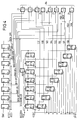
- a scrambler circuit 100 embodying this invention includes a first series of flip-flops 1 through 7 for generating the SONET polynomial and a second series of flip-flops 8 through 15 which capture every eighth term of the polynomial.
- a master exclusive OR gate 110 is associated with these flip-flops.
- the flip-flops 1 through 7 have their set terminals coupled together by a lead 120.
- the clock terminals of these flip-flops are connected together by a lead 122 to a high speed clock input 130 (HSCKB).
- the Q output terminal of each of these flip-flops is connected to the data terminal of the next flip-flop in the series.
- flip-flops 1 and 8 are connected by lead 134 to the output terminal of the exclusive OR gate 110. All of the reset terminals of the flip-flops 8 through 15 are connected to lead 138 from the output of OR gate 140.
- the circuit 100 includes a timing circuit 101 for enabling and disabling the scrambler.
- This timing circuit or timing generator includes an OR gate 140 coupled to a 2:1 (two inputs - one output) multiplexer 144 and a NOR gate 148 coupled to flip-flop 16 which is coupled to the multiplexer 144.
- the multiplexer 144 is also coupled to series- connected flip-flops 17 and 18.
- a descrambler enable signal (DSCREN) is applied to lead 150 which is connected to terminal A of the input to the OR gate 140.
- a source of reset signal (RESET) is connected to lead 152 which is connected to the B input to OR gate 140.
- the output of the OR gate 140 is connected to lead 138 to the reset terminals of the flip-flops 8 through 15.
- This lead 138 out of OR gate 140 is also connected to an input of the multiplexer 144.
- the output of the multiplexer 144 is coupled to the data terminal of flip-flop 17.
- the output of the flip-flop 17 is connected to the data terminal of the flip-flop 18 and to an input terminal of the multiplexer 144.
- the output of flip-flop 18 is connected to the set lead 120.
- a divide by eight clock signal (DIV8) is connected to one input of NOR gate 148 and a divide by four signal (DIV4B) is coupled to the second input of the NOR gate 148.
- the output terminal of NOR gate 148 is connected to the data input of flip-flop 16 and the output of flip-flop 16 is coupled to the multiplexer 144.
- a clock input HSCK is coupled on lead 160 to the clock inputs of flip-flops 16 and 17 and the clock input of flip-flop 18 is connected by lead 162 to lead 122 from clock HSCKB.
- the circuit 100 also includes a series of exclusive OR gates 22 to 29 each of which includes four input terminals.
- one terminal of each is named LDAT (data) and one terminal is named DSCR.
- the terminals LDAT are denoted LDAT0, LDAT1...LDAT7 for the exclusive OR gates 22 to 29 respectively, and the terminals DSCR one similarly denoted DSCR0 to DSCR7 for these gates.
- All of the LDAT terminals are connected to a bus 168 (LDAT).
- Bus 168 (LDAT) includes eight parallel lines of data coming from a serial/parallel shift register the input of which receives the data in serial form. The serial/parallel register is not shown herein. Thus, eight separate data lines are coupled to the one input of the XOR gates and LDAT0 represents one line. LDAT1 represents a second line, etc.
- all of the DSCR terminals are connected to the output of the associated flip-flop 8 through 15, respectively, with DSCR0 connected to flip-flop 8, DSCR1 connected to flip-flop 9, etc.
- first flip-flops 1 to 7 are preset to 1111111 on the byte following the STS-1 #N C1 (STS-1 ID) byte. This is done by DSCREN and power-up reset signals on leads 150 and 152, respectively. This byte and all subsequent bytes to be scrambled are added to the outputs of the scrambler. The frame bytes A1 and A2 and the STS-1 identification byte C1 from STS-1 #1 through STS-1 #N are not scrambled.
- the scrambler (or descrambler) is enabled during all bytes of a data frame except when A1's, A2's and C1 are present at the beginning of a frame.
- An external signal FRMSYN (frame synch) is used to drive DSCREN which enables and disables the scrambler.
- the FRMSYN signal is a high level pulse whose period is 125 microseconds and whose duration is dependent on the system line rate configuration (i.e., OC-3 or OC-12).
- the FRMSYN signal is loosely frame aligned with the beginning of the SONET Frame and circuitry is provided to synchronize FRMSYN with the scrambler timing.
- the new synchronized signal is DSCREN (Descrambler enable) which is applied to lead 150 into OR gate 140.
- the timing window for FRMSYN to go high is one-half period of the DIV8 clock on either side of the start of a new serial frame, where DIV8 is at one-eighth of the line rate.
- FRMSYN is synchronized with the Descrambler by the DIV8B clock (the inverse of DIV8 clock).
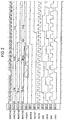
- FRMSYN is captured by a flip-flop clocked with DIV8B and then clocked into a flip-flop by the high speed clock, the output of which is signal DSCREN. Timing diagrams for disabling the Descrambler are shown in FIG. 2.
- DSCREN on lead 150 is applied to OR gate 140 where it is OR'ed with power-up reset on lead 152 and applied to the resets of the parallel data flip-flop latches 8 through 15.
- DSCREN is also applied to the SET inputs of flip-flops 1 through 7 via circuitry composed of multiplexer 144 and flip-flops 17 and 18.
- Flip-flops 1 through 7 and exclusive OR gate 110 implement the SONET polynomial 1+X6+X7.
- the setting or disabling of the polynomial circuitry timing is not critical as the resetting of latches 8 through 15 isolates all outputs of the polynomial circuitry.
- the timing of DSCREN is such that DSCREN going high resets flip-flops 8 through 15 in the middle of the period of the DIV8 clock after the last byte of the previous frame is added to the sampled polynomial output and prior to the application of the first A1 byte of the present frame.
- the enabling of the descrambler occurs on the byte following the STS-1 #N C1 (STS-1 ID) byte.
- the FRMSYN low going signal timing window is one-half the DIV8 clock period on either side of the rising edge of the DIV8 clock that captures the last C1 byte from the serial data stream.
- the FRMSYN timing window for disabling (logic one or high) and enabling (logic zero or low) is one DIV8 period or eight times the line rate period.
- DSCREN developed by FRMSYN being clocked by DIV8B and one high speed clock, goes low (removes reset) and enables flip-flops 8 through 15.
- the timing enabling (set removal) of the polynomial flip-flops 1 through 7 is critical and thus the need for OR gate 140, (2:1) multiplexer 144 and flip-flops 16, 17 and 18.
- the enabling of the polynomial flip-flops 1 through 7 must be delayed until after the DIV8 clock rising edge loads in the first polynomial value (FE HEX) to be added to the first data byte after the last C1 byte and before the next rising edge of HSCKB clock (inverse of the high speed clock HSCK).
- the logic low output of multiplexer 144 is sampled by flip-flop 17 with HSCK and the logic low output of flip-flop 17 is looped back to the zero input of multiplexer 144 where the select input (flip-flop 16 output) is now a logic low and is thus retained by flip-flop 17.
- the logic level of DSCREN is sampled every eight high speed clock pulses by NOR gate 148, flip-flop 16, and multiplexer 144 through OR gate 140.
- flip-flop 18 is used to retime the falling edge of the polynomial SET signal POLYSET (out of flip-flop 18) with the HSCKB clock.
- the start of a SONET frame on bus 168 begins with A1 and A2 bytes which are the framing pattern, and C1 bytes which are the identification bytes. These non data bytes (A1, A2, C1) pass through the circuit unchanged, i.e., neither scrambled nor descrambled. Thus, the scrambler (descrambler) is disabled when A1, A2 and C1 bytes pass through the circuit.
- flip-flop latches 8 through 15 are applied each to one input of each of the exclusive OR gates 22 through 29 and thus each such output is added to the data in the exclusive OR gate.
- SDAT(7:0) is the HEX value results of the descrambler adding LDAT(7:0) with DSCR(7:0).
- FRMSYN is the external descrambler disabling and enabling signal, the crosshatched area being the allowed window of edge transition.
- DSCREN is the synchronized FRMSYN signal clocked by DIV8B and then HSCKB.
- POLYSET derived from DSCREN, is the SET signal for polynomial flip-flops 1 through 7; the timing for this signal is most critical when the descrambler is enabled.
- HSCKB the inverted high speed clock, clocks polynomial flip-flops 1 through 7.
- DIV8 clock is one-eighth the high speed clock.
- DIV4B inverted DIV4, is one-fourth the high speed clock.
- DIV2 is one-half the high speed clock.
- CNT2 is the output of NOR gate 148, the timing generator decoded "two"
- FIG. 4 there is shown the serial to parallel register from which the input/output leads LDAT0 through LDAT7 are coupled to the exclusive OR gates 22 through 29.
- the eight parallel LDAT leads and the polynomial flip-flops are shown coupled to the exclusive OR gates.
Landscapes
- Engineering & Computer Science (AREA)
- Physics & Mathematics (AREA)
- Spectroscopy & Molecular Physics (AREA)
- Power Engineering (AREA)
- Computer Networks & Wireless Communication (AREA)
- Signal Processing (AREA)
- Synchronisation In Digital Transmission Systems (AREA)
Applications Claiming Priority (2)
| Application Number | Priority Date | Filing Date | Title |
|---|---|---|---|
| US619155 | 1990-11-28 | ||
| US07/619,155 US5163092A (en) | 1990-11-28 | 1990-11-28 | Parallel scrambler used in sonet data transmission |
Publications (2)
| Publication Number | Publication Date |
|---|---|
| EP0488325A2 true EP0488325A2 (fr) | 1992-06-03 |
| EP0488325A3 EP0488325A3 (en) | 1993-05-19 |
Family
ID=24480687
Family Applications (1)
| Application Number | Title | Priority Date | Filing Date |
|---|---|---|---|
| EP19910120448 Withdrawn EP0488325A3 (en) | 1990-11-28 | 1991-11-28 | Parallel scrambler used in sonet data transmission |
Country Status (3)
| Country | Link |
|---|---|
| US (1) | US5163092A (fr) |
| EP (1) | EP0488325A3 (fr) |
| JP (1) | JPH04269035A (fr) |
Cited By (3)
| Publication number | Priority date | Publication date | Assignee | Title |
|---|---|---|---|---|
| EP0777367A1 (fr) * | 1995-11-30 | 1997-06-04 | STMicroelectronics S.A. | Circuit de suppression de dispersion dans une transmission de données |
| EP0748089A3 (fr) * | 1995-06-05 | 1997-08-06 | Matsushita Electric Industrial Co Ltd | Procédé et appareil d'embrouillage et de désembrouillage de données |
| US5966447A (en) * | 1996-06-04 | 1999-10-12 | Matsushita Electric Industrial Co., Ltd. | Data scrambling method, data scrambling apparatus, data descrambling method, and data descrambling apparatus |
Families Citing this family (19)
| Publication number | Priority date | Publication date | Assignee | Title |
|---|---|---|---|---|
| ES2038912B1 (es) * | 1991-09-30 | 1994-08-01 | Alcatel Standard Electrica | Sistema sincrono de aleatorizacion de datos en paralelo. |
| US5216714A (en) * | 1991-12-13 | 1993-06-01 | 3Com Corporation | Method and apparatus for controlling the spectral content of a data stream |
| KR950013847B1 (ko) * | 1993-03-18 | 1995-11-16 | 한국전기통신공사 | 셀 기반 병렬 비동기 전달 모드(atm) 물리계층의 역혼화를 위한 병렬 분산 표본 역혼화 회로 |
| US5440640A (en) * | 1993-10-05 | 1995-08-08 | Arithmetica, Inc. | Multistream encryption system for secure communication |
| US5696692A (en) * | 1995-04-24 | 1997-12-09 | Cadence Design Systems, Inc. | Conditional selection method for reducing power consumption in a circuit |
| SE506817C2 (sv) * | 1996-06-20 | 1998-02-16 | Ericsson Telefon Ab L M | Seriell-parallell- och parallell-seriellomvandlare innefattande frekvensdelare |
| US5946398A (en) * | 1997-03-25 | 1999-08-31 | Level One Communications, Inc. | State synchronized cipher text scrambler |
| US6122376A (en) * | 1997-08-28 | 2000-09-19 | Level One Communications, Inc. | State synchronized cipher text scrambler |
| US6577732B1 (en) * | 1998-09-22 | 2003-06-10 | Lucent Technologies Inc. | Hierarchical encryption technique for dense wavelength division multiplexed systems using a wavelength bus architecture |
| US6590795B2 (en) * | 2001-02-23 | 2003-07-08 | Micron Technology, Inc. | High speed data capture circuit for a digital device |
| JP4191915B2 (ja) * | 2001-08-30 | 2008-12-03 | 独立行政法人情報通信研究機構 | 変換装置、暗号化復号化システム、多段変換装置、プログラム、ならびに、情報記録媒体 |
| US20040091106A1 (en) * | 2002-11-07 | 2004-05-13 | Moore Frank H. | Scrambling of data streams having arbitrary data path widths |
| US7370212B2 (en) * | 2003-02-25 | 2008-05-06 | Microsoft Corporation | Issuing a publisher use license off-line in a digital rights management (DRM) system |
| US8438645B2 (en) | 2005-04-27 | 2013-05-07 | Microsoft Corporation | Secure clock with grace periods |
| US8725646B2 (en) | 2005-04-15 | 2014-05-13 | Microsoft Corporation | Output protection levels |
| US20060265758A1 (en) | 2005-05-20 | 2006-11-23 | Microsoft Corporation | Extensible media rights |
| CN101018097B (zh) * | 2006-02-07 | 2011-09-21 | 华为技术有限公司 | 扰码生成装置 |
| US8000477B2 (en) | 2006-06-01 | 2011-08-16 | Dell Products L.P. | Data security system and method for high bandwidth bus |
| US9473333B2 (en) * | 2008-02-11 | 2016-10-18 | International Business Machines Corporation | Communications system via data scrambling and associated methods |
Family Cites Families (6)
| Publication number | Priority date | Publication date | Assignee | Title |
|---|---|---|---|---|
| US4202051A (en) * | 1977-10-03 | 1980-05-06 | Wisconsin Alumni Research Foundation | Digital data enciphering and deciphering circuit and method |
| US4531022A (en) * | 1983-01-13 | 1985-07-23 | International Standard Electric Corporation | Device for generating binary digit pseudo-random sequences |
| US4736419A (en) * | 1984-12-24 | 1988-04-05 | American Telephone And Telegraph Company, At&T Bell Laboratories | Electronic lock system |
| GB8727846D0 (en) * | 1987-11-27 | 1987-12-31 | British Telecomm | Optical communications network |
| US5031129A (en) * | 1989-05-12 | 1991-07-09 | Alcatel Na Network Systems Corp. | Parallel pseudo-random generator for emulating a serial pseudo-random generator and method for carrying out same |
| US4965881A (en) * | 1989-09-07 | 1990-10-23 | Northern Telecom Limited | Linear feedback shift registers for data scrambling |
-
1990
- 1990-11-28 US US07/619,155 patent/US5163092A/en not_active Expired - Lifetime
-
1991
- 1991-11-28 EP EP19910120448 patent/EP0488325A3/en not_active Withdrawn
- 1991-11-28 JP JP3314268A patent/JPH04269035A/ja active Pending
Cited By (6)
| Publication number | Priority date | Publication date | Assignee | Title |
|---|---|---|---|---|
| EP0748089A3 (fr) * | 1995-06-05 | 1997-08-06 | Matsushita Electric Industrial Co Ltd | Procédé et appareil d'embrouillage et de désembrouillage de données |
| US5844989A (en) * | 1995-06-05 | 1998-12-01 | Matsushita Electric Industrial Co., Ltd. | Data scrambling method, data scrambling apparatus, data descrambling method, and data descrambling apparatus |
| US5978486A (en) * | 1995-06-05 | 1999-11-02 | Matsushita Electric Industrial Co., Ltd. | Data scrambling method, data scrambling apparatus, data descrambling method, and data descrambling apparatus |
| EP0777367A1 (fr) * | 1995-11-30 | 1997-06-04 | STMicroelectronics S.A. | Circuit de suppression de dispersion dans une transmission de données |
| FR2742016A1 (fr) * | 1995-11-30 | 1997-06-06 | Sgs Thomson Microelectronics | Circuit de suppression de dispersion dans une transmission de donnees |
| US5966447A (en) * | 1996-06-04 | 1999-10-12 | Matsushita Electric Industrial Co., Ltd. | Data scrambling method, data scrambling apparatus, data descrambling method, and data descrambling apparatus |
Also Published As
| Publication number | Publication date |
|---|---|
| EP0488325A3 (en) | 1993-05-19 |
| JPH04269035A (ja) | 1992-09-25 |
| US5163092A (en) | 1992-11-10 |
Similar Documents
| Publication | Publication Date | Title |
|---|---|---|
| US5163092A (en) | Parallel scrambler used in sonet data transmission | |
| US5185799A (en) | Parallel scrambler used in SONET data transmission | |
| EP0477582B1 (fr) | Multiplication digitale de la fréquence et circuit pour la conversion en données sérielles | |
| EP0539007B1 (fr) | Circuit et méthode de multiplexage flexible et à haute vitesse pour la transmission de données par fibres optiques | |
| US7593411B2 (en) | Bus interface for transfer of multiple SONET/SDH rates over a serial backplane | |
| US6820159B2 (en) | Bus interface for transfer of SONET/SDH data | |
| US5442636A (en) | Circuit and method for alignment of digital information packets | |
| EP0545392B1 (fr) | Circuit synchrone | |
| EP0311448B1 (fr) | Multiplexeur numérique | |
| US5202904A (en) | Pulse stuffing apparatus and method | |
| US4247936A (en) | Digital communications system with automatic frame synchronization and detector circuitry | |
| US5267236A (en) | Asynchronous parallel data formatter | |
| US4680765A (en) | Autosync circuit for error correcting block decoders | |
| JP3434149B2 (ja) | フレーム同期信号検出装置 | |
| US5113417A (en) | Frame detection system | |
| US20020114348A1 (en) | Bus interface for transfer of multiple SONET/SDH rates over a serial backplane | |
| US5784013A (en) | Circuit for removing energy dispersal in a data transmission | |
| GB2294850A (en) | Digital transmission system clock extraction circuit | |
| KR0173945B1 (ko) | 16비트 병렬 디스크램블러의 16비트 병렬 디스크램블링 데이타 생성 회로 | |
| JP3073856B2 (ja) | Atmセル処理装置 | |
| KR0168920B1 (ko) | 에스티엠-64 중계구간 오버헤드 다중화장치 | |
| KR950005610B1 (ko) | 광 케이블 텔레비젼(catv)망에서 가입자 접속/단말장치의 다중/역다중화 회로 | |
| SU1411759A1 (ru) | Устройство дл сопр жени между абонентами | |
| JPS6338901B2 (fr) | ||
| JPS6320932A (ja) | パリテイカウンタ |
Legal Events
| Date | Code | Title | Description |
|---|---|---|---|
| PUAI | Public reference made under article 153(3) epc to a published international application that has entered the european phase |
Free format text: ORIGINAL CODE: 0009012 |
|
| AK | Designated contracting states |
Kind code of ref document: A2 Designated state(s): DE FR GB NL SE |
|
| PUAL | Search report despatched |
Free format text: ORIGINAL CODE: 0009013 |
|
| AK | Designated contracting states |
Kind code of ref document: A3 Designated state(s): DE FR GB NL SE |
|
| 17P | Request for examination filed |
Effective date: 19931105 |
|
| STAA | Information on the status of an ep patent application or granted ep patent |
Free format text: STATUS: THE APPLICATION IS DEEMED TO BE WITHDRAWN |
|
| 18D | Application deemed to be withdrawn |
Effective date: 19950601 |