EP0488732A2 - Vorrichtung zur Musikbegleitung - Google Patents
Vorrichtung zur Musikbegleitung Download PDFInfo
- Publication number
- EP0488732A2 EP0488732A2 EP91311020A EP91311020A EP0488732A2 EP 0488732 A2 EP0488732 A2 EP 0488732A2 EP 91311020 A EP91311020 A EP 91311020A EP 91311020 A EP91311020 A EP 91311020A EP 0488732 A2 EP0488732 A2 EP 0488732A2
- Authority
- EP
- European Patent Office
- Prior art keywords
- information
- musical
- midi
- sound
- musical accompaniment
- Prior art date
- Legal status (The legal status is an assumption and is not a legal conclusion. Google has not performed a legal analysis and makes no representation as to the accuracy of the status listed.)
- Ceased
Links
- 230000001131 transforming effect Effects 0.000 claims description 26
- 238000001514 detection method Methods 0.000 claims description 9
- 230000015654 memory Effects 0.000 description 24
- 230000005236 sound signal Effects 0.000 description 16
- 238000000034 method Methods 0.000 description 8
- 238000004891 communication Methods 0.000 description 7
- 238000005286 illumination Methods 0.000 description 7
- 238000013459 approach Methods 0.000 description 5
- 230000033764 rhythmic process Effects 0.000 description 5
- 238000006243 chemical reaction Methods 0.000 description 4
- 230000000694 effects Effects 0.000 description 4
- 239000000203 mixture Substances 0.000 description 3
- 230000003287 optical effect Effects 0.000 description 3
- 238000012546 transfer Methods 0.000 description 3
- 238000010586 diagram Methods 0.000 description 2
- 239000012636 effector Substances 0.000 description 2
- 230000006870 function Effects 0.000 description 2
- 241001342895 Chorus Species 0.000 description 1
- 230000003044 adaptive effect Effects 0.000 description 1
- 230000005540 biological transmission Effects 0.000 description 1
- 239000003086 colorant Substances 0.000 description 1
- 239000004020 conductor Substances 0.000 description 1
- 238000010276 construction Methods 0.000 description 1
- HAORKNGNJCEJBX-UHFFFAOYSA-N cyprodinil Chemical compound N=1C(C)=CC(C2CC2)=NC=1NC1=CC=CC=C1 HAORKNGNJCEJBX-UHFFFAOYSA-N 0.000 description 1
- 230000000994 depressogenic effect Effects 0.000 description 1
- 239000000284 extract Substances 0.000 description 1
- 238000000605 extraction Methods 0.000 description 1
- 238000002360 preparation method Methods 0.000 description 1
- 238000012545 processing Methods 0.000 description 1
- 239000004065 semiconductor Substances 0.000 description 1
- 230000000007 visual effect Effects 0.000 description 1
Images



Classifications
-
- G—PHYSICS
- G10—MUSICAL INSTRUMENTS; ACOUSTICS
- G10H—ELECTROPHONIC MUSICAL INSTRUMENTS; INSTRUMENTS IN WHICH THE TONES ARE GENERATED BY ELECTROMECHANICAL MEANS OR ELECTRONIC GENERATORS, OR IN WHICH THE TONES ARE SYNTHESISED FROM A DATA STORE
- G10H5/00—Instruments in which the tones are generated by means of electronic generators
- G10H5/005—Voice controlled instruments
-
- G—PHYSICS
- G10—MUSICAL INSTRUMENTS; ACOUSTICS
- G10H—ELECTROPHONIC MUSICAL INSTRUMENTS; INSTRUMENTS IN WHICH THE TONES ARE GENERATED BY ELECTROMECHANICAL MEANS OR ELECTRONIC GENERATORS, OR IN WHICH THE TONES ARE SYNTHESISED FROM A DATA STORE
- G10H1/00—Details of electrophonic musical instruments
- G10H1/0033—Recording/reproducing or transmission of music for electrophonic musical instruments
- G10H1/0041—Recording/reproducing or transmission of music for electrophonic musical instruments in coded form
- G10H1/0058—Transmission between separate instruments or between individual components of a musical system
- G10H1/0066—Transmission between separate instruments or between individual components of a musical system using a MIDI interface
-
- G—PHYSICS
- G10—MUSICAL INSTRUMENTS; ACOUSTICS
- G10H—ELECTROPHONIC MUSICAL INSTRUMENTS; INSTRUMENTS IN WHICH THE TONES ARE GENERATED BY ELECTROMECHANICAL MEANS OR ELECTRONIC GENERATORS, OR IN WHICH THE TONES ARE SYNTHESISED FROM A DATA STORE
- G10H1/00—Details of electrophonic musical instruments
- G10H1/36—Accompaniment arrangements
- G10H1/361—Recording/reproducing of accompaniment for use with an external source, e.g. karaoke systems
-
- G—PHYSICS
- G10—MUSICAL INSTRUMENTS; ACOUSTICS
- G10H—ELECTROPHONIC MUSICAL INSTRUMENTS; INSTRUMENTS IN WHICH THE TONES ARE GENERATED BY ELECTROMECHANICAL MEANS OR ELECTRONIC GENERATORS, OR IN WHICH THE TONES ARE SYNTHESISED FROM A DATA STORE
- G10H2220/00—Input/output interfacing specifically adapted for electrophonic musical tools or instruments
- G10H2220/005—Non-interactive screen display of musical or status data
- G10H2220/011—Lyrics displays, e.g. for karaoke applications
-
- G—PHYSICS
- G10—MUSICAL INSTRUMENTS; ACOUSTICS
- G10H—ELECTROPHONIC MUSICAL INSTRUMENTS; INSTRUMENTS IN WHICH THE TONES ARE GENERATED BY ELECTROMECHANICAL MEANS OR ELECTRONIC GENERATORS, OR IN WHICH THE TONES ARE SYNTHESISED FROM A DATA STORE
- G10H2240/00—Data organisation or data communication aspects, specifically adapted for electrophonic musical tools or instruments
- G10H2240/011—Files or data streams containing coded musical information, e.g. for transmission
- G10H2240/031—File merging MIDI, i.e. merging or mixing a MIDI-like file or stream with a non-MIDI file or stream, e.g. audio or video
Definitions
- This invention relates to so called a musical accompaniment playing apparatus or "KARAOKE” apparatus, and more particularly to a musical accompaniment playing apparatus using a MIDI (Musical Instrument Digital Interface).
- KARAOKE musical accompaniment playing apparatus
- MIDI Musical Instrument Digital Interface
- the musical accompaniment playing apparatus there are known the playing apparatus in the form of a laser video disk and the playing apparatus in the form of a compact disk.
- the apparatus for reproducing musical accompaniment information in the form of a laser video disk comprises a LVD automatic changer for accommodating therein a plurality of laser video disks serving as the musical accompaniment information recording medium and reproducing them, a commander for controlling the LVD automatic changer to allow it to select a desired laser video disk in the LVD automatic changer by a request inputted from a control unit, an amplifier and a speaker for outputting a reproduced audio signal as a sound, an image display unit for displaying a reproduced image signal as an image, and a microphone for changing a voice sung to an audio signal to output it to the amplifier.
- the amplifier mixes the audio signal from the LVD automatic changer and the audio signal of the voice sung from the microphone to output a mixed signal to the speaker.
- the apparatus for reproducing musical accompaniment information in the form of a compact disk comprises a CD automatic changer for accommodating therein a plurality of CDs and reproducing them, a commander for controlling the CD automatic changer to allow it to select a desired CD in the CD autmatic changer by a request inputted from a control unit, an amplifier and a speaker for outputting a reproduced audio signal as a sound, a graphic decoder for converting graphic data reproduced from subcode data in the CD to an image signal, a graphic display unit for displaying the image signal as an imge, and a microphone for changing a vioce sung to an audio signal to output it to the amplifier.
- the amplifier mixes the audio signal from the CD automatic changer and the audio signal of the voice sung from the microphone to output a mixed signal to the speaker.
- the musical accompaniment playing apparatus By constituting the musical accompaniment playing apparatus in this way, a singer can sing a song with a musical accompaniment, and can enjoy, at the same time, a corresponding image.
- this method merely allows a voice to be easy to be heard, but has no effect to correct deviation of the musical interval. Further, there was the problem that when the musical interval of the entirety of a music is varied in correspondence with the musical interval (key) of a voice of a singer, the key of the music frequently changes, so the singer becomes rather difficult to sing a song, and a listener is disagreeable to hear that song in appreciation thereof.
- An object of the present invention is to provide a musical accompaniment playing apparatus in which even if there takes place any change in the musical interval of a singer, the singer is easy to sing a song and the listener is agreeable to hear that song.
- a musical accompaniment playing apparatus comprising: a musical accompaniment playing information reproducing unit for reproducing MIDI sound source control information from a musical accompaniment playing information memory medium on which the MIDI sound source control information for controlling MIDI sound source unit generating musical accompaniment playing information in conformity with a MIDI standard is stored; the MIDI sound source unit for generating the musical accompaniment playing information by the MIDI sound source control information reproduced by the musical accompaniment playing information reproducing unit; an acoustoelectric transducer for transforming a voice sung by a singer to an electric signal to output it as voice information; a sound volume control unit for effecting a control so as to increase or decrease the sound volume level of the musical accompaniment playing information in dependency upon a singing ability of the singer; a mixing unit for mixing the musical accompaniment playing information and the voice information to output it as mixed sound information; and a sound output unit for transforming the mixed sound information to sound to output it.
- the singing ability may include an ability to keep a musical key of a voice sung by the singer in tune with a musical accompaniment outputted by the sound output means or an ability to keep a singing timing of a voice sung by the singer in time with a musical accompaniment output ted by the sound output means.
- a musical accompaniment playing apparatus comprising: a musical accompaniment information reproducing unit for reproducing MIDI sound source control information from a musical accompaniment information recording medium on which the MIDI sound source control information for controlling MIDI sound source unit to generate musical accompaniment information in conformity with a MIDI standard is recorded; the MIDI sound source unit for generating the musical accompaniment information by the MIDI sound source control information reproduced by the musical accompaniment information reproducing unit; an acoustoelectric transducer for transforming a voice sung by a singer to an electric signal to output it as voice information; a sound volume control unit for controlling a sound volume level of the voice information in dependency upon a singing ability of the singer; a mixing unit for mixing the musical accompaniment information and the voice information to output it as mixed sound information; and sound output unit for transforming the mixed sound information to sound to output it.
- the said singing ability may include an ability to keep a musical key of a voice sung by the singer in tune with a musical accompaniment outputted by the sound output means or an ability to keep a singing timing of a voice sung by the singer in time with a musical accompaniment output ted by the sound output unit.
- a musical accompaniment apparatus comprising: a musical accompaniment information reproducing unit for reproducing MIDI sound source control information and second musical ,information from a musical accompaniment information recording medium on which the MIDI sound source control information for controlling MIDI sound source unit to generate first musical information in conformity with a MIDI standard and the second musical information to be mixed with the first musical information to form musical accompaniment information are recorded; the MIDI sound source unit for generating the first musical information by MIDI sound source control information reproduced by the musical accompaniment information reproducing unit; an acoustoelectric transducer for transforming a voice sung by a singer to an electric signal to output it as voice information; a sound volume control unit for controlling a sound volume level of the musical accompaniment information in dependency upon a singing ability of the singer; a mixing unit for mixing the generated first musical information, the reproduced second musical information and the voice information to output it as mixed sound information; and a sound output unit for transforming the mixed sound information to sound to output
- the singing ability may include an ability to keep a musical key of a voice sung by the singer in tune with a musical accompaniment outputted by the sound output means or an ability to keep a singing timing of a voice sung by the singer in time with a musical accompaniment outputted by the sound output unit.
- a musical accompaniment apparatus comprising: a musical accompaniment information reproducing unit for reproducing MIDI sound source control information and second musical information from a musical accompaniment information recording medium on which the MIDI sound source control information for controlling MIDI sound source unit to generate first musical information in conformity with a MIDI standard and the second musical information to be mixed with the first musical, information to form musical accompaniment information are recorded; the MIDI sound source unit for generating the first musical information by MIDI sound source control information reproduced by the musical accompaniment information reproducing unit; an acoustoelectric transducer for transforming a voice sung by a singer to an electric signal to output it as voice information; a sound volume control unit for controlling a sound volume level of the voice information in dependency upon a singing ability of the singer; a mixing unit for mixing the generated first musical information, the reproduced second musical information and the voice information to output it as mixed sound information; and a sound output unit for transforming the mixed sound information to sound to output it.
- the singing ability may include an ability to keep a musical key of a voice sung by the singer in tune with a musical accompaniment outputted by the sound output means or an ability to keep a singing timing of a voice sung by the singer in time with a musical accompaniment outputted by the sound output unit.
- a musical accompaniment playing apparatus comprising: a musical accompaniment information reproducing unit for reproducing MIDI sound source control information from a musical accompaniment information recording medium on which the MIDI sound source control information for controlling MIDI sound source unit to generate musical accompaniment information in conformity with a MIDI standard is recorded, said musical accompaniment information having a plurality of first note information, and the MIDI sound source control information having first MIDI note information for tuning a musical interval of each first note information; the MIDI sound source unit for generating the musical accompaniment information by the MIDI sound source control information reproduced by the musical accompaniment information reproducing unit; an acoustoelectric transducer for transforming a voice sung by a singer to an electric signal to output it as voice information, the voice information having a plurality of second note information; a musical interval detection unit for detecting a musical interval of the second note information to transform said detected musical interval to information according to the MIDI standard to output it as second MIDI note information
- a musical accompaniment playing apparatus comprising: a musical accompaniment information reproducing unit for reproducing MIDI sound source control information from a musical accompaniment information recording medium on which the MIDI sound source control information for controlling MIDI sound source unit to generate musical accompaniment information in conformity with a MIDI standard is recorded, said musical accompaniment information having a plurality of first note information, and the MIDI sound source control information having first MIDI note information for tuning a musical interval of each first note information; the MIDI sound source unit for generating the musical accompaniment information by the MIDI sound source control information reproduced by said musical accompaniment information reproducing unit; an acoustoelectric transducer for transforming a voice sung by a singer to an electric signal to output it as voice information, the voice information having a plurality of second note information; a musical interval detection unit for detecting a musical interval of the second note information to transform said detected musical interval to information according to the MIDI standard to output it as second MIDI note information; a comparison
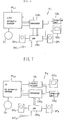
- FIG. 6 is a block diagram showing the configuration of an apparatus called a LVD musical accompaniment playing apparatus.
- This LVD musical accompaniment playing apparatus K1 comprises a LVD automatic changer PL1 for accommodating therein a plurality of laser video disks D1 serving as a musical accompaniment playing information memory medium and reproducing them, a commander CM1 for controlling the LVD automatic changer PL1 to allow it to select a desired laser video disk D1 in the LVD automatic changer PL1 by a request inputted from a operation unit CB1, an amplifier AM1 and speakers SP1 and SP2 for outputting as sound a reproduced audio signal, an image display unit GD1 for displaying a reproduced image signal as an image, and a microphone MC1 for changing a voice sung to an audio signal to output it to the amplifier AM1.
- the amplifier AM1 mixes an audio signal from the LVD automatic changer PL1 which is a musical signal from the so called musical accompaniment player and an audio signal of a voice sung from the microphone MC1 to output it to the speakers SP1 and SP2.
- the commander CM1 may ordinarily include the operation unit CB1.
- FIG. 7 is a block diagram showing the configuration of an apparatus called a CD musical accompaniment playing apparatus K2.
- This musical accompaniment playing apparatus K2 comprises a CD automatic changer PL2 for accommodating therein a plurality of compact disks D2 serving as a musical accompaniment playing information memory medium and reproducing them, a commander CM2 for controlling the CD automatic changer PL2 to allow it to select a desired compact disk D2 in the CD automatic changer PL2 by a request inputted from the operation unit CB2, an amplifier AM2 and speakers SP3 and SP4 for outputting a reproduced audio signal as sound, a graphic decoder DE for converting graphic data reproduced from the subcode data in the compact disk D2 to an image signal, an image display unit GD2 for displaying this image signal as an image, and a microphone MC2 for changing a voice sung to an audio signal to output it to the amplifier AM2.
- the amplifier AM2 mixes an audio signal from the CD automatic changer PL2 which is a musical signal from the so called musical accompaniment player and an audio signal of a voice sung from the microphone MC2 to output it to the speakers SP3 and SP4.
- the commander CM2 may ordinarily include the operation unit CB2 and the graphic decoder DE.
- the musical accompaniment playing apparatus By constituting the musical accompaniment playing apparatus in this way, a singer can sing a song with a music from a musical accompaniment player as a musical accompaniment, and can enjoy, at the same time, a corresponding image.
- this method merely allows a voice to be easy to be heard, but has no effect to correct deviation of the musical interval. Further, there was the problem that when the musical interval of the entirety of a music is varied in correspondence with the musical interval (key) of a voice of a singer, the key of the music frequently changes, so the singer becomes rather difficult to sing a song, and a listener is disagreeable to hear that song in appreciation thereof.
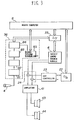
- a musical accompaniment playing apparatus 110 comprises a musical accompaniment information reproducing unit 111 for reproducing MIDI sound source control information from a musical accompaniment information recording medium 100 on which the MIDI sound source control information for controlling MIDI sound source unit 112 to generate musical accompaniment information in conformity with a MIDI standard is recorded, the musical accompaniment information having a plurality of first note information, and the MIDI sound source control information having first MIDI note information for tuning a musical interval of each first note information; the MIDI sound source unit 112 for generating the musical accompaniment information by the MIDI sound source control information reproduced by the musical accompaniment information reproducing unit 111; an acoustoelectric transducer 113 for transforming a voice sung by a singer to an electric signal to output it as voice information, the voice information having a plurality of second note information; a musical interval detection unit 114 for detecting a musical interval of the second note information to transform the detected musical interval to information according to the MIDI standard to output it as second MIDI note information;
- a musical interval detection unit 114 a comparison unit 115 and a control unit 116 are equialent to a sound volume control unit.
- the MIDI (Musical Instrument Digital Interface) is the standard determined for permitting musical instruments such as synthesizer or electronic piano, etc. to be connected to each other to effect exchange of information therebetween.
- MIDI equipments Electronic instruments provided with a hardware based on the MIDI standard and having a function to carry out transmission and receiption of a MIDI control signal serving as a musical instrument playing control signal in the form defined to support musical information are called MIDI equipments.
- CDs Compact Disk
- CD V Video
- LVD Laser Video Disk
- P, Q, R, S, T, U, V and W channels There are subcode of P, Q, R, S, T, U, V and W channels.
- the P and Q channels thereof are used for the purpose of effecting control of a disk player and display.
- R to W channels are empty channels called user's bit.
- MIDI format signals may be recorded in the user's bit area.
- the standard therefor has been already proposed.
- an approach may be employed to deliver an audio video signal reproduced by the disk player to the AV system to carry out audio visual operation of a program recorded on the disk, and an approach may be also employed to allow the AV system itself to have such a function, or to deliver playing program information to other MIDI equipments. Accordingly, various studies of application to construction of the AV system with realism or presence including electronic musical instruments, or preparation of educational software, etc. are being conducted.
- the MIDI equipments play music in accordance with the musical instrument performance program formed by a MIDI signal obtained by converting MIDI format signals sequentially delivered from the disk player to serial signals.
- the MIDI control signal delivered to the MIDI equipment is serial data of a transfer rate 31.25 [Kbaud], and 10 bits in total of 8 data bits, and one start bit and one stop bit of respective one bits constitute data corresponding to one unit.
- At least one status byte for designating the kind of data sent and the MIDI channel and one or two data bytes introduced by that status are combined to form a message serving as musical information. Accordingly, one message is comprised of 1 to 3 bytes, and a transfer time of 320 to 960 [ ⁇ sec] is required for the transfer.
- a musical instrument playing program is formed by a series of messages.
- FIG. 8 The configuration of a "note on message" which is one example of such a channel voice messages is shown in FIG. 8 as an example of such a message.
- the note on message of the status byte is a command corresponding to the operation that the key of the keyboard is depressed, and is used as a pair with a "note off message" corresponding to the operation that the key of the keyboard is released.
- a relationship is shown in FIG. 9.
- 9h h: hexadecimal digit
- 8h etc.
- the channel can cope with 16 kinds of sound sources, and 0h to Fh are used therefor.
- the note number of the data byte 1 designates any one of 128 stages (0h to 7Fh) assigneed to the key with the C of the center being as a center.
- the velocity of the data byte 2 is generally utilized for providing a difference of sound intensity, and designates any one of 128 stages (0h to 7Fh).
- the MIDI equipment responds to the note on message, the MIDI equipment generates a sound of a designated musical scale at a designated intensity. Further, responding to the note off message, the MIDI equipment carries out, e.g., the operatlon for allowing the key of the keyboard to be released.
- the MIDI sound source module MD the amplifier AM3 and the speaker SP5 are used, thereby making it possible to generate an arbitrary musical sound by the MIDI control signal S MIDI .
- FIG. 11 shows the data structure of the MIDI accompaniment music playing file stored in an OMD (Optical Memory Disk).
- the OMD is a writable optical disk used as a memory.
- This MIDI accompaniment music playing file format 102 is roughly classified into a sequence file SF and a Table file IF.
- the sequence file SF is a file required at the time of playing a musical accompaniment, and includes a note file NF serving as a MIDI sound source control information memory area, a lyrics file LF serving as a lyrics information memory area, and a PCM file PF serving as a second musical accompaniment informtion memory area.
- the Table file IF corresponds to a retrieval information memory area. Further, the lyrics file LF, the PCM file PF and the Table file IF constitute a musical accompaniment related information memory area.
- the note file NF is a file in which actual playing data is stored, and includes data areas of NF1 to NF17.
- the tone color track NF3 stores data for setting a plurality of tone colors of the MIDI sound source.
- the conductor track NF5 stores data for setting the rhythm and the tempo. The tempo change, etc. is stored into this data area.
- the rhythm pattern track NF7 stores pattern data corresponding to one measure of the rhythm in relation to rhythm.
- NF8 to NF15 are called a note track.
- 16 tracks can be used at the maximum.
- Data for the MIDI sound source playing are stored therein.
- the track NF9 is a track exclusive for melody.
- the track 16 NF15 is a track exclusive for rhythm.
- the track numbers a to n are 2 to 15.
- the control command track NF17 stores various control commands such as illumination control or LD player control, etc..
- the lyrics file LF is a file for storing data lyrics Telop displayed on a monitor television, and includes data area of LF1 to LF13. Among them, data of the lyrics themselves are stored into the LF3, LF7 and LF11. Further, data relating to the display timing of the lyrics and the color change speed (scroll) are stored into LF4, LF8 and LF12.
- FIG. 12(A) shows the further detailed structure of the lyrics file LF.
- FIG. 12 shows the example of LF2 to LF5.
- the track header section LF2 is a data area for storing data for designating a track length, an initial value of the lyrics Telop display color, and an initial value of the lyrics Telop scroll color, and includes data LF21 to LF26. It is to be noted that data of the lyrics Telop display color and the lyrics Telop scroll color may be omitted. In this case, data are set to a predetermined initial value (default value) by the control unit.
- the status LF21 of the track length is one byte (FFh, h:hexadecimal digit), and the track length data LF22 is four bytes as shown in FIG. 12(B).
- the data of LF22 is stored from the high order byte (MSB) of the track length from the first byte.
- the status LF23 of the lyrics display color is one byte (AOh), and the lyrics display color data LF24 is three bytes as shown in FIG. 12(C).
- the display color of the lyrics Telop is designated by B(blue), R(red) and G(green).
- the first, second and third byte of the data bytes correspond to B(blue), R(red) and G(green), respectively, and are designated in the range of OOh to OFh.
- the status LF25 of the scroll color is one byte (BOh), and the scroll color data LF26 is three bytes.
- the specification of the data byte is the same as in the case of the lyrics display.
- FIG. 13 An example of the color code by B, R and G is shown in FIG. 13.
- the lyrics data is stored in the form of the JIS (Japan Industrial Standard) code.
- the status of the lyrics data LF3 is COh and the lyrics data succeeding to the status COh is displayed as the lyrics data by one frame. Further, lyrics train numbers are assigned to the lyrics data train succeeding to the status COh in order from 1. In addition, the status and the data of the data end are EOh.
- the lyrics Telop display timing In the data of the timing map LF4, there are included the lyrics Telop display timing, the lyrics Telop erase timing, the lyrics display color, the scroll map data, and the map end.
- the status of the lyrics Telop display timing is DFh, and the data is three bytes of [Display Timing] and [Lyrics Number].
- the lyrics of the [Lyrics Number] are displayed.
- the first byte and the second byte of data are stored into the area of the high order byte of timing and the area of the low order byte of timing in order recited.
- the status 2 of the lyrics erase timing is DOh, and the data is two bytes of [Off Timing).
- the first and second bytes of data correspond to the high order byte of timing and the low order byte of timing, respectively.
- the status of the lyrics display color is AOh, and data is three bytes of [Display Color].
- the data format is the same as the format of the lyrics display color in the track header. It is to be noted that the lyric display color timing must be subsequent to the display timing of the lyrics Telop display timing.
- the status of the scroll color is BOh, and data is three bytes of [Scroll Color].
- the data format is the same as the format of the scroll color in the track header. In the timing map, the scroll color timing must be preceding to the scroll map data.
- the status of the scroll map data is COh, and data is two bytes of [Scroll Speed] and [Lyrics Count].
- the number of characters of [Lyrics Speed] is scrolled at a speed of the musical note of [Scroll Speed] per each character.
- the status of the map end is EOh, and the data is EOh.
- the status of the track end is FEh, and the data is FEh.
- data of two languages or a parody of a song, etc. can be stored into the areas of LF6 to LF13. It is to be noted that such data are not stored when they are not used.
- the PCM file is a file PF in which data of sound effect or back chorus, etc. that cannot be generated by the MIDI sound source, and includes data areas of PF1 to PF6.
- various methods such as the PCM (Pulse Code Modulation) method or the ADPCM (Adaptive Differential Pulse Code Modulation), etc. can be adopted.
- the Table file IF is a file for retrieval, and includes IF1 and IF2.
- the information file IF1 there are included the title of a musical composition, the name of a singer, the name of a lyric writer, the name of a musical composer, genre of a music, lyrics inserted, LVD screen setting data, etc..
- sequence data for allowing the MIDI sound source to play one phrase of a music is stored.
- An example of the detailed configuration of the Table file IF is shown in FIG. 14.
- FIG. 16 shows an example of an image displayed in the case of the displaying the reservation state by making use of this Table data.
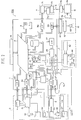
- This MIDI musical accompaniment playing apparatus 110A roughly comprises, as shown in FIG. 2, a MIDI control unit 1, a sound output system 2, an image display system 3, a microphone 4 serving as the acoustoelectric conversion means, an illumination system 10, and a Table system 14.
- a data receiving system 11 As the additional system, there are a data receiving system 11, and a data transmitting system 12 connected to the data receiving system 11 through a telephone line 13.
- the MIDI contol unit 1 comprises an OMDD (Optical Memory Disk Drive) 5 serving as the musical accompaniment playing information reproducing means for writing or reproducing information by using an OMD (not shown) serving as the musical accompaniment playing information memory medium, a MIDI sound source module 6 serving as the MIDI sound source means, a board computer 8 serving as the control means, an operation unit 15, a memory unit 21 such as a hard disk, etc. for storing the control program, etc. of the board computer 8, a D/A converter 22, a key controller 23, a mixer 24, a superimpose circuit 25, a video signal processing circuit 26, a power supply 27, a power switch 28, interfaces 29, 30, 31, 32, 33, 34 and 35, and a sound volume control block 36.
- OMDD Optical Memory Disk Drive
- OMD not shown
- MIDI sound source module 6 serving as the MIDI sound source means
- a board computer 8 serving as the control means
- an operation unit 15 such as a hard disk, etc. for storing the control program, etc. of
- the sound output system 2 comprises an amplifier 41, a sound effector 42, and speakers 43 and 44.
- the sound output system 2 constitutes the sound output means.
- the mixer 24 constitutes the mixing means.
- the image display system 3 comprises a LVD player 7, an image effector 51, a video camera 52, a customer display 53, a display 54 for reservation, and a display 57 for a singer.
- the image display system 3 constitutes the image display means.
- the Table system 14 includes a customer's seat terminal 9 for customers, a MIDI sound source module 55, and a head phone 56.
- the illumination system 10 comprises an illumination controller 61, a driver 62 and an illumination unit 63.
- the data receiving system 11 comprises a microcomputer 71, a memory unit 72 and a modem 73.
- the data transmitting system 12 comprises a center computer 74, a modem 75 and a memory unit 76.
- the sound volume control block 36 comprises a microphone amplifier 81, a musical interval detection unit 82, a MIDI data conversion unit 83, a musical interval comparison unit 84, and a sound volume change unit 85.
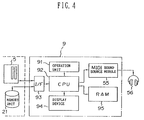
- the configuration of the customer terminal 9 will now be described with reference to FIG. 4.
- the customer terminal 9 comprises, as shown, an operation unit 91, a CPU 92, an interface 93, a display device 94, and a RAM 95.
- the Table file IF of the MIDI musical accompaniment playing data is transmitted to a RAM (not shown) in the board computer 8 when the system is powered.
- the Table file IF is retrieved by operating the control unit 15 to request a song that a singer desires to sing.
- the board computer 8 responds to the request to read, from the OMDD 5, data (note file NF, lyrics file LF, PCM file PF) of a corresponding music in the sequential file, thus to store it into the RAM in the board computer 8.
- note file NF including image select data
- lyrics file LF transmitted to the superimpose circuit 25
- PCM file PF transmitted to the D/A converter 22.
- a command is transmitted to the LVD player 7 to allow it to search the background image designated as data in the Table file IF, thus causing the LVD player 7 to play a music.
- musical performance begins.
- the board computer 8 reads out, from the RAM, note file data NF to transform it to a MIDI signal to transmit that signal to the MIDI sound source module 6, and to transmit it to the sound volume control block 36.
- a voice signal from the MIDI sound source module 6 is transmitted to the mixer 24.
- PCM file data PF is read out. The data thus read out is transmitted to the D/A converter 22.
- the D/A converter 22 converts that data to an analog voice signal to transmit it to the mixer 24, at which two signals are mixed.
- the mixed signal thus obtained is delivered to the amplifier 41.
- sound is produced from the speakers 43 and 44.
- a voice signal from the microphone 4 is mixed with the above mentioned signal to produce sound from speakers 43 and 44.
- the board computer 8 reads out lyrics file data LF in synchronism with output of the MIDI signal and the PCM signal relating to voice to convert it to a character signal to deliver that character signal to the superimpose circuit 25.
- the superimpose circuit 25 superimposes the ctiaracter signal and a video signal sent from the LVD player 7 to send it to the display 57 for singer.
- an approach may be employed to generate a key control signal from a signal generator (not shown) provided in the microphone 4 so as to become in correspondence with the pitch of a singer to send the MIDI signal and the PCM signal of which keys are changed in correspondence with change of the key at the control unit board computer 8, thereby making it possible to change the key of sound.
- the voice of a singer from the microphone is sent to the sound volume control block 36, and is compared with a MIDI signal of accompaniment. Depending upon the result, sound volume data sent to the MIDI sound source module 6 is controlled.
- a voice of a singer taken in from the microphone 4 is suitably amplified by the microphone amplifier 81, and is then sent to the musical interval detection unit 82.
- the musical interval detection unit 82 includes a fundamental period extraction device (see Japanese Patent Application No. 43200/90), and extracts that fundamental period from the signal to send it to the MIDI data conversion unit 83.
- the MIDI data conversion unit 83 converts the fundamental period data to MIDI data to send it to the musical interval comparison unit 84.
- a MIDI signal of the musical accompaniment playing is also sent through the interface 33 from the board computer 8.
- the musical interval comparison unit 84 compares note numbers of the two MIDI data.
- the sound volume change unit 85 sends a signal to the board computer 8 to increase the sound volume (velocity value) of the MIDI musical accompaniment playing signal to send it to the MIDI sound source module 6.
- the MIDI sound source module generates a musical accompaniment playing signal on the basis of the altered sound volume data (velocity value) to send it to the mixer 24.
- a musical signal from the PCM signal is also sent from the board computer 8 through the D/A converter 22 and the key controller 23.
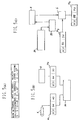
- FIG. 5 A
- FIG. 5(B) MIDI data of a voice from the microphone 4
- M2 data of the MIDI signal for musical accompaniment playing from the board computer 8
- the difference between note number values indicating the musical interval is equal to 10.
- comparison with data before and after M2 is made according to need.
- the sound volume control block 36 melody is caused to be easy to hear when the shift quantity of the musical interval is large in dependency upon the difference between the musical interval of a voice sung and that of musical accompaniment.
- a singer becomes easy to sing a song, and a listener becomes easy to hear that song.
- the sound volume of melody is caused to be in correspondence with a standard sound volume for a second time.
- the sound volume control block 36 does not change any other components except for the melody line, there results less disagreement of feeling.
- the communication is carried out in accordance with a predetermined protocol.
- the center computer 74 carries out supervisory control of the entirety thereof.
- This center computer 74 read thereinto MIDI musical accompaniment playing data stored in the memory unit 76 to send it to the data receiving system 11 in accordance with the above mentioned communication protocol through the modem 75.
- the microcomputer 71 carries out supervisory control of the entirety thereof to receive data through the modem 73 in accordance with the above mentioned communication protocol to temporarily store it into the memory unit 72.
- communication is completed in accordance with the protocol.
- the board computer 8 is not busy, data temporarily stored into the memory unit 72 is transferred to the OMDD 5 through the microcomputer 71 and the board computer 8, and is stored thereat. In this way, delivery of new musics is carried out.
- the board computer 8 controls the illumination system 10 on the basis of illumination control data in the note file NF, thus making it possible to provide atmosphere in harmony with the feeling of the music during playing of the musical accompaniment.
- lyrics file LF for example, in the case of lyrics of two languages or more
- one lyric for example, lyric of the Japanese
- alternation of musics is ready to be made at any time from that time point. For example, an alternation from the Japanese to the English, and to the Japanese for a second time may be carried out, or lyrics of the Japanese and the English may be displayed at the same time.
- lyrics data data of display color and/or display timing, etc. are also included.
- a singer can freely select a desired lyric.
- musical accompaniment playing data for the foreign language and that for the Japanese may be commonly used.
- performance corresponding to the preference of a singer such as duet together with a foreigner or singing a part to be sung in a chastened or practiced voice in English may be conducted.
- lyrics of two languages but also a parody of song may be similarly displayed.
- the Table file IF is stored into RAM 95 by the OMDD5 of the MIDI control unit 1 when the system is powered. Since the Table file IF exists per each music, Table files corresponding to the number of songs stored in the OMDD 5 within the MIDI control unit 1 are stored into the RAM 95.
- retrieval of musics can be conducted in dependency upon the title of a musical composition, the name of a singer, the name of a lyric writer, the name of a musical composer, and genre, etc.. Further, by transmitting sequence data of a retrieved music to the MIDI sound source module 55, a user can hear the introduction part (or a portion in the middle of a music).
- reservation data is temporarily stored into the memory unit 21 in the MIDI control unit 1. Then, data of the name of a musical composition, the name of a singer and the order of reservation, or a person who makes reservation are read out in addition to data of the number of the music, and are changed to character data. Those character data are displayed on a disply.
- writable OMD is used as the musical accompaniment playing information recording medium
- such a medium is not necessarily required to be writable, if new musics are delivered not only in the form of data, but also in the form of memory media.
- ordinary CDs, CD ROMs, semiconductor memories, IC cards, magnetic memories, or photomagnetic disks, etc. may be used for this purpose.
Landscapes
- Physics & Mathematics (AREA)
- Engineering & Computer Science (AREA)
- Acoustics & Sound (AREA)
- Multimedia (AREA)
- Electrophonic Musical Instruments (AREA)
- Signal Processing Not Specific To The Method Of Recording And Reproducing (AREA)
- Reverberation, Karaoke And Other Acoustics (AREA)
Applications Claiming Priority (2)
| Application Number | Priority Date | Filing Date | Title |
|---|---|---|---|
| JP2332838A JPH04199096A (ja) | 1990-11-29 | 1990-11-29 | カラオケ演奏装置 |
| JP332838/90 | 1990-11-29 |
Publications (2)
| Publication Number | Publication Date |
|---|---|
| EP0488732A2 true EP0488732A2 (de) | 1992-06-03 |
| EP0488732A3 EP0488732A3 (en) | 1993-04-28 |
Family
ID=18259363
Family Applications (1)
| Application Number | Title | Priority Date | Filing Date |
|---|---|---|---|
| EP19910311020 Ceased EP0488732A3 (en) | 1990-11-29 | 1991-11-28 | Musical accompaniment playing apparatus |
Country Status (4)
| Country | Link |
|---|---|
| US (1) | US5194682A (de) |
| EP (1) | EP0488732A3 (de) |
| JP (1) | JPH04199096A (de) |
| CA (1) | CA2056658A1 (de) |
Cited By (17)
| Publication number | Priority date | Publication date | Assignee | Title |
|---|---|---|---|---|
| GB2271661A (en) * | 1992-10-14 | 1994-04-20 | Matsushita Electric Industrial Co Ltd | Music accompaniment apparatus |
| WO1994022130A1 (en) * | 1993-03-17 | 1994-09-29 | Ivl Technologies Ltd. | Musical entertainment system |
| GB2276754A (en) * | 1993-03-19 | 1994-10-05 | Yamaha Corp | Karaoke apparatus having automatic effect control |
| GB2279172A (en) * | 1993-06-17 | 1994-12-21 | Matsushita Electric Industrial Co Ltd | A karaoke sound processor. |
| WO1994028539A3 (en) * | 1993-05-21 | 1995-03-02 | Coda Music Tech Inc | Intelligent accompaniment apparatus and method |
| US5454723A (en) * | 1992-12-28 | 1995-10-03 | Pioneer Electronic Corporation | Karaoke apparatus and method for medley playback |
| EP0698875A1 (de) * | 1994-08-10 | 1996-02-28 | Yamaha Corporation | Vorrichtung zur Erzeugung von Tonsignalen |
| GB2295754A (en) * | 1994-12-01 | 1996-06-05 | Sega Enterprises Kk | An effect control device in a Karaoke system |
| US5585585A (en) * | 1993-05-21 | 1996-12-17 | Coda Music Technology, Inc. | Automated accompaniment apparatus and method |
| EP0726559A3 (de) * | 1995-02-13 | 1997-01-08 | Yamaha Corp | Vorrichtung zur Verarbeitung von Audiosignalen, wobei eine harmonische Stimme von polyphonischen Stimmen abgeleitet wird |
| WO1997038415A1 (en) * | 1996-04-04 | 1997-10-16 | Coda Music Technology, Inc. | Apparatus and method for analyzing vocal audio data to provide accompaniment to a vocalist |
| WO1998058364A1 (en) * | 1997-06-19 | 1998-12-23 | Timewarp Technologies, Ltd. | A method and apparatus for real-time correlation of a performance to a musical score |
| US5952597A (en) * | 1996-10-25 | 1999-09-14 | Timewarp Technologies, Ltd. | Method and apparatus for real-time correlation of a performance to a musical score |
| US6333455B1 (en) | 1999-09-07 | 2001-12-25 | Roland Corporation | Electronic score tracking musical instrument |
| US6376758B1 (en) | 1999-10-28 | 2002-04-23 | Roland Corporation | Electronic score tracking musical instrument |
| GB2400722B (en) * | 2001-11-21 | 2005-11-02 | Line 6 Inc | Multimedia presentation that assists a user in the playing of a musical instrument |
| WO2006078108A1 (en) * | 2005-01-18 | 2006-07-27 | Moon-Jong Seo | System and method for synthesizing music and voice, and service system and method thereof |
Families Citing this family (67)
| Publication number | Priority date | Publication date | Assignee | Title |
|---|---|---|---|---|
| JP3068226B2 (ja) * | 1991-02-27 | 2000-07-24 | 株式会社リコス | バックコーラス合成装置 |
| JP2500703B2 (ja) * | 1991-03-01 | 1996-05-29 | ヤマハ株式会社 | 自動演奏装置 |
| JPH04275595A (ja) * | 1991-03-04 | 1992-10-01 | Sanyo Electric Co Ltd | 記憶媒体およびその再生装置 |
| KR940004830B1 (ko) * | 1991-03-14 | 1994-06-01 | 주식회사 금성사 | 연주용 데이타화일 기록방법 및 재생장치 |
| JPH0561491A (ja) * | 1991-09-02 | 1993-03-12 | Sanyo Electric Co Ltd | カラオケ装置及びその記録媒体 |
| KR950009380B1 (ko) * | 1992-02-28 | 1995-08-21 | 삼성전자주식회사 | 레이저 디스크 플레이어 가라오케장치 |
| JPH06102890A (ja) * | 1992-09-22 | 1994-04-15 | Pioneer Electron Corp | カラオケシステム |
| US5296643A (en) * | 1992-09-24 | 1994-03-22 | Kuo Jen Wei | Automatic musical key adjustment system for karaoke equipment |
| JPH06131802A (ja) * | 1992-10-14 | 1994-05-13 | Pioneer Electron Corp | 録音装置 |
| JPH08503584A (ja) * | 1992-11-16 | 1996-04-16 | マルチメディア システムズ コーポレイション | 対話式マルチメディア娯楽システム |
| JP2580941B2 (ja) * | 1992-12-21 | 1997-02-12 | ヤマハ株式会社 | 楽音処理装置 |
| US5464946A (en) * | 1993-02-11 | 1995-11-07 | Multimedia Systems Corporation | System and apparatus for interactive multimedia entertainment |
| US5518408A (en) * | 1993-04-06 | 1996-05-21 | Yamaha Corporation | Karaoke apparatus sounding instrumental accompaniment and back chorus |
| JP3206619B2 (ja) * | 1993-04-23 | 2001-09-10 | ヤマハ株式会社 | カラオケ装置 |
| US6025553A (en) * | 1993-05-18 | 2000-02-15 | Capital Bridge Co. Ltd. | Portable music performance device |
| DE69434923T2 (de) * | 1993-05-26 | 2007-12-06 | Pioneer Electronic Corp. | Aufzeichnungsmedium |
| JPH0738878A (ja) * | 1993-07-16 | 1995-02-07 | Brother Ind Ltd | データ伝送装置 |
| JP3540344B2 (ja) * | 1993-07-27 | 2004-07-07 | 株式会社リコス | カラオケ装置におけるバックコーラス再生装置 |
| US5583308A (en) * | 1993-10-14 | 1996-12-10 | Maestromedia, Inc. | Musical effects apparatus and tone control process for a musical instrument |
| US5744744A (en) * | 1993-10-28 | 1998-04-28 | Kabushiki Kaisha Kawai Gakki Seisakusho | Electric stringed instrument having automated accompaniment system |
| US5654516A (en) * | 1993-11-03 | 1997-08-05 | Yamaha Corporation | Karaoke system having a playback source with pre-stored data and a music synthesizing source with rewriteable data |
| US5569038A (en) * | 1993-11-08 | 1996-10-29 | Tubman; Louis | Acoustical prompt recording system and method |
| TW311196B (de) * | 1994-04-06 | 1997-07-21 | Brother Ind Ltd | |
| US5602811A (en) * | 1994-08-11 | 1997-02-11 | Yamaha Corporation | Musical information recording and reproducing technique for use with a recording medium having a UTOC area |
| JP3564753B2 (ja) * | 1994-09-05 | 2004-09-15 | ヤマハ株式会社 | 歌唱用伴奏装置 |
| KR0135792B1 (ko) * | 1994-12-08 | 1998-05-15 | 김광호 | 노래반주용 곡프로그램 및 이에 적합한 노래반주장치 |
| JP2820052B2 (ja) * | 1995-02-02 | 1998-11-05 | ヤマハ株式会社 | コーラス効果付与装置 |
| JPH08272863A (ja) * | 1995-03-30 | 1996-10-18 | Ekushingu:Kk | 情報提供システム |
| JP3218946B2 (ja) * | 1995-09-29 | 2001-10-15 | ヤマハ株式会社 | 歌詞データ処理装置及び補助データ処理装置 |
| JP3226011B2 (ja) * | 1995-09-29 | 2001-11-05 | ヤマハ株式会社 | 歌詞表示装置 |
| JP3552379B2 (ja) * | 1996-01-19 | 2004-08-11 | ソニー株式会社 | 音響再生装置 |
| US5864868A (en) * | 1996-02-13 | 1999-01-26 | Contois; David C. | Computer control system and user interface for media playing devices |
| JP4097726B2 (ja) * | 1996-02-13 | 2008-06-11 | 常成 小島 | 電子音響装置 |
| US7423213B2 (en) * | 1996-07-10 | 2008-09-09 | David Sitrick | Multi-dimensional transformation systems and display communication architecture for compositions and derivations thereof |
| US7297856B2 (en) * | 1996-07-10 | 2007-11-20 | Sitrick David H | System and methodology for coordinating musical communication and display |
| US7989689B2 (en) * | 1996-07-10 | 2011-08-02 | Bassilic Technologies Llc | Electronic music stand performer subsystems and music communication methodologies |
| US7098392B2 (en) * | 1996-07-10 | 2006-08-29 | Sitrick David H | Electronic image visualization system and communication methodologies |
| JPH10116088A (ja) * | 1996-10-14 | 1998-05-06 | Roland Corp | 効果付与装置 |
| PL356477A1 (en) * | 1999-12-22 | 2004-06-28 | 2+2+2 Ag | Method and arrangement for recording and playing back sounds |
| US7827488B2 (en) | 2000-11-27 | 2010-11-02 | Sitrick David H | Image tracking and substitution system and methodology for audio-visual presentations |
| EP1423852A4 (de) * | 2001-08-07 | 2009-10-28 | Kent Justin A | System zum umsetzen einer plattenspielerbewegung in midi-daten |
| KR100563680B1 (ko) * | 2001-11-27 | 2006-03-28 | 엘지전자 주식회사 | 재기록 가능 기록매체의 오디오 가사 데이터 기록 관리 및재생방법 |
| KR20030043299A (ko) * | 2001-11-27 | 2003-06-02 | 주식회사 엘지이아이 | 오디오 데이터와 부가 데이터간의 동기 기록 관리 및재생방법 |
| US7787822B2 (en) * | 2003-03-03 | 2010-08-31 | Wayne M. Preis | FM-jam device and kit |
| FR2852778B1 (fr) * | 2003-03-21 | 2005-07-22 | Cit Alcatel | Terminal de telecommunication |
| US20040266337A1 (en) * | 2003-06-25 | 2004-12-30 | Microsoft Corporation | Method and apparatus for synchronizing lyrics |
| US7599598B2 (en) * | 2006-08-09 | 2009-10-06 | Adc Telecommunications, Inc. | Cable payout systems and methods |
| US7563976B2 (en) * | 2007-07-18 | 2009-07-21 | Creative Technology Ltd | Apparatus and method for processing at least one MIDI signal |
| US7973230B2 (en) * | 2007-12-31 | 2011-07-05 | Apple Inc. | Methods and systems for providing real-time feedback for karaoke |
| US9224129B2 (en) | 2011-05-06 | 2015-12-29 | David H. Sitrick | System and methodology for multiple users concurrently working and viewing on a common project |
| US10402485B2 (en) | 2011-05-06 | 2019-09-03 | David H. Sitrick | Systems and methodologies providing controlled collaboration among a plurality of users |
| US8826147B2 (en) | 2011-05-06 | 2014-09-02 | David H. Sitrick | System and methodology for collaboration, with selective display of user input annotations among member computing appliances of a group/team |
| US8914735B2 (en) | 2011-05-06 | 2014-12-16 | David H. Sitrick | Systems and methodologies providing collaboration and display among a plurality of users |
| US8990677B2 (en) | 2011-05-06 | 2015-03-24 | David H. Sitrick | System and methodology for collaboration utilizing combined display with evolving common shared underlying image |
| US9330366B2 (en) | 2011-05-06 | 2016-05-03 | David H. Sitrick | System and method for collaboration via team and role designation and control and management of annotations |
| US8918721B2 (en) | 2011-05-06 | 2014-12-23 | David H. Sitrick | Systems and methodologies providing for collaboration by respective users of a plurality of computing appliances working concurrently on a common project having an associated display |
| US8918722B2 (en) | 2011-05-06 | 2014-12-23 | David H. Sitrick | System and methodology for collaboration in groups with split screen displays |
| US8875011B2 (en) | 2011-05-06 | 2014-10-28 | David H. Sitrick | Systems and methodologies providing for collaboration among a plurality of users at a plurality of computing appliances |
| US8918723B2 (en) | 2011-05-06 | 2014-12-23 | David H. Sitrick | Systems and methodologies comprising a plurality of computing appliances having input apparatus and display apparatus and logically structured as a main team |
| US11611595B2 (en) | 2011-05-06 | 2023-03-21 | David H. Sitrick | Systems and methodologies providing collaboration among a plurality of computing appliances, utilizing a plurality of areas of memory to store user input as associated with an associated computing appliance providing the input |
| US8806352B2 (en) | 2011-05-06 | 2014-08-12 | David H. Sitrick | System for collaboration of a specific image and utilizing selected annotations while viewing and relative to providing a display presentation |
| US8924859B2 (en) | 2011-05-06 | 2014-12-30 | David H. Sitrick | Systems and methodologies supporting collaboration of users as members of a team, among a plurality of computing appliances |
| US8918724B2 (en) | 2011-05-06 | 2014-12-23 | David H. Sitrick | Systems and methodologies providing controlled voice and data communication among a plurality of computing appliances associated as team members of at least one respective team or of a plurality of teams and sub-teams within the teams |
| KR20180012800A (ko) * | 2015-05-27 | 2018-02-06 | 광저우 쿠고우 컴퓨터 테크놀로지 컴퍼니, 리미티드 | 오디오 처리 방법, 장치 및 시스템 |
| JP6657713B2 (ja) * | 2015-09-29 | 2020-03-04 | ヤマハ株式会社 | 音響処理装置および音響処理方法 |
| JP2020106753A (ja) * | 2018-12-28 | 2020-07-09 | ローランド株式会社 | 情報処理装置および映像処理システム |
| CN111445742B (zh) * | 2020-05-18 | 2021-09-07 | 潍坊工程职业学院 | 一种基于远程教育系统的声乐教学系统 |
Family Cites Families (4)
| Publication number | Priority date | Publication date | Assignee | Title |
|---|---|---|---|---|
| GB2013386A (en) * | 1977-09-10 | 1979-08-08 | Fox H M | Electronic sound processing device |
| US4771671A (en) * | 1987-01-08 | 1988-09-20 | Breakaway Technologies, Inc. | Entertainment and creative expression device for easily playing along to background music |
| US4829872A (en) * | 1987-05-11 | 1989-05-16 | Fairlight Instruments Pty. Limited | Detection of musical gestures |
| US4942551A (en) * | 1988-06-24 | 1990-07-17 | Wnm Ventures Inc. | Method and apparatus for storing MIDI information in subcode packs |
-
1990
- 1990-11-29 JP JP2332838A patent/JPH04199096A/ja active Pending
-
1991
- 1991-11-25 US US07/797,542 patent/US5194682A/en not_active Expired - Fee Related
- 1991-11-28 EP EP19910311020 patent/EP0488732A3/en not_active Ceased
- 1991-11-29 CA CA002056658A patent/CA2056658A1/en not_active Abandoned
Cited By (29)
| Publication number | Priority date | Publication date | Assignee | Title |
|---|---|---|---|---|
| US5447438A (en) * | 1992-10-14 | 1995-09-05 | Matsushita Electric Industrial Co., Ltd. | Music training apparatus |
| GB2271661A (en) * | 1992-10-14 | 1994-04-20 | Matsushita Electric Industrial Co Ltd | Music accompaniment apparatus |
| GB2271661B (en) * | 1992-10-14 | 1996-04-10 | Matsushita Electric Industrial Co Ltd | Music training apparatus |
| US5454723A (en) * | 1992-12-28 | 1995-10-03 | Pioneer Electronic Corporation | Karaoke apparatus and method for medley playback |
| WO1994022130A1 (en) * | 1993-03-17 | 1994-09-29 | Ivl Technologies Ltd. | Musical entertainment system |
| GB2276754A (en) * | 1993-03-19 | 1994-10-05 | Yamaha Corp | Karaoke apparatus having automatic effect control |
| US5521323A (en) * | 1993-05-21 | 1996-05-28 | Coda Music Technologies, Inc. | Real-time performance score matching |
| AU674592B2 (en) * | 1993-05-21 | 1997-01-02 | Coda Music Technologies, Inc. | Intelligent accompaniment apparatus and method |
| WO1994028539A3 (en) * | 1993-05-21 | 1995-03-02 | Coda Music Tech Inc | Intelligent accompaniment apparatus and method |
| US5585585A (en) * | 1993-05-21 | 1996-12-17 | Coda Music Technology, Inc. | Automated accompaniment apparatus and method |
| US5477003A (en) * | 1993-06-17 | 1995-12-19 | Matsushita Electric Industrial Co., Ltd. | Karaoke sound processor for automatically adjusting the pitch of the accompaniment signal |
| GB2279172B (en) * | 1993-06-17 | 1996-12-18 | Matsushita Electric Industrial Co Ltd | A karaoke sound processor |
| GB2279172A (en) * | 1993-06-17 | 1994-12-21 | Matsushita Electric Industrial Co Ltd | A karaoke sound processor. |
| US6259015B1 (en) | 1994-08-10 | 2001-07-10 | Yamaha Corporation | Acoustic signal producing apparatus |
| EP0698875A1 (de) * | 1994-08-10 | 1996-02-28 | Yamaha Corporation | Vorrichtung zur Erzeugung von Tonsignalen |
| US5773743A (en) * | 1994-12-01 | 1998-06-30 | Sega Enterprises, Ltd. | Effect control method, an effect control device and a karaoke system using such method and device |
| GB2295754A (en) * | 1994-12-01 | 1996-06-05 | Sega Enterprises Kk | An effect control device in a Karaoke system |
| US5712437A (en) * | 1995-02-13 | 1998-01-27 | Yamaha Corporation | Audio signal processor selectively deriving harmony part from polyphonic parts |
| EP0726559A3 (de) * | 1995-02-13 | 1997-01-08 | Yamaha Corp | Vorrichtung zur Verarbeitung von Audiosignalen, wobei eine harmonische Stimme von polyphonischen Stimmen abgeleitet wird |
| WO1997038415A1 (en) * | 1996-04-04 | 1997-10-16 | Coda Music Technology, Inc. | Apparatus and method for analyzing vocal audio data to provide accompaniment to a vocalist |
| US5693903A (en) * | 1996-04-04 | 1997-12-02 | Coda Music Technology, Inc. | Apparatus and method for analyzing vocal audio data to provide accompaniment to a vocalist |
| US5952597A (en) * | 1996-10-25 | 1999-09-14 | Timewarp Technologies, Ltd. | Method and apparatus for real-time correlation of a performance to a musical score |
| US6166314A (en) * | 1997-06-19 | 2000-12-26 | Time Warp Technologies, Ltd. | Method and apparatus for real-time correlation of a performance to a musical score |
| WO1998058364A1 (en) * | 1997-06-19 | 1998-12-23 | Timewarp Technologies, Ltd. | A method and apparatus for real-time correlation of a performance to a musical score |
| US6333455B1 (en) | 1999-09-07 | 2001-12-25 | Roland Corporation | Electronic score tracking musical instrument |
| US6376758B1 (en) | 1999-10-28 | 2002-04-23 | Roland Corporation | Electronic score tracking musical instrument |
| GB2400722B (en) * | 2001-11-21 | 2005-11-02 | Line 6 Inc | Multimedia presentation that assists a user in the playing of a musical instrument |
| WO2006078108A1 (en) * | 2005-01-18 | 2006-07-27 | Moon-Jong Seo | System and method for synthesizing music and voice, and service system and method thereof |
| KR100819740B1 (ko) * | 2005-01-18 | 2008-04-07 | 서문종 | 음악과 음성의 합성 시스템 및 방법과 이를 이용한 서비스시스템 및 방법 |
Also Published As
| Publication number | Publication date |
|---|---|
| CA2056658A1 (en) | 1992-05-30 |
| US5194682A (en) | 1993-03-16 |
| JPH04199096A (ja) | 1992-07-20 |
| EP0488732A3 (en) | 1993-04-28 |
Similar Documents
| Publication | Publication Date | Title |
|---|---|---|
| US5194682A (en) | Musical accompaniment playing apparatus | |
| US5247126A (en) | Image reproducing apparatus, image information recording medium, and musical accompaniment playing apparatus | |
| US5286907A (en) | Apparatus for reproducing musical accompaniment information | |
| US5235124A (en) | Musical accompaniment playing apparatus having phoneme memory for chorus voices | |
| US5805545A (en) | Midi standards recorded information reproducing device with repetitive reproduction capacity | |
| US5454723A (en) | Karaoke apparatus and method for medley playback | |
| US5131311A (en) | Music reproducing method and apparatus which mixes voice input from a microphone and music data | |
| US5569869A (en) | Karaoke apparatus connectable to external MIDI apparatus with data merge | |
| US5506370A (en) | Display controlling apparatus for music accompaniment playing system, and the music accompaniment playing system | |
| US5574243A (en) | Melody controlling apparatus for music accompaniment playing system the music accompaniment playing system and melody controlling method for controlling and changing the tonality of the melody using the MIDI standard | |
| JPH0744183A (ja) | カラオケ演奏装置 | |
| JP2901845B2 (ja) | カラオケ演奏装置 | |
| JP3353595B2 (ja) | 自動演奏装置およびカラオケ装置 | |
| JP2991480B2 (ja) | カラオケ演奏装置 | |
| JP3214623B2 (ja) | 電子楽音再生装置 | |
| JP3637196B2 (ja) | 音楽再生装置 | |
| JP2822590B2 (ja) | メドレー演奏機能付き楽音情報再生装置 | |
| JP3551441B2 (ja) | カラオケ装置 | |
| JPH04149499A (ja) | カラオケ情報記憶装置及びカラオケ演奏装置 | |
| JP2822592B2 (ja) | 楽音再生装置 | |
| JPH04136997A (ja) | 電子音楽再生装置 | |
| JP3000441U (ja) | 電子音楽再生装置 | |
| JPH07152386A (ja) | カラオケ装置 | |
| JPH04136998A (ja) | 電子音楽再生装置 | |
| JPH1049180A (ja) | カラオケ装置 |
Legal Events
| Date | Code | Title | Description |
|---|---|---|---|
| PUAI | Public reference made under article 153(3) epc to a published international application that has entered the european phase |
Free format text: ORIGINAL CODE: 0009012 |
|
| AK | Designated contracting states |
Kind code of ref document: A2 Designated state(s): DE FR GB |
|
| PUAL | Search report despatched |
Free format text: ORIGINAL CODE: 0009013 |
|
| AK | Designated contracting states |
Kind code of ref document: A3 Designated state(s): DE FR GB |
|
| 17P | Request for examination filed |
Effective date: 19931008 |
|
| 17Q | First examination report despatched |
Effective date: 19951004 |
|
| STAA | Information on the status of an ep patent application or granted ep patent |
Free format text: STATUS: THE APPLICATION HAS BEEN REFUSED |
|
| 18R | Application refused |
Effective date: 19960328 |