EP0488758B1 - Développateur pour le développement d'images électrostatiques, appareil de formation d'images, élément d'appareil et appareil pour fac-similé - Google Patents
Développateur pour le développement d'images électrostatiques, appareil de formation d'images, élément d'appareil et appareil pour fac-similé Download PDFInfo
- Publication number
- EP0488758B1 EP0488758B1 EP91311070A EP91311070A EP0488758B1 EP 0488758 B1 EP0488758 B1 EP 0488758B1 EP 91311070 A EP91311070 A EP 91311070A EP 91311070 A EP91311070 A EP 91311070A EP 0488758 B1 EP0488758 B1 EP 0488758B1
- Authority
- EP
- European Patent Office
- Prior art keywords
- toner
- group
- developer according
- developer
- image
- Prior art date
- Legal status (The legal status is an assumption and is not a legal conclusion. Google has not performed a legal analysis and makes no representation as to the accuracy of the status listed.)
- Expired - Lifetime
Links
- VYPSYNLAJGMNEJ-UHFFFAOYSA-N Silicium dioxide Chemical compound O=[Si]=O VYPSYNLAJGMNEJ-UHFFFAOYSA-N 0.000 claims description 148
- 239000000843 powder Substances 0.000 claims description 118
- 239000002245 particle Substances 0.000 claims description 97
- 239000000377 silicon dioxide Substances 0.000 claims description 74
- 229920005989 resin Polymers 0.000 claims description 56
- 239000011347 resin Substances 0.000 claims description 56
- 150000001875 compounds Chemical class 0.000 claims description 52
- 239000011230 binding agent Substances 0.000 claims description 41
- 229920001577 copolymer Polymers 0.000 claims description 35
- 125000001424 substituent group Chemical group 0.000 claims description 20
- 230000002209 hydrophobic effect Effects 0.000 claims description 18
- 125000001997 phenyl group Chemical group [H]C1=C([H])C([H])=C(*)C([H])=C1[H] 0.000 claims description 18
- 239000000696 magnetic material Substances 0.000 claims description 17
- 125000004435 hydrogen atom Chemical group [H]* 0.000 claims description 16
- 238000012546 transfer Methods 0.000 claims description 15
- 125000000217 alkyl group Chemical group 0.000 claims description 14
- 239000003795 chemical substances by application Substances 0.000 claims description 14
- 239000000654 additive Substances 0.000 claims description 13
- 125000003545 alkoxy group Chemical group 0.000 claims description 13
- 239000000463 material Substances 0.000 claims description 13
- 125000003710 aryl alkyl group Chemical group 0.000 claims description 10
- 238000004140 cleaning Methods 0.000 claims description 10
- 230000000996 additive effect Effects 0.000 claims description 9
- 125000003277 amino group Chemical group 0.000 claims description 9
- 229910052757 nitrogen Inorganic materials 0.000 claims description 9
- 125000001624 naphthyl group Chemical group 0.000 claims description 8
- 239000000126 substance Substances 0.000 claims description 8
- 239000003086 colorant Substances 0.000 claims description 7
- 125000003178 carboxy group Chemical group [H]OC(*)=O 0.000 claims description 6
- 125000005843 halogen group Chemical group 0.000 claims description 6
- 239000003082 abrasive agent Substances 0.000 claims description 5
- 230000009471 action Effects 0.000 claims description 5
- 125000002915 carbonyl group Chemical group [*:2]C([*:1])=O 0.000 claims description 5
- 125000003262 carboxylic acid ester group Chemical group [H]C([H])([*:2])OC(=O)C([H])([H])[*:1] 0.000 claims description 5
- 125000004093 cyano group Chemical group *C#N 0.000 claims description 5
- 239000000314 lubricant Substances 0.000 claims description 5
- 125000000449 nitro group Chemical group [O-][N+](*)=O 0.000 claims description 5
- 229920001225 polyester resin Polymers 0.000 claims description 5
- 239000004645 polyester resin Substances 0.000 claims description 5
- 125000000542 sulfonic acid group Chemical group 0.000 claims description 5
- 125000005428 anthryl group Chemical group [H]C1=C([H])C([H])=C2C([H])=C3C(*)=C([H])C([H])=C([H])C3=C([H])C2=C1[H] 0.000 claims description 4
- 125000001183 hydrocarbyl group Chemical group 0.000 claims 6
- 239000001692 EU approved anti-caking agent Substances 0.000 claims 4
- 238000012360 testing method Methods 0.000 description 78
- 238000000034 method Methods 0.000 description 28
- PPBRXRYQALVLMV-UHFFFAOYSA-N Styrene Chemical compound C=CC1=CC=CC=C1 PPBRXRYQALVLMV-UHFFFAOYSA-N 0.000 description 27
- OKKJLVBELUTLKV-UHFFFAOYSA-N Methanol Chemical compound OC OKKJLVBELUTLKV-UHFFFAOYSA-N 0.000 description 24
- 239000000203 mixture Substances 0.000 description 23
- 150000003672 ureas Chemical class 0.000 description 22
- -1 metal complex salts Chemical class 0.000 description 21
- 239000000047 product Substances 0.000 description 17
- 239000000049 pigment Substances 0.000 description 16
- 230000007613 environmental effect Effects 0.000 description 15
- FFUAGWLWBBFQJT-UHFFFAOYSA-N hexamethyldisilazane Chemical compound C[Si](C)(C)N[Si](C)(C)C FFUAGWLWBBFQJT-UHFFFAOYSA-N 0.000 description 14
- XEEYBQQBJWHFJM-UHFFFAOYSA-N Iron Chemical compound [Fe] XEEYBQQBJWHFJM-UHFFFAOYSA-N 0.000 description 13
- UHOVQNZJYSORNB-UHFFFAOYSA-N Benzene Chemical compound C1=CC=CC=C1 UHOVQNZJYSORNB-UHFFFAOYSA-N 0.000 description 12
- 239000004615 ingredient Substances 0.000 description 12
- 239000006229 carbon black Substances 0.000 description 11
- 230000006866 deterioration Effects 0.000 description 11
- 238000002156 mixing Methods 0.000 description 11
- SOGAXMICEFXMKE-UHFFFAOYSA-N Butylmethacrylate Chemical compound CCCCOC(=O)C(C)=C SOGAXMICEFXMKE-UHFFFAOYSA-N 0.000 description 10
- 239000004743 Polypropylene Substances 0.000 description 10
- 229920001155 polypropylene Polymers 0.000 description 10
- 230000008569 process Effects 0.000 description 10
- 229910000859 α-Fe Inorganic materials 0.000 description 9
- 238000011156 evaluation Methods 0.000 description 8
- 229920000178 Acrylic resin Polymers 0.000 description 7
- 239000004925 Acrylic resin Substances 0.000 description 7
- 239000000975 dye Substances 0.000 description 7
- 239000001993 wax Substances 0.000 description 7
- 238000009826 distribution Methods 0.000 description 6
- 229910052742 iron Inorganic materials 0.000 description 6
- 239000000243 solution Substances 0.000 description 6
- 238000003860 storage Methods 0.000 description 6
- 238000005033 Fourier transform infrared spectroscopy Methods 0.000 description 5
- 239000004115 Sodium Silicate Substances 0.000 description 5
- FAPWRFPIFSIZLT-UHFFFAOYSA-M Sodium chloride Chemical compound [Na+].[Cl-] FAPWRFPIFSIZLT-UHFFFAOYSA-M 0.000 description 5
- 239000002253 acid Substances 0.000 description 5
- XCJYREBRNVKWGJ-UHFFFAOYSA-N copper(II) phthalocyanine Chemical compound [Cu+2].C12=CC=CC=C2C(N=C2[N-]C(C3=CC=CC=C32)=N2)=NC1=NC([C]1C=CC=CC1=1)=NC=1N=C1[C]3C=CC=CC3=C2[N-]1 XCJYREBRNVKWGJ-UHFFFAOYSA-N 0.000 description 5
- LIKFHECYJZWXFJ-UHFFFAOYSA-N dimethyldichlorosilane Chemical compound C[Si](C)(Cl)Cl LIKFHECYJZWXFJ-UHFFFAOYSA-N 0.000 description 5
- 239000006185 dispersion Substances 0.000 description 5
- RBTKNAXYKSUFRK-UHFFFAOYSA-N heliogen blue Chemical class [Cu].[N-]1C2=C(C=CC=C3)C3=C1N=C([N-]1)C3=CC=CC=C3C1=NC([N-]1)=C(C=CC=C3)C3=C1N=C([N-]1)C3=CC=CC=C3C1=N2 RBTKNAXYKSUFRK-UHFFFAOYSA-N 0.000 description 5
- NTHWMYGWWRZVTN-UHFFFAOYSA-N sodium silicate Chemical group [Na+].[Na+].[O-][Si]([O-])=O NTHWMYGWWRZVTN-UHFFFAOYSA-N 0.000 description 5
- 229910052911 sodium silicate Inorganic materials 0.000 description 5
- 238000005160 1H NMR spectroscopy Methods 0.000 description 4
- PXHVJJICTQNCMI-UHFFFAOYSA-N Nickel Chemical compound [Ni] PXHVJJICTQNCMI-UHFFFAOYSA-N 0.000 description 4
- 229910052751 metal Inorganic materials 0.000 description 4
- 239000002184 metal Substances 0.000 description 4
- 150000002739 metals Chemical class 0.000 description 4
- 235000012239 silicon dioxide Nutrition 0.000 description 4
- 229920002545 silicone oil Polymers 0.000 description 4
- 229920003048 styrene butadiene rubber Polymers 0.000 description 4
- 150000003585 thioureas Chemical class 0.000 description 4
- 125000000391 vinyl group Chemical group [H]C([*])=C([H])[H] 0.000 description 4
- GOXQRTZXKQZDDN-UHFFFAOYSA-N 2-Ethylhexyl acrylate Chemical compound CCCCC(CC)COC(=O)C=C GOXQRTZXKQZDDN-UHFFFAOYSA-N 0.000 description 3
- NRCMAYZCPIVABH-UHFFFAOYSA-N Quinacridone Chemical compound N1C2=CC=CC=C2C(=O)C2=C1C=C1C(=O)C3=CC=CC=C3NC1=C2 NRCMAYZCPIVABH-UHFFFAOYSA-N 0.000 description 3
- 125000002887 hydroxy group Chemical group [H]O* 0.000 description 3
- SZVJSHCCFOBDDC-UHFFFAOYSA-N iron(II,III) oxide Inorganic materials O=[Fe]O[Fe]O[Fe]=O SZVJSHCCFOBDDC-UHFFFAOYSA-N 0.000 description 3
- 239000007788 liquid Substances 0.000 description 3
- 230000007774 longterm Effects 0.000 description 3
- 239000000178 monomer Substances 0.000 description 3
- 230000002093 peripheral effect Effects 0.000 description 3
- 229920000728 polyester Polymers 0.000 description 3
- RMAQACBXLXPBSY-UHFFFAOYSA-N silicic acid Chemical compound O[Si](O)(O)O RMAQACBXLXPBSY-UHFFFAOYSA-N 0.000 description 3
- 239000011780 sodium chloride Substances 0.000 description 3
- 239000002689 soil Substances 0.000 description 3
- 238000004448 titration Methods 0.000 description 3
- MYRTYDVEIRVNKP-UHFFFAOYSA-N 1,2-Divinylbenzene Chemical compound C=CC1=CC=CC=C1C=C MYRTYDVEIRVNKP-UHFFFAOYSA-N 0.000 description 2
- KXGFMDJXCMQABM-UHFFFAOYSA-N 2-methoxy-6-methylphenol Chemical compound [CH]OC1=CC=CC([CH])=C1O KXGFMDJXCMQABM-UHFFFAOYSA-N 0.000 description 2
- KUDUQBURMYMBIJ-UHFFFAOYSA-N 2-prop-2-enoyloxyethyl prop-2-enoate Chemical compound C=CC(=O)OCCOC(=O)C=C KUDUQBURMYMBIJ-UHFFFAOYSA-N 0.000 description 2
- IJGRMHOSHXDMSA-UHFFFAOYSA-N Atomic nitrogen Chemical compound N#N IJGRMHOSHXDMSA-UHFFFAOYSA-N 0.000 description 2
- YCKRFDGAMUMZLT-UHFFFAOYSA-N Fluorine atom Chemical compound [F] YCKRFDGAMUMZLT-UHFFFAOYSA-N 0.000 description 2
- BAPJBEWLBFYGME-UHFFFAOYSA-N Methyl acrylate Chemical compound COC(=O)C=C BAPJBEWLBFYGME-UHFFFAOYSA-N 0.000 description 2
- 238000005481 NMR spectroscopy Methods 0.000 description 2
- 239000004698 Polyethylene Substances 0.000 description 2
- 239000004793 Polystyrene Substances 0.000 description 2
- 229910004298 SiO 2 Inorganic materials 0.000 description 2
- QYKIQEUNHZKYBP-UHFFFAOYSA-N Vinyl ether Chemical class C=COC=C QYKIQEUNHZKYBP-UHFFFAOYSA-N 0.000 description 2
- HCHKCACWOHOZIP-UHFFFAOYSA-N Zinc Chemical compound [Zn] HCHKCACWOHOZIP-UHFFFAOYSA-N 0.000 description 2
- VSCWAEJMTAWNJL-UHFFFAOYSA-K aluminium trichloride Chemical compound Cl[Al](Cl)Cl VSCWAEJMTAWNJL-UHFFFAOYSA-K 0.000 description 2
- 239000011324 bead Substances 0.000 description 2
- 238000006243 chemical reaction Methods 0.000 description 2
- IJOOHPMOJXWVHK-UHFFFAOYSA-N chlorotrimethylsilane Chemical compound C[Si](C)(C)Cl IJOOHPMOJXWVHK-UHFFFAOYSA-N 0.000 description 2
- 239000000470 constituent Substances 0.000 description 2
- 238000001816 cooling Methods 0.000 description 2
- 238000000354 decomposition reaction Methods 0.000 description 2
- 238000011161 development Methods 0.000 description 2
- 238000010586 diagram Methods 0.000 description 2
- 150000001991 dicarboxylic acids Chemical class 0.000 description 2
- IJKVHSBPTUYDLN-UHFFFAOYSA-N dihydroxy(oxo)silane Chemical compound O[Si](O)=O IJKVHSBPTUYDLN-UHFFFAOYSA-N 0.000 description 2
- 125000000118 dimethyl group Chemical group [H]C([H])([H])* 0.000 description 2
- 238000001035 drying Methods 0.000 description 2
- 239000008151 electrolyte solution Substances 0.000 description 2
- 239000000839 emulsion Substances 0.000 description 2
- FJKIXWOMBXYWOQ-UHFFFAOYSA-N ethenoxyethane Chemical compound CCOC=C FJKIXWOMBXYWOQ-UHFFFAOYSA-N 0.000 description 2
- 239000000706 filtrate Substances 0.000 description 2
- 238000001914 filtration Methods 0.000 description 2
- 239000011737 fluorine Substances 0.000 description 2
- 229910052731 fluorine Inorganic materials 0.000 description 2
- 239000011521 glass Substances 0.000 description 2
- 150000002430 hydrocarbons Chemical group 0.000 description 2
- 229920000554 ionomer Polymers 0.000 description 2
- UQSXHKLRYXJYBZ-UHFFFAOYSA-N iron oxide Inorganic materials [Fe]=O UQSXHKLRYXJYBZ-UHFFFAOYSA-N 0.000 description 2
- 238000004898 kneading Methods 0.000 description 2
- 238000004519 manufacturing process Methods 0.000 description 2
- 238000005259 measurement Methods 0.000 description 2
- NYGZLYXAPMMJTE-UHFFFAOYSA-M metanil yellow Chemical class [Na+].[O-]S(=O)(=O)C1=CC=CC(N=NC=2C=CC(NC=3C=CC=CC=3)=CC=2)=C1 NYGZLYXAPMMJTE-UHFFFAOYSA-M 0.000 description 2
- 229910052759 nickel Inorganic materials 0.000 description 2
- 230000003647 oxidation Effects 0.000 description 2
- 238000007254 oxidation reaction Methods 0.000 description 2
- RZXMPPFPUUCRFN-UHFFFAOYSA-N p-toluidine Chemical compound CC1=CC=C(N)C=C1 RZXMPPFPUUCRFN-UHFFFAOYSA-N 0.000 description 2
- 229920006122 polyamide resin Polymers 0.000 description 2
- 229920000573 polyethylene Polymers 0.000 description 2
- 238000006116 polymerization reaction Methods 0.000 description 2
- 229920002223 polystyrene Polymers 0.000 description 2
- 238000010992 reflux Methods 0.000 description 2
- 230000001105 regulatory effect Effects 0.000 description 2
- YGSDEFSMJLZEOE-UHFFFAOYSA-N salicylic acid Chemical class OC(=O)C1=CC=CC=C1O YGSDEFSMJLZEOE-UHFFFAOYSA-N 0.000 description 2
- 239000011669 selenium Substances 0.000 description 2
- 229910052710 silicon Inorganic materials 0.000 description 2
- 239000010703 silicon Substances 0.000 description 2
- 229920002050 silicone resin Polymers 0.000 description 2
- 239000000758 substrate Substances 0.000 description 2
- 239000000725 suspension Substances 0.000 description 2
- 229920002554 vinyl polymer Polymers 0.000 description 2
- UIYCHXAGWOYNNA-UHFFFAOYSA-N vinyl sulfide Chemical compound C=CSC=C UIYCHXAGWOYNNA-UHFFFAOYSA-N 0.000 description 2
- XLYOFNOQVPJJNP-UHFFFAOYSA-N water Substances O XLYOFNOQVPJJNP-UHFFFAOYSA-N 0.000 description 2
- 239000001052 yellow pigment Substances 0.000 description 2
- 229910052725 zinc Inorganic materials 0.000 description 2
- 239000011701 zinc Substances 0.000 description 2
- NWUYHJFMYQTDRP-UHFFFAOYSA-N 1,2-bis(ethenyl)benzene;1-ethenyl-2-ethylbenzene;styrene Chemical compound C=CC1=CC=CC=C1.CCC1=CC=CC=C1C=C.C=CC1=CC=CC=C1C=C NWUYHJFMYQTDRP-UHFFFAOYSA-N 0.000 description 1
- QLLUAUADIMPKIH-UHFFFAOYSA-N 1,2-bis(ethenyl)naphthalene Chemical compound C1=CC=CC2=C(C=C)C(C=C)=CC=C21 QLLUAUADIMPKIH-UHFFFAOYSA-N 0.000 description 1
- VDYWHVQKENANGY-UHFFFAOYSA-N 1,3-Butyleneglycol dimethacrylate Chemical compound CC(=C)C(=O)OC(C)CCOC(=O)C(C)=C VDYWHVQKENANGY-UHFFFAOYSA-N 0.000 description 1
- SYJZYFOTCABQES-UHFFFAOYSA-N 1,3-bis(4-chlorophenyl)thiourea Chemical compound C1=CC(Cl)=CC=C1NC(=S)NC1=CC=C(Cl)C=C1 SYJZYFOTCABQES-UHFFFAOYSA-N 0.000 description 1
- YQJPWWLJDNCSCN-UHFFFAOYSA-N 1,3-diphenyltetramethyldisiloxane Chemical compound C=1C=CC=CC=1[Si](C)(C)O[Si](C)(C)C1=CC=CC=C1 YQJPWWLJDNCSCN-UHFFFAOYSA-N 0.000 description 1
- OSNILPMOSNGHLC-UHFFFAOYSA-N 1-[4-methoxy-3-(piperidin-1-ylmethyl)phenyl]ethanone Chemical compound COC1=CC=C(C(C)=O)C=C1CN1CCCCC1 OSNILPMOSNGHLC-UHFFFAOYSA-N 0.000 description 1
- KTZVZZJJVJQZHV-UHFFFAOYSA-N 1-chloro-4-ethenylbenzene Chemical compound ClC1=CC=C(C=C)C=C1 KTZVZZJJVJQZHV-UHFFFAOYSA-N 0.000 description 1
- ADAKRBAJFHTIEW-UHFFFAOYSA-N 1-chloro-4-isocyanatobenzene Chemical compound ClC1=CC=C(N=C=O)C=C1 ADAKRBAJFHTIEW-UHFFFAOYSA-N 0.000 description 1
- OZCMOJQQLBXBKI-UHFFFAOYSA-N 1-ethenoxy-2-methylpropane Chemical compound CC(C)COC=C OZCMOJQQLBXBKI-UHFFFAOYSA-N 0.000 description 1
- FMDGXCSMDZMDHZ-UHFFFAOYSA-N 1-isocyanato-4-methoxybenzene Chemical compound COC1=CC=C(N=C=O)C=C1 FMDGXCSMDZMDHZ-UHFFFAOYSA-N 0.000 description 1
- LNETULKMXZVUST-UHFFFAOYSA-N 1-naphthoic acid Chemical class C1=CC=C2C(C(=O)O)=CC=CC2=C1 LNETULKMXZVUST-UHFFFAOYSA-N 0.000 description 1
- SMZOUWXMTYCWNB-UHFFFAOYSA-N 2-(2-methoxy-5-methylphenyl)ethanamine Chemical compound COC1=CC=C(C)C=C1CCN SMZOUWXMTYCWNB-UHFFFAOYSA-N 0.000 description 1
- NIXOWILDQLNWCW-UHFFFAOYSA-N 2-Propenoic acid Natural products OC(=O)C=C NIXOWILDQLNWCW-UHFFFAOYSA-N 0.000 description 1
- VXEGSRKPIUDPQT-UHFFFAOYSA-N 4-[4-(4-methoxyphenyl)piperazin-1-yl]aniline Chemical compound C1=CC(OC)=CC=C1N1CCN(C=2C=CC(N)=CC=2)CC1 VXEGSRKPIUDPQT-UHFFFAOYSA-N 0.000 description 1
- DBCAQXHNJOFNGC-UHFFFAOYSA-N 4-bromo-1,1,1-trifluorobutane Chemical compound FC(F)(F)CCCBr DBCAQXHNJOFNGC-UHFFFAOYSA-N 0.000 description 1
- QSNSCYSYFYORTR-UHFFFAOYSA-N 4-chloroaniline Chemical compound NC1=CC=C(Cl)C=C1 QSNSCYSYFYORTR-UHFFFAOYSA-N 0.000 description 1
- MGYGFNQQGAQEON-UHFFFAOYSA-N 4-tolyl isocyanate Chemical compound CC1=CC=C(N=C=O)C=C1 MGYGFNQQGAQEON-UHFFFAOYSA-N 0.000 description 1
- HRPVXLWXLXDGHG-UHFFFAOYSA-N Acrylamide Chemical compound NC(=O)C=C HRPVXLWXLXDGHG-UHFFFAOYSA-N 0.000 description 1
- NLHHRLWOUZZQLW-UHFFFAOYSA-N Acrylonitrile Chemical compound C=CC#N NLHHRLWOUZZQLW-UHFFFAOYSA-N 0.000 description 1
- 238000004438 BET method Methods 0.000 description 1
- KAKZBPTYRLMSJV-UHFFFAOYSA-N Butadiene Chemical group C=CC=C KAKZBPTYRLMSJV-UHFFFAOYSA-N 0.000 description 1
- OYPRJOBELJOOCE-UHFFFAOYSA-N Calcium Chemical compound [Ca] OYPRJOBELJOOCE-UHFFFAOYSA-N 0.000 description 1
- OKTJSMMVPCPJKN-UHFFFAOYSA-N Carbon Chemical compound [C] OKTJSMMVPCPJKN-UHFFFAOYSA-N 0.000 description 1
- RYGMFSIKBFXOCR-UHFFFAOYSA-N Copper Chemical compound [Cu] RYGMFSIKBFXOCR-UHFFFAOYSA-N 0.000 description 1
- JIGUQPWFLRLWPJ-UHFFFAOYSA-N Ethyl acrylate Chemical compound CCOC(=O)C=C JIGUQPWFLRLWPJ-UHFFFAOYSA-N 0.000 description 1
- VEXZGXHMUGYJMC-UHFFFAOYSA-N Hydrochloric acid Chemical compound Cl VEXZGXHMUGYJMC-UHFFFAOYSA-N 0.000 description 1
- FYYHWMGAXLPEAU-UHFFFAOYSA-N Magnesium Chemical compound [Mg] FYYHWMGAXLPEAU-UHFFFAOYSA-N 0.000 description 1
- CERQOIWHTDAKMF-UHFFFAOYSA-N Methacrylic acid Chemical compound CC(=C)C(O)=O CERQOIWHTDAKMF-UHFFFAOYSA-N 0.000 description 1
- VVQNEPGJFQJSBK-UHFFFAOYSA-N Methyl methacrylate Chemical compound COC(=O)C(C)=C VVQNEPGJFQJSBK-UHFFFAOYSA-N 0.000 description 1
- GYCMBHHDWRMZGG-UHFFFAOYSA-N Methylacrylonitrile Chemical compound CC(=C)C#N GYCMBHHDWRMZGG-UHFFFAOYSA-N 0.000 description 1
- CTQNGGLPUBDAKN-UHFFFAOYSA-N O-Xylene Chemical compound CC1=CC=CC=C1C CTQNGGLPUBDAKN-UHFFFAOYSA-N 0.000 description 1
- 239000002033 PVDF binder Substances 0.000 description 1
- 239000004734 Polyphenylene sulfide Substances 0.000 description 1
- 239000004111 Potassium silicate Substances 0.000 description 1
- OFOBLEOULBTSOW-UHFFFAOYSA-N Propanedioic acid Natural products OC(=O)CC(O)=O OFOBLEOULBTSOW-UHFFFAOYSA-N 0.000 description 1
- BUGBHKTXTAQXES-UHFFFAOYSA-N Selenium Chemical compound [Se] BUGBHKTXTAQXES-UHFFFAOYSA-N 0.000 description 1
- 229910003902 SiCl 4 Inorganic materials 0.000 description 1
- 239000006087 Silane Coupling Agent Substances 0.000 description 1
- ATJFFYVFTNAWJD-UHFFFAOYSA-N Tin Chemical compound [Sn] ATJFFYVFTNAWJD-UHFFFAOYSA-N 0.000 description 1
- RTAQQCXQSZGOHL-UHFFFAOYSA-N Titanium Chemical compound [Ti] RTAQQCXQSZGOHL-UHFFFAOYSA-N 0.000 description 1
- XTXRWKRVRITETP-UHFFFAOYSA-N Vinyl acetate Chemical compound CC(=O)OC=C XTXRWKRVRITETP-UHFFFAOYSA-N 0.000 description 1
- BZHJMEDXRYGGRV-UHFFFAOYSA-N Vinyl chloride Chemical compound ClC=C BZHJMEDXRYGGRV-UHFFFAOYSA-N 0.000 description 1
- 239000004110 Zinc silicate Substances 0.000 description 1
- YKTSYUJCYHOUJP-UHFFFAOYSA-N [O--].[Al+3].[Al+3].[O-][Si]([O-])([O-])[O-] Chemical compound [O--].[Al+3].[Al+3].[O-][Si]([O-])([O-])[O-] YKTSYUJCYHOUJP-UHFFFAOYSA-N 0.000 description 1
- GBTKXRHCGMUSDA-UHFFFAOYSA-N [SiH3]OC(=O)CCC=C Chemical compound [SiH3]OC(=O)CCC=C GBTKXRHCGMUSDA-UHFFFAOYSA-N 0.000 description 1
- 150000001252 acrylic acid derivatives Chemical class 0.000 description 1
- 150000001447 alkali salts Chemical class 0.000 description 1
- 229910052915 alkaline earth metal silicate Inorganic materials 0.000 description 1
- 150000001336 alkenes Chemical class 0.000 description 1
- 229910045601 alloy Inorganic materials 0.000 description 1
- 239000000956 alloy Substances 0.000 description 1
- MDKXFHZSHLHFLN-UHFFFAOYSA-N alumanylidynecobalt Chemical compound [Al].[Co] MDKXFHZSHLHFLN-UHFFFAOYSA-N 0.000 description 1
- 150000003863 ammonium salts Chemical class 0.000 description 1
- 229910021417 amorphous silicon Inorganic materials 0.000 description 1
- 150000001448 anilines Chemical class 0.000 description 1
- 229910052787 antimony Inorganic materials 0.000 description 1
- WATWJIUSRGPENY-UHFFFAOYSA-N antimony atom Chemical compound [Sb] WATWJIUSRGPENY-UHFFFAOYSA-N 0.000 description 1
- IRERQBUNZFJFGC-UHFFFAOYSA-L azure blue Chemical compound [Na+].[Na+].[Na+].[Na+].[Na+].[Na+].[Na+].[Na+].[Al+3].[Al+3].[Al+3].[Al+3].[Al+3].[Al+3].[S-]S[S-].[O-][Si]([O-])([O-])[O-].[O-][Si]([O-])([O-])[O-].[O-][Si]([O-])([O-])[O-].[O-][Si]([O-])([O-])[O-].[O-][Si]([O-])([O-])[O-].[O-][Si]([O-])([O-])[O-] IRERQBUNZFJFGC-UHFFFAOYSA-L 0.000 description 1
- 229910052790 beryllium Inorganic materials 0.000 description 1
- ATBAMAFKBVZNFJ-UHFFFAOYSA-N beryllium atom Chemical compound [Be] ATBAMAFKBVZNFJ-UHFFFAOYSA-N 0.000 description 1
- 230000015572 biosynthetic process Effects 0.000 description 1
- 229910052797 bismuth Inorganic materials 0.000 description 1
- JCXGWMGPZLAOME-UHFFFAOYSA-N bismuth atom Chemical compound [Bi] JCXGWMGPZLAOME-UHFFFAOYSA-N 0.000 description 1
- CAURZYXCQQWBJO-UHFFFAOYSA-N bromomethyl-chloro-dimethylsilane Chemical compound C[Si](C)(Cl)CBr CAURZYXCQQWBJO-UHFFFAOYSA-N 0.000 description 1
- CQEYYJKEWSMYFG-UHFFFAOYSA-N butyl acrylate Chemical compound CCCCOC(=O)C=C CQEYYJKEWSMYFG-UHFFFAOYSA-N 0.000 description 1
- UTOVMEACOLCUCK-PLNGDYQASA-N butyl maleate Chemical compound CCCCOC(=O)\C=C/C(O)=O UTOVMEACOLCUCK-PLNGDYQASA-N 0.000 description 1
- 229910052793 cadmium Inorganic materials 0.000 description 1
- BDOSMKKIYDKNTQ-UHFFFAOYSA-N cadmium atom Chemical compound [Cd] BDOSMKKIYDKNTQ-UHFFFAOYSA-N 0.000 description 1
- 229910052791 calcium Inorganic materials 0.000 description 1
- 239000011575 calcium Substances 0.000 description 1
- 150000001733 carboxylic acid esters Chemical class 0.000 description 1
- 125000002843 carboxylic acid group Chemical group 0.000 description 1
- 239000004203 carnauba wax Substances 0.000 description 1
- 235000013869 carnauba wax Nutrition 0.000 description 1
- 229910000420 cerium oxide Inorganic materials 0.000 description 1
- 230000008859 change Effects 0.000 description 1
- ITKVLPYNJQOCPW-UHFFFAOYSA-N chloro-(chloromethyl)-dimethylsilane Chemical compound C[Si](C)(Cl)CCl ITKVLPYNJQOCPW-UHFFFAOYSA-N 0.000 description 1
- KMVZWUQHMJAWSY-UHFFFAOYSA-N chloro-dimethyl-prop-2-enylsilane Chemical compound C[Si](C)(Cl)CC=C KMVZWUQHMJAWSY-UHFFFAOYSA-N 0.000 description 1
- HNEGQIOMVPPMNR-IHWYPQMZSA-N citraconic acid Chemical compound OC(=O)C(/C)=C\C(O)=O HNEGQIOMVPPMNR-IHWYPQMZSA-N 0.000 description 1
- 239000011248 coating agent Substances 0.000 description 1
- 238000000576 coating method Methods 0.000 description 1
- 229910017052 cobalt Inorganic materials 0.000 description 1
- 239000010941 cobalt Substances 0.000 description 1
- GUTLYIVDDKVIGB-UHFFFAOYSA-N cobalt atom Chemical compound [Co] GUTLYIVDDKVIGB-UHFFFAOYSA-N 0.000 description 1
- 230000000052 comparative effect Effects 0.000 description 1
- 239000000498 cooling water Substances 0.000 description 1
- 229910052802 copper Inorganic materials 0.000 description 1
- 239000010949 copper Substances 0.000 description 1
- 239000011162 core material Substances 0.000 description 1
- 239000003431 cross linking reagent Substances 0.000 description 1
- 238000004925 denaturation Methods 0.000 description 1
- 230000036425 denaturation Effects 0.000 description 1
- 125000000664 diazo group Chemical group [N-]=[N+]=[*] 0.000 description 1
- IGFFTOVGRACDBL-UHFFFAOYSA-N dichloro-phenyl-prop-2-enylsilane Chemical compound C=CC[Si](Cl)(Cl)C1=CC=CC=C1 IGFFTOVGRACDBL-UHFFFAOYSA-N 0.000 description 1
- ZZNQQQWFKKTOSD-UHFFFAOYSA-N diethoxy(diphenyl)silane Chemical compound C=1C=CC=CC=1[Si](OCC)(OCC)C1=CC=CC=C1 ZZNQQQWFKKTOSD-UHFFFAOYSA-N 0.000 description 1
- FSBVERYRVPGNGG-UHFFFAOYSA-N dimagnesium dioxido-bis[[oxido(oxo)silyl]oxy]silane hydrate Chemical compound O.[Mg+2].[Mg+2].[O-][Si](=O)O[Si]([O-])([O-])O[Si]([O-])=O FSBVERYRVPGNGG-UHFFFAOYSA-N 0.000 description 1
- JJQZDUKDJDQPMQ-UHFFFAOYSA-N dimethoxy(dimethyl)silane Chemical compound CO[Si](C)(C)OC JJQZDUKDJDQPMQ-UHFFFAOYSA-N 0.000 description 1
- LDCRTTXIJACKKU-ARJAWSKDSA-N dimethyl maleate Chemical compound COC(=O)\C=C/C(=O)OC LDCRTTXIJACKKU-ARJAWSKDSA-N 0.000 description 1
- 239000004205 dimethyl polysiloxane Substances 0.000 description 1
- 235000013870 dimethyl polysiloxane Nutrition 0.000 description 1
- 239000002270 dispersing agent Substances 0.000 description 1
- AFOSIXZFDONLBT-UHFFFAOYSA-N divinyl sulfone Chemical compound C=CS(=O)(=O)C=C AFOSIXZFDONLBT-UHFFFAOYSA-N 0.000 description 1
- 239000013013 elastic material Substances 0.000 description 1
- 230000005684 electric field Effects 0.000 description 1
- 239000003822 epoxy resin Substances 0.000 description 1
- BITPLIXHRASDQB-UHFFFAOYSA-N ethenyl-[ethenyl(dimethyl)silyl]oxy-dimethylsilane Chemical compound C=C[Si](C)(C)O[Si](C)(C)C=C BITPLIXHRASDQB-UHFFFAOYSA-N 0.000 description 1
- DRUOQOFQRYFQGB-UHFFFAOYSA-N ethoxy(dimethyl)silicon Chemical compound CCO[Si](C)C DRUOQOFQRYFQGB-UHFFFAOYSA-N 0.000 description 1
- RSIHJDGMBDPTIM-UHFFFAOYSA-N ethoxy(trimethyl)silane Chemical compound CCO[Si](C)(C)C RSIHJDGMBDPTIM-UHFFFAOYSA-N 0.000 description 1
- VYXSBFYARXAAKO-UHFFFAOYSA-N ethyl 2-[3-(ethylamino)-6-ethylimino-2,7-dimethylxanthen-9-yl]benzoate;hydron;chloride Chemical compound [Cl-].C1=2C=C(C)C(NCC)=CC=2OC2=CC(=[NH+]CC)C(C)=CC2=C1C1=CC=CC=C1C(=O)OCC VYXSBFYARXAAKO-UHFFFAOYSA-N 0.000 description 1
- SUPCQIBBMFXVTL-UHFFFAOYSA-N ethyl 2-methylprop-2-enoate Chemical compound CCOC(=O)C(C)=C SUPCQIBBMFXVTL-UHFFFAOYSA-N 0.000 description 1
- STVZJERGLQHEKB-UHFFFAOYSA-N ethylene glycol dimethacrylate Substances CC(=C)C(=O)OCCOC(=O)C(C)=C STVZJERGLQHEKB-UHFFFAOYSA-N 0.000 description 1
- 239000005038 ethylene vinyl acetate Substances 0.000 description 1
- 229920006244 ethylene-ethyl acrylate Polymers 0.000 description 1
- 238000009472 formulation Methods 0.000 description 1
- 239000007849 furan resin Substances 0.000 description 1
- PBZROIMXDZTJDF-UHFFFAOYSA-N hepta-1,6-dien-4-one Chemical compound C=CCC(=O)CC=C PBZROIMXDZTJDF-UHFFFAOYSA-N 0.000 description 1
- UQEAIHBTYFGYIE-UHFFFAOYSA-N hexamethyldisiloxane Chemical compound C[Si](C)(C)O[Si](C)(C)C UQEAIHBTYFGYIE-UHFFFAOYSA-N 0.000 description 1
- 229920001519 homopolymer Polymers 0.000 description 1
- 239000001257 hydrogen Substances 0.000 description 1
- 229910052739 hydrogen Inorganic materials 0.000 description 1
- UCNNJGDEJXIUCC-UHFFFAOYSA-L hydroxy(oxo)iron;iron Chemical compound [Fe].O[Fe]=O.O[Fe]=O UCNNJGDEJXIUCC-UHFFFAOYSA-L 0.000 description 1
- 230000003116 impacting effect Effects 0.000 description 1
- 238000007689 inspection Methods 0.000 description 1
- 239000003456 ion exchange resin Substances 0.000 description 1
- 229920003303 ion-exchange polymer Polymers 0.000 description 1
- 235000013980 iron oxide Nutrition 0.000 description 1
- VBMVTYDPPZVILR-UHFFFAOYSA-N iron(2+);oxygen(2-) Chemical class [O-2].[Fe+2] VBMVTYDPPZVILR-UHFFFAOYSA-N 0.000 description 1
- 239000012948 isocyanate Chemical class 0.000 description 1
- 150000002513 isocyanates Chemical class 0.000 description 1
- PBOSTUDLECTMNL-UHFFFAOYSA-N lauryl acrylate Chemical compound CCCCCCCCCCCCOC(=O)C=C PBOSTUDLECTMNL-UHFFFAOYSA-N 0.000 description 1
- 239000011133 lead Substances 0.000 description 1
- 229910052749 magnesium Inorganic materials 0.000 description 1
- 239000011777 magnesium Substances 0.000 description 1
- 239000000391 magnesium silicate Substances 0.000 description 1
- 229910052919 magnesium silicate Inorganic materials 0.000 description 1
- 235000019792 magnesium silicate Nutrition 0.000 description 1
- 239000006249 magnetic particle Substances 0.000 description 1
- VZCYOOQTPOCHFL-UPHRSURJSA-N maleic acid Chemical compound OC(=O)\C=C/C(O)=O VZCYOOQTPOCHFL-UPHRSURJSA-N 0.000 description 1
- 239000011976 maleic acid Substances 0.000 description 1
- 150000002688 maleic acid derivatives Chemical class 0.000 description 1
- WPBNNNQJVZRUHP-UHFFFAOYSA-L manganese(2+);methyl n-[[2-(methoxycarbonylcarbamothioylamino)phenyl]carbamothioyl]carbamate;n-[2-(sulfidocarbothioylamino)ethyl]carbamodithioate Chemical compound [Mn+2].[S-]C(=S)NCCNC([S-])=S.COC(=O)NC(=S)NC1=CC=CC=C1NC(=S)NC(=O)OC WPBNNNQJVZRUHP-UHFFFAOYSA-L 0.000 description 1
- 229910001507 metal halide Inorganic materials 0.000 description 1
- 150000005309 metal halides Chemical class 0.000 description 1
- 229910044991 metal oxide Inorganic materials 0.000 description 1
- 150000004706 metal oxides Chemical class 0.000 description 1
- 239000000113 methacrylic resin Substances 0.000 description 1
- 239000005055 methyl trichlorosilane Substances 0.000 description 1
- XJRBAMWJDBPFIM-UHFFFAOYSA-N methyl vinyl ether Chemical compound COC=C XJRBAMWJDBPFIM-UHFFFAOYSA-N 0.000 description 1
- JLUFWMXJHAVVNN-UHFFFAOYSA-N methyltrichlorosilane Chemical compound C[Si](Cl)(Cl)Cl JLUFWMXJHAVVNN-UHFFFAOYSA-N 0.000 description 1
- 239000003094 microcapsule Substances 0.000 description 1
- 239000004200 microcrystalline wax Substances 0.000 description 1
- 235000019808 microcrystalline wax Nutrition 0.000 description 1
- 150000002763 monocarboxylic acids Chemical class 0.000 description 1
- ZARXZEARBRXKMO-UHFFFAOYSA-N n,n-bis(ethenyl)aniline Chemical compound C=CN(C=C)C1=CC=CC=C1 ZARXZEARBRXKMO-UHFFFAOYSA-N 0.000 description 1
- 239000000025 natural resin Substances 0.000 description 1
- HILCQVNWWOARMT-UHFFFAOYSA-N non-1-en-3-one Chemical compound CCCCCCC(=O)C=C HILCQVNWWOARMT-UHFFFAOYSA-N 0.000 description 1
- NZIDBRBFGPQCRY-UHFFFAOYSA-N octyl 2-methylprop-2-enoate Chemical compound CCCCCCCCOC(=O)C(C)=C NZIDBRBFGPQCRY-UHFFFAOYSA-N 0.000 description 1
- 229940065472 octyl acrylate Drugs 0.000 description 1
- ANISOHQJBAQUQP-UHFFFAOYSA-N octyl prop-2-enoate Chemical compound CCCCCCCCOC(=O)C=C ANISOHQJBAQUQP-UHFFFAOYSA-N 0.000 description 1
- TWNQGVIAIRXVLR-UHFFFAOYSA-N oxo(oxoalumanyloxy)alumane Chemical compound O=[Al]O[Al]=O TWNQGVIAIRXVLR-UHFFFAOYSA-N 0.000 description 1
- BMMGVYCKOGBVEV-UHFFFAOYSA-N oxo(oxoceriooxy)cerium Chemical compound [Ce]=O.O=[Ce]=O BMMGVYCKOGBVEV-UHFFFAOYSA-N 0.000 description 1
- BHAAPTBBJKJZER-UHFFFAOYSA-N p-anisidine Chemical compound COC1=CC=C(N)C=C1 BHAAPTBBJKJZER-UHFFFAOYSA-N 0.000 description 1
- FJKROLUGYXJWQN-UHFFFAOYSA-N papa-hydroxy-benzoic acid Natural products OC(=O)C1=CC=C(O)C=C1 FJKROLUGYXJWQN-UHFFFAOYSA-N 0.000 description 1
- 239000012188 paraffin wax Substances 0.000 description 1
- 238000005192 partition Methods 0.000 description 1
- UCUUFSAXZMGPGH-UHFFFAOYSA-N penta-1,4-dien-3-one Chemical class C=CC(=O)C=C UCUUFSAXZMGPGH-UHFFFAOYSA-N 0.000 description 1
- PNJWIWWMYCMZRO-UHFFFAOYSA-N pent‐4‐en‐2‐one Natural products CC(=O)CC=C PNJWIWWMYCMZRO-UHFFFAOYSA-N 0.000 description 1
- 239000003208 petroleum Substances 0.000 description 1
- 229920001568 phenolic resin Polymers 0.000 description 1
- 239000005011 phenolic resin Substances 0.000 description 1
- WRAQQYDMVSCOTE-UHFFFAOYSA-N phenyl prop-2-enoate Chemical compound C=CC(=O)OC1=CC=CC=C1 WRAQQYDMVSCOTE-UHFFFAOYSA-N 0.000 description 1
- IEQIEDJGQAUEQZ-UHFFFAOYSA-N phthalocyanine Chemical compound N1C(N=C2C3=CC=CC=C3C(N=C3C4=CC=CC=C4C(=N4)N3)=N2)=C(C=CC=C2)C2=C1N=C1C2=CC=CC=C2C4=N1 IEQIEDJGQAUEQZ-UHFFFAOYSA-N 0.000 description 1
- 229920000435 poly(dimethylsiloxane) Polymers 0.000 description 1
- 229920001200 poly(ethylene-vinyl acetate) Polymers 0.000 description 1
- 229920002285 poly(styrene-co-acrylonitrile) Polymers 0.000 description 1
- 229920002037 poly(vinyl butyral) polymer Polymers 0.000 description 1
- 229920001748 polybutylene Polymers 0.000 description 1
- 229920000647 polyepoxide Polymers 0.000 description 1
- 229920000642 polymer Polymers 0.000 description 1
- 230000000379 polymerizing effect Effects 0.000 description 1
- 229920000069 polyphenylene sulfide Polymers 0.000 description 1
- 229920002635 polyurethane Polymers 0.000 description 1
- 239000004814 polyurethane Substances 0.000 description 1
- 229920003225 polyurethane elastomer Polymers 0.000 description 1
- 239000011118 polyvinyl acetate Substances 0.000 description 1
- 229920002689 polyvinyl acetate Polymers 0.000 description 1
- 239000004800 polyvinyl chloride Substances 0.000 description 1
- 229920000915 polyvinyl chloride Polymers 0.000 description 1
- 229920002102 polyvinyl toluene Polymers 0.000 description 1
- 229920002981 polyvinylidene fluoride Polymers 0.000 description 1
- NNHHDJVEYQHLHG-UHFFFAOYSA-N potassium silicate Chemical compound [K+].[K+].[O-][Si]([O-])=O NNHHDJVEYQHLHG-UHFFFAOYSA-N 0.000 description 1
- 235000019353 potassium silicate Nutrition 0.000 description 1
- 229910052913 potassium silicate Inorganic materials 0.000 description 1
- 238000002360 preparation method Methods 0.000 description 1
- 238000003825 pressing Methods 0.000 description 1
- 229960004889 salicylic acid Drugs 0.000 description 1
- 150000003839 salts Chemical class 0.000 description 1
- 229920006395 saturated elastomer Polymers 0.000 description 1
- 229910052711 selenium Inorganic materials 0.000 description 1
- 239000011257 shell material Substances 0.000 description 1
- HBMJWWWQQXIZIP-UHFFFAOYSA-N silicon carbide Chemical compound [Si+]#[C-] HBMJWWWQQXIZIP-UHFFFAOYSA-N 0.000 description 1
- 229910010271 silicon carbide Inorganic materials 0.000 description 1
- 150000003377 silicon compounds Chemical class 0.000 description 1
- 239000005049 silicon tetrachloride Substances 0.000 description 1
- 229920002379 silicone rubber Polymers 0.000 description 1
- 239000004945 silicone rubber Substances 0.000 description 1
- 239000011734 sodium Substances 0.000 description 1
- 235000019794 sodium silicate Nutrition 0.000 description 1
- 239000002904 solvent Substances 0.000 description 1
- 238000001179 sorption measurement Methods 0.000 description 1
- 241000894007 species Species 0.000 description 1
- 238000001694 spray drying Methods 0.000 description 1
- 239000010935 stainless steel Substances 0.000 description 1
- 229910001220 stainless steel Inorganic materials 0.000 description 1
- 238000006467 substitution reaction Methods 0.000 description 1
- 239000004094 surface-active agent Substances 0.000 description 1
- 238000003786 synthesis reaction Methods 0.000 description 1
- 229920003002 synthetic resin Polymers 0.000 description 1
- 239000000057 synthetic resin Substances 0.000 description 1
- 150000003505 terpenes Chemical class 0.000 description 1
- 235000007586 terpenes Nutrition 0.000 description 1
- 125000000383 tetramethylene group Chemical group [H]C([H])([*:1])C([H])([H])C([H])([H])C([H])([H])[*:2] 0.000 description 1
- 229910052718 tin Inorganic materials 0.000 description 1
- 239000011135 tin Substances 0.000 description 1
- XOLBLPGZBRYERU-UHFFFAOYSA-N tin dioxide Chemical compound O=[Sn]=O XOLBLPGZBRYERU-UHFFFAOYSA-N 0.000 description 1
- 229910001887 tin oxide Inorganic materials 0.000 description 1
- 239000010936 titanium Substances 0.000 description 1
- 229910052719 titanium Inorganic materials 0.000 description 1
- XJDNKRIXUMDJCW-UHFFFAOYSA-J titanium tetrachloride Chemical compound Cl[Ti](Cl)(Cl)Cl XJDNKRIXUMDJCW-UHFFFAOYSA-J 0.000 description 1
- VZCYOOQTPOCHFL-UHFFFAOYSA-N trans-butenedioic acid Natural products OC(=O)C=CC(O)=O VZCYOOQTPOCHFL-UHFFFAOYSA-N 0.000 description 1
- 239000001003 triarylmethane dye Substances 0.000 description 1
- CAPIMQICDAJXSB-UHFFFAOYSA-N trichloro(1-chloroethyl)silane Chemical compound CC(Cl)[Si](Cl)(Cl)Cl CAPIMQICDAJXSB-UHFFFAOYSA-N 0.000 description 1
- FLPXNJHYVOVLSD-UHFFFAOYSA-N trichloro(2-chloroethyl)silane Chemical compound ClCC[Si](Cl)(Cl)Cl FLPXNJHYVOVLSD-UHFFFAOYSA-N 0.000 description 1
- KHOQXNHADJBILQ-UHFFFAOYSA-N trimethyl(sulfanyl)silane Chemical compound C[Si](C)(C)S KHOQXNHADJBILQ-UHFFFAOYSA-N 0.000 description 1
- 239000005051 trimethylchlorosilane Substances 0.000 description 1
- PQDJYEQOELDLCP-UHFFFAOYSA-N trimethylsilane Chemical compound C[SiH](C)C PQDJYEQOELDLCP-UHFFFAOYSA-N 0.000 description 1
- WFKWXMTUELFFGS-UHFFFAOYSA-N tungsten Chemical compound [W] WFKWXMTUELFFGS-UHFFFAOYSA-N 0.000 description 1
- 229910052721 tungsten Inorganic materials 0.000 description 1
- 239000010937 tungsten Substances 0.000 description 1
- 235000013799 ultramarine blue Nutrition 0.000 description 1
- 229910052720 vanadium Inorganic materials 0.000 description 1
- GPPXJZIENCGNKB-UHFFFAOYSA-N vanadium Chemical compound [V]#[V] GPPXJZIENCGNKB-UHFFFAOYSA-N 0.000 description 1
- 239000012808 vapor phase Substances 0.000 description 1
- KOZCZZVUFDCZGG-UHFFFAOYSA-N vinyl benzoate Chemical compound C=COC(=O)C1=CC=CC=C1 KOZCZZVUFDCZGG-UHFFFAOYSA-N 0.000 description 1
- 229920001567 vinyl ester resin Polymers 0.000 description 1
- 229960000834 vinyl ether Drugs 0.000 description 1
- FUSUHKVFWTUUBE-UHFFFAOYSA-N vinyl methyl ketone Natural products CC(=O)C=C FUSUHKVFWTUUBE-UHFFFAOYSA-N 0.000 description 1
- 239000008096 xylene Substances 0.000 description 1
- XSMMCTCMFDWXIX-UHFFFAOYSA-N zinc silicate Chemical compound [Zn+2].[O-][Si]([O-])=O XSMMCTCMFDWXIX-UHFFFAOYSA-N 0.000 description 1
- 235000019352 zinc silicate Nutrition 0.000 description 1
- XOOUIPVCVHRTMJ-UHFFFAOYSA-L zinc stearate Chemical compound [Zn+2].CCCCCCCCCCCCCCCCCC([O-])=O.CCCCCCCCCCCCCCCCCC([O-])=O XOOUIPVCVHRTMJ-UHFFFAOYSA-L 0.000 description 1
Images


Classifications
-
- G—PHYSICS
- G03—PHOTOGRAPHY; CINEMATOGRAPHY; ANALOGOUS TECHNIQUES USING WAVES OTHER THAN OPTICAL WAVES; ELECTROGRAPHY; HOLOGRAPHY
- G03G—ELECTROGRAPHY; ELECTROPHOTOGRAPHY; MAGNETOGRAPHY
- G03G9/00—Developers
- G03G9/08—Developers with toner particles
- G03G9/097—Plasticisers; Charge controlling agents
- G03G9/09733—Organic compounds
- G03G9/09775—Organic compounds containing atoms other than carbon, hydrogen or oxygen
Definitions
- the present invention relates to a developer for visualizing electrostatic images in image forming methods, such as electrophotography, electrostatic recording and electrostatic printing, and an image forming apparatus, an apparatus unit and a facsimile apparatus using the developer.
- Developing methods used in such electrophotographic processes may be roughly classified into the dry developing method and the wet developing method.
- the former is further classified into the method using a two-component type developer and a mono-component type developer.
- the developer used in the dry developing method comprises a toner which has conventionally comprised fine powder in which a dye or pigment is dispersed in a natural or synthetic resin.
- a colorant is dispersed in a binder resin such as polystyrene, and particles obtained by micropulverizing the resultant dispersion into sizes of about 1 - 30 microns are used as the toner.
- a magnetic toner has been prepared by dispersing magnetic particles in a binder resin.
- a toner is used generally in mixture with carrier particles, such as glass beads or iron powder.
- the toner is required to have a positive or negative charge depending on the polarity of an electrostatic latent image to be developed.
- the charge controllers known in the art at present may include: metal complex salts of monoazo dyes,metal complex salts of salicylic acid, naphthoic acid and dicarboxylic acids, and copper phthalocyanine pigment.
- charge controllers some are liable to soil a toner-carrying member such as a sleeve or a carrier and therefore a toner using such a charge controller causes a lowering in triboelectric charge leading to an image density decrease as the number of copied sheets is increased. Further, some charge controllers provide only an insufficient triboelectric chargeability which is liable to be affected by changes in temperature and humidity, thus resulting in lower image density according to environmental changes. Some charge controllers have a poor storage stability and cause a lowering in triboelectric chargeabllity during a long term of storage.
- Some charge controllers have a poor dispersibility in a resin, so that a toner using the controller is liable to be accompanied with ununiform triboelectric charges among particles and with fog. Some charge controllers have poor thermal stability and can decompose or denaturate, and a toner prepared by re-use of a toner using such a controller is liable to produce reversely charged particles resulting in fog. Some charge controllers are colored and therefore cannot be used in a color toner.
- a generic object of the present invention is to provide a developer for developing electrostatic images having solved the above-mentioned problems.
- a more specific object of the present invention is to provide a developer which does not easily soil a developer-carrying member, such as a sleeve or a carrier and does not cause a lowering in triboelectric charge on copying of an increased number of sheets, thus providing a stable image density.
- Another object of the present invention is to provide a developer excellent in triboelectric chargeability which is little affected by changes in temperature and humidity.
- An object of the present invention is to provide a developer having a good storage stability and a triboelectric chargeability which is free from or accompanied with only little change in a long term of storage.
- An object of the present invention is to provide a developer wherein toner particles containing a charge controller uniformly dispersed within a resin are provided with a uniform triboelectric charge to provide the developer with little tendency of providing fogged images.
- An object of the present invention is to provide a developer which contains a charge controller having a good thermal stability and free from decomposition or denaturation during a hot kneading step for toner production, can be recycled and is little liable to cause fog.
- An object of the present invention is to provide a developer comprising a color toner containing a colorless or light-colored charge controller.
- a further object of the present invention is to provide an image forming apparatus, an apparatus unit and a facsimile apparatus using such a developer as described above.
- a developer for developing electrostatic images comprising: a toner containing a binder resin and a charge controller, said charge controller comprising an arylurea compound which comprises an arylurea having at least one electron-attractive group or electron-donative group, or a polyarylurea including such an arylurea as a recurring unit.
- an image forming apparatus comprising:
- an apparatus unit which is to be incorporated so as to form the image forming apparatus described above and comprises the developing means supported integrally together with at least one of the image-bearing member, charging means and cleaning means, so that the apparatus can be arbitrarily connected to or released from an apparatus body including at least the latent image forming means, the transfer means and the fixing means.
- a facsimile apparatus comprising the above-mentioned image forming apparatus as a printer, and receiving means for receiving image data from a remote terminal.
- Figure 1 is an FTIR chart of an urea derivative of Compund Example 1.
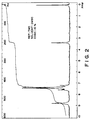
- Figure 2 is an 1 H-NMR chart of an urea derivative of Compound Example 1.
- Figure 3 is an FTIR chart of an urea derivative of Compund Example 21.
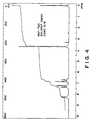
- Figure 4 is an 1 H-NMR chart of an urea derivative of Compound Example 21.
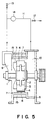
- Figure 5 is a schematic illustration of an embodiment of an apparatus for embedding particles (B) onto particles (A).
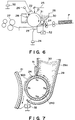
- Figure 6 is an illustration of an embodiment of the image forming apparatus according to the present invention.
- Figure 7 is a partially enlarged view of the developing zone of the apparatus shown in Figure 6.
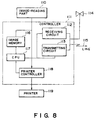
- Figure 8 is a block diagram of a facsimile apparatus incorporating such an image forming apparatus as a printer.
- an arylurea compound comprising an arylurea having at least one electron-attractive group or electron-donative group or a polyarylurea including such an arylurea as a recurring unit is substantially colorless and, when contained in a toner, provides the toner with a sufficient triboelectric chargeability, thus providing a solution to the above-mentioned problems.
- the present invention is based on the discovery.
- urea derivatives are colorless or only lightly colored, even if colored, thus being inclusively regarded as substantially colorless, so that they are optimum as charge controllers for color toners.
- Urea derivatives are thermally and mechanically stable and do not decompose when stirred in a developing apparatus. Therefore, a color toner obtained by using a urea derivative can always provide clear images regardless of an increased number of copying cycles.
- the present invention has been accomplished based on a discovery that a toner containing a class of the urea derivatives according to the present invention is provided with better properties than a toner containing a conventional charge controller.
- the arylurea compound used as the charge controller according to the present invention comprises an arylurea having at least one electron-attractive group or electron-donative group or a polyarylurea including such an arylurea as a recurring unit.
- the arylurea compound according to the present invention may preferably be an N,N′-bisarylurea derivative represented by the following formula (I) in view of facility of synthesis: wherein Y 1 and Y 2 denote a phenyl or naphthyl group; R 1 and R 2 independently denote a halogen atom, nitro group, sulfonic acid group, carboxyl group, carboxylic acid ester group, cyano group or carbonyl group; R 3 and R 4 denote a hydrogen atom, alkyl group, alkoxy group, phenyl group capable of having a substituent, or aralkyl group capable of having a substituent; R 5 and R 6 denote a hydrogen atom or C 1 - C 8 hydrocarbon group; k and l are 0, 1 or 2 satisfying k+ l ⁇ 1; and m and n are 1 or 2.
- formula (I) in view of facility of synthesis: wherein Y 1 and Y 2 denote a pheny
- Examples of the substituent attachable to the phenyl group and aralkyl group may include: halogen atom, nitro group, sulfonic acid group, carboxyl group, carboxylic acid group, cyano group and carbonyl group; of which halogen atom, carboxyl group and carboxylic acid ester group are particularly preferred.
- Another class of the arylurea compund according to the present invention preferred in view of facility of handling may include an N,N'-bisarylurea derivative represented by the following formula (II): wherein Y 1 and Y 2 denote a phenyl group, naphthyl group or anthryl group; R 1 and R 2 independently denote an alkyl group, alkoxy group or amino group; R 3 and R 4 denote a hydrogen atom, alkyl group, alkoxy group, amino group, phenyl group capable of having a substituent, or aralkyl group capable of having a substituent; R 5 and R 6 are a hydrogen atom or C 1 - C 8 hydrocarbon group; k and l are 0, 1 or 2 satisfying k+ l ⁇ 1; and m and n are 1 or 2.
- the substituent attachable to the phenyl group or aralkyl group may include: alkyl group, alkoxy group and amino group, of which alkyl group is particularly preferred.
- the urea derivative according to the present invention may be synthesized according to an ordinary method, e.g., by reacting an aniline derivative and an isocyanate derivative in benzene as solvent.
- an aniline derivative and an isocyanate derivative in benzene as solvent.
- a parachloro-substituted form of Compund Example (1) was synthesized in the following manner.
- the product was identified by FTIR (Fourier transform infrared spectroscopy) using an infrared spectrophotometer ("Model 270-30", available from Hitachi Seisakusho K.K.) and 1 H-NMR (nuclear magnetic resonance) using a nuclear magnetic resonance apparatus ("Model R-24B”, available from Hitachi Seisakusho K.K.) to obtain charts shown in Figures 1 and 2, respectively.
- FTIR Fastier transform infrared spectroscopy
- 1 H-NMR nuclear magnetic resonance apparatus
- a paramethyl-substituted form a Compound Example (21) was synthesized identified in substantially the same manner as above from 4-methylaniline and 4-methylphenyl isocyanate.
- the urea derivative according to the present invention may be added to a toner internally or externally.
- the amount of addition cannot be determined in a unitary way but may depend on several factors of toner production, such as the kind of the binder resin, the presence or absence of optional additives and methods of addition of such additives.
- the toner particles carrying the urea derivative are withdrawn from a product withdrawal outlet 10.
- the blades 4 are supported by a rotor 2 which is placed at a part separated from the outlet chamber 10 by a partition plate 5.
- the temperature within the apparatus is controlled, as desired, by passing cooling water through a jacket 15.
- the blades 4 may preferably be rotated at a peripheral speed of 30 - 130 m/sec, more preferably 30 - 100 m/sec.
- the blades 4 and the liner 7 may preferably be disposed with a spacing therebetween of about 0.5 - 10 mm, more preferably 1 - 7 mm, so as to provide good results.
- the liner 7 may assume any shapes, inclusive of a wave, a sawtooth and a flat plate.
- the toner according to the present invention can be used in combination with silica fine powder externally added thereto.
- the silica fine powder may be produced through either the dry process or the wet process.
- the dry process mentioned above refers to a process for producing silica fine powder by vapor phase oxidation of a silicon halide.
- Such fine silica powder may, for example, be obtained by pyrolytic oxidation of gaseous silicon tetrachloride in oxygen-hydrogen flame.
- the basic reaction scheme may be represented as follows: SiCl 4 + 2H 2 + O 2 ⁇ SiO 2 + 4HCl
- silica fine powder to be used in the present invention through the wet process, for example, decomposition of sodium silicate with an acid represented by the following scheme may be applied: Na 2 O ⁇ xSiO 2 + HCl + H 2 O ⁇ SiO 2 ⁇ nH 2 O + NaCl.
- silicic acid there may also be used a process wherein sodium silicate is decomposed with an ammonium salt or an alkali salt, a process wherein an alkaline earth metal silicate is produced from sodium silicate and decomposed with an acid to form silicic acid, a process wherein a sodium silicate solution is treated with an ion-exchange resin to form silicic acid, and a process wherein natural silicic acid or silicate is utilized.
- the silica fine power to be used herein may be anhydrous silicon dioxide (silica), and also a silicate such as aluminum silicate, sodium silicate, potassium silicate, magnesium silicate and zinc silicate.
- silicate such as aluminum silicate, sodium silicate, potassium silicate, magnesium silicate and zinc silicate.
- the silica fine powder may preferably have a specific surface area of at least 30 m 2 /g, more preferably 50 - 400 m 2 /g, as measured by the BET method according to nitrogen adsorption.
- the silica fine powder used in the present invention may have been treated with an agent, such as a silane coupling agent or organic silicon compound, for the purpose of imparting a hydrophobicity, etc. More specifically, silica fine powder may be treated with such a treating agent reactive with or physically adsorbed onto the silica fine powder.
- an agent such as a silane coupling agent or organic silicon compound
- Examples of such a treating agent may include: hexamethyldisilazane, trimethylsilane, trimethylchlorosilane, trimethylethoxysilane, dimethyldichlorosilane, methyltrichlorosilane, allyldimethylchlorosilane, allylphenyldichlorosilane, benzyldimethylcholrosilane, bromomethyldimethylchlorosilane, ⁇ -chloroethyltrichlorosilane, ⁇ -chloroethyltrichlorosilane, chloromethyldimethylchlorosilane, triorganosilylmercaptans such as trimethylsilylmercaptan, triorganosilyl acrylates, vinylmethylacetoxysilane, dimethylethoxysilane, dimethyldimethoxysilane, diphenyldiethoxysilane, hexamethyldisiloxane, 1,3
- the silica fine powder used in the present invention may preferably have a hydrophobicity of 30 - 80 according to the methanol titration test as measured after such a treatment as described above so as to provide a developer containing the silica fine powder with a sharp and uniform triboelectric chargeability. According to the methanol titration test, the degree of hydrophobicity of the silica fine powder having a hydrophobicity-imparted surface.
- the methanol titration test used herein may be conducted in the following manner.
- Sample silica powder (0.2 g) is charged into 50 ml of water in a 250 ml-Erlenmeyer's flask.
- Methanol is added dropwise from a buret until the whole amount of the silica is wetted therewith.
- the content in the flask is constantly stirred by means of a magnetic stirrer.
- the end point can be observed when the total amount of the silica powder is suspended in the liquid, and the hydrophobicity is represented by the percentage of the methanol in the liquid mixture of water and methanol on reaching the end point.
- the colorant to be used in the developer of the present invention may be one or a mixture of known dyes or pigments including Carbon Black, Lamp Black, Iron Black, ultramarine blue, nigrosine dyes, Aniline Blue, Phthalocyanine Blue, Phthalocyanine Green, Hansa Yellow G, Rhodamine 6G Lake, Chalcooil Blue, Chrome Yellow, Quinacridone, Benzidine Yellow, Rose Bengal, triarylmethane dyes, monoazo dyes and pigments and disazo dyes and pigments.
- known dyes or pigments including Carbon Black, Lamp Black, Iron Black, ultramarine blue, nigrosine dyes, Aniline Blue, Phthalocyanine Blue, Phthalocyanine Green, Hansa Yellow G, Rhodamine 6G Lake, Chalcooil Blue, Chrome Yellow, Quinacridone, Benzidine Yellow, Rose Bengal, triarylmethane dyes, monoazo dyes and pigments and disazo dyes and pigments.
- the binder resin for the developer of the present invention may for example be composed of: homopolymers of styrene and derivatives thereof, such as polystyrene, poly-p-chlorostyrene and polyvinyltoluene; styrene copolymers such as styrene-p-chlorostyrene copolymer, styrene-vinyltoluene copolymer, styrene-vinylnaphthalene copolymer, styrene-acrylate copolymer, styrene-methacrylate copolymer, styrene-methyl- ⁇ -chloromethacrylate copolymer, styrene-acrylonitrile copolymer, styrene-vinyl methyl ether copolymer, styrene-vinyl ethyl ether copolymer, styrene-viny
- the binder resin may have been crosslinked, and a crosslinked styrene copolymer is particularly preferred.
- Examples of the comonomer constituting such a styrene copolymer together with styrene monomer may include other vinyl monomers inclusive of: monocarboxylic acids having a double bond and derivative thereof, such as acrylic acid, methyl acrylate, ethyl acrylate, butyl acrylate, dodecyl acrylate, octyl acrylate, 2-ethylhexyl acrylate, phenyl acrylate, methacrylic acid, methyl methacrylate, ethyl methacrylate, butyl methacrylate, octyl methacrylate, acrylonitrile, methacrylonitrile, and acrylamide; dicarboxylic acids having a double and and derivatives thereof, such as maleic acid, butyl maleate, methyl maleate and dimethyl maleate; vinyl esters, such as vinyl chloride, vinyl acetate, and vinyl benzoate; ethylenic olefin
- the crosslinking agent may principally be a compound having two or more double bonds susceptible of polymerization, examples of which may include: aromatic divinyl compounds, such as divinylbenzene, and divinylnaphthalene; carboxylic acid esters having two double bonds, such as ethylene glycol diacrylate, ethylene glycol dimethacrylate and 1,3-butanediol dimethacrylate; divinyl compounds, such as divinylaniline, divinyl ether, divinyl sulfide and divinylsulfone; and compounds having three or more vinyl groups. These may be used singly or in mixture.
- aromatic divinyl compounds such as divinylbenzene, and divinylnaphthalene
- carboxylic acid esters having two double bonds such as ethylene glycol diacrylate, ethylene glycol dimethacrylate and 1,3-butanediol dimethacrylate
- divinyl compounds such as divinylaniline, divinyl ether, divinyl s
- a binder resin for a pressure-fixable toner examples of which may include: polyethylene, polypropylene, polybutylene, polyurethane elastomer, ethylene-ethyl acrylate copolymer, ethylenevinyl acetate copolymer, ionomer resin, styrenebutadiene copolymer, styrene-isoprene copolymer, linear saturated polyester and paraffins.
- the toner constituting the developer according to the present invention can be composed as a magnetic toner by incorporating therein a magnetic material.
- the magnetic material may be one or a mixture of: iron oxides, such as magnetite, ⁇ -iron oxide, ferrite, and excessive iron-containing ferrite; metals, such as iron, cobalt and nickel, and alloys of these metals with other metals, such as aluminum cobalt, copper, zinc, lead, magnesium, tin, zinc, antimony, beryllium, bismuth, cadmium, calcium, manganese, selenium, titanium, tungsten and vanadium; and mixture of the above.
- These magnetic materials may preferably have an average particle size of 0.1 - 1 micrometer (micron), more preferably 0.1 - 0.5 micron and may preferably be contained in an amount of 40 - 150 wt. parts, more preferably 60 - 120 wt. parts, per 100 wt. parts of the binder resin.
- the toner containing the charge controller according to the present invention may have a weight-average particle size of 3 - 15 microns.
- the toner has a weight-average particle size of 4 - 10 microns and contains 12 - 60 % by number of toner particles having a particle size of 5 microns or smaller, 1 - 33 % by number of toner particles having a particle size of 8 - 12.7 microns, and 2.0 wt. % or less of toner particles having a particle size of 16 microns or larger.
- the particle size distribution of a toner may suitably be measured by means of a Coulter counter in the present invention, while it may be measured in various manners.
- Coulter counter Model TA-II (available from Coulter Electronics Inc.) is used as an instrument for measurempnt, to which an interface (available from Nikkaki K.K.) for providing a number-basis distribution, and a volume-basis distribution and a personal computer CX-1 (available from Canon K.K.) are connected.
- a 1 %-NaCl agueous solution as an electrolytic solution is prepared by using a reagent-grade sodium chloride.
- ISOTON R -II (available from Coulter Scientific Japan K.K.) may be used therefor.
- a surfactant preferably an alkylbenzenesulfonic acid salt
- 2 to 20 mg of a sample is added thereto.
- the resultant dispersion of the sample in the electrolytic liquid is subjected to a dispersion treatment for about 1 - 3 minutes by means of an ultrasonic disperser, and then subjected to measurement of particle size distribution in the range of 2 - 40 microns by using the above-mentioned Coulter counter Model TA-II with a 100 micron-aperture to obtain a volume-basis distribution and a number-basis distribution.
- the developer according to the present invention may also be constituted as a two-component type developer by mixing a toner with a carrier.
- the carrier particles used for this purpose may be those known in the art including, for example, powder or particles of magnetic metals, such as iron, ferrite and nickel; glass beads; and these particles further coated with resins.
- coating resins may include: styrene-acrylate copolymer, styrene-methacrylate copolymer, other acrylate copolymers and methacrylate copolymers, silicone resin, fluorine-containing resin, polyamide resin, ionomer resin and polyphenylene sulfide resin. These resins may be used singly or in mixture.
- the developer according to the present invention may further contain optional additives, examples of which may include: lubricants, such as zinc stearate; abrasives, such as cerium oxide, and silicon carbide; fluidity-imparting agents, such as aluminum oxide; anti-caking agent; and electroconductivityimparting agents, such as carbon black and tin oxide. It is also possible to add fine powder of a fluorine-containing polymer, such as polyvinylidene fluoride, as a preferable additive, in order to provide fluidity, abrasive-characteristic and charge-stability.
- lubricants such as zinc stearate
- abrasives such as cerium oxide, and silicon carbide
- fluidity-imparting agents such as aluminum oxide
- anti-caking agent anti-caking agent
- electroconductivityimparting agents such as carbon black and tin oxide.
- fine powder of a fluorine-containing polymer such as polyvinylidene fluoride
- a releasing substance in a toner so as to improve the releasability at the time of hot roller fixation.
- the releasing substance may include waxy substances, such as low-molecular weight polyethylene, low-molecular weight polypropylene, microcrystalline wax, carnauba wax, sasol wax, and paraffin wax.
- Such a releasing subslance may be added in a proportion of about 0.5 - 5 wt. % of the toner.
- the toner according to the present invention may preferably be prepared through a process wherein the above-mentioned toner constituents are sufficiently blended in a blender such as a ball mill, well kneaded by a hot kneading means such as a hot roller kneader or an extruder, cooled to be solidified, mechanically pulverized and classified to provide a toner.
- a blender such as a ball mill
- a hot kneading means such as a hot roller kneader or an extruder
- the thus obtained toner may be further blended with other additives as desired by means of a blender, such as a Henschel mixer, to provide a developer according to the present invention.
- a blender such as a Henschel mixer
- the developer according to the present invention may be applicable to any known methods of developing electrostatic images inclusive of electrophotography, electrostatic recording and electrostatic printing.
- the apparatus includes a photosensitive drum 21 of, e.g., an OPC (organic photoconductor) as an electrostatic image-bearing member and a charger 22 for charging the photosensitive drum 21.
- a prescribed voltage is supplied to thy charger 22 from a power supply unit 35.
- a prescribed bias voltage is supplied to a transfer charger 23 as a transfer means from a constant voltage supply 34.
- Preferred bias conditions include a current value of 0.1 - 50 ⁇ A and a voltage value (absolute) of 500 to 4000 volts.
- the photosensitive drum 21 surface is charged to, e.g., a negative polarity by the charger 22 connected to the power supply unit 35 (voltage application means) and exposed image light from exposure means 26 as a latent image-forming means to form an electrostatic latent image thereon. Then, the latent image is subjected to, e.g., reverse-development with a monocomponent-type negatively chargeable magnetic developer 30 contained in a developing apparatus 29 equipped with a magnetic iron blade 31 and a non-magnetic developing sleeve 24 (developer-carrying member) containing therein a magnet 240.
- a monocomponent-type negatively chargeable magnetic developer 30 contained in a developing apparatus 29 equipped with a magnetic iron blade 31 and a non-magnetic developing sleeve 24 (developer-carrying member) containing therein a magnet 240.
- the developing sleeve 24 comprises, e.g., a cylinder of stainless steel (SUS 304) having a diameter of 50 mm and plural sphere-traced surface concavities thereon.
- an alternating bias, a pulsed bias and/or a DC bias is applied between the conductive substrate of the photosensitive drum 21 and the developing sleeve 24 by a bias application means 32.
- a sheet of transfer paper P is conveyed to reach a transfer station, where the back side (opposite side with respect to the photosensitive drum) of the transfer paper is charged by the transfer charger 23, whereby a developed image (toner image) on the photosensitive drum surface is electrostatically transferred to the transfer paper P.
- the transfer paper P separated from the photosensitive drum 1 is sent to a hot pressure roller fixer 27 where the toner image on the transfer paper P is fixed.
- the photosensitive drum 21 is discharged by an erasing exposure light source 26 and is subjected to a repeating cycle starting with the charging step by the primary charger 22.
- the photosensitive drum 21 comprises an OPC photosensitive layer on an electroconductive substrate and rotates in the direction of the arrow.
- the developing sleeve 24 as a developer-carrying member comprising a non-magnetic cylinder rotates so as to move in the same direction as the photosensitive drum 21 surface at the developing station.
- a multi-polar permanent magnet 240 (magnet roll) so as not to rotate.
- the multi-polar permanent magnet 240 may preferably be set to 500 - 900 Gauss at a pole N1, 600 - 1100 Gauss at a pole N2, 800 - 1500 Gauss at a pole S1 and 400 - 800 Gauss at a pole S2.
- the magnetic developer 30 in the developing device 29 is applied onto the developing sleeve 24 and the developer particles are provided with, e.g., a negative charge due to friction, e.g., between the developing sleeve 24 surface and the developer particles.
- the magnetic doctor blade 31 of iron is disposed in proximity with the cylindrical developing sleeve surface with a gap of about 50 microns to 500 microns and so as to confront one magnetic pole of the multi-polar permanent magnet, whereby a magnetic toner layer is formed in a thin and uniform thickness (30 - 300 microns) so that the magnetic developer layer is thinner than the gap between the photosensitive drum 21 and the developing sleeve 24 at the developing station.
- the revolution speed of the developing sleeve 24 is adjusted so that the sleeve surface velocity is substantially the same as or close to the speed of the photosensitive drum 21 surface. It is possible to compose the magnetic doctor blade 31 of a permanent magnet instead of iron.
- the AC bias may appropriately comprise a frequency f of 900 - 1600 Hz and a peak-to-peak voltage Vpp of 1500 - 2300 V, and the DC bias may appropriately be -100 to -350 volts.
- the developer particles are transferred to the photosensitive drum side while reciprocating between the developing sleeve 24 and the photosensitive drum 21 because of an electrostatic force exerted by the electrostatic image-bearing member surface and the action of the AC bias or pulsed bias electric field.
- an elastic blade formed of an elastic material such as silicone rubber can also be used to apply the developer 300 in a regulated thickness onto the developing sleeve 24 under the action of a pressing force.
- the OPC photosensitive drum it is possible to use an insulating drum for electrostatic recording, or a photosensitive drum having a layer of a photoconductive insulating substance, such as a-Se, CdS, ZnO 2 or a-Si in appropriate selection depending on the developing conditions, as the photosensitive drum 21.
- a photoconductive insulating substance such as a-Se, CdS, ZnO 2 or a-Si in appropriate selection depending on the developing conditions
- plural members inclusive of some of the above-mentioned members such as the photosensitive drum (image-bearing member), developing means, charging means and cleaning means can be integrally combined to form an apparatus unit so that the unit can be connected to or released from the apparatus body.
- the charging means, photosensitive drum and cleaning means can be integrally combined with the developing means to form a single unit so that it can be attached to or released from the apparatus body including the remainder of the image forming apparatus by a guide means such as a guide rail provided to the body.
- a guide means such as a guide rail provided to the body.
- the image light 25 as a latent image forming means may be replaced by digital light image of laser light for printing received data.
- Figure 8 is a block diagram for illustrating such an embodiment.
- a controller 111 controls an image reader (or image reading unit) 110 and a printer 119.
- the entirety of the controller 111 is regulated by a CPU 117.
- Data read from the image reader 110 is transmitted through a transmitter circuit 113 to a remote terminal such as another facsimile machine.
- data received from a remote terminal is transmitted through a receiver circuit 112 to a printer 119.
- An image memory 116 stores prescribed image data.
- a printer controller 118 controls the printer 119.
- a telephone handset 114 is connected to the receiver circuit 112 and the transmitter circuit 113.
- an image received from a line (or circuit) 115 is demodulated by means of the receiver circuit 112, decoded by the CPU 117, and sequentially stored in the image memory 116.
- image data corresponding to at least one page is stored in the image memory 116, image recording or output is effected with respect to the corresponding page.
- the CPU 117 reads image data corresponding to one page from the image memory 116, and transmits the decoded data corresponding to one page to the printer controller 118.
- the printer controller 118 controls the printer 119 so that image data recording corresponding to the page is effected.
- the CPU 117 receives another image data corresponding to the next page.
- the urea derivative according to the present invention is little liable to soil the developer-carrying member, is colorless or only light-colored, is thermally and mechanically stable and has good triboelectric chargeability.
- the developer prepared by using the urea derivative is not readily affected by changes in temperature and humidity and does not readily cause image quality deterioration during continuous copying, thus being able to provide images having an excellent uniformity of density. Further, the developer is excellent in storage stability and causes little decrease in triboelectric chargeability by a long term of storage.
- the urea derivative is used to form a color toner, the color toner can provide clear images. Further, the urea derivative can have a remarkably different levels of triboelectric chargeability by using different kinds of substituents so that the developer according to the present invention can be applied to a variety of developing methods.
- the above ingredients were well blended in a blender and kneaded through a twin-screw extruder set at 150 °C.
- the kneaded product was cooled, coarsely crushed by a cutter mill and finely pulverized by a pulverizer using a jet air stream, followed by classification by means of a fixed wall-type wind force classifier.
- the resultant classified powder was further subjected to classification by a multi-division classifier ("Elbow Jet Classifier", available from Nittetsu Kogyo K.K.) for strict classification-removal of coarse powder fraction and ultra-fine powder fraction simultaneously, to recover black fine powder (toner) having a weight-average particle size of 8.5 microns.
- Elbow Jet Classifier available from Nittetsu Kogyo K.K.
- the thus obtained black fine powder contained 23 % by number of particles having a particle size of 5 microns or below, 26 % by number of particles having a particle size of 8 - 12.7 microns, and 0.3 wt. % of particles having a particle size of 16 microns or larger.
- 0.6 part of hydrophobic silica fine powder treated with dimethyldichlorosilane was added to 100 parts of the black fine powder, and the mixture was blended in a Henschel mixer to obtain a toner (containing silica fine powder).
- the toner in an amount of 5 g was mixed with 96 g of carrier to measure the triboelectric charge thereof by the flow-off method in a normal temperature/normal humidity environment of 23 °C/60 %RH, whereby a value of -28 ⁇ C/g was obtained.
- the two-component type developer was subjected to a copying test by using a commercially available color electrophotographic copier ("CLC-500", available from Canon K.K.).
- Blue fine powder (toner) having a weight-average particle size of 8.3 microns was prepared and mixed with silica fine powder in the same manner as in Example 1 except that the 5 parts of carbon black was replaced by 4 parts of a copper phthalocyanine pigment (C.I. Pigment Blue 15).
- the toner (with silica) was further blended with the same carrier in the same ratio as in Example 1 to obtain a two-component type developer.
- the developer was subjected to the same copying test as in Example 1 whereby, under the conditions of 23 °C/60 %RH, clear blue images free from fog and having a density of 1.56 were obtained from the initial stage. No image quality deterioration was observed even after copying of 10 4 sheets. As a result of the copying tests under 35°C/85 %RH and 15°C/10 %RH, similarly good results as under 23 °C/60% RH were obtained.
- Red fine powder having a weight-average particle size of 8.2 microns was prepared and mixed with silica fine powder in the same manner as in Example 1 except that the 5 parts of carbon black was replaced by 4 parts of a quinacridone pigment (C.I. Pigment Red 122).
- the toner (with silica) was further blended with the same carrier in the same ratio as in Example 1 to obtain a two-component type developer.
- the developer was subjected to the same copying test as in Example 1 whereby, under the conditions of 23 °C/60 %RH, clear magenta images free from fog and having a density of 1.57 were obtained from the initial stage. No image quality deterioration was observed even after copying of 10 4 sheets. As a result of the copying tests under 35°C/85 %RH and 15 °C/10 %RH, similarly good results as under 23°C/60% RH were obtained.
- Yellow fine powder (toner) having a weight-average particle size of 8.1 microns was prepared and mixed with silica fine powder in the same manner as in Example 1 except that the 5 parts of carbon black was replaced by 4 parts of a yellow pigment (C.I. Pigment Yellow 17).
- the toner (with silica) in an amount of 6 parts was further blended with 100 parts of the same carrier as in Example 1 to obtain a two-component type developer.
- the developer was subjected to the same copying test as in Example 1 whereby, under the conditions of 23 °C/60 %RH, clear yellow images free from fog and having a density of 1.53 were obtained from the initial stage. No image quality deterioration was observed even after copying of 10 4 sheets. As a result of the copying tests under 35 °C/85 %RH and 15 °C/10 %RH, similarly good results as under 23 °C/60% RH were obtained.
- Full color images were formed by using the black, cyan, magenta and yellow developers prepared by Examples 1 - 4, whereby clear full color images were provided with good color mixing characteristic and gradation characteristic.
- Black fine powder (toner) having a weight-average particle size of 8.4 microns was prepared and mixed with silica fine powder in the same manner as in Example 1 except that the 2 parts of Compound Example 1 was replaced by 2 parts of N,N'-bis(4-chlorophenyl)thiourea.
- the toner showed a triboelectric charge of -11 ⁇ C/g as measured according to the same method as in Example 1.
- the toner (with silica) was further blended with the same carrier in the same ratio as in Example 1 to obtain a two-component type developer.
- the developer was subjected to the same copying test as in Example 1 under the conditions of 23 °C/60 %RH, whereby an image having an image density of 1.39 was obtained.
- the image density was lowered to 1.20 on a 2000-th sheet which also showed ground fog in a practically problematic degree.
- conspicuous toner scattering was observed in the copying apparatus, so that the toner was judged as commercially unacceptable.
- the above ingredients were well blended in a blender and kneaded through a twin-screw extruder set at 140 °C.
- the kneaded product was cooled, coarsely crushed by a cutter mill and finely pulverized by a pulverizer using a jet air stream, followed by classification by means of a fixed wall-type wind force classifier.
- the resultant classified powder was further subjected to classification by a multi-division classifier ("Elbow Jet Classifier", available from Nittetsu Kogyo K.K.) for strict classification-removal of coarse powder fraction and ultra-fine powder fraction simultaneously, to recover black fine powder (toner) having a weight-average particle size of 8.3 microns.
- Elbow Jet Classifier available from Nittetsu Kogyo K.K.
- hydrophobic silica fine powder treated with hexamethyldisilazane was added to 100 parts of the black fine powder, and the mixture was blended in a Henschel mixer to obtain a monocomponent-type developer.
- the monocomponent-type developer thus obtained was subjected to a copying test by using a commercially available copying machine ("NP-6650", available from Canon K.K.) under the environmental conditions of 23 °C/60 % RH (normal temperature/normal humidity), whereby clear images free from fog and roughness having an image density of 1.41 were obtained at a resolution of 6.3 lines/mm. Further, on continuous copying of 3x10 4 sheets for evaluation of durability, it was possible to obtain good images having an image density of 1.39 and a resolution of 6.3 lines/mm which were thus not inferior to the images at the initial stage.
- NP-6650 commercially available copying machine
- RH normal temperature/normal humidity
- the triboelectric charge of the developer on the developing sleeve was measured to be -11.5 ⁇ C/g at the initial stage and -10.7 ⁇ C/g after copying 3x10 4 sheets, and almost no soiling was observed on the sleeve. Then, a copying test was performed under the conditions of 15 °C/10 %RH, similarly good images were obtained at a high density. Similarly good results were obtained in a continuous copying test of 3x10 4 sheets. Similar copying test and continuous copying test were performed under the conditions of 35 °C/85 %RH, whereby good results were obtained. The developer was further left standing for 1 month under the conditions and then subjected to the same copying test and continuous copying test, whereby satisfactory results of no problem were obtained.
- Black fine powder (magnetic toner) having a weight-average particle size of 11.4 microns was prepared in the same manner as in Example 6 except that the 3 parts of Compound Example (2) was replaced by 3 parts of Compound Example (3) in a parachloro-substituted form and the amount of the magnetic material was reduced from 80 parts to 60 parts.
- hydrophobic silica fine powder treated with silicone oil was added to 100 parts of the black fine powder, followed by blending with a Henschel mixer, to obtain a monocomponent-type developer.
- the monocomponent-type developer thus obtained was subjected to a copying test by using a commercially available copying machine ("NP-6650", available from Canon K.K.) under the environmental conditions of 23 °C/60 % RH (normal temperature/normal humidity), whereby clear images free from fog and roughness having a high image density of 1.40 were obtained. Further, on continuous copying of 3x10 4 sheets for evaluation of durability, it was possible to obtain good images not inferior to the images at the initial stage.
- the triboelectric charge of the developer on the developing sleeve was measured to be -10.6 ⁇ C/g at the initial stage and -10.2 ⁇ C/g after copying 3x10 4 sheets, and almost no soiling was observed on the sleeve.
- Styrene/n-butyl methacrylate copolymer 100 parts Copper-phthalocyanine pigment (C.I. Pigment Blue 15) 5 " Low-molecular weight polypropylene wax 3 " Compound Example (4) in a ortho-chloro-substituted form 4 "
- a blue fine powder (toner) having a weight average particle size of 11.5 microns was prepared from the above ingredients otherwise in a similar manner as in Example 6.
- hydrophobic silica fine powder treated with dimethyldichlorosilane was added to 100 parts of the blue fine powder thus obtained, followed by blending by using a Henschel mixer to obtain a toner (with silica). Then, 7 parts of the toner (with silica) was blended with 100 parts of an acrylic resin-coated ferrite carrier having an average particle size of 65 microns to obtain a two-component type developer.
- the two-component type developer thus obtained was subjected to a copying test using a commercially available copying machine ("NP-6650", available from Canon K.K.) under the environmental conditions of 23 °C/60 %RH, whereby good images having an image density of 1.35 were obtained.
- NP-6650 available from Canon K.K.
- the two-component type developer was evaluated with respect to durability by continuous copying of 5000 sheets, whereby good images not inferior to the images at the initial stage were obtained.
- Polyester (acid value: 9.5 mgKOH/g, hydroxyl value: 16.3 mgKOH/g 100 parts Carbon black 5 " Compound Example (5) in a meta-nitro-substituted form 2 "
- a black fine powder (toner) having a weight average particle size of 8.2 microns was prepared from the above ingredients otherwise in a similar manner as in Example 1.
- hydrophobic silica fine powder treated with hexamethyldisilazane was added to 100 parts of the black fine powder thus obtained, followed by blending by using a Henschel mixer to obtain a toner (with silica). Then, 6 parts of the toner (with silica) was blended with 100 parts of an acrylic resin-coated ferrite carrier having an average particle size of 65 microns to obtain a two-component type developer.
- the two-component type developer thus obtained was subjected to a copying test using a commercially available color copying machine ("CLC-500", available from Canon K.K.) under the environmental conditions of 23 °C/60 %RH, whereby clear images having an image density of 1.42 were obtained from the initial stage, and no image quality deterioration was observed even after copying of 10 4 sheets.
- CLC-500 commercially available color copying machine
- the above ingredients were well blended in a blender and kneaded through a twin-screw extruder set at 150 °C.
- the kneaded product was cooled, coarsely crushed by a cutter mill and finely pulverized by a pulverizer using a jet air stream, followed by classification by means of a fixed wall-type wind force classifier.
- the resultant classified powder was further subjected to classification by a multi-division classifier ("Elbow Jet Classifier", available from Nittetsu Kogyo K.K.) for strict classification-removal of coarse powder fraction and ultra-fine powder fraction simultaneously, to recover fine powder having a weight-average particle size of 8.7 microns.
- Elbow Jet Classifier available from Nittetsu Kogyo K.K.
- the mixture was subjected to 5 min. of an attaching-embedding treatment by means of an apparatus as shown in Figure 5 under the conditions of a minimum blade clearance of 1 mm and a blade peripheral speed of 60 m/sec.
- an attaching-embedding treatment by means of an apparatus as shown in Figure 5 under the conditions of a minimum blade clearance of 1 mm and a blade peripheral speed of 60 m/sec.
- the additive materials were attached to and partially embedded in the surface of the toner particles.
- 0.5 part of hydrophobic silica fine powder treated with hexamethyldisilazane was added and blended, to obtain a mono-component type developer.
- the monocomponent-type developer thus obtained was subjected to a copying test by using a commercially available copying machine ("NP-6650", available from Canon K.K.) under the environmental conditions of 23 °C/60 %RH (normal temperature/normal humidity), whereby clear images free from fog and roughness having an image density of 1.38 were obtained at a resolution of 6.3 lines/mm. Further, on continuous copying of 2x10 4 sheets for evaluation of durability, it was possible to obtain good images having an image density of 1.32 which were thus not inferior to the images at the initial stage. Then, a copying test was performed under the conditions of 15 °C/10 %RH, similarly good images were obtained at a high density. Similarly good results were obtained in a continuous copying test of 2x10 4 sheets. Similar copying test and continuous copying test were performed under the conditions of 35 °C/85 %RH, whereby good results were obtained.
- NP-6650 available from Canon K.K.
- the above ingredients were well blended in a blender and kneaded through a twin-screw extruder set at 140 °C.
- the kneaded product was cooled, coarsely crushed by a cutter mill and finely pulverized by a pulverizer using a jet air stream, followed by classification by means of a fixed wall-type wind force classifier.
- the resultant classified powder was further subjected to classification by a multi-division classifier ("Elbow Jet Classifier", available from Nittetsu Kogyo K.K.) for strict classification-removal of coarse powder fraction and ultra-fine powder fraction simultaneously, to recover black fine powder (toner) having a weight-average particle size of 8.1 microns.
- Elbow Jet Classifier available from Nittetsu Kogyo K.K.
- hydrophobic silica fine powder treated with dimethyl silicone oil was added to 100 parts of the black fine powder, and the mixture was blended in a Henschel mixer to obtain a monocomponent-type developer.
- the monocomponent-type developer thus obtained was subjected to a copying test by using a commercially available laser beam printer ("LBP-8II", available from Canon K.K.) under the environmental conditions of 23 °C/60 %RH (normal temperature/normal humidity), whereby clear images free from fog having an image density of 1.41 were obtained. Further, on continuous copying of 3000 sheets for evaluation of durability, it was possible to obtain good images having an image density of 1.40 which were thus not inferior to the images at the initial stage. Then, a copying test was performed under the conditions of 15 °C/10 %RH, similarly good images were obtained at a high density. Similarly good results were obtained in a continuous copying test of 3000 sheets. Similar copying test and continuous copying test were performed under the conditions of 35°C/85 %RH, whereby good results were obtained.
- LBP-8II laser beam printer
- the above ingredients were well blended in a blender and kneaded through a twin-screw extruder set at 150 °C.
- the kneaded product was cooled, coarsely crushed by a cutter mill and finely pulverized by a pulverizer using a jet air stream, followed by classification by means of a fixed wall-type wind force classifier.
- the resultant classified powder was further subjected to classification by a multi-division classifier ("Elbow Jet Classifier", available from Nittetsu Kogyo K.K.) for strict classification-removal of coarse powder fraction and ultra-fine powder fraction simultaneously, to recover black fine powder (toner) having a weight-average particle size of 7.9 microns.
- Elbow Jet Classifier available from Nittetsu Kogyo K.K.
- 0.6 part of hydrophobic silica fine powder treated with dimethyldichlorosilane was added to 100 parts of the black fine powder, and the mixture was blended in a Henschel mixer to obtain a toner (containing silica fine powder).
- the triboelectric charge of the toner was measured to be -24 ⁇ C/g by the blow-off method.
- the two-component type developer was subjected to a copying test by using a commercially available color electrophotographic copier ("CLC-500", available from Canon K.K.).
- Blue fine powder (toner) having a weight-average particle size of 8.5 microns was prepared and mixed with silica fine powder in the same manner as in Example 12 except that the 5 parts of carbon black was replaced by 4 parts of a copper phthalocyanine pigment (C.I. Pigment Blue 15).
- the toner (with silica) was further blended with the same carrier in the same ratio as in Example 12 to obtain a two-component type developer.
- the developer was subjected to the same copying test as in Example 12 whereby, under the conditions of 23 °C/60 %RH, clear blue images free from fog and having a density of 1.48 were obtained from the initial stage. No image quality deterioration was observed even after copying of 10 4 sheets. As a result of the copying tests under 35 °C/85 %RH and 15 °C/10 %RH, similarly good results as under 23 °C/60% RH were obtained.
- Red fine powder having a weight-average particle size of 8.0 microns was prepared and mixed with silica fine powder in the same manner as in Example 12 except that the 5 parts of carbon black was replaced by 4 parts of a quinacridone pigment (C.I. Pigment Red 122).
- the toner (with silica) was further blended with the same carrier in the same ratio as in Example 12 to obtain a two-component type developer.
- the developer was subjected to the same copying test as in Example 12 whereby, under the conditions of 23 °C/60 %RH, clear magenta images free from fog and having a density of 1.49 were obtained from the initial stage. No image quality deterioration was observed even after copying of 10 4 sheets. As a result of the copying tests under 35 °C/85 %RH and 15 °C/10 %RH, similarly good results as under 23°C/60% RH were obtained.
- Yellow fine powder (toner) having a weight-average particle size of 8.3 microns was prepared and mixed with silica fine powder in the same manner as in Example 12 except that the 5 parts of carbon black was replaced by 4 parts of a yellow pigment (C.I. Pigment Yellow 17).
- the toner (with silica) in an amount of 6 parts was further blended with 100 parts of the same carrier as in Example 12 to obtain a two-component type developer.
- the developer was subjected to the same copying test as in Example 12 whereby, under the conditions of 23 °C/60 %RH, clear yellow images free from fog and having a density of 1.46 were obtained from the initial stage. No image quality deterioration was observed even after copying of 10 4 sheets. As a result of the copying tests under 35 °C/85 %RH and 15 °C/10 %RH, similarly good results as under 23°C/60% RH were obtained.
- Full color images were formed by using the black, cyan, magenta and yellow developers prepared by Examples 12 - 15, whereby clear full color images were provided with good color mixing characteristic and gradation characteristic.
- Styrene/n-butyl methacrylate copolymer 100 wt.parts Magnetic material 80 " Low-molecular weight polypropylene wax 3 " Compound Example (22) in a paraisopropyl-substituted form 3 "
- the above ingredients were well blended in a blender and kneaded through a twin-screw extruder set at 140 °C.
- the kneaded product was cooled, coarsely crushed by a cutter mill and finely pulverized by a pulverizer using a jet air stream, followed by classification by means of a fixed wall-type wind force classifier.
- the resultant classified powder was further subjected to classification by a multi-division classifier ("Elbow Jet Classifier", available from Nittetsu Kogyo K.K.) for strict classification-removal of coarse powder fraction and ultra-fine powder fraction simultaneously, to recover black fine powder (toner) having a weight-average particle size of 8.0 microns.
- Elbow Jet Classifier available from Nittetsu Kogyo K.K.
- hydrophobic silica fine powder treated with hexamethyldisilazane was added to 100 parts of the black fine powder, and the mixture was blended in a Henschel mixer to obtain a monocomponent-type developer.
- the monocomponent-type developer thus obtained was subjected to a copying test by using a commercially available copying machine ("NP-6650", available from Canon K.K.) under the environmental conditions of 23 °C/60 % RH (normal temperature/normal humidity), whereby clear images free from fog and roughness having an image density of 1.39 were obtained at a resolution of 6.3 lines/mm. Further, on continuous copying of 3x10 4 sheets for evaluation of durability, it was possible to obtain good images having an image density of 1.36 and a resolution of 6.3 lines/mm which were thus not inferior to the images at the initial stage.
- NP-6650 commercially available copying machine
- RH normal temperature/normal humidity
- the triboelectric charge of the developer on the developing sleeve was measured to be -9.5 ⁇ C/g at the initial stage and -9.0 ⁇ C/g after copying 3x10 4 sheets, and almost no soiling was observed on the sleeve. Then, a copying test was performed under the conditions of 15 °C/10 %RH, similarly good images were obtained at a high density. Similarly good results were obtained in a continuous copying test of 3x10 4 sheets. Similar copying test and continuous copying test were performed under the conditions of 35 °C/85 %RH, whereby good results were obtained. The developer was further left standing for 1 month under the conditions and then subjected to the same copying test and continuous copying test, whereby satisfactory results of no problem were obtained.
- Black fine powder (magnetic toner) having a weight-average particle size of 10.2 microns was prepared in the same manner as in Example 17 except that the 3 parts of Compound Example (22) was replaced by 3 parts of Compound Exemple (23) in a paramethoxy-substituted form and the amount of the magnetic material was reduced from 80 parts to 60 parts.
- hydrophobic silica fine powder treated with silicone oil was added to 100 parts of the black fine powder, followed by blending with a Henschel mixer, to obtain a monocomponent-type developer.
- the monocomponent-type developer thus obtained was subjected to a copying test by using a commercially available copying machine ("NP-6650", available from Canon K.K.) under the environmental conditions of 23 °C/60 % RH (normal temperature/normal humidity), whereby clear images free from fog and roughness having a high image density of 1.36 were obtained. Further, on continuous copying of 3x10 4 sheets for evaluation of durability, it was possible to obtain good images not inferior to the images at the initial stage.
- the triboelectric charge of the developer on the developing sleeve was measured to be -9.6 ⁇ C/g at the initial stage and -9.0 ⁇ C/g after copying 3x10 4 sheets, and almost no soiling was observed on the sleeve.
- Styrene/n-butyl methacrylate copolymer 100 parts Copper-phthalocyanine pigment (C.I. Pigment Blue 15) 5 " Low-molecular weight polypropylene wax 3 " Compound Example (24) in a ortho-ethyl-substituted form 4 "
- a blue fine powder (toner) having a weight average particle size of 11.7 microns was prepared from the above ingredients otherwise in a similar manner as in Example 17.
- hydrophobic silica fine powder treated with dimethyldichlorosilane was added to 100 parts of the blue fine powder thus obtained, followed by blending by using a Henschel mixer to obtain a toner (with silica). Then, 7 parts of the toner (with silica) was blended with 100 parts of an acrylic resin-coated ferrite carrier having an average particle size of 65 microns to obtain a two-component type developer.
- the two-component type developer thus obtained was subjected to a copying test using a commercially available copying machine ("NP-6650", available from Canon K.K.) under the environmental conditions of 23 °C/60 %RH, whereby good images having an image density of 1.32 were obtained.
- NP-6650 available from Canon K.K.
- the two-component type developer was evaluated with respect to durability by continuous copying of 5000 sheets, whereby good images not inferior to the images at the initial stage were obtained.
- Polyester (acid value: 9.5 mgKOH/g, hydroxyl value: 16.3 mgKOH/g 100 parts Carbon black 5 " Compound Example (25) in a meta-butyl-substituted form 2 "
- a black fine powder (toner) having a weight average particle size of 7.7 microns was prepared from the above ingredients otherwise in a similar manner as in Example 12.
- hydrophobic silica fine powder treated with hexamethyldisilazane was added to 100 parts of the black fine powder thus obtained, followed by blending by using a Henschel mixer to obtain a toner (with silica). Then, 6 parts of the toner (with silica) was blended with 100 parts of an acrylic resin-coated ferrite carrier having an average particle size of 65 microns to obtain a two-component type developer.
- the two-component type developer thus obtained was subjected to a copying test using a commercially available color copying machine ("CLC-500", available from Canon K.K.) under the environmental conditions of 23 °C/60 %RH, whereby clear images having an image density of 1.44 were obtained from the initial stage, and no image quality deterioration was observed even after copying of 10 4 sheets.
- CLC-500 commercially available color copying machine
- the above ingredients were well blended in a blender and kneaded through a twin-screw extruder set at 150 °C.
- the kneaded product was cooled, coarsely crushed by a cutter mill and finely pulverized by a pulverizer using a jet air stream, followed by classification by means of a fixed wall-type wind force classifier.
- the resultant classified powder was further subjected to classification by a multi-division classifier ("Elbow Jet Classifier", available from Nittetsu Kogyo K.K.) for strict classification-removal of coarse powder fraction and ultra-fine powder fraction simultaneously, to recover fine powder having a weight-average particle size of 8.7 microns.
- Elbow Jet Classifier available from Nittetsu Kogyo K.K.
- the monocomponent-type developer thus obtained was subjected to a copying test by using a commercially available copying machine ("NP-6650", available from Canon K.K.) under the environmental conditions of 23 °C/60 % RH (normal temperature/normal humidity), whereby clear images free from fog and roughness having an image density of 1.32 were obtained at a resolution of 6.3 lines/mm. Further, on continuous copying of 2x10 4 sheets for evaluation of durability, it was possible to obtain good images having an image density of 1.28 which were thus not inferior to the images at the initial stage. Then, a copying test was performed under the conditions of 15 °C/10 %RH, similarly good images were obtained at a high density. Similarly good results were obtained in a continuous copying test of 2x10 4 sheets. Similar copying test and continuous copying test were performed under the conditions of 35 °C/85 %RH, whereby good results were obtained.
- NP-6650 available from Canon K.K.
- the above ingredients were well blended in a blender and kneaded through a twin-screw extruder set at 140 °C.
- the kneaded product was cooled, coarsely crushed by a cutter mill and finely pulverized by a pulverizer using a jet air stream, followed by classification by means of a fixed wall-type wind force classifier.
- the resultant classified powder was further subjected to classification by a multi-division classifier ("Elbow Jet Classifier", available from Nittetsu Kogyo K.K.) for strict classification-removal of coarse powder fraction and ultra-fine powder fraction simultaneously, to recover black fine powder (toner) having a weight-average particle size of 8.3 microns.
- Elbow Jet Classifier available from Nittetsu Kogyo K.K.
- hydrophobic silica fine powder treated with dimethyl silicone oil was added to 100 parts of the black fine powder, and the mixture was blended in a Henschel mixer to obtain a monocomponent-type developer.
- the monocomponent-type developer thus obtained was subjected to a copying test by using a commercially available laser beam printer ("LBP-8II", available from Canon K.K.) under the environmental conditions of 23 °C/60 % RH (normal temperature/normal humidity), whereby clear images free from fog having an image density of 1.37 were obtained. Further, on continuous copying of 3000 sheets for evaluation of durability, it was possible to obtain good images having an image density of 1.34 which were thus not inferior to the images at the initial stage. Then, a copying test was performed under the conditions of 15 °C/10 %RH, similarly good images were obtained at a high density. Similarly good results were obtained in a continuous copying test of 3000 sheets. Similar copying test and continuous copying test were performed under the conditions of 35 °C/85 %RH, whereby good results were obtained.
- LBP-8II laser beam printer
Landscapes
- Physics & Mathematics (AREA)
- General Physics & Mathematics (AREA)
- Developing Agents For Electrophotography (AREA)
- Fax Reproducing Arrangements (AREA)
Claims (81)
- Développateur pour le développement d'images électrostatiques, comprenant : un toner contenant une résine utilisée comme liant et un régulateur de charge, ce régulateur de charge comprenant un composé d'arylurée qui comprend une arylurée ayant au moins un groupe attirant les électrons ou un groupe cédant des électrons, ou une polyarylurée contenant cette arylurée comme motif récurrent.
- Développateur suivant la revendication 1, dans lequel l'arylurée en question porte un groupe attirant les électrons.
- Développateur suivant la revendication 2, dans lequel l'arylurée comprend un dérivé de N,N'-bisarylurée représenté par la formule suivante :

k et l ont la valeur 0, 1 ou 2 qui satisfait la relation k+l ≥ 1 ; et m et n ont la valeur 1 ou 2. - Développateur suivant la revendication 2 ou 3, qui est un développateur du type à un seul composant comprenant le toner.
- Développateur suivant la revendication 4, dans lequel l'arylurée comprend un dérivé de N,N'-bisarylurée représenté par la formule suivante :

- Développateur suivant la revendication 4, dans lequel le composé d'arylurée comprend au moins un composé choisi dans le groupe consistant en :
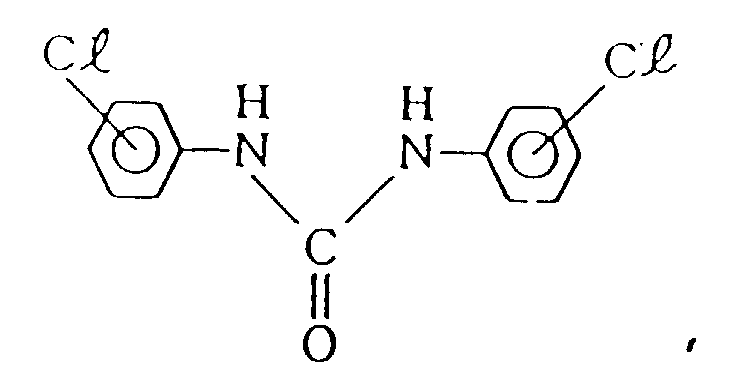


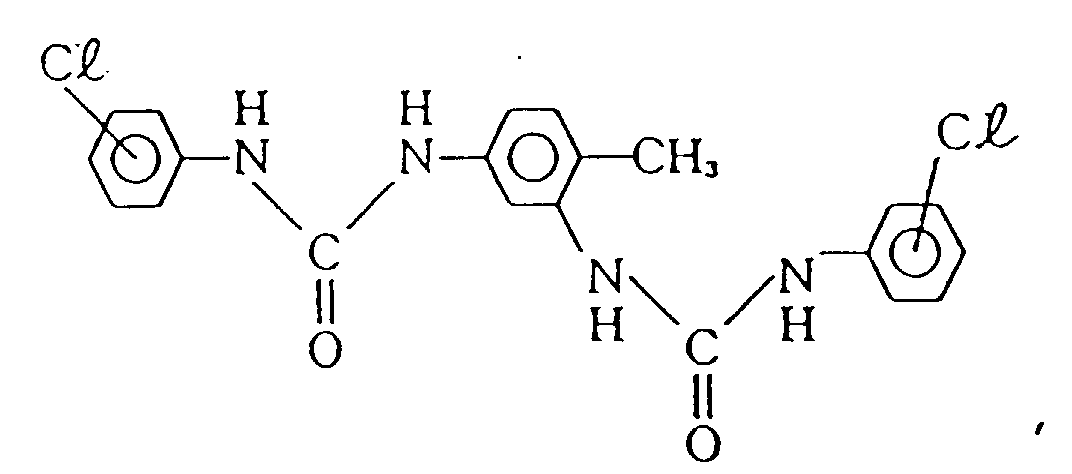

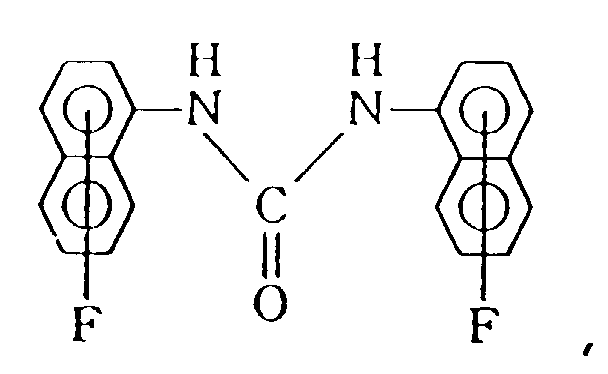


- Développateur suivant la revendication 4, 5 ou 6, dans lequel le composé d'arylurée est ajouté par voie interne au toner en proportion de 0,1 à 10 parties en poids pour 100 parties en poids de la résine utilisée comme liant.
- Développateur suivant la revendication 4, 5 ou 6, dans lequel le composé d'arylurée est ajouté par voie externe au toner en proportion de 0,01 à 10 parties en poids pour 100 parties en poids de la résine utilisée comme liant.
- Développateur suivant l'une quelconque des revendications 4 à 8, dans lequel le développateur du type à un seul composant en question contient en outre de la silice en poudre fine ayant une surface spécifique BET d'au moins 30 m2/g.
- Développateur suivant la revendication 9, dans lequel la silice en poudre fine comprend de la silice hydrophobe en poudre fine ayant un degré hydrophobe de 30 à 80.
- Développateur suivant l'une quelconque des revendications 4 à 10, dans lequel le toner contient un colorant.
- Développateur suivant la revendication 11, dans lequel le toner est un toner de couleur.
- Développateur suivant l'une quelconque des revendications 4 à 12, dans lequel le toner est un toner magnétique contenant une matière magnétique ayant un diamètre moyen de particules de 0,1 à 1 µm.
- Développateur suivant la revendication 13, dans lequel la matière magnétique est contenue dans le toner magnétique en proportion de 40 à 150 parties en poids pour 100 parties en poids de la résine utilisée comme liant.
- Développateur suivant l'une quelconque des revendications 4 à 14, dans lequel la résine utilisée comme liant comprend un copolymère styrène-acrylate.
- Développateur suivant l'une quelconque des revendications 4 à 14, dans lequel la résine utilisée comme liant comprend un copolymère styrène-méthacrylate.
- Développateur suivant l'une quelconque des revendications 4 à 14, dans lequel la résine utilisée comme liant comprend une résine de polyester.
- Développateur suivant l'une quelconque des revendications 4 à 17, dans lequel le toner a une moyenne pondérale de diamètre des particules de 3 à 15 µm,
- Développateur suivant la revendication 18, dans lequel le toner a une moyenne pondérale de diamètre des particules de 4 à 10 µm et contient 12 à 60 % en nombre de particules de toner ayant un diamètre de 5 µm ou moins, 1 à 33 % en nombre de particules de toner ayant un diamètre de 8 à 12,7 µm et 2,0 % en poids ou moins de particules de toner ayant un diamètre de 16 µm ou plus.
- Développateur suivant l'une quelconque des revendications 4 à 19, dans lequel le développateur du type à un seul composant en question contient au moins un additif choisi dans le groupe consistant en lubrifiants, abrasifs, agents conférant la fluidité, agents anti-agglomération et agents conférant la conductibilité électrique.
- Développateur suivant l'une quelconque des revendications 4 à 20, dans lequel le toner contient une substance cireuse.
- Développateur suivant la revendication 2, qui est un développateur du type à deux composants comprenant le toner et un support.
- Développateur suivant la revendication 22, dans lequel l'arylurée comprend un dérivé de N,N'-bisarylurée représenté par la formule suivante :

- Développateur suivant la revendication 22, dans lequel le composé d'arylurée en question comporte au moins un composé choisi dans le groupe consistant en :
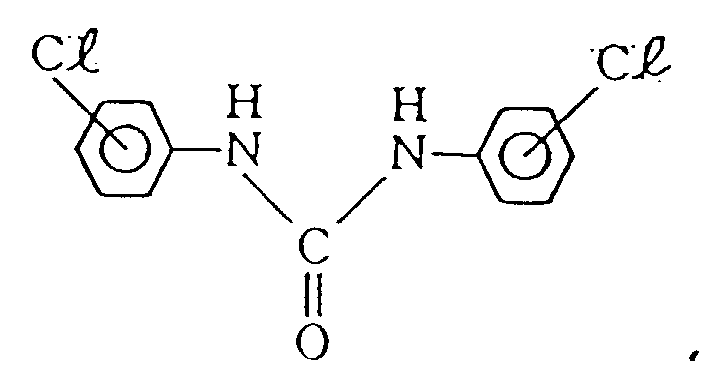


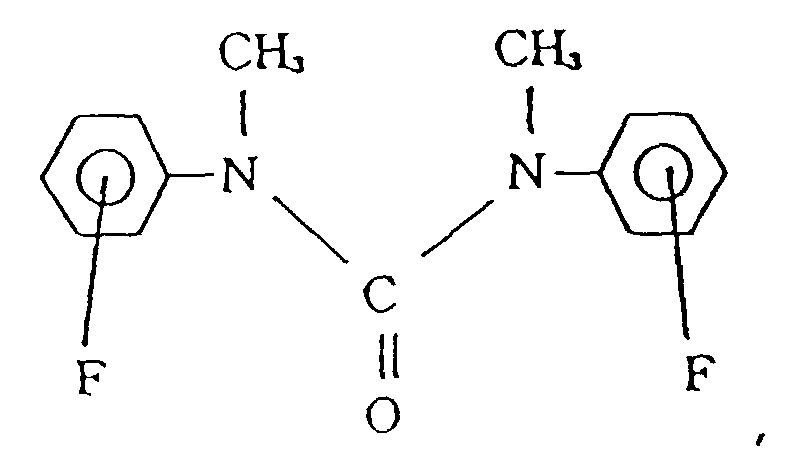


- Développateur suivant la revendication 22, dans lequel le composé d'arylurée est ajouté par voie interne au toner en proportion de 0,1 à 10 parties en poids pour 100 parties en poids de la résine utilisée comme liant.
- Développateur suivant la revendication 22, 23 ou 24, dans lequel le composé d'arylurée est ajouté par voie externe au toner en proportion de 0,01 à 10 parties en poids pour 100 parties en poids de la résine utilisée comme liant.
- Développateur suivant l'une quelconque des revendications 22 à 26, dans lequel le développateur du type à deux composants en question contient en outre de la silice en poudre fine ayant une surface spécifique BET d'au moins 30 m2/g.
- Développateur suivant la revendication 27, dans lequel la silice en poudre fine comprend de la silice hydrophobe en poudre fine ayant un degré hydrophobe de 30 à 80.
- Développateur suivant l'une quelconque des revendications 22 à 28, dans lequel le toner contient un colorant.
- Développateur suivant la revendication 29, dans lequel le toner est un toner de couleur.
- Développateur suivant l'une quelconque des revendications 22 à 30, dans lequel le toner est un toner magnétique contenant une matière magnétique ayant un diamètre moyen de particules de 0,1 à 1 µm.
- Développateur suivant la revendication 31, dans lequel la matière magnétique est contenue dans le toner magnétique en proportion de 40 à 150 parties en poids pour 100 parties en poids de la résine utilisée comme liant.
- Développateur suivant l'une quelconque des revendications 22 à 31, dans lequel la résine utilisée comme liant comprend un copolymère styrène-acrylate.
- Développateur suivant l'une quelconque des revendications 22 à 31, dans lequel la résine utilisée comme liant comprend un copolymère styrène-méthacrylate.
- Développateur suivant l'une quelconque des revendications 22 à 34, dans lequel la résine utilisée comme liant comprend une résine de polyester.
- Développateur suivant l'une quelconque des revendications 22 à 35, dans lequel le toner a une moyenne pondérale de diamètre des particules de 3 à 15 µm.
- Développateur suivant la revendication 36, dans lequel le toner a une moyenne pondérale de diamètre des particules de 4 à 10 µm et contient 12 à 60 % en nombre de particules de toner ayant un diamètre égal ou inférieur à 5 µm, 1 à 33 % en nombre de particules de toner ayant un diamètre de 8 à 12,7 µm et 2,0 % en poids ou moins de particules de toner ayant un diamètre de 16 µm ou plus.
- Développateur suivant l'une quelconque des revendications 22 à 37, dans lequel le développateur du type à deux composants en question contient au moins un additif choisi dans le groupe consistant en lubrifiants, abrasifs, agents conférant la fluidité, agents anti-agglomération et agents conférant la conductibilité électrique.
- Développateur suivant l'une quelconque des revendications 22 à 38, dans lequel le toner contient une substance cireuse.
- Développateur suivant la revendication 1, dans lequel l'arylurée en question porte un groupe cédant des électrons.
- Développateur suivant la revendication 40, dans lequel l'arylurée comprend un dérivé de N,N'-bisarylurée représenté par la formule suivante :

- Développateur suivant la revendication 40 ou 41, qui est un développateur du type à un seul composant comprenant le toner.
- Développateur suivant la revendication 42, dans lequel l'arylurée comprend un dérivé de N,N'-bisarylurée représenté par la formule suivante :

- Développateur suivant la revendication 42, dans lequel le composé d'arylurée comprend au moins un composé choisi dans le groupe consistant en :


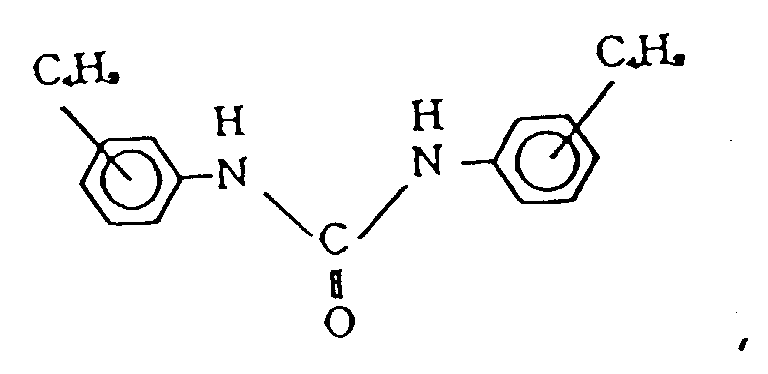


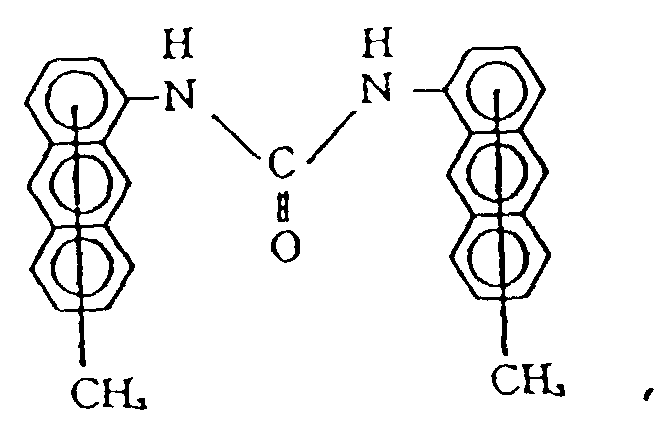
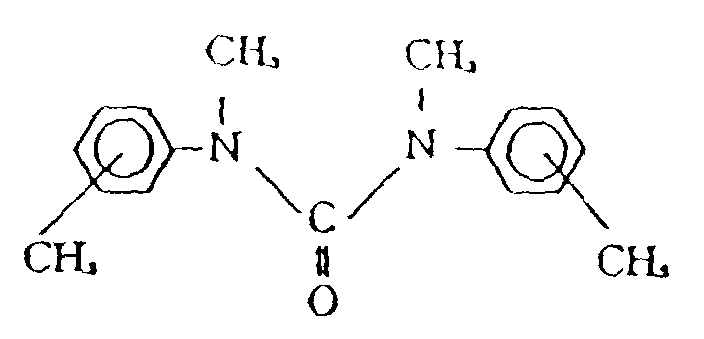

- Développateur suivant la revendication 42, 43 ou 44, dans lequel le composé d'arylurée est ajouté par voie interne au toner en proportion de 0,1 à 10 parties en poids pour 100 parties en poids de la résine utilisée comme liant.
- Développateur suivant la revendication 42, 43 ou 44, dans lequel le composé d'arylurée est ajouté par voie externe au toner en proportion de 0,01 à 10 parties en poids pour 100 parties en poids de la résine utilisée comme liant.
- Développateur suivant l'une quelconque des revendications 42 à 46, dans lequel le développateur du type à un seul composant en question comprend en outre de la silice en poudre fine ayant une surface spécifique BET d'au moins 30 m2/g.
- Développateur suivant la revendication 47, dans lequel la silice en poudre fine comprend de la silice hydrophobe en poudre fine ayant un degré hydrophobe de 30 à 80.
- Développateur suivant l'une quelconque des revendications 42 à 48, dans lequel le toner contient un colorant.
- Développateur suivant la revendication 49, dans lequel le toner est un toner de couleur.
- Développateur suivant l'une quelconque des revendications 42 à 50, dans lequel le toner est un toner magnétique contenant une matière magnétique ayant un diamètre moyen de particules de 0,1 à 1 µm.
- Développateur suivant la revendication 51, dans lequel la matière magnétique est contenue dans le toner magnétique en proportion de 40 à 150 parties en poids pour 100 parties en poids de la résine utilisée comme liant.
- Développateur suivant l'une quelconque des revendications 42 à 52, dans lequel la résine utilisée comme liant comprend un copolymère styrène-acrylate.
- Développateur suivant l'une quelconque des revendications 42 à 52, dans lequel la résine utilisée comme liant comprend un copolymère styrène-méthacrylate.
- Développateur suivant l'une quelconque des revendications 42 à 52, dans lequel la résine utilisée comme liant comprend une résine de polyester.
- Développateur suivant l'une quelconque des revendications 42 à 55, dans lequel le toner a une moyenne pondérale de diamètre des particules de 3 à 15 µm.
- Développateur suivant la revendication 56, dans lequel le toner a une moyenne pondérale de diamètre des particules de 4 à 10 µm et contient 12 à 60 % en nombre de particules de toner ayant un diamètre de 5 µm ou moins, 1 à 33 % en nombre de particules de toner ayant un diamètre de 8 à 12,7 µm et 2,0 % en poids ou moins de particules de toner ayant un diamètre de 16 µm ou plus.
- Développateur suivant l'une quelconque des revendications 42 à 57, dans lequel le développateur du type à un seul composant en question contient au moins un additif choisi dans le groupe consistant en lubrifiants, abrasifs, agents conférant la fluidité, agents anti-agglomération et agents conférant la conductibilité électrique.
- Développateur suivant l'une quelconque des -revendications 42 à 58, dans lequel le toner contient une substance cireuse.
- Développateur suivant la revendication 40, qui est un développateur du type à deux composants comprenant le toner et un support.
- Développateur suivant la revendication 60, dans lequel l'arylurée comprend un dérivé de N,N'-bisarylurée représenté par la formule suivante :

- Développateur suivant la revendication 60, dans lequel le composé d'arylurée en question comprend au moins un composé choisi dans le groupe consistant en :


- Développateur suivant la revendication 60, 61 ou 62, dans lequel le composé d'arylurée est ajouté par voie interne au toner en proportion de 0,1 à 10 parties en poids pour 100 parties en poids de la résine utilisée comme liant.
- Développateur suivant la revendication 60, 61 ou 62, dans lequel le composé d'arylurée est ajouté par voie externe au toner en proportion de 0,01 à 10 parties en poids pour 100 parties en poids de la résine utilisée comme liant.
- Développateur suivant l'une quelconque des revendications 60 à 64, dans lequel le développateur du type à deux composants en question comprend en outre de la silice en poudre fine ayant une surface spécifique BET d'au moins 30 m2/g.
- Développateur suivant la revendication 65, dans lequel la silice en poudre fine comprend de la silice hydrophobe en poudre fine ayant un degré hydrophobe de 30 à 80.
- Développateur suivant l'une quelconque des revendications 60 à 66, dans lequel le toner contient un colorant.
- Développateur suivant la revendication 67, dans lequel le toner est un toner de couleur.
- Développateur suivant l'une quelconque des revendications 60 à 68, dans lequel le toner est un toner magnétique contenant une matière magnétique ayant un diamètre moyen de particules de 0,1 à 1 µm.
- Développateur suivant la revendication 69, dans lequel la matière magnétique est contenue dans le toner magnétique en proportion de 40 à 150 parties en poids pour 100 parties en poids de la résine utilisée comme liant.
- Développateur suivant l'une quelconque des revendications 60 à 70, dans lequel la résine utilisée comme liant comprend un copolymère styrène-acrylate.
- Développateur suivant l'une quelconque des revendications 60 à 70, dans lequel la résine utilisée comme liant comprend un copolymère styrène-méthacrylate.
- Développateur suivant l'une quelconque des revendications 60 à 70, dans lequel la résine utilisée comme liant comprend une résine de polyester.
- Développateur suivant l'une quelconque des revendications 60 à 73, dans lequel le toner a une moyenne pondérale de diamètre des particules de 3 à 15 µm.
- Développateur suivant la revendication 74, dans lequel le toner a une moyenne pondérale de diamètre des particules de 4 à 10 µm et contient 12 à 60 % en nombre de particules de toner de diamètre égal ou inférieur à 5 µm, 1 à 33 % en nombre de particules de toner ayant un diamètre de 8 à 12,7 µm et 2,0 % en poids ou moins de particules de toner ayant un diamètre de 16 µm ou plus.
- Développateur suivant l'une quelconque des revendications 60 à 75, dans lequel le développateur du type à deux composants en question contient au moins un additif choisi dans le groupe consistant en lubrifiants, abrasifs, agents conférant la fluidité, agents anti-agglomération et agents conférant la conductibilité électrique.
- Développateur suivant l'une quelconque des revendications 60 à 76, dans lequel le toner contient une substance cireuse.
- Appareil électrophotographique de formation d'images, comprenant :un élément porteur d'image servant à porter une image électrostatique latente ;un moyen de charge servant à charger l'élément porteur d'image ;un moyen de formation d'image latente servant à former une image latente sur l'élément porteur d'image chargée ;un moyen développateur servant au développement de l'image électrostatique latente pour former une image de toner sur l'élément porteur d'image ;un moyen de transfert servant à transférer l'image de toner de l'élément porteur d'image à une matière réceptrice de transfert,un moyen de nettoyage servant à enlever une partie du toner restant sur l'élément porteur d'image ;un moyen de fixage servant à fixer l'image de toner transférée sur la matière réceptrice de transfert sous l'action de la chaleur et de la pression ;dans lequel le moyen développateur retient un développateur tel que défini dans l'une quelconque des revendications 1 à 77.
- Unité d'appareil, pouvant être montée de façon amovible au corps d'un appareil électrophotographique, comprenant :un élément porteur d'image servant à porter une image électrostatique, et un moyen développateur servant au développement de l'image électrostatique pour former une image de toner sur l'élément porteur d'image,dans laquelle le moyen développateur retient un développateur comprenant un toner qui contient une résine utilisée comme liant et un régulateur de charge, ce régulateur de charge comprenant un composé d'arylurée qui est constitué d'une arylurée portant au moins un groupe attirant les électrons ou un groupe cédant des électrons, ou une polyarylurée renfermant une telle arylurée comme motif récurrent.
- Appareil télécopieur, comprenant :un appareil électrophotographique et un moyen récepteur servant à recevoir des données d'image provenant d'un terminal éloigné ; cet appareil électrophotographique comprenant :un élément porteur d'image servant à porter une image électrostatique latente ;un moyen de charge servant à charger l'élément porteur d'image,un moyen formant une image latente servant à former une image latente sur l'élément porteur d'image chargée,un moyen développateur servant à développer l'image électrostatique latente pour former une image de toner sur l'élément porteur d'image,un moyen de transfert servant à transférer l'image de toner de l'élément porteur d'image à une matière réceptrice de transfert,un moyen de nettoyage servant à enlever une partie du toner restant sur l'élément porteur d'image,un moyen de fixage servant à fixer l'image de toner transférée sur la matière réceptrice de transfert sous l'action de la chaleur et de la pression ;dans lequel le moyen développateur retient un développateur comprenant un toner qui contient une résine utilisée comme liant et un régulateur de charge, ce régulateur de charge comprenant un composé d'arylurée qui consiste en une arylurée portant au moins un groupe attirant les électrons ou un groupe cédant des électrons, ou une polyarylurée contenant une telle arylurée comme motif récurrent.
- Unité d'appareil suivant la revendication 79, comprenant en outre au moins un moyen de charge servant à charger l'élément porteur d'image, et un moyen de nettoyage servant à enlever une partie du toner restant sur l'élément porteur d'image après le transfert d'une image de toner depuis l'élément porteur d'image.
Applications Claiming Priority (4)
| Application Number | Priority Date | Filing Date | Title |
|---|---|---|---|
| JP339095/90 | 1990-11-30 | ||
| JP33909590 | 1990-11-30 | ||
| JP14276391 | 1991-05-20 | ||
| JP142763/91 | 1991-05-20 |
Publications (2)
| Publication Number | Publication Date |
|---|---|
| EP0488758A1 EP0488758A1 (fr) | 1992-06-03 |
| EP0488758B1 true EP0488758B1 (fr) | 1997-01-22 |
Family
ID=26474664
Family Applications (1)
| Application Number | Title | Priority Date | Filing Date |
|---|---|---|---|
| EP91311070A Expired - Lifetime EP0488758B1 (fr) | 1990-11-30 | 1991-11-29 | Développateur pour le développement d'images électrostatiques, appareil de formation d'images, élément d'appareil et appareil pour fac-similé |
Country Status (4)
| Country | Link |
|---|---|
| US (1) | US5288579A (fr) |
| EP (1) | EP0488758B1 (fr) |
| JP (1) | JP2814158B2 (fr) |
| DE (1) | DE69124348T2 (fr) |
Families Citing this family (10)
| Publication number | Priority date | Publication date | Assignee | Title |
|---|---|---|---|---|
| JPH06258871A (ja) * | 1993-03-09 | 1994-09-16 | Hodogaya Chem Co Ltd | 静電荷像現像用トナ− |
| DE69425624T2 (de) * | 1993-10-15 | 2001-04-26 | Canon K.K., Tokio/Tokyo | Trägermaterial für Elektrophotographie, Entwickler des zwei-komponenten Typs, und Bildherstellungsverfahren |
| US6537671B2 (en) * | 2000-12-05 | 2003-03-25 | Alpha Coating Technologies, Llc | Coating powders having enhanced electrostatic chargeability |
| JP2003177604A (ja) * | 2001-12-11 | 2003-06-27 | Ricoh Co Ltd | トナー飛散防止装置および画像形成装置 |
| JP6910805B2 (ja) | 2016-01-28 | 2021-07-28 | キヤノン株式会社 | トナー、画像形成装置及び画像形成方法 |
| JP6869819B2 (ja) | 2016-06-30 | 2021-05-12 | キヤノン株式会社 | トナー、現像装置及び画像形成装置 |
| JP6904801B2 (ja) | 2016-06-30 | 2021-07-21 | キヤノン株式会社 | トナー、該トナーを備えた現像装置及び画像形成装置 |
| JP6891051B2 (ja) | 2016-06-30 | 2021-06-18 | キヤノン株式会社 | トナー、現像装置、及び画像形成装置 |
| US10295920B2 (en) | 2017-02-28 | 2019-05-21 | Canon Kabushiki Kaisha | Toner |
| US10303075B2 (en) | 2017-02-28 | 2019-05-28 | Canon Kabushiki Kaisha | Toner |
Family Cites Families (3)
| Publication number | Priority date | Publication date | Assignee | Title |
|---|---|---|---|---|
| US2297691A (en) * | 1939-04-04 | 1942-10-06 | Chester F Carlson | Electrophotography |
| US4663263A (en) * | 1984-10-19 | 1987-05-05 | Canon Kabushiki Kaisha | Toner, charge-imparting material and composition containing substituted guanidine compound for electrophotography |
| US4636451A (en) * | 1986-02-13 | 1987-01-13 | Minnesota Mining And Manufacturing Company | Pressure-fixable toner material and method of making same |
-
1991
- 1991-11-29 EP EP91311070A patent/EP0488758B1/fr not_active Expired - Lifetime
- 1991-11-29 JP JP3339420A patent/JP2814158B2/ja not_active Expired - Fee Related
- 1991-11-29 DE DE69124348T patent/DE69124348T2/de not_active Expired - Fee Related
- 1991-12-02 US US07/801,486 patent/US5288579A/en not_active Expired - Lifetime
Also Published As
| Publication number | Publication date |
|---|---|
| DE69124348D1 (de) | 1997-03-06 |
| EP0488758A1 (fr) | 1992-06-03 |
| DE69124348T2 (de) | 1997-06-05 |
| JP2814158B2 (ja) | 1998-10-22 |
| JPH0534985A (ja) | 1993-02-12 |
| US5288579A (en) | 1994-02-22 |
Similar Documents
| Publication | Publication Date | Title |
|---|---|---|
| EP0533069B1 (fr) | Toner magnétique, développateur magnétique et son utilisation dans un bloc d'assemblage, élément de formation d'images et facsimilé | |
| EP0247884B1 (fr) | Toner magnétique | |
| US4737432A (en) | Positively chargeable toner and developer for developing electrostatic images contains di-organo tin borate charge controller | |
| EP0356993B1 (fr) | Procédé de formation d'images | |
| EP0488758B1 (fr) | Développateur pour le développement d'images électrostatiques, appareil de formation d'images, élément d'appareil et appareil pour fac-similé | |
| JP2862412B2 (ja) | 磁性トナー、磁性現像剤、装置ユニット、画像形成装置及びファクシミリ装置 | |
| JP2899038B2 (ja) | 静電荷像現像用トナー | |
| JP2896826B2 (ja) | トナー及び画像形成方法 | |
| KR100215999B1 (ko) | 정전하상 현상용 토너, 화상 형성 방법, 현상소자및프로세스카트리지 | |
| JP2003122047A (ja) | トナーキット及び画像形成方法 | |
| JPH07104611B2 (ja) | 正帯電性一成分系磁性現像剤 | |
| JP2851895B2 (ja) | 静電荷像現像用トナー | |
| JP2726745B2 (ja) | 静電荷像現像用トナー | |
| JP2704765B2 (ja) | 静電荷像現像用トナー | |
| JPH02284150A (ja) | 一成分系非磁性現像剤 | |
| JPH02190868A (ja) | カラー電子写真法 | |
| JP2728969B2 (ja) | 静電荷像現像用トナー、二成分系現像剤、装置ユニット、電子写真装置及びファクシミリ装置 | |
| JP2759490B2 (ja) | 画像形成方法 | |
| JP2726740B2 (ja) | 静電荷像現像用トナー | |
| JP2603287B2 (ja) | 摩擦帯電性磁性トナー | |
| JP2759489B2 (ja) | 画像形成方法 | |
| JPH0488356A (ja) | 静電荷像現像用トナー、装置ユニット、電子写真装置及びファクシミリ | |
| JP3323711B2 (ja) | 静電荷像現像用トナーおよび画像形成方法 | |
| JPH10123762A (ja) | 画像形成方法 | |
| JP3062964B2 (ja) | 磁性体分散型キャリア、静電荷像現像用二成分系現像剤、磁性体分散型キャリアの製造方法及び画像形成方法 |
Legal Events
| Date | Code | Title | Description |
|---|---|---|---|
| PUAI | Public reference made under article 153(3) epc to a published international application that has entered the european phase |
Free format text: ORIGINAL CODE: 0009012 |
|
| AK | Designated contracting states |
Kind code of ref document: A1 Designated state(s): DE FR GB IT |
|
| 17P | Request for examination filed |
Effective date: 19921021 |
|
| 17Q | First examination report despatched |
Effective date: 19950220 |
|
| GRAG | Despatch of communication of intention to grant |
Free format text: ORIGINAL CODE: EPIDOS AGRA |
|
| GRAH | Despatch of communication of intention to grant a patent |
Free format text: ORIGINAL CODE: EPIDOS IGRA |
|
| GRAH | Despatch of communication of intention to grant a patent |
Free format text: ORIGINAL CODE: EPIDOS IGRA |
|
| GRAA | (expected) grant |
Free format text: ORIGINAL CODE: 0009210 |
|
| AK | Designated contracting states |
Kind code of ref document: B1 Designated state(s): DE FR GB IT |
|
| PG25 | Lapsed in a contracting state [announced via postgrant information from national office to epo] |
Ref country code: IT Free format text: LAPSE BECAUSE OF FAILURE TO SUBMIT A TRANSLATION OF THE DESCRIPTION OR TO PAY THE FEE WITHIN THE PRE;WARNING: LAPSES OF ITALIAN PATENTS WITH EFFECTIVE DATE BEFORE 2007 MAY HAVE OCCURRED AT ANY TIME BEFORE 2007. THE CORRECT EFFECTIVE DATE MAY BE DIFFERENT FROM THE ONE RECORDED.SCRIBED TIME-LIMIT Effective date: 19970122 Ref country code: FR Effective date: 19970122 |
|
| REF | Corresponds to: |
Ref document number: 69124348 Country of ref document: DE Date of ref document: 19970306 |
|
| EN | Fr: translation not filed | ||
| PLBE | No opposition filed within time limit |
Free format text: ORIGINAL CODE: 0009261 |
|
| STAA | Information on the status of an ep patent application or granted ep patent |
Free format text: STATUS: NO OPPOSITION FILED WITHIN TIME LIMIT |
|
| 26N | No opposition filed | ||
| REG | Reference to a national code |
Ref country code: GB Ref legal event code: IF02 |
|
| PGFP | Annual fee paid to national office [announced via postgrant information from national office to epo] |
Ref country code: GB Payment date: 20041115 Year of fee payment: 14 |
|
| PGFP | Annual fee paid to national office [announced via postgrant information from national office to epo] |
Ref country code: DE Payment date: 20050121 Year of fee payment: 14 |
|
| PG25 | Lapsed in a contracting state [announced via postgrant information from national office to epo] |
Ref country code: GB Free format text: LAPSE BECAUSE OF NON-PAYMENT OF DUE FEES Effective date: 20051129 |
|
| PG25 | Lapsed in a contracting state [announced via postgrant information from national office to epo] |
Ref country code: DE Free format text: LAPSE BECAUSE OF NON-PAYMENT OF DUE FEES Effective date: 20060601 |
|
| GBPC | Gb: european patent ceased through non-payment of renewal fee |
Effective date: 20051129 |