EP0491464A2 - Procédé d'alcoylation d'aromatiques - Google Patents
Procédé d'alcoylation d'aromatiques Download PDFInfo
- Publication number
- EP0491464A2 EP0491464A2 EP91310368A EP91310368A EP0491464A2 EP 0491464 A2 EP0491464 A2 EP 0491464A2 EP 91310368 A EP91310368 A EP 91310368A EP 91310368 A EP91310368 A EP 91310368A EP 0491464 A2 EP0491464 A2 EP 0491464A2
- Authority
- EP
- European Patent Office
- Prior art keywords
- distillation
- olefin
- vessel
- aromatic compounds
- organic aromatic
- Prior art date
- Legal status (The legal status is an assumption and is not a legal conclusion. Google has not performed a legal analysis and makes no representation as to the accuracy of the status listed.)
- Withdrawn
Links
Images



Classifications
-
- C—CHEMISTRY; METALLURGY
- C07—ORGANIC CHEMISTRY
- C07B—GENERAL METHODS OF ORGANIC CHEMISTRY; APPARATUS THEREFOR
- C07B37/00—Reactions without formation or introduction of functional groups containing hetero atoms, involving either the formation of a carbon-to-carbon bond between two carbon atoms not directly linked already or the disconnection of two directly linked carbon atoms
- C07B37/02—Addition
-
- C—CHEMISTRY; METALLURGY
- C07—ORGANIC CHEMISTRY
- C07C—ACYCLIC OR CARBOCYCLIC COMPOUNDS
- C07C2/00—Preparation of hydrocarbons from hydrocarbons containing a smaller number of carbon atoms
- C07C2/54—Preparation of hydrocarbons from hydrocarbons containing a smaller number of carbon atoms by addition of unsaturated hydrocarbons to saturated hydrocarbons or to hydrocarbons containing a six-membered aromatic ring with no unsaturation outside the aromatic ring
- C07C2/64—Addition to a carbon atom of a six-membered aromatic ring
- C07C2/66—Catalytic processes
-
- B—PERFORMING OPERATIONS; TRANSPORTING
- B01—PHYSICAL OR CHEMICAL PROCESSES OR APPARATUS IN GENERAL
- B01D—SEPARATION
- B01D3/00—Distillation or related exchange processes in which liquids are contacted with gaseous media, e.g. stripping
- B01D3/009—Distillation or related exchange processes in which liquids are contacted with gaseous media, e.g. stripping in combination with chemical reactions
-
- Y—GENERAL TAGGING OF NEW TECHNOLOGICAL DEVELOPMENTS; GENERAL TAGGING OF CROSS-SECTIONAL TECHNOLOGIES SPANNING OVER SEVERAL SECTIONS OF THE IPC; TECHNICAL SUBJECTS COVERED BY FORMER USPC CROSS-REFERENCE ART COLLECTIONS [XRACs] AND DIGESTS
- Y02—TECHNOLOGIES OR APPLICATIONS FOR MITIGATION OR ADAPTATION AGAINST CLIMATE CHANGE
- Y02P—CLIMATE CHANGE MITIGATION TECHNOLOGIES IN THE PRODUCTION OR PROCESSING OF GOODS
- Y02P20/00—Technologies relating to chemical industry
- Y02P20/10—Process efficiency
-
- Y—GENERAL TAGGING OF NEW TECHNOLOGICAL DEVELOPMENTS; GENERAL TAGGING OF CROSS-SECTIONAL TECHNOLOGIES SPANNING OVER SEVERAL SECTIONS OF THE IPC; TECHNICAL SUBJECTS COVERED BY FORMER USPC CROSS-REFERENCE ART COLLECTIONS [XRACs] AND DIGESTS
- Y10—TECHNICAL SUBJECTS COVERED BY FORMER USPC
- Y10S—TECHNICAL SUBJECTS COVERED BY FORMER USPC CROSS-REFERENCE ART COLLECTIONS [XRACs] AND DIGESTS
- Y10S203/00—Distillation: processes, separatory
- Y10S203/03—Acrylonitrile
-
- Y—GENERAL TAGGING OF NEW TECHNOLOGICAL DEVELOPMENTS; GENERAL TAGGING OF CROSS-SECTIONAL TECHNOLOGIES SPANNING OVER SEVERAL SECTIONS OF THE IPC; TECHNICAL SUBJECTS COVERED BY FORMER USPC CROSS-REFERENCE ART COLLECTIONS [XRACs] AND DIGESTS
- Y10—TECHNICAL SUBJECTS COVERED BY FORMER USPC
- Y10S—TECHNICAL SUBJECTS COVERED BY FORMER USPC CROSS-REFERENCE ART COLLECTIONS [XRACs] AND DIGESTS
- Y10S203/00—Distillation: processes, separatory
- Y10S203/06—Reactor-distillation
Definitions
- the present invention relates to a catalytic distillation process for the alkylation of organic aromatic compounds with olefins over an acidic catalytic distillation structure. More particularly the invention relates to an improvement in the process whereby the olefin concentration in the liquid phase is increased by increasing the olefin partial pressure in the vapor phase while maintaining a constant olefin feed rate and aromatic compound to olefin ratio.
- the two columns should act as one continuous column.
- Increasing the olefin concentration in the vapor will increase the equilibrium olefin concentration in the liquid phase and thus the driving force for the reaction; resulting in a more economical process.
- the effect on the projected catalyst life may be deleterious as it has been found that a key variable in catalyst aging is the concentration of the olefin in the liquid phase in contact with the catalyst.
- Another associated effect is a decrease in the liquid organic aromatic compound loading throughout the system which detrimentally affect the reaction kinetics and selectivites due to the reduction in the critical organic aromatic compound to olefin ratio.
- the invention is an improvement of the process for the alkylation of organic aromatic compounds which utilizes catalytic distillation wherein the improvement comprises the ability to increase the olefin vapor pressure in the catalyst bed while maintaining the olefin feed rate and the olefin to aromatic ratio.
- a side stream from the vapor from the second column below the catalyst and olefin feed is condensed and rerouted to the aromatic make up stream from the reflux drum.
- the vapor pressure of the olefin in the lower end of the first column in the catalyst bed is thus increased which increases the equilibrium concentration of the olefin in the liquid phase.
- a refluxed enriching section is added to the second column above the liquid feed from the first column which improves the vapor quality.
- the effective driving force for the reaction is increased by injecting the olefin at different heights within the catalyst bed. If additional olefin is injected more catalyst bed height would be required, but the additional catalyst is more than offset by the increased throughput at the same overall olefin conversion.
- the practice of injecting the olefin feed at different heights is especially useful when the same olefin feed rate is used but split among the several streams because less catalyst, hence a smaller reactor is required for the same alkylation throughput.
- FIG.1 is a simplified flow diagram in schematic form as the process was formerly practiced.
- FIG. 2 is a simplified flow diagram in schematic form showing one embodiment of the present invention.
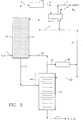
- FIG. 3 is a simplified flow diagram in schematic form showing a second embodiment of the present invention.
- FIG. 4 is a simplified flow diagram in schematic form showing a third embodiment of the present invention.
- FIG. 1 shows in a very simplified form the previous design practice for organic aromatic alkylation as embodied in the production of ethylbenzene from the reaction of benzene with ethylene.
- Other organic aromatic compounds and olefins may be used as feeds yielding different products or product mixes.
- polysubstituted aromatic compounds may also be produced and separated for transalkylation.
- the previous operation utilizes a distillation column reactor having an "upper” column 10 containing the particulate acid catalyst 12 in the form of catalytic distillation structures.
- This "upper” column is commonly referred to as the distillation reaction zone.
- a “lower” column 14 contains standard distillation structure and is referred to as the benzene stripper which completes the separation of unreacted benzene from the higher boiling reaction products -- ethylbenzene and polysubstituted aromatic compounds.
- the olefin is fed via flow line 1 to the top of the benzene stripper 14 and make up benzene is fed to the reflux drum 18 via flow line 9.
- the upper column 10 containing the distillation reaction zone behaves as a packed absorber column.
- the olefin absorption rate into the liquid phase is limited by the average partial pressure of olefin in the vapor phase as it travels upward through the distillation reaction zone 12.
- higher average olefin partial pressure is required to maintain the minimum olefin conversion.
- the process embodied in the present invention provides the capability to raise this driving force and allows variation of the driving force at will during the life of the catalyst.
- a condenser 20 is provided to condense a slip stream 19 of the vapor from the benzene stripper 14.
- the olefin feed line 1 is moved to the bottom of the "upper" column 10 to prevent any of the olefin from being withdrawn with the slip stream.
- the olefin feed line 1 could be injected into the vapor return line 15 upstream of the slip stream draw off.
- the slip stream 19 lowers the concentration of benzene in the vapor and thus increases the olefin concentration at the lower end of the distillation reaction zone 12.
- the condensed liquid from the condenser 20 is routed via line 21 to the top of the distillation reaction zone 12 by combining it with the reflux in line 11.
- the condenser 20 may be used as a knock back condenser with the condensed liquid being returned to the top of the benzene stripper or used elsewhere in the process and the reduced vapor flowing on to the "upper" column via flow line 15.
- a second embodiment is shown in FIG. 3.
- a Short enriching section 14A is added above the liquid inlet to the benzene stripper to provide more efficient separation in the stripper 14.
- the enriching section 14A may include a reflux via line 23 as shown. In either case the amount of vapor enriched in benzene provided to the bottom of the distillation reaction zone is reduced.
- the olefin partial pressure is effectively increased by dividing the olefin feed in to several streams and feeding at different heights in the distillation reaction zone 12. Although there is no actual increase in the olefin this improvement extends the cycle time with a resultant increase in olefin in the liquid phase.
- the partial pressure of the olefin in the vapor phase is highest at the bottom and lowest at the top due to the progressive reaction up through the reaction zone bed 12.
- the equilibrium concentration in the liquid phase follows the same profile.
- the overall conversions of olefin at six feet and twelve feet above the bottom of the bed are about 40 and 63% respectively. These conversions represent a driving force reduction of about 40% per six feet of bed.
- An additional six foot catalyst bed is installed above the top bed of the original five bed reaction distillation zone (30 feet original bed height). Additional olefin equal to about 40% of the original amount fed at the bottom of the zone is fed between the bottommost bed and the next higher. All of the olefins are in contact with at least 30 feet of catalyst and the overall conversion of the combined olefin feed is more than maintained.
- the advantage that is realized is that a 40% increase in olefin throughput can be achieved with only a 20% increase in additional bed height. At a constant throughput this represents a reduction in the cross sectional area of the distillation reaction zone of about 30% and a net reduction in the required catalyst volume of about 20%.
Landscapes
- Chemical & Material Sciences (AREA)
- Organic Chemistry (AREA)
- Chemical Kinetics & Catalysis (AREA)
- Organic Low-Molecular-Weight Compounds And Preparation Thereof (AREA)
- Low-Molecular Organic Synthesis Reactions Using Catalysts (AREA)
Applications Claiming Priority (4)
| Application Number | Priority Date | Filing Date | Title |
|---|---|---|---|
| US611105 | 1990-11-09 | ||
| US07/611,104 US5113031A (en) | 1990-11-09 | 1990-11-09 | Aromatic alkylation process |
| US611104 | 1990-11-09 | ||
| US07/611,105 US5086193A (en) | 1990-11-09 | 1990-11-09 | Aromatic alkylation process |
Publications (2)
| Publication Number | Publication Date |
|---|---|
| EP0491464A2 true EP0491464A2 (fr) | 1992-06-24 |
| EP0491464A3 EP0491464A3 (en) | 1993-06-16 |
Family
ID=27086437
Family Applications (1)
| Application Number | Title | Priority Date | Filing Date |
|---|---|---|---|
| EP19910310368 Withdrawn EP0491464A3 (en) | 1990-11-09 | 1991-11-08 | Aromatic alkylation process |
Country Status (5)
| Country | Link |
|---|---|
| EP (1) | EP0491464A3 (fr) |
| JP (1) | JP3028333B2 (fr) |
| KR (1) | KR100188322B1 (fr) |
| CA (1) | CA2054816C (fr) |
| SA (1) | SA92130132B1 (fr) |
Cited By (2)
| Publication number | Priority date | Publication date | Assignee | Title |
|---|---|---|---|---|
| FR2739096A1 (fr) * | 1995-09-25 | 1997-03-28 | Erdoelchemie Gmbh | Procede et dispositif de conversion d'olefines en c3-c12 par catalyse acide |
| WO1999003804A1 (fr) * | 1997-07-16 | 1999-01-28 | Catalytic Distillation Technologies | Procede d'alkylation a contre-courant |
Families Citing this family (8)
| Publication number | Priority date | Publication date | Assignee | Title |
|---|---|---|---|---|
| US5770782A (en) * | 1996-02-08 | 1998-06-23 | Huntsman Petrochemical Corporation | Process and system for alkylation of aromatic compounds |
| US6060632A (en) * | 1996-07-19 | 2000-05-09 | Asahi Kasei Kogyo Kabushiki Kaisha | Process for producing ethylbenzene |
| JP4489487B2 (ja) * | 2004-04-02 | 2010-06-23 | ダイセル化学工業株式会社 | ヨウ化水素の分離方法 |
| CN102633730A (zh) | 2004-12-03 | 2012-08-15 | 先灵公司 | 作为cb1拮抗剂的取代哌嗪 |
| JP2009528266A (ja) | 2006-01-18 | 2009-08-06 | シェーリング コーポレイション | カンナビノイド受容体修飾因子 |
| US7632974B2 (en) * | 2006-07-19 | 2009-12-15 | Lammus Technology Inc. | Alkylation process for increased conversion and reduced catalyst use |
| CA2692268A1 (fr) | 2007-06-28 | 2009-01-08 | Intervet International B.V. | Piperazines a substitution servant d'antagonistes des recepteurs cb1 |
| US9187384B2 (en) * | 2011-12-13 | 2015-11-17 | Exxonmobil Chemical Patents Inc. | Production of alkylaromatic compounds |
Family Cites Families (3)
| Publication number | Priority date | Publication date | Assignee | Title |
|---|---|---|---|---|
| US4849569A (en) * | 1987-11-16 | 1989-07-18 | Chemical Research & Licensing Company | Alkylation of organic aromatic compounds |
| US5019669A (en) * | 1989-03-10 | 1991-05-28 | Chemical Research & Licensing Company | Alkylation of organic aromatic compounds |
| US4950834A (en) * | 1989-07-26 | 1990-08-21 | Arganbright Robert P | Alkylation of organic aromatic compounds in a dual bed system |
-
1991
- 1991-11-01 CA CA002054816A patent/CA2054816C/fr not_active Expired - Lifetime
- 1991-11-08 EP EP19910310368 patent/EP0491464A3/en not_active Withdrawn
- 1991-11-08 KR KR1019910019951A patent/KR100188322B1/ko not_active Expired - Lifetime
- 1991-11-11 JP JP3294556A patent/JP3028333B2/ja not_active Expired - Fee Related
-
1992
- 1992-09-30 SA SA92130132A patent/SA92130132B1/ar unknown
Cited By (2)
| Publication number | Priority date | Publication date | Assignee | Title |
|---|---|---|---|---|
| FR2739096A1 (fr) * | 1995-09-25 | 1997-03-28 | Erdoelchemie Gmbh | Procede et dispositif de conversion d'olefines en c3-c12 par catalyse acide |
| WO1999003804A1 (fr) * | 1997-07-16 | 1999-01-28 | Catalytic Distillation Technologies | Procede d'alkylation a contre-courant |
Also Published As
| Publication number | Publication date |
|---|---|
| KR100188322B1 (ko) | 1999-06-01 |
| CA2054816C (fr) | 2002-06-18 |
| KR920009436A (ko) | 1992-06-25 |
| SA92130132B1 (ar) | 2006-06-04 |
| EP0491464A3 (en) | 1993-06-16 |
| JPH04266830A (ja) | 1992-09-22 |
| CA2054816A1 (fr) | 1992-05-10 |
| JP3028333B2 (ja) | 2000-04-04 |
Similar Documents
| Publication | Publication Date | Title |
|---|---|---|
| US5086193A (en) | Aromatic alkylation process | |
| US5215725A (en) | Aromatic alkylation process | |
| CA1203253A (fr) | Preparation d'ethers-oxydes d'alcoyle tertiaire | |
| US4950834A (en) | Alkylation of organic aromatic compounds in a dual bed system | |
| KR101200142B1 (ko) | 측면 인출물 재순환을 이용하는 헵탄 제거기를 사용한크실렌 이성체의 제조 방법 | |
| US7888541B2 (en) | Double bond hydroisomerization of butenes | |
| US7026517B2 (en) | Process and apparatus for catalytic distillations | |
| US6774273B2 (en) | Process for selective disproportionation of toluene and disproportionation and transalkylation of toluene and C9+ aromatics | |
| US5113031A (en) | Aromatic alkylation process | |
| EP1087922B1 (fr) | Production de mibk au moyen de la technologie par distillation catalytique | |
| CA2054816C (fr) | Procede d'alkylation de composes aromatiques | |
| US6232491B1 (en) | Purification process for removal of impurities in acetic acid-ethylene reactions | |
| US6228226B1 (en) | Process for working up crude, liquid vinyl acetate | |
| US5821384A (en) | Process for generating vinyl carboxylate esters | |
| US5925685A (en) | Method for carrying out heterogeneous catalysis | |
| RU2368593C1 (ru) | Способ выделения изобутилена | |
| RU2086527C1 (ru) | Способ получения трет.бутанола | |
| KR100348988B1 (ko) | 고순도 디아릴에탄의 제조방법 | |
| JPH10287600A (ja) | シクロヘキサノールの製造方法 | |
| JPH0288531A (ja) | イソプロピル化ナフタレン類の製造方法 | |
| MXPA99003809A (en) | Purification process |
Legal Events
| Date | Code | Title | Description |
|---|---|---|---|
| PUAI | Public reference made under article 153(3) epc to a published international application that has entered the european phase |
Free format text: ORIGINAL CODE: 0009012 |
|
| AK | Designated contracting states |
Kind code of ref document: A2 Designated state(s): BE DE ES FR GB IT NL SE |
|
| PUAL | Search report despatched |
Free format text: ORIGINAL CODE: 0009013 |
|
| AK | Designated contracting states |
Kind code of ref document: A3 Designated state(s): BE DE ES FR GB IT NL SE |
|
| STAA | Information on the status of an ep patent application or granted ep patent |
Free format text: STATUS: THE APPLICATION IS DEEMED TO BE WITHDRAWN |
|
| 18D | Application deemed to be withdrawn |
Effective date: 19931217 |