EP0497201B1 - Tricyclische Verbindungen und ihre Zwischenprodukte - Google Patents
Tricyclische Verbindungen und ihre Zwischenprodukte Download PDFInfo
- Publication number
- EP0497201B1 EP0497201B1 EP92101012A EP92101012A EP0497201B1 EP 0497201 B1 EP0497201 B1 EP 0497201B1 EP 92101012 A EP92101012 A EP 92101012A EP 92101012 A EP92101012 A EP 92101012A EP 0497201 B1 EP0497201 B1 EP 0497201B1
- Authority
- EP
- European Patent Office
- Prior art keywords
- compound
- oxepin
- dihydro
- alkyl
- carboxamide
- Prior art date
- Legal status (The legal status is an assumption and is not a legal conclusion. Google has not performed a legal analysis and makes no representation as to the accuracy of the status listed.)
- Expired - Lifetime
Links
- 0 CC*(C)C(C)(CCC1)C[C@@]1*(C)=CC Chemical compound CC*(C)C(C)(CCC1)C[C@@]1*(C)=CC 0.000 description 3
Classifications
-
- C—CHEMISTRY; METALLURGY
- C07—ORGANIC CHEMISTRY
- C07D—HETEROCYCLIC COMPOUNDS
- C07D491/00—Heterocyclic compounds containing in the condensed ring system both one or more rings having oxygen atoms as the only ring hetero atoms and one or more rings having nitrogen atoms as the only ring hetero atoms, not provided for by groups C07D451/00 - C07D459/00, C07D463/00, C07D477/00 or C07D489/00
- C07D491/02—Heterocyclic compounds containing in the condensed ring system both one or more rings having oxygen atoms as the only ring hetero atoms and one or more rings having nitrogen atoms as the only ring hetero atoms, not provided for by groups C07D451/00 - C07D459/00, C07D463/00, C07D477/00 or C07D489/00 in which the condensed system contains two hetero rings
- C07D491/04—Ortho-condensed systems
-
- A—HUMAN NECESSITIES
- A61—MEDICAL OR VETERINARY SCIENCE; HYGIENE
- A61P—SPECIFIC THERAPEUTIC ACTIVITY OF CHEMICAL COMPOUNDS OR MEDICINAL PREPARATIONS
- A61P3/00—Drugs for disorders of the metabolism
- A61P3/06—Antihyperlipidemics
-
- A—HUMAN NECESSITIES
- A61—MEDICAL OR VETERINARY SCIENCE; HYGIENE
- A61P—SPECIFIC THERAPEUTIC ACTIVITY OF CHEMICAL COMPOUNDS OR MEDICINAL PREPARATIONS
- A61P43/00—Drugs for specific purposes, not provided for in groups A61P1/00-A61P41/00
-
- A—HUMAN NECESSITIES
- A61—MEDICAL OR VETERINARY SCIENCE; HYGIENE
- A61P—SPECIFIC THERAPEUTIC ACTIVITY OF CHEMICAL COMPOUNDS OR MEDICINAL PREPARATIONS
- A61P9/00—Drugs for disorders of the cardiovascular system
- A61P9/10—Drugs for disorders of the cardiovascular system for treating ischaemic or atherosclerotic diseases, e.g. antianginal drugs, coronary vasodilators, drugs for myocardial infarction, retinopathy, cerebrovascula insufficiency, renal arteriosclerosis
-
- C—CHEMISTRY; METALLURGY
- C07—ORGANIC CHEMISTRY
- C07C—ACYCLIC OR CARBOCYCLIC COMPOUNDS
- C07C233/00—Carboxylic acid amides
- C07C233/64—Carboxylic acid amides having carbon atoms of carboxamide groups bound to carbon atoms of six-membered aromatic rings
- C07C233/65—Carboxylic acid amides having carbon atoms of carboxamide groups bound to carbon atoms of six-membered aromatic rings having the nitrogen atoms of the carboxamide groups bound to hydrogen atoms or to carbon atoms of unsubstituted hydrocarbon radicals
-
- C—CHEMISTRY; METALLURGY
- C07—ORGANIC CHEMISTRY
- C07D—HETEROCYCLIC COMPOUNDS
- C07D223/00—Heterocyclic compounds containing seven-membered rings having one nitrogen atom as the only ring hetero atom
- C07D223/14—Heterocyclic compounds containing seven-membered rings having one nitrogen atom as the only ring hetero atom condensed with carbocyclic rings or ring systems
- C07D223/18—Dibenzazepines; Hydrogenated dibenzazepines
- C07D223/20—Dibenz [b, e] azepines; Hydrogenated dibenz [b, e] azepines
-
- C—CHEMISTRY; METALLURGY
- C07—ORGANIC CHEMISTRY
- C07D—HETEROCYCLIC COMPOUNDS
- C07D313/00—Heterocyclic compounds containing rings of more than six members having one oxygen atom as the only ring hetero atom
- C07D313/02—Seven-membered rings
- C07D313/06—Seven-membered rings condensed with carbocyclic rings or ring systems
- C07D313/10—Seven-membered rings condensed with carbocyclic rings or ring systems condensed with two six-membered rings
- C07D313/12—[b,e]-condensed
-
- C—CHEMISTRY; METALLURGY
- C07—ORGANIC CHEMISTRY
- C07D—HETEROCYCLIC COMPOUNDS
- C07D337/00—Heterocyclic compounds containing rings of more than six members having one sulfur atom as the only ring hetero atom
- C07D337/02—Seven-membered rings
- C07D337/06—Seven-membered rings condensed with carbocyclic rings or ring systems
- C07D337/10—Seven-membered rings condensed with carbocyclic rings or ring systems condensed with two six-membered rings
- C07D337/12—[b,e]-condensed
-
- C—CHEMISTRY; METALLURGY
- C07—ORGANIC CHEMISTRY
- C07C—ACYCLIC OR CARBOCYCLIC COMPOUNDS
- C07C2603/00—Systems containing at least three condensed rings
- C07C2603/02—Ortho- or ortho- and peri-condensed systems
- C07C2603/04—Ortho- or ortho- and peri-condensed systems containing three rings
- C07C2603/30—Ortho- or ortho- and peri-condensed systems containing three rings containing seven-membered rings
- C07C2603/32—Dibenzocycloheptenes; Hydrogenated dibenzocycloheptenes
Definitions
- the present invention relates to tricyclic compounds and intermediates thereof with a side chain having an anilino moiety having an acyl coenzyme A: cholesterol acyltransferase (hereafter referred to as ACAT) inhibiting activity.
- ACAT cholesterol acyltransferase
- Cholesterol is supplied in vivo by biosynthesis and absorption. Compounds which inhibit biosynthesis and absorption might reduce cholesterol level in blood serum. As compounds having an activity of inhibiting absorption, nicotinic acid derivatives and sterols originated from plants are known. However, their activity is not sufficient.
- Cholesterol is absorbed on epithelial cells of the intestine in its free form, then esterified by ACAT, included in chylomicrons, and transported to liver by blood stream in chylomicron form.
- ACAT plays an important role in accumulation of cholesterol in liver.
- ACAT is also involved in transformation of macrophage to foam cell.
- ACAT is thought to cause progression of arteriosclerosis [J. Lipid Res., 26 , 647 (1985); Nippon Rinsho (Clinic in Japan), 47 , 554 (1989)].
- Compounds which inhibit ACAT might inhibit the absorption of cholesterol and accumulation of cholesterol in liver. Therefore, these effects accelerate excretion of cholesterol and consequently reduce cholesterol level in blood serum. Furthermore, such compounds inhibit the formation of foam cells and are thus expected to be effective for the treatment of hyperlipemia and arteriosclerosis.
- FR-A- 2 356 631 discloses N-substituted carboxylic acid amides having hypoglycaemic and/or hypolipidaemic properties of formula wherein A is a valency bond, an oxygen or a sulphur atom or a methylene, ethylene, vinylene, ethyleneoxa or ethylenethia radical, V is a straight-chained or branched, saturated or unsaturated trivalent hydrocarbon radical containing up to 4 carbon atoms, R 1 and R 2 , which may be the same or different, are hydrogen or halogen atoms, hydroxyl groups or alkyl or alkoxy radicals, R 3 is a hydrogen atom, a hydroxyl group or an alkoxy radical, Y is a branched or unbranched alkylene radical containing up to 3 carbon atoms, X is a valency bond or a straight-chained or branched, saturated or unsaturated divalent aliphatic hydrocarbon radical containing up to
- An object of the present invention is to provide tricyclic compounds with a side chain having anilino moiety which are useful for the treatment of hyperlipemia and arteriosclerosis, and intermediates thereof.
- the present invention relates to a tricyclic compound represented by formula (I): wherein each of R 1 , R 2 , R 3 and R 4 independently represents hydrogen, lower alkyl, lower alkoxy, lower alkylthio, amino, lower alkylamino, halogenated lower alkyl, halogenated lower alkoxy, halogen, nitro, cyano, carboxy, lower alkoxycarbonyl, hydroxymethyl, CR 9 R 10 CO 2 R 11 (wherein each of R 9 , R 10 and R 11 independently represents hydrogen or lower alkyl) or CONR 12 R 13 (wherein each of R 12 and R 13 independently represents hydrogen or lower alkyl); R 5 represents hydrogen or lower alkyl; each of R 6 , R 7 and R 8 independently represents hydrogen, lower alkyl, hydroxy, lower alkoxy, lower alkanoyloxy, lower alkylthio, thiocyanato or halogen; X represents CH or N; Y 1 -Y 2 represents CH 2 -O, CH 2
- the alkyl moiety in the lower alkyl, lower alkoxy, lower alkylthio, lower alkoxycarbonyl and lower alkylamino means a straight or branched chain alkyl having 1 to 6 carbon atoms such as methyl, ethyl, propyl, isopropyl, butyl, isobutyl, sec-butyl, tert-butyl, pentyl, hexyl, etc.
- the alkanoyl moiety in the lower alkanoyloxy refers to a straight or branched chain alkanoyl having 1 to 6 carbon atoms such as formyl, acetyl, propionyl, butyryl, isobutyryl, valeryl, pivaloyl, etc.
- the halogen includes, for example, fluorine, chlorine, bromine and iodine.
- the alkyl moiety in the halogenated lower alkyl and halogenated lower alkoxy has the same significance as defined above and is independently substituted with 1 to 6 halogens and the halogenated alkyl moiety includes, for example, trifluoromethyl, pentafluoroethyl, etc.
- pharmaceutically acceptable salt of Compound (I) mention may be made of pharmaceutically acceptable acid addition salts, for example, inorganic acid salts such as hydrochlorides, sulfates, phosphates etc. and organic acid salts such as maleates, fumarates, citrates, etc.; pharmaceutically acceptable alkali metal salts such as lithium salts, sodium salts and potassium salts; pharmaceutically acceptable alkali earth metal salts such as calcium salts and magnesium salts, and pharmaceutically acceptable ammonium salts.
- inorganic acid salts such as hydrochlorides, sulfates, phosphates etc. and organic acid salts such as maleates, fumarates, citrates, etc.
- pharmaceutically acceptable alkali metal salts such as lithium salts, sodium salts and potassium salts
- pharmaceutically acceptable alkali earth metal salts such as calcium salts and magnesium salts, and pharmaceutically acceptable ammonium salts.
- Compound (Ia) which is Compound (I) wherein Z is oxygen can be obtained by condensing a reactive carboxylic acid (II) with an aniline derivative (III) in a conventional manner.
- Aniline derivative (III) is reacted with a carboxylic acid reactive derivative such as an acid halide or a mixed acid anhydride, etc. derived from the reactive carboxylic acid (II) or with the carboxylic acid (II) using 1,3-dicyclohexylcarbodiimide or 2-chloro-1-methylpyridinium iodide, etc. as a condensing agent.
- a carboxylic acid reactive derivative such as an acid halide or a mixed acid anhydride, etc. derived from the reactive carboxylic acid (II) or with the carboxylic acid (II) using 1,3-dicyclohexylcarbodiimide or 2-chloro-1-methylpyridinium iodide, etc. as a condensing agent.
- Compound (Ia) can be prepared by reacting Compound (II) with 1 to 20 equivalents of a halogenating agent such as thionyl chloride, oxalyl chloride, phosphorus pentachloride, phosphorus oxychloride, phosphorus tribromide, etc.
- a halogenating agent such as thionyl chloride, oxalyl chloride, phosphorus pentachloride, phosphorus oxychloride, phosphorus tribromide, etc.
- Compound (Ib) which is Compound (I) wherein Z is sulfur can be obtained by reacting Compound (Ia) obtained by Process A with 1 to 5 equivalents of 2,4-bis(4-methoxyphenyl)-1,3-dithia-2,4-diphosphetane-2,4-disulfide (Lawesson's reagent) for 0.5 to 6 hours in a solvent such as benzene, toluene, xylene, etc. at an appropriate temperature of from 60°C to the boiling point of a solvent used.
- a solvent such as benzene, toluene, xylene, etc.
- Compound (Ic) which is Compound (I) wherein at least one of R 6 , R 7 and R 8 is hydroxy can be obtained by treating Compound (Id) which is Compound (I) wherein the corresponding group to each hydroxy group in Compound (Ic) is lower alkoxy, with boron tribromide or aluminium chloride.
- Compound (Id) is obtained using Compound (III) wherein at least one of the corresponding R 6 , R 7 and R 8 is alkoxy in Process A.
- Compound (Ic) can be obtained by reacting Compound (Id) with 1 to 5 equivalents of boron tribromide in a solvent such as dichloromethane or chloroform for 1 to 24 hours at an appropriate temperature of from -78°C to room temperature and adding water to the reaction mixture.
- a solvent such as dichloromethane or chloroform
- Compound (Ie) which is Compound (I) wherein at least one of R 1 , R 2 , R 3 , R 4 , R 6 , R 7 and R 8 is carboxy can be obtained by hydrolyzing Compound (If) wherein the corresponding group is a lower alkoxycarbonyl.
- Compound (If) is obtained using Compound (II) and Compound (III) in either of which at least one of the corresponding R 1 , R 2 , R 3 , R 4 , R 6 , R 7 and R 8 is lower alkoxycarbonyl in Process A.
- Compound (Ie) can be obtained by hydrolysis of Compound (If) in an aqueous organic solvent such as methanol, ethanol, tetrahydrofuran, 1,4-dioxane, etc. at an appropriate temperature of from room temperature to the boiling point of a solvent used, in the presence of 1 to 10 equivalents of lithium hydroxide, sodium hydroxide or potassium hydroxide.
- an aqueous organic solvent such as methanol, ethanol, tetrahydrofuran, 1,4-dioxane, etc.
- Compound (Ig) which is Compound (I) wherein at least one of R 1 , R 2 , R 3 and R 4 is hydroxymethyl can be obtained by reducing Compound (Ie) wherein at least one of the corresponding R 1 , R 2 , R 3 and R 4 is carboxy which compound is obtained in Process D.
- Compound (Ig) can be obtained by reacting Compound (Ie) with 1 to 2 equivalents of ethyl chloroformate in a solvent such as ether, tetrahydrofuran and dimethylformamide, at an appropriate temperature of from 0°C to room temperature in the presence of 1 to 2 equivalents of triethylamine or pyridine for 1 to 24 hours, and adding 1 to 2 equivalents of sodium borohydride thereto. The mixture was allowed to stand at an appropriate temperature of from 0°C to room temperature for 1 to 12 hours.
- a solvent such as ether, tetrahydrofuran and dimethylformamide
- m represents 1 or 2 and X, Z, R 1 , R 2 , R 3 , R 4 , R 5 , R 6 , R 7 and R 8 have the same significances as previously defined.
- Compound (Ih) which is Compound (I) wherein Y 1 -Y 2 represents -CH 2 -S(O) m - wherein m represents 1 or 2 can be prepared by treating Compound (Ii) wherein Y 1 -Y 2 represents -CH 2 -S- with an appropriate oxidizing agent, for example, hydrogen peroxide, sodium metaperiodate, m-chloroperbenzoic acid, etc.
- Compound (Ii) is obtained using Compound (II) wherein Y 1 -Y 2 is CH 2 S in Process A.
- Compound (Ih) can be obtained by treating Compound (Ii) with 1 to 5 equivalents of m-chloroperbenzoic acid in dichloromethane in an appropriate temperature of from -78°C to room temperature for 15 minutes to 6 hours.
- Compound (Ij) which is Compound (I) wherein at least one of R 1 , R 2 , R 3 and R 4 is amino can be obtained by reducing Compound (Ik) wherein the corresponding group is nitro.
- Compound (Ik) is obtained using Compound (II) wherein at least one of the corresponding R 1 , R 2 , R 3 and R 4 is nitro.
- Compound (Ij) can be obtained by reducing Compound (Ik) in an aqueous organic solvent such as methanol, ethanol, etc. at an appropriate temperature of from room temperature to the boiling point of a solvent used, in the presence of 2 to 10 equivalents of iron and in the presence of a catalytic amount of ferric chloride.
- an aqueous organic solvent such as methanol, ethanol, etc.
- Compound (Im) which is Compound (I) wherein at least one of R 1 , R 2 , R 3 and R 4 is lower alkylamino can be obtained by alkylating Compound (Ij) wherein the corresponding group is amino.
- Compound (Im) can be obtained by reacting Compound (Ij) with 1 to 5 equivalents of sodium cyanoborohydride and 1 to 20 equivalents of the corresponding aldehyde in a solvent such as methanol or ethanol at an appropriate temperature of from 0°C to room temperature under weakly acidic conditions.
- the starting Compound (IIa) which is Compound (II) wherein Y 1 -Y 2 is CH 2 -O can be prepared by the following method. wherein X, R 1 , R 2 , R 3 and R 4 have the same significances as previously defined.
- Compound (IV) prepared by the known method [West German Patent No. 1,294,970] or by its modified method is reacted with the ylide prepared by treating trimethylsulfonium iodide with 1 to 2 equivalents of sodium hydride, in a solvent mixture of dimethylsulfoxide and tetrahydrofuran at an appropriate temperature of from -78°C to room temperature for 1 to 12 hours to give Compound (V).
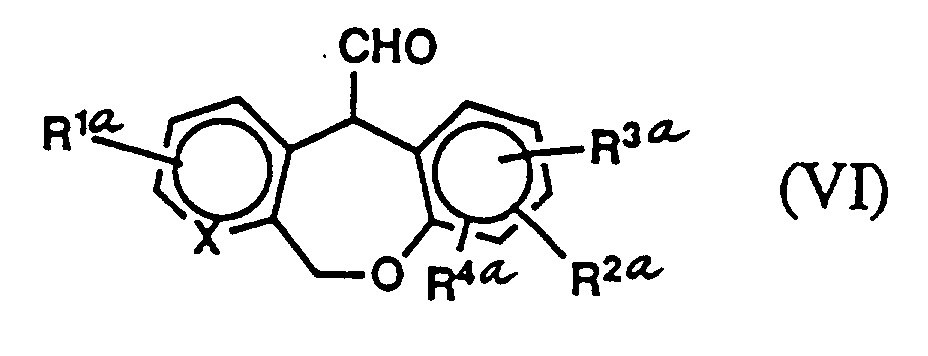
- Compound (V) is reacted with a catalytic amount of Lewis acid, e.g., boron trifluoride-ether complex at an appropriate temperature of from -78°C to 0°C for 10 minutes to 6 hours in dichloromethane and the resulting mixture is treated with water to give Compound (VI).
- Lewis acid e.g., boron trifluoride-ether complex
- Compound (VI) can be converted into Compound (IIa) by conventional oxidation using as an oxidizing agent, for example, chromic oxide or potassium permanganate.
- an oxidizing agent for example, chromic oxide or potassium permanganate.
- Compound (IIa) can be obtained by reacting Compound (VI) with an excess of Jones' reagent in acetone at an appropriate temperature of from -60 to 0°C.
- Compound (IV) can be reacted with 1 to 5 equivalents of trimethylsilylnitrile in dichloromethane at room temperature for 6 to 72 hours in the presence of a catalytic amount of zinc iodide and 10 to 100 wt% of molecular sieve to give Compound (VII).
- Compound (VII) is treated under reflux in hydrochloric acid-acetic acid (1 :1) for 1 to 6 hours in the presence of an equimolar amount of stannous chloride to give Compound (IIa).
- Compound (IIa) may also be obtained by treating Compound (VIII) prepared by the known method (Japanese Published Unexamined Patent Application No. 35178/75) or by its modified method with a mineral acid, for example, hydrochloric acid, sulfuric acid or phosphoric acid at 60 to 120°C for 1 to 12 hours, if necessary, in the presence of acetic acid.
- a mineral acid for example, hydrochloric acid, sulfuric acid or phosphoric acid at 60 to 120°C for 1 to 12 hours, if necessary, in the presence of acetic acid.
- the intermediates and the desired compounds in the processes described above can be isolated and purified by methods for purification conventionally used in organic synthetic chemistry, for example, filtration, extraction, washing, drying, concentration, recrystallization, various chromatographies, etc.
- the intermediates can be used for the next reaction without any particular purification.
- the salts may be purified as they are when the product is obtained in a salt form.
- the product is obtained in a free form, the product is dissolved or suspended in an appropriate solvent and an acid or a base is added to the solution or suspension to form its salt.
- Compound (I) and its pharmaceutically acceptable salt thereof may be present in the form of adducts with water or various solvents. These adducts are also included in the present invention.
- the present invention includes all possible stereoisomers and a mixture thereof.
- Me, Et, iPro and tBu represent methyl, ethyl, isopropyl and tert-butyl, respectively.
- the number which designates the position of each substituent represents the positional number in the figure. Thus, it might be different from the number given in the nomenclature.
- Me, Et, iPro and tBu represent methyl, ethyl, isopropyl and tert-butyl, respectively.
- Test Example 1 Test for acute toxicity
- test for ACAT inhibitory activity was performed by a modified method of the method of Brecher et al. [Biochim. Biophys. Acta, 617 , 458 (1980)]. 10 ⁇ l of a solution of each test compound (final concentration of the test compound: 10 -6 M) in methanol was added to 180 ⁇ l of 0.1 M phosphate buffer containing 0.1 mg protein of microsome fraction prepared from rabbit liver, 2 mM dithiothreitol and 1.7 mg of bovine serum albumin. Furthermore [ 14 C] oleoyl coenzyme A was added to the mixture followed by incubation at 37°C for 10 minutes.
- Table 4 Compound No. Inhibiting rate(%) 10 -6 M 2 66 3 77 4 98 5 56 16 81 17 94 18 100 20 84 23 69 24 90 27 80 28 52 29 86 30 78 32 88 39 91 42 91 44 95 48 96 49 97 50 93 51 99 53 100 55 100 56 99 57 98 59 100 60 99 61 92 62 100 64 100 68 99 69 98
- Golden hamster (SLC, male, age of 6 weeks) was made free access to feed containing 2% cholesterol for 3 days. Each test compound was suspended in olive oil and orally administered once a day in a dose of 30 mg/kg during the feeding.
- A Test Group administered with the test compound
- B Control Group administered with olive oil only
- feed free from cholesterol was fed for 3 days.
- Table 5 Compound No. Inhibition Rate (%) 4 70 18 114 20 63 21 67 32 67
- Compound (I) or its pharmaceutically acceptable salt may be administered singly as they are, but it is generally preferred that these compounds be administered in the form of various pharmaceutical preparations. These pharmaceutical preparations can be used for animals and human beings.
- the most effective administrative route is chosen from oral and parenteral administration such as intrarectal, topical, intranasal, intraocular, intrabuccal, subcutaneous, intramuscular and intravenous routes, etc.
- a capsule As the form of administration, mention may be made of a capsule, a tablet, a granule, a powder, a syrup, an emulsion, a suppository, an injection, etc.
- a liquid preparation suitable for oral administration for example, an emulsion and a syrup can be prepared using water; sugars such as sucrose, sorbitol, fructose, etc.; glycols such as polyethylene glycol, propylene glycol, etc.; oils such as sesame oil, olive oil, soybean oil, etc.; antiseptics such as p-hydroxybenzoic acid esters, etc.; flavors such as strawberry flavor, pepper mint, etc. Further a capsule, a tablet, a powder and a granule, etc.
- an excipient such as lactose, glucose, sucrose, mannitol, etc.; a disintegrator such as starch, sodium alginate, etc.; a lubricant such as magnesium stearate, talc, etc.; a binder such as polyvinyl alcohol, hydroxypropyl cellulose, gelatin, etc.; a surfactant such as an aliphatic ester, etc.; a plasticizer such as glycerine, etc.
- an excipient such as lactose, glucose, sucrose, mannitol, etc.
- a disintegrator such as starch, sodium alginate, etc.
- a lubricant such as magnesium stearate, talc, etc.
- a binder such as polyvinyl alcohol, hydroxypropyl cellulose, gelatin, etc.
- a surfactant such as an aliphatic ester, etc.
- a plasticizer such as glycerine, etc.
- a preparation suitable for parenteral administration is a sterile aqueous preparation containing Compound (I), and preferably isotonic to blood of recipient.
- a solution for injection is prepared using carriers composed of a saline solution, a glucose solution or a mixture of saline and glucose solution.
- a preparation for rectal administration is provided as a suppository using conventional carriers, for example, cacao fat, hydrogenated fat or hydrogenated fat carboxylic acid, etc.
- parenteral preparations may also be added with one or more auxiliary components such as a diluent, a flavour, an antiseptic (including an antioxidant), an excipient, a disintegrator, a lubricant, a binder, a surfactant, a plasticizer and the like.
- auxiliary components such as a diluent, a flavour, an antiseptic (including an antioxidant), an excipient, a disintegrator, a lubricant, a binder, a surfactant, a plasticizer and the like.
- Effective dose and number of administration of Compound (I) or pharmaceutically acceptable salt thereof vary depending upon administration route, age, body weight and conditions of patients.
- daily dose for oral administration is 1 ⁇ g to 300 mg/kg and daily dose for parenteral administration is 0.1 ⁇ g to 30 mg/kg.
- the number of administration is once to several times a day; the dosage may vary according to the various conditions.
- Example 2 The similar procedures as in Example 1 were repeated except using 1.20 g of Compound A and 1.00 g of 2,6-diisopropylaniline in place of aniline to obtain 1.85 g of Compound 4.
- Example 2 The similar procedures as in Example 1 were repeated except using 1.0 g of Compound A and 0.63 g of 2-isopropylaniline in place of aniline to obtain 1.84 g of Compound 5.
- Example 2 The similar procedures as in Example 1 were repeated except using 1.0 g of Compound A and 0.76 g of 2,6-dichloroaniline in place of aniline to obtain 1.38 g of Compound 6.
- Example 2 The similar procedures as in Example 1 were repeated except using 2.32 g of Compound A and 1.85 g of 2,4,6-trimethoxyaniline in place of aniline to obtain 1.56 g of Compound 10 as amorphous.
- Example 11 The similar procedures as in Example 1 were repeated except using 1.40 g of 2-ethyl-6,11-dihydrodibenz[b,e]oxepin-11-carboxylic acid (Compound B) obtained in Example 40 in place of Compound A and 0.83 g of 2,6-diisopropylaniline in place of aniline to obtain 1.40 g of Compound 11.
- Compound B 2-ethyl-6,11-dihydrodibenz[b,e]oxepin-11-carboxylic acid
- Example 12 The similar procedures as in Example 1 were repeated except using 2.34 g of 6,11-dihydro-2-isopropyldibenz[b,e]oxepin-11-carboxylic acid (Compound C) obtained in Example 41 in place of Compound A and 0.73 g of 2,6-dimethylaniline in place of aniline to obtain 1.18 g of Compound 12.
- Example 13 The similar procedures as in Example 1 were repeated except using 2.34 g of Compound C in place of Compound A and 0.90 g of 2,6-diethylaniline in place of aniline to obtain 1.26 g of Compound 13.
- Example 14 The similar procedures as in Example 1 were repeated except using 1.50 g of 2-(tert-butyl)-6,11-dihydrodibenz[b,e]oxepin-11-carboxylic acid (Compound D) obtained in Example 42 in place of Compound A and 0.61 g of 2,6-dimethylaniline in place of aniline to obtain 1.36 g of Compound 14.
- Example 1 The similar procedures as in Example 1 were repeated except using 1.70 g of 2-bromo-6,11-dihydrodibenz[b,e]oxepin-11-carboxylic acid (Compound H) obtained in Example 46 in place of Compound A and 1.13 g of 2,6-diisopropylaniline in place of aniline to obtain 2.49 g of Compound 18.
- Compound H 2-bromo-6,11-dihydrodibenz[b,e]oxepin-11-carboxylic acid
- Example 1 The similar procedures as in Example 1 were repeated except using 3.35 g of 6,11-dihydro-2-trifluoromethyldibenz[b,e]oxepin-11-carboxylic acid (Compound N) obtained in Example 51 in place of Compound A and 1.93 g of 2,6-diisopropylaniline in place of aniline to obtain 4.22 g of Compound 20.
- Compound N 6,11-dihydro-2-trifluoromethyldibenz[b,e]oxepin-11-carboxylic acid obtained in Example 51 in place of Compound A and 1.93 g of 2,6-diisopropylaniline in place of aniline to obtain 4.22 g of Compound 20.
- Example 2 The similar procedures as in Example 1 were repeated except using 2.11 g of 4-bromo-6,11-dihydro-2-methyldibenz[b,e]oxepin-11-carboxylic acid (Compound Q) obtained in Example 53 in place of Compound A and 1.01 g of 2,6-diisopropylaniline in place of aniline to obtain 1.52 g of Compound 21.
- Compound Q 4-bromo-6,11-dihydro-2-methyldibenz[b,e]oxepin-11-carboxylic acid
- Example 2 The similar procedures as in Example 1 were repeated except using 6.54 g of 6,11-dihydro-2-methoxydibenz[b,e]oxepin-11-carboxylic acid (Compound P) obtained in Example 52 in place of Compound A and 4.30 g of 2,6-diisopropylaniline in place of aniline to obtain 7.96 g of Compound 22.
- Example 2 The similar procedures as in Example 1 were repeated except using 1.10 g of 6,11-dihydro-2-methoxycarbonyldibenz[b,e]oxepin-11-carboxylic acid (Compound L) obtained in Example 49 in place of Compound A and 0.79 g of 2,6-diisopropylaniline in place of aniline to obtain 1.63 g of Compound 24.
- Example 27 The similar procedures as in Example 1 were repeated except using 1.37 g of Compound H obtained in Example 46 in place of Compound A and 0.59 g of 2,6-diethylaniline in place of aniline to obtain 1.14 g of Compound 27.
- Example 1 The similar procedures as in Example 1 were repeated except using 1.40 g of 3-bromo-6,11-dihydrodibenz[b,e]oxepin-11-carboxylic acid (Compound K) obtained in Example 48 in place of Compound A and 0.71 g of 2,6-dichloroaniline in place of aniline to obtain 1.01 g of Compound 28.
- Compound K 3-bromo-6,11-dihydrodibenz[b,e]oxepin-11-carboxylic acid
- Example 2 The similar procedures as in Example 1 were repeated except using 1.40 g of Compound K in place of Compound A and 0.78 g of 2,6-diisopropylaniline in place of aniline to obtain 1.54 g of Compound 29.
- Example 2 The similar procedures as in Example 1 were repeated except using 1.12 g of Compound A and 1.18 g of 2,6-diisopropyl-4-methylthioaniline in place of aniline to obtain 1.70 g of Compound 30.
- Example 2 The similar procedures as in Example 1 were repeated except using 1.12 g of Compound A and 1.24 g of 2,6-diisopropyl-4-thiocyanatoaniline in place of aniline to obtain 1.63 g of Compound 31.
- Example 2 The similar procedures as in Example 1 were repeated except using 1.70 g of 2-bromo-6,11-dihydrodibenzo[b,e]thiepin-11-carboxylic acid obtained in Reference Example 1 in place of Compound A and 0.90 g of 2,6-diisopropylaniline in place of aniline to obtain 1.42 g of Compound 32.
- Example 4 The similar procedures as in Example 1 were repeated except using 1.72 g of 9-bromo-6,11-dihydrodibenz[b,e]oxepin-11-carboxylic acid (Compound R) obtained in Example 54 in place of Compound A and 1.15 g of 2,6-diisopropylaniline in place of aniline to obtain 1.50 g of Compound 33.
- Compound R 9-bromo-6,11-dihydrodibenz[b,e]oxepin-11-carboxylic acid
- Example 5 The similar procedures as in Example 1 were repeated except using 1.77 g of 2,9-dibromo-6,11-dihydrodibenz[b,e]oxepin-11-carboxylic acid (Compound T) obtained in Example 56 in place of Compound A and 1.56 g of 2,6-diisopropylaniline in place of aniline to obtain 0.3 g of Compound 35.
- Compound T 2,9-dibromo-6,11-dihydrodibenz[b,e]oxepin-11-carboxylic acid
- Example 36 The similar procedures as in Example 36 were repeated except using 0.97 g of 2-bromo-6,11-dihydro-N-(2,6-diisopropylphenyl)dibenz[b,e]oxepin-11-carboxamide obtained in Example 18 in place of Compound 4 to obtain 0.83 g of Compound 37.
- Example 1 The similar procedures as in Example 1 were repeated except using 0.55 g of 5,11-dihydrobenzoxepino[3,4-b]pyridin-5-carboxylic acid (Compound U) obtained in Example 57 in place of Compound A and 0.60 g of 2,6-diisopropylaniline in place of aniline to obtain 0.73 g of Compound 38.
- Example 39 The similar procedures as in Example 39 were repeated except using 23.8 g of 6,11-dihydro-2-ethyldibenz[b,e]oxepin-11-one in place of 6,11-dihydro-2-methyldibenz[b,e]oxepin-11-one to obtain 6.28 g of Compound B.
- Example 39 The similar procedures as in Example 39 were repeated except using 25.0 g of 6,11-dihydro-2-isopropyldibenz[b,e]oxepin-11-one in place of 6,11-dihydro-2-methyldibenz[b,e]oxepin-11-one to obtain 5.98 g of Compound C.
- Example 39 The similar procedures as in Example 39 were repeated except using 13.3 g of 2-(tert-butyl)-6,11-dihydrodibenz[b,e]oxepin-11-one in place of 6,11-dihydro-2-methyldibenz[b,e]oxepin-11-one to obtain 3.71 g of Compound D.
- Example 39 The similar procedures as in Example 39 were repeated except using 13.9 g of 6,11-dihydrodibenz[b,e]oxepin-11-one in place of 6,11-dihydro-2-methyldibenz[b,e]oxepin-11-one to obtain 7.65 g of Compound E.
- Example 39 The similar procedures as in Example 39 were repeated except using 19.0 g of 2-fluoro-6,11-dihydrodibenz[b,e]oxepin-11-one in place of 6,11-dihydro-2-methyldibenz[b,e]oxepin-11-one to obtain 2.17 g of Compound F.
- Example 39 The similar procedures as in Example 39 were repeated except using 12.2 g of 2-chloro-6,11-dihydrodibenz[b,e]oxepin-11-one in place of 6,11-dihydro-2-methyldibenz[b,e]oxepin-11-one to obtain 7.00 g of Compound G.
- Example 39 The similar procedures as in Example 39 were repeated except using 14.5 g of 2-bromo-6,11-dihydrodibenz[b,e]oxepin-11-one in place of 6,11-dihydro-2-methyldibenz[b,e]oxepin-11-one to obtain 2.00 g of Compound H.
- Example 39 The similar procedures as in Example 39 were repeated except using 5.10 g of 2-cyano-6,11-dihydrodibenz[b,e]oxepin-11-one in place of 6,11-dihydro-2-methyldibenz[b,e]oxepin-11-one to obtain 1.69 g of Compound J.
- Example 39 The similar procedures as in Example 39 were repeated except using 28.9 g of 3-bromo-6,11-dihydrodibenz[b,e]oxepin-11-one in place of 6,11-dihydro-2-methyldibenz[b,e]oxepin-11-one to obtain 7.58 g of Compound K.
- Example 39 The similar procedures as in Example 39 were repeated except using 15.7 g of 6,11-dihydro-2-methoxycarbonyldibenz[b,e]oxepin-11-one in place of 6,11-dihydro-2-methyldibenz[b,e]oxepin-11-one to obtain 9.20 g of 6,11-dihydro-2-methoxycarbonyldibenz[b,e]oxepin-11-carbaldehyde. In 300 ml of acetone/2-methyl-2-propanol (1 : 1) was dissolved 9.20 g of the resulting carbaldehyde.
- Example 50 The similar procedures as in Example 50 were repeated except using 19.8 g of 6,11-dihydro-2-trifluoromethyldibenz[b,e]oxepin-11-one in place of 6,11-dihydro-2-iododibenz[b,e]oxepin-11-one to obtain 7.78 g of Compound N.
- Example 50 The similar procedures as in Example 50 were repeated except using 4.80 g of 6,11-dihydro-2-methoxydibenz[b,e]oxepin-11-one in place of 6,11-dihydro-2-iododibenz[b,e]oxepin-11-one to obtain 2.10 g of Compound P.
- Example 50 The similar procedures as in Example 50 were repeated except using 15.2 g of 4-bromo-6,11-dihydro-2-methyldibenz[b,e]oxepin-11-one in place of 6,11-dihydro-2-iododibenz[b,e]oxepin-11-one to obtain 8.62 g of Compound Q.
- Example 54 The similar procedures as in Example 54 were repeated except using 6.24 g of 9-bromo-6,11-dihydro-2-methyldibenz[b,e]oxepin-11-carbonitrile in place of 9-bromo-6,11-dihydrodibenz[b,e]oxepin-11-carbonitrile to obtain 5.02 g of Compound S.
- Example 54 The similar procedures as in Example 54 were repeated except using 3.85 g of 2,9-dibromo-6,11-dihydrodibenz[b,e]oxepin-11-carbonitrile in place of 9-bromo-6,11-dihydrodibenz[b,e]oxepin-11-carbonitrile to obtain 1.77 g of Compound T.
- Example 57 The similar procedures as in Example 57 were repeated except using 1.53 g of 7-bromo-5,11-dihydrobenzoxepino[3,4-b]pyridin-5-carbonitrile in place of 5,11-dihydrobenzoxepino[3,4-b]pyridin-5-carbonitrile to obtain 1.54 g of Compound X.
- Example 54 The similar procedures as in Example 54 were repeated except using 3.82 g of 6,11-dihydro-2-nitodibenz[b,e]oxepin-11-carbonitrile in place of 9-bromo-6,11-dihydrodibenz[b,e]oxepin-11-carbonitrile to obtain 1.82 g of Compound AA.
- Example 54 The similar procedures as in Example 54 were repeated except using 2.0 g of 6,11-dihydro-2,3-dimethyldibenz[b,e]oxepin-11-carbonitrile in place of 9-bromo-6,11-dihydrodibenz[b,e]oxepin-11-carbonitrile to obtain 1.71 g of Compound AB.
- Example 54 The similar procedures as in Example 54 were repeated using 18.98 g of 6,11-dihydro-1,4-dimethyldibenz[b,e]oxepin-11-carbonitrile in place of 9-bromo-6,11-dihydrodibenz[b,e]oxepin-11-carbonitrile to obtain 7.46 g of Compound AC.
- Example 49 The similar procedures as in Example 49 were repeated except using 13.7 g of 6,11-dihydro-4-methoxycarbonyl-2-methyldibenz[b,e]oxepin-11-one in place of 6,11-dihydro-2-methoxycarbonyldibenz[b,e]oxepin-11-one to obtain 7.70 g of Compound AD.
- Example 54 The similar procedures as in Example 54 were repeated except using 20.28 g of 2-bromo-6,11-dihydro-4-nitrodibenz[b,e]oxepin-11-carbonitrile in place of 9-bromo-6,11-dihydrodibenz[b,e]oxepin-11-carbonitrile to obtain 3.36 g of Compound AE.
- Example 54 The similar procedures as in Example 54 were repeated except using 14.15 g of 2-bromo-6,11-dihydro-1,3-dimethyldibenz[b,e]oxepin-11-carbonitrile in place of 9-bromo-6,11-dihydrodibenz[b,e]oxepin-11-carbonitrile to obtain 4.91 g of Compound AF.
- Example 54 The similar procedures as in Example 54 were repeated except using 5.20 g of 4-chloro-6,11-dihydro-1,2-dimethyldibenz[b,e]oxepin-11-carbonitrile in place of 9-bromo-6,11-dihydrodibenz[b,e]oxepin-11-carbonitrile to obtain 3.26 g of Compound AG.
- Example 54 The similar procedures as in Example 54 were repeated except using 11.7 g of 6,11-dihydro-2-methylthiodibenz[b,e]oxepin-11-carbonitrile in place of 9-bromo-6,11-dihydrodibenz[b,e]oxepin-11-carbonitrile to obtain 2.7 g of Compound AH.
- Example 54 The similar procedures as in Example 54 were repeated except using 4.15 g of 2-bromo-6,11-dihydro-10-methyldibenz[b,e]oxepin-11-carbonitrile in place of 9-bromo-6,11-dihydrodibenz[b,e]oxepin-11-carbonitrile to obtain 3.54 g of Compound AI.
- Example 54 The similar procedures as in Example 54 were repeated except using 5.46 g of 6,11-dihydro-1,3-dimethyldibenz[b,e]oxepin-11-carbonitrile in place of 9-bromo-6,11-dihydrodibenz[b,e]oxepin-11-carbonitrile to obtain 5.63 g of Compound AJ.
- Example 54 The similar procedures as in Example 54 were repeated except using 5.07 g of 4-chloro-6,11-dihydro-1-methyldibenz[b,e]oxepin-11-carbonitrile in place of 9-bromo-6,11-dihydrodibenz[b,e]oxepin-11-carbonitrile to obtain 3.50 g of Compound AK.
- Example 46 The similar procedures as in Example 1 were repeated except using 1.67 g of 2-bromo-6,11-dihydrodibenz[b,e]oxepin-11-carboxylic acid obtained in Example 46 (Compound H) in place of Compound A and 0.76 g of 2,6-dichloroaniline in place of aniline to obtain 0.40 g of Compound 39.
- Example 4 The similar procedures as in Example 1 were repeated except using 1.0 g of 2-bromo-6,11-dihydrodibenz[b,e]oxepin-11-carboxylic acid obtained in Example 46 (Compound H) in place of Compound A and 0.48 g of 2,4-difluoroaniline in place of aniline to obtain 0.64 g of Compound 40.
- Example 1 The similar procedures as in Example 1 were repeated except using 0.74 g of 5,11-dihydro-7-methoxybenzoxepino[3,4-b]pyridin-5-carboxylic acid obtained in Example 58 (Compound W) in place of Compound A and 0.72 g of 2,6-diisopropylaniline in place of aniline to obtain 0.86 g of Compound 41.
- Example 2 The similar procedures as in Example 1 were repeated except using 1.40 g of 7-bromo-5,11-dihydrobenzoxepino[3,4-b]pyridin-5-carboxylic acid obtained in Example 59 (Compound X) in place of Compound A and 1.16 g of 2,6-diisopropylaniline in place of aniline to obtain 1.79 g of Compound 42.
- Example 46 The similar procedures as in Example 1 were repeated except using 1.0 g of 2-bromo-6,11-dihydrodibenz[b,e]oxepin-11-carboxylic acid obtained in Example 46 (Compound H) in place of Compound A and 0.41 g of N-methylaniline in place of aniline to obtain 0.63 g of Compound 43.
- Example 46 The similar procedures as in Example 1 were repeated except using 1.0 g of 2-bromo-6,11-dihydrodibenz[b,e]oxepin-11-carboxylic acid obtained in Example 46 (Compound H) in place of Compound A and 0.84 g of 2,6-diisopropyl-4-methylthioaniline in place of aniline to obtain 1.25 g of Compound 44.
- Example 4 The similar procedures as in Example 1 were repeated except using 1.0 g of 2-(tert-butyl)-6,11-dihydrodibenz[b,e]oxepin-11-carboxylic acid obtained in Example 42 (Compound D) in place of Compound A and 0.49 g of 2,6-dichloroaniline in place of aniline to obtain 0.92 g of Compound 45.
- Example 1 The similar procedures as in Example 1 were repeated except using 1.18 g of 6,11-dihydro-2-nitrodibenz[b,e]oxepin-11-carboxylic acid obtained in Example 62 (Compound AA) in place of Compound A and 0.73 g of 2,6-diisopropylaniline in place of aniline to obtain 0.83 g of Compound 46.
- Example 25 The similar procedures as in Example 1 were repeated except using 0.92 g of 2-carboxy-6,11-dihydro-N-(2,6-diisopropylphenyl)dibenz[b,e]oxepin-11-carboxamide (Compound 25) obtained in Example 25 in place of Compound A and 0.34 g of dimethylamine hydrochloride in place of aniline to obtain 0.70 g of Compound 47.
- Example 63 The similar procedures as in Example 1 were repeated except using 0.84 g of 6,11-dihydro-2,3-dimethyldibenz[b,e]oxepin-11-carboxylic acid obtained in Example 63 (Compound AB) in place of Compound A and 0.83 g of 2,6-diisopropylaniline in place of aniline to obtain 1.25 g of Compound 48.
- Example 64 The similar procedures as in Example 1 were repeated except using 1.34 g of 6,11-dihydro-1,4-dimethyldibenz[b,e]oxepin-11-carboxylic acid obtained in Example 64 (Compound AC) in place of Compound A and 1.18 g of 2,6-diisopropylaniline in place of aniline to obtain 1.19 g of Compound 49.
- Example 1 The similar procedures as in Example 1 were repeated except using 1.0 g of 6,11-dihydro-1,4-dimethyldibenz[b,e]oxepin-11-carboxylic acid obtained in Example 64 (Compound AC) in place of Compound A and 0.62 g of 2,6-diethylaniline in place of aniline to obtain 0.61 g of Compound 50.
- Example 65 The similar procedures as in Example 1 were repeated except using 6.73 g of 6,11-dihydro-4-methoxycarbonyl-2-methyldibenz[b,e]oxepin-11-carboxylic acid obtained in Example 65 (Compound AD) in place of Compound A and 3.82 g of 2,6-diisopropylaniline in place of aniline to obtain 0.86 g of Compound 51.
- Example 25 The similar procedures as in Example 25 were repeated except using 0.43 g of methyl 6,11-dihydro-11-(2,6-diisopropylphenyl)aminocarbonyl-2-methyldibenz[b,e]oxepin-4-carboxylate (Compound 51) obtained in Example 85 in place of Compound 24 to obtain 0.25 g of Compound 52.
- Example AE 2-bromo-6,11-dihydro-4-nitrodibenz[b,e]oxepin-11-carboxylic acid
- reaction solution was concentrated under reduced pressure and ethyl acetate and water were added to the residue.
- the mixture was made alkaline with 10 N sodium hydroxide.
- the organic layer was washed with water and saturated sodium chloride aqueous solution successively, dried over anhydrous magnesium sulfate and concentrated under reduced pressure.
- Example AF 2-bromo-6,11-dihydro-1,3-dimethyldibenz[b,e]oxepin-11-carboxylic acid obtained in Example 67 in place of Compound A and 1.95 g of 2,6-diisopropylaniline in place of aniline to obtain 1.32 g of Compound 56.
- Example AF 2-bromo-6,11-dihydro-1,3-dimethyldibenz[b,e]oxepin-11-carboxylic acid obtained in Example 67 in place of Compound A and 0.82 g of 2,6-diethylaniline in place of aniline to obtain 0.87 g of Compound 57.
- Example AF 2-bromo-6,11-dihydro-1,3-dimethyldibenz[b,e]oxepin-11-carboxylic acid obtained in Example 67 in place of Compound A and 0.38 g of 2,6-dimethylaniline in place of aniline to obtain 0.55 g of Compound 58.
- Example 2 The similar procedures as in Example 1 were repeated except using 1.60 g of 4-chloro-6,11-dihydro-1,2-dimethyldibenz[b,e]oxepin-11-carboxylic acid (Compound AG) obtained in Example 68 in place of Compound A and 1.36 g of 2,6-diisopropylaniline in place of aniline to obtain 1.85 g of Compound 59.
- Compound AG 4-chloro-6,11-dihydro-1,2-dimethyldibenz[b,e]oxepin-11-carboxylic acid
- Example 2 The similar procedures as in Example 1 were repeated except using 0.37 g of (+)-2-bromo-6,11-dihydrodibenz[b,e]oxepin-11-carboxylic acid (Compound Z) obtained in Example 61 in place of Compound A and 0.23 g of 2,6-diisopropylaniline in place of aniline to obtain 0.31 g of Compound 61 [(+) form of Compound 18].
- Example AJ 6,11-dihydro-1,3-dimethyldibenz[b,e]oxepin-11-carboxylic acid obtained in Example 71 in place of Compound A and 0.88 g of 2,6-diisopropylaniline in place of aniline to obtain 0.39 g of Compound 62.
- Example AJ 6,11-dihydro-1,3-dimethyldibenz[b,e]oxepin-11-carboxylic acid obtained in Example 71 in place of Compound A and 0.61 g of 2,6-diethylaniline in place of aniline to obtain 0.53 g of Compound 63.
- Example AK 4-chloro-6,11-dihydro-1-methyldibenz[b,e]oxepin-11-carboxylic acid obtained in Example 72 in place of Compound A and 1.25 g of 2,6-diisopropylaniline in place of aniline to obtain 1.39 g of Compound 64.
- Example AH 6,11-dihydro-2-methylthiodibenz[b,e]oxepin-11-carboxylic acid obtained in Example 69 in place of Compound A and 1.12 g of 2,6-diisopropylaniline in place of aniline to obtain 1.43 g of Compound 65.
- Example 1 The similar procedures as in Example 1 were repeated except using 1.0 g of 2-bromo-6,11-dihydro-10-methyldibenz[b,e]oxepin-11-carboxylic acid (Compound AI) obtained in Example 70 in place of Compound A and 0.54 g of 2,6-diethyl aniline in place of aniline to obtain 0.45 g of Compound 66.
- Compound AI 2-bromo-6,11-dihydro-10-methyldibenz[b,e]oxepin-11-carboxylic acid
- Example 2 The similar procedures as in Example 1 were repeated except using 2.03 g of 10,11-dihydro-5H-dibenzo[a,d]cyclohepten-5-carboxylic acid obtained in Reference Example 3 in place of Compound A and 1.81 g of 2,6-diisopropylaniline in place of aniline to obtain 0.72 g of Compound 67.
- Example 2 The similar procedures as in Example 1 were repeated except using 1.14 g of 10,11-dihydro-3-methyl-5H-dibenzo[a,d]cyclohepten-5-carboxylic acid obtained in Reference Example 4 in place of Compound A and 0.8 g of 2,6-diisopropylaniline in place of aniline to obtain 0.28 g of Compound 68.
- Example 2 The similar procedures as in Example 1 were repeated except using 1.20 g of 2-bromo-10,11-dihydro-5H-dibenzo[a,d]cyclohepten-5-carboxylic acid obtained in Reference Example 5 in place of Compound A and 0.81 g of 2,6-diisopropylaniline in place of aniline to obtain 1.70 g of Compound 69.
- Example 1 The similar procedures as in Example 1 were repeated except using 1.99 g of 5H-dibenzo[a,d]cyclohepten-5-carboxylic acid obtained in Reference Example 6 in place of Compound A and 1.80 g of 2,6-diisopropylaniline in place of aniline to obtain 1.42 g of Compound 70.
- Example 2 The similar procedures as in Example 1 were repeated except using 1.38 g of 2-bromo-5,11-dihydro-5-methyl-6-oxo-11H-dibenz[b,e]azepin-11-carboxylic acid obtained in Reference Example 2 in place of Compound A and 0.86 g of 2,6-diisopropylaniline in place of aniline to obtain 1.60 g of Compound 71.
- Example 39 The similar procedures as in Example 39 were repeated except using 13.3 g of 2-bromo-5,11-dihydro-5-methyl-11H-dibenz[b,e]azepin-6,11-dione in place of 6,11-dihydro-2-methyldibenz[b,e]oxepin-11-one to obtain 5.08 g of 2-bromo-5,11-dihydro-5-methyl-6-oxo-11H-dibenz[b,e]azepin-11-carboxylic acid.
- Example 54 The similar procedures as in Example 54 were repeated except using 5.50 g of 10,11-dihydro-5H-dibenzo[a,d]cyclohepten-5-carbonitrile in place of 9-bromo-6,11-dihydrodibenz[b,e]oxepin-11-carbonitrile to obtain 2.43 g of 10,11-dihydro-5H-dibenzo[a,d]cyclohepten-5-carboxylic acid.
- Example 50 The similar procedures as in Example 50 were repeated except using 14.4 g of 10,11-dihydro-3-methyl-5H-dibenzo[a,d]cyclohepten-5-one in place of 6,11-dihydro-2-iododibenz[b,e]oxepin-11-one to obtain 1.62 g of 10,11-dihydro-3-methyl-5H-dibenzo[a,d]cyclohepten-5-carboxylic acid.
- Example 54 The similar procedures as in Example 54 were repeated except using 2.70 g of 2-bromo-10,11-dihydro-5H-dibenzo[a,d]cyclohepten-5-carbonitrile in place of 9-bromo-6,11-dihydrodibenz[b,e]oxepin-11-carbonitrile to obtain 0.93 g of 2-bromo-10,11-dihydro-5H-dibenzo[a,d]cyclohepten-5-carboxylic acid.
- Example 54 The similar procedures as in Example 54 were repeated except using 3.48 g of 5H-dibenzo[a,d]cyclohepten-5-carbonitrile in place of 9-bromo-6,11-dihydrodibenz[b,e]oxepin-11-carbonitrile to obtain 2.45 g of 5H-dibenzo[a,d]cyclohepten-5-carboxylic acid.
- a tablet comprising the following composition is prepared in a conventional manner.
- Compound 2 100 mg Lactose 60 mg Potato starch 30 mg Polyvinyl alcohol 2 mg Magnesium stearate 1 mg Tar pigment trace
- a powder comprising the following composition is prepared in a conventional manner.
- Compound 3 150 mg Lactose 280 mg
Landscapes
- Chemical & Material Sciences (AREA)
- Organic Chemistry (AREA)
- Health & Medical Sciences (AREA)
- Engineering & Computer Science (AREA)
- Bioinformatics & Cheminformatics (AREA)
- Public Health (AREA)
- Animal Behavior & Ethology (AREA)
- General Health & Medical Sciences (AREA)
- Veterinary Medicine (AREA)
- Chemical Kinetics & Catalysis (AREA)
- General Chemical & Material Sciences (AREA)
- Medicinal Chemistry (AREA)
- Nuclear Medicine, Radiotherapy & Molecular Imaging (AREA)
- Pharmacology & Pharmacy (AREA)
- Life Sciences & Earth Sciences (AREA)
- Heart & Thoracic Surgery (AREA)
- Vascular Medicine (AREA)
- Urology & Nephrology (AREA)
- Diabetes (AREA)
- Hematology (AREA)
- Obesity (AREA)
- Cardiology (AREA)
- Pharmaceuticals Containing Other Organic And Inorganic Compounds (AREA)
- Nitrogen Condensed Heterocyclic Rings (AREA)
- Nitrogen And Oxygen Or Sulfur-Condensed Heterocyclic Ring Systems (AREA)
- Preparation Of Compounds By Using Micro-Organisms (AREA)
- Heterocyclic Carbon Compounds Containing A Hetero Ring Having Oxygen Or Sulfur (AREA)
- Organic Low-Molecular-Weight Compounds And Preparation Thereof (AREA)
- Other In-Based Heterocyclic Compounds (AREA)
- Pyrane Compounds (AREA)
- Luminescent Compositions (AREA)
- Acyclic And Carbocyclic Compounds In Medicinal Compositions (AREA)
Claims (35)
- Tricyclische Verbindung der Formel (I):

- Tricyclische Verbindung nach Anspruch 1, in der Y1-Y2 CH2-O darstellt.
- Tricyclische Verbindung nach Anspruch 2, in der X CH darstellt.
- Tricyclische Verbindung nach Anspruch 3, in der Z ein Sauerstoffatom darstellt.
- Tricyclische Verbindung nach Anspruch 4, in der R5 ein Wasserstoffatom darstellt.
- Tricyclische Verbindung nach Anspruch 5, in der einer der Reste R6, R7 und R8 eine C1-6-Alkyl-, Hydroxyl-, C1-6-Alkoxy-, C1-6-Alkanoyloxy-, C1-6-Alkylthio-, Thiocyanatogruppe oder ein Halogenatom darstellt.
- Tricyclische Verbindung nach Anspruch 6, in der einer der Reste R2, R3 und R4 eine C1-6-Alkyl-, C1-6-Alkoxy-, C1-6-Alkylthio-, Amino-, C1-6-Alkylamino-, halogenierte C1-6-Alkyl-, halogenierte C1-6-Alkoxy-, Halogen-, Nitro-, Cyano-, Carboxy-, C1-6-Alkoxycarbonyl-, Hydroxymethylgruppe, CR9R10CO2R11 (wobei jeder der Reste R9, R10 und R11 unabhängig ein Wasserstoffatom oder einen C1-6-Alkylrest darstellt) oder CONR12R13 darstellt (wobei jeder der Reste R12 und R13 unabhängig ein Wasserstoffatom oder einen C1-6-Alkylrest darstellt).
- Tricyclische Verbindung nach Anspruch 7, in der R1 ein Wasserstoffatom darstellt.
- Verbindung nach Anspruch 8, ausgewählt aus
6,11-Dihydro-N-(2,6-diisopropylphenyl)-2-methyldibenz[b,e]oxepin-11-carbonsäureamid,
2-Chlor-6,11-dihydro-N-(2,6-diisopropylphenyl)dibenz[b,e]oxepin-11-carbonsäureamid,
2-Brom-6,11-dihydro-N-(2,6-diisopropylphenyl)dibenz[b,e]oxepin-11-carbonsäureamid,
6,11-Dihydro-N-(2,6-diisopropylphenyl)-2-methoxycarbonyldibenz[b,e]oxepin-11-carbonsäureamid,
2-Brom-N-(2,6-dichlorphenyl)-6,11-dihydrodibenz[b,e]oxepin-11-carbonsäureamid,
2-Brom-6,11-dihydro-N-(2,6-diisopropyl-4-methylthiophenyl)dibenz[b,e]oxepin-11-carbonsäureamid,
6,11-Dihydro-N-(2,6-diisopropylphenyl)-2,3-dimethyldibenz[b,e]oxepin-11-carbonsäureamid,
6,11-Dihydro-N-(2,6-Diisopropylphenyl)-1,4-dimethyldibenz[b,e]oxepin-11-carbonsäureamid,
6,11-Dihydro-N-(2,6-diethylphenyl)-1,4-dimethyldibenz[b,e]oxepin-11-carbonsäureamid,
2-Brom-6,11-dihydro-N-(2,6-diisopropylphenyl)-4-nitrodibenz[b,e]oxepin-11-carbonsäureamid,
2-Brom-6,11-dihydro-N-(2,6-diisopropylphenyl)-4-dimethylaminodibenz[b,e]oxepin-11-carbonsäureamid-Hydrochlorid,
2-Brom-6,11-dihydro-N-(2,6-diisopropylphenyl)-1,3-dimethyldibenz[b,e]oxepin-11-carbonsäureamid,
2-Brom-N-(2,6-diethylphenyl)-6,11-dihydro-1,3-dimethyldibenz[b,e]oxepin-11-carbonsäureamid,
4-Chlor-6,11-dihydro-N-(2,6-diisopropylphenyl)-1,2-dimethyldibenz[b,e]oxepin-11-carbonsäureamid,
6,11-Dihydro-N-(2,6-diisopropylphenyl)-1,3-dimethyldibenz(b,e]oxepin-11-carbonsäureamid und
4-Chlor-6,11-dihydro-N-(2,6-diisopropylphenyl)-1-methyldibenz[b,e]oxepin-11-carbonsäureamid. - (-)-2-Brom-6,11-dihydro-N-(2,6-diisopropylphenyl)dibenz[b,e]oxepin-11-carbonsäureamid.
- (+)-2-Brom-6,11-dihydro-N-(2,6-diisopropylphenyl)dibenz[b,e]oxepin-11-carbonsäureamid.
- Tricyclische Verbindung nach Anspruch 2, in der X N darstellt.
- Tricyclische Verbindung nach Anspruch 12, in der Z ein Sauerstoffatom darstellt.
- Tricyclische Verbindung nach Anspruch 13, in der R5 ein Wasserstoffatom darstellt.
- Tricyclische Verbindung nach Anspruch 14, in der einer der Reste R6, R7 und R8 eine C1-6-Alkyl-, Hydroxyl-, C1-6-Alkoxy-, C1-6-Alkanoyloxy-, C1-6-Alkylthio-, Thiocyanatogruppe oder ein Halogenatom darstellt.
- 2-Brom-5,11-dihydro-N-(2,6-diisopropylphenyl)benzoxepino[3,4-b]pyridin-5-carbonsäureamid.
- Tricyclische Verbindung nach Anspruch 1, in der Y1-Y2 CH2CH2 oder CH=CH darstellt.
- Tricyclische Verbindung nach Anspruch 17, in der X CH darstellt.
- Tricyclische Verbindung nach Anspruch 18, in der Z ein Sauerstoffatom darstellt.
- Tricyclische Verbindung nach Anspruch 19, in der R5 ein Wasserstoffatom darstellt.
- Tricyclische Verbindung nach Anspruch 20, in der einer der Reste R6, R7 und R8 eine C1-6-Alkyl-, Hydroxyl-, C1-6-Alkoxy-, C1-6-Alkanoyloxy-, C1-6-Alkylthio-, Thiocyanatogruppe oder ein Halogenatom darstellt.
- Tricyclische Verbindung nach Anspruch 21, in der einer der Reste R2, R3 und R4 eine C1-6-Alkyl-, C1-6-Alkoxy-, C1-6-Alkylthio-, Amino-, C1-6-Alkylamino-, halogenierte C1-6-Alkyl-, halogenierte C1-6-Alkoxy-, Halogen-, Nitro-, Cyano-, Carboxy-, C1-6-Alkoxycarbonyl-, Hydroxymethylgruppe, CR9R10CO2R11 (wobei jeder der Reste R9, R10 und R11 unabhängig ein Wasserstoffatom oder einen C1-6-Alkylrest darstellt) oder CONR12R13 darstellt (wobei jeder der Reste R12 und R13 unabhängig ein Wasserstoffatom oder einen C1-6-Alkylrest darstellt).
- Tricyclische Verbindung nach Anspruch 22, in der R1 ein Wasserstoffatom darstellt.
- 10,11-Dihydro-N-(2,6-diisopropylphenyl)-3-methyl-5H-dibenz[a,d]cyclohepten-5-carbonsäureamid.
- 2-Brom-10,11-dihydro-N-(2,6-diisopropylphenyl)-5H-dibenz[a,d]cyclohepten-5-carbonsäureamid.
- Tricyclische Verbindung nach Anspruch 1, in der Y1-Y2 CH2-S(O)n (wobei n 0, 1 oder 2 darstellt) oder CON(R14) darstellt (wobei R14 ein Wasserstoffatom oder einen C1-6-Alkylrest darstellt).
- Tricyclische Verbindung nach Anspruch 26, in der X CH darstellt.
- Tricyclische Verbindung nach Anspruch 27, in der Z ein Sauerstoffatom darstellt.
- Tricyclische Verbindung nach Anspruch 28, in der R5 ein Wasserstoffatom darstellt.
- Tricyclische Verbindung nach Anspruch 29, in der einer der Reste R6, R7 und R8 eine C1-6-Alkyl-, Hydroxyl-, C1-6-Alkoxy-, C1-6-Alkanoyloxy-, C1-6-Alkylthio-, Thiocyanatogruppe oder ein Halogenatom darstellt.
- Tricyclische Verbindung der Formel (IIa):

- Tricyclische Verbindung der Formel (VI):
- Arzneimittel, umfassend einen pharmazeutisch verträglichen Träger und als Wirkstoff eine wirksame Menge einer Verbindung nach einem der Ansprüche 1 - 32.
- Verbindung nach einem der Ansprüche 1 - 32 zur Verwendung als Medikament.
- Verwendung einer Verbindung nach einem der Ansprüche 1 - 32 oder der Zusammensetzung nach Anspruch 33 zur Herstellung eines Medikaments zur Behandlung von Hyperlipämie und Arteriosklerose.
Applications Claiming Priority (2)
| Application Number | Priority Date | Filing Date | Title |
|---|---|---|---|
| JP6589/91 | 1991-01-23 | ||
| JP658991 | 1991-01-23 |
Publications (2)
| Publication Number | Publication Date |
|---|---|
| EP0497201A1 EP0497201A1 (de) | 1992-08-05 |
| EP0497201B1 true EP0497201B1 (de) | 1997-01-15 |
Family
ID=11642521
Family Applications (1)
| Application Number | Title | Priority Date | Filing Date |
|---|---|---|---|
| EP92101012A Expired - Lifetime EP0497201B1 (de) | 1991-01-23 | 1992-01-22 | Tricyclische Verbindungen und ihre Zwischenprodukte |
Country Status (10)
| Country | Link |
|---|---|
| US (2) | US5340807A (de) |
| EP (1) | EP0497201B1 (de) |
| JP (1) | JPH0694464B2 (de) |
| AT (1) | ATE147738T1 (de) |
| CA (1) | CA2059792C (de) |
| DE (1) | DE69216645T2 (de) |
| DK (1) | DK0497201T3 (de) |
| ES (1) | ES2099174T3 (de) |
| GR (1) | GR3022304T3 (de) |
| HU (1) | HU211887A9 (de) |
Families Citing this family (12)
| Publication number | Priority date | Publication date | Assignee | Title |
|---|---|---|---|---|
| CA2106103A1 (en) * | 1992-09-16 | 1994-03-17 | Masashi Yanase | Tricyclic compounds |
| US5679703A (en) * | 1992-09-16 | 1997-10-21 | Kyowa Hakko Kogyo, Co., Ltd. | Tricyclic compounds having ACAT inhibiting activity |
| US5534529A (en) * | 1993-06-30 | 1996-07-09 | Sankyo Company, Limited | Substituted aromatic amides and ureas derivatives having anti-hypercholesteremic activity, their preparation and their therapeutic uses |
| AU3358397A (en) * | 1996-07-08 | 1998-02-02 | Kyowa Hakko Kogyo Co. Ltd. | Solid dispersions or solid dispersion preparations of tricyclic compounds |
| US6323206B1 (en) | 1996-07-12 | 2001-11-27 | Millennium Pharmaceuticals, Inc. | Chemokine receptor antagonists and methods of use therefor |
| US6509346B2 (en) | 1998-01-21 | 2003-01-21 | Millennium Pharmaceuticals, Inc. | Chemokine receptor antagonists and methods of use therefor |
| US6613905B1 (en) | 1998-01-21 | 2003-09-02 | Millennium Pharmaceuticals, Inc. | Chemokine receptor antagonists and methods of use therefor |
| AU2331999A (en) | 1998-01-21 | 1999-08-09 | Kyowa Hakko Kogyo Co. Ltd. | Chemokine receptor antagonists and methods of use therefor |
| CA2318088A1 (en) | 1998-01-21 | 1999-07-29 | Yoshisuke Nakasato | Chemokine receptor antagonists and methods of use therefor |
| US7271176B2 (en) * | 1998-09-04 | 2007-09-18 | Millennium Pharmaceuticals, Inc. | Chemokine receptor antagonists and methods of use thereof |
| US7541365B2 (en) * | 2001-11-21 | 2009-06-02 | Millennium Pharmaceuticals, Inc. | Chemokine receptor antagonists and methods of use therefor |
| TWI291467B (en) * | 2002-11-13 | 2007-12-21 | Millennium Pharm Inc | CCR1 antagonists and methods of use therefor |
Family Cites Families (3)
| Publication number | Priority date | Publication date | Assignee | Title |
|---|---|---|---|---|
| DE2629752A1 (de) * | 1976-07-02 | 1978-01-05 | Boehringer Mannheim Gmbh | Neue carbonsaeurederivate und verfahren zu ihrer herstellung |
| US4489090A (en) | 1983-05-06 | 1984-12-18 | American Cyanamid Company | Dibenzocycloalkanamido and dibenzothioxanthenyl benzoic acids |
| US4868210A (en) * | 1988-03-30 | 1989-09-19 | Warner-Lambert Company | Antihyperlipidemic and antiatherosclerotic compounds and compositions |
-
1992
- 1992-01-21 JP JP4008406A patent/JPH0694464B2/ja not_active Expired - Fee Related
- 1992-01-22 ES ES92101012T patent/ES2099174T3/es not_active Expired - Lifetime
- 1992-01-22 CA CA002059792A patent/CA2059792C/en not_active Expired - Fee Related
- 1992-01-22 EP EP92101012A patent/EP0497201B1/de not_active Expired - Lifetime
- 1992-01-22 DK DK92101012.0T patent/DK0497201T3/da active
- 1992-01-22 AT AT92101012T patent/ATE147738T1/de not_active IP Right Cessation
- 1992-01-22 DE DE69216645T patent/DE69216645T2/de not_active Expired - Fee Related
- 1992-12-11 US US08/989,906 patent/US5340807A/en not_active Expired - Fee Related
-
1994
- 1994-05-02 US US08/236,097 patent/US5478835A/en not_active Expired - Fee Related
-
1995
- 1995-06-21 HU HU95P/P00308P patent/HU211887A9/hu unknown
-
1997
- 1997-01-16 GR GR970400064T patent/GR3022304T3/el unknown
Also Published As
| Publication number | Publication date |
|---|---|
| DK0497201T3 (da) | 1997-06-23 |
| EP0497201A1 (de) | 1992-08-05 |
| GR3022304T3 (en) | 1997-04-30 |
| HK1000601A1 (en) | 1998-04-09 |
| DE69216645T2 (de) | 1997-06-05 |
| DE69216645D1 (de) | 1997-02-27 |
| US5478835A (en) | 1995-12-26 |
| US5340807A (en) | 1994-08-23 |
| JPH05132477A (ja) | 1993-05-28 |
| ES2099174T3 (es) | 1997-05-16 |
| ATE147738T1 (de) | 1997-02-15 |
| HU211887A9 (en) | 1995-12-28 |
| JPH0694464B2 (ja) | 1994-11-24 |
| CA2059792A1 (en) | 1992-07-24 |
| CA2059792C (en) | 2001-07-10 |
Similar Documents
| Publication | Publication Date | Title |
|---|---|---|
| EP0091241B1 (de) | Kondensierte Pyrrolinon-Derivate, und ihre Herstellung | |
| EP0497201B1 (de) | Tricyclische Verbindungen und ihre Zwischenprodukte | |
| AU608580B2 (en) | 1,4-disubstituted piperazine compounds, their production and use | |
| US5846969A (en) | Tricyclic heterocyclic sulfonamide and sulfonic ester derivatives | |
| US3420851A (en) | Novel dibenzoxepines | |
| US4882351A (en) | Tricyclic compounds | |
| EP0316022A2 (de) | Tricyclische Verbindungen | |
| EP1626050B1 (de) | Schwefelhaltige naphthoylimidderivate | |
| CZ283257B6 (cs) | Inhibitory proteolytických enzymů na bázi sacharinových derivátů | |
| EP0421456B1 (de) | Chinolinderivate, deren Herstellung und Verwendung | |
| SK283288B6 (sk) | Tetrahydropyridínové zlúčeniny, farmaceutický prostriedok s ich obsahom a ich použitie | |
| US5679703A (en) | Tricyclic compounds having ACAT inhibiting activity | |
| US4356186A (en) | Acetic acid derivatives and composition containing the same | |
| US20090105327A1 (en) | Dibenzocycloheptane compounds and pharmaceuticals containing these compounds | |
| EP0472116A1 (de) | Thienopyridin-Derivate, deren Herstellung und Verwendung | |
| HK1000601B (en) | Tricyclic compounds and intermediates thereof | |
| EP0481243A1 (de) | Tricyclische heterocyclische Verbindungen, ihre Herstellung und Anwendung | |
| EP0653426B1 (de) | Indolderivate, ihre Salze und sie enthaltende Arzneimittel zur Behandlung von Herzkrankheiten | |
| US5547961A (en) | Method of treatment of intestinal diseases | |
| IE46505B1 (en) | Pyrido (2,1-b) quinazoline derivatives | |
| US5854273A (en) | Bisimide compounds | |
| US5336679A (en) | Tetrahydroimidazopyridine derivatives and salts thereof | |
| US6034252A (en) | Substituted thienocycloalkylpyrazoles: dopamine receptor subtype specific ligands | |
| IE58839B1 (en) | Tricyclic dibenzo condensed derivatives and process for their preparation | |
| EP0588608B1 (de) | Trizyklische Verbindungen und diese enthaltende pharmazeutische Zusammenstellungen |
Legal Events
| Date | Code | Title | Description |
|---|---|---|---|
| PUAI | Public reference made under article 153(3) epc to a published international application that has entered the european phase |
Free format text: ORIGINAL CODE: 0009012 |
|
| AK | Designated contracting states |
Kind code of ref document: A1 Designated state(s): AT BE CH DE DK ES FR GB GR IT LI LU MC NL PT SE |
|
| 17P | Request for examination filed |
Effective date: 19930128 |
|
| 17Q | First examination report despatched |
Effective date: 19950612 |
|
| GRAH | Despatch of communication of intention to grant a patent |
Free format text: ORIGINAL CODE: EPIDOS IGRA |
|
| GRAH | Despatch of communication of intention to grant a patent |
Free format text: ORIGINAL CODE: EPIDOS IGRA |
|
| GRAA | (expected) grant |
Free format text: ORIGINAL CODE: 0009210 |
|
| AK | Designated contracting states |
Kind code of ref document: B1 Designated state(s): AT BE CH DE DK ES FR GB GR IT LI LU MC NL PT SE |
|
| REF | Corresponds to: |
Ref document number: 147738 Country of ref document: AT Date of ref document: 19970215 Kind code of ref document: T |
|
| REG | Reference to a national code |
Ref country code: CH Ref legal event code: EP |
|
| ET | Fr: translation filed | ||
| ITF | It: translation for a ep patent filed | ||
| REG | Reference to a national code |
Ref country code: CH Ref legal event code: NV Representative=s name: BOVARD AG PATENTANWAELTE |
|
| REF | Corresponds to: |
Ref document number: 69216645 Country of ref document: DE Date of ref document: 19970227 |
|
| REG | Reference to a national code |
Ref country code: GR Ref legal event code: FG4A Free format text: 3022304 |
|
| REG | Reference to a national code |
Ref country code: ES Ref legal event code: FG2A Ref document number: 2099174 Country of ref document: ES Kind code of ref document: T3 |
|
| REG | Reference to a national code |
Ref country code: DK Ref legal event code: T3 |
|
| PLBE | No opposition filed within time limit |
Free format text: ORIGINAL CODE: 0009261 |
|
| STAA | Information on the status of an ep patent application or granted ep patent |
Free format text: STATUS: NO OPPOSITION FILED WITHIN TIME LIMIT |
|
| 26N | No opposition filed | ||
| K2C3 | Correction of patent specification (complete document) published |
Effective date: 19970115 |
|
| REG | Reference to a national code |
Ref country code: GB Ref legal event code: IF02 |
|
| PGFP | Annual fee paid to national office [announced via postgrant information from national office to epo] |
Ref country code: GR Payment date: 20041216 Year of fee payment: 14 |
|
| PGFP | Annual fee paid to national office [announced via postgrant information from national office to epo] |
Ref country code: MC Payment date: 20041229 Year of fee payment: 14 |
|
| PGFP | Annual fee paid to national office [announced via postgrant information from national office to epo] |
Ref country code: NL Payment date: 20050103 Year of fee payment: 14 |
|
| PGFP | Annual fee paid to national office [announced via postgrant information from national office to epo] |
Ref country code: SE Payment date: 20050107 Year of fee payment: 14 |
|
| PGFP | Annual fee paid to national office [announced via postgrant information from national office to epo] |
Ref country code: FR Payment date: 20050110 Year of fee payment: 14 |
|
| PGFP | Annual fee paid to national office [announced via postgrant information from national office to epo] |
Ref country code: AT Payment date: 20050112 Year of fee payment: 14 |
|
| PGFP | Annual fee paid to national office [announced via postgrant information from national office to epo] |
Ref country code: DK Payment date: 20050114 Year of fee payment: 14 |
|
| PGFP | Annual fee paid to national office [announced via postgrant information from national office to epo] |
Ref country code: GB Payment date: 20050119 Year of fee payment: 14 |
|
| PGFP | Annual fee paid to national office [announced via postgrant information from national office to epo] |
Ref country code: PT Payment date: 20050120 Year of fee payment: 14 Ref country code: DE Payment date: 20050120 Year of fee payment: 14 |
|
| PGFP | Annual fee paid to national office [announced via postgrant information from national office to epo] |
Ref country code: CH Payment date: 20050127 Year of fee payment: 14 |
|
| PGFP | Annual fee paid to national office [announced via postgrant information from national office to epo] |
Ref country code: LU Payment date: 20050201 Year of fee payment: 14 |
|
| PGFP | Annual fee paid to national office [announced via postgrant information from national office to epo] |
Ref country code: ES Payment date: 20050211 Year of fee payment: 14 |
|
| PGFP | Annual fee paid to national office [announced via postgrant information from national office to epo] |
Ref country code: BE Payment date: 20050419 Year of fee payment: 14 |
|
| PG25 | Lapsed in a contracting state [announced via postgrant information from national office to epo] |
Ref country code: GB Free format text: LAPSE BECAUSE OF NON-PAYMENT OF DUE FEES Effective date: 20060122 Ref country code: AT Free format text: LAPSE BECAUSE OF NON-PAYMENT OF DUE FEES Effective date: 20060122 |
|
| PG25 | Lapsed in a contracting state [announced via postgrant information from national office to epo] |
Ref country code: SE Free format text: LAPSE BECAUSE OF NON-PAYMENT OF DUE FEES Effective date: 20060123 Ref country code: ES Free format text: LAPSE BECAUSE OF NON-PAYMENT OF DUE FEES Effective date: 20060123 |
|
| PG25 | Lapsed in a contracting state [announced via postgrant information from national office to epo] |
Ref country code: MC Free format text: LAPSE BECAUSE OF NON-PAYMENT OF DUE FEES Effective date: 20060131 Ref country code: LU Free format text: LAPSE BECAUSE OF NON-PAYMENT OF DUE FEES Effective date: 20060131 Ref country code: LI Free format text: LAPSE BECAUSE OF NON-PAYMENT OF DUE FEES Effective date: 20060131 Ref country code: FR Free format text: LAPSE BECAUSE OF NON-PAYMENT OF DUE FEES Effective date: 20060131 Ref country code: DK Free format text: LAPSE BECAUSE OF NON-PAYMENT OF DUE FEES Effective date: 20060131 Ref country code: CH Free format text: LAPSE BECAUSE OF NON-PAYMENT OF DUE FEES Effective date: 20060131 Ref country code: BE Free format text: LAPSE BECAUSE OF NON-PAYMENT OF DUE FEES Effective date: 20060131 |
|
| PGFP | Annual fee paid to national office [announced via postgrant information from national office to epo] |
Ref country code: IT Payment date: 20060131 Year of fee payment: 15 |
|
| PG25 | Lapsed in a contracting state [announced via postgrant information from national office to epo] |
Ref country code: PT Free format text: LAPSE BECAUSE OF NON-PAYMENT OF DUE FEES Effective date: 20060724 |
|
| PG25 | Lapsed in a contracting state [announced via postgrant information from national office to epo] |
Ref country code: NL Free format text: LAPSE BECAUSE OF NON-PAYMENT OF DUE FEES Effective date: 20060801 Ref country code: DE Free format text: LAPSE BECAUSE OF NON-PAYMENT OF DUE FEES Effective date: 20060801 |
|
| REG | Reference to a national code |
Ref country code: DK Ref legal event code: EBP |
|
| REG | Reference to a national code |
Ref country code: CH Ref legal event code: PL |
|
| EUG | Se: european patent has lapsed | ||
| GBPC | Gb: european patent ceased through non-payment of renewal fee |
Effective date: 20060122 |
|
| REG | Reference to a national code |
Ref country code: PT Ref legal event code: MM4A Effective date: 20060724 |
|
| NLV4 | Nl: lapsed or anulled due to non-payment of the annual fee |
Effective date: 20060801 |
|
| REG | Reference to a national code |
Ref country code: FR Ref legal event code: ST Effective date: 20060929 |
|
| REG | Reference to a national code |
Ref country code: ES Ref legal event code: FD2A Effective date: 20060123 |
|
| BERE | Be: lapsed |
Owner name: *KYOWA HAKKO KOGYO CO. LTD Effective date: 20060131 |
|
| PG25 | Lapsed in a contracting state [announced via postgrant information from national office to epo] |
Ref country code: GR Free format text: LAPSE BECAUSE OF NON-PAYMENT OF DUE FEES Effective date: 20060802 |
|
| PG25 | Lapsed in a contracting state [announced via postgrant information from national office to epo] |
Ref country code: IT Free format text: LAPSE BECAUSE OF NON-PAYMENT OF DUE FEES Effective date: 20070122 |