EP0497612A1 - Stahlkord und Reifen - Google Patents
Stahlkord und Reifen Download PDFInfo
- Publication number
- EP0497612A1 EP0497612A1 EP92300825A EP92300825A EP0497612A1 EP 0497612 A1 EP0497612 A1 EP 0497612A1 EP 92300825 A EP92300825 A EP 92300825A EP 92300825 A EP92300825 A EP 92300825A EP 0497612 A1 EP0497612 A1 EP 0497612A1
- Authority
- EP
- European Patent Office
- Prior art keywords
- wires
- steel cord
- layer
- intermediate layer
- filaments
- Prior art date
- Legal status (The legal status is an assumption and is not a legal conclusion. Google has not performed a legal analysis and makes no representation as to the accuracy of the status listed.)
- Granted
Links
Images




Classifications
-
- D—TEXTILES; PAPER
- D07—ROPES; CABLES OTHER THAN ELECTRIC
- D07B—ROPES OR CABLES IN GENERAL
- D07B1/00—Constructional features of ropes or cables
- D07B1/06—Ropes or cables built-up from metal wires, e.g. of section wires around a hemp core
- D07B1/0606—Reinforcing cords for rubber or plastic articles
- D07B1/062—Reinforcing cords for rubber or plastic articles the reinforcing cords being characterised by the strand configuration
- D07B1/0626—Reinforcing cords for rubber or plastic articles the reinforcing cords being characterised by the strand configuration the reinforcing cords consisting of three core wires or filaments and at least one layer of outer wires or filaments, i.e. a 3+N configuration
-
- B—PERFORMING OPERATIONS; TRANSPORTING
- B60—VEHICLES IN GENERAL
- B60C—VEHICLE TYRES; TYRE INFLATION; TYRE CHANGING; CONNECTING VALVES TO INFLATABLE ELASTIC BODIES IN GENERAL; DEVICES OR ARRANGEMENTS RELATED TO TYRES
- B60C9/00—Reinforcements or ply arrangement of pneumatic tyres
- B60C9/0007—Reinforcements made of metallic elements, e.g. cords, yarns, filaments or fibres made from metal
-
- D—TEXTILES; PAPER
- D07—ROPES; CABLES OTHER THAN ELECTRIC
- D07B—ROPES OR CABLES IN GENERAL
- D07B1/00—Constructional features of ropes or cables
- D07B1/06—Ropes or cables built-up from metal wires, e.g. of section wires around a hemp core
- D07B1/0606—Reinforcing cords for rubber or plastic articles
- D07B1/062—Reinforcing cords for rubber or plastic articles the reinforcing cords being characterised by the strand configuration
- D07B1/0633—Reinforcing cords for rubber or plastic articles the reinforcing cords being characterised by the strand configuration having a multiple-layer configuration
-
- D—TEXTILES; PAPER
- D07—ROPES; CABLES OTHER THAN ELECTRIC
- D07B—ROPES OR CABLES IN GENERAL
- D07B2201/00—Ropes or cables
- D07B2201/20—Rope or cable components
- D07B2201/2015—Strands
- D07B2201/2024—Strands twisted
- D07B2201/2029—Open winding
-
- D—TEXTILES; PAPER
- D07—ROPES; CABLES OTHER THAN ELECTRIC
- D07B—ROPES OR CABLES IN GENERAL
- D07B2401/00—Aspects related to the problem to be solved or advantage
- D07B2401/20—Aspects related to the problem to be solved or advantage related to ropes or cables
- D07B2401/208—Enabling filler penetration
-
- Y—GENERAL TAGGING OF NEW TECHNOLOGICAL DEVELOPMENTS; GENERAL TAGGING OF CROSS-SECTIONAL TECHNOLOGIES SPANNING OVER SEVERAL SECTIONS OF THE IPC; TECHNICAL SUBJECTS COVERED BY FORMER USPC CROSS-REFERENCE ART COLLECTIONS [XRACs] AND DIGESTS
- Y10—TECHNICAL SUBJECTS COVERED BY FORMER USPC
- Y10S—TECHNICAL SUBJECTS COVERED BY FORMER USPC CROSS-REFERENCE ART COLLECTIONS [XRACs] AND DIGESTS
- Y10S57/00—Textiles: spinning, twisting, and twining
- Y10S57/902—Reinforcing or tyre cords
Definitions
- the present invention relates to a steel cord of a three-layer twisted construction and a tire manufactured by using the steel cord.
- the wires of the steel cord comprise 3+9+15, i.e., a core layer composed of three wires, an intermediate layer composed of nine wires, and an outer layer composed of 15 wires.
- the wires of each layer consist of filaments of the same diameter.
- Japanese Laid-Open Patent Publication No. 61-89390 discloses a steel cord including lapping wires, consisting of filaments of smaller diameter, arranged around the outer layer.
- Japanese Laid-Open Patent Publication No. 54-50640 discloses a steel cord of 2+7+12 or 3+8+13 and free space ratio (the ratio of the wire-free space to the whole space including the wire-free space and the wire-occupied space, i.e.
- Japanese Laid-Open Patent Publication No. 58-177702 discloses a steel cord having free space ratio of 0 to 33% in the core layer and 5 to 15% in the intermediate and the outer layers.
- Japanese Laid-Open Patent Publication No. 59-223503 discloses a steel cord in which the core layer, the intermediate layer, and the outer layer are composed of four wires, nine wires, and 14 wires, respectively.
- the above-described conventional steel cords have disadvantages.
- the steel cord of 3+9+15 it is difficult for rubber to penetrate into the gaps between adjacent filaments. Consequently, filaments rub each other during the use of a tire. As a result, filaments are worn down or corroded. Thus, the steel cord becomes frail.
- the steel cord disclosed in Japanese Laid-Open Patent Publication No. 54-50640 having the free space ratio of 14% to 25% and the wire construction of 2+7+12 or 3+8+13, it is difficult for rubber to penetrate sufficiently into the inner side of the intermediate layer because the gaps between adjacent wires are small.
- the core layer is composed of two wires. Therefore, the use of a tire including the core layer causes the wires to be bent. As a result, directionality is generated in the rigidity of the wires and the arrangement of the steel cord is likely to be nonuniform.
- Japanese Laid-Open Patent Publication No. 58-177702 also discloses a steel cord in which the core layer is composed of three wires, the intermediate layer is composed of eight wires, and the outer layer is composed of 13 wires and each wire consists of filaments of the same diameter.
- rubber penetrates into the gap between the intermediate layer and the outer layer, it does not penetrate sufficiently into the gap between the intermediate layer and the core layer. As a result, it is likely that wires corrode and deteriorate in quality.
- the intermediate layer is composed of nine wires
- the outer layer is composed of 14 wires
- a steel cord comprising: a core layer composed of three wires; an intermediate layer composed of seven wires, the space ratio of the intermediate layer being in the range of from 25% to 34%; and an outer layer composed of 13 wires, the space ratio of the outer layer being in the range of from 10% to 20%.
- the space ratio of the intermediate layer is in the range of from 25% to 34%, the space ratio is greater than that of the core layer and that of the outer layer. Accordingly, rubber is capable of smoothly penetrating into the gap between the core layer and the intermediate layer and as a result, the core layer can be effectively prevented from being corroded and as such, the durability of the entire steel cord can be improved and steel cords are durable because the steel cords hardly contact with each other to cause friction. Further, the steel cord can be stabilized in its construction by controlling the twist pitch ratio of the intermediate layer to the core layer and that of the outer layer to the intermediate layer in a specific range, respectively. Then, the space ratio is not less than 25% and the arrangement of filaments can be effectively prevented from becoming nonuniform. As a result, nonuniform directionality does not occur in the filaments and rubber is capable of penetrating sufficiently into the core layer. Thus, the steel cord can be effectively prevented from being corroded and the tire comprising the steel cord can be made
- the twist pitch ratio of the intermediate layer to the core layer is in the range of from 1.6 to 2.2, it is easy to uniformly arrange the filaments of the intermediate layer.
- the twist pitch ratio of the outer layer to the intermediate layer is in the range of from 1.4 to 2.0, undefective twisting of filaments is not caused.
- a tire manufactured by using a steel cord comprising: a core layer composed of three wires; an intermediate layer composed of seven wires,the space ratio of the intermediate layer being in the range of from 25% to 34%; and an outer layer composed of 13 wires, the space ratio of the outer layer being in the range of from 10% to 20%.
- a radial tire manufactured by using the steel cord of the above construction is capable of displaying all the advantages of the steel cord and the tire can be made light.
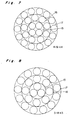
- a steel cord of the embodiment of the present invention comprises a core layer 10 composed of three wires 10a, an intermediate layer 11 composed of seven wires 11a, and an outer layer 12 composed of 13 wires 12a.
- the space ratio of the outer layer 12 ranges from 10% to 20% and that of the intermediate layer 11 ranges from 25% to 34%.
- Fig. 1 shows the steel code in which the diameter of the filament of each wire is 0. 175mm, the twist pitch thereof which is in mm is 5/10/16, and the twist direction thereof is S/S/Z.
- Fig. 2 shows the steel code in which the diameter of the filament of each wire is 0.23mm, the twist pitch thereof which is in mm is 6/12/18, and the twist direction thereof is S/S/Z.
- the reason the space ratio of the outer layer 12 is in the range from 10% to 20% is that if the space ratio is less than 10%, rubber does not penetrate sufficiently into the outer layer 12, and if the space ratio is more than 20%, the arrangement of filaments becomes ununiform and defective twisting occurs. As a result, the wire 11a of the intermediate layer 11 may project from the outer layer 12 or the arrangement of the outer layer 12 may be excessively ununiform.
- the reason the space ratio of the intermediate layer 11 is in the range from 25% to 34% is that if the space ratio is less than 25%, rubber does not penetrate sufficiently into the intermediate layer 11, and if the space ratio is more than 34%, the arrangement of filaments becomes excessively ununiform and the durability of the steel cord deteriorates.
- the twist pitches of the core layer 10, the intermediate layer 11, and the outer layer 12 are (A)mm, (B)mm, and (C)mm, respectively. If, in this condition, the twist pitch ratio (B/A) of the intermediate layer 11 to the core layer 10 is in the range from 1.6 to 2.2, it is easy to uniformly arrange the filaments of the intermediate layer 11. If, in the above condition, the twist pitch ratio (C/B) of the outer layer 12 to the intermediate layer 11 is in the range from 1.4 to 2.0, preferably, undefective twisting of filaments does not occur.
- the ratio (B/A) is smaller than 1.6, fretting degree of filaments becomes large and consequently, the steel cord has a poor quality, while if the ratio (B/A) is greater than 2.2, the construction stability deteriorates and as a result, the filaments are likely to be separated from each other. If the ratio (C/B) is smaller than 1.4, fretting degree becomes large and consequently, the steel cord has a poor quality, while if the ratio (C/B) is greater than 2.0, the construction stability deteriorates and as a result, the filaments are likely to be separated from each other.
- the space ratio of the intermediate layer 11 is in the range from 25% to 34%, the space ratio is greater than that of the core layer 10 and that of the outer layer 12. Accordingly, rubber is capable of smoothly penetrating into the gap between the core layer 10 and the intermediate layer 11 and as a result, the core layer 10 can be effectively prevented from being corroded and as such, the durability of the entire steel cord can be improved and steel cords are durable because the steel cords hardly contact with each other to cause frictions. Further, the steel cord can be stabilized in its construction by controlling the twist pitch ratio of the intermediate layer to the core layer and that of the outer layer to the intermediate layer in a specific range, respectively.
- the space ratio is not less than 25% and the arrangement of filaments can be effectively prevented from becoming ununiform.
- ununiform directionality does not occur in the filaments and rubber is capable of penetrating sufficiently into the core layer.
- the steel cord can be effectively prevented from being corroded and the tire comprising the steel cord can be made to be light.
- twist pitch ratio (B/A) of the intermediate layer 11 to the core layer 10 is in the range from 1.6 to 2.2, it is easy to uniformly arrange that the filaments of the intermediate layer 11.
- twist pitch ratio (C/B) of the outer layer 12 to the intermediate layer 11 is in the range from 1. 4 to 2. 0, undefective twisting of filaments is not caused.
- a radial tire manufactured by using the steel cord of the above construction is capable of displaying all the advantages of the steel cord and the tire can be made to be light.
- the present invention is not limited to the above-described embodiment, but various modifications thereof can be made.
- the diameters of filaments two or more different diameters may be adopted.
- the twist pitch and twist direction of filaments are not limited to the above-described embodiment.
- the core layer was composed of three wires
- the intermediate layer was composed of 7 wires
- the outer layer was composed of 13 wires and the wires of each layer consisted of filaments of 0.175mm.
- the core layer was composed of three wires
- the intermediate layer was composed of 7 wires
- the outer layer was composed of 13 wires and the wires of each layer consisted of filaments of 0.23mm.
- Figs. 3 through 9 show seven comparative examples in which each steel cord comprised a core layer 15, an intermediate layer 16, and an outer layer 17.
- the number of wires of the core layer + the intermediate layer + the outer layer is 3+9+15 (comparative example 1 shown in Fig. 3);
- the diameters of the filaments composing the wires of the comparative examples 1 through 5 were 0.175mm while the diameters of the filaments composing the wires of comparative example 6 were 0.23mm.
- the steel cord of comparative example 7 was in two-layer construction having seven layers 18 each composed of four wires 18a each consisting of filaments of 0.175mm in diameter.
- Ten tires were prepared for each of examples 1 and 2 and each of comparative examples 1 through 7 by using the above-described steel cords as a carcass-ply and a breaker-ply.
- the tread patterns of these tires were all rib pattern most widely used.
- the tires were mounted on a track of 10 tons.
- the wheels of the track comprised two front wheels and four rear wheels including four driving wheels and four idler wheels.
- the route track ran 200,000 kilometers to conduct the test of penetration degree of rubber and travel tests. In order to use each tire evenly, the tires were used by rotations.
- the average gap (m) and the average distance (n) between the centers of filaments are described using a first sheath (B1).
- the average gap (m) means a gap between adjacent steel filaments (F1) when the whole steel filaments (F1) arranged at the first sheath (B1) are uniformly dispersed around a core (C).
- the pitch circle of the sheath (B) is considered as a polygon formed by connecting the centers of the steel filaments and then (M/N) is a ratio of a space to the whole length of the polygon.
- Each tire was dismantled to arbitrarily take out three steel cords of 30cm from the ply and then, filaments were taken out from the outer layer.
- the amount of rubber which covered the filaments of the intermediate layer was evaluated in six grades of "0" to "5" to define the penetration degree of rubber (intermediate layer/outer layer). Filaments of the intermediate layer were removed to evaluate the amount of rubber which covered the filaments of the core layer in six grades of "0" to "5" to define the penetration degree of rubber (core layer/intermediate layer).
- the grades of 0, 1, 2, 3, 4, and 5 correspond to 1% to 20%, 21% to 40%, 41% to 60%, 61% to 80%, and 81% to 100%.
- plies were taken out from five portions of each tire when the tire was dismantled and steel cords were arbitrarily taken out from each ply, and per tire, plies were taken out from six portions located in the carcass which was moved in the greatest degree, namely, a region (III) between a breaker end (I) and a beater portion (II).
- reference numeral 1 denotes a tire
- 2 denotes a bead core
- 3 denotes a bead
- 4 denotes a side wall
- 5 denotes a tread
- 6 denotes a belt layer
- 7 denotes a carcass.
- core layer is abbreviated as core
- intermediate layer is abbreviated as intermediate
- outer layer is abbreviated as outer
- penetration degree means penetration degree of rubber
- comparative example is abbreviated as Comp
- % means the ratio of wire-free space to area.
- the steel cords of examples 1 and 2 made the best grades in the penetration degree of rubber and filament fretting.
Landscapes
- Engineering & Computer Science (AREA)
- Mechanical Engineering (AREA)
- Ropes Or Cables (AREA)
Applications Claiming Priority (2)
| Application Number | Priority Date | Filing Date | Title |
|---|---|---|---|
| JP56254/91 | 1991-01-31 | ||
| JP5625491 | 1991-01-31 |
Publications (2)
| Publication Number | Publication Date |
|---|---|
| EP0497612A1 true EP0497612A1 (de) | 1992-08-05 |
| EP0497612B1 EP0497612B1 (de) | 1995-10-18 |
Family
ID=13021949
Family Applications (1)
| Application Number | Title | Priority Date | Filing Date |
|---|---|---|---|
| EP92300825A Expired - Lifetime EP0497612B1 (de) | 1991-01-31 | 1992-01-31 | Stahlkord und Reifen |
Country Status (3)
| Country | Link |
|---|---|
| US (1) | US5285836A (de) |
| EP (1) | EP0497612B1 (de) |
| DE (1) | DE69205449T2 (de) |
Cited By (6)
| Publication number | Priority date | Publication date | Assignee | Title |
|---|---|---|---|---|
| EP0560564A1 (de) * | 1992-03-09 | 1993-09-15 | Sumitomo Rubber Industries Limited | Reifenkord und Reifen |
| EP0709236A1 (de) * | 1994-10-28 | 1996-05-01 | Sumitomo Rubber Industries Limited | Reifenkord |
| EP0744490A3 (de) * | 1995-05-26 | 1998-11-11 | Bridgestone Metalpha Corporation | Stahlseil und damit verstärkter Luftreifen |
| FR2795751A1 (fr) | 1999-06-29 | 2001-01-05 | Michelin Soc Tech | Cable d'acier multicouches pour carcasse de pneumatique |
| WO2004033789A1 (fr) | 2002-10-11 | 2004-04-22 | Societe De Technologie Michelin | Cables utilisables pour renforcer des pneumatiques poids-lourd |
| FR2999616A1 (fr) * | 2012-12-14 | 2014-06-20 | Michelin & Cie | Cable metallique a couches cylindriques de structure 3+9+14 |
Families Citing this family (7)
| Publication number | Priority date | Publication date | Assignee | Title |
|---|---|---|---|---|
| EP0551124B1 (de) * | 1992-01-09 | 1998-05-20 | Bridgestone Corporation | Stahlseil |
| KR100296075B1 (ko) * | 1999-03-05 | 2001-07-03 | 조충환 | 고무침투성이 향상된 고무 및 타이어 보강용 스틸코드 |
| US7104299B2 (en) * | 2001-04-23 | 2006-09-12 | The Goodyear Tire & Rubber Company | Two piece tire with improved tire tread belt |
| US7093634B2 (en) * | 2001-04-23 | 2006-08-22 | The Goodyear Tire & Rubber Company | Two piece tire with improved tire tread belt |
| US9077960B2 (en) * | 2005-08-12 | 2015-07-07 | Microsoft Corporation | Non-zero coefficient block pattern coding |
| US20070131331A1 (en) * | 2005-12-08 | 2007-06-14 | Neubauer Robert A | Tire assembly with high elongation cable belt |
| FR2999614B1 (fr) * | 2012-12-14 | 2015-08-21 | Michelin & Cie | Cable metallique a couches a haute penetrabilite |
Citations (2)
| Publication number | Priority date | Publication date | Assignee | Title |
|---|---|---|---|---|
| DE2829205A1 (de) * | 1977-07-07 | 1979-01-18 | Bekaert Sa Nv | Metallseil |
| EP0342492A1 (de) * | 1988-05-12 | 1989-11-23 | Tokusen Kogyo Company Limited | Stahlcord mit hoher Bruchfestigkeit und mit diesem Stahlcord verstärkte Radialluftreifen |
Family Cites Families (6)
| Publication number | Priority date | Publication date | Assignee | Title |
|---|---|---|---|---|
| JPS58177702A (ja) * | 1982-04-09 | 1983-10-18 | Sumitomo Rubber Ind Ltd | 耐久寿命を改良したスチ−ルラジアルタイヤ |
| JPS59223503A (ja) * | 1983-06-01 | 1984-12-15 | Toyo Tire & Rubber Co Ltd | 空気タイヤ |
| US4608817A (en) * | 1984-05-21 | 1986-09-02 | The Goodyear Tire & Rubber Company | Single strand metal cord and method of making |
| JPH0663183B2 (ja) * | 1984-10-03 | 1994-08-17 | 金井 宏之 | スチ−ルコ−ド |
| JP2832061B2 (ja) * | 1990-03-27 | 1998-12-02 | 住友ゴム工業 株式会社 | 重荷重用ラジアルタイヤ |
| JP2815097B2 (ja) * | 1990-03-27 | 1998-10-27 | 住友ゴム工業 株式会社 | 重荷重用ラジアルタイヤ |
-
1992
- 1992-01-29 US US07/827,931 patent/US5285836A/en not_active Expired - Fee Related
- 1992-01-31 DE DE69205449T patent/DE69205449T2/de not_active Expired - Fee Related
- 1992-01-31 EP EP92300825A patent/EP0497612B1/de not_active Expired - Lifetime
Patent Citations (2)
| Publication number | Priority date | Publication date | Assignee | Title |
|---|---|---|---|---|
| DE2829205A1 (de) * | 1977-07-07 | 1979-01-18 | Bekaert Sa Nv | Metallseil |
| EP0342492A1 (de) * | 1988-05-12 | 1989-11-23 | Tokusen Kogyo Company Limited | Stahlcord mit hoher Bruchfestigkeit und mit diesem Stahlcord verstärkte Radialluftreifen |
Non-Patent Citations (1)
| Title |
|---|
| PATENT ABSTRACTS OF JAPAN vol. 8, no. 16 (M-270)(1453) 24 January 1984 & JP-A-58 177 702 ( SUMITOMO GOMU KOGYO K.K. ) 18 October 1983 * |
Cited By (10)
| Publication number | Priority date | Publication date | Assignee | Title |
|---|---|---|---|---|
| EP0560564A1 (de) * | 1992-03-09 | 1993-09-15 | Sumitomo Rubber Industries Limited | Reifenkord und Reifen |
| US5327713A (en) * | 1992-03-09 | 1994-07-12 | Sumitomo Rubber Industries, Ltd. | Tire cord and tire |
| US5410868A (en) * | 1992-03-09 | 1995-05-02 | Sumitomo Rubber Industries, Ltd. | Tire cord and tire |
| EP0709236A1 (de) * | 1994-10-28 | 1996-05-01 | Sumitomo Rubber Industries Limited | Reifenkord |
| US5836145A (en) * | 1994-10-28 | 1998-11-17 | Sumitomo Rubber Industries, Ltd. | Tire cord having a core and sheath with improved rubber penetration |
| EP0744490A3 (de) * | 1995-05-26 | 1998-11-11 | Bridgestone Metalpha Corporation | Stahlseil und damit verstärkter Luftreifen |
| FR2795751A1 (fr) | 1999-06-29 | 2001-01-05 | Michelin Soc Tech | Cable d'acier multicouches pour carcasse de pneumatique |
| WO2004033789A1 (fr) | 2002-10-11 | 2004-04-22 | Societe De Technologie Michelin | Cables utilisables pour renforcer des pneumatiques poids-lourd |
| FR2999616A1 (fr) * | 2012-12-14 | 2014-06-20 | Michelin & Cie | Cable metallique a couches cylindriques de structure 3+9+14 |
| WO2014090999A3 (fr) * | 2012-12-14 | 2014-08-07 | Compagnie Generale Des Etablissements Michelin | Câble métallique à couches cylindriques de structure 3+9+14 |
Also Published As
| Publication number | Publication date |
|---|---|
| DE69205449T2 (de) | 1996-04-25 |
| DE69205449D1 (de) | 1995-11-23 |
| EP0497612B1 (de) | 1995-10-18 |
| US5285836A (en) | 1994-02-15 |
Similar Documents
| Publication | Publication Date | Title |
|---|---|---|
| JP3777210B2 (ja) | 空気入りラジアルタイヤ | |
| KR100686906B1 (ko) | 타이어 케이싱용 다층 강 케이블 및 이를 포함하는 대형 차량용 타이어 | |
| EP0168858B1 (de) | Kompakt-Stahlkord mit verbesserter Zugfestigkeit | |
| EP0497612A1 (de) | Stahlkord und Reifen | |
| JP3045732B2 (ja) | ラジアルタイヤ | |
| US6612354B2 (en) | Pneumatic tire | |
| EP2653608A1 (de) | Stahlseil zur verstärkung eines gummiartikels und luftreifen damit | |
| GB2080845A (en) | Metal cords for reinforcing elastomeric articles | |
| US5688597A (en) | Tire core | |
| EP0567334A1 (de) | Stahlseile zur Verstärkung elastomerer Erzeugnisse und radiale Luftreifen für LKW, die solche Seile aufweisen | |
| EP1344864B1 (de) | Stahlseil, Verfahren zu dessen Herstellung und solche Stahlseile enthaltender Luftreifen | |
| US6415593B1 (en) | Metallic cord and pneumatic tire | |
| EP1041194B1 (de) | Stahlseil, verfahren zu dessen herstellung sowie luftreifen | |
| JPS5929503A (ja) | 耐久性にすぐれるラジアルタイヤ | |
| US6695026B2 (en) | Pneumatic tire | |
| EP0779390A1 (de) | Stahlseile zur Verstärkung von Gummiartikeln und solche Stahlseile aufweisender radialer Luftreifen | |
| EP0905305A1 (de) | Stahlseil zur Verstärkung von Gummiartikeln und solche Stahlseile aufweisender Luftreifen | |
| EP0893282B1 (de) | Stahlkabel zur Verstärkung elastomerer Erzeugnisse und radiale Luftreifen mit solchen Kabeln | |
| JP3026743B2 (ja) | 空気入りタイヤ | |
| JPH1025677A (ja) | エラストマー補強用の金属コード | |
| JP3043166B2 (ja) | スチールコード | |
| JPH044162B2 (de) | ||
| JP2001114143A (ja) | 弾性クローラ | |
| JPH08127984A (ja) | ゴム物品補強用スチールコードおよび空気入りラジアルタイヤ | |
| JP2983578B2 (ja) | 空気タイヤ |
Legal Events
| Date | Code | Title | Description |
|---|---|---|---|
| PUAI | Public reference made under article 153(3) epc to a published international application that has entered the european phase |
Free format text: ORIGINAL CODE: 0009012 |
|
| AK | Designated contracting states |
Kind code of ref document: A1 Designated state(s): DE FR GB |
|
| 17P | Request for examination filed |
Effective date: 19920820 |
|
| 17Q | First examination report despatched |
Effective date: 19931222 |
|
| 19A | Proceedings stayed before grant |
Effective date: 19950116 |
|
| 19F | Resumption of proceedings before grant (after stay of proceedings) |
Effective date: 19950220 |
|
| GRAA | (expected) grant |
Free format text: ORIGINAL CODE: 0009210 |
|
| AK | Designated contracting states |
Kind code of ref document: B1 Designated state(s): DE FR GB |
|
| REF | Corresponds to: |
Ref document number: 69205449 Country of ref document: DE Date of ref document: 19951123 |
|
| ET | Fr: translation filed | ||
| PLBE | No opposition filed within time limit |
Free format text: ORIGINAL CODE: 0009261 |
|
| 26N | No opposition filed | ||
| REG | Reference to a national code |
Ref country code: GB Ref legal event code: IF02 |
|
| PGFP | Annual fee paid to national office [announced via postgrant information from national office to epo] |
Ref country code: FR Payment date: 20020110 Year of fee payment: 11 |
|
| PGFP | Annual fee paid to national office [announced via postgrant information from national office to epo] |
Ref country code: GB Payment date: 20020130 Year of fee payment: 11 |
|
| PGFP | Annual fee paid to national office [announced via postgrant information from national office to epo] |
Ref country code: DE Payment date: 20020227 Year of fee payment: 11 |
|
| PG25 | Lapsed in a contracting state [announced via postgrant information from national office to epo] |
Ref country code: GB Free format text: LAPSE BECAUSE OF NON-PAYMENT OF DUE FEES Effective date: 20030131 |
|
| PG25 | Lapsed in a contracting state [announced via postgrant information from national office to epo] |
Ref country code: DE Free format text: LAPSE BECAUSE OF NON-PAYMENT OF DUE FEES Effective date: 20030801 |
|
| GBPC | Gb: european patent ceased through non-payment of renewal fee | ||
| PG25 | Lapsed in a contracting state [announced via postgrant information from national office to epo] |
Ref country code: FR Free format text: LAPSE BECAUSE OF NON-PAYMENT OF DUE FEES Effective date: 20030930 |
|
| REG | Reference to a national code |
Ref country code: FR Ref legal event code: ST |