EP0499372A2 - Dispositif et procédé pour la fabrication d'écrans de projection holographiques - Google Patents
Dispositif et procédé pour la fabrication d'écrans de projection holographiques Download PDFInfo
- Publication number
- EP0499372A2 EP0499372A2 EP92300643A EP92300643A EP0499372A2 EP 0499372 A2 EP0499372 A2 EP 0499372A2 EP 92300643 A EP92300643 A EP 92300643A EP 92300643 A EP92300643 A EP 92300643A EP 0499372 A2 EP0499372 A2 EP 0499372A2
- Authority
- EP
- European Patent Office
- Prior art keywords
- film
- longitudinal axis
- polygon shaped
- interference pattern
- reference beam
- Prior art date
- Legal status (The legal status is an assumption and is not a legal conclusion. Google has not performed a legal analysis and makes no representation as to the accuracy of the status listed.)
- Granted
Links
Images



Classifications
-
- G—PHYSICS
- G02—OPTICS
- G02B—OPTICAL ELEMENTS, SYSTEMS OR APPARATUS
- G02B5/00—Optical elements other than lenses
- G02B5/32—Holograms used as optical elements
Definitions
- the present invention relates to optical imaging systems and fabrication techniques therefor. More specifically, the present invention relates to techniques for fabricating holographic projection screens.
- Visual displays are useful for many applications including the simulation of scenery to allow for the training of a vehicle operator.
- air flight simulators allow a simulator pilot to view imagery on a projection screen while piloting a mock aircraft.
- the simulator pilot is positioned at the center of a large diameter dome.
- the diameter of the dome is typically between 9.5 and 40 feet.
- the visual display is projected onto the inner surface of the dome by means of one or more projectors located outside the dome.
- Input imagery is projected through a small hole in the dome onto the hemisphere opposite the point of projection.
- the dotted line in Fig. 1 shows the boundary of the forward hemisphere into which Projector "A" projects a visual display.
- the visual display is projected onto the inner surface of the dome (hereinafter the "screen").
- the angle of incidence of light at the screen is equal to the projection angle.
- the angle of reflection of light from the screen is equal to the angle of incidence and therefore the projection angle. Since the projection angle typically varies from 0 to 57 degrees, the angle of reflection typically varies from 0 to 57 degrees. The is problematic in that it prohibits the use of screens with optical gain.
- the use of screens with high optical gain is highly desirable as these screens afford improved brightness and contrast ratio for the visual display.
- the high optical gain is in the specular reflection direction.
- the specular reflection direction is away from the pilot's location for large projection angles.
- the visual display brightness using a gain screen is less than if a standard Lambertian screen was used. (A Lambertian screen has an optical gain that is uniform in all directions but the gain is always one or less.) Because of the integrating sphere effects, the gain should be less than one and typically, 0.5 ⁇ 0.1.
- dome visual displays typically must use a screen with a gain of only 0.5. Consequently, the brightness is only 1/8th as bright as the equivalent flat gain screen visual display.
- Holographic screens were developed for use in simulators to reduce specular reflection thereby increasing the brightness of the image seen by the simulator pilot.
- a hologram has the unique characteristic that if light is incident on the hologram from one direction then light is caused to be propagated in a second direction other than the specular reflection direction.
- Fig. 2 shows a closeup of a holographic screen. As shown, the projected beam causes light to propagate in the direction of the simulator pilot. Depending upon the design and manufacture of the hologram, practically all of the light is propagated in the direction of the simulator pilot and ideally none of the light is propagated in the specular reflection direction. This enables high brightness visual displays because most of the projector light is propagated in the direction of the simulator pilot.
- holographic projection screens were made using a diffuser to enable the simulator pilot to see the visual display. If the holographic projection screen is made without a diffuser, the pilot would see only a single bright point of light throughout the entire angular subtend of the holographic screen. For example, if the holographic screen was made in increments of one square foot, the simulator pilot would see only one bright point of light per square foot of holographic projection screen area.
- speckle is a phenomenon that occurs whenever coherent light is used to illuminate a diffuse surface. It appears as a grainy texture superimposed on the diffuse surface, but yet projected out in space to the plane of the observer and therefore it can be quite irritating to the observer. It is therefore desirable to eliminate the speckle associated with conventional holographic projection screens.
- each hologram is smaller than the resolution of the visual display.
- Each hologram is essentially a high resolution picture of the interference pattern created by the interaction of two laser beams, a signal beam containing the "image" and a reference beam. When the two beams interact, the beams interfere with each other constructively and destructively.
- an area of maximum optical intensity is created and recorded on photographic film as a light area, typically a line.
- an area of minimum optical add an interference pattern is created which is recorded on film as a dark area.
- start and stop movement requires considerable laser power because the photographic film may only be exposed after it has stopped moving. Power is consumed while the laser waits in a power up standby mode for the film to stop moving.
- the need in the art is addressed by the present invention which provides a fast, accurate system for manufacturing holographic projection screens.
- the invention includes a mechanism for moving holographic film along a longitudinal axis thereof in a first direction.
- a mechanism is provided for directing and maintaining an input beam onto the film as the film is moved.
- the application of a reference beam is then effective to create an interference pattern with the input beam which is stored on the film.
- the mechanism for maintaining the input image at a fixed location on the film includes a polygon shaped mirror mounted to rotate at a rate matched to the rate of movement of the film.
- the present invention also provides an image stabilization system which includes a detector for monitoring an interference pattern created by a signal beam and a reference beam. Control circuitry is included which is responsive to signals from the detector and provides servo control signals in response thereto. A phase shifter induces a phase shift in the reference beam. A phase shifter positioning mechanism adjusts the phase shifter in response to the control signals to stabilize the image on the hologram despite the movement thereof.
- Fig. 1 is an optical schematic diagram from a side view of a typical dome display such as that used in a simulator illustrating the need for a holographic display.
- Fig. 2 is an optical schematic diagram from a closeup sectional side view of a holographic screen.
- Fig. 3(a) is an optical schematic diagram of an illustrative embodiment of the system for manufacturing holographic projection screens of the present invention.
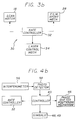
- Fig. 3(b) is a block diagram of an illustrative implementation of a rate control system utilized in the present invention.
- Fig. 4(a) is an optical schematic diagram of an illustrative implementation of an image stabilization system utilized with the system for manufacturing holographic projection screens of the present invention.
- Fig. 4(b) is a block diagram of an illustrative implementation of the control system of the stabilization system of the system for manufacturing holographic projection screens of the present invention.
- Fig. 3(a) is an optical schematic diagram of an illustrative embodiment of the system for manufacturing holographic projection screens of the present invention.
- the system 10 includes a multi-faceted polygon 12 with N p mirrored facets 14.
- the polygon 12 is mounted for rotation about a longitudinal axis 16 extending through the center thereof.
- the polygon is driven by a motor (not shown).
- the polygon 12 may be implemented with a conventional scanning mirror or galvanometer.
- An input signal beam 22 of coherent light from a source such as a laser 20 is reflected off a facet 14 of the polygon 12.
- the polygon 12 scans the signal beam 22 of diameter D1 through an afocal telescope consisting of lenses L1 and L2.
- Lenses L1 and L2 change the diameter of the beam 22 from D1 to D2 by simple optics.
- a third lens L3 focuses the beam 22 to a single point of light at the focal point 24 thereof.
- the lenses L1, L2 and L3 should have F Theta distortion.
- a lens with F Theta distortion provides an image in the focal plane having a height equal to the lens focal length times the input angle.
- An unexposed photographic film 26 is positioned a distance z from the focal plane of the lens L3.
- the width of the signal beam at the hologram surface is D z .
- a reference beam 23 of width D r is simultaneously incident on the same location of the unexposed photographic film 26 as the signal beam 22 at an angle of ⁇ r with respect to the longitudinal axis of the signal beam 22.
- the reference beam is provided via an adjustable phase shifter 25 and is discussed more fully below.
- D r D z cos ⁇ r [1]
- the dome radius R d and the pupil diameter D p are illustrated in Fig. 3(a).
- the dome radius is the distance from the holographic screen to the observer.
- the pupil diameter D p is the diameter of the pupil surrounding the observer's head. Within the pupil the observer can see the image. Outside the pupil the observer can see nothing.
- the pupil diameter D p is typically 24 inches.
- the hologram a piece of high resolution photographic film, is moved by a film transport mechanism 28 (not shown).
- the film transport mechanism 28 moves the film 26 along the longitudinal axis thereof.
- the film is mounted so that the direction of movement of the film 26 is normal to the longitudinal axis of the polygon 12. In effect, the film is moved in a direction opposite to the scan of the beam 22 thereacross.
- the scan of the beam 22 is synchronized with the movement of the film 26 so that the image is stationary on the film.
- the system 10 of the present invention allows for a moving image to be held stationary on the film during exposure thereof. Start and stop motion is eliminated thereby obviating the necessity to allow the mechanism to settle as is required by the step and repeat method of the prior art.
- Fig. 3(b) shows an illustrative implementation of a rate control system 30 for controlling the movement of the hologram 26 relative to the movement of the scanning polygon 12 to achieve a stationary holographic image thereon.
- the rate control system 30 includes a rate controller 32 which is connected to the scan motor 18 and the hologram film transport mechanism 28.
- the rate controller may be implemented with a microprocessor and that the rotational velocity of the spinning polygon is adjusted to make the linear velocity to the image in the focal plane of the lens L3 exactly match the linear velocity of the film plate.
- the rate control mechanism may also be connected to a mechanism for controlling a shutter (not shown) which interrupts the beam from the source 20.
- the optical path difference cannot change by more than a fraction of a wavelength with respect to the photographic film. Because the microdot is moving with respect to the reference beam, it is necessary to compensate for the change in optical path length. This is accomplished with the roof prism 44 of Fig. 4(a). (not shown in Fig. 3(b)). Moving the roof prism 44 in a direction opposite to the movement of the microdot hologram maintains a stationary optical path difference. By monitoring the brightness of the reference band signal beam interference pattern, as discussed below, and moving the roof prism 44 in a transverse direction, alignment of the reference beam and the signal beam may be maintained.
- Fig. 4(a) is an optical schematic diagram of an illustrative implementation of an image stabilization system utilized with the system for manufacturing holographic projection screens of the present invention.
- Both the signal beam 22 and the reference beam 23 originate from the same coherent source, the laser 20.
- the beam from the laser 20 passes through opening in the shutter 34 which is controlled by the rate controller 32 of Fig. 3(b).
- the beam is then split by a conventional beamsplitter 42 into the signal beam 22 and the reference beam 23, each of appropriate intensity. (Optical filtering of the reference beam, signal beam or both beams may be necessary in order to obtain the optimum diffraction efficiency from the developed hologram.)
- the signal beam 22 is applied to the film 26 as described above with respect to Fig. 3(a).
- the reference beam 23 is applied to an adjustable phase shifter 25.
- the adjustable phase shifter 25 is implemented with a roof prism 44 and a phase shifter adjustment mechanism 46 (not shown).
- the reference beam 23 exits the roof prism 44 and is directed by first and second gimballed mirrors 48 and 49 onto the holographic film 26 via fourth and fifth lenses L4 and L5.
- the gimballed mirrors are fixed during exposure and changed thereafter as necessary to direct the reference beam at the correct angle relative to the holographic film to achieve the x and y coordinate values per each projection angle.
- the gimbals are indexed only during a transition from one microdot hologram to the next adjacent microdot hologram.
- the lenses L4 and L5 serve the same purpose as lenses L1 and L2, viz., to change the diameter of the beam 23.
- the interference pattern created by the intersection of the signal beam 22 and the reference beam 23 on the photographic film is monitored by a detector arrangement 50.
- the detector arrangement 50 includes a mirror 52 mounted in the optical path of the signal beam 22.
- the mirror 52 reflects the signal beam 22 to a beamcombiner 54 from which the beam is reflected to an interferometer 56.
- the mirror 52 and the beamcombiner 54 may be of conventional design and construction.
- the reference beam is reflected off the film 26 through the beamcombiner 54 to the interferometer 56.
- the interference pattern is formed on the interferometer 56 and is detected by a photodetector 58.
- the closed loop servo-control system is completed by a system controller 60.
- the controller 60 controls the position of the phase shifter via the phase shifter positioning mechanism 46 in response to the output of the photodetector 58.
- the system controller 60 also controls the positions of the gimbals 48 and 49 as necessary for each projection angle.
- the rate at which the holograms are made is also controlled through the system controller 60 via the rate controller 32.
- the hologram master is made flat and subsequent copies will become curved when applied to the inside of the dome.
- the reference beam angle must be changed slightly as the unexposed hologram is transported in both the x and y directions.
- the following table shows the change in reference beam angle. TABLE II Dome diameter (ft) 9.5 40.0 Change in reference beam angle per inch .503 .119 Assumed hologram size (inches) ⁇ 6.0 ⁇ 6.0 Change in reference beam angle ⁇ 3.02 ⁇ .72
- the present invention has been described herein with reference to a particular embodiment for a particular application. Those having ordinary skill in the art and access to the present teachings will recognize additional modifications applications and embodiments within the scope thereof.
- the invention is not limited to the use of a spinning polygon. Any scanning mirror could be used. The only requirement is that the velocity of the image in the focal plane is equal to the velocity of the hologram transport.
Landscapes
- Physics & Mathematics (AREA)
- General Physics & Mathematics (AREA)
- Optics & Photonics (AREA)
- Holo Graphy (AREA)
- Overhead Projectors And Projection Screens (AREA)
- Diffracting Gratings Or Hologram Optical Elements (AREA)
Applications Claiming Priority (2)
| Application Number | Priority Date | Filing Date | Title |
|---|---|---|---|
| US07/653,526 US5151799A (en) | 1991-02-11 | 1991-02-11 | System and technique for making holographic projection screens |
| US653526 | 1996-05-24 |
Publications (3)
| Publication Number | Publication Date |
|---|---|
| EP0499372A2 true EP0499372A2 (fr) | 1992-08-19 |
| EP0499372A3 EP0499372A3 (en) | 1993-10-06 |
| EP0499372B1 EP0499372B1 (fr) | 1997-04-09 |
Family
ID=24621237
Family Applications (1)
| Application Number | Title | Priority Date | Filing Date |
|---|---|---|---|
| EP92300643A Expired - Lifetime EP0499372B1 (fr) | 1991-02-11 | 1992-01-24 | Dispositif et procédé pour la fabrication d'écrans de projection holographiques |
Country Status (5)
| Country | Link |
|---|---|
| US (1) | US5151799A (fr) |
| EP (1) | EP0499372B1 (fr) |
| JP (1) | JP2510370B2 (fr) |
| CA (1) | CA2058802C (fr) |
| DE (1) | DE69218814T2 (fr) |
Cited By (2)
| Publication number | Priority date | Publication date | Assignee | Title |
|---|---|---|---|---|
| DE19934162A1 (de) * | 1999-07-21 | 2001-02-08 | Daimler Chrysler Ag | Verfahren, Vorrichtung und Lasersystem zur Herstellung von Bildschirmhologrammen, sowie Hologramm |
| WO2013087447A1 (fr) * | 2011-12-16 | 2013-06-20 | Eads Deutschland Gmbh | Procédé et dispositif pour produire un écran holographique pour une projection frontale électronique |
Families Citing this family (9)
| Publication number | Priority date | Publication date | Assignee | Title |
|---|---|---|---|---|
| US5270842A (en) * | 1991-02-20 | 1993-12-14 | Holographix, Inc. | Holographic recording and scanning system and method |
| JP2769393B2 (ja) * | 1991-04-26 | 1998-06-25 | 直弘 丹野 | 立体光記録装置 |
| EP0534616B1 (fr) * | 1991-08-29 | 1997-10-29 | Fujitsu Limited | Dispositif pour l'enregistrement d'hologrammes et élément optique holographique |
| US5774240A (en) * | 1992-02-20 | 1998-06-30 | Nikon Corporation | Exposure apparatus for reproducing a mask pattern onto a photo-sensitive surface of a substrate using holographic techniques |
| US5541769A (en) * | 1994-11-18 | 1996-07-30 | Hughes Training, Inc. | Uniform-brightness, high-gain display structures and methods |
| US6198555B1 (en) | 1996-03-25 | 2001-03-06 | Denso Corporation | Manufacturing method for a hologram and a related exposure apparatus |
| US6882477B1 (en) | 1999-11-10 | 2005-04-19 | Massachusetts Institute Of Technology | Method and system for interference lithography utilizing phase-locked scanning beams |
| DE102020209021A1 (de) | 2020-07-20 | 2022-01-20 | Robert Bosch Gesellschaft mit beschränkter Haftung | Holografische Projektionsfläche für eine Projektionsvorrichtung und Projektionsvorrichtung |
| US11815729B2 (en) * | 2021-04-13 | 2023-11-14 | Meta Platforms Technologies, Llc | System and method for interference fringe stabilization |
Family Cites Families (17)
| Publication number | Priority date | Publication date | Assignee | Title |
|---|---|---|---|---|
| US3838903A (en) * | 1965-10-29 | 1974-10-01 | Battelle Development Corp | Wavefront reconstruction |
| US3558207A (en) * | 1966-12-06 | 1971-01-26 | Searle Medidata Inc | Hologram system employing incoherent light |
| US3539242A (en) * | 1967-11-01 | 1970-11-10 | Texas Instruments Inc | On-axis holography |
| US3636838A (en) * | 1969-04-04 | 1972-01-25 | Ibm | Beam motion compensation in optical image transfer systems having moving parts |
| US3632214A (en) * | 1969-06-23 | 1972-01-04 | Ibm | Method and apparatus for stabilizing the phase of radiation |
| US3622794A (en) * | 1969-06-23 | 1971-11-23 | Boeing Co | Improvements in feedback apparatus for stabilizing holograms |
| US3572882A (en) * | 1969-11-28 | 1971-03-30 | Us Air Force | Variable reference phase holocamera to compensate for object motion |
| BE760000A (fr) * | 1969-12-10 | 1971-05-17 | Ampex | Dispositif de memorisation et de restitution holographique |
| US3659947A (en) * | 1970-06-18 | 1972-05-02 | Gco | Holographic apparatus with automatic control system for maintaining constant phase relation between reference and object beams |
| US3812496A (en) * | 1972-08-22 | 1974-05-21 | Trw Inc | Optical signal recording system |
| US3964032A (en) * | 1974-03-18 | 1976-06-15 | Harris Corporation | Optical system for storing information |
| HU172499B (hu) * | 1976-05-31 | 1978-09-28 | Mta Koezponti Fiz Kutato Intez | Sposob i ustrojstvo dlja kontrolja fotomaski, metodom izvlechenija |
| US4500163A (en) * | 1981-07-29 | 1985-02-19 | The Singer Company | Holographic projection screen |
| JPS61189502A (ja) * | 1985-02-19 | 1986-08-23 | Hitachi Ltd | 回折格子形成方法及び装置 |
| JP2761899B2 (ja) * | 1988-09-28 | 1998-06-04 | アンリツ株式会社 | 回折格子露光装置 |
| JPH02254403A (ja) * | 1989-03-28 | 1990-10-15 | Kuraray Co Ltd | 干渉露光装置および干渉露光法 |
| GB8911454D0 (en) * | 1989-05-18 | 1989-07-05 | Pilkington Plc | Hologram construction |
-
1991
- 1991-02-11 US US07/653,526 patent/US5151799A/en not_active Expired - Lifetime
-
1992
- 1992-01-06 CA CA002058802A patent/CA2058802C/fr not_active Expired - Fee Related
- 1992-01-24 EP EP92300643A patent/EP0499372B1/fr not_active Expired - Lifetime
- 1992-01-24 DE DE69218814T patent/DE69218814T2/de not_active Expired - Fee Related
- 1992-02-07 JP JP4022862A patent/JP2510370B2/ja not_active Expired - Fee Related
Cited By (4)
| Publication number | Priority date | Publication date | Assignee | Title |
|---|---|---|---|---|
| DE19934162A1 (de) * | 1999-07-21 | 2001-02-08 | Daimler Chrysler Ag | Verfahren, Vorrichtung und Lasersystem zur Herstellung von Bildschirmhologrammen, sowie Hologramm |
| US6982817B1 (en) | 1999-07-21 | 2006-01-03 | Eads Deutschland Gmbh | Method, device and laser system for producing screen holograms, and screen hologram |
| DE19934162B4 (de) * | 1999-07-21 | 2006-06-29 | Eads Deutschland Gmbh | Verfahren und Vorrichtung zur Herstellung von Bildschirmhologrammen, sowie Bildschirmhologramm |
| WO2013087447A1 (fr) * | 2011-12-16 | 2013-06-20 | Eads Deutschland Gmbh | Procédé et dispositif pour produire un écran holographique pour une projection frontale électronique |
Also Published As
| Publication number | Publication date |
|---|---|
| JPH04335626A (ja) | 1992-11-24 |
| JP2510370B2 (ja) | 1996-06-26 |
| EP0499372A3 (en) | 1993-10-06 |
| CA2058802C (fr) | 1998-08-25 |
| US5151799A (en) | 1992-09-29 |
| EP0499372B1 (fr) | 1997-04-09 |
| DE69218814T2 (de) | 1997-11-20 |
| DE69218814D1 (de) | 1997-05-15 |
| CA2058802A1 (fr) | 1992-08-12 |
Similar Documents
| Publication | Publication Date | Title |
|---|---|---|
| US3316348A (en) | Scanning system for recording pictorial data | |
| KR100917497B1 (ko) | 스크린 및 프로젝션 시스템 | |
| US4819033A (en) | Illumination apparatus for exposure | |
| US4126386A (en) | Image stabilization system for continuous film scanning apparatus | |
| US6099128A (en) | Method of spatially moving a projection beam from a video or graphics projector | |
| EP0499372B1 (fr) | Dispositif et procédé pour la fabrication d'écrans de projection holographiques | |
| JP4379482B2 (ja) | 光源装置及びプロジェクタ | |
| US5835252A (en) | Device for generating annular pictures | |
| US5500692A (en) | Image projecting apparatus for producing an image for display on a projection screen | |
| JP2011164450A (ja) | プロジェクター及びアナモフィックプリズム光学ユニット | |
| US4099829A (en) | Flat field optical scanning system | |
| US4911532A (en) | Laser optical system with a single collimating lens and combining means | |
| US3687025A (en) | Image spacing system | |
| US5099358A (en) | Apparatus for recording image including an afocal optical system | |
| US4125843A (en) | Method and apparatus for recording and projecting images | |
| JPS6119003B2 (fr) | ||
| US4933687A (en) | Laser-actuated digital imaging system | |
| US2821105A (en) | System for optically combining plural images | |
| US4978184A (en) | Laser raster scanner having passive facet tracking | |
| US7167216B2 (en) | Projection system with adjustable aspect ratio optics | |
| JPH02220016A (ja) | 2焦点光学装置 | |
| GB2068597A (en) | Laser spatial stabilization transmission system | |
| US5078487A (en) | Projecting apparatus | |
| JPH05173094A (ja) | レーザ表示装置 | |
| WO2022113614A1 (fr) | Dispositif d'affichage |
Legal Events
| Date | Code | Title | Description |
|---|---|---|---|
| PUAI | Public reference made under article 153(3) epc to a published international application that has entered the european phase |
Free format text: ORIGINAL CODE: 0009012 |
|
| AK | Designated contracting states |
Kind code of ref document: A2 Designated state(s): DE FR GB |
|
| PUAL | Search report despatched |
Free format text: ORIGINAL CODE: 0009013 |
|
| AK | Designated contracting states |
Kind code of ref document: A3 Designated state(s): DE FR GB |
|
| 17P | Request for examination filed |
Effective date: 19940315 |
|
| 17Q | First examination report despatched |
Effective date: 19950828 |
|
| GRAG | Despatch of communication of intention to grant |
Free format text: ORIGINAL CODE: EPIDOS AGRA |
|
| GRAH | Despatch of communication of intention to grant a patent |
Free format text: ORIGINAL CODE: EPIDOS IGRA |
|
| GRAH | Despatch of communication of intention to grant a patent |
Free format text: ORIGINAL CODE: EPIDOS IGRA |
|
| GRAA | (expected) grant |
Free format text: ORIGINAL CODE: 0009210 |
|
| AK | Designated contracting states |
Kind code of ref document: B1 Designated state(s): DE FR GB |
|
| REF | Corresponds to: |
Ref document number: 69218814 Country of ref document: DE Date of ref document: 19970515 |
|
| ET | Fr: translation filed | ||
| PLBE | No opposition filed within time limit |
Free format text: ORIGINAL CODE: 0009261 |
|
| 26N | No opposition filed | ||
| REG | Reference to a national code |
Ref country code: GB Ref legal event code: 732E |
|
| REG | Reference to a national code |
Ref country code: FR Ref legal event code: TP Ref country code: FR Ref legal event code: CA Ref country code: FR Ref legal event code: CD |
|
| REG | Reference to a national code |
Ref country code: GB Ref legal event code: IF02 |
|
| REG | Reference to a national code |
Ref country code: GB Ref legal event code: 732E |
|
| REG | Reference to a national code |
Ref country code: FR Ref legal event code: TP |
|
| PGFP | Annual fee paid to national office [announced via postgrant information from national office to epo] |
Ref country code: DE Payment date: 20090302 Year of fee payment: 18 |
|
| PGFP | Annual fee paid to national office [announced via postgrant information from national office to epo] |
Ref country code: GB Payment date: 20090129 Year of fee payment: 18 |
|
| PGFP | Annual fee paid to national office [announced via postgrant information from national office to epo] |
Ref country code: FR Payment date: 20090119 Year of fee payment: 18 |
|
| GBPC | Gb: european patent ceased through non-payment of renewal fee |
Effective date: 20100124 |
|
| REG | Reference to a national code |
Ref country code: FR Ref legal event code: ST Effective date: 20100930 |
|
| PG25 | Lapsed in a contracting state [announced via postgrant information from national office to epo] |
Ref country code: FR Free format text: LAPSE BECAUSE OF NON-PAYMENT OF DUE FEES Effective date: 20100201 |
|
| PG25 | Lapsed in a contracting state [announced via postgrant information from national office to epo] |
Ref country code: DE Free format text: LAPSE BECAUSE OF NON-PAYMENT OF DUE FEES Effective date: 20100803 |
|
| PG25 | Lapsed in a contracting state [announced via postgrant information from national office to epo] |
Ref country code: GB Free format text: LAPSE BECAUSE OF NON-PAYMENT OF DUE FEES Effective date: 20100124 |