EP0499656A1 - Rouleau destiné à être utilisé dans un four de traitement thermique et méthode pour sa fabrication - Google Patents
Rouleau destiné à être utilisé dans un four de traitement thermique et méthode pour sa fabrication Download PDFInfo
- Publication number
- EP0499656A1 EP0499656A1 EP91102282A EP91102282A EP0499656A1 EP 0499656 A1 EP0499656 A1 EP 0499656A1 EP 91102282 A EP91102282 A EP 91102282A EP 91102282 A EP91102282 A EP 91102282A EP 0499656 A1 EP0499656 A1 EP 0499656A1
- Authority
- EP
- European Patent Office
- Prior art keywords
- layer
- alloy
- roll
- spray
- coating
- Prior art date
- Legal status (The legal status is an assumption and is not a legal conclusion. Google has not performed a legal analysis and makes no representation as to the accuracy of the status listed.)
- Granted
Links
Images
Classifications
-
- C—CHEMISTRY; METALLURGY
- C21—METALLURGY OF IRON
- C21D—MODIFYING THE PHYSICAL STRUCTURE OF FERROUS METALS; GENERAL DEVICES FOR HEAT TREATMENT OF FERROUS OR NON-FERROUS METALS OR ALLOYS; MAKING METAL MALLEABLE, e.g. BY DECARBURISATION OR TEMPERING
- C21D1/00—General methods or devices for heat treatment, e.g. annealing, hardening, quenching or tempering
-
- C—CHEMISTRY; METALLURGY
- C23—COATING METALLIC MATERIAL; COATING MATERIAL WITH METALLIC MATERIAL; CHEMICAL SURFACE TREATMENT; DIFFUSION TREATMENT OF METALLIC MATERIAL; COATING BY VACUUM EVAPORATION, BY SPUTTERING, BY ION IMPLANTATION OR BY CHEMICAL VAPOUR DEPOSITION, IN GENERAL; INHIBITING CORROSION OF METALLIC MATERIAL OR INCRUSTATION IN GENERAL
- C23C—COATING METALLIC MATERIAL; COATING MATERIAL WITH METALLIC MATERIAL; SURFACE TREATMENT OF METALLIC MATERIAL BY DIFFUSION INTO THE SURFACE, BY CHEMICAL CONVERSION OR SUBSTITUTION; COATING BY VACUUM EVAPORATION, BY SPUTTERING, BY ION IMPLANTATION OR BY CHEMICAL VAPOUR DEPOSITION, IN GENERAL
- C23C28/00—Coating for obtaining at least two superposed coatings either by methods not provided for in a single one of groups C23C2/00 - C23C26/00 or by combinations of methods provided for in subclasses C23C and C25C or C25D
- C23C28/30—Coatings combining at least one metallic layer and at least one inorganic non-metallic layer
- C23C28/32—Coatings combining at least one metallic layer and at least one inorganic non-metallic layer including at least one pure metallic layer
- C23C28/321—Coatings combining at least one metallic layer and at least one inorganic non-metallic layer including at least one pure metallic layer with at least one metal alloy layer
-
- B—PERFORMING OPERATIONS; TRANSPORTING
- B21—MECHANICAL METAL-WORKING WITHOUT ESSENTIALLY REMOVING MATERIAL; PUNCHING METAL
- B21B—ROLLING OF METAL
- B21B39/00—Arrangements for moving, supporting, or positioning work, or controlling its movement, combined with or arranged in, or specially adapted for use in connection with, metal-rolling mills
- B21B39/008—Rollers for roller conveyors
-
- C—CHEMISTRY; METALLURGY
- C21—METALLURGY OF IRON
- C21D—MODIFYING THE PHYSICAL STRUCTURE OF FERROUS METALS; GENERAL DEVICES FOR HEAT TREATMENT OF FERROUS OR NON-FERROUS METALS OR ALLOYS; MAKING METAL MALLEABLE, e.g. BY DECARBURISATION OR TEMPERING
- C21D9/00—Heat treatment, e.g. annealing, hardening, quenching or tempering, adapted for particular articles; Furnaces therefor
- C21D9/0006—Details, accessories not peculiar to any of the following furnaces
- C21D9/0012—Rolls; Roll arrangements
-
- C—CHEMISTRY; METALLURGY
- C23—COATING METALLIC MATERIAL; COATING MATERIAL WITH METALLIC MATERIAL; CHEMICAL SURFACE TREATMENT; DIFFUSION TREATMENT OF METALLIC MATERIAL; COATING BY VACUUM EVAPORATION, BY SPUTTERING, BY ION IMPLANTATION OR BY CHEMICAL VAPOUR DEPOSITION, IN GENERAL; INHIBITING CORROSION OF METALLIC MATERIAL OR INCRUSTATION IN GENERAL
- C23C—COATING METALLIC MATERIAL; COATING MATERIAL WITH METALLIC MATERIAL; SURFACE TREATMENT OF METALLIC MATERIAL BY DIFFUSION INTO THE SURFACE, BY CHEMICAL CONVERSION OR SUBSTITUTION; COATING BY VACUUM EVAPORATION, BY SPUTTERING, BY ION IMPLANTATION OR BY CHEMICAL VAPOUR DEPOSITION, IN GENERAL
- C23C28/00—Coating for obtaining at least two superposed coatings either by methods not provided for in a single one of groups C23C2/00 - C23C26/00 or by combinations of methods provided for in subclasses C23C and C25C or C25D
- C23C28/30—Coatings combining at least one metallic layer and at least one inorganic non-metallic layer
- C23C28/32—Coatings combining at least one metallic layer and at least one inorganic non-metallic layer including at least one pure metallic layer
- C23C28/324—Coatings combining at least one metallic layer and at least one inorganic non-metallic layer including at least one pure metallic layer with at least one metal matrix material layer comprising a mixture of at least two metals or metal phases or a metal-matrix material with hard embedded particles, e.g. WC-Me
-
- C—CHEMISTRY; METALLURGY
- C23—COATING METALLIC MATERIAL; COATING MATERIAL WITH METALLIC MATERIAL; CHEMICAL SURFACE TREATMENT; DIFFUSION TREATMENT OF METALLIC MATERIAL; COATING BY VACUUM EVAPORATION, BY SPUTTERING, BY ION IMPLANTATION OR BY CHEMICAL VAPOUR DEPOSITION, IN GENERAL; INHIBITING CORROSION OF METALLIC MATERIAL OR INCRUSTATION IN GENERAL
- C23C—COATING METALLIC MATERIAL; COATING MATERIAL WITH METALLIC MATERIAL; SURFACE TREATMENT OF METALLIC MATERIAL BY DIFFUSION INTO THE SURFACE, BY CHEMICAL CONVERSION OR SUBSTITUTION; COATING BY VACUUM EVAPORATION, BY SPUTTERING, BY ION IMPLANTATION OR BY CHEMICAL VAPOUR DEPOSITION, IN GENERAL
- C23C28/00—Coating for obtaining at least two superposed coatings either by methods not provided for in a single one of groups C23C2/00 - C23C26/00 or by combinations of methods provided for in subclasses C23C and C25C or C25D
- C23C28/30—Coatings combining at least one metallic layer and at least one inorganic non-metallic layer
- C23C28/34—Coatings combining at least one metallic layer and at least one inorganic non-metallic layer including at least one inorganic non-metallic material layer, e.g. metal carbide, nitride, boride, silicide layer and their mixtures, enamels, phosphates and sulphates
- C23C28/345—Coatings combining at least one metallic layer and at least one inorganic non-metallic layer including at least one inorganic non-metallic material layer, e.g. metal carbide, nitride, boride, silicide layer and their mixtures, enamels, phosphates and sulphates with at least one oxide layer
-
- C—CHEMISTRY; METALLURGY
- C23—COATING METALLIC MATERIAL; COATING MATERIAL WITH METALLIC MATERIAL; CHEMICAL SURFACE TREATMENT; DIFFUSION TREATMENT OF METALLIC MATERIAL; COATING BY VACUUM EVAPORATION, BY SPUTTERING, BY ION IMPLANTATION OR BY CHEMICAL VAPOUR DEPOSITION, IN GENERAL; INHIBITING CORROSION OF METALLIC MATERIAL OR INCRUSTATION IN GENERAL
- C23C—COATING METALLIC MATERIAL; COATING MATERIAL WITH METALLIC MATERIAL; SURFACE TREATMENT OF METALLIC MATERIAL BY DIFFUSION INTO THE SURFACE, BY CHEMICAL CONVERSION OR SUBSTITUTION; COATING BY VACUUM EVAPORATION, BY SPUTTERING, BY ION IMPLANTATION OR BY CHEMICAL VAPOUR DEPOSITION, IN GENERAL
- C23C4/00—Coating by spraying the coating material in the molten state, e.g. by flame, plasma or electric discharge
- C23C4/04—Coating by spraying the coating material in the molten state, e.g. by flame, plasma or electric discharge characterised by the coating material
- C23C4/06—Metallic material
-
- C—CHEMISTRY; METALLURGY
- C23—COATING METALLIC MATERIAL; COATING MATERIAL WITH METALLIC MATERIAL; CHEMICAL SURFACE TREATMENT; DIFFUSION TREATMENT OF METALLIC MATERIAL; COATING BY VACUUM EVAPORATION, BY SPUTTERING, BY ION IMPLANTATION OR BY CHEMICAL VAPOUR DEPOSITION, IN GENERAL; INHIBITING CORROSION OF METALLIC MATERIAL OR INCRUSTATION IN GENERAL
- C23C—COATING METALLIC MATERIAL; COATING MATERIAL WITH METALLIC MATERIAL; SURFACE TREATMENT OF METALLIC MATERIAL BY DIFFUSION INTO THE SURFACE, BY CHEMICAL CONVERSION OR SUBSTITUTION; COATING BY VACUUM EVAPORATION, BY SPUTTERING, BY ION IMPLANTATION OR BY CHEMICAL VAPOUR DEPOSITION, IN GENERAL
- C23C4/00—Coating by spraying the coating material in the molten state, e.g. by flame, plasma or electric discharge
- C23C4/04—Coating by spraying the coating material in the molten state, e.g. by flame, plasma or electric discharge characterised by the coating material
- C23C4/06—Metallic material
- C23C4/08—Metallic material containing only metal elements
-
- C—CHEMISTRY; METALLURGY
- C23—COATING METALLIC MATERIAL; COATING MATERIAL WITH METALLIC MATERIAL; CHEMICAL SURFACE TREATMENT; DIFFUSION TREATMENT OF METALLIC MATERIAL; COATING BY VACUUM EVAPORATION, BY SPUTTERING, BY ION IMPLANTATION OR BY CHEMICAL VAPOUR DEPOSITION, IN GENERAL; INHIBITING CORROSION OF METALLIC MATERIAL OR INCRUSTATION IN GENERAL
- C23C—COATING METALLIC MATERIAL; COATING MATERIAL WITH METALLIC MATERIAL; SURFACE TREATMENT OF METALLIC MATERIAL BY DIFFUSION INTO THE SURFACE, BY CHEMICAL CONVERSION OR SUBSTITUTION; COATING BY VACUUM EVAPORATION, BY SPUTTERING, BY ION IMPLANTATION OR BY CHEMICAL VAPOUR DEPOSITION, IN GENERAL
- C23C4/00—Coating by spraying the coating material in the molten state, e.g. by flame, plasma or electric discharge
- C23C4/18—After-treatment
-
- F—MECHANICAL ENGINEERING; LIGHTING; HEATING; WEAPONS; BLASTING
- F27—FURNACES; KILNS; OVENS; RETORTS
- F27D—DETAILS OR ACCESSORIES OF FURNACES, KILNS, OVENS OR RETORTS, IN SO FAR AS THEY ARE OF KINDS OCCURRING IN MORE THAN ONE KIND OF FURNACE
- F27D1/00—Casings; Linings; Walls; Roofs
- F27D1/0003—Linings or walls
- F27D1/0006—Linings or walls formed from bricks or layers with a particular composition or specific characteristics
-
- F—MECHANICAL ENGINEERING; LIGHTING; HEATING; WEAPONS; BLASTING
- F27—FURNACES; KILNS; OVENS; RETORTS
- F27D—DETAILS OR ACCESSORIES OF FURNACES, KILNS, OVENS OR RETORTS, IN SO FAR AS THEY ARE OF KINDS OCCURRING IN MORE THAN ONE KIND OF FURNACE
- F27D3/00—Charging; Discharging; Manipulation of charge
- F27D3/02—Skids or tracks for heavy objects
- F27D3/026—Skids or tracks for heavy objects transport or conveyor rolls for furnaces; roller rails
-
- B—PERFORMING OPERATIONS; TRANSPORTING
- B21—MECHANICAL METAL-WORKING WITHOUT ESSENTIALLY REMOVING MATERIAL; PUNCHING METAL
- B21B—ROLLING OF METAL
- B21B27/00—Rolls, roll alloys or roll fabrication; Lubricating, cooling or heating rolls while in use
-
- C—CHEMISTRY; METALLURGY
- C22—METALLURGY; FERROUS OR NON-FERROUS ALLOYS; TREATMENT OF ALLOYS OR NON-FERROUS METALS
- C22C—ALLOYS
- C22C2204/00—End product comprising different layers, coatings or parts of cermet
Definitions
- the present invention relates to a roll for use in heat treating furnace, preferably, in a hearth roll with coatings for steel sheet carrying and installed in continuous annealing furnace for producing steel sheets and a method of producing the same, excellent build-up resistance, heat resistance and wear resistance, in case of using the roll under respective atmosphere such as reducing atmosphere, non-oxidizing atmosphere, as a case may be weak oxidizing atmosphere.
- steel sheet When the metal sheet (hereinafter, referred to as “ steel sheet” is heat-treated, a plurality of rolls (hearth roll) are installed in the heat treating furnace (for example, “Continuous annealing furnace” for steel sheet ) to carry the steel sheet.
- the heat treating furnace for example, “Continuous annealing furnace” for steel sheet
- the temperature in the heat treating furnace is controlled by the kinds of steel sheet to be treated and the object, but in recent, heat treating furnace operates at a temperature of not lower than 1100°C.
- the hearth rolls installed in such a heat treating furnace must support steel sheets under high temperatures, so that the hearth rolls are subjected to large frictional resistances. Therefore, such a hearth roll requires on its surface an excellent heat resistance and wear resistance.
- Japanese Patent Laid-open No. 23,755/86 discloses a method of spraying ceramics of Cr2O3-Al2O3 (Cr2O3 : 70 ⁇ 90 wt%, Al2O3 : balance) solid solution on the surface of the hearth roll. This technique improves pick-up phenomenon on the roll surface, but it is found that when the operating temperature becomes 900°C more ceramic sprayed coating is susceptible to peeling from the roll surface and impatient of long term utilization.
- the Japanese Patent Laid-open No.141,861/85 discloses a method of forming a sprayed coating on a hearth roll with the use of an alloy (Co: 35 ⁇ 55 wt%, Al: 3 ⁇ 20 wt%, balance: at least one of Cr, Ni, C, Ta, Y, Mo and Zr). This technique provides a sprayed coating with good adherence, but it is found that a build-up resistance under high temperature operation is not enough and there is required to improve wear resistance.
- the Japanese Patent Laid-open No. 81,236/74 discloses a high-temperature wear-resistant coated article, and a process for producing it, wherein the coated layer comprises metal oxide particles uniformly dispersed in a metal alloy matrix.
- This article satisfies the following conditions.
- the sprayed coating obtained by the conventional technique improves heat resistance and wear resistance, but build-up resistance, in case of applying this sprayed coating on the hearth roll for use in the heat treating furnace under reducing atmosphere and non-oxidizing atmosphere, is not described at all, and this has been also found by an experiment.
- These conventional techniques disclose means for uniformly dispersing only metal oxide particles in a metal alloy matrix in order to improve heat resistance and wear resistance of the coated layer.
- the conventional techniques do not disclose the dispersion of carbide particles in the metal alloy at all but rather describe that carbide particle is an unsuitable particle for a coating reinforcing component.
- the conventional roll with a coating for heat treating furnace has excellent heat resistance, wear resistance and peeling resistance, but does not exhibit excellent build-up resistance at a high temperature under a reducible atmosphere. That is, there is a problem to be solved that the conventional roll does not exhibit well build-up resistance at a high temperature under a reducible atmosphere.
- the build-up is caused by strong contact of the metal (steel sheet) and the metal oxide (ferric oxide) with the roll surface under reducible atmosphere, thereby adhering it thereto, so that the metal oxide or the like are adhered on micropores which are formed in the coating layer provided on the roll surface.
- an alloy exhibiting excellent adherence is sprayed on the roll surface to form an alloy layer.
- a mixture of metal (matrix alloy) and carbide particles as well as metal oxide which are efficient to add excellent high-temperature strength and wear resistance is sprayed on the thus sprayed alloy layer to form a reinforced layer.
- This reinforced layer is coated with a chemical conversion coating of an oxide solution, the surface of the sprayed coating layer is treated with water solution including chromium compound to impregnate and seal the micro pores of the reinforced layer.
- a thermal decomposition at a temperature of 400°C or more, a hard chromium oxide with wear resistance is finally filled in the micropores of the reinforced layer, thereby obtaining a multi-layer composite coating (coating layer) having a chemical conversion coating as an outermost layer.
- a roll for use in a heat treating furnace in which composit powders of heat resistant alloy being matrix and non-metallic inorganic reinforcing materials are thermo-sprayed on the surface of a metal roll substrate to form a coating layer having a multi-layer construction;
- the coating layer formed on the roll substrate comprised an alloy spray-coated layer formed by thermo-spraying heat resistant alloy on the roll substrate;
- a cermet spray-coated layer is formed by thermo-spraying on the alloy spray-coated layer a cermet consisting of a heat resistance alloy being a matrix and a mixture of carbide or composite of carbide and oxide which are dispersed in the heat resistant alloy;
- a chemical conversion coating layer formed by coating on the cermet spray coated layer a metal oxide which is formed by chemical densifying treatment for thermally decomposing a metal oxide solution coatings; and a cermet reinforcement spray-coated zone formed by impregnating a metal oxide separated out on the cermet sprayed layer by
- the heat resistant alloy is at least two selected from a group consisting of Ni, Co, Cr, Al, Y, Ta, Hf, Ce, Mo, Zr, Ti, S, W.
- the composite powder is at least one of a carbide selected from a group consisting of Cr3C2, NbC, TiC, MoC, WTiC, ZrC2, HfC, VC, TaC, and SiC or a composite powder of the carbide and oxide selected from a group consisting of Al2O3, SiO2, Cr2O3, ZrO2, HfO2 and complex oxide thereof.
- the metal oxide separated by the chemical densifying treatment is separated by thermo-decomposing an applied coating of chromic acid, aqueous chromate solution or mixed solution including chromium and alminium component.
- the cermet for spraying on the alloy spray-coated layer has a composition of carbide of 1 ⁇ 30 weight % or composite particles of 1 ⁇ 30 weight % per the heat resistant alloy of 100 weight parts.
- a method of producing a roll for use in heat treating furnace which comprises steps of:
- the present inventors have studied the cause of build-up formed on a roll surface, in forming desired coating layer thereon. The results of this study are classified in following cases.
- the coating layer formed on the roll surface is composed of material having a nature in such a manner that the outermost layer (chemical conversion layer) is not reduced under the reducible atmosphere as a utilizing circumstance (metal oxide is not converted into metal).
- the thus obtained conversion layer has a hardness so as not to cause score even in contact with the metal sheet.
- This conversion layer itself is an agglomerate of micro powders separated by thermo-decomporsing conversion treating solution (aqueous chromate solution). This separated substance is impregnated into micropores distributed in the surface portion of the sprayed and reinforced layer which is present as an intermediate layer beneath the outermost layer so that these micropores are sealed. This impregnation causes an anchor function, thereby holding excellent adherence to the sprayed and reinforced layer.
- the chemical conversion coating for forming the outermost layer of the coating layers is constructed by using an aqueous solution including as a solute a compound which is formed by thermo-decomposing cromic acid, dichromic acid, ammonium salts of chromic acid and dichromic acid, nitrate, carbonate or the like, thereby separating chromium oxids(Cr2O3).
- This aqueous solution is referred to as " chemical conversion solution.”
- the thus obtained chemical conversion solution is applied onto the cermet sprayed-coated layer as an under layer, and then the surface is dried and heated, thereby forming Cr2O3 deposite on the upper portion of the cermet spray-coated layer.
- a solute deposit produced from the chemical conversion solution is generally very fine due to a heating condition, and remains in the micropores as a deposited product having very fine micro powder shape which is rather in a non-particle shape (0.05 ⁇ or less) as compared with the conventional sprayed particle.
- the thus produced chromium oxide deposit is not soluble in water, so that even if the above aqueous solution is again applied onto the deposite, this deposite may not be dissoluved.
- aqueous solution including aluminum in addition to the aqueous solution including chromium, aqueous solution including aluminum may also be used.
- aqueous solution including aluminum compounds such as aluminum hydroxide, aluminum nitrate, aluminum chloride, aluminum carbonate, ammonium aluminate and the like may be used. These compounds are soluble in water and suspended in colloidal state to form an aluminum oxide (Al2O3) through heating, so that chemical conversion coating may be formed with these compounds by the same treatment as described on chromium oxide.
- Chromic acid compounds and aluminum compound are used in the form of aqueous solution, so that these compounds may also be used by mixing them in optional mixing ratio.
- the produced deposit become chemical conversion coating including both compounds with the same ratio as the above mixing ratio.
- the heating temperature for forming the chemical conversion coating including chromium oxide and aluminum oxide is approximately 200 ⁇ 600°C.
- the surface hardness of the thus obtained chemical conversion coating is approximately 900 ⁇ 1500VHN.
- the sprayed and reinforced layer having non-metallic particles distributed therein and formed beneath the chemical conversion coating is explained hereinafter.
- the sprayed and reinforced layer which occupies the majority of the whole coating layers is formed by spraying on the sprayed alloy layer a mixture of metal (alloy) powder and particles such as carbide and oxide in the given ratio.
- plasma spraying or flame spraying may suitably be used as a spraying process.
- the heat resistant alloy, oxide and carbide may be used as a spraying component as follows.
- Heat resistant metal (alloy) component Metal selected from the group consisting of Ni, Co, Cr, Al, Y, Ta, Hf, Ce, Mo, Zr, Ti and W, or an alloy thereof.
- Non-metallic particle composed of at least one of Cr3C2, NbC, TiC, MoC, WTiC, ZrC2, HfC, VC, TaC and SiC.
- Non-metallic particle composed of at least one of Al2O3, SiO2, Cr2O3, ZrO2, HfO2 or a complex oxide of the above metal oxides, such as ZrSiO4.
- the component of heat resistant metal serves as a security of toughness, the thermal shock resistance and mechanical shock properties of sprayed coating under high tempereture circumstance.
- Carbide is used as an aggregate serving as an increase of high-temperature strength of the coating and exhibiting a function of resisting force component for the load of steel sheet.
- Metal oxide serves as the same aggregate as in the carbide particle and exhibiting a chemical stability at a high temperature.
- the amount of oxide in the sprayed coating formed by spraying a metal (alloy) in the atmosphere need not be limited as long as unsuitable result does not arise to the utilizing object.
- the heat resistant alloy layer directly coated on the roll substrate is formed by spraying an alloy having a given composition of components.
- the object of using the sprayed alloy layer as an under coating is to obtain excellent adherence to the roll substrate and to increase peeling resistance of the coating layer by improving adherence to the sprayed and reinforced layer to obtain thermal shock properties to the roll substrate under utilizing circumstance and to obtain mechanical shock properties due to the contact with the metal plate.
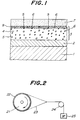
- Fig.1 shows the construction of coating layer formed on the roll substrate according to the present invention.
- the coating layers according to the present invention comprise the following three layer construction in view of component and coating method. That is, the coating layer comprises, viewing from uppermost layer, a chemical conversion coating formed by chemical densifying method, a sprayed and reinforced layer formed by spraying a material including non-metallic reinforcing particles, and a sprayed alloy layer obtained by spraying a metal alloy.
- the coating layers according to the present invention show the above three classified layers and comprise a hearth roll substrate (matrix) 1, a sprayed alloy layer 2 of heat resistant alloy matrix 4, carbide particles 5, oxide particles 6 and a chemical conversion coating 7 including Cr2O3 as a principal component.
- Reference numeral 8 shows a condition that component (Cr2O3) of the chemical conversion coating is impregnated or inserted into micropores at the surface portion of the reinforced layer 3, thereby obtaining high adherence thereto, since the insertion of Cr2O3 into the reinforced layer exhibits high anchor effect.
- each of the multi-layer coating according to the present invention may be selected as following range which exhibits suitable performance. Alloy spray-coating layer 10 ⁇ 300 ⁇ m Spray coatings Cermet spray-coating layer including of reinforced cermet spray-coating zone 30 ⁇ 300 ⁇ m Chemical conversion coating 0.5 ⁇ 20 ⁇ m Chemical conversion coating
- Cr2O3 100 ⁇ 70%
- Al2O3 0 ⁇ 30%.
- fine hexagonal cracks occur on the coating under utilizing circumstance.
- the heat resistant metal (alloy) of the sprayed alloy layer and the sprayed and reinforced layer have following compositions of components.
- This alloy includes Co, Ni, Cr, Al, Y as a principal component and is preferable to make five-component system alloy. If necessary, the alloy may also include at least one selected from a group consisting of Ta, Ti, W, Mo, Zr, Hf and Ce.
- the component has preferablly a range of Co: 5 ⁇ 70wt%, Ni: 10 ⁇ 50wt%, Cr: 10 ⁇ 50wt%, Al: 4 ⁇ 20wt% and Y: 0.01 ⁇ 3wt%. The reason why this range of composition is as follows.
- the component has preferablly a ratio of Ta: 1 ⁇ 15wt%, Ti: 1 ⁇ 15wt%, W: 1 ⁇ 15wt%, Mo: 1 ⁇ 15wt%, Zr: 1 ⁇ 15wt%, Ce: 1 ⁇ 10wt%, Hf: 1 ⁇ 10wt%.
- these components do not substantially limit the present invention.
- non-metallic reinforcing material mixed in the matrix alloy uses the following composition. That is, the following components par 100 parts by weight of the above heat resistant alloy may be preferably added.
- These oxides and carbides are included in the heat resistant alloy with the above composition, thereby improving heat resistance and loading resistance of the cermet spray-coated layer.
- these components have the amount of less than 1%, the above effect becomes very slight, while when these components have the amount of more than 30%, the sprayed coating is liable to be brittle.
- carbide In case of adding the reinforcing particles, if oxide particles is added carbide must be always coexistent. However, carbide may be independently added, thereby obtaining expected function (build-up of resistance), since the mechanical strength by the carbide under high temperature circumstance is larger than in the oxide. Therefore, it has excellent aggregate. Carbide is stably present under a reducible atmosphere and becomes not unstable in changing (carbide oxide) under an oxidizable atmosphere, so that the high temperature strength may fully be utilized.
- the kinds of oxide and carbide are not limited as long as they are operated under operating conditions of the hearth roll, since when the components are within a range of 1 ⁇ 30%, they exhibit sufficient performance as a coating.
- Fig.2 shows a test apparatus for evaluating the coatings obtained by the present invention.
- This apparatus comprises a sleeve 21 of stainless steel (AISI 304) and a coating 22 to be tested which is provided on the outer periphery of the sleeve 21.
- the apparatus further comprise a wheel of mild steel 23(JIS 41, ASTM A 441-79) which is wound on the coating 22 and a weight 25 secured to one end of the mild steel 23 through a supporting roll 24.
- the contacting pressure between the mild steel 23 and the sleeve 21 probided with the coating 22 may be controlled by changing the weight value of the weight 25 and the the slip speed may be changed by controlling the rotating speed of the sleeve 21.
- the sleeve portion is mounted in an electric furnace capable of controlling atmospheres, so that the build-up resistance may be tested in various atmospheres, such as air (oxidizable), a gas including H2 (reducible) and Ar, N2 gas (non-oxidizable).
- atmospheres such as air (oxidizable), a gas including H2 (reducible) and Ar, N2 gas (non-oxidizable).
- Table 1 shows experimental Results as to appearance of a coating after the test.
- the sprayed coatings according to the present invention exhibited excellent build-up resistance and adherence under all test atmospheres such as oxidizable, reducible and non-oxidizable atmospheres.
- the reason why the sprayed coatings according to the present invention showed excellent performance under not only reducible and non-oxidizable atmospheres but also oxidizable atmosphere is due to the presence of Cr2O3 deposits which are agglomerate of Cr2O3 fine powders separated and produced on the outermost layer by the chemical conversion treatment through chemical densifying method.
- This Cr2O3 deposit is impregnated into not only surface layer but also micropores of upper portion of the cermet spray-coated layer and fully sealed micropores, so that they fully prevented oxygen impregnated from outer atmosphere and thus carbide particles in the intermediate reinforced layer was present stably.
- test coating No.8 including only oxide into the heat resistant alloy as in the reinforced layer has poor build-up resistance.
- the sprayed coating including no carbide in the reinforced layer was subjected to a deformation, because of low mechanical strength of the reinforced layer as the test time becomes large and the contacting load to the coating becomes large, even if Cr2O3 coating layer was formed on the outermost layer, thereby causing the peeling of coating, and producing build-up under reducible and non-oxidizable atmospheres.
- the coating having no alloy layer was peeled off from the boundary of the sleeve 21 and the reinforced layer portion.
- Table 2 shows experimented Results of Example 2.
- the coatings according to the present invention were not subjected to effects for such test time, even in case of changing the atmosphere during test. However, the coating in comparative example exhibited build-up and the peeling.
- Example 1 the test was performed under the condition that Cr2O3 of the outermost player (chemical conversion coatings) was worn with friction. That is, the sleeve with the same coating as in Example 1 was formed and this sleeve was heated at 1000°C for 5 hours in the electric furnace and then only the outermost layer (corresponding to chemical conversion coating) was removed by a blasting process for the sleeve(test NO. 1 ⁇ 7 and 9 ⁇ 11). The thus obtained coatings were tested under same conditions as in Example 1.
- Example 3 shows the Experimental Results of Example 3.
- the coatings according to the present invention had excellent build-up resistance and adherence of sprayed coatings under reducible and non-oxidizable atmospheres. Under an oxidizable atmosphere, the build-up was slightly caused, but this is smaller than the comparative example. Since it is considered that the outermost layer was removed by the blasting process, but Cr2O3 remaining in the micropores of the reinforced layer exhibite a build-up resistance. On the contrary, the coatings in comparative example were fairly inferior in the build-up resistance and the peeling resistance.
Landscapes
- Chemical & Material Sciences (AREA)
- Engineering & Computer Science (AREA)
- Mechanical Engineering (AREA)
- Materials Engineering (AREA)
- Metallurgy (AREA)
- Organic Chemistry (AREA)
- Chemical Kinetics & Catalysis (AREA)
- Physics & Mathematics (AREA)
- Inorganic Chemistry (AREA)
- Plasma & Fusion (AREA)
- General Engineering & Computer Science (AREA)
- Thermal Sciences (AREA)
- Crystallography & Structural Chemistry (AREA)
- Coating By Spraying Or Casting (AREA)
- Other Surface Treatments For Metallic Materials (AREA)
- Heat Treatment Of Strip Materials And Filament Materials (AREA)
Priority Applications (2)
| Application Number | Priority Date | Filing Date | Title |
|---|---|---|---|
| DE69114118T DE69114118T2 (de) | 1991-02-18 | 1991-02-18 | Rolle zur Verwendung in einem Ofen zur Wärmebehandlung und Verfahren zu ihrer Herstellung. |
| DE199191102282T DE499656T1 (de) | 1991-02-18 | 1991-02-18 | Rolle zur verwendung in einem ofen zur waermebehandlung und verfahren zu ihrer herstellung. |
Applications Claiming Priority (1)
| Application Number | Priority Date | Filing Date | Title |
|---|---|---|---|
| JP1210670A JPH0819535B2 (ja) | 1989-08-17 | 1989-08-17 | 高温熱処理炉用ロールおよびその製造方法 |
Publications (2)
| Publication Number | Publication Date |
|---|---|
| EP0499656A1 true EP0499656A1 (fr) | 1992-08-26 |
| EP0499656B1 EP0499656B1 (fr) | 1995-10-25 |
Family
ID=16593170
Family Applications (1)
| Application Number | Title | Priority Date | Filing Date |
|---|---|---|---|
| EP91102282A Expired - Lifetime EP0499656B1 (fr) | 1989-08-17 | 1991-02-18 | Rouleau destiné à être utilisé dans un four de traitement thermique et méthode pour sa fabrication |
Country Status (4)
| Country | Link |
|---|---|
| US (1) | US5070587A (fr) |
| EP (1) | EP0499656B1 (fr) |
| JP (1) | JPH0819535B2 (fr) |
| KR (1) | KR960002788B1 (fr) |
Cited By (7)
| Publication number | Priority date | Publication date | Assignee | Title |
|---|---|---|---|---|
| EP0698672A1 (fr) * | 1994-08-26 | 1996-02-28 | Praxair S.T. Technology, Inc. | Rouleau de foyer à capacité de trempe supérieure |
| DE4436823C1 (de) * | 1994-10-14 | 1996-05-02 | Haldenwanger Tech Keramik Gmbh | Tragkörper aus SiC und dessen Verwendung |
| DE19625274A1 (de) * | 1996-06-25 | 1998-01-02 | Lwk Plasmakeramik Gmbh & Co Kg | Verstärkung von thermisch gespritzten Hochtemperatur-Keramikformteilen mit thermisch gespritzten Metallschichten |
| EP0894757A1 (fr) * | 1997-07-28 | 1999-02-03 | Eastman Kodak Company | Rouleau de transport résistant à l'usure |
| WO2006103127A1 (fr) | 2005-03-31 | 2006-10-05 | Siemens Aktiengesellschaft | Matrice et systeme de couches |
| EP2034034A4 (fr) * | 2006-06-21 | 2010-09-29 | Nippon Steel Corp | Rouleau d'alimentation et rideau de cheminée pour four de recuisson en continu |
| WO2016168083A1 (fr) * | 2015-04-15 | 2016-10-20 | Owens-Brockway Glass Container Inc. | Matériau composite capable de résister au contact avec du verre fondu et masses fondues de précurseurs de verre |
Families Citing this family (29)
| Publication number | Priority date | Publication date | Assignee | Title |
|---|---|---|---|---|
| US5223099A (en) * | 1988-11-15 | 1993-06-29 | Valmet Paper Machinery Inc. | External heating arrangement for a paper web ceramic coated roll in a paper machine |
| US5235747A (en) * | 1989-10-27 | 1993-08-17 | Valmet Paper Machinery Inc. | Method of manufacture of a roll for use in paper production |
| US5242363A (en) * | 1990-07-27 | 1993-09-07 | Praxair S.T. Technology, Inc. | Water cooled rolls for cooling steel sheets |
| US5397650A (en) * | 1991-08-08 | 1995-03-14 | Tocalo Co., Ltd. | Composite spray coating having improved resistance to hot-dip galvanization |
| DE4141250C2 (de) * | 1991-12-14 | 1993-10-14 | Loi Ind Ofenanlagen | Rolle für Rollenherdöfen und Verfahren zu ihrer Herstellung |
| CA2092235C (fr) * | 1992-03-30 | 2000-04-11 | Yoshio Harada | Tambour a revetement applique par pulverisation destine a la galvanisation en continu |
| US5472793A (en) * | 1992-07-29 | 1995-12-05 | Tocalo Co., Ltd. | Composite spray coating having improved resistance to hot-dip galvanization |
| US5702338A (en) * | 1993-03-24 | 1997-12-30 | Morando; Jorge A. | Heat treating, annealing and tunnel furnace rolls |
| US5355996A (en) * | 1993-08-02 | 1994-10-18 | Global Consulting, Inc. | Wear resistant ceramic fiber conveyor rolls |
| JP3312709B2 (ja) * | 1994-10-24 | 2002-08-12 | 新日本製鐵株式会社 | 連続溶融亜鉛メッキ用浸漬ロール |
| GB9607718D0 (en) * | 1996-04-13 | 1996-06-19 | Apv Uk Plc | Injection moulding processes especially metal imjection moulding processed |
| US5833455A (en) * | 1996-05-14 | 1998-11-10 | Bricmont, Inc. | Dry roll furnace arrangement |
| DE69809992T2 (de) | 1997-04-11 | 2003-07-24 | Metso Paper, Inc. | Walze für eine Papier- oder Kartonmaschine und Verfahren zur Herstellung der Walze |
| FI112266B (fi) * | 1997-04-11 | 2003-11-14 | Metso Paper Inc | Keraamipinnoitteinen puristintela vaikeisiin korroosio-olosuhteisiin, menetelmä telan valmistamiseksi ja pinnoitekoostumus |
| EP1026466A1 (fr) * | 1999-02-02 | 2000-08-09 | Plibrico G.m.b.H. | Corps tubulaire à refroidissement interne avec une enveloppe de béton réfractaire et procédé pour sa fabrication |
| EP1149931A4 (fr) * | 1999-11-09 | 2008-02-13 | Jfe Steel Corp | Poudre de cermet pour revetement pulverise presentant une excellente resistance de montage et rouleau dote de ce revetement pulverise |
| FR2821857B1 (fr) * | 2001-03-06 | 2004-07-30 | Usinor | Rouleau destine au transport d'une bande metallique dans une installation de recuit continu |
| KR100439411B1 (ko) * | 2001-09-28 | 2004-07-09 | 대신메탈라이징 주식회사 | 허스롤의 용사코팅방법 |
| CA2504831C (fr) * | 2005-04-21 | 2010-10-19 | Standard Aero Limited | Revetements composites en ceramique resistant a l'usure et methode de production connexe |
| EP1840245A1 (fr) * | 2006-03-27 | 2007-10-03 | Siemens Aktiengesellschaft | Matrice et système de revêtement ayant des particles non-stochiométriques |
| EP2213755B1 (fr) | 2007-11-28 | 2013-07-24 | Nippon Steel & Sumitomo Metal Corporation | Rouleau de four pour four à recuit continu et son procédé de fabrication |
| US20100144511A1 (en) * | 2008-07-21 | 2010-06-10 | Lehigh University | Microporous ceramics and methods of manufacture |
| KR101951809B1 (ko) * | 2014-05-28 | 2019-02-25 | 닛테츠스미킨하드 가부시키가이샤 | 열연공장 권취설비의 롤 |
| JP6376342B2 (ja) * | 2014-10-03 | 2018-08-22 | Jfeスチール株式会社 | ハースロール、連続焼鈍設備および連続焼鈍方法 |
| JP6453608B2 (ja) * | 2014-10-17 | 2019-01-16 | 新日鐵住金株式会社 | 連続焼鈍炉用ハースロール及びその製造方法 |
| CN108004498A (zh) * | 2017-12-29 | 2018-05-08 | 上海英佛曼纳米科技股份有限公司 | 一种具有抗高温结瘤抗氧化耐腐蚀耐磨损涂层的高温热轧钢炉辊 |
| JP7316923B2 (ja) * | 2019-12-23 | 2023-07-28 | 日本製鉄株式会社 | 連続焼鈍炉用ハースロール |
| JP7787554B2 (ja) * | 2021-11-12 | 2025-12-17 | 株式会社ディ・ビー・シー・システム研究所 | 溶融亜鉛処理機器およびその製造方法ならびに耐熱部材およびその製造方法 |
| CN120210712B (zh) * | 2025-03-26 | 2026-01-23 | 北矿新材科技有限公司 | 一种金属间化合物基热防护涂层材料及其制备方法 |
Citations (2)
| Publication number | Priority date | Publication date | Assignee | Title |
|---|---|---|---|---|
| DE3505827A1 (de) * | 1985-02-20 | 1986-10-02 | Gerhart 7000 Stuttgart Leuze | Walze oder rolle sowie verfahren zum herstellen einer solchen |
| EP0197374A1 (fr) * | 1985-04-03 | 1986-10-15 | Winfried Heinzel | Rouleau et gaine de rouleau d'impression et leur procédé de fabrication |
Family Cites Families (11)
| Publication number | Priority date | Publication date | Assignee | Title |
|---|---|---|---|---|
| JPS5634632A (en) * | 1979-08-30 | 1981-04-06 | Teijin Ltd | S-sulfonated immunoglobulin composition |
| DE3046757C2 (de) * | 1980-12-12 | 1985-09-12 | W.C. Heraeus Gmbh, 6450 Hanau | Tiefdruckzylinder |
| US4470802A (en) * | 1982-03-31 | 1984-09-11 | Nippon Steel Corporation | Highly buildup-resistant hearth roll for conveying a steel strip through a continuous annealing furnace and a method therefor |
| JPS5970712A (ja) * | 1982-10-13 | 1984-04-21 | Nippon Steel Corp | 耐摩耗性と耐ビルドアツプ性の優れた連続焼鈍炉のハ−スロ−ル |
| JPS6029413A (ja) * | 1983-07-29 | 1985-02-14 | Nippon Steel Corp | 熱処理炉用ハ−スロ−ル |
| JPS6099408A (ja) * | 1983-11-04 | 1985-06-03 | Nippon Steel Corp | 高クロム鋳鉄圧延ロ−ル |
| JPS6123755A (ja) * | 1984-07-13 | 1986-02-01 | Nippon Steel Corp | 熱処理炉用ロ−ル |
| JPH0724753B2 (ja) * | 1986-07-24 | 1995-03-22 | 石川島播磨重工業株式会社 | 高圧発生装置 |
| JPS6347379A (ja) * | 1986-08-15 | 1988-02-29 | Nippon Steel Corp | 熱処理炉用炉内ロ−ル及びその製造方法 |
| JPS6353249A (ja) * | 1986-08-22 | 1988-03-07 | Kawasaki Steel Corp | 熱処理炉用ロ−ラ |
| EP0266509B1 (fr) * | 1986-09-05 | 1991-01-09 | Kawasaki Steel Corporation | Installation pour le traitement thermique en continu d'une bande métallique et rouleau de sole pour cela |
-
1989
- 1989-08-17 JP JP1210670A patent/JPH0819535B2/ja not_active Expired - Lifetime
-
1990
- 1990-08-09 US US07/566,168 patent/US5070587A/en not_active Expired - Lifetime
- 1990-08-17 KR KR1019900012705A patent/KR960002788B1/ko not_active Expired - Lifetime
-
1991
- 1991-02-18 EP EP91102282A patent/EP0499656B1/fr not_active Expired - Lifetime
Patent Citations (3)
| Publication number | Priority date | Publication date | Assignee | Title |
|---|---|---|---|---|
| DE3505827A1 (de) * | 1985-02-20 | 1986-10-02 | Gerhart 7000 Stuttgart Leuze | Walze oder rolle sowie verfahren zum herstellen einer solchen |
| EP0197374A1 (fr) * | 1985-04-03 | 1986-10-15 | Winfried Heinzel | Rouleau et gaine de rouleau d'impression et leur procédé de fabrication |
| EP0199084A1 (fr) * | 1985-04-03 | 1986-10-29 | Winfried Heinzel | Rouleau et gaine de rouleau d'impression et leur procédé de fabrication |
Non-Patent Citations (4)
| Title |
|---|
| * abstract * * |
| PATENT ABSTRACTS OF JAPAN vol. 10, no. 194 (C-358)(2250) 8 July 1986 & JP-A-61 037 955 ( OSAKA FUJI KOGYO K.K. ) 22 February 1986 * |
| PATENT ABSTRACTS OF JAPAN vol. 8, no. 172 (C-237)(1609) 9 August 1984 & JP-A-59 070 712 ( SHIN NIPPON SEITETSU K.K. ) * |
| WPIL/DERWENT, AN=91-137423, & JP-A-3075383 (TOCALOY K.K.), 29-03-91 * |
Cited By (12)
| Publication number | Priority date | Publication date | Assignee | Title |
|---|---|---|---|---|
| CN1062316C (zh) * | 1994-08-25 | 2001-02-21 | 普拉塞尔·S·T·技术有限公司 | 表面具有陶瓷热喷涂覆层的炉辊 |
| EP0698672A1 (fr) * | 1994-08-26 | 1996-02-28 | Praxair S.T. Technology, Inc. | Rouleau de foyer à capacité de trempe supérieure |
| DE4436823C1 (de) * | 1994-10-14 | 1996-05-02 | Haldenwanger Tech Keramik Gmbh | Tragkörper aus SiC und dessen Verwendung |
| DE19625274A1 (de) * | 1996-06-25 | 1998-01-02 | Lwk Plasmakeramik Gmbh & Co Kg | Verstärkung von thermisch gespritzten Hochtemperatur-Keramikformteilen mit thermisch gespritzten Metallschichten |
| EP0894757A1 (fr) * | 1997-07-28 | 1999-02-03 | Eastman Kodak Company | Rouleau de transport résistant à l'usure |
| US5924967A (en) * | 1997-07-28 | 1999-07-20 | Eastman Kodak Company | Wear resistant transport roller |
| WO2006103127A1 (fr) | 2005-03-31 | 2006-10-05 | Siemens Aktiengesellschaft | Matrice et systeme de couches |
| RU2395624C2 (ru) * | 2005-03-31 | 2010-07-27 | Сименс Акциенгезелльшафт | Материал и система слоев |
| EP2034034A4 (fr) * | 2006-06-21 | 2010-09-29 | Nippon Steel Corp | Rouleau d'alimentation et rideau de cheminée pour four de recuisson en continu |
| US8328705B2 (en) | 2006-06-21 | 2012-12-11 | Nippon Steel Corporation | Conveying roll, and hearth roll in a continuous annealing furnace |
| WO2016168083A1 (fr) * | 2015-04-15 | 2016-10-20 | Owens-Brockway Glass Container Inc. | Matériau composite capable de résister au contact avec du verre fondu et masses fondues de précurseurs de verre |
| US9856163B2 (en) | 2015-04-15 | 2018-01-02 | Owens-Brockway Glass Container Inc. | Nanocomposite material |
Also Published As
| Publication number | Publication date |
|---|---|
| US5070587A (en) | 1991-12-10 |
| EP0499656B1 (fr) | 1995-10-25 |
| JPH0375383A (ja) | 1991-03-29 |
| JPH0819535B2 (ja) | 1996-02-28 |
| KR960002788B1 (ko) | 1996-02-26 |
| KR910004821A (ko) | 1991-03-29 |
Similar Documents
| Publication | Publication Date | Title |
|---|---|---|
| EP0499656B1 (fr) | Rouleau destiné à être utilisé dans un four de traitement thermique et méthode pour sa fabrication | |
| US5161306A (en) | Roll for use in heat treating furnace and method of producing the same | |
| JP2824189B2 (ja) | 耐火性酸化物被覆形成用粉末供給組成物、使用方法及び製品 | |
| US4447501A (en) | Ceramic based composite material for flame spraying | |
| US5952102A (en) | Diamond coated WC and WC-based composites with high apparent toughness | |
| Yang et al. | Development of nickel aluminide matrix composites | |
| EP0138228B1 (fr) | Revêtement résistant à l'usure et procédé de sa fabrication | |
| US6723387B1 (en) | Multimodal structured hardcoatings made from micro-nanocomposite materials | |
| US7198858B2 (en) | Method of vibration damping in metallic articles | |
| JP2002309364A (ja) | 低温溶射皮膜被覆部材およびその製造方法 | |
| US4562090A (en) | Method for improving the density, strength and bonding of coatings | |
| JP2988281B2 (ja) | 溶射用セラミックス・金属複合粉末及び溶射被膜の形成方法 | |
| JPH0645863B2 (ja) | 高温耐摩耗・耐ビルドアップ性に優れた溶射材料およびその被覆物品 | |
| JP3522590B2 (ja) | 高硬度炭化物サーメット溶射皮膜被覆部材およびその製造方法 | |
| EP0748879B1 (fr) | Procédé pour la production d'un revêtement à base de TiB2 et articles revêtus ainsi obtenus | |
| JPS6033187B2 (ja) | 表面硬化処理方法 | |
| Dallaire et al. | The influence of composition and process parameters on the microstructure of TiC-Fe multiphase and multilayer coatings | |
| JPH10195547A (ja) | 耐摩耗性、耐ビルドアップ性に優れたハースロールおよびその製造方法 | |
| JP3403459B2 (ja) | セラミック溶射皮膜を備えた炭素製部材 | |
| JPH0733567A (ja) | 非酸化物系セラミック溶射皮膜を有する炭素材料およびその製造方法 | |
| US20130260172A1 (en) | Coated titanium alloy surfaces | |
| Martins et al. | Wear resistant high speed steel matrix composites | |
| WO1997019201A1 (fr) | Procede d'obtention d'articles composites de metal-ceramique de formes complexes | |
| JP2003105426A (ja) | 冶金用水冷ランスおよびその製造方法 | |
| JP2592628B2 (ja) | 耐ビルドアップ性にすぐれた溶射皮膜の形成方法 |
Legal Events
| Date | Code | Title | Description |
|---|---|---|---|
| PUAI | Public reference made under article 153(3) epc to a published international application that has entered the european phase |
Free format text: ORIGINAL CODE: 0009012 |
|
| 17P | Request for examination filed |
Effective date: 19910218 |
|
| AK | Designated contracting states |
Kind code of ref document: A1 Designated state(s): DE FR GB IT |
|
| ITCL | It: translation for ep claims filed |
Representative=s name: PROPRIA PROTEZIONE PROPRIETA' IND. |
|
| EL | Fr: translation of claims filed | ||
| DET | De: translation of patent claims | ||
| 17Q | First examination report despatched |
Effective date: 19940119 |
|
| GRAA | (expected) grant |
Free format text: ORIGINAL CODE: 0009210 |
|
| AK | Designated contracting states |
Kind code of ref document: B1 Designated state(s): DE FR GB IT |
|
| REF | Corresponds to: |
Ref document number: 69114118 Country of ref document: DE Date of ref document: 19951130 |
|
| ITF | It: translation for a ep patent filed | ||
| ET | Fr: translation filed | ||
| PLBE | No opposition filed within time limit |
Free format text: ORIGINAL CODE: 0009261 |
|
| STAA | Information on the status of an ep patent application or granted ep patent |
Free format text: STATUS: NO OPPOSITION FILED WITHIN TIME LIMIT |
|
| 26N | No opposition filed | ||
| REG | Reference to a national code |
Ref country code: GB Ref legal event code: IF02 |
|
| PGFP | Annual fee paid to national office [announced via postgrant information from national office to epo] |
Ref country code: IT Payment date: 20100219 Year of fee payment: 20 Ref country code: FR Payment date: 20100225 Year of fee payment: 20 |
|
| PGFP | Annual fee paid to national office [announced via postgrant information from national office to epo] |
Ref country code: GB Payment date: 20100217 Year of fee payment: 20 |
|
| PGFP | Annual fee paid to national office [announced via postgrant information from national office to epo] |
Ref country code: DE Payment date: 20100330 Year of fee payment: 20 |
|
| REG | Reference to a national code |
Ref country code: DE Ref legal event code: R071 Ref document number: 69114118 Country of ref document: DE |
|
| REG | Reference to a national code |
Ref country code: GB Ref legal event code: PE20 Expiry date: 20110217 |
|
| PG25 | Lapsed in a contracting state [announced via postgrant information from national office to epo] |
Ref country code: GB Free format text: LAPSE BECAUSE OF EXPIRATION OF PROTECTION Effective date: 20110217 |
|
| PG25 | Lapsed in a contracting state [announced via postgrant information from national office to epo] |
Ref country code: DE Free format text: LAPSE BECAUSE OF EXPIRATION OF PROTECTION Effective date: 20110218 |