EP0501313A1 - Installation de combustion et procédé pour sa régulation - Google Patents
Installation de combustion et procédé pour sa régulation Download PDFInfo
- Publication number
- EP0501313A1 EP0501313A1 EP92102875A EP92102875A EP0501313A1 EP 0501313 A1 EP0501313 A1 EP 0501313A1 EP 92102875 A EP92102875 A EP 92102875A EP 92102875 A EP92102875 A EP 92102875A EP 0501313 A1 EP0501313 A1 EP 0501313A1
- Authority
- EP
- European Patent Office
- Prior art keywords
- fuel
- burner
- controlling
- change
- supplied
- Prior art date
- Legal status (The legal status is an assumption and is not a legal conclusion. Google has not performed a legal analysis and makes no representation as to the accuracy of the status listed.)
- Granted
Links
- 238000002485 combustion reaction Methods 0.000 title claims abstract description 112
- 238000000034 method Methods 0.000 title claims abstract description 20
- 239000000446 fuel Substances 0.000 claims abstract description 117
- 230000008859 change Effects 0.000 claims abstract description 51
- 238000009792 diffusion process Methods 0.000 claims abstract description 43
- 230000000694 effects Effects 0.000 claims abstract description 13
- 230000001276 controlling effect Effects 0.000 claims description 37
- 230000001105 regulatory effect Effects 0.000 claims description 9
- 239000000203 mixture Substances 0.000 claims description 3
- 230000004044 response Effects 0.000 claims description 2
- 238000012544 monitoring process Methods 0.000 claims 8
- 230000001502 supplementing effect Effects 0.000 claims 8
- 239000013589 supplement Substances 0.000 claims 3
- 238000001514 detection method Methods 0.000 claims 2
- 238000012806 monitoring device Methods 0.000 claims 2
- 230000011664 signaling Effects 0.000 claims 1
- 239000007789 gas Substances 0.000 description 16
- 239000003949 liquefied natural gas Substances 0.000 description 9
- 230000003247 decreasing effect Effects 0.000 description 7
- 238000010586 diagram Methods 0.000 description 4
- 230000009467 reduction Effects 0.000 description 4
- VNWKTOKETHGBQD-UHFFFAOYSA-N methane Chemical compound C VNWKTOKETHGBQD-UHFFFAOYSA-N 0.000 description 2
- 238000009835 boiling Methods 0.000 description 1
- 238000010276 construction Methods 0.000 description 1
- 238000010790 dilution Methods 0.000 description 1
- 239000012895 dilution Substances 0.000 description 1
- 238000010304 firing Methods 0.000 description 1
- 238000010248 power generation Methods 0.000 description 1
- 230000035945 sensitivity Effects 0.000 description 1
- 230000006641 stabilisation Effects 0.000 description 1
- 238000011105 stabilization Methods 0.000 description 1
- 238000011144 upstream manufacturing Methods 0.000 description 1
Images


Classifications
-
- F—MECHANICAL ENGINEERING; LIGHTING; HEATING; WEAPONS; BLASTING
- F02—COMBUSTION ENGINES; HOT-GAS OR COMBUSTION-PRODUCT ENGINE PLANTS
- F02C—GAS-TURBINE PLANTS; AIR INTAKES FOR JET-PROPULSION PLANTS; CONTROLLING FUEL SUPPLY IN AIR-BREATHING JET-PROPULSION PLANTS
- F02C9/00—Controlling gas-turbine plants; Controlling fuel supply in air- breathing jet-propulsion plants
- F02C9/26—Control of fuel supply
- F02C9/40—Control of fuel supply specially adapted to the use of a special fuel or a plurality of fuels
-
- F—MECHANICAL ENGINEERING; LIGHTING; HEATING; WEAPONS; BLASTING
- F23—COMBUSTION APPARATUS; COMBUSTION PROCESSES
- F23R—GENERATING COMBUSTION PRODUCTS OF HIGH PRESSURE OR HIGH VELOCITY, e.g. GAS-TURBINE COMBUSTION CHAMBERS
- F23R3/00—Continuous combustion chambers using liquid or gaseous fuel
- F23R3/02—Continuous combustion chambers using liquid or gaseous fuel characterised by the air-flow or gas-flow configuration
- F23R3/26—Controlling the air flow
-
- F—MECHANICAL ENGINEERING; LIGHTING; HEATING; WEAPONS; BLASTING
- F23—COMBUSTION APPARATUS; COMBUSTION PROCESSES
- F23R—GENERATING COMBUSTION PRODUCTS OF HIGH PRESSURE OR HIGH VELOCITY, e.g. GAS-TURBINE COMBUSTION CHAMBERS
- F23R2900/00—Special features of, or arrangements for continuous combustion chambers; Combustion processes therefor
- F23R2900/00002—Gas turbine combustors adapted for fuels having low heating value [LHV]
Definitions
- This invention relates to improvements in combustion apparatus and controlling method therefore, and particularly it relates to a combustion apparatus suitable for application to a gas turbine and comprising a premix burner and a diffusion burner.
- the burners have been combined in two stages for the purpose of obtaining a combustion apparatus capable of effecting a low NOx and stable combustion due to the diffusion combustion which achieves a high combustion stability and the premix combustion which achieves a high reduction of NOx concentration although the stable combustion range therein is narrow.
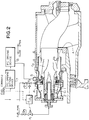
- This type of two-stage combustion apparatus comprises an antechamber (diffusion combustion chamber) l, F1 nozzles 2 for diffusion combustion, a main chamber (premix combustion chamber) 3, F2 nozzles 4 for premix combustion, and a combustion air supply section.
- a combustion air supply section Particularly, in order to control the flow rate of premixed air A2 through the F2 nozzles 4 the stable combustion range of which is narrow, an internal flow rate control (referred to as IFC, hereinafter) 5 is provided in this combustion air supply section.
- IFC internal flow rate control
- the fuel-air ratio (the ratio of fuel amount to air amount) be controlled to be kept at a constant value by changing the air flow rate in response to the fuel flow rate determined beforehand for the operation of the gas turbine as disclosed in Japanese Patent unexamined Publication No. 60-66020 as well. Namely, the fuel flow rate is changed in accordance with the change of load and the distribution of air in the burners is also changed in accordance with the change of this fuel flow rate so as to set the fuel-to-air ratio at the predetermined value, thereby realizing the stabilization of the combustion and the reduction of the NOx.
- Figure 3 shows the relationship between the fuel-air ratio and the NOx, in which the abscissa represents the fuel-air ratio and the ordinate represents the NOx relative value and which illustrates the difference between the diffusion combustion and the premix combustion.
- the theoretical fuel-air ratio of methane is 0.058, and gas turbine burners are usually used at fuel-air ratios smaller than 0.058.
- the diffusion combustion which is stable over the wide operation range is utilized from the start-up to the low-load operation of the gas turbine, and the premix combustion and the diffusion combustion are utilized simultaneously from the low-load operation to the rated-load operation, so as to reduce the NOx.
- the fuel-air ratio is set to be in the operation range by controlling the flow rate of air A2 by the IFC 5 of Figure 2.
- Total combustion air A of Figure 2 is divided into a flow rate of air A1 flowing through the antechamber 1, a flow rate of air A2 flowing through the main chamber 3 and a flow rate of air A3 flowing into through dilution holes 6.
- BOG gas blow-off gas
- the calorie of the BOG gas is lower than that of the LNG due to the difference in boiling points of the fuel components. If the BOG gas is not discharged to the outside periodically, the internal pressure of an LNG tank is increased to bring about damage. To cope with this, the BOG gas is treated as being mixed with the LNG in the existing circumstances. This results in a sudden change of the calorific value (calorie) in the LNG power plant. It is therefore difficult to realize the stable combustion and the reduction of the NOx by controlling the fuel flow alone in the conventional manner.
- An object of the present invention is to solve the above-described problems, and further, to provide a combustion apparatus capable of dealing with various kinds of fuel.
- the abscissa represents the fuel command signal correspondingly to the load ranging from the no load to the rated load and the ordinate represents the flow rate of fuel through the F1 and F2 nozzles 2 and 4 and the opening of the IFC 5.
- the flow rate of fuel is small and a lean combustion is effected, so that the diffusion combustion is utilized only due to the F1 nozzles 2.
- the IFC 5 is fully opened to reduce the air in the antechamber 1 so that the fuel-air ratio is increased to realize the stable combustion.
- the opening of the IFC 5 is increased, as the load is increased to the rated load in due order through A ⁇ B ⁇ C, so that the flow rate of air A2 through the main chamber 3 is increased and, at the same time, the fuel supplied from the F2 nozzles 4 is increased, thereby setting the fuel-air ratio to be in the operation range shown in Figure 3 so as to reduce the NOx.
- the fuel command signal is sent to an IFC opening setting device 7 so as to operate an IFC driving device 8 as shown in Figure 2.
- the composition or calorific value of the fuel is measured before it is supplied to the burners and the air distribution is changed so as to minimize the NOx in the premix combustion zone within the stable range, and the change of the load attributable to the change of the calorific value is controlled by the supply of the fuel to the diffusion combustion zone.
- the amount of air bypassed is so set as to minimize the NOx in the premix combustion zone in accordance with the change of the calorific value, the change of the load attributable to the change of the calorific value is controlled by the supply of the fuel to the diffusion combustion zone.
- the calorific value of the fuel is measured by a means or device for measuring the calorific value before the fuel flows into gas turbine burners. Further, a means or device for regulating the air flow rate distribution of the burners operates to change the distribution of air in accordance with the change of the flow rate of the design fuel so as to keep the fuel-air ratio at the design value. It is noted that the fuel is designed to be used in several conditions classified taking the calorific value as the parameter so as to control the flow rate of air to be changed in accordance with the measured calorific value while keeping the flow rate of the fuel constant.
- the same amount of the fuel as that supplied before the calorific value is changed is supplied to the premix combustion zone and the flow of the fuel supplied to the diffusion combustion zone is changed so as to increase/decrease the fuel used to correct the change of the load.
- the calorific value is decreased the amount of the fuel supplied is increased, and when the calorific value is increased the amount of the fuel supplied is decreased, thereby keeping the load constant.
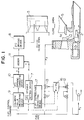
- fuel is sampled on the upstream side of an F1 fuel control valve 12 and an F2 fuel control valve 13 and its calorific value is measured by a calorific value measuring device 9.
- Deviation from the design value is sent from the measuring device 9 to an IFC opening correcting device 10.
- a signal from the IFC opening correcting device 10 and a signal issued from an IFC opening setting device 7 based on the fuel control command are added by an adder 11 in which the fuel signal is corrected for the calorific value.
- an IFC driving device 8 is operated to open/close an IFC 5 so as to set the ratio of air A2 to the fuel through F2 fuel nozzles 2 at a target value.
- the signal from the calorific value measuring device 9 is also sent to a fuel distribution correcting device 17 so that the flow of fuel used for correcting increase/decrease of the output attributable to the change of the calorific value is so controlled as to be distributed only to the F1 nozzles 2 for the diffusion combustion, while the flow rate of the fuel F2 makes no contribution to the correction for the power.
- Figure 5 shows the relationship between the calorific value and the concentration of the NOx taking the IFC opening as a parameter, in which the abscissa represents the calorific value of the fuel and the ordinate represents the concentration of the NOx.
- the calorific value is changed at the design point during the operation, if only the flow rate of the fuel is controlled as conventionally done, the calorific value reaches the premix flame blowout limit when it is not greater than the minimum value because the IFC opening is not changed, resulting in a flame-out.
- the calorific value is increased, the NOx content is increased.
- the calorific value is further increased to reach the maximum, it exceeds the premix flame backfire limit so as to cause a backfire, resulting in the possibility of the burnout of the F2 nozzle 2.
- the IFC opening is shifted from the design IFC opening to the smaller side until it is set at A, thereby preventing the blowout.
- the calorific value is increased, the IFC opening is shifted to the larger side until it is set at B, thereby keeping the NOx content low as well as preventing the backfire.
- the abscissa represents the fuel command signal and the ordinate represents the IFC opening.
- the IFC opening is increased/decreased based on the measured value of the change of the calorific value.
- the IFC opening is controlled to be in the range of +K A to -K A as shown at A on the abscissa of Figure 6.
- the amount of correction for the flow of air required becomes larger even for the same change of the calorific value, and therefore, the amount of correction is increased as being in the range of +K B to -K B at B on the abscissa and in the range of +K C to -K C at C on the abscissa.
- Figure 10 shows the relationship between the power and the flow rate of fuel taking the calorific value as a parameter, in which the abscissa represents the power and the ordinate represents the flow rates of fuels F1 and F2.
- the fuel increased to control the change of the power attributable to the change of the calorific value is used for the stable F1 diffusion combustion alone, while for the F2 premix combustion, only the flow rate of air is changed at once when the calorific value is changed, thereby setting the fuel-air ratio properly at which the stable and low NOx combustion can be effected.
- Figure 9 shows the effect of this controlling method, in which the abscissa represents the fuel-air ratio and the ordinate represents the NOx relative value.
- the IFC 5 of Figure 1 is changed to the close position so as to reduce the flow of air A2 and increase the flow of air A1.
- the F2 premix combustion is shifted to the point E at which the stable and low NOx combustion can be effected.
- the F1 diffusion combustion is shifted, in correspondence to the increase of the air A1, from the point D to the point E which is nearer to the unstable range, and however, there arises no problem because the range of the stable fuel-air ratios is wider as compared with the F2 premix combustion.
- the amount of the fuel corresponding to the shortage required for keeping the power constant is appropriated for the F1 diffusion combustion zone, it is shifted from the point E to the point E' at which a more stable combustion can be effected.
- the abscissa represents the calorific value signal and the ordinate represents the IFC opening correction amount.
- the range of the fuel command signal is taken as parameter that is so set as being 1 between the points A and B, 2 between the points B and C and 3 between the point C and the point of the rated load, as shown in Figure 6, while giving consideration to the increase of the sensitivity in the amount of correction for the flow rate of air attributable to the increase of the flow rate of the fuel.
- FIG 8 is a control block diagram of the present invention.
- the IFC opening setting device 7 is the conventional setting device of Figure 4 and the IFC opening correcting device 10 is the one shown in Figure 7.
- the signal is sent to the adder 11 through a rate limit 14 provided additionally.
- the signal is passed through a limiter 15 before it serves as the IFC control signal so as to protect the issue of such command that is beyond the IFC full open position.
- the present invention it is possible to prevent the blowout and backfire of the premix flame, increase of the NOx concentration and the like which are caused due to the change of the calorific value of the fuel, and it is also possible to improve the reliability on the treatment of BOG gas in the LNG firing combined cycle power plant.
Landscapes
- Engineering & Computer Science (AREA)
- Chemical & Material Sciences (AREA)
- Combustion & Propulsion (AREA)
- Mechanical Engineering (AREA)
- General Engineering & Computer Science (AREA)
Applications Claiming Priority (2)
| Application Number | Priority Date | Filing Date | Title |
|---|---|---|---|
| JP30655/91 | 1991-02-26 | ||
| JP3030655A JP2961913B2 (ja) | 1991-02-26 | 1991-02-26 | 燃焼装置及びその制御方法 |
Publications (2)
| Publication Number | Publication Date |
|---|---|
| EP0501313A1 true EP0501313A1 (fr) | 1992-09-02 |
| EP0501313B1 EP0501313B1 (fr) | 1997-01-29 |
Family
ID=12309794
Family Applications (1)
| Application Number | Title | Priority Date | Filing Date |
|---|---|---|---|
| EP92102875A Expired - Lifetime EP0501313B1 (fr) | 1991-02-26 | 1992-02-20 | Installation de combustion et procédé pour sa régulation |
Country Status (4)
| Country | Link |
|---|---|
| US (1) | US5281129A (fr) |
| EP (1) | EP0501313B1 (fr) |
| JP (1) | JP2961913B2 (fr) |
| DE (1) | DE69217093T2 (fr) |
Cited By (8)
| Publication number | Priority date | Publication date | Assignee | Title |
|---|---|---|---|---|
| WO1996000364A1 (fr) * | 1994-06-24 | 1996-01-04 | United Technologies Corporation | Injecteur pilote pour moteurs a turbine a gaz |
| EP0915242A3 (fr) * | 1997-11-04 | 2001-02-21 | Hitachi, Ltd. | Turbine à gaz |
| EP1524423A1 (fr) * | 2003-10-13 | 2005-04-20 | Siemens Aktiengesellschaft | Procédé et dispositif pour niveler la fluctuation de la composition du carburant dans une turbine à gaz |
| EP1174606A3 (fr) * | 2000-07-21 | 2006-04-19 | Mitsubishi Heavy Industries, Ltd. | Méthode de régulation pour une turbine à gaz |
| WO2008092252A1 (fr) * | 2007-01-30 | 2008-08-07 | Pratt & Whitney Canada Corp. | Système de commande de carburant de turbine à gaz |
| RU2482393C2 (ru) * | 2007-05-23 | 2013-05-20 | Нуово Пиньоне С.п.А. | Способ и устройство для управления сгоранием в газовой турбине |
| EP1703102A3 (fr) * | 2005-02-23 | 2015-02-18 | Kabushiki Kaisha Toshiba | Centrale électrique à gaz naturel liquéfié et procédé pour son exploitation |
| EP1788309A3 (fr) * | 2005-11-22 | 2015-06-03 | General Electric Company | Procédés et appareil de fonctionnement de systèmes de turbine à gaz |
Families Citing this family (10)
| Publication number | Priority date | Publication date | Assignee | Title |
|---|---|---|---|---|
| US5987875A (en) * | 1997-07-14 | 1999-11-23 | Siemens Westinghouse Power Corporation | Pilot nozzle steam injection for reduced NOx emissions, and method |
| WO2000014451A1 (fr) * | 1998-09-10 | 2000-03-16 | Siemens Aktiengesellschaft | Procede pour faire fonctionner un bruleur, et ensemble bruleur correspondant |
| US6250063B1 (en) * | 1999-08-19 | 2001-06-26 | General Electric Co. | Fuel staging apparatus and methods for gas turbine nozzles |
| JP4495971B2 (ja) * | 2002-01-25 | 2010-07-07 | アルストム テクノロジー リミテッド | ガスタービン群を運転するための方法 |
| JP4563242B2 (ja) * | 2005-04-19 | 2010-10-13 | 三菱重工業株式会社 | 燃料ガスカロリ制御方法及び装置 |
| JP4745940B2 (ja) * | 2006-11-09 | 2011-08-10 | 三菱重工業株式会社 | 石炭ガス化複合発電システム及びその運転制御方法 |
| US8151740B2 (en) * | 2009-06-02 | 2012-04-10 | General Electric Company | System and method for controlling the calorie content of a fuel |
| JP5159741B2 (ja) * | 2009-09-30 | 2013-03-13 | 株式会社日立製作所 | ガスタービン燃焼器の制御装置およびガスタービン燃焼器の制御方法 |
| JP6190670B2 (ja) * | 2013-08-30 | 2017-08-30 | 三菱日立パワーシステムズ株式会社 | ガスタービン燃焼システム |
| US10281140B2 (en) | 2014-07-15 | 2019-05-07 | Chevron U.S.A. Inc. | Low NOx combustion method and apparatus |
Citations (4)
| Publication number | Priority date | Publication date | Assignee | Title |
|---|---|---|---|---|
| US3766734A (en) * | 1972-03-01 | 1973-10-23 | Gen Electric | Dual fuel control system for a gas turbine |
| EP0055852A1 (fr) * | 1980-12-27 | 1982-07-14 | Hitachi, Ltd. | Méthode et dispositif de contrôle de la combustion d'un carburant gazifié |
| EP0222173A1 (fr) * | 1985-10-11 | 1987-05-20 | Hitachi, Ltd. | Chambre de combustion pour turbine à gaz |
| WO1988008075A1 (fr) * | 1987-04-09 | 1988-10-20 | Solar Turbines Incorporated | Systeme de combustion de combustibles gazeux ayant une large plage de valeurs calorifiques pour moteurs a turbine a gaz |
Family Cites Families (10)
| Publication number | Priority date | Publication date | Assignee | Title |
|---|---|---|---|---|
| US4111637A (en) * | 1977-03-10 | 1978-09-05 | Phillips Petroleum Company | Control system for plurality of gas supplies |
| US4369026A (en) * | 1980-02-21 | 1983-01-18 | Phillips Petroleum Company | Control of the fuel/oxygen ratio for a combustion process |
| IT1131905B (it) * | 1980-07-04 | 1986-06-25 | Snam Spa | Metodo per regolare la portata termica di un impianto alimentato a gas naturale a potere calorifico e densita' variabili ed apparecchiatura adatta allo scopo |
| US4815965A (en) * | 1983-05-12 | 1989-03-28 | Applied Automation, Inc. | Monitoring and control of a furnace |
| JPS6066020A (ja) * | 1983-09-21 | 1985-04-16 | Hitachi Ltd | ガスタービン燃焼器 |
| DE3408397A1 (de) * | 1984-03-08 | 1985-09-19 | Ruhrgas Ag, 4300 Essen | Verfahren und anordnung zur bestimmung des mischungsverhaeltnisses eines ein sauerstofftraegergas und einen brennstoff enthaltenden gemisches |
| JPS6140432A (ja) * | 1984-08-01 | 1986-02-26 | Hitachi Ltd | ガスタ−ビン燃料制御装置 |
| JPS63194111A (ja) * | 1987-02-06 | 1988-08-11 | Hitachi Ltd | ガス燃料の燃焼方法及び装置 |
| JPH0674892B2 (ja) * | 1987-06-10 | 1994-09-21 | 株式会社日立製作所 | 多段燃焼器の燃焼制御方法及びその装置 |
| JPH0653023B2 (ja) * | 1987-08-12 | 1994-07-20 | 株式会社クボタ | 脱穀機の二番還元装置 |
-
1991
- 1991-02-26 JP JP3030655A patent/JP2961913B2/ja not_active Expired - Lifetime
-
1992
- 1992-02-20 EP EP92102875A patent/EP0501313B1/fr not_active Expired - Lifetime
- 1992-02-20 DE DE69217093T patent/DE69217093T2/de not_active Expired - Lifetime
- 1992-02-25 US US07/840,813 patent/US5281129A/en not_active Expired - Lifetime
Patent Citations (4)
| Publication number | Priority date | Publication date | Assignee | Title |
|---|---|---|---|---|
| US3766734A (en) * | 1972-03-01 | 1973-10-23 | Gen Electric | Dual fuel control system for a gas turbine |
| EP0055852A1 (fr) * | 1980-12-27 | 1982-07-14 | Hitachi, Ltd. | Méthode et dispositif de contrôle de la combustion d'un carburant gazifié |
| EP0222173A1 (fr) * | 1985-10-11 | 1987-05-20 | Hitachi, Ltd. | Chambre de combustion pour turbine à gaz |
| WO1988008075A1 (fr) * | 1987-04-09 | 1988-10-20 | Solar Turbines Incorporated | Systeme de combustion de combustibles gazeux ayant une large plage de valeurs calorifiques pour moteurs a turbine a gaz |
Cited By (14)
| Publication number | Priority date | Publication date | Assignee | Title |
|---|---|---|---|---|
| US5755090A (en) * | 1994-06-24 | 1998-05-26 | United Technologies Corporation | Pilot injector for gas turbine engines |
| WO1996000364A1 (fr) * | 1994-06-24 | 1996-01-04 | United Technologies Corporation | Injecteur pilote pour moteurs a turbine a gaz |
| EP0915242A3 (fr) * | 1997-11-04 | 2001-02-21 | Hitachi, Ltd. | Turbine à gaz |
| EP1174606A3 (fr) * | 2000-07-21 | 2006-04-19 | Mitsubishi Heavy Industries, Ltd. | Méthode de régulation pour une turbine à gaz |
| EP1524423A1 (fr) * | 2003-10-13 | 2005-04-20 | Siemens Aktiengesellschaft | Procédé et dispositif pour niveler la fluctuation de la composition du carburant dans une turbine à gaz |
| WO2005038214A1 (fr) * | 2003-10-13 | 2005-04-28 | Siemens Aktiengesellschaft | Procede et dispositif pour compenser des variations de la composition du combustible dans une installation a turbine a gaz |
| US7472540B2 (en) | 2003-10-13 | 2009-01-06 | Siemens Aktiengesellschaft | Method and device for compensating variations in fuel composition in a gas turbine system |
| EP1703102A3 (fr) * | 2005-02-23 | 2015-02-18 | Kabushiki Kaisha Toshiba | Centrale électrique à gaz naturel liquéfié et procédé pour son exploitation |
| EP1788309A3 (fr) * | 2005-11-22 | 2015-06-03 | General Electric Company | Procédés et appareil de fonctionnement de systèmes de turbine à gaz |
| WO2008092252A1 (fr) * | 2007-01-30 | 2008-08-07 | Pratt & Whitney Canada Corp. | Système de commande de carburant de turbine à gaz |
| US7950216B2 (en) | 2007-01-30 | 2011-05-31 | Pratt & Whitney Canada Corp. | Gas turbine engine fuel control system |
| US9127596B2 (en) | 2007-01-30 | 2015-09-08 | Pratt & Whitney Canada Corp. | Gas turbine engine fuel control system |
| US10145309B2 (en) | 2007-01-30 | 2018-12-04 | Pratt & Whitney Canada Corp. | Gas turbine fuel control system |
| RU2482393C2 (ru) * | 2007-05-23 | 2013-05-20 | Нуово Пиньоне С.п.А. | Способ и устройство для управления сгоранием в газовой турбине |
Also Published As
| Publication number | Publication date |
|---|---|
| US5281129A (en) | 1994-01-25 |
| JP2961913B2 (ja) | 1999-10-12 |
| EP0501313B1 (fr) | 1997-01-29 |
| JPH04270821A (ja) | 1992-09-28 |
| DE69217093D1 (de) | 1997-03-13 |
| DE69217093T2 (de) | 1997-08-07 |
Similar Documents
| Publication | Publication Date | Title |
|---|---|---|
| EP0501313B1 (fr) | Installation de combustion et procédé pour sa régulation | |
| EP0509496B1 (fr) | Appareil et procédé de commande d'une chambre de combustion de turbine à gaz | |
| US6715295B2 (en) | Gas turbine pilot burner water injection and method of operation | |
| US4716719A (en) | Method of and apparatus for controlling fuel of gas turbine | |
| EP0222173B1 (fr) | Chambre de combustion pour turbine à gaz | |
| US20010047650A1 (en) | Method of operating a gas-turbine chamber with gaseous fuel | |
| US7003939B1 (en) | Method for the adaption of the operation of a staged combustion chamber for gas turbines | |
| JP3771677B2 (ja) | パイロット比自動調整装置 | |
| JPH0544537B2 (fr) | ||
| JP4418124B2 (ja) | ガスエンジンの副室差圧制御装置 | |
| JPH074267A (ja) | ガスタービン用燃料ガス供給装置 | |
| JPH10212976A (ja) | ガスタービン燃焼器 | |
| JP2899294B2 (ja) | ガスタービン制御装置 | |
| JP3472424B2 (ja) | ガスタービンおよびガスタービンの運転方法 | |
| JP3131804B2 (ja) | ガスタービン用燃焼器における燃料分配制御装置 | |
| US20250003594A1 (en) | Combustion system | |
| JPH07119492A (ja) | ガスタービンの燃焼装置及びその制御方法 | |
| EP4116554B1 (fr) | Procédé de fonctionnement d'une turbine à gaz et procédé de mise à niveau d'une turbine à gaz | |
| JP3181122B2 (ja) | ガスタービン燃焼器の制御方法 | |
| JP2783638B2 (ja) | ガスタービン燃焼装置 | |
| JP3703615B2 (ja) | ガスタービン装置 | |
| JPS6340245B2 (fr) | ||
| KR20250121116A (ko) | 가스 터빈 제어 장치, 가스 터빈 제어 방법, 및, 가스 터빈 제어 프로그램을 기록한 컴퓨터에서 독취 가능한 기록 매체 | |
| JP2025005659A (ja) | ガスタービン制御装置、ガスタービン、及び、ガスタービン制御方法 | |
| JPS6198930A (ja) | ガスタ−ビンの燃料制御装置 |
Legal Events
| Date | Code | Title | Description |
|---|---|---|---|
| PUAI | Public reference made under article 153(3) epc to a published international application that has entered the european phase |
Free format text: ORIGINAL CODE: 0009012 |
|
| AK | Designated contracting states |
Kind code of ref document: A1 Designated state(s): CH DE FR GB IT LI |
|
| 17P | Request for examination filed |
Effective date: 19930225 |
|
| 17Q | First examination report despatched |
Effective date: 19940627 |
|
| GRAG | Despatch of communication of intention to grant |
Free format text: ORIGINAL CODE: EPIDOS AGRA |
|
| GRAH | Despatch of communication of intention to grant a patent |
Free format text: ORIGINAL CODE: EPIDOS IGRA |
|
| GRAH | Despatch of communication of intention to grant a patent |
Free format text: ORIGINAL CODE: EPIDOS IGRA |
|
| GRAA | (expected) grant |
Free format text: ORIGINAL CODE: 0009210 |
|
| AK | Designated contracting states |
Kind code of ref document: B1 Designated state(s): CH DE FR GB IT LI |
|
| REG | Reference to a national code |
Ref country code: CH Ref legal event code: NV Representative=s name: TROESCH SCHEIDEGGER WERNER AG Ref country code: CH Ref legal event code: EP |
|
| REF | Corresponds to: |
Ref document number: 69217093 Country of ref document: DE Date of ref document: 19970313 |
|
| ITF | It: translation for a ep patent filed | ||
| ET | Fr: translation filed | ||
| PLBE | No opposition filed within time limit |
Free format text: ORIGINAL CODE: 0009261 |
|
| STAA | Information on the status of an ep patent application or granted ep patent |
Free format text: STATUS: NO OPPOSITION FILED WITHIN TIME LIMIT |
|
| 26N | No opposition filed | ||
| REG | Reference to a national code |
Ref country code: GB Ref legal event code: IF02 |
|
| PGFP | Annual fee paid to national office [announced via postgrant information from national office to epo] |
Ref country code: DE Payment date: 20110216 Year of fee payment: 20 Ref country code: FR Payment date: 20110218 Year of fee payment: 20 Ref country code: CH Payment date: 20110214 Year of fee payment: 20 Ref country code: IT Payment date: 20110216 Year of fee payment: 20 |
|
| PGFP | Annual fee paid to national office [announced via postgrant information from national office to epo] |
Ref country code: GB Payment date: 20110216 Year of fee payment: 20 |
|
| REG | Reference to a national code |
Ref country code: DE Ref legal event code: R071 Ref document number: 69217093 Country of ref document: DE |
|
| REG | Reference to a national code |
Ref country code: DE Ref legal event code: R071 Ref document number: 69217093 Country of ref document: DE |
|
| REG | Reference to a national code |
Ref country code: CH Ref legal event code: PL |
|
| REG | Reference to a national code |
Ref country code: GB Ref legal event code: PE20 Expiry date: 20120219 |
|
| PG25 | Lapsed in a contracting state [announced via postgrant information from national office to epo] |
Ref country code: DE Free format text: LAPSE BECAUSE OF EXPIRATION OF PROTECTION Effective date: 20120221 |
|
| PG25 | Lapsed in a contracting state [announced via postgrant information from national office to epo] |
Ref country code: GB Free format text: LAPSE BECAUSE OF EXPIRATION OF PROTECTION Effective date: 20120219 |