EP0501358A2 - Vorrichtung und Verfahren zur Verbindung elektrischer Bauelemente - Google Patents
Vorrichtung und Verfahren zur Verbindung elektrischer Bauelemente Download PDFInfo
- Publication number
- EP0501358A2 EP0501358A2 EP92103025A EP92103025A EP0501358A2 EP 0501358 A2 EP0501358 A2 EP 0501358A2 EP 92103025 A EP92103025 A EP 92103025A EP 92103025 A EP92103025 A EP 92103025A EP 0501358 A2 EP0501358 A2 EP 0501358A2
- Authority
- EP
- European Patent Office
- Prior art keywords
- electrical
- carrier
- electric circuit
- circuit components
- connecting member
- Prior art date
- Legal status (The legal status is an assumption and is not a legal conclusion. Google has not performed a legal analysis and makes no representation as to the accuracy of the status listed.)
- Granted
Links
Images




Classifications
-
- H—ELECTRICITY
- H10—SEMICONDUCTOR DEVICES; ELECTRIC SOLID-STATE DEVICES NOT OTHERWISE PROVIDED FOR
- H10W—GENERIC PACKAGES, INTERCONNECTIONS, CONNECTORS OR OTHER CONSTRUCTIONAL DETAILS OF DEVICES COVERED BY CLASS H10
- H10W70/00—Package substrates; Interposers; Redistribution layers [RDL]
- H10W70/01—Manufacture or treatment
- H10W70/05—Manufacture or treatment of insulating or insulated package substrates, or of interposers, or of redistribution layers
- H10W70/095—Manufacture or treatment of insulating or insulated package substrates, or of interposers, or of redistribution layers of vias therein
-
- H—ELECTRICITY
- H01—ELECTRIC ELEMENTS
- H01R—ELECTRICALLY-CONDUCTIVE CONNECTIONS; STRUCTURAL ASSOCIATIONS OF A PLURALITY OF MUTUALLY-INSULATED ELECTRICAL CONNECTING ELEMENTS; COUPLING DEVICES; CURRENT COLLECTORS
- H01R12/00—Structural associations of a plurality of mutually-insulated electrical connecting elements, specially adapted for printed circuits, e.g. printed circuit boards [PCB], flat or ribbon cables, or like generally planar structures, e.g. terminal strips, terminal blocks; Coupling devices specially adapted for printed circuits, flat or ribbon cables, or like generally planar structures; Terminals specially adapted for contact with, or insertion into, printed circuits, flat or ribbon cables, or like generally planar structures
- H01R12/70—Coupling devices
- H01R12/71—Coupling devices for rigid printing circuits or like structures
- H01R12/712—Coupling devices for rigid printing circuits or like structures co-operating with the surface of the printed circuit or with a coupling device exclusively provided on the surface of the printed circuit
- H01R12/714—Coupling devices for rigid printing circuits or like structures co-operating with the surface of the printed circuit or with a coupling device exclusively provided on the surface of the printed circuit with contacts abutting directly the printed circuit; Button contacts therefore provided on the printed circuit
-
- H—ELECTRICITY
- H05—ELECTRIC TECHNIQUES NOT OTHERWISE PROVIDED FOR
- H05K—PRINTED CIRCUITS; CASINGS OR CONSTRUCTIONAL DETAILS OF ELECTRIC APPARATUS; MANUFACTURE OF ASSEMBLAGES OF ELECTRICAL COMPONENTS
- H05K3/00—Apparatus or processes for manufacturing printed circuits
- H05K3/36—Assembling printed circuits with other printed circuits
- H05K3/368—Assembling printed circuits with other printed circuits parallel to each other
-
- H—ELECTRICITY
- H10—SEMICONDUCTOR DEVICES; ELECTRIC SOLID-STATE DEVICES NOT OTHERWISE PROVIDED FOR
- H10W—GENERIC PACKAGES, INTERCONNECTIONS, CONNECTORS OR OTHER CONSTRUCTIONAL DETAILS OF DEVICES COVERED BY CLASS H10
- H10W70/00—Package substrates; Interposers; Redistribution layers [RDL]
- H10W70/60—Insulating or insulated package substrates; Interposers; Redistribution layers
- H10W70/62—Insulating or insulated package substrates; Interposers; Redistribution layers characterised by their interconnections
- H10W70/63—Vias, e.g. via plugs
- H10W70/635—Through-vias
-
- H—ELECTRICITY
- H05—ELECTRIC TECHNIQUES NOT OTHERWISE PROVIDED FOR
- H05K—PRINTED CIRCUITS; CASINGS OR CONSTRUCTIONAL DETAILS OF ELECTRIC APPARATUS; MANUFACTURE OF ASSEMBLAGES OF ELECTRICAL COMPONENTS
- H05K2201/00—Indexing scheme relating to printed circuits covered by H05K1/00
- H05K2201/10—Details of components or other objects attached to or integrated in a printed circuit board
- H05K2201/10227—Other objects, e.g. metallic pieces
- H05K2201/10378—Interposers
-
- H—ELECTRICITY
- H05—ELECTRIC TECHNIQUES NOT OTHERWISE PROVIDED FOR
- H05K—PRINTED CIRCUITS; CASINGS OR CONSTRUCTIONAL DETAILS OF ELECTRIC APPARATUS; MANUFACTURE OF ASSEMBLAGES OF ELECTRICAL COMPONENTS
- H05K2203/00—Indexing scheme relating to apparatus or processes for manufacturing printed circuits covered by H05K3/00
- H05K2203/02—Details related to mechanical or acoustic processing, e.g. drilling, punching, cutting, using ultrasound
- H05K2203/0278—Flat pressure, e.g. for connecting terminals with anisotropic conductive adhesive
-
- H—ELECTRICITY
- H05—ELECTRIC TECHNIQUES NOT OTHERWISE PROVIDED FOR
- H05K—PRINTED CIRCUITS; CASINGS OR CONSTRUCTIONAL DETAILS OF ELECTRIC APPARATUS; MANUFACTURE OF ASSEMBLAGES OF ELECTRICAL COMPONENTS
- H05K3/00—Apparatus or processes for manufacturing printed circuits
- H05K3/30—Assembling printed circuits with electric components, e.g. with resistors
- H05K3/32—Assembling printed circuits with electric components, e.g. with resistors electrically connecting electric components or wires to printed circuits
- H05K3/325—Assembling printed circuits with electric components, e.g. with resistors electrically connecting electric components or wires to printed circuits by abutting or pinching; Mechanical auxiliary parts therefor
-
- H—ELECTRICITY
- H05—ELECTRIC TECHNIQUES NOT OTHERWISE PROVIDED FOR
- H05K—PRINTED CIRCUITS; CASINGS OR CONSTRUCTIONAL DETAILS OF ELECTRIC APPARATUS; MANUFACTURE OF ASSEMBLAGES OF ELECTRICAL COMPONENTS
- H05K3/00—Apparatus or processes for manufacturing printed circuits
- H05K3/30—Assembling printed circuits with electric components, e.g. with resistors
- H05K3/32—Assembling printed circuits with electric components, e.g. with resistors electrically connecting electric components or wires to printed circuits
- H05K3/328—Assembling printed circuits with electric components, e.g. with resistors electrically connecting electric components or wires to printed circuits by welding
-
- H—ELECTRICITY
- H10—SEMICONDUCTOR DEVICES; ELECTRIC SOLID-STATE DEVICES NOT OTHERWISE PROVIDED FOR
- H10W—GENERIC PACKAGES, INTERCONNECTIONS, CONNECTORS OR OTHER CONSTRUCTIONAL DETAILS OF DEVICES COVERED BY CLASS H10
- H10W72/00—Interconnections or connectors in packages
- H10W72/071—Connecting or disconnecting
- H10W72/0711—Apparatus therefor
-
- H—ELECTRICITY
- H10—SEMICONDUCTOR DEVICES; ELECTRIC SOLID-STATE DEVICES NOT OTHERWISE PROVIDED FOR
- H10W—GENERIC PACKAGES, INTERCONNECTIONS, CONNECTORS OR OTHER CONSTRUCTIONAL DETAILS OF DEVICES COVERED BY CLASS H10
- H10W72/00—Interconnections or connectors in packages
- H10W72/071—Connecting or disconnecting
- H10W72/0711—Apparatus therefor
- H10W72/07141—Means for applying energy, e.g. ovens or lasers
-
- H—ELECTRICITY
- H10—SEMICONDUCTOR DEVICES; ELECTRIC SOLID-STATE DEVICES NOT OTHERWISE PROVIDED FOR
- H10W—GENERIC PACKAGES, INTERCONNECTIONS, CONNECTORS OR OTHER CONSTRUCTIONAL DETAILS OF DEVICES COVERED BY CLASS H10
- H10W72/00—Interconnections or connectors in packages
- H10W72/071—Connecting or disconnecting
- H10W72/0711—Apparatus therefor
- H10W72/07173—Means for moving chips, wafers or other parts, e.g. conveyor belts
-
- H—ELECTRICITY
- H10—SEMICONDUCTOR DEVICES; ELECTRIC SOLID-STATE DEVICES NOT OTHERWISE PROVIDED FOR
- H10W—GENERIC PACKAGES, INTERCONNECTIONS, CONNECTORS OR OTHER CONSTRUCTIONAL DETAILS OF DEVICES COVERED BY CLASS H10
- H10W72/00—Interconnections or connectors in packages
- H10W72/071—Connecting or disconnecting
- H10W72/072—Connecting or disconnecting of bump connectors
- H10W72/07251—Connecting or disconnecting of bump connectors characterised by changes in properties of the bump connectors during connecting
-
- H—ELECTRICITY
- H10—SEMICONDUCTOR DEVICES; ELECTRIC SOLID-STATE DEVICES NOT OTHERWISE PROVIDED FOR
- H10W—GENERIC PACKAGES, INTERCONNECTIONS, CONNECTORS OR OTHER CONSTRUCTIONAL DETAILS OF DEVICES COVERED BY CLASS H10
- H10W72/00—Interconnections or connectors in packages
- H10W72/20—Bump connectors, e.g. solder bumps or copper pillars; Dummy bumps; Thermal bumps
Definitions
- the present invention relates to an electrical connecting member for allowing the electrical connection between electric circuit components such as printed boards in a secure manner, a connecting method for the electric circuit components using that connecting member, and an apparatus therefore.
- the methods for obtaining the electrical connecting state between electric circuit components include a wire bonding method, an automatic bonding method based on a tape carrier method as disclosed in Japanese Patent Application Laid-Open No. 59-139636, and a so-called TAB (Tape Automated Bonding) method.
- Fig. 7 is a half-size view illustrating a conventional connecting form between electric circuit components, in which 21, 22 are long size substrates which are electric circuit components such as printed boards, and 23, 24 are presser members.
- Each substrate 21, 22 of electric circuit component has the printed wiring disposed on its surface, or electrical joints 21a, 22a located closer to one side, arranged in parallel, and in the vicinity of the arrangement of electrical joints 21a, 22a, there are provided holes 21b, 22b for passing pressure bonding screws 25 therethrough, both substrates 21, 22 are joined one on the other in the state in which the electrical joints 21a, 22a and holes 21b, 22b are opposed to each other, so as to be interposed between the presser members 23, 24.
- Each presser member 23, 24 is formed of a metallic plate having a respective thickness, with a screw hole 23a formed on the presser member 23, and a hole 24a formed on the presser member 24, respectively, and further the presser member 24 is formed with a presser section 24b slightly bent toward the substrate 2 on a portion opposed to the electrical joints 21a, 22a for the connection so as to apply the pressure to the substrates 1, 2 in a secure manner, so that the electrical joints 21a, 22a are bonded with each other by inserting the pressure bonding screws 25 through the holes 24a of the presser member 24 and the holes 21b, 22b of the substrates 21, 22, threadingly engaging and tightening them into threaded holes 23a of the presser member 23.
- Fig. 24 shows a conventional electrical connecting member and the connected state of substrates such as printed boards by the use of that member
- Figs. 25A and 25B are explanation views for illustrating the forms before and after the connection of electrical connecting member, respectively.
- 1 is an electrical connecting member
- 4, 5 are substrates such as printed boards which are electrical circuit boards to be connected.
- the electrical connecting member 1 is constituted in such a manner that holes are bored into a film-like carrier 2 made of an electrical insulating member, spaced at predetermined intervals, and a plurality of conductive members 3 are provided within the holes in the mutually insulating stated
- One end of each conductive member 45 is exposed to one face of the carrier 2, and the other end is exposed to the other face of the carrier 2, in the form of slightly projecting from the surface of the carrier 2, the diameter of each end portion being slightly larger than that of the hole to prevent the member from getting out of the hole.
- each portion in the electrical connecting member 41 is such that the thickness of the carrier 2 is about 10 ⁇ m, the diameter of the hole (column portion of conductive member) is about 20 ⁇ m, the pitch between holes is about 40 ⁇ m, and the amount of projection of the conductive member 3 is about several ⁇ m on both front and back faces, as shown in Fig. 25A.
- the conductive members 3, 3 are made of a metal having an excellent conductivity, which may be often gold (Au) or gold alloy.
- the interval between conductive members 3, 3 can be determined under the condition in which the insulating property is assured between adjacent conductive members 3, 3.
- FIG. 24B The connecting form of the electric circuit component with this electrical connecting member 1 is shown in Fig. 24B.
- 4, 5 are electric circuit components to be connected, and when they are connected using the electrical connecting member 41, the electric circuit components 4, 5 are laid on both faces of the carrier 2, the electrodes 6, 7 for use as the connecting ends are aligned with each other in a plan view, and then these electric circuit components are pressurized and bonded by appropriate means against exposed ends of conductive members 3, 3 on respective opposed faces. Thereby, the electrodes 6, 7, i.e., the electric circuit components 4, 5 are electrically connected via the conductive member 3.
- thermocompression bonding method As the method for joining the electric circuit components using the electrical connecting member more securely, a thermocompression bonding method is well known.
- Fig. 26 is a typical view illustrating the conventional thermocompression method and its apparatus for connecting the printed boards with each other, on a partially enlarged scale, in which 14, 15 are substrates such as printed boards which are electric circuit components, 1 is an electrical connecting member interposed between both substrates 4, 5, and 50 is a press.
- the substrates 4, 5 have the printed wirings applied on one face (or both faces), electrical joints 6, 7 being collectively arranged at positions closer to one side, and the electrical connecting member 1 is formed in such a manner that a plurality of holes 3b bored into the carrier 2 made of an electrical insulating material are filled with conductive members made of gold, each one end of which is exposed to one face of the carrier and the other end thereof is exposed to the other face of the carrier, in the form of being slightly protruded from the surface of the carrier, as shown in Fig. 26.
- the electrical connecting member 1 is sandwiched and joined between substrates 4, 5, with the electrical joints 7 of the substrate 5 being opposed to one ends of the conductive members 3 provided on the electrical connecting member 1, and the electrical joints 6 of the substrate 4 being opposed to the other ends of the conductive members 3, and then disposed in this state between the upper and lower halves 51, 52 containing heaters in the press 50.
- the upper and lower halves 51, 52 each are secured to pressurizing portions P on a base board B with the interposition of heat insulating members 53, 54, respectively, the electrical joints 6, 7 of the substrates 4, 5 and the conductive members 3 of the electrical connecting member 1 are heated up to a temperature of 350 to 400°C and pressed under a predetermined pressure.
- the electrical joints 6, 7 of the substrates 4, 5 and the conductive members 3 of the electrical connecting member 11 are bonded together under pressure in the heated state to be electrically connected with each other in an alloyed state due to the solid phase metal diffusion.
- FIG. 27 is a typical cross-sectional view showing the process of bonding compressively the electrical connecting member 1 sandwiched between the substrates 4, 5.
- the electrical joints 6, 7 of the substrates 4, 5 are placed into contact with the conductive members 3 of the electrical connecting member 1 carried therebetween from both face sides, and if the substrates 4, 5 are pressurized, the carrier 2 between adjacent conductive members 3 starts to bulge in the upper and lower directions, due to the deformation of each conductive member 3, particularly with the increasing diameter of column portion located within the carrier 12 (Fig. 28B), then making contact with the surfaces of the substrates 4, 5 if further pressurized (Fig. 28C), and finally the conductive members 3 and the carrier 2 fill a gap between the substrates 4, 5 (Fig. 28D).
- Fig. 29 is a graph showing the relation between the amount of deformation of the conductive member and the pressure against the substrate 4, 5 in the above-mentioned process, with the amount of deformation in the axis of abscissas and the pressure in the axis of ordinates.
- the pressure may suffice to be small in a process in which the conductive member mainly deforms as shown in Fig. 28B, and if the carrier 2 is placed into contact with the substrates 4, 5 and starts to be deformed, the pressure starts to increase abruptly, and at a state as shown in Fig. 28D, the deformation does not arise even if the pressure is increased.
- the present invention has been achieved in the light of the above-mentioned state of affairs, and is aimed to provide a connecting method for electric circuit components allowing for the compression bonding under a uniform pressure, irrespective of the density of electrical joints.
- Another object of the present invention is to provide a connecting method and a connecting apparatus without damaging any electric circuit component with the pressure.
- Another object of the present invention is to provide a manufacturing method for electric circuit component allowing for a securer compression bonding between electrical joints of electric circuit components such as substrate and conductive members of an electrical connecting member.
- a further object of the present invention is to provide an electrical connecting member and a connecting method using the connecting member allowing for the connection of electric circuit components without requiring any pressure by the use of a special compression bonding apparatus and any heating at a high temperature.
- a main constitution of the method for the electrical connection between electrical joints of the electric circuit components according to the present invention is that: the electric circuit components are disposed so that the joints for the electrical connection are opposed to each other, and the electrical connection between electrical joints is made by a biasing force which is exerted by an elastic member from at least one side of the electric circuit component so that the biasing force is exerted in succession from an intermediate position of connecting area for the connection to the periphery of the connecting area, or the electric circuit components are disposed so that the joints for the electrical connection are opposed to each other, and the electrical connection between electrical joints is made by compressing them between members having the magnetic force, or the electric circuit components are compressed in part via the electrical connecting member, and the electric circuit components and the electrical connecting member are thermally compressed by applying the heat to that partially compressed portion while moving that portion, or a plurality of conductive members which are held in mutually insulating state are provided on a carrier containing a thermosetting adhesive, an electrical connecting member having both ends of
- a main constitution of a connecting apparatus is that one electric circuit component for the connection is provided on its portion with a pressurizing mechanism for exerting a biasing force for the electrical connection between electric circuit components, means for moving a pressed portion with the pressure mechanism while exerting the biasing force on the electric circuit component at the portion thereof, means for adjusting the biasing force to be applied to the electric circuit component, and a heating portion useful for the thermocompression bonding.
- a constitution of electrical connecting member according to the present invention is to comprise: a carrier made of an electrical insulating material containing a thermosetting adhesive, and a plurality of conductive members held on the carrier in mutually insulating state, wherein one end of each conductive member is exposed to one face of the carrier, and the other end of each conductive member is exposed to the other face of the carrier.
- the constitution of electrical connecting member is to comprise: a carrier made of an electrical insulating material, and a plurality of conductive members held on the carrier in mutually insulating state, wherein one end of each conductive member is exposed to one face of the carrier, and the other end of each conductive member is exposed to the other face of the carrier, and wherein a thermosetting adhesive is applied onto at least one surface of the carrier.
- the electrical connecting member it is possible to make a securer connection, because the bump is deformed to a predetermined amount in making the connection.
- a carrier holding conductive members contains an adhesive having the thermosetting property, or has a coating layer of a thermosetting adhesive on both faces thereof
- the carrier itself or the coating layer on that surface is shrunk with the curing and shrinkage of the adhesive, and due to a shrinkage force produce therein, the electric circuit components on both faces of the carrier are pressed against the conductive members, thereby producing an excellent connecting state therebetween.
- the pressure required in this case is sufficient if it can maintain the direct contact between the electric circuit components and the electrical connecting member, and the force greater than necessary is not required.
- the heating required may be sufficient at a curing temperature of the adhesive (normally 100 to 200°C), and the high temperature is not necessary. Therefore, the electric circuit components weak in the strength or the electric circuit components weak in the high temperature can be connected stably and securely without damaging them.
- Figs. 1A and 1B are typical views showing an example of the present invention.
- Fig. 2 is a typical view showing another example of the present invention.
- Figs. 3A and 3B are typical views showing the state before the compression bonding in a further example of the present invention.
- Figs. 4A and 4B are typical side views showing the state after the compression bonding in the- example as shown in Fig. 3.
- Fig. 5 is a graph showing the experimental results in the example as shown in Fig. 1.
- Fig. 6 is a graph showing the experimental results as shown in Figs. 3 and 4.
- Fig. 7 is a typical view showing an example in which the junction is made using a magnetic force.
- Figs. 8A and 8B are operation explanation views showing the states before and after the pressure welding between electrical joints, respectively.
- Figs. 9A and 9B are operation explanation views showing the states before and after the pressure welding between electrical joints, respectively, in another example of the present invention.
- Fig. 10 is a typical view showing a thermocompression bonding method and its example.
- Fig. 11 is a partially enlarged view of Fig. 10.
- Fig. 12 is a side view showing a specific constitution of a thermocompression bonding apparatus.
- Fig 13 is a typical view showing the state in operation in another example of the present invention.
- Fig. 14 is a typical view showing another state in operation in the example of the present invention.
- Figs. 15A - 15E are typical views showing the manufacturing process of an electrical connecting member according to a first embodiment of the present invention.
- Figs. 16A - 16E are typical views showing the manufacturing process of an electrical connecting member according to a third embodiment of the present invention.
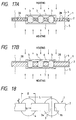
- Figs. 17A and 17B are explanation views for a connection method of electric circuit components with an electrical connecting member according to the present invention.
- Fig. 18 is a typical cross-sectional view of an electrical connecting member fabricated with the example.
- Figs. 19A and 19B are graphs showing the relation between the rate of junction and the rate of deformation and the pressure.
- Fig. 20 is a graph showing the relation between the amount of decrease in height and the radius of column portion of conductive member when the height of conductive member is varied with the pitch of conductive member fixed.
- Fig. 21 is a graph showing the relation between the amount of decrease in height and the radius of conductive member when the height of conductive member is varied with the pitch of conductive member fixed.
- Fig. 22 is a graph showing the relation between the amount of decrease in height and the pressure when the height of conductive member is varied with the pitch of conductive member fixed.
- Figs. 23A - 23F are views showing a main manufacturing process of an electrical connecting member according to the present invention.
- Fig. 24 is a typical view showing a connecting method in the background art.
- Figs. 25A and 25B are explanation views showing the connecting form between typical electric circuit components and an electrical connecting member.
- Fig. 26 is a typical view showing a thermocompression bonding apparatus in the background art.
- Fig. 27 is a typical view showing an example of the connection using the apparatus of Fig. 26.
- Figs. 28A - 28D are typical cross-sectional views showing a process for the compression bonding between an electrical connecting member and printed boards which are electric circuit components.
- Fig. 29 is a graph showing the relation between the amount of deformation in height of conductive member and the pressure against the electric circuit component.
- Fig. 1 shows the state in operation for a connecting method of electric circuit components, according to the present invention, in which Fig. 1A is a typical side view and Fig. 1B is a partial enlarged side view.
- each substrate 4, 5 is long size substrates which are electric circuit components such as printed boards
- 9 is a supporting member
- 5 is a leaf spring member as the elastic member exerting a biasing force against the printed board.
- Each substrate 4, 5 has the printed wirings applied on one face (or both faces), and electrical joints 6, 7 for the connection with the other substrate are arranged closer to one side.
- Each electrical joint 6, 7 is formed using a conductive material such as gold so as to be swollen slightly from the surface of the substrate 4, 5.
- both substrates 4, 5 are laid on the supporting member 9, one on the other, with electrical joints 6, 7 opposed to each other, in which the leaf spring member 8 serves to apply a compression bonding load from the substrate 4.
- the supporting member 9 is formed using a metallic plate having a significant thickness to be slightly wider than the substrates 4, 5.
- the leaf spring member 8 is bend like an arc at a predetermined radius of curvature, disposed on the substrate 4 so that a central portion of its convex face side is opposed to an upper surface of the substrate 4 at an intermediate position of electrical connecting area for the electrical connection between electrical circuit components, and then pressed by presser members 10, 10 at both end portions.
- the leaf spring member 8 and the substrate 4 are directly contacted, but it should be noted that an elastic member such as silicon rubber as the protective member may be interposed therebetween to distribute the pressure of the leaf spring member 8 against the substrate 4, or not to damage the circuit components.
- an elastic member such as silicon rubber as the protective member may be interposed therebetween to distribute the pressure of the leaf spring member 8 against the substrate 4, or not to damage the circuit components.
- the presser member 10 is linked to pressing means such as a press, not shown, so as to bend the leaf spring member 8 from a state as indicated by the solid line in Fig. 1A to a flat state where the whole of its lower surface is placed in facial contact with the upper surface of the substrate as indicated by the dashed line.
- the length of the leaf spring 8 which is bent to be flat is set to be slightly longer than the length of the substrate 4, 5, and the width b is set to cover sufficiently the electrical joints 6, 7 for compression bonding and its neighborhood.
- the thickness h of the leaf spring member 8 can be determined by the following way, based on the length determined by the dimensions of the substrates 4, 5, the width b, and the total load p necessary for the compression bonding of electrical joints.
- h2 (6 ⁇ p ⁇ l)/( ⁇ max .b) (1)
- ⁇ max maximum bending stress (which is set from an allowable bending stress with a safety factor)
- the initial radius of curvature R for the leaf spring member is defined according to the expression (3).
- ⁇ (4 ⁇ p ⁇ l3)/(E ⁇ b ⁇ h3) (2)
- E Young's modulus.
- R (R - ⁇ )2 + 1302 (3) Supposing that the total compression bonding load p necessary for the compression bonding of electrical joints in 25 kg, the width b of the leaf spring member is 6 mm, the length 2e is 130 mm, and the maximum bending stress ⁇ max is 150 kg/mm2, the thickness of the leaf spring member 8 is about 5 mm. Also, the amount of deflection ⁇ is 16.74 mm, and the radius of curvature R is about 515 mm.
- Fig. 2 is a typical view showing another example of the present invention.
- a leaf spring member 8 having the substantial same dimensions as the leaf spring member 8 as previously described is also disposed under the supporting member 9, with it convex side being in contact with the supporting member 9, which is supported by the leaf spring member 8 against a biasing force of the leaf spring member 8 from upward, thereby preventing the deflection of the supporting member 9 from occurring, and allowing for a uniform compression bonding between electrical joints of the substrates 4, 5.
- the supporting member 9 can be made thin.
- the dimensions of the leaf spring member 8 can be set in the same way as in the example 1. It will be appreciated that in the example 2, an elastic member such as a silicon rubber sheet may be interposed between each leaf spring member 8, 8, the substrate 4 and the supporting member 9.
- Fig. 3A is a typical view showing the state before the compression bonding in another example of the present invention
- Fig. 3B is a partial enlarged side view thereof
- Fig. 4A is a side view after the compression bonding
- Fig. 4B is a partial enlarged side view of Fig. 4A.
- the present invention is applied where conductive members 3 of the electrical connecting member 1 are interposed for the compression bonding between electrical joints 4, 5 of the substrates 4, 5.
- the supporting member 9 is made of a metal, and formed as a thick rectangular shape, on one face thereof being formed a step portion 11 in parallel with the long side at a central portion in the width direction and having a height corresponding to the sum of the thicknesses for the substrate 5 and the electrical connecting member 1.
- the substrate 5 and the electrical connecting member 1 having the conductive members opposed to the electrical joints at one end portion thereof are arranged along the step portion 11, while on a higher side thereof, the substrate 4 is arranged with its electrical joints 6 opposed to the conductive members 3 of the electrical connecting member 1 at the other end portion thereof.
- the leaf spring member 8 is disposed in alignment with a position where the electrical joints 6, 7 of the substrates 4, 5 and the conductive members 3 of the electrical connecting member 1 are opposed to each other.
- the electrical connecting member 1 is formed in such a manner that a plurality of through holes bored into the carrier 2 made of an electrical insulating material are filled with the conductive members 3 made of gold, each one end portion 3c thereof being exposed to one face of the carrier 2, and the other end portion 3c being exposed to the other face of the carrier 2, in the form of being slightly swollen from the surface of the carrier 2.
- the pressing force is applied to both end portions of the leaf spring member 8 in the state as shown in Figs. 3A and 3B, and the electric circuit components are mutually connected by the compression bonding between the electrical joints and the conductive members 3, as shown in Figs. 4A and 4B.
- the dimensions of the leaf spring member 8 are set in the same way as in the previous example 1. It will be appreciated that an elastic member such as silicone rubber for the protection of a circuit board may be also interposed between the leaf spring member and the substrate 4 in this example.
- Fig. 5 is a graph showing the pressure distribution of the leaf spring member in a longitudinal direction in which using a leaf spring member having a length of 90 mm, a thickness of 3.5 mm and a radius of curvature of 550 mm in the example as shown in Figs. 1A and 1B, the load of 50 kg is applied to both end portions to make the compression bonding between the electrical joints 6, 7 of substrates 4, 5, with the axis of abscissas indicating the length (mm) from one end of the leaf spring member, and the axis of orinates indicating the pressure (kg/mm2).
- the plot with a signs ⁇ shows a result in which the silicone rubber sheet is interposed between the leaf spring member and the substrate
- the plot with a sign ⁇ shows a result in which the leaf spring member is placed in contact with the surface of the substrate.
- Fig. 6 is a graph showing the pressure distribution in which using a leaf spring member having a length of 230 mm, a thickness of 9.0 mm and a radius of curvature of 1500 mm, the substrate is pressed directly or indirectly with the interposition of a silicone rubber sheet, with the axis of abscissas indicating the length (mm) from one end of the leaf spring member, and the axis of ordinates indicating the pressure (kg/mm2).
- the plot with a sign ⁇ shows a result in which the silicone rubber sheet is interposed between the leaf spring member and the substrate
- the plot with a sign ⁇ shows a result in which the silicone rubber sheet is not interposed.
- Fig. 7 is a typical view showing the state in operation for the connecting method of electric circuit components, according to the present invention, in which Figs. 8A and 8B are operation explanation views showing the state before and after the connection.
- 4, 5 are long size substrates which are electric circuit components such as printed boards, and 12, 13 are magnets.
- Each substrate 4, 5 has the printed wirings 13, 13 applied on one face (or both faces), and the electrical joints 6, 7 are arranged closer to one side of a plurality of substrates 4, 5, opposed to each other.
- Each electrical joint 6, 7 is formed using a conductive material such as gold to be swollen slightly from the surface of substrate 4, 5.
- Both substrates 4, 5 have the electrical joints 6, 7 arranged, one end portions thereof opposed to each other in the upper and lower sides, as shown in Fig. 8A, for example, in which a permanent magnet 12 with a silicone rubber sheet 14 as the protective member interposed on a lower surface of the substrate 5 in the neighborhood of one side where the electrical joints 6 are arranged, and a permanent magnet 12 with a silicone rubber sheet 14 interposed on an upper surface of the substrate 4 as the protective member in the neighborhood of one side where the electrical joints 6 are arranged, are positioned with different magnetic poles opposed to each other in the upper and lower sides.
- both permanent magnets 12, 12 are attracted mutually by their magnetic forces, and this attractive force allows the electrical joints 6, 7 of both substrates 4, 5 to be secured with each other as shown in Fig. 8B.
- the permanent magnet 12 is made of one or more kinds of materials such as ferrite, Fe, Ni, Co rare earth element, and formed as a slender shape of rectangular cross section, having substantially the same length as the width of the substrate 4, 5, and the width corresponding to the positions opposed to the electrical joints and its neighborhood, in which its one end side is magnetized as the N pole and the other end side is magnetized as the S pole.
- the permanent magnets 12, 12 are used, but the electromagnets can be also used, in which each electromagnet is fixed to a back face of the substrate 4, 5, and both electromagnets are excited, when the substrate are energized, so as to secure the electrical joints of the substrates 4, 5 under pressure, while the electromagnets are deexcited, when the substrates are deenergized, so as to separate the substrates 4, 5 with the action of the elastic member, not shown.
- an electrical connecting member is interposed between the substrates 4, 5 constituting the electric circuit component and indirectly welded under pressure.
- Figs. 9A and 9B are operation explanation views for illustrating the state before and after the pressure welding of electrical joints 6, 7 on the substrates 4, 5, respectively, in this example.
- 1 is an electrical connecting member
- 15, 15 are electromagnets.
- the electrical connecting member 1 is formed, as previously shown and described, in such a manner that the through holes bored into a carrier 2 made of an electrical insulating material are filled with the conductive members 3 made of gold, each one end portion of which is exposed to one face of the carrier 2, and the other end is exposed to be other face of the carrier 2, in the form of being slightly swollen from the surface of the carrier 2, respectively.
- Each conductive member of the electrical connecting member 1 has set the size and the pitch so that at least two or more conductive members 3 may be opposed to each one electrical joint 6, 7 of substrate 4, 5, as can be seen from Figs. 9A and 9B.
- Each electromagnet 15, 15 is formed in such a manner that the whole size is substantially equal to the size of the electromagnet 14, 14 in the previous example by winding the coil around an iron core, and secured with an adhesive to the back face of each substrate 4, 5 so that different magnetic poles, when excited, are opposed to each other in the upper and lower sides.
- both electromagnets 15, 15 are excited by energizing the coils, both substrates 4, 5 are pressed by the magnetic forces of both electromagnets 15, 15, in the state where the electrical connecting member is carried therebetween, so that the electrical joints 6 of the substrate 4 are welded under pressure via the conductive members 3 of the electrical connecting member 1 with the electrical joints 7 of the substrate 5.
- Fig. 10 is a typical view showing a method and its apparatus for the thermocompression bonding between electric circuit components, according to the present invention
- Fig. 11 is a partial enlarged cross-sectional view.
- 4, 5 are substrates such as printed boards which are electric circuit components
- 1 is an electrical connecting member
- 16 is a supporting base containing heaters 16a and thermocouples 16b
- 17 is a pressurizing board
- B is a base.
- the substrates 4, 5 have the printed wirings (not shown) applied on one face (or both faces), the electrical joints 6, 7 being collectively arranged at the positions closer to one side, and the electrical connecting member 1 is formed in such a manner that a plurality of holes 3b bored into the carrier 2 made of an electrical insulating material are filled with the conductive members made of gold, each one end of which is swollen slightly from the surface of the carrier 2.
- a pair of stoppers 19a, 19b movable for the positioning are spaced at a predetermined interval on the base board B, and between both stoppers 19a, 19b is disposed the supporting board 16 with the interposition of a heat insulating member 18, on which supporting board 16 are disposed both substrates 4, 5, laid one on the other, with the electrical joints 6 of the substrate 4 being opposed to one end portions of the conductive members 3 exposed to one face of the electrical connecting member 1, and the electrical joints 7 of the substrate 5 opposed to the other end portions of the conductive members 3, in which the pressure is applied by the pressurizing board 17 from upward of the substrate 4.
- the pressurizing board 17 is formed like a sector having a pressure face 17a curved as a circular shape at a predetermined radius of curvature, and contains heaters 17b and thermocouples 17c along the pressure face 17a, in which the center of curvature or the point O is borne on an arm constituting a pressurizing apparatus as shown in Fig. 12.
- Fig. 13 is a side view of the pressurizing apparatus, in which there are disposed the stoppers 19a, 19b for arranging the substrates 4, 5 on a central portion of the base board B, a strut 12 on one side, and an air cylinder 23 for the evacuation on the other side, with a rod 23b mounting a roll 23a being directed upward.
- the strut 22 has its lower end portion supported on a linear guide 24 of the base board B, and stood movable horizontally as indicated by the arrow.
- This strut 12 is provided with a nut member 22a near the lower end, through which a ball screw 22b is inserted, one end of the ball screw 22b being borne through a supporting plate 22c provided on the base board B, which is linked via a belt to a motor M, whereby the strut 22 can be reciprocated horizontally as indicated by the arrow with the driving of the motor M.
- the arm 21 On an upper end of the strut 22, the arm 21 has its one end secured with a shaft 21a, and is rotatable around the shaft 21a upward or downward.
- the other end portion of the arm 21 has a weight 21c suspended via a rod 21b vertically provided thereon, and on a substantial central portion thereof, the pressure board 5 is secured swingably around a shaft 21d as indicated by the arrow.
- a guide rail 21e is fixed at a position opposed to the roll 23a of the air cylinder 23, the driving of which causes the roll 23a to make contact with the guide rail 21e, lifting the arm 21 to be moved between a position indicated by the solid line and a position indicated by the dashed line around the shaft 21a at its one end, and causing the pressurizing board 17 to be retreated from between the stoppers 19a, 19b to make contact with the substrate 1 between the stoppers 19a, 19b.
- thermocompression bonding apparatus 20 With this thermocompression bonding apparatus 20, the air cylinder 23 for the evacuation is driven to rotate the arm 21 around the shaft 21a to retreat back to a position indicated by the dashed line, at which position a set screw 19c is loosened to open the stoppers 19a, 19b at a predetermined interval, between which stoppers 19a, 19b the heat insulating member 18 and the supporting board 16 are disposed, and the electrical connecting member 1 sandwiched between the substrates 4, 5 is laid thereon, whereby the stoppers 19a or 19b are positioned with the set screws 19c.
- the heaters 16a of the supporting board 16 and the heaters 17b of the pressure board 17 are activated under the monitoring of the detected values of the thermocouples 16b, 17b, in which the substrates 4, 5 are set in a range from 340 to 400°C, and the weight 21 is set at a predetermined weight.
- the air cylinder 23 for the evacuation is retreated to place the central portion on the lower face of the pressurizing board 17 into contact with the central portion on the upper face of the substrate 4, under a load of the weight 21c, in which state the motor M is driven to retract the strut 22, and the arm 21 to a position indicated by the broken line.
- the pressurizing board 17 is rotated around the shaft 21d, thereby moving the abutting point against the upper face of the substrate 4 to the left side in succession.
- the electrical joints 6, 7 of the substrates 4, 5 and the conductive members 3 of the electrical connecting member 1 are bonded together compressively, plural parts each time, successively, with the pressure welding and the rolling of the pressurizing board 17.
- the motor M is reversely rotated, causing the pressurizing board 17 to a position at which the other side of the pressurizing board 17 is in parallel to the inner face of the stopper 19b.
- the operation is repeated by plural number until the compression bonding is terminated.
- the inner faces of the stoppers 17a, 17b abutting on both ends of the pressurizing board 17 may be formed as a concave face to prevent any slippage between the pressurizing board 17 and the substrate 4. Also, to prevent the slippage of the pressurizing board 17 with respect to the substrate 4, a number of curved lines crossing on the pressure face may be formed as a rough face.
- the electrical joints 6, 7 of the substrates 4, 5 correspond to the conductive members 3 of the electrical connecting member 1, one to one, but a plurality of conductive members 3 can correspond to each electrical joint 6, 7, by providing a smaller pitch, in which case the substrates 4, 5 and the electrical connecting member 1 can be opposed to each other only with the alignment, whereby the operation efficiency can be further improved.
- a pressure roll 24 is used instead of the pressurizing board 17 as shown in the example.
- Fig. 13 is a typical view showing the operation state of the example.
- 24 is the pressure roll, in which both end portions are borne on supporting legs, not shown, which serve to reciprocate horizontally the pressure roll 24 by applying a predetermined load against the surface of the substrate 4, and thereby press the electrical joints 6, 7 of the substrates 4, 5 and the conductive members 3 of the electrical connecting member 1 for the compression bonding.
- the heater and the thermocouple may be provided in the neighborhood of a peripheral face of the pressure roll 24.
- the peripheral face of the pressure roll may be a rough face to be useful for the prevention of slippage.
- a press having a smaller size than the width of the substrate 4, 5 is used to press a part of the substrate 4 with a predetermined pressure, which is then lifted once to be moved to the left or the right by a predetermined length, and the above-described operation is repeated.
- the heater and the thermocouple may be provided in the neighborhood of the pressure face.
- a metallic plate e.g., copper plate
- a negative-type photosensitive polyimide resin 11 containing an adhesive 28 in a number of capsule-like lumps is applied.
- This polyimide resin 27 constitutes a carrier 2 on the electrical connecting member 1, as will be described later, the application thickness of polyimide resin being thicker than the thickness of the carrier 2 to be obtained, in consideration of an decrease with the splashing of the solvent and the shrinkage in the subsequent curing process.
- the adhesive contained in the polyimide resin requires to have the thermosetting property, and may be an adhesive resin such as epoxy, polyester, polyurethan, phenol, resorcinol, urea, or melamine.
- the surface of coating layer made of polyimide resin is covered with a photomask (not shown) having a predetermined pattern formed, and then irradiated (exposed) via the photomask and developed. Thereby, an unexposed portion is removed, and a number of through holes 3b, 3b penetrating through the coating layer of polyimide resin from the inside to the outside are formed, as shown in Fig. 15B.
- the etching is made from the surface side of polyimide resin, so that the metallic plate 26 located beneath the through holes 3b, 3b is etched and recess portions 29, 29 are formed, as shown in Fig. 15C. Note that this etching process is continued until the diameter of recess portions 29, 29 is slightly larger than that of the through holes 3b, 3b.
- the through holes 3b, 3b and the recess portions 29, 29 are filled with gold 14 through the electroplating having the metallic plate 20 as a common electrode. This filling is made until gold 14 is swollen up to the thickness nearly corresponding to that of the recess portions 29, 29 at the opening end portion for the through holes 3b, 3b on the surface of polyimide resin 27.
- the filling with the electroplating is not limited to the use of gold (Au), but the metal such as Ag, Cu, Be, Mo, Ni or the alloy thereof may be used.
- the electrical connecting member 1 according to the present invention can be constituted as shown in Fig. 15E, in which a number of conductive members 3, 3 made of gold are embedded into the carrier 2 made of polyimide resin 27 which is an insulating material and containing an adhesive 20 in the insulating state, their both ends being exposed to the inside and the outside of the carrier 2, respectively.
- the fabrication of the electrical connecting member according to a third embodiment of the present invention is performed in the following way.
- the negative photosensitive polyimide resin 27 is coated on the metallic plate 20 which is the base, as shown in Fig. 16A.
- the coating layer should have a greater thickness than the carrier 2, as previously described.
- the surface of the coating layer made of polyimide resin 27 is exposed via the photomask having a predetermined pattern formed, and further developed, so that a number of through holes 3b, 3b penetrating from the inside of the coating layer to the outside are formed. Then, they are heated to cure the coating layer of polyimide resin 27 with the conversion into the imide, the metallic plate 26 located beneath the through holes 3b, 3b is etched with the etching from the surface side of the coating layer to form the recess portions 29, 29, and the through holes 3b, 3b and the recess portions 13, 13 are filled with gold 30 with the electroplating having the metallic plate 20 as the common electrode.
- the process from the state of Fig. 16A to this state is the same as from Fig. 15B to Fig. 15D in the fabrication of the electrical connecting member 1 according to the previous example, and therefore the figures are omitted.
- a crude product 1 is constituted as shown in Fig. 16B, in which a number of conductive members 3, 3 made of gold are embedded into the carrier 2 made of polyimide resin which is an insulating material, in the mutually insulating state, and their both ends are exposed to the inside and the outside of the carrier 2. It will be appreciated that this crude product 1 corresponds to a conventional electrical connecting member 1 as shown in Fig. 4.
- a resist layer 31 having an adequate thickness is formed only on an exposed portion of each conductive member 3 on the inside and the outside of the carrier 2 for the crude product 1, as shown in Fig. 16C.
- the formation of such resist layer 31 can be performed in the same procedure as the formation of the through holes 3b, that is, in such a procedure that first, the photosensitive resist agent is coated on the entire surface of the carrier 2, the surface of the coating layer is covered with the photomask having a predetermined pattern formed, exposed via the photomask and then developed, and the unexposed portion is removed, so that the residual portion becomes a resist layer.
- the electrical connecting member 1 according to the third embodiment of the present invention can be obtained as shown in Fig. 16E, in which the adhesive 28 is coated a predetermined thickness on the inside and the outside of the carrier 2 carrying the conductive members 3, 3.
- the adhesive 28 coated on the surface of the carrier 2 requires to have the thermosetting property, and may be an adhesive resin such as epoxy, polyester, polyurethan, phenol, resorcinol, urea, or melamine. It is also possible that the coating of the adhesive 28 is made on the entire surface of the carrier 2, and the adhesive applied on the formation portion of the layer 31 is removed at the same time when the resist layer 31 is peeled off after the coating.
- Fig. 17 is a typical view shoring a connecting form of electric circuit components with the electrical connecting member in this example as obtained in the above-described manner, in which Fig. 17A shows the use of an electrical connecting member 1 in the previous example, and Fig. 17B shows the use of an electrical connecting member 1 in another example.
- 4, 5 are electric circuit components to be connected, and the electric circuit components 4, 5 are disposed on both front and back faces of the carrier 2, as conventionally performed, and electrodes 6, 7 for use at connection ends are aligned in a plan view.
- the electric circuit components 4, 5 are placed into contact with the both faces of the carrier 2, as shown in Fig. 17A, if the electrical connecting member 1 according to the first embodiment is used, or after the electric circuit components 4, 5 are placed into contact with the coating layer surfaces 28, 28 of the adhesive on both faces of the carrier 2, as shown in Fig. 17B, if the electrical connecting member 1 according to the third embodiment is used, the whole entity is heated.
- This heating is applied until the adhesive contained in the carrier 2 or the adhesive 28 applied on the surface of the carrier 2 reaches a curing temperature, whereby the electric circuit components 4, 5 are adhered to the carrier 2 or the coating layer of the adhesive on the surface of the carrier 2, and further, with the curing and shrinkage of the adhesive caused by the heating, the carrier 2 itself in the electrical connecting member 1 of Fig. 17A or the coating layer of the adhesive 20 in the electrical connecting member 1 of Fig.
- the electric circuit components 4, 5 are subjected to the pressure for maintaining the contact with the carrier 2 and the heating for curing the adhesive 28, in which as the curing temperature of the thermosetting adhesive is normally about 100 to 200°C, there is no risk that the electric circuit components 4, 5 and the carrier 2 are damaged due to the heating and the pressure, and as the thermal stress arising in the conductive members 3, 3 is small, it is possible to eliminate the occurrence of conduction failures and the increase in the electrical resistance after the connection.
- the electric circuit components 4, 5 and the electrical connecting member 1 are connected with a joining force between the electrodes 6, 7 and the conductive members 3, 3, as well as an adhesive force between the whole of electric circuit components 4, 5 and the carrier 2, so that there is an additional advantage that an extreme high bond strength can be obtained.
- the present inventors made the experiments and studies with efforts for the amount of deformation in the conductive member for obtaining the metallic solid phase diffusion state in a secure manner without incurring the unbonding between the electrical joints of the electric circuit components and the conductive member of the electrical connecting member in order to assure a stable and secure electrical connection using the electrical connecting member, and thus consequently obtained such a view that when the amount of deformation in the conductive member of electrical connecting member (the amount of deformation in view of the diameter of bump) is 17% or more in a condition in which the temperature of the conductive members of the electrical connecting member is from 250 to 400°C, the metallic solid phase diffusion state is obtained in the connection between the conductive members and the electrical joints, and the unbonding may be incurred before the conductive members reach such an amount of deformation.
- Fig. 18 is a typical cross-sectional view showing an electrical connecting member according to the present invention, in which 1 is an electrical connecting member, 2 is a carrier made of an electrical insulating material, and 3 is a conductive member made of for example gold.
- the carrier 2 is made of a photosensitive polyimide resin, in which the conductive members 3 made of gold are provided within the holes 3 bored therein. one end of the conductive member 3 is exposed to one face of the carrier 2, and the other end thereof is exposed to the other face of the carrier 2, in the state of slightly protruding from the surface of the carrier 2.
- Fig. 19 is a graph showing the relation between the pressure being applied increasingly and the rate of deformation and the rate of junction in the conductive member 3, with the electrical connecting member of Fig. 18 sandwiched between the substrates.
- the electrical connecting member 1 having the conductive members 3 is pressed between the substrates which are electric circuit components, in which the pitch between conductive members 3 is L, the protruding height of the conductive member 3 from the surface of the carrier 2 is h, the maximum diameter of the conductive member 3 is D, and the diameter of the column portion 3a of the conductive member 3 located within the carrier 2 is r.
- the interrelation between the height h of the conductive member 3, the pitch L, the diameter r of the column portion of the conductive member is as follows.
- Fig. 20 is a graph showing the relation between the amount of decrease in height h from the surface of the carrier and the radius of column portion of conductive member, in which in the graph, the pitch L of conductive member is fixed at 30 ⁇ m, and the height h of conductive member is changed as 2 ⁇ m (solid line), 5 ⁇ m (dashed line) and 8 ⁇ m (broken line). It will be clearly found from the graph that the larger the height h, the greater increase in the radius of column portion when it is pressed and deformed. The increase of column portion can set the height h of conductive member properly because of the corresponding increase in the swelling amount on the carrier 2.
- Fig. 21 is a graph showing the relation between the amount of decrease in height h and the radius of column portion of conductive member, in which the pitch L of conductive member is fixed at 40 ⁇ m, and the height h of conductive member is changed as 2 ⁇ m (solid line), 5 ⁇ m (dashed line) and 8 ⁇ m (broken line).
- Fig. 22 is a graph showing the relation between the amount of decrease in height h and the pressure (Kgf/mm2) required for the compression bonding, in which the pitch L of conductive member is fixed at 30 ⁇ m, and the height h of conductive member is changed as 2 ⁇ m (solid line), 5 ⁇ m (dashed line) and 8 ⁇ m (broken line). It will be clearly found from the graph that when the height h of the conductive member is small, the deformation reaches a limit with a slight decrease of the height h, requiring some wasteful pressure.
- Fig. 23 is a typical cross-sectional view showing a principal process of the fabrication method for the electrical connecting member according to the present invention, in which first, a metallic sheet 26 which is a base is prepared (Fig. 23A), and a negative-type photosensitive resin is applied on this metallic sheet 26 with a spinner for the prebake (Fig. 23B).
- the photosensitive resin 27 is irradiated and exposed via a photomask (not shown) having a predetermined pattern, and then developed (Fig. 23C). Thereby, the photosensitive resin 27 remains on the exposed portion, while the photosensitive resin 27 is removed from the unexposed portion with the processing, so that holes 3b through which the surface of metallic sheet is exposed are formed on the bottom.
- the photosensitive resin is cured with the rise in the temperature, it is dipped in an etching liquid to allow the etching for the surface of metallic sheet 11 exposed within the holes 3b, and form the recess portions (Fig. 23D).
- the holes 3b and the recess portions 29 are filled with gold 30, and the gold plating is applied to be swollen a predetermined amount above the surface of photosensitive resin 27, so that the conductive members 3 are formed (Fig. 23E).
- the metallic sheet 27 is removed with the etching, so that the electrical connecting member 1 constituted of the conductive members 3 made of gold and the carrier 2 made of the photosensitive resin 27 respectively can be fabricated, as shown in Fig. 23F.
- Table 1 Size conditions for conductive member Detected Data Height ( ⁇ m) Max. diameter ( ⁇ m) Pitch ( ⁇ m) Max.
- Table 1 shows the results in which the heating compression bonding is made by changing the height h of conductive member from the carrier, the maximum diameter R of conductive member, and the pitch L of conductive member, respectively, with a target of 100% compression bonding between the conductive members and the electrical joints of the substate, the compression bonding ratio (the ratio % of the number of compression bonded conductive members to the total number of conductive members) and the pressure (Kgf/mm2) under the heating was obtained in respective cases, and the integrated evaluation was made. Note that in the integrated evaluation, the sign o indicates the compression bonding ratio of 100%, the sign ⁇ indicates the compression bonding ratio of 80% or greater, and the sign x indicates the compression bonding ratio below 80%.
- an elastic member is used in the compression bonding between a plurality of electrical joints, and may be suitable for the multipoint joints particularly on a long substrate, from an intermediate point in the electrical connecting area, allowing for the application of a uniform bonding load to each electrical joint, whereby the compression bonding structure is simplified, and as elastic member for the protection are interposed between the previously-described elastic member and the electric circuit components, it is possible to make the compression bonding load more uniform by absorbing minute irregularities on the elastic member such as a leaf spring or the electric circuit components themselves. Moreover, since the compression bonding is made between elastic members producing the biasing force, a further uniform bonding load can be applied, whereby the method of the present invention can exhibit the excellent effects.
- connection between electrical joints of the electric circuit components is made using the magnetic force of magnet, it is possible to make and maintain the contact of electrical joints with a uniform pressure, so that the compression bonding structure is simplified, and as the magnet may be an electromagnet, it is possible to separate the electrical joints from each other as required.
- the electric circuit components, laid one on the other, with the electrical connecting member carried therebetween, are pressed gradually on a part thereof in succession to make the compression bonding for all of the electrical joints, so that there is a less influence from the mechanical error, thermal distortion error and secular change, and a higher accuracy can be obtained in the compression bonding as compared with the collective bonding, with a less dispersion of the characteristics, because of a higher operation efficiency and a more uniform bonding load as compared with the single point junction.
- the electrical connecting member according to the present invention is such that the carrier carrying conductive members embedded contains a thermosetting adhesive or has a coating layer of thermosetting adhesive on its surface
- the connecting method of electric circuit components using the electrical connecting member according to the present invention is one in which the electric circuit components to be connected are laid on both sides of the carrier and then heated, and with the shrinkage of the carrier itself or the coating layer due to the curing of the adhesive, the electric circuit components are pressed against the conductive members, in which as the pressure for maintaining the contact and the heating for attaining the curing temperature of adhesive are only required, no special apparatus is necessary, and there is no risk that the pressure and the heating may damage the electric circuit components and the electrical connecting member, so that an excellent connecting state can be obtained between two components, with a decreased thermal stress in the conductive members, whereby excellent effects can be exhibited such as effective prevention of the occurrence of conduction failures and the increase in the electrical resistance after the connection, and the easy connection between electric circuit components inferior in the thermal resistivity such as a liquid crystal substrate.
- the pitch of conductive member provided on the carrier and the protruding height of conductive member from the surface of the carrier are set so that the amount of deformation in the conductive member may reach 17% or greater, it is possible to make a secure compression bonding between the conductive members and the electrical joints of electric circuit components in the metallic solid phase diffused junction state, thereby enabling the uniform compression bonding at a lower pressure.
- a method for the electrical connection between electrical joints of electric circuit components includes disposing said electric circuit components so that said joints for the electrical connection are opposed to each other, and making the electrical connection between said electrical joints with a biasing force which is exerted by an elastic member from at least one side of said electric circuit component so that the biasing force is exerted consecutively from an intermediate position of connecting area where said joints are located to the periphery of said connecting area.
Landscapes
- Engineering & Computer Science (AREA)
- Manufacturing & Machinery (AREA)
- Microelectronics & Electronic Packaging (AREA)
- Combinations Of Printed Boards (AREA)
Applications Claiming Priority (10)
| Application Number | Priority Date | Filing Date | Title |
|---|---|---|---|
| JP53903/91 | 1991-02-25 | ||
| JP03053903A JP3113987B2 (ja) | 1991-02-25 | 1991-02-25 | 電気的接続部材及びこれを用いた電気回路部品の接続方法 |
| JP69089/91 | 1991-03-09 | ||
| JP3069089A JPH04282582A (ja) | 1991-03-09 | 1991-03-09 | 電気回路部品の接続方法 |
| JP8982691A JPH04299546A (ja) | 1991-03-27 | 1991-03-27 | 電気回路部品の熱圧着方法及びその装置 |
| JP89827/91 | 1991-03-27 | ||
| JP3089827A JPH04298976A (ja) | 1991-03-27 | 1991-03-27 | 電気回路部品の接続方法 |
| JP89826/91 | 1991-03-27 | ||
| JP146944/91 | 1991-05-21 | ||
| JP14694491A JPH04342971A (ja) | 1991-05-21 | 1991-05-21 | 電気的接続部材の製造方法 |
Publications (3)
| Publication Number | Publication Date |
|---|---|
| EP0501358A2 true EP0501358A2 (de) | 1992-09-02 |
| EP0501358A3 EP0501358A3 (en) | 1992-12-16 |
| EP0501358B1 EP0501358B1 (de) | 1997-01-15 |
Family
ID=27523114
Family Applications (1)
| Application Number | Title | Priority Date | Filing Date |
|---|---|---|---|
| EP92103025A Expired - Lifetime EP0501358B1 (de) | 1991-02-25 | 1992-02-24 | Vorrichtung und Verfahren zur Verbindung elektrischer Bauelemente |
Country Status (3)
| Country | Link |
|---|---|
| US (1) | US6015081A (de) |
| EP (1) | EP0501358B1 (de) |
| DE (1) | DE69216658T2 (de) |
Cited By (4)
| Publication number | Priority date | Publication date | Assignee | Title |
|---|---|---|---|---|
| US5819406A (en) * | 1990-08-29 | 1998-10-13 | Canon Kabushiki Kaisha | Method for forming an electrical circuit member |
| EP0811245A4 (de) * | 1995-09-27 | 1998-11-18 | Texas Instruments Inc | Mikroelektronische anordnung mit z-achsig leitender schicht |
| EP2075802A4 (de) * | 2006-10-19 | 2010-11-03 | Nat Inst Of Advanced Ind Scien | Folie zur formung einer leitfähigen struktur, verfahren zur formung einer leitfähigen struktur und vorrichtung zur formung einer leitfähigen struktur für die folie zur formung einer leitfähigen struktur |
| US8187006B2 (en) | 2009-02-02 | 2012-05-29 | Apex Technologies, Inc | Flexible magnetic interconnects |
Families Citing this family (22)
| Publication number | Priority date | Publication date | Assignee | Title |
|---|---|---|---|---|
| US5894982A (en) * | 1995-09-29 | 1999-04-20 | Kabushiki Kaisha Toshiba | Connecting apparatus |
| US6332173B2 (en) | 1998-10-31 | 2001-12-18 | Advanced Micro Devices, Inc. | UART automatic parity support for frames with address bits |
| TW396462B (en) * | 1998-12-17 | 2000-07-01 | Eriston Technologies Pte Ltd | Bumpless flip chip assembly with solder via |
| US6142361A (en) * | 1999-12-09 | 2000-11-07 | International Business Machines Corporation | Chip C4 assembly improvement using magnetic force and adhesive |
| WO2001075970A2 (en) * | 2000-03-31 | 2001-10-11 | Dyconex Patente Ag | Element and method for connecting constituents of an electronic assembly |
| JP2002204531A (ja) | 2000-10-31 | 2002-07-19 | Canon Inc | 交流連系装置およびその制御方法 |
| JP2002233045A (ja) | 2001-02-02 | 2002-08-16 | Canon Inc | 太陽光発電システムの地絡検出のための装置及び方法 |
| US6375475B1 (en) * | 2001-03-06 | 2002-04-23 | International Business Machines Corporation | Method and structure for controlled shock and vibration of electrical interconnects |
| DE20205339U1 (de) * | 2002-04-06 | 2003-08-14 | Diehl AKO Stiftung & Co. KG, 88239 Wangen | Sensorschaltungsbaugruppe |
| US7477527B2 (en) * | 2005-03-21 | 2009-01-13 | Nanoconduction, Inc. | Apparatus for attaching a cooling structure to an integrated circuit |
| JP4079118B2 (ja) * | 2004-05-11 | 2008-04-23 | オムロン株式会社 | 異方性導電フィルム |
| US7344384B2 (en) * | 2004-10-25 | 2008-03-18 | Hewlett-Packard Development Company, L.P. | Bolster plate assembly for processor module assembly |
| US7703658B2 (en) * | 2007-03-29 | 2010-04-27 | Suss Microtec Ag | Apparatus and method for semiconductor wafer bumping via injection molded solder |
| JP4814277B2 (ja) * | 2008-04-18 | 2011-11-16 | ソニーケミカル&インフォメーションデバイス株式会社 | 接合体、該接合体の製造方法、及び該接合体に用いられる異方性導電膜 |
| JP5553504B2 (ja) | 2008-12-26 | 2014-07-16 | キヤノン株式会社 | 半導体装置の製造方法及び半導体装置 |
| US9300081B2 (en) | 2010-02-02 | 2016-03-29 | Charles Albert Rudisill | Interposer connectors with magnetic components |
| US8766426B2 (en) * | 2010-09-24 | 2014-07-01 | Stats Chippac Ltd. | Integrated circuit packaging system with warpage control and method of manufacture thereof |
| US10680383B2 (en) | 2013-03-14 | 2020-06-09 | Apex Technologies, Inc. | Linear electrode systems for module attachment with non-uniform axial spacing |
| DE102015006981B4 (de) | 2015-05-29 | 2018-09-27 | Mühlbauer Gmbh & Co. Kg | Thermokompressionsvorrichtung und Verfahren zum Verbinden von elektrischen Bauteilen mit einem Substrat |
| DE102016107890B4 (de) * | 2016-04-28 | 2025-09-04 | Oliver Ott | Kontaktfolie und Trägervorrichtung mit einer Kontaktfolie sowie ein Verfahren zu deren Herstellung |
| JP7023302B2 (ja) * | 2020-02-04 | 2022-02-21 | 田中貴金属工業株式会社 | 導電性接合材料を備える接合部材及び接合方法 |
| DE102020007235A1 (de) | 2020-11-26 | 2022-06-02 | Mühlbauer Gmbh & Co. Kg | Thermokompressionsvorrichtung und Verfahren zum Verbinden von elektrischen Bauteilen mit einem Substrat |
Family Cites Families (41)
| Publication number | Priority date | Publication date | Assignee | Title |
|---|---|---|---|---|
| US2614590A (en) * | 1946-08-27 | 1952-10-21 | Hervey Foundation Inc | Press platen for laminated material |
| GB639658A (en) * | 1947-04-15 | 1950-07-05 | Harold Vezey Strong | Improvements relating to the manufacture of electrical circuits and circuit components |
| US2713379A (en) * | 1952-11-25 | 1955-07-19 | Firestone Tire & Rubber Co | Magnetic device for clamping overlapping parts during adhesive bonding |
| US3119922A (en) * | 1961-06-12 | 1964-01-28 | Nat Distillers Chem Corp | Constant heat sealer |
| JPS422096Y1 (de) * | 1964-05-25 | 1967-02-08 | ||
| US3680037A (en) * | 1970-11-05 | 1972-07-25 | Tech Wire Prod Inc | Electrical interconnector |
| US3870582A (en) * | 1972-10-05 | 1975-03-11 | Polaroid Corp | Novel laminating system |
| US3901758A (en) * | 1973-05-14 | 1975-08-26 | Seal | Laminating apparatus utilizing offset rollers |
| US3972766A (en) * | 1975-01-17 | 1976-08-03 | Andre Fontvieille | Apparatus for fabricating flat objects |
| US4050756A (en) * | 1975-12-22 | 1977-09-27 | International Telephone And Telegraph Corporation | Conductive elastomer connector and method of making same |
| JPS5421165A (en) * | 1977-07-18 | 1979-02-17 | Nec Corp | Semiconductor device |
| JPS56116282A (en) * | 1980-02-19 | 1981-09-11 | Sharp Kk | Electronic part with plural terminals |
| FR2495845A1 (fr) * | 1980-12-05 | 1982-06-11 | Cii Honeywell Bull | Dispositif de serrage entre les elements superposes de groupes alignes, notamment pour la connexion electrique d'elements conducteurs |
| FR2495846A1 (fr) * | 1980-12-05 | 1982-06-11 | Cii Honeywell Bull | Dispositif de connexion electrique a haute densite de contacts |
| JPS59139636A (ja) * | 1983-01-20 | 1984-08-10 | Matsushita Electric Ind Co Ltd | ボンデイング方法 |
| US4545838A (en) * | 1983-02-07 | 1985-10-08 | Sealtran Corp. | Lamination product and method employing temporary transfer film |
| US4664309A (en) * | 1983-06-30 | 1987-05-12 | Raychem Corporation | Chip mounting device |
| JPS6057944A (ja) * | 1983-09-09 | 1985-04-03 | Matsushita Electronics Corp | 半導体装置 |
| WO1985001913A1 (fr) * | 1983-11-02 | 1985-05-09 | Boeck Josef | Procede et installation pour comprimer des feuilles flexibles et clavier fabrique selon ce procede |
| EP0152189A3 (de) * | 1984-01-25 | 1987-12-09 | Luc Technologies Limited | Verbindung mit elektrischen Leitern und damit verbundene Bausteine |
| JPS60216411A (ja) * | 1984-04-11 | 1985-10-29 | 日立化成工業株式会社 | 異方導電性接着フイルムの製造方法 |
| JPS6178069A (ja) * | 1984-09-26 | 1986-04-21 | 日立化成工業株式会社 | 回路の接続部材 |
| JPS61166876A (ja) * | 1985-01-17 | 1986-07-28 | Matsushita Electric Ind Co Ltd | 異方導電性接着剤 |
| JPS61174643A (ja) * | 1985-01-28 | 1986-08-06 | Sony Chem Kk | 配線基板の接続方法 |
| US4729809A (en) * | 1985-03-14 | 1988-03-08 | Amp Incorporated | Anisotropically conductive adhesive composition |
| US4754546A (en) * | 1985-07-22 | 1988-07-05 | Digital Equipment Corporation | Electrical connector for surface mounting and method of making thereof |
| FR2588121B1 (fr) * | 1985-10-02 | 1990-02-23 | Bull Sa | Procede et dispositif de soudage d'elements sur les plots correspondants d'une plaquette telle que notamment une plaquette de circuits integres de haute densite |
| EP0262580B1 (de) * | 1986-09-25 | 1993-11-24 | Kabushiki Kaisha Toshiba | Verfahren zum elektrischen Verbinden von zwei Objekten |
| JPS63246835A (ja) * | 1987-04-02 | 1988-10-13 | Canon Inc | 電気的接続部材及びそれを用いた電気回路部材 |
| JPS63228726A (ja) * | 1987-03-18 | 1988-09-22 | Canon Inc | 電気的接続部材及びそれを用いた電気回路部材 |
| JPS63222437A (ja) * | 1987-03-11 | 1988-09-16 | Canon Inc | 電気回路部材 |
| JPS63224235A (ja) * | 1987-03-12 | 1988-09-19 | Canon Inc | 電気回路部材 |
| JPS63249393A (ja) * | 1987-04-03 | 1988-10-17 | シャープ株式会社 | 電子部品の接続方法 |
| JPS6444095A (en) * | 1987-08-12 | 1989-02-16 | Hitachi Ltd | Method of mounting hybrid integrated circuit |
| US5078820A (en) * | 1988-03-25 | 1992-01-07 | Somar Corporation | Method and apparatus for pressure sticking a thin film to a base plate |
| EP0349756A3 (de) * | 1988-05-30 | 1991-03-20 | Canon Kabushiki Kaisha | Herstellung einer elektrischen Schaltkreisvorrichtung |
| JP2702507B2 (ja) * | 1988-05-31 | 1998-01-21 | キヤノン株式会社 | 電気的接続部材及びその製造方法 |
| JPH01316674A (ja) * | 1988-06-17 | 1989-12-21 | Hitachi Ltd | コネクタ |
| DE68929282T2 (de) * | 1988-11-09 | 2001-06-07 | Nitto Denko Corp., Ibaraki | Leitersubstrat, Filmträger, Halbleiteranordnung mit dem Filmträger und Montagestruktur mit der Halbleiteranordnung |
| US5039371A (en) * | 1989-03-23 | 1991-08-13 | Lockheed Corporation | Apparatus for roll-consolidation of thermoplastic composite laminates |
| US4975637A (en) * | 1989-12-29 | 1990-12-04 | International Business Machines Corporation | Method and apparatus for integrated circuit device testing |
-
1992
- 1992-02-24 DE DE69216658T patent/DE69216658T2/de not_active Expired - Fee Related
- 1992-02-24 EP EP92103025A patent/EP0501358B1/de not_active Expired - Lifetime
-
1994
- 1994-03-07 US US08/206,270 patent/US6015081A/en not_active Expired - Fee Related
Cited By (5)
| Publication number | Priority date | Publication date | Assignee | Title |
|---|---|---|---|---|
| US5819406A (en) * | 1990-08-29 | 1998-10-13 | Canon Kabushiki Kaisha | Method for forming an electrical circuit member |
| EP0811245A4 (de) * | 1995-09-27 | 1998-11-18 | Texas Instruments Inc | Mikroelektronische anordnung mit z-achsig leitender schicht |
| EP2075802A4 (de) * | 2006-10-19 | 2010-11-03 | Nat Inst Of Advanced Ind Scien | Folie zur formung einer leitfähigen struktur, verfahren zur formung einer leitfähigen struktur und vorrichtung zur formung einer leitfähigen struktur für die folie zur formung einer leitfähigen struktur |
| US8278561B2 (en) | 2006-10-19 | 2012-10-02 | National Institute Of Advanced Industrial Science And Technology | Conductive pattern forming film, and conductive pattern forming method and conductive pattern forming apparatus for the conductive pattern forming film |
| US8187006B2 (en) | 2009-02-02 | 2012-05-29 | Apex Technologies, Inc | Flexible magnetic interconnects |
Also Published As
| Publication number | Publication date |
|---|---|
| DE69216658T2 (de) | 1997-08-07 |
| US6015081A (en) | 2000-01-18 |
| EP0501358B1 (de) | 1997-01-15 |
| EP0501358A3 (en) | 1992-12-16 |
| DE69216658D1 (de) | 1997-02-27 |
Similar Documents
| Publication | Publication Date | Title |
|---|---|---|
| US6015081A (en) | Electrical connections using deforming compression | |
| US6518091B1 (en) | Method of making anisotropic conductive elements for use in microelectronic packaging | |
| JP2730357B2 (ja) | 電子部品実装接続体およびその製造方法 | |
| US5739053A (en) | Process for bonding a semiconductor to a circuit substrate including a solder bump transferring step | |
| US6406988B1 (en) | Method of forming fine pitch interconnections employing magnetic masks | |
| US20050020116A1 (en) | Connector and an electronic apparatus having electronic parts connected to each other by the connector | |
| EP0662256B1 (de) | Elektrische verbindungsstruktur und verfahren zum elektrischen verbinden von anschluessen untereinander | |
| JP2001313314A (ja) | バンプを用いた半導体装置、その製造方法、および、バンプの形成方法 | |
| KR20040081322A (ko) | 보강판 부착 장치 및 부착 방법 | |
| US6973720B2 (en) | Method for manufacturing a connector integrated with a LED | |
| JP2004140384A (ja) | プリント配線基板の接続方法 | |
| EP0596393B1 (de) | Verfahren zum Aufbringen von Kontakthöckern auf einer Halbleitervorrichtung sowie zum Verbinden dieser Vorrichtung mit einer Leiterplatte | |
| JPH06112270A (ja) | 半導体素子の実装方法 | |
| JPH0671032B2 (ja) | 電子部品の実装装置 | |
| JP2890911B2 (ja) | 回路基板装置 | |
| JP3952623B2 (ja) | 積層型回路実装モジュ―ルおよびインターコネクタ | |
| JP3813766B2 (ja) | プリント配線基板の接続構造 | |
| JPH0661419A (ja) | 電子部品及びその接続方法 | |
| JP3051617B2 (ja) | 半導体装置の製造方法 | |
| JP3031134B2 (ja) | 電極の接続方法 | |
| JP3135435B2 (ja) | 回路基板の電極接続方法 | |
| JP3113987B2 (ja) | 電気的接続部材及びこれを用いた電気回路部品の接続方法 | |
| JP3111688B2 (ja) | 回路基板検査用アダプター装置の製造方法並びに回路基板の検査方法および検査装置 | |
| JPH09223860A (ja) | 検査用回路基板装置 | |
| JP3027171B2 (ja) | 電気回路部材 |
Legal Events
| Date | Code | Title | Description |
|---|---|---|---|
| PUAI | Public reference made under article 153(3) epc to a published international application that has entered the european phase |
Free format text: ORIGINAL CODE: 0009012 |
|
| AK | Designated contracting states |
Kind code of ref document: A2 Designated state(s): DE FR GB IT NL |
|
| PUAL | Search report despatched |
Free format text: ORIGINAL CODE: 0009013 |
|
| AK | Designated contracting states |
Kind code of ref document: A3 Designated state(s): DE FR GB IT NL |
|
| 17P | Request for examination filed |
Effective date: 19930428 |
|
| 17Q | First examination report despatched |
Effective date: 19940809 |
|
| GRAG | Despatch of communication of intention to grant |
Free format text: ORIGINAL CODE: EPIDOS AGRA |
|
| GRAH | Despatch of communication of intention to grant a patent |
Free format text: ORIGINAL CODE: EPIDOS IGRA |
|
| GRAH | Despatch of communication of intention to grant a patent |
Free format text: ORIGINAL CODE: EPIDOS IGRA |
|
| GRAA | (expected) grant |
Free format text: ORIGINAL CODE: 0009210 |
|
| AK | Designated contracting states |
Kind code of ref document: B1 Designated state(s): DE FR GB IT NL |
|
| REF | Corresponds to: |
Ref document number: 69216658 Country of ref document: DE Date of ref document: 19970227 |
|
| ET | Fr: translation filed | ||
| ET | Fr: translation filed |
Free format text: CORRECTIONS |
|
| ITF | It: translation for a ep patent filed | ||
| PLBE | No opposition filed within time limit |
Free format text: ORIGINAL CODE: 0009261 |
|
| STAA | Information on the status of an ep patent application or granted ep patent |
Free format text: STATUS: NO OPPOSITION FILED WITHIN TIME LIMIT |
|
| 26N | No opposition filed | ||
| REG | Reference to a national code |
Ref country code: GB Ref legal event code: IF02 |
|
| PGFP | Annual fee paid to national office [announced via postgrant information from national office to epo] |
Ref country code: NL Payment date: 20090217 Year of fee payment: 18 Ref country code: DE Payment date: 20090228 Year of fee payment: 18 |
|
| PGFP | Annual fee paid to national office [announced via postgrant information from national office to epo] |
Ref country code: GB Payment date: 20090218 Year of fee payment: 18 |
|
| PGFP | Annual fee paid to national office [announced via postgrant information from national office to epo] |
Ref country code: FR Payment date: 20100315 Year of fee payment: 19 Ref country code: IT Payment date: 20100215 Year of fee payment: 19 |
|
| REG | Reference to a national code |
Ref country code: NL Ref legal event code: V1 Effective date: 20100901 |
|
| GBPC | Gb: european patent ceased through non-payment of renewal fee |
Effective date: 20100224 |
|
| PG25 | Lapsed in a contracting state [announced via postgrant information from national office to epo] |
Ref country code: NL Free format text: LAPSE BECAUSE OF NON-PAYMENT OF DUE FEES Effective date: 20100901 |
|
| PG25 | Lapsed in a contracting state [announced via postgrant information from national office to epo] |
Ref country code: DE Free format text: LAPSE BECAUSE OF NON-PAYMENT OF DUE FEES Effective date: 20100901 |
|
| PG25 | Lapsed in a contracting state [announced via postgrant information from national office to epo] |
Ref country code: GB Free format text: LAPSE BECAUSE OF NON-PAYMENT OF DUE FEES Effective date: 20100224 |
|
| REG | Reference to a national code |
Ref country code: FR Ref legal event code: ST Effective date: 20111102 |
|
| PG25 | Lapsed in a contracting state [announced via postgrant information from national office to epo] |
Ref country code: IT Free format text: LAPSE BECAUSE OF NON-PAYMENT OF DUE FEES Effective date: 20110224 |
|
| PG25 | Lapsed in a contracting state [announced via postgrant information from national office to epo] |
Ref country code: FR Free format text: LAPSE BECAUSE OF NON-PAYMENT OF DUE FEES Effective date: 20110228 |