EP0501397B1 - Härtbare, hitzeaktivierbare Transfertoner - Google Patents
Härtbare, hitzeaktivierbare Transfertoner Download PDFInfo
- Publication number
- EP0501397B1 EP0501397B1 EP92103117A EP92103117A EP0501397B1 EP 0501397 B1 EP0501397 B1 EP 0501397B1 EP 92103117 A EP92103117 A EP 92103117A EP 92103117 A EP92103117 A EP 92103117A EP 0501397 B1 EP0501397 B1 EP 0501397B1
- Authority
- EP
- European Patent Office
- Prior art keywords
- toner
- image
- tacky
- receptor
- temperature
- Prior art date
- Legal status (The legal status is an assumption and is not a legal conclusion. Google has not performed a legal analysis and makes no representation as to the accuracy of the status listed.)
- Expired - Lifetime
Links
- 230000002035 prolonged effect Effects 0.000 claims description 43
- 238000000034 method Methods 0.000 claims description 35
- 125000004432 carbon atom Chemical group C* 0.000 claims description 28
- 239000004014 plasticizer Substances 0.000 claims description 23
- -1 aryl carboxylate Chemical class 0.000 claims description 22
- 238000010438 heat treatment Methods 0.000 claims description 22
- 239000000203 mixture Substances 0.000 claims description 22
- 229920001897 terpolymer Polymers 0.000 claims description 19
- 229910052751 metal Inorganic materials 0.000 claims description 17
- 239000002184 metal Substances 0.000 claims description 17
- 229910052782 aluminium Inorganic materials 0.000 claims description 14
- 230000005855 radiation Effects 0.000 claims description 14
- XAGFODPZIPBFFR-UHFFFAOYSA-N aluminium Chemical group [Al] XAGFODPZIPBFFR-UHFFFAOYSA-N 0.000 claims description 13
- 238000004132 cross linking Methods 0.000 claims description 12
- 150000001875 compounds Chemical class 0.000 claims description 11
- 230000003213 activating effect Effects 0.000 claims description 10
- 239000002253 acid Substances 0.000 claims description 9
- 229920001169 thermoplastic Polymers 0.000 claims description 9
- XZZNDPSIHUTMOC-UHFFFAOYSA-N triphenyl phosphate Chemical group C=1C=CC=CC=1OP(OC=1C=CC=CC=1)(=O)OC1=CC=CC=C1 XZZNDPSIHUTMOC-UHFFFAOYSA-N 0.000 claims description 9
- NHXVNEDMKGDNPR-UHFFFAOYSA-N zinc;pentane-2,4-dione Chemical compound [Zn+2].CC(=O)[CH-]C(C)=O.CC(=O)[CH-]C(C)=O NHXVNEDMKGDNPR-UHFFFAOYSA-N 0.000 claims description 9
- NIXOWILDQLNWCW-UHFFFAOYSA-N 2-Propenoic acid Natural products OC(=O)C=C NIXOWILDQLNWCW-UHFFFAOYSA-N 0.000 claims description 8
- OYPRJOBELJOOCE-UHFFFAOYSA-N Calcium Chemical compound [Ca] OYPRJOBELJOOCE-UHFFFAOYSA-N 0.000 claims description 8
- 229910052684 Cerium Inorganic materials 0.000 claims description 8
- 229910052791 calcium Inorganic materials 0.000 claims description 8
- 239000011575 calcium Substances 0.000 claims description 8
- SMZOUWXMTYCWNB-UHFFFAOYSA-N 2-(2-methoxy-5-methylphenyl)ethanamine Chemical compound COC1=CC=C(C)C=C1CCN SMZOUWXMTYCWNB-UHFFFAOYSA-N 0.000 claims description 7
- 239000004215 Carbon black (E152) Substances 0.000 claims description 7
- 229930195733 hydrocarbon Natural products 0.000 claims description 7
- 150000002430 hydrocarbons Chemical class 0.000 claims description 7
- 150000002902 organometallic compounds Chemical class 0.000 claims description 7
- 238000000926 separation method Methods 0.000 claims description 7
- 239000007787 solid Substances 0.000 claims description 7
- XTEGARKTQYYJKE-UHFFFAOYSA-M Chlorate Chemical compound [O-]Cl(=O)=O XTEGARKTQYYJKE-UHFFFAOYSA-M 0.000 claims description 6
- CERQOIWHTDAKMF-UHFFFAOYSA-N Methacrylic acid Chemical compound CC(=C)C(O)=O CERQOIWHTDAKMF-UHFFFAOYSA-N 0.000 claims description 6
- PPBRXRYQALVLMV-UHFFFAOYSA-N Styrene Chemical compound C=CC1=CC=CC=C1 PPBRXRYQALVLMV-UHFFFAOYSA-N 0.000 claims description 6
- 239000003086 colorant Substances 0.000 claims description 6
- 229910052726 zirconium Inorganic materials 0.000 claims description 6
- 125000000217 alkyl group Chemical group 0.000 claims description 5
- 125000003118 aryl group Chemical group 0.000 claims description 5
- 125000001424 substituent group Chemical group 0.000 claims description 5
- 229910019142 PO4 Inorganic materials 0.000 claims description 4
- 229910052797 bismuth Inorganic materials 0.000 claims description 4
- GWXLDORMOJMVQZ-UHFFFAOYSA-N cerium Chemical compound [Ce] GWXLDORMOJMVQZ-UHFFFAOYSA-N 0.000 claims description 4
- 229910052801 chlorine Inorganic materials 0.000 claims description 4
- 229910052731 fluorine Inorganic materials 0.000 claims description 4
- 229910052736 halogen Inorganic materials 0.000 claims description 4
- 150000002367 halogens Chemical class 0.000 claims description 4
- 239000011133 lead Substances 0.000 claims description 4
- 229910052748 manganese Inorganic materials 0.000 claims description 4
- 239000011572 manganese Substances 0.000 claims description 4
- PXHVJJICTQNCMI-UHFFFAOYSA-N nickel Substances [Ni] PXHVJJICTQNCMI-UHFFFAOYSA-N 0.000 claims description 4
- FBUKVWPVBMHYJY-UHFFFAOYSA-N nonanoic acid Chemical compound CCCCCCCCC(O)=O FBUKVWPVBMHYJY-UHFFFAOYSA-N 0.000 claims description 4
- 238000009877 rendering Methods 0.000 claims description 4
- 229910052725 zinc Inorganic materials 0.000 claims description 4
- 239000011701 zinc Substances 0.000 claims description 4
- RYSXWUYLAWPLES-MTOQALJVSA-N (Z)-4-hydroxypent-3-en-2-one titanium Chemical compound [Ti].C\C(O)=C\C(C)=O.C\C(O)=C\C(C)=O.C\C(O)=C\C(C)=O.C\C(O)=C\C(C)=O RYSXWUYLAWPLES-MTOQALJVSA-N 0.000 claims description 3
- QTBSBXVTEAMEQO-UHFFFAOYSA-M Acetate Chemical compound CC([O-])=O QTBSBXVTEAMEQO-UHFFFAOYSA-M 0.000 claims description 3
- VVQNEPGJFQJSBK-UHFFFAOYSA-N Methyl methacrylate Chemical compound COC(=O)C(C)=C VVQNEPGJFQJSBK-UHFFFAOYSA-N 0.000 claims description 3
- 229910002651 NO3 Inorganic materials 0.000 claims description 3
- NHNBFGGVMKEFGY-UHFFFAOYSA-N Nitrate Chemical compound [O-][N+]([O-])=O NHNBFGGVMKEFGY-UHFFFAOYSA-N 0.000 claims description 3
- QAOWNCQODCNURD-UHFFFAOYSA-L Sulfate Chemical compound [O-]S([O-])(=O)=O QAOWNCQODCNURD-UHFFFAOYSA-L 0.000 claims description 3
- 125000005599 alkyl carboxylate group Chemical group 0.000 claims description 3
- XYLMUPLGERFSHI-UHFFFAOYSA-N alpha-Methylstyrene Chemical compound CC(=C)C1=CC=CC=C1 XYLMUPLGERFSHI-UHFFFAOYSA-N 0.000 claims description 3
- 150000001768 cations Chemical class 0.000 claims description 3
- 229910052759 nickel Inorganic materials 0.000 claims description 3
- NBIIXXVUZAFLBC-UHFFFAOYSA-K phosphate Chemical compound [O-]P([O-])([O-])=O NBIIXXVUZAFLBC-UHFFFAOYSA-K 0.000 claims description 3
- 239000010452 phosphate Substances 0.000 claims description 3
- 125000000547 substituted alkyl group Chemical group 0.000 claims description 3
- VXUYXOFXAQZZMF-UHFFFAOYSA-N titanium(IV) isopropoxide Chemical compound CC(C)O[Ti](OC(C)C)(OC(C)C)OC(C)C VXUYXOFXAQZZMF-UHFFFAOYSA-N 0.000 claims description 3
- MMEDJBFVJUFIDD-UHFFFAOYSA-N 2-[2-(carboxymethyl)phenyl]acetic acid Chemical compound OC(=O)CC1=CC=CC=C1CC(O)=O MMEDJBFVJUFIDD-UHFFFAOYSA-N 0.000 claims description 2
- KTXWGMUMDPYXNN-UHFFFAOYSA-N 2-ethylhexan-1-olate;titanium(4+) Chemical compound [Ti+4].CCCCC(CC)C[O-].CCCCC(CC)C[O-].CCCCC(CC)C[O-].CCCCC(CC)C[O-] KTXWGMUMDPYXNN-UHFFFAOYSA-N 0.000 claims description 2
- UVPKUTPZWFHAHY-UHFFFAOYSA-L 2-ethylhexanoate;nickel(2+) Chemical compound [Ni+2].CCCCC(CC)C([O-])=O.CCCCC(CC)C([O-])=O UVPKUTPZWFHAHY-UHFFFAOYSA-L 0.000 claims description 2
- XBIUWALDKXACEA-UHFFFAOYSA-N 3-[bis(2,4-dioxopentan-3-yl)alumanyl]pentane-2,4-dione Chemical compound CC(=O)C(C(C)=O)[Al](C(C(C)=O)C(C)=O)C(C(C)=O)C(C)=O XBIUWALDKXACEA-UHFFFAOYSA-N 0.000 claims description 2
- NKFIBMOQAPEKNZ-UHFFFAOYSA-N 5-amino-1h-indole-2-carboxylic acid Chemical compound NC1=CC=C2NC(C(O)=O)=CC2=C1 NKFIBMOQAPEKNZ-UHFFFAOYSA-N 0.000 claims description 2
- YPIFGDQKSSMYHQ-UHFFFAOYSA-M 7,7-dimethyloctanoate Chemical compound CC(C)(C)CCCCCC([O-])=O YPIFGDQKSSMYHQ-UHFFFAOYSA-M 0.000 claims description 2
- FERIUCNNQQJTOY-UHFFFAOYSA-M Butyrate Chemical compound CCCC([O-])=O FERIUCNNQQJTOY-UHFFFAOYSA-M 0.000 claims description 2
- FERIUCNNQQJTOY-UHFFFAOYSA-N Butyric acid Natural products CCCC(O)=O FERIUCNNQQJTOY-UHFFFAOYSA-N 0.000 claims description 2
- PWHULOQIROXLJO-UHFFFAOYSA-N Manganese Chemical compound [Mn] PWHULOQIROXLJO-UHFFFAOYSA-N 0.000 claims description 2
- XBDQKXXYIPTUBI-UHFFFAOYSA-M Propionate Chemical compound CCC([O-])=O XBDQKXXYIPTUBI-UHFFFAOYSA-M 0.000 claims description 2
- HCHKCACWOHOZIP-UHFFFAOYSA-N Zinc Chemical compound [Zn] HCHKCACWOHOZIP-UHFFFAOYSA-N 0.000 claims description 2
- QCWXUUIWCKQGHC-UHFFFAOYSA-N Zirconium Chemical compound [Zr] QCWXUUIWCKQGHC-UHFFFAOYSA-N 0.000 claims description 2
- 229910052788 barium Inorganic materials 0.000 claims description 2
- DSAJWYNOEDNPEQ-UHFFFAOYSA-N barium atom Chemical compound [Ba] DSAJWYNOEDNPEQ-UHFFFAOYSA-N 0.000 claims description 2
- JCXGWMGPZLAOME-UHFFFAOYSA-N bismuth atom Chemical compound [Bi] JCXGWMGPZLAOME-UHFFFAOYSA-N 0.000 claims description 2
- NSPSPMKCKIPQBH-UHFFFAOYSA-K bismuth;7,7-dimethyloctanoate Chemical compound [Bi+3].CC(C)(C)CCCCCC([O-])=O.CC(C)(C)CCCCCC([O-])=O.CC(C)(C)CCCCCC([O-])=O NSPSPMKCKIPQBH-UHFFFAOYSA-K 0.000 claims description 2
- YHWCPXVTRSHPNY-UHFFFAOYSA-N butan-1-olate;titanium(4+) Chemical compound [Ti+4].CCCC[O-].CCCC[O-].CCCC[O-].CCCC[O-] YHWCPXVTRSHPNY-UHFFFAOYSA-N 0.000 claims description 2
- 125000000484 butyl group Chemical group [H]C([*])([H])C([H])([H])C([H])([H])C([H])([H])[H] 0.000 claims description 2
- LTPCXXMGKDQPAO-UHFFFAOYSA-L calcium;2-ethylhexanoate Chemical compound [Ca+2].CCCCC(CC)C([O-])=O.CCCCC(CC)C([O-])=O LTPCXXMGKDQPAO-UHFFFAOYSA-L 0.000 claims description 2
- NDWWLJQHOLSEHX-UHFFFAOYSA-L calcium;octanoate Chemical compound [Ca+2].CCCCCCCC([O-])=O.CCCCCCCC([O-])=O NDWWLJQHOLSEHX-UHFFFAOYSA-L 0.000 claims description 2
- 229910017052 cobalt Inorganic materials 0.000 claims description 2
- 239000010941 cobalt Substances 0.000 claims description 2
- GUTLYIVDDKVIGB-UHFFFAOYSA-N cobalt atom Chemical compound [Co] GUTLYIVDDKVIGB-UHFFFAOYSA-N 0.000 claims description 2
- 125000000113 cyclohexyl group Chemical group [H]C1([H])C([H])([H])C([H])([H])C([H])(*)C([H])([H])C1([H])[H] 0.000 claims description 2
- HHFAWKCIHAUFRX-UHFFFAOYSA-N ethoxide Chemical compound CC[O-] HHFAWKCIHAUFRX-UHFFFAOYSA-N 0.000 claims description 2
- UKRVECBFDMVBPU-UHFFFAOYSA-N ethyl 3-oxoheptanoate Chemical compound CCCCC(=O)CC(=O)OCC UKRVECBFDMVBPU-UHFFFAOYSA-N 0.000 claims description 2
- FUZZWVXGSFPDMH-UHFFFAOYSA-M hexanoate Chemical compound CCCCCC([O-])=O FUZZWVXGSFPDMH-UHFFFAOYSA-M 0.000 claims description 2
- 125000002887 hydroxy group Chemical group [H]O* 0.000 claims description 2
- 229910052742 iron Inorganic materials 0.000 claims description 2
- XEEYBQQBJWHFJM-UHFFFAOYSA-N iron Substances [Fe] XEEYBQQBJWHFJM-UHFFFAOYSA-N 0.000 claims description 2
- 125000001449 isopropyl group Chemical group [H]C([H])([H])C([H])(*)C([H])([H])[H] 0.000 claims description 2
- 229910052745 lead Inorganic materials 0.000 claims description 2
- GIWKOZXJDKMGQC-UHFFFAOYSA-L lead(2+);naphthalene-2-carboxylate Chemical compound [Pb+2].C1=CC=CC2=CC(C(=O)[O-])=CC=C21.C1=CC=CC2=CC(C(=O)[O-])=CC=C21 GIWKOZXJDKMGQC-UHFFFAOYSA-L 0.000 claims description 2
- 229910052749 magnesium Inorganic materials 0.000 claims description 2
- WPBNNNQJVZRUHP-UHFFFAOYSA-L manganese(2+);methyl n-[[2-(methoxycarbonylcarbamothioylamino)phenyl]carbamothioyl]carbamate;n-[2-(sulfidocarbothioylamino)ethyl]carbamodithioate Chemical compound [Mn+2].[S-]C(=S)NCCNC([S-])=S.COC(=O)NC(=S)NC1=CC=CC=C1NC(=S)NC(=O)OC WPBNNNQJVZRUHP-UHFFFAOYSA-L 0.000 claims description 2
- SGGOJYZMTYGPCH-UHFFFAOYSA-L manganese(2+);naphthalene-2-carboxylate Chemical compound [Mn+2].C1=CC=CC2=CC(C(=O)[O-])=CC=C21.C1=CC=CC2=CC(C(=O)[O-])=CC=C21 SGGOJYZMTYGPCH-UHFFFAOYSA-L 0.000 claims description 2
- 229910052750 molybdenum Inorganic materials 0.000 claims description 2
- GEMHFKXPOCTAIP-UHFFFAOYSA-N n,n-dimethyl-n'-phenylcarbamimidoyl chloride Chemical compound CN(C)C(Cl)=NC1=CC=CC=C1 GEMHFKXPOCTAIP-UHFFFAOYSA-N 0.000 claims description 2
- 125000005609 naphthenate group Chemical group 0.000 claims description 2
- WSFQLUVWDKCYSW-UHFFFAOYSA-M sodium;2-hydroxy-3-morpholin-4-ylpropane-1-sulfonate Chemical compound [Na+].[O-]S(=O)(=O)CC(O)CN1CCOCC1 WSFQLUVWDKCYSW-UHFFFAOYSA-M 0.000 claims description 2
- 229910052719 titanium Inorganic materials 0.000 claims description 2
- 239000010936 titanium Substances 0.000 claims description 2
- JMXKSZRRTHPKDL-UHFFFAOYSA-N titanium ethoxide Chemical compound [Ti+4].CC[O-].CC[O-].CC[O-].CC[O-] JMXKSZRRTHPKDL-UHFFFAOYSA-N 0.000 claims description 2
- 229910052720 vanadium Inorganic materials 0.000 claims description 2
- IFNXAMCERSVZCV-UHFFFAOYSA-L zinc;2-ethylhexanoate Chemical compound [Zn+2].CCCCC(CC)C([O-])=O.CCCCC(CC)C([O-])=O IFNXAMCERSVZCV-UHFFFAOYSA-L 0.000 claims description 2
- CHJMFFKHPHCQIJ-UHFFFAOYSA-L zinc;octanoate Chemical compound [Zn+2].CCCCCCCC([O-])=O.CCCCCCCC([O-])=O CHJMFFKHPHCQIJ-UHFFFAOYSA-L 0.000 claims description 2
- IJEFAHUDTLUXDY-UHFFFAOYSA-J 7,7-dimethyloctanoate;zirconium(4+) Chemical compound [Zr+4].CC(C)(C)CCCCCC([O-])=O.CC(C)(C)CCCCCC([O-])=O.CC(C)(C)CCCCCC([O-])=O.CC(C)(C)CCCCCC([O-])=O IJEFAHUDTLUXDY-UHFFFAOYSA-J 0.000 claims 1
- DSSXKBBEJCDMBT-UHFFFAOYSA-M lead(2+);octanoate Chemical compound [Pb+2].CCCCCCCC([O-])=O DSSXKBBEJCDMBT-UHFFFAOYSA-M 0.000 claims 1
- 125000005474 octanoate group Chemical group 0.000 claims 1
- 239000002245 particle Substances 0.000 description 19
- 229920000642 polymer Polymers 0.000 description 13
- 239000003795 chemical substances by application Substances 0.000 description 6
- 239000000463 material Substances 0.000 description 6
- 239000003822 epoxy resin Substances 0.000 description 5
- 239000000178 monomer Substances 0.000 description 5
- 239000000049 pigment Substances 0.000 description 5
- 229920000647 polyepoxide Polymers 0.000 description 5
- 150000003839 salts Chemical class 0.000 description 5
- 239000004416 thermosoftening plastic Substances 0.000 description 5
- 238000012644 addition polymerization Methods 0.000 description 4
- 239000000975 dye Substances 0.000 description 4
- 239000000843 powder Substances 0.000 description 4
- 238000002360 preparation method Methods 0.000 description 4
- 150000003254 radicals Chemical class 0.000 description 4
- 229920005989 resin Polymers 0.000 description 4
- 239000011347 resin Substances 0.000 description 4
- VEXZGXHMUGYJMC-UHFFFAOYSA-M Chloride anion Chemical compound [Cl-] VEXZGXHMUGYJMC-UHFFFAOYSA-M 0.000 description 3
- YMWUJEATGCHHMB-UHFFFAOYSA-N Dichloromethane Chemical compound ClCCl YMWUJEATGCHHMB-UHFFFAOYSA-N 0.000 description 3
- 229920004142 LEXAN™ Polymers 0.000 description 3
- QSHDDOUJBYECFT-UHFFFAOYSA-N mercury Chemical compound [Hg] QSHDDOUJBYECFT-UHFFFAOYSA-N 0.000 description 3
- 230000003287 optical effect Effects 0.000 description 3
- 235000021317 phosphate Nutrition 0.000 description 3
- 239000003505 polymerization initiator Substances 0.000 description 3
- 239000000758 substrate Substances 0.000 description 3
- 229920005992 thermoplastic resin Polymers 0.000 description 3
- KXGFMDJXCMQABM-UHFFFAOYSA-N 2-methoxy-6-methylphenol Chemical compound [CH]OC1=CC=CC([CH])=C1O KXGFMDJXCMQABM-UHFFFAOYSA-N 0.000 description 2
- XKRFYHLGVUSROY-UHFFFAOYSA-N Argon Chemical compound [Ar] XKRFYHLGVUSROY-UHFFFAOYSA-N 0.000 description 2
- CPELXLSAUQHCOX-UHFFFAOYSA-M Bromide Chemical compound [Br-] CPELXLSAUQHCOX-UHFFFAOYSA-M 0.000 description 2
- KFZMGEQAYNKOFK-UHFFFAOYSA-N Isopropanol Chemical compound CC(C)O KFZMGEQAYNKOFK-UHFFFAOYSA-N 0.000 description 2
- 239000004952 Polyamide Substances 0.000 description 2
- 239000002202 Polyethylene glycol Substances 0.000 description 2
- 239000004793 Polystyrene Substances 0.000 description 2
- 125000003545 alkoxy group Chemical group 0.000 description 2
- RWCCWEUUXYIKHB-UHFFFAOYSA-N benzophenone Chemical compound C=1C=CC=CC=1C(=O)C1=CC=CC=C1 RWCCWEUUXYIKHB-UHFFFAOYSA-N 0.000 description 2
- 239000012965 benzophenone Substances 0.000 description 2
- 239000011230 binding agent Substances 0.000 description 2
- QAZYYQMPRQKMAC-FDGPNNRMSA-L calcium;(z)-4-oxopent-2-en-2-olate Chemical compound [Ca+2].C\C([O-])=C\C(C)=O.C\C([O-])=C\C(C)=O QAZYYQMPRQKMAC-FDGPNNRMSA-L 0.000 description 2
- 229920001577 copolymer Polymers 0.000 description 2
- 238000001723 curing Methods 0.000 description 2
- 230000003111 delayed effect Effects 0.000 description 2
- 239000006185 dispersion Substances 0.000 description 2
- 239000011152 fibreglass Substances 0.000 description 2
- 239000011521 glass Substances 0.000 description 2
- XLYOFNOQVPJJNP-UHFFFAOYSA-M hydroxide Chemical compound [OH-] XLYOFNOQVPJJNP-UHFFFAOYSA-M 0.000 description 2
- 239000003112 inhibitor Substances 0.000 description 2
- 238000004519 manufacturing process Methods 0.000 description 2
- 238000002156 mixing Methods 0.000 description 2
- DKYVVNLWACXMDW-UHFFFAOYSA-N n-cyclohexyl-4-methylbenzenesulfonamide Chemical compound C1=CC(C)=CC=C1S(=O)(=O)NC1CCCCC1 DKYVVNLWACXMDW-UHFFFAOYSA-N 0.000 description 2
- 229920001568 phenolic resin Polymers 0.000 description 2
- 239000005011 phenolic resin Substances 0.000 description 2
- 229920003023 plastic Polymers 0.000 description 2
- 239000004033 plastic Substances 0.000 description 2
- 229920003229 poly(methyl methacrylate) Polymers 0.000 description 2
- 229920002647 polyamide Polymers 0.000 description 2
- 229920001223 polyethylene glycol Polymers 0.000 description 2
- 239000005020 polyethylene terephthalate Substances 0.000 description 2
- 229920000139 polyethylene terephthalate Polymers 0.000 description 2
- 229920005596 polymer binder Polymers 0.000 description 2
- 239000002491 polymer binding agent Substances 0.000 description 2
- 239000004926 polymethyl methacrylate Substances 0.000 description 2
- 229920002223 polystyrene Polymers 0.000 description 2
- 230000001681 protective effect Effects 0.000 description 2
- 239000010453 quartz Substances 0.000 description 2
- VYPSYNLAJGMNEJ-UHFFFAOYSA-N silicon dioxide Inorganic materials O=[Si]=O VYPSYNLAJGMNEJ-UHFFFAOYSA-N 0.000 description 2
- 125000003107 substituted aryl group Chemical group 0.000 description 2
- NSAWTIQLFWITEH-PJFPACTGSA-K (z)-1,1,1-trifluoro-4-[[(z)-5,5,5-trifluoro-4-oxopent-2-en-2-yl]oxy-[(e)-5,5,5-trifluoro-4-oxopent-2-en-2-yl]oxyalumanyl]oxypent-3-en-2-one Chemical compound FC(F)(F)C(=O)/C=C(/C)O[Al](O\C(C)=C/C(=O)C(F)(F)F)O\C(C)=C\C(=O)C(F)(F)F NSAWTIQLFWITEH-PJFPACTGSA-K 0.000 description 1
- ROLAGNYPWIVYTG-UHFFFAOYSA-N 1,2-bis(4-methoxyphenyl)ethanamine;hydrochloride Chemical compound Cl.C1=CC(OC)=CC=C1CC(N)C1=CC=C(OC)C=C1 ROLAGNYPWIVYTG-UHFFFAOYSA-N 0.000 description 1
- CMCBDXRRFKYBDG-UHFFFAOYSA-N 1-dodecoxydodecane Chemical compound CCCCCCCCCCCCOCCCCCCCCCCCC CMCBDXRRFKYBDG-UHFFFAOYSA-N 0.000 description 1
- RMSGBIDKBWPHMJ-UHFFFAOYSA-N 1-tert-butyl-4-ethoxybenzene Chemical compound CCOC1=CC=C(C(C)(C)C)C=C1 RMSGBIDKBWPHMJ-UHFFFAOYSA-N 0.000 description 1
- OVOUKWFJRHALDD-UHFFFAOYSA-N 2-[2-(2-acetyloxyethoxy)ethoxy]ethyl acetate Chemical compound CC(=O)OCCOCCOCCOC(C)=O OVOUKWFJRHALDD-UHFFFAOYSA-N 0.000 description 1
- GTELLNMUWNJXMQ-UHFFFAOYSA-N 2-ethyl-2-(hydroxymethyl)propane-1,3-diol;prop-2-enoic acid Chemical class OC(=O)C=C.OC(=O)C=C.OC(=O)C=C.CCC(CO)(CO)CO GTELLNMUWNJXMQ-UHFFFAOYSA-N 0.000 description 1
- FLFWJIBUZQARMD-UHFFFAOYSA-N 2-mercapto-1,3-benzoxazole Chemical compound C1=CC=C2OC(S)=NC2=C1 FLFWJIBUZQARMD-UHFFFAOYSA-N 0.000 description 1
- 125000003903 2-propenyl group Chemical group [H]C([*])([H])C([H])=C([H])[H] 0.000 description 1
- YPIFGDQKSSMYHQ-UHFFFAOYSA-N 7,7-dimethyloctanoic acid Chemical class CC(C)(C)CCCCCC(O)=O YPIFGDQKSSMYHQ-UHFFFAOYSA-N 0.000 description 1
- NIXOWILDQLNWCW-UHFFFAOYSA-M Acrylate Chemical compound [O-]C(=O)C=C NIXOWILDQLNWCW-UHFFFAOYSA-M 0.000 description 1
- OKTJSMMVPCPJKN-UHFFFAOYSA-N Carbon Chemical compound [C] OKTJSMMVPCPJKN-UHFFFAOYSA-N 0.000 description 1
- 241001561902 Chaetodon citrinellus Species 0.000 description 1
- DQFBYFPFKXHELB-UHFFFAOYSA-N Chalcone Natural products C=1C=CC=CC=1C(=O)C=CC1=CC=CC=C1 DQFBYFPFKXHELB-UHFFFAOYSA-N 0.000 description 1
- VYZAMTAEIAYCRO-UHFFFAOYSA-N Chromium Chemical compound [Cr] VYZAMTAEIAYCRO-UHFFFAOYSA-N 0.000 description 1
- RYGMFSIKBFXOCR-UHFFFAOYSA-N Copper Chemical compound [Cu] RYGMFSIKBFXOCR-UHFFFAOYSA-N 0.000 description 1
- 239000004641 Diallyl-phthalate Substances 0.000 description 1
- VOWAEIGWURALJQ-UHFFFAOYSA-N Dicyclohexyl phthalate Chemical compound C=1C=CC=C(C(=O)OC2CCCCC2)C=1C(=O)OC1CCCCC1 VOWAEIGWURALJQ-UHFFFAOYSA-N 0.000 description 1
- 239000004129 EU approved improving agent Substances 0.000 description 1
- 239000004593 Epoxy Substances 0.000 description 1
- 229920000084 Gum arabic Polymers 0.000 description 1
- 241001441571 Hiodontidae Species 0.000 description 1
- BPQQTUXANYXVAA-UHFFFAOYSA-N Orthosilicate Chemical compound [O-][Si]([O-])([O-])[O-] BPQQTUXANYXVAA-UHFFFAOYSA-N 0.000 description 1
- 241001330988 Palmyra Species 0.000 description 1
- 229920003171 Poly (ethylene oxide) Polymers 0.000 description 1
- 239000004698 Polyethylene Substances 0.000 description 1
- 241000168036 Populus alba Species 0.000 description 1
- 241000978776 Senegalia senegal Species 0.000 description 1
- OKKRPWIIYQTPQF-UHFFFAOYSA-N Trimethylolpropane trimethacrylate Chemical compound CC(=C)C(=O)OCC(CC)(COC(=O)C(C)=C)COC(=O)C(C)=C OKKRPWIIYQTPQF-UHFFFAOYSA-N 0.000 description 1
- 235000010489 acacia gum Nutrition 0.000 description 1
- 239000000205 acacia gum Substances 0.000 description 1
- 239000000654 additive Substances 0.000 description 1
- 239000000853 adhesive Substances 0.000 description 1
- 230000001070 adhesive effect Effects 0.000 description 1
- 150000004703 alkoxides Chemical class 0.000 description 1
- WPPDFTBPZNZZRP-UHFFFAOYSA-N aluminum copper Chemical compound [Al].[Cu] WPPDFTBPZNZZRP-UHFFFAOYSA-N 0.000 description 1
- 150000001412 amines Chemical class 0.000 description 1
- 229910052786 argon Inorganic materials 0.000 description 1
- 230000015572 biosynthetic process Effects 0.000 description 1
- QUDWYFHPNIMBFC-UHFFFAOYSA-N bis(prop-2-enyl) benzene-1,2-dicarboxylate Chemical compound C=CCOC(=O)C1=CC=CC=C1C(=O)OCC=C QUDWYFHPNIMBFC-UHFFFAOYSA-N 0.000 description 1
- 229910052794 bromium Inorganic materials 0.000 description 1
- 229910052799 carbon Inorganic materials 0.000 description 1
- 239000006229 carbon black Substances 0.000 description 1
- 150000001735 carboxylic acids Chemical class 0.000 description 1
- 235000005513 chalcones Nutrition 0.000 description 1
- 238000006243 chemical reaction Methods 0.000 description 1
- VDQQXEISLMTGAB-UHFFFAOYSA-N chloramine T Chemical compound [Na+].CC1=CC=C(S(=O)(=O)[N-]Cl)C=C1 VDQQXEISLMTGAB-UHFFFAOYSA-N 0.000 description 1
- 229910052804 chromium Inorganic materials 0.000 description 1
- 239000011651 chromium Substances 0.000 description 1
- XEHUIDSUOAGHBW-UHFFFAOYSA-N chromium;pentane-2,4-dione Chemical compound [Cr].CC(=O)CC(C)=O.CC(=O)CC(C)=O.CC(=O)CC(C)=O XEHUIDSUOAGHBW-UHFFFAOYSA-N 0.000 description 1
- 150000001851 cinnamic acid derivatives Chemical class 0.000 description 1
- 239000011248 coating agent Substances 0.000 description 1
- 238000000576 coating method Methods 0.000 description 1
- 230000000052 comparative effect Effects 0.000 description 1
- 239000000470 constituent Substances 0.000 description 1
- 238000007796 conventional method Methods 0.000 description 1
- 238000001816 cooling Methods 0.000 description 1
- 229910052802 copper Inorganic materials 0.000 description 1
- 239000010949 copper Substances 0.000 description 1
- 239000003431 cross linking reagent Substances 0.000 description 1
- 238000006471 dimerization reaction Methods 0.000 description 1
- DWNAQMUDCDVSLT-UHFFFAOYSA-N diphenyl phthalate Chemical compound C=1C=CC=C(C(=O)OC=2C=CC=CC=2)C=1C(=O)OC1=CC=CC=C1 DWNAQMUDCDVSLT-UHFFFAOYSA-N 0.000 description 1
- 238000009826 distribution Methods 0.000 description 1
- 238000001035 drying Methods 0.000 description 1
- 230000000694 effects Effects 0.000 description 1
- 229920001971 elastomer Polymers 0.000 description 1
- 230000002708 enhancing effect Effects 0.000 description 1
- 238000005530 etching Methods 0.000 description 1
- 239000004744 fabric Substances 0.000 description 1
- 239000012530 fluid Substances 0.000 description 1
- 238000009472 formulation Methods 0.000 description 1
- 238000010528 free radical solution polymerization reaction Methods 0.000 description 1
- 125000000524 functional group Chemical group 0.000 description 1
- 238000000227 grinding Methods 0.000 description 1
- 238000013007 heat curing Methods 0.000 description 1
- 239000004615 ingredient Substances 0.000 description 1
- 229910052740 iodine Inorganic materials 0.000 description 1
- VQPKAMAVKYTPLB-UHFFFAOYSA-N lead;octanoic acid Chemical compound [Pb].CCCCCCCC(O)=O VQPKAMAVKYTPLB-UHFFFAOYSA-N 0.000 description 1
- 239000003446 ligand Substances 0.000 description 1
- 239000011777 magnesium Substances 0.000 description 1
- AKTIAGQCYPCKFX-FDGPNNRMSA-L magnesium;(z)-4-oxopent-2-en-2-olate Chemical compound [Mg+2].C\C([O-])=C\C(C)=O.C\C([O-])=C\C(C)=O AKTIAGQCYPCKFX-FDGPNNRMSA-L 0.000 description 1
- 239000000155 melt Substances 0.000 description 1
- 238000002844 melting Methods 0.000 description 1
- 230000008018 melting Effects 0.000 description 1
- 150000002739 metals Chemical class 0.000 description 1
- 125000001624 naphthyl group Chemical group 0.000 description 1
- BMGNSKKZFQMGDH-FDGPNNRMSA-L nickel(2+);(z)-4-oxopent-2-en-2-olate Chemical compound [Ni+2].C\C([O-])=C\C(C)=O.C\C([O-])=C\C(C)=O BMGNSKKZFQMGDH-FDGPNNRMSA-L 0.000 description 1
- 125000000449 nitro group Chemical group [O-][N+](*)=O 0.000 description 1
- 229920000620 organic polymer Polymers 0.000 description 1
- 239000003973 paint Substances 0.000 description 1
- 125000001997 phenyl group Chemical group [H]C1=C([H])C([H])=C(*)C([H])=C1[H] 0.000 description 1
- XNGIFLGASWRNHJ-UHFFFAOYSA-L phthalate(2-) Chemical compound [O-]C(=O)C1=CC=CC=C1C([O-])=O XNGIFLGASWRNHJ-UHFFFAOYSA-L 0.000 description 1
- 238000007747 plating Methods 0.000 description 1
- 229920001490 poly(butyl methacrylate) polymer Polymers 0.000 description 1
- 229920000515 polycarbonate Polymers 0.000 description 1
- 239000004417 polycarbonate Substances 0.000 description 1
- 229920000728 polyester Polymers 0.000 description 1
- 229920006267 polyester film Polymers 0.000 description 1
- 229920000573 polyethylene Polymers 0.000 description 1
- 229920006254 polymer film Polymers 0.000 description 1
- 229920005862 polyol Polymers 0.000 description 1
- 150000003077 polyols Chemical class 0.000 description 1
- 229920002689 polyvinyl acetate Polymers 0.000 description 1
- 239000011118 polyvinyl acetate Substances 0.000 description 1
- 125000002924 primary amino group Chemical group [H]N([H])* 0.000 description 1
- 230000001902 propagating effect Effects 0.000 description 1
- RLJWTAURUFQFJP-UHFFFAOYSA-N propan-2-ol;titanium Chemical compound [Ti].CC(C)O.CC(C)O.CC(C)O.CC(C)O RLJWTAURUFQFJP-UHFFFAOYSA-N 0.000 description 1
- 238000003303 reheating Methods 0.000 description 1
- 239000005060 rubber Substances 0.000 description 1
- 238000005201 scrubbing Methods 0.000 description 1
- 230000035945 sensitivity Effects 0.000 description 1
- 239000002904 solvent Substances 0.000 description 1
- 229910001220 stainless steel Inorganic materials 0.000 description 1
- 239000010935 stainless steel Substances 0.000 description 1
- 238000003860 storage Methods 0.000 description 1
- 150000005846 sugar alcohols Polymers 0.000 description 1
- 238000001931 thermography Methods 0.000 description 1
- 229920001187 thermosetting polymer Polymers 0.000 description 1
- 150000003608 titanium Chemical class 0.000 description 1
- DQFBYFPFKXHELB-VAWYXSNFSA-N trans-chalcone Chemical compound C=1C=CC=CC=1C(=O)\C=C\C1=CC=CC=C1 DQFBYFPFKXHELB-VAWYXSNFSA-N 0.000 description 1
- 125000000391 vinyl group Chemical group [H]C([*])=C([H])[H] 0.000 description 1
- 229920002554 vinyl polymer Polymers 0.000 description 1
- XLYOFNOQVPJJNP-UHFFFAOYSA-N water Substances O XLYOFNOQVPJJNP-UHFFFAOYSA-N 0.000 description 1
- 150000003754 zirconium Chemical class 0.000 description 1
Classifications
-
- G—PHYSICS
- G03—PHOTOGRAPHY; CINEMATOGRAPHY; ANALOGOUS TECHNIQUES USING WAVES OTHER THAN OPTICAL WAVES; ELECTROGRAPHY; HOLOGRAPHY
- G03F—PHOTOMECHANICAL PRODUCTION OF TEXTURED OR PATTERNED SURFACES, e.g. FOR PRINTING, FOR PROCESSING OF SEMICONDUCTOR DEVICES; MATERIALS THEREFOR; ORIGINALS THEREFOR; APPARATUS SPECIALLY ADAPTED THEREFOR
- G03F3/00—Colour separation; Correction of tonal value
- G03F3/10—Checking the colour or tonal value of separation negatives or positives
- G03F3/103—Checking the colour or tonal value of separation negatives or positives using tonable photoresist or photopolymerisable systems
-
- G—PHYSICS
- G03—PHOTOGRAPHY; CINEMATOGRAPHY; ANALOGOUS TECHNIQUES USING WAVES OTHER THAN OPTICAL WAVES; ELECTROGRAPHY; HOLOGRAPHY
- G03F—PHOTOMECHANICAL PRODUCTION OF TEXTURED OR PATTERNED SURFACES, e.g. FOR PRINTING, FOR PROCESSING OF SEMICONDUCTOR DEVICES; MATERIALS THEREFOR; ORIGINALS THEREFOR; APPARATUS SPECIALLY ADAPTED THEREFOR
- G03F7/00—Photomechanical, e.g. photolithographic, production of textured or patterned surfaces, e.g. printing surfaces; Materials therefor, e.g. comprising photoresists; Apparatus specially adapted therefor
- G03F7/26—Processing photosensitive materials; Apparatus therefor
- G03F7/28—Processing photosensitive materials; Apparatus therefor for obtaining powder images
Definitions
- This invention relates to prolonged tack toners and, in particular, to improved non-electroscopic prolonged tack toners for transferring toned images to image receptors at low temperature with reduced back transfer of the transferred image.
- This invention also concerns a method of using these toners to prevent back transfer.
- Prolonged tack materials prepared from thermoplastic resins and a plasticizer are well known in the art. Upon heating the thermoplastic resin and plasticizer mixture, the mixture becomes tacky or sticky and remains tacky for a considerable time even after cooling. This property is known as delayed tack or setting and has been found useful in the preparation of adhesive compositions, as well as in thermography, to produce a master which is imagewise exposed by means of heat, toned, and the toned image is then transferred onto an image receptor to provide a copy of the original image. In the above-described process, the prolonged tack property is present in the form of a continuous film over an imagewise tacky element.
- the prolonged tack toners and transfer process described above can be used to make four color proofs.
- the cyan toner image is transferred to a receptor.
- the magenta toner image is then transferred to the same receptor, with the two images in register.
- the yellow image is then transferred and finally, the black image is transferred so that all four images are in register.
- the transferred toner image on the receptor remains tacky when the next color is transferred, the image on the receptor can back transfer to the surface of the photopolymer surface of the next color, resulting in partial image loss from the receptor to the photopolymer. Back transfer problems and the resulting image loss are unacceptable in the printing industry.
- U.S. Patent 4,461,823 issued to Held on July 24, 1984, describes multiple transfer of tacky image areas using prolonged tack toners wherein the toners can be prepared by combining a thermoplastic resin, e.g., polystyrene, with a plasticizer or a copolymer of methylmethacrylate (90)/methacrylic acid (10) and triphenyl phosphate plasticizer.
- a dye or colored pigment can be combined with the resin/plasticizer component.
- One of the main disadvantages with these toners is that it is difficult to transfer a toned image to an image receptor without getting some back transfer when transferring the next color.
- organic polymers and plasticizers are described in column 1 and include polystyrene and N-cyclohexyl-p-toluenesulfonamide, poly(methylmethacrylate) (90)/methacrylic acid (10) and triphenyl phosphate.
- One of the main disadvantages using these toners is that it is difficult to transfer a sufficient amount of toner to an image receptor at a low temperature.
- U.S. Patent 3,405,469 issued to Titow on April 14, 1970 describes a particulate ink system for use in a printing process comprising an ink transfer step and a print fixing step.
- the particulate ink comprises two components: an epoxy resin as the principle resin binder, and a curing agent for the epoxy resin that is dispersed in a low melting point polyamide.
- the ink transfer step the particulate ink is applied to a substrate.
- the two components are fused by heating to a temperature sufficient to melt the polyamide thereby bringing the curing agent into contact with the epoxy resin.
- the epoxy resin is cured and the image is fixed to the substrate.
- U.S. Patent 4,579,802 issued to Kishi et al..on April 1, 1986, describes a method of fixing a toner image on a supporting member by bringing the supporting member supporting thereon the toner image into pressure contact with a fixing roller, wherein an elasticity improving agent is used to increase the elasticity of the toner.
- These elasticity improving agents include agents capable of enhancing the elasticity of toner material, polyhydric alcohols, polyvalent amines, and polyvalent carboxylic acids.
- Applicant's assignee's copending application Serial No. 07/422,361 filed October 16, 1989, describes a non-electroscopic prolonged tack toner comprising an organic, thermoplastic terpolymer, a solid plasticizer and optionally a colorant wherein said toner is suitable for transferring toned images at low temperatures to an image receptor.
- DE-A- 3215550 describes an electroscopic toner comprising a polymer containing acid groups and a crosslinking agent; a plasticizer is not foreseen in this toner.
- This invention relates to a non-electroscopic prolonged tack toner comprising:
- a process for forming an image from an element having a latent image, said image having toner receptive and background areas said process comprises:
- Prolonged tack toner means a toner that is non-tacky at normal room temperatures but upon heating to an elevated temperature becomes and remains tacky for a period of time even though the temperature of the toner returns or is returned to a temperature below the temperature at which the toner became tacky, including room temperature. Such toners are sometimes referred to as delayed tack toners.
- non-electroscopic means that the toners are neither repelled from nor attracted to a charged rod when placed in close proximity to the particles.
- a latent tacky image has tacky toner-receptive areas and non-tacky background areas.
- the image is formed from films comprising a support with a photosensitive layer.
- the films are capable of forming imagewise tacky and non-tacky images on their surface, either directly, e.g., by exposure to actinic radiation, or by treatment with solutions, heat, or other means.
- the tacky images are formed in photosensitive layers which comprise positive-working or negative-working compositions.
- Suitable positive-working compositions are photohardenable, e.g., photopolymerizable compositions disclosed, for example, in Chu and Cohen, U.S. Patent 3,649,268 and suitable negative-working compositions are disclosed for example, in Abele and Grossa, U.S. Patent 4,243,741; Cohen and Fan, U.S. Patent 4,174,216, Dueber, U.S. Patent 4,162,162, and Kempf, U.S. Patent 4,859,551.
- photopolymerizable and photohardenable refer to systems in which the molecular weight of at least one component of the photosensitive layer is increased by exposure to actinic radiation sufficiently to result in a change in the rheological and thermal behavior of the exposed areas.
- heat curing means the application of heat to a transferred toned image to promote sufficient crosslinking of the metal salts of the crosslinking compound with the polymer acid groups in the terpolymer/plasticizer mixture.
- the toners of this invention can be made readily as described in Example 1 below. These toners facilitate high quality transfers of toned images to image receptors at low temperatures and exhibit improved back transfer characteristics. Multi-copy transfer can occur at low temperature thereby simplifying the process and eliminating heat distortions. Thus, greater resolution is obtained.
- the non-electroscopic, prolonged tack toners of the invention comprise an organic, thermoplastic terpolymer, a solid plasticizer and a crosslinking compound selected from the group consisting of a ⁇ -diketone and an organometallic compound.
- a colorant may be added to the terpolymer/plasticizer mixture.
- the organic thermoplastic terpolymer consists of substantially equal percentages by weight of styrene, alpha-methyl styrene and an acid selected from the group consisting of acrylic acid and methacrylic acid which can be made using conventional techniques such as solution polymerization.
- the preferred acid is acrylic acid.
- the terpolymer has an average molecular weight in the range from 1,000 to 100,000, preferably 1,500 to 10,000 and, most preferably, 2,000 to 8,000. It is present in an amount from 10% by weight to 70% by weight based on total weight of polymer and plasticizer and, more preferably, 20% to 50%.
- Other acrylate based polymers such as copolymers of methyl methacrylate/acrylic acid (90/10) molecular weight 20,000, can be used as well.
- a solid plasticizer is added to the organic thermoplastic terpolymer.
- Plasticizers suitable for practicing the invention include triphenyl phosphate, diphenyl phthalate, dicyclohexyl phthalate, or N-cyclohexyl-p-toluenesulfonamide.
- the preferred plasticizer is triphenyl phosphate.
- the plasticizer is present in an amount from about 30% to about 90% by weight based on total weight. However, the preferred range is from about 50% to about 70%.
- a colorant such as a dye or pigment
- a colorant can be added to the terpolymer/plasticizer mixture.
- a colorant such as a dye or pigment
- a number of dyes and pigments known to those skilled in the art can be used.
- Colorants suitable for practicing the invention include a dye or pigment such as carbon black which can be combined with the terpolymer and plasticizer. The colorant is present in an amount from 0% to 50% based on total toner weight and, more preferably, from 0.5% to 20%.
- the crosslinking compound can be a ⁇ -diketone compound or an organometallic compound.
- ⁇ -diketone compounds which can be used have the general formula: where M is a metal cation such as A1 +3 , Ca +2 , Ni +2 , Cr +3 , Mg +2 , etc.; R and R 1 which can be the same or different are alkyl of 1 to 18 carbon atoms, substituted alkyl of 1 to 18 carbon atoms which is substituted with alkyl of 1 to 10 carbon atoms, alkoxy of 1 to 10 carbon atoms, halogen such as chloride, bromide, etc.; amino, and other substituents known to those of ordinary skill in the art, aryl of 6 to 30 carbon atoms, substituted aryl of 6 to 30 carbon atoms substituted with alkyl of 1 to 10 carbon atoms, alkoxy of 1 to 10 carbon atoms, halogen such as chloride, bromide, etc.; amino, hydroxyl, nitro, and others known to those of ordinary skill in the art; n is the valency of the metal;
- Suitable metal salts of ⁇ -diketone include: zinc acetylacetonate, titanium acetylacetonate, calcium acetylacetonate, aluminum acetylacetonate, aluminum octadecanoylacetonate, aluminum benzoylacetonate, calcium octadecanoylacetonate, calcium benzoylacetonate, nickel acetylacetonate, chromium acetylacetonate, aluminum diacetylacetonate hydroxide, calcium acetylacetonate hydroxide, aluminum diacetylacetonate chloride, aluminum octanoylacetonate, calcium octanoylacetonate, aluminum dodecanoylacetonate, calcium dodecanoylacetonate, nickel benzoylacetonate, chromium benzoylacetonate, aluminum p-methoxybenzoylace-tonate, aluminum trifluoroace
- a bivalent salt helps to prevent back transfer by crosslinking with the polymer acid functional groups in the toner. After applying toner to the image and after transfer to a receptor, heat is applied to the transferred image in order to accelerate the crosslinking reaction.
- Organometallic compounds which can be used to practice the invention include at least one compound of the formula: M +n (R-) n , M +n (CO 2 R'-) n or M +n (OR''-) n where R, R' and R'', one independently selected from the group consisting of a linear or branched hydrocarbon of 1 to 30 carbon atoms, or a linear or branched chain hydrocarbon of 1 to 30 carbon atoms substituted with at least one substituent selected from the group consisting of halogen, e.g., Cl, Br, I, F; one or more hydroxyl groups, nitro cyclopentyl, cyclohexyl, aryl, e.g., phenyl, naphthyl, etc.; M is Bi, Ca, Ce, Co, Fe, Mg, Mn, Mo, Ni, Pb, Ti, V, Zn, Zr, etc.; n is at least 2 and is equal to the valence of the metal (M).
- organometallic compounds wherein the substituents (ligands) attached to M +n in the formula M +n (CO 2 R'-) n are selected from the group consisting of propionate, butyrate, hexoate, octaoate, nonoate, 2-ethylhexoate, neodecanoate, naphthenate, ethoxide, butyl, isopropyl, etc., include: zinc naphthenate, zinc 2-ethylhexoate, zinc octoate, zirconium octoate, zirconium 2-ethylhexoate, manganese octoate, manganese naphthenate, manganese 2-ethylhexoate, barium 2-ethylhexoate, cobalt naphthenate, calcium octoate, calcium naphthenate, calcium 2-ethylhexoate, calcium nonoate, nickel octo
- the crosslinking compound is present in an amount of about 2 to 30 percent by weight of metal salt based on the total weight of toner.
- the toner particles have a size distribution within the range of 0.2 to 30 micrometers and not more than 50% of the toner particles are less than 1 micrometer particle size as described in U.S. Patent 3,620,726.
- the toners of the present invention are used to tone photopolymerizable or photohardenable elements comprising photopolymerizable or photohardenable compositions on supports.
- photopolymerizable or photohardenable compositions are: (1) those in which a photopolymerizable monomer is present alone or in combination with a compatible binder, or (2) those in which the photopolymerizable groups are attached to a polymer backbone which becomes activated to light and can then crosslink by reacting with a similar group or other reactive sites on adjacent polymer chains.
- the photosensitive layer preferably contains a free radical generating, addition polymerization initiator. Plasticizing agents, as well as other known additives, can be present in the photosensitive layer.
- Free radical initiated, chain propagating, additional polymerizable layers which can be used to practice the invention are described in U.S. Patent 3,060,023, 3,261,686 and 3,380,831 and are herein incorporated by reference.
- Polymers for use in the monomer-polymer binder system and preferred free radical generating addition polymerization initiators are described in U.S. Patent 3,060,023 and are herein incorporated by reference.
- Photodimerizable materials useful in practicing the invention include cinnamic acid esters of high molecular weight polyols, polymers having chalcone and benzophenone type groups, and others disclosed in Chapter 4 of "Light-Sensitive Systems” by Jaromir Kosar, published by John Wiley & Sons, Inc., New York, 1965. Photopolymerizable materials capable of photocrosslinking with more than one adjacent polymeric chain to form a network are described in U.S. Patent 3,418,295 and 3,469,982.
- Preferred free radical generating addition polymerization initiators activatable by actinic radiation, e.g., ultraviolet and visible radiation, are listed in U.S. Patent 3,060,023 and the other patents referred to above.
- Plasticizing agents which can be present in the photosensitive layer include dialkyl phthalate, polyoxyethylene(4)monolaurylether, polyethylene glycol, triethylene glycol diacetate, alkyl phosphates, etc.
- a photosensitive layer 0.0003 to 0.004 inch (0.0076 to 0.10 mm) thick, is present on a support such as a polymer film, plastic, metal or sheet such as paper whereon it adheres.
- the photosensitive composition can be either laminated or coated on the support under conditions known to those skilled in the art.
- a known protective film such as the one described in U.S. Patent 3,060,026 can be present on the photosensitive layer.
- a protective film, such as polyethylene terephthalate, polyethylene, etc., can be present during imagewise exposure but is removed prior to application of the non-electroscopic, prolonged tack toner to the tacky imaged surface.
- the photopolymerizable layer is exposed to actinic radiation, generally through a process negative or positive transparency.
- the transparency is an image-bearing transparency consisting solely of substantially opaque and substantially transparent areas where the opaque areas are substantially of the same optical density.
- Photosensitive compositions used in the process of this invention generally exhibit their maximum sensitivity in the ultraviolet range, therefore, the radiation source should furnish an effective amount of this type of radiation having a wavelength range between 320-400 nm, and for blue sensitive photopolymers, the wavelength range is between 400-500 nm, usually with appropriate filters such as Kokomo® and Lexan® filters.
- filters such as Kokomo® and Lexan® filters.
- Suitable radiation sources include carbon arcs, mercury-vapor arcs, fluorescent lamps with special ultraviolet-emitting phosphors, argon glow lamps, electronic flash units and photographic flood lamps.
- the radiation exposure time can vary from fractions of a second to minutes, depending upon the intensity, type of radiation source used, its distance from the photopolymer element and nature and amount of photopolymer element. In general, exposure times range from 10 seconds to 10 minutes or more using standard commercial radiation sources.
- the image is developed by toning the tacky image areas with particles of a non-electroscopic, prolonged tack toner of the type described above.
- the toner particles adhere primarily in the tacky image areas. Any toner particles remaining in the non-tacky background areas can be removed by means known in the art, e.g., wiping, air devices, etc.
- the prolonged tack toner particles are activated by heating the toner particles to at least a temperature wherein the toner particles become tacky.
- the activated tacky toned image-bearing substrate is then brought into intimate contact, under pressure, at a low temperature in the range from 20°C to 70°C with an image receptor.
- Image receptors suitable for practicing the invention include paper, uncoated or coated paper such as Kromekote®, film such as polyethylene terephthalate, or metals such as aluminum copper clad fiberglass, epoxy, or phenolic resin board.
- the toner fails cohesively and a portion thereof transfers imagewise to the image receptor.
- the transferred toned image is tacky and after reducing the temperature of the prolonged tack toner particles to below their activating temperature, the prolonged tack toner particles remain tacky for a period of time.
- the transferred toned image on the receptor is then heated to a temperature of about 90° to 400°C which is above the toner activating temperature to deactivate the prolonged tack toner.
- the image is now non-tacky and thus able to receive an additional transferred image.
- the process can be repeated to receive each additional transferred image and thereby produce a multi-layered image with improved back transfer characteristics.
- An image capable of accepting a prolonged tack toner of the type disclosed below, a method for applying toner thereon and a heating source to heat the transferred image are needed to practice the process of the invention.
- Heat sources suitable for practicing the invention include a hot plate, a quartz heater, cal-rod heaters, etc.
- Prolonged tack toned images of the types described above can be used in single or multiple transfers to an image receptor using the same or different toners.
- the transferred image can also be toned subsequently with additional prolonged tack toner to generate a higher density transferred image.
- Multicolored images can be prepared on at least one image receptor by preparing a desired number of photosensitive elements, e.g., at least two and, preferably, four, exposing each element through a different color separation transparency and toning each imagewise tacky element with the appropriately colored prolonged tack toner.
- Each toned image is then transferred in register to the same image receptor, then heated to effect crosslinking. Following heat treatment, the transferred image is detackified.
- a four color proof can be made without any back transfer problems.
- the invention is useful for the preparation of toned images of high optical density wherein a tackified toned image on an element is retoned with additional toner a number of times, so as to build the image density on the surface of the element to any desired point.
- high optical densities can be obtained on different image receptors by reheating the toned image left behind on the element after the initial transfer, followed by partially transferring this reheated toned image to a different image receptor, reducing the temperature of transferred toned image below the activating temperature of the prolonged tack toner wherein the toner remains tacky and retoning the transferred toned image with additional dry particulate prolonged tack toner.
- Resist images can be formed by transferring the toned image to copper clad laminates, e.g., phenolic resin or fiberglass epoxy boards, for example, and subsequently etching or plating the boards in the conventional manner.
- copper clad laminates e.g., phenolic resin or fiberglass epoxy boards, for example, and subsequently etching or plating the boards in the conventional manner.
- Lithographic printing plates can also be prepared by transferring the toned image to a lithographic surface, e.g., an aluminum plate, at a temperature in the range from 20°C to 70°C. The transferred image is then treated and inked to produce inked impressions of the image.
- a lithographic surface e.g., an aluminum plate
- a cyan toner was prepared according to the following procedure: 26.4 grams (6.6%) of Heliogen® Blue K 7090 (BASF Corp., Holland, MI 49423), 244.4 grams (61.1%) of triphenyl phosphate (Monsanto Company, St. Louis, MO 63167) and 129.2 grams (32.3%) of a terpolymer consisting of approximately equal percentages by weight of styrene, alpha-methyl-styrene and acrylic acid and having a weight average molecular weight of ca. 2500 were placed in a 2 quart Bain Marie container (Le Beau Products, Baraboo, WI 53913). A 6 inch (15.24 cm) stainless steel chain was added and the mixture shaken on a Paint Conditioner, Model MKI-R (Red Devil, Inc., Union, NJ 07083) for 30 minutes.
- Model MKI-R Red Devil, Inc., Union, NJ 07083
- the mixture was slowly added to a 2 roll rubber mill at 50-55°C so that a continuous molten band formed.
- the mill had 6 inch (15.24 cm) diameter rolls, 13 inches (30.48 cms) wide (William Thropp & Sons, Salem, OH 44460).
- the mixture was cut by a doctor blade and returned repeatedly to the mill to reband for 20 minutes.
- the dispersion was then left on the rotating rolls for another 20 minutes. After removal from the rolls, it was cooled and broken up into 1-3 inch (2.54-7.62 cm) chips which were sufficiently small to be fed to a hammer mill.
- the chips were then fed to a Reitz mill to produce a course powder.
- the powder was fed to an 8 inch (20.32 cm) jet mill (Jet Pulverizer Co., Palmyra, NJ) at 50 grams per minute.
- Particle size was obtained on a Coulter Counter Model TAII (Coulter Electronics, Inc., Hialeah, FL 33010) with a 30 micron aperture. Population average was 1.6 microns. Volume average was 13.0 microns.
- Powdered zinc acetylacetonate was added to the toner by physically blending it in a jar with toner using a blender (Osterizer, Liquefier Blender) at a weight ratio of 10 grams of toner to 1.0 gram of zinc acetylacetonate.
- a photopolymerizable element similar to that described in U.S. Patent 4,461,823 was placed in a vacuum frame, with the cover sheet facing the glass cover of the vacuum frame.
- a transparency bearing a positive halftone image of the subject to be reproduced was then placed over the cover sheet, and the vacuum frame glass cover closed.
- a vacuum of about 25 inches of water (approx. 635 kg/m 2 ) was applied to assure intimate contact of the transparency and the element.
- the photopolymer element was given a 35 second exposure.
- the unexposed areas of the photopolymerizable layer surface were imagewise tacky and the exposed areas were non-tacky.
- the element was then removed from the vacuum frame and the cover sheet was peeled off.
- the exposed element was then toned by hand using an acrylic pad material attached to a plastic handle, whereby the toner prepared as described above was applied over the exposed photopolymerizable surface. Toner particles adhered to the tacky areas and the remaining toner was wiped off the element by a special cloth (Las-Stik® manufacture by Las-Stik Manufacturing Co., Hamilton, OH).
- the toned element was then subjected to heating to 135°F (57.2°C) for about 1 minute on a heating platen.
- the image was then transferred to a Kromekote® receptor manufacture by the Champion Paper Co.
- the transferred toner image had good quality with a resolution of 2-97% dots in a 150 lines per inch target.
- the density was uniform at about 1.30 as measured on a Macbeth reflection densitometer.
- a cyan toner was prepared according to the procedures described in Example 1 except that zinc acetylacetonate was not added to the toner.
- the toner was used to make a transferred image as described in Example 1, however, the transferred image was not heated. The image on the paper remained tacky to back transfer.
- a magenta toner was prepared according to the procedure of Example 1 with the following exceptions: 22.2 grams Quindo® Magenta RV-6803 (Mobay Corp., Haledon, NJ 07508), 4.2 grams Indofast Brilliant Scarlet R-6300 (Mobay Corp.), 200.0 grams triphenyl phosphate and 173.6 grams of terpolymer from above were used to prepare a magenta toner.
- the particle size was obtained on a Coulter Counter using a 30 micron aperture. Population average was 1.6 microns. Volume average was 3.0 microns.
- This toner was used to make a transferred image as described in Example 1.
- the transferred image was found to be non-tacky to back transfer on heating.
- the transferred toner image had good quality with a resolution of 2-97% dots in a 150 lines per inch target.
- the density was uniform at about 1.20 as measured on a Macbeth reflection densitometer.
- a black toner was prepared according to the procedure of Example 1 with the following exceptions: 31.2 grams Sterling NS (Cabot Corp., Waltham, MA 02254), 240 grams triphenyl phosphate, and 128.8 grams of terpolymer from above were used to prepare a black toner.
- Mean particle size was 2.3 microns as measured on a Microtrac® Particle Analyzer (Leeds and Northrup Instruments, North Wales, PA 19450).
- This toner was used to make a transferred image as described in Example 1.
- the transferred image was found to be non-tacky on heating.
- the transferred toner image had good quality with a resolution of 2-97% dots in a 150 lines per inch target.
- the density was uniform at about 1.30 as measured on a Macbeth reflection densitometer.
- a yellow toner was prepared according to the procedure of Example 1 with the following exceptions: 28.0 grams Dalamar® Yellow, YT-858-D (Heubach, Inc., Newark, NJ 07114), 240 grams triphenyl phosphate, and 132 grams of terpolymer from above were used to prepare a yellow toner.
- the mean particle size as measured on a Microtrac® Particle Analyzer was 3.0 microns.
- This toner was used to make a transferred image as described in Example 1.
- the transferred image was found to be non-tacky to back transfer on heating.
- the transferred toner image had good quality with a resolution of 2-97% dots in a 150 lines per inch target.
- the density was uniform at about 1.10 as measured on a Macbeth reflection densitometer.
- the toners and transfer process described above were used to make a four color proof.
- the cyan image was produced on Kromekote® paper as described in Example 1 using the toner of Example 1.
- the magenta image was generated as described in Example 2 using the toner of Example 2, except that the transfer was made on top of the cyan image in register using standard pin registration for the exposure and transfer steps.
- the yellow image produced as described above using the yellow toner of Example 4 which was transferred, in register, on top of the magenta image.
- the black image was transferred, in register, on top of the yellow image using the toner of Example 4.
- the transferred image was heated by convection for five minutes on a hot plate at 200 degrees F. The image was sufficiently crosslinked after the heat treatment that there was no back transfer of the images from the paper to the next photopolymer surface. Thus, a high quality four color proof was generated.
- Example 5 was repeated with the following exception: the transferred image was heated to a temperature of 380°F by passing under a quartz heater at a distance of about 10 inches with a time of about two minutes for a proof size of 12x20 inches. Again, there was no back transfer of the image from the paper to the next photopolymer surface.
- Toners were prepared as described in Examples 1, 2, 3, and 4 with the following exception: titanium acetylacetonate was used in place of zinc acetylacetonate.
- the titanium salt was made by drying from an isopropanol solution of Tyzor® AA manufactured by E. I. du Pont de Nemours and Company, Wilmington, DE, and grinding the dried material into a powder in order to blend with the pigmented part of the toner. The transfers used both conductive and radiative heat to cure the transferred image and gave the same results as above.
- a black toner was prepared as described in Example 7.
- the toner was used as described in Example 1 with the following exception: the toner image was transferred to an aluminum plate suitable for the preparation of a lithographic printing plate having a silicate coated surface.
- the photopolymer toned element was brought into intimate contact with the aluminum plate under high pressure in a nip formed by two rollers at 50°C.
- a uniform looking image was transferred into the aluminum plate.
- the transferred image was subsequently heated with conductive heat at 200°F for 5 minutes to provide a more durable image.
- a gum arabic scrubbing and cleanser solution was wiped on the aluminum plate.
- the transferred image was then used as a lithographic printing plate to produce 25,000 inked impressions.
- Example 5 was repeated except that the photopolymer film contained the following formulation: Ingredient % dry weight Polymethylmethacrylate (Elvacite® 2051) 19.3 Polybutylmethacrylate (Elvacite® 2045) 9.2 Polyvinylacetate (Vinac® B15) 18.5 Trimethylolpropane trimethacrylate 27.4 Ethoxylated trimethylolpropane triacrylate 7.6 Polyethylene glycol(4)lauryl ether (Brij® 30) 7.6 2,2'-Bis(o-chlorophenyl)-4,4'-5,5'-tetraphenylbiimidazole 2.4 2,2'-Bis(o-chlorophenyl)-4,4'-5,5'-tetrakis-(m-methoxyphenyl)-biimidazole 2.4 2-Mercaptobenzoxazole 2.4 2-(N-ethyl-1,2,3,4-tetrahydro-6-quinolylidene)-1-chromanone
- the film was prepared as described in U.S. Patent 4,461,823 at 90 mg/dm square coating weight on 7 mil subbed polyester film, and coated from methylene chloride solvent. A 0.5 mil polyester cover sheet was laminated to the photopolymer film.
- the exposure for this film for each color separation was first to UV light using a Kokomo® filter and imagewise to a 5 KW mercury vapor light source at about 40 inch distance to the frame for about 40 seconds, this generates an inhibitor imagewise as described previously in Dueber and Kempf.
- the second exposure is to blue light using the same light source but through a Lexan® polycarbonate filter to filter out the UV light. This polymerizes the monomers where inhibitor did not form in the first exposure.
- Example 5 The results were the same as in Example 5, except that the four color proof was generated from negative color separations instead of positive color separations as in Example 5.
Landscapes
- Physics & Mathematics (AREA)
- General Physics & Mathematics (AREA)
- Developing Agents For Electrophotography (AREA)
- Photosensitive Polymer And Photoresist Processing (AREA)
Claims (31)
- Nichtelektroskopischer Toner mit anhaltender Klebrigkeit, umfassend:(i) ein organisches thermoplastisches Polymer, das Säuregruppen enthält;(ii) einen festen Weichmacher, der in einer Menge von 30 bis 90 Gew.-% vorhanden ist; und(iii) eine vernetzende Verbindung, die aus der Gruppe ausgewählt ist, bestehend aus:(a) einer β-Diketonverbindung der allgemeinen Formelwobei M ein Metallkation ist
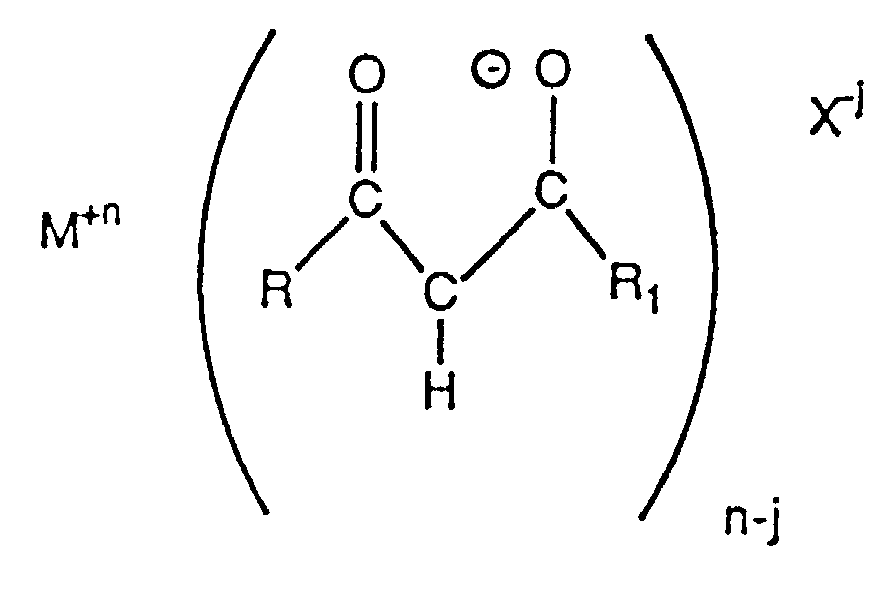 R und R1, die gleich oder verschieden sein können, Alkyl mit 1 bis 18 Kohlenstoffatomen, substituiertes Alkyl mit 1 bis 18 Kohlenstoffatomen oder Aryl mit 6 bis 30 Kohlenstoffatomen sind;+n die Wertigkeit des Metalls ist;j 0 bis n-1 beträgt; undX- aus der Gruppe ausgewählt ist, die aus OH, Cl, F, Sulfat, Nitrat, Chlorat, Phosphat, Acetat, Alkylcarboxylat mit 1 bis 18 Kohlenstoffatomen oder Arylcarboxylat mit 6 bis 30 Kohlenstoffatomen besteht, und(b) wenigstens einer metallorganischen Verbindung, die aus der Gruppe ausgewählt ist, die aus M+n(R-)n, M+n(CO2R'-)n und M+n(OR"-)n besteht, wobei R, R' und R" unabhängig aus der Gruppe ausgewählt sind, die aus einem linearen oder verzweigten Kohlenwasserstoff mit 1 bis 30 Kohlenstoffatomen oder einem linearen oder verzweigten substituierten Kohlenwasserstoff mit 10 bis 30 Kohlenstoffatomen besteht, M ein Metall ist und n wenigstens 2 beträgt und gleich der Wertigkeit des Metalls ist.
 - Toner gemäß Anspruch 1, wobei das organische thermoplastische Polymer ein Terpolymer ist, das aus im wesentlichen gleichen Gewichtsprozentanteilen Styrol, α-Methylstyrol und einer Säure, die aus der Gruppe ausgewählt ist, die aus Acrylsäure und Methacrylsäure besteht, besteht, wobei das Terpolymer ein mittleres Molekulargewicht im Bereich von 1000 bis 100 000 hat und in einer Menge im Bereich von 10 bis 70 Gew.-% vorhanden ist.
- Toner gemäß Anspruch 1, wobei das organische thermoplastische Polymer im wesentlichen aus Methylmethacrylat und Acrylsäure besteht.
- Toner gemäß Anspruch 1, wobei der lineare oder verzweigte Kohlenwasserstoff mit 10 bis 30 Kohlenstoffatomen mit wenigstens einem Substituenten substituiert ist, der aus der Gruppe ausgewählt ist, die aus einem Halogen, einer oder mehreren Hydroxygruppen, Nitro, Cyclopentyl, Cyclohexyl und Aryl besteht.
- Toner gemäß Anspruch 1, wobei es sich bei dem β-Diketon um Zinkacetylacetonat handelt.
- Toner gemäß Anspruch 1, wobei es sich bei dem β-Diketon um Titanacetylacetonat handelt.
- Toner gemäß Anspruch 1, wobei es sich bei dem β-Diketon um Aluminiumacetylacetonat handelt.
- Toner gemäß Anspruch 1, wobei die in der Formel für die β-Diketonverbindung an M+n gebundenen Substituenten aus der Gruppe ausgewählt sind, die aus Propionat, Butyrat, Hexoat, Octoat, Nonoat, 2-Ethylhexoat, Neodecanoat, Naphthenat, Ethoxid, Butyl und Isopropyl besteht und M aus der Gruppe ausgewählt ist, die aus Bi, Ca, Ce, Co, Fe, Mg, Mo, Mn, Ni, Pb, Ti, V, Zn und Zr besteht.
- Toner gemäß Anspruch 1, wobei die metallorganische Verbindung aus der Gruppe ausgewählt ist, die aus Zinknaphthenat, Zink-2-ethylhexoat, Zinkoctoat, Zirconiumoctoat, Zirconium-2-ethylhexoat, Manganoctoat, Mangannaphthenat, Mangan-2-ethylhexoat, Barium-2-ethylhexoat, Cobaltnaphthenat, Calciumoctoat, Calciumnaphthenat, Calcium-2-ethylhexoat, Calciumnonoat, Nickeloctoat, Bismutoctoat, Bismutneodecanoat, Bismut-2-ethylhexoat, Bleioctoat, Cobaltoctoat, Bleinaphthenat, Cernaphthenat, Cer-2-ethylhexoat, Tetrabutyltitanat, Tetrakis (2-ethylhexyl)titanat, Titantetraethoxid, Tetraisopropyltitanat, Calcium-, Cer-, Cobalt-, Blei-, Mangan-, Zink- und Zirconiumneodecanoat und Gemischen davon besteht.
- Toner gemäß Anspruch 1, wobei es sich bei der Säure um Acrylsäure handelt.
- Toner gemäß Anspruch 1, wobei es sich bei dem Weichmacher um Triphenylphosphat handelt.
- Toner gemäß Anspruch 1, wobei ein Färbemittel in einer Menge im Bereich von 0,5% bis 50% vorhanden ist.
- Toner gemäß Anspruch 1, wobei das Terpolymer in einer Menge von 10 bis 70 Gew.-% des Gesamtgewichts des Toners vorhanden ist.
- Toner gemäß Anspruch 2, wobei das Terpolymer ein Molekulargewicht im Bereich von 1500 bis 10000 hat.
- Toner gemäß Anspruch 2, wobei das Terpolymer ein Molekulargewicht im Bereich von 2000 bis 8000 hat.
- Toner gemäß Anspruch 1 oder 11, wobei der Weichmacher in einer Menge von etwa 50 bis 70% des Gesamtgewichts des Toners vorhanden ist.
- Verfahren zur Erzeugung eines Bildes aus einem Element mit einem latenten Bild, wobei das Bild toneraufnehmende und Hintergrundbereiche aufweist, umfassend:(a) Auftragen eines Toners mit anhaltender Klebrigkeit gemäß Anspruch 1 auf das latente Bild des Elements unter Bildung eines nichtklebrigen getonten Bildes;(b) Erhitzen des getonten Bildes auf eine Temperatur, die ausreicht, um den Toner zu aktivieren, indem der Toner klebrig wird;(c) Bringen des klebrigen getonten Elements in innigen Kontakt mit einem Bildrezeptor und, während der Toner noch aktiviert ist,(d) Trennen des Elements und des Bildrezeptors, wodurch ein Teil des aktivierten Toners mit anhaltender Klebrigkeit bildartig auf den Rezeptor übertragen wird; und(e) Erhitzen des übertragenen Tonerbildes auf dem Rezeptor auf eine Temperatur von etwa 90 bis 400°C, also oberhalb der Toneraktivierungstemperatur, so daß der Toner mit anhaltender Klebrigkeit vernetzt wird.
- Verfahren gemäß Anspruch 17, wobei nach Schritt (d) folgendes durchgeführt wird:(d') Reduzieren der Temperatur des klebrig gemachten getonten Bildes unter die Aktivierungstemperatur des Toners mit anhaltender Klebrigkeit, wobei der Toner klebrig bleibt;(d") Auftragen von trockenem teilchenförmigem Toner mit anhaltender Klebrigkeit über den restlichen klebrigen Toner auf dem Element; und(d"') wenigstens einmal Wiederholen der Schritte (b) bis (d) unter Verwendung eines getrennten Bildrezeptors in Schritt (c).
- Verfahren gemäß Anspruch 17 oder 18, wobei das getonte Bild bei einer Temperatur im Bereich von 20°C bis 70°C übertragen wird.
- Verfahren zur Erzeugung eines Bildes aus einem Element mit einem latenten Bild, wobei das Bild toneraufnehmende und Hintergrundbereiche aufweist, umfassend:(a) Auftragen eines Toners mit anhaltender Klebrigkeit gemäß Anspruch 1 auf das latente Bild des Elements unter Bildung eines nichtklebrigen getonten Bildes;(b) Erhitzen des getonten Bildes auf eine Temperatur, die ausreicht, um den Toner zu aktivieren, indem der Toner klebrig wird;(c) Bringen des klebrigen getonten Elements in innigen Kontakt mit einem Bildrezeptor und, während der Toner noch aktiviert ist,(d) Trennen des Elements und des Bildrezeptors, wodurch ein Teil des aktivierten Toners mit anhaltender Klebrigkeit bildartig auf den Rezeptor übertragen wird;(e) Reduzieren der Temperatur des klebrig gemachten getonten Bildes auf dem Bildrezeptor unter die Aktivierungstemperatur des Toners mit anhaltender Klebrigkeit, wobei der Toner klebrig bleibt;(f) Auftragen von trockenem teilchenförmigem Toner mit anhaltender Klebrigkeit über das noch klebrige Bild auf dem Bildrezeptor, so daß die Dichte des getonten übertragenen Bildes erhöht wird; und(g) Erhitzen des übertragenen Tonerbildes auf dem Rezeptor auf eine Temperatur von 90 bis 400°C, also oberhalb der Toneraktivierungstemperatur, so daß der Toner mit anhaltender Klebrigkeit vernetzt wird.
- Verfahren gemäß Anspruch 20, wobei nach Schritt (g) die Schritte (b) bis (f) wenigstens einmal unter Verwendung eines anderen Bildrezeptors in Schritt (c) wiederholt werden.
- Verfahren gemäß Anspruch 20 oder 21, wobei das getonte Bild bei einer Temperatur im Bereich von 20°C bis 70°C übertragen wird.
- Verfahren zur Erzeugung eines Bildes aus einem Element mit einem latenten Bild, das toneraufnehmende und Hintergrundbereiche aufweist, umfassend:wobei die Schritte (a) bis (d) wenigstens zweimal wiederholt werden, wobei andere Elemente mit klebrigen toneraufnehmenden Bereichen und nichtklebrigen Hintergrundbereichen, die durch Belichtung mit aktinischer Strahlung durch verschiedene Farbauszugsfolien darin gebildet sind, verwendet werden, und der Übertragungsschritt erreicht wird, indem man Toner der geeigneten Farbe in bezug auf die Auszugsfolien paßgenau auf einen einzigen Bildrezeptor überträgt.(a) Auftragen eines Toners mit anhaltender Klebrigkeit gemäß Anspruch 1 auf das latente Bild des Elements unter Bildung eines nichtklebrigen getonten Bildes;(b) Erhitzen des getonten Bildes auf eine Temperatur, die ausreicht, um den Toner zu aktivieren, indem der Toner klebrig wird;(c) Bringen des klebrigen getonten Elements in innigen Kontakt mit einem Bildrezeptor und, während der Toner noch aktiviert ist,(d) Trennen des Elements und des Bildrezeptors, wodurch ein Teil des aktivierten Toners mit anhaltender Klebrigkeit bildartig auf den Bildrezeptor übertragen wird;(e) Erhitzen des übertragenen Tonerbildes auf dem Rezeptor auf eine Temperatur von 90 bis 400°C, also oberhalb der Toneraktivierungstemperatur, so daß der Toner mit anhaltender Klebrigkeit vernetzt wird;
- Verfahren gemäß Anspruch 23, wobei nach Schritt (d) die folgenden Schritte durchgeführt werden:(d') Reduzieren der Temperatur des klebrig gemachten getonten Bildes auf dem Element unter die Aktivierungstemperatur des Toners mit anhaltender Klebrigkeit, wobei der Toner klebrig bleibt;(d") Auftragen von trockenem teilchenförmigem Toner mit anhaltender Klebrigkeit über den restlichen klebrigen Toner auf dem Element; und(d"') wenigstens einmal Wiederholen der Schritte (b) bis (d) unter Verwendung eines getrennten Bildrezeptors in Schritt (c).
- Verfahren gemäß Anspruch 23, wobei es sich bei dem Bildrezeptor um Papier handelt.
- Verfahren gemäß Anspruch 23, wobei es sich bei dem Bildrezeptor um beschichtetes Papier handelt.
- Verfahren gemäß Anspruch 17 oder 18, wobei der Bildrezeptor eine Aluminiumplatte ist und das Bild nach der Bildübertragung auf eine Temperatur von bis zu etwa 150°C erhitzt, mit lithographischen Lösungen behandelt und als lithographische Druckplatte verwendet wird.
- Verfahren gemäß Anspruch 23, wobei das getonte Bild bei einer Temperatur im Bereich von 20°C bis 70°C übertragen wird.
- Verfahren gemäß Anspruch 27, wobei das getonte Bild bei einer Temperatur im Bereich von 20°C bis 70°C übertragen wird.
- Verfahren gemäß Anspruch 23, wobei die Schritte (a) bis (d) viermal wiederholt werden.
- Verfahren gemäß Anspruch 24, wobei die Schritte (b) bis (d"') viermal wiederholt werden.
Applications Claiming Priority (2)
| Application Number | Priority Date | Filing Date | Title |
|---|---|---|---|
| US07/661,986 US5240814A (en) | 1991-02-27 | 1991-02-27 | Curable, heat activatable transfer toners |
| US661986 | 1991-02-27 |
Publications (2)
| Publication Number | Publication Date |
|---|---|
| EP0501397A1 EP0501397A1 (de) | 1992-09-02 |
| EP0501397B1 true EP0501397B1 (de) | 1998-11-11 |
Family
ID=24655928
Family Applications (1)
| Application Number | Title | Priority Date | Filing Date |
|---|---|---|---|
| EP92103117A Expired - Lifetime EP0501397B1 (de) | 1991-02-27 | 1992-02-25 | Härtbare, hitzeaktivierbare Transfertoner |
Country Status (5)
| Country | Link |
|---|---|
| US (1) | US5240814A (de) |
| EP (1) | EP0501397B1 (de) |
| JP (1) | JP2697991B2 (de) |
| CA (1) | CA2061672A1 (de) |
| DE (1) | DE69227531T2 (de) |
Families Citing this family (6)
| Publication number | Priority date | Publication date | Assignee | Title |
|---|---|---|---|---|
| US5411778A (en) * | 1994-09-26 | 1995-05-02 | International Business Machines Corp. | Rollers for use in electrophotographic development |
| JP3863744B2 (ja) * | 2001-08-31 | 2006-12-27 | 株式会社巴川製紙所 | リサイクルシステム用トナー及びそれを用いたトナーリサイクル式現像方法 |
| WO2005066719A1 (ja) * | 2003-12-26 | 2005-07-21 | Orient Chemical Industries, Ltd. | 正帯電性荷電制御剤及び静電荷像現像用トナー |
| EP1686426B1 (de) * | 2005-01-26 | 2012-11-21 | Ricoh Company, Ltd. | Toner und Herstellungsverfahren des Toners |
| JP2013064954A (ja) * | 2011-09-20 | 2013-04-11 | Fuji Xerox Co Ltd | 静電荷像現像用トナー、静電荷像現像剤、トナーカートリッジ、画像形成方法及び画像形成装置 |
| JP5845965B2 (ja) | 2012-02-24 | 2016-01-20 | 富士ゼロックス株式会社 | 静電荷像現像用透明トナー、静電荷像現像剤、トナーカートリッジ、画像形成方法及び画像形成装置 |
Family Cites Families (9)
| Publication number | Priority date | Publication date | Assignee | Title |
|---|---|---|---|---|
| GB1157077A (en) * | 1966-09-13 | 1969-07-02 | Molins Machine Co Ltd | Particulate Ink Systems |
| US3723114A (en) * | 1970-02-04 | 1973-03-27 | Xerox Corp | Thermosetting electrostatographic developer of a carrier and preploymer of diallyl phthalate, isophthalate and mixtures |
| US4469625A (en) * | 1980-02-25 | 1984-09-04 | E. I. Du Pont De Nemours And Company | Prolonged tack toners for the preparation of electric circuits |
| US4461823A (en) * | 1980-02-25 | 1984-07-24 | E. I. Du Pont De Nemours And Company | Multiple transfer of tacky image areas using prolonged tack toners |
| US4355055A (en) * | 1980-02-25 | 1982-10-19 | E. I. Du Pont De Nemours And Company | Use of prolonged tack toners for the preparation of multilayer electric circuits |
| DE3215550C2 (de) * | 1981-04-27 | 1986-07-03 | Canon K.K., Tokio/Tokyo | Toner und Verfahren zu dessen Herstellung |
| US4579802A (en) * | 1982-09-14 | 1986-04-01 | Konishiroku Photo Industry Co. Ltd. | Method of fixing toner image |
| JPH01126302A (ja) * | 1987-11-10 | 1989-05-18 | Nippon Paint Co Ltd | 光重合性組成物 |
| US5039588A (en) * | 1989-10-16 | 1991-08-13 | E. I. Du Pont De Nemours And Company | Non-electroscopic prolonged tack toners |
-
1991
- 1991-02-27 US US07/661,986 patent/US5240814A/en not_active Expired - Lifetime
-
1992
- 1992-02-21 CA CA002061672A patent/CA2061672A1/en not_active Abandoned
- 1992-02-25 DE DE69227531T patent/DE69227531T2/de not_active Expired - Fee Related
- 1992-02-25 EP EP92103117A patent/EP0501397B1/de not_active Expired - Lifetime
- 1992-02-27 JP JP4041739A patent/JP2697991B2/ja not_active Expired - Fee Related
Also Published As
| Publication number | Publication date |
|---|---|
| DE69227531T2 (de) | 1999-05-12 |
| JPH0572726A (ja) | 1993-03-26 |
| CA2061672A1 (en) | 1992-08-28 |
| EP0501397A1 (de) | 1992-09-02 |
| JP2697991B2 (ja) | 1998-01-19 |
| DE69227531D1 (de) | 1998-12-17 |
| US5240814A (en) | 1993-08-31 |
Similar Documents
| Publication | Publication Date | Title |
|---|---|---|
| US3607264A (en) | Image reproduction process involving photohardening and delamination | |
| US3649268A (en) | Process for forming images by photohardening and applying a colorant | |
| US3615435A (en) | Photohardenable image reproduction element with integral pigmented layer and process for use | |
| JPS63309946A (ja) | 転写層用の圧縮可能な一時的支持体 | |
| US4461823A (en) | Multiple transfer of tacky image areas using prolonged tack toners | |
| JPH02176753A (ja) | 光重合性ポジ作動画像形成システムに対する顔料転送法 | |
| EP0501396B1 (de) | UV-härtbarer, wärmeaktivierbarer Übertragungstoner | |
| JPH021863A (ja) | 画像形成方法 | |
| US5240814A (en) | Curable, heat activatable transfer toners | |
| JPH0549979B2 (de) | ||
| CA2068401A1 (en) | Photopolymerizable, negative working, peel developable, single sheet color proofing system | |
| EP0553638B1 (de) | Übertragungsverfahren unter Verwendung von Ultraviolett-härtbaren Tonern ohne verlängerte Klebrigkeit | |
| EP0495923B1 (de) | Nichtelektroskopischer toner mit verlängerter klebrigkeit | |
| EP0501403B1 (de) | Verfahren zur Verhinderung der Klebrigkeit von Tonerbildern nach ihrer Übertragung | |
| US3736138A (en) | Process for transferring images from a surface to a temporary surface and to a final surface | |
| JPH06332164A (ja) | 光重合性材料、および着色画像の製造法 | |
| CA1157710A (en) | Multiple transfer of tacky image areas using prolonged tack toners | |
| JPH05158227A (ja) | 画像形成方法 |
Legal Events
| Date | Code | Title | Description |
|---|---|---|---|
| PUAI | Public reference made under article 153(3) epc to a published international application that has entered the european phase |
Free format text: ORIGINAL CODE: 0009012 |
|
| AK | Designated contracting states |
Kind code of ref document: A1 Designated state(s): DE FR GB IT |
|
| 17P | Request for examination filed |
Effective date: 19930122 |
|
| 17Q | First examination report despatched |
Effective date: 19970109 |
|
| GRAG | Despatch of communication of intention to grant |
Free format text: ORIGINAL CODE: EPIDOS AGRA |
|
| GRAG | Despatch of communication of intention to grant |
Free format text: ORIGINAL CODE: EPIDOS AGRA |
|
| GRAG | Despatch of communication of intention to grant |
Free format text: ORIGINAL CODE: EPIDOS AGRA |
|
| GRAH | Despatch of communication of intention to grant a patent |
Free format text: ORIGINAL CODE: EPIDOS IGRA |
|
| GRAH | Despatch of communication of intention to grant a patent |
Free format text: ORIGINAL CODE: EPIDOS IGRA |
|
| GRAA | (expected) grant |
Free format text: ORIGINAL CODE: 0009210 |
|
| AK | Designated contracting states |
Kind code of ref document: B1 Designated state(s): DE FR GB IT |
|
| REF | Corresponds to: |
Ref document number: 69227531 Country of ref document: DE Date of ref document: 19981217 |
|
| ITF | It: translation for a ep patent filed | ||
| ET | Fr: translation filed | ||
| PLBE | No opposition filed within time limit |
Free format text: ORIGINAL CODE: 0009261 |
|
| STAA | Information on the status of an ep patent application or granted ep patent |
Free format text: STATUS: NO OPPOSITION FILED WITHIN TIME LIMIT |
|
| 26N | No opposition filed | ||
| REG | Reference to a national code |
Ref country code: GB Ref legal event code: IF02 |
|
| PGFP | Annual fee paid to national office [announced via postgrant information from national office to epo] |
Ref country code: DE Payment date: 20090219 Year of fee payment: 18 |
|
| PGFP | Annual fee paid to national office [announced via postgrant information from national office to epo] |
Ref country code: GB Payment date: 20090225 Year of fee payment: 18 |
|
| PGFP | Annual fee paid to national office [announced via postgrant information from national office to epo] |
Ref country code: IT Payment date: 20090217 Year of fee payment: 18 |
|
| PGFP | Annual fee paid to national office [announced via postgrant information from national office to epo] |
Ref country code: FR Payment date: 20090213 Year of fee payment: 18 |
|
| GBPC | Gb: european patent ceased through non-payment of renewal fee |
Effective date: 20100225 |
|
| REG | Reference to a national code |
Ref country code: FR Ref legal event code: ST Effective date: 20101029 |
|
| PG25 | Lapsed in a contracting state [announced via postgrant information from national office to epo] |
Ref country code: FR Free format text: LAPSE BECAUSE OF NON-PAYMENT OF DUE FEES Effective date: 20100301 |
|
| PG25 | Lapsed in a contracting state [announced via postgrant information from national office to epo] |
Ref country code: DE Free format text: LAPSE BECAUSE OF NON-PAYMENT OF DUE FEES Effective date: 20100901 |
|
| PG25 | Lapsed in a contracting state [announced via postgrant information from national office to epo] |
Ref country code: GB Free format text: LAPSE BECAUSE OF NON-PAYMENT OF DUE FEES Effective date: 20100225 Ref country code: IT Free format text: LAPSE BECAUSE OF NON-PAYMENT OF DUE FEES Effective date: 20100225 |