EP0501865A1 - Procédé de fabrication de matériau thermoplastique, matériau thermoplastique obtenu et son utilisation comme matériau transparent résistant à haute température - Google Patents
Procédé de fabrication de matériau thermoplastique, matériau thermoplastique obtenu et son utilisation comme matériau transparent résistant à haute température Download PDFInfo
- Publication number
- EP0501865A1 EP0501865A1 EP92400469A EP92400469A EP0501865A1 EP 0501865 A1 EP0501865 A1 EP 0501865A1 EP 92400469 A EP92400469 A EP 92400469A EP 92400469 A EP92400469 A EP 92400469A EP 0501865 A1 EP0501865 A1 EP 0501865A1
- Authority
- EP
- European Patent Office
- Prior art keywords
- thermoplastic material
- process according
- polymer
- units
- maleic anhydride
- Prior art date
- Legal status (The legal status is an assumption and is not a legal conclusion. Google has not performed a legal analysis and makes no representation as to the accuracy of the status listed.)
- Ceased
Links
- 238000000034 method Methods 0.000 title claims abstract description 30
- 230000008569 process Effects 0.000 title claims abstract description 22
- 238000004519 manufacturing process Methods 0.000 title claims abstract description 21
- 239000012815 thermoplastic material Substances 0.000 title claims abstract description 15
- 239000012780 transparent material Substances 0.000 title 1
- 229920000642 polymer Polymers 0.000 claims abstract description 65
- 230000009477 glass transition Effects 0.000 claims abstract description 24
- 239000000203 mixture Substances 0.000 claims abstract description 21
- 150000008064 anhydrides Chemical group 0.000 claims abstract description 14
- DFPAKSUCGFBDDF-UHFFFAOYSA-N Nicotinamide Chemical group NC(=O)C1=CC=CN=C1 DFPAKSUCGFBDDF-UHFFFAOYSA-N 0.000 claims abstract description 12
- 239000000470 constituent Substances 0.000 claims abstract description 5
- 150000001412 amines Chemical class 0.000 claims description 21
- 238000007363 ring formation reaction Methods 0.000 claims description 21
- 239000000178 monomer Substances 0.000 claims description 17
- 150000003141 primary amines Chemical class 0.000 claims description 17
- FPYJFEHAWHCUMM-UHFFFAOYSA-N maleic anhydride Chemical compound O=C1OC(=O)C=C1 FPYJFEHAWHCUMM-UHFFFAOYSA-N 0.000 claims description 16
- 229920001577 copolymer Polymers 0.000 claims description 15
- 229920001897 terpolymer Polymers 0.000 claims description 10
- 125000000391 vinyl group Chemical group [H]C([*])=C([H])[H] 0.000 claims description 7
- NIXOWILDQLNWCW-UHFFFAOYSA-N acrylic acid group Chemical group C(C=C)(=O)O NIXOWILDQLNWCW-UHFFFAOYSA-N 0.000 claims description 6
- 229920002554 vinyl polymer Polymers 0.000 claims description 5
- JHPBZFOKBAGZBL-UHFFFAOYSA-N (3-hydroxy-2,2,4-trimethylpentyl) 2-methylprop-2-enoate Chemical compound CC(C)C(O)C(C)(C)COC(=O)C(C)=C JHPBZFOKBAGZBL-UHFFFAOYSA-N 0.000 claims description 4
- 229920006352 transparent thermoplastic Polymers 0.000 claims 1
- 230000003287 optical effect Effects 0.000 abstract description 8
- 125000002924 primary amino group Chemical class [H]N([H])* 0.000 abstract 2
- 238000006798 ring closing metathesis reaction Methods 0.000 abstract 1
- YXFVVABEGXRONW-UHFFFAOYSA-N Toluene Chemical compound CC1=CC=CC=C1 YXFVVABEGXRONW-UHFFFAOYSA-N 0.000 description 45
- 239000000463 material Substances 0.000 description 25
- PPBRXRYQALVLMV-UHFFFAOYSA-N Styrene Chemical compound C=CC1=CC=CC=C1 PPBRXRYQALVLMV-UHFFFAOYSA-N 0.000 description 23
- OKKJLVBELUTLKV-UHFFFAOYSA-N Methanol Chemical compound OC OKKJLVBELUTLKV-UHFFFAOYSA-N 0.000 description 21
- CTSLXHKWHWQRSH-UHFFFAOYSA-N oxalyl chloride Chemical compound ClC(=O)C(Cl)=O CTSLXHKWHWQRSH-UHFFFAOYSA-N 0.000 description 18
- PAFZNILMFXTMIY-UHFFFAOYSA-N cyclohexylamine Chemical compound NC1CCCCC1 PAFZNILMFXTMIY-UHFFFAOYSA-N 0.000 description 16
- 238000006243 chemical reaction Methods 0.000 description 14
- IJGRMHOSHXDMSA-UHFFFAOYSA-N Atomic nitrogen Chemical compound N#N IJGRMHOSHXDMSA-UHFFFAOYSA-N 0.000 description 12
- 238000002329 infrared spectrum Methods 0.000 description 10
- JJWLVOIRVHMVIS-UHFFFAOYSA-N isopropylamine Chemical compound CC(C)N JJWLVOIRVHMVIS-UHFFFAOYSA-N 0.000 description 10
- VVQNEPGJFQJSBK-UHFFFAOYSA-N Methyl methacrylate Chemical compound COC(=O)C(C)=C VVQNEPGJFQJSBK-UHFFFAOYSA-N 0.000 description 9
- ZMANZCXQSJIPKH-UHFFFAOYSA-N Triethylamine Chemical compound CCN(CC)CC ZMANZCXQSJIPKH-UHFFFAOYSA-N 0.000 description 9
- 239000013307 optical fiber Substances 0.000 description 9
- 238000007334 copolymerization reaction Methods 0.000 description 8
- 238000010438 heat treatment Methods 0.000 description 8
- 238000006116 polymerization reaction Methods 0.000 description 8
- WFDIJRYMOXRFFG-UHFFFAOYSA-N Acetic anhydride Chemical compound CC(=O)OC(C)=O WFDIJRYMOXRFFG-UHFFFAOYSA-N 0.000 description 6
- 229910052757 nitrogen Inorganic materials 0.000 description 6
- 238000011282 treatment Methods 0.000 description 6
- BQTPKSBXMONSJI-UHFFFAOYSA-N 1-cyclohexylpyrrole-2,5-dione Chemical compound O=C1C=CC(=O)N1C1CCCCC1 BQTPKSBXMONSJI-UHFFFAOYSA-N 0.000 description 5
- 230000008901 benefit Effects 0.000 description 5
- 230000018044 dehydration Effects 0.000 description 5
- 238000006297 dehydration reaction Methods 0.000 description 5
- 150000002734 metacrylic acid derivatives Chemical class 0.000 description 5
- CERQOIWHTDAKMF-UHFFFAOYSA-M methacrylate group Chemical group C(C(=C)C)(=O)[O-] CERQOIWHTDAKMF-UHFFFAOYSA-M 0.000 description 5
- 230000004048 modification Effects 0.000 description 5
- 238000012986 modification Methods 0.000 description 5
- 239000000047 product Substances 0.000 description 5
- 150000003923 2,5-pyrrolediones Chemical class 0.000 description 4
- HEDRZPFGACZZDS-UHFFFAOYSA-N Chloroform Chemical compound ClC(Cl)Cl HEDRZPFGACZZDS-UHFFFAOYSA-N 0.000 description 4
- ATUOYWHBWRKTHZ-UHFFFAOYSA-N Propane Chemical compound CCC ATUOYWHBWRKTHZ-UHFFFAOYSA-N 0.000 description 4
- 239000002253 acid Substances 0.000 description 4
- 150000001252 acrylic acid derivatives Chemical class 0.000 description 4
- 125000000217 alkyl group Chemical group 0.000 description 4
- 230000005540 biological transmission Effects 0.000 description 4
- -1 des motifs anhydrides Chemical class 0.000 description 4
- 150000002148 esters Chemical group 0.000 description 4
- 150000003949 imides Chemical class 0.000 description 4
- 125000005395 methacrylic acid group Chemical group 0.000 description 4
- 229920003229 poly(methyl methacrylate) Polymers 0.000 description 4
- 239000004926 polymethyl methacrylate Substances 0.000 description 4
- 238000002360 preparation method Methods 0.000 description 4
- 239000012429 reaction media Substances 0.000 description 4
- 238000011160 research Methods 0.000 description 4
- 239000002904 solvent Substances 0.000 description 4
- UHOVQNZJYSORNB-UHFFFAOYSA-N Benzene Chemical compound C1=CC=CC=C1 UHOVQNZJYSORNB-UHFFFAOYSA-N 0.000 description 3
- 239000004342 Benzoyl peroxide Substances 0.000 description 3
- OMPJBNCRMGITSC-UHFFFAOYSA-N Benzoylperoxide Chemical compound C=1C=CC=CC=1C(=O)OOC(=O)C1=CC=CC=C1 OMPJBNCRMGITSC-UHFFFAOYSA-N 0.000 description 3
- 238000005481 NMR spectroscopy Methods 0.000 description 3
- XYLMUPLGERFSHI-UHFFFAOYSA-N alpha-Methylstyrene Chemical compound CC(=C)C1=CC=CC=C1 XYLMUPLGERFSHI-UHFFFAOYSA-N 0.000 description 3
- 235000019400 benzoyl peroxide Nutrition 0.000 description 3
- 230000015572 biosynthetic process Effects 0.000 description 3
- HQABUPZFAYXKJW-UHFFFAOYSA-N butan-1-amine Chemical compound CCCCN HQABUPZFAYXKJW-UHFFFAOYSA-N 0.000 description 3
- 239000006227 byproduct Substances 0.000 description 3
- 239000012024 dehydrating agents Substances 0.000 description 3
- 238000001035 drying Methods 0.000 description 3
- 239000012535 impurity Substances 0.000 description 3
- VLKZOEOYAKHREP-UHFFFAOYSA-N n-Hexane Chemical compound CCCCCC VLKZOEOYAKHREP-UHFFFAOYSA-N 0.000 description 3
- 239000013308 plastic optical fiber Substances 0.000 description 3
- 239000004417 polycarbonate Substances 0.000 description 3
- 229920000515 polycarbonate Polymers 0.000 description 3
- 239000000843 powder Substances 0.000 description 3
- 239000002244 precipitate Substances 0.000 description 3
- 239000000126 substance Substances 0.000 description 3
- NQDOCLXQTQYUDH-UHFFFAOYSA-N 1-propan-2-ylpyrrole-2,5-dione Chemical compound CC(C)N1C(=O)C=CC1=O NQDOCLXQTQYUDH-UHFFFAOYSA-N 0.000 description 2
- NGNBDVOYPDDBFK-UHFFFAOYSA-N 2-[2,4-di(pentan-2-yl)phenoxy]acetyl chloride Chemical compound CCCC(C)C1=CC=C(OCC(Cl)=O)C(C(C)CCC)=C1 NGNBDVOYPDDBFK-UHFFFAOYSA-N 0.000 description 2
- PAYRUJLWNCNPSJ-UHFFFAOYSA-N Aniline Chemical compound NC1=CC=CC=C1 PAYRUJLWNCNPSJ-UHFFFAOYSA-N 0.000 description 2
- CURLTUGMZLYLDI-UHFFFAOYSA-N Carbon dioxide Chemical compound O=C=O CURLTUGMZLYLDI-UHFFFAOYSA-N 0.000 description 2
- LFQSCWFLJHTTHZ-UHFFFAOYSA-N Ethanol Chemical compound CCO LFQSCWFLJHTTHZ-UHFFFAOYSA-N 0.000 description 2
- QUSNBJAOOMFDIB-UHFFFAOYSA-N Ethylamine Chemical compound CCN QUSNBJAOOMFDIB-UHFFFAOYSA-N 0.000 description 2
- VEXZGXHMUGYJMC-UHFFFAOYSA-N Hydrochloric acid Chemical compound Cl VEXZGXHMUGYJMC-UHFFFAOYSA-N 0.000 description 2
- 238000004566 IR spectroscopy Methods 0.000 description 2
- BAVYZALUXZFZLV-UHFFFAOYSA-N Methylamine Chemical compound NC BAVYZALUXZFZLV-UHFFFAOYSA-N 0.000 description 2
- 239000004793 Polystyrene Substances 0.000 description 2
- VYPSYNLAJGMNEJ-UHFFFAOYSA-N Silicium dioxide Chemical compound O=[Si]=O VYPSYNLAJGMNEJ-UHFFFAOYSA-N 0.000 description 2
- VMHLLURERBWHNL-UHFFFAOYSA-M Sodium acetate Chemical compound [Na+].CC([O-])=O VMHLLURERBWHNL-UHFFFAOYSA-M 0.000 description 2
- 230000009471 action Effects 0.000 description 2
- 230000032683 aging Effects 0.000 description 2
- 230000004075 alteration Effects 0.000 description 2
- 125000003368 amide group Chemical group 0.000 description 2
- 125000003118 aryl group Chemical group 0.000 description 2
- 125000004429 atom Chemical group 0.000 description 2
- 238000007707 calorimetry Methods 0.000 description 2
- 239000011248 coating agent Substances 0.000 description 2
- 238000000576 coating method Methods 0.000 description 2
- 150000001875 compounds Chemical class 0.000 description 2
- 239000012141 concentrate Substances 0.000 description 2
- 238000001816 cooling Methods 0.000 description 2
- 238000004132 cross linking Methods 0.000 description 2
- 238000001125 extrusion Methods 0.000 description 2
- 239000000835 fiber Substances 0.000 description 2
- 238000001914 filtration Methods 0.000 description 2
- 229920002313 fluoropolymer Polymers 0.000 description 2
- 238000010907 mechanical stirring Methods 0.000 description 2
- 238000000655 nuclear magnetic resonance spectrum Methods 0.000 description 2
- KNCYXPMJDCCGSJ-UHFFFAOYSA-N piperidine-2,6-dione Chemical group O=C1CCCC(=O)N1 KNCYXPMJDCCGSJ-UHFFFAOYSA-N 0.000 description 2
- 239000001294 propane Substances 0.000 description 2
- 239000001632 sodium acetate Substances 0.000 description 2
- 235000017281 sodium acetate Nutrition 0.000 description 2
- KZNICNPSHKQLFF-UHFFFAOYSA-N succinimide Chemical group O=C1CCC(=O)N1 KZNICNPSHKQLFF-UHFFFAOYSA-N 0.000 description 2
- 239000000725 suspension Substances 0.000 description 2
- XLYOFNOQVPJJNP-UHFFFAOYSA-N water Substances O XLYOFNOQVPJJNP-UHFFFAOYSA-N 0.000 description 2
- DTGKSKDOIYIVQL-WEDXCCLWSA-N (+)-borneol Chemical group C1C[C@@]2(C)[C@@H](O)C[C@@H]1C2(C)C DTGKSKDOIYIVQL-WEDXCCLWSA-N 0.000 description 1
- XDIAMRVROCPPBK-UHFFFAOYSA-N 2,2-dimethylpropan-1-amine Chemical compound CC(C)(C)CN XDIAMRVROCPPBK-UHFFFAOYSA-N 0.000 description 1
- PYSRRFNXTXNWCD-UHFFFAOYSA-N 3-(2-phenylethenyl)furan-2,5-dione Chemical compound O=C1OC(=O)C(C=CC=2C=CC=CC=2)=C1 PYSRRFNXTXNWCD-UHFFFAOYSA-N 0.000 description 1
- UGFAIRIUMAVXCW-UHFFFAOYSA-N Carbon monoxide Chemical compound [O+]#[C-] UGFAIRIUMAVXCW-UHFFFAOYSA-N 0.000 description 1
- OKTJSMMVPCPJKN-OUBTZVSYSA-N Carbon-13 Chemical compound [13C] OKTJSMMVPCPJKN-OUBTZVSYSA-N 0.000 description 1
- RYGMFSIKBFXOCR-UHFFFAOYSA-N Copper Chemical compound [Cu] RYGMFSIKBFXOCR-UHFFFAOYSA-N 0.000 description 1
- XDTMQSROBMDMFD-UHFFFAOYSA-N Cyclohexane Chemical compound C1CCCCC1 XDTMQSROBMDMFD-UHFFFAOYSA-N 0.000 description 1
- PIICEJLVQHRZGT-UHFFFAOYSA-N Ethylenediamine Chemical compound NCCN PIICEJLVQHRZGT-UHFFFAOYSA-N 0.000 description 1
- UFHFLCQGNIYNRP-UHFFFAOYSA-N Hydrogen Chemical compound [H][H] UFHFLCQGNIYNRP-UHFFFAOYSA-N 0.000 description 1
- 239000004642 Polyimide Substances 0.000 description 1
- 229920000147 Styrene maleic anhydride Polymers 0.000 description 1
- 150000008065 acid anhydrides Chemical class 0.000 description 1
- 125000002723 alicyclic group Chemical group 0.000 description 1
- 150000001336 alkenes Chemical class 0.000 description 1
- 150000003973 alkyl amines Chemical class 0.000 description 1
- 229920006125 amorphous polymer Polymers 0.000 description 1
- 238000004458 analytical method Methods 0.000 description 1
- 238000013459 approach Methods 0.000 description 1
- 150000004982 aromatic amines Chemical class 0.000 description 1
- 150000004984 aromatic diamines Chemical class 0.000 description 1
- 239000001273 butane Substances 0.000 description 1
- 125000004432 carbon atom Chemical group C* 0.000 description 1
- 239000001569 carbon dioxide Substances 0.000 description 1
- 229910002092 carbon dioxide Inorganic materials 0.000 description 1
- 229910002091 carbon monoxide Inorganic materials 0.000 description 1
- 150000001735 carboxylic acids Chemical class 0.000 description 1
- 230000015556 catabolic process Effects 0.000 description 1
- 238000007385 chemical modification Methods 0.000 description 1
- 239000003153 chemical reaction reagent Substances 0.000 description 1
- 229910052801 chlorine Inorganic materials 0.000 description 1
- 150000001805 chlorine compounds Chemical class 0.000 description 1
- 125000001309 chloro group Chemical group Cl* 0.000 description 1
- 238000004040 coloring Methods 0.000 description 1
- 230000000295 complement effect Effects 0.000 description 1
- 238000009833 condensation Methods 0.000 description 1
- 230000005494 condensation Effects 0.000 description 1
- 229910052802 copper Inorganic materials 0.000 description 1
- 239000010949 copper Substances 0.000 description 1
- 150000001923 cyclic compounds Chemical class 0.000 description 1
- 125000000113 cyclohexyl group Chemical group [H]C1([H])C([H])([H])C([H])([H])C([H])(*)C([H])([H])C1([H])[H] 0.000 description 1
- 238000000354 decomposition reaction Methods 0.000 description 1
- 238000007872 degassing Methods 0.000 description 1
- 238000006731 degradation reaction Methods 0.000 description 1
- 238000011161 development Methods 0.000 description 1
- 230000018109 developmental process Effects 0.000 description 1
- 238000010586 diagram Methods 0.000 description 1
- 150000004985 diamines Chemical class 0.000 description 1
- 238000000113 differential scanning calorimetry Methods 0.000 description 1
- 238000001938 differential scanning calorimetry curve Methods 0.000 description 1
- 239000012467 final product Substances 0.000 description 1
- 239000004811 fluoropolymer Substances 0.000 description 1
- 239000007789 gas Substances 0.000 description 1
- 229920001519 homopolymer Polymers 0.000 description 1
- 239000001257 hydrogen Substances 0.000 description 1
- 229910052739 hydrogen Inorganic materials 0.000 description 1
- 125000002887 hydroxy group Chemical group [H]O* 0.000 description 1
- 238000006358 imidation reaction Methods 0.000 description 1
- 238000009434 installation Methods 0.000 description 1
- 230000003993 interaction Effects 0.000 description 1
- 238000003760 magnetic stirring Methods 0.000 description 1
- 125000005439 maleimidyl group Chemical group C1(C=CC(N1*)=O)=O 0.000 description 1
- IJDNQMDRQITEOD-UHFFFAOYSA-N n-butane Chemical compound CCCC IJDNQMDRQITEOD-UHFFFAOYSA-N 0.000 description 1
- ZPQILRVCDUDSEB-UHFFFAOYSA-N n-chloroethanamine Chemical compound CCNCl ZPQILRVCDUDSEB-UHFFFAOYSA-N 0.000 description 1
- OFBQJSOFQDEBGM-UHFFFAOYSA-N n-pentane Natural products CCCCC OFBQJSOFQDEBGM-UHFFFAOYSA-N 0.000 description 1
- 239000003921 oil Substances 0.000 description 1
- 239000011368 organic material Substances 0.000 description 1
- 238000010422 painting Methods 0.000 description 1
- 229920003023 plastic Polymers 0.000 description 1
- 239000004033 plastic Substances 0.000 description 1
- 229920000728 polyester Polymers 0.000 description 1
- 229920001721 polyimide Polymers 0.000 description 1
- 230000000379 polymerizing effect Effects 0.000 description 1
- 229920002223 polystyrene Polymers 0.000 description 1
- 230000001376 precipitating effect Effects 0.000 description 1
- 238000000746 purification Methods 0.000 description 1
- 239000011541 reaction mixture Substances 0.000 description 1
- 238000011084 recovery Methods 0.000 description 1
- 238000010992 reflux Methods 0.000 description 1
- 150000003839 salts Chemical class 0.000 description 1
- 229920006395 saturated elastomer Polymers 0.000 description 1
- 150000003334 secondary amides Chemical class 0.000 description 1
- 229910052710 silicon Inorganic materials 0.000 description 1
- 239000010703 silicon Substances 0.000 description 1
- 239000000377 silicon dioxide Substances 0.000 description 1
- 238000001228 spectrum Methods 0.000 description 1
- 239000000758 substrate Substances 0.000 description 1
- 238000003786 synthesis reaction Methods 0.000 description 1
- YBRBMKDOPFTVDT-UHFFFAOYSA-N tert-butylamine Chemical compound CC(C)(C)N YBRBMKDOPFTVDT-UHFFFAOYSA-N 0.000 description 1
- 238000005979 thermal decomposition reaction Methods 0.000 description 1
Classifications
-
- C—CHEMISTRY; METALLURGY
- C08—ORGANIC MACROMOLECULAR COMPOUNDS; THEIR PREPARATION OR CHEMICAL WORKING-UP; COMPOSITIONS BASED THEREON
- C08F—MACROMOLECULAR COMPOUNDS OBTAINED BY REACTIONS ONLY INVOLVING CARBON-TO-CARBON UNSATURATED BONDS
- C08F8/00—Chemical modification by after-treatment
- C08F8/48—Isomerisation; Cyclisation
-
- C—CHEMISTRY; METALLURGY
- C08—ORGANIC MACROMOLECULAR COMPOUNDS; THEIR PREPARATION OR CHEMICAL WORKING-UP; COMPOSITIONS BASED THEREON
- C08F—MACROMOLECULAR COMPOUNDS OBTAINED BY REACTIONS ONLY INVOLVING CARBON-TO-CARBON UNSATURATED BONDS
- C08F220/00—Copolymers of compounds having one or more unsaturated aliphatic radicals, each having only one carbon-to-carbon double bond, and only one being terminated by only one carboxyl radical or a salt, anhydride ester, amide, imide or nitrile thereof
-
- C—CHEMISTRY; METALLURGY
- C08—ORGANIC MACROMOLECULAR COMPOUNDS; THEIR PREPARATION OR CHEMICAL WORKING-UP; COMPOSITIONS BASED THEREON
- C08F—MACROMOLECULAR COMPOUNDS OBTAINED BY REACTIONS ONLY INVOLVING CARBON-TO-CARBON UNSATURATED BONDS
- C08F8/00—Chemical modification by after-treatment
- C08F8/30—Introducing nitrogen atoms or nitrogen-containing groups
- C08F8/32—Introducing nitrogen atoms or nitrogen-containing groups by reaction with amines
Definitions
- the invention relates to a method of manufacturing a thermoplastic material having a high glass transition temperature. It also relates to the thermoplastic material capable of being obtained by the process according to the invention, as well as the use of the thermoplastic material obtained by this process for the constitution of optical fibers.
- Silica optical fibers have excellent transmission capacity and are used industrially for applications in high speed communications over long distances. But because of their poor mechanical properties, in particular flexibility, their implementation remains difficult, making their manufacture and installation very costly.
- Plastic optical fibers have, because of their higher attenuation, lower transmission capacities. On the other hand, their excellent mechanical properties make their production easier and less expensive. They are increasingly used for transmitting data over short distances, that is to say up to around 200 meters. These fibers consist of a core polymer, generally made of polymethyl methacrylate (PMMA) or of polystyrene (PS), around which a sheath polymer is deposited, generally consisting of fluorinated polymer or copolymer or fluoropolymer.
- PMMA polymethyl methacrylate
- PS polystyrene
- a first line of research consists in the production of condensation polymers having good transparency and a high glass transition temperature.
- the most studied polymers are polycarbonates which have high glass transition temperatures, around 150 ° C. However, they nevertheless exhibit strong attenuations and too great aging at high temperatures. This is generally due to the difficulty of eliminating the by-products formed during the reaction, or to the decomposition of the polymer itself, these two causes leading to an undesirable coloration of the optical fiber.
- a second line of research consists in the copolymerization or terpolymerization of methacrylic polyesters having voluminous alkyl groups, with other methacrylates (MMA).
- the glass transition temperature of the material is then increased by the presence of bulky and rigid lateral groupings in the immediate vicinity of the chain.
- These materials have the following general formula: where A represents an alicyclic hydrocarbon group and R an alkyl group.
- the monomers used for the preparation of these materials are acrylates or methacrylates of bornyl, norbornyle, menthyl, fenchyle, adamantyle or various cyclanes.
- the polymers obtained have moderately high glass transition temperatures Tg, since they are limited to the Tg of the homopolymer comprising only the hindered structure.
- Tg glass transition temperature
- the bulk imposed by such side groups can make polymerization laborious, and it can be difficult to obtain high molecular weights.
- a third line of research consists in carrying out, after the polymerization of the acrylates or methacrylates, an intermolecular crosslinking or a cyclization of the methacrylate functions in the presence of amines or in the presence of equivalent reactive compounds. Mention may be made, for example, of the imidation of polymethyl methacrylate with a primary amine, which gives rise to a methacrylic polyimide having the following general formula:
- This type of modification is generally difficult to control and causes the appearance of by-products resulting in a harmful coloring of the material and giving it a poor optical transmission capacity.
- N-alkyl or N-aryl maleimides are cyclic compounds with 5 atoms, having a double bond and therefore capable of polymerizing, or of copolymerizing with other monomers.
- Their general formula is as follows:
- the object of the invention is to remedy these difficulties and to propose a new method for manufacturing thermoplastic material with a high glass transition temperature, this method also making it possible to vary the final properties of the thermoplastic material very easily.
- This process makes it possible to easily and economically manufacture organic materials of optical quality having glass transition temperatures Tg which can range between temperatures of around 100 ° C and temperatures above 200 ° C, which can reach around 250 ° C.
- the process for manufacturing thermoplastic material with a high glass transition temperature is characterized in that a starting polymer is prepared having, among its constituent units, anhydride units, which are reacted with a sufficient amount of primary amines or of a mixture of primary amines for the anhydride units to be transformed at least in part into acid-amide units, and for the cyclization of the polyacid-amide obtained.
- the starting polymer is based on maleic anhydride, and more preferably still it consists of a copolymer of maleic anhydride and of an acrylic or methacrylic ester, optionally fluorinated or chlorinated, or of a copolymer of maleic anhydride and vinyl monomer such as styrene or its derivatives. It may also be a terpolymer of maleic anhydride, acrylic or methacrylic ester, optionally fluorinated or chlorinated, and vinyl monomer including in particular styrene and its derivatives such as ⁇ -methylstyrene.
- maleic anhydride is present in the starting polymer in a proportion greater than 5%, and preferably greater than 10%.
- the amine used to react with the anhydride units comprised by the starting polymer is a primary amine or a mixture of primary amines. Any type of amine can be used, but preferably a substituted amine or a mixture of primary amines comprising at least one substituted amine is used. Alkylamines and / or arylamines can thus be used, among which there may be mentioned in particular methylamine, ethylamine, isopropylamine, n-butylamine, t-butylamine, cyclohexylamine, aniline and its derivatives , chloro-2-ethylamine, neo-pentylamine.
- diamines such as ethylenediamine, diamino-1-2 propane, diamino-1-3 propane, diamino-1-4 butane, diamino-1-4 hexane, or aromatic diamines, allows d increase the molecular weight of the copolymer used, or even ensure its crosslinking.
- the nature of the alkyl group or of the aryl group of the primary amine used or the respective proportion of the different amines used in the mixture of amines added to the starting polymer will also have a direct influence on the glass transition temperature of the final material obtained.
- cyclohexylamine gives, for the same starting polymer, higher Tg values than isopropylamine, because essentially the larger size of the cyclohexyl ring.
- n-butylamine which has a long linear chain, therefore mobile, leads to a lower Tg of the final material.
- the quantity of primary amines or of the mixture of primary amines added to the starting polymer is sufficient for at least approximately 25%, preferably at least 50%, and more preferably at least 75% of the anhydride units are transformed into acid-amide units.
- the cyclization of the polymer obtained comprising the acid-amide units it can be carried out either chemically or thermally.
- this cyclization is carried out chemically, the polymer obtained after reaction with the amine being treated, advantageously in the solvent phase, in the presence of a dehydrating agent.
- dehydrating agent of an acid chloride or an acid anhydride.
- oxalyl chloride is used.
- the latter is indeed very reactive and makes it possible to replace the OH group of the acid function with a chlorine atom, the acid chloride thus formed, more reactive than the acid, reacting quickly with the hydrogen of the neighboring amide group. to quantitatively form the imide cycle.
- this reagent has the advantage of decomposing during the reaction into hydrochloric acid, carbon monoxide and carbon dioxide, which means that few residual impurities are present in the reaction medium.
- the addition of the dehydrating agent can be carried out on the polymer left in suspension in a solvent such as benzene, toluene, cyclohexane, derivatives or the mixture of these solvents, the addition being carried out at room temperature or at around 30-40 ° C.
- the reaction medium is then brought to a higher temperature for a time sufficient for the cyclization to take place.
- the reaction is thus carried out at a temperature above 60 ° C, preferably of the order of 80 ° C, for a period of a few hours.
- the polymer redissolves, and it is therefore necessary at the end of handling to concentrate the solution before reprecipitating the polymer obtained in methanol or ethanol, or in another non-solvent for the polymer.
- the cyclization is carried out thermally.
- This method simple and fast, is preferred because it allows to obtain a final polymer containing a minimum of impurities and directly exploitable for the production of thermoplastic materials.
- the polymer obtained after reaction with the primary amine or amines is isolated and then subjected to a heat treatment, which can be carried out in a closed enclosure in which circulates a flow of nitrogen free of traces of water in order to '' avoid reformation of anhydride cycles.
- the dehydration or cyclization conditions depend of course on the amine used for the modification of the polymer.
- the control of the final product can be carried out by recording the infrared spectrum, or the NMR spectrum of carbon 13.
- the determination of the glass transition temperature Tg is, in turn, carried out by differential calorimetry.
- the process according to the invention leads to the production of a whole range of new polymers, having in their structure units derived from acrylic or methacrylic esters and / or vinyl units, anhydride rings with 5 carbon atoms, N- alkyl or N-aryl imides with 5 atoms in the ring.
- the final polymers obtained are practically free from difficult-to-remove monomers such as maleimides.
- the polymers capable of being obtained by the process according to the invention differ very clearly from the polymers of approaching structure obtained by direct polymerization of the corresponding monomers.
- An essential advantage of the process according to the invention lies in the possibility of using a mixture of amines, whereas by direct polymerization, it would be necessary to be able to have available all the corresponding maleimides.
- the polymers obtained using the process according to the invention can be used as coating or coating materials, in particular in the electronic industries, as support materials, or as optical materials, in particular as constituent materials of optical fibers, also good for the sheath as for the heart.
- This example relates to a plastic material made from a 50/50 styrene-maleic anhydride copolymer.
- the first step consists first of all in carrying out the solution copolymerization of the 50/50 mixture of styrene and maleic anhydride, the reaction taking place in toluene.
- the polymer insoluble in toluene, precipitates during polymerization.
- the medium is then cooled to room temperature and filtered through a sinter of porosity No. 4.
- the polymer which then appears as a white powder, is then dried under vacuum to constant mass, and it is analyzed in infrared and NMR, as well as in differential scanning calorimetry.
- the thermal diagram shows the presence of a single glass transition temperature located at 209 ° C.
- the copolymer formed is then treated with cyclohexylamine.
- cyclohexylamine 3 g of polymer are dispersed in 5 cm 3 of toluene, and the suspension is brought to 80 ° C.
- the white polymer obtained is filtered through a sinter of porosity 4.
- the white powder collected is then dried to constant mass and then analyzed by infrared, NMR and DSC.
- the infrared spectrum indicates the appearance of secondary amide bands.
- the DSC thermogram reveals the presence of a single glass transition temperature, located at 203 ° C. Cyclization is then carried out by two different methods.
- Cyclization is carried out by dehydration of the acid-amide polymer obtained using acetic anhydride and sodium acetate.
- the polymer is then dissolved in chloroform, then precipitated in methanol and dried under vacuum to constant mass.
- An analysis of the polymer obtained is then carried out by infrared spectrometry, NMR spectrometry and DSC.
- the infrared spectrum is identical to that of a 50/50 copolymer prepared from styrene and N-cyclohexylmaleimide (NCHMI).
- the NMR spectrum of the product is exactly identical to that obtained by radical copolymerization of styrene and NCHMI in a 50/50 proportion.
- the DSC spectrum reveals an amorphous polymer of Tg equal to 226 ° C.
- Cyclization is carried out here by dehydration of the poly-acid-amide obtained using oxalyl chloride.
- Oxalyl chloride is added slowly using a syringe at room temperature. During the addition, a significant gas evolution is observed which lasts a few minutes and then calms down.
- the reaction mixture is then heated gradually to approximately 70 ° C., a slight stream of nitrogen being always established. The temperature is then maintained for 3 hours, then it is increased to 80 ° C for approximately 15 hours. It is noted that the polymer dissolves hot in toluene during the reaction. The solution is then cooled to room temperature, and the polymer precipitates. It is filtered, redissolved in chloroform, then precipitated in methanol and dried to constant mass.
- the infrared spectrum obtained reveals that the copolymer obtained has a large majority of maleimide units.
- a final treatment carried out with triethylamine at 10% in methanol makes it possible to transform the few units possibly formed from isomeimides and acid chlorides, respectively into maleimides and into ester units.
- the infrared spectrum obtained on this final copolymer is compared with that of a 50/50 styrene-NCHMI copolymer prepared by the radical route. All the characteristic bands are found.
- the glass transition temperature Tg of the material obtained is 220 ° C before the complementary treatment with triethylamine in methanol, and 221 ° C at the end of this treatment.
- the preparation process described above was reproduced by replacing cyclohexylamine with isopropylamine.
- the cyclization reaction was carried out by dehydration using oxalyl chloride.
- This example relates to the preparation of polymeric materials from styrene, maleic anhydride and methyl methacrylate terpolymer, the proportion of the latter being gradually increased.
- the temperature conditions are close to those of the previous example.
- the smooth running of the operation is checked on the IR spectrum of the product obtained.
- Each of the acid-amide polymers obtained is treated on the scale of one gram with 0.53 g of oxalyl chloride in 15 cc of toluene and brought to 80 ° C for 18 hours. It is noted that during this cyclization reaction the various polymers prepared redissolve, and it is therefore necessary at the end of handling to concentrate the reaction medium before precipitating the polymers in methanol. The glass transition temperature of the polymers was then measured by DSC. Table 1 below presents the results obtained. It can be observed that in all cases high Tg values are obtained, greater than 150 ° C.
- This example illustrates the influence of the alkyl or aryl group of the primary amine used on the glass transition temperature of the product obtained.
- This example illustrates the carrying out of the cyclization step by heat treatment, in order to lead to the formation of imide cycles.
- Composition n ° 9 of the painting 1 was taken up in order to produce, under the conditions cited in Example No. 3, the initial terpolymer. After filtration and drying, samples of 2 grams of this polymer were treated respectively with 0.79 g of cyclohexylamine and 0.59 g of isopropylamine in 30 cm3 of toluene for 5 hours at 60 ° C.
- the polymers thus modified are subjected to a heat treatment, this being carried out in an oven inside which circulates a flow of nitrogen free of traces of water in order to avoid reformation of anhydride cycles.
- Table 3 presents the results obtained, the heat treatment being carried out at a temperature of 230 ° C for 20 minutes for the terpolymer modified with cyclohexylamine and 220 ° C for 20 minutes for the terpolymer modified with isopropylamine.
- This table also presents the glass transition temperature measured on the corresponding material, cyclized using chemical treatment.
- the thermal cyclization reaction can be carried out quite satisfactorily by passing the powdered polymer through a single or twin screw extruder provided with a degassing vent.
- This example illustrates the implementation of the thermal cyclization step in a single screw extruder with a diameter of 16 mm.
- the different terpolymers are introduced in the form of compacted powder into the feed zone of the extruder and brought to different extrusion temperatures.
- the infrared spectrum obtained from the final material No. 9 has the peak located at 1,697 cm ⁇ 1 characteristic of the succinimide groups originating from the cyclization into imides of the poly (acid-amide).
- compositions 10 and 11 have an infrared spectrum which also shows a shoulder situated around 1 670 cm ⁇ 1 characteristic of glutarimide groups.
- the materials obtained by heat treatment contain both succinimide units and glutarimide units originating respectively from the cyclization of the acid-amide derived from the anhydride unit (e.g. maleic anhydride) and from interaction of an amide group with a neighboring ester unit (eg methyl methacrylate) or of a mole of amine used in excess (contained in the form of the acid salt) with two consecutive methyl methacrylate units.
- anhydride unit e.g. maleic anhydride
- an amide group e.g. methyl methacrylate
- a neighboring ester unit eg methyl methacrylate
- a mole of amine used in excess obtained in the form of the acid salt
Landscapes
- Chemical & Material Sciences (AREA)
- Health & Medical Sciences (AREA)
- Chemical Kinetics & Catalysis (AREA)
- Medicinal Chemistry (AREA)
- Polymers & Plastics (AREA)
- Organic Chemistry (AREA)
- General Chemical & Material Sciences (AREA)
- Addition Polymer Or Copolymer, Post-Treatments, Or Chemical Modifications (AREA)
- Optical Fibers, Optical Fiber Cores, And Optical Fiber Bundles (AREA)
Abstract
L'invention concerne un procédé de fabrication de matériau thermoplastique ayant une température de transition vitreuse élevée, ce procédé étant caractérisé par le fait que l'on prépare un polymère de départ présentant, parmi ses motifs constitutifs des motifs anhydrides, que l'on fait réagir une quantité suffisante d'amine primaire ou d'un mélange d'amines primaires pour que les motifs anhydrides soient transformés au moins en partie en motifs acide-amide, et que l'on effectue la cyclisation du polyacide-amide obtenu. Le matériau thermoplastique obtenu peut servir notamment à la constitution de fibres optiques résistantes aux hautes températures.
Description
- L'invention a pour objet un procédé de fabrication de matériau thermoplastique ayant une température de transition vitreuse élevée. Elle vise également le matériau thermoplastique susceptible d'être obtenu par le procédé conforme à l'invention, ainsi que l'utilisation du matériau thermoplastique obtenu par ce procédé pour la constitution de fibres optiques.
- Du fait de leurs propriétés spécifiques, les fibres optiques silices ou plastiques concurrencent de plus en plus les traditionnels câbles de cuivre pour le transport d'informations dans le domaine des télécommunications.
- Les fibres optiques silices (FOS) sont douées d'une excellente capacité de transmission et sont utilisées industriellement pour des applications dans les communications à haut débit, sur de longues distances. Mais du fait de leurs faibles propriétés mécaniques, notamment la flexibilité, leur mise en oeuvre reste délicate, rendant leur fabrication et leur pose très coûteuses.
- Les fibres optiques plastiques (FOP) présentent, quant à elles, du fait de leur plus forte atténuation, des capacités de transmission plus faibles. En revanche, leurs excellentes propriétés mécaniques rendent leur production plus aisée et moins onéreuse. Elles sont de plus en plus utilisées pour les transmissions de données sur de courtes distances, c'est-à-dire jusqu'à environ 200 mètres. Ces fibres sont constituées d'un polymère de coeur, généralement en polyméthacrylate de méthyle (PMMA) ou en polystyrène (PS), autour duquel est déposé un polymère de gaine, généralement constitué de polymère ou copolymère fluoré ou fluoropolymère.
- Les polymères de coeur (PMMA, PS) très purs ont de bonnes transparences, ainsi que de bonnes propriétés mécaniques, mais malheureusement leurs températures de transition vitreuse (Tg), qui varient de 100 à 105°C environ, limitent leur utilisation à des températures inférieures à environ 80°C.
- Ceci est d'autant plus fâcheux qu'il existe un important marché potentiel pour des fibres optiques plastiques qui seraient résistantes à de plus hautes températures. En particulier une demande importante existe dans le domaine de l'automobile et le domaine de l'aérospatiale où les systèmes de transmission de données doivent présenter des performances de tenue en température de 1000 heures à 125°C pour l'automobile, et de 1000 heures à plus de 140°C pour l'aérospatiale.
- Ceci explique que des recherches très actives sont actuellement entreprises en vue de la fabrication de fibres optiques présentant une bonne résistance aux hautes températures.
- Une première voie de recherche consiste en la réalisation de polymères de condensation présentant une bonne transparence et une haute température de transition vitreuse.
- Les polymères les plus étudiés sont les polycarbonates qui possèdent de hautes températures de transition vitreuse, aux alentours de 150°C. Mais ils présentent cependant de fortes atténuations et un vieillissement trop important aux hautes températures. Ceci est généralement dû à la difficulté d'éliminer les sous-produits formés lors de la réaction, ou à la décomposition même du polymère, ces deux causes entraînant une coloration indésirable de la fibre optique.
- Une seconde voie de recherche consiste en la copolymérisation ou la terpolymérisation de polyesters méthacryliques ayant des groupes alkyles volumineux, avec d'autres méthacrylates (MMA).
- La température de transition vitreuse du matériau est alors augmentée par la présence de groupements latéraux volumineux et rigides au voisinage immédiat de la chaîne. Ces matériaux présentent la formule générale suivante :

où A représente un groupement alicyclique hydrocarboné et R un groupement alkyle. - Ils ont l'avantage de pouvoir être polymérisés en masse, sans formation de sous-produits. Les monomères servant à la préparation de ces matériaux sont des acrylates ou méthacrylates de bornyle, norbornyle, menthyle, fenchyle, adamantyle ou de cyclanes divers.
- Les polymères obtenus ont des températures de transition vitreuse Tg moyennement élevées, car limitées au Tg de l'homopolymère comportant uniquement la structure encombrée. L'encombrement imposé par de tels groupes latéraux peut rendre la polymérisation laborieuse, et il peut être difficile d'obtenir de hautes masses moléculaires.
- Les propriétés mécaniques de ces matériaux sont rarement satisfaisantes, ainsi d'ailleurs que leur vieillissement aux hautes températures, car il est probable que les groupements latéraux en question ont tendance à se décomposer (décomposition thermique des esters en acides carboxyliques et alcènes).
- Une troisième voie de recherche consiste à effectuer, après la polymérisation des acrylates ou des méthacrylates, une réticulation intermoléculaire ou une cyclisation des fonctions méthacrylates en présence d'amines ou en présence de composés réactifs équivalents. On peut citer par exemple l'imidation du polyméthacrylate de méthyle par une amine primaire, ce qui donne naissance à un polyimide méthacrylique présentant la formule générale suivante :

- Ce type de modificatlon est généralement difficilement controlable et provoque l'apparition de sous-produits entraînant une coloration néfaste du matériau et lui conférant une mauvaise capacité de transmission optique.
- Enfin, une autre démarche consiste à effectuer la copolymérisation ou la terpolymérisation d'acrylates, de méthacrylates ou de composés vinyliques avec les maléïmides.
- De la même famille que l'anhydride maléïque, les N-alkyl ou N-aryl maléimides sont des composés cycliques à 5 atomes, présentant une double liaison et donc susceptibles de se polymériser, ou de se copolymériser avec d'autres monomères. Leur formule générale est la suivante :

- L'introduction de telles molécules dans la chaîne principale d'un polymère augmente considérablement la rigidité de la structure moléculaire, accroissant ainsi sa tenue en température.
- Diverses études ont déjà été effectuées sur la polymérisation de ces produits avec des acrylates, des méthacrylates ou des composés styréniques. On trouve ainsi dans la littérature un certain nombre de brevets, généralement d'origine japonaise ou américaine, revendiquant l'emploi de tels monomères pour la mise au point de matériaux optiques résistant à de hautes températures. On peut ainsi citer notamment :
- la copolymérisation de N-aryl maléïmide avec le méthacrylate de méthyle (demande de brevet japonais n° 61,147,203),
- la copolymérisation de styrène et de N-alkyl ou de N-aryl maléimide pour la réalisation de substrats pour disques optiques se déformant à des températures de l'ordre de 150°C (demande de brevet japonais n° 61,278,509),
- la polymérisation de N-cyclohexylmaléimide avec du méthacrylate de méthyle et des monomères vinyliques aromatiques (styrène, α-méthylstyrène) pour la réalisation d'un polymère de gaine pour une fibre optique à coeur en polycarbonate (demande de brevet japonais n° 63,74,007),
- la copolymérisation de N-isopropylmaléimide avec le méthacrylate de méthyle pour la production de fibres optiques résistantes aux hautes températures (demande de brevet japonais n° 63,89,806),
- la polymérisation de N-alkylmaléimide avec du méthacrylate de méthyle et/ou du styrène, conduisant à des polymères de qualité optique possédant des Tg variant de 135°C à 146°C, utilisés pour le coeur de fibres optiques (US Patent n° 4,810,055 ou EP n° 0 269 223).
- Ces différents brevets ou demandes de brevet montrent tout l'intérêt porté à l'utilisation de ces monomères pour la réalisation de fibres optiques présentant une bonne résistance aux hautes températures. Mais la synthèse et la purification des monomères s'avèrent difficiles et augmentent par conséquent de façon considérable le coût de production des polymères finaux.
- L'invention a pour objet de remédier à ces difficultés et de proposer un nouveau procédé de fabrication de matériau thermoplastique de température de transition vitreuse élevée, ce procédé permettant en outre de faire varier très facilement les propriétés finales du matériau thermoplastique. Ce procédé permet de fabriquer facilement et économiquement des matériaux organiques de qualité optique présentant des températures de transition vitreuse Tg pouvant s'échelonner entre des températures d'environ 100°C et des températures supérieures à 200°C, pouvant atteindre 250°C environ.
- Selon l'invention, le procédé de fabrication de matériau thermoplastique de température de transition vitreuse élevée est caractérisé par le fait que l'on prépare un polymère de départ présentant, parmi ses motifs constitutifs, des motifs anhydrides, que l'on fait réagir une quantité suffisante d'amines primaires ou d'un mélange d'amines primaires pour que les motifs anhydrides soient transformés au moins en partie en motifs acide-amide, et que l'on effectue la cyclisation du polyacide-amide obtenu.
- Le procédé de fabrication conforme à l'invention comporte donc trois étapes consistant en :
- a) la réalisation d'un polymère de départ possédant, parmi ses motifs constitutifs, des motifs anhydrides et pouvant supporter une modification chimique ou thermique sans dégradation sensible;
- b) la modification chimique quantitative des motifs anhydrides comportés par le polymère de départ, par une amine primaire ou un mélange d'amines primaires, la sélection de l'amine ou des amines en question étant effectuée en fonction des propriétés désirées du matériau final;
- c) la cyclisation, chimique ou thermique, du poly(acide-amide) ainsi obtenu.
- De préférence, le polymère de départ est à base d'anhydride maléique, et plus préférentiellement encore il est constitué d'un copolymère d'anhydride maléique et d'ester acrylique ou méthacrylique, éventuellement fluoré ou chloré, ou d'un copolymère d'anhydride maléique et de monomère vinylique tel que le styrène ou ses dérivés. Il peut également s'agir d'un terpolymère d'anhydride maléique, d'ester acrylique ou méthacrylique, éventuellement fluoré ou chloré, et de monomère vinylique dont notamment le styrène et ses dérivés comme l'α-méthylstyrène. Les proportions entre l'anhydride maléique et les autres comonomères éventuellement présents, comme les esters acryliques ou méthacryliques ou les composés vinyliques, sont choisies en fonction des propriétés recherchées pour le matériau final. De façon générale, l'anhydride maléïque est présent dans le polymère de départ en une proportion supérieure à 5 %,et de préférence supérieure à 10 %.
- L'amine utilisée pour réagir avec les motifs anhydrides comportés par le polymère de départ est une amine primaire ou un mélange d'amines primaires. On peut faire appel à tout type d'amine, mais de préférence on fait appel à une amine substituée ou à un mélange d'amines primaires comprenant au moins une amine substituée. On peut ainsi faire appel à des alkylamines et/ou des arylamines, parmi lesquelles on peut citer notamment la méthylamine, l'éthylamine, l'isopropylamine, la n-butylamine, la t-butylamine, la cyclohexylamine, l'aniline et ses dérivés, la chloro-2-éthylamine, la néo-pentylamine.
- L'utilisation de diamines telles que l'éthylènediamine, le diamino-1-2 propane, le diamino-1-3 propane, le diamino-1-4 butane, le diamino-1-4 hexane, ou de diamines aromatiques, permet d'augmenter la masse moléculaire du copolymère utilisé, voire d'assurer sa réticulation.
- La nature du groupement alkyle ou du groupement aryle de l'amine primaire utilisée ou la proportion respective des différentes amines utilisées dans le mélange d'amines ajouté au polymère de départ exerceront également une influence directe sur la température de transition vitreuse du matériau final obtenu. Ainsi, par exemple, la cyclohexylamine donne, pour un même polymère de départ, des valeurs de Tg plus élevées que l'isopropylamine, en raison essentiellement de l'encombrement plus grand du cycle cyclohexyle. En revanche, la n-butylamine, qui possède une chaine linéaire longue, donc mobile, conduit à une Tg du matériau final plus faible.
- La faculté de pouvoir régler ou choisir les propriétés, dont notamment la température de transition vitreuse, du matériau final, en faisant varier séparément ou à la fois la nature et les proportions en monomères du polymère de départ, ou la nature et la proportion des amines primaires ajoutées, représente un des avantages essentiels du procédé conforme à l'invention.
- De façon générale, la quantité d'amines primaires ou du mélange d'amines primaires ajoutée au polymère de départ est suffisante pour qu'au moins environ 25 %, de préférence au moins 50 %, et plus préférentiellement au moins 75 % des motifs anhydrides soient transformés en motifs acide-amide.
- En ce qui concerne la cyclisation du polymère obtenu comportant les motifs acide-amide, elle peut être effectuée soit par voie chimique, soit par voie thermique.
- Selon un premier mode de réalisation, cette cyclisation est effectuée par voie chimique, le polymère obtenu après réaction avec l'amine étant traité, avantageusement en phase solvant, en présence d'un agent déshydratant.
- De préférence, on fait appel en tant qu'agent déshydratant à un chlorure d'acide ou à un anhydride d'acide. De préférence, pour les applications optiques, on fait appel au chlorure d'oxalyle. Ce dernier est en effet très réactif et permet de substituer le groupement-OH de la fonction acide par un atome de chlore, le chlorure d'acide ainsi formé, plus réactif que l'acide, réagissant rapidement avec l'hydrogène du groupement amide voisin pour former quantitativement le cycle imide. De plus, ce réactif présente l'avantage de se décomposer lors de la réaction en acide chlorhydrique, en oxyde de carbone et en gaz carbonique, ce qui fait que peu d'impuretés résiduelles sont présentes dans le milieu réactionnel.
- L'addition de l'agent déshydratant peut être effectuée sur le polymère laissé en suspension dans un solvant tel que le benzène, le toluène, le cyclohexane, des dérivés ou le mélange de ces solvants, l'addition s'effectuant à température ambiante ou à 30-40°C environ. Le milieu réactionnel est ensuite porté à une température plus élevée pendant un temps suffisant pour que la cyclisation puisse se réaliser. Avec le chlorure d'oxalyle, la réaction est ainsi effectuée à une température supérieure à 60°C, de préférence de l'ordre de 80°C, pendant une durée de quelques heures. Au cours de la réaction, le polymère se redissout, et il est donc nécessaire en fin de manipulation de concentrer la solution avant de reprécipiter le polymère obtenu dans le méthanol ou l'éthanol, ou dans un autre non-solvant du polymère.
- Selon un deuxième mode de réalisation, la cyclisation est effectuée par voie thermique. Cette méthode, simple et rapide, est préférée, car elle permet d'obtenir un polymère final contenant un minimum d'impuretés et directement exploitable pour la réalisation de matériaux thermoplastiques.
- Ainsi, le polymère obtenu après réaction avec l'amine ou les amines primaires est isolé puis soumis à un traitement thermique, celui-ci pouvant être réalisé dans une enceinte fermée dans laquelle circule un flux d'azote exempt de traces d'eau afin d'éviter la reformation de cycles anhydrides. Les conditions de déshydratation ou de cyclisation dépendent bien sûr de l'amine utilisée pour la modification du polymère. Mais en règle générale, un traitement thermique réalisé à une température comprise entre 160 et 300°C, et de préférence entre 200 et 250°C, pendant un temps pouvant varier d'environ 5 minutes à quelques heures, est suffisant pour procéder à la cyclisation.
- Des études réalisées tant en calorimétrie différentielle qu'en spectrométrie infrarouge ont montré que les cycles imides formés peuvent en effet subir sans aucune altération du spectre infrarouge, donc sans altération du matériau, des températures voisines de 300°C.
- Le contrôle du produit final peut être réalisé par enregistrement du spectre infrarouge, ou du spectre RMN du carbone 13. La détermination de la température de transition vitreuse Tg est, quant à elle, réalisée par calorimétrie différentielle.
- Le procédé selon l'invention conduit à l'obtention de toute une gamme de polymères nouveaux, présentant dans leur structure des motifs dérivés des esters acryliques ou méthacryliques et/ou des motifs vinyliques, des cycles anhydrides à 5 atomes de carbone, des N-alkyl ou N-aryl imides à 5 atomes dans le cycle. En outre, grâce au procédé de préparation conforme à l'invention, les polymères finaux obtenus sont pratiquement exempts de monomères difficilement éliminables comme les maléimides. En cela également, les polymères susceptibles d'être obtenus par le procédé selon l'invention se différencient très nettement des polymères de structure approchante obtenus par polymérisation directe des monomères correspondants.
- Un intérêt essentiel du procédé conforme à l'invention réside dans la possibilité d'utiliser un mélange d'amines, alors que par polymérisation directe, il faudrait pouvoir disposer de tous les maléimides correspondants.
- Les polymères obtenus à l'aide du procédé conforme à l'invention peuvent être utilisés comme matériaux de revêtement ou d'enrobage, notamment dans les industries électroniques, comme matériaux support, ou comme matériaux optiques, notamment comme matériaux constitutifs de fibres optiques, aussi bien pour la gaine que pour le coeur.
- L'invention pourra être mieux comprise à l'aide des exemples qui suivent, donnés à titre purement illustratif.
- Cet exemple est relatif à un matériau plastique fabriqué à partir d'un copolymère 50/50 styrène-anhydride maléique.
- La première étape consiste tout d'abord à réaliser la copolymérisation en solution du mélange 50/50 de styrène et d'anhydride maléique, la réaction s'effectuant dans le toluène.
- Ainsi, dans un réacteur de 500 ml muni d'une agitation mécanique, d'un réfrigérant à reflux, d'un thermomètre, et d'une arrivée d'azote, on introduit 300 cm3 de toluène que l'on sature d'azote pendant 1 heure. Puis on ajoute 10,4 g de styrène, 9,8 g d'anhydride maléique et 0,1 g de peroxyde de benzoyle. On agite le tout à température ambiante jusqu'à ce que la solution devienne claire. On chauffe ensuite à une température de 100°C pendant 5 heures sous agitation mécanique.
- Le polymère, insoluble dans le toluène, précipite lors de la polymérisation. Le milieu est ensuite refroidi à température ambiante et filtré sur un fritté de porosité n° 4. Le polymère, qui se présente alors sous l'aspect d'une poudre blanche, est ensuite séché sous vide jusqu'à masse constante, et il est analysé en infrarouge et en RMN, ainsi qu'en analyse calorimétrique différentielle.
- Le diagramme thermique montre la présence d'une seule température de transition vitreuse située à 209°C.
- Dans une deuxième étape, le copolymère formé est alors traité avec de la cyclohexylamine. Ainsi 3 g de polymère sont dispersés dans 5 cm3 de toluène, et la suspension est portée à 80°C. On ajoute ensuite 1,77 g de cyclohexylamine dissous dans 15 cm3 de toluène,à l'aide d'une ampoule d'addition. La réaction a lieu pendant 5 heures, puis on laisse refroidir le milieu jusqu'à la température ambiante.
- Le polymère blanc obtenu est filtré sur fritté de porosité 4. La poudre blanche recueillie est alors séchée jusqu'à masse constante puis est analysée en infrarouge, RMN et DSC.
- Le spectre infrarouge indique l'apparition de bandes amides secondaires.
- Le thermogramme DSC révèle la présence d'une seule température de transition vitreuse, située à 203°C. On procède alors à la cyclisation par deux méthodes différentes.
- On procède à la cyclisation par deshydratation du polymère acide-amide obtenu à l'aide d'anhydride acétique et d'acétate de sodium.
- 1 g de polymère est introduit dans un ballon de 50 cm3 muni d'un agitateur magnétique, d'un réfrigérant, et d'un bain d'huile. On ajoute 10 cm3 d'anhydride acétique distillé sous vide et 1,36 g d'acétate de sodium. Le tout est porté à 120°C sous agitation magnétique et laissé à cette température pendant 1 h 15.
- Le polymère est ensuite dissous dans le chloroforme, puis précipité dans le méthanol et séché sous vide jusqu'à masse constante. On procède alors à une analyse du polymère obtenu par spectrométrie infrarouge, spectrométrie RMN et DSC.
- Le spectre infrarouge est identique à celui d'un copolymère 50/50 préparé à partir de styrène et de N-cyclohexylmaléimide (NCHMI).
- Le spectre RMN du produit est exactement identique à celui obtenu par copolymérisation radicalaire du styrène et du NCHMI dans une proportion 50/50.
- Le spectre DSC révèle un polymère amorphe de Tg égale à 226°C.
- La cyclisation est ici réalisée grâce à une déshydratation du poly-acide-amide obtenu à l'aide de chlorure d'oxalyle.
- L'avantage de cette méthode est que lors de la réaction, des produits volatils sont formés et que donc le polymère final est dépourvu d'impuretés.
- 1 g de polymère est donc introduit dans 35 cm3 de toluène sous azote, et 0,63 g de chlorure d'oxalyle sont ajoutés.
- Le chlorure d'oxalyle est ajouté lentement à l'aide d'une seringue à température ambiante. Lors de l'addition on observe un important dégagement gazeux qui dure quelques minutes puis se calme. On chauffe alors le mélange réactionnel de manière progressive jusqu'à 70°C environ, un léger courant d'azote étant toujours établi. La température est alors maintenue 3 heures, puis on l'augmente à 80°C pendant 15 heures environ. On note que le polymère se dissout à chaud dans le toluène en cours de réaction. La solution est alors refroidie jusqu'à la température ambiante, et le polymère précipite. On le filtre, on le redissout dans le chloroforme, puis on le précipite dans le méthanol et on le sèche jusqu'à masse constante.
- Le spectre infrarouge obtenu révèle que le copolymère obtenu possède une grande majorité de motifs maléimides.
- Un dernier traitement réalisé avec de la triéthylamine à 10 % dans le méthanol permet de transformer les quelques motifs éventuellement formés d'isomaléimides et de chlorures d'acides, respectivement en maléimides et en motifs esters. Cette réaction peut être suivie grâce notamment au spectre infrarouge où l'on voit disparaître les deux bandes à 1825 et 1780 cm⁻¹, et apparaître un épaulement correspondant au groupement C=O de l'ester, à 1730 cm⁻¹.
- Le spectre infrarouge obtenu sur ce copolymère final est comparé avec celui d'un copolymère styrène-NCHMI 50/50 préparé par voie radicalaire. Toutes les bandes caractéristiques se retrouvent. La température de transition vitreuse Tg du matériau obtenu est de 220°C avant le traitement complémentaire à la triéthylamine dans le méthanol, et de 221°C à l'issue de ce traitement.
- Le procédé de préparation décrit précédemment a été reproduit en remplaçant la cyclohexylamine par l'isopropylamine. La réaction de cyclisation a été effectuée par déshydratation à l'aide de chlorure d'oxalyle.
- Les températures de transition vitreuse mesurées sur les polymères obtenus à l'issue de différentes étapes du procédé ont été de :
- 209°C pour le copolymère obtenu à la fin de la réaction de copolymérisation radicalaire,
- 196°C pour le copolymère ayant réagi avec l'isopropylamine,
- 198°C pour le copolymère obtenu après action du chlorure d'oxalyle à 80°C pendant 15 heures,
- 201°C pour le copolymère obtenu après traitement complémentaire à l'aide de la triéthylamine dans le méthanol à 60°C pendant 5 heures.
- Cet exemple est relatif à la préparation de matériaux polymériques à partir de terpolymère styrène, anhydride maléique et méthacrylate de méthyle, la proportion de ce dernier étant progressivement augmentée.
- Les conditions de température sont proches de celles de l'exemple précédent.
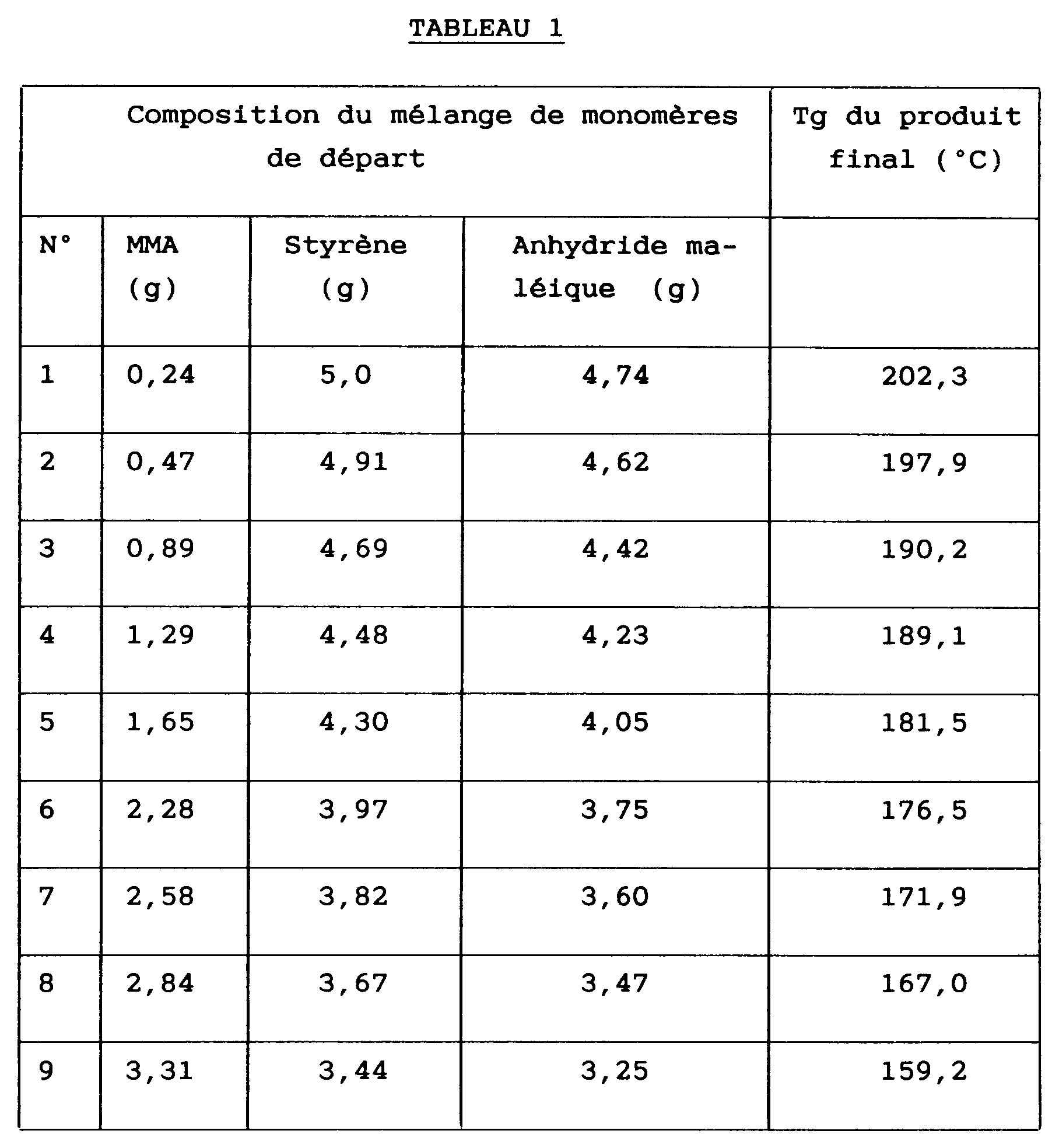
- Les différents mélanges de monomères dont les compositions figurent dans le tableau 1 sont polymérisés par chauffage à 80°C dans 150 cm³ de toluène en présence de 0,05 g de peroxyde de benzoyle.
- Au cours de la réaction qui dure 18 heures, le polymère formé précipite spontanément. Après refroidissement et séchage, 3 g de chaque terpolymère ainsi obtenu sont traités dans 50 cm³ de toluène par 0,88 g d'isopropylamine ajoutés à 30°C, puis le milieu réactionnel est porté à 60°C pour 5 heures.
- Le bon déroulement de l'opération est contrôlé sur le spectre IR du produit obtenu.
- Chacun des polymères acide-amide obtenu est traité à l'échelle d'un gramme par 0,53 g de chlorure d'oxalyle dans 15 cm³ de toluène et porté à 80°C pendant 18 heures. On note qu'au cours de cette réaction de cyclisation les différents polymères préparés se redissolvent, et il est donc nécessaire en fin de manipulation de concentrer le milieu réactionnel avant de précipiter les polymères dans le méthanol. La température de transition vitreuse des polymères a ensuite été mesurée par DSC. Le tableau 1 ci-après présente les résultats obtenus. On peut observer que dans tous les cas on obtient des valeurs de Tg élevées, supérieures à 150°C. On note également que l'introduction en proportion croissante de méthacrylate de méthyle dans le mélange de monomères de départ, pour les concentrations choisies, fait diminuer de manière linéaire la température de transition vitreuse du terpolymère final, permettant ainsi de pouvoir ajuster la tenue en température du matériau final.
- Cet exemple illustre l'influence du groupement alkyle ou aryle de l'amine primaire utilisée sur la température de transition vitreuse du produit obtenu.
- 10 g d'un mélange de monomères dans les proportions de la composition n° 9 du tableau 1 (soit 33,3 % en moles de chaque monomère) sont polymérisés par chauffage pendant 18 heures dans 150 cm³ de toluène contenant 0,05 g de peroxyde de benzoyle.
- Après refroidissement, filtration et séchage, trois échantillons de 1 gramme chacun sont modifiés à 60°C dans 15 cm³ de toluène en présence de trois amines différentes : cyclohexylamine, isopropylamine et n-butylamine dans les proportions du tableau 2. Chaque polymère modifié subit ensuite une déshydratation par 0,63 g de chlorure d'oxalyle dans 15 cm³ de toluène porté à 80°C pour 18 heures. Après récupération des polymères obtenus, la température de transition vitreuse a été mesurée par DSC et le tableau 2 ci-après présente les résultats obtenus.

- On peut noter que la nature du groupement substitué sur l'amine exerce une influence directe sur la Tg du matériau obtenu.
- Cet exemple illustre la réalisation de l'étape de cyclisation par traitement thermique, afin de conduire à la formation des cycles imides. La composition n° 9 du tableau 1 a été reprise pour réaliser dans les conditions citées à l'exemple n°3, le terpolymère initial. Après filtration et séchage, des échantillons de 2 grammes de ce polymère ont été traités respectivement par 0,79 g de cyclohexylamine et 0,59 g d'isopropylamine dans 30 cm³ de toluène pendant 5 heures à 60°C. Les polymères ainsi modifiés sont soumis à un traitement thermique, celui-ci étant réalisé dans une étuve à l'intérieur de laquelle circule un flux d'azote exempt de traces d'eau afin d'éviter la reformation de cycles anhydrides. Le tableau 3 présente les résultats obtenus, le traitement thermique étant réalisé à une température de 230°C pendant 20 minutes pour le terpolymère modifié à la cyclohexylamine et de 220°C pendant 20 minutes pour le terpolymère modifié à l'isopropylamine.
- Ce tableau présente également la température de transition vitreuse mesurée sur le matériau correspondant, cyclisé à l'aide du traitement chimique.
- On peut observer que les températures obtenues à l'aide des deux traitements sont très voisines.
- La réaction de cyclisation thermique peut être réalisée de façon tout à fait satisfaisante par passage du polymère en poudre dans une extrudeuse à simple ou double vis munie d'un évent de dégazage.

- Cet exemple illustre la réalisation de l'étape de cyclisation thermique dans une extrudeuse monovis de diamètre 16 mm.
- Les différents terpolymères sont introduits sous forme de poudre compactée dans la zone d'alimentation de l'extrudeuse et portés à différentes températures d'extrusion.
- Le tableau 4 ci-après présente les résultats obtenus.
- On peut noter que le spectre infrarouge obtenu à partir du matériau final n° 9 présente le pic situé à 1 697 cm⁻¹ caractéristique des groupements succinimides provenant de la cyclisation en imides du poly(acide-amide).
- Les terpolymères obtenus à partir des compositions 10 et 11 présentent un spectre infrarouge qui fait apparaître en plus un épaulement situé vers 1 670 cm⁻¹ caractéristique des groupements glutarimides.
- Il est donc probable que les matériaux obtenus par traitement thermique contiennent à la fois des motifs succinimides et des motifs glutarimides provenant respectivement de la cyclisation de l'acide-amide dérivé du motif anhydride (ex.: l'anhydride maléique) et de l'interaction d'un groupe amide avec un motif ester voisin (ex.: méthacrylate de méthyle) ou d'une mole d'amine employée en excès (contenue sous forme de sel de l'acide) avec deux motifs méthacrylate de méthyle consécutifs.
- L'importance de cette dernière réaction augmente vraisemblablement avec la température d'extrusion, ce qui contribue à élever la température de transition vitreuse du matériau final (composition 11).

Claims (10)
- Procédé de fabrication de matériau thermoplastique ayant une température de transition vitreuse élevée, caractérisé par le fait que l'on prépare un polymère de départ présentant parmi ses motifs constitutifs des motifs anhydrides, que l'on fait réagir une quantité suffisante d'amine primaire ou d'un mélange d'amines primaires pour que les motifs anhydrides soient transformés au moins en partie en motifs acide-amide, et que l'on effectue la cyclisation du poly-acide-amide obtenu.
- Procédé selon la revendication 1, caractérisé par le fait que l'amine primaire est substituée ou que le mélange d'amines primaires comprend au moins une amine substituée.
- Procédé selon l'une des revendications 1 et 2, caractérisé par le fait que le polymère de départ est un polymère à base d'anhydride maléique.
- Procédé selon la revendication 3, caractérisé par le fait que le polymère de départ est un copolymère d'anhydride maléique et d'ester acrylique ou méthacrylique, éventuellement fluoré ou chloré ou un copolymère d'anhydride maléique et de monomère vinylique.
- Procédé selon l'une des revendications 3 et 4, caractérisé par le fait que le polymère de départ est un terpolymère d'anhydride maléique, d'ester acrylique ou méthacrylique, éventuellement fluoré ou chloré, et de monomère vinylique.
- Procédé selon l'une quelconque des revendications 1 à 5, caractérisé par le fait que l'anhydride maléique est présent dans le polymère de départ ou une proportion supérieure à 5 %, de préférence supérieure à 10 %.
- Procédé selon l'une quelconque des revendications 1 à 6, caractérisé par le fait que la cyclisation est effectuée par voie chimique.
- Procédé selon l'une quelconque des revendications 1 à 7, caractérisé par le fait que la cyclisation est effectuée par voie thermique, de préférence sous atmosphère inerte.
- Matériau thermoplastique susceptible d'être obtenu par le procédé selon l'une quelconque des revendications 1 à 8.
- Utilisation du matériau thermoplastique obtenu par le procédé selon l'une quelconque des revendications 1 à 8 comme matériau thermoplastique transparent résistant à haute température.
Applications Claiming Priority (2)
| Application Number | Priority Date | Filing Date | Title |
|---|---|---|---|
| FR9102217 | 1991-02-25 | ||
| FR9102217A FR2673185B1 (fr) | 1991-02-25 | 1991-02-25 | Procede de fabrication de materiau thermoplastique, materiau thermoplastique obtenu et son utilisation pour la constitution de fibres optiques. |
Publications (1)
| Publication Number | Publication Date |
|---|---|
| EP0501865A1 true EP0501865A1 (fr) | 1992-09-02 |
Family
ID=9410054
Family Applications (1)
| Application Number | Title | Priority Date | Filing Date |
|---|---|---|---|
| EP92400469A Ceased EP0501865A1 (fr) | 1991-02-25 | 1992-02-24 | Procédé de fabrication de matériau thermoplastique, matériau thermoplastique obtenu et son utilisation comme matériau transparent résistant à haute température |
Country Status (7)
| Country | Link |
|---|---|
| EP (1) | EP0501865A1 (fr) |
| JP (1) | JPH05105717A (fr) |
| KR (1) | KR920016488A (fr) |
| CA (1) | CA2061715A1 (fr) |
| CS (1) | CS54492A3 (fr) |
| FR (1) | FR2673185B1 (fr) |
| HU (1) | HUT64147A (fr) |
Cited By (1)
| Publication number | Priority date | Publication date | Assignee | Title |
|---|---|---|---|---|
| NL1005928C2 (nl) * | 1997-04-29 | 1998-11-02 | Dsm Nv | Copolymeer dat in of aan de hoofdketen éen of meer amine-gesubstitueerde imidegroepen bevat en een werkwijze voor de bereiding hiervan. |
Families Citing this family (2)
| Publication number | Priority date | Publication date | Assignee | Title |
|---|---|---|---|---|
| EP1333072A3 (fr) * | 2002-01-30 | 2003-11-12 | Rohm And Haas Company | Comnposition d'encre |
| JP2006124592A (ja) * | 2004-10-29 | 2006-05-18 | Kaneka Corp | イミド樹脂及びその樹脂組成物 |
Citations (2)
| Publication number | Priority date | Publication date | Assignee | Title |
|---|---|---|---|---|
| US2921928A (en) * | 1957-11-29 | 1960-01-19 | Monsanto Chemicals | Preparation of copolymer diamides |
| EP0269223A2 (fr) * | 1986-10-02 | 1988-06-01 | Toray Industries, Inc. | Fibre optique plastique résistant à la chaleur et sa méthode de fabrication |
Family Cites Families (2)
| Publication number | Priority date | Publication date | Assignee | Title |
|---|---|---|---|---|
| JPS59140212A (ja) * | 1983-02-01 | 1984-08-11 | Toray Ind Inc | マレイミド系グラフト共重合体の製造方法 |
| JPS6058409A (ja) * | 1983-09-12 | 1985-04-04 | Mitsubishi Rayon Co Ltd | 熱可塑性重合体 |
-
1991
- 1991-02-25 FR FR9102217A patent/FR2673185B1/fr not_active Expired - Fee Related
-
1992
- 1992-02-24 CA CA002061715A patent/CA2061715A1/fr not_active Abandoned
- 1992-02-24 EP EP92400469A patent/EP0501865A1/fr not_active Ceased
- 1992-02-25 CS CS92544A patent/CS54492A3/cs unknown
- 1992-02-25 KR KR1019920002916A patent/KR920016488A/ko not_active Withdrawn
- 1992-02-25 JP JP4038064A patent/JPH05105717A/ja active Pending
- 1992-02-25 HU HU9200624A patent/HUT64147A/hu unknown
Patent Citations (2)
| Publication number | Priority date | Publication date | Assignee | Title |
|---|---|---|---|---|
| US2921928A (en) * | 1957-11-29 | 1960-01-19 | Monsanto Chemicals | Preparation of copolymer diamides |
| EP0269223A2 (fr) * | 1986-10-02 | 1988-06-01 | Toray Industries, Inc. | Fibre optique plastique résistant à la chaleur et sa méthode de fabrication |
Non-Patent Citations (3)
| Title |
|---|
| CHEMICAL ABSTRACTS, vol. 102, no. 4, Janvier 1985, Columbus, Ohio, US; abstract no. 25165V, C. T. ANDRADE: 'PREPARATION AND CHARACTERIZATION OF ACID-AMIDE AND ACID-AMIDE-IMIDE COPOLYMERS FROM POLY(METHACRYLIC ACID)' page 8 ;colonne 2 ; * |
| CHEMICAL ABSTRACTS, vol. 103, no. 24, Décembre 1985, Columbus, Ohio, US; abstract no. 196581C, 'CYCLIC IMIDE-CONTAINING POLYMERS' page 12 ;colonne 1 ; & JP-A-60058409 (MITSUBISHI RAYON CO., LTD.) 04-04-1985 * |
| PATENT ABSTRACTS OF JAPAN vol. 8, no. 266 (C-255)(1703) 6 Décembre 1984 & JP-A-59 140 212 ( TORAY K.K. ) 11 Août 1984 * |
Cited By (1)
| Publication number | Priority date | Publication date | Assignee | Title |
|---|---|---|---|---|
| NL1005928C2 (nl) * | 1997-04-29 | 1998-11-02 | Dsm Nv | Copolymeer dat in of aan de hoofdketen éen of meer amine-gesubstitueerde imidegroepen bevat en een werkwijze voor de bereiding hiervan. |
Also Published As
| Publication number | Publication date |
|---|---|
| CA2061715A1 (fr) | 1992-08-26 |
| CS54492A3 (en) | 1992-09-16 |
| HU9200624D0 (en) | 1992-05-28 |
| KR920016488A (ko) | 1992-09-24 |
| FR2673185B1 (fr) | 1994-05-27 |
| HUT64147A (en) | 1993-11-29 |
| JPH05105717A (ja) | 1993-04-27 |
| FR2673185A1 (fr) | 1992-08-28 |
Similar Documents
| Publication | Publication Date | Title |
|---|---|---|
| EP0724747B1 (fr) | Polyesterimides utilisables en optique lineaire et/ou en optique non lineaire et l'un de leurs procedes de preparation | |
| EP3204435A1 (fr) | Procédé de préparation de dérives du polyfluorure de vinylidene | |
| FR2797877A1 (fr) | Copolymeres a base d'azurant optique, leur fabrication et monomere polymerisable utile pour cette fabrication | |
| EP0032644B1 (fr) | Procédé pour éviter la cristallisation des N-N' diphénylène bis-imides dans les compositions thermodurcissables en contenant | |
| FR2675810A1 (fr) | Nouveaux composes ayant des proprietes optiques non lineaires. | |
| FR2830535A1 (fr) | Utilisation d'acides sulfoniques, phosphoniques comme dopants de la polyaniline et de materiaux composites conducteurs a base de polyaniline | |
| WO1995004772A1 (fr) | Procede de preparation de polyaminoacides | |
| JPH0384010A (ja) | シアン化ビニリデン共重合体 | |
| FR2673185A1 (fr) | Procede de fabrication de materiau thermoplastique, materiau thermoplastique obtenu et son utilisation pour la constitution de fibres optiques. | |
| Spring et al. | Adamantyl and carbazole containing trans-poly (norbornene-dicarboximide) s as electro-optic chromophore hosts | |
| EP0408473A1 (fr) | Poly(amide-imides) aromatiques linéaires fonctionnalisés en bout de chaînes par des groupements comprenant un reste à fonction maléimide latente, procédé pour leur préparation et leur emploi pour notamment préparer des polymères réticulés | |
| Nagase et al. | Control of thermal, mechanical, and optical properties of three‐component maleimide copolymers by steric bulkiness and hydrogen bonding | |
| EP0170590A1 (fr) | Nouveaux précurseurs de réseaux de copolyphtalocyanine-imides, leur procédé de préparation et les réseaux qui en derivent | |
| FR2690453A1 (fr) | Nouveaux composés polymères ayant des propriétés optiques non linéaires. | |
| JP3852700B2 (ja) | 末端にラジカル重合反応を誘導できるハロゲン基を有するノルボルネン系モノマーから誘導されたマクロモノマー、側鎖にラジカル重合反応を誘導できる基を有するノルボルネン重合体、そのマクロモノマーとアクリレート系モノマーまたはスチレン類モノマ−を用いてグラフト反応生成物であるノルボルネン重合体とそれらの調製方法 | |
| CA1316293C (fr) | Compositions de polybenzhydrolimides terminees par des groupements a insaturation ethylenique, les polyimides reticules obtenus par leur polymerisation thermique et l'utilisation de ces compositions | |
| JPH01103614A (ja) | シアン化ビニリデン共重合体 | |
| FR2853655A1 (fr) | Polymides perdeuteres, leur procede de preparation et leur utilisation en tant que materiaux transparents dans la zone de 2500 a 3500cm-1 | |
| Cianga et al. | Synthesis and characterization of new optically active monomers based on 4-maleimidobenzoic acid | |
| KR100443719B1 (ko) | 이미드기를 갖는 삼환형 노르보넨 유도체 및 그의 제조방법 | |
| EP2276798B1 (fr) | Procede de reticulation par reaction de huisgen thermique, polymeres chromophores reticulables et materiaux polymeres reticules a proprietes electro-optiques stables | |
| Luo et al. | Optically active composite nanoparticles with chemical bonds between core and shell | |
| KR20100000064A (ko) | 노보넨계 중합체 | |
| EP0071493B1 (fr) | Polymères de résines d'hydrocarbures aromatiques contenant des groupes propénoyles et leur procédé de préparation | |
| JP3964717B2 (ja) | 桂皮酸誘導体から成る色素含有非線形有機材料 |
Legal Events
| Date | Code | Title | Description |
|---|---|---|---|
| PUAI | Public reference made under article 153(3) epc to a published international application that has entered the european phase |
Free format text: ORIGINAL CODE: 0009012 |
|
| 17P | Request for examination filed |
Effective date: 19920708 |
|
| AK | Designated contracting states |
Kind code of ref document: A1 Designated state(s): AT BE CH DE DK ES FR GB GR IT LI LU MC NL PT SE |
|
| 17Q | First examination report despatched |
Effective date: 19950303 |
|
| GRAG | Despatch of communication of intention to grant |
Free format text: ORIGINAL CODE: EPIDOS AGRA |
|
| STAA | Information on the status of an ep patent application or granted ep patent |
Free format text: STATUS: THE APPLICATION HAS BEEN REFUSED |
|
| 18R | Application refused |
Effective date: 19961010 |