EP0503978A2 - Verfahren zur Aufnahme von Musikdatei und Vorrichtung zur Wiedergabe davon - Google Patents
Verfahren zur Aufnahme von Musikdatei und Vorrichtung zur Wiedergabe davon Download PDFInfo
- Publication number
- EP0503978A2 EP0503978A2 EP19920302231 EP92302231A EP0503978A2 EP 0503978 A2 EP0503978 A2 EP 0503978A2 EP 19920302231 EP19920302231 EP 19920302231 EP 92302231 A EP92302231 A EP 92302231A EP 0503978 A2 EP0503978 A2 EP 0503978A2
- Authority
- EP
- European Patent Office
- Prior art keywords
- information
- musical performance
- tune
- special
- video
- Prior art date
- Legal status (The legal status is an assumption and is not a legal conclusion. Google has not performed a legal analysis and makes no representation as to the accuracy of the status listed.)
- Withdrawn
Links
Images


Classifications
-
- G—PHYSICS
- G11—INFORMATION STORAGE
- G11B—INFORMATION STORAGE BASED ON RELATIVE MOVEMENT BETWEEN RECORD CARRIER AND TRANSDUCER
- G11B20/00—Signal processing not specific to the method of recording or reproducing; Circuits therefor
- G11B20/10—Digital recording or reproducing
-
- G—PHYSICS
- G10—MUSICAL INSTRUMENTS; ACOUSTICS
- G10H—ELECTROPHONIC MUSICAL INSTRUMENTS; INSTRUMENTS IN WHICH THE TONES ARE GENERATED BY ELECTROMECHANICAL MEANS OR ELECTRONIC GENERATORS, OR IN WHICH THE TONES ARE SYNTHESISED FROM A DATA STORE
- G10H1/00—Details of electrophonic musical instruments
- G10H1/36—Accompaniment arrangements
- G10H1/361—Recording/reproducing of accompaniment for use with an external source, e.g. karaoke systems
- G10H1/368—Recording/reproducing of accompaniment for use with an external source, e.g. karaoke systems displaying animated or moving pictures synchronized with the music or audio part
-
- G—PHYSICS
- G10—MUSICAL INSTRUMENTS; ACOUSTICS
- G10H—ELECTROPHONIC MUSICAL INSTRUMENTS; INSTRUMENTS IN WHICH THE TONES ARE GENERATED BY ELECTROMECHANICAL MEANS OR ELECTRONIC GENERATORS, OR IN WHICH THE TONES ARE SYNTHESISED FROM A DATA STORE
- G10H1/00—Details of electrophonic musical instruments
- G10H1/0033—Recording/reproducing or transmission of music for electrophonic musical instruments
- G10H1/0041—Recording/reproducing or transmission of music for electrophonic musical instruments in coded form
- G10H1/0058—Transmission between separate instruments or between individual components of a musical system
- G10H1/0066—Transmission between separate instruments or between individual components of a musical system using a MIDI interface
-
- G—PHYSICS
- G10—MUSICAL INSTRUMENTS; ACOUSTICS
- G10H—ELECTROPHONIC MUSICAL INSTRUMENTS; INSTRUMENTS IN WHICH THE TONES ARE GENERATED BY ELECTROMECHANICAL MEANS OR ELECTRONIC GENERATORS, OR IN WHICH THE TONES ARE SYNTHESISED FROM A DATA STORE
- G10H1/00—Details of electrophonic musical instruments
- G10H1/36—Accompaniment arrangements
- G10H1/361—Recording/reproducing of accompaniment for use with an external source, e.g. karaoke systems
- G10H1/363—Recording/reproducing of accompaniment for use with an external source, e.g. karaoke systems using optical disks, e.g. CD, CD-ROM, to store accompaniment information in digital form
-
- G—PHYSICS
- G10—MUSICAL INSTRUMENTS; ACOUSTICS
- G10H—ELECTROPHONIC MUSICAL INSTRUMENTS; INSTRUMENTS IN WHICH THE TONES ARE GENERATED BY ELECTROMECHANICAL MEANS OR ELECTRONIC GENERATORS, OR IN WHICH THE TONES ARE SYNTHESISED FROM A DATA STORE
- G10H1/00—Details of electrophonic musical instruments
- G10H1/36—Accompaniment arrangements
- G10H1/361—Recording/reproducing of accompaniment for use with an external source, e.g. karaoke systems
- G10H1/365—Recording/reproducing of accompaniment for use with an external source, e.g. karaoke systems the accompaniment information being stored on a host computer and transmitted to a reproducing terminal by means of a network, e.g. public telephone lines
-
- G—PHYSICS
- G10—MUSICAL INSTRUMENTS; ACOUSTICS
- G10H—ELECTROPHONIC MUSICAL INSTRUMENTS; INSTRUMENTS IN WHICH THE TONES ARE GENERATED BY ELECTROMECHANICAL MEANS OR ELECTRONIC GENERATORS, OR IN WHICH THE TONES ARE SYNTHESISED FROM A DATA STORE
- G10H5/00—Instruments in which the tones are generated by means of electronic generators
- G10H5/005—Voice controlled instruments
-
- G—PHYSICS
- G11—INFORMATION STORAGE
- G11B—INFORMATION STORAGE BASED ON RELATIVE MOVEMENT BETWEEN RECORD CARRIER AND TRANSDUCER
- G11B20/00—Signal processing not specific to the method of recording or reproducing; Circuits therefor
-
- G—PHYSICS
- G11—INFORMATION STORAGE
- G11B—INFORMATION STORAGE BASED ON RELATIVE MOVEMENT BETWEEN RECORD CARRIER AND TRANSDUCER
- G11B27/00—Editing; Indexing; Addressing; Timing or synchronising; Monitoring; Measuring tape travel
- G11B27/02—Editing, e.g. varying the order of information signals recorded on, or reproduced from, record carriers
- G11B27/031—Electronic editing of digitised analogue information signals, e.g. audio or video signals
- G11B27/034—Electronic editing of digitised analogue information signals, e.g. audio or video signals on discs
-
- G—PHYSICS
- G11—INFORMATION STORAGE
- G11B—INFORMATION STORAGE BASED ON RELATIVE MOVEMENT BETWEEN RECORD CARRIER AND TRANSDUCER
- G11B2220/00—Record carriers by type
- G11B2220/20—Disc-shaped record carriers
- G11B2220/21—Disc-shaped record carriers characterised in that the disc is of read-only, rewritable, or recordable type
- G11B2220/215—Recordable discs
- G11B2220/218—Write-once discs
-
- G—PHYSICS
- G11—INFORMATION STORAGE
- G11B—INFORMATION STORAGE BASED ON RELATIVE MOVEMENT BETWEEN RECORD CARRIER AND TRANSDUCER
- G11B2220/00—Record carriers by type
- G11B2220/20—Disc-shaped record carriers
- G11B2220/25—Disc-shaped record carriers characterised in that the disc is based on a specific recording technology
- G11B2220/2537—Optical discs
- G11B2220/2545—CDs
Definitions
- This invention relates to a so-called karaoke system including a compact disk player (hereinafter a "CD player") and a sound module and, particularly, to a recording method wherein musical information in addition to a background visual signal are recorded on a CD to store a number of playing tune signals, and to a reproducing system for such a CD.
- CD player compact disk player
- sound module a recording method wherein musical information in addition to a background visual signal are recorded on a CD to store a number of playing tune signals, and to a reproducing system for such a CD.
- CD is used to encompass disks of whatever size including 30cm as well as 12cm diameter that use CD-type storage technology.
- a CD karaoke system comprises a reproducing system which integrally incorporates a CD player and a sound module to reproduce visual or video signals and audio signals both recorded on the CD.
- a karaoke system comprises signal pick-up means for driving the CD at a constant angular velocity or at a constant linear velocity to read-out from the CD the video signals and audio signals, error correcting means for correcting errors in the read-out signal from the signal pick-up means and for separating the error-corrected signal into a visual or video signal and an audio signal, sound means for processing the separated audio signal from the error-correcting means to output a processed audio signal, and video processing means for processing the separated video signal separated by the error correcting means to output a processed video signal to an external display unit.
- the video signals and audio signals are recorded on the CD driven by the system in the form of digital signals.
- the video signals recorded on the CD have real-time visual information which is compressed and processed to minimize the amount of information, but the audio signals include both real-time voice information and tune (or sound) information which is actually being played.
- a conventional CD cannot store a large quantity of tunes to be played with their visual signals due to the aforesaid reason. If a user wishes to reproduce a large number of tunes and their video signals using a conventional karaoke system, he has frequently to change the CD. There has been a remarkable economic burden in that the user has to purchase many CDs when he wishes to have a large number of tunes available to play.
- a CD of diameter 30cm can store on both of its sides only 24 tunes.
- a preferred data file recording method embodying the present invention comprises the steps of recording consecutively on a CD video information for the words of a tune by sections, and recording consecutively musical performance information by sections following the video information recorded on the CD.
- the musical performance information includes a section of MIDI (Musical Instrument Digital Interface) information for playing a measure of a tune in the music and special information for synchronizing the musical performance information with the video information for each section.
- MIDI Musical Instrument Digital Interface
- the data file reproducing system of the preferred embodiment comprises means for driving a CD to read-out the data file from the CD, means for separating the data file from the driving means into musical performance information and video information, means for generating playing tune signals according to the musical performance information from the separating means, and means for reproducing video signals corresponding to the words of the music by processing the video information from the separating means.
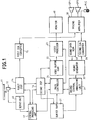
- FIG. 1 is a block diagram of a karaoke system embodying the present invention.
- the karaoke system comprises a compact disk (CD) 11 in which are recorded both visual or video information and also MIDI information for each frame, and a pick-up unit 12 for driving the CD to read-out the information recorded on the CD.
- the system includes a servo unit 13 for controlling the pick-up unit 12 under the control of a first central processing unit 17, a first DSP (Digital Signal Processor) 14 for receiving the read-out information from the pick-up unit 12 so as to correct errors generated in the read-out information, such as by the Cross Interactive Reed Solomon Code, to ensure the reliability of the CD's real-time processed data.
- CD compact disk
- MIDI for each frame
- the system includes a servo unit 13 for controlling the pick-up unit 12 under the control of a first central processing unit 17, a first DSP (Digital Signal Processor) 14 for receiving the read-out information from the pick-up unit 12 so as to correct errors generated
- the first DSP also separates the error-corrected information into a data file for musical performance, and audio information.
- a first digital/analog converter (hereinafter, "D/A converter") 15 converts the audio information from the first DSP 14 into an analog audio signal
- a second DSP 16 corrects errors generated in the data file from the first DSP 14 according to the laser error correction code technique, and separates the error-corrected data file into MIDI information and video information.
- the first central processing unit 17 controls the first DSP 14 and the second DSP 16 to correct errors appropriately and simultaneously controls the information output from the first and second DSPs 14 and 16.
- the system further includes a buffer RAM 21 for receiving the MIDI information from the second DSP 16 and storing the received MIDI information, a video buffer RAM 22, for receiving the visual information from the second DSP 16 and storing the received visual information, a video processor 23 for receiving the visual information from the video buffer RAM 22 to process the received visual information in real-time, and a main controller 24 for controlling the whole system.
- the system includes a second central processing unit 31 for performing an overall control function to generate sound which corresponds to the MIDI information received from the buffer RAM 21, a sound generator 32 for reading out sound data from a sound data ROM 33 under the control of the second central processing unit 31 to generate a digital tune signal, a second D/A converter 34 for converting the digital tune signal from the sound generator 32 into an analog tune signal, a monitor 40 for displaying the background video signal output from the video processor 23, and a mixing amplifier 50 for mixing and amplifying the analog audio signal from the first D/A converter 15, the analog tune signal from the second D/A converter 34, and an output signal from a microphone MIC, to output the mixed and amplified signal.
- a second central processing unit 31 for performing an overall control function to generate sound which corresponds to the MIDI information received from the buffer RAM 21, a sound generator 32 for reading out sound data from a sound data ROM 33 under the control of the second central processing unit 31 to generate a digital tune signal, a second D/A converter 34 for converting the digital tune
- the audio information recorded on the CD is played back by the audio reproducing means comprising the pick-up unit 12, the first DSP 14 and the D/A converter 15.
- the pick up unit 12 reads out the MIDI information and the visual information from the CD 11 and provides the read-out information to the first DSP 14.
- the first DSP 14 corrects errors generated in the read-out information from the pick-up unit 12 and thereafter provides the error-corrected information to the second DSP 16 under the control of the central processing unit 17.
- the second DSP 16 corrects errors in the MIDI information and the visual information from the first DSP under the control of the central processing unit 17 and then writes the error-corrected MIDI information into the buffer RAM 21 and stores the error-corrected visual information in the video buffer RAM 22.
- the main controller 24 controls the buffer RAM 21, so that it provides the MIDI information written in buffer RAM 21 in turn to the central processing unit 31 and also controls the video processor 23 according to exclusive or special information contained in the MIDI information from the buffer RAM 21.
- the video processor 23 processes the visual information written in the video buffer RAM 22 to generate a video signal in the form of an analog signal and provides the generated video signal to the monitor 40.
- the second central processing unit 31 controls the sound generator 32 in accordance with the MIDI information output from the buffer RAM 21.
- the sound generator 32 under the control of the second central processing unit 31, reads from the sound data ROM 33 sound data which corresponds to the MIDI information and generates digital tune data by assembling the thus-read sound data.
- the generated digital tune data from the sound generating unit 32 is provided to speakers SP1 and SP2 via the second D/A converter 34 and the mixing amplifier 50.
- the speakers SP1 and SP2 output the tune corresponding to the digital tune data.
- a user can sing a song along with the tune being played by using the microphone MIC, while reading the words of the song from the monitor 40.
- Figure 3 illustrates the format of the visual information and MIDI information contained in the data file which is recorded on a CD.
- a plurality of video information frames corresponding to the words classified by each measure of a piece of sheet music as shown in Figures 2A to 2C is written on section a-b.
- musical performance information for the musical notes as shown in Figures 2A to 2C is written.
- the example shown in Figures 2A to 2C is a song with Korean words.
- Figures 2D to 2F of a song with English words is given in Figures 2D to 2F of a song with English words.
- Figure 4 illustrates the format of the video information in the section a-b and the following associated musical performance information in the section b-c, in relation to the sheet music of Figure 2.
- visual information comprising in order a first frame, a second frame and so on to a last frame is recorded on section a-b of the CD such as shown in Figure 3.
- Each frame may comprise the words associated with several bars of the music, as shown in Figure 2.
- the visual information may be stored as text information.
- Musical performance information comprising in order a first measure's MIDI information, a second measure's MIDI information, and so on to the last measure's MIDI information is recorded on section b-c of the CD such as shown in Figure 3.
- the second central processing unit 17 informs the main controller 24 at the end of each measure's MIDI information, where special information is input, that a measure of the tune being played is completed.
- the main controller 24 provides to the video processor 23 information representing the termination of a measure of the tune, namely a specific command to the effect that it should prepare the frame of video information to include the following measure.
- the video processor 23 reads and processes the video information for the following measure from video buffer RAM 22 based on the specific command in order to generate the required video signal, and provides the generated video signal to the monitor 40 and displays it on the monitor.
- Figure 5 illustrates the format of the MIDI information for the musical notes of one measure.
- the MIDI information comprising note-on information, note information, velocity information and note-off information, represents the musical note such as shown in Figure 6.
- the note-on information designates the output start time of the tone to be played and the number of the channel to output the tone.
- the note information represents the pitch of the tone, and the velocity information represents the intensity of the tone.
- the note-off information designates the output end time of the tone being played and the number of the channel to output the tone.
- the measure MIDI information includes a great amount of MIDI information, as well as special information arranged after the MIDI information for the last tone to be played in the measure.
- the special information comprises special start information, special data and special end information which is a command having the effect that the frame of video information synchronizes with the measure of MIDI information.
- the special start information represents the start of special data.
- the special data has the frame number of the frame of visual information for the following measure's words or the frame number of the frame of visual information for the current measure's words in order to initiate preparation of the frame of video information for the words of the following measure.
- the special end information represents the end of the special data.
- Figures 7A to 7D illustrate the formats of the note-on information, note information, velocity information and note-off information.
- the initial four bits of the note-on information illustrated in Figure 7A are status bits and "1001" is the start time of the tone to be played; the remaining four bits are for designating the number of the channel to output the tone, such four bits allowing the designation of a maximum of 16 channels.
- the channels can output differently sounding notes to each other.
- 8 channels, 4 channels and 4 channels are assigned, respectively, to the melody part, the accompaniment part and the rhythm part, and the tone colour can be varied according to the kind of channel.
- Note information shown in Figure 7B comprises information bits designating the pitch of tone being played, wherein the first bit has the value 0 and the remaining 7 bits represent the pitch between values 0-127.
- the width of pitch with 128 steps is from C-2 to G8, and in case of pianos they include all of the notes A1 to C7.
- Velocity information shown in Figure 7C comprises information bits designating the intensity of a tone being played, wherein the first bit has value 0 and the remaining 7 bits represent the intensity from step 0 to step 127; 0 represents no tone and 127 represents the most intense sound in music (fff).
- the initial 4 bits having the value 1000 represent the end time of the tone and the remaining 4 bits designate the channel number for which the output of the tone is to terminate. In this case, the number of channels capable of being designated is 16.
- MIDI information composed as shown in Figures 7A to 7D is output, and in the case of playing the musical note as shown in Figure 6 in this manner, it is sufficient to have only 4 bytes of memory.
- Figures 8A to 8D illustrate the format of the special (or exclusive) information arranged at the end of each measure's MIDI information, namely the special format which directs the video processor to read a frame of video information for the following measure.
- Figure 8A is the format of the special start information representing the start of the special data.
- Figure 8B is an information bit representing the identity number of each manufacturing company, namely the identity number which the MIDI Standards Association grants to the manufacturing company where those companies use special information for their unique functions.
- Figure 8C illustrates the format of special data.
- the initial bit is 0 and the remaining 7 bits have a predetermined value representing the frame number for the following frame of video information.
- Figure 8D illustrates a special end information representing the end of special data, wherein the special end information comprises one byte.
- the present system has advantages in which the amount of information for one piece of music can be reduced to of the order of approximately 30 Kbytes by formatting the music using the MIDI system.
- a CD of diameter 12cm capable of storing 540 Mbytes the video and musical performance information for some 1000 pieces of music can be stored, which results in improved capacity.
- Another advantage is that users can enjoy playing the music with free option of melody, rhythym and accompaniment by controlling the MIDI channels being played.
- the present system has the further advantage of application to the musical education field by freely controlling playing tempo and measure tone colour.
Landscapes
- Engineering & Computer Science (AREA)
- Multimedia (AREA)
- Physics & Mathematics (AREA)
- Acoustics & Sound (AREA)
- Signal Processing (AREA)
- General Engineering & Computer Science (AREA)
- Electrophonic Musical Instruments (AREA)
- Signal Processing For Digital Recording And Reproducing (AREA)
- Reverberation, Karaoke And Other Acoustics (AREA)
Applications Claiming Priority (2)
| Application Number | Priority Date | Filing Date | Title |
|---|---|---|---|
| KR914077 | 1991-03-14 | ||
| KR1019910004077A KR940004830B1 (ko) | 1991-03-14 | 1991-03-14 | 연주용 데이타화일 기록방법 및 재생장치 |
Publications (2)
| Publication Number | Publication Date |
|---|---|
| EP0503978A2 true EP0503978A2 (de) | 1992-09-16 |
| EP0503978A3 EP0503978A3 (en) | 1993-12-22 |
Family
ID=19312100
Family Applications (1)
| Application Number | Title | Priority Date | Filing Date |
|---|---|---|---|
| EP19920302231 Withdrawn EP0503978A3 (en) | 1991-03-14 | 1992-03-16 | Musical data file recording method and reproducing system therefor |
Country Status (4)
| Country | Link |
|---|---|
| US (1) | US5410100A (de) |
| EP (1) | EP0503978A3 (de) |
| JP (1) | JPH07140974A (de) |
| KR (1) | KR940004830B1 (de) |
Cited By (1)
| Publication number | Priority date | Publication date | Assignee | Title |
|---|---|---|---|---|
| CN101364407B (zh) * | 2008-09-17 | 2011-12-28 | 清华大学 | 保持主观一致性的卡拉ok演唱评分方法 |
Families Citing this family (14)
| Publication number | Priority date | Publication date | Assignee | Title |
|---|---|---|---|---|
| DE69434923T2 (de) * | 1993-05-26 | 2007-12-06 | Pioneer Electronic Corp. | Aufzeichnungsmedium |
| KR960002330A (ko) * | 1994-06-22 | 1996-01-26 | 김광호 | 영상노래반주장치 |
| KR0129964B1 (ko) * | 1994-07-26 | 1998-04-18 | 김광호 | 악기선택 가능한 영상노래반주장치 |
| US5627657A (en) * | 1995-02-28 | 1997-05-06 | Daewoo Electronics Co., Ltd. | Method for sequentially displaying information recorded on interactive information recording medium |
| CA2261275A1 (en) * | 1996-06-24 | 1997-12-31 | Van Koevering Company | Musical instrument system |
| US6782299B1 (en) | 1998-02-09 | 2004-08-24 | Sony Corporation | Method and apparatus for digital signal processing, method and apparatus for generating control data, and medium for recording program |
| US6218602B1 (en) | 1999-01-25 | 2001-04-17 | Van Koevering Company | Integrated adaptor module |
| EP1172796B1 (de) * | 1999-03-08 | 2016-11-09 | Faith, Inc. | Datenwiedergabegerät, datenwiedergabeverfahren und informationsterminal |
| EP1081596A4 (de) * | 1999-03-26 | 2008-04-23 | Sony Corp | Vorrichtung und verfahren zur dateiverwaltung, datenaufzeichnung und - wiedergabe |
| US6462264B1 (en) | 1999-07-26 | 2002-10-08 | Carl Elam | Method and apparatus for audio broadcast of enhanced musical instrument digital interface (MIDI) data formats for control of a sound generator to create music, lyrics, and speech |
| JP3712679B2 (ja) * | 2001-02-08 | 2005-11-02 | 株式会社ソニー・コンピュータエンタテインメント | 情報処理プログラム、情報処理プログラムを記録した記録媒体、プログラム実行装置、情報表現方法 |
| US7897865B2 (en) * | 2002-01-15 | 2011-03-01 | Yamaha Corporation | Multimedia platform for recording and/or reproducing music synchronously with visual images |
| US10311844B1 (en) * | 2018-05-04 | 2019-06-04 | Peter T. Godart | Musical instrument recording system |
| US11635936B2 (en) | 2020-02-11 | 2023-04-25 | Aimi Inc. | Audio techniques for music content generation |
Family Cites Families (23)
| Publication number | Priority date | Publication date | Assignee | Title |
|---|---|---|---|---|
| JPS58208914A (ja) * | 1982-05-31 | 1983-12-05 | Toshiba Ii M I Kk | オーディオ用記録媒体の記録再生装置およびそれに使用する記録媒体 |
| JPS6024591A (ja) * | 1983-07-20 | 1985-02-07 | 松下電器産業株式会社 | 音楽演奏装置 |
| JP2538921B2 (ja) * | 1987-06-02 | 1996-10-02 | 日本放送協会 | 音楽演奏情報伝送方法および送信装置と受信装置 |
| US5159140A (en) * | 1987-09-11 | 1992-10-27 | Yamaha Corporation | Acoustic control apparatus for controlling musical tones based upon visual images |
| JPH01199385A (ja) * | 1988-02-03 | 1989-08-10 | Yamaha Corp | ソース再生装置 |
| JPH079749B2 (ja) * | 1988-11-21 | 1995-02-01 | 日本ビクター株式会社 | Midi信号復調装置 |
| AU633828B2 (en) * | 1988-12-05 | 1993-02-11 | Ricos Co., Ltd. | Apparatus for reproducing music and displaying words |
| US4992886A (en) * | 1988-12-20 | 1991-02-12 | Wnm Ventures, Inc. | Method and apparatus for encoding data within the subcode channel of a compact disc or laser disc |
| JPH02199675A (ja) * | 1989-01-30 | 1990-08-08 | Pioneer Electron Corp | ディスク演奏装置 |
| JPH02203485A (ja) * | 1989-01-31 | 1990-08-13 | Pioneer Electron Corp | 情報記録媒体演奏装置 |
| JPH02208697A (ja) * | 1989-02-08 | 1990-08-20 | Victor Co Of Japan Ltd | Midi信号誤動作防止方式及びmidi信号記録再生装置 |
| US5079984A (en) * | 1989-03-02 | 1992-01-14 | Victor Company Of Japan, Ltd. | MIDI signal processor |
| US5225618A (en) * | 1989-08-17 | 1993-07-06 | Wayne Wadhams | Method and apparatus for studying music |
| JPH03152787A (ja) * | 1989-11-08 | 1991-06-28 | Miotsugu Tsumura | デジタル音楽情報の伝送記憶装置 |
| JP2538668Y2 (ja) * | 1990-03-02 | 1997-06-18 | ブラザー工業株式会社 | メッセージ機能付き音楽再生装置 |
| JP2895932B2 (ja) * | 1990-08-21 | 1999-05-31 | 株式会社リコス | アニメーション合成表示装置 |
| US5286907A (en) * | 1990-10-12 | 1994-02-15 | Pioneer Electronic Corporation | Apparatus for reproducing musical accompaniment information |
| US5054360A (en) * | 1990-11-01 | 1991-10-08 | International Business Machines Corporation | Method and apparatus for simultaneous output of digital audio and midi synthesized music |
| US5208421A (en) * | 1990-11-01 | 1993-05-04 | International Business Machines Corporation | Method and apparatus for audio editing of midi files |
| JP3241372B2 (ja) * | 1990-11-27 | 2001-12-25 | パイオニア株式会社 | カラオケ演奏方法 |
| JPH04199096A (ja) * | 1990-11-29 | 1992-07-20 | Pioneer Electron Corp | カラオケ演奏装置 |
| US5265248A (en) * | 1990-11-30 | 1993-11-23 | Gold Disk Inc. | Synchronization of music and video generated by simultaneously executing processes within a computer |
| JP2925754B2 (ja) * | 1991-01-01 | 1999-07-28 | 株式会社リコス | カラオケ装置 |
-
1991
- 1991-03-14 KR KR1019910004077A patent/KR940004830B1/ko not_active Expired - Fee Related
-
1992
- 1992-03-12 US US07/850,979 patent/US5410100A/en not_active Expired - Fee Related
- 1992-03-13 JP JP4088316A patent/JPH07140974A/ja active Pending
- 1992-03-16 EP EP19920302231 patent/EP0503978A3/en not_active Withdrawn
Cited By (1)
| Publication number | Priority date | Publication date | Assignee | Title |
|---|---|---|---|---|
| CN101364407B (zh) * | 2008-09-17 | 2011-12-28 | 清华大学 | 保持主观一致性的卡拉ok演唱评分方法 |
Also Published As
| Publication number | Publication date |
|---|---|
| KR940004830B1 (ko) | 1994-06-01 |
| EP0503978A3 (en) | 1993-12-22 |
| US5410100A (en) | 1995-04-25 |
| KR920018725A (ko) | 1992-10-22 |
| JPH07140974A (ja) | 1995-06-02 |
Similar Documents
| Publication | Publication Date | Title |
|---|---|---|
| US4614144A (en) | Music card system | |
| JP3503958B2 (ja) | オムニバスカラオケ演奏装置 | |
| US5410100A (en) | Method for recording a data file having musical program and video signals and reproducing system thereof | |
| JP2951502B2 (ja) | カラオケ装置 | |
| US5506370A (en) | Display controlling apparatus for music accompaniment playing system, and the music accompaniment playing system | |
| JPH079749B2 (ja) | Midi信号復調装置 | |
| US5299181A (en) | Auto-playing apparatus | |
| JP2655806B2 (ja) | オーディオ信号を記録するオーディオ信号記録方法及びオーディオ信号の再生方法及び装置 | |
| JP2901845B2 (ja) | カラオケ演奏装置 | |
| JPH05297867A (ja) | 同期演奏装置 | |
| JP3010936B2 (ja) | 音楽再生装置 | |
| JP2504834B2 (ja) | 演奏教習装置 | |
| JP2797644B2 (ja) | 発声機能付きカラオケ装置 | |
| JP2956852B2 (ja) | 採点機能付きカラオケ装置 | |
| KR0138464B1 (ko) | 화음데이터가 기록된 영상가요매체와 그 재생장치 | |
| JP3229275B2 (ja) | カラオケ用記録媒体 | |
| JPH07122793B2 (ja) | 自動演奏装置 | |
| JPH0546071A (ja) | 記録情報再生装置 | |
| JPH02247870A (ja) | 伴奏音楽再生装置 | |
| JP3267940B2 (ja) | カラオケ再生装置及び再生方法 | |
| JPH09288484A (ja) | 記録再生装置及び記録媒体の記録方法 | |
| JPH07182789A (ja) | Cd−rom及びcd−rom再生装置 | |
| JPH0546072A (ja) | 記録情報再生装置 | |
| JPH0895586A (ja) | カラオケ装置 | |
| JPH06102891A (ja) | カラオケ歌い出し示唆方法 |
Legal Events
| Date | Code | Title | Description |
|---|---|---|---|
| PUAI | Public reference made under article 153(3) epc to a published international application that has entered the european phase |
Free format text: ORIGINAL CODE: 0009012 |
|
| AK | Designated contracting states |
Kind code of ref document: A2 Designated state(s): DE FR GB IT |
|
| RIN1 | Information on inventor provided before grant (corrected) |
Inventor name: KIM, MYOUNG HWAN 602, 122-DONG, |
|
| PUAL | Search report despatched |
Free format text: ORIGINAL CODE: 0009013 |
|
| AK | Designated contracting states |
Kind code of ref document: A3 Designated state(s): DE FR GB IT |
|
| 17P | Request for examination filed |
Effective date: 19940201 |
|
| 17Q | First examination report despatched |
Effective date: 19960814 |
|
| STAA | Information on the status of an ep patent application or granted ep patent |
Free format text: STATUS: THE APPLICATION IS DEEMED TO BE WITHDRAWN |
|
| 18D | Application deemed to be withdrawn |
Effective date: 19961228 |