EP0504812B1 - Composés aromatiques, procédés pour leur préparation et leurs compositions comme insecticides - Google Patents
Composés aromatiques, procédés pour leur préparation et leurs compositions comme insecticides Download PDFInfo
- Publication number
- EP0504812B1 EP0504812B1 EP92104601A EP92104601A EP0504812B1 EP 0504812 B1 EP0504812 B1 EP 0504812B1 EP 92104601 A EP92104601 A EP 92104601A EP 92104601 A EP92104601 A EP 92104601A EP 0504812 B1 EP0504812 B1 EP 0504812B1
- Authority
- EP
- European Patent Office
- Prior art keywords
- group
- methyl
- ethyl
- chloro
- carbon atoms
- Prior art date
- Legal status (The legal status is an assumption and is not a legal conclusion. Google has not performed a legal analysis and makes no representation as to the accuracy of the status listed.)
- Expired - Lifetime
Links
- 0 *C1CC*CC1 Chemical compound *C1CC*CC1 0.000 description 3
Classifications
-
- C—CHEMISTRY; METALLURGY
- C07—ORGANIC CHEMISTRY
- C07C—ACYCLIC OR CARBOCYCLIC COMPOUNDS
- C07C43/00—Ethers; Compounds having groups, groups or groups
- C07C43/02—Ethers
- C07C43/20—Ethers having an ether-oxygen atom bound to a carbon atom of a six-membered aromatic ring
-
- C—CHEMISTRY; METALLURGY
- C07—ORGANIC CHEMISTRY
- C07C—ACYCLIC OR CARBOCYCLIC COMPOUNDS
- C07C323/00—Thiols, sulfides, hydropolysulfides or polysulfides substituted by halogen, oxygen or nitrogen atoms, or by sulfur atoms not being part of thio groups
- C07C323/10—Thiols, sulfides, hydropolysulfides or polysulfides substituted by halogen, oxygen or nitrogen atoms, or by sulfur atoms not being part of thio groups containing thio groups and singly-bound oxygen atoms bound to the same carbon skeleton
- C07C323/18—Thiols, sulfides, hydropolysulfides or polysulfides substituted by halogen, oxygen or nitrogen atoms, or by sulfur atoms not being part of thio groups containing thio groups and singly-bound oxygen atoms bound to the same carbon skeleton having the sulfur atom of at least one of the thio groups bound to a carbon atom of a six-membered aromatic ring of the carbon skeleton
- C07C323/19—Thiols, sulfides, hydropolysulfides or polysulfides substituted by halogen, oxygen or nitrogen atoms, or by sulfur atoms not being part of thio groups containing thio groups and singly-bound oxygen atoms bound to the same carbon skeleton having the sulfur atom of at least one of the thio groups bound to a carbon atom of a six-membered aromatic ring of the carbon skeleton with singly-bound oxygen atoms bound to acyclic carbon atoms of the carbon skeleton
-
- A—HUMAN NECESSITIES
- A01—AGRICULTURE; FORESTRY; ANIMAL HUSBANDRY; HUNTING; TRAPPING; FISHING
- A01N—PRESERVATION OF BODIES OF HUMANS OR ANIMALS OR PLANTS OR PARTS THEREOF; BIOCIDES, e.g. AS DISINFECTANTS, AS PESTICIDES OR AS HERBICIDES; PEST REPELLANTS OR ATTRACTANTS; PLANT GROWTH REGULATORS
- A01N31/00—Biocides, pest repellants or attractants, or plant growth regulators containing organic oxygen or sulfur compounds
- A01N31/08—Oxygen or sulfur directly attached to an aromatic ring system
- A01N31/14—Ethers
-
- A—HUMAN NECESSITIES
- A01—AGRICULTURE; FORESTRY; ANIMAL HUSBANDRY; HUNTING; TRAPPING; FISHING
- A01N—PRESERVATION OF BODIES OF HUMANS OR ANIMALS OR PLANTS OR PARTS THEREOF; BIOCIDES, e.g. AS DISINFECTANTS, AS PESTICIDES OR AS HERBICIDES; PEST REPELLANTS OR ATTRACTANTS; PLANT GROWTH REGULATORS
- A01N31/00—Biocides, pest repellants or attractants, or plant growth regulators containing organic oxygen or sulfur compounds
- A01N31/08—Oxygen or sulfur directly attached to an aromatic ring system
- A01N31/16—Oxygen or sulfur directly attached to an aromatic ring system with two or more oxygen or sulfur atoms directly attached to the same aromatic ring system
-
- A—HUMAN NECESSITIES
- A01—AGRICULTURE; FORESTRY; ANIMAL HUSBANDRY; HUNTING; TRAPPING; FISHING
- A01N—PRESERVATION OF BODIES OF HUMANS OR ANIMALS OR PLANTS OR PARTS THEREOF; BIOCIDES, e.g. AS DISINFECTANTS, AS PESTICIDES OR AS HERBICIDES; PEST REPELLANTS OR ATTRACTANTS; PLANT GROWTH REGULATORS
- A01N43/00—Biocides, pest repellants or attractants, or plant growth regulators containing heterocyclic compounds
- A01N43/02—Biocides, pest repellants or attractants, or plant growth regulators containing heterocyclic compounds having rings with one or more oxygen or sulfur atoms as the only ring hetero atoms
- A01N43/24—Biocides, pest repellants or attractants, or plant growth regulators containing heterocyclic compounds having rings with one or more oxygen or sulfur atoms as the only ring hetero atoms with two or more hetero atoms
- A01N43/26—Biocides, pest repellants or attractants, or plant growth regulators containing heterocyclic compounds having rings with one or more oxygen or sulfur atoms as the only ring hetero atoms with two or more hetero atoms five-membered rings
- A01N43/28—Biocides, pest repellants or attractants, or plant growth regulators containing heterocyclic compounds having rings with one or more oxygen or sulfur atoms as the only ring hetero atoms with two or more hetero atoms five-membered rings with two hetero atoms in positions 1,3
-
- C—CHEMISTRY; METALLURGY
- C07—ORGANIC CHEMISTRY
- C07C—ACYCLIC OR CARBOCYCLIC COMPOUNDS
- C07C205/00—Compounds containing nitro groups bound to a carbon skeleton
- C07C205/27—Compounds containing nitro groups bound to a carbon skeleton the carbon skeleton being further substituted by etherified hydroxy groups
- C07C205/35—Compounds containing nitro groups bound to a carbon skeleton the carbon skeleton being further substituted by etherified hydroxy groups having nitro groups and etherified hydroxy groups bound to carbon atoms of six-membered aromatic rings of the carbon skeleton
-
- C—CHEMISTRY; METALLURGY
- C07—ORGANIC CHEMISTRY
- C07C—ACYCLIC OR CARBOCYCLIC COMPOUNDS
- C07C255/00—Carboxylic acid nitriles
- C07C255/49—Carboxylic acid nitriles having cyano groups bound to carbon atoms of six-membered aromatic rings of a carbon skeleton
- C07C255/54—Carboxylic acid nitriles having cyano groups bound to carbon atoms of six-membered aromatic rings of a carbon skeleton containing cyano groups and etherified hydroxy groups bound to the carbon skeleton
-
- C—CHEMISTRY; METALLURGY
- C07—ORGANIC CHEMISTRY
- C07C—ACYCLIC OR CARBOCYCLIC COMPOUNDS
- C07C43/00—Ethers; Compounds having groups, groups or groups
- C07C43/02—Ethers
- C07C43/20—Ethers having an ether-oxygen atom bound to a carbon atom of a six-membered aromatic ring
- C07C43/225—Ethers having an ether-oxygen atom bound to a carbon atom of a six-membered aromatic ring containing halogen
-
- C—CHEMISTRY; METALLURGY
- C07—ORGANIC CHEMISTRY
- C07D—HETEROCYCLIC COMPOUNDS
- C07D317/00—Heterocyclic compounds containing five-membered rings having two oxygen atoms as the only ring hetero atoms
- C07D317/08—Heterocyclic compounds containing five-membered rings having two oxygen atoms as the only ring hetero atoms having the hetero atoms in positions 1 and 3
- C07D317/44—Heterocyclic compounds containing five-membered rings having two oxygen atoms as the only ring hetero atoms having the hetero atoms in positions 1 and 3 ortho- or peri-condensed with carbocyclic rings or ring systems
- C07D317/46—Heterocyclic compounds containing five-membered rings having two oxygen atoms as the only ring hetero atoms having the hetero atoms in positions 1 and 3 ortho- or peri-condensed with carbocyclic rings or ring systems condensed with one six-membered ring
- C07D317/48—Methylenedioxybenzenes or hydrogenated methylenedioxybenzenes, unsubstituted on the hetero ring
- C07D317/50—Methylenedioxybenzenes or hydrogenated methylenedioxybenzenes, unsubstituted on the hetero ring with only hydrogen atoms, hydrocarbon or substituted hydrocarbon radicals, directly attached to atoms of the carbocyclic ring
- C07D317/54—Radicals substituted by oxygen atoms
Definitions
- the present invention relates to aromatic compounds, their production processes and their compositions for the control of insect pests.
- R 1 is a C 3 -C 8 alkyl group, a C 3 -C 8 alkoxy group, an alkoxyalkyl group having 3 to 8 carbon atoms, a C 3 -C 8 alkenyl group, a C 3 -C 8 alkenyloxy group, an alkenyloxyalkyl group having 3 to 8 carbon atoms, a C 3 -C 8 haloalkyl group, a C 3 -C 8 haloalkoxy group, a haloalkoxyalkyl group having 3 to 8 carbon atoms, a C 3 -C 8 haloalkenyl group, a C 3 -C 8 haloalkenyloxy group, a haloalkenyloxyal group, a haloalkenyloxyal group, a haloalkenyloxyal
- the aromatic compounds (I) of the invention have an excellent juvenile hormone-like activity against insect pests. They exhibit various actions such as metamorphosis inhibition, embryogenesis inhibition and sterilization and are thus efficacious as growth regulators, chemosterilants, ovicides or reproduction inhibitory agents on various insect pests such as agricultural, forestal, hygienic and stored grain insect pests. They are also efficacious against insect pests having an increased resistance to commercial insecticides.
- examples of the C 3 -C 8 alkyl group represented by R 1 are n-propyl, isopropyl, n-butyl, sec-butyl, isobutyl, tert-butyl, n-pentyl, neopentyl, 2-methylbutyl, 1-methylbutyl, 1-ethylpropyl, 1,1-dimethylpropyl, n-hexyl, 1-methylpentyl, 2-methylpentyl, 3-methylpentyl, 4-methylpentyl, 3,3-dimethylbutyl, 2,2-dimethylbutyl, 1,1-dimethylbutyl, 2-ethylbutyl, 1-ethylbutyl, 1,3-dimethylbutyl, n-heptyl, 5-methylhexyl, 4-methylhexyl, 3-methylhexyl, 2-methylhexyl, 1-methylhexyl, 1-methylhexyl
- Examples of the C 3 -C 8 alkoxy group represented by R 1 are n-propoxy, isopropoxy, n-butoxy, sec-butoxy, isobutoxy, tert-butoxy, n-pentyloxy, neopentyloxy, 2-methylbutoxy, 1-methylbutoxy, 1-ethylpropoxy, 1,1-dimethylpropoxy, n-hexyloxy, 1-methylpentyloxy, 2-methylpentyloxy, 3-methylpentyloxy, 4-methylpentyloxy, 3,3-dimethylbutoxy, 2,2-dimethox- ybutoxy, 1-1-dimethylbutoxy, 2-ethylbutoxy, 1-ethylbutoxy, 1,3-dimethylbutoxy, n-pentyloxy, 5-methylhexyloxy, 4-methylhexyloxy, 3-methylhexyloxy, 2-methylhexyloxy, 1-methylhexyloxy, 3-ethylpentyloxy,
- Examples of the alkoxyalkyl group having 3 to 8 carbon atoms represented by R 1 are ethoxymethyl, n-propoxymethyl, isopropoxymethyl, sec-butoxymethyl, isobutoxymethyl, (1-ethylpropoxy)methyl, (2-ethylbutoxy)methyl, (1-ethylbutoxy)methyl, (2-ethylpentyloxy)methyl, (3-ethylpentyloxy)methyl, 2-methoxyethyl, 1-methoxyethyl, 2-ethoxyethyl, 3-methoxypropyl, 2-methoxypropyl, 1-methoxypropyl, 2-ethoxypropyl, 3-(n-propoxy)propyl, 4-methoxybutyl, 2-methoxybutyl, 4-ethoxybutyl, 2-ethoxybutyl, 5-ethoxypentyl and 6-ethox- yhexyl.
- Examples of the C 3 -C 8 alkenyl group represented by R 1 include 1-methylvinyl, allyl, 2-methylallyl, 1-propenyl, 1-methyl-1-propenyl, 2-methyl-1-propenyl, 1,1-dimethyl-2-propenyl, 2-butenyl, 3-butenyl, 3-methyl-2-butenyl, 2-methyl-2-butenyl, 2-methyl-3-butenyl, 1-pentenyl, 2-pentenyl, 1-hexenyl, 2-hexenyl, 5-hexenyl, 6-heptenyl and 7-octenyl.
- Examples of the C 3 -C 8 alkenyloxy group represented by R 1 are allyloxy, 2-methylallyloxy, 1-propenyloxy, 2-methyl-1-propenyloxy, 2-butenyloxy, 3-butenyloxy, 3-methyl-2-butenyloxy, 2-methyl-2-butenyloxy, 2-methyl-3-butenyloxy, 2-pentenyloxy, 1-pentenyloxy, 1-hexenyloxy, 2-hexenyloxy, 5-hexenyloxy, 6-heptenyloxy and 7-octenyloxy.
- alkenyloxyalkyl group having 3 to 8 carbon atoms represented by R 1 are allyloxymethyl, (2-methylallyloxy)methyl, (1-propenyloxy)methyl, (2-methyl-1-propenyloxy)methyl, (2-butenyloxy)methyl, (3-butenyloxy)methyl, (3-methyl-2-butenyloxy)methyl, (2-methyl-2-butenyloxy)methyl, (2-methyl-3-butenyloxy)methyl, (2-pentenyloxy)methyl, (1-pentenyloxy)methyl, (1-hexenyloxy)methyl, (2-hexenyloxy)methyl, (5-hexenyloxy)methyl, (6-heptenyloxy)methyl, 2-allyloxyethyl, 2-(2-methylallyloxy)ethyl, 2-(1-propenyloxy)ethyl, 2-(2-methyl-1-propenyloxy)ethyl, 2-(2-butenyloxy)ethyl, 2-
- Examples of the C 3 -C 8 haloalkyl group represented by R 1 are 3-fluoropropyl, 2,2,3,3,3-pentafluoropropyl, 2-chloro-1-methylpropyl, 3-chloropropyl, 2-chloropropyl, 2,3-dichloropropyl, 3-bromopropyl, 2-bromopropyl, 3-iodopropyl, 4-fluorobutyl, 3,3,4,4,4-pentafluoro-2-butyl, 4-chlorobutyl, 3-chlorobutyl, 2,3,4-trichlorobutyl, 4-bromobutyl, 3-bromobutyl, 4-iodobutyl, 5-fluoropentyl, 5-chloropentyl, 5-bromopentyl, 6-fluorohexyl, 6-chlorohexyl, 6-bromohexyl, 7-fluoroheptyl, 7-bromoh
- Examples of the C 3 -C 8 haloalkoxy group represented by R 1 are 3-fluoropropoxyl, 2,2,3,3,3-pentafluoropropoxy, 2-chloro-1-methylpropoxy, 3-chloropropoxy, 2-chloropropoxy, 2,3-dichloropropoxy, 3-bromopropoxy, 2-bromopropoxy, 3-iodopropoxy, 4-fluorobutoxy, 3,3,4,4,4-pen- tafluoro-2-butoxy, 4-chlorobutoxy, 3-chlorobutoxy, 2,3,4-trichlorobutoxy, 4-bromobutoxy, 3-bromobutoxy, 4-iodobutoxy, 5-fluoropentyloxy, 5-chloropentyloxy, 5-bromopentyloxy, 6-fluorohexyloxy, 6-chlorohexyloxy, 6-bromohexyloxy, 7-fluoroheptyloxy, 7-bromoheptyloxy, 8-
- Examples of the haloalkoxyalkyl group having 3 to 8 carbon atoms represented by R 1 are (3-fluoropropoxy)methyl, (2,2,3,3,3-pentafluoropropoxy)methyl, (2-chloro-1-methylpropoxy)methyl, (3-chloropropoxy)methyl, (2-chloropropoxy)methyl, (2,3-dichloropropoxy)methyl, (3-bromopropoxy)methyl, (2-bromopropoxy)methyl, (3-iodopropoxy)methyl, (4-fluorobutoxy)methyl, (3,3,4,4,4-pentafluoro-2-butoxy)methyl, (4-chlorobutoxy)methyl, (3-chlorobutoxy)methyl, (2,3,4-trichlorobutoxy)methyl, (4-bromobutoxy)methyl, (3-bromobutoxy)methyl, (4-iodobutoxy)methyl, (5-fluoropentyloxy)methyl, (5-chloropentyloxy)methyl, (5-brom
- Examples of the C 3 -C 8 haloalkenyl group represented by R 1 include 2,3-dichloroallyl, 2,3-dibromoallyl, 2-chloro-2-propenyl, 3-chloro-2-propenyl, 2-bromo-2-propenyl, 2-chloromethyl-2-propenyl,2-chloro-3-butenyl, 3-chloro-2-butenyl, 4-chloro-2-butenyl, 4-bromo-2-butenyl and 7-chloro-7-octenyl.
- Examples of the C 3 -C 8 haloalkenyloxy group represented by R 1 are 2,3-dichloroallyloxy, 2,3-dibromoal- lyloxy, 2-chloro-2-propenyloxy, 3-chloro-2-propenyloxy, 2-bromo-2-propenyloxy, 2-chloro-3-butenyloxy, 3-chloro-2-butenyloxy, 4-chloro-2-butenyloxy, 4-bromo-2-butenyloxy and 7-chloro-7-octenyloxy.
- Examples of the haloalkenyloxyalkyl group having 3 to 8 carbon atoms represented by R 1 are (2,3-dichloroallyloxy)-methyl, (2,3-dibromoallyloxy)methyl, (2-chloro-2-propenyloxy)methyl, (3-chloro-2-propenyloxy)methyl, (2-bromo-2-propenyloxy)methyl, (2-chloro-3-butenyloxy)methyl, (3-chloro-2-butenyloxy)methyl, (4-chloro-2-butenyl-oxy)methyl, (4-bromo-2-butenyloxy)methyl, (7-chloro-7-octenyloxy)methyl, 1-(2,3-dichloroallyloxy)-ethyl, 1-(2,3-dibromoallyloxy)ethyl, 1-(2-chloro-2-propenyloxy)ethyl, 1-(3-chloro-2-propenyloxy)eth
- Examples of the C 3 -C 8 alkynyloxy group represented by R 1 are 2-propynyloxy, 1-methyl-2-propynyloxy, 1-ethyl-2-propynyloxy, 1-propyl-2-propynyloxy, 2-butynyloxy, 1-ethyl-2-butynyloxy, 1-propyl-2-butynyloxy, 1-n-butyl-2-butynyloxy, 2-pen- tynyloxy, 4-methyl-2-pentynyloxy, 1,4-dimethyl-2-pentynyloxy, 1-ethyl-4-methyl-2-pentynyloxy, 2-hexynyloxy, 3-hexynyloxy, 2-heptynyloxy, 2-octynyloxy and 7-octynyloxy.
- Examples of the halogen atom represented by R 3 are fluorine, chlorine, bromine and iodine, among which
- aromatic compounds (I) of the invention can be produced by various processes, among which typical examples are shown below.
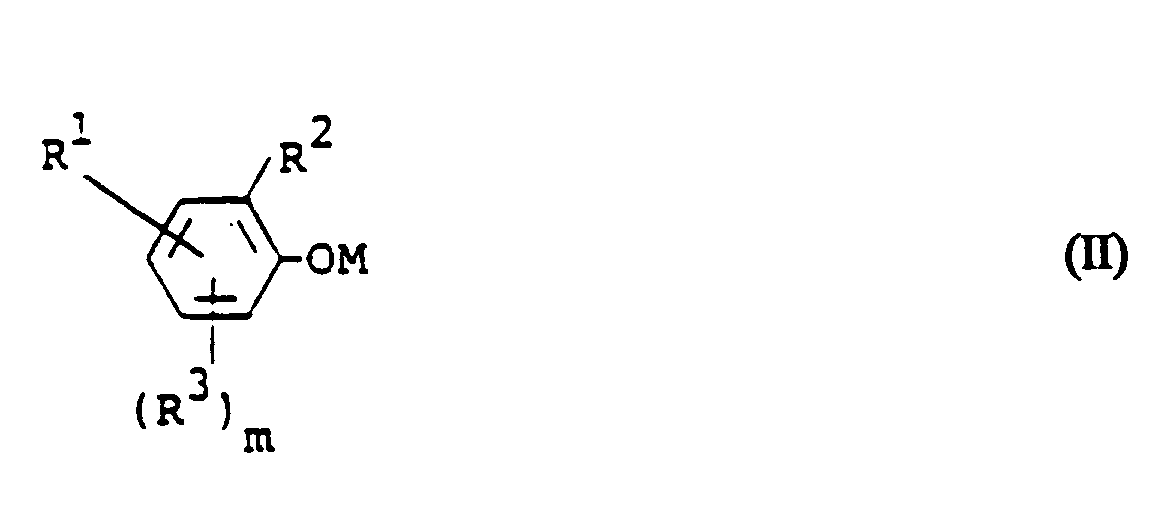
- the aromatic compound (I) is produced by reacting a phenol compound of the formula: wherein M is an alkali metal atom or a hydrogen atom and R 1 , R 2 , R 3 and m are each as defined above with a halide of the formula: wherein A is a halogen atom and R 4 and R 5 are each as defined above.
- the reaction may be carried out usually in an inert solvent in the presence of a base at a temperature of from -20 ° C to the boiling point of the solvent, preferably from -5 ° C to the boiling point of the solvent.
- a base is not necessarily required to use.
- the molar proportion of the phenol compound (II) and the halide (III) to be used for the reaction is not limitative but is preferred to be nearly equal.
- the inert solvent are lower alcohols (e.g. methanol, ethanol, propanol, isopropanol, tert-butyl alcohol), ketones (e.g. acetone, methyl ethyl ketone), hydrocarbons (e.g. hexane, benzene, toluene), ethers (e.g. diethyl ether, diisopropyl ether, tetrahydrofuran, dioxane), acid amides (e.g.
- N,N-dimethylformamide, hexamethylphosphoric triamide N,N-dimethylformamide, hexamethylphosphoric triamide
- halogenated hydrocarbons e.g. dichloromethane, chloroform, 1,2-dichloroethane, chlorobenzene
- nitriles e.g. acetonitrile
- nitro compounds e.g. nitromethane
- Example of the base are alkali metal hydroxides (e.g. sodium hydroxide, potassium hydroxide), alkali metal carbonates (e.g. sodium carbonate, potassium carbonate), alkali metals (e.g. metallic sodium), alkali metal hydrides (e.g.
- an ammonium salt such as triethylbenzylammonium chloride and tetrabutylammonium bromide may be added to the reaction system as a catalyst.
- post-treatment may follow in a per se conventional manner such as extraction with an organic solvent and concentration.
- the product may further be purified by chromatography, distillation, recrystallization, etc.
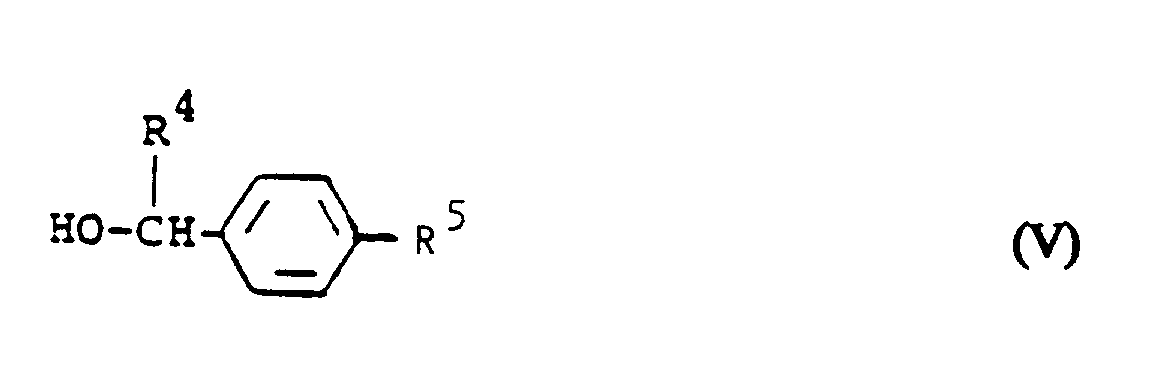
- the aromatic compound (I) is produced by reacting a phenol compound of the formula: wherein R 1 , R 2 , R 3 and m are each as defined above with an alcohol of the formula: wherein R 4 and R 5 are each as defined above. This process is advantageously applicable when R 4 is other than a hydrogen atom.
- the reaction may be carried out normally in an inert solvent in the presence of a dehydrating catalyst or agent at a temperature of from -20 to 200 ° C or the boiling point of the inert solvent.
- the molar proportion of the phenol compound (IV) and the alcohol (V) is not limitative but is preferred to be nearly equal.
- the dehydrating catalyst are inorganic acids (e.g. hydrochloric acid, sulfuric acid), aromatic sulfonic acids and sulfonic acid halides.
- the dehydrating agent include dicyclohexylcarbodimide, diisopropyl azodicarboxylate with triphenylphosphine and diethyl azodicarboxylate with triphenylphosphine.
- inert solvent examples include hydrocarbons (e.g. benzene, toluene, xylene), ethers (e.g. diethyl ether, diisopropyl ether, tetrahydrofuran, dioxane) and halogenated hydrocarbons (e.g. carbon tetrachloride, dichloromethane, 1,2-dichloroethane, chlorobenzene, dichlorobenzene).
- hydrocarbons e.g. benzene, toluene, xylene
- ethers e.g. diethyl ether, diisopropyl ether, tetrahydrofuran, dioxane
- halogenated hydrocarbons e.g. carbon tetrachloride, dichloromethane, 1,2-dichloroethane, chlorobenzene, dichlorobenzene.
- post-treatment may follow in a per se conventional manner such as extraction with an organic solvent and concentration.
- the product may further be purified by e.g. chromatography, distillation or recrystallization.
- the aromatic compounds (I) of the invention have some asymmetric carbon atoms and can form optical isomers. Those optical isomers and their mixtures fall within the scope of the invention.
- the halide (III) and the alcohol (V) are available on the commercial market or can be readily produced from appropriate commercial products by the known method as described in Chem.Ber., 89, 1732 (1956), J.Amer.Chem.Soc., 76, 908 (1954), etc.
- the phenol compound (II) wherein M is an alkali metal atom can be prepared from the corresponding phenol compound (IV) (i.e. the compound of the formula (II) wherein M is a hydrogen atom).
- the phenol compound (IV) are available on the commercial market or can be readily produced from appropriate commercial products by conventional method.
- the phenol compound (II) or (IV) wherein R 2 is a chlorine atom can be also prepared by the known method as described in J.Amer.Chem.Soc., 73, 2723 (1951), J.Org.Chem., 39, 1160 (1974), etc. Furthermore, the phenol compound (IV) may be prepared by reacting the corresponding non-clorinated compound, i.e. a phenol compound, of the formula: wherein R 1 , R 3 and m are each as defined above with a chlorinating agent, preferably in an inert solvent.
- the molar proportion of the phenol compound (VI) and the chlorinating agent is not limitative but it is ordinary to use the chlorinating agent in an amount equivalent to the phenol compound (VI) or somewhat in excess.
- the chlorinating agent are chlorine, tert-butyl hypochlorite and sulfuryl chloride.
- the reaction can be carried out in the presence of an inert solvent. Examples or the solvent are dichloromethane, 1,2-dichloroethane, carbon tetrachloride, benzene and acetic acid.
- the chlorinating agent itself may be available as a reaction medium when it is liquid.
- the reaction temperature is usually from -80 °C to the refluxing temperature of the reaction system, preferably from -20 °C to the refluxing temperature of the reaction system.
- post-treatment may follow in a per se conventional manner such as extraction with an organic solvent and concentration.
- the product may further be purified by chromatography, distillation, recrystallization, etc.
- Planthoppers such as brown planthopper (Nilaparvata lugens), white-backed rice planthopper (Sogatella furcifera) and small brown planthopper (Laodelphax striatellus); leafhoppers such as green rice leafhopper (Nephotettix cincticeps), Nephotettix virescense, Nephotettix nigropictus, zig-zag rice leafhopper (Recilia dorsalis), tea green leafhopper (Empoasca onukii) and grape leafhopper (Arboridia apicalis); aphids such as cotton aphid (Aphis gossypii) and green peach aphid (Myzus persicae); bugs; whiteflies (Aleyrodidae) such as sweet potato whitefly (Bemisia tabaci) and greenhouse whitefly (Trialeurodes vaporariorum); scales; mealy bugs; lace bugs (Tingidae); psyllid
- Pyralid moths such as rice stem borer (Chilo suppressalis), rice leafroller (Cnaphalocrocis medinalis) and Indian meal moth (Plodia interpunctella); Noctuidae such as tobacco curworm (Spodoptera litura), rice armyworm (Pseudaletia separate), cabbage armyworm (Mamestra brassicae) and beet semi- looper (Autographa nigrisigna); Agrothis spp.
- turnip cutworm Agrothis segetum
- black cutworm Agrothis ipsilon
- Heliothis spp. Pieridae such as common cabbageworm (Pieris rapae crucivora); tortricid moths (Tortricidae) such as Adoxophyes spp.
- Carposinidae such as lyonetiid moths (Lyonetiidae), leafblotch miners (Gracillariidae), gelechiid moths (Gelechiidae) and tussock moths (Lyman- triidae); diamondback moth (Plutella xylostella), clothes moths (Tineidae), casemaking clothes moth (Tinea translucens) and webbing clothes moth (Tineola bisselliella).
- Mosquitos (Calicidae) such as common mosquito (Culex pipiens pallens) and Culex tritaeniorhynchus; Aedes spp. such as Aedes aegypti and Aedes albopictus; Anopheles spp.
- Anopheles sinensis such as Anopheles sinensis; midges (Chironomidae); Muscidae such as housefly (musca domestica) and false stablefly (Muscina stabulans); Calliphoridae; Sarcophagidae; lesser housefly (Fannia canicularis); anthomyiid flies (An- thomyiidae) such as seedcorn maggot (Delia platura) and onion maggot (Delia antique); fruit flies (Teph- ritidae); shore flies (Ephydridae); small fruit flies (Drosophilidae); moth flies (Psychodidae); black flies (Simuliidae); Tabanidae; stable flies (Stomoxyidae).
- Leaf beetles Chrysomelidae such as cucurbit beetle (Aulacophora femoralis), striped flea beetles (Phyllotrata striolata), western corn rootworm (Diabrotica virgifora) and southern corn root worm (Diabrotica undecimpunctata); scarabs (Scarabaeidae) such as cupreous chafer (Anomala cuprea) and soybeen beetle (Anomala rufocuprea); weevils (Cureulionidae) such as maize weevil (Sitophilus zeamais), rice water weevil (Lissorhoptrus oryzophilus) and adzuki bean weevil (Callosobruchys chineneis), etc.; darkling beetles (Tenebrionidae) such as yellow mealworm (Tenebrio moliter) and red flour beetles (Tribolium castaneum
- Blattellidae such as German cockroach (Blattella germanica); Blattidae such as smokybrown cockroach (Periplaneta fuliginosa), American cockroach (Periplaneta americana), brown cockroach (Periplaneta brun- nea) and oriental cockroach (Blatta orientalis).
- Thysanoptera -
- Thrips such as Thrips palmi, yellow tea thrips (Scirtothrips dorsalis) and flower thrips (Thrips hawaiien- sis).
- Ants Formidae
- sawflies Teenthredinidae
- cabbage sawfly Athalia rosae ruficornis
- Mole crickets (Gryllotalpidae); grasshoppers (Acrididae).
- Reticulitermes speratus Formosan subterrauean termite (Coptotermes formosanus).
- the aromatic compounds (I) are particularly effective in controlling those belonging to Hemiptera and also exhibit a remarkable controlling effect on planthoppers and leaf-hoppers in a field of rice plant or aphids.
- aromatic compounds (I) may be used alone as insecticides or in mixtures with other insecticides and/or acaricides to enhance or expand their insecticidal or pesticidal use.
- Examples of the other insecticides and/or acaricide include organophosphorus compounds (e.g. fenitrothion (O,O-dimethyl O-(3-methyl-4-nitrophenyl)phosphorothioate), fenthion (O,O-dimethyl O-[3-methyl-4-(methylthio)phenyl]phosphorothioate), diazinon (O,O-diethyl-O-(2-isopropyl-6-methyl-pyrimidin-4-yl)-phosphorothioate), chlorpyrifos (O,O-diethyl-O-(3,5,6-trichloro-2-pyridyl)phosphorothioate), acephate (O,S-dimethyl acetylphosphoramidothioate), methidathion (S-2,3-dihydro-5-methoxy-2-oxo-1,3,4-thiadiazol-3-ylmethyl O,O-dimethylphosphorod
- BPMC (2-sec-butylphenyl methylcarbamate), benfuracarb (ethyl N-[2,3-dihydro-2,2-dimethylbenzofuran-7-yloxycarbonyl-(methyl)aminothio]-N-isopropyl-beta-alaninate), propoxur (2-isopropoxyphenyl N-methylcarbamate), carbosulfan (2,3-dihydro-2,2-dimethyl-7-benzo[b]furanyl N-methylcarbamate), carbaryl (1-naphthyl-N-methylcarbamate), methomyl (S-methyl-N-[(methylcarbamoyl)oxy]thioacetimidate), ethiofen- carb (2-(ethylthiomethyl)phenyl methylcarbamate), aldicarb (2-methyl-2-(methylthio)propionaldehyde O-methylcarbamoyloxime) and Oxamyl
- buprofezin (2-tert-butylimino-3-isopropyl-5-phenyl-1,3,5-triadiazin-4-one));nitroimidazolidine derivatives (e.g. imidacloprid (1-(6-chloro-3-pyridylmethyl)-N-nitro-imidazolidin-2-ylideneamine));nereistoxin derivatives (e.g.
- cartap S,S'-(2-dimethylaminotrimethylene) bis(thiocarbamate), thiocyclam (N,N-dimethyl-1,2,3-trithian-5-ylamine) and ben- sultap (S,S'-2-dimethylaminotrimethylene di(benzenethiosulphonate)); halogenated hydrocarbons (e.g.
- chlorfluazuron (1-[3,5-dichloro-4-(3-chloro-5-trifluoromethylpyridin-2-yloxy)phehyl]-3-(2,6-difluorobenzoyl)urea), tefluben- mecanicon (1-(3,5-dichloro-2,4-difluorophenyl)-3-(2,6-difluorobenzoyl)urea) and flufenoxuron (1-[4-(2-chloro-4-trifluoromethylphenoxy)-2-fluorophenyl]-3-(2,6-difluorobenzoyl)urea); formamidine derivatives (e.g.
- amitraz N,N'-[(methylimino)dimethylidyne]-di-2,4-xylidine
- chlordimeform N'-(4-chloro-2-methylphenyl)-N,N-dimethylmethanimidamide)
- the aromatic compounds (I) as insecticides, they may be employed as such but are normally mixed with appropriate additives such as solid carriers, liquid carriers, gaseous carriers and feed to formulate their compositions.
- surfactants and other adjuvants may be further incorporated therein.
- the compositions may be prepared into any conventional forms such as oil sprays, emulsifiable concentrates, wettable powders, flowable concentrates (e.g. water-based suspension formulations, water-based emulsion formulations), granules, dusts, aerosals, heating smoking formulations (e.g. self-burning-type smoking formulations, chemical reaction-type smoking formulations, porous ceramic plate-type smoking formulations), ULV formulations and poison baits.
- oil sprays emulsifiable concentrates, wettable powders, flowable concentrates (e.g. water-based suspension formulations, water-based emulsion formulations), granules, dusts, aerosals, heating smoking formulations (e.g. self-
- composition of the invention contains generally the aromatic compound(s) (I) as the active ingredient in an amount of from 0.001 % to 95 % by weight based on the composition.
- the solid carrier usable for making the composition are fine powders or granules of clays (e.g. kaolin clay, diatomaceous earth, synthetic hydrated silica, bentonite, Fubasami clay, terra alba), talc, ceramics, other inorganic minerals (e.g. sericite, quartz, sulfur, activated carbon, calcium carbonate, hydrated silica) and chemical fertilizers (e.g. ammonium sulfate, ammonium phosphate, ammonium nitrate, urea, ammonium chloride).
- the liquid carrier include water, alcohols (e.g. methanol, ethanol), ketones (e.g.
- acetone, methyl ethyl ketone aromatic hydrocarbons (e.g. benzene, toluene, xylene, ethylbenzene, methyl naphthalene), aliphatic hydrocarbons (e.g. hexane, cyclohexane, kerosene, gas oil), esters (e.g. ethyl acetate, butyl acetate), nitriles (e.g. acetonitriles, isobutyronitrile), ethers (e.g. diisopropyl ether, dioxane), acid amides (e.g.
- aromatic hydrocarbons e.g. benzene, toluene, xylene, ethylbenzene, methyl naphthalene
- aliphatic hydrocarbons e.g. hexane, cyclohexane, kerosene, gas oil
- gaseous carrier i.e. a propellant
- freon gas butane gas
- LPG liquefied petroleum gas
- dimethyl ether dimethyl ether and carbon dioxide.
- surfactant examples include alkylsulfates, alkylsulfonates, alkylarylsulfonates, alkyl aryl ethers and polyoxyethylene derivatives thereof, polyethylene glycol ethers, polyvalent alcohol esters and sugar alcohol derivatives.
- adjuvants such as binders and dispersing agents are casein, gelatin, polysaccharides (e.g. starch powders, gum arabic, cellulose derivatives, alginic acid), lignin derivatives, bentonite, sugars and synthetic water-soluble high molecular weight substances (e.g. polyacrylic alcohol, polyvinylpyrrolidone, polyacrylic acid).
- the stabilizer examples include PAP (acidic isopropyl phosphate), BHT (2,6-di-tert-butyl-4-methylphenol), BHA (mixture of 2-tert-butyl-4-methoxyphenol and 3-tert-butyl-4-methoxyphenol), vegetable oils, mineral oils, surfactants and fatty acids or esters thereof.
- the base material for self-burning-type smoking formulations may include, for example, burning heat-generating agents such as nitrates, nitrites, guanidine salts, potassium chlorate, nitrocellulose, ethyl cellulose and wood powders, pyrolysis-promoting agents such as alkali metal salts, alkaline earth metal salts, dichromates and chromates, oxygen-supplying agents such as potassium nitrate, burning-supporting agents such as melamine and wheat starch, extenders such as diatomaceous earth and binders such as synthetic pastes.
- burning heat-generating agents such as nitrates, nitrites, guanidine salts, potassium chlorate, nitrocellulose, ethyl cellulose and wood powders
- pyrolysis-promoting agents such as alkali metal salts, alkaline earth metal salts, dichromates and chromates
- oxygen-supplying agents such as potassium nitrate
- burning-supporting agents such as melamine and wheat
- the base material for chemical reation-type smoking formulations can include, for example, heat-generating agents such as alkali metal sulfides, alkali metal polysulfides, alkali metal hydrosulfides, hydrated salts of alkali metals and calcium oxide, catalyzing agents such as carbonaceous substances, iron carbide and activated clay, organic foaming agents such as azodicarbonamide, benzenesulfonyl hydrazides, dinitrosopentamethylenetetramine, polystyrene and polyurethane, fillers such as natural fiber pieces and synthetic fiber pieces.
- heat-generating agents such as alkali metal sulfides, alkali metal polysulfides, alkali metal hydrosulfides, hydrated salts of alkali metals and calcium oxide
- catalyzing agents such as carbonaceous substances, iron carbide and activated clay
- organic foaming agents such as azodicarbonamide, benzenesulfonyl hydra
- the base material for poison baits may contain feed components such as crop powders, essential vegetable oil, sugars and crystalline cellulose, antioxidants such as dibutylhydroxyrtolune and nordihydroguaiaretic acid, preservatives such as dehydroacetic acid, feeding error preventing agnets such as red paper powders, incentive flavors such as cheese flavor and onion flavor.
- feed components such as crop powders, essential vegetable oil, sugars and crystalline cellulose, antioxidants such as dibutylhydroxyrtolune and nordihydroguaiaretic acid, preservatives such as dehydroacetic acid, feeding error preventing agnets such as red paper powders, incentive flavors such as cheese flavor and onion flavor.
- Flowable concentrates are generally obtained by dispersing about 1 to 75 parts by weight of the aromatic compound (I) as the active ingredient finely and uniformly into water containing about 0.5 to 15 parts by weight of a dipersing agent, about 0.1 to 10 parts by weight of a suspending agent (e.g. protective colloids, compounds giving a thixotropic property) and optionally about 0 to 10 parts by weight of an auxiliary agent(s) such as a defoaming agent, an anticorrosive agent, a stabilizing agent, a spreading agents, penetration auxiliaries, antifreezing agent, an antibacterial agent and an antimolding agent.
- a suspending agent e.g. protective colloids, compounds giving a thixotropic property
- an auxiliary agent(s) such as a defoaming agent, an anticorrosive agent, a stabilizing agent, a spreading agents, penetration auxiliaries, antifreezing agent, an antibacterial agent and an antimolding agent.
- Examples of the compounds giving a thixotropic property are bentonite, aluminum magnesium silicate, xanthane gum and polyacrylic acid.
- composition of the invention thus obtained may be used as such or after diluting with water. It may be also used in a mixture with any other active component or composition chosen from insecticides, nematocides, acaricides, fungicides, bacteriocides, herbicides, plant growth regulators, synergistic agents, fertilizers, soil conditioners and animal feed. Alternatively, the composition of the invention may be applied separately but simultaneously with said other active component or composition.
- the aromatic compound (I) according to the present invention may be applied to the insect pests or the locus where the insect pests propagate generally in an amount of 0.001 g to 500 g, and preferably 0.1 g to 500 g per 10 ares.
- the aromatic compound (I) When the aromatic compound (I) is applied in a form of emulsifiable concentrate, wettable powder or flowable concentrate after dilution with water, its concentration may be from 0.0001 to 1000 ppm. Granules and dusts may be used as such, i.e. without water dilution.
- the aromatic compound (I) When used for household or public hygiene, it may be used in the form of an emulsifiable concentrate, wettable powder, flowable concentrate or in a similar form with water dilution.
- the concentration of the active ingredient may be from 0.0001 to 10,000 ppm.
- oils, aerosol, fumigants, ULV formulations and poison baits they may be applied as such.
- the doses and concentrations may vary within broad ranges depending upon the composition, the application time, the place applied, the application method, the kind of insect pests and the condition of damage, and may be increased or decreased, irrespective of the general ranges set forth above.
- a mixture of 0.3 part of each of Compound Nos. 1 to 36, 2 parts of fenitrothion (O,O-dimethyl O-(3-methyl-4-nitrophenyl)phosphorothioate as an organophosphorus insecticide, 3 parts of fine powders of synthetic hydrated silica, 1 part of "Driless B" and 3.7 parts of clay are pestled in a mortar and stirred in a mixer. Then, 90 parts of cut clay are added thereto, and the resultant mixture is further mixed in a sack to give dusts.
- a mixture of 0.3 part of each of Compound Nos. 1 to 36, 2 parts of BPMC (O-sec-butylphenyl N-methylcarbamate) as a carbamate insecticide, 3 parts of fine powders of synthetic hydrated silica, 1 part of "Driless B" and 3.7 parts of clay are pestled in a mortar and stirred in a mixer. Then, 90 parts of cut clay are added thereto, and the resultant mixture is further mixed in a sack to give dusts.
- BPMC O-sec-butylphenyl N-methylcarbamate
- a propellant liquefied petroleum gas
- a propellant liquefied petroleum gas
- Each of Compound Nos. 1 to 36 (100 mg) is dissolved in an appropriate amount of acetone, and the resultant solution is impregnated with a porous ceramic plate (4.0 x 4.0 x 1.2 cm) to give a fumigant.
- Test Examples show some of test results which support the controlling effect of the aromatic compounds (I) on insect pests.
- the compound numbers correspond to those as shown in Table 2.
- the compounds used for comparison are as follows:
- An emulfiable concentrate prepared according to Formulation Example 1 was diluted with water to make a predetermined concentration.
- the dilution was sprayed onto rice plants cultivated in polyethylene cups at a rate of 20 ml/2 pots on a turning table. After air-drying, the plants were infested with about ten 3rd instar nymphs of brown rice planthopper (Nilaparvata lugens). After 10 days, the number of normal adults was counted to obtain an emergence inhibitory rate.
- Table 4 The results are shown in Table 4.
- An emulfiable concentrate prepared according to Formulation Example 1 was diluted with water to make a predetermined concentration.
- the dilution was sprayed onto rice plants (about 20 cm in height) cultivated in plastic pots (1/5000 are in width) at a rate of 40 ml/2 pots on a turning table. After air-drying, the pots were covered with wire cages, and each 10 male and female adults of green rice leafhopper (Nephotettix cincticeps) were released in each of the cages. After 3 weeks, the number of nymphs was counted to obtain a reproduction inhibitory rate. The results are shown in Table 5.
- An emulfiable concentrate prepared according to Formulation Example 1 was diluted with water to make a predetermined concentration.
- the dilution was sprayed onto rice plants (about 20 cm in height) cultivated in plastic pots (1/5000 are in width) at a rate of 40 ml/2 pots on a turning table. After air-drying, the pots were covered with wire cages, and each 5 male and female adults of brown rice planthopper (Nilaparvata lugens) were released in each of the cages. After about 3 weeks, the number of nymphs was counted to obtain a reproduction inhibitory rate. The results are shown in Table 6.
- An emulfiable concentrate prepared according to Formulation Example 1 was diluted with water to make a predetermined concentration. The dilution was sprayed onto potted cotton plants (in a stage of 8-9 days after sowing) infested with 1 st instar nymphs of cotton aphids (Aphis gossypil) at a rate of 30 ml/2 pots on a turning table. Before spraying and one week after spraying, the humber of nymphs and aduts was counted, and a reproduction inhibitory index was expressed by the following equation: wherein the judgement of activity is based on the following standard:
Landscapes
- Organic Chemistry (AREA)
- Chemical & Material Sciences (AREA)
- Life Sciences & Earth Sciences (AREA)
- Dentistry (AREA)
- Health & Medical Sciences (AREA)
- Engineering & Computer Science (AREA)
- Plant Pathology (AREA)
- General Health & Medical Sciences (AREA)
- Wood Science & Technology (AREA)
- Zoology (AREA)
- Environmental Sciences (AREA)
- Pest Control & Pesticides (AREA)
- Agronomy & Crop Science (AREA)
- Agricultural Chemicals And Associated Chemicals (AREA)
- Organic Low-Molecular-Weight Compounds And Preparation Thereof (AREA)
Claims (8)




Applications Claiming Priority (2)
| Application Number | Priority Date | Filing Date | Title |
|---|---|---|---|
| JP8195591 | 1991-03-19 | ||
| JP81955/91 | 1991-03-19 |
Publications (3)
| Publication Number | Publication Date |
|---|---|
| EP0504812A2 EP0504812A2 (fr) | 1992-09-23 |
| EP0504812A3 EP0504812A3 (en) | 1992-10-28 |
| EP0504812B1 true EP0504812B1 (fr) | 1995-09-06 |
Family
ID=13760926
Family Applications (1)
| Application Number | Title | Priority Date | Filing Date |
|---|---|---|---|
| EP92104601A Expired - Lifetime EP0504812B1 (fr) | 1991-03-19 | 1992-03-17 | Composés aromatiques, procédés pour leur préparation et leurs compositions comme insecticides |
Country Status (6)
| Country | Link |
|---|---|
| US (1) | US5302619A (fr) |
| EP (1) | EP0504812B1 (fr) |
| KR (1) | KR920017995A (fr) |
| AU (1) | AU643121B2 (fr) |
| BR (1) | BR9200917A (fr) |
| DE (1) | DE69204505T2 (fr) |
Families Citing this family (5)
| Publication number | Priority date | Publication date | Assignee | Title |
|---|---|---|---|---|
| DE69505490T2 (de) * | 1994-08-04 | 1999-06-24 | Sumitomo Chemical Co., Ltd., Osaka | Dihalopropenverbindungen, sie enthaltende insektizide/akarizide mittel, und zwischenprodukte |
| US6177412B1 (en) | 1999-05-28 | 2001-01-23 | Valent U.S.A. Corporation | Insecticidal composition and method for the use thereof |
| US20050065577A1 (en) * | 2003-09-23 | 2005-03-24 | Mcarthur Frank G. | Low level laser tissue treatment |
| WO2006004982A1 (fr) * | 2004-06-29 | 2006-01-12 | University Of Florida Research Foundation, Inc. | Analogues d'hormone juvenile pour la lutte contre les membracides et les cicadelles |
| CA2607591A1 (fr) * | 2005-05-07 | 2006-11-16 | Merial Limited | Phenylethers pesticides substitues |
Family Cites Families (14)
| Publication number | Priority date | Publication date | Assignee | Title |
|---|---|---|---|---|
| US2121723A (en) * | 1938-06-21 | Aralkyl ethers | ||
| US2121724A (en) * | 1938-06-21 | aralkyl ethers of ethyl-phenol | ||
| US2213215A (en) * | 1939-02-25 | 1940-09-03 | Rohm & Haas | Insecticide |
| US2817622A (en) * | 1954-05-19 | 1957-12-24 | Lehn & Fink Products Corp | Compositions having joint insecticidal and bactericidal action |
| FR1589436A (fr) * | 1968-05-03 | 1970-03-31 | ||
| US4048235A (en) * | 1972-03-16 | 1977-09-13 | Ciba-Geigy Corporation | Propenyloxy benzene compounds |
| US3966824A (en) * | 1972-12-26 | 1976-06-29 | University Of Illinois Foundation | P,P'-Disubstituted α-trichloromethylbenzylphenyl ethers |
| US4088776A (en) * | 1973-04-18 | 1978-05-09 | Ciba-Geigy Corporation | Methylene dioxy-substituted benzene derivatives |
| US4153731A (en) * | 1973-04-18 | 1979-05-08 | Ciba-Geigy Corporation | Phenoxy (benzyloxy/benzylthio) benzene derivatives |
| GB1482195A (en) * | 1973-08-23 | 1977-08-10 | Beecham Group Ltd | Biologically active phenyl(thio)ether derivatives |
| US4306097A (en) * | 1977-09-13 | 1981-12-15 | Pfizer Inc. | 3-[2-Hydroxy-4-(substituted)phenyl]-cycloalkanol analgesic agents |
| US4168388A (en) * | 1978-03-23 | 1979-09-18 | Eli Lilly And Company | Trifluoromethylphenyl benzyl ethers |
| JPS57176272A (en) * | 1981-04-21 | 1982-10-29 | Sumitomo Chemical Co | Dyeing of hydrophobic fiber |
| JPS6341451A (ja) * | 1986-08-06 | 1988-02-22 | Nippon Kayaku Co Ltd | エ−テル誘導体およびそれを有効成分とする殺ダニ、殺虫組成物 |
-
1992
- 1992-02-17 AU AU10994/92A patent/AU643121B2/en not_active Ceased
- 1992-02-28 US US07/843,200 patent/US5302619A/en not_active Expired - Fee Related
- 1992-03-17 DE DE69204505T patent/DE69204505T2/de not_active Expired - Fee Related
- 1992-03-17 EP EP92104601A patent/EP0504812B1/fr not_active Expired - Lifetime
- 1992-03-18 BR BR929200917A patent/BR9200917A/pt not_active Application Discontinuation
- 1992-03-19 KR KR1019920004545A patent/KR920017995A/ko not_active Withdrawn
Also Published As
| Publication number | Publication date |
|---|---|
| DE69204505T2 (de) | 1996-03-28 |
| EP0504812A3 (en) | 1992-10-28 |
| AU1099492A (en) | 1992-09-24 |
| EP0504812A2 (fr) | 1992-09-23 |
| AU643121B2 (en) | 1993-11-04 |
| US5302619A (en) | 1994-04-12 |
| KR920017995A (ko) | 1992-10-21 |
| DE69204505D1 (de) | 1995-10-12 |
| BR9200917A (pt) | 1992-11-17 |
Similar Documents
| Publication | Publication Date | Title |
|---|---|---|
| US5151428A (en) | Pyridine derivatives and their compositions for the control of insect pests | |
| US5411979A (en) | Oxazoline derivative, its production and its use | |
| EP0754683B1 (fr) | Compose d'ether, son utilisation et intermediaire pour l'obtention de ce compose | |
| EP0504812B1 (fr) | Composés aromatiques, procédés pour leur préparation et leurs compositions comme insecticides | |
| US5258410A (en) | Aromatic compounds, their production processes and their compositions for the control of insect pests | |
| US5252610A (en) | Aromatic compounds and their compositions for the control of insect pests | |
| EP0488236B1 (fr) | Composés aromatiques, procédés pour leur préparation et leurs compositions pour combattre les insectes | |
| US5243087A (en) | Pyridine derivatives, their production processes and their compositions for the control of insect pests | |
| US5356930A (en) | Amide derivatives, their production processes and their compositions for the control of insect pests | |
| US5137907A (en) | 1-(3-(4-(3,5-difluorophenoxy) phenoxy) propyl) - pyrazole, and its production and use | |
| US5346920A (en) | Carbamic acid derivatives, and their production and use | |
| US5232949A (en) | 3-(4-substituted-2-chlorophenoxy)propionaldoxime ethyl ether compounds, their production processes and their compositions for the control of insect pests | |
| US5262441A (en) | Aromatic compounds, their production processes and their compositions for the control of insect pests | |
| EP0460472B1 (fr) | Dérivés de l'acide carbamic, leur préparation et utilisation | |
| JPH05222006A (ja) | 1,2,3−トリアゾール誘導体、その製造法、その中間体およびそれを有効成分として含有する有害生物防除剤 | |
| JPH05186384A (ja) | 芳香族系化合物、その製造法、その中間体およびそれを有効成分とする有害生物防除剤 | |
| JPH05178704A (ja) | 芳香族系化合物、その製造法およびそれを有効成分とする有害生物防除剤 | |
| JPH051015A (ja) | カルバミン酸誘導体、その製造法、その中間体およびそれを有効成分とする有害生物防除剤 |
Legal Events
| Date | Code | Title | Description |
|---|---|---|---|
| PUAI | Public reference made under article 153(3) epc to a published international application that has entered the european phase |
Free format text: ORIGINAL CODE: 0009012 |
|
| PUAL | Search report despatched |
Free format text: ORIGINAL CODE: 0009013 |
|
| AK | Designated contracting states |
Kind code of ref document: A2 Designated state(s): CH DE FR GB IT LI |
|
| AK | Designated contracting states |
Kind code of ref document: A3 Designated state(s): CH DE FR GB IT LI |
|
| 17P | Request for examination filed |
Effective date: 19921106 |
|
| 17Q | First examination report despatched |
Effective date: 19940414 |
|
| GRAA | (expected) grant |
Free format text: ORIGINAL CODE: 0009210 |
|
| AK | Designated contracting states |
Kind code of ref document: B1 Designated state(s): CH DE FR GB IT LI |
|
| ITF | It: translation for a ep patent filed | ||
| REF | Corresponds to: |
Ref document number: 69204505 Country of ref document: DE Date of ref document: 19951012 |
|
| ET | Fr: translation filed | ||
| PGFP | Annual fee paid to national office [announced via postgrant information from national office to epo] |
Ref country code: FR Payment date: 19951228 Year of fee payment: 5 |
|
| PG25 | Lapsed in a contracting state [announced via postgrant information from national office to epo] |
Ref country code: GB Effective date: 19960317 |
|
| PG25 | Lapsed in a contracting state [announced via postgrant information from national office to epo] |
Ref country code: LI Effective date: 19960331 Ref country code: CH Effective date: 19960331 |
|
| PLBE | No opposition filed within time limit |
Free format text: ORIGINAL CODE: 0009261 |
|
| STAA | Information on the status of an ep patent application or granted ep patent |
Free format text: STATUS: NO OPPOSITION FILED WITHIN TIME LIMIT |
|
| 26N | No opposition filed | ||
| GBPC | Gb: european patent ceased through non-payment of renewal fee |
Effective date: 19960317 |
|
| REG | Reference to a national code |
Ref country code: CH Ref legal event code: PL |
|
| PG25 | Lapsed in a contracting state [announced via postgrant information from national office to epo] |
Ref country code: FR Effective date: 19961129 |
|
| PG25 | Lapsed in a contracting state [announced via postgrant information from national office to epo] |
Ref country code: DE Effective date: 19961203 |
|
| REG | Reference to a national code |
Ref country code: FR Ref legal event code: ST |
|
| PG25 | Lapsed in a contracting state [announced via postgrant information from national office to epo] |
Ref country code: IT Free format text: LAPSE BECAUSE OF NON-PAYMENT OF DUE FEES Effective date: 20050317 |