EP0505708B1 - Überzogenes Befestigungselement aus Metall und Überzugszusammensetzung dafür - Google Patents
Überzogenes Befestigungselement aus Metall und Überzugszusammensetzung dafür Download PDFInfo
- Publication number
- EP0505708B1 EP0505708B1 EP92102230A EP92102230A EP0505708B1 EP 0505708 B1 EP0505708 B1 EP 0505708B1 EP 92102230 A EP92102230 A EP 92102230A EP 92102230 A EP92102230 A EP 92102230A EP 0505708 B1 EP0505708 B1 EP 0505708B1
- Authority
- EP
- European Patent Office
- Prior art keywords
- monomer
- coating
- metal fastener
- fastener
- resin
- Prior art date
- Legal status (The legal status is an assumption and is not a legal conclusion. Google has not performed a legal analysis and makes no representation as to the accuracy of the status listed.)
- Expired - Lifetime
Links
Images
Classifications
-
- F—MECHANICAL ENGINEERING; LIGHTING; HEATING; WEAPONS; BLASTING
- F16—ENGINEERING ELEMENTS AND UNITS; GENERAL MEASURES FOR PRODUCING AND MAINTAINING EFFECTIVE FUNCTIONING OF MACHINES OR INSTALLATIONS; THERMAL INSULATION IN GENERAL
- F16B—DEVICES FOR FASTENING OR SECURING CONSTRUCTIONAL ELEMENTS OR MACHINE PARTS TOGETHER, e.g. NAILS, BOLTS, CIRCLIPS, CLAMPS, CLIPS OR WEDGES; JOINTS OR JOINTING
- F16B15/00—Nails; Staples
- F16B15/0092—Coated nails or staples
-
- B—PERFORMING OPERATIONS; TRANSPORTING
- B05—SPRAYING OR ATOMISING IN GENERAL; APPLYING FLUENT MATERIALS TO SURFACES, IN GENERAL
- B05D—PROCESSES FOR APPLYING FLUENT MATERIALS TO SURFACES, IN GENERAL
- B05D7/00—Processes, other than flocking, specially adapted for applying liquids or other fluent materials to particular surfaces or for applying particular liquids or other fluent materials
- B05D7/14—Processes, other than flocking, specially adapted for applying liquids or other fluent materials to particular surfaces or for applying particular liquids or other fluent materials to metal, e.g. car bodies
-
- C—CHEMISTRY; METALLURGY
- C09—DYES; PAINTS; POLISHES; NATURAL RESINS; ADHESIVES; COMPOSITIONS NOT OTHERWISE PROVIDED FOR; APPLICATIONS OF MATERIALS NOT OTHERWISE PROVIDED FOR
- C09D—COATING COMPOSITIONS, e.g. PAINTS, VARNISHES OR LACQUERS; FILLING PASTES; CHEMICAL PAINT OR INK REMOVERS; INKS; CORRECTING FLUIDS; WOODSTAINS; PASTES OR SOLIDS FOR COLOURING OR PRINTING; USE OF MATERIALS THEREFOR
- C09D135/00—Coating compositions based on homopolymers or copolymers of compounds having one or more unsaturated aliphatic radicals, each having only one carbon-to-carbon double bond, and at least one being terminated by a carboxyl radical, and containing at least another carboxyl radical in the molecule, or of salts, anhydrides, esters, amides, imides or nitriles thereof; Coating compositions based on derivatives of such polymers
- C09D135/06—Copolymers with vinyl aromatic monomers
-
- B—PERFORMING OPERATIONS; TRANSPORTING
- B05—SPRAYING OR ATOMISING IN GENERAL; APPLYING FLUENT MATERIALS TO SURFACES, IN GENERAL
- B05D—PROCESSES FOR APPLYING FLUENT MATERIALS TO SURFACES, IN GENERAL
- B05D2258/00—Small objects (e.g. screws)
-
- B—PERFORMING OPERATIONS; TRANSPORTING
- B05—SPRAYING OR ATOMISING IN GENERAL; APPLYING FLUENT MATERIALS TO SURFACES, IN GENERAL
- B05D—PROCESSES FOR APPLYING FLUENT MATERIALS TO SURFACES, IN GENERAL
- B05D2401/00—Form of the coating product, e.g. solution, water dispersion, powders or the like
- B05D2401/10—Organic solvent
-
- C—CHEMISTRY; METALLURGY
- C08—ORGANIC MACROMOLECULAR COMPOUNDS; THEIR PREPARATION OR CHEMICAL WORKING-UP; COMPOSITIONS BASED THEREON
- C08L—COMPOSITIONS OF MACROMOLECULAR COMPOUNDS
- C08L31/00—Compositions of homopolymers or copolymers of compounds having one or more unsaturated aliphatic radicals, each having only one carbon-to-carbon double bond, and at least one being terminated by an acyloxy radical of a saturated carboxylic acid, of carbonic acid or of a haloformic acid; Compositions of derivatives of such polymers
- C08L31/02—Homopolymers or copolymers of esters of monocarboxylic acids
- C08L31/04—Homopolymers or copolymers of vinyl acetate
-
- Y—GENERAL TAGGING OF NEW TECHNOLOGICAL DEVELOPMENTS; GENERAL TAGGING OF CROSS-SECTIONAL TECHNOLOGIES SPANNING OVER SEVERAL SECTIONS OF THE IPC; TECHNICAL SUBJECTS COVERED BY FORMER USPC CROSS-REFERENCE ART COLLECTIONS [XRACs] AND DIGESTS
- Y10—TECHNICAL SUBJECTS COVERED BY FORMER USPC
- Y10S—TECHNICAL SUBJECTS COVERED BY FORMER USPC CROSS-REFERENCE ART COLLECTIONS [XRACs] AND DIGESTS
- Y10S411/00—Expanded, threaded, driven, headed, tool-deformed, or locked-threaded fastener
- Y10S411/90—Fastener or fastener element composed of plural different materials
- Y10S411/901—Core and exterior of different materials
- Y10S411/902—Metal core
- Y10S411/903—Resinous exterior
-
- Y—GENERAL TAGGING OF NEW TECHNOLOGICAL DEVELOPMENTS; GENERAL TAGGING OF CROSS-SECTIONAL TECHNOLOGIES SPANNING OVER SEVERAL SECTIONS OF THE IPC; TECHNICAL SUBJECTS COVERED BY FORMER USPC CROSS-REFERENCE ART COLLECTIONS [XRACs] AND DIGESTS
- Y10—TECHNICAL SUBJECTS COVERED BY FORMER USPC
- Y10S—TECHNICAL SUBJECTS COVERED BY FORMER USPC CROSS-REFERENCE ART COLLECTIONS [XRACs] AND DIGESTS
- Y10S411/00—Expanded, threaded, driven, headed, tool-deformed, or locked-threaded fastener
- Y10S411/922—Nail, spike or tack having locking device
Definitions
- the invention herein relates to a coating for metal fasteners, to a process for coating metal fasteners and to metal fasteners with a coating applied and dried thereon.
- the coating protects the metal fastener and exhibits an attraction for plaster-like materials.
- Fasteners such as nails, staples, and truss plates are utilized extensively in the construction and assembly of countless articles from buildings to fences.
- the useful life of a fastener is critical to its suitability for a particular purpose. For example, a nail which is not corrosion-resistant is not suited for service where it will be exposed to outdoor weather conditions.
- a suitable fastener coating must adequately adhere to the fastener.
- fasteners are made of carbon steel.
- Fasteners can also be made of aluminum or copper alloys such as bronze.
- a fastener may be zinc coated or chromate coated before a protective outer coating is applied. A suitable coating should therefore adhere to a variety of metals or metallic surfaces.
- Coatings for fasteners impart desirable properties to the fasteners. For example, most protective coatings on metal fasteners provide corrosion resistance, but some coatings enable a fastener to be inserted with less force yet increase the force required to remove the fastener.
- a fastener coating with both above-described properties is disclosed in Lat et al., U.S. Patent No. 4,964,774.
- the coating disclosed in the Lat et al. patent comprises a film forming, thermoplastic, predominantly aliphatic polyurethane resin, which is applied onto the fastener in an aqueous medium and then dried thereon.
- a metal coating composition comprising a copolymer of a vinyl halide, a vinyl ester of a lower saturated fatty acid and an aliphatic ⁇ , ⁇ -mono-olefinic carboxylic acid that exhibits improved adhesion to smooth metal surfaces is disclosed.
- the adhesion of the coating composition is improved by co-polymerizing the vinyl halide and the aliphatic vinyl ester with small quantities of an unsaturated carboxylic acid.
- a metal fastener coating that adheres to wood is disclosed.
- the coating comprises about 50 to about 80 percent by weight resin solids of a rosin-like resin, which is dispersed in about 20 to 50 percent by weight of an ethylene copolymer or terpolymer containing carboxyl or esterified carboxyl groups.
- porous materials such as plaster due to the chemical and physical properties of porous materials.
- the binder polymer in the plaster must be compatible, chemically, to the fastener overcoat for good adhesion to develop on drying.
- plaster-like materials such as spackling compound are applied as a finish over sheets of plasterboard which have been fastened to building frames. If the fastener used does not exhibit some sort of affinity for the spackling compound, the spackling compound will not adhere to those portions of the fastener not embedded in the plasterboard. If the spackling compound does not adhere to the exposed portions of the fastener, the finish coating will be uneven or pocked, which is unacceptable.
- the present invention is directed to a coated metal fastener, a coating therefore and a process for coating a metal fastener.
- the coating composition reduces penetration force, increases withdrawal force, and resists chipping or tearing away the article or object into which the fastener is imbedded or otherwise anchored.
- the coating further protects the metal fastener from corrosion.
- the coating has a strong attraction to plaster and plaster-like materials, which more readily adhere to the coated fastener of claim 1.
- the coating is a combination of two resins.
- the first resin is a copolymer of an aromatic monomer, preferably styrene, and a monomer with ⁇ , ⁇ unsaturation associated with carboxyl groups or partially esterified carboxyl groups, preferably maleic anhydride.
- the second resin is a thermoplastic resin, preferably vinyl acetate.
- the coating composition is prepared by combining 4% to 15%, preferably 7.5 weight percent of the copolymer resin with 3% to 16%, preferably 5 weight percent of the thermoplastic resin in an inert organic solvent or mixture of solvents.
- the ratio of the first resin to the second resin is 80 to 20 to 20 to 80 parts by weight.
- the inert organic solvents can be aromatic solvents, ketones, chlorohydrocarbons, and mixtures thereof. Preferred solvents are toluene, methylethylketone, and chloroethane, 1,1,1 trichloroethane being the most preferred.
- the organic solvent generally comprises 80 to 90 percent by weight of the coating composition, preferably 87 percent by weight.
- the coating composition optionally contains a dye which, if present, is in an amount of 0.1% to 1%, preferably 0.2 percent by weight of the composition.
- the coating composition is suited for application onto metal fasteners made preferably of carbon steel.
- the fastener itself may be a nail, staple, or truss plate.
- thermoplastic, polymeric coating is applied to the fastener by dipping, spraying or roller coating the fastener with the coating composition in inert organic solvent.
- a reservoir filled with the coating composition is provided for this purpose.
- the liquid coating composition is then cured and dried on the fastener by conventional means.
- the coating is dried upon the fastener at approximately ambient temperature.
- the thickness of the dried coating composition on the fastener is 0.2 to 2 millimeters, preferably 0.5 to 1.5 millimeters.
- the cured coating composition is sufficiently brittle that, if bridges of dried coating should form between individual fasteners, these bridges can be broken without damaging the coating on either fastener.
- thermoplastic, polymeric coating is applied by any of the above-described methods so as to coat a substantial part of the fastener, preferably the entire fastener.
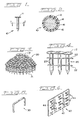
- FIGURE 1 is an elevational view of a nail constituting a preferred embodiment of this invention.
- FIGURE 2 is a cross-sectional view on a slightly larger scale, as taken along plane 2--2 of FIGURE 1 in a direction indicated by arrows.
- FIGURE 3 is a simplified perspective view of a collated coil of nails.
- FIGURE 4 is an elevational view on a slightly smaller scale, showing a fragmentary, collated strip of nails from the coil of FIGURE 3 similar to the nail of FIGURE 1.
- FIGURE 5 is a perspective view of a staple constituting an alternative embodiment of this invention.
- FIGURE 6 is a simplified, perspective view of a truss plate constituting a further embodiment of this invention.
- the present invention is directed to a coating composition for a metal fastener, a metal fastener coated with the coating composition and a method for coating the metal fastener with the coating composition.
- the coating composition is a combination of a copolymer and a thermoplastic resin.
- the copolymer contains an aromatic monomer selected from the group cited below and a monomer with ⁇ , ⁇ unsaturation associated with carboxyl groups selected from the group cited below.
- the copolymer and resin are combined in an inert organic solvent and applied to the metal fastener by any suitable method, preferably dipcoating.
- Aromatic monomers suitable for use in the invention are styrene, vinyl toluene ⁇ -methylstyrene, ⁇ -methylstyrene and divinylbenzene. Styrene is preferred due to its greater availability and lower cost. Polymers made from aromatic monomers tend to be stiff and clear. Therefore, the aromatic monomer provides a degree of rigidity to the cured coating.
- Aromatic monomers are commonly copolymerized with other monomers. Monomers with ⁇ , ⁇ unsaturation with carboxyl groups copolymerize with aromatic monomers to form linear, strong polymers. After copolymerization, a portion of the anhydride in the resulting polymer can be partially esterified, in which case a linear aromatic polyester resin is formed.
- the monomers with ⁇ , ⁇ unsaturation with carboxyl groups are selected from the group consisting of maleic anhydride, maleic acid and fumaric acid.
- the preferred monomer is maleic anhydride.
- Styrene/maleic anhydride copolymers preferred for use in the coating composition disclosed herein are preferably unmodified copolymers of styrene and maleic anhydride monomers with mole ratios of styrene to maleic anhydride monomer of 1 to 1 to 3 to 1.
- the copolymer has a relatively high melting temperature, in the range of 55°C to 170°C and a high thermal stability.
- the number average molecular weight of the resin is 1600 to 2800.
- the copolymer has an acid number of 100 to 500.
- the acid number is the number of milligrams of potassium hydroxide necessary to neutralize the acid in one gram of substance.
- the copolymer has a melt viscosity of 15 cps to 55 cps in a mixture that is 15 percent nonvolatile material.
- the copolymer is soluble in a number of organic solvents.
- the solution viscosity and the solubility of the copolymer in the solution both increase as the ratio of styrene monomer to maleic anhydride monomer increases.
- the copolymer can be either in the anhydride or partial ester form.
- the copolymer can be partially esterified by treating the styrene/maleic anhydride copolymer with an alcohol such as ethylene glycol.
- the preferred degree of esterification of the copolymer is 35 percent to 50 percent.
- Thermoplastic synthetic resin adhesives comprise a variety of polymerized materials such as polyvinyl acetate, polyvinyl butyryl, polyvinyl alcohol, and other polyvinyl resins.
- Acrylic and methacrylic acid ester resins and various other synthetic resins such as polyisobutylene, polyamides, coumarone-indene products and silicones also exhibit adhesive properties desirable for the coating composition disclosed herein.
- the thermoplastic resins usually have permanent solubility and fusibility so that they creep under stress and soften when heated.
- the preferred thermoplastic resin herein is polyvinyl acetate (PVAc) which has demonstrated affinity for plaster and plaster-like compositions.
- the PVAc resin used in the composition disclosed herein can be in the form of beads such as VINAC beads manufactured by Air Products and Chemicals Inc.
- VINAC is a registered trademark of Air Products and Chemicals, Inc.
- PVAc resins are typically small, glass-like beads which have a number of uses such as laminating, label and hot melt adhesives, pigmented and grease-proof paper coatings, over print varnishes, industrial lacquers and coatings, printing inks, and textile sizes and finishes.
- PVAc resin is resistant to attack by weak acids, alkalies and salts, but is soluble in many organic solvents.
- PVAc resin generally has a softening point above 120°C to 165°C.
- Suitable PVAc resins generally have a molar viscosity of 10 cps to 75 cps in organic solvent.
- the number average molecular weight of the PVAc resin is 90,000 to 500,000.
- the resin contains no more than 2% by weight volatile components.
- the ratio of styrene/maleic anhydride copolymer to PVAc resin in the coating composition is 20:80 to 80:20 parts by weight.
- the copolymer and resin are combined in an inert organic solvent.
- Organic solvents suitable for this application can be an aromatic solvent, a ketone, a chlorohydrocarbon and mixtures thereof. Solvents that will evaporate quickly at room temperature are preferred. Preferred solvents are toluene, methylethylketone and chloroethane, most preferably 1,1,1 trichloroethane.
- the organic solvent generally constitutes 70 to 95 parts by weight of the coating composition, most preferably 87 percent by weight.
- the coating is then applied to the fastener by dipping, spraying, roller coating or another standard technique, such as by any of the techniques disclosed in Lat et al., U.S. Patent No. 4,964,774, the teachings of which are incorporated herein by reference.
- the liquid coating composition preferably has a low viscosity so that drops of coating do not form on the fastener when it is removed from the coating bath.
- the coated metal fastener is then removed from the coating bath and is dried at about ambient temperature. This is below the softening temperature of the thermoplastic resin in the coating composition. Preferably the temperature is in the range of 60°F (15°C) to 100°F (38°C).
- the polymer in the coating may or may not be cross-linked. The degree of cross-linking in a particular instance is dependent upon the specific composition of the resin dispersed in the solvent and the cross-linking agent, and/or accelerators that may be present.
- bridges of coating may form between individual fasteners. When dry, these bridges are brittle and break easily without damaging the coating on the fasteners to which the bridges are attached.
- a coating composition was prepared in which methylethylketone (MEK) solvent (150 lbs), 1,1,1 trichloroethane solvent (130 lbs) and toluene solvent (12 lbs) were combined.
- MEK methylethylketone
- a styrene/maleic anhydride copolymeric resin 35 lbs) (2625 A Resin obtained from Atochem, Inc.) and a polyvinyl acetate resin (25 lbs) (VINAC B-100 Resin obtained from Air Products Corp.) were uniformly dispersed in the organic solvent mixture using mechanical mixing.
- the coating composition contained 13 ⁇ 0.25 percent solids, which was determined by using an evaporation method.
- the coating composition had an estimated viscosity of 16-18 seconds using a #2 Zahn Cup.
- a coated nail 10, as shown in FIGURES 1 and 2 constitutes a preferred embodiment of this invention.
- the head 11 of the coated nail 10 is cupped, in a known manner, so as to provide a reservoir for a spackling compound applied over the coated nail 10.
- the coated nail 10 has a metal body 12, which is made of carbon steel, preferably AISI C 1008 steel. Its metal surfaces are covered completely with an inner zinc layer 14, an intermediate chromate conversion layer 16, and an outer copolymer/thermoplastic resin coating 18.
- the inner zinc layer 14, as applied by a known electroplating process, has a thickness of at least 0.5 mm so as to comply with Federal Building Code FF-N-105B, which is referenced to ASTM Specification A641, Class 1, Type 2.
- the chromate conversion layer 16 is a golden yellow (yellow iridescent) chromate conversion layer.
- a dark olive drab or dark black chromate conversion layer may be alternatively applied over the zinc layer 14, if desired.
- the other copolymer/thermoplastic resin coating 18 has a thickness of 0.2 mm to 2 mm, preferably 0.5 mm to 1.5 mm.
- a plurality of coated nails 20, each of which is similar to the coated nail 10, are collated into a coil, to be coated generally as disclosed in Langas et al. U.S. Pat. No. 3,276,576.
- Each nail 20 has a cupped head 19 similar to the cupped head 11 of the coated nail 10.
- each coated nail 20 is situated in a rubber band 21 and formed into a coil 20.
- the metal surfaces of each coated nail 20 are covered completely with an inner zinc layer 14, as described above, and with an intermediate chromium conversion layer 16, as described above.
- FIGURE 4 is a detailed view of a few coated nails in a coil which fits a magazine (not shown) of a fastener driving tool.
- the wires 22 are affixed to the coated nails 20 by welds 23.
- the zinc and chromate conversion layers are applied to each coated nail 20 before such coated nail 20 is situated between and welded to the wires 22.
- a coated staple 30, as shown in FIGURE 5, constitutes yet another embodiment of this invention.
- the coated staple 30 has a metal body, which is made of carbon steel, preferably AISI C 1008 steel. Its metal surfaces are covered completely with an inner zinc layer, as described above, an intermediate chromate conversion layer, as described above, and an outer, copolymer/thermoplastic resin coating, as described above.
- the coated staple 30 may be one of a series (not shown) of similar staples that are collated.
- the outer coating on each of such staples, including the coated staple 30, may be advantageously used to collate the staples by applying the coating to the staples after the staples have been placed in a series, in side-to-side relation to one another.
- a coated truss plate 40, as shown in FIGURE 6 constitutes yet another embodiment of this invention.
- the coated truss plate 40 is formed from a planar member 42, from which a plurality of pointed teeth 44 are struck.
- the truss plate 40 usually is made of carbon steel, such as AISI C 1008 steel.
- the truss plate 40 is covered in its entirety with an inner zinc layer, as described above, an intermediate chromium conversion layer, as described above, and an outer coating, as described above.
- the coated truss plate 40 may be alternatively made from a galvanized, i.e., zinc-coated, steel sheet, which sheet has been galvanized in a hot-dip or other process.
- a galvanized i.e., zinc-coated, steel sheet
- the teeth 44 are struck from the planar member 42, the edges of the teeth 44 and the edges of the openings left in the planar member 42 by the teeth 44 are exposed without any zinc coating on the exposed edges.
- the truss plate 40 may be then immersed in a phosphating bath so as to apply a phosphate coating on the exposed edges as well as on the other parts of the metal body.
- a zinc phosphate coating is preferred.
- An iron phosphate coating may be alternatively applied.
- an intermediate chromate conversion layer, as described above, and an outer, coating, as described above, are applied to the truss plate 40 in its entirety.
- the intermediate chromium conversion layer may be optionally omitted.
- Nails made of AISI C 1008 steel are first cleaned in an alkaline earth metal bath, rinsed, pickled in an acidic bath, rinsed, galvanized, and rinsed again.
- the nails are galvanized so as to comply with ASTM Specification A641, Class 1, Type 2.
- a chromate conversion layer is applied to the nails. Thereafter, the thus treated nails are rinsed and over-coated.
- Nails which have been galvanized and chromated are preferred to be coated with the coating composition. It is envisioned that the composition can be applied to fasteners that have not been galvanized or chromated but upon which the properties imparted by the coating would be desirable.
- the nails are collated into coils by means of the wires 22.
- the coils are dipped into bath of coating composition as described in Example 1 above, to provide a dry coat thickness of 0.5 mm to 1.5 mm.
- the coating composition has a viscosity of less than 100 cps.
- the coating is dried in a circulating air atmosphere at about ambient temperature, preferably 60°F (15°C) to 100°F (38°C).
- bridges of coating between the nails may form even though the coating composition has a low viscosity. These bridges of coating harden as the coating is dried. These bridges could be problematic if they were too rigid and therefor not easily broken. For example, a coated coil of nails that is placed in a magazine of a driving tool would be unsatisfactory if the coating bridges caused the nails to bind in the magazine. Also, if the bridges, when broken, removed portions of the coating on the fastener, the fastener would be less effective for its intended purpose.
- the copolymer/thermoplastic resin coating is brittle when dried, the bridges that form during the coating process can be easily broken without damaging the coating on the fastener itself.
- the desired brittleness is provided by the styrene monomer in the copolymer.
- the coated fastener has a demonstrated affinity for plaster and plaster-like materials.
- the nails are thus particularly suited for use in drywall or plasterboard applications to fasten the plasterboard to wooden frames.
- a plaster spackling compound is applied over the seams and the exposed nail heads to make a uniform surface. If the spackling compound does not adhere to the nail head it may be visible through the overcoat, or a pocked or otherwise uneven surface could result. The appearance of the resulting surface would be unacceptable. Because the coating composition of the present invention has a demonstrated affinity for plaster-like materials, the spackling compound or other plaster based overcoat adheres to the fastener head and the desired uniform overcoat appearance is obtained.
Landscapes
- Engineering & Computer Science (AREA)
- Life Sciences & Earth Sciences (AREA)
- Chemical & Material Sciences (AREA)
- Wood Science & Technology (AREA)
- General Engineering & Computer Science (AREA)
- Materials Engineering (AREA)
- Organic Chemistry (AREA)
- Mechanical Engineering (AREA)
- Paints Or Removers (AREA)
Claims (10)
- Metallisches Befestigungselement, das an Gips haftet, mit einem polymeren Überzug, welcher auf das Befestigungselement aufgebracht und daran getrocknet wird, wobei der polymere Überzug ein Kopolymer aus einem aromatischen Monomer, wobei das aromatische Monomer aus der Gruppe ausgewahlt wird, die aus Styrol, Vinyltoluol, ρ-Methylstyrol, α-Methylstyrol und Divenylbenzol besteht, und einem Monomer mit α-, β-Ungesättigtheit mit Karboxylgruppen umfaßt, wobei das α, β-ungesättigte Monomer aus der Gruppe ausgewählt wird, die aus Maleinsäure, Maleinsäureanhydrid und Fumarsäure besteht, sowie ein thermoplastisches Harz über im wesentlichen seine gesamte Metalloberfläche und daran angrenzend, wobei der Gewichtsprozentanteil des Kopolymerharzes 4 bis 15 % beträgt und der Gewichtsprozentanteil des thermoplastischen Harzes 3 bis 16 % beträgt, und wobei das Verhältnis des ersten Harzes zu dem zweiten Harz 20:80 bis 80:20 Gewichtsanteile beträgt.
- Metallisches Befestigungselement gemäß Anspruch 1, wobei das aromatische Monomer Styrol ist.
- Metallisches Befestigungselement gemäß Anspruch 1 oder 2, wobei das Monomer mit α, β-Ungesättigtheit Maleinsäureanhydrid ist.
- Metallisches Befestigungselement nach einem der Anspruche 1 bis 3, wobei das Molverhältnis des Styrolmonomers zu dem Maleinsäureanhydridmonomer in dem Kopolymer 1:1 bis 3:1 ist.
- Metallisches Befestigungselement nach einem der Ansprüche 1 bis 4, wobei der polymere Überzug eine Dicke in dem Bereich von 0,2 bis 2 mm hat.
- Metallisches Befestigungselement nach einem der Ansprüche 1 bis 5, wobei das metallische Befestigungselement ein Nagel oder eine Klammer ist.
- Metallisches Befestigungselement nach einem der Ansprüche 1 bis 5, wobei das metallische Befestigungselement eine Befestigungsplatte ist.
- Überzugszusammensetzung für ein metallisches Befestigungselement mit einem Kopolymer aus einem aromatischen Monomer, wobei das aromatische Monomer aus der Gruppe ausgewählt wird, die aus Styrol, Vinyltoluol, ρ-Methylstyrol, α-Methylstyrol und Divinylbenzol besteht, und einem Monomer mit α, β-Ungesättigtheit mit Karboxylgruppen, wobei das α, β-ungesättigte Monomer aus der Gruppe ausgewählt wird, die aus Maleinsäure, Maleinsäureanhydrid und Fumarsäure besteht, und einem thermoplastischen Harz, wobei der Gewichtsprozentanteil des Kopolymerharzes 4 bis 15 % beträgt und wobei der Gewichtsprozentanteil des thermoplastischen Harzes 3 bis 16 % beträgt, und wobei das Verhältnis des ersten Harzes zu dem zweiten Harz 20:80 bis 80:20 Gewichtsanteile beträgt, und einem inerten organischen Lösungsmittel, das aus der Gruppe ausgewählt ist, die aus aromatischen Lösungsmitteln, Ketonen, Chlorkohlenwasserstoffen und Mischungen davon besteht, wobei der Gewichtsprozentanteii des Lösungsmittels 70 bis 95 % beträgt.
- Verfahren zum Beschichten eines metallischen Befestigungselementes gemäß einem der Ansprüche 1 bis 7 mit:
Vorsehen eines Reservoirs mit einem Beschichtungsmaterial, das eine Mischung eines Kopolymers aus einem Styrolmonomer und Maleinsäureanhydridmonomer aufweist, wobei das Verhältnis des Styrolmonomers zu dem Maleinsäureanhydridmonomer in dem Kopolymer 1:1 bis 3:1 beträgt, sowie ein thermoplastisches Harz in einem organischen Lösungsmittel, das aus der Gruppe ausge-wählt ist, die aus aromatischen Lösungsmitteln, Ketonen, Chlorkohlenwasserstoffen und deren Mischungen besteht;
Eintauchen eines metallischen Befestigungselementes in das Reservoir, welches die Überzugszusammensetzung enthält; und
Trocknen des beschichteten metallischen Befestigungselementes bei Umgebungstemperatur. - Verfahren zum Beschichten eines metallischen Befestigungselementes gemäß Anspruch 9, wobei der Gewichtsprozentanteil des Lösungsmittels in der Überzugszusammensetzung 70 - 95 % beträgt.
Applications Claiming Priority (2)
| Application Number | Priority Date | Filing Date | Title |
|---|---|---|---|
| US07/659,236 US5149237A (en) | 1991-02-22 | 1991-02-22 | Coated metal fastener and coating composition therefor |
| US659236 | 1991-02-22 |
Publications (2)
| Publication Number | Publication Date |
|---|---|
| EP0505708A1 EP0505708A1 (de) | 1992-09-30 |
| EP0505708B1 true EP0505708B1 (de) | 1995-04-12 |
Family
ID=24644630
Family Applications (1)
| Application Number | Title | Priority Date | Filing Date |
|---|---|---|---|
| EP92102230A Expired - Lifetime EP0505708B1 (de) | 1991-02-22 | 1992-02-11 | Überzogenes Befestigungselement aus Metall und Überzugszusammensetzung dafür |
Country Status (9)
| Country | Link |
|---|---|
| US (2) | US5149237A (de) |
| EP (1) | EP0505708B1 (de) |
| JP (1) | JP2640706B2 (de) |
| AU (1) | AU640854B2 (de) |
| CA (1) | CA2060607A1 (de) |
| DE (1) | DE69201990T2 (de) |
| HK (1) | HK147395A (de) |
| NZ (1) | NZ241674A (de) |
| ZA (1) | ZA92836B (de) |
Families Citing this family (36)
| Publication number | Priority date | Publication date | Assignee | Title |
|---|---|---|---|---|
| US5441373A (en) * | 1993-09-07 | 1995-08-15 | Illinois Tool Works Inc. | Coated fastener |
| US5547325A (en) * | 1994-02-18 | 1996-08-20 | Utility Composites, Inc. | Nail packs made of composites having high compressive strength and flexural modules |
| US5489179A (en) * | 1994-08-19 | 1996-02-06 | Illinois Tool Works Inc. | Fastener and building assembly comprising workpiece, substrate, and fastener |
| DE69505212T2 (de) * | 1994-08-19 | 1999-03-04 | Illinois Tool Works Inc., Glenview, Ill. | Befestigungselement mit polymerbeschichtetem Schaft |
| US5741104A (en) * | 1994-08-19 | 1998-04-21 | Illinois Tool Works Inc. | Steel fastener having grooved shank |
| US5590495A (en) * | 1995-07-06 | 1997-01-07 | Bressler Group Inc. | Solar roofing system |
| US6431430B1 (en) * | 1998-09-18 | 2002-08-13 | Stanley Fastening Systems, L.P. | Battery operated roofing nailer and nails therefor |
| CA2292166A1 (en) | 1999-01-13 | 2000-07-13 | Kent B. Godsted | Chemically coated fasteners having improved penetration and withdrawal resistance |
| US7011242B2 (en) * | 2001-12-07 | 2006-03-14 | Acme Staple Company, Inc. | Coated staple and fastening tool for the same |
| US7563835B2 (en) * | 2001-12-28 | 2009-07-21 | Sun Chemical Corporation | Solventless universal colorants |
| US7395925B2 (en) * | 2002-02-01 | 2008-07-08 | Stanley Fastening Systems, L.P. | Pallet nail with enlarged head |
| US6758018B2 (en) | 2002-02-01 | 2004-07-06 | Stanley Fastening Systems, L.P. | Power driven nails for sheathing having enlarged diameter heads for enhanced retention and method |
| US20040022601A1 (en) * | 2002-08-05 | 2004-02-05 | Meyer Gregory Scott | Jackscrew with coating |
| US20040126201A1 (en) * | 2002-08-09 | 2004-07-01 | Brian Kobylinski | Color-coded staples |
| US7581911B2 (en) * | 2002-09-18 | 2009-09-01 | Utility Composites International Limited | Plastic impact driven fasteners |
| US6848607B2 (en) * | 2003-02-25 | 2005-02-01 | Acme Staple Company, Inc. | Fastening tool with modified driver travel path |
| US7273337B2 (en) | 2003-06-30 | 2007-09-25 | Illinois Tool Works Inc. | Partially coated fastener assembly and method for coating |
| US20050147485A1 (en) * | 2003-06-30 | 2005-07-07 | Strunk Jeffrey L. | Self-filling fastener and method of making |
| US20050013680A1 (en) * | 2003-07-18 | 2005-01-20 | Steve Karaga | Screws and methods of driving a screw into a workpiece |
| US20050129932A1 (en) * | 2003-12-16 | 2005-06-16 | Briley Robert E. | Rivet and coating technique |
| US20050232723A1 (en) * | 2004-04-16 | 2005-10-20 | Stanley Fastening Systems, L.P. | Fastener for use in adverse environmental conditions |
| US20060016129A1 (en) * | 2004-07-23 | 2006-01-26 | Riese Frederick C | Downspout extension retaining device |
| JP2006183305A (ja) * | 2004-12-27 | 2006-07-13 | Aic:Kk | 釘穴止水性能を有する建築用留め具 |
| US7618222B2 (en) * | 2006-03-01 | 2009-11-17 | Chi Hyun Kim | Collated fastener strips with opposing wire connectors |
| US8333538B2 (en) * | 2006-05-12 | 2012-12-18 | Illinois Tool Works Inc. | Debris-free plastic collating strip for nails |
| US8360703B2 (en) * | 2006-05-12 | 2013-01-29 | Illinois Tool Works Inc. | Debris-free plastic collating strip for nails |
| US8047752B2 (en) * | 2007-06-25 | 2011-11-01 | Msi Technology L.L.C. | Fastener assembly and multi-layered structure |
| DE102008052619B4 (de) * | 2008-10-21 | 2012-02-23 | Henkel Ag & Co. Kgaa | Stoffschlüssige Verklebung drahtförmiger Einzelelemente mittels Zweischichtsystem auf Basis von Acrylatharzen |
| US8251686B1 (en) | 2008-12-02 | 2012-08-28 | Illinois Tool Works Inc. | Apparatus for making debris-free nail collation |
| US8033005B1 (en) | 2008-12-02 | 2011-10-11 | Illinois Tool Works Inc. | Method for making debris-free nail collation |
| US8882426B2 (en) * | 2010-09-07 | 2014-11-11 | Illinois Tool Works Inc. | Fastener coating formulation |
| US9057397B2 (en) * | 2010-09-22 | 2015-06-16 | Mcgard Llc | Chrome-plated fastener with organic coating |
| FR2968367B1 (fr) * | 2010-12-07 | 2013-01-18 | Lafarge Gypsum Int | Systeme pour la construction d'une paroi seche |
| CN102989649B (zh) * | 2012-12-25 | 2015-04-01 | 沈阳市航达科技有限责任公司 | 一种镀锌钢铁材质紧固件有机涂层顶涂双层防护方法 |
| CN109563867B (zh) * | 2016-06-17 | 2021-01-01 | 佐治亚-太平洋石膏有限责任公司 | 自密封紧固件、建筑面板、系统和方法 |
| US20210108663A1 (en) * | 2019-10-11 | 2021-04-15 | Thompson Handyman Services LLC | Multi-Fastener Supply Depletion Indicator |
Family Cites Families (15)
| Publication number | Priority date | Publication date | Assignee | Title |
|---|---|---|---|---|
| GB657703A (en) * | 1948-01-26 | 1951-09-26 | Karl Werner Torsten Moller | An improved method of increasing the holding power of metal elements in wood |
| US3146142A (en) * | 1960-06-07 | 1964-08-25 | Union Oil Co | Joint adhesives |
| GB1044976A (en) * | 1963-10-10 | 1966-10-05 | Ici Ltd | Plastic-coated articles |
| US3370975A (en) * | 1964-03-30 | 1968-02-27 | Pittsburgh Plate Glass Co | Method of coating metal surface with an alkyd resin-aminoplast composition |
| US3396135A (en) * | 1964-07-02 | 1968-08-06 | Monsanto Co | Coating composition containing styrenemaleic anhydride partial ester copolymer as emulsifier |
| US3276576A (en) * | 1964-12-14 | 1966-10-04 | Signode Corp | Adhered strip of full-headed nails |
| US3853606A (en) * | 1971-01-19 | 1974-12-10 | Steel Corp | Coated metal fasteners |
| US3814156A (en) * | 1971-09-27 | 1974-06-04 | Loctite Corp | Threaded articles with locking or sealing coatings |
| US3983304A (en) * | 1973-09-19 | 1976-09-28 | Hi-Shear Corporation | Fastener with protective metal-organic base coating |
| JPS521963U (de) * | 1975-06-24 | 1977-01-08 | ||
| JPS5327617U (de) * | 1976-08-14 | 1978-03-09 | ||
| DE2823301A1 (de) * | 1978-05-29 | 1979-12-13 | Hoechst Ag | Waessrige kunststoffdispersion auf basis von vinylesterpolymeren |
| JPS6036576A (ja) * | 1983-08-10 | 1985-02-25 | Mitsui Toatsu Chem Inc | 水分散塗料用組成物 |
| CH671271A5 (en) * | 1986-07-07 | 1989-08-15 | Ebnoether Ag | Fixing element for hammering in partic. nail or clamp - has coating on shaft comprising vinyl] acetate copolymer, acrylate] or methacrylate]-unsatd. acid copolymer, opt. polyvinyl alcohol, etc. |
| US4964774A (en) * | 1989-09-29 | 1990-10-23 | Illinois Tool Works Inc. | Coated metal fastener |
-
1991
- 1991-02-22 US US07/659,236 patent/US5149237A/en not_active Expired - Fee Related
-
1992
- 1992-02-04 CA CA002060607A patent/CA2060607A1/en not_active Abandoned
- 1992-02-05 ZA ZA92836A patent/ZA92836B/xx unknown
- 1992-02-10 AU AU10829/92A patent/AU640854B2/en not_active Ceased
- 1992-02-11 DE DE69201990T patent/DE69201990T2/de not_active Expired - Fee Related
- 1992-02-11 EP EP92102230A patent/EP0505708B1/de not_active Expired - Lifetime
- 1992-02-20 NZ NZ241674A patent/NZ241674A/en unknown
- 1992-02-21 JP JP4070121A patent/JP2640706B2/ja not_active Expired - Lifetime
- 1992-04-16 US US07/868,892 patent/US5476687A/en not_active Expired - Fee Related
-
1995
- 1995-09-14 HK HK147395A patent/HK147395A/en not_active IP Right Cessation
Also Published As
| Publication number | Publication date |
|---|---|
| US5476687A (en) | 1995-12-19 |
| JP2640706B2 (ja) | 1997-08-13 |
| US5149237A (en) | 1992-09-22 |
| JPH0593165A (ja) | 1993-04-16 |
| CA2060607A1 (en) | 1992-08-23 |
| DE69201990D1 (de) | 1995-05-18 |
| ZA92836B (en) | 1993-01-27 |
| EP0505708A1 (de) | 1992-09-30 |
| HK147395A (en) | 1995-09-22 |
| NZ241674A (en) | 1994-09-27 |
| AU640854B2 (en) | 1993-09-02 |
| AU1082992A (en) | 1992-08-20 |
| DE69201990T2 (de) | 1995-11-23 |
Similar Documents
| Publication | Publication Date | Title |
|---|---|---|
| EP0505708B1 (de) | Überzogenes Befestigungselement aus Metall und Überzugszusammensetzung dafür | |
| US4964774A (en) | Coated metal fastener | |
| US4605592A (en) | Composite decorative article | |
| US5178903A (en) | Coated metal fastener and method for making same | |
| KR880014046A (ko) | 수성에폭시수지 조성물 및 그 수지조성물이 도포된 금속소지 | |
| JPH0471415B2 (de) | ||
| US20040013815A1 (en) | Method for coating sheet metals | |
| US2872366A (en) | Method of laminating vinyl chloride to metal with synthetic resin-rubber adhesive and resultant article | |
| EP0165580A2 (de) | Harzzusammensetzungen und damit hergestellte Gegenstände | |
| CA1270080A (en) | Thermosetting fluorocarbon polymer primers | |
| US5869568A (en) | One-part cold crosslinking emulsion composition and method of manufacturing the same | |
| US4317857A (en) | Composite coated metal sheet | |
| AU634038B2 (en) | Adhesive-backed film composite which can become permanently bonded to a plasticized substrate | |
| JP2937734B2 (ja) | 加熱接着用表面被覆電磁鋼板の製造方法 | |
| US3467611A (en) | Mixture of aqueous emulsions | |
| JPH0418344A (ja) | 制振性薄葉体 | |
| JP3016670B2 (ja) | 制振性薄葉体 | |
| JP4121629B2 (ja) | 接着剤組成物、接着シート、および接着構造 | |
| EP0191244B1 (de) | 100 % Feststoffe im Endzustand und ein Lösungsmittel am Anfang enthaltende vernetzbare Überzugszusammensetzungen und Verfahren zu deren Herstellung | |
| JPS5986676A (ja) | ラミネ−ト金属板用電子線硬化型接着剤組成物 | |
| CA2021957A1 (en) | Abrasion resistant ionomeric film | |
| JPS6349618B2 (de) | ||
| JPS5848593B2 (ja) | 防触塗料組成物 | |
| JP2682869B2 (ja) | 加工性および耐食性の優れたチタン積層鋼板 | |
| CA1086916A (en) | Acrylic adhesive for bonding vinyl coatings |
Legal Events
| Date | Code | Title | Description |
|---|---|---|---|
| PUAI | Public reference made under article 153(3) epc to a published international application that has entered the european phase |
Free format text: ORIGINAL CODE: 0009012 |
|
| 17P | Request for examination filed |
Effective date: 19920222 |
|
| AK | Designated contracting states |
Kind code of ref document: A1 Designated state(s): BE DE FR GB SE |
|
| 17Q | First examination report despatched |
Effective date: 19930806 |
|
| GRAA | (expected) grant |
Free format text: ORIGINAL CODE: 0009210 |
|
| AK | Designated contracting states |
Kind code of ref document: B1 Designated state(s): BE DE FR GB SE |
|
| REF | Corresponds to: |
Ref document number: 69201990 Country of ref document: DE Date of ref document: 19950518 |
|
| PG25 | Lapsed in a contracting state [announced via postgrant information from national office to epo] |
Ref country code: SE Effective date: 19950712 |
|
| ET | Fr: translation filed | ||
| PLBE | No opposition filed within time limit |
Free format text: ORIGINAL CODE: 0009261 |
|
| STAA | Information on the status of an ep patent application or granted ep patent |
Free format text: STATUS: NO OPPOSITION FILED WITHIN TIME LIMIT |
|
| 26N | No opposition filed | ||
| REG | Reference to a national code |
Ref country code: GB Ref legal event code: IF02 |
|
| PGFP | Annual fee paid to national office [announced via postgrant information from national office to epo] |
Ref country code: FR Payment date: 20020117 Year of fee payment: 11 |
|
| PGFP | Annual fee paid to national office [announced via postgrant information from national office to epo] |
Ref country code: DE Payment date: 20020118 Year of fee payment: 11 |
|
| PGFP | Annual fee paid to national office [announced via postgrant information from national office to epo] |
Ref country code: GB Payment date: 20020121 Year of fee payment: 11 |
|
| PGFP | Annual fee paid to national office [announced via postgrant information from national office to epo] |
Ref country code: BE Payment date: 20020208 Year of fee payment: 11 |
|
| PG25 | Lapsed in a contracting state [announced via postgrant information from national office to epo] |
Ref country code: GB Free format text: LAPSE BECAUSE OF NON-PAYMENT OF DUE FEES Effective date: 20030211 |
|
| PG25 | Lapsed in a contracting state [announced via postgrant information from national office to epo] |
Ref country code: BE Free format text: LAPSE BECAUSE OF NON-PAYMENT OF DUE FEES Effective date: 20030228 |
|
| PG25 | Lapsed in a contracting state [announced via postgrant information from national office to epo] |
Ref country code: DE Free format text: LAPSE BECAUSE OF NON-PAYMENT OF DUE FEES Effective date: 20030902 |
|
| GBPC | Gb: european patent ceased through non-payment of renewal fee | ||
| PG25 | Lapsed in a contracting state [announced via postgrant information from national office to epo] |
Ref country code: FR Free format text: LAPSE BECAUSE OF NON-PAYMENT OF DUE FEES Effective date: 20031031 |
|
| REG | Reference to a national code |
Ref country code: FR Ref legal event code: ST |