EP0511648B1 - Ferritisches, hitzebeständiger Stahl mit hohen Stickstoff- und Niobgehalten und Verfahren zu seiner Herstellung - Google Patents
Ferritisches, hitzebeständiger Stahl mit hohen Stickstoff- und Niobgehalten und Verfahren zu seiner Herstellung Download PDFInfo
- Publication number
- EP0511648B1 EP0511648B1 EP92107301A EP92107301A EP0511648B1 EP 0511648 B1 EP0511648 B1 EP 0511648B1 EP 92107301 A EP92107301 A EP 92107301A EP 92107301 A EP92107301 A EP 92107301A EP 0511648 B1 EP0511648 B1 EP 0511648B1
- Authority
- EP
- European Patent Office
- Prior art keywords
- steel
- nitrogen
- content
- rupture strength
- creep rupture
- Prior art date
- Legal status (The legal status is an assumption and is not a legal conclusion. Google has not performed a legal analysis and makes no representation as to the accuracy of the status listed.)
- Expired - Lifetime
Links
Images


Classifications
-
- C—CHEMISTRY; METALLURGY
- C22—METALLURGY; FERROUS OR NON-FERROUS ALLOYS; TREATMENT OF ALLOYS OR NON-FERROUS METALS
- C22C—ALLOYS
- C22C38/00—Ferrous alloys, e.g. steel alloys
- C22C38/18—Ferrous alloys, e.g. steel alloys containing chromium
- C22C38/26—Ferrous alloys, e.g. steel alloys containing chromium with niobium or tantalum
-
- C—CHEMISTRY; METALLURGY
- C22—METALLURGY; FERROUS OR NON-FERROUS ALLOYS; TREATMENT OF ALLOYS OR NON-FERROUS METALS
- C22C—ALLOYS
- C22C38/00—Ferrous alloys, e.g. steel alloys
Definitions
- This invention relates to a ferritic heat-resisting steel, more particularly to a high-nitrogen ferritic heat-resisting steel containing chromium and appropriate for use in a high-temperature, high-pressure environment, and to a method of producing the same.
- the creep rupture strength of a heat-resisting steel is governed by solution hardening in the case of short-term aging and by precipitation hardening in the case of prolonged aging. This is because the solution-hardening elements initially present in solid solution in the steel for the most pert precipitate as stable carbides such as M 23 C 6 during aging, and then when the aging is prolonged these precipitates coagulate and enlarge, with a resulting decrease in creep rupture strength.
- Japanese Patent Public Disclosures No. Sho 63-89644, Sho 61-231139 and Sho 62-297435 teach ferritic steels that achieve dramatically higher creep rupture strength than conventional Mo-containing ferritic heat-resisting steels by the use of W as a solution hardening element.
- ferritic heat-resisting steels at up to 650°C has been considered difficult because of their inferior high-temperature oxidation resistance as compared with austenitic heat-resisting steels.
- a particular problem with these steels is the pronounced degradation of high-temperature oxidation resistance that results from the precipitation of Cr in the form of coarse N 23 C 6 type precipitates at the grain boundaries.
- FR-A-1 140 573 discloses ferritic steels comprising especially higher levels of chromium (9-20%) and 0.001-0.2% nitrogen. Although the document teaches to improve hardness by precipitation it does not mention the specific nature of these precipitates. Further, the document does not disclose the importance of nitrides informing precipitates or even the importance of a high nitrogen content at all.
- the highest temperature limit for use of ferritic heat-resisting steel has therefore been considered to be 600°C.
- ferritic heat-resisting steels are somewhat inferior to austenitic steels in high-temperature strength and anticorrosion property, they have a cost advantage. Furthermore, for reasons related to the difference in thermal expansion coefficient, among the various steam oxidation resistance properties they are particularly superior in scale defoliation resistance. For these reasons, they are attracting attention as a boiler material.
- ferritic heat-resisting steels that are capable of standing up for 150 thousand hours under operating conditions of 650°C and 355 bar, that are low in price and that exhibit good steam oxidation resistance.
- the gist of their disclosure was a ferritic heat-resisting steel characterized in comprising, in weight per cent, 0.01 - 0.30% C, 0.02 - 0.80% Si, 0.20 - 1.00% Mn, 8.00 - 13.00% Cr, 0.50 - 3.00% W, 0.005 - 1.00% Mo, 0.05 - 0.50% V, 0.02 -0.12% Nb and 0.20 - 0.50% N and being controlled to include not more than 0.050% P, not more than 0.010% S and not more than 0.020% O, and optionally comprising (A) one or both of 0.01 - 1.00% Ta and 0.01 - 1.00% Hf and/or (B) one or both of 0.0005 - 0.10% Zr and 0.01 - 0.10% Ti, the balance being Fe and unavoidable impurities and a method of producing the steel wherein the steel components are melted and equilibrated in an atmosphere of a mixed gas of a prescribed nitrogen partial pressure or nitrogen gas and
- An object of this invention is to provide a high-nitrogen ferritic heat-resisting steel which overcomes the shortcomings of the conventional heat-resisting steels and particularly to provide such a steel exhibiting outstanding creep rupture strength and capable of being used under severe operating conditions, wherein the decrease in creep rupture strength following prolonged aging and the degradation of high-temperature oxidation resistance caused by precipitation of carbides are mitigated by adding nitrogen to supersaturation so as to precipitate fine nitrides and/or carbo-nitrides which suppress the formation of carbides such as the M 23 C 6 precipitates seen in conventional steels.
- This invention was accomplished in the light of the aforesaid knowledge and, in one aspect, pertains substantially to a high-nitrogen ferritic heat-resisting steel with high niobium content comprising, in weight per cent, 0.01 - 0.30% C, 0.02 - 0.80% Si, 0.20 - 1.00% Mn, 8.00 - 13.00% Cr, 0.005 - 1.00% Mo, 0.20 - 1.50% W, 0.05 - 1.00% V, over 0.12 up to 2.00% Nb and more than 0.20 - 0.50% N and being controlled to include not more than 0.050% P, not more than 0.010% S and not more than 0.020% O, and optionally comprising (A) one or both of 0.01 - 1.00% Ta and 0.01 - 1.00% Hf and/or (B) one or both of 0.0005 - 0.10% Zr and 0.01 - 0.10% Ti, the balance being Fe and unavoidable impurities, wherein the N content of the steel of said chemical
- Another aspect of the invention pertains to a method of producing such a high-nitrogen ferritic heat-resisting steel with high niobium content wherein the steel components are melted and equilibrated in an atmosphere of a mixed gas of a prescribed nitrogen partial pressure or nitrogen gas and the resulting melt is thereafter cast or solidified in an atmosphere controlled to have a total pressure of not less than 2.5 bar and a nitrogen partial pressure of not less than 1.0 bar, with the relationship between the nitrogen partial pressure p and the total pressure P being P > 2.5p.
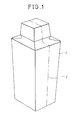
- Figure 1 is a perspective view of an ingot and the manner in which it is to be cut.
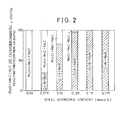
- Figure 2 is a graph showing the relationship between the steel nitrogen content and the weight percentage of the total of M 23 C 6 + M 6 C + NbC + Cr 2 N + NbN among the precipitates in the steel accounted for by M 23 C 6 + M 6 C + NbC and the relationship between the steel nitrogen content and the weight percentage of the total of M 23 C 6 + M 6 C + NbC + Cr 2 N + NbN among the precipitates in the steel accounted for by Cr 2 N + NbN.
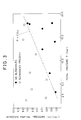
- Figure 3 is a graph showing conditions under which blowholes occur in the ingot in terms of the relationship between the total pressure and nitrogen partial pressure of the atmosphere during casting.
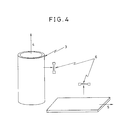
- Figure 4 is a schematic view showing the manner in which creep test pieces are taken from a pipe specimen and a rolled plate specimen.
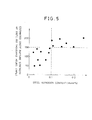
- Figure 5 is a graph showing the relationship between steel nitrogen content and estimated creep rupture strength at 650°C, 150 thousand hours.
- Figure 6 is a graph showing the relationship between steel Nb content and estimated creep rupture strength at 650°C, 150 thousand hours.
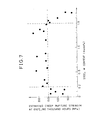
- Figure 7 is a graph showing the relationship between steel W content and estimated creep rupture strength at 650°C, 150 thousand hours.
- Figure 8 is a graph showing an example of creep test results in terms of stress vs rupture time.
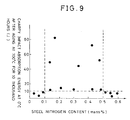
- Figure 9 is a graph showing the relationship between steel nitrogen content and Charpy impact absorption energy at 0°C following aging at 700°C for 10 thousand hours.
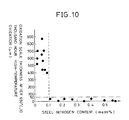
- Figure 10 is a graph showing the relationship between steel nitrogen content and the thickness of the oxidation scale formed on the surface of a test piece after oxidation at 650°C for 10 thousand hours.
- C is required for achieving strength. Adequate strength cannot be achieved at a C content of less than 0.01%, while at a C content exceeding 0.30% the steel is strongly affected by welding heat and undergoes hardening which becomes a cause for low-temperature cracking.
- the C content range is therefore set at 0.01 - 0.30%.
- Si is important for achieving oxidation resistance and is also required as a deoxidizing agent. It is insufficient for these purposes at a content of less than 0.02%, whereas a content exceeding 0.80% reduces the creep rupture strength.
- the Si content range is therefore set at 0.02 - 0.80%.
- Mn is required for deoxidation and also for achieving strength. It has to be added at least 0.20% for adequately exhibiting its effect. When it exceeds 1.00% it may in some cases reduce creep rupture strength. The Mn content range is therefore set at 0.20 - 1.00%.
- Cr is indispensable to oxidation resistance. It also contributes to increasing creep resistance by combining with N and finely precipitating in the base metal matrix in the form of Cr 2 N, Cr 2 (C, N) and the like. Its lower limit is set at 8.00% from the viewpoint of oxidation resistance. Its upper limit is set at 13.00% for maintaining the Cr equivalent value at a low level so as to realize a martensite phase texture.
- W produces a marked increase in creep rupture strength by solution hardening. Its effect toward increasing creep rupture strength over long periods at high temperatures of 550°C and higher is particularly pronounced. Its upper limit is set at 1.50% because at contents higher than this level it precipitates in large quantities in the form of carbide and intermetallic compounds which sharply reduce the toughness of the base metal. The lower limit is set at 0.20% because it does not exhibit adequate solution hardening effect at lower levels.
- Mo increases high-temperature strength through solution hardening. It does not exhibit adequate effect at a content of less than 0.005% and at a content higher than 1.00% it may, when added together with W, cause heavy precipitation of Mo 2 C type oxides which markedly reduce base metal toughness.
- the Mo content range is therefore set at 0.005 - 1.00%.
- V produces a marked increase in the high-temperature strength of the steel regardless of whether it forms precipitates or, like W, enters solid solution in the matrix.
- the resulting VN and (Nb, V)N serve as precipitation nuclei for Cr 2 N and Cr 2 (C, N), which has a pronounced effect toward promoting fine dispersion of the precipitates. It has no effect at below 0.05% and reduces toughness at higher than 1.00%.
- the V content range is therefore set at 0.05 - 1.00%.
- Nb is an element which increases high-temperature strength by precipitating as NbN, (Nb, V)N, Nb(C, N) and (Nb, V)(C, N). Also, similarly to V, it promotes fine precipitate dispersion by forming precipitation nuclei for Cr 2 N, Cr 2 (C, N) and the like. For it to disperse in the steel as the primary precipitation hardening factor it has to be added in excess of 0.12%. However, its upper limit is set at 2.00% because when present at higher levels it reduces strength by causing precipitate coagulation and enlargement.
- N dissolves in the matrix and also forms nitride and carbo-nitride precipitates.
- the form of the precipitates is mainly Cr 2 N and Cr 2 (C, N)
- Cr 2 N and Cr 2 C, N
- N thus increases oxidation resistance and creep rupture strength.
- At least 0.10% is required for precipitation of nitrides and carbo-nitrides and suppressing precipitation of M 23 C 6 and M 6 C.
- the upper limit is set at 0.50% for preventing coagulation and enlargement of nitride and carbo-nitride precipitates by the presence of excessive nitrogen.
- Steels according to the invention are defined to comprise from >0.20 to 0.50% N.
- P, S and O are present in the steel according to this invention as impurities.
- P and S hinder the achievement of the purpose of the invention by lowering strength, while 0 has the adverse effect of forming oxides which reduce toughness.
- the upper limits on these elements is therefore set at 0.050%, 0.010% and 0.020%, respectively.
- the basic components of the steel according to this invention (aside from Fe) are as set out above. Depending on the purpose to which the steel is to be put, however, it may additionally contain (A) one or both of 0.01 - 1.00% Ta and 0.01 - 1.00% Hf and/or (B) one or both of 0.0005 - 0.10% Zr and 0.01 - 0.10% Ti.
- Ta and Hf act as deoxidizing agents. At high concentrations they form fine high melting point nitrides and carbo-nitrides and, as such, increase toughness by decreasing the austenite grain size. In addition, they also reduce the degree to which Cr and W dissolve in precipitates and by this effect enhance the effect of supersaturation with nitrogen. Neither element exhibits any effect at less than 0.01%. When either is present at greater than 1.00%, it reduces toughness by causing enlargement of nitride and carbo-nitride precipitates. The content range of each of these elements is therefore set at 0.01 - 1.00%.
- Zr suppresses the formation of oxides by markedly reducing the amount of oxygen activity.
- its strong affinity for N promotes precipitation of fine nitrides and carbo-nitrides which increase creep rupture strength and high-temperature oxidation resistance.
- the Zr content range is therefore set at 0.0005 - 0.10%.
- Ti raises the effect of excess nitrogen by precipitating in the form of nitrides and carbo-nitrides. At a content of less than 0.01% it has no effect while a Ti content of over 0.10% results in precipitation of coarse nitrides and carbo-nitrides which reduce toughness.
- the Ti content range is therefore set at 0.01 - 0.10%.
- the aforesaid alloying components can be added individually or in combinations.
- the object of this invention is to provide a ferritic heat-resisting steel that is superior in creep rupture strength and high-temperature oxidation resistance. Depending on the purpose of use it can be produced by various methods and be subjected to various types of heat treatment. These methods and treatments in no way diminish the effect of the invention.
- the ingot was cut vertically as shown in Figure 1 and the ingot 1 was visually examined for the presence of blowholes.
- This plate was subjected to solution treatment at 1200°C for 1 hour and to tempering at 800°C for 3 hours.
- the steel was then chemically analyzed and the dispersion state and morphology of the nitrides and carbo-nitrides were investigated by observation with an optical microscope, an electron microscope, X-ray diffraction and electron beam diffraction, whereby the chemical structure was determined.
- Figure 2 shows how the proportion of the precipitates in the steel accounted for by M 23 C 6 type carbides and M 6 C or NbC type carbides and the proportion thereof accounted for by Cr 2 N type nitrides and NbN type nitrides vary with nitrogen concentration.
- nitrides account for the majority of the precipitates in the steel of the invention, while at a nitrogen concentration of 0.15%, substantially 100% of the precipitates are nitrides with virtually no carbides present whatsoever.
- the nitrogen concentration of the steel is more than 0.2%.
- the graph of Figure 3 shows how the state of blowhole occurrence varies depending on the relationship between the total and nitrogen partial pressures of the atmosphere. For achieving a nitrogen concentration of 0.10% or higher it is necessary to use a total pressure of not less than 2.5 bar. Equilibrium calculation based on Sievert's law shows that in this case the nitrogen partial pressure in the steel of this invention is not less than 1.0 bar.
- the nitrogen partial pressure is maintained at 1.0 - 6.0 bar (nitrogen concentration within the steel of approximately 0.5 mass%), it becomes necessary to vary the total pressure between 2.5 and about 15 bar, the actual value selected depending on the nitrogen partial pressure. Namely, it is necessary to use a total pressure falling above the broken line representing the boundary pressure in Figure 3.
- the steel of this invention includes finely dispersed nitrides and carbo-nitrides, it is superior to conventional ferritic heat-resisting steels in hot-workability. This is also one reason for employing nitrides and carbo-nitrides obtained by adding nitrogen to beyond the solution limit.
- the steel according to the invention can also be provided in the form of plate or sheet.
- the plate or sheet can, in its hot-rolled state or after whatever heat treatment is found necessary, be provided as a heat-resisting material in various shapes, without any influence on the effects provided by the invention.
- the pipe, tube, plate, sheet and variously shaped heat-resisting materials referred to above can, in accordance with their purpose and application, be subjected to various heat treatments, and it is important for them to be so treated for realizing the full effect of the invention.
- the resulting melt was cleaned by ladle furnace processing (under bubbling with a gas of the same composition as the atmosphere) for reducing its impurity content, whereafter the atmosphere was regulated using a mixed gas of nitrogen and argon so as to satisfy the conditions of the inequality shown in claim 5.
- the melt was then cast into a mold and processed into a round billet, part of which was hot extruded to obtain a tube 60 mm in outside diameter and 10 mm in wall thickness and the remainder of which was subjected to seamless rolling to obtain a pipe 380 mm in outside diameter and 50 mm in wall thickness.
- the tube and pipe were subjected to a single normalization at 1200°C for 1 hour and were then tempered at 800°C for 3 hours.
- creep test pieces 6 measuring 6 mm in diameter were taken along the axial direction 4 of the pipe or tube 3 and along the rolling direction 5 of the plates and subjected to creep test measurement at 650°C. Based on the data obtained, a linear extrapolation was made for estimating the creep rupture strength at 150 thousand hours. A creep rupture strength of 150 MPa was used as the creep rupture strength evaluation reference value. The creep rupture strength at 650°C, 150 thousand hours is hereinafter defined as the linearly extrapolated value at 150 thousand hours on the creep rupture strength vs rupture time graph.
- Toughness was evaluated through an accelerated evaluation test in which aging was carried out at 700°C for 10 thousand hours. JIS No. 4 tension test pieces were cut from the aged steel and evaluated for impact absorption energy. Assuming a water pressure test at 0°C, the toughness evaluation reference value was set at 10 J.
- High-temperature oxidation resistance was evaluated by suspending a 25 mm x 25 mm x 5 mm test piece cut from the steel in 650°C atmospheric air in a furnace for 10 thousand hours and then cutting the test piece parallel to the direction of growth of the scale and measuring the oxidation scale thickness.
- the 650°C, 150 thousand hour creep rupture strength, the Charpy impact absorption energy at 0°C after aging at 700°C for 10 thousand hours and the oxidation scale thickness after oxidation at 650°C for 10 thousand hours are shown in Tables 2, 4, 6, 8, 10, 12, and 14.
- Figure 5 shows the relationship between the nitrogen content of the steels and the estimated creep rupture strength at 650°C, 150 thousand hours. It will be noted that the creep rupture strength attains high values exceeding 150 MPa at a steel nitrogen content of 0.1% or higher but falls below 150 MPa and fails to satisfy the evaluation reference value that was set at a steel nitrogen content of less than 0.1%.
- Figure 6 shows the relationship between the Nb content of the steels and the estimated creep rupture strength at 650°C, 150 thousand hours. It will be noted that the creep rupture strength attains values exceeding 150 MPa at a steel Nb content exceeding 0.12% but at a Nb content of 2.0% or higher the creep rupture strength is instead lowered owing to the precipitation of coarse NbN and Fe 2 Nb type Laves phase at the melting stage.
- Figure 7 shows the relationship between the W content of the steels and the estimated creep rupture strength at 650°C, 150 thousand hours.
- the creep rupture strength is below 150 MPa at a W content of less than 0.2% and is 150 MPa or higher in a content range of 0.2 - 1.5%.
- the creep rupture strength falls below 150 MPa owing to coarse Fe 2 W precipitating at the grain boundaries.
- Figure 8 shows the results of the creep test in terms of stress vs rupture time.
- a good linear relationship can be noted between stress and rupture time at a steel nitrogen content of not less than 0.1%.
- the creep rupture strength is high.
- the relationship between stress and rupture time exhibits a pronounced decline in creep rupture strength with increasing time lapse. Either the linearity is not maintained, or the slope of the creep rupture curve is steep, with the short-term side creep rupture strength being high but the long-term creep rupture strength being low, or the creep rupture strength is low throughout. This is because W and the other solution hardening elements precipitate as carbides whose coagulation and enlargement degrades the creep rupture strength property of the base metal.
- Figure 9 shows the relationship between Charpy impact absorption energy at 0 °C following aging at 700°C for 10 thousand hours and steel nitrogen content.
- the impact absorption energy exceeds 10 J.
- the impact absorption energy decreases, and when it exceeds 0.5%, the impact absorption energy is reduced by heavy nitride precipitation.
- Figure 10 shows the relationship between the thickness of the oxidation scale formed on the surface of a test piece after oxidation at 650°C for 10 thousand hours and the steel nitrogen content.
- the oxidation scale thickness is between 400 and 900 ⁇ m when the steel nitrogen content falls below 0.1%, it decreases to 50 ⁇ m or less when the steel nitrogen content is 0.1% or higher.
- Nos. 161 and 162 are examples in which insufficient steel nitrogen content resulted in a low estimated creep rupture strength at 650°C, 150 thousand hours and also to poor high-temperature oxidation resistance.
- Nos. 163 and 164 are examples in which excessive steel nitrogen content caused heavy precipitation of coarse nitrides and carbo-nitrides, resulting in a Charpy impact absorption energy at 0°C after aging at 700°C for 10 thousand hours of not more than 10 J.
- No. 165 is an example in which a low W concentration resulted in a low creep rupture strength at 650°C, 150 thousand hours owing to insufficient solution hardening notwithstanding that the steel nitrogen content fell within the range of the invention.
- No. 166 is an example in which a high W concentration led to low rupture strength and toughness owing to precipitation of coarse Fe 2 W type Laves phase at the grain boundaries during creep.
- No. 167 is an example in which a low Nb content resulted in a low estimated creep rupture strength at 650°C, 150 thousand hours.
- No. 168 is an example in which a high Nb content caused profuse precipitation of coarse Fe 2 Nb type Laves phase during creep, which in turn lowered both the estimated creep rupture strength at 650°C, 150 thousand hours and the Charpy impact absorption energy at 0°C after aging at 700°C for 10 thousand hours.
- Nos. 170, 171 and 172 are examples similar to the case of No. 169 except that the elements present in excess were Ta, Hf and Ti, respectively.
- heavy precipitation of coarse TaN, HfN and TiN resulted in a Charpy impact absorption energy at 0°C after aging at 700°C for 10 thousand hours of less than 10 J. No.
Landscapes
- Chemical & Material Sciences (AREA)
- Engineering & Computer Science (AREA)
- Materials Engineering (AREA)
- Mechanical Engineering (AREA)
- Metallurgy (AREA)
- Organic Chemistry (AREA)
- Treatment Of Steel In Its Molten State (AREA)
Claims (5)
- Hitzebeständiger Ferritstahl mit hohem Stickstoffanteil und einem hohen Nb-Gehalt, enthaltend in Gew.-%:0,01 - 0,30 % C,0,02 - 0,80 % Si,0,20 - 1,00 % Mn,8,00 - 13,00 % Cr,0,005 - 1,00 % Mo,0,20 - 1,50 % W,0,05 - 1,00 Vmehr als 0,12 bis zu 2,00 % Nb und> 0,20 - 0,50 % N,der so eingestellt ist, daß ernicht mehr als 0,050 % P,nicht mehr als 0,010 % S undnicht mehr als 0,020 % Oenthält, der Rest aus Fe und unvermeidlichen Verunreinigungen besteht, wobei der N-Gehalt des Stahls dieser chemischen Zusammensetzung die N-Konzentration in einem Stahl übersteigt, der während des Gießens mit 1 bar N-Gas ins Gleichgewicht gebracht wurde.
- Hitzebeständiger Ferritstahl mit hohem Stickstoffanteil und einem hohen Nb-Gehalt, enthaltend in Gew.-%:0,01 - 0,30 % C,0,02 - 0,80 % Si,0,20 - 1,00 % Mn,8,00 - 13,00 % Cr,0,005 - 1,00 % Mo,0,20 - 1,50 % W,0,05 - 1,00 V,mehr als 0,12 bis zu 2,00 % Nb und> 0,20 - 0,50 % N sowie0,01 - 1,00 % Ta und/oder0,01 - 1,00 % Hf,der so eingestellt ist, daß ernicht mehr als 0,050 % P,nicht mehr als 0,010 % S undnicht mehr als 0,020 % Oenthält, der Rest aus Fe und unvermeidlichen Verunreinigungen besteht, wobei der N-Gehalt des Stahls dieser chemischen Zusammensetzung die N-Konzentration in einem Stahl übersteigt, der während des Gießens mit 1 bar N-Gas ins Gleichgewicht gebracht wurde.
- Hitzebeständiger Ferritstahl mit hohem Stickstoffanteil und einem hohen Nb-Gehalt, enthaltend in Gew.-%:0,01 - 0,30 % C,0,02 - 0,80 % Si,0,20 - 1,00 % Mn,8,00 - 13,00 % Cr,0,005 - 1,00 % Mo,0,20 - 1,50 % W,0,05 - 1,00 V,mehr als 0,12 bis zu 2,00 % Nb und> 0,20 - 0,50 % N sowie0,0005 - 0,10 Zr und/oder0,01 - 0,10 % Tider so eingestellt ist, daß ernicht mehr als 0,050 % P,nicht mehr als 0,010 % S undnicht mehr als 0,020 % Oenthält, der Rest aus Fe und unvermeidlichen Verunreinigungen besteht, wobei der N-Gehalt des Stahls dieser chemischen Zusammensetzung die N-Konzentration in einem Stahl übersteigt, der während des Gießens mit 1 bar N-Gas ins Gleichgewicht gebracht wurde.
- Hitzebeständiger Ferritstahl mit hohem Stickstoffanteil und einem hohen Nb-Gehalt, enthaltend in Gew.-%:0,01 - 0,30 % C,0,02 - 0,80 % Si,0,20 - 1,00 % Mn,8,00 - 13,00 % Cr,0,005 - 1,00 % Mo,0,20 - 1,50 % W,0,05 - 1,00 V,mehr als 0,12 bis zu 2,00 % Nb und> 0,20 - 0,50 % N sowie0,01 - 1,00 % Ta und/oder0,01 - 1,00 Hf sowie0,0005 - 10 % Zr und/oder0,01 - 0,10 % Tider so eingestellt ist, daß ernicht mehr als 0,050 % P,nicht mehr als 0,010 % S undnicht mehr als 0,020 % Oenthält, der Rest aus Fe und unvermeidlichen Verunreinigungen besteht, wobei der N-Gehalt des Stahls dieser chemischen Zusammensetzung die N-Konzentration in einem Stahl übersteigt, der während des Gießens mit 1 bar N-Gas ins Gleichgewicht gebracht wurde.
- Verfahren zur Herstellung eines hitzebeständigen Ferritstahls mit hohem Stickstoffanteil und einem hohen Nb-Gehalt, der eine Zusammensetzung nach einem der Ansprüche 1 bis 4 aufweist, bei dem der Stahl in einer Mischgasatmosphäre mit einem vorgeschriebenen Stickstoffpartialdruck oder Stickstoffgas geschmolzen und ins Gleichgewicht gebracht wird und anschließend in einer auf einen Gesamtdruck von nicht weniger als 2,5 bar und einen Stickstoffpartialdruck von nicht weniger als 1,0 eingestellten Atmosphäre gegossen oder verfestigt wird, wobei für das Verhältnis zwischen dem Stickstoffpartialdruck p und dem Gesamtdruck P gilt:

Applications Claiming Priority (2)
| Application Number | Priority Date | Filing Date | Title |
|---|---|---|---|
| JP3097765A JP2890073B2 (ja) | 1991-04-30 | 1991-04-30 | 高Nb含有高窒素フェライト系耐熱鋼およびその製造方法 |
| JP97765/91 | 1991-04-30 |
Publications (2)
| Publication Number | Publication Date |
|---|---|
| EP0511648A1 EP0511648A1 (de) | 1992-11-04 |
| EP0511648B1 true EP0511648B1 (de) | 1997-02-19 |
Family
ID=14200964
Family Applications (1)
| Application Number | Title | Priority Date | Filing Date |
|---|---|---|---|
| EP92107301A Expired - Lifetime EP0511648B1 (de) | 1991-04-30 | 1992-04-29 | Ferritisches, hitzebeständiger Stahl mit hohen Stickstoff- und Niobgehalten und Verfahren zu seiner Herstellung |
Country Status (4)
| Country | Link |
|---|---|
| US (1) | US5254307A (de) |
| EP (1) | EP0511648B1 (de) |
| JP (1) | JP2890073B2 (de) |
| DE (1) | DE69217510T2 (de) |
Families Citing this family (6)
| Publication number | Priority date | Publication date | Assignee | Title |
|---|---|---|---|---|
| US5582657A (en) * | 1993-11-25 | 1996-12-10 | Hitachi Metals, Ltd. | Heat-resistant, ferritic cast steel having high castability and exhaust equipment member made thereof |
| ES2208047B1 (es) * | 2002-01-14 | 2005-06-16 | Sidenori + D, S.A. | Un acero ductil y su metodo de obtencion. |
| US7914732B2 (en) * | 2006-02-23 | 2011-03-29 | Daido Tokushuko Kabushiki Kaisha | Ferritic stainless steel cast iron, cast part using the ferritic stainless steel cast iron, and process for producing the cast part |
| CN101990690B (zh) * | 2008-04-10 | 2013-10-09 | Nxp股份有限公司 | 8形电感器 |
| JP6160625B2 (ja) * | 2012-10-10 | 2017-07-12 | 日立金属株式会社 | 被削性に優れたフェライト系耐熱鋳鋼及びそれからなる排気系部品 |
| EP4671405A1 (de) * | 2024-06-28 | 2025-12-31 | Droigk Formenbau GmbH | Chrom-kohlenstoff-eisen-hartlegierung |
Citations (2)
| Publication number | Priority date | Publication date | Assignee | Title |
|---|---|---|---|---|
| DE865504C (de) * | 1950-02-25 | 1953-02-02 | Didier Kogag Hinselmann Koksof | Verfahren und Vorrichtung zum thermischen Spalten von Methan und aehnlichen Kohlenwasserstoffe enthaltenden Gasen |
| FR1140573A (fr) * | 1956-01-25 | 1957-07-29 | Birmingham Small Arms Co Ltd | Aciers ferritiques au chrome |
Family Cites Families (5)
| Publication number | Priority date | Publication date | Assignee | Title |
|---|---|---|---|---|
| GB741935A (en) * | 1952-08-22 | 1955-12-14 | Hadfields Ltd | Improvements in alloy steels |
| US2848323A (en) * | 1955-02-28 | 1958-08-19 | Birmingham Small Arms Co Ltd | Ferritic steel for high temperature use |
| CH537459A (de) * | 1968-06-17 | 1973-05-31 | Armco Steel Corp | Durch Wärmebehandlung härtbarer rostfreier Stahl |
| JPS5270935A (en) * | 1975-12-10 | 1977-06-13 | Kubota Ltd | Method of centrifugal casting |
| JPS5550959A (en) * | 1978-10-05 | 1980-04-14 | Kubota Ltd | Method and apparatus for centrifugal casting |
-
1991
- 1991-04-30 JP JP3097765A patent/JP2890073B2/ja not_active Expired - Lifetime
-
1992
- 1992-04-28 US US07/875,685 patent/US5254307A/en not_active Expired - Fee Related
- 1992-04-29 DE DE69217510T patent/DE69217510T2/de not_active Expired - Fee Related
- 1992-04-29 EP EP92107301A patent/EP0511648B1/de not_active Expired - Lifetime
Patent Citations (2)
| Publication number | Priority date | Publication date | Assignee | Title |
|---|---|---|---|---|
| DE865504C (de) * | 1950-02-25 | 1953-02-02 | Didier Kogag Hinselmann Koksof | Verfahren und Vorrichtung zum thermischen Spalten von Methan und aehnlichen Kohlenwasserstoffe enthaltenden Gasen |
| FR1140573A (fr) * | 1956-01-25 | 1957-07-29 | Birmingham Small Arms Co Ltd | Aciers ferritiques au chrome |
Non-Patent Citations (1)
| Title |
|---|
| Iron Steel Handbook Vol. 1, 3rd edition, 1981, p. 158-159 * |
Also Published As
| Publication number | Publication date |
|---|---|
| DE69217510D1 (de) | 1997-03-27 |
| EP0511648A1 (de) | 1992-11-04 |
| US5254307A (en) | 1993-10-19 |
| DE69217510T2 (de) | 1997-06-05 |
| JPH0598393A (ja) | 1993-04-20 |
| JP2890073B2 (ja) | 1999-05-10 |
Similar Documents
| Publication | Publication Date | Title |
|---|---|---|
| JP3838216B2 (ja) | オーステナイト系ステンレス鋼 | |
| EP0688883B1 (de) | Martensitischer wärmebeständiger stahl mit hervorragender erweichungsbeständigkeit und verfahren zu dessen herstellung | |
| EP1357198B1 (de) | Wärme- und korrosionsbeständige austenitische Legierung, wärme- und druckbeständige Bauteile und Verfahren zu deren Herstellung | |
| EP0306578B2 (de) | Ferritischer rostfreier Stahl und Verfahren zur Herstellung | |
| EP0703301B1 (de) | Temperaturbeständiger ferritischer Stahl mit hohem Chromgehalt | |
| EP0340631B1 (de) | Hochtemperaturfestes Stahlrohr mit niedrigem Siliziumgehalt und mit verbesserten Duktilitäts- und Fähigkeitseigenschaften | |
| EP0443489B1 (de) | Ferritischer hitzebeständiger Stahl mit hohem Stickstoffgehalt und Verfahren zu seiner Herstellung | |
| GB2133037A (en) | Stainless duplex ferritic- austenitic steel, articles made therefrom and method of enhancing intergranular corrosion resistance of a weld of the stainless duplex ferritic austenitic steel | |
| EP0511648B1 (de) | Ferritisches, hitzebeständiger Stahl mit hohen Stickstoff- und Niobgehalten und Verfahren zu seiner Herstellung | |
| EP0511647B1 (de) | Ferritischer, hitzebeständiger Stahl mit hohen Stickstoff- und Vanadingehalten und Verfahren zu seiner Herstellung | |
| JP7272438B2 (ja) | 鋼材およびその製造方法、ならびにタンク | |
| US5204056A (en) | Method of production of high-nitrogen ferritic heat-resisting steel | |
| US4255497A (en) | Ferritic stainless steel | |
| JPH0759740B2 (ja) | 靭性およびクリープ強度に優れたフェライト系耐熱鋼 | |
| JPH02294452A (ja) | 溶接ボンド部靭性の優れたフェライト系耐熱鋼 | |
| JP3928200B2 (ja) | 耐高温溶接割れ性および溶接熱影響部の靭性に優れるフェライト系耐熱鋼 | |
| JPH06322487A (ja) | 超高窒素フェライト系耐熱鋼およびその製造方法 | |
| US4022586A (en) | Austenitic chromium-nickel-copper stainless steel and articles | |
| JP2002146481A (ja) | 電縫溶接性に優れた酸化物分散強化型フェライト系電縫ボイラ用鋼および鋼管 | |
| EP0835946A1 (de) | Schweissbares ferritisches Gussstahl mit niedrigem Chromgehalt und mit sehr gute Warmfestigkeit | |
| JPH08209293A (ja) | 蒸気タービン | |
| JPH0132288B2 (de) | ||
| JPS60155619A (ja) | 靭性に優れた高クロム鋼の製造方法 | |
| JPH06192786A (ja) | 脆性破壊発生特性の優れた高強度鋼 |
Legal Events
| Date | Code | Title | Description |
|---|---|---|---|
| PUAI | Public reference made under article 153(3) epc to a published international application that has entered the european phase |
Free format text: ORIGINAL CODE: 0009012 |
|
| AK | Designated contracting states |
Kind code of ref document: A1 Designated state(s): CH DE FR GB LI |
|
| 17P | Request for examination filed |
Effective date: 19921210 |
|
| 17Q | First examination report despatched |
Effective date: 19940809 |
|
| GRAG | Despatch of communication of intention to grant |
Free format text: ORIGINAL CODE: EPIDOS AGRA |
|
| GRAH | Despatch of communication of intention to grant a patent |
Free format text: ORIGINAL CODE: EPIDOS IGRA |
|
| GRAH | Despatch of communication of intention to grant a patent |
Free format text: ORIGINAL CODE: EPIDOS IGRA |
|
| GRAA | (expected) grant |
Free format text: ORIGINAL CODE: 0009210 |
|
| AK | Designated contracting states |
Kind code of ref document: B1 Designated state(s): CH DE FR GB LI |
|
| REG | Reference to a national code |
Ref country code: CH Ref legal event code: NV Representative=s name: KIRKER & CIE SA Ref country code: CH Ref legal event code: EP |
|
| ET | Fr: translation filed | ||
| REF | Corresponds to: |
Ref document number: 69217510 Country of ref document: DE Date of ref document: 19970327 |
|
| PG25 | Lapsed in a contracting state [announced via postgrant information from national office to epo] |
Ref country code: LI Free format text: LAPSE BECAUSE OF NON-PAYMENT OF DUE FEES Effective date: 19970430 Ref country code: CH Free format text: LAPSE BECAUSE OF NON-PAYMENT OF DUE FEES Effective date: 19970430 |
|
| PG25 | Lapsed in a contracting state [announced via postgrant information from national office to epo] |
Ref country code: GB Effective date: 19970519 |
|
| REG | Reference to a national code |
Ref country code: CH Ref legal event code: PL |
|
| PLBE | No opposition filed within time limit |
Free format text: ORIGINAL CODE: 0009261 |
|
| STAA | Information on the status of an ep patent application or granted ep patent |
Free format text: STATUS: NO OPPOSITION FILED WITHIN TIME LIMIT |
|
| PG25 | Lapsed in a contracting state [announced via postgrant information from national office to epo] |
Ref country code: FR Free format text: LAPSE BECAUSE OF NON-PAYMENT OF DUE FEES Effective date: 19971231 |
|
| PG25 | Lapsed in a contracting state [announced via postgrant information from national office to epo] |
Ref country code: DE Free format text: LAPSE BECAUSE OF NON-PAYMENT OF DUE FEES Effective date: 19980101 |
|
| GBPC | Gb: european patent ceased through non-payment of renewal fee |
Effective date: 19970519 |
|
| 26N | No opposition filed | ||
| REG | Reference to a national code |
Ref country code: FR Ref legal event code: ST |