EP0512269A2 - Verfahren und Gemisch zur Herstellung einer grossflächigen Beschichtung - Google Patents
Verfahren und Gemisch zur Herstellung einer grossflächigen Beschichtung Download PDFInfo
- Publication number
- EP0512269A2 EP0512269A2 EP92105987A EP92105987A EP0512269A2 EP 0512269 A2 EP0512269 A2 EP 0512269A2 EP 92105987 A EP92105987 A EP 92105987A EP 92105987 A EP92105987 A EP 92105987A EP 0512269 A2 EP0512269 A2 EP 0512269A2
- Authority
- EP
- European Patent Office
- Prior art keywords
- mixture
- weight
- mixture according
- solids content
- total solids
- Prior art date
- Legal status (The legal status is an assumption and is not a legal conclusion. Google has not performed a legal analysis and makes no representation as to the accuracy of the status listed.)
- Granted
Links
- 239000000203 mixture Substances 0.000 title claims abstract description 43
- 238000000576 coating method Methods 0.000 title claims abstract description 26
- 239000011248 coating agent Substances 0.000 title claims abstract description 20
- 238000000034 method Methods 0.000 title claims abstract description 15
- 239000000126 substance Substances 0.000 claims abstract description 25
- 239000000758 substrate Substances 0.000 claims abstract description 19
- 239000000463 material Substances 0.000 claims abstract description 18
- 239000000654 additive Substances 0.000 claims abstract description 14
- BPQQTUXANYXVAA-UHFFFAOYSA-N Orthosilicate Chemical compound [O-][Si]([O-])([O-])[O-] BPQQTUXANYXVAA-UHFFFAOYSA-N 0.000 claims abstract description 9
- 238000005507 spraying Methods 0.000 claims abstract description 5
- 239000012744 reinforcing agent Substances 0.000 claims abstract description 4
- VYPSYNLAJGMNEJ-UHFFFAOYSA-N Silicium dioxide Chemical compound O=[Si]=O VYPSYNLAJGMNEJ-UHFFFAOYSA-N 0.000 claims description 22
- 229910052500 inorganic mineral Inorganic materials 0.000 claims description 15
- 239000011707 mineral Substances 0.000 claims description 15
- 239000007787 solid Substances 0.000 claims description 12
- 239000000243 solution Substances 0.000 claims description 10
- 239000000843 powder Substances 0.000 claims description 9
- 239000000377 silicon dioxide Substances 0.000 claims description 9
- 239000007864 aqueous solution Substances 0.000 claims description 8
- 239000002893 slag Substances 0.000 claims description 8
- 235000012239 silicon dioxide Nutrition 0.000 claims description 6
- LFQSCWFLJHTTHZ-UHFFFAOYSA-N Ethanol Chemical compound CCO LFQSCWFLJHTTHZ-UHFFFAOYSA-N 0.000 claims description 5
- 239000002956 ash Substances 0.000 claims description 5
- 229910021485 fumed silica Inorganic materials 0.000 claims description 5
- 239000004033 plastic Substances 0.000 claims description 5
- 229920003023 plastic Polymers 0.000 claims description 5
- 229910021487 silica fume Inorganic materials 0.000 claims description 5
- 229910052681 coesite Inorganic materials 0.000 claims description 4
- 229910052906 cristobalite Inorganic materials 0.000 claims description 4
- 239000000835 fiber Substances 0.000 claims description 4
- 239000010881 fly ash Substances 0.000 claims description 4
- 239000011521 glass Substances 0.000 claims description 4
- 229910052682 stishovite Inorganic materials 0.000 claims description 4
- 229910052905 tridymite Inorganic materials 0.000 claims description 4
- 239000004111 Potassium silicate Substances 0.000 claims description 3
- 150000001412 amines Chemical class 0.000 claims description 3
- 239000003365 glass fiber Substances 0.000 claims description 3
- 239000004058 oil shale Substances 0.000 claims description 3
- -1 polypropylene Polymers 0.000 claims description 3
- 229910052913 potassium silicate Inorganic materials 0.000 claims description 3
- 229910000519 Ferrosilicon Inorganic materials 0.000 claims description 2
- 239000004743 Polypropylene Substances 0.000 claims description 2
- 229910001570 bauxite Inorganic materials 0.000 claims description 2
- 230000001680 brushing effect Effects 0.000 claims description 2
- 229910052593 corundum Inorganic materials 0.000 claims description 2
- 239000010431 corundum Substances 0.000 claims description 2
- 229910001648 diaspore Inorganic materials 0.000 claims description 2
- 239000010438 granite Substances 0.000 claims description 2
- 229910052751 metal Inorganic materials 0.000 claims description 2
- 239000002184 metal Substances 0.000 claims description 2
- 229920002239 polyacrylonitrile Polymers 0.000 claims description 2
- 229920001155 polypropylene Polymers 0.000 claims description 2
- 239000010453 quartz Substances 0.000 claims description 2
- 238000005096 rolling process Methods 0.000 claims description 2
- 239000004576 sand Substances 0.000 claims description 2
- ZLMJMSJWJFRBEC-UHFFFAOYSA-N Potassium Chemical compound [K] ZLMJMSJWJFRBEC-UHFFFAOYSA-N 0.000 claims 1
- 230000000996 additive effect Effects 0.000 claims 1
- 150000001298 alcohols Chemical class 0.000 claims 1
- 230000007935 neutral effect Effects 0.000 claims 1
- ZDHURYWHEBEGHO-UHFFFAOYSA-N potassiopotassium Chemical compound [K].[K] ZDHURYWHEBEGHO-UHFFFAOYSA-N 0.000 claims 1
- 229910052700 potassium Inorganic materials 0.000 claims 1
- 239000011591 potassium Substances 0.000 claims 1
- 239000003795 chemical substances by application Substances 0.000 abstract description 2
- 239000000945 filler Substances 0.000 abstract description 2
- 238000005299 abrasion Methods 0.000 description 4
- 239000002253 acid Substances 0.000 description 4
- 235000019353 potassium silicate Nutrition 0.000 description 4
- 239000006223 plastic coating Substances 0.000 description 3
- LYCAIKOWRPUZTN-UHFFFAOYSA-N Ethylene glycol Chemical compound OCCO LYCAIKOWRPUZTN-UHFFFAOYSA-N 0.000 description 2
- 229910000831 Steel Inorganic materials 0.000 description 2
- 230000002378 acidificating effect Effects 0.000 description 2
- 239000003513 alkali Substances 0.000 description 2
- 230000002787 reinforcement Effects 0.000 description 2
- NTHWMYGWWRZVTN-UHFFFAOYSA-N sodium silicate Chemical compound [Na+].[Na+].[O-][Si]([O-])=O NTHWMYGWWRZVTN-UHFFFAOYSA-N 0.000 description 2
- 239000010959 steel Substances 0.000 description 2
- XLYOFNOQVPJJNP-UHFFFAOYSA-N water Substances O XLYOFNOQVPJJNP-UHFFFAOYSA-N 0.000 description 2
- 206010016807 Fluid retention Diseases 0.000 description 1
- 229910000746 Structural steel Inorganic materials 0.000 description 1
- GSEJCLTVZPLZKY-UHFFFAOYSA-N Triethanolamine Chemical compound OCCN(CCO)CCO GSEJCLTVZPLZKY-UHFFFAOYSA-N 0.000 description 1
- ITLVJEYRPIYSOW-UHFFFAOYSA-N [K].[K].[K] Chemical compound [K].[K].[K] ITLVJEYRPIYSOW-UHFFFAOYSA-N 0.000 description 1
- 150000007513 acids Chemical class 0.000 description 1
- 239000004568 cement Substances 0.000 description 1
- 238000002485 combustion reaction Methods 0.000 description 1
- 238000010276 construction Methods 0.000 description 1
- 238000005260 corrosion Methods 0.000 description 1
- 230000007797 corrosion Effects 0.000 description 1
- 238000005336 cracking Methods 0.000 description 1
- 238000009792 diffusion process Methods 0.000 description 1
- 230000000694 effects Effects 0.000 description 1
- 239000012717 electrostatic precipitator Substances 0.000 description 1
- 238000005429 filling process Methods 0.000 description 1
- 239000008187 granular material Substances 0.000 description 1
- WGCNASOHLSPBMP-UHFFFAOYSA-N hydroxyacetaldehyde Natural products OCC=O WGCNASOHLSPBMP-UHFFFAOYSA-N 0.000 description 1
- 239000002557 mineral fiber Substances 0.000 description 1
- 239000004570 mortar (masonry) Substances 0.000 description 1
- SLCVBVWXLSEKPL-UHFFFAOYSA-N neopentyl glycol Chemical compound OCC(C)(C)CO SLCVBVWXLSEKPL-UHFFFAOYSA-N 0.000 description 1
- 239000010451 perlite Substances 0.000 description 1
- 235000019362 perlite Nutrition 0.000 description 1
- 239000004848 polyfunctional curative Substances 0.000 description 1
- NNHHDJVEYQHLHG-UHFFFAOYSA-N potassium silicate Chemical compound [K+].[K+].[O-][Si]([O-])=O NNHHDJVEYQHLHG-UHFFFAOYSA-N 0.000 description 1
- 239000011435 rock Substances 0.000 description 1
Classifications
-
- C—CHEMISTRY; METALLURGY
- C04—CEMENTS; CONCRETE; ARTIFICIAL STONE; CERAMICS; REFRACTORIES
- C04B—LIME, MAGNESIA; SLAG; CEMENTS; COMPOSITIONS THEREOF, e.g. MORTARS, CONCRETE OR LIKE BUILDING MATERIALS; ARTIFICIAL STONE; CERAMICS; REFRACTORIES; TREATMENT OF NATURAL STONE
- C04B28/00—Compositions of mortars, concrete or artificial stone, containing inorganic binders or the reaction product of an inorganic and an organic binder, e.g. polycarboxylate cements
- C04B28/24—Compositions of mortars, concrete or artificial stone, containing inorganic binders or the reaction product of an inorganic and an organic binder, e.g. polycarboxylate cements containing alkyl, ammonium or metal silicates; containing silica sols
- C04B28/26—Silicates of the alkali metals
-
- C—CHEMISTRY; METALLURGY
- C04—CEMENTS; CONCRETE; ARTIFICIAL STONE; CERAMICS; REFRACTORIES
- C04B—LIME, MAGNESIA; SLAG; CEMENTS; COMPOSITIONS THEREOF, e.g. MORTARS, CONCRETE OR LIKE BUILDING MATERIALS; ARTIFICIAL STONE; CERAMICS; REFRACTORIES; TREATMENT OF NATURAL STONE
- C04B2111/00—Mortars, concrete or artificial stone or mixtures to prepare them, characterised by specific function, property or use
- C04B2111/00034—Physico-chemical characteristics of the mixtures
- C04B2111/00146—Sprayable or pumpable mixtures
- C04B2111/00155—Sprayable, i.e. concrete-like, materials able to be shaped by spraying instead of by casting, e.g. gunite
-
- C—CHEMISTRY; METALLURGY
- C04—CEMENTS; CONCRETE; ARTIFICIAL STONE; CERAMICS; REFRACTORIES
- C04B—LIME, MAGNESIA; SLAG; CEMENTS; COMPOSITIONS THEREOF, e.g. MORTARS, CONCRETE OR LIKE BUILDING MATERIALS; ARTIFICIAL STONE; CERAMICS; REFRACTORIES; TREATMENT OF NATURAL STONE
- C04B2111/00—Mortars, concrete or artificial stone or mixtures to prepare them, characterised by specific function, property or use
- C04B2111/00474—Uses not provided for elsewhere in C04B2111/00
- C04B2111/00482—Coating or impregnation materials
-
- Y—GENERAL TAGGING OF NEW TECHNOLOGICAL DEVELOPMENTS; GENERAL TAGGING OF CROSS-SECTIONAL TECHNOLOGIES SPANNING OVER SEVERAL SECTIONS OF THE IPC; TECHNICAL SUBJECTS COVERED BY FORMER USPC CROSS-REFERENCE ART COLLECTIONS [XRACs] AND DIGESTS
- Y02—TECHNOLOGIES OR APPLICATIONS FOR MITIGATION OR ADAPTATION AGAINST CLIMATE CHANGE
- Y02W—CLIMATE CHANGE MITIGATION TECHNOLOGIES RELATED TO WASTEWATER TREATMENT OR WASTE MANAGEMENT
- Y02W30/00—Technologies for solid waste management
- Y02W30/50—Reuse, recycling or recovery technologies
- Y02W30/91—Use of waste materials as fillers for mortars or concrete
Definitions
- the invention relates to a method for the large-area coating of mineral and / or metallic substrates and a mixture of an aqueous solution, at least one powder component and one or more additives, which is intended for use as a self-curing coating material.
- a number of methods are known for coating substrates, for example in the building industry, and thus improving the mechanical or chemical resistance.
- Organic plastics are often used for the large-area coating to improve the chemical resistance of mineral or metallic substrates.
- these coatings can usually only be applied to dry substrates.
- the fire resistance of plastic coatings is generally poor.
- some of these materials run the risk of aggressive media being released during combustion.
- the abrasion resistance of plastic coatings is hardly greater than that of the substrate. Moisture diffusion can lead to adhesion problems, and the different temperature behavior of plastics and mineral or metallic substrates often leads to large-scale peeling or cracks.
- coatings or coatings made of cement-bound materials possibly using hard grain aggregates
- significant improvements in the abrasion resistance of the substrates can be achieved; however, these coatings are usually not chemically stable, e.g. not against acids.
- the coatings are also too heavy.
- the object of the invention is to provide a mixture and a method for the large-area coating of substrates, in particular for construction purposes, which combine the advantages of excellent chemical resistance in an acidic and alkaline environment and superior mechanical properties and fire resistance of the finished coating.
- the invention provides a mixture of an aqueous solution, a powder component and one or more additives, which is characterized in that the aqueous solution is an alkaline silicate solution and that the powder component is a mixture of at least one substance each from two latent hydraulic or pozzolanic substance groups, one of which consists of electrostatic precipitator ash, fly ash, trass and burnt oil shale and the other of pyrogenic silica, precipitated silica, ground blast furnace sands and blast furnace slag.
- this system according to the invention hardens independently, i.e. without the addition of heat or the involvement of an inorganic or organic hardener. Hardening takes place at a temperature from around 5 ° C.
- the invention further provides that the aqueous solution is an alkaline silicate solution and that the powder component contains at least one latent hydraulic or pozzolanic substance from the group of substances consisting of pyrogenic silica, precipitated silica, ground blast furnace sand and ground blast furnace slag.
- the mixture according to the invention is applied to the substrate over a large area.
- a particular advantage of the invention is that the mixture according to the invention is not restricted to a specific layer thickness.
- the mixture contains an alkaline silicate solution, a weight fraction of 5 to 35%, in current exemplary embodiments 10 to 15%, based on the total solids content being preferred.
- a potassium silicate solution with a SiO2: K2O molar ratio of less than 1.5 has proven to be particularly suitable.
- the mixture according to the invention contains two different substances, both of which have latent hydraulic or pozzolana properties.
- a latent hydraulic or pozzolanic material is a substance that needs a stimulator in order to be able to harden hydraulically in a technically usable time.
- Fly ash, gravel, burned oil shale, pyrogenic silica or precipitated silica, electrostatic filter ash, if necessary with the addition of Microsilica or similar, ground blast furnace slag or a combination of the aforementioned substances or the like latent hydraulic or pozzolana materials are used.
- the additives include the usual inert additives, or lean agents or fillers, reinforcing agents, setting accelerating substances, as well as moisture regulators.
- the setting properties and thus also the mechanical properties of the finished layer can be adjusted by varying the proportions of the mixture, in particular the setting accelerating substances.
- quartz granules preferably up to 1 mm grain size, or broken natural stones, such as granite or basalt, can be used as additives in a proportion of preferably up to 99% by weight, based on the total solids content.
- high temperature resistant minerals e.g. bauxite, diasporite, Corundum, heavy spar, ferrosilicon or ores as well as other aggregates, e.g. Perlite or similar. Additives, the temperature resistance of the hardened coating material can be increased up to 1700 ° C.
- the mechanical resistance and strength can additionally be increased if reinforcements made of metal, plastic, mineral, glass or a mixture of these substances are added in a further development of the invention.
- Steel fibers, mineral fibers, glass fibers and plastic fibers such as e.g. Polyacrylonitrile and polypropylene fibers. Common structural steel can also be used.
- glass fibers in a proportion of 0.01 to 5% by weight, based on the total solids content, is currently preferred.
- the mixture contains ground blast furnace slag with a glass fraction greater than 90% in a weight fraction of 0.1 to 12, preferably 1 to 2%, based on the total solid fraction.
- a glass fraction greater than 90% in a weight fraction of 0.1 to 12, preferably 1 to 2%, based on the total solid fraction.
- hydrophilic substances were added, which improved the water retention of the mixture, e.g. up to 8% by weight of an alcohol and / or a low molecular weight amine.
- the alcohol can be mono- or polyvalent, preferably divalent. 1 to 2% by weight of a glycol, for example neopentyl glycol, is currently preferred.
- the alcohol can be wholly or partly by an amine, preferably an alkanolamine, e.g. Triethanolamine.
- the process according to the invention and the mixture used thereby achieve excellent acid, water and alkali resistance, excellent fire resistance and excellent creep properties as a prerequisite for crack-free curing.
- the coating material is characterized by high early strength, high final strength and high resistance to aggressive media.
- the treated surfaces withstand a much higher abrasion load than conventional plastic coatings. Even damp Surfaces can be treated with good adhesion.
- the alkaline coating provides good protection against corrosion, eg for steel.
- the mixture can be applied equally well in the brushing, rolling, spraying, slurrying and filling processes on mineral and metallic substrates.
- the coating material provided by the invention has a significantly lower tendency to shrinkage than previously known silicate-based materials. Since uncontrolled systems dry out faster than setting or hardening, conventional materials tend to swell and are therefore more susceptible to cracking. This effect is counteracted by accelerating the setting process.
- the hardened coating material has high mechanical strength, high abrasion resistance and high resistance in the acidic and alkaline range.
- the mixture according to the invention can be processed excellently by hand and in the dense-flow spraying process with all common screw and multi-piston machines.
- the weight proportions of electrostatic filter ash and microsilica can be changed to vary the material properties.
- the proportion of additives can vary between 22 and 80% by weight, based in each case on the total solids content.
- the mixture can contain additional reinforcements.
- the following mixture is particularly suitable for coatings that should be stable over a wide pH range in both acid and alkaline.
- the mixture can contain temperature-resistant minerals, ores or rocks.
Landscapes
- Chemical & Material Sciences (AREA)
- Engineering & Computer Science (AREA)
- Ceramic Engineering (AREA)
- Chemical Kinetics & Catalysis (AREA)
- Inorganic Chemistry (AREA)
- Materials Engineering (AREA)
- Structural Engineering (AREA)
- Organic Chemistry (AREA)
- Paints Or Removers (AREA)
- Road Signs Or Road Markings (AREA)
Abstract
Description
- Die Erfindung betrifft ein Verfahren zur großflächigen Beschichtung mineralischer und/oder metallischer Untergründe und ein Gemisch aus einer wässrigen Lösung, mindestens einer Pulverkomponente und ein oder mehreren Zusätzen, das für die Verwendung als selbsterhärtendes Beschichtungsmaterial vorgesehen ist.
- Es sind eine Reihe von Verfahren bekannt, um Untergründe, beispielsweise im Bauwesen, zu beschichten und so die mechanische oder chemische Beständigkeit zu verbessern.
- Für die großflächige Beschichtung zur Verbesserung der chemischen Beständigkeit von mineralischen oder metallischen Untergründen werden oft organische Kunststoffe eingesetzt. Diese Beschichtungen können jedoch in der Regel nur auf trockene Untergründe aufgebracht werden. Die Feuerbeständigkeit von Kunststoffbeschichtungen ist im allgemeinen schlecht. Zusätzlich besteht bei einigen dieser Werkstoffe die Gefahr, daß bei der Verbrennung aggressive Medien frei werden. Die Abriebbeständigkeit von Kunststoffbeschichtungen ist kaum größer als die des Untergrundes. Durch Feuchtigkeitsdiffusion können Haftungsprobleme entstehen, und das unterschiedliche Temperaturverhalten von Kunststoffen und mineralischen oder metallischen Untergründen führt oft zu großflächigen Abschälungen oder Rissen.
- Mit Beschichtungen oder Überzügen aus zementgebundenen Werkstoffen, ggf. unter Einsatz von Hartkornzuschlägen, können zwar wesentliche Verbesserungen der Abriebbeständigkeit der Untergründe erreicht werden; diese Überzüge sind jedoch in der Regel nicht chemisch beständig, z.B. nicht gegen Säuren. Die Beschichtungen sind außerdem zu schwer.
- Besonders für die Verwendung auf mineralischen Untergründen sind seit langem Wasserglaskitte und -mörtel bekannt, die sich durch ihre hohe Säurefestigkeit auszeichnen. Gegen Wasser und Alkali sind diese Wasserglaskitte jedoch wenig beständig. Sie haben weiter den Nachteil, daß sie zur Rißbildung neigen. Zur großflächigen Beschichtung waren diese bekannten Materialien daher weniger gut geeignet.
- Es fehlt bisher an einem Verfahren zum großflächigen Oberflächenschutz mineralischer oder metallischer Untergründe im Bauwesen, welches die geforderten Eigenschaften gleichzeitig besitzt und mit einer guten Verarbeitungsfähigkeit verbindet. Hier schafft die Erfindung Abhilfe.
- Aufgabe der Erfindung ist es, ein Gemisch und ein Verfahren für die großflächige Beschichtung von Untergründen insbesondere für Bauzwecke zur Verfügung zu stellen, welche die Vorteile ausgezeichneter chemischer Beständigkeit in saurem und alkalischem Milieu und überlegener mechanischer Eigenschaften sowie Feuerbeständigkeit der fertigen Beschichtung vereinigen.
- Zur Lösung dieser Aufgabe sieht die Erfindung ein Gemisch aus einer wässrigen Lösung, einer Pulverkomponente und einem oder mehreren Zusätzen vor, das sich dadurch auszeichnet, daß die wässrige Lösung eine alkalische Silikatlösung ist und daß die Pulverkomponente eine Abmischung von mindestens je einem Stoff aus zwei latenthydraulischen bzw. puzzolanischen Stoffgruppen enthält, von denen eine aus Elektrofilterasche, Flugasche, Trass und gebranntem Ölschiefer und die andere aus pyrogener Kieselsäure, gefällter Kieselsäure, gemahlenen Hüttensanden und Hochofenschlacken besteht. Überraschenderweise härtet dieses erfindungsgemäße System selbständig, d.h. ohne Wärmezufuhr oder Beteiligung eines anorganischen oder organischen Härters aus. Das Aushärten findet bei einer Temperatur ab etwa 5°C statt.
- Zur Lösung der Erfindungsaufgabe sieht die Erfindung ferner vor, daß die wässrige Lösung eine alkalische Silikatlösung ist und daß die Pulverkomponente wenigstens einen latenthydraulischen bzw. puzzolanischen Stoff aus der aus pyrogener Kieselsäure, gefällter Kieselsäure, gemahlenem Hüttensand und gemahlener Hochofenschlacke bestehenden Stoffgruppe enthält.
- Zum Beschichten mineralischer und/oder metallischer Untergründe wird das erfindungsgemäße Gemisch großflächig auf den Untergrund aufgebracht. Ein besonderer Vorteil der Erfindung liegt darin, das erfindungsgemäße Gemisch nicht auf eine bestimmte Schichtstärke beschränkt ist.
- Das Gemisch enthält erfindungsgemäß eine alkalische Silikatlösung, wobei ein Gewichtsanteil von 5 bis 35%, bei gegenwärtigen Ausführungsbeispielen von 10 bis 15%, bezogen auf den Gesamtfeststoffgehalt bevorzugt wird. Als besonders geeignet hat sich eine kalialkalische Silikatlösung mit einem Molverhältnis SiO₂:K₂O kleiner 1,5 erwiesen.
- Das erfindungsgemäße Gemisch enthält zwei unterschiedliche Stoffe, die beide latenthydraulische oder puzzolanische Eigenschaften haben.
- (Unter einem latenthydraulischen oder puzzolanischen Material wird ein Stoff verstanden, der einen Anreger braucht, um in technisch nutzbarer Zeit hydraulisch erhärten zu können.) Es können Flugasche, Traß, gebrannter Ölschiefer, pyrogene Kieselsäure oder gefällte Kieselsäure, Elektrofilterasche, ggf. unter Zusatz von Mikrosilica o.ä., gemahlene Hochofenschlacke oder eine Kombination der vorgenannten Stoffe, o.ä. latenthydraulische oder puzzolanische Stoffe verwendet werden.
- Die Zusätze umfassen die üblichen inerten Zuschlagstoffe, bzw. Magerungsmittel oder Füllstoffe, Armierungsmittel, abbindebeschleunigende Stoffe, sowie Feuchtigkeitsregulatoren. Durch Variation der Gemischanteile, insbesondere der abbindebeschleunigenden Stoffe, lassen sich die Abbindeeigenschaften und damit auch die mechanischen Eigenschaften der fertigen Schicht einstellen.
- Als Zuschlagstoffe können beispielsweise Quarzkörnungen, vorzugsweise bis 1mm Korngröße oder gebrochene Natursteine, wie Granit oder Basalt, in einem Anteil von vorzugsweise bis zu 99 Gew.-% bezogen auf den Gesamtfeststoffgehalt eingesetzt werden. Mittels hochtemperaturbeständiger Mineralien, z.B. Bauxit, Diasporit, Korund, Schwerspat, Ferrosilizium oder Erzen sowie weiterer Zuschläge, z.B. Perlite o.ä. Zuschlagstoffen, kann die Temperaturbeständigkeit des ausgehärteten Beschichtungsmaterials auf bis zu 1700°C erhöht werden.
- Die mechanische Beständigkeit und Festigkeit kann zusätzlich gesteigert werden, wenn in Weiterbildung der Erfindung Armierungen aus Metall, Kunststoff, Mineral, Glas oder einer Mischung dieser Stoffe zugegeben werden. Geeignet sind hierbei Stahlfasern, Mineralfasern, Glasfasern und Kunststoffasern, wie z.B. Polyacrylnitril- und Polypropylenfasern. Auch üblicher Baustahl kann eingesetzt werden. Derzeit bevorzugt wird der Einsatz von Glasfasern in einem Anteil von 0,01 bis 5 Gew.-% bezogen auf den Gesamtfeststoffgehalt.
- In bevorzugter Weiterbildung der Erfindung enthält das Gemisch gemahlene Hochofenschlacke mit einem Glasanteil größer 90% in einem Gewichtsanteil von 0,1 bis 12, vorzugsweise 1 bis 2% bezogen auf den Gesamtfestoffanteil. Besonders gute Verarbeitungseigenschaften konnten bei Zusatz von hydrophilen Stoffen festgestellt werden, die die Wasserrückhaltung des Gemischs verbesserten, z.B. von bis zu 8 Gew.-% eines Alkohols und/oder eines niedermolekularen Amins. Der Alkohol kann ein- oder mehrwertig, vorzugsweise zweiwertig sein. Derzeitig bevorzugt sind 1 bis 2 Gew.-% eines Glykols, beispielsweise Neopentylglykol. Der Alkohol kann ganz oder teilweise durch ein Amin, vorzugsweise ein Alkanolamin, z.B. Triäthanolamin, ersetzt werden.
- Durch das erfindungsgemäße Verfahren und das dabei verwendete Gemisch werden eine ausgezeichnete Säure-, Wasser- und Alkalibeständigkeit, eine ausgezeichnete Feuerbeständigkeit und ein ausgezeichnetes Kriechvermögen als Voraussetzung für ein rißfreies Aushärten erreicht. Das Beschichtungsmaterial zeichnet sich durch hohe Frühfestigkeit, hohe Endfestigkeit und eine hohe Beständigkeit gegen aggressive Medien aus. Die behandelten Oberflächen halten einer wesentlich höheren Abriebbelastung stand als herkömmliche Kunststoffbeschichtungen. Auch feuchte Untergründe können behandelt werden, wobei eine gute Haftung erzielt wird. Die alkalisch wirkende Beschichtung bildet einen guten Korrosionsschutz, z.B. für Stahl.
- Das Gemisch kann nach dem erfindungsgemäßen Verfahren gleichermaßen gut im Streichverfahren, Rollverfahren, Spritzverfahren, Schlämmverfahren und Spachtelverfahren auf mineralischen und metallischen Untergründen aufgebracht werden.
- Überraschenderweise wurde gefunden, daß das durch die Erfindung zur Verfügung gestellte Beschichtungsmaterial eine deutlich geringere Schwindrißneigung als bisher bekannte Materialien auf Silikatbasis hat. Da bei ungesteuerten Systemen die Austrocknung schneller erfolgt als das Abbinden bzw. Erhärten, neigen herkömmliche Materialien zu einem größeren Schwiden und demzufolge hoher Rißanfälligkeit. Durch Beschleunigung Des Abbindevorgangs wird diesem Effekt entgegengewirkt.
- Das ausgehärtete Beschichtungsmaterial besitzt hohe mechanische Festigkeiten, eine hohe Abriebbeständigkeit und eine hohe Beständigkeit im sauren und alkalischen Bereich. Bei einer erfindungsgemäßen Beschichtung wurde z.B. eine Temperaturbeständigkeit bis etwa 1.700°C bei einem a T 23/80 = 21,9 x 10⁻⁶ K⁻¹ mit einer bleibenden Dehnung von 0,17mm/m festgestellt.
- Das erfindungsgemäße Gemisch läßt sich hervorragend von Hand sowie im Dichtstromspritzverfahren mit allen gängigen Schnecken- und Mehrkolbenmaschinen verarbeiten.
-

- 10 bis 15 Gew.-% kalialkalischer Kalisilikatlösung mit einem Molverhältnis SiO₂:K₂O kleiner 1,5.
- Zur Variation der Materialeigenschaften können die Gewichtsanteile an Elektrofilterasche und Mikrosilica verändert werden.
- Besonders vorteilhafte Eigenschaften konnten erhalten werden, wenn zwischen 5 und 85 Gew.-%, insbesondere zwischen 10 und 50 Gew.-% Efa und zwischen 0,1 und 20 Gew.-%, insbesondere zwischen 1 und 15 Gew.-% Mikrosilica eingesetzt wurden.
- Der Anteil an Zuschlagstoffen kann sich dabei zwischen 22 und 80 Gew.-% bewegen, jeweils bezogen auf den Gesamtfeststoffgehalt.
-

-

-
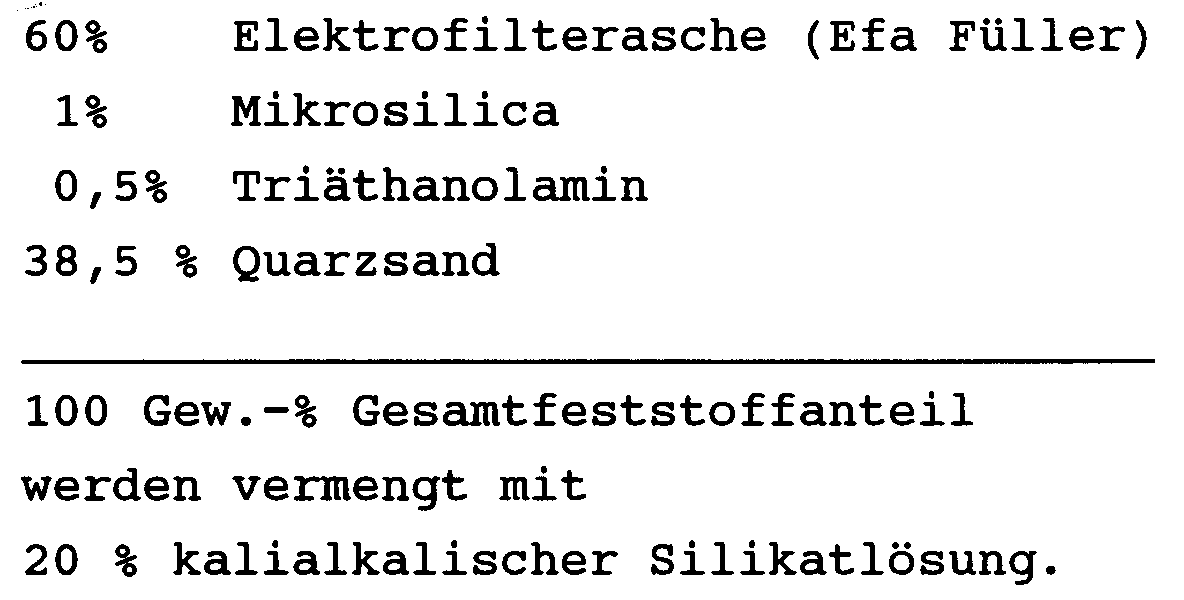
- Das Gemisch kann zusätzliche Armierungen enthalten.

- Das folgende Gemisch ist besonders geeignet für solche Beschichtungen, die über weite pH-Bereiche sowohl im Sauren als auch im Alkalischen beständig sein sollen.

-

- Für den Einsatz im Hochtemperaturbereich kann das Gemisch temperaturbeständige Mineralien, Erze oder Gesteine enthalten.

Claims (17)
- Gemisch aus einer wässrigen Lösung, mindestens einer Pulverkomponente und einem oder mehreren Zusätzen zur Verwendung als selbsterhärtendes Beschichtungsmaterial für mineralische und/oder metallische Untergründe,
dadurch gekennzeichnet,
daß die wässrige Lösung eine alkalische Silikatlösung ist und daß die Pulverkomponente eine Abmischung von mindestens je einem Stoff aus zwei latenthydraulischen bzw. puzzolanischen Stoffgruppen enthält, von denen eine aus Elektrofilterasche, Flugasche, Trass und gebranntem Ölschiefer und die andere Stoffgruppe aus pyrogener Kieselsäure, gefällter Kieselsäure, gemahlenen Hüttensanden und Hochofenschlacken besteht. - Gemisch aus einer wässrigen Lösung, mindestens einer Pulverkomponente und einem oder mehreren Zusätzen zur Verwendung als selbsterhärtendes Beschichtungsmaterial für mineralische und/oder metallische Untergründe, dadurch gekennzeichnet, daß die wässrige Lösung eine alkalische Silikatlösung ist und daß die Pulverkomponente wenigstens einen latenthydraulischen bzw. puzzolanischen Stoff aus der aus pyrogener Kieselsäure, gefällter Kieselsäure, gemahlenem Hüttensand und gemahlener Hochofenschlacke bestehenden Stoffgruppe enthält.
- Gemisch nach Anspruch 1 oder 2, dadurch gekennzeichnet, daß die alkalische Silikatlösung eine kalialkalische Silikatlösung ist, die in einem Anteil von 5 bis 35 Gew.-%, vorzugsweise von 10 bis 15 Gew.-%, bezogen auf den Gesamtfeststoffanteil enthalten ist.
- Gemisch nach Anspruch 3, dadurch gekennzeichnet, daß die kalialkalische Silikatlösung einen Feststoffgehalt von 25 bis 65 Gew.-%, vorzugsweise mit einem Molverhältnis von SiO₂ : K₂O von 0,8 bis 2,3, insbesondere kleiner als 1,5 hat.
- Gemisch nach einem der Ansprüche 1 bis 4, dadurch gekennzeichnet, die Pulverkomponente aus einer Abmischung aus Flugasche und Microsilica besteht, vorzugsweise 5 bis 85 Gew.-% Elektrofilterasche und 1 bis 15 Gew.-% Microsilica, jeweils bezogen auf den Gesamtfeststoffgehalt.
- Gemisch nach einem der Ansprüche 1 bis 5, dadurch gekennzeichnet, daß das latenthydraulische Material wenigstens einen reaktiven Zusatz enthält, der das bei der Erhärtung entstehende SiO₂-Gitter gegenüber neutralen und alkalischen Medien stabilisiert.
- Gemisch nach Anspruch 6, dadurch gekennzeichnet, daß der reaktive Zusatz gemahlene Hochofenschlacke, vorzugsweise mit einem Glasanteil größer 90%. enthält.
- Gemisch nach Anspruch 6 oder 7, dadurch gekennzeichnet, daß die Zusätze Zuschlagstoffe in Form von Quarzkörnungen und/oder gebrochenen Natursteinen, einschließlich Granit und Basalt (inerte Zuschlagstoffe) und/oder hochtemperaturbeständigen Mineralien, vorzugsweise aus der Gruppe Bauxit, Diasporit, Korund, Schwerspat, Ferrosilizium, Erze, enthalten.
- Gemisch nach einem der Ansprüche 1 bis 8, dadurch ge8kennzeichnet, daß das Gemisch abbindebeschleunigende Stoffe, z.B. latenthydraulische Stoffe und/oder abbindebeschleunigende Zuschlagstoffe in einem Anteil von 0,1 bis 12 Gew.-%, vorzugsweise von 1 bis 2 Gew.-%, bezogen auf den Gesamtfeststoffgehalt enthält.
- Gemisch nach einem der Ansprüche 1 bis 9, dadurch gekennzeichnet, daß das Gemisch als Zusatz von Armierungsmittel aus Metall, Kunststoff, vorzugsweise Polyacrylnitril oder Polypropylen, Mineralien, Glas oder einer Mischung dieser Stoffe, vorzugsweise in Faserform, enthält.
- Gemisch nach Anspruch 10, dadurch gekennzeichnet, daß als Armierungsmittel Glasfasern in einem Anteil von 0,01 bis 5 Gew.-% bezogen auf den Gesamtfeststoffgehalt enthalten sind.
- Gemisch nach einem der Ansprüche 1 bis 11, dadurch gekennzeichnet, daß die Zusätze wasserrückhaltend wirkende organisch-chemische Stoffe enthalten, vorzugsweise Alkohole und/oder Amine.
- Gemisch nach Anspruch 12, dadurch gekennzeichnet, daß als Alkohol ein mehrwertiger, vorzugsweise ein zweiwertiger Alkohol in einem Anteil von 0,1 bis 8 Gew.-%, vorzugsweise 1 Gew.-%, bezogen auf den Gesamtfeststoffgehalt und/oder als Amin ein niedermolekulares Amin, vorzugsweise ein Alkanolamin, in einem Anteil von 0,1 bis 8 Gew.-%, vorzugsweise 1 Gew.-%, bezogen auf den Gesamtfeststoffgehalt enthalten sind/ist.
- Verfahren zur Beschichtung mineralischer und/oder metallischer Untergründe, dadurch gekennzeichnet, daß ein Gemisch nach einem der Ansprüche 1 bis 13 großflächig auf den Untergrund aufgebracht wird.
- Verfahren nach Anspruch 14, dadurch gekennzeichnet, daß die Abbindeeigenschaften des Gemisches durch Variation der Gemischanteile, insbesondere der abbindebeschleunigenden Stoffe eingestellt werden.
- Verfahren nach Anspruch 14 oder 15, dadurch gekennzeichnet, daß das Gemisch durch Aufstreichen, Aufrollen, Aufspritzen, Schlämmen oder Spachteln auf den Untergrund aufgebracht wird.
- Verfahren nach Anspruch 14 oder 16, dadurch gekennzeichnet, daß das Gemisch von Hand oder im Dichtstromspritzverfahren mit Hilfe von Schnecken- oder Mehrkolbenmaschinen aufgebracht wird.
Applications Claiming Priority (2)
| Application Number | Priority Date | Filing Date | Title |
|---|---|---|---|
| DE4111326 | 1991-04-08 | ||
| DE19914111326 DE4111326A1 (de) | 1991-04-08 | 1991-04-08 | Verfahren und gemisch zur herstellung einer grossflaechigen beschichtung |
Publications (4)
| Publication Number | Publication Date |
|---|---|
| EP0512269A2 true EP0512269A2 (de) | 1992-11-11 |
| EP0512269A3 EP0512269A3 (en) | 1993-03-31 |
| EP0512269B1 EP0512269B1 (de) | 1995-06-21 |
| EP0512269B2 EP0512269B2 (de) | 1997-09-17 |
Family
ID=6429061
Family Applications (1)
| Application Number | Title | Priority Date | Filing Date |
|---|---|---|---|
| EP19920105987 Expired - Lifetime EP0512269B2 (de) | 1991-04-08 | 1992-04-07 | Verfahren und Gemisch zur Herstellung einer grossflächigen Beschichtung |
Country Status (3)
| Country | Link |
|---|---|
| EP (1) | EP0512269B2 (de) |
| AT (1) | ATE124026T1 (de) |
| DE (2) | DE4111326A1 (de) |
Cited By (9)
| Publication number | Priority date | Publication date | Assignee | Title |
|---|---|---|---|---|
| EP0921106A1 (de) * | 1997-12-05 | 1999-06-09 | Crc Chemical Research Company Ltd. | Baustoffmischung mit einer Alkalisilikat-Bindemittelkomponente und einer Pulverkomponente zum Beschichten und Verfugen |
| EP1081114A1 (de) * | 1999-09-02 | 2001-03-07 | Heidelberger Bauchemie GmbH Marke Deitermann | Baustoffmischung |
| WO2010130582A3 (de) * | 2009-05-14 | 2011-03-31 | Construction Research & Technology Gmbh | Schwundreduktion bei alkaliaktivierten alumosilikatbindemitteln |
| EP1236702B2 (de) † | 2001-03-02 | 2011-08-10 | maxit Deutschland GmbH | Wasserglasenthaltende Baustoffmischung |
| WO2012069024A3 (en) * | 2010-11-23 | 2012-08-09 | Razl Ivan | Acid and high temperature resistant cement composites |
| WO2014067721A1 (en) | 2012-10-31 | 2014-05-08 | Construction Research & Technology Gmbh | Alkali-activated aluminosilicate binder with superior freeze-thaw stability |
| WO2019115634A1 (en) * | 2017-12-13 | 2019-06-20 | Eternit France Sas | Geopolymeric coating system for fiber cement products |
| EP2061732B2 (de) † | 2006-07-28 | 2022-06-15 | Red Lion Cement Technology Limited | Unschädlicher geopolymerzement auf der basis von flugasche |
| WO2024175540A1 (de) * | 2023-02-24 | 2024-08-29 | Coatib Gmbh | Silikatische zweikomponenten-beschichtungszusammensetzung |
Families Citing this family (1)
| Publication number | Priority date | Publication date | Assignee | Title |
|---|---|---|---|---|
| CN116924727A (zh) * | 2023-07-26 | 2023-10-24 | 马鞍山上建双诚商品砼有限公司 | 一种高性能耐热混凝土及其制备方法 |
Family Cites Families (23)
| Publication number | Priority date | Publication date | Assignee | Title |
|---|---|---|---|---|
| DE25137C (de) * | E. g. Thenn in München, Karlstr. 101 | Verfahren zur Herstellung wetterfester Maueranstrich-Farben | ||
| DE831723C (de) * | 1949-12-21 | 1952-02-18 | Farbwerke Hoechst Vormals Meis | Verfahren zur Herstellung von saeurefeste Bindungen ergebenden, selbsterhaertenden Wasserglaskittmassen |
| GB701668A (en) * | 1950-12-23 | 1953-12-30 | Cowles Chem Co | Cementitious composition |
| DE1254790B (de) * | 1957-08-03 | 1967-11-23 | Dr Karl Brandt | Anstrich- und Bindemittel auf der Grundlage von waesserigen Alkalisilikatloesungen |
| DE1124860B (de) * | 1959-07-21 | 1962-03-01 | Wacker Chemie Gmbh | Erhoehung der Wasserfestigkeit hydraulisch erhaertender Stoffe |
| DE1282215B (de) * | 1962-11-09 | 1968-11-07 | Air Prehheater Company Inc | Aushaertendes UEberzugsmittel auf Kaliumsilikatbasis |
| DE1285652B (de) * | 1964-06-19 | 1968-12-19 | Wacker Chemie Gmbh | Waessrige Anstrichfarbe |
| US3615781A (en) * | 1968-08-06 | 1971-10-26 | Robert H Schneider | Two-pot silicate coatings compositions |
| JPS5327735B2 (de) * | 1972-11-14 | 1978-08-10 | ||
| DE2460543B2 (de) * | 1974-12-20 | 1978-02-09 | Grünzweig + Hartmann und Glasfaser AG, 6700 Ludwigshafen | Kleber und bzw. oder beschichtungsmasse auf wasserglasbasis |
| DE2728436A1 (de) * | 1977-06-24 | 1979-01-11 | Ruprecht Dr Ing Zimbelmann | Mittel zur erhoehung der festigkeit von mineralisch gebundenen stoffsystemen, z.b. beton |
| DE2747663A1 (de) * | 1977-10-24 | 1979-04-26 | Gruenzweig Hartmann Glasfaser | Durch pressen verdichteter formkoerper aus einem gemisch aus pyrogener kieselsaeure, einem truebungsmittel und mineralwolle |
| DE2831189A1 (de) * | 1978-07-15 | 1980-01-24 | Bayer Ag | Beschichtungspasten fuer anorganische baustoffe und verfahren zur beschichtung |
| DE3303409C2 (de) * | 1983-02-02 | 1986-10-30 | Dynamit Nobel Ag, 5210 Troisdorf | Mischung zur Herstellung eines Maschinenfundamentes und deren Verwendung |
| DE3410844A1 (de) * | 1983-05-25 | 1984-11-29 | Johann 5040 Brühl Passut | Fliess- bzw. streichfaehige, bindemittel und gegebenenfalls fuellstoffe und netzmittel enthaltende beschichtungsmasse sowie verfahren zur flammschmelz-beschichtung von metallischen und mineralischen gegenstaenden |
| SU1257080A1 (ru) * | 1984-09-14 | 1986-09-15 | Киевский Ордена Трудового Красного Знамени Инженерно-Строительный Институт | Состав дл покрыти |
| HU206070B (en) * | 1985-03-12 | 1992-08-28 | Thomas Breen | Hardening artificial stone composition for producing pieces, constructional elements and prefabricated concrete-like element, as well as process for producing the composition |
| JPS6451472A (en) * | 1987-08-21 | 1989-02-27 | Yokohama Rubber Co Ltd | Heat-resistant coating material composition |
| US4833025A (en) * | 1988-03-07 | 1989-05-23 | Manville Corporation | Method for applying a refractory layer on a surface and the layer produced thereby |
| GB8805481D0 (en) * | 1988-03-08 | 1988-04-07 | Marley Uk Ltd | Cementitious products |
| JPH0238370A (ja) * | 1988-07-27 | 1990-02-07 | Hitachi Metals Ltd | セラミックコーティング用複合粉末及びその製造法 |
| DE3832452A1 (de) * | 1988-09-23 | 1990-03-29 | Lothar Mansfeld | Anorganischer baustoff und dessen verwendung |
| DE3930502A1 (de) * | 1989-09-12 | 1991-03-21 | Huels Troisdorf | Formkoerper aus einer schnellhaertenden, anorganischen formmasse |
-
1991
- 1991-04-08 DE DE19914111326 patent/DE4111326A1/de not_active Withdrawn
-
1992
- 1992-04-07 EP EP19920105987 patent/EP0512269B2/de not_active Expired - Lifetime
- 1992-04-07 AT AT92105987T patent/ATE124026T1/de active
- 1992-04-07 DE DE59202593T patent/DE59202593D1/de not_active Expired - Lifetime
Cited By (11)
| Publication number | Priority date | Publication date | Assignee | Title |
|---|---|---|---|---|
| EP0921106A1 (de) * | 1997-12-05 | 1999-06-09 | Crc Chemical Research Company Ltd. | Baustoffmischung mit einer Alkalisilikat-Bindemittelkomponente und einer Pulverkomponente zum Beschichten und Verfugen |
| EP1081114A1 (de) * | 1999-09-02 | 2001-03-07 | Heidelberger Bauchemie GmbH Marke Deitermann | Baustoffmischung |
| EP1236702B2 (de) † | 2001-03-02 | 2011-08-10 | maxit Deutschland GmbH | Wasserglasenthaltende Baustoffmischung |
| EP2061732B2 (de) † | 2006-07-28 | 2022-06-15 | Red Lion Cement Technology Limited | Unschädlicher geopolymerzement auf der basis von flugasche |
| WO2010130582A3 (de) * | 2009-05-14 | 2011-03-31 | Construction Research & Technology Gmbh | Schwundreduktion bei alkaliaktivierten alumosilikatbindemitteln |
| WO2012069024A3 (en) * | 2010-11-23 | 2012-08-09 | Razl Ivan | Acid and high temperature resistant cement composites |
| WO2014067721A1 (en) | 2012-10-31 | 2014-05-08 | Construction Research & Technology Gmbh | Alkali-activated aluminosilicate binder with superior freeze-thaw stability |
| US9242898B2 (en) | 2012-10-31 | 2016-01-26 | Construction Research & Technology Gmbh | Alkali-activated aluminosilicate binder with superior freeze-thaw stability |
| RU2648735C2 (ru) * | 2012-10-31 | 2018-03-28 | Констракшн Рисёрч Энд Текнолоджи Гмбх | Активированное щелочью алюмосиликатное вяжущее с высокой устойчивостью при замерзании и оттаивании |
| WO2019115634A1 (en) * | 2017-12-13 | 2019-06-20 | Eternit France Sas | Geopolymeric coating system for fiber cement products |
| WO2024175540A1 (de) * | 2023-02-24 | 2024-08-29 | Coatib Gmbh | Silikatische zweikomponenten-beschichtungszusammensetzung |
Also Published As
| Publication number | Publication date |
|---|---|
| EP0512269A3 (en) | 1993-03-31 |
| DE59202593D1 (de) | 1995-07-27 |
| DE4111326A1 (de) | 1992-10-15 |
| EP0512269B2 (de) | 1997-09-17 |
| EP0512269B1 (de) | 1995-06-21 |
| ATE124026T1 (de) | 1995-07-15 |
Similar Documents
| Publication | Publication Date | Title |
|---|---|---|
| DE102008033447C5 (de) | Silikatische Baustoffmischung und deren Verwendungen | |
| JPH0761852A (ja) | セメント組成物 | |
| EP0512269B1 (de) | Verfahren und Gemisch zur Herstellung einer grossflächigen Beschichtung | |
| EP3126308A1 (de) | Schnelltrocknende baustoffzusammensetzung auf basis eines mineralischen hybridbindemittels | |
| DE3327176A1 (de) | Einkomponenten-alkalisilikat- zementzusammensetzung | |
| DE10341171B4 (de) | Verwendung eines Materials zur Beschichtung von Bauelementen in chemisch aggressiver Umgebung | |
| EP2036870B1 (de) | Meerwasser beständige Betonzusammensetzung | |
| DE2522537A1 (de) | Leichtes gipsmaterial sowie leichter gipskoerper und verfahren zur herstellung des letzteren | |
| DE69012909T2 (de) | Trockene Mischung für Epoxyzementbeton. | |
| DE69109688T2 (de) | Verfahren zur verbesserung der aktivierung latent hydraulischer basischer hochofenschlacke zur herstellung eines baumaterials. | |
| DE69218571T2 (de) | Betonstruktur und Verfahren zu deren Herstellung | |
| DE69002793T2 (de) | Verfahren zum Schutz vor Zerstörung bei gehärtetem, zementbasiertem Werkstoff. | |
| DE2617685C3 (de) | Putzzusammensetzung für Baumaterial | |
| WO2014086971A1 (de) | Baumaterial enthaltend bambusfasern und verfahren zum herstellen eines solchen | |
| DE19632711A1 (de) | Zuschlagstoff für Leichtbeton | |
| DE3405917C2 (de) | ||
| DE2620669B2 (de) | Verfahren und Vorrichtung zum Aufbringen von Zementmörtelschutzschichten auf Innenflächen von Röhren | |
| DE19912652C2 (de) | Verfahren zur Herstellung eines säurebeständigen Mörtels oder eines säurebeständigen Betons und deren Verwendung | |
| EP2364960A1 (de) | Brandschutzzusammensetzung | |
| DE69902038T3 (de) | Verfahren zur Herstellung eines Elements | |
| EP0096736A2 (de) | Verfahren zur Erzielung eines kraftschlüssigen Verbundes zwischen mit Duroplasten beschichteten, lackierten Gegenständen und Beton | |
| EP0248791B1 (de) | Trockenmörtelgemisch | |
| DE2718236C2 (de) | Verfahren zum Herstellen von hochkolloidalen Zement-Wasser-Gemischen | |
| DE102013004101B4 (de) | Zusammensetzung, Verfahren zur Herstellung eines Verbundwerkstoffs, Verwendung der Zusammensetzung sowie Verbundwerkstoff | |
| DE708094C (de) | Kunststein mit Schwerspatbeimischung |
Legal Events
| Date | Code | Title | Description |
|---|---|---|---|
| PUAI | Public reference made under article 153(3) epc to a published international application that has entered the european phase |
Free format text: ORIGINAL CODE: 0009012 |
|
| AK | Designated contracting states |
Kind code of ref document: A2 Designated state(s): AT BE CH DE GB LI NL |
|
| PUAL | Search report despatched |
Free format text: ORIGINAL CODE: 0009013 |
|
| AK | Designated contracting states |
Kind code of ref document: A3 Designated state(s): AT BE CH DE GB LI NL |
|
| 17P | Request for examination filed |
Effective date: 19930410 |
|
| 17Q | First examination report despatched |
Effective date: 19940920 |
|
| GRAA | (expected) grant |
Free format text: ORIGINAL CODE: 0009210 |
|
| AK | Designated contracting states |
Kind code of ref document: B1 Designated state(s): AT BE CH DE GB LI NL |
|
| REF | Corresponds to: |
Ref document number: 124026 Country of ref document: AT Date of ref document: 19950715 Kind code of ref document: T |
|
| REF | Corresponds to: |
Ref document number: 59202593 Country of ref document: DE Date of ref document: 19950727 |
|
| GBT | Gb: translation of ep patent filed (gb section 77(6)(a)/1977) |
Effective date: 19950814 |
|
| PLBQ | Unpublished change to opponent data |
Free format text: ORIGINAL CODE: EPIDOS OPPO |
|
| PLBI | Opposition filed |
Free format text: ORIGINAL CODE: 0009260 |
|
| PLBF | Reply of patent proprietor to notice(s) of opposition |
Free format text: ORIGINAL CODE: EPIDOS OBSO |
|
| 26 | Opposition filed |
Opponent name: SIKA AG, VORMALS KASPAR WINKLER & CO. Effective date: 19960321 |
|
| NLR1 | Nl: opposition has been filed with the epo |
Opponent name: SIKA AG, VORMALS KASPAR WINKLER & CO. |
|
| PLBF | Reply of patent proprietor to notice(s) of opposition |
Free format text: ORIGINAL CODE: EPIDOS OBSO |
|
| PLAW | Interlocutory decision in opposition |
Free format text: ORIGINAL CODE: EPIDOS IDOP |
|
| PLAW | Interlocutory decision in opposition |
Free format text: ORIGINAL CODE: EPIDOS IDOP |
|
| PUAH | Patent maintained in amended form |
Free format text: ORIGINAL CODE: 0009272 |
|
| STAA | Information on the status of an ep patent application or granted ep patent |
Free format text: STATUS: PATENT MAINTAINED AS AMENDED |
|
| 27A | Patent maintained in amended form |
Effective date: 19970917 |
|
| AK | Designated contracting states |
Kind code of ref document: B2 Designated state(s): AT BE CH DE GB LI NL |
|
| REG | Reference to a national code |
Ref country code: CH Ref legal event code: AEN Free format text: AUFRECHTERHALTUNG DES PATENTES IN GEAENDERTER FORM |
|
| NLR2 | Nl: decision of opposition | ||
| GBTA | Gb: translation of amended ep patent filed (gb section 77(6)(b)/1977) | ||
| NLR3 | Nl: receipt of modified translations in the netherlands language after an opposition procedure | ||
| REG | Reference to a national code |
Ref country code: GB Ref legal event code: IF02 |
|
| PGFP | Annual fee paid to national office [announced via postgrant information from national office to epo] |
Ref country code: DE Payment date: 20110430 Year of fee payment: 20 Ref country code: CH Payment date: 20110428 Year of fee payment: 20 |
|
| PGFP | Annual fee paid to national office [announced via postgrant information from national office to epo] |
Ref country code: NL Payment date: 20110426 Year of fee payment: 20 Ref country code: AT Payment date: 20110414 Year of fee payment: 20 Ref country code: BE Payment date: 20110414 Year of fee payment: 20 Ref country code: GB Payment date: 20110421 Year of fee payment: 20 |
|
| REG | Reference to a national code |
Ref country code: DE Ref legal event code: R071 Ref document number: 59202593 Country of ref document: DE |
|
| REG | Reference to a national code |
Ref country code: DE Ref legal event code: R071 Ref document number: 59202593 Country of ref document: DE |
|
| REG | Reference to a national code |
Ref country code: CH Ref legal event code: PL |
|
| REG | Reference to a national code |
Ref country code: NL Ref legal event code: V4 Effective date: 20120407 |
|
| BE20 | Be: patent expired |
Owner name: EUROPEAN CHEMICAL INDUSTRIES LTD *ECI Effective date: 20120407 |
|
| REG | Reference to a national code |
Ref country code: GB Ref legal event code: PE20 Expiry date: 20120406 |
|
| PG25 | Lapsed in a contracting state [announced via postgrant information from national office to epo] |
Ref country code: DE Free format text: LAPSE BECAUSE OF EXPIRATION OF PROTECTION Effective date: 20120408 |
|
| PG25 | Lapsed in a contracting state [announced via postgrant information from national office to epo] |
Ref country code: GB Free format text: LAPSE BECAUSE OF EXPIRATION OF PROTECTION Effective date: 20120406 |
|
| REG | Reference to a national code |
Ref country code: AT Ref legal event code: MK07 Ref document number: 124026 Country of ref document: AT Kind code of ref document: T Effective date: 20120407 |