EP0512874A1 - Distanzplatte für die Herstellung von gross dimensionierten Platten aus Faserzement, das Herstellungsverfahren und die Form - Google Patents
Distanzplatte für die Herstellung von gross dimensionierten Platten aus Faserzement, das Herstellungsverfahren und die Form Download PDFInfo
- Publication number
- EP0512874A1 EP0512874A1 EP92400976A EP92400976A EP0512874A1 EP 0512874 A1 EP0512874 A1 EP 0512874A1 EP 92400976 A EP92400976 A EP 92400976A EP 92400976 A EP92400976 A EP 92400976A EP 0512874 A1 EP0512874 A1 EP 0512874A1
- Authority
- EP
- European Patent Office
- Prior art keywords
- mold
- resin
- matrix
- molding
- manufacture
- Prior art date
- Legal status (The legal status is an assumption and is not a legal conclusion. Google has not performed a legal analysis and makes no representation as to the accuracy of the status listed.)
- Granted
Links
- 238000004519 manufacturing process Methods 0.000 title claims abstract description 27
- 239000004568 cement Substances 0.000 title claims description 13
- 238000000034 method Methods 0.000 title claims description 10
- 125000006850 spacer group Chemical group 0.000 title abstract 2
- 229920005989 resin Polymers 0.000 claims abstract description 24
- 239000011347 resin Substances 0.000 claims abstract description 24
- 239000000463 material Substances 0.000 claims abstract description 22
- 239000011521 glass Substances 0.000 claims abstract description 18
- 238000000465 moulding Methods 0.000 claims abstract description 17
- 239000004744 fabric Substances 0.000 claims abstract description 13
- 239000003795 chemical substances by application Substances 0.000 claims description 19
- 239000011159 matrix material Substances 0.000 claims description 15
- 238000006116 polymerization reaction Methods 0.000 claims description 7
- 238000005192 partition Methods 0.000 claims description 6
- 239000003822 epoxy resin Substances 0.000 claims description 3
- 229920000647 polyepoxide Polymers 0.000 claims description 3
- 238000009432 framing Methods 0.000 claims description 2
- 238000000926 separation method Methods 0.000 claims 1
- 239000011248 coating agent Substances 0.000 abstract 1
- 238000000576 coating method Methods 0.000 abstract 1
- 239000011518 fibre cement Substances 0.000 abstract 1
- 239000000126 substance Substances 0.000 abstract 1
- 239000010410 layer Substances 0.000 description 17
- 239000011229 interlayer Substances 0.000 description 15
- 241001639412 Verres Species 0.000 description 7
- 238000004140 cleaning Methods 0.000 description 7
- 239000007788 liquid Substances 0.000 description 6
- 229920000728 polyester Polymers 0.000 description 4
- 229910000831 Steel Inorganic materials 0.000 description 3
- 239000010959 steel Substances 0.000 description 3
- 238000010521 absorption reaction Methods 0.000 description 2
- 239000000835 fiber Substances 0.000 description 2
- 235000011837 pasties Nutrition 0.000 description 2
- 210000001519 tissue Anatomy 0.000 description 2
- 239000004593 Epoxy Substances 0.000 description 1
- 230000006835 compression Effects 0.000 description 1
- 238000007906 compression Methods 0.000 description 1
- 239000004035 construction material Substances 0.000 description 1
- 238000001816 cooling Methods 0.000 description 1
- 230000007547 defect Effects 0.000 description 1
- 230000006866 deterioration Effects 0.000 description 1
- 230000008034 disappearance Effects 0.000 description 1
- 230000001747 exhibiting effect Effects 0.000 description 1
- 239000003365 glass fiber Substances 0.000 description 1
- 238000010438 heat treatment Methods 0.000 description 1
- 230000004048 modification Effects 0.000 description 1
- 238000012986 modification Methods 0.000 description 1
- 230000002093 peripheral effect Effects 0.000 description 1
- 238000003825 pressing Methods 0.000 description 1
- 230000035939 shock Effects 0.000 description 1
- 239000010454 slate Substances 0.000 description 1
- 239000004575 stone Substances 0.000 description 1
- 239000002344 surface layer Substances 0.000 description 1
Images
Classifications
-
- B—PERFORMING OPERATIONS; TRANSPORTING
- B29—WORKING OF PLASTICS; WORKING OF SUBSTANCES IN A PLASTIC STATE IN GENERAL
- B29C—SHAPING OR JOINING OF PLASTICS; SHAPING OF MATERIAL IN A PLASTIC STATE, NOT OTHERWISE PROVIDED FOR; AFTER-TREATMENT OF THE SHAPED PRODUCTS, e.g. REPAIRING
- B29C70/00—Shaping composites, i.e. plastics material comprising reinforcements, fillers or preformed parts, e.g. inserts
- B29C70/04—Shaping composites, i.e. plastics material comprising reinforcements, fillers or preformed parts, e.g. inserts comprising reinforcements only, e.g. self-reinforcing plastics
- B29C70/28—Shaping operations therefor
- B29C70/30—Shaping by lay-up, i.e. applying fibres, tape or broadsheet on a mould, former or core; Shaping by spray-up, i.e. spraying of fibres on a mould, former or core
- B29C70/34—Shaping by lay-up, i.e. applying fibres, tape or broadsheet on a mould, former or core; Shaping by spray-up, i.e. spraying of fibres on a mould, former or core and shaping or impregnating by compression, i.e. combined with compressing after the lay-up operation
- B29C70/345—Shaping by lay-up, i.e. applying fibres, tape or broadsheet on a mould, former or core; Shaping by spray-up, i.e. spraying of fibres on a mould, former or core and shaping or impregnating by compression, i.e. combined with compressing after the lay-up operation using matched moulds
-
- B—PERFORMING OPERATIONS; TRANSPORTING
- B29—WORKING OF PLASTICS; WORKING OF SUBSTANCES IN A PLASTIC STATE IN GENERAL
- B29C—SHAPING OR JOINING OF PLASTICS; SHAPING OF MATERIAL IN A PLASTIC STATE, NOT OTHERWISE PROVIDED FOR; AFTER-TREATMENT OF THE SHAPED PRODUCTS, e.g. REPAIRING
- B29C33/00—Moulds or cores; Details thereof or accessories therefor
- B29C33/0055—Moulds or cores; Details thereof or accessories therefor with incorporated overflow cavities
-
- B—PERFORMING OPERATIONS; TRANSPORTING
- B29—WORKING OF PLASTICS; WORKING OF SUBSTANCES IN A PLASTIC STATE IN GENERAL
- B29C—SHAPING OR JOINING OF PLASTICS; SHAPING OF MATERIAL IN A PLASTIC STATE, NOT OTHERWISE PROVIDED FOR; AFTER-TREATMENT OF THE SHAPED PRODUCTS, e.g. REPAIRING
- B29C70/00—Shaping composites, i.e. plastics material comprising reinforcements, fillers or preformed parts, e.g. inserts
- B29C70/04—Shaping composites, i.e. plastics material comprising reinforcements, fillers or preformed parts, e.g. inserts comprising reinforcements only, e.g. self-reinforcing plastics
- B29C70/06—Fibrous reinforcements only
- B29C70/08—Fibrous reinforcements only comprising combinations of different forms of fibrous reinforcements incorporated in matrix material, forming one or more layers, and with or without non-reinforced layers
- B29C70/083—Combinations of continuous fibres or fibrous profiled structures oriented in one direction and reinforcements forming a two dimensional structure, e.g. mats
-
- B—PERFORMING OPERATIONS; TRANSPORTING
- B29—WORKING OF PLASTICS; WORKING OF SUBSTANCES IN A PLASTIC STATE IN GENERAL
- B29L—INDEXING SCHEME ASSOCIATED WITH SUBCLASS B29C, RELATING TO PARTICULAR ARTICLES
- B29L2031/00—Other particular articles
- B29L2031/757—Moulds, cores, dies
Definitions
- the subject of the present invention is the manufacture of panels of large continuous dimensions made of fiber-cement construction materials imitating natural reliefs (stone, slate, etc.), hereinafter referred to simply as "materials”.
- Such large panels are produced in batches of several panels, constituting a sandwich structure alternating layers of material and intermediate plates; this sandwich structure naturally heats up (the fiber-cement material being exothermic) to a temperature of the order of 80 ° C. at the same time as it is subjected to very high transverse compression (applied to the large end faces), of l '' order of 300 bars.
- the panels finally obtained have characteristics of thickness, flatness, surface condition which must meet strict criteria. It is therefore necessary that the intermediate plates also meet specific stability requirements and that they can be reused, so as to reduce manufacturing costs as much as possible.
- the panels must have reliefs (such as striations or the like) on at least one of their faces, the other face however remaining smooth. It is therefore necessary that the intermediate plates are also arranged in a corresponding manner, for example with a smooth face and a face provided with reliefs.
- interlayer plates which are more efficient than those used up to now, that is to say for interlayer plates which can undergo a high number of operational cycles without cleaning or at least without significant cleaning, which withstand without deformation and without dimensional modification this high number of operational cycles, and which can receive significant reliefs, several millimeters deep, or even on the order of a centimeter or more, without altering its capabilities.
- the object of the invention is precisely to propose an intermediate plate which gives better satisfaction to the various requirements of the practice and to also propose the means - method and manufacturing mold - which make it possible to concretely produce such an intermediate plate.
- the invention relates to an intermediate plate intended to be used for the manufacture, hot and under very high pressure, of large-sized panels of fiber-cement material
- intermediate plate which , being arranged in accordance with the invention, is essentially characterized in that it is made of epoxy resin with main faces having a glossy surface state resulting from the polymerization of respectively two outer layers made up of a dry mat of glass and framing a stack of unidirectional glass fabrics, pre-impregnated with resin, arranged in successive layers having mutually different orientations from one layer to the next.
- An intermediate plate arranged in accordance with the invention has a very high rigidity, a perfect flatness of its main faces and its dimensions (in particular its thickness) remain, from one plate to another, within very tight tolerances due to very precise control of the resin content ( ⁇ 0.2%) of the finished plate.
- these intermediate plates have main faces having a "glossy" surface state which guarantees quality manufacturing for panels made of fiber cement material.
- the improvement obtained in the rigidity of the intermediate plates of the invention makes it possible to eliminate stiffening systems which had hitherto been used during the manufacture of panels of fiber-cement material; this results in a gain in the duration of each manufacturing cycle, savings in materials and a reduction in handling.
- the invention relates to a mold for implementing the method of the invention described above.
- a mold comprising a matrix having a molding imprint and a closure cover intended to close the matrix
- the matrix is essentially characterized, being arranged according to the invention, in that the matrix also has a groove for collecting a excess resin which surrounds the cavity and is separated from it by a partition wall having a height substantially less than the height of the side walls of the matrix externally surrounding the groove and in that the cover rests on the side walls of the matrix, an interval remaining between the partition wall and the cover for the flow of an excess of resin from the impression to the collection groove.
- the matrix of this mold at least, is made of charged resin and, preferably, is then produced by molding on a "mother" form.
- Such a mold can withstand, without damage and above all without deformation, the severe conditions of manufacture of the intermediate plates and it is thus ensured that the quality of the intermediate plates obtained is constant.
- the implementation of the provisions of the invention overcomes the drawbacks noted in the technique used so far.
- the molds formed according to the invention can undergo several tens (at least fifty) of polymerization cycles at 120 ° C. without exhibiting any appearance defects on their active surface and it is possible to produce main molding surfaces having a perfect flatness despite the very large dimensions (of the order of 4 mx 2 m) of these surfaces.
- the deformations during the pressing cycle are reduced to a minimum despite the very high pressures (of the order of 300 bars) involved.
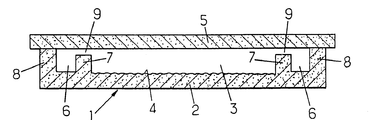
- the mold shown in the drawing generally designated by the reference 1, comprises a matrix 2 having a molding imprint 3 (with a bottom 4 provided with reliefs such as striations) and a cover 5 covering and closing the matrix 2.
- a gutter 6 Around the molding impression 3 is provided a gutter 6 which is separated from the impression by a partition 7.
- the partition 7 has a height less than that of the side wall 8 of the mold which externally surrounds the gutter 6.
- interval 9 is continuous around the entire periphery of the impression, and not discontinuous, so that the excess of the product present in the impression can pass freely, without discomfort, because, as will appear more far, the product in question is in principle pasty and would flow more difficult in the case of a discontinuous interval.
- the material is made of charged resin, by overmolding of a "mother" shape which can be used for the manufacture of a whole set of dies and which ensures the identity of the molding impressions, and therefore of the molded objects obtained from this plurality of molds.
- a "mother" shape which can be used for the manufacture of a whole set of dies and which ensures the identity of the molding impressions, and therefore of the molded objects obtained from this plurality of molds.
- We uses for example an epoxy tooling resin and glass fibers which undergo a heat treatment up to approximately 150 ° C.
- the mold obtained is stable and is capable of withstanding several tens (for example at least fifty in the current state of development) of polymerization cycles at 120 ° C.
- the bottom of the imprint is coated with a release agent consisting of a special wax and a liquid release agent.
- a release agent consisting of a special wax and a liquid release agent.
- the wax is spread cold, not hot to prevent it from hardening, then the liquid release agent is poured onto this wax; under these conditions, the product spreads perfectly in the imprint and penetrates into all the reliefs, in particular the reliefs such as striations or undulations present on the bottom 4 of the imprint, as fine as these reliefs may be.
- the mold cover Before being put in place, the mold cover is also coated with a release agent which has been extended when cold.
- the mold contents are then heat treated, maintaining a temperature of 120 ° C for 90 min under a pressure of 5 bars.
- the release product migrates to the two external webs which then perfectly match the two surfaces of the mold with which they are in contact.
- the resin permeating the tissues of the central layers polymerizes while the excess of pasty resin flows into the peripheral gutter of the mold.
- the hot plate is then removed from the mold, while the mold is still in the expanded state.
- this liquid release agent Due to the absorption of the liquid release agent by the external layers, this liquid release agent is not placed once and for all in the mold as is traditionally the case and as is the case with the wax, but it must be renewed regularly. With the liquid release agent mentioned above, it seems that its renewal is necessary every two or three operations, the wax being spread once and for all.
- intermediate sheets are obtained having completely original characteristics and much superior to those of the intermediate sheets, in particular polyester or steel, which were used until 'here, in particular with regard to shape and respect for thicknesses and dimensions.
- the material constituting the intermediate plates of the invention suitably withstands repeated thermal shocks from successive manufacturing cycles, and there no longer occurs the deteriorations - bursts, cracks - which appeared on the anterior plates.
- the plates can therefore be used for a large number of manufacturing cycles, far greater than the limit of around fifty cycles that the previous plates can undergo, and this at a much higher rate.
- the superior mechanical qualities of the material constituting the intermediate plates of the invention have made it possible to increase, when desired, the dimensions of the interlayers and therefore panels of fiber-cement material which they make it possible to produce, hence a significant increase in production from this point of view alone.
- interlayer plates of approximately 4 m ⁇ 2 m, compared to a maximum of 2.6 m ⁇ 1.3 m for the polyester interlayer plates currently used.
- the much higher rigidity of the intermediate plates of the invention has made it possible to eliminate various stiffening systems hitherto associated with the anterior plates, thereby saving time and handling.
Landscapes
- Engineering & Computer Science (AREA)
- Mechanical Engineering (AREA)
- Chemical & Material Sciences (AREA)
- Composite Materials (AREA)
- Laminated Bodies (AREA)
- Moulds For Moulding Plastics Or The Like (AREA)
Applications Claiming Priority (2)
| Application Number | Priority Date | Filing Date | Title |
|---|---|---|---|
| FR9104302 | 1991-04-09 | ||
| FR9104302A FR2675073B1 (fr) | 1991-04-09 | 1991-04-09 | Plaque intercalaire pour la fabrication de panneaux de grandes dimensions en materiau fibres-ciment, et procede et moule pour sa fabrication. |
Publications (2)
| Publication Number | Publication Date |
|---|---|
| EP0512874A1 true EP0512874A1 (de) | 1992-11-11 |
| EP0512874B1 EP0512874B1 (de) | 1995-12-06 |
Family
ID=9411630
Family Applications (1)
| Application Number | Title | Priority Date | Filing Date |
|---|---|---|---|
| EP19920400976 Expired - Lifetime EP0512874B1 (de) | 1991-04-09 | 1992-04-07 | Distanzplatte für die Herstellung von gross dimensionierten Platten aus Faserzement, das Herstellungsverfahren und die Form |
Country Status (3)
| Country | Link |
|---|---|
| EP (1) | EP0512874B1 (de) |
| DE (1) | DE69206474D1 (de) |
| FR (1) | FR2675073B1 (de) |
Cited By (1)
| Publication number | Priority date | Publication date | Assignee | Title |
|---|---|---|---|---|
| CN105014770A (zh) * | 2014-04-30 | 2015-11-04 | 王建军 | 纤维增强型复合基材板架的制造方法 |
Citations (5)
| Publication number | Priority date | Publication date | Assignee | Title |
|---|---|---|---|---|
| GB889486A (en) * | 1958-01-14 | 1962-02-14 | Rohm & Haas | Method for producing abrasion-resistant surfaces on plastic articles |
| GB2079667A (en) * | 1980-07-10 | 1982-01-27 | Itt | Plastic moulded part |
| EP0320302A2 (de) * | 1987-12-10 | 1989-06-14 | General Electric Company | Verfahren und Vorrichtung zum Herstellen eines Gegenstandes aus faserverstärktem Verbundwerkstoff |
| US4952355A (en) * | 1988-09-12 | 1990-08-28 | Seward Thomas J | Method for making a plastic tool |
| US4992127A (en) * | 1988-05-17 | 1991-02-12 | Mitsui Toatsu Chemicals, Inc. | Process for preparing fiber-reinforced thermoplastic molded articles using notched prepreg containing continuous fiber |
-
1991
- 1991-04-09 FR FR9104302A patent/FR2675073B1/fr not_active Expired - Fee Related
-
1992
- 1992-04-07 EP EP19920400976 patent/EP0512874B1/de not_active Expired - Lifetime
- 1992-04-07 DE DE69206474T patent/DE69206474D1/de not_active Expired - Lifetime
Patent Citations (5)
| Publication number | Priority date | Publication date | Assignee | Title |
|---|---|---|---|---|
| GB889486A (en) * | 1958-01-14 | 1962-02-14 | Rohm & Haas | Method for producing abrasion-resistant surfaces on plastic articles |
| GB2079667A (en) * | 1980-07-10 | 1982-01-27 | Itt | Plastic moulded part |
| EP0320302A2 (de) * | 1987-12-10 | 1989-06-14 | General Electric Company | Verfahren und Vorrichtung zum Herstellen eines Gegenstandes aus faserverstärktem Verbundwerkstoff |
| US4992127A (en) * | 1988-05-17 | 1991-02-12 | Mitsui Toatsu Chemicals, Inc. | Process for preparing fiber-reinforced thermoplastic molded articles using notched prepreg containing continuous fiber |
| US4952355A (en) * | 1988-09-12 | 1990-08-28 | Seward Thomas J | Method for making a plastic tool |
Cited By (1)
| Publication number | Priority date | Publication date | Assignee | Title |
|---|---|---|---|---|
| CN105014770A (zh) * | 2014-04-30 | 2015-11-04 | 王建军 | 纤维增强型复合基材板架的制造方法 |
Also Published As
| Publication number | Publication date |
|---|---|
| EP0512874B1 (de) | 1995-12-06 |
| FR2675073B1 (fr) | 1993-07-30 |
| FR2675073A1 (fr) | 1992-10-16 |
| DE69206474D1 (de) | 1996-01-18 |
Similar Documents
| Publication | Publication Date | Title |
|---|---|---|
| EP0581098B1 (de) | Verfahren zur Herstellung eines Skis | |
| EP0141700A1 (de) | Form für grosse Formteile aus Verbundmaterial | |
| FR2612508A1 (fr) | Bloc de verre cellulaire multicouche avec couche de surface de verre dense et procede de production | |
| EP2826389A1 (de) | Büstenhalterkorb und Fertigungsmethode | |
| WO2008049975A1 (fr) | Outil composite pour le moulage de pieces cylindriques | |
| EP0512874B1 (de) | Distanzplatte für die Herstellung von gross dimensionierten Platten aus Faserzement, das Herstellungsverfahren und die Form | |
| EP0454520B1 (de) | Verfahren zur Herstellung einer eine aus Polymethylmethacrylat gegossene Platte und eine thermoplastische Grundschicht enthaltenden Verbundfolie und so erhaltenes Produkt | |
| EP0364360B1 (de) | Verfahren zum Herstellen von Verbundwerkstoffteilen, bestehend aus einem Flies und einer Verstärkung | |
| EP1680244A2 (de) | Verfahren zur herstellung eines formwerkzeugs und so erhaltenes formwerkzeug | |
| EP0558009B1 (de) | Verfahren zur Herstellung eines Skis | |
| FR2490993A3 (fr) | Procede et dispositif pour la realisation de corps creux en matiere stratifiee et corps creux ainsi obtenus | |
| FR2597395A1 (fr) | Procede de fabrication de pieces composites a fibres avec utilisation d'un agent de demoulage | |
| FR2704477A1 (fr) | Procédé de fabrication de plaques planes ondulées ou nervurées à base de résine thermodurcissable et dispositif pour la mise en Óoeuvre de ce procédé. | |
| FR2860227A1 (fr) | Procede pour fabriquer des plaques en verre ou en vitroceramique avec de larges facettes et plaques en verre ou en vitroceramique avec une large facette abrasee | |
| FR2750640A1 (fr) | Procede de fabrication d'un produit en matiere plastique renforcee de fibres | |
| EP1912783A1 (de) | Verfahren zur herstellung eines teils mit einer von einem träger getragenen schaumstofflage | |
| WO2015086834A1 (fr) | Procédé de fabrication d'une pièce en matériau composite thermoplastique | |
| FR2763879A1 (fr) | Moules a peau remplacable (coquilles) pour production r.t.m. | |
| WO1990000474A1 (fr) | Elements composites de construction a armatures tridimensionelles | |
| EP4155043A1 (de) | Form, insbesondere für die herstellung von verbundwerkstücken, und verfahren zur herstellung einer solchen form | |
| FR2498985A1 (fr) | Structure en nid d'abeilles en matiere fibreuse cellulosique, panneaux obtenus au moyen desdites structures et procede de fabrication de cette structure | |
| BE466983A (de) | ||
| FR2525519A1 (fr) | Procede de moulage de produits creux en beton et boite de raccordement obtenue selon ce procede | |
| EP1004417A1 (de) | Formwerkzeuge mit auswechselbarer Schale für das RTM-Verfahren | |
| EP0821202A1 (de) | Wärmedämmplatte für einen Boden mit Heizungs- und/oder Kühlungsanlage, Verfahrenzu ihrer Herstellung und Vorrichtung zur Durchführung des Verfahrens |
Legal Events
| Date | Code | Title | Description |
|---|---|---|---|
| PUAI | Public reference made under article 153(3) epc to a published international application that has entered the european phase |
Free format text: ORIGINAL CODE: 0009012 |
|
| AK | Designated contracting states |
Kind code of ref document: A1 Designated state(s): BE DE GB IT |
|
| 17P | Request for examination filed |
Effective date: 19921211 |
|
| 17Q | First examination report despatched |
Effective date: 19940603 |
|
| RAP1 | Party data changed (applicant data changed or rights of an application transferred) |
Owner name: CONSTRUCTIONS MECANIQUES DE NORMANDIE |
|
| GRAA | (expected) grant |
Free format text: ORIGINAL CODE: 0009210 |
|
| AK | Designated contracting states |
Kind code of ref document: B1 Designated state(s): BE DE GB IT |
|
| PG25 | Lapsed in a contracting state [announced via postgrant information from national office to epo] |
Ref country code: IT Free format text: LAPSE BECAUSE OF FAILURE TO SUBMIT A TRANSLATION OF THE DESCRIPTION OR TO PAY THE FEE WITHIN THE PRESCRIBED TIME-LIMIT;WARNING: LAPSES OF ITALIAN PATENTS WITH EFFECTIVE DATE BEFORE 2007 MAY HAVE OCCURRED AT ANY TIME BEFORE 2007. THE CORRECT EFFECTIVE DATE MAY BE DIFFERENT FROM THE ONE RECORDED. Effective date: 19951206 |
|
| REF | Corresponds to: |
Ref document number: 69206474 Country of ref document: DE Date of ref document: 19960118 |
|
| PG25 | Lapsed in a contracting state [announced via postgrant information from national office to epo] |
Ref country code: DE Effective date: 19960307 |
|
| PG25 | Lapsed in a contracting state [announced via postgrant information from national office to epo] |
Ref country code: BE Effective date: 19960430 |
|
| GBT | Gb: translation of ep patent filed (gb section 77(6)(a)/1977) |
Effective date: 19960430 |
|
| PLBE | No opposition filed within time limit |
Free format text: ORIGINAL CODE: 0009261 |
|
| STAA | Information on the status of an ep patent application or granted ep patent |
Free format text: STATUS: NO OPPOSITION FILED WITHIN TIME LIMIT |
|
| BERE | Be: lapsed |
Owner name: CONSTRUCTIONS MECANIQUES DE NORMANDIE Effective date: 19960430 |
|
| 26N | No opposition filed | ||
| PGFP | Annual fee paid to national office [announced via postgrant information from national office to epo] |
Ref country code: GB Payment date: 20000425 Year of fee payment: 9 |
|
| PG25 | Lapsed in a contracting state [announced via postgrant information from national office to epo] |
Ref country code: GB Free format text: LAPSE BECAUSE OF NON-PAYMENT OF DUE FEES Effective date: 20010407 |
|
| GBPC | Gb: european patent ceased through non-payment of renewal fee |
Effective date: 20010407 |