EP0518332B1 - Verfahren und Vorrichtung zur Flüssigphasenepitaxie - Google Patents
Verfahren und Vorrichtung zur Flüssigphasenepitaxie Download PDFInfo
- Publication number
- EP0518332B1 EP0518332B1 EP92109855A EP92109855A EP0518332B1 EP 0518332 B1 EP0518332 B1 EP 0518332B1 EP 92109855 A EP92109855 A EP 92109855A EP 92109855 A EP92109855 A EP 92109855A EP 0518332 B1 EP0518332 B1 EP 0518332B1
- Authority
- EP
- European Patent Office
- Prior art keywords
- chamber
- solution
- growth chamber
- growth
- liquid
- Prior art date
- Legal status (The legal status is an assumption and is not a legal conclusion. Google has not performed a legal analysis and makes no representation as to the accuracy of the status listed.)
- Expired - Lifetime
Links
- 239000007791 liquid phase Substances 0.000 title claims description 40
- 238000000034 method Methods 0.000 title claims description 23
- 239000000758 substrate Substances 0.000 claims description 43
- 238000003756 stirring Methods 0.000 claims description 4
- 239000003575 carbonaceous material Substances 0.000 claims description 3
- 238000001914 filtration Methods 0.000 claims 1
- 238000010438 heat treatment Methods 0.000 claims 1
- 239000004065 semiconductor Substances 0.000 description 10
- 230000005484 gravity Effects 0.000 description 7
- 238000009826 distribution Methods 0.000 description 6
- 239000012535 impurity Substances 0.000 description 5
- 229910001218 Gallium arsenide Inorganic materials 0.000 description 4
- 238000004519 manufacturing process Methods 0.000 description 4
- 238000010276 construction Methods 0.000 description 3
- 230000000694 effects Effects 0.000 description 3
- 239000000155 melt Substances 0.000 description 3
- 238000005192 partition Methods 0.000 description 3
- 239000010453 quartz Substances 0.000 description 3
- VYPSYNLAJGMNEJ-UHFFFAOYSA-N silicon dioxide Inorganic materials O=[Si]=O VYPSYNLAJGMNEJ-UHFFFAOYSA-N 0.000 description 3
- 230000000052 comparative effect Effects 0.000 description 2
- 239000000463 material Substances 0.000 description 2
- 230000000737 periodic effect Effects 0.000 description 2
- 238000001816 cooling Methods 0.000 description 1
- 239000007788 liquid Substances 0.000 description 1
- 229910052751 metal Inorganic materials 0.000 description 1
- 239000002184 metal Substances 0.000 description 1
- 150000002739 metals Chemical class 0.000 description 1
- 230000004048 modification Effects 0.000 description 1
- 238000012986 modification Methods 0.000 description 1
- 239000002245 particle Substances 0.000 description 1
- 230000001376 precipitating effect Effects 0.000 description 1
- 239000004180 red 2G Substances 0.000 description 1
- 239000007787 solid Substances 0.000 description 1
- 239000002904 solvent Substances 0.000 description 1
- 238000003860 storage Methods 0.000 description 1
Images

Classifications
-
- C—CHEMISTRY; METALLURGY
- C30—CRYSTAL GROWTH
- C30B—SINGLE-CRYSTAL GROWTH; UNIDIRECTIONAL SOLIDIFICATION OF EUTECTIC MATERIAL OR UNIDIRECTIONAL DEMIXING OF EUTECTOID MATERIAL; REFINING BY ZONE-MELTING OF MATERIAL; PRODUCTION OF A HOMOGENEOUS POLYCRYSTALLINE MATERIAL WITH DEFINED STRUCTURE; SINGLE CRYSTALS OR HOMOGENEOUS POLYCRYSTALLINE MATERIAL WITH DEFINED STRUCTURE; AFTER-TREATMENT OF SINGLE CRYSTALS OR A HOMOGENEOUS POLYCRYSTALLINE MATERIAL WITH DEFINED STRUCTURE; APPARATUS THEREFOR
- C30B19/00—Liquid-phase epitaxial-layer growth
- C30B19/06—Reaction chambers; Boats for supporting the melt; Substrate holders
- C30B19/061—Tipping system, e.g. by rotation
Definitions
- the present invention relates to a method of and an apparatus for liquid-phase epitaxial growth to obtain thin epitaxial layers grown on a plurality of thin plate-like substrates.
- Patent abstract of Japan Vol. 6, Number 170 (E-128)(1048), September 3, 1982 discloses a semiconductor manufacturing device comprising a solution chamber and a growth chamber connected to each other.
- the chambers are separated from each other by a sliding plate with openings, which act as a gate valve.
- the chamber are rotated about a horizontal axis during operation.
- the prior art document teaches only half revolution of both chambers while cooling, vice versa while the liquid-phase epitaxial growth is carried out.
- the growth chamber is repeatedly or periodically turned or rotated during the liquid-phase epitaxial growth.
- both chamber or containers 11, 14 are rotated directly by a drive means.
- the growth chamber is rotated through a circular cylindrical tube by a drive means. Since this drive means is operatively connected with a furnace tube for rotating the furnace tube to make an angular movement of the growth chamber about a horizontal axis, the growth chamber can be tilted or overturned.
- the liquid-phase epitaxial growth method is a process for precipitating and growing the solute in a supersaturated solution on a substrate which is brought into contact with the supersaturated solution.
- this method is used mainly for the production of light emitting diodes (LEDs), in which instance molten metals are used as a solvent to form a thin semiconductor layer with a desired impurity concentration on a semiconductor substrate.
- LEDs light emitting diodes
- molten metals are used as a solvent to form a thin semiconductor layer with a desired impurity concentration on a semiconductor substrate.
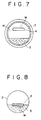
- FIG. 7 of the accompanying drawings shows one such known technique generally known as a tipping method in which a solution S used for the liquid-phase epitaxial growth is held at a lower portion of a reaction tube 2 with a space H defined at an upper portion of the reaction tube 2.
- a substrate holder 4 is disposed in the space H and a semiconductor substrate W is held horizontally on an upper surface of the substrate holder 4.
- the reaction tube 2 is turned through an angle of 180 degrees around its axis so that an upper surface of the semiconductor substrate W is directed downward and immersed in the solution S, as shown in FIG. 8. Due to contact between the solution S and the semiconductor substrate W, a thin epitaxial layer is grown on the semiconductor substrate W.
- the semiconductor substrate W while being in contact with the solution is held parallel to the surface of the solution, only a limited number of semiconductor substrates W can be received at one time in the reaction chamber. This method is, therefore, not suited for the mass production.
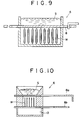
- FIGS. 9 and 10 show two other known methods in which substrates W are held vertically within a substrate holder 6 and a solution S falls down by gravity along the surface of the substrates W.
- a horizontal partition plate 8 is pulled outward to allow the solution S to fall down along the surface of the substrates W.
- the solution S is removed from the substrate holder 6.
- the method shown in FIG. 10 is a modification of the method shown in FIG. 9 and includes an upper horizontal partition plate 8a which is moved forward to allow the solution S to fall down along outside surface of the substrates W.
- a lower horizontal partition plate 8b is forced forward to allow the solution S to fall down into a solution tank 10, thereby separating the substrates W and the solution S.
- These known methods are able to process an increased number of substrates W at one time within the substrate holder 6.
- the solute tends to exhaust at the lower portion of the solution S so that the thickness and impurity concentration of epitaxial growth layers vary between an upper portion and a lower portion of each individual substrate W.
- the solution S dropped from the substrates W cannot be used again.
- liquid-phase epitaxial growth method and apparatus which is capable of obtaining epitaxial layers grown efficiently at one time on a multiplicity of thin plate-like substrates, with high quality homogeneity and thickness uniformity.
- a method of liquid-phase epitaxial growth which comprises the steps of: holding at least one row of thin plate-like substrates in a sealable growth chamber; then, filling the growth chamber with a solution to be used for the liquid-phase epitaxial growth; and thereafter, while keeping the growth chamber in a sealed condition, periodically rotating the growth chamber about the horizontal axis to tilt or overturn the growth chamber periodically for stirring the solution whereby a thin epitaxial layer is grown on each of the substrates.
- the angle of rotation of the growth chamber is a periodic function of time elapsed, which period varies with the progress of liquid-phase epitaxial growth.
- an apparatus for liquid-phase epitaxial growth which comprises: a sealable growth chamber for receiving therein at least one row of thin plate-like substrates; a sealable solution chamber connected with the growth chamber for holding therein a solution to be used for the liquid-phase epitaxial growth; a gate valve disposed between the growth chamber and the solution chamber for selectively connecting together the growth chamber and the solution chamber and separating apart the growth chamber and the solution chamber; wherein said growth chamber, said solution chamber and said gate valve are non-rotatably disposed in a circular cylindrical tube, and drive means are operatively connected to said tube for rotating the same to turn said growth chamber about a horizontal axis so as to tilt or overturn said growth chamber.
- the growth chamber, solution chamber and gate valve are preferably made of a heat insulating and chemically stable material, such as a high purity carbonaceous material.
- the apparatus may further include a circular cylindrical tube in which the growth chamber, solution chamber and gate valve are non-rotatably disposed.
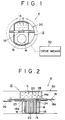
- FIG. 1 diagrammatically shows the general construction of an apparatus 12 constituting a liquid-phase epitaxial growth system E according to an embodiment of this invention.
- the apparatus 12 includes a furnace tube 30 made of quartz, a solution chamber 14 disposed in the quartz furnace tube 30 for holding therein a solution S of the desired composition to achieve liquid-phase epitaxial growth, and a growth chamber 16 disposed in the quartz furnace tube 30 for receiving therein at least one row of substrates W supported by a support plate 15 (FIG. 2).
- the furnace tube 30, solution chamber 14 and growth chamber 16 are non-rotatable relative to one another but slidably movable relative to one another in a horizontal direction.
- the furnace tube 30 is rotatable so that the solution chamber 14 and the growth chamber 16 are rotated about a horizontal axis.
- the solution chamber 14 and the growth chamber 16 are normally separated by a gate valve 18 but they are able to communicate with each other upon operation of the gate valve 18.
- the solution chamber 14, growth chamber 16 and gate valve 18 are preferably made of a heat insulating and chemically stable material, such as a high purity carbonaceous material.
- An opening 24 of a valve plate 18a (FIG. 2) of the gate valve 18 is fitted with a filter 28 in the form of a drainboard. With the filter 28 thus provided, solid particles which may be formed in the solution S cannot enter the growth chamber 16.
- the gate valve 18 used in the illustrated embodiment is constructed to selectively communicate and separate the solution chamber 14 and the growth chamber 16 through sliding movement between the valve plate 18a and a valve sheet formed by portions of the chambers 14 and 16.
- the gate valve 18 of this construction is illustrative rather than restrictive, and a valve of a different construction, such as a butterfly valve can be used.
- the valve plate 18a may be fixed in which instance the solution chamber 14 and the growth chamber 16 are movable relative to the fixed valve plate 18a between a closed position in which the solution chamber 14 and the growth chamber 16 are separated from one another, and an open position in which the solution chamber 14 and the growth chamber 16 communicate with each other.
- the filter 28 composed of densely pitched fine wires fitted to the opening 24 of the valve plate 18a of the gate valve 18 may be replaced with a net-like filter disposed at an outlet of the solution chamber 14 or an inlet of the growth chamber 16.
- the solution chamber 14 has a bottom wall 14a provided with a lower opening 20, while the growth chamber 16 has a top wall 16a provided with an upper opening 22 aligned with the lower opening 20.
- the bottom wall 14a and the top wall 16a are vertically separated from one another with a space defined therebetween.
- the valve plate 18a of the gate valve 18 is slidably disposed in the space between the bottom wall 14a and the top wall 16a.
- the valve plate 18a has the opening 24 which can be aligned with the lower opening 20 and the upper opening 22 in response to the movement of the valve plate 18a.
- the opening 24 is normally out of position with the lower and upper openings 20, 22 to separate the solution chamber 14 and the growth chamber 16.
- Numeral 26 is an actuating rod connected with the valve plate 18a to reciprocate the same for opening and closing the gate valve 18.
- the apparatus 12 further includes a drive means 32 operatively connected with the furnace tube 30 for rotating the furnace tube 30 to make an angular movement of the growth chamber 16 about a horizontal axis, thereby tilting or overturning the growth chamber 16.
- the rotation of the growth chamber 16 is performed such that the angle of rotation of the growth chamber 16 is a periodic function of time elapsed, which period may be variable with the progress of liquid-phase epitaxial growth.
- the solution S received in the solution chamber 14 can be filled in the growth chamber 16 through the opening 24 of the gate valve 18 and then sealed in the growth chamber 16 by the gate valve 18. It is possible to return the solution S from the growth chamber 16 to the solution chamber 14 through the opening 24 of the gate valve 18.
- the solution S is charged into the growth chamber 16 and then the growth chamber 16 is closed or sealed by the gate valve 18. Subsequently, the furnace tube 30 is turned to tilt or overturn the growth chamber 16 about the horizontal axis whereby liquid-phase epitaxial growth of a thin epitaxial layer takes place on the substrates W received in the growth chamber 16.
- the rotation of the growth chamber 16 may be carried out such that the angular positions of the growth chamber 16 oscillates within a predetermined angular range.
- the horizontal axis about which the growth chamber 16 tilts or overturns extends parallel to the line normal to the general plane of the substrates W.
- the horizontal axis about which the growth chamber 16 tilts or overturns extends perpendicular to the line normal to the general plane of the substrates W.
- the substrates W may be arranged such that the line normal to the general plane of the substrates W extends obliquely to the horizontal axis. In either arrangement, by tilting or overturning the growth chamber 16, the solution S is kept in an homogeneous condition and liquid-phase epitaxial growth is achieved uniformly without being influenced by gravity.
- the liquid-phase epitaxial growth thus achieved is able to exclude the effect of gravity on the solution S and provides a constant growth rate and a uniform impurity concentration in the solution S with the result that a homogeneous epitaxial growth layer of uniform thickness is produced over the entire surface of each substrate W.
- the solution S is returned from the growth chamber 16 to the solution chamber 14 so that the repeated use of the solution S is possible.
- the effect of gravity can be canceled out. Accordingly, the difference in specific gravity between the upper portion and the lower portion of the solution S is no longer materialized with the result that the distribution of solute concentration in a vertical direction is uniform, and the thickness of the epitaxial growth layer and the impurity distribution are also uniform in the vertical direction.
- an angular movement of the growth chamber 16 stirs the solution S and promotes replenishment of the solute exhausted in the vicinity of the growth interface, thus accelerating the growth rate. As a result, an epitaxial growth layer of uniform thickness and quality can be obtained efficiently.
- the solution S is easy to achieve highly homogeneous condition, it is possible to increase the solution temperature otherwise kept near the room temperature, and shorten the period of time needed for dissolving unsaturated part of the solute. It is also possible to uniformly clean or melt back the surface of the substrate W by increasing the temperature of the solution S while the growth chamber 16 is turned about the horizontal axis for stirring the solution S.
- the growth chamber 16, solution chamber 14 and gate valve 18 are rotatable about a horizontal axis, so that when the gate valve 18 is opened while the solution chamber 14 is disposed above the growth chamber 16, the solution S held in the solution chamber 14 is supplied into the growth chamber 16 through the opening 24 of the gate valve 18.
- the gate valve 18 is opened with the growth chamber 16 disposed above the solution chamber 14, the solution S is returned from the growth chamber 16 to the solution chamber 14.
- the liquid-phase epitaxial growth can be started and stopped in a short period of time.
- the growth chamber 16 is sealable by the gate valve 18, it is possible to tilt or overturn the growth chamber 16, thereby canceling out the effect of gravity on the solution S.
- the solute concentration therefore, distributes uniformly in the vertical direction.
- the solution S is stirred during angular movement of the growth chamber 16, the solute consumed in the vicinity of the growth interface is replenished smoothly and the growth rate is increased.
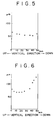
- liquid-phase epitaxial growth was carried out at a temperature from 700 to 900°C for 200 min. by using the apparatus of this invention shown in FIGS. 1 and 2.
- a target thickness of the GaAs epitaxial growth layer was 100 ⁇ m.
- the growth chamber of the apparatus was turned about a horizontal axis into a tilted position or an overturned position.
- the distribution of thickness of the epitaxial growth layer was measured. The results obtained are shown in FIG. 5.
- the thickness of the epitaxial growth layer is substantially uniform throughout the measured area of the substrate. This means that the impurity concentration in a solution used in the liquid-phase epitaxial growth was substantially uniform.
- liquid-phase epitaxial growth was carried out under the same condition described above with respect to the Inventive Example but by using a conventional system in which the growth chamber was not rotatable.
- the distribution of thickness of an epitaxial growth layer was measured in the same procedure as described above. The results thus obtained are shown in FIG. 6. As is obvious from FIG. 6, the thickness of the epitaxial growth layer is not uniform at all.
- the Inventive Example 1 described above relates to the liquid-phase epitaxial growth of a GaAs layer, this invention is also applicable to the liquid-phase epitaxial growth of a GaP or a GaAlAs layer.
Landscapes
- Chemical & Material Sciences (AREA)
- Engineering & Computer Science (AREA)
- Crystallography & Structural Chemistry (AREA)
- Materials Engineering (AREA)
- Metallurgy (AREA)
- Organic Chemistry (AREA)
- Liquid Deposition Of Substances Of Which Semiconductor Devices Are Composed (AREA)
- Crystals, And After-Treatments Of Crystals (AREA)
Claims (10)
- Verfahren für Flüssigphasenepitaxie, umfassend folgende Schritte:Halten wenigstens einer Reihe dünner plattenförmiger Substrate (W) in einer abdichtbaren Wachstumskammer (16);anschließend, Anfüllen der Wachstumskammer (16) mit einer Lösung (S), welche für die Flüssigphasenepitaxie verwendet wird; undanschließend, während die Wachstumskammer (16) in einem abgedichteten Zustand gehalten wird, periodisches Rotieren der Wachstumskammer (16) um eine horizontale Achse, so daß sich die Wachstumskammer (16) neigt oder umdreht, um die Lösung (S) umzurühren, wodurch eine dünne Epitaxieschicht auf jedem der Substrate wächst.
- Verfahren nach Anspruch 1, wobei die Wachstumskammer (16) periodisch mit einem vorherbestimmten Winkel und Zyklus rotiert wird.
- Verfahren nach Anspruch 2, wobei eine Rotationsperiode der Wachstumskammer (16) in Hinblick auf den Winkel und den Zyklus variabel ist.
- Vorrichtung zur Erzielung einer Flüssigphasenepitaxie, umfassend:eine abdichtbare Wachstumskammer (16) zur Aufnahme von wenigstens einer Reihe dünner plattenförmiger Substrate (W);eine abdichtbare Lösungskammer (14), welche mit der Wachstumskammer (16) verbunden ist, um in dieser eine Lösung (S) zu halten, welche bei der Flüssigphasenepitaxie verwendet wird;ein Schieberventil (18), welches zwischen der Wachstumskammer (16) und der Lösungskammer (14) angeordnet ist, um die Wachstumskammer (16) und die Lösungskammer (14) selektiv zu verbinden und die Wachstumskammer (16) und die Lösungskammer (14) voneinander zu trennen, wobeidie Wachstumskammer (16), die Lösungskammer (14) und das Schieberventil (18) nicht rotierbar in einem kreisförmigen zylindrischen Rohr (30) angeordnet sind und Antriebseinrichtungen (32) im Betrieb mit dem Rohr (30) verbunden sind, um das Rohr zu rotieren, um die Wachstumskammer (16) um eine horizontale Achse zu drehen, so daß sich die Wachstumskammer (16) neigt oder umdreht.
- Vorrichtung nach Anspruch 4, wobei die Wachstumskammer (16), die Lösungskammer (14) und das Schieberventil (18) aus einem kohlenstoffhaltigen Material hergestellt sind.
- Vorrichtung nach Anspruch 4, wobei das Rohr (30) als ein Ofenrohr dient, um eine Wärmebehandlung der Substrate (W) zu erzielen.
- Vorrichtung nach einem der vorhergehenden Ansprüche 4 bis 6, wobei das Schieberventil (18) eine Öffnung (24) aufweist, um einen Durchgang für die Lösung (S) zu schaffen.
- Vorrichtung nach Anspruch 7, wobei die Öffnung (24) mit einem Filter (28) versehen ist, um die Lösung (S) zu filtern.
- Vorrichtung nach Anspruch 8, wobei der Filter (28) dicht angeordnete feine Drähte umfaßt.
- Vorrichtung nach Anspruch 8, wobei der Filter (28) ein Drahtnetz umfaßt.
Applications Claiming Priority (2)
| Application Number | Priority Date | Filing Date | Title |
|---|---|---|---|
| JP170501/91 | 1991-06-14 | ||
| JP3170501A JPH04367587A (ja) | 1991-06-14 | 1991-06-14 | 液相成長方法及び装置 |
Publications (2)
| Publication Number | Publication Date |
|---|---|
| EP0518332A1 EP0518332A1 (de) | 1992-12-16 |
| EP0518332B1 true EP0518332B1 (de) | 1996-04-03 |
Family
ID=15906133
Family Applications (1)
| Application Number | Title | Priority Date | Filing Date |
|---|---|---|---|
| EP92109855A Expired - Lifetime EP0518332B1 (de) | 1991-06-14 | 1992-06-11 | Verfahren und Vorrichtung zur Flüssigphasenepitaxie |
Country Status (4)
| Country | Link |
|---|---|
| US (1) | US5366552A (de) |
| EP (1) | EP0518332B1 (de) |
| JP (1) | JPH04367587A (de) |
| DE (1) | DE69209564T2 (de) |
Cited By (1)
| Publication number | Priority date | Publication date | Assignee | Title |
|---|---|---|---|---|
| DE102017003638B3 (de) | 2017-04-13 | 2018-03-08 | 3-5 Power Electronics GmbH | Flüssigphasenepitaxievorrichtung |
Families Citing this family (4)
| Publication number | Priority date | Publication date | Assignee | Title |
|---|---|---|---|---|
| JP2885268B2 (ja) * | 1994-08-30 | 1999-04-19 | 信越半導体株式会社 | 液相成長方法及び装置 |
| KR101167732B1 (ko) * | 2003-03-17 | 2012-07-23 | 오사카 유니버시티 | Ⅲ족 원소 질화물 단결정의 제조 방법 및 이것에 이용하는장치 |
| RU2638575C1 (ru) * | 2016-11-08 | 2017-12-14 | Общество с ограниченной ответственностью "МеГа Эпитех" | Способ получения полупроводниковых структур методом жидкофазной эпитаксии с высокой однородностью по толщине эпитаксиальных слоев |
| DE102017009110B3 (de) | 2017-09-29 | 2018-10-04 | 3-5 Power Electronics GmbH | Flüssigphasenepitaxievorrichtung |
Family Cites Families (12)
| Publication number | Priority date | Publication date | Assignee | Title |
|---|---|---|---|---|
| US3648653A (en) * | 1970-06-01 | 1972-03-14 | Bell Telephone Labor Inc | Liquid phase crystal growth apparatus |
| US3933539A (en) * | 1973-12-26 | 1976-01-20 | Texas Instruments Incorporated | Solution growth system for the preparation of semiconductor materials |
| JPS50110570A (de) * | 1974-02-07 | 1975-08-30 | ||
| JPS5329064A (en) * | 1976-08-30 | 1978-03-17 | Mitsubishi Electric Corp | Color picture tube |
| JPS5659696A (en) * | 1979-10-23 | 1981-05-23 | Sanyo Electric Co Ltd | Liquid phase epitaxial growing apparatus |
| JPS56109894A (en) * | 1980-02-04 | 1981-08-31 | Toshiba Corp | Liquid phase growing apparatus |
| JPS5785222A (en) * | 1980-11-17 | 1982-05-27 | Toshiba Corp | Semiconductor manufacturing device |
| JPS59116190A (ja) * | 1982-12-21 | 1984-07-04 | Sanyo Electric Co Ltd | 液相エピタキシヤル成長装置 |
| JPS63144189A (ja) * | 1986-12-04 | 1988-06-16 | Fujitsu Ltd | 液相エピタキシヤル成長装置 |
| JPS6442390A (en) * | 1987-08-05 | 1989-02-14 | Hitachi Cable | Process and apparatus for carrying out liquid phase epitaxial growth |
| JPH01257187A (ja) * | 1988-04-06 | 1989-10-13 | Mitsubishi Electric Corp | 液相エピタキシヤル成長装置 |
| JPH02130839A (ja) * | 1988-11-10 | 1990-05-18 | Fujitsu Ltd | 液相エピタキシャル成長方法 |
-
1991
- 1991-06-14 JP JP3170501A patent/JPH04367587A/ja active Pending
-
1992
- 1992-06-11 DE DE69209564T patent/DE69209564T2/de not_active Expired - Fee Related
- 1992-06-11 US US07/897,169 patent/US5366552A/en not_active Expired - Fee Related
- 1992-06-11 EP EP92109855A patent/EP0518332B1/de not_active Expired - Lifetime
Cited By (1)
| Publication number | Priority date | Publication date | Assignee | Title |
|---|---|---|---|---|
| DE102017003638B3 (de) | 2017-04-13 | 2018-03-08 | 3-5 Power Electronics GmbH | Flüssigphasenepitaxievorrichtung |
Also Published As
| Publication number | Publication date |
|---|---|
| DE69209564D1 (de) | 1996-05-09 |
| EP0518332A1 (de) | 1992-12-16 |
| DE69209564T2 (de) | 1996-09-19 |
| US5366552A (en) | 1994-11-22 |
| JPH04367587A (ja) | 1992-12-18 |
Similar Documents
| Publication | Publication Date | Title |
|---|---|---|
| CA2259395C (en) | Equipment for crystal growth and crystal-growing method using the same | |
| JP2016508544A (ja) | 粒子材料の処理のための方法及び装置 | |
| US20020092464A1 (en) | Liquid phase growth process, liquid phase growth system and substrate member production method | |
| WO1999022048A1 (en) | Method of manufacturing single crystal and apparatus for manufacturing single crystal | |
| US20210222320A1 (en) | Method of Producing a Single-Crystal | |
| Lu et al. | Effect of vibrational stirring on the quality of Bridgman-grown CdTe | |
| US5366552A (en) | Apparatus for liquid-phase epitaxial growth | |
| US5114528A (en) | Edge-defined contact heater apparatus and method for floating zone crystal growth | |
| JPH1179886A (ja) | 結晶成長方法および装置 | |
| US3765959A (en) | Method for the liquid phase epitaxial growth of semiconductor crystals | |
| US6391108B2 (en) | Liquid phase growth method of silicon crystal, method of producing solar cell, and liquid phase growth apparatus | |
| US4063972A (en) | Method for growing epitaxial layers on multiple semiconductor wafers from liquid phase | |
| US20220364259A1 (en) | Raw material supply unit, and apparatus comprising same for growing single-crystal silicon ingot | |
| GB2194554A (en) | A method for the growth of a compound semiconductor crystal and an apparatus for the same | |
| EP0699783B1 (de) | Verfahren und Vorrichtung zur Epitaxialzüchtung aus der Flüssigphase | |
| JPS63307190A (ja) | 液面調節機構付分子線源 | |
| US3756194A (en) | Centrifugal drum for growing crystal | |
| KR100349872B1 (ko) | 단결정체의 제조방법 및 단결정체 제조장치 | |
| US3729291A (en) | Method for growing crystals from molten melts saturated with crystalline material | |
| JPS6120041Y2 (de) | ||
| JP3495910B2 (ja) | 液相エピタキシャル成長装置 | |
| JPH026383A (ja) | 半導体結晶成長装置 | |
| JP2002141295A (ja) | 液相成長方法及び液相成長装置 | |
| JPH07242490A (ja) | 竪型多数枚液相エピタキシャル成長装置の溶液撹拌機構 | |
| JPH0353275B2 (de) |
Legal Events
| Date | Code | Title | Description |
|---|---|---|---|
| PUAI | Public reference made under article 153(3) epc to a published international application that has entered the european phase |
Free format text: ORIGINAL CODE: 0009012 |
|
| AK | Designated contracting states |
Kind code of ref document: A1 Designated state(s): DE FR GB |
|
| 17P | Request for examination filed |
Effective date: 19930216 |
|
| 17Q | First examination report despatched |
Effective date: 19940608 |
|
| GRAH | Despatch of communication of intention to grant a patent |
Free format text: ORIGINAL CODE: EPIDOS IGRA |
|
| GRAA | (expected) grant |
Free format text: ORIGINAL CODE: 0009210 |
|
| AK | Designated contracting states |
Kind code of ref document: B1 Designated state(s): DE FR GB |
|
| REF | Corresponds to: |
Ref document number: 69209564 Country of ref document: DE Date of ref document: 19960509 |
|
| ET | Fr: translation filed | ||
| PLBE | No opposition filed within time limit |
Free format text: ORIGINAL CODE: 0009261 |
|
| STAA | Information on the status of an ep patent application or granted ep patent |
Free format text: STATUS: NO OPPOSITION FILED WITHIN TIME LIMIT |
|
| 26N | No opposition filed | ||
| PGFP | Annual fee paid to national office [announced via postgrant information from national office to epo] |
Ref country code: GB Payment date: 19990609 Year of fee payment: 8 |
|
| PGFP | Annual fee paid to national office [announced via postgrant information from national office to epo] |
Ref country code: FR Payment date: 19990610 Year of fee payment: 8 |
|
| PG25 | Lapsed in a contracting state [announced via postgrant information from national office to epo] |
Ref country code: GB Free format text: LAPSE BECAUSE OF NON-PAYMENT OF DUE FEES Effective date: 20000611 |
|
| GBPC | Gb: european patent ceased through non-payment of renewal fee |
Effective date: 20000611 |
|
| PG25 | Lapsed in a contracting state [announced via postgrant information from national office to epo] |
Ref country code: FR Free format text: LAPSE BECAUSE OF NON-PAYMENT OF DUE FEES Effective date: 20010228 |
|
| REG | Reference to a national code |
Ref country code: FR Ref legal event code: ST |
|
| PGFP | Annual fee paid to national office [announced via postgrant information from national office to epo] |
Ref country code: DE Payment date: 20010605 Year of fee payment: 10 |
|
| PG25 | Lapsed in a contracting state [announced via postgrant information from national office to epo] |
Ref country code: DE Free format text: LAPSE BECAUSE OF NON-PAYMENT OF DUE FEES Effective date: 20030101 |