EP0520498B1 - Verfahren zur Herstellung photographischer Kuppler - Google Patents
Verfahren zur Herstellung photographischer Kuppler Download PDFInfo
- Publication number
- EP0520498B1 EP0520498B1 EP92110838A EP92110838A EP0520498B1 EP 0520498 B1 EP0520498 B1 EP 0520498B1 EP 92110838 A EP92110838 A EP 92110838A EP 92110838 A EP92110838 A EP 92110838A EP 0520498 B1 EP0520498 B1 EP 0520498B1
- Authority
- EP
- European Patent Office
- Prior art keywords
- photographic
- compound
- coupler
- group
- product
- Prior art date
- Legal status (The legal status is an assumption and is not a legal conclusion. Google has not performed a legal analysis and makes no representation as to the accuracy of the status listed.)
- Expired - Lifetime
Links
- 238000000034 method Methods 0.000 title claims description 29
- 238000002360 preparation method Methods 0.000 title description 4
- 150000001875 compounds Chemical class 0.000 claims description 57
- -1 amino compound Chemical class 0.000 claims description 44
- 239000003795 chemical substances by application Substances 0.000 claims description 24
- 239000000463 material Substances 0.000 claims description 24
- 238000011161 development Methods 0.000 claims description 15
- 125000000951 phenoxy group Chemical group [H]C1=C([H])C([H])=C(O*)C([H])=C1[H] 0.000 claims description 14
- 238000012545 processing Methods 0.000 claims description 14
- 230000002140 halogenating effect Effects 0.000 claims description 10
- 239000003112 inhibitor Substances 0.000 claims description 10
- 125000001424 substituent group Chemical group 0.000 claims description 10
- 229910052739 hydrogen Inorganic materials 0.000 claims description 9
- 239000001257 hydrogen Substances 0.000 claims description 9
- 125000002768 hydroxyalkyl group Chemical group 0.000 claims description 9
- 125000000217 alkyl group Chemical group 0.000 claims description 8
- UFHFLCQGNIYNRP-UHFFFAOYSA-N Hydrogen Chemical compound [H][H] UFHFLCQGNIYNRP-UHFFFAOYSA-N 0.000 claims description 7
- YGYAWVDWMABLBF-UHFFFAOYSA-N Phosgene Chemical compound ClC(Cl)=O YGYAWVDWMABLBF-UHFFFAOYSA-N 0.000 claims description 6
- 125000002887 hydroxy group Chemical group [H]O* 0.000 claims description 5
- 229910052799 carbon Inorganic materials 0.000 claims description 4
- 239000012320 chlorinating reagent Substances 0.000 claims description 4
- 125000004103 aminoalkyl group Chemical group 0.000 claims description 3
- 125000003118 aryl group Chemical group 0.000 claims description 3
- 125000003107 substituted aryl group Chemical group 0.000 claims description 3
- OKTJSMMVPCPJKN-UHFFFAOYSA-N Carbon Chemical compound [C] OKTJSMMVPCPJKN-UHFFFAOYSA-N 0.000 claims description 2
- 125000004435 hydrogen atom Chemical group [H]* 0.000 claims description 2
- 125000003282 alkyl amino group Chemical group 0.000 claims 1
- XEKOWRVHYACXOJ-UHFFFAOYSA-N Ethyl acetate Chemical compound CCOC(C)=O XEKOWRVHYACXOJ-UHFFFAOYSA-N 0.000 description 27
- 239000010410 layer Substances 0.000 description 27
- 229910052709 silver Inorganic materials 0.000 description 27
- 239000004332 silver Substances 0.000 description 27
- 238000006243 chemical reaction Methods 0.000 description 22
- 239000000839 emulsion Substances 0.000 description 21
- 239000000047 product Substances 0.000 description 18
- 239000000975 dye Substances 0.000 description 16
- OKKJLVBELUTLKV-UHFFFAOYSA-N Methanol Chemical compound OC OKKJLVBELUTLKV-UHFFFAOYSA-N 0.000 description 15
- 230000015572 biosynthetic process Effects 0.000 description 11
- WEVYAHXRMPXWCK-UHFFFAOYSA-N Acetonitrile Chemical compound CC#N WEVYAHXRMPXWCK-UHFFFAOYSA-N 0.000 description 9
- NLKNQRATVPKPDG-UHFFFAOYSA-M potassium iodide Chemical compound [K+].[I-] NLKNQRATVPKPDG-UHFFFAOYSA-M 0.000 description 9
- XLYOFNOQVPJJNP-UHFFFAOYSA-N water Substances O XLYOFNOQVPJJNP-UHFFFAOYSA-N 0.000 description 9
- RTZKZFJDLAIYFH-UHFFFAOYSA-N Diethyl ether Chemical compound CCOCC RTZKZFJDLAIYFH-UHFFFAOYSA-N 0.000 description 8
- CSNNHWWHGAXBCP-UHFFFAOYSA-L Magnesium sulfate Chemical compound [Mg+2].[O-][S+2]([O-])([O-])[O-] CSNNHWWHGAXBCP-UHFFFAOYSA-L 0.000 description 8
- 125000004432 carbon atom Chemical group C* 0.000 description 8
- 238000011160 research Methods 0.000 description 8
- 238000003786 synthesis reaction Methods 0.000 description 7
- 108010010803 Gelatin Proteins 0.000 description 6
- 239000008273 gelatin Substances 0.000 description 6
- 229920000159 gelatin Polymers 0.000 description 6
- 235000019322 gelatine Nutrition 0.000 description 6
- 235000011852 gelatine desserts Nutrition 0.000 description 6
- 239000000203 mixture Substances 0.000 description 6
- 230000008569 process Effects 0.000 description 6
- 230000002411 adverse Effects 0.000 description 5
- 150000004982 aromatic amines Chemical class 0.000 description 5
- 239000007787 solid Substances 0.000 description 5
- 238000003756 stirring Methods 0.000 description 5
- PAYRUJLWNCNPSJ-UHFFFAOYSA-N Aniline Chemical compound NC1=CC=CC=C1 PAYRUJLWNCNPSJ-UHFFFAOYSA-N 0.000 description 4
- 150000003973 alkyl amines Chemical class 0.000 description 4
- 150000001412 amines Chemical group 0.000 description 4
- 229910052943 magnesium sulfate Inorganic materials 0.000 description 4
- 230000002829 reductive effect Effects 0.000 description 4
- IAZDPXIOMUYVGZ-UHFFFAOYSA-N Dimethylsulphoxide Chemical compound CS(C)=O IAZDPXIOMUYVGZ-UHFFFAOYSA-N 0.000 description 3
- BQCADISMDOOEFD-UHFFFAOYSA-N Silver Chemical compound [Ag] BQCADISMDOOEFD-UHFFFAOYSA-N 0.000 description 3
- 239000000123 paper Substances 0.000 description 3
- ZUNKMNLKJXRCDM-UHFFFAOYSA-N silver bromoiodide Chemical compound [Ag].IBr ZUNKMNLKJXRCDM-UHFFFAOYSA-N 0.000 description 3
- GVEYRUKUJCHJSR-UHFFFAOYSA-N (4-azaniumyl-3-methylphenyl)-ethyl-(2-hydroxyethyl)azanium;sulfate Chemical compound OS(O)(=O)=O.OCCN(CC)C1=CC=C(N)C(C)=C1 GVEYRUKUJCHJSR-UHFFFAOYSA-N 0.000 description 2
- HZAXFHJVJLSVMW-UHFFFAOYSA-N 2-Aminoethan-1-ol Chemical compound NCCO HZAXFHJVJLSVMW-UHFFFAOYSA-N 0.000 description 2
- ZNBNBTIDJSKEAM-UHFFFAOYSA-N 4-[7-hydroxy-2-[5-[5-[6-hydroxy-6-(hydroxymethyl)-3,5-dimethyloxan-2-yl]-3-methyloxolan-2-yl]-5-methyloxolan-2-yl]-2,8-dimethyl-1,10-dioxaspiro[4.5]decan-9-yl]-2-methyl-3-propanoyloxypentanoic acid Chemical compound C1C(O)C(C)C(C(C)C(OC(=O)CC)C(C)C(O)=O)OC11OC(C)(C2OC(C)(CC2)C2C(CC(O2)C2C(CC(C)C(O)(CO)O2)C)C)CC1 ZNBNBTIDJSKEAM-UHFFFAOYSA-N 0.000 description 2
- IJGRMHOSHXDMSA-UHFFFAOYSA-N Atomic nitrogen Chemical compound N#N IJGRMHOSHXDMSA-UHFFFAOYSA-N 0.000 description 2
- QUSNBJAOOMFDIB-UHFFFAOYSA-N Ethylamine Chemical compound CCN QUSNBJAOOMFDIB-UHFFFAOYSA-N 0.000 description 2
- BAVYZALUXZFZLV-UHFFFAOYSA-N Methylamine Chemical compound NC BAVYZALUXZFZLV-UHFFFAOYSA-N 0.000 description 2
- IMNFDUFMRHMDMM-UHFFFAOYSA-N N-Heptane Chemical compound CCCCCCC IMNFDUFMRHMDMM-UHFFFAOYSA-N 0.000 description 2
- FZERHIULMFGESH-UHFFFAOYSA-N N-phenylacetamide Chemical compound CC(=O)NC1=CC=CC=C1 FZERHIULMFGESH-UHFFFAOYSA-N 0.000 description 2
- JUJWROOIHBZHMG-UHFFFAOYSA-N Pyridine Chemical compound C1=CC=NC=C1 JUJWROOIHBZHMG-UHFFFAOYSA-N 0.000 description 2
- VYPSYNLAJGMNEJ-UHFFFAOYSA-N Silicium dioxide Chemical compound O=[Si]=O VYPSYNLAJGMNEJ-UHFFFAOYSA-N 0.000 description 2
- 150000001448 anilines Chemical class 0.000 description 2
- 239000003153 chemical reaction reagent Substances 0.000 description 2
- 230000001419 dependent effect Effects 0.000 description 2
- DOIRQSBPFJWKBE-UHFFFAOYSA-N dibutyl phthalate Chemical compound CCCCOC(=O)C1=CC=CC=C1C(=O)OCCCC DOIRQSBPFJWKBE-UHFFFAOYSA-N 0.000 description 2
- 239000012153 distilled water Substances 0.000 description 2
- 230000000694 effects Effects 0.000 description 2
- 229910000378 hydroxylammonium sulfate Inorganic materials 0.000 description 2
- VBEGHXKAFSLLGE-UHFFFAOYSA-N n-phenylnitramide Chemical compound [O-][N+](=O)NC1=CC=CC=C1 VBEGHXKAFSLLGE-UHFFFAOYSA-N 0.000 description 2
- 230000000269 nucleophilic effect Effects 0.000 description 2
- 150000002894 organic compounds Chemical class 0.000 description 2
- 125000001997 phenyl group Chemical group [H]C1=C([H])C([H])=C(*)C([H])=C1[H] 0.000 description 2
- IPNPIHIZVLFAFP-UHFFFAOYSA-N phosphorus tribromide Chemical compound BrP(Br)Br IPNPIHIZVLFAFP-UHFFFAOYSA-N 0.000 description 2
- IOLCXVTUBQKXJR-UHFFFAOYSA-M potassium bromide Chemical compound [K+].[Br-] IOLCXVTUBQKXJR-UHFFFAOYSA-M 0.000 description 2
- BWHMMNNQKKPAPP-UHFFFAOYSA-L potassium carbonate Chemical compound [K+].[K+].[O-]C([O-])=O BWHMMNNQKKPAPP-UHFFFAOYSA-L 0.000 description 2
- 239000002243 precursor Substances 0.000 description 2
- WGYKZJWCGVVSQN-UHFFFAOYSA-N propylamine Chemical compound CCCN WGYKZJWCGVVSQN-UHFFFAOYSA-N 0.000 description 2
- 239000011541 reaction mixture Substances 0.000 description 2
- 239000000741 silica gel Substances 0.000 description 2
- 229910002027 silica gel Inorganic materials 0.000 description 2
- JHJLBTNAGRQEKS-UHFFFAOYSA-M sodium bromide Chemical compound [Na+].[Br-] JHJLBTNAGRQEKS-UHFFFAOYSA-M 0.000 description 2
- 230000003381 solubilizing effect Effects 0.000 description 2
- 238000006467 substitution reaction Methods 0.000 description 2
- 239000000725 suspension Substances 0.000 description 2
- FYSNRJHAOHDILO-UHFFFAOYSA-N thionyl chloride Chemical compound ClS(Cl)=O FYSNRJHAOHDILO-UHFFFAOYSA-N 0.000 description 2
- ILKZXYARHQNMEF-UHFFFAOYSA-N (4-azaniumyl-3-methylphenyl)-ethyl-(2-methoxyethyl)azanium;4-methylbenzenesulfonate Chemical compound CC1=CC=C(S(O)(=O)=O)C=C1.CC1=CC=C(S(O)(=O)=O)C=C1.COCCN(CC)C1=CC=C(N)C(C)=C1 ILKZXYARHQNMEF-UHFFFAOYSA-N 0.000 description 1
- KJCVRFUGPWSIIH-UHFFFAOYSA-N 1-naphthol Chemical compound C1=CC=C2C(O)=CC=CC2=C1 KJCVRFUGPWSIIH-UHFFFAOYSA-N 0.000 description 1
- JAAIPIWKKXCNOC-UHFFFAOYSA-N 1h-tetrazol-1-ium-5-thiolate Chemical compound SC1=NN=NN1 JAAIPIWKKXCNOC-UHFFFAOYSA-N 0.000 description 1
- OQNCPSHYLBEOGZ-UHFFFAOYSA-N 2,3-didodecylbenzene-1,4-diol Chemical compound CCCCCCCCCCCCC1=C(O)C=CC(O)=C1CCCCCCCCCCCC OQNCPSHYLBEOGZ-UHFFFAOYSA-N 0.000 description 1
- VFVHWCKUHAEDMY-UHFFFAOYSA-N 2-chloro-5-nitrobenzaldehyde Chemical compound [O-][N+](=O)C1=CC=C(Cl)C(C=O)=C1 VFVHWCKUHAEDMY-UHFFFAOYSA-N 0.000 description 1
- VKPPFDPXZWFDFA-UHFFFAOYSA-N 2-chloroethanamine Chemical compound NCCCl VKPPFDPXZWFDFA-UHFFFAOYSA-N 0.000 description 1
- FPFBCKWDTFFTKL-UHFFFAOYSA-N 2h-benzotriazole;carbonyl dichloride Chemical compound ClC(Cl)=O.C1=CC=CC2=NNN=C21 FPFBCKWDTFFTKL-UHFFFAOYSA-N 0.000 description 1
- XTBFKMDOQMQYPP-UHFFFAOYSA-N 4-n,4-n-diethylbenzene-1,4-diamine;hydron;chloride Chemical compound Cl.CCN(CC)C1=CC=C(N)C=C1 XTBFKMDOQMQYPP-UHFFFAOYSA-N 0.000 description 1
- QMKSRSYIUILOCR-UHFFFAOYSA-N C1(=CC=CC=C1)SC1(N=NN=N1)SC1=CC=CC=C1 Chemical compound C1(=CC=CC=C1)SC1(N=NN=N1)SC1=CC=CC=C1 QMKSRSYIUILOCR-UHFFFAOYSA-N 0.000 description 1
- 229940090898 Desensitizer Drugs 0.000 description 1
- CPELXLSAUQHCOX-UHFFFAOYSA-N Hydrogen bromide Chemical compound Br CPELXLSAUQHCOX-UHFFFAOYSA-N 0.000 description 1
- CWNSVVHTTQBGQB-UHFFFAOYSA-N N,N-Diethyldodecanamide Chemical compound CCCCCCCCCCCC(=O)N(CC)CC CWNSVVHTTQBGQB-UHFFFAOYSA-N 0.000 description 1
- QPCDCPDFJACHGM-UHFFFAOYSA-N N,N-bis{2-[bis(carboxymethyl)amino]ethyl}glycine Chemical compound OC(=O)CN(CC(O)=O)CCN(CC(=O)O)CCN(CC(O)=O)CC(O)=O QPCDCPDFJACHGM-UHFFFAOYSA-N 0.000 description 1
- PHSPJQZRQAJPPF-UHFFFAOYSA-N N-alpha-Methylhistamine Chemical compound CNCCC1=CN=CN1 PHSPJQZRQAJPPF-UHFFFAOYSA-N 0.000 description 1
- ABDMQSFNJPYOLA-UHFFFAOYSA-N NS(=O)(=O)[N+]([O-])=O Chemical compound NS(=O)(=O)[N+]([O-])=O ABDMQSFNJPYOLA-UHFFFAOYSA-N 0.000 description 1
- 239000000020 Nitrocellulose Substances 0.000 description 1
- ISWSIDIOOBJBQZ-UHFFFAOYSA-N Phenol Chemical compound OC1=CC=CC=C1 ISWSIDIOOBJBQZ-UHFFFAOYSA-N 0.000 description 1
- 239000004698 Polyethylene Substances 0.000 description 1
- 239000004743 Polypropylene Substances 0.000 description 1
- 239000007868 Raney catalyst Substances 0.000 description 1
- NPXOKRUENSOPAO-UHFFFAOYSA-N Raney nickel Chemical compound [Al].[Ni] NPXOKRUENSOPAO-UHFFFAOYSA-N 0.000 description 1
- 229910000564 Raney nickel Inorganic materials 0.000 description 1
- 229910006124 SOCl2 Inorganic materials 0.000 description 1
- 229910021607 Silver chloride Inorganic materials 0.000 description 1
- YSMRWXYRXBRSND-UHFFFAOYSA-N TOTP Chemical compound CC1=CC=CC=C1OP(=O)(OC=1C(=CC=CC=1)C)OC1=CC=CC=C1C YSMRWXYRXBRSND-UHFFFAOYSA-N 0.000 description 1
- FJWGYAHXMCUOOM-QHOUIDNNSA-N [(2s,3r,4s,5r,6r)-2-[(2r,3r,4s,5r,6s)-4,5-dinitrooxy-2-(nitrooxymethyl)-6-[(2r,3r,4s,5r,6s)-4,5,6-trinitrooxy-2-(nitrooxymethyl)oxan-3-yl]oxyoxan-3-yl]oxy-3,5-dinitrooxy-6-(nitrooxymethyl)oxan-4-yl] nitrate Chemical compound O([C@@H]1O[C@@H]([C@H]([C@H](O[N+]([O-])=O)[C@H]1O[N+]([O-])=O)O[C@H]1[C@@H]([C@@H](O[N+]([O-])=O)[C@H](O[N+]([O-])=O)[C@@H](CO[N+]([O-])=O)O1)O[N+]([O-])=O)CO[N+](=O)[O-])[C@@H]1[C@@H](CO[N+]([O-])=O)O[C@@H](O[N+]([O-])=O)[C@H](O[N+]([O-])=O)[C@H]1O[N+]([O-])=O FJWGYAHXMCUOOM-QHOUIDNNSA-N 0.000 description 1
- MPLZNPZPPXERDA-UHFFFAOYSA-N [4-(diethylamino)-2-methylphenyl]azanium;chloride Chemical compound [Cl-].CC[NH+](CC)C1=CC=C(N)C(C)=C1 MPLZNPZPPXERDA-UHFFFAOYSA-N 0.000 description 1
- SJOOOZPMQAWAOP-UHFFFAOYSA-N [Ag].BrCl Chemical compound [Ag].BrCl SJOOOZPMQAWAOP-UHFFFAOYSA-N 0.000 description 1
- HOLVRJRSWZOAJU-UHFFFAOYSA-N [Ag].ICl Chemical compound [Ag].ICl HOLVRJRSWZOAJU-UHFFFAOYSA-N 0.000 description 1
- 238000010521 absorption reaction Methods 0.000 description 1
- 229960001413 acetanilide Drugs 0.000 description 1
- 230000009471 action Effects 0.000 description 1
- 125000003277 amino group Chemical group 0.000 description 1
- 125000004397 aminosulfonyl group Chemical group NS(=O)(=O)* 0.000 description 1
- 229940101006 anhydrous sodium sulfite Drugs 0.000 description 1
- QVQLCTNNEUAWMS-UHFFFAOYSA-N barium oxide Chemical compound [Ba]=O QVQLCTNNEUAWMS-UHFFFAOYSA-N 0.000 description 1
- 230000004888 barrier function Effects 0.000 description 1
- 229910001864 baryta Inorganic materials 0.000 description 1
- 238000004061 bleaching Methods 0.000 description 1
- HQABUPZFAYXKJW-UHFFFAOYSA-N butan-1-amine Chemical compound CCCCN HQABUPZFAYXKJW-UHFFFAOYSA-N 0.000 description 1
- 125000003917 carbamoyl group Chemical group [H]N([H])C(*)=O 0.000 description 1
- 125000005521 carbonamide group Chemical group 0.000 description 1
- 125000002915 carbonyl group Chemical group [*:2]C([*:1])=O 0.000 description 1
- 239000003054 catalyst Substances 0.000 description 1
- 229920002678 cellulose Polymers 0.000 description 1
- 229920002301 cellulose acetate Polymers 0.000 description 1
- 239000011248 coating agent Substances 0.000 description 1
- 238000000576 coating method Methods 0.000 description 1
- 239000000084 colloidal system Substances 0.000 description 1
- 239000008139 complexing agent Substances 0.000 description 1
- 238000007796 conventional method Methods 0.000 description 1
- 238000001816 cooling Methods 0.000 description 1
- 229920001577 copolymer Polymers 0.000 description 1
- 238000012937 correction Methods 0.000 description 1
- 239000012043 crude product Substances 0.000 description 1
- 239000013078 crystal Substances 0.000 description 1
- 238000001035 drying Methods 0.000 description 1
- 150000002148 esters Chemical class 0.000 description 1
- 150000002170 ethers Chemical class 0.000 description 1
- 238000011156 evaluation Methods 0.000 description 1
- 239000010408 film Substances 0.000 description 1
- 239000000706 filtrate Substances 0.000 description 1
- 239000011521 glass Substances 0.000 description 1
- YOSVFFVBSPQTTP-UHFFFAOYSA-N hexadecane-1-sulfonyl chloride Chemical compound CCCCCCCCCCCCCCCCS(Cl)(=O)=O YOSVFFVBSPQTTP-UHFFFAOYSA-N 0.000 description 1
- 125000004029 hydroxymethyl group Chemical group [H]OC([H])([H])* 0.000 description 1
- PTFYQSWHBLOXRZ-UHFFFAOYSA-N imidazo[4,5-e]indazole Chemical compound C1=CC2=NC=NC2=C2C=NN=C21 PTFYQSWHBLOXRZ-UHFFFAOYSA-N 0.000 description 1
- 230000002401 inhibitory effect Effects 0.000 description 1
- 239000011229 interlayer Substances 0.000 description 1
- JJWLVOIRVHMVIS-UHFFFAOYSA-N isopropylamine Chemical compound CC(C)N JJWLVOIRVHMVIS-UHFFFAOYSA-N 0.000 description 1
- 230000000873 masking effect Effects 0.000 description 1
- 238000005259 measurement Methods 0.000 description 1
- 229910052751 metal Inorganic materials 0.000 description 1
- 239000002184 metal Substances 0.000 description 1
- 125000000250 methylamino group Chemical group [H]N(*)C([H])([H])[H] 0.000 description 1
- 238000012986 modification Methods 0.000 description 1
- 230000004048 modification Effects 0.000 description 1
- AJDUTMFFZHIJEM-UHFFFAOYSA-N n-(9,10-dioxoanthracen-1-yl)-4-[4-[[4-[4-[(9,10-dioxoanthracen-1-yl)carbamoyl]phenyl]phenyl]diazenyl]phenyl]benzamide Chemical compound O=C1C2=CC=CC=C2C(=O)C2=C1C=CC=C2NC(=O)C(C=C1)=CC=C1C(C=C1)=CC=C1N=NC(C=C1)=CC=C1C(C=C1)=CC=C1C(=O)NC1=CC=CC2=C1C(=O)C1=CC=CC=C1C2=O AJDUTMFFZHIJEM-UHFFFAOYSA-N 0.000 description 1
- YNSWLTVUKZRTNX-UHFFFAOYSA-N n-[2-(4-amino-n,2-diethyl-3-methylanilino)ethyl]methanesulfonamide;sulfuric acid;hydrate Chemical compound O.OS(O)(=O)=O.CS(=O)(=O)NCCN(CC)C1=CC=C(N)C(C)=C1CC YNSWLTVUKZRTNX-UHFFFAOYSA-N 0.000 description 1
- KUDPGZONDFORKU-UHFFFAOYSA-N n-chloroaniline Chemical compound ClNC1=CC=CC=C1 KUDPGZONDFORKU-UHFFFAOYSA-N 0.000 description 1
- NSBIQPJIWUJBBX-UHFFFAOYSA-N n-methoxyaniline Chemical compound CONC1=CC=CC=C1 NSBIQPJIWUJBBX-UHFFFAOYSA-N 0.000 description 1
- 229920001220 nitrocellulos Polymers 0.000 description 1
- 229910052757 nitrogen Inorganic materials 0.000 description 1
- 150000004989 p-phenylenediamines Chemical class 0.000 description 1
- UHZYTMXLRWXGPK-UHFFFAOYSA-N phosphorus pentachloride Chemical compound ClP(Cl)(Cl)(Cl)Cl UHZYTMXLRWXGPK-UHFFFAOYSA-N 0.000 description 1
- 229920006289 polycarbonate film Polymers 0.000 description 1
- 229920000573 polyethylene Polymers 0.000 description 1
- 229920000139 polyethylene terephthalate Polymers 0.000 description 1
- 239000005020 polyethylene terephthalate Substances 0.000 description 1
- 239000004848 polyfunctional curative Substances 0.000 description 1
- 229920001155 polypropylene Polymers 0.000 description 1
- 229910000028 potassium bicarbonate Inorganic materials 0.000 description 1
- 235000015497 potassium bicarbonate Nutrition 0.000 description 1
- 239000011736 potassium bicarbonate Substances 0.000 description 1
- 229910000027 potassium carbonate Inorganic materials 0.000 description 1
- 235000011181 potassium carbonates Nutrition 0.000 description 1
- TYJJADVDDVDEDZ-UHFFFAOYSA-M potassium hydrogencarbonate Chemical compound [K+].OC([O-])=O TYJJADVDDVDEDZ-UHFFFAOYSA-M 0.000 description 1
- 239000000843 powder Substances 0.000 description 1
- 230000001681 protective effect Effects 0.000 description 1
- JEXVQSWXXUJEMA-UHFFFAOYSA-N pyrazol-3-one Chemical compound O=C1C=CN=N1 JEXVQSWXXUJEMA-UHFFFAOYSA-N 0.000 description 1
- MCSKRVKAXABJLX-UHFFFAOYSA-N pyrazolo[3,4-d]triazole Chemical compound N1=NN=C2N=NC=C21 MCSKRVKAXABJLX-UHFFFAOYSA-N 0.000 description 1
- UMJSCPRVCHMLSP-UHFFFAOYSA-N pyridine Natural products COC1=CC=CN=C1 UMJSCPRVCHMLSP-UHFFFAOYSA-N 0.000 description 1
- 230000005855 radiation Effects 0.000 description 1
- 239000002516 radical scavenger Substances 0.000 description 1
- 239000000376 reactant Substances 0.000 description 1
- 230000009467 reduction Effects 0.000 description 1
- 239000012260 resinous material Substances 0.000 description 1
- 150000003839 salts Chemical class 0.000 description 1
- ADZWSOLPGZMUMY-UHFFFAOYSA-M silver bromide Chemical compound [Ag]Br ADZWSOLPGZMUMY-UHFFFAOYSA-M 0.000 description 1
- HKZLPVFGJNLROG-UHFFFAOYSA-M silver monochloride Chemical compound [Cl-].[Ag+] HKZLPVFGJNLROG-UHFFFAOYSA-M 0.000 description 1
- 239000012279 sodium borohydride Substances 0.000 description 1
- 229910000033 sodium borohydride Inorganic materials 0.000 description 1
- CDBYLPFSWZWCQE-UHFFFAOYSA-L sodium carbonate Substances [Na+].[Na+].[O-]C([O-])=O CDBYLPFSWZWCQE-UHFFFAOYSA-L 0.000 description 1
- 229910000029 sodium carbonate Inorganic materials 0.000 description 1
- HRZFUMHJMZEROT-UHFFFAOYSA-L sodium disulfite Chemical compound [Na+].[Na+].[O-]S(=O)S([O-])(=O)=O HRZFUMHJMZEROT-UHFFFAOYSA-L 0.000 description 1
- 229940001584 sodium metabisulfite Drugs 0.000 description 1
- 235000010262 sodium metabisulphite Nutrition 0.000 description 1
- 239000011877 solvent mixture Substances 0.000 description 1
- 230000003595 spectral effect Effects 0.000 description 1
- 238000001228 spectrum Methods 0.000 description 1
- 239000003381 stabilizer Substances 0.000 description 1
- 239000000126 substance Substances 0.000 description 1
- 229940066769 systemic antihistamines substituted alkylamines Drugs 0.000 description 1
- YBRBMKDOPFTVDT-UHFFFAOYSA-N tert-butylamine Chemical compound CC(C)(C)N YBRBMKDOPFTVDT-UHFFFAOYSA-N 0.000 description 1
- PDUGDDKYNIMHPX-UHFFFAOYSA-N tetrazole-5,5-dithiol Chemical group SC1(N=NN=N1)S PDUGDDKYNIMHPX-UHFFFAOYSA-N 0.000 description 1
- 239000006097 ultraviolet radiation absorber Substances 0.000 description 1
- 238000005406 washing Methods 0.000 description 1
- 239000001043 yellow dye Substances 0.000 description 1
- 239000004711 α-olefin Substances 0.000 description 1
Classifications
-
- G—PHYSICS
- G03—PHOTOGRAPHY; CINEMATOGRAPHY; ANALOGOUS TECHNIQUES USING WAVES OTHER THAN OPTICAL WAVES; ELECTROGRAPHY; HOLOGRAPHY
- G03C—PHOTOSENSITIVE MATERIALS FOR PHOTOGRAPHIC PURPOSES; PHOTOGRAPHIC PROCESSES, e.g. CINE, X-RAY, COLOUR, STEREO-PHOTOGRAPHIC PROCESSES; AUXILIARY PROCESSES IN PHOTOGRAPHY
- G03C7/00—Multicolour photographic processes or agents therefor; Regeneration of such processing agents; Photosensitive materials for multicolour processes
- G03C7/30—Colour processes using colour-coupling substances; Materials therefor; Preparing or processing such materials
- G03C7/305—Substances liberating photographically active agents, e.g. development-inhibiting releasing couplers
- G03C7/30576—Substances liberating photographically active agents, e.g. development-inhibiting releasing couplers characterised by the linking group between the releasing and the released groups, e.g. time-groups
Definitions
- This invention relates to a method of preparing a photographic coupler that comprises a parent coupler moiety (COUP) containing a phenoxy coupling-off group having an aminoalkyl group linking a photographically useful group to the 2-position of the phenoxy coupling-off group.
- COUP parent coupler moiety
- a method of preparing a photographic coupler that comprises a parent coupler moiety (COUP) containing a phenoxy coupling-off group having an aminoalkyl group linking a photographically useful group to the 2-position of the phenoxy coupling-off group, comprising:
- the coupler moiety (COUP) as described can be any coupler moiety known in the photographic art, preferably a naphtholic coupler moiety or acetanilide coupler moiety.
- a highly preferred coupler moiety is a naphtholic coupler moiety containing a water solubilizing group, such as -CONH 2 or -CONHCH 3 , in the 2-position of the naphtholic nucleus.
- Such coupler moieties typically react with oxidized color developing agent in photographic processing to yield colorless compounds or colored compounds.
- the coupler moiety can be ballasted or unballasted. It can be monomeric, or it can be a dimeric, oligomeric or polymeric coupler.
- the coupler moiety is typically a dye-forming coupler such as a colored or colorless dye-forming coupler and can be diffusible or non-diffusible.
- the coupler moiety is preferably a 2-equivalent coupler of the open-chain ketomethylene, pyrazolone, pyrazolotriazole, pyrazolobenzimidazole, phenol or naphthol type know in the photographic art.
- the phenoxy coupling-off group can be any such coupling-off group known in the photographic art provided that the phenoxy group contains a substituted or unsubstituted hydroxyalkyl as described, in the 2-position of the phenoxy group.
- the phenoxy coupling-off group can be unsubstituted except for the substituted or unsubstituted hydroxyalkyl group.
- the phenoxy coupling-off group can be substituted with groups that do not adversely affect the coupler or the photographic material in which the coupler is used or the reaction as described.
- substituent groups include, for example, groups known to be useful on phenoxy coupling-off groups in the photographic art, such as ballast groups, alkyl, aryl, nitro, sulfonamide, sulfamyl, carbamoyl, ethers, esters, carbonamide, and the like groups.
- the described hydroxyalkyl group preferably containing 1 to 40 carbon atoms, has the hydroxy group on the alpha carbon atom of the alkyl.
- This hydroxyalkyl group is represented by the formula: wherein R 1 and R 2 are individually hydrogen or substituents that do not adversely affect the described synthesis, such as alkyl or phenyl, but preferably hydrogen.
- the hydroxyalkyl group is preferably hydroxymethyl.
- the described unsubstituted or substituted hydroxyalkyl group preferably containing 1 to 40 carbon atoms, also has the hydroxy group on the alpha carbon atom.
- Substituents in the described hydroxyalkyl groups that can adversely affect the described synthesis include other hydroxyl and amine groups.
- the halogening agent as described can be any halogenating agent known in the organic compound synthesis art. Such halogenating agents are preferably brominating agents but can be chlorinating agents. Illustrative examples of such halogenating agents include, HBr, phosphorous tribromide, SOCl 2 , PCl2, and PCl 5 which do not affect the remainder of the molecule.
- the halogenating reaction is carried out under conditions of pressure and temperature that are dependent upon the halogenating agent used.
- the pressure and temperature are typical normal atmospheric conditions.
- elevated temperatures such as 60°C. It is not necessary to carry out this reaction above or below normal atmospheric pressure.
- the reaction is carried out at a temperature within the range of 0 to 100°C.
- the halogenating reaction is carried out to completion. Typically an excess of halogenating agent is used in the reaction.
- the step (B) as described is carried out with any amine compound that reacts with the product of step (A).
- the amine compound is preferably an alkylamine or arylamine.
- the alkylamine is typically an alkylamine comprising 1 to 40 carbon atoms, such as methylamine, ethylamine, n-propylamine, i-propylamine, n-butylamine, t-butylamine, ethanolamine, chloroethylamine, or other substituted alkylamines.
- the arylamine is typically an unsubstituted or substituted phenylamine containing 6 to 40 carbon atoms.
- arylamines include aniline, methoxyaniline, chloroaniline or nitroaniline.
- Illustrative phenylamine compounds are represented by the formula: R 3 is -NHSO 2 R 4 , -SO 2 NHR 5 , -NHCOR 6 , -CONHR 7 , -CO 2 R 8 , -OR 9 or hydrogen: wherein R 4 , R 5 , R 6 , R 7 , R 8 , and R 9 individually are substituents that do not adversely affect the described synthesis, such as alkyl, for instance alkyl containing 1 to 40 carbon atoms, or aryl, for instance phenyl.
- the arylamine is preferably
- the reaction of the product of step (A) as described with the amine compound is carried out under conditions of pressure and temperature that are dependent upon the amine compound used, 0° to 100°C being preferred. Typically the reaction is carried out under normal atmospheric conditions of temperature and pressure. Elevated temperatures and pressures above or below may be required depending on the amine. The described reaction is typically carried out at a temperature within the range of 0 to 100°C. Less nucleophilic amines such as nitroanilines may require elevated temperatures. The more nucleophilic amines may require reaction at room temperature (20°C) or below.)
- reaction of the product of step (A) as described with the amine compound is typically carried to completion.
- concentrations of reactants can be mixed in stoichiometric ratios; however, typically the amine compound is typically added in excess of that required.
- step (B) is typically reacted with phosgene under normal atmospheric conditions and the product of this reaction then reacted with a photographically useful compound. This enables formation of a coupler that is capable of releasing a photographically useful group (PUG) in a photographic material upon processing.
- PAG photographically useful group
- the product from the reaction in step (B) can be reacted with a bis-mercaptotetrazole compound known in the photographic art, such as bis-phenylmercaptotetrazole or benzotriazole carbonyl chloride.
- a bis-mercaptotetrazole compound known in the photographic art such as bis-phenylmercaptotetrazole or benzotriazole carbonyl chloride.
- This reaction can also be carried out under normal atmospheric pressure and temperatures preferably within the range of 0 to 100°C. This enables formation of a coupler that is capable of releasing a mercaptotetrazole development inhibitor moiety in a photographic material upon processing.
- the described bis-mercaptotetrazole moiety can be any such compound known in the organic compound synthesis art, preferably those compounds known in the photographic art that enable formation of a development inhibitor releasing compound that is useful in a photographic silver halide material.
- a preferred method as described is a method of forming a photographic coupler represented by the formula: wherein PUG is a photographically useful group; R 10 is a hydrogen or a photographic ballast group known in the photographic art; R 11 is unsubstituted or substituted aryl or alkyl; R 12 and R 13 individually are hydrogen or substituents that do not adversely affect the coupler, preferably hydrogen; one of R 10 , R 11 , R 12 or R 13 is a photographic ballast group preferably R 11 ; comprising
- the PUG can be any group that is typically made available in a photographic element in an imagewise fashion.
- the PUG can be a photographic reagent or a photographic dye.
- a photographic reagent herein is a moiety that upon release further reacts with components in the photographic element, such as a development inhibitor, a development accelerator, a coupler (for example, a competing coupler, a dye-forming coupler, or a development inhibitor releasing coupler [DIR coupler]), a dye precursor, a dye, a developing agent (for example, a competing developing agent, a dye-forming developing agent, or a silver halide developing agent), a silver complexing agent, a fixing agent, an image toner, a stabilizer, a hardener, a tanning agent, a fogging agent, an ultraviolet radiation absorber, an antifoggant, a nucleator, a chemical or spectral sensitizer, or a desensitizer.
- a development inhibitor for example, a competing coupler,
- the PUG can be present in the coupling-off group as a preformed species or it can be in a blocked form or as a precursor.
- the PUG can be, for example, a preformed development inhibitor or the development inhibiting function can be blocked by being the point of attachment to the carbonyl group bonded to the PUG.
- Other examples are a preformed dye, a dye that is blocked to shift its absorption, and a leuco dye.
- Preferred naphtholic compounds are prepared according to the following methods that are illustrative of the described process: These compounds are photographic couplers that can be used in photographic materials and are compounds that can be used for preparation of other photographic couplers, as described, such as DIR and DIAR couplers.
- the image dye-forming couplers can be incorporated in photographic elements and/or in photographic processing solutions, such as developer solutions, so that upon development of an exposed photographic element they will be in reactive association with oxidized color developing agent.
- Coupler compounds incorporated in photographic processing solutions should be of such molecular size and configuration that they will diffuse through photographic layers with the processing solution.
- the coupler compounds should be non-diffusible, that is they should be of such molecular size and configuration that they will not significantly diffuse or wander from the layer in which they are coated.
- Photographic elements can be processed by conventional techniques in which color forming couplers and color developing agents are incorporated in separate processing solutions or compositions or in the element.
- Photographic elements in which the compounds are incorporated can be a simple element comprising a support and a single silver halide emulsion layer or they can be multilayer, multicolor elements.
- the compounds can be incorporated in at least one of the silver halide emulsion layers and/or in at least one other layer, such as an adjacent layer, where they will come into reactive association with oxidized color developing agent which has developed silver halide in the emulsion layer.
- the silver halide emulsion layer can contain or have associated with it, other photographic compounds, such as dye-forming couplers, colored masking couplers, and/or competing couplers. These other photographic couplers can form dyes of the same or different color and hue as the photographic couplers of this invention. Additionally, the silver halide emulsion layers and other layers of the photographic element can contain addenda conventionally contained in such layers.
- a typical multilayer, multicolor photographic element can comprise a support having thereon a red-sensitive silver halide emulsion unit having associated therewith a cyan dye image-providing material, a green-sensitive silver halide emulsion unit having associated therewith a magenta dye image-providing material and a blue-sensitive silver halide emulsion unit having associated therewith a yellow dye image-providing material, at least one of the silver halide emulsion units having associated therewith a photographic coupler.
- Each silver halide emulsion unit can be composed of one or more layers and the various units and layers can be arranged in different locations with respect to one another.
- the couplers can be incorporated in or associated with one or more layers or units of the photographic element.
- a layer or unit affected by PUG can be controlled by incorporating in appropriate locations in the element a scavenger layer which will confine the action of PUG to the desired layer or unit.
- At least one of the layers of the photographic element can be, for example, a mordant layer or a barrier layer.
- the light sensitive silver halide emulsions can include coarse, regular or fine grain silver halide crystals or mixtures thereof and can be comprised of such silver halides as silver chloride, silver bromide, silver bromoiodide, silver chlorobromide, silver chloroiodide, silver chlorobromoiodide and mixtures thereof.
- the emulsions can be negative-working or direct-positive emulsions. They can form latent images predominantly on the surface of the silver halide grains or predominantly on the interior of the silver halide grains.
- the emulsion can be of the type used in reversal color photographic materials, color negative photographic materials, such as motion picture films and the like. They can be chemically and spectrally sensitized.
- the emulsions typically will be gelatin emulsions although other hydrophilic colloids are useful.
- Tabular grain light sensitive silver halides are particularly useful such as described in Research Disclosure, January 1983, Item No. 22534 and US-A-4,434,226.
- the support can be any support used with photographic elements. Typical supports include cellulose nitrate film, cellulose acetate film, polyvinylacetal film, polyethylene terephthalate film, polycarbonate film and related films or resinous materials as well as glass, paper, metal and the like. Typically, a flexible support is employed, such as a polymeric film or paper support. Paper supports can be acetylated or coated with baryta and/or an ⁇ -olefin containing 2 to 10 carbon atoms such as polyethylene, polypropylene, ethylene-butene copolymers and the like.
- the coupling-off group contain a releasable PUG.
- the couplers can be incorporated in a photographic element for different purposes and in different locations.
- the photographic elements can be coated on a variety of supports as described in Research Disclosure Section XVII and the references described therein.
- Photographic elements can be exposed to actinic radiation, typically in the visible region of the spectrum, to form a latent image as described in Research Disclosure Section XVIII and the processed to form a visible dye image as described in Research Disclosure Section XIX.
- Processing to form a visible dye image includes the step of contacting the element with a color developing agent to reduce developable silver halide and oxidize the color developing agent. Oxidized color developing agent in turn reacts with the coupler to yield a dye.
- Preferred color developing agents useful in the method according to the invention are p-phenylene diamines.
- Preferred color developing agents useful in the method according to the invention are 4-amino-N,N-diethylaniline hydrochloride; 4-amino-3-methyl-N,N-diethylaniline hydrochloride; 4-amino-3-methyl-N-ethyl-ethyl- ⁇ -(methanesulfonamido)-ethylaniline sulfate hydrate; 4-amino-3-methyl-N-ethyl-N- ⁇ -hydroxyethylaniline sulfate; 4-amino-3- ⁇ -(methanesulfonamido)-ethyl-N,N-diethyl-aniline hydrochloride; and 4-amino-N-ethyl-N-(2-methoxyethyl)-m-toluidine di-p-toluenesulfonic acid.
- the processing step described above gives a negative image.
- this step can be preceded by development with a non-chromogenic developing agent to develop exposed silver halide, but not form a dye, and then uniformly fogging the element to render unexposed silver halide developable.
- a direct positive emulsion can be employed to obtain a positive image.
- Compound I-4 (15) was prepared as described in Example 1.
- Compounds I-1, I-2 and I-3 were also prepared by similar procedures.
- Photographic elements were prepared by coating the following layers on a cellulose ester film support (amounts of each component are indicated in mg/m 2 ):
- Emulsion layer 1 Gelatin - 2420 red sensitized silver bromoiodide (as Ag)-1615; yellow image coupler dispersed in dibutyl phthalate (RECEIVER LAYER) Interlayer Gelatin - 860; didodecylhydroquinone - 113 Emulsion layer 2 Gelatin - 2690; green sensitized silver bromoiodide (as Ag)-1615; magenta image coupler dispersed in tritolyl phosphate; DIR compound of Table 1 dispersed in N,N-diethyl-dodecanamide and coated at levels of 5, 10, 15 and 20 ⁇ m/ft 2 .
- CAUSER LAYER Protective Gelatin
- Color Developer Distilled water 800 mL Sodium Metabisulfite 2.18 g Sodium Sulfite, anhydrous 0.38 g CD-4 (color developer)* 4.52 g Potassium Carbonate, anhyd.
- Interimage effect (the degree of color correction) was evaluated after a daylight exposure. Interimage effect, as reported in Table I, was quantified as the ratio of the gamma of the green-sensitive layer (causer) to that of the red-sensitive layer (receiver). Table I Compound Gamma Reduction 1 Gamma Causer Gamma Receiver Acutance(AMT) I-1 0.40 2.52 92 I-2 0.71 2.87 94 I-3 1.15 3.01 94 I-4 1.84 1.94 92
Landscapes
- Physics & Mathematics (AREA)
- General Physics & Mathematics (AREA)
- Silver Salt Photography Or Processing Solution Therefor (AREA)
Claims (6)
- Verfahren zur Herstellung eines photographischen Kupplers, der einen Stammkupplerrest (COUP) mit einer abkuppelnden Phenoxygruppe aufweist, die eine Aminoalkylgruppe, welche eine photographisch nützliche Gruppe an die 2-Position der abkuppelnden Phenoxygruppe bindet, aufweist, bei dem man:(a) einen Kupplerrest mit einer abkuppelnden Phenoxygruppe mit einer Hydroxyalkylgruppe in der 2-Position, wobei die Hydroxygruppe sich an dem Alpha-Kohlenstoff der Alkylgruppe befindet, mit einer halogenierenden Verbindung unter Erzeugung eines ersten Produktes umsetzt; bei dem man(b) das erste Produkt von Stufe (a) mit einer Aminoverbindung unter Erzeugung eines zweiten Produktes umsetzt; und bei dem man(c) das zweite Produkt umsetzt mit Phosgen und dann mit einer photographisch nützlichen Verbindung, unter Erzeugung eines photographischen Kupplers für die Freisetzung der photographisch nützlichen Verbindung in einem photographischen Material durch Exponierung und Entwicklung des photographischen Materials.
- Verfahren nach Anspruch 1, bei dem das Halogenierungsmittel ein Bromierungs- oder Chlorierungsmittel ist.
- Verfahren nach Anspruch 1, bei dem die Aminoverbindung eine aromatische oder aliphatische Aminoverbindung ist.
- Verfahren nach Anspruch 1, bei dem das Produkt von Stufe (b) mit Phosgen umgesetzt wird und dann mit einer Entwicklungsinhibitorverbindung (PUG) unter Erzeugung eines Kupplers, der eine Entwicklungsinhibitorverbindung in einem photographischen Material nach Exponierung und Entwicklung des photographischen Materials freizusetzen vermag.
- Verfahren nach Anspruch 1, bei dem der Kupplerrest in einem photographischen Material nach Exponierung und Entwicklung einen Farbstoff zu erzeugen vermag, der aus dem photographischen Material ausgewaschen werden kann.
- Verfahren nach Anspruch 1 zur Herstellung eines photographischen Kupplers, der durch die Formel wiedergegeben wird:
 (a) einen Kupplerrest gemäß der Formel
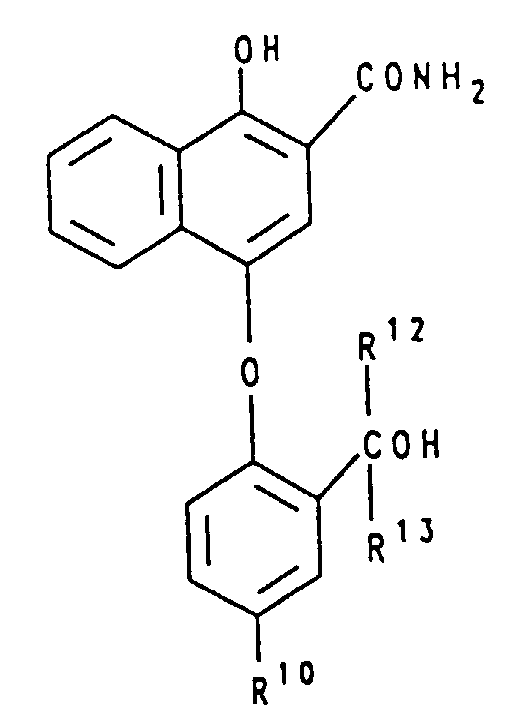 (b) einem Bromieruns- oder Chlorierungsmittel unter Umgebungsbedingungen;wobei man daraufhin
(B) das Produkt von Stufe (A) mit einer unsubstituierten oder substituierten Aryl- oder Alkylaminoverbindung umsetzt;
bei dem man dann
(c) das Produkt von Stufe (B) mit Phosgen umsetzt;
und bei dem man
(d) das Produkt von Stufe (c) mit einer photographisch nützlichen Verbindung umsetzt.
Applications Claiming Priority (2)
| Application Number | Priority Date | Filing Date | Title |
|---|---|---|---|
| US722807 | 1985-04-12 | ||
| US72280791A | 1991-06-28 | 1991-06-28 |
Publications (2)
| Publication Number | Publication Date |
|---|---|
| EP0520498A1 EP0520498A1 (de) | 1992-12-30 |
| EP0520498B1 true EP0520498B1 (de) | 1997-12-17 |
Family
ID=24903471
Family Applications (1)
| Application Number | Title | Priority Date | Filing Date |
|---|---|---|---|
| EP92110838A Expired - Lifetime EP0520498B1 (de) | 1991-06-28 | 1992-06-26 | Verfahren zur Herstellung photographischer Kuppler |
Country Status (3)
| Country | Link |
|---|---|
| EP (1) | EP0520498B1 (de) |
| JP (1) | JPH05188540A (de) |
| DE (1) | DE69223551T2 (de) |
Families Citing this family (1)
| Publication number | Priority date | Publication date | Assignee | Title |
|---|---|---|---|---|
| EP0594256A1 (de) * | 1992-10-20 | 1994-04-27 | Eastman Kodak Company | Photographisches Element und Verfahren zur dessen Herstellung |
Citations (1)
| Publication number | Priority date | Publication date | Assignee | Title |
|---|---|---|---|---|
| US4248962A (en) * | 1977-12-23 | 1981-02-03 | Eastman Kodak Company | Photographic emulsions, elements and processes utilizing release compounds |
Family Cites Families (1)
| Publication number | Priority date | Publication date | Assignee | Title |
|---|---|---|---|---|
| CA2036041A1 (en) * | 1990-02-22 | 1991-08-23 | William James Begley | Photographic material and process comprising wash-out naphtholic coupler |
-
1992
- 1992-06-24 JP JP16613692A patent/JPH05188540A/ja active Pending
- 1992-06-26 EP EP92110838A patent/EP0520498B1/de not_active Expired - Lifetime
- 1992-06-26 DE DE1992623551 patent/DE69223551T2/de not_active Expired - Fee Related
Patent Citations (1)
| Publication number | Priority date | Publication date | Assignee | Title |
|---|---|---|---|---|
| US4248962A (en) * | 1977-12-23 | 1981-02-03 | Eastman Kodak Company | Photographic emulsions, elements and processes utilizing release compounds |
Also Published As
| Publication number | Publication date |
|---|---|
| EP0520498A1 (de) | 1992-12-30 |
| DE69223551D1 (de) | 1998-01-29 |
| JPH05188540A (ja) | 1993-07-30 |
| DE69223551T2 (de) | 1998-06-25 |
Similar Documents
| Publication | Publication Date | Title |
|---|---|---|
| EP0394974B1 (de) | Photographisches Material und Verfahren | |
| EP0347849B1 (de) | Photographisches Aufzeichnungsmaterial für eine beschleunigte Entwicklung | |
| EP0249473B1 (de) | Photographische Acetanilidkuppler und photographische Elemente, die diese enthalten | |
| EP0444501B1 (de) | Photographisches Material und Verfahren, eine Verbindung umfassend, die eine auswaschbare Farbe zu bilden vermag | |
| EP0296794B1 (de) | Fluoreszierende farbstoffliefernde Kupplerverbindung enthaltendes Bildelement | |
| US5151343A (en) | Photographic material and process comprising wash-out naphtholic coupler | |
| JP2774130B2 (ja) | シアン色素生成カプラーを含有する写真材料 | |
| EP0443530B1 (de) | Photographisches Material und Verfahren, das einen auswaschbaren Naphtholkuppler umfasst | |
| EP0477848B1 (de) | Photographische Materialien mit neuen Cyanfarbe erzeugenden Kupplern | |
| US5234800A (en) | Photographic material and process comprising wash-out naphtholic coupler | |
| EP0520496B1 (de) | Photographisches Material sowie Verfahren mit einem Universalkuppler | |
| EP0576088B1 (de) | Photographisches Material und Verfahren, einen Kuppler umfassend, das eine auswaschbare Farbe zu bilden vermag | |
| EP0444502B1 (de) | Photographisches Material und Verfahren | |
| US5352570A (en) | Method and photographic material and process comprising a benzotriazole compound | |
| EP0520498A1 (de) | Verfahren zur Herstellung photographischer Kuppler | |
| EP0577182B1 (de) | Photographisches Material und Verfahren, einen Kuppler umfassend, das einen auswaschbaren Farbstoff zu bilden vermag | |
| EP0594256A1 (de) | Photographisches Element und Verfahren zur dessen Herstellung | |
| EP0523423B1 (de) | Photographisches Silberhalogenidmaterial sowie Verfahren mit in Wasser lösbaren naphtholischen Kupplern | |
| EP0577190B1 (de) | Photographisches Element, das eine bleichbeschleunigende freisetzende Verbindung mit einer säure-solubilisierende Gruppe, enthält | |
| US5286859A (en) | Method of forming a photographic washout coupler (BARC) using a strong base | |
| JPH05224366A (ja) | 現像抑制剤放出化合物含有写真材料 | |
| EP0296793B1 (de) | Farbphotographische Silberhalogenidmaterialien und Verfahren | |
| EP0577191B1 (de) | Photographisches Element und Verfahren, das eine bleichbeschleunigende freisetzende Verbindung umfasst und Verfahrer zur Herstellung dieser | |
| JPH04264444A (ja) | アルキル置換カプラー含有ハロゲン化銀写真材料 | |
| EP0271323A2 (de) | Farbbildender Kuppler und photogaphisches Element, das diesen enthält |
Legal Events
| Date | Code | Title | Description |
|---|---|---|---|
| PUAI | Public reference made under article 153(3) epc to a published international application that has entered the european phase |
Free format text: ORIGINAL CODE: 0009012 |
|
| AK | Designated contracting states |
Kind code of ref document: A1 Designated state(s): AT BE CH DE DK ES FR GB GR IT LI LU MC NL PT SE |
|
| 17P | Request for examination filed |
Effective date: 19930607 |
|
| 17Q | First examination report despatched |
Effective date: 19960729 |
|
| GRAG | Despatch of communication of intention to grant |
Free format text: ORIGINAL CODE: EPIDOS AGRA |
|
| GRAG | Despatch of communication of intention to grant |
Free format text: ORIGINAL CODE: EPIDOS AGRA |
|
| GRAH | Despatch of communication of intention to grant a patent |
Free format text: ORIGINAL CODE: EPIDOS IGRA |
|
| RBV | Designated contracting states (corrected) |
Designated state(s): DE NL |
|
| GRAH | Despatch of communication of intention to grant a patent |
Free format text: ORIGINAL CODE: EPIDOS IGRA |
|
| GRAA | (expected) grant |
Free format text: ORIGINAL CODE: 0009210 |
|
| AK | Designated contracting states |
Kind code of ref document: B1 Designated state(s): DE NL |
|
| REF | Corresponds to: |
Ref document number: 69223551 Country of ref document: DE Date of ref document: 19980129 |
|
| PLBE | No opposition filed within time limit |
Free format text: ORIGINAL CODE: 0009261 |
|
| STAA | Information on the status of an ep patent application or granted ep patent |
Free format text: STATUS: NO OPPOSITION FILED WITHIN TIME LIMIT |
|
| 26N | No opposition filed | ||
| PGFP | Annual fee paid to national office [announced via postgrant information from national office to epo] |
Ref country code: NL Payment date: 20000320 Year of fee payment: 9 |
|
| PGFP | Annual fee paid to national office [announced via postgrant information from national office to epo] |
Ref country code: DE Payment date: 20000630 Year of fee payment: 9 |
|
| PG25 | Lapsed in a contracting state [announced via postgrant information from national office to epo] |
Ref country code: NL Free format text: LAPSE BECAUSE OF NON-PAYMENT OF DUE FEES Effective date: 20020101 |
|
| NLV4 | Nl: lapsed or anulled due to non-payment of the annual fee |
Effective date: 20020101 |
|
| PG25 | Lapsed in a contracting state [announced via postgrant information from national office to epo] |
Ref country code: DE Free format text: LAPSE BECAUSE OF NON-PAYMENT OF DUE FEES Effective date: 20020403 |