EP0520679A2 - Verfahren zur Herstellung eines vorgeformten Verpackungssystems - Google Patents
Verfahren zur Herstellung eines vorgeformten Verpackungssystems Download PDFInfo
- Publication number
- EP0520679A2 EP0520679A2 EP92305577A EP92305577A EP0520679A2 EP 0520679 A2 EP0520679 A2 EP 0520679A2 EP 92305577 A EP92305577 A EP 92305577A EP 92305577 A EP92305577 A EP 92305577A EP 0520679 A2 EP0520679 A2 EP 0520679A2
- Authority
- EP
- European Patent Office
- Prior art keywords
- leads
- plastic
- molding compound
- lead frame
- leadframe
- Prior art date
- Legal status (The legal status is an assumption and is not a legal conclusion. Google has not performed a legal analysis and makes no representation as to the accuracy of the status listed.)
- Ceased
Links
Images

Classifications
-
- H—ELECTRICITY
- H10—SEMICONDUCTOR DEVICES; ELECTRIC SOLID-STATE DEVICES NOT OTHERWISE PROVIDED FOR
- H10W—GENERIC PACKAGES, INTERCONNECTIONS, CONNECTORS OR OTHER CONSTRUCTIONAL DETAILS OF DEVICES COVERED BY CLASS H10
- H10W70/00—Package substrates; Interposers; Redistribution layers [RDL]
- H10W70/40—Leadframes
- H10W70/464—Additional interconnections in combination with leadframes
- H10W70/468—Circuit boards
-
- H—ELECTRICITY
- H10—SEMICONDUCTOR DEVICES; ELECTRIC SOLID-STATE DEVICES NOT OTHERWISE PROVIDED FOR
- H10W—GENERIC PACKAGES, INTERCONNECTIONS, CONNECTORS OR OTHER CONSTRUCTIONAL DETAILS OF DEVICES COVERED BY CLASS H10
- H10W74/00—Encapsulations, e.g. protective coatings
- H10W74/01—Manufacture or treatment
-
- H—ELECTRICITY
- H10—SEMICONDUCTOR DEVICES; ELECTRIC SOLID-STATE DEVICES NOT OTHERWISE PROVIDED FOR
- H10W—GENERIC PACKAGES, INTERCONNECTIONS, CONNECTORS OR OTHER CONSTRUCTIONAL DETAILS OF DEVICES COVERED BY CLASS H10
- H10W76/00—Containers; Fillings or auxiliary members therefor; Seals
- H10W76/10—Containers or parts thereof
- H10W76/12—Containers or parts thereof characterised by their shape
- H10W76/15—Containers comprising an insulating or insulated base
- H10W76/157—Containers comprising an insulating or insulated base having interconnections parallel to the insulating or insulated base
-
- H—ELECTRICITY
- H10—SEMICONDUCTOR DEVICES; ELECTRIC SOLID-STATE DEVICES NOT OTHERWISE PROVIDED FOR
- H10W—GENERIC PACKAGES, INTERCONNECTIONS, CONNECTORS OR OTHER CONSTRUCTIONAL DETAILS OF DEVICES COVERED BY CLASS H10
- H10W72/00—Interconnections or connectors in packages
- H10W72/50—Bond wires
- H10W72/551—Materials of bond wires
- H10W72/552—Materials of bond wires comprising metals or metalloids, e.g. silver
- H10W72/5522—Materials of bond wires comprising metals or metalloids, e.g. silver comprising gold [Au]
-
- H—ELECTRICITY
- H10—SEMICONDUCTOR DEVICES; ELECTRIC SOLID-STATE DEVICES NOT OTHERWISE PROVIDED FOR
- H10W—GENERIC PACKAGES, INTERCONNECTIONS, CONNECTORS OR OTHER CONSTRUCTIONAL DETAILS OF DEVICES COVERED BY CLASS H10
- H10W72/00—Interconnections or connectors in packages
- H10W72/50—Bond wires
- H10W72/551—Materials of bond wires
- H10W72/552—Materials of bond wires comprising metals or metalloids, e.g. silver
- H10W72/5524—Materials of bond wires comprising metals or metalloids, e.g. silver comprising aluminium [Al]
-
- H—ELECTRICITY
- H10—SEMICONDUCTOR DEVICES; ELECTRIC SOLID-STATE DEVICES NOT OTHERWISE PROVIDED FOR
- H10W—GENERIC PACKAGES, INTERCONNECTIONS, CONNECTORS OR OTHER CONSTRUCTIONAL DETAILS OF DEVICES COVERED BY CLASS H10
- H10W74/00—Encapsulations, e.g. protective coatings
Definitions
- This invention relates generally to leadframes for silicon devices and more particularly to a metal leadframe for physically supporting and electrically connecting a silicon device to the larger lead spacings of the next higher level of interconnection such as a printed circuit board.
- Silicon integrated devices because of their small size and fragile nature are frequently embedded in a plastic molding compound and electrically connected to an array of electrical conductors which project beyond the edge of the assemblage.
- the ends of the electrical conductors embedded within the plastic molding compound and located close to the silicon device are known as the inner leads and are connected to bonding pads on the silicon device through fine gold wire bonds.
- the outer ends of the leads which project outward from the edge of the assemblage are shaped to form "J" type leads or "Gull Wing" leads for mounting onto a circuit board.
- the plurality of leads which connect the silicon device to the circuit board is stamped or punched from sheet material and is called a leadframe.
- the leads may be formed by etching because the spacing between the inner leads may be too small to be formed with a punch tool.
- each lead is connected to a bond pad on a silica device by means of a gold or aluminum wire.
- the silicon devices are supported by a ceramic member which, in turn, is physically supported by the inner leads.
- the ends of the inner leads are electrically connected to the silicon device and also provides support for the silicon device.
- One method of forming the final package is by a "post-molding" process.
- the leadframe is entirely encapsulated by a thermoset plastic molding compound.
- Encapsulation normally occurs in a production-size molding tool over a three minute cycle. Of the three minute cycle time, the plastic molding compound flows into the mold in 15 seconds, two minutes is needed to polymerize or cure the plastic; and the remaining time is used to prepare the mold for the next molding cycle.
- the plastic molding compound generates flow-induced stresses on the fragile silicon device, the connecting wires and the leads as it fills the cavity which causes damage and yield loss.
- Another method of packaging electronic devices is that of a pre-molded package.
- a plastic ring or shell is molded around a leadframe, the silicon devices are attached to the leadframe in some fashion, and a lid or cover is attached to seal the package.
- the molding compound does not flow over the silicon devices and wirebonds.
- thermoset material provides enough mass and the thermal shrinkage is uniform enough so as to assure coplanarity of the leads in the final configuration.
- a frame member is molded around the leads initially, the silicon devices or substrate is then attached followed by attachment of a cover.
- the frame is a thin member which must be strong enough to withstand subsequent trim and form operations.
- the plastic is generally a thermoplastic material and due to this type of molding, it can often contain large stresses which can lead to excessive warping. This warpage can often cause unacceptable warpage of the leadframe thus causing difficulty in attaching the leadframe to a printed circuit board.
- This invention is directed towards providing a substantially flat premolded leadframe which minimizes the stresses applied to solder joints and resists cracking and/or breaking during assemblage.
- thermoplastic ring molded onto a leadframe In a pre-molded package assembly, a thermoplastic ring molded onto a leadframe must maintain lead coplanarity.
- a plastic member of liquid crystal polmar is molded onto the leads of a metal leadframe.
- the plastic member is a thermoplastic anisotropic material which, when formed, has a flow direction which is in the long dimension of the plastic member and a transverse direction which is in the short dimension of the plastic member.
- Dam members on the leadframe help contain the plastic molding compound within the mold cavity during the molding process. A puddle gate prevents the formation of a weld line in the plastic member. Upon completion of the molding process, the dam members are excised from the leadframe to provide discrete leads.
- silicon devices packaged in plastic consists of electrical leads which connect small bond pad spaces of the silicon device to larger lead spacings of the next higher level of interconnection such as a printed circuit board.
- One such package is a pre-molded plastic package which contains a silicon device supported by a ceramic member and electrically connected via wire bonds to a leadframe.
- the plastic package usually requires some secondary operations such as a large batch post cure or post polymerization to complete the polymerication reaction.
- the leads of the leadframe are then formed to their final configuration in a trim and form operation.
- Other secondary operations can include writing information on the package; testing; and a burn in test where the device is operated at elevated temperatures and bias to eliminate premature failures.
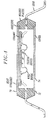
- a silicon device 10 is secured to a ceramic member 12 by thermally conductive epoxy adhesive 14.
- the ceramic member 12 supports conductive paths for making electrical connections from the silicon device to the leads of a lead frame 24.
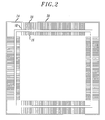
- Fig. 2 illustrates a typical prior art leadframe 24.
- fine wire bonds 16 electrically connect the various bond pads on the silicon device 10 to appropriate conductive paths on the ceramic member 12.
- the conductive paths on the ceramic member 12 are also connected electrically to the inner ends of the various leads 18 of the leadframe 24.
- the ceramic member 12, silicon device 10, wire bands 16 and inner ends of the leads 18 are embedded within a plastic molding compound 20 which provides support and electrical isolation.
- the leads 18 for surface mount packages are normally formed into "J" leads or "gull wing” leads.
- J leads extend under the molded body and conserve area on the circuit board. However, they are difficult to inspect.
- Gull wing leads, such as leads 18 are formed to extend away from the molded body and allow for visual inspection of solder attachments to the printed circuit board. Fine pitch plastic packages typically use gull wing leads when attachment yield is an issue.
- the leadframe 24 can be of a flat sheet of metal such as copper, copper alloy or the like stamped or etched to form a square of a plurality of conductive leads 18 having inner ends 26 and outer ends 28.
- the outer ends 28 are attached to an outer frame support member 30 which holds the various leads 18 in position relative to each other until after the ends 26 of the leads 18 have been connected to the ceramic member 12 and the wire bands 16, and the assemblage has been encapsulated in the plastic molding compound. Following the molding process the outer frame support member 30 is removed from the leads 18; and, the ends 28 of the leads 18 are formed to their final configuration in a trim and form operation.
- the metal leads 18 have a direct effect on the performance characteristics of the device as they provide a path for removing heat from the silicon device.
- the leads are formed from punched or stamped sheet stock. Those which require high interconnection density, such as 164-lead packages and above, are normally formed by etching because the inner lead spacing is too small to be formed with a punching tool.
- Gold or aluminum wires 12 are used to connect the ends 26 of the leads to the band pads on the silicon device.
- the encapsulating material which is a thermoset polymer molding compound, is one of the most important materials in molded plastic packaging.
- the molding polymer is converted from a low-viscosity fluid to a hard plastic during the process. Although it has a softening point, or glass transition temperature, it does not flow after polymerization, even at soldering temperatures, because it has a cross-linked molecular architecture.
- Epoxy is the cross-linkable resin for nearly all commercial molding compounds.
- the formulation consists of a mixture of epoxy resin, hardener, catalyst, fillers, flame retardants, flexiblizers, coupling agents, mold release agents and colorants.
- Important molding compound properties include low viscosity to reduce damage to the fragile assemblies during molding, rapid cure to provide high productivity and low thermal shrinkage forces caused by differences in coefficient of thermal expansion among molding compound, leadframe and the silicon device.
- the molding compound contains about 75 percent by weight of inorganic filler, e.g., ground silicon to lower the coefficient of thermal expansion and increase thermal conductivity. Higher filler loadings achieved through improvements in filler size and size distribution have lowered the coefficient of thermal expansion while reducing the material viscosity.
- inorganic filler e.g., ground silicon
- thermoset molding compounds Almost all post-molded plastic packages are made by a transfer molding process using thermoset molding compounds.
- the assembled leadframe is loaded on the molding tool either manually or with an automated leadframe loader.
- the molding compound is pre-softened by heating it in a dielectric preheater above its glass transition temperature. It is then placed in a cylindrical cavity in the molding tool.
- the operator starts the transfer by beginning the plunger movement that pushes the molding compound out of the transfer pot and into the mold.
- the pressure is increased and the molding compound is packed and further polymerized under a higher applied pressure. Packing is important because the material is porous after filling. Packing compresses both macroscopic and microscopic voids in the molded body, lowers package permeability and eliminates voids where liquid water can collect and promote corrosion.
- the leads are formed.
- the alternative packaging method used for ICs is that of a thermoplastic pre-molded package. Though by utilizing these types of package the wiresweep issue is no longer significant. There are significant issues related to coplanarity which must be maintained within ⁇ .002 inches; that the leadframe should be robust enough to withstand the stresses imposed on it during the assemblage and encapsulation process; and, the lead frame should be capable of withstanding the high temperatures that it experiences during subsequent soldering to the printed circuit board. These temperatures are up to 540°F for exposure of up to ten minutes. Also, during this exposure, the plastic cannot experience any significant warping or change its properties.
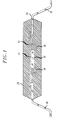
- the leadframe 30 is composed of conductive material such as sheet copper or copper alloy or the like punched, stamped or etched to form leads 32 having an outer support frame member 34, an outer end 36, a first intermediate dam member 38, a second intermediate dam member 40, an intermediate section 44 located between the first and second intermediate dams 38, 40, and an inner end 42.
- a plastic member is formed to encapsulate the center portion 44 of each lead from the first intermediate dam frame member 38 to the second intermediate dam frame member 48 and to completely encircle the inner ends 42 of the leads.
- the frame is of a thermoplastic material rather than a thermoset material which is not very tough and could fracture during the trim and forming operations.
- Thermoplastics differed from thermosets in that they are melted and then forced into a cold mold where they solidify, whereas thermosets are chemically cross-linked in a hot mold. Thermoplastics can be recycled as they can be reheated and remolded whereas thermosets cannot be returned to a liquid state.
- Thermosets typically have much higher in-use temperatures but several new thermoplastics are now available for applications involving temperatures higher than 500°F.
- thermoplastics and other unfilled polymers typically have coefficient of thermal expansions (CTE) of over 100ppm/°C.
- the metal leadframe if of a copper alloy material, has a CTE of about 17 ppm/°C.
- the plastic member which encircles the inner ends of the leads is the structure which provides rigidity and coplanarity to the leads. Warping of the leads, either initially or during assembly of the package, or during attachment to the printed circuit board will prevent the package from being soldered correctly to the printed circuit board.
- the leadframe is located within a mold tool which, depending upon the material that is being molded, is typically at a temperature of between 100°C through 350°F.
- a mold tool which, depending upon the material that is being molded, is typically at a temperature of between 100°C through 350°F.
- the leadframe which is put into the mold tool will be heated and expand.
- the plastic is then injected into the mold and encapsulates the center portions 44 of the leadframe.
- the plastic upon solidification, shrinks and if the shrinkage is not equal to the expansion and subsequent contraction of the leadframe, warpage due to stress may be introduced into the leadframe.
- the design of the plastic member must be such that it does not warp or distort under the influence of residual internal stresses.
- a plastic which gives good results is an anisotropic plastic material such as liquid crystal polymer resin XYDAR ® G-330 liquid crystal polymer resin by Amoco Performance Products, Inc. located in Ridgefield, CT 06877, U.S.A.
- the polymer used is a liquid crystal polymer. It is an anisotropic material which means that its properties are different in different directions. With this material, the gate location in the mold tool determines the flow direction and the transverse direction of the material as it flows across the leadframe in the mold. A high temperature material can result by adding glass and/or minerals to the polymer, which will also lower its Coefficient of Thermal Expansion (CTE).
- CTE Coefficient of Thermal Expansion
- XYDAR ® G-330 is a 30% glass-filled material with a CTE in the flow direction of 7 ppm/°C and a CTE in the transverse direction which is near 100 ppm/°C. It is to be noted that the CTE of a copper leadframe is about 19 ppm. This difference of CTE contributes to the formation of residual stresses in the plastic member and the copper leadframe. The residual stress can be significant when it is realized that the plastic is molded at elevated temperatures and then allowed to cool to room temperature.
- the location of the gate is at a corner of the leadframe and, therefore, it is at a corner of the plastic frame member being formed.
- the die tool is clamped down on and covers the first and second intermediate dam frame members 38, 40.
- the center portions 44 of the leads are located within the mold cavity of the die tool.
- the gate of the die tool through which the plastic enters the die cavity is located at a corner of the die tool and, therefore, at one corner of the leadframe. This causes the plastic to split into two streams as it enters the die cavity. Each stream flows across the center portions of the leads of the near array of leads; make a sharp turn, and flows across the center portions of the leads of the remote array of leads. The two streams meet at the corner of the leadframe which is opposite the corner located at the entrance gate.
- the entrance gate can be positioned to allow plastic to enter on one side or on both sides of the leadframe. In either instance, the flow is balanced and proceeds uniformly along each side of the leadframe because of the presence of the openings 43 between adjacent leads.
- the plastic member formed has a coefficient of expansion along its major dimension, the direction of flow, which is substantially similar to that of the ceramic member 12 which is bonded to the ends of the inner leads. Thus, the stress where the ceramic member is joined to the ends of the leads is reduced.
- the direction across the direction of flow is the transverse direction. This dimension is small and has been found to cause substantially no stress to the solder joints.
- a weld line is weaker than the base material adjacent to the weld line and, therefore, is objectionable as the molded plastic part may fracture at the weld line during the trim and form operation.
- a puddle gate is provided at the last to fill part of the mold cavity. In the embodiment disclosed, a puddle gate is provided at the corner of the leadframe which is opposite the input gate.
- the puddle gate permits a small amount of plastic to flow into a small reservoir which is not a part of the plastic member being formed.
- the weakest point, the weld line is pushed out of the mold cavity and into the puddle gate reservoir which is designed to be broken away from the formed plastic member after molding.
- the cavity area must be sealed to prevent the plastic molding compound from leaking out onto the leads of the leadframe during the molding process.
- This seal is obtained with the first and second dam frame members 38, 40.
- the first and second dam frame members tie the various leads of the leadframe together to provide a flat sealing surface for the mold tool to close against.
- the plastic material encapsulates the center portions 44 of each lead and completely fills the spaces 43 between the center portions 44 of the leads.
- the first and second dam frame members 38, 40 are fully excised between each lead with a shearing tool to provide a lead frame which has discrete leads.
- the outer support frame member 34 is removed from the outer ends 36 of the leads, and the leads are formed to the desired J or gull wing configuration. It is during this operation that the plastic frame which encircles the inner ends of the leads is subjected to large stresses which can cause cracking.
- Fig. 4 there is illustrated across sectional view of an assemblage using a lead frame member having a molded frame which encircles the inner ends of the leads in accordance with the principles of the invention.
- the molded plastic frame which encapsulates portions of the leads can contain an upper step 70 which can accommodate a member for distributing heat; and a lower step 72 which can accommodate a member 74 for protecting the silica device and associated wire bonds.
- the assemblage can be encapsulated, either with or without the member 74 in place to provide an assemblage which is similar to that of Fig. 1.
Landscapes
- Encapsulation Of And Coatings For Semiconductor Or Solid State Devices (AREA)
- Lead Frames For Integrated Circuits (AREA)
- Injection Moulding Of Plastics Or The Like (AREA)
- Structures Or Materials For Encapsulating Or Coating Semiconductor Devices Or Solid State Devices (AREA)
Applications Claiming Priority (2)
| Application Number | Priority Date | Filing Date | Title |
|---|---|---|---|
| US07/722,069 US5213748A (en) | 1991-06-27 | 1991-06-27 | Method of molding a thermoplastic ring onto a leadframe |
| US722069 | 2000-11-24 |
Publications (2)
| Publication Number | Publication Date |
|---|---|
| EP0520679A2 true EP0520679A2 (de) | 1992-12-30 |
| EP0520679A3 EP0520679A3 (en) | 1993-06-16 |
Family
ID=24900399
Family Applications (1)
| Application Number | Title | Priority Date | Filing Date |
|---|---|---|---|
| EP19920305577 Ceased EP0520679A3 (en) | 1991-06-27 | 1992-06-18 | Method of forming a premolded package assembly |
Country Status (3)
| Country | Link |
|---|---|
| US (1) | US5213748A (de) |
| EP (1) | EP0520679A3 (de) |
| JP (1) | JP2558413B2 (de) |
Cited By (5)
| Publication number | Priority date | Publication date | Assignee | Title |
|---|---|---|---|---|
| WO1995000973A1 (en) * | 1993-06-23 | 1995-01-05 | Vlsi Technology, Inc. | Electrically and thermally enhanced package using a separate silicon substrate |
| US5598031A (en) * | 1993-06-23 | 1997-01-28 | Vlsi Technology, Inc. | Electrically and thermally enhanced package using a separate silicon substrate |
| WO1997007540A1 (de) * | 1995-08-19 | 1997-02-27 | Daimler-Benz Aktiengesellschaft | Gehäuse für bauelemente und module der mikroelektronik und verfahren zu seiner herstellung |
| EP0845806A1 (de) * | 1996-11-27 | 1998-06-03 | Texas Instruments Inc. | Verbesserungen in oder hinsichtlich integrierten Schaltungen |
| EP1960203A4 (de) * | 2005-12-05 | 2013-04-10 | Zamtec Ltd | Selbstreferenzierende druckkopfanordnung |
Families Citing this family (16)
| Publication number | Priority date | Publication date | Assignee | Title |
|---|---|---|---|---|
| US5365409A (en) * | 1993-02-20 | 1994-11-15 | Vlsi Technology, Inc. | Integrated circuit package design having an intermediate die-attach substrate bonded to a leadframe |
| US5640746A (en) * | 1995-08-15 | 1997-06-24 | Motorola, Inc. | Method of hermetically encapsulating a crystal oscillator using a thermoplastic shell |
| US5939775A (en) * | 1996-11-05 | 1999-08-17 | Gcb Technologies, Llc | Leadframe structure and process for packaging intergrated circuits |
| US5869883A (en) * | 1997-09-26 | 1999-02-09 | Stanley Wang, President Pantronix Corp. | Packaging of semiconductor circuit in pre-molded plastic package |
| US6022583A (en) * | 1997-12-16 | 2000-02-08 | Nordson Corporation | Method of encapsulating a wire bonded die |
| SG157957A1 (en) * | 2003-01-29 | 2010-01-29 | Interplex Qlp Inc | Package for integrated circuit die |
| DE10352079A1 (de) * | 2003-11-08 | 2005-06-02 | Robert Bosch Gmbh | Elektromotor, sowie Verfahren zur Herstellung eines solchen |
| DE102004050178B3 (de) * | 2004-10-14 | 2006-05-04 | Infineon Technologies Ag | Flip-Chip-Bauelement |
| US20060266446A1 (en) * | 2005-05-25 | 2006-11-30 | Osenbach John W | Whisker-free electronic structures |
| US7465033B2 (en) * | 2005-12-05 | 2008-12-16 | Silverbrook Research Ptv Ltd | Self-referencing printhead assembly |
| US7800207B2 (en) * | 2007-10-17 | 2010-09-21 | Fairchild Semiconductor Corporation | Method for connecting a die attach pad to a lead frame and product thereof |
| US8946875B2 (en) | 2012-01-20 | 2015-02-03 | Intersil Americas LLC | Packaged semiconductor devices including pre-molded lead-frame structures, and related methods and systems |
| US8796052B2 (en) | 2012-02-24 | 2014-08-05 | Intersil Americas LLC | Optoelectronic apparatuses with post-molded reflector cups and methods for manufacturing the same |
| JP6508036B2 (ja) * | 2015-12-24 | 2019-05-08 | 株式会社デンソー | 回路基板 |
| CN109427698B (zh) | 2017-09-04 | 2023-08-29 | 恩智浦美国有限公司 | 组装qfp型半导体器件的方法 |
| CN114141637B (zh) * | 2021-12-01 | 2025-07-29 | 甬矽电子(宁波)股份有限公司 | 扇出型芯片封装方法和扇出型芯片封装结构 |
Family Cites Families (13)
| Publication number | Priority date | Publication date | Assignee | Title |
|---|---|---|---|---|
| US3341647A (en) * | 1963-10-14 | 1967-09-12 | Federal Mogul Corp | Method and apparatus for making dual-lip seals |
| US4195193A (en) * | 1979-02-23 | 1980-03-25 | Amp Incorporated | Lead frame and chip carrier housing |
| JPS5932139A (ja) * | 1982-08-18 | 1984-02-21 | Toshiba Corp | 半導体樹脂封止用金型 |
| US4632798A (en) * | 1983-07-27 | 1986-12-30 | Celanese Corporation | Encapsulation of electronic components with anisotropic thermoplastic polymers |
| JPS62500338A (ja) * | 1984-09-27 | 1987-02-05 | モトロ−ラ・インコ−ポレ−テッド | 支持リ−ドの改良された構造をもつリ−ドフレ−ムおよびこれを用いる半導体装置 |
| US4873615A (en) * | 1986-10-09 | 1989-10-10 | Amp Incorporated | Semiconductor chip carrier system |
| US4778635A (en) * | 1987-09-18 | 1988-10-18 | American Telephone And Telegraph Company | Method and apparatus for fabricating anisotropically conductive material |
| US4859632A (en) * | 1987-12-28 | 1989-08-22 | Siemens Corporate Research And Support, Inc. | Method for manufacturing the same |
| US4837184A (en) * | 1988-01-04 | 1989-06-06 | Motorola Inc. | Process of making an electronic device package with peripheral carrier structure of low-cost plastic |
| JPH01226170A (ja) * | 1988-03-07 | 1989-09-08 | Fuji Electric Co Ltd | 中空パッケージ型半導体装置の組立方法 |
| JP2893085B2 (ja) * | 1988-10-18 | 1999-05-17 | トーワ株式会社 | 電子部品の樹脂封止成形方法及び装置 |
| JPH02133932A (ja) * | 1988-11-14 | 1990-05-23 | Polyplastics Co | プレモールドパッケージとその製造方法 |
| JPH0395258A (ja) * | 1989-09-08 | 1991-04-19 | Tosoh Corp | 芳香族ポリエステル樹脂組成物 |
-
1991
- 1991-06-27 US US07/722,069 patent/US5213748A/en not_active Expired - Fee Related
-
1992
- 1992-06-18 EP EP19920305577 patent/EP0520679A3/en not_active Ceased
- 1992-06-24 JP JP4188870A patent/JP2558413B2/ja not_active Expired - Fee Related
Cited By (6)
| Publication number | Priority date | Publication date | Assignee | Title |
|---|---|---|---|---|
| WO1995000973A1 (en) * | 1993-06-23 | 1995-01-05 | Vlsi Technology, Inc. | Electrically and thermally enhanced package using a separate silicon substrate |
| US5598031A (en) * | 1993-06-23 | 1997-01-28 | Vlsi Technology, Inc. | Electrically and thermally enhanced package using a separate silicon substrate |
| WO1997007540A1 (de) * | 1995-08-19 | 1997-02-27 | Daimler-Benz Aktiengesellschaft | Gehäuse für bauelemente und module der mikroelektronik und verfahren zu seiner herstellung |
| EP0845806A1 (de) * | 1996-11-27 | 1998-06-03 | Texas Instruments Inc. | Verbesserungen in oder hinsichtlich integrierten Schaltungen |
| US5894173A (en) * | 1996-11-27 | 1999-04-13 | Texas Instruments Incorporated | Stress relief matrix for integrated circuit packaging |
| EP1960203A4 (de) * | 2005-12-05 | 2013-04-10 | Zamtec Ltd | Selbstreferenzierende druckkopfanordnung |
Also Published As
| Publication number | Publication date |
|---|---|
| JPH06252316A (ja) | 1994-09-09 |
| JP2558413B2 (ja) | 1996-11-27 |
| US5213748A (en) | 1993-05-25 |
| EP0520679A3 (en) | 1993-06-16 |
Similar Documents
| Publication | Publication Date | Title |
|---|---|---|
| US5213748A (en) | Method of molding a thermoplastic ring onto a leadframe | |
| US5172213A (en) | Molded circuit package having heat dissipating post | |
| KR100806479B1 (ko) | 반도체 장치 및 그 제조 방법 | |
| US6288444B1 (en) | Semiconductor device and method of producing the same | |
| US5136366A (en) | Overmolded semiconductor package with anchoring means | |
| KR100435051B1 (ko) | 반도체장치, 반도체장치의 제조방법, 수지밀봉금형 및 반도체 제조시스템 | |
| US6114192A (en) | Method of manufacturing a semiconductor device having a ball grid array package structure using a supporting frame | |
| US6777268B2 (en) | Method of fabricating tape attachment chip-on-board assemblies | |
| US5441918A (en) | Method of making integrated circuit die package | |
| CA2086825A1 (en) | Arrangement for encasing a functional device, and a process for the production of same | |
| KR20000006304A (ko) | 반도체장치및그제조방법 | |
| US5821628A (en) | Semiconductor device and two-layer lead frame for it | |
| KR20010066939A (ko) | 반도체 장치 및 그 제조 방법 | |
| KR101398404B1 (ko) | 기계적으로 분리된 리드 부착물을 갖는 플라스틱오버몰딩된 패키지들 | |
| JPH0595079A (ja) | リードフレーム、半導体集積回路搭載用基板及び半導体装置並びにそれらの製造方法 | |
| KR20040045045A (ko) | 반도체장치 | |
| WO1998008251A1 (en) | Semiconductor and method for manufacturing the same | |
| JP2001504273A (ja) | 改良されたリードフレーム構造および集積回路のパッケージ方法 | |
| JP2004530307A (ja) | チップのリードフレーム | |
| JP2004311748A (ja) | 樹脂封止型半導体装置およびその製造方法ならびに成形型 | |
| JP3281859B2 (ja) | 混成集積回路装置の製造方法 | |
| KR960007277B1 (ko) | 평형 런너를 갖는 이송 주형 | |
| EP0430204B1 (de) | Kunststoffumhüllte Halbleiteranordnung | |
| JP3550100B2 (ja) | 自動車用電子回路装置及びそのパッケージ製造方法 | |
| US5759875A (en) | Reduced filler particle size encapsulant for reduction in die surface damage in LOC packages and method of use |
Legal Events
| Date | Code | Title | Description |
|---|---|---|---|
| PUAI | Public reference made under article 153(3) epc to a published international application that has entered the european phase |
Free format text: ORIGINAL CODE: 0009012 |
|
| AK | Designated contracting states |
Kind code of ref document: A2 Designated state(s): DE FR GB NL |
|
| PUAL | Search report despatched |
Free format text: ORIGINAL CODE: 0009013 |
|
| AK | Designated contracting states |
Kind code of ref document: A3 Designated state(s): DE FR GB NL |
|
| 17P | Request for examination filed |
Effective date: 19931202 |
|
| RAP3 | Party data changed (applicant data changed or rights of an application transferred) |
Owner name: AT&T CORP. |
|
| 17Q | First examination report despatched |
Effective date: 19950906 |
|
| STAA | Information on the status of an ep patent application or granted ep patent |
Free format text: STATUS: THE APPLICATION HAS BEEN REFUSED |
|
| 18R | Application refused |
Effective date: 19970403 |