EP0520698A2 - Procédé de déshydratation de boues par électro-osmose - Google Patents
Procédé de déshydratation de boues par électro-osmose Download PDFInfo
- Publication number
- EP0520698A2 EP0520698A2 EP92305637A EP92305637A EP0520698A2 EP 0520698 A2 EP0520698 A2 EP 0520698A2 EP 92305637 A EP92305637 A EP 92305637A EP 92305637 A EP92305637 A EP 92305637A EP 0520698 A2 EP0520698 A2 EP 0520698A2
- Authority
- EP
- European Patent Office
- Prior art keywords
- sludge
- aluminum salt
- dehydrator
- electroosmotically
- dehydration
- Prior art date
- Legal status (The legal status is an assumption and is not a legal conclusion. Google has not performed a legal analysis and makes no representation as to the accuracy of the status listed.)
- Granted
Links
Images

Classifications
-
- B—PERFORMING OPERATIONS; TRANSPORTING
- B01—PHYSICAL OR CHEMICAL PROCESSES OR APPARATUS IN GENERAL
- B01D—SEPARATION
- B01D61/00—Processes of separation using semi-permeable membranes, e.g. dialysis, osmosis or ultrafiltration; Apparatus, accessories or auxiliary operations specially adapted therefor
- B01D61/42—Electrodialysis; Electro-osmosis ; Electro-ultrafiltration; Membrane capacitive deionization
- B01D61/56—Electro-osmotic dewatering
-
- C—CHEMISTRY; METALLURGY
- C02—TREATMENT OF WATER, WASTE WATER, SEWAGE, OR SLUDGE
- C02F—TREATMENT OF WATER, WASTE WATER, SEWAGE, OR SLUDGE
- C02F1/00—Treatment of water, waste water, or sewage
- C02F1/52—Treatment of water, waste water, or sewage by flocculation or precipitation of suspended impurities
- C02F1/5236—Treatment of water, waste water, or sewage by flocculation or precipitation of suspended impurities using inorganic agents
- C02F1/5245—Treatment of water, waste water, or sewage by flocculation or precipitation of suspended impurities using inorganic agents using basic salts, e.g. of aluminium and iron
-
- C—CHEMISTRY; METALLURGY
- C02—TREATMENT OF WATER, WASTE WATER, SEWAGE, OR SLUDGE
- C02F—TREATMENT OF WATER, WASTE WATER, SEWAGE, OR SLUDGE
- C02F11/00—Treatment of sludge; Devices therefor
- C02F11/12—Treatment of sludge; Devices therefor by de-watering, drying or thickening
-
- C—CHEMISTRY; METALLURGY
- C02—TREATMENT OF WATER, WASTE WATER, SEWAGE, OR SLUDGE
- C02F—TREATMENT OF WATER, WASTE WATER, SEWAGE, OR SLUDGE
- C02F11/00—Treatment of sludge; Devices therefor
- C02F11/12—Treatment of sludge; Devices therefor by de-watering, drying or thickening
- C02F11/15—Treatment of sludge; Devices therefor by de-watering, drying or thickening by treatment with electric, magnetic or electromagnetic fields; by treatment with ultrasonic waves
Definitions
- This invention relates to a method of electroosmotically dehydrating sludge produced in processing service water, sewage or various types of industrial sewage. More particularly, the invention relates to such a method using a filter press.
- the particles of sludge contained in service water sludge and sewage sludge, for example, are electrically negatively charged, while the water contained in the sludge is positively charged.
- electroosmotic dehydration the water contained in sludge moves electroosmotically toward a cathode, and the salt contained in the sludge is electrolyzed, so that the filtrate is acid on the anode side and alkaline on the cathode side.
- metal ions precipitate as insoluble metal hydroxide on the alkaline side, and the precipitate sticks to the electrode surfaces and filter cloths on the cathode side and disadvantageously affects the electroosmotic dehydration. This can be prevented by a method of reversing the polarity of the electrodes for a few minutes at the last step, or for every several batches, of electroosmotic dehydration, in order for the acid filtrate to dissolve and remove the precipitate.
- This invention is characterized by electroosmotic dehydration with aluminum salt added to sludge to reduce the clogging of the filter cloths of the dehydrator, and to improve the cake release.
- the aluminum salt is preferably polyaluminum chloride.
- the aluminum hydroxide is dissolved again when the filtrate pH is 10 or higher and discharged with the filtrate, thus reducing the precipitate on the cathode side and preventing the clogging of filter cloths on this side.
- Figs. 1a, 1b and 1c are schematic partial views in cross section of a pressurized electroosmotic dehydrator, showing steps of prior art sludge dehydration;
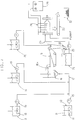
- Fig. 2 is a flow diagram of a sludge dehydration process according to the invention.
- sludge 9 to be dehydrated is fed into a sludge tank 10 and stirred in it by a rotatable paddle or propeller 11. Similar stirrers are provided in other tanks of the system.
- Perlite is mixed by a paddle 13 with water in a separate perlite tank 12. Perlite is added to the sludge to facilitate the dehydration of the sludge and the release of the resultant cake from the filter cloths of a pressurized electroosmotic dehydrator, as will be explained later.
- Polyalkylmetacrylate as polymer is mixed with water in a polymer tank 14. Polymer is added to the sludge to coagulate the sludge into flocks to facilitate the succeeding screening of the sludge.
- the sludge, the dilute perlite and the polymer are pumped by pumps to a common line 17 and to a coagulating and mixing tank 16, where they are mixed together and the sludge is coagulated.
- the coagulated sludge is fed through a conduit 16a to a predehydrator 18, where it is screened in order to concentrate it.
- Polyaluminum chloride as aluminum salt is stirred in a "PAC" tank 20.
- the aluminum salt is pumped to a mixer 22 along with the screened sludge from the predehydrator screen 18, and in which the sludge and aluminum salt are mixed together by a paddle 23.
- the mixed sludge is fed to a concentrated sludge tank 24, from which it is pumped through a line 25 to a pressurized electroosmotic dehydrator 26.
- the dehydrator 26 has a construction substantially as described in U.S. patent No. 5,034,111 dated July 23, 1991 to Kondo et al. and illustrated in Figs. 1a, 1b and 1c herein.
- the dehydrator 26 is connected to a DC power source 28.
- the sludge cake is discharged from the dehydrator 26 onto a conveyor 30, which conveys it to a cake container 32.
- the dehydrator 26 processes the sludge substantially in the same manner as by the conventional process shown in Figs. 1a - 1c.
- the sludge C is forced through the feed bores 6 into the closed space formed between the press plates 2a and 2b and surrounded by the two filter cloths 3, and it is dehydrated by the squeezing pressure.
- the filtrate is discharged from the machine through the discharge bores 7.
- the mixed sludge initially had a concentration of 3.42 wt.% and 34,200 mg/l of suspended solids.
- the mixed sludge was mixed with perlite having a concentration of 5 wt.% in an amount of 15.37 wt.% of the total solids of the sludge, and with polyalkylmetacrylate having a concentration of 0.2 wt.% in an amount of 0.52 wt.% of the total sludge solids.
- the pressure for squeezing the sludge into the dehydrator 26 was 4 kg/cm2.
- the pressure by each pressurized diaphragm of this dehydrator was 4 kg/cm2.
- the DC voltage between the electrodes was 40 V.
- the electrode plate on each diaphragm was the anode.
- the filtering speed was 1.23 kgDS/m2h (DS: dry solids).
- the consumed electric energy was 0.88 kWh/kgDS.
- the mixed sludge mixed with the perlite and polymer was further mixed with polyaluminum chloride having a concentration of 10 wt.% in an amount of 1.11 wt.% of the total sludge solids.
- the filtering speed was 2.34 kgDS/m2h, which is much higher than in Example 1.
- the consumed electric energy was 0.43 kWh/kgDS, which is much lower than in Example 1.
- the cake release was much better than in Example 1.
- the amount of added polyaluminum chloride should be 0.7 - 1.5 wt.%. For raw sludge only, this amount should be 0.3 - 1.0 wt.%. For excess activated sludge only, this amount should be 1.0 - 2.0 wt.%.
- aluminum sulfate although it is aluminum salt, is not desirable if the electrodes are carbonaceous, because it causes corrosion. Also, any metal salt (such as iron salt) other than aluminum salt is not effective because the hydroxide is not dissolved again on the alkaline side.
- the addition of aluminum salt to sludge reduces considerably the blinding or clogging of the filter cloths, improves the filtration, saves the amount of consumed electric power and improves the cake release. This stabilizes the dehydration for a long time, in combination with the polarity reversal of the electrode plates to dissolve and remove precipitate on the electrode surfaces.
Landscapes
- Chemical & Material Sciences (AREA)
- Water Supply & Treatment (AREA)
- Engineering & Computer Science (AREA)
- Hydrology & Water Resources (AREA)
- Life Sciences & Earth Sciences (AREA)
- Environmental & Geological Engineering (AREA)
- Organic Chemistry (AREA)
- Inorganic Chemistry (AREA)
- Physics & Mathematics (AREA)
- Electromagnetism (AREA)
- Health & Medical Sciences (AREA)
- Urology & Nephrology (AREA)
- Chemical Kinetics & Catalysis (AREA)
- Treatment Of Sludge (AREA)
- Separation Using Semi-Permeable Membranes (AREA)
Applications Claiming Priority (2)
| Application Number | Priority Date | Filing Date | Title |
|---|---|---|---|
| JP3154539A JP2716600B2 (ja) | 1991-06-26 | 1991-06-26 | 汚泥の電気浸透脱水方法 |
| JP154539/91 | 1991-06-26 |
Publications (3)
| Publication Number | Publication Date |
|---|---|
| EP0520698A2 true EP0520698A2 (fr) | 1992-12-30 |
| EP0520698A3 EP0520698A3 (en) | 1993-03-17 |
| EP0520698B1 EP0520698B1 (fr) | 1996-08-14 |
Family
ID=15586472
Family Applications (1)
| Application Number | Title | Priority Date | Filing Date |
|---|---|---|---|
| EP92305637A Expired - Lifetime EP0520698B1 (fr) | 1991-06-26 | 1992-06-19 | Procédé de déshydratation de boues par électro-osmose |
Country Status (5)
| Country | Link |
|---|---|
| US (1) | US5279718A (fr) |
| EP (1) | EP0520698B1 (fr) |
| JP (1) | JP2716600B2 (fr) |
| DE (1) | DE69212731T2 (fr) |
| SG (1) | SG44588A1 (fr) |
Cited By (2)
| Publication number | Priority date | Publication date | Assignee | Title |
|---|---|---|---|---|
| WO2010143003A1 (fr) * | 2009-06-09 | 2010-12-16 | Palhazy Istvan | Équipement et procédé pour la production continue de combustible à partir de boues d'épuration |
| WO2016135422A1 (fr) * | 2015-02-26 | 2016-09-01 | Veolia Water Solutions & Technologies Support | Procede de deshydratation de boues |
Families Citing this family (7)
| Publication number | Priority date | Publication date | Assignee | Title |
|---|---|---|---|---|
| AUPN483495A0 (en) * | 1995-08-16 | 1995-09-07 | Commonwealth Scientific And Industrial Research Organisation | Dewatering of sludges |
| US6982431B2 (en) * | 1998-08-31 | 2006-01-03 | Molecular Devices Corporation | Sample analysis systems |
| CN101472669A (zh) * | 2006-06-14 | 2009-07-01 | 艾尔科泰克技术公司 | 用于处理和/或提高物质干燥度的方法和设备 |
| KR101045151B1 (ko) * | 2011-02-11 | 2011-06-30 | 주식회사 화인 | 슬러지의 원활한 투입 및 처리가 가능한 전기영동식 전기 침투 탈수기 |
| CN105800891B (zh) * | 2016-05-15 | 2019-03-26 | 中国计量大学 | 电渗透与机械压滤耦合的污水污泥脱水方法 |
| CN110183061B (zh) * | 2019-06-25 | 2024-08-20 | 青岛颐辰环保有限公司 | 一种基于氧化沟的利用内碳源脱氮除磷污水处理系统及方法 |
| CN113332768A (zh) * | 2021-06-07 | 2021-09-03 | 深圳市创裕达电子有限公司 | 一种用于泥浆电渗脱水的过滤袋及其制备方法 |
Family Cites Families (12)
| Publication number | Priority date | Publication date | Assignee | Title |
|---|---|---|---|---|
| FR449358A (fr) * | 1912-07-17 | 1913-02-25 | Gesellschaft Fuer Elektro-Osmose M B H | Procédé de deshydratation électro-osmotique sous-pression des substances végétales, animales ou minérales |
| JPS5117345B2 (fr) * | 1972-10-24 | 1976-06-01 | ||
| US4118319A (en) * | 1976-03-11 | 1978-10-03 | Toyo Soda Manufacturing Co., Ltd. | Treatment of sludge |
| US4201668A (en) * | 1976-05-18 | 1980-05-06 | Toyo Soda Manufacturing Co. Ltd. | Treatment of sludge comprising biological aggregate |
| DE2839386A1 (de) * | 1977-09-12 | 1979-04-05 | Hokuren | Verfahren zum behandeln naehrstoffreicher abwasser |
| JPS5528715A (en) * | 1978-08-19 | 1980-02-29 | Ishigaki Kiko Kk | Dehydration method of digested sludge |
| JPS58122085A (ja) * | 1982-01-13 | 1983-07-20 | Mitsubishi Heavy Ind Ltd | 脱水方法 |
| JPS6485198A (en) * | 1987-09-28 | 1989-03-30 | Ishigaki Mech Ind | Method and apparatus for electrolytic treatment of sludge |
| JPS6490100A (en) * | 1987-10-01 | 1989-04-05 | Kurita Water Ind Ltd | Method for dehydrating sludge |
| EP0384081B1 (fr) * | 1988-12-28 | 1993-11-03 | Shinko Pantec Co., Ltd. | Appareil de deshydratation par électro-osmose et compression |
| JPH06239B2 (ja) * | 1988-12-29 | 1994-01-05 | 栗田工業株式会社 | 有機性汚泥の脱水方法 |
| US5092974A (en) * | 1990-01-25 | 1992-03-03 | Shinko Pantec Co., Ltd. | Electrode and method for compressive and electro-osmotic dehydration |
-
1991
- 1991-06-26 JP JP3154539A patent/JP2716600B2/ja not_active Expired - Fee Related
-
1992
- 1992-05-22 US US07/887,296 patent/US5279718A/en not_active Expired - Fee Related
- 1992-06-19 SG SG1996003231A patent/SG44588A1/en unknown
- 1992-06-19 DE DE69212731T patent/DE69212731T2/de not_active Expired - Fee Related
- 1992-06-19 EP EP92305637A patent/EP0520698B1/fr not_active Expired - Lifetime
Cited By (3)
| Publication number | Priority date | Publication date | Assignee | Title |
|---|---|---|---|---|
| WO2010143003A1 (fr) * | 2009-06-09 | 2010-12-16 | Palhazy Istvan | Équipement et procédé pour la production continue de combustible à partir de boues d'épuration |
| WO2016135422A1 (fr) * | 2015-02-26 | 2016-09-01 | Veolia Water Solutions & Technologies Support | Procede de deshydratation de boues |
| FR3033164A1 (fr) * | 2015-02-26 | 2016-09-02 | Veolia Water Solutions & Tech | Procede de deshydratation de boues |
Also Published As
| Publication number | Publication date |
|---|---|
| EP0520698A3 (en) | 1993-03-17 |
| DE69212731D1 (de) | 1996-09-19 |
| US5279718A (en) | 1994-01-18 |
| EP0520698B1 (fr) | 1996-08-14 |
| JPH054100A (ja) | 1993-01-14 |
| JP2716600B2 (ja) | 1998-02-18 |
| SG44588A1 (en) | 1997-12-19 |
| DE69212731T2 (de) | 1996-12-05 |
Similar Documents
| Publication | Publication Date | Title |
|---|---|---|
| US3959133A (en) | Alum recovery and waste disposal in water treatment | |
| US4411797A (en) | Dewatering of sewage sludges on chamber filter presses | |
| US3578586A (en) | Treatiment of slurries | |
| US4105558A (en) | Apparatus for draining of muddy liquids | |
| Al-Malack et al. | Coagulation-crossflow microfiltration of domestic wastewater | |
| US4792406A (en) | Method for dewatering a slurry using a twin belt press with cationic amine salts | |
| US20100140181A1 (en) | Regeneration of used cleaning solution | |
| US5279718A (en) | Method of electroosmotically dehydrating sludge | |
| CN114904897B (zh) | 一种碱渣制备工程土的方法 | |
| US4812234A (en) | Oil sludge conditioning equipment | |
| US4728437A (en) | Treatment and disposal of wastewaters containing carbon black and ash | |
| JP2620749B2 (ja) | 汚泥処理方法 | |
| CN102241447A (zh) | 一种分离含锰废水中钙、镁离子的工艺方法 | |
| KR100547496B1 (ko) | 불소 함유 폐액의 처리 방법 및 장치 | |
| CA1164111A (fr) | Dispositif de conditionnement chimique des boues | |
| JPH09155396A (ja) | 汚泥処理におけるアルミニウム回収方法 | |
| EP1483032A1 (fr) | Procede de filtration continu d'une saumure brute destinee a etre utilisee dans l'electrolyse chlore-alcali | |
| US4639300A (en) | Method and apparatus for electrofiltration | |
| JPH0731999A (ja) | 汚泥脱水法 | |
| CN117735792B (zh) | 一种聚四氟乙烯分散树脂废水的处理系统及处理方法 | |
| JPH06343999A (ja) | 汚泥の脱水方法 | |
| CN223716473U (zh) | 一种污泥脱水及滤液循环回收装置 | |
| CN220845888U (zh) | 一种污泥脱水处理系统 | |
| JPH0880488A (ja) | 有機性汚水の高度処理方法 | |
| JPS61293600A (ja) | スクリユ−プレスによる汚泥脱水方法 |
Legal Events
| Date | Code | Title | Description |
|---|---|---|---|
| PUAI | Public reference made under article 153(3) epc to a published international application that has entered the european phase |
Free format text: ORIGINAL CODE: 0009012 |
|
| AK | Designated contracting states |
Kind code of ref document: A2 Designated state(s): CH DE FR GB IT LI NL SE |
|
| PUAL | Search report despatched |
Free format text: ORIGINAL CODE: 0009013 |
|
| AK | Designated contracting states |
Kind code of ref document: A3 Designated state(s): CH DE FR GB IT LI NL SE |
|
| 17P | Request for examination filed |
Effective date: 19930505 |
|
| 17Q | First examination report despatched |
Effective date: 19940317 |
|
| GRAH | Despatch of communication of intention to grant a patent |
Free format text: ORIGINAL CODE: EPIDOS IGRA |
|
| GRAH | Despatch of communication of intention to grant a patent |
Free format text: ORIGINAL CODE: EPIDOS IGRA |
|
| GRAA | (expected) grant |
Free format text: ORIGINAL CODE: 0009210 |
|
| AK | Designated contracting states |
Kind code of ref document: B1 Designated state(s): CH DE FR GB IT LI NL SE |
|
| REG | Reference to a national code |
Ref country code: CH Ref legal event code: NV Representative=s name: TROESCH SCHEIDEGGER WERNER AG |
|
| REF | Corresponds to: |
Ref document number: 69212731 Country of ref document: DE Date of ref document: 19960919 |
|
| ET | Fr: translation filed | ||
| ITF | It: translation for a ep patent filed | ||
| PLBE | No opposition filed within time limit |
Free format text: ORIGINAL CODE: 0009261 |
|
| STAA | Information on the status of an ep patent application or granted ep patent |
Free format text: STATUS: NO OPPOSITION FILED WITHIN TIME LIMIT |
|
| 26N | No opposition filed | ||
| PGFP | Annual fee paid to national office [announced via postgrant information from national office to epo] |
Ref country code: SE Payment date: 19990607 Year of fee payment: 8 |
|
| PGFP | Annual fee paid to national office [announced via postgrant information from national office to epo] |
Ref country code: FR Payment date: 19990610 Year of fee payment: 8 |
|
| PGFP | Annual fee paid to national office [announced via postgrant information from national office to epo] |
Ref country code: GB Payment date: 19990616 Year of fee payment: 8 |
|
| PGFP | Annual fee paid to national office [announced via postgrant information from national office to epo] |
Ref country code: DE Payment date: 19990618 Year of fee payment: 8 |
|
| PGFP | Annual fee paid to national office [announced via postgrant information from national office to epo] |
Ref country code: NL Payment date: 19990628 Year of fee payment: 8 Ref country code: CH Payment date: 19990628 Year of fee payment: 8 |
|
| PG25 | Lapsed in a contracting state [announced via postgrant information from national office to epo] |
Ref country code: GB Free format text: LAPSE BECAUSE OF NON-PAYMENT OF DUE FEES Effective date: 20000619 |
|
| PG25 | Lapsed in a contracting state [announced via postgrant information from national office to epo] |
Ref country code: SE Free format text: LAPSE BECAUSE OF NON-PAYMENT OF DUE FEES Effective date: 20000620 |
|
| PG25 | Lapsed in a contracting state [announced via postgrant information from national office to epo] |
Ref country code: LI Free format text: LAPSE BECAUSE OF NON-PAYMENT OF DUE FEES Effective date: 20000630 Ref country code: CH Free format text: LAPSE BECAUSE OF NON-PAYMENT OF DUE FEES Effective date: 20000630 |
|
| PG25 | Lapsed in a contracting state [announced via postgrant information from national office to epo] |
Ref country code: NL Free format text: LAPSE BECAUSE OF NON-PAYMENT OF DUE FEES Effective date: 20010101 |
|
| GBPC | Gb: european patent ceased through non-payment of renewal fee |
Effective date: 20000619 |
|
| REG | Reference to a national code |
Ref country code: CH Ref legal event code: PL |
|
| EUG | Se: european patent has lapsed |
Ref document number: 92305637.8 |
|
| PG25 | Lapsed in a contracting state [announced via postgrant information from national office to epo] |
Ref country code: FR Free format text: LAPSE BECAUSE OF NON-PAYMENT OF DUE FEES Effective date: 20010228 |
|
| NLV4 | Nl: lapsed or anulled due to non-payment of the annual fee |
Effective date: 20010101 |
|
| REG | Reference to a national code |
Ref country code: FR Ref legal event code: ST |
|
| PG25 | Lapsed in a contracting state [announced via postgrant information from national office to epo] |
Ref country code: DE Free format text: LAPSE BECAUSE OF NON-PAYMENT OF DUE FEES Effective date: 20010403 |
|
| PG25 | Lapsed in a contracting state [announced via postgrant information from national office to epo] |
Ref country code: IT Free format text: LAPSE BECAUSE OF NON-PAYMENT OF DUE FEES Effective date: 20050619 |