EP0524372B1 - Composés azoiques, encres les contenant et méthode et instrument d'enregistrement les utilisant - Google Patents
Composés azoiques, encres les contenant et méthode et instrument d'enregistrement les utilisant Download PDFInfo
- Publication number
- EP0524372B1 EP0524372B1 EP92105478A EP92105478A EP0524372B1 EP 0524372 B1 EP0524372 B1 EP 0524372B1 EP 92105478 A EP92105478 A EP 92105478A EP 92105478 A EP92105478 A EP 92105478A EP 0524372 B1 EP0524372 B1 EP 0524372B1
- Authority
- EP
- European Patent Office
- Prior art keywords
- ink
- recording
- group
- jet recording
- carbon atoms
- Prior art date
- Legal status (The legal status is an assumption and is not a legal conclusion. Google has not performed a legal analysis and makes no representation as to the accuracy of the status listed.)
- Expired - Lifetime
Links
- 239000000976 ink Substances 0.000 title claims description 152
- 238000000034 method Methods 0.000 title claims description 20
- QGZKDVFQNNGYKY-UHFFFAOYSA-O Ammonium Chemical compound [NH4+] QGZKDVFQNNGYKY-UHFFFAOYSA-O 0.000 claims abstract description 31
- -1 azo compound Chemical class 0.000 claims abstract description 25
- 150000001875 compounds Chemical class 0.000 claims abstract description 23
- 125000004432 carbon atom Chemical group C* 0.000 claims abstract description 20
- 125000000217 alkyl group Chemical group 0.000 claims abstract description 18
- 229910052783 alkali metal Inorganic materials 0.000 claims abstract description 16
- 150000001340 alkali metals Chemical group 0.000 claims abstract description 16
- 125000004429 atom Chemical group 0.000 claims abstract description 9
- 125000005843 halogen group Chemical group 0.000 claims abstract description 9
- 125000004435 hydrogen atom Chemical group [H]* 0.000 claims abstract description 9
- 125000000956 methoxy group Chemical group [H]C([H])([H])O* 0.000 claims abstract description 9
- XLYOFNOQVPJJNP-UHFFFAOYSA-N water Substances O XLYOFNOQVPJJNP-UHFFFAOYSA-N 0.000 claims description 53
- 239000003795 chemical substances by application Substances 0.000 claims description 18
- 239000000463 material Substances 0.000 claims description 16
- 239000000203 mixture Substances 0.000 claims description 16
- MTHSVFCYNBDYFN-UHFFFAOYSA-N diethylene glycol Chemical compound OCCOCCO MTHSVFCYNBDYFN-UHFFFAOYSA-N 0.000 claims description 14
- LYCAIKOWRPUZTN-UHFFFAOYSA-N Ethylene glycol Chemical compound OCCO LYCAIKOWRPUZTN-UHFFFAOYSA-N 0.000 claims description 13
- 239000003960 organic solvent Substances 0.000 claims description 10
- KFZMGEQAYNKOFK-UHFFFAOYSA-N Isopropanol Chemical compound CC(C)O KFZMGEQAYNKOFK-UHFFFAOYSA-N 0.000 claims description 9
- 239000007788 liquid Substances 0.000 claims description 8
- YODZTKMDCQEPHD-UHFFFAOYSA-N thiodiglycol Chemical compound OCCSCCO YODZTKMDCQEPHD-UHFFFAOYSA-N 0.000 claims description 5
- 229950006389 thiodiglycol Drugs 0.000 claims description 5
- GSEJCLTVZPLZKY-UHFFFAOYSA-N Triethanolamine Chemical compound OCCN(CCO)CCO GSEJCLTVZPLZKY-UHFFFAOYSA-N 0.000 claims description 3
- 239000012046 mixed solvent Substances 0.000 claims description 2
- 229920000098 polyolefin Polymers 0.000 claims description 2
- WGCNASOHLSPBMP-UHFFFAOYSA-N hydroxyacetaldehyde Natural products OCC=O WGCNASOHLSPBMP-UHFFFAOYSA-N 0.000 claims 4
- 239000000654 additive Substances 0.000 claims 1
- 239000000975 dye Substances 0.000 description 36
- 239000000123 paper Substances 0.000 description 35
- 0 *c1c(*)cc(*)c(*)c1 Chemical compound *c1c(*)cc(*)c(*)c1 0.000 description 18
- 238000002845 discoloration Methods 0.000 description 16
- HEMHJVSKTPXQMS-UHFFFAOYSA-M Sodium hydroxide Chemical compound [OH-].[Na+] HEMHJVSKTPXQMS-UHFFFAOYSA-M 0.000 description 15
- 230000003287 optical effect Effects 0.000 description 13
- RTZKZFJDLAIYFH-UHFFFAOYSA-N Diethyl ether Chemical compound CCOCC RTZKZFJDLAIYFH-UHFFFAOYSA-N 0.000 description 11
- 239000000243 solution Substances 0.000 description 11
- LFQSCWFLJHTTHZ-UHFFFAOYSA-N Ethanol Chemical compound CCO LFQSCWFLJHTTHZ-UHFFFAOYSA-N 0.000 description 10
- VEXZGXHMUGYJMC-UHFFFAOYSA-N Hydrochloric acid Chemical compound Cl VEXZGXHMUGYJMC-UHFFFAOYSA-N 0.000 description 10
- 230000015572 biosynthetic process Effects 0.000 description 10
- ZMXDDKWLCZADIW-UHFFFAOYSA-N N,N-Dimethylformamide Chemical compound CN(C)C=O ZMXDDKWLCZADIW-UHFFFAOYSA-N 0.000 description 9
- HRXZRAXKKNUKRF-UHFFFAOYSA-N 4-ethylaniline Chemical compound CCC1=CC=C(N)C=C1 HRXZRAXKKNUKRF-UHFFFAOYSA-N 0.000 description 8
- 238000001816 cooling Methods 0.000 description 8
- 238000001454 recorded image Methods 0.000 description 8
- 238000003786 synthesis reaction Methods 0.000 description 8
- 238000011084 recovery Methods 0.000 description 7
- 239000007864 aqueous solution Substances 0.000 description 6
- 235000019441 ethanol Nutrition 0.000 description 6
- 238000010438 heat treatment Methods 0.000 description 6
- LPXPTNMVRIOKMN-UHFFFAOYSA-M sodium nitrite Chemical compound [Na+].[O-]N=O LPXPTNMVRIOKMN-UHFFFAOYSA-M 0.000 description 6
- 238000003860 storage Methods 0.000 description 6
- VMHLLURERBWHNL-UHFFFAOYSA-M Sodium acetate Chemical compound [Na+].CC([O-])=O VMHLLURERBWHNL-UHFFFAOYSA-M 0.000 description 5
- 239000006185 dispersion Substances 0.000 description 5
- 230000000694 effects Effects 0.000 description 5
- 230000014759 maintenance of location Effects 0.000 description 5
- 238000002360 preparation method Methods 0.000 description 5
- 239000001632 sodium acetate Substances 0.000 description 5
- 235000017281 sodium acetate Nutrition 0.000 description 5
- FAPWRFPIFSIZLT-UHFFFAOYSA-M Sodium chloride Chemical compound [Na+].[Cl-] FAPWRFPIFSIZLT-UHFFFAOYSA-M 0.000 description 4
- 238000000862 absorption spectrum Methods 0.000 description 4
- 238000001914 filtration Methods 0.000 description 4
- 239000002244 precipitate Substances 0.000 description 4
- SMBAGGHBUKLZPQ-UHFFFAOYSA-J tetrasodium 6-amino-4-hydroxy-3-[[7-sulfinato-4-[(4-sulfonatophenyl)diazenyl]naphthalen-1-yl]diazenyl]naphthalene-2,7-disulfonate Chemical compound C1=CC(=CC=C1N=NC2=C3C=CC(=CC3=C(C=C2)N=NC4=C(C5=CC(=C(C=C5C=C4S(=O)(=O)[O-])S(=O)(=O)[O-])N)O)S(=O)[O-])S(=O)(=O)[O-].[Na+].[Na+].[Na+].[Na+] SMBAGGHBUKLZPQ-UHFFFAOYSA-J 0.000 description 4
- HBZVNWNSRNTWPS-UHFFFAOYSA-N 6-amino-4-hydroxynaphthalene-2-sulfonic acid Chemical compound C1=C(S(O)(=O)=O)C=C(O)C2=CC(N)=CC=C21 HBZVNWNSRNTWPS-UHFFFAOYSA-N 0.000 description 3
- QTBSBXVTEAMEQO-UHFFFAOYSA-N Acetic acid Chemical compound CC(O)=O QTBSBXVTEAMEQO-UHFFFAOYSA-N 0.000 description 3
- PEDCQBHIVMGVHV-UHFFFAOYSA-N Glycerine Chemical compound OCC(O)CO PEDCQBHIVMGVHV-UHFFFAOYSA-N 0.000 description 3
- WMFOQBRAJBCJND-UHFFFAOYSA-M Lithium hydroxide Chemical compound [Li+].[OH-] WMFOQBRAJBCJND-UHFFFAOYSA-M 0.000 description 3
- OKKJLVBELUTLKV-UHFFFAOYSA-N Methanol Chemical compound OC OKKJLVBELUTLKV-UHFFFAOYSA-N 0.000 description 3
- LRHPLDYGYMQRHN-UHFFFAOYSA-N N-Butanol Chemical compound CCCCO LRHPLDYGYMQRHN-UHFFFAOYSA-N 0.000 description 3
- KWYUFKZDYYNOTN-UHFFFAOYSA-M Potassium hydroxide Chemical compound [OH-].[K+] KWYUFKZDYYNOTN-UHFFFAOYSA-M 0.000 description 3
- DNIAPMSPPWPWGF-UHFFFAOYSA-N Propylene glycol Chemical compound CC(O)CO DNIAPMSPPWPWGF-UHFFFAOYSA-N 0.000 description 3
- VYPSYNLAJGMNEJ-UHFFFAOYSA-N Silicium dioxide Chemical compound O=[Si]=O VYPSYNLAJGMNEJ-UHFFFAOYSA-N 0.000 description 3
- DKGAVHZHDRPRBM-UHFFFAOYSA-N Tert-Butanol Chemical compound CC(C)(C)O DKGAVHZHDRPRBM-UHFFFAOYSA-N 0.000 description 3
- 230000000052 comparative effect Effects 0.000 description 3
- SWXVUIWOUIDPGS-UHFFFAOYSA-N diacetone alcohol Natural products CC(=O)CC(C)(C)O SWXVUIWOUIDPGS-UHFFFAOYSA-N 0.000 description 3
- 125000000664 diazo group Chemical group [N-]=[N+]=[*] 0.000 description 3
- 238000006193 diazotization reaction Methods 0.000 description 3
- 125000001495 ethyl group Chemical group [H]C([H])([H])C([H])([H])* 0.000 description 3
- 239000011521 glass Substances 0.000 description 3
- 150000002500 ions Chemical class 0.000 description 3
- LNOPIUAQISRISI-UHFFFAOYSA-N n'-hydroxy-2-propan-2-ylsulfonylethanimidamide Chemical compound CC(C)S(=O)(=O)CC(N)=NO LNOPIUAQISRISI-UHFFFAOYSA-N 0.000 description 3
- 239000000049 pigment Substances 0.000 description 3
- 239000000047 product Substances 0.000 description 3
- 239000011541 reaction mixture Substances 0.000 description 3
- 235000010288 sodium nitrite Nutrition 0.000 description 3
- 159000000000 sodium salts Chemical class 0.000 description 3
- JVMSQRAXNZPDHF-UHFFFAOYSA-N 2,4-diaminobenzenesulfonic acid Chemical compound NC1=CC=C(S(O)(=O)=O)C(N)=C1 JVMSQRAXNZPDHF-UHFFFAOYSA-N 0.000 description 2
- SVTBMSDMJJWYQN-UHFFFAOYSA-N 2-methylpentane-2,4-diol Chemical compound CC(O)CC(C)(C)O SVTBMSDMJJWYQN-UHFFFAOYSA-N 0.000 description 2
- PNPCRKVUWYDDST-UHFFFAOYSA-N 3-chloroaniline Chemical compound NC1=CC=CC(Cl)=C1 PNPCRKVUWYDDST-UHFFFAOYSA-N 0.000 description 2
- JJYPMNFTHPTTDI-UHFFFAOYSA-N 3-methylaniline Chemical compound CC1=CC=CC(N)=C1 JJYPMNFTHPTTDI-UHFFFAOYSA-N 0.000 description 2
- CSCPPACGZOOCGX-UHFFFAOYSA-N Acetone Chemical compound CC(C)=O CSCPPACGZOOCGX-UHFFFAOYSA-N 0.000 description 2
- SECXISVLQFMRJM-UHFFFAOYSA-N N-Methylpyrrolidone Chemical compound CN1CCCC1=O SECXISVLQFMRJM-UHFFFAOYSA-N 0.000 description 2
- AMQJEAYHLZJPGS-UHFFFAOYSA-N N-Pentanol Chemical compound CCCCCO AMQJEAYHLZJPGS-UHFFFAOYSA-N 0.000 description 2
- 150000001412 amines Chemical class 0.000 description 2
- 239000011230 binding agent Substances 0.000 description 2
- BTANRVKWQNVYAZ-UHFFFAOYSA-N butan-2-ol Chemical compound CCC(C)O BTANRVKWQNVYAZ-UHFFFAOYSA-N 0.000 description 2
- 238000010276 construction Methods 0.000 description 2
- 230000007547 defect Effects 0.000 description 2
- 125000004177 diethyl group Chemical group [H]C([H])([H])C([H])([H])* 0.000 description 2
- 238000007654 immersion Methods 0.000 description 2
- 230000001788 irregular Effects 0.000 description 2
- ZXEKIIBDNHEJCQ-UHFFFAOYSA-N isobutanol Chemical compound CC(C)CO ZXEKIIBDNHEJCQ-UHFFFAOYSA-N 0.000 description 2
- 239000002609 medium Substances 0.000 description 2
- 230000005499 meniscus Effects 0.000 description 2
- 150000007524 organic acids Chemical class 0.000 description 2
- 235000005985 organic acids Nutrition 0.000 description 2
- 229920001223 polyethylene glycol Polymers 0.000 description 2
- BDERNNFJNOPAEC-UHFFFAOYSA-N propan-1-ol Chemical compound CCCO BDERNNFJNOPAEC-UHFFFAOYSA-N 0.000 description 2
- 239000011780 sodium chloride Substances 0.000 description 2
- 239000002904 solvent Substances 0.000 description 2
- 150000005846 sugar alcohols Polymers 0.000 description 2
- 239000008399 tap water Substances 0.000 description 2
- 235000020679 tap water Nutrition 0.000 description 2
- PUPZLCDOIYMWBV-UHFFFAOYSA-N (+/-)-1,3-Butanediol Chemical compound CC(O)CCO PUPZLCDOIYMWBV-UHFFFAOYSA-N 0.000 description 1
- ZWVMLYRJXORSEP-UHFFFAOYSA-N 1,2,6-Hexanetriol Chemical compound OCCCCC(O)CO ZWVMLYRJXORSEP-UHFFFAOYSA-N 0.000 description 1
- CYSGHNMQYZDMIA-UHFFFAOYSA-N 1,3-Dimethyl-2-imidazolidinon Chemical compound CN1CCN(C)C1=O CYSGHNMQYZDMIA-UHFFFAOYSA-N 0.000 description 1
- RYHBNJHYFVUHQT-UHFFFAOYSA-N 1,4-Dioxane Chemical compound C1COCCO1 RYHBNJHYFVUHQT-UHFFFAOYSA-N 0.000 description 1
- NAZDVUBIEPVUKE-UHFFFAOYSA-N 2,5-dimethoxyaniline Chemical compound COC1=CC=C(OC)C(N)=C1 NAZDVUBIEPVUKE-UHFFFAOYSA-N 0.000 description 1
- WRZOMWDJOLIVQP-UHFFFAOYSA-N 5-Chloro-ortho-toluidine Chemical compound CC1=CC=C(Cl)C=C1N WRZOMWDJOLIVQP-UHFFFAOYSA-N 0.000 description 1
- LSNNMFCWUKXFEE-UHFFFAOYSA-M Bisulfite Chemical compound OS([O-])=O LSNNMFCWUKXFEE-UHFFFAOYSA-M 0.000 description 1
- WHXSMMKQMYFTQS-UHFFFAOYSA-N Lithium Chemical compound [Li] WHXSMMKQMYFTQS-UHFFFAOYSA-N 0.000 description 1
- FXHOOIRPVKKKFG-UHFFFAOYSA-N N,N-Dimethylacetamide Chemical compound CN(C)C(C)=O FXHOOIRPVKKKFG-UHFFFAOYSA-N 0.000 description 1
- 239000004698 Polyethylene Substances 0.000 description 1
- 239000002202 Polyethylene glycol Substances 0.000 description 1
- ZLMJMSJWJFRBEC-UHFFFAOYSA-N Potassium Chemical compound [K] ZLMJMSJWJFRBEC-UHFFFAOYSA-N 0.000 description 1
- 235000010842 Sarcandra glabra Nutrition 0.000 description 1
- 240000004274 Sarcandra glabra Species 0.000 description 1
- 239000002253 acid Substances 0.000 description 1
- 150000007513 acids Chemical class 0.000 description 1
- 230000002411 adverse Effects 0.000 description 1
- 150000005215 alkyl ethers Chemical class 0.000 description 1
- 125000005233 alkylalcohol group Chemical group 0.000 description 1
- 125000002947 alkylene group Chemical group 0.000 description 1
- 229910052782 aluminium Inorganic materials 0.000 description 1
- XAGFODPZIPBFFR-UHFFFAOYSA-N aluminium Chemical compound [Al] XAGFODPZIPBFFR-UHFFFAOYSA-N 0.000 description 1
- PNEYBMLMFCGWSK-UHFFFAOYSA-N aluminium oxide Inorganic materials [O-2].[O-2].[O-2].[Al+3].[Al+3] PNEYBMLMFCGWSK-UHFFFAOYSA-N 0.000 description 1
- 150000001408 amides Chemical class 0.000 description 1
- 239000012736 aqueous medium Substances 0.000 description 1
- 239000012298 atmosphere Substances 0.000 description 1
- 239000002585 base Substances 0.000 description 1
- 230000005587 bubbling Effects 0.000 description 1
- 238000005119 centrifugation Methods 0.000 description 1
- 239000000919 ceramic Substances 0.000 description 1
- 238000004140 cleaning Methods 0.000 description 1
- 238000004040 coloring Methods 0.000 description 1
- 239000008367 deionised water Substances 0.000 description 1
- 229910021641 deionized water Inorganic materials 0.000 description 1
- 230000008021 deposition Effects 0.000 description 1
- 150000001983 dialkylethers Chemical class 0.000 description 1
- ZBCBWPMODOFKDW-UHFFFAOYSA-N diethanolamine Chemical compound OCCNCCO ZBCBWPMODOFKDW-UHFFFAOYSA-N 0.000 description 1
- 238000001035 drying Methods 0.000 description 1
- 239000000428 dust Substances 0.000 description 1
- 229920001971 elastomer Polymers 0.000 description 1
- 150000002170 ethers Chemical class 0.000 description 1
- 238000005562 fading Methods 0.000 description 1
- 230000002349 favourable effect Effects 0.000 description 1
- 239000002657 fibrous material Substances 0.000 description 1
- 239000000706 filtrate Substances 0.000 description 1
- 229940051250 hexylene glycol Drugs 0.000 description 1
- 150000004679 hydroxides Chemical class 0.000 description 1
- 229910052500 inorganic mineral Chemical class 0.000 description 1
- 229940035429 isobutyl alcohol Drugs 0.000 description 1
- 150000002576 ketones Chemical class 0.000 description 1
- 239000010985 leather Substances 0.000 description 1
- 229910052744 lithium Inorganic materials 0.000 description 1
- XIXADJRWDQXREU-UHFFFAOYSA-M lithium acetate Chemical compound [Li+].CC([O-])=O XIXADJRWDQXREU-UHFFFAOYSA-M 0.000 description 1
- 238000000691 measurement method Methods 0.000 description 1
- 230000005012 migration Effects 0.000 description 1
- 238000013508 migration Methods 0.000 description 1
- 239000011707 mineral Chemical class 0.000 description 1
- 238000002156 mixing Methods 0.000 description 1
- 239000003607 modifier Substances 0.000 description 1
- FSUMZUVANZAHBW-UHFFFAOYSA-N n,n-dimethoxyaniline Chemical compound CON(OC)C1=CC=CC=C1 FSUMZUVANZAHBW-UHFFFAOYSA-N 0.000 description 1
- 229910001120 nichrome Inorganic materials 0.000 description 1
- 230000000704 physical effect Effects 0.000 description 1
- 239000004033 plastic Substances 0.000 description 1
- 229920003023 plastic Polymers 0.000 description 1
- 239000002985 plastic film Substances 0.000 description 1
- 229920006255 plastic film Polymers 0.000 description 1
- 229920000233 poly(alkylene oxides) Polymers 0.000 description 1
- 229920001515 polyalkylene glycol Polymers 0.000 description 1
- 229920000573 polyethylene Polymers 0.000 description 1
- 229920001451 polypropylene glycol Polymers 0.000 description 1
- 229920002635 polyurethane Polymers 0.000 description 1
- 239000004814 polyurethane Substances 0.000 description 1
- 239000011148 porous material Substances 0.000 description 1
- 229910052700 potassium Inorganic materials 0.000 description 1
- 239000011591 potassium Substances 0.000 description 1
- 239000000843 powder Substances 0.000 description 1
- 230000001681 protective effect Effects 0.000 description 1
- HNJBEVLQSNELDL-UHFFFAOYSA-N pyrrolidin-2-one Chemical compound O=C1CCCN1 HNJBEVLQSNELDL-UHFFFAOYSA-N 0.000 description 1
- 238000001223 reverse osmosis Methods 0.000 description 1
- 238000005185 salting out Methods 0.000 description 1
- 150000003839 salts Chemical class 0.000 description 1
- 239000000377 silicon dioxide Substances 0.000 description 1
- 229910052814 silicon oxide Inorganic materials 0.000 description 1
- 239000007787 solid Substances 0.000 description 1
- 239000000126 substance Substances 0.000 description 1
- 239000000758 substrate Substances 0.000 description 1
- HXJUTPCZVOIRIF-UHFFFAOYSA-N sulfolane Chemical compound O=S1(=O)CCCC1 HXJUTPCZVOIRIF-UHFFFAOYSA-N 0.000 description 1
- 239000004094 surface-active agent Substances 0.000 description 1
- ZIBGPFATKBEMQZ-UHFFFAOYSA-N triethylene glycol Chemical compound OCCOCCOCCO ZIBGPFATKBEMQZ-UHFFFAOYSA-N 0.000 description 1
- 238000000108 ultra-filtration Methods 0.000 description 1
- 239000004034 viscosity adjusting agent Substances 0.000 description 1
- 239000002699 waste material Substances 0.000 description 1
Images


Classifications
-
- C—CHEMISTRY; METALLURGY
- C09—DYES; PAINTS; POLISHES; NATURAL RESINS; ADHESIVES; COMPOSITIONS NOT OTHERWISE PROVIDED FOR; APPLICATIONS OF MATERIALS NOT OTHERWISE PROVIDED FOR
- C09D—COATING COMPOSITIONS, e.g. PAINTS, VARNISHES OR LACQUERS; FILLING PASTES; CHEMICAL PAINT OR INK REMOVERS; INKS; CORRECTING FLUIDS; WOODSTAINS; PASTES OR SOLIDS FOR COLOURING OR PRINTING; USE OF MATERIALS THEREFOR
- C09D11/00—Inks
- C09D11/30—Inkjet printing inks
- C09D11/32—Inkjet printing inks characterised by colouring agents
- C09D11/328—Inkjet printing inks characterised by colouring agents characterised by dyes
-
- B—PERFORMING OPERATIONS; TRANSPORTING
- B41—PRINTING; LINING MACHINES; TYPEWRITERS; STAMPS
- B41J—TYPEWRITERS; SELECTIVE PRINTING MECHANISMS, i.e. MECHANISMS PRINTING OTHERWISE THAN FROM A FORME; CORRECTION OF TYPOGRAPHICAL ERRORS
- B41J2/00—Typewriters or selective printing mechanisms characterised by the printing or marking process for which they are designed
- B41J2/005—Typewriters or selective printing mechanisms characterised by the printing or marking process for which they are designed characterised by bringing liquid or particles selectively into contact with a printing material
- B41J2/01—Ink jet
- B41J2/17—Ink jet characterised by ink handling
- B41J2/175—Ink supply systems ; Circuit parts therefor
-
- C—CHEMISTRY; METALLURGY
- C09—DYES; PAINTS; POLISHES; NATURAL RESINS; ADHESIVES; COMPOSITIONS NOT OTHERWISE PROVIDED FOR; APPLICATIONS OF MATERIALS NOT OTHERWISE PROVIDED FOR
- C09B—ORGANIC DYES OR CLOSELY-RELATED COMPOUNDS FOR PRODUCING DYES, e.g. PIGMENTS; MORDANTS; LAKES
- C09B31/00—Disazo and polyazo dyes of the type A->B->C, A->B->C->D, or the like, prepared by diazotising and coupling
- C09B31/16—Trisazo dyes
- C09B31/18—Trisazo dyes from a coupling component "D" containing a directive amine group
Definitions
- the present invention relates to novel azo compounds, inks separately containing such azo compounds as a recording agent, and an ink-jet recording method and instrument making use of such inks, and more specifically to novel azo compounds suitable for use in the preparation of inks which can achieve high image density and improved water resistance upon printing on non-coated paper such as woodfree paper, paper for copying, bond paper and paper for reporting, i.e., so-called plain paper, and which can provide images improved in indoor discoloration upon recording on recording materials having on their surface an ink-receiving layer composed of a binder and a pigment, i.e., so-called coated paper, and to inks separately containing such azo compounds, and an ink-jet recording method and an instrument making use of such inks.
- non-coated paper such as woodfree paper, paper for copying, bond paper and paper for reporting, i.e., so-called plain paper
- ink-receiving layer composed of a binder and a pigment, i
- C.I. Food Black 2 has been principally used for the formation of both mono-color and full-color images, for example, in a field of ink-jet recording method (see Japanese Patent Application Laid-Open Nos. 59-93766 and 59-93768).
- Inks making use of C.I. Food Black 2 are excellent in that sufficiently high-density images are provided, but have left a problem in respect of light fastness and water resistance. Namely, the color of images printed with such an ink is changed from black to brown when exposed to indoor light for a long period of time or posted near a copying machine, resulting in remarkably deteriorated image quality (this very often occurs where the recording material is a coated paper sheet). Further, they involved a problem that the images become unreadable upon a test on the assumption that water was poured out on the images.
- Japanese Patent Application Laid-Open Nos. 55-144067 and 61-285276 disclose inks the storage stability and jetting responsibility of which have been improved by specifying the structure of a dye used. However, the water resistance of recorded images formed with such inks is still insufficient. In addition, the above-described problem of discoloration is not yet solved in the former inks.
- Japanese Patent Application Laid-Open No. 1-135880 discloses inks the jetting stability, water resistance of recorded images, etc. of which have been improved by introducing at least one specific structural unit in the structure of a dye used.
- Japanese Patent Application Laid-Open No. 1-193375 are disclosed black inks high in affinity for recording materials, excellent in fixing property and water resistance and capable of imparting good quality to images printed on plain paper.
- Japanese Patent Publication No. 62-10274 discloses inks taking account of jetting stability, light fastness of recorded images, etc.
- Japanese Patent Application Laid-Open Nos. 3-781 and 3-782 are disclosed inks hard to clog and scarce in discoloration.
- Japanese Patent Application Laid-Open Nos. 3-294366 and 3-294367 disclose inks scarcely undergoing discoloration.
- Inks first require performance suited to recording systems. After satisfying such performance, the inks are secondly required to exhibit excellent performance as a print, i.e., sufficient performance in respect of quality and fastness properties. However, it is considerably difficult to satisfy all the above requirements as apparent from the prior art.
- Discoloration has heretofore not become a serious problem, but has come to attract attention as a result of the fact that many problems have been solved with the advancement of technique. In particular, its influence is important in black inks which are used in a greater amount. In the case of full-color images, the discoloration of black ink makes the quality of the images rapidly lowered.
- This discoloration is allowed to proceed even in a room not exposed to direct sunlight, and varies according to the kind of recording materials on which images are formed. Namely, the discoloration occurs remarkably in paper sheets containing a pigment such as silica. It has been impossible to solve this problem in C.I. Food Black 2 which has been widely used to date.
- Japanese Patent Application Laid-Open No. 55-152747 discloses compounds similar to the compounds according to this invention, which serve to dye cellulosic fibrous materials, paper or leather black.
- Another object of this invention is to provide novel azo compounds suitable for use in the preparation of inks which can provide images scarcely undergoing discoloration even upon recording on coated paper.
- R 1 , R 2 and R 3 mean individually a group or atom selected from the class consisting of a hydrogen atom, alkyl groups having 1 to 4 carbon atoms, a methoxy group, halogen atoms, COOM and COOR 4 in which R 4 is an alkyl group having 1 to 4 carbon atoms, and M denotes an alkali metal atom, or an ammonium or organic ammonium ion.
- a black dye composition comprising, as a principal component, an azo compound represented by the following general formula (A): wherein R 1 , R 2 and R 3 mean individually a group or atom selected from the class consisting of a hydrogen atom, alkyl groups having 1 to 4 carbon atoms, a methoxy group, halogen atoms, COOM and COOR 4 in which R 4 is an alkyl group having 1 to 4 carbon atoms, and M denotes an alkali metal atom, or an ammonium or organic ammonium ion.
- R 1 , R 2 and R 3 mean individually a group or atom selected from the class consisting of a hydrogen atom, alkyl groups having 1 to 4 carbon atoms, a methoxy group, halogen atoms, COOM and COOR 4 in which R 4 is an alkyl group having 1 to 4 carbon atoms, and M denotes an alkali metal atom, or an ammonium or organic ammonium ion.
- an ink comprising a recording agent and a liquid medium dissolving or dispersing the recording agent therein, characterized in that the ink contains, as the recording agent, an azo compound represented by the following general formula (A): wherein R 1 , R 2 and R 3 mean individually a group or atom selected from the class consisting of a hydrogen atom, alkyl groups having 1 to 4 carbon atoms, a methoxy group, halogen atoms, COOM and COOR 4 in which R 4 is an alkyl group having 1 to 4 carbon atoms, and M denotes an alkali metal atom, or an ammonium or organic ammonium ion, and an ink-jet recording method and an instrument making use of said ink.
- R 1 , R 2 and R 3 mean individually a group or atom selected from the class consisting of a hydrogen atom, alkyl groups having 1 to 4 carbon atoms, a methoxy group, halogen atoms, COOM and COOR 4 in which R 4 is
- Figs. 1 and 2 are a longitudinal cross section and a transverse cross section, respectively, of a head of an ink-jet recording apparatus.
- Fig. 3 is a perspective view of the appearance of a multi-head which is an array of such heads as shown in Figs. 1 and 2.
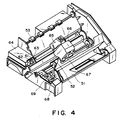
- Fig. 4 is a perspective view of an illustrative ink-jet recording apparatus.
- Fig. 5 is a longitudinal cross section of an illustrative ink cartridge.
- Fig. 6 is a perspective view of a recording unit.
- the present invention provides an ink which can provide black images high in density and excellent in water resistance upon recording on plain paper, and moreover, which can provide black images scarcely undergoing discoloration even upon recording on coated paper, and an ink-jet recording method and an instrument making use of such an ink.
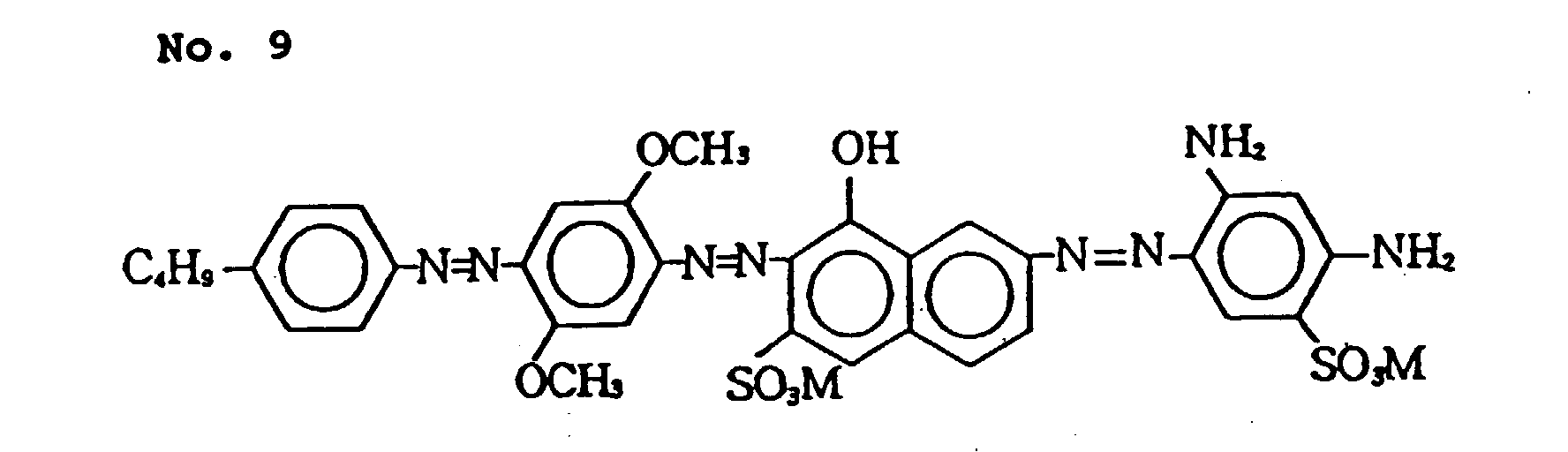
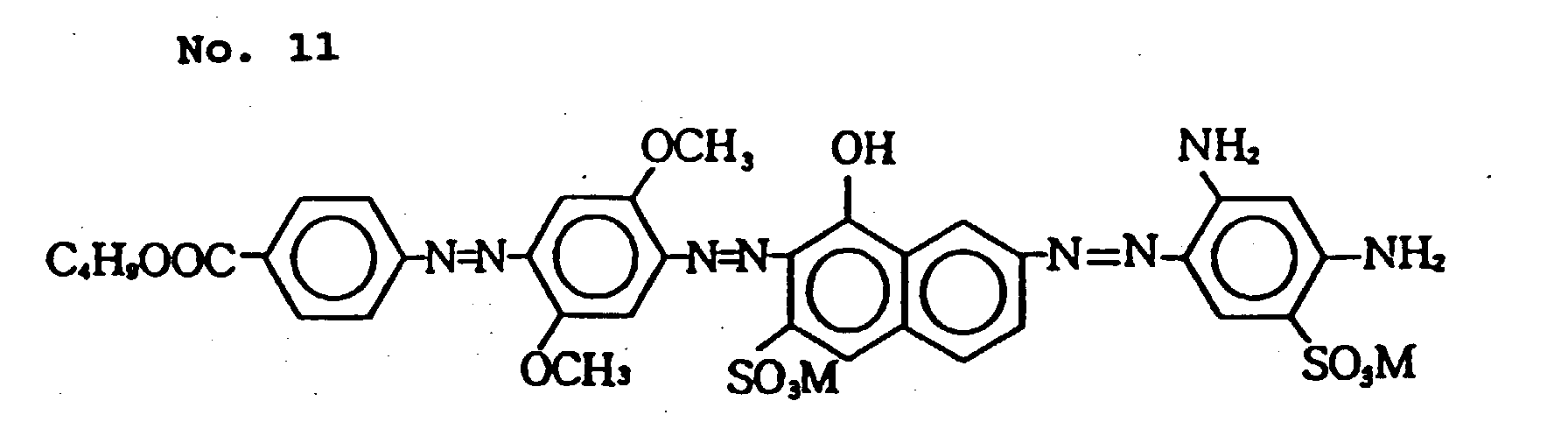
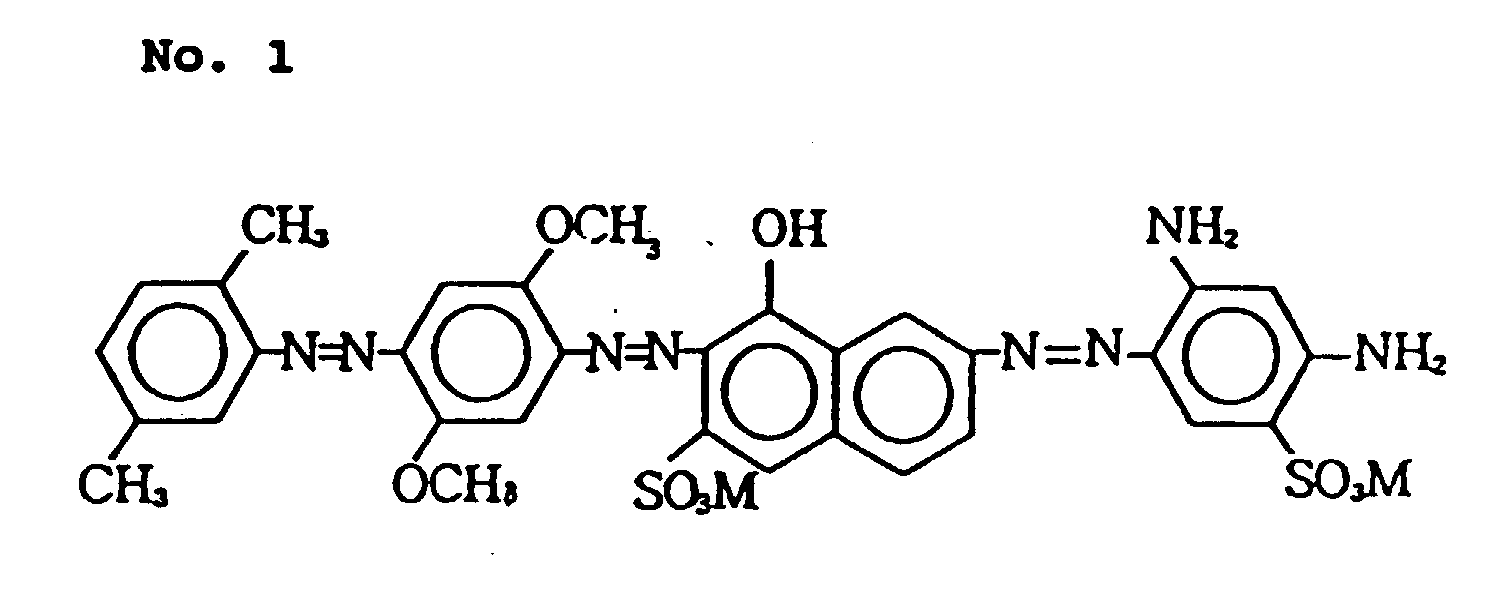
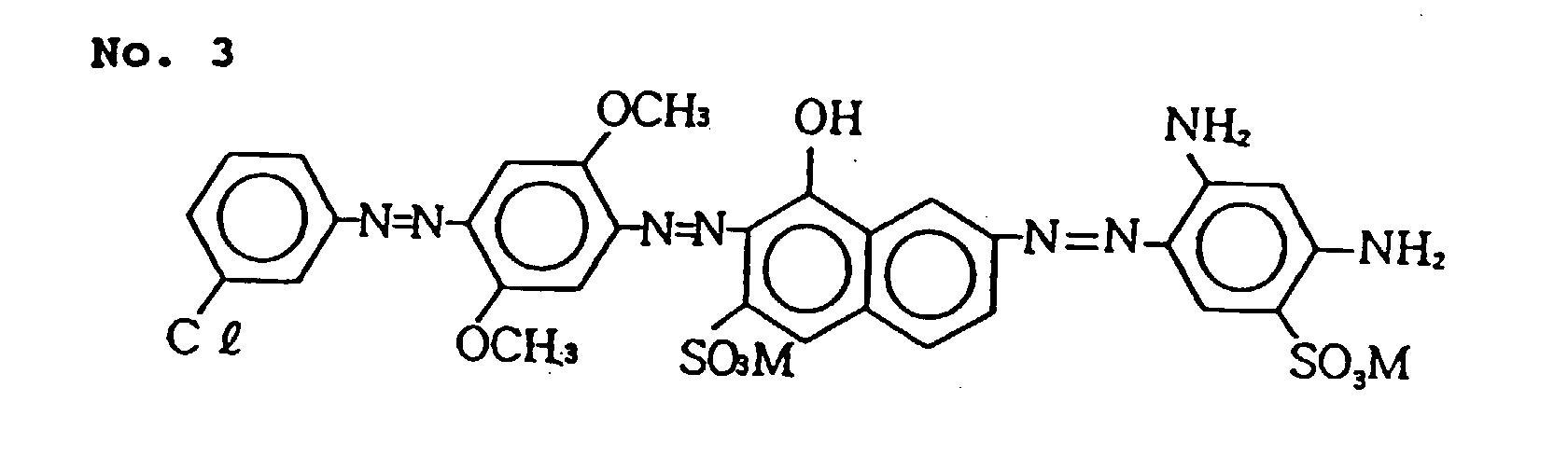
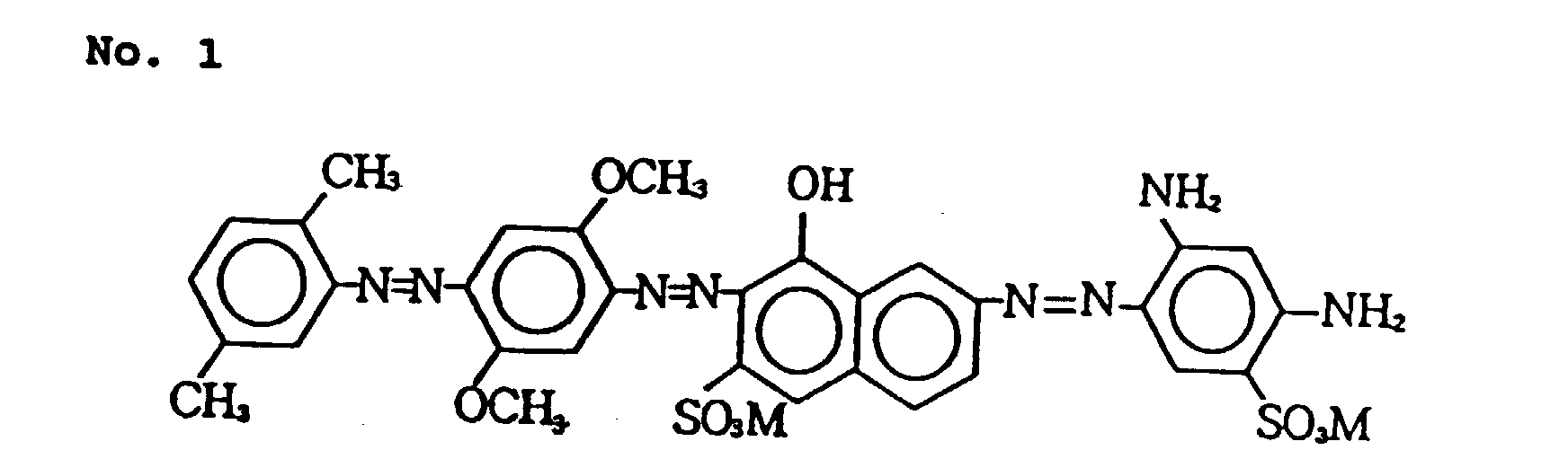
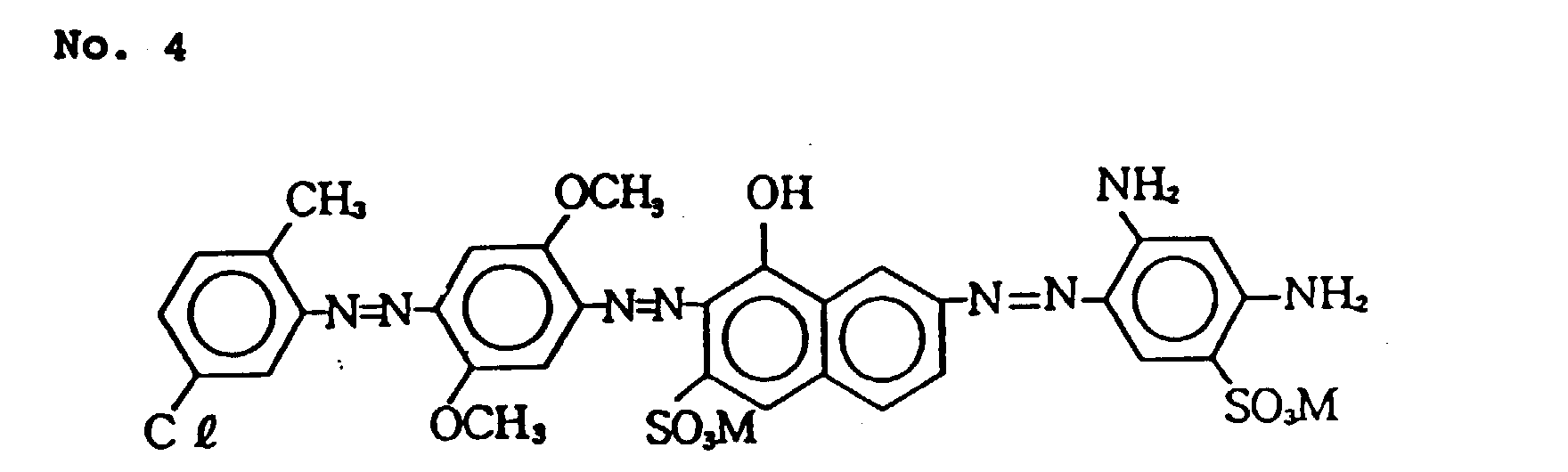
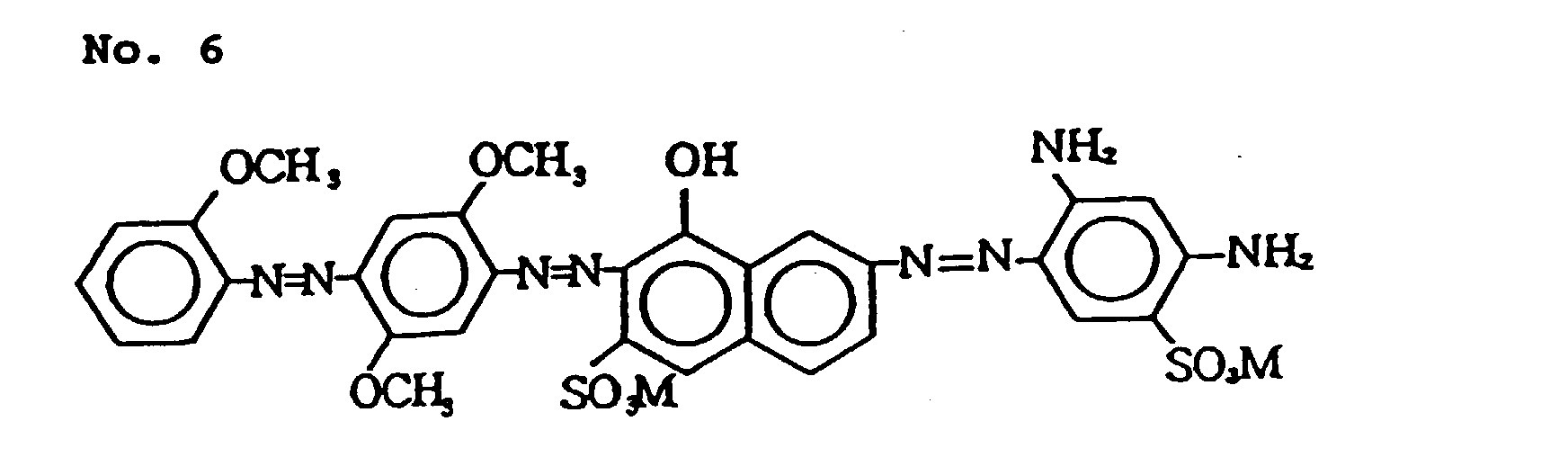
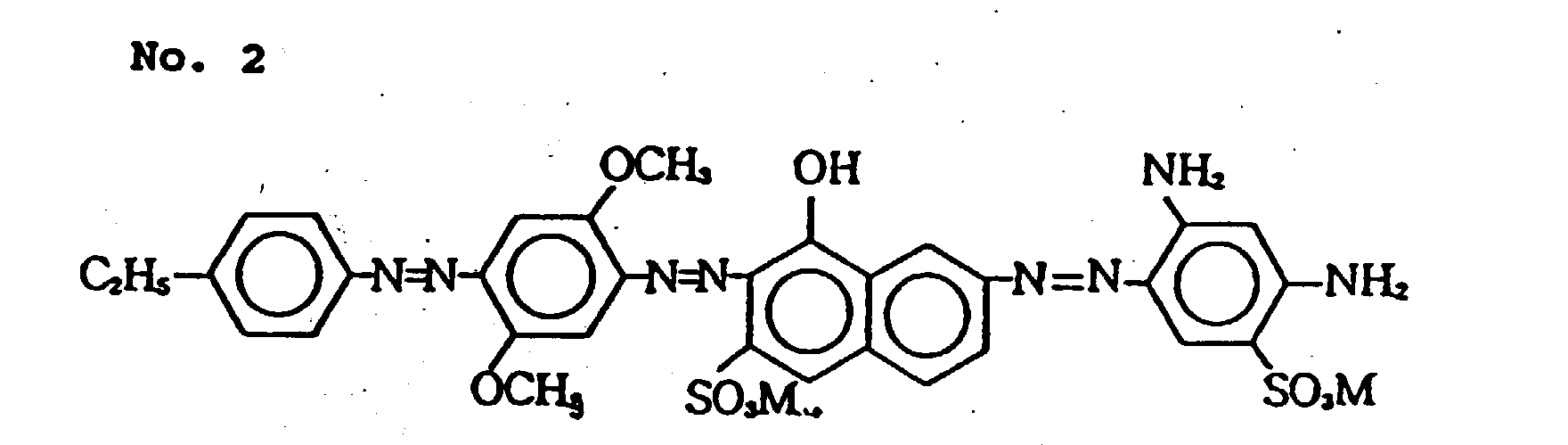
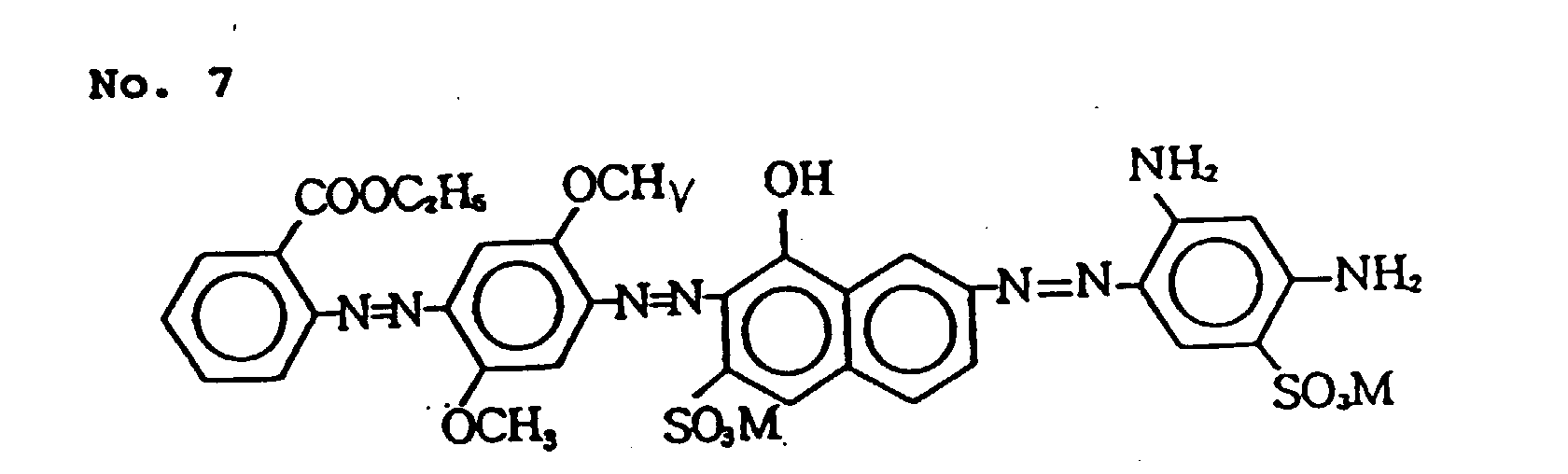
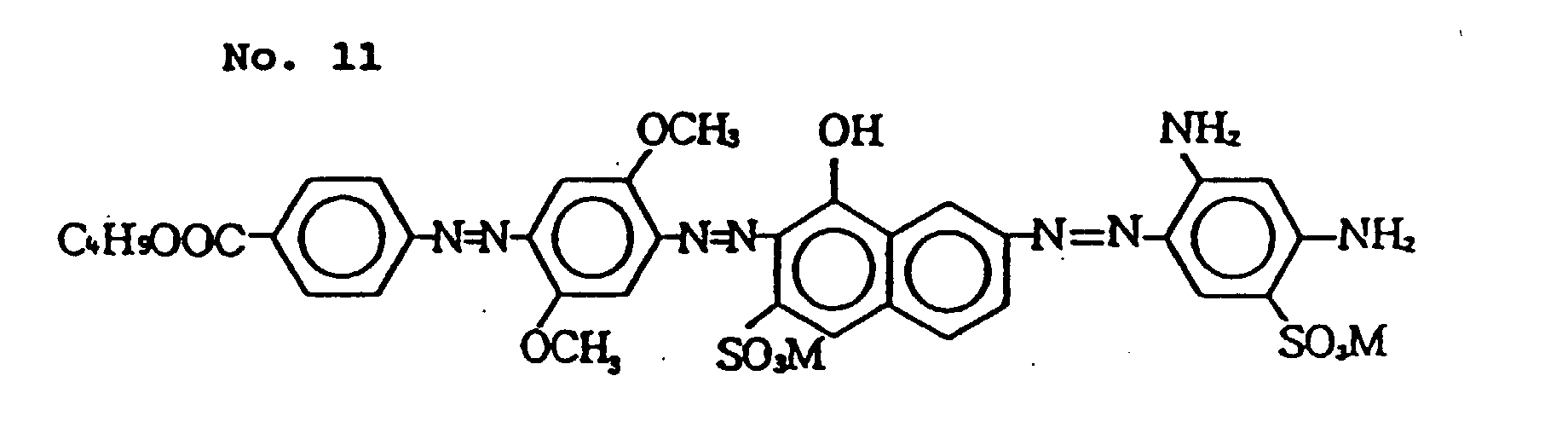
- azo compound (dye) represented by the general formula (A) and principally constituting a characteristic feature of this invention may be mentioned the following compounds (dyes): wherein M means an alkali metal atom, or an ammonium or organic ammonium ion.
- the azo compounds (dyes) according to this invention are generally the sodium salts with their hydrophilic groups such as sulfonic group, but not limited to these sodium salts in the present invention.
- the compounds of this invention have the same effect as the sodium salts even when their counter ions are potassium, lithium, ammonium or organic amino ions.
- the present invention also embraces dyes containing these other counter ions.
- the dyes according to this invention can be satisfactorily used as black coloring matter.
- the above dyes may be synthesized in the following manner in accordance with the process described in Yutaka Hosoda, "Riron Seizo: Senryo Kagaku (Theory and Preparation: Dyestuff Chemistry)” or the like.
- the dye of Specific Example No. 3 is synthesized in the following manner.
- m-Chloroaniline is diazotized in accordance with the conventionally known method.
- the resulting diazotized amine is coupled with 2,5-dimethoxyaniline, and the resulting monoazo compound is separated to diazotize it.
- the resulting diazotized compound is coupled with gamma acid in alkaline condition.
- the thus-formed disazo compound is separated to further diazotize it.
- the thus-formed diazotized compound is coupled with m-phenylenediamine-4-sulfonic acid.
- the thus-formed compound is salted out with sodium acetate and then washed with ethanol to purify it, thereby obtaining the intended dye.
- the dye according to the present invention may be used either in the form of powder or in the form of an aqueous solution (liquid composition). In the latter case, it may also be possible to use a solubilizing agent for the dye in combination.
- the amount of the dye to be used in the ink according to the present invention preferably comprises generally from 0.1 to 15 % by weight, preferably from 0.5 to 10 % by weight, more preferably from 0.5 to 6 % by weight of the total weight of the ink.
- the dyes of this invention may be used either singly or in combination with the conventionally known dyes.
- the medium suitable for use in the ink according to this invention is water or a mixed solvent of water and a water-soluble organic solvent.
- water it is preferable to use deionized water instead of tap water containing various ions.
- alkyl alcohols having 1 to 5 carbon atoms such as methyl alcohol, ethyl alcohol, n-propyl alcohol, isopropyl alcohol, n-butyl alcohol, sec-butyl alcohol, tert-butyl alcohol, isobutyl alcohol and n-pentanol; amides such as dimethylformamide and dimethylacetamide; ketones and ketone alcohols such as acetone and diacetone alcohol; ethers such as dioxane; polyalkylene glycols such as polyethylene glycol and polypropylene glycol; alkylene glycols whose alkylene moiety has 2 to 6 carbon atoms, such as ethylene glycol, propylene glycol, butylene glycol, diethylene glycol, triethylene glycol, thiodiglycol and hexylene glycol; 1,2,6-hexanetriol; glycerol; lower alkyl ether
- organic solvents may be suitably chosen for use.
- diethylene glycol or thiodiglycol in particular, for the purpose of preventing the ink according to this invention from clogging.
- a nitrogen-containing cyclic compound or an ether compound of a polyalkylene oxide from the viewpoint of image density and jetting stability.
- a lower alcohol or surface active agent may preferably be used from the viewpoint of frequency response. Therefore, preferred solvent compositions in this invention are those containing a variety of the components as described above in addition to water.
- the content of the water-soluble organic solvent in the ink is generally within a range of from 2 to 80 % by weight, preferably from 3 to 70 % by weight, more preferably from 4 to 60 % by weight of the total weight of the ink.
- the proportion of water to be used is generally within a range of from 10 to 97.5 % by weight, preferably at least 35 % by weight, more preferably at least 45 % by weight of the total weight of the ink.
- the amount of water is too little, a great amount of the low-volatile organic solvent leaves in images formed, resulting in problems of migration of dye, feathering of the images, etc. It is hence not preferred to use water in such a small amount.
- the inks of this invention may contain, in addition to the above components, a pH adjustor, viscosity modifier, surface tension modifier and/or the like as necessary.
- a pH adjustor may be mentioned various kinds of organic amines such as diethanolamine and triethanolamine; inorganic alkalis such as the hydroxides of alkali metals, for example, sodium hydroxide, lithium hydroxide, potassium hydroxide, etc.; salts of organic acids such as lithium acetate; and organic acids and mineral acids.
- the inks of this invention as described above preferably have a viscosity of 1 to 20 mPas (cps), preferably 1 to 15 mPas (cps) at 25°C, a surface tension of at least 3 ⁇ 10 -2 N/m (30 dyn/cm), preferably at least 4 ⁇ 10 -2 N/m (40 dyn/cm), and a pH of about 4 to 10.
- the inks of this invention are effective for use in recording methods of an ink-jet recording system.
- a recording material may be used any one of general-purpose plain paper (for example, wood-free paper, medium-quality paper and bond paper), coated paper, plastic films for OHP, etc.
- the inks of this invention are particularly suitable for use in an ink-jet recording system of a type that an ink is ejected by the bubbling phenomenon of the ink caused by thermal energy.
- This recording system has a feature that the ejection of the ink becomes extremely stable, and no satellite dots generate.
- the thermal properties (for example, the specific heat, the coefficient of thermal expansion, the heat conductivity, etc.) of the ink may however be controlled in some cases.
- the inks according to this invention may suitably be used, in particular, in an ink-jet recording system of a type that recording is conducted by causing an ink to jet out by the action of thermal energy. It however goes without saying that the inks may also be used for general-purpose writing instruments.
- thermal energy corresponding to recording signals is applied to an ink within a recording head, and ink droplets are generated in accordance with the thermal energy.
- FIGS. 1, 2 and 3 Examples of the construction of an head, which is a main component of such an apparatus, are illustrated in Figs. 1, 2 and 3.
- a head 13 is composed of a glass, ceramic or plastic plate or the like having an ink-passing channel 14 and a heating head 15, which is used for thermal recording (the drawing shows a head to which, however, is not limited), said heating head 15 being bonded to the plate.
- the heating head 15 is composed of a protective film 16 made of silicon oxide or the like, aluminum electrodes 17-1 and 17-2, a heating resistor layer 18 made of nichrome or the like, a heat accumulating layer 19, and a substrate 20 having good heat radiating property and made of alumina or the like.
- An ink 21 comes up to an ejection orifice 22 (a minute opening) and forms a meniscus 23 owing to a pressure (not shown).
- Fig. 3 illustrates an appearance of a multi-head composed of an array of a number of heads as shown in Fig. 1.
- the multi-head is formed by bonding a glass plate 27 having a number of channels 26 to a heating head 28 similar to the head as illustrated in Fig. 1.
- Fig. 1 is a cross-sectional view of the head 13 taken along the flow path of the ink
- Fig. 2 is a cross-sectional view taken along line A-B in Fig. 1.
- Fig. 4 illustrates an example of an ink-jet recording apparatus in which such a head has been incorporated.
- reference numeral 61 designates a blade serving as a wiping member, one end of which is a stationary end held by a blade-holding member to form a cantilever.
- the blade 61 is provided at the position adjacent to the region in which a recording head operates, and in this embodiment, is held in such a form that it protrudes to the course through which the recording head is moved.
- Reference numeral 62 indicates a cap, which is provided at the home position adjacent to the blade 61, and is so constituted that it moves in the direction perpendicular to the direction in which the recording head is moved and comes into contact with the face of ejection openings to cap it.
- Reference numeral 63 denotes an ink-absorbing member provided adjoiningly to the blade 61 and, similar to the blade, held in such a form that it protrudes to the course through which the recording head is moved.
- the above-described blade 61, cap 62 and absorbing member 63 constitute a recovery portion 64 for the recording head, where the blade 61 and absorbing member 63 remove off water, dust and/or the like from the face of the ink-ejecting openings.
- Reference numeral 65 designates the recording head having an ejection-energy-generating means and serving to eject the ink onto a recording material set in an opposing relation with the ejection opening face provided with ejection openings to conduct recording.
- Reference numeral 66 indicates a carriage on which the recording head 65 is mounted so that the recording head 65 can be moved.
- the carriage 66 is slidably interlocked with a guide rod 67 and is connected (not illustrated) at its part to a belt 69 driven by a motor 68.
- the carriage 66 can be moved along the guide rod 67 and hence, the recording head 65 can be moved from a recording region to a region adjacent thereto.
- Reference numerals 51 and 52 denote a paper feeding part from which the recording materials are separately inserted, and paper feed rollers driven by a motor (not illustrated), respectively. With such construction, the recording material is fed to the position opposite to the ejection opening face of the recording head, and discharged from a paper discharge section provided with paper discharge rollers 53 with the progress of recording.
- the cap 62 in the head recovery portion 64 is receded from the moving course of the recording head 65 when the recording head 65 is returned to its home position, for example, after completion of recording, and the blade 61 remains protruded to the moving course.
- the ejection opening face of the recording head 65 is wiped.
- the cap 62 comes into contact with the ejection opening face of the recording head 65 to cap it, the cap 62 is moved so as to protrude to the moving course of the recording head.
- the cap 62 and the blade 61 are at the same positions as the positions upon the wiping as described above. As a result, the ejection opening face of the recording head is also wiped at the time of this movement.
- the above movement of the recording head to its home position is made not only when the recording is completed or the recording head is recovered for ejection, but also when the recording head is moved between recording regions for the purpose of recording, during which it is moved to the home position adjacent to each recording region at given intervals, where the ejection opening face is wiped in accordance with this movement.
- Fig. 5 illustrates an exemplary ink cartridge in which an ink fed to the head through an ink-feeding member, for example, a tube is contained.
- reference numeral 40 designates an ink container portion containing the ink to be fed, as exemplified by a bag for the ink. One end thereof is provided with a stopper 42 made of rubber. A needle (not illustrated) may be inserted into this stopper 42 so that the ink in the bag 40 for the ink can be fed to the head.
- Reference numeral 44 indicates an ink absorbing member for receiving a waste ink. It is preferred in this invention that the ink container portion is formed of a polyolefin, in particular, polyethylene, at its surface with which the ink comes into contact.
- the ink-jet recording apparatus used in this invention may not be limited to the apparatus as described above in which the head and the ink cartridge are separately provided. Therefore, a device in which these members are integrally formed as shown in Fig. 6 can also be preferably used.
- reference numeral 70 designates a recording unit, in the interior of which an ink container portion containing an ink, for example, an ink-absorbing member, is contained.
- the recording unit 70 is so constructed that the ink in such an ink-absorbing member is ejected in the form of ink droplets through a head 71 having a plurality of orifices.
- polyurethane is preferably used as a material for the ink-absorbing member.
- Reference numeral 72 indicates an air passage for communicating the interior of the recording unit 70 with the atmosphere.
- the recording unit 70 can be used in place of the recording head shown in Fig. 4, and is detachably installed on the carriage 66.
- the intended compound was synthesized in the same manner as in Example 1 except that m-chloroaniline was used in place of p-ethylaniline. Its maximum absorption spectrum was 578 nm (in water).
- the intended compound was synthesized in the same manner as in Example 1 except that 2-amino-4-chlorotoluene was used in place of p-ethylaniline. Its maximum absorption spectrum was 575 nm (in water).
- the intended compound was synthesized in the same manner as in Example 1 except that m-toluidine was used in place of p-ethylaniline. Its maximum absorption spectrum was 575 nm (in water).
- Inks having their corresponding compositions shown in the following Table 1 were prepared by mixing the respective components shown in Table 1 into solutions and filtering the resulting solutions through a filter having a pore size of 0.2 ⁇ m. Incidentally, all the dyes were thoroughly desalted and purified by a suitable means such as reverse osmosis or ultrafiltration before their use.
- the inks shown above in Table 1 were separately charged in a recording apparatus equipped with an On-Demand type multi-head (orifice size: 50 x 40 ⁇ m, drive voltage: 30 V, frequency: 4 kHz) which conducted recording by applying thermal energy to the ink in a recording head and forming ink droplets to evaluate their printing performance, jetting performance and storage stability after printing.
- the results are given in Table 2 which will be shown subsequently.
- the measurement methods and conditions of the evaluated respective properties are as follows:
- the present invention can provide the inks satisfying various performance characteristics required for printed images on plain paper, to say nothing of water resistance, by using the compounds (dyes) represented by the general formula (A) as a dye in the inks.
- the present invention can provide black images which are high in quality, excellent in resolution, and scarcely undergo discoloration and are excellent in fastness properties even upon printing on coated paper.
- the inks of this invention can exhibit the above properties even at their pH 4 to 10 near the neutrality. Therefore, they do not require to add a strongly alkaline substance as described in Japanese Patent Application Laid-Open No. 56-57862 and hence, are also favorable from the viewpoint of safety.
- the inks according to this invention are applied to an ink-jet recording method in which an ink is ejected by the action of thermal energy, they undergo no formation of deposit on a heater used in this method and can be used stably over a long period of time. Changes of the physical properties and deposition of solid matter are not recognized during their storage.
Landscapes
- Chemical & Material Sciences (AREA)
- Organic Chemistry (AREA)
- Life Sciences & Earth Sciences (AREA)
- Engineering & Computer Science (AREA)
- Materials Engineering (AREA)
- Wood Science & Technology (AREA)
- Inks, Pencil-Leads, Or Crayons (AREA)
- Ink Jet Recording Methods And Recording Media Thereof (AREA)
Claims (40)
- Composé azoïque représenté par la formule générale

- Composé azoïque suivant la revendication 1, qui est choisi dans le groupe consistant en les composés N° 1 à N° 12 suivants :




- Composition de colorant noir comprenant, comme constituant principal, un composé azoïque représenté par la formule générale

- Composition de colorant noir suivant la revendication 3, qui comprend, comme constituant principal, un composé azoïque choisi dans le groupe consistant en les composés N° 1 à N° 12 suivants :



- Encre comprenant un agent d'enregistrement et un milieu liquide dans lequel est dissous ou dispersé l'agent d'enregistrement, ladite encre étant caractérisée en ce qu'elle contient, comme agent d'enregistrement, un composé azoïque représenté par la formule générale

- Encre suivant la revendication 5, qui contient, comme agent d'enregistrement, au moins un composé choisi dans le groupe consistant en les composés N° 1 à N° 12 suivants :




- Encre suivant la revendication 5, dont le pH est compris dans l'intervalle de 4 à 10.
- Encre suivant la revendication 5, dans laquelle l'agent d'enregistrement est présent en une quantité d'environ 0,1 à 15 % en poids du poids total de l'encre.
- Encre suivant la revendication 5, dans laquelle le milieu liquide comprend un solvant consistant en un mélange d'eau et d'un solvant organique hydrosoluble.
- Encre suivant la revendication 9, dans laquelle l'eau est présente en une quantité de 10 à 97,5 % en poids du poids total de l'encre.
- Encre suivant la revendication 9, dans laquelle le solvant organique hydrosoluble est présent en une quantité de 2 à 80 % en poids du poids total de l'encre.
- Encre suivant la revendication 9, dans laquelle le solvant organique hydrosoluble comprend (a) un ou plusieurs glycols.
- Encre suivant la revendication 12, dans laquelle le glycol est le diéthylène-glycol et/ou le thiodiglycol.
- Encre suivant la revendication 5, qui est utilisée pour l'enregistrement par jet d'encre.
- Encre suivant la revendication 14, qui comprend au moins un agent d'enregistrement, un solvant organique hydrosoluble et de l'eau.
- Encre suivant la revendication 15, dans laquelle le solvant organique hydrosoluble comprend (a) un ou plusieurs glycols.
- Encre suivant la revendication 16, dans laquelle le glycol est le diéthylène-glycol et/ou le thiodiglycol.
- Encre suivant la revendication 17, qui comprend, comme additifs, du 2-propanol et/ou de la triéthanolamine.
- Encre suivant la revendication 18, qui comprend au moins un agent d'enregistrement, de l'eau, du thiodiglycol, du thiopropanol et de la triéthanolamine.
- Procédé d'enregistrement par jet d'encre pour effectuer un enregistrement par application de gouttelettes d'une encre sur un support d'enregistrement, qui comprend l'utilisation de l'encre répondant à la définition figurant dans la revendication 5.
- Procédé d'enregistrement par jet d'encre suivant la revendication 20, qui comprend l'application d'énergie thermique à l'encre pour provoquer l'éjection de gouttelettes d'encre.
- Procédé d'enregistrement par jet d'encre suivant la revendication 20, dans lequel le support d'enregistrement est une feuille de papier non couché ou de papier couché.
- Unité d'enregistrement équipée d'une partie servant de récipient d'encre, renfermant une encre, et d'une tête pour l'éjection de l'encre sous forme de gouttelettes, caractérisée en ce que ladite encre est l'encre répondant à la définition figurant dans la revendication 5.
- Unité d'enregistrement suivant la revendication 23, dans laquelle la tête est une tête dans laquelle de l'énergie thermique est appliquée à l'encre pour provoquer l'éjection de gouttelettes de cette encre.
- Unité d'enregistrement suivant la revendication 23, qui est utilisée pour l'enregistrement par jet d'encre.
- Procédé d'enregistrement par jet d'encre, comprenant l'étape consistant à effectuer un enregistrement par application de gouttelettes d'une encre sur un support d'enregistrement au moyen de l'unité d'enregistrement répondant à la définition suivant l'une quelconque des revendications 23 à 25.
- Cartouche d'encre équipée d'une partie servant de récipient d'encre renfermant une encre, caractérisée en ce que l'encre est l'encre répondant à la définition figurant dans la revendication 5.
- Cartouche d'encre suivant la revendication 27, dans laquelle la partie servant de récipient d'encre a une structure analogue à celle d'un sachet.
- Cartouche d'encre suivant la revendication 27, dans laquelle la partie servant de récipient d'encre est constituée d'une polyoléfine au niveau de sa surface avec laquelle l'encre vient en contact.
- Cartouche d'encre suivant la revendication 27, qui est utilisée pour l'enregistrement par jet d'encre.
- Procédé d'enregistrement par jet d'encre, comprenant l'étape consistant à effectuer un enregistrement par application de gouttelettes d'une encre sur un support d'enregistrement en utilisant la cartouche d'encre répondant à la définition figurant dans l'une quelconque des revendications 27 à 30.
- Appareil d'enregistrement par jet d'encre équipé de l'unité d'enregistrement répondant à la définition figurant dans l'une quelconque des revendications 23 à 25, caractérisé en ce que l'encre est l'encre répondant à la définition figurant dans la revendication 5.
- Appareil d'enregistrement par jet d'encre suivant la revendication 32, qui comprend en outre un chariot pour l'unité d'enregistrement.
- Appareil d'enregistrement par jet d'encre, comprenant la cartouche d'encre répondant à la définition figurant dans l'une quelconque des revendications 27 à 30 et une tête d'enregistrement.
- Appareil d'enregistrement par jet d'encre suivant la revendication 34, qui comprend en outre un dispositif de distribution d'encre pour distribuer une encre présente dans la cartouche d'encre à la tête d'enregistrement.
- Appareil d'enregistrement par jet d'encre suivant la revendication 34, dont la tête d'enregistrement est une tête dans laquelle de l'énergie thermique est appliquée à l'encre pour provoquer l'éjection de gouttelettes de cette encre.
- Utilisation d'un composé azoïque représenté par la formule générale

- Utilisation du composé azoïque suivant la revendication 37, qui est choisi dans le groupe consistant en les composés N° 1 à N° 12 suivants :




- Utilisation d'une encre comprenant un agent d'enregistrement et un milieu liquide dans lequel l'agent d'enregistrement est dissous ou dispersé, caractérisée en ce que l'encre contient, comme agent d'enregistrement, un composé azoïque représenté par la formule générale

- Utilisation de l'encre suivant la revendication 39, qui contient, comme agent d'enregistrement, au moins un composé choisi dans le groupe consistant en les composés N° 1 à N° 12 suivants :






Applications Claiming Priority (2)
| Application Number | Priority Date | Filing Date | Title |
|---|---|---|---|
| JP20872191 | 1991-07-26 | ||
| JP208721/91 | 1991-07-26 |
Publications (3)
| Publication Number | Publication Date |
|---|---|
| EP0524372A2 EP0524372A2 (fr) | 1993-01-27 |
| EP0524372A3 EP0524372A3 (en) | 1993-08-25 |
| EP0524372B1 true EP0524372B1 (fr) | 1997-09-17 |
Family
ID=16560987
Family Applications (1)
| Application Number | Title | Priority Date | Filing Date |
|---|---|---|---|
| EP92105478A Expired - Lifetime EP0524372B1 (fr) | 1991-07-26 | 1992-03-30 | Composés azoiques, encres les contenant et méthode et instrument d'enregistrement les utilisant |
Country Status (4)
| Country | Link |
|---|---|
| US (1) | US5258505A (fr) |
| EP (1) | EP0524372B1 (fr) |
| AT (1) | ATE158331T1 (fr) |
| DE (1) | DE69222245T2 (fr) |
Families Citing this family (27)
| Publication number | Priority date | Publication date | Assignee | Title |
|---|---|---|---|---|
| JPH06135124A (ja) * | 1992-08-13 | 1994-05-17 | Canon Inc | 事務機用被記録材およびその製造方法 |
| US6003987A (en) * | 1992-09-17 | 1999-12-21 | Canon Kabushiki Kaisha | Ink set recording apparatus and method using ink set having a dye that becomes insoluble when mixed with another dye |
| US5451251A (en) * | 1993-02-26 | 1995-09-19 | Canon Kabushiki Kaisha | Ink, and ink-jet recording method and instrument using the same |
| US5429671A (en) * | 1993-03-12 | 1995-07-04 | Canon Kabushiki Kaisha | Ink, and ink-jet recording method and apparatus employing the ink |
| JPH06287493A (ja) * | 1993-04-07 | 1994-10-11 | Canon Inc | インク及びこれを用いた記録装置 |
| US5500023A (en) * | 1993-04-21 | 1996-03-19 | Canon Kabushiki Kaisha | Ink-jet printing process, ink set for use in such process, and processed article obtained thereby |
| US5466282A (en) * | 1993-05-18 | 1995-11-14 | Canon Kabushiki Kaisha | Azo dye compound, ink containing the same, and recording method and instrument using the ink |
| US5482545A (en) * | 1993-12-28 | 1996-01-09 | Canon Kabushiki Kaisha | Ink, and ink-jet recording method and instrument using the same |
| US5482546A (en) * | 1994-03-30 | 1996-01-09 | Canon Kabushiki Kaisha | Dye, ink containing the same, and ink-jet recording method and instrument using the ink |
| DE4424484A1 (de) * | 1994-07-12 | 1996-01-18 | Bayer Ag | Azofarbstoffe, deren Herstellung und Verwendung |
| US5529616A (en) * | 1994-11-23 | 1996-06-25 | E. I. Du Pont De Nemours And Company | Ink jet inks containing mixtures of alcohols |
| US5728201A (en) * | 1995-09-14 | 1998-03-17 | Canon Kabushiki Kaisha | Ink, and ink-jet recording method and instruments using the same |
| DE10015004A1 (de) * | 2000-03-25 | 2001-09-27 | Clariant Gmbh | Schwarze Tris-Azo-Metall-Komplex-Farbstoffe |
| WO2005044932A1 (fr) * | 2003-11-11 | 2005-05-19 | Canon Kabushiki Kaisha | Encre comprenant un agent dispersant copolymere bloc possedant un hydrophile et un segment hydrophobe, processus d'application d'encre et appareils utilisant ce processus |
| JP5422864B2 (ja) * | 2004-12-27 | 2014-02-19 | 三菱化学株式会社 | トリスアゾ色素、該色素を含む異方性色素膜用組成物、異方性色素膜及び偏光素子 |
| JP4808418B2 (ja) * | 2005-02-28 | 2011-11-02 | キヤノンファインテック株式会社 | インクジェット用水系インク、インクジェット記録方法、インクカートリッジおよびインクジェット記録装置 |
| JP4851167B2 (ja) | 2005-11-07 | 2012-01-11 | キヤノンファインテック株式会社 | インクジェット用水性インク、インクジェット記録方法、インクカートリッジおよびインクジェット記録装置 |
| US8163075B2 (en) | 2006-10-31 | 2012-04-24 | Sensient Colors Llc | Inks comprising modified pigments and methods for making and using the same |
| EP3483222A3 (fr) | 2007-08-23 | 2019-08-07 | Sensient Colors LLC | Pigments auto-dispersés et procédés de préparation et d'utilisation de ceux-ci |
| JP5227581B2 (ja) * | 2007-12-25 | 2013-07-03 | キヤノンファインテック株式会社 | 顔料分散液、インクジェット記録用インク、インクジェット記録方法、インクカートリッジおよびインクジェット記録装置 |
| JP2012523479A (ja) | 2009-04-07 | 2012-10-04 | センシエント カラーズ エルエルシー | 自己分散性粒子並びにその製造方法及び使用方法 |
| JP5988754B2 (ja) | 2011-09-08 | 2016-09-07 | キヤノン株式会社 | 水性インク、インクカートリッジ、及びインクジェット記録方法 |
| TWI561588B (en) * | 2011-10-22 | 2016-12-11 | Archroma Ip Gmbh | Trisazo acid dyes |
| JP2013209620A (ja) | 2012-03-02 | 2013-10-10 | Canon Inc | インク、インクカートリッジ、及びインクジェット記録方法 |
| JP2016138253A (ja) | 2015-01-23 | 2016-08-04 | キヤノン株式会社 | 水性インク、インクカートリッジ、及びインクジェット記録方法 |
| US10253200B2 (en) | 2015-01-23 | 2019-04-09 | Canon Kabushiki Kaisha | Aqueous ink, ink cartridge, and ink jet recording method |
| US12480012B2 (en) | 2021-01-29 | 2025-11-25 | Canon Kabushiki Kaisha | Ink jet recording method and ink jet recording apparatus |
Family Cites Families (26)
| Publication number | Priority date | Publication date | Assignee | Title |
|---|---|---|---|---|
| JPS517572B2 (fr) * | 1972-08-23 | 1976-03-09 | ||
| GB1465889A (en) * | 1972-12-21 | 1977-03-02 | Ici Ltd | Trisazo dyes |
| US4120854A (en) * | 1974-04-10 | 1978-10-17 | Sandoz Ltd. | Disazo and trisazo dyes having a 1,3-diamino-, dihydroxy- or amino-hydroxy-benzene nucleus and metal complexes thereof |
| CH588535A5 (fr) * | 1974-06-17 | 1977-06-15 | Sandoz Ag | |
| US4255327A (en) * | 1979-03-27 | 1981-03-10 | Crompton & Knowles Corporation | Direct black dye |
| JPS55144067A (en) * | 1979-04-27 | 1980-11-10 | Canon Inc | Recording liquid |
| JPS5993768A (ja) * | 1982-11-19 | 1984-05-30 | Canon Inc | 記録液 |
| JPS5993766A (ja) * | 1982-11-19 | 1984-05-30 | Canon Inc | 記録液 |
| US4734489A (en) * | 1985-03-29 | 1988-03-29 | Taoka Chemical Company, Limited | Trisazo compounds useful in producing water-resistant ink compositions |
| JPS61285276A (ja) * | 1985-06-11 | 1986-12-16 | Canon Inc | 記録液 |
| US4841037A (en) * | 1985-06-11 | 1989-06-20 | Canon Kabushiki Kaisha | Amino sulfonaphtholtrisazo compounds and recording liquids containing the same |
| JPS6210274A (ja) * | 1985-07-08 | 1987-01-19 | Sumitomo Electric Ind Ltd | 気相合成方法および装置 |
| US4804411A (en) * | 1986-02-17 | 1989-02-14 | Canon Kabushiki Kaisha | Recording liquid |
| JPS62289682A (ja) * | 1986-06-03 | 1987-12-16 | 田岡化学工業株式会社 | 新規トリスアゾ染料による天然および合成材料の染色法 |
| BR8701672A (pt) * | 1986-08-04 | 1988-01-05 | United Technologies Corp | Processo para detectar uma folha de motor em uma aeronave de motor multiplo |
| JPH0823606B2 (ja) * | 1987-03-10 | 1996-03-06 | 三菱化学株式会社 | カラ−フイルタ− |
| US4988804A (en) * | 1987-11-10 | 1991-01-29 | Ciba-Geigy Corporation | Polyazo dyes obtained by successive coupling of H-acid and two further anilinic diazo components on resorcinol or the like |
| JPH01135880A (ja) * | 1987-11-24 | 1989-05-29 | Canon Inc | 記録液 |
| JPH01167703A (ja) * | 1987-12-23 | 1989-07-03 | Mitsubishi Kasei Corp | 偏光膜 |
| JPH01193375A (ja) * | 1988-01-29 | 1989-08-03 | Canon Inc | 記録液 |
| JPH0778191B2 (ja) * | 1989-02-02 | 1995-08-23 | キヤノン株式会社 | インク及び記録方法 |
| JP2663303B2 (ja) * | 1989-02-02 | 1997-10-15 | キヤノン株式会社 | インク及び記録方法 |
| JPH03782A (ja) * | 1989-02-02 | 1991-01-07 | Canon Inc | インク及び記録方法 |
| EP0440084B1 (fr) * | 1990-01-30 | 1994-06-15 | Canon Kabushiki Kaisha | Encre et procédé d'enregistrement au jet d'encre et appareil utilisant cette encre |
| JP2801410B2 (ja) * | 1990-02-09 | 1998-09-21 | キヤノン株式会社 | インク、これを用いたインクジェット記録方法及び機器 |
| JP2801411B2 (ja) * | 1990-02-09 | 1998-09-21 | キヤノン株式会社 | インク、これを用いたインクジェット記録方法及び機器 |
-
1992
- 1992-03-27 US US07/858,604 patent/US5258505A/en not_active Expired - Lifetime
- 1992-03-30 EP EP92105478A patent/EP0524372B1/fr not_active Expired - Lifetime
- 1992-03-30 AT AT92105478T patent/ATE158331T1/de not_active IP Right Cessation
- 1992-03-30 DE DE69222245T patent/DE69222245T2/de not_active Expired - Fee Related
Also Published As
| Publication number | Publication date |
|---|---|
| EP0524372A2 (fr) | 1993-01-27 |
| DE69222245T2 (de) | 1998-03-19 |
| US5258505A (en) | 1993-11-02 |
| DE69222245D1 (de) | 1997-10-23 |
| ATE158331T1 (de) | 1997-10-15 |
| EP0524372A3 (en) | 1993-08-25 |
Similar Documents
| Publication | Publication Date | Title |
|---|---|---|
| US5258505A (en) | Trisazo compounds, and dye compositions containing same | |
| US5082496A (en) | Ink, and ink-jet recording method and apparatus employing the ink | |
| US5215577A (en) | Ink, and ink-jet recording method and apparatus employing the ink | |
| US5178671A (en) | Ink, and ink-jet recording method and apparatus employing the ink | |
| US5110356A (en) | Ink, and recording process using the same | |
| EP0440084B1 (fr) | Encre et procédé d'enregistrement au jet d'encre et appareil utilisant cette encre | |
| US5135570A (en) | Ink, and recording process making use of it | |
| US5216437A (en) | Ink, and recording method making use of same | |
| EP0447870B1 (fr) | Encre, procédé d'enregistrement par jet d'encre et instrument faisant usage de cette encre | |
| US5139573A (en) | Ink, and recording method making use of same | |
| EP0418792B1 (fr) | Encre, méthode d'enregistrement par jet d'encre utilisant cette encre, méthode pour produire cette encre et utilisation de cette encre pour enregistrement sur un substrat | |
| US5220347A (en) | Ink jet recording method and apparatus employing ink | |
| EP0472196B1 (fr) | Solution d'enregistrement, son utilisation dans le procédé d'impression par jet d'encre et son procédé de préparation | |
| US5482546A (en) | Dye, ink containing the same, and ink-jet recording method and instrument using the ink | |
| US5130723A (en) | Ink, and ink-jet recording method and apparatus employing the ink | |
| US5248991A (en) | Ink, ink-jet recording process recording unit, ink cartridge, and ink-jet recording apparatus employing ink | |
| US5231417A (en) | Ink jet recording process, device, apparatus and cartridge employing ink | |
| EP0490195B1 (fr) | Encre, procédé d'enregistrement à jet d'encre et instrument faisant usage de l'encre | |
| US5466282A (en) | Azo dye compound, ink containing the same, and recording method and instrument using the ink | |
| US5604276A (en) | Recording liquid and method for ink jet recording using same | |
| US5429671A (en) | Ink, and ink-jet recording method and apparatus employing the ink | |
| EP0443386B1 (fr) | Encre, procédé d'enregistrement par jet d'encre et appareil faisant usage de cette encre | |
| EP0382227B1 (fr) | Encre et méthode d'enregistrement utilisant celle-ci | |
| JP2919615B2 (ja) | インク、これを用いたインクジェット記録方法及びかかるインクを用いた機器 | |
| JP3244754B2 (ja) | アゾ化合物、これを含有するインク及びこのインクを用いる記録方法 |
Legal Events
| Date | Code | Title | Description |
|---|---|---|---|
| PUAI | Public reference made under article 153(3) epc to a published international application that has entered the european phase |
Free format text: ORIGINAL CODE: 0009012 |
|
| AK | Designated contracting states |
Kind code of ref document: A2 Designated state(s): AT BE CH DE DK ES FR GB GR IT LI LU NL PT SE |
|
| PUAL | Search report despatched |
Free format text: ORIGINAL CODE: 0009013 |
|
| AK | Designated contracting states |
Kind code of ref document: A3 Designated state(s): AT BE CH DE DK ES FR GB GR IT LI LU NL PT SE |
|
| 17P | Request for examination filed |
Effective date: 19931222 |
|
| GRAG | Despatch of communication of intention to grant |
Free format text: ORIGINAL CODE: EPIDOS AGRA |
|
| 17Q | First examination report despatched |
Effective date: 19961024 |
|
| GRAH | Despatch of communication of intention to grant a patent |
Free format text: ORIGINAL CODE: EPIDOS IGRA |
|
| GRAH | Despatch of communication of intention to grant a patent |
Free format text: ORIGINAL CODE: EPIDOS IGRA |
|
| GRAA | (expected) grant |
Free format text: ORIGINAL CODE: 0009210 |
|
| AK | Designated contracting states |
Kind code of ref document: B1 Designated state(s): AT BE CH DE DK ES FR GB GR IT LI LU NL PT SE |
|
| PG25 | Lapsed in a contracting state [announced via postgrant information from national office to epo] |
Ref country code: NL Free format text: LAPSE BECAUSE OF FAILURE TO SUBMIT A TRANSLATION OF THE DESCRIPTION OR TO PAY THE FEE WITHIN THE PRESCRIBED TIME-LIMIT Effective date: 19970917 Ref country code: LI Effective date: 19970917 Ref country code: GR Free format text: LAPSE BECAUSE OF FAILURE TO SUBMIT A TRANSLATION OF THE DESCRIPTION OR TO PAY THE FEE WITHIN THE PRESCRIBED TIME-LIMIT Effective date: 19970917 Ref country code: ES Free format text: THE PATENT HAS BEEN ANNULLED BY A DECISION OF A NATIONAL AUTHORITY Effective date: 19970917 Ref country code: DK Free format text: LAPSE BECAUSE OF NON-PAYMENT OF DUE FEES Effective date: 19970917 Ref country code: CH Effective date: 19970917 Ref country code: BE Effective date: 19970917 Ref country code: AT Effective date: 19970917 |
|
| REF | Corresponds to: |
Ref document number: 158331 Country of ref document: AT Date of ref document: 19971015 Kind code of ref document: T |
|
| REG | Reference to a national code |
Ref country code: CH Ref legal event code: EP |
|
| REF | Corresponds to: |
Ref document number: 69222245 Country of ref document: DE Date of ref document: 19971023 |
|
| ITF | It: translation for a ep patent filed | ||
| ET | Fr: translation filed | ||
| PG25 | Lapsed in a contracting state [announced via postgrant information from national office to epo] |
Ref country code: SE Effective date: 19971217 Ref country code: PT Effective date: 19971217 |
|
| NLV1 | Nl: lapsed or annulled due to failure to fulfill the requirements of art. 29p and 29m of the patents act | ||
| PG25 | Lapsed in a contracting state [announced via postgrant information from national office to epo] |
Ref country code: LU Free format text: LAPSE BECAUSE OF NON-PAYMENT OF DUE FEES Effective date: 19980330 |
|
| REG | Reference to a national code |
Ref country code: CH Ref legal event code: PL |
|
| PLBE | No opposition filed within time limit |
Free format text: ORIGINAL CODE: 0009261 |
|
| STAA | Information on the status of an ep patent application or granted ep patent |
Free format text: STATUS: NO OPPOSITION FILED WITHIN TIME LIMIT |
|
| 26N | No opposition filed | ||
| REG | Reference to a national code |
Ref country code: GB Ref legal event code: IF02 |
|
| PGFP | Annual fee paid to national office [announced via postgrant information from national office to epo] |
Ref country code: GB Payment date: 20040324 Year of fee payment: 13 |
|
| PGFP | Annual fee paid to national office [announced via postgrant information from national office to epo] |
Ref country code: FR Payment date: 20050308 Year of fee payment: 14 |
|
| PG25 | Lapsed in a contracting state [announced via postgrant information from national office to epo] |
Ref country code: GB Free format text: LAPSE BECAUSE OF NON-PAYMENT OF DUE FEES Effective date: 20050330 |
|
| GBPC | Gb: european patent ceased through non-payment of renewal fee |
Effective date: 20050330 |
|
| PGFP | Annual fee paid to national office [announced via postgrant information from national office to epo] |
Ref country code: IT Payment date: 20060331 Year of fee payment: 15 |
|
| REG | Reference to a national code |
Ref country code: FR Ref legal event code: ST Effective date: 20061130 |
|
| PGFP | Annual fee paid to national office [announced via postgrant information from national office to epo] |
Ref country code: DE Payment date: 20070322 Year of fee payment: 16 |
|
| PG25 | Lapsed in a contracting state [announced via postgrant information from national office to epo] |
Ref country code: FR Free format text: LAPSE BECAUSE OF NON-PAYMENT OF DUE FEES Effective date: 20060331 |
|
| PG25 | Lapsed in a contracting state [announced via postgrant information from national office to epo] |
Ref country code: DE Free format text: LAPSE BECAUSE OF NON-PAYMENT OF DUE FEES Effective date: 20081001 |
|
| PG25 | Lapsed in a contracting state [announced via postgrant information from national office to epo] |
Ref country code: IT Free format text: LAPSE BECAUSE OF NON-PAYMENT OF DUE FEES Effective date: 20070330 |