EP0525751B1 - Procédé de préparation d'une dispersion aqueuse d'un monomère cationique soluble dans l'eau - Google Patents
Procédé de préparation d'une dispersion aqueuse d'un monomère cationique soluble dans l'eau Download PDFInfo
- Publication number
- EP0525751B1 EP0525751B1 EP92112954A EP92112954A EP0525751B1 EP 0525751 B1 EP0525751 B1 EP 0525751B1 EP 92112954 A EP92112954 A EP 92112954A EP 92112954 A EP92112954 A EP 92112954A EP 0525751 B1 EP0525751 B1 EP 0525751B1
- Authority
- EP
- European Patent Office
- Prior art keywords
- acrylate
- methacrylate
- cationic
- acrylamide
- general formula
- Prior art date
- Legal status (The legal status is an assumption and is not a legal conclusion. Google has not performed a legal analysis and makes no representation as to the accuracy of the status listed.)
- Expired - Lifetime
Links
Classifications
-
- C—CHEMISTRY; METALLURGY
- C08—ORGANIC MACROMOLECULAR COMPOUNDS; THEIR PREPARATION OR CHEMICAL WORKING-UP; COMPOSITIONS BASED THEREON
- C08F—MACROMOLECULAR COMPOUNDS OBTAINED BY REACTIONS ONLY INVOLVING CARBON-TO-CARBON UNSATURATED BONDS
- C08F220/00—Copolymers of compounds having one or more unsaturated aliphatic radicals, each having only one carbon-to-carbon double bond, and only one being terminated by only one carboxyl radical or a salt, anhydride ester, amide, imide or nitrile thereof
- C08F220/02—Monocarboxylic acids having less than ten carbon atoms; Derivatives thereof
- C08F220/10—Esters
- C08F220/34—Esters containing nitrogen, e.g. N,N-dimethylaminoethyl (meth)acrylate
-
- C—CHEMISTRY; METALLURGY
- C08—ORGANIC MACROMOLECULAR COMPOUNDS; THEIR PREPARATION OR CHEMICAL WORKING-UP; COMPOSITIONS BASED THEREON
- C08F—MACROMOLECULAR COMPOUNDS OBTAINED BY REACTIONS ONLY INVOLVING CARBON-TO-CARBON UNSATURATED BONDS
- C08F20/00—Homopolymers and copolymers of compounds having one or more unsaturated aliphatic radicals, each having only one carbon-to-carbon double bond, and only one being terminated by only one carboxyl radical or a salt, anhydride, ester, amide, imide or nitrile thereof
- C08F20/02—Monocarboxylic acids having less than ten carbon atoms, Derivatives thereof
- C08F20/10—Esters
- C08F20/34—Esters containing nitrogen, e.g. N,N-dimethylaminoethyl (meth)acrylate
-
- C—CHEMISTRY; METALLURGY
- C08—ORGANIC MACROMOLECULAR COMPOUNDS; THEIR PREPARATION OR CHEMICAL WORKING-UP; COMPOSITIONS BASED THEREON
- C08F—MACROMOLECULAR COMPOUNDS OBTAINED BY REACTIONS ONLY INVOLVING CARBON-TO-CARBON UNSATURATED BONDS
- C08F20/00—Homopolymers and copolymers of compounds having one or more unsaturated aliphatic radicals, each having only one carbon-to-carbon double bond, and only one being terminated by only one carboxyl radical or a salt, anhydride, ester, amide, imide or nitrile thereof
- C08F20/02—Monocarboxylic acids having less than ten carbon atoms, Derivatives thereof
- C08F20/52—Amides or imides
- C08F20/54—Amides, e.g. N,N-dimethylacrylamide or N-isopropylacrylamide
- C08F20/60—Amides, e.g. N,N-dimethylacrylamide or N-isopropylacrylamide containing nitrogen in addition to the carbonamido nitrogen
-
- C—CHEMISTRY; METALLURGY
- C08—ORGANIC MACROMOLECULAR COMPOUNDS; THEIR PREPARATION OR CHEMICAL WORKING-UP; COMPOSITIONS BASED THEREON
- C08F—MACROMOLECULAR COMPOUNDS OBTAINED BY REACTIONS ONLY INVOLVING CARBON-TO-CARBON UNSATURATED BONDS
- C08F220/00—Copolymers of compounds having one or more unsaturated aliphatic radicals, each having only one carbon-to-carbon double bond, and only one being terminated by only one carboxyl radical or a salt, anhydride ester, amide, imide or nitrile thereof
- C08F220/02—Monocarboxylic acids having less than ten carbon atoms; Derivatives thereof
- C08F220/52—Amides or imides
- C08F220/54—Amides, e.g. N,N-dimethylacrylamide or N-isopropylacrylamide
- C08F220/60—Amides, e.g. N,N-dimethylacrylamide or N-isopropylacrylamide containing nitrogen in addition to the carbonamido nitrogen
Definitions
- the present invention relates to a process for the preparation of an aqueous dispersion of a water-soluble cationic polymer for use in waste water treatment as a flocculant or a dehydrating agent, and in paper manufacturing as a paper chemical.
- suspension polymerization in a hydrophobic solvent employs an inflammable solvent such as cyclohexane and toluene; therefore, plant investment costs are very high.
- Japanese Patent Laid-Open Application No.50-70489 teaches a precipitation polymerization in an ammonium sulfate solution for the preparation of a nonionic or an anionic water-soluble polymer.
- the plant investment costs for the precipitation polymerization process are not expensive preferably; however, the resulting polymer particles are sticky and have a tendency to agglomerate each other to thereby give a large polymer mass which is not easy to handle.
- Japanese Patent Laid-Open Application No.61-123610 proposes a process for the polymerization or copolymerization of a quaternary benzyl chloride salt of dimethylaminoethyl methacrylate or acrylate as a cationic monomer in which the polymerization is carried out in an aqueous salt solution which does not dissolve the resulting polymer or copolymer, and in the presence of a polymer which is soluble in the salt solution to thereby provide a cationic water-soluble polymer in a dispersion state.
- the present invention relates to a polymerization process for the preparation of an aqueous dispersion of a water-soluble cationic polymer by use of a cationic quaternary monomer obtained by the quaternization of dimethylaminoethyl methacrylate or acrylate, with a specific aliphatic halide or aromatic halide.
- the polymerization is carried out in an aqueous salt solution which does not dissolve the resulting polymer or copolymer, and in the presence of a dispdrsant of a specific cationic polymer which is soluble in the salt solution.
- the preferred molar ratio of the monomer represented by the general formula (1) to the monomer by (2) is always more than 1.
- the polymerization or copolymerization is carried out in an aqueous salt solution which does not dissolve the resulting polymer or copolymer, and in the presence of a dispersant of a specific cationic polymer which is soluble in the salt solution, the specific cationic polymer having one or more of organic residues in an amount of more than 20 % by mole, and being obtained from a monomer represented by the above general formula (2).
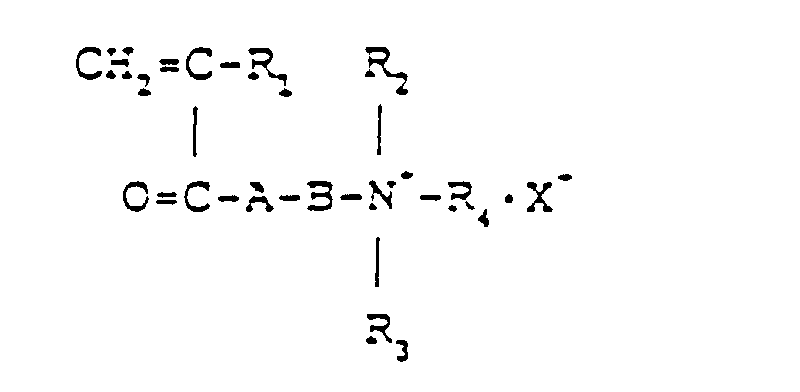
- Any monomers represented by the general formula (1) may be employed; however, preferred examples include quaternary salts obtained by the reaction of an alkyl halide having C 4 to C 10 carbon atoms or a 2-haloethylbenzene with dimethylaminoethyl methacrylate or acrylate; diethylaminoethyl methacrylate or acrylate; dimethylaminohydroxypropyl methacrylate or acrylate; or dimethylaminopropyl methacrylamide or acrylamide.
- Quaternary monomers obtained by the reaction of an alkyl halide having C 3 or lower carbon atoms are not suitable because the resulting polymer is partly soluble in the salt solution, whereas quaternary monomers obtained from an alkyl halide having C 11 or higher carbon atoms are also not suitable because they are insoluble in the salt solution.
- Typical examples of the cationic monomers represented by the general formula (2) include monomers obtained by neutralization with hydrochloric acid or sulfuric acid, or by quaternization with methyl chloride or dimethyl sulfate of a monomer selected from the group consisting of dimethylaminoethyl methacrylate or acrylate, diethylaminoethyl methacrylate or acrylate, dimethylaminohydroxypropyl methacrylate or acrylate, and dimethylaminopropyl methacrylamide or acrylamide.
- the resulting copolymer is insoluble in the aqueous salt solution as a polymerization medium; that is to say, the copolymer can be separated out of the salt solution by salting-out.
- homopolymers which are most readily separated out are polymers obtained from the monomers represented by the general formula (1), whereas homopolymers obtained from the monomers represented by the general formula (2) cannot be separated out.
- the dispersant employed in the polymerization should be readily soluble in the aqueous salt solution; therefore, the preferred dispersant comprises a cationic polymer obtained from the monomers represented by the formula (2), with the polymer having one or more of organic residues in an amount of more than 20 % by mole.
- the most preferred dispersant is a homopolymer obtained from one of the monomers represented by the general formula (2).
- Acrylamide is a typical comonomer which may be copolymerized with the monomer represented by the formula (2); however, any monomers may be used, provided that they are soluble in the salt solution.
- polymerization is carried out in the presence of the dispersant with stirring by use of the monomer or monomer mixture in an aqueous salt solution.
- the preferred monomer concentration is in a range from 5 to 30 % by weight.
- insolubility of the resulting polymer or copolymer in the aqueous salt solution used as a dispersion medium is a prerequisite for the salt solution used.
- any salts may be employed for preparing the aqueous dispersion, so long as they do not dissolve the resulting polymer.
- Typical examples of the salts include polyvalent anion salts such as sodium sulfate, ammonium sulfate, magnesium sulfate, aluminium sulfate, and sodium dihydrogenphosphate.
- the salt concentration it will depend on the molar ratio of cationic monomers represented by the formula (1) and (2), and the kind of the salt employed. In general a range of from 15 % by weight or beyond, up to the limit of solubility of the salt is preferred.
- the preferred amount of dispersant is 1 to 10 % by weight, based on the total weight of monomers.
- the amount is less than 1 % by weight, the polymerization gives sticky polymer particles which tend to result in separation of a bulky polymer mass unpreferably. Inversely, when it is more than 10 % by weight, no additional merits can be obtained.
- the polymerization temperature will depend on the kind of the initiator. Any temperature may be employed, with proviso that the particular initiator can function.
- any initiator may be employed such as redox or azo type initiators.
- the process of the present invention is characterized in that the polymerization of a cationic monomer by the formula (1) or mixture thereof, is carried out in an aqueous salt solution which is a dispersion medium, with stirring in the presence of a cationic polymer dispersant which is soluble in the aqueous salt solution.
- the role of the salt in the dispersion medium in this case, is to prevent the resulting polymer from being dissolved in said dispersion medium.
- the resulting polymer is difficult to dissolve in a salt solution, because the amino group of the cationic monomer by the general formula (1) has been combined with an alkyl group which is strongly hydrophobic.
- the polymer dispersion had a viscosity of 2.5 Pa ⁇ s (2500 cp) (at 25°C), and the viscosity of the 0.5 % polymer in 4 % aqueous NaCl solution was 0.028 Pa ⁇ s (28 cp).
- the polymer solution had a viscosity (at 25°C) of 3.2 Pa ⁇ s (3200 cp).
- the viscosity of the 0.5 % polymer in 2 % aqueous ammonium sulfate solution was 0.035 Pa ⁇ s (35 cp).
- Example I In the separable flask employed in Example I were placed 2.7 g of a homopolymer of methacryloyloxyethyltrimethylammonium chloride as a dispersant, 112.3 g of sodium sulfate, followed by dissolving in 386.2 g of deionized water.
- the polymer dispersion has a viscosity (at 25° ) of 4.5 Pa ⁇ s (4500 cp) which is lowered to 0.5 Pa ⁇ s (500 cp) after addition of 20g of ammonium sulfate to the dispersion.
- the viscosity of the 0.5 % polymer in 2 % aqueous ammonium sulfate solution was 0.040 Pa ⁇ s (40 cp).
- Example I In the separable flask employed in Example I were placed 2.7 g of a homopolymer of acryloyloxyethyltrimethylammonium chloride as a dispersant, and 112.3 g of sodium sulfate, followed by dissolving in 398.2g of deionized water.
- the polymer dispersion had a viscosity (at 25°C) of 2.7 Pa ⁇ s (2700 cp).
- the viscosity of the 0.5 % polymer in 2 % aqueous ammonium sulfate solution was 0.023 Pa ⁇ s (23 cp).
- Example I In the separable flask employed in Example I were placed 2.7 g of a homopolymer of acryloyloxyethyltrimethylammonium chloride as a dispersant, 112.3 g of ammonium sulfate, followed by dissolving the contents in 390.6 g of deionized water.
Landscapes
- Chemical & Material Sciences (AREA)
- Health & Medical Sciences (AREA)
- Chemical Kinetics & Catalysis (AREA)
- Medicinal Chemistry (AREA)
- Polymers & Plastics (AREA)
- Organic Chemistry (AREA)
- Addition Polymer Or Copolymer, Post-Treatments, Or Chemical Modifications (AREA)
- Polymerisation Methods In General (AREA)
Claims (24)
- Dispersion aqueuse d'un polymère ou copolymère cationique hydrosoluble, pouvant être obtenue par polymérisation ou copolymérisation d'un mélange de monomères cationiques comprenanta) 5 à 100% en moles d'un ou plusieurs des monomères cationiques représentés par la formule générale (1):
 b) 0 à 50% en moles d'un ou plusieurs des monomères cationiques représentés par la formule générale (2):
 c) 0 à 95% en moles de méthacrylamide ou d'acrylamide dans une solution saline aqueuse, qui ne dissout pas le polymère ou le copolymère résultant et en présence d'un dispersant polymère cationique qui est soluble dans la solution saline et qui contient des unités monomères représentées par la formule générale (2) en une quantité de plus de 20% en moles.
- Procédé pour la préparation d'une dispersion aqueuse d'un polymère ou copolymère cationique hydrosoluble par utilisation d'un mélange de monomères cationiques comprenanta) 5 à 100% en moles d'un ou plusieurs des monomères cationiques représentés par la formule (1) suivante:
 b) 0 à 50% en moles d'un ou plusieurs des monomères cationiques représentés par la formule générale (2) suivante:
 c) 0 à 95% en moles de méthacrylamide ou d'acrylamide, le procédé comprenant la polymérisation ou copolymérisation du mélange de monomères cationiques dans une solution saline aqueuse, qui ne dissout pas le polymère ou le copolymère résultant et en présence d'un dispersant polymère cationique qui est soluble dans la solution saline et qui contient des unités monomères représentées par la formule générale (2) en une quantité de plus de 20% en moles.
- Procédé selon la revendication 2, dans lequel le rapport molaire du monomère représenté par la formule générale (1) au monomère représenté par la formule générale (2) est supérieur à 1.
- Procédé selon la revendication 2, dans lequel le monomère cationique représenté par la formule générale (1) est obtenu par quaternisation d'un monomère choisi dans le groupe consistant en méthacrylate ou acrylate de diméthylaminoéthyle, méthacrylate ou acrylate de diéthylaminoéthyle, méthacrylate ou acrylate de diméthylaminohydroxypropyle, et diméthylaminopropyl méthacrylamide ou acrylamide, avec un halogénure d'alkyle en C4 à C10 ou le 2-halogénoéthylbenzène.
- Procédé selon la revendication 2, dans lequel le monomère cationique représenté par la formule générale (1) est obtenu par quaternisation d'un monomère choisi dans le groupe consistant en méthacrylate ou acrylate de diméthylaminoéthyle, méthacrylate ou acrylate de diéthylaminoéthyle, méthacrylate ou acrylate de diméthylaminohydroxypropyle, et diméthylaminopropyl méthacrylamide ou acrylamide, avec un halogénure de butyle.
- Procédé selon la revendication 2, dans lequel le monomère cationique représenté par la formule générale (1) est obtenu par quaternisation d'un monomère choisi dans le groupe consistant en méthacrylate ou acrylate de diméthylaminoéthyle, méthacrylate ou acrylate de diéthylaminoéthyle, méthacrylate ou acrylate de diméthylaminohydroxypropyle, et diméthylaminopropyl méthacrylamide ou acrylamide, avec un halogénure de pentyle.
- Procédé selon la revendication 2, dans lequel le monomère cationique représenté par la formule générale (1) est obtenu par quaternisation d'un monomère choisi dans le groupe consistant en méthacrylate ou acrylate de diméthylaminoéthyle, méthacrylate ou acrylate de diéthylaminoéthyle, méthacrylate ou acrylate de diméthylaminohydroxypropyle, et diméthylaminopropyl méthacrylamide ou acrylamide, avec un halogénure d'hexyle.
- Procédé selon la revendication 2, dans lequel le monomère cationique représenté par la formule générale (1) est obtenu par quaternisation d'un monomère choisi dans le groupe consistant en méthacrylate ou acrylate de diméthylaminoéthyle, méthacrylate ou acrylate de diméthylaminohydroxypropyle, et diméthylaminopropyl méthacrylamide ou acrylamide, avec un halogénure d'heptyle.
- Procédé selon la revendication 2, dans lequel le monomère cationique représenté par la formule générale (1) est obtenu par quaternisation d'un monomère choisi dans le groupe consistant en méthacrylate ou acrylate de diméthylaminoéthyle, méthacrylate ou acrylate de diméthylaminohydroxypropyle, et diméthylaminopropyl méthacrylamide ou acrylamide, avec un halogénure d'octyle.
- Procédé selon la revendication 2, dans lequel le monomère cationique représenté par la formule générale (1) est obtenu par quaternisation d'un monomère choisi dans le groupe consistant en méthacrylate ou acrylate de diméthylaminoéthyle, méthacrylate ou acrylate de diméthylaminohydroxypropyle, et diméthylaminopropyl méthacrylamide ou acrylamide, avec un 2-halogénoéthylbenzène.
- Procédé selon la revendication 2, dans lequel le monomère cationique représenté par la formule générale (1) est obtenu par quaternisation de méthacrylate ou acrylate de diméthylaminoéthyle avec un halogénure d'alkyle en C4 à C10 ou un 2-halogénoéthylbenzène.
- Procédé selon la revendication 2, dans lequel le monomère cationique représenté par la formule générale (2) est obtenu par neutralisation avec de l'acide chlorhydrique ou de l'acide sulfurique ou par quaternisation avec du chlorure de méthyle ou du sulfate de diméthyle d'un monomère choisi dans le groupe consistant en méthacrylate ou acrylate de diméthylaminoéthyle, méthacrylate ou acrylate de diéthylaminoéthyle, méthacrylate ou acrylate de diméthylaminohydroxypropyle, et diméthylaminopropyl méthacrylamide ou acrylamide.
- Procédé selon la revendication 2, dans lequel le monomère cationique représenté par la formule générale (2) est obtenu par quaternisation d'un monomère choisi dans le groupe consistant en méthacrylate ou acrylate de diméthylaminoéthyle, méthacrylate ou acrylate de diéthylaminoéthyle, méthacrylate ou acrylate de diméthylaminohydroxypropyle, et diméthylaminopropyl méthacrylamide ou acrylamide, avec du chlorure de méthyle ou du sulfate de diméthyle.
- Procédé selon la revendication 2, dans lequel le dispersant polymère cationique est obtenu par polymérisation d'un ou plusieurs des monomères choisis dans le groupe consistant en des produits de neutralisation avec de l'acide chlorhydrique ou de l'acide sulfurique, ou des produits quaternisés avec du chlorure de méthyle ou du sulfate de diméthyle, d'un monomère choisi dans le groupe consistant en méthacrylate ou acrylate de diméthylaminoéthyle, méthacrylate ou acrylate de diéthylaminoéthyle, méthacrylate ou acrylate de diméthylaminohydroxypropyle, et diméthylaminopropyl méthacrylamide ou acrylamide.
- Procédé selon la revendication 2, dans lequel le dispersant polymère cationique est obtenu par polymérisation d'un ou plusieurs des monomères choisis dans le groupe consistant en des produits quaternisés avec du chlorure de méthyle ou du sulfate de diméthyle, d'un monomère choisi dans le groupe consistant en méthacrylate ou acrylate de diméthylaminoéthyle, méthacrylate ou acrylate de diéthylaminoéthyle, méthacrylate ou acrylate de diméthylaminohydroxypropyle, et diméthylaminopropyl méthacrylamide ou acrylamide.
- Procédé selon la revendication 2, dans lequel le dispersant polymère cationique est obtenu par copolymérisation d'acrylamide avec un ou plusieurs des monomères, en une quantité de plus de 20% en moles, choisis dans le groupe consistant en des produits de neutralisation avec de l'acide chlorhydrique ou de l'acide sulfurique, et des produits quaternisés avec du chlorure de méthyle ou du sulfate de diméthyle, de méthacrylate ou acrylate de diméthylaminoéthyle, méthacrylate ou acrylate de diéthylaminoéthyle, méthacrylate ou acrylate de diméthylaminohydroxypropyle, et diméthylaminopropyl méthacrylamide ou acrylamide, le dispersant polymère cationique étant soluble dans la solution saline en tant que milieu de polymérisation.
- Procédé selon la revendication 2, dans lequel le dispersant polymère cationique est obtenu par copolymérisation d'acrylamide avec un ou plusieurs des monomères, en une quantité de plus de 20% en moles, choisis dans le groupe consistant en des produits de quaternisation avec du chlorure de méthyle ou du sulfate de diméthyle, de méthacrylate ou acrylate de diméthylaminoéthyle, méthacrylate ou acrylate de diéthylaminoéthyle, méthacrylate ou acrylate de diméthylaminohydroxypropyle, et diméthylaminopropyl méthacrylamide ou acrylamide, le dispersant polymère cationique étant soluble dans la solution saline en tant que milieu de polymérisation.
- Procédé selon la revendication 2, dans lequel la quantité de dispersant polymère cationique est de 1 à 10% en poids, par rapport au poids total des monomères.
- Procédé selon la revendication 2, dans lequel le sel contenu dans la solution saline en tant que milieu de polymérisation est un sel d'anion polyvalent.
- Procédé selon la revendication 2, dans lequel le sel contenu dans la solution saline en tant que milieu de polymérisation est un sel d'anion polyvalent choisi dans le groupe consistant en sulfate de sodium, sulfate de magnésium, sulfate d'aluminium, dihydrogénophosphate de sodium et leurs mélanges.
- Procédé selon la revendication 2, dans lequel la quantité de sel contenue dans la solution saline en tant que milieu de polymérisation est de plus de 15% en poids.
- Utilisation de la dispersion aqueuse de polymères hydrosolubles selon la revendication 1 comme agents de floculation.
- Utilisation de la dispersion aqueuse de polymères hydrosolubles selon la revendication 1 comme agents de déshydratation.
- Utilisation de la dispersion aqueuse de polymères hydrosolubles selon la revendication 1 comme produit chimique pour papier dans la fabrication du papier.
Applications Claiming Priority (3)
| Application Number | Priority Date | Filing Date | Title |
|---|---|---|---|
| JP211309/91 | 1991-07-30 | ||
| JP3211309A JPH0532722A (ja) | 1991-07-30 | 1991-07-30 | カチオン性水溶性重合体分散液の製造方法 |
| CN92111157A CN1042037C (zh) | 1991-07-30 | 1992-09-30 | 水溶性阳离子聚合物分散体的制备方法 |
Publications (2)
| Publication Number | Publication Date |
|---|---|
| EP0525751A1 EP0525751A1 (fr) | 1993-02-03 |
| EP0525751B1 true EP0525751B1 (fr) | 1997-06-25 |
Family
ID=36790986
Family Applications (1)
| Application Number | Title | Priority Date | Filing Date |
|---|---|---|---|
| EP92112954A Expired - Lifetime EP0525751B1 (fr) | 1991-07-30 | 1992-07-29 | Procédé de préparation d'une dispersion aqueuse d'un monomère cationique soluble dans l'eau |
Country Status (7)
| Country | Link |
|---|---|
| EP (1) | EP0525751B1 (fr) |
| JP (1) | JPH0532722A (fr) |
| CN (1) | CN1042037C (fr) |
| AU (1) | AU657556B2 (fr) |
| CA (1) | CA2074758C (fr) |
| DE (1) | DE69220546T2 (fr) |
| ES (1) | ES2103015T3 (fr) |
Families Citing this family (45)
| Publication number | Priority date | Publication date | Assignee | Title |
|---|---|---|---|---|
| FR2695800B1 (fr) * | 1992-09-23 | 1996-03-08 | Inst Textile De France | Compose antiseptique. |
| SE9502522D0 (sv) * | 1995-07-07 | 1995-07-07 | Eka Nobel Ab | A process for the production of paper |
| EP0877120B2 (fr) * | 1995-12-25 | 2006-06-21 | Hymo Corporation | Procede de fabrication de papier |
| EP0831177B1 (fr) * | 1996-09-24 | 2007-07-25 | Nalco Chemical Company | Polymères hydrophiles en dispersion pour applications papetières |
| EP0952964A1 (fr) * | 1996-10-03 | 1999-11-03 | Cytec Technology Corp. | Dispersions aqueuses |
| US6702946B1 (en) | 1996-10-03 | 2004-03-09 | Cytec Technology Corp. | Aqueous dispersions |
| US5792366A (en) * | 1996-10-03 | 1998-08-11 | Cytec Technology Corp. | Aqueous dispersions |
| US6013708A (en) * | 1996-10-03 | 2000-01-11 | Cytec Technology Corp. | Cationic water-soluble polymer precipitation in salt solutions |
| US5696228A (en) * | 1996-10-03 | 1997-12-09 | Cytec Technology Corp. | Process for producing substantially dry polymer particles from aqueous dispersions |
| US6608124B1 (en) | 1996-10-03 | 2003-08-19 | Cytec Technology Corp. | Aqueous dispersions |
| US5738794A (en) * | 1996-10-03 | 1998-04-14 | Cytec Technology Corp. | Cationic water-soluble polymer preciptation in salt solutions |
| US5733462A (en) * | 1996-10-03 | 1998-03-31 | Cytec Technology Corp. | Cationic water-soluble polymer precipitation in salt solutions |
| US5843320A (en) * | 1996-10-03 | 1998-12-01 | Cytec Technology Corp. | Aqueous dispersions |
| US6664326B1 (en) | 1996-10-03 | 2003-12-16 | Cytec Technology Corp. | Aqueous dispersions |
| US5919854A (en) * | 1996-10-03 | 1999-07-06 | Cytec Technology Corp. | Process for preparing aqueous dispersions |
| US5981668A (en) * | 1996-10-31 | 1999-11-09 | Sanyo Chemical Industries, Ltd. | Anti-bacterial water absorbing agent and anti-bacterial water absorbent material |
| DE19654897A1 (de) * | 1996-11-14 | 1998-06-04 | Roehm Gmbh | Monomere für Polymere mit antimikrobiellen Eigenschaften |
| US6020422A (en) * | 1996-11-15 | 2000-02-01 | Betzdearborn Inc. | Aqueous dispersion polymers |
| FR2757866B1 (fr) * | 1996-12-30 | 2004-12-17 | Catalyse | Polymeres comportant des groupes ammoniums quaternaires, leur utilisation pour la fabrication d'un materiau a propretes antibacteriennes et leurs procedes de preparation |
| MY120719A (en) * | 1997-01-20 | 2005-11-30 | Ciba Spec Chem Water Treat Ltd | Polymeric compositions and their production and uses |
| MY118538A (en) * | 1997-01-20 | 2004-12-31 | Ciba Spec Chem Water Treat Ltd | Polymeric compositions and their production and uses |
| AU742527B2 (en) | 1997-10-16 | 2002-01-03 | Hymo Corporation | Process for the preparation of dispersions of water-soluble polymers |
| FR2770527B1 (fr) * | 1997-11-04 | 2000-01-14 | Atochem Elf Sa | Dispersions aqueuses salines de polymeres hydrosolubles contenant un dispersant amphiphile a base de polymere cationique ayant des motifs hydrophobes |
| FR2770526B1 (fr) * | 1997-11-04 | 2000-01-14 | Atochem Elf Sa | Dispersions aqueuses stables a base de polymeres hydrosolubles contenant un dispersant cationique comportant des motifs hydrophobes |
| ATE242276T1 (de) | 1998-02-24 | 2003-06-15 | Mitsubishi Rayon Co | Optische plastikfaser, faseroptisches kabel, faseroptisches kabel mit stecker, verfahren zur herstellung von polymer auf der basis von methylmethacrylat und verfahren zur herstellung einer optischen plastikfaser |
| US6262168B1 (en) | 1998-03-11 | 2001-07-17 | Cytec Technology Corp. | Aqueous dispersions |
| KR100403840B1 (ko) | 1998-04-27 | 2003-11-01 | 악조 노벨 엔.브이. | 제지 방법 |
| KR100278510B1 (ko) * | 1998-08-24 | 2001-03-02 | 한성욱 | 콜로이달 실리카를 포함하는 미립자보류용 수용성 고분자 분산액 및 그 제조방법 |
| KR20010085880A (ko) * | 1998-10-05 | 2001-09-07 | 마이클 제이. 켈리 | 수성 분산액 |
| CN1183970C (zh) * | 1998-12-08 | 2005-01-12 | 奎克-麦德技术公司 | 具有内在杀菌性能的吸收性敷料及制作方法 |
| DE19921903A1 (de) * | 1999-05-12 | 2000-11-16 | Creavis Tech & Innovation Gmbh | Mikrobizide Copolymere |
| US6846384B2 (en) | 2000-08-07 | 2005-01-25 | Akzo Nobel N.V. | Process for sizing paper |
| FR2815635B1 (fr) * | 2000-10-23 | 2003-02-14 | Snf Sa | Dispersions aqueuses d'un polymere hydrosoluble, procede pour leurs preparations, et leurs applications |
| US7091273B2 (en) | 2002-05-07 | 2006-08-15 | Akzo Nobel N.V. | Process for preparing a polymer dispersion |
| JP4918963B2 (ja) * | 2004-10-08 | 2012-04-18 | 日清紡ホールディングス株式会社 | 針状または楕円球状有機ポリマー粒子の製造方法 |
| DE102004063791A1 (de) * | 2004-12-30 | 2006-07-13 | Stockhausen Gmbh | Kationische Polymerdispersionen, Verfahren zu deren Herstellung und deren Verwendung |
| DE102004063793A1 (de) * | 2004-12-30 | 2006-07-13 | Stockhausen Gmbh | Hoch kationische Polymerdispersionen, Verfahren zu deren Herstellung und deren Verwendung |
| JP4886228B2 (ja) * | 2005-07-06 | 2012-02-29 | ハイモ株式会社 | 水溶性重合体分散液及びそれを用いた抄紙方法 |
| CN1311004C (zh) * | 2005-07-14 | 2007-04-18 | 中国科学院长春应用化学研究所 | 一种阳离子型水溶性高分子分散体 |
| JP5168842B2 (ja) * | 2005-08-04 | 2013-03-27 | 三菱化学株式会社 | 毛髪洗浄剤組成物 |
| EP1911778B1 (fr) * | 2005-08-04 | 2010-05-12 | Mitsubishi Chemical Corporation | Copolymere et compositions detergentes contenant ce copolymere |
| CN100348634C (zh) * | 2005-12-06 | 2007-11-14 | 河北工业大学 | 阳离子型聚电解质制备的沉淀聚合法 |
| JP5878409B2 (ja) * | 2012-03-09 | 2016-03-08 | Mtアクアポリマー株式会社 | 有機凝結剤を用いる廃水処理方法 |
| CN103772604B (zh) * | 2014-01-23 | 2015-12-09 | 中国海洋石油总公司 | 一种阳离子聚合物 |
| FR3096985B1 (fr) * | 2019-06-05 | 2021-05-14 | S N F Sa | Procede de preparation de polymeres structures sous forme de poudre par voie gel |
Family Cites Families (5)
| Publication number | Priority date | Publication date | Assignee | Title |
|---|---|---|---|---|
| JPS6024124B2 (ja) * | 1977-10-13 | 1985-06-11 | 三菱化学株式会社 | ビ−ズ状重合体の製造法 |
| CA1267483A (fr) * | 1984-11-19 | 1990-04-03 | Hisao Takeda | Production d'un melange de polymere soluble a l'eau |
| JPH0672170B2 (ja) * | 1985-07-18 | 1994-09-14 | ハイモ株式会社 | 水溶性重合体分散液の製造方法 |
| DE3788696T2 (de) * | 1986-10-01 | 1994-04-28 | Allied Colloids Ltd | Wasserlösliche Polymerzusammensetzung. |
| DE3730781A1 (de) * | 1987-09-12 | 1989-03-23 | Stockhausen Chem Fab Gmbh | Wasser-in-oel-dispersionen von kationischen, vernetzten polymeren und verwendung von wasser-in-oel-dispersionen von kationischen, vernetzten polymeren zum verdicken von wasser und waessrigen loesungen sowie zur herstellung von druckpasten fuer den textildruck |
-
1991
- 1991-07-30 JP JP3211309A patent/JPH0532722A/ja active Pending
-
1992
- 1992-07-28 CA CA002074758A patent/CA2074758C/fr not_active Expired - Fee Related
- 1992-07-29 DE DE69220546T patent/DE69220546T2/de not_active Expired - Lifetime
- 1992-07-29 AU AU20598/92A patent/AU657556B2/en not_active Ceased
- 1992-07-29 EP EP92112954A patent/EP0525751B1/fr not_active Expired - Lifetime
- 1992-07-29 ES ES92112954T patent/ES2103015T3/es not_active Expired - Lifetime
- 1992-09-30 CN CN92111157A patent/CN1042037C/zh not_active Expired - Lifetime
Also Published As
| Publication number | Publication date |
|---|---|
| ES2103015T3 (es) | 1997-08-16 |
| JPH0532722A (ja) | 1993-02-09 |
| DE69220546D1 (de) | 1997-07-31 |
| DE69220546T2 (de) | 1997-12-11 |
| CA2074758C (fr) | 2002-06-04 |
| CN1042037C (zh) | 1999-02-10 |
| CN1084859A (zh) | 1994-04-06 |
| CA2074758A1 (fr) | 1993-01-31 |
| EP0525751A1 (fr) | 1993-02-03 |
| AU657556B2 (en) | 1995-03-16 |
| AU2059892A (en) | 1993-02-04 |
Similar Documents
| Publication | Publication Date | Title |
|---|---|---|
| AU657556B2 (en) | Water-soluble cationic polymers and dispersions and processes for their preparation | |
| EP0984990B1 (fr) | Preparation de dispersions de polymeres hydrosolubles a partir de monomeres de vinylamides | |
| EP0183466B1 (fr) | Procédé de préparation d'une dispersion d'un polymère soluble dans l'eau | |
| EP0364175B1 (fr) | Procédé de préparation de polymères cationiques solubles dans l'eau | |
| CA2125545C (fr) | Dispersants hydrophobes utilises pour l'obtention de dispersions polymeriques | |
| EP0630909B1 (fr) | Procédé de polymérisation dans une dispersion | |
| US5045587A (en) | Method of maintaining flowability of acrylic polymer dispersion | |
| US5627260A (en) | Quaternized tertiary aminomethyl acrylamide polymer microemulsions with improved performance | |
| JP3013263B2 (ja) | ポリアクリル酸の製造方法 | |
| KR19990045009A (ko) | 소수성 단위 함유 양이온성 고분자 기제의 양친매성 분산제를함유하는 수용성 고분자의 수성 함염 분산액 | |
| GB2084585A (en) | The Preparation of High Molecular Weight Hydrophilic Polymer Gels | |
| US20030171489A1 (en) | Saline aqueous dispersions of water soluble (co) polymers based on cationic monomers, method for making same and uses thereof | |
| EP0814099B1 (fr) | Procédé de préparation d'une dispersion aqueuse d'un polymère cationique soluble dans l'eau | |
| JPH11507411A (ja) | 水溶性ビニルポリマーの分散物を製造するための方法及びその方法を実施するための安定剤 | |
| EP0385627B1 (fr) | Emulsion polymère | |
| JPS6220511A (ja) | 水溶性重合体分散液の製造方法 | |
| CA1258146A (fr) | Preparation de terpolymeres cationiques, et produits ainsi obtenus | |
| KR20020071964A (ko) | 양이온성 단량체를 기재로 한 공중합체의 수용성 함염수성 분산액, 이의 제조 방법 및 그의 용도 | |
| USRE36780E (en) | Mannich acrylamide polymers | |
| US20030166771A1 (en) | Water soluble saline aqueous dispersion of copolymers based on cationic monomers, method for making same and uses thereof | |
| JP2676486B2 (ja) | 紙用防滑剤兼サイズ剤 | |
| JP3580396B2 (ja) | ビニルアミン系ポリマーの水系分散液の製造方法 | |
| JP3599945B2 (ja) | 水溶性高分子分散液組成物 | |
| JPH0971659A (ja) | ビニルアミン系ポリマーの水系分散液の製造方法 | |
| JPH10120735A (ja) | 水溶性カチオンポリマー水系分散液の製造方法 |
Legal Events
| Date | Code | Title | Description |
|---|---|---|---|
| PUAI | Public reference made under article 153(3) epc to a published international application that has entered the european phase |
Free format text: ORIGINAL CODE: 0009012 |
|
| AK | Designated contracting states |
Kind code of ref document: A1 Designated state(s): DE ES FR GB NL SE |
|
| 17P | Request for examination filed |
Effective date: 19930730 |
|
| 17Q | First examination report despatched |
Effective date: 19950802 |
|
| RAP1 | Party data changed (applicant data changed or rights of an application transferred) |
Owner name: HYMO CORPORATION |
|
| GRAG | Despatch of communication of intention to grant |
Free format text: ORIGINAL CODE: EPIDOS AGRA |
|
| GRAH | Despatch of communication of intention to grant a patent |
Free format text: ORIGINAL CODE: EPIDOS IGRA |
|
| GRAH | Despatch of communication of intention to grant a patent |
Free format text: ORIGINAL CODE: EPIDOS IGRA |
|
| GRAA | (expected) grant |
Free format text: ORIGINAL CODE: 0009210 |
|
| AK | Designated contracting states |
Kind code of ref document: B1 Designated state(s): DE ES FR GB NL SE |
|
| REF | Corresponds to: |
Ref document number: 69220546 Country of ref document: DE Date of ref document: 19970731 |
|
| REG | Reference to a national code |
Ref country code: ES Ref legal event code: FG2A Ref document number: 2103015 Country of ref document: ES Kind code of ref document: T3 |
|
| ET | Fr: translation filed | ||
| PLBE | No opposition filed within time limit |
Free format text: ORIGINAL CODE: 0009261 |
|
| STAA | Information on the status of an ep patent application or granted ep patent |
Free format text: STATUS: NO OPPOSITION FILED WITHIN TIME LIMIT |
|
| 26N | No opposition filed | ||
| REG | Reference to a national code |
Ref country code: GB Ref legal event code: IF02 |
|
| PGFP | Annual fee paid to national office [announced via postgrant information from national office to epo] |
Ref country code: NL Payment date: 20020730 Year of fee payment: 11 |
|
| PG25 | Lapsed in a contracting state [announced via postgrant information from national office to epo] |
Ref country code: NL Free format text: LAPSE BECAUSE OF NON-PAYMENT OF DUE FEES Effective date: 20040201 |
|
| NLV4 | Nl: lapsed or anulled due to non-payment of the annual fee |
Effective date: 20040201 |
|
| PGFP | Annual fee paid to national office [announced via postgrant information from national office to epo] |
Ref country code: ES Payment date: 20070824 Year of fee payment: 16 |
|
| PGFP | Annual fee paid to national office [announced via postgrant information from national office to epo] |
Ref country code: SE Payment date: 20070704 Year of fee payment: 16 |
|
| EUG | Se: european patent has lapsed | ||
| REG | Reference to a national code |
Ref country code: ES Ref legal event code: FD2A Effective date: 20080730 |
|
| PG25 | Lapsed in a contracting state [announced via postgrant information from national office to epo] |
Ref country code: ES Free format text: LAPSE BECAUSE OF NON-PAYMENT OF DUE FEES Effective date: 20080730 |
|
| PG25 | Lapsed in a contracting state [announced via postgrant information from national office to epo] |
Ref country code: SE Free format text: LAPSE BECAUSE OF NON-PAYMENT OF DUE FEES Effective date: 20080730 |
|
| PGFP | Annual fee paid to national office [announced via postgrant information from national office to epo] |
Ref country code: FR Payment date: 20100805 Year of fee payment: 19 Ref country code: DE Payment date: 20100721 Year of fee payment: 19 |
|
| PGFP | Annual fee paid to national office [announced via postgrant information from national office to epo] |
Ref country code: GB Payment date: 20100728 Year of fee payment: 19 |
|
| GBPC | Gb: european patent ceased through non-payment of renewal fee |
Effective date: 20110729 |
|
| REG | Reference to a national code |
Ref country code: FR Ref legal event code: ST Effective date: 20120330 |
|
| PG25 | Lapsed in a contracting state [announced via postgrant information from national office to epo] |
Ref country code: FR Free format text: LAPSE BECAUSE OF NON-PAYMENT OF DUE FEES Effective date: 20110801 Ref country code: DE Free format text: LAPSE BECAUSE OF NON-PAYMENT OF DUE FEES Effective date: 20120201 |
|
| REG | Reference to a national code |
Ref country code: DE Ref legal event code: R119 Ref document number: 69220546 Country of ref document: DE Effective date: 20120201 |
|
| PG25 | Lapsed in a contracting state [announced via postgrant information from national office to epo] |
Ref country code: GB Free format text: LAPSE BECAUSE OF NON-PAYMENT OF DUE FEES Effective date: 20110729 |