EP0529268A2 - Couche dure antireflet pour lentille en plastique - Google Patents
Couche dure antireflet pour lentille en plastique Download PDFInfo
- Publication number
- EP0529268A2 EP0529268A2 EP92111855A EP92111855A EP0529268A2 EP 0529268 A2 EP0529268 A2 EP 0529268A2 EP 92111855 A EP92111855 A EP 92111855A EP 92111855 A EP92111855 A EP 92111855A EP 0529268 A2 EP0529268 A2 EP 0529268A2
- Authority
- EP
- European Patent Office
- Prior art keywords
- layer
- plasma
- optical lens
- layers
- substrate
- Prior art date
- Legal status (The legal status is an assumption and is not a legal conclusion. Google has not performed a legal analysis and makes no representation as to the accuracy of the status listed.)
- Granted
Links
Images

Classifications
-
- G—PHYSICS
- G02—OPTICS
- G02B—OPTICAL ELEMENTS, SYSTEMS OR APPARATUS
- G02B1/00—Optical elements characterised by the material of which they are made; Optical coatings for optical elements
- G02B1/10—Optical coatings produced by application to, or surface treatment of, optical elements
- G02B1/11—Anti-reflection coatings
- G02B1/113—Anti-reflection coatings using inorganic layer materials only
- G02B1/115—Multilayers
-
- G—PHYSICS
- G02—OPTICS
- G02B—OPTICAL ELEMENTS, SYSTEMS OR APPARATUS
- G02B1/00—Optical elements characterised by the material of which they are made; Optical coatings for optical elements
- G02B1/10—Optical coatings produced by application to, or surface treatment of, optical elements
- G02B1/11—Anti-reflection coatings
- G02B1/111—Anti-reflection coatings using layers comprising organic materials
-
- G—PHYSICS
- G02—OPTICS
- G02B—OPTICAL ELEMENTS, SYSTEMS OR APPARATUS
- G02B1/00—Optical elements characterised by the material of which they are made; Optical coatings for optical elements
- G02B1/10—Optical coatings produced by application to, or surface treatment of, optical elements
- G02B1/14—Protective coatings, e.g. hard coatings
Definitions
- the invention relates to a method and a device according to the preamble of claims 1 and 10.
- the problem with lenses is often to apply a protective layer that is translucent on the one hand and non-reflective on the other.
- eyeglass lenses can be exposed to extreme stresses that cause scratches not only on plastic lenses but also on silicate lenses.
- a sharp-edged object that is pulled over the surface with pressure is usually responsible for a surface injury. That can e.g. B. sand with its sharp edges, which is in the cleaning cloth or case, or a rough fabric.
- Plastic glasses which are increasingly used instead of silicate glasses because they combine the properties of lower weight and higher breaking strength with the possibility of individual coloring, have the serious disadvantage that their surface, which is considerably softer than silicate glasses, is very susceptible to mechanical injuries.
- Thermosets which consist of chemically closely linked macromolecules, are widely used as lens plastics. At room temperatures, they are usually very brittle. They are also temperature-resistant, not weldable, insoluble and only slightly swellable.
- a thermoset thermoplastic preferred is CR 39, which is a diallyldiethylene glycol carbonate. Only recently have other plastics such as polymethyl methacrylate (PMMA), polystyrene (PS) and polycarbonate appeared alongside this plastic, which is used almost exclusively in eyeglass optics (PC).
- PMMA polymethyl methacrylate
- PS polystyrene
- PC eyeglass optics
- a CR 39 plastic can be provided with an appropriate protective layer, the problems of detachment of the protective layer from the lens body, the different thermal expansion of the protective layer and lens body and in many cases the low temperature resistance of the protective layer must be solved.
- the substrate is heated to a high temperature of approximately 300 ° C., as a result of which sufficient energy is available for the coating molecules applied in a vapor deposition process in order to produce defect-free, dense layers.
- a plastic coating is produced, cold vapor deposition is generally required.
- the layers on the growing layers are bombarded with ions of an inert gas. Additional ionization of the vapor particles and the reactive gas intensifies the compression process in the layer condensation.
- IAD ion-assisted vapor deposition processes
- plasma polymerization in which the properties of the layer can be continuously changed during the layer build-up so that on the one hand the chemical structure of the layer is adapted to the plastic surface and on the other , at the interface with the air, form a glass-like structure which has a very high mechanical resistance.
- the plasma is generated by means of high frequency between two electrodes, one of which performs a cathode function and is connected to the substrates.
- the substrates are exposed to ion bombardment by glow discharge in an atmosphere containing noble gas.
- a device with which optical lenses can be coated on both sides in a plasma-assisted process is also known (DE-C-3 931 713).
- This device has two electrodes, between which there are holding members for workpieces to be coated.
- the holding members are at a defined electrical potential.
- a vacuum chamber is provided with a substrate carrier arranged therein, with a plasma generator, a magnet and an electron emitter Lich in the vacuum chamber, a device for generating atoms, molecules or clusters of the materials for producing the layer is arranged on the substrates, which is located directly next to the plasma generator and opposite the substrates (EP-90123712.3, K. Matl, W. Klug, A. Zöller: Ion assisted deposition with a new plasma source, paper presented at the Sec.PSE Conf. Garmisch-Partenmaschinen 1990).
- IAD ion-assisted deposition
- anti-reflective layers that are applied to plastic lenses and z. B. consist of two layers, of which the first layer is an SiO x layer and the second layer is an SiO layer (DE-A-27 38 044, Fig. 1A).
- anti-reflective layers consist of four or more individual layers, z.
- the layer sequence, counted from the substrate is as follows: SiO, Si0 2 , Ce0 2 , Si0 2 , Ce0 2 , Si0 2 , Ce0 2 (DE-A-38 18 341).
- DE-A-39 09 654 describes an anti-reflective system on plastic substrates with a first layer made of SiO and a second layer made of SiO 2 .
- the second layer only serves to improve the tensile strength, which is why it is only 10 nm to 60 nm thick.
- a scratch protection layer on plastic substrates in which a layer thickness of 1 .mu.m to 10 .mu.m is provided, is also known (US Pat. No. 3,811,753). A combination of scratch protection and good adhesion cannot be achieved with this.
- a homogeneous layer of SiO or an inhomogeneous layer consisting of SiO and a substance with a higher refractive index is first applied to an object (DE-A-22 10 505 ).
- object DE-A-22 10 505
- the degree of oxidation of the first SiO layer is not specified.
- only the refractive index is inhomogeneous, but not the hardness of the layer.
- X / 2 layers of Ti0 2 , Ce0 2 , A1 2 0 3 and Si0 2 (DE-C-27 38 044).
- a method for the production of plastic objects with a hard coating in which a layer based on silicon is arranged on a base material and an SiO 2 film is applied to this layer (EP-A-0 266 225).
- the Si0 2 layer is applied here by means of a vacuum vapor deposition process, preferably with an ion plating process.
- the invention has for its object to provide a scratch-resistant coating of glasses, objective lenses and the like, which consist of relatively soft plastic material.
- the advantage achieved by the invention is in particular that the tensions between the relatively soft plastic substrate and the hard coating are reduced.
- the Si0 2 protective layer on the other hand, must be relatively thick, ie> 500 nm, because otherwise the requirements for scratch resistance will not be met. Thinner Si0 2 layers break through under a given load even if they are very hard.
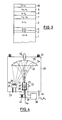
- Fig. 1 is a lens substrate 1 made of a plastic, for. B. CR 39, shown, which is provided with a very thin SiO layer 2, which has a thickness of an atomic layer up to 20 nm.
- This layer 2 essentially serves to bring about better adhesion of a protective layer 3 with a thickness of at least 500 nm made of SiO 2 .
- a directly applied Si0 2 layer adheres poorly to a plastic.
- coated substrates are cyclically immersed in a boiling saline solution for a defined time.
- B. contains 5% NaCI in water, and then quenched in cold water.
- a layer of Si0 2 applied directly to plastic dissolves very quickly in such cooking tests, e.g. B. after 5 to 10 minutes.
- an SiO layer 2 is arranged between the Si0 2 layer 3 and the plastic substrate, which is vapor-deposited with a resistance evaporator boat or an electron beam gun while simultaneously bombarding with plasma and ions, the adhesion of the Si0 2 layer 3 increases considerably. Even after a 40-minute boiling test, no impairments were found on layers 2 and 3.
- CR 39 has a hardness of approx. 180 to 200 N / mm 2 .
- Solid quartz, ie Si0 2 on the other hand has a hardness of 4500 N / mm 2.
- the retention of the protective layer 3 can be adjusted in a very wide range via the plasma and coating parameters. Up to now, betting of approx. 1000 N / mm 2 to almost 4500 N / mm 2 has been achieved using special plasma coatings.
- the abrasion resistance increases with the holding and the layer thickness, whereby with the layer thickness from approx. 3 to 8 ⁇ m, depending on the hardness, a saturation effect occurs in the abrasion resistance.
- CR 39 z. B a thermal expansion coefficient of about 1 10- 4 / K, while the thermal expansion coefficient of quartz, however, is almost negligible.
- a 70 mm CR 39 lens therefore expands by approx. 0.4 mm at a temperature difference of 80 ° C.
- the expansion of quartz on the other hand, is almost 0. The stresses caused thereby place great demands on the adhesion of the layer.
- Si0 2 instead of a suboxide as the starting material.
- Si0 2 Can be evaporated with very low evaporator output. As a result, the temperature load on the substrates is kept as low as possible during the production of the thick protective layer.
- This layer 5 preferably has a refractive index that is smaller than the refractive index of the substrate 1 and larger than the refractive index of the protective layer 3. If CR39 is used as the substrate and the protective layer 3 consists of SiO 2 , the refractive index of the layer 5 is between 1.45 and 1.52.
- the thickness of the layer 5 is approximately 80 to 120 nm, which corresponds to a quarter wavelength at a light wavelength of 550 nm. This measure dampens the oscillations caused by the thickness of the protective layer 3.
- SiO x layer is used as the intermediate layer 6, where x is a numerical value between 1 and 2.
- x is a numerical value between 1 and 2.
- the layers are produced in the following manner and described with reference to FIG. 4.
- the layers are evaporated by means of an electron beam evaporator 21 (see above, Matl, Klug, Zöller).
- a plasma source 22 is arranged in the middle and on the bottom 23 of the system 20 and directed onto an electrically insulating substrate holder 24.
- a cylindrical, electron-emitting LaB 6 cathode 25 is surrounded by a cylindrical anode 26 with a diameter of approximately 50 mm.
- a glow discharge plasma is generated, an inert gas, primarily argon, being supplied via a line 28.
- a cylindrical magnetic coil 29 surrounds the anode 26 and causes the electrons that generate the plasma to move, is considerably enlarged in the axial direction and is considerably reduced in the radial direction.
- the electrons spiral around the magnetic field lines, as a result of which the plasma enters the coating chamber 20.
- an annular magnetic coil 31 is provided on the ceiling 30 of the coating chamber 20 and above the substrate holder 24, with an annular magnetic coil 31 is provided with an inner diameter that is larger than the diameter of the substrate holder.
- the magnetic field of this ring coil 31 and the magnetic field of the solenoid 29 overlap to form a guiding field for the electrons on their way from the cathode 25, which is indirectly heated by a heater 27, which in turn is fed by the power supply 32, and for the entire plasma the plasma source 22 and the substrate holder 24.
- a dome-shaped plasma edge layer is produced in front of the dome-shaped substrate holder 24. Because the potential of the substrate holder 24 is negative relative to the plasma, the ions are accelerated out of the plasma edge layer and bombard a growing film, which is thereby compressed.
- a major advantage of this manufacturing method compared to conventional IAD methods with an ion source is that the ions, which start from a plasma edge layer that forms parallel to the entire inner surface of the substrate holder, are accelerated over a short distance. This is different for an ion source where the acceleration occurs from the bottom of the chamber. 4, the ions from the plasma edge layer are not affected by collisions and energy losses.
- the plasma extends over the entire area between the plasma source 22 and the substrate holder 24, so that the ion source essentially covers the same area as the substrate holder 24.
- an extraction lattice surface is required which almost corresponds to the surface area of the substrate.
- a reactive gas e.g. B. 0 2 , N 2
- a reactive gas is introduced via a line 34 into the chamber 20. Due to the plasma in chamber 20, it is ionized and activated.
- the vaporized material 35 of the electron beam gun 21 must also pass through the plasma from the substrate holder 24 so that it is ionized and activated.
- the plasma source 22 is electrically isolated from the chamber 20 In addition to the discharge voltage supplied, a potential difference is therefore obtained between the source 22 and the chamber 20.
- the source 22 assumes a variable positive potential with respect to the chamber 20, while the substrate holder 24 is almost on top of it same potential as the chamber 20.
- the ion energy is determined by the potential difference between the anode tube 26, which is fed from a direct current source 36 with a positive potential, and the substrate holder 24.
- the changing potential of the source 22 depends on the discharge voltage, the partial pressures of the gases and the strength of the magnetic field.
- the positive "floating" potential of the electric field creates an electric field that reflects the electrons between the source 22 and the substrate holder 24.
- the plasma in front of the substrate holder 24 is dominated by ions. This can be seen from the potential of the substrate holder 24, which is approximately between 3 and 5 volts, based on the chamber wall 20 .
- the discharge parameters are up to 80 V discharge voltage, 70 A discharge current and 5 kW plasma power.
- the pressures amount to 1 x 10- 4 to 8 x 10- 4 mbar with a ratio of 0 2 : Ar of up to 4: 1.
- Any vaporizable starting material e.g. B. oxides and fluorides, can be evaporated in the evaporator 21 because there is no coupling between the plasma source and the evaporator source.
- Si0 2 granulate is used, which is evaporated in the electron beam evaporator 21 with the electron beam generator 40.
- a relatively low evaporator output is required for these granules.
- a multi-cup crucible with small bowls is preferably used, of which only one bowl 41 is shown.
- the SiO adhesive layer is evaporated at a rate of 0.1 nm / s.
- the plasma source 22 is switched on.
- the source 22 is operated in this case mbar with pure argon at a partial pressure of about 2.5 x 10-. 4
- the discharge current is approximately 30 A at a discharge voltage of approximately 30 V.
- the plasma source 22 is switched off at the same time as the evaporator screen is closed.
- the thick Si0 2 protective layer is evaporated.
- the plasma source 22 is operated with argon.
- the hardness of the Si0 2 layer depends on the plasma discharge power, ie current and voltage, the gas pressure and the coating rate.
- the hardness gradient of the layer is set with these parameters. Particularly low hardness values can be achieved with low plasma power «1 kW) at relatively high pressure (approx. 6 x 10- 4 mbar) and a large coating rate (approx. 5 x 10 nm / s).
- the greatest hardness values were achieved in tests carried out with a plasma power of approx. 5 kW at a pressure of 1.5 x 10- 4 mbar at a rate of 0.1 nm / s.
- the first highly refractive layer Ta 2 0s is evaporated.
- other high-index materials such as. As titanium oxide, zirconium oxide, etc. can be used.
- the plasma source is also operated mbar with argon at a pressure of about 2 x 10- 4 22nd
- oxygen is introduced with a partial pressure of about 4 x 10- 4 mbar through the conduit 34 into the chamber twentieth
- An oxygen inlet, not shown, directly into the plasma source, analogous to inlet 28, is also possible.
- the plasma source is operated with a discharge power of approx. 5 kW. The coating rate is approximately 0.2 nm / s.
- the next layer of Si0 2 is basically evaporated like the Si0 2 protective layer, namely at a pressure of 2 x 10- 4 mbar, a plasma power of approx. 4 kW and a coating rate of approx. 0.5 nm / s.
- the evaporation of the following high refractive index layer takes place with the same parameters as the first high refractive index layer.
- the last Si0 2 layer is evaporated like the previous Si0 2 layer.
- the optimal manufacturing parameters of the x / 4-SiO x intermediate layer for damping the oscillations of the spectral curve, which is located between the SiO layer and the protective layer, depend on the hardness and thus the refractive index profile of the protective layer.
- the following parameters are suitable: Print approx. 2 x. 10- 4 mbar, plasma power approx. 4 kW, rate approx. 0.1 nm / s.
- a thermal evaporator or a sputtering cathode can be used instead of an electron beam evaporator. It is only essential that the plasma is generated in a device separate from the electron beam gun, etc. Because the plasma in the plasma source 22 and the small particles to be applied are generated in an evaporator source 21, the uniformity of the coating becomes particularly great. In addition, the coating parameters can be set largely independently of one another, which is of great importance for the production of layers with strength gradients.
- the substrate holder 24, the lower edge of which is designated 33, can be rotated via a shaft 42. It can have numerous lenses or the like to be coated on its underside.
- the substrate holder 24 can have an evaporation protection (not shown) which, when insulating materials are applied, prevents part of the surface of the substrate holder from being coated with these insulating materials and thus allows electrical charges to flow away via the substrate carrier. 4 result from the German patent application P 40 20 158.9 and are therefore not described in detail.
Landscapes
- Physics & Mathematics (AREA)
- General Physics & Mathematics (AREA)
- Optics & Photonics (AREA)
- Chemical & Material Sciences (AREA)
- Inorganic Chemistry (AREA)
- Surface Treatment Of Optical Elements (AREA)
- Physical Vapour Deposition (AREA)
Applications Claiming Priority (2)
| Application Number | Priority Date | Filing Date | Title |
|---|---|---|---|
| DE4128547A DE4128547A1 (de) | 1991-08-28 | 1991-08-28 | Verfahren und vorrichtung fuer die herstellung einer entspiegelungsschicht auf linsen |
| DE4128547 | 1991-08-28 |
Publications (3)
| Publication Number | Publication Date |
|---|---|
| EP0529268A2 true EP0529268A2 (fr) | 1993-03-03 |
| EP0529268A3 EP0529268A3 (en) | 1993-04-28 |
| EP0529268B1 EP0529268B1 (fr) | 1996-09-11 |
Family
ID=6439326
Family Applications (1)
| Application Number | Title | Priority Date | Filing Date |
|---|---|---|---|
| EP92111855A Expired - Lifetime EP0529268B1 (fr) | 1991-08-28 | 1992-07-11 | Couche dure antireflet pour lentille en plastique |
Country Status (7)
| Country | Link |
|---|---|
| US (1) | US5597622A (fr) |
| EP (1) | EP0529268B1 (fr) |
| JP (1) | JPH05196803A (fr) |
| KR (1) | KR100278135B1 (fr) |
| CA (1) | CA2076094C (fr) |
| DE (2) | DE4128547A1 (fr) |
| ES (1) | ES2094257T3 (fr) |
Cited By (11)
| Publication number | Priority date | Publication date | Assignee | Title |
|---|---|---|---|---|
| EP0619504A1 (fr) * | 1993-04-08 | 1994-10-12 | Optische Werke G. Rodenstock | Couche antiréfléchissante |
| EP0698798A3 (fr) * | 1994-08-26 | 1996-05-15 | Leybold Ag | Lentille optique en matière plastique recouverte |
| EP0780707A1 (fr) * | 1995-12-21 | 1997-06-25 | Heraeus Quarzglas GmbH | Elément pour transmission de rayonnement UV à haute énergie et procédé de fabrication d'un tel élément et son application |
| DE19819414A1 (de) * | 1998-04-30 | 1999-11-04 | Leybold Ag | Für ein Kunststoffsubstrat bestimmtes Schichtpaket und Verfahren zum Erzeugen eines solchen Schichtpaketes |
| EP0816881A3 (fr) * | 1996-07-05 | 2003-07-30 | Molex Incorporated | Atténuateur à fibre optique |
| WO2003038141A3 (fr) * | 2001-10-31 | 2003-10-23 | Fraunhofer Ges Forschung | Procede de production d'une couche anti-abrasion transparente absorbant les u.v. |
| EP1162647B1 (fr) * | 2000-06-08 | 2007-02-28 | Satis Vacuum Industries Vertriebs - AG | Source pour évaporation par plasma avec electrode cathodique pour un dispositif de dépot de couche |
| EP2180356A1 (fr) * | 2008-10-24 | 2010-04-28 | Seiko Epson Corporation | Article optique et son procédé de fabrication |
| AT513060A1 (de) * | 2012-06-29 | 2014-01-15 | Zizala Lichtsysteme Gmbh | Abdeckscheibe für das Gehäuse eines Scheinwerfers |
| US8789944B2 (en) | 2010-08-02 | 2014-07-29 | Hoya Lens Manufacturing Philippines Inc. | Optical article and optical article production method |
| WO2018178073A1 (fr) * | 2017-03-29 | 2018-10-04 | Rodenstock Gmbh | Couche dure à gradient ayant un module d'élasticité variable |
Families Citing this family (51)
| Publication number | Priority date | Publication date | Assignee | Title |
|---|---|---|---|---|
| DE4338040C2 (de) * | 1993-11-08 | 1997-01-30 | Leybold Ag | Vorrichtung zum Beschichten von Brillengläsern im Vakuum und Betriebsverfahren hierfür |
| DE4342463C2 (de) * | 1993-12-13 | 1997-03-27 | Leybold Ag | Verfahren und Vorrichtung zum Beschichten von optischen Linsen mit Schutzschichten und mit optischen Schichten im Vakuum |
| DE19513097A1 (de) * | 1995-04-07 | 1996-10-10 | Leybold Ag | Verfahren und Vorrichtung für die H¶2¶O-Zugabe beim plasmaunterstützten Beschichtungsprozeß |
| AU5483196A (en) * | 1995-04-14 | 1996-10-30 | Spectra-Physics Lasers, Inc. | Method for producing dielectric coatings |
| DE19544584A1 (de) * | 1995-11-30 | 1997-06-05 | Leybold Ag | Vakuumbeschichtungsanlage mit einem in der Vakuumkammer angeordneten Tiegel zur Aufnahme von zu verdampfendem Material |
| CA2241678C (fr) * | 1997-06-26 | 2007-08-28 | General Electric Company | Depot de dioxyde de silicium par un procede d'evaporation active par un plasma |
| DE19752889C1 (de) * | 1997-11-28 | 1999-06-24 | Fraunhofer Ges Forschung | Verfahren zur Beschichtung von Oberflächen |
| CA2281265C (fr) * | 1998-09-22 | 2003-12-16 | Toyota Jidosha Kabushiki Kaisha | Methode de fabrication de couches minces destinees a l'optique non lineaire |
| US6660365B1 (en) | 1998-12-21 | 2003-12-09 | Cardinal Cg Company | Soil-resistant coating for glass surfaces |
| US6974629B1 (en) * | 1999-08-06 | 2005-12-13 | Cardinal Cg Company | Low-emissivity, soil-resistant coating for glass surfaces |
| US6964731B1 (en) * | 1998-12-21 | 2005-11-15 | Cardinal Cg Company | Soil-resistant coating for glass surfaces |
| DE19909703A1 (de) * | 1999-03-05 | 2000-09-07 | Schlafhorst & Co W | Vorrichtung zur optischen Garnüberwachung |
| DE19925049C5 (de) | 1999-06-01 | 2005-12-22 | Hella Kgaa Hueck & Co. | Kunststoffscheibe von Kraftfahrzeugscheinwerfern oder Kraftfahrzeugleuchten und Verfahren zu deren Herstellung |
| DE10042413C2 (de) * | 2000-08-30 | 2002-11-07 | Airbus Gmbh | Kabinenfensteranordnung für ein Flugzeug |
| JP2004157497A (ja) * | 2002-09-09 | 2004-06-03 | Shin Meiwa Ind Co Ltd | 光学用反射防止膜及びその成膜方法 |
| US7294404B2 (en) * | 2003-12-22 | 2007-11-13 | Cardinal Cg Company | Graded photocatalytic coatings |
| US20050181177A1 (en) * | 2004-02-18 | 2005-08-18 | Jamie Knapp | Isotropic glass-like conformal coatings and methods for applying same to non-planar substrate surfaces at microscopic levels |
| EP1765740B1 (fr) * | 2004-07-12 | 2007-11-07 | Cardinal CG Company | Revêtements à entretien minime |
| US7923114B2 (en) * | 2004-12-03 | 2011-04-12 | Cardinal Cg Company | Hydrophilic coatings, methods for depositing hydrophilic coatings, and improved deposition technology for thin films |
| US8092660B2 (en) * | 2004-12-03 | 2012-01-10 | Cardinal Cg Company | Methods and equipment for depositing hydrophilic coatings, and deposition technologies for thin films |
| WO2006081006A2 (fr) * | 2004-12-21 | 2006-08-03 | Corning Incorporated | Produits polarisant la lumiere et procedes de fabrication correspondants |
| ES2335408T3 (es) | 2004-12-21 | 2010-03-26 | Corning Incorporated | Productos de polarizacion de la luz y procedimiento para fabricar los mismos. |
| KR100925649B1 (ko) | 2006-01-17 | 2009-11-06 | 최학림 | 적외선 차단 필터 일체형 렌즈 모듈 |
| JP2009534563A (ja) | 2006-04-19 | 2009-09-24 | 日本板硝子株式会社 | 同等の単独の表面反射率を有する対向機能コーティング |
| US7692855B2 (en) * | 2006-06-28 | 2010-04-06 | Essilor International Compagnie Generale D'optique | Optical article having a temperature-resistant anti-reflection coating with optimized thickness ratio of low index and high index layers |
| US20080011599A1 (en) | 2006-07-12 | 2008-01-17 | Brabender Dennis M | Sputtering apparatus including novel target mounting and/or control |
| US8318245B2 (en) * | 2007-02-23 | 2012-11-27 | Essilor International (Compagnie Generale D'optique) | Method for producing an optical article coated with an antireflection or a reflective coating having improved adhesion and abrasion resistance properties |
| FR2913116B1 (fr) * | 2007-02-23 | 2009-08-28 | Essilor Int | Procede de fabrication d'un article optique revetu d'un revetement anti-reflets ou reflechissant ayant des proprietes d'adhesion et de resistance a l'abrasion ameliorees |
| EP1965234B1 (fr) | 2007-02-28 | 2019-03-20 | Corning Incorporated | Articles à polarisation lumineuse et procédé de fabrication correspondant |
| CA2664369A1 (fr) * | 2007-09-14 | 2009-03-19 | Cardinal Cg Company | Revetements a faible entretien et procedes de production de revetements a faible entretien |
| ES2302661B1 (es) * | 2008-02-14 | 2009-10-29 | Indo Internacional S.A. | Lente de base polimerica que comprende una capa endurecedora, una multicapa interferencial y una capa dura intercalada entre ambas, y procedimiento de fabricacion correspondiente. |
| GB2462604B (en) * | 2008-08-11 | 2011-08-10 | Toshiba Res Europ Ltd | Thin film structure and method for fabricating a thin film structure |
| JP2010231172A (ja) * | 2009-03-04 | 2010-10-14 | Seiko Epson Corp | 光学物品およびその製造方法 |
| JP5458732B2 (ja) * | 2009-08-07 | 2014-04-02 | コニカミノルタ株式会社 | 光学素子の製造方法及び光学素子 |
| CN101994087B (zh) * | 2009-08-14 | 2013-04-24 | 鸿富锦精密工业(深圳)有限公司 | 蒸镀装置 |
| US20110229660A1 (en) * | 2010-03-22 | 2011-09-22 | Timothy Ray Reynolds | Ion beam assisted deposition of ophthalmic lens coatings |
| WO2012173596A1 (fr) | 2011-06-13 | 2012-12-20 | Essilor Internation (Compagnie General D'optique) | Procédé permettant d'obtenir des articles optiques offrant des propriétés de résistance à l'abrasion supérieures, et articles dotés d'un revêtement préparés selon un tel procédé |
| US20140043585A1 (en) * | 2012-08-07 | 2014-02-13 | Brian C. Wilson | Method for promoting adhesion of hard coat to optical substrate |
| JP5787917B2 (ja) * | 2013-02-21 | 2015-09-30 | 中外炉工業株式会社 | 成膜方法及び成膜装置 |
| US9366784B2 (en) | 2013-05-07 | 2016-06-14 | Corning Incorporated | Low-color scratch-resistant articles with a multilayer optical film |
| US9110230B2 (en) | 2013-05-07 | 2015-08-18 | Corning Incorporated | Scratch-resistant articles with retained optical properties |
| US11267973B2 (en) | 2014-05-12 | 2022-03-08 | Corning Incorporated | Durable anti-reflective articles |
| US9335444B2 (en) * | 2014-05-12 | 2016-05-10 | Corning Incorporated | Durable and scratch-resistant anti-reflective articles |
| US9790593B2 (en) * | 2014-08-01 | 2017-10-17 | Corning Incorporated | Scratch-resistant materials and articles including the same |
| CN105990081B (zh) * | 2015-02-09 | 2018-09-21 | 中微半导体设备(上海)有限公司 | 等离子体处理装置及其制作方法 |
| EP3770649A1 (fr) | 2015-09-14 | 2021-01-27 | Corning Incorporated | Articles anti-réfléchissants de transmission de lumière élevée et résistants aux rayures |
| WO2018093985A1 (fr) | 2016-11-17 | 2018-05-24 | Cardinal Cg Company | Technologie de revêtement à dissipation statique |
| KR102591065B1 (ko) | 2018-08-17 | 2023-10-19 | 코닝 인코포레이티드 | 얇고, 내구성 있는 반사-방지 구조를 갖는 무기산화물 물품 |
| CN114787666A (zh) * | 2019-12-02 | 2022-07-22 | 日本轻金属株式会社 | 光学构件及其制造方法 |
| US12386101B2 (en) | 2020-07-09 | 2025-08-12 | Corning Incorporated | Textured region of a substrate to reduce specular reflectance incorporating surface features with an elliptical perimeter or segments thereof, and method of making the same |
| CN115365083B (zh) * | 2021-05-17 | 2024-06-11 | 亨泰光学股份有限公司 | 双向阳极电浆化学气相沉积镀膜设备 |
Family Cites Families (45)
| Publication number | Priority date | Publication date | Assignee | Title |
|---|---|---|---|---|
| DE294572C (fr) * | ||||
| US2758510A (en) * | 1949-04-28 | 1956-08-14 | Alois Vogt | Interference filter for sunglasses |
| US3356522A (en) * | 1964-02-10 | 1967-12-05 | Mc Donnell Douglas Corp | Polycarbonate film containing an antireflection coating |
| JPS5622177Y2 (fr) * | 1971-09-01 | 1981-05-25 | ||
| DE2210505A1 (de) * | 1972-03-04 | 1973-09-20 | Zeiss Carl Fa | Verfahren zur herstellung einer entspiegelungsschicht auf optischen elementen aus transparentem thermisch empfindlichem material, insbesondere aus kunststoff |
| US3984581A (en) * | 1973-02-28 | 1976-10-05 | Carl Zeiss-Stiftung | Method for the production of anti-reflection coatings on optical elements made of transparent organic polymers |
| JPS53306B2 (fr) * | 1973-10-16 | 1978-01-07 | ||
| US4052520A (en) * | 1974-09-30 | 1977-10-04 | American Optical Corporation | Process for coating a synthetic polymer sheet material with a durable abrasion-resistant vitreous composition |
| US3991234A (en) * | 1974-09-30 | 1976-11-09 | American Optical Corporation | Process for coating a lens of synthetic polymer with a durable abrasion resistant vitreous composition |
| DE2738044C2 (de) * | 1976-09-27 | 1984-11-29 | AO Inc., Southbridge, Mass. | Linse aus einem synthetischen Polymerisat |
| JPS544152A (en) * | 1977-06-13 | 1979-01-12 | Seiko Epson Corp | Production of reflection preventive film of transparent optical element |
| JPS5423557A (en) * | 1977-07-23 | 1979-02-22 | Ito Kougaku Kougiyou Kk | Optical parts of plastics and method of manufacturing same |
| DE2829279A1 (de) * | 1978-07-04 | 1980-01-17 | Rollei Werke Franke Heidecke | Reflexionsvermindernder mehrschichtenbelag (antireflexbelag) fuer durchsichtige mittelhochbrechende unterlagen |
| JPS55145739A (en) * | 1979-05-04 | 1980-11-13 | Asahi Glass Co Ltd | Forming method of cured siox coating on transparent plastic body |
| JPS5779169A (en) * | 1980-11-06 | 1982-05-18 | Sumitomo Electric Ind Ltd | Physical vapor deposition method |
| JPS5860701A (ja) * | 1981-10-07 | 1983-04-11 | Konishiroku Photo Ind Co Ltd | 反射防止膜 |
| US4590117A (en) * | 1983-03-10 | 1986-05-20 | Toray Industries, Inc. | Transparent material having antireflective coating |
| JPS60130703A (ja) * | 1983-12-20 | 1985-07-12 | Canon Inc | 合成樹脂基板の反射防止膜 |
| JPS60130704A (ja) * | 1983-12-20 | 1985-07-12 | Canon Inc | 合成樹脂基板の反射防止膜 |
| JPS60130701A (ja) * | 1983-12-20 | 1985-07-12 | Canon Inc | 合成樹脂基板の反射防止膜 |
| JPS60131501A (ja) * | 1983-12-21 | 1985-07-13 | Canon Inc | 合成樹脂基板の反射鏡 |
| DE3413019A1 (de) * | 1984-04-06 | 1985-10-17 | Robert Bosch Gmbh, 7000 Stuttgart | Verfahren zum aufbringen einer duennen, transparenten schicht auf der oberflaeche optischer elemente |
| JPS60221566A (ja) * | 1984-04-18 | 1985-11-06 | Agency Of Ind Science & Technol | 薄膜形成装置 |
| US4514437A (en) * | 1984-05-02 | 1985-04-30 | Energy Conversion Devices, Inc. | Apparatus for plasma assisted evaporation of thin films and corresponding method of deposition |
| WO1987002026A1 (fr) * | 1984-05-28 | 1987-04-09 | Shuhara Akira | Procede de production d'un film a base de bioxyde de silicium |
| JPS6115967A (ja) * | 1984-06-29 | 1986-01-24 | Sumitomo Electric Ind Ltd | 表面処理方法 |
| JPS61246361A (ja) * | 1985-04-23 | 1986-11-01 | Toray Ind Inc | コ−テイング層の製造方法および装置 |
| US4673586A (en) * | 1985-10-29 | 1987-06-16 | Cosden Technology, Inc. | Method for making plastic containers having decreased gas permeability |
| JPH0726198B2 (ja) * | 1986-01-29 | 1995-03-22 | 株式会社日立製作所 | 薄膜形成方法及びその装置 |
| US4778721A (en) * | 1986-07-09 | 1988-10-18 | Battelle Memorial Institute | Method of forming abrasion-resistant plasma coatings and resulting articles |
| DE3624467A1 (de) * | 1986-07-19 | 1988-01-28 | Leybold Heraeus Gmbh & Co Kg | Verfahren zum herstellen transparenter schutzschichten aus siliziumverbindungen |
| US4921760A (en) * | 1986-09-26 | 1990-05-01 | Minolta Camera Kabushiki Kaisha | Anti-reflection coating of optical part made of synthetic resin |
| JPS63114957A (ja) * | 1986-10-31 | 1988-05-19 | Hashimoto Forming Co Ltd | 表面硬化プラスチツク成形品の製造方法 |
| CA1268618A (fr) * | 1986-11-05 | 1990-05-08 | William P. Trumble | Methode de fabrication d'un element de guide d'ondes optiques |
| DE3818341C2 (de) * | 1987-06-04 | 1993-10-28 | Olympus Optical Co | Teildurchlässiger Spiegel aus Kunststoff |
| DE3719616A1 (de) * | 1987-06-12 | 1988-12-29 | Leybold Ag | Verfahren und vorrichtung zur beschichtung eines substrats |
| US5015353A (en) * | 1987-09-30 | 1991-05-14 | The United States Of America As Represented By The Secretary Of The Navy | Method for producing substoichiometric silicon nitride of preselected proportions |
| JPH01273001A (ja) * | 1988-04-25 | 1989-10-31 | Olympus Optical Co Ltd | 合成樹脂製光学部品の反射防止膜 |
| JPH0282201A (ja) * | 1988-09-20 | 1990-03-22 | Olympus Optical Co Ltd | 合成樹脂製光学部品の多層膜裏面反射鏡 |
| EP0403985A1 (fr) * | 1989-06-22 | 1990-12-27 | Satis Vacuum AG | Procédé de prétraitement de substrats transparents en matière plastique en vue de leur revêtement sous vide et dispositif de mise en oeuvre de ce procédé |
| US5053245A (en) * | 1989-10-26 | 1991-10-01 | Sanyo Electric Co., Ltd. | Method of improving the quality of an edge surface of a cutting device |
| US5077112A (en) * | 1990-04-12 | 1991-12-31 | Armstrong World Industries, Inc. | Floor covering with inorganic wear layer |
| US5085904A (en) * | 1990-04-20 | 1992-02-04 | E. I. Du Pont De Nemours And Company | Barrier materials useful for packaging |
| DE4020158C2 (de) * | 1990-06-25 | 1998-10-08 | Leybold Ag | Vorrichtung zum Beschichten von Substraten |
| US5415756A (en) * | 1994-03-28 | 1995-05-16 | University Of Houston | Ion assisted deposition process including reactive source gassification |
-
1991
- 1991-08-28 DE DE4128547A patent/DE4128547A1/de not_active Ceased
-
1992
- 1992-07-11 EP EP92111855A patent/EP0529268B1/fr not_active Expired - Lifetime
- 1992-07-11 DE DE59207103T patent/DE59207103D1/de not_active Expired - Fee Related
- 1992-07-11 ES ES92111855T patent/ES2094257T3/es not_active Expired - Lifetime
- 1992-08-08 KR KR1019920014281A patent/KR100278135B1/ko not_active Expired - Fee Related
- 1992-08-13 CA CA002076094A patent/CA2076094C/fr not_active Expired - Fee Related
- 1992-08-28 JP JP4253835A patent/JPH05196803A/ja active Pending
-
1994
- 1994-01-04 US US08/177,638 patent/US5597622A/en not_active Expired - Fee Related
Cited By (12)
| Publication number | Priority date | Publication date | Assignee | Title |
|---|---|---|---|---|
| EP0619504A1 (fr) * | 1993-04-08 | 1994-10-12 | Optische Werke G. Rodenstock | Couche antiréfléchissante |
| EP0698798A3 (fr) * | 1994-08-26 | 1996-05-15 | Leybold Ag | Lentille optique en matière plastique recouverte |
| EP0780707A1 (fr) * | 1995-12-21 | 1997-06-25 | Heraeus Quarzglas GmbH | Elément pour transmission de rayonnement UV à haute énergie et procédé de fabrication d'un tel élément et son application |
| EP0816881A3 (fr) * | 1996-07-05 | 2003-07-30 | Molex Incorporated | Atténuateur à fibre optique |
| DE19819414A1 (de) * | 1998-04-30 | 1999-11-04 | Leybold Ag | Für ein Kunststoffsubstrat bestimmtes Schichtpaket und Verfahren zum Erzeugen eines solchen Schichtpaketes |
| EP1162647B1 (fr) * | 2000-06-08 | 2007-02-28 | Satis Vacuum Industries Vertriebs - AG | Source pour évaporation par plasma avec electrode cathodique pour un dispositif de dépot de couche |
| WO2003038141A3 (fr) * | 2001-10-31 | 2003-10-23 | Fraunhofer Ges Forschung | Procede de production d'une couche anti-abrasion transparente absorbant les u.v. |
| EP2180356A1 (fr) * | 2008-10-24 | 2010-04-28 | Seiko Epson Corporation | Article optique et son procédé de fabrication |
| US8789944B2 (en) | 2010-08-02 | 2014-07-29 | Hoya Lens Manufacturing Philippines Inc. | Optical article and optical article production method |
| AT513060A1 (de) * | 2012-06-29 | 2014-01-15 | Zizala Lichtsysteme Gmbh | Abdeckscheibe für das Gehäuse eines Scheinwerfers |
| AT513060B1 (de) * | 2012-06-29 | 2014-03-15 | Zizala Lichtsysteme Gmbh | Abdeckscheibe für das Gehäuse eines Scheinwerfers |
| WO2018178073A1 (fr) * | 2017-03-29 | 2018-10-04 | Rodenstock Gmbh | Couche dure à gradient ayant un module d'élasticité variable |
Also Published As
| Publication number | Publication date |
|---|---|
| EP0529268A3 (en) | 1993-04-28 |
| CA2076094A1 (fr) | 1993-03-01 |
| DE4128547A1 (de) | 1993-03-04 |
| DE59207103D1 (de) | 1996-10-17 |
| CA2076094C (fr) | 2002-10-15 |
| KR100278135B1 (ko) | 2001-02-01 |
| US5597622A (en) | 1997-01-28 |
| EP0529268B1 (fr) | 1996-09-11 |
| JPH05196803A (ja) | 1993-08-06 |
| ES2094257T3 (es) | 1997-01-16 |
Similar Documents
| Publication | Publication Date | Title |
|---|---|---|
| EP0529268B1 (fr) | Couche dure antireflet pour lentille en plastique | |
| EP0698798A2 (fr) | Lentille optique en matière plastique recouverte | |
| DE69530758T3 (de) | Ionenstrahlverfahren zur herstellung hochabriebfester beschichtungen | |
| DE19983075B3 (de) | Organisches Substrat mit durch Magnetronzerstäubung abgeschiedenen optischen Lagen und Verfahren zur Herstellung desselben, sowie Verwendung eines solchen Verfahrens | |
| EP2801846B1 (fr) | Élément optique doté d'un revêtement à haute diffusivité | |
| DE10241708B4 (de) | Verfahren zur Reduzierung der Grenzflächenreflexion von Kunststoffsubstraten sowie derart modifiziertes Substrat und dessen Verwendung | |
| DE10342398B4 (de) | Schutzschicht für einen Körper sowie Verfahren zur Herstellung und Verwendung von Schutzschichten | |
| EP1537057B1 (fr) | Procede de realisation de couches et de systemes de couches, et substrat recouvert | |
| DE2824818A1 (de) | Ionenstrahl-sputter-implantierverfahren | |
| EP2735018B1 (fr) | Procédé et dispositif de fabrication de couches pauvres en particules sur des substrats | |
| EP0502385A1 (fr) | Procédé pour la production d'un revêtement bilatéral sur les pièces optiques | |
| EP2118691A1 (fr) | Élément optique comprenant une couche anti-condensation et son procédé de réalisation | |
| DE19912737A1 (de) | Verfahren zur Herstellung von porösen SiO¶x¶-Schichten und poröse SiO¶x¶-Schichten | |
| DE3852939T2 (de) | Verfahren zur Beschichtung künstlicher optischer Substrate. | |
| WO1997023661A2 (fr) | Procede de production, par depot sous vide, de couches d'oxyde, d'oxynitrure ou de nitrure modifiees de maniere organique | |
| DE19834314A1 (de) | Verfahren zum Aufbringen einer Kratzschutzschicht und eines Entspiegelungsschichtsystems und Vorrichtung zu seiner Durchführung | |
| DE3627248A1 (de) | Verfahren zur herstellung eines antireflexionsfilms auf organischen linsen oder brillenglaesern | |
| CH686747A5 (de) | Optisches Schichtmaterial. | |
| CH645136A5 (en) | Process and apparatus for treating the surface of optical objects in vacuo | |
| DE19859695A1 (de) | Verfahren zum Beschichten von Substraten aus Kunststoff | |
| EP1655385B1 (fr) | Procédé de dépôt de couches optiques | |
| DE102005017742A1 (de) | Verfahren zur Beschichtung optischer Substrate | |
| DE102005015631B4 (de) | Verfahren zur Herstellung eines reflexionsvermindernden Kratzschutzschichtsystems für Kunststoffe | |
| DE19523442A1 (de) | Verfahren zur Beschichtung von Gegenständen aus Metall oder Metall-Legierungen oder entsprechenden Oberflächen | |
| DE102017003042B3 (de) | Gradienten-Hartschicht mit sich änderndem E-Modul |
Legal Events
| Date | Code | Title | Description |
|---|---|---|---|
| PUAI | Public reference made under article 153(3) epc to a published international application that has entered the european phase |
Free format text: ORIGINAL CODE: 0009012 |
|
| AK | Designated contracting states |
Kind code of ref document: A2 Designated state(s): BE CH DE ES FR GB IT LI LU NL SE |
|
| PUAL | Search report despatched |
Free format text: ORIGINAL CODE: 0009013 |
|
| AK | Designated contracting states |
Kind code of ref document: A3 Designated state(s): BE CH DE ES FR GB IT LI LU NL SE |
|
| 17P | Request for examination filed |
Effective date: 19930616 |
|
| 17Q | First examination report despatched |
Effective date: 19950223 |
|
| GRAH | Despatch of communication of intention to grant a patent |
Free format text: ORIGINAL CODE: EPIDOS IGRA |
|
| GRAH | Despatch of communication of intention to grant a patent |
Free format text: ORIGINAL CODE: EPIDOS IGRA |
|
| GRAA | (expected) grant |
Free format text: ORIGINAL CODE: 0009210 |
|
| AK | Designated contracting states |
Kind code of ref document: B1 Designated state(s): BE CH DE ES FR GB IT LI LU NL SE |
|
| REG | Reference to a national code |
Ref country code: CH Ref legal event code: NV Representative=s name: PATENTANWALTSBUERO FELDMANN AG |
|
| RAP2 | Party data changed (patent owner data changed or rights of a patent transferred) |
Owner name: BALZERS UND LEYBOLD DEUTSCHLAND HOLDING AKTIENGESE |
|
| REF | Corresponds to: |
Ref document number: 59207103 Country of ref document: DE Date of ref document: 19961017 |
|
| ET | Fr: translation filed | ||
| GBT | Gb: translation of ep patent filed (gb section 77(6)(a)/1977) |
Effective date: 19961021 |
|
| NLT2 | Nl: modifications (of names), taken from the european patent patent bulletin |
Owner name: BALZERS UND LEYBOLD DEUTSCHLAND HOLDING AKTIENGESE |
|
| ITF | It: translation for a ep patent filed | ||
| REG | Reference to a national code |
Ref country code: ES Ref legal event code: FG2A Ref document number: 2094257 Country of ref document: ES Kind code of ref document: T3 |
|
| PLBE | No opposition filed within time limit |
Free format text: ORIGINAL CODE: 0009261 |
|
| STAA | Information on the status of an ep patent application or granted ep patent |
Free format text: STATUS: NO OPPOSITION FILED WITHIN TIME LIMIT |
|
| 26N | No opposition filed | ||
| REG | Reference to a national code |
Ref country code: GB Ref legal event code: IF02 |
|
| PGFP | Annual fee paid to national office [announced via postgrant information from national office to epo] |
Ref country code: FR Payment date: 20050614 Year of fee payment: 14 |
|
| PGFP | Annual fee paid to national office [announced via postgrant information from national office to epo] |
Ref country code: GB Payment date: 20050615 Year of fee payment: 14 |
|
| PGFP | Annual fee paid to national office [announced via postgrant information from national office to epo] |
Ref country code: NL Payment date: 20050616 Year of fee payment: 14 |
|
| PGFP | Annual fee paid to national office [announced via postgrant information from national office to epo] |
Ref country code: DE Payment date: 20050617 Year of fee payment: 14 |
|
| PGFP | Annual fee paid to national office [announced via postgrant information from national office to epo] |
Ref country code: CH Payment date: 20050620 Year of fee payment: 14 |
|
| PGFP | Annual fee paid to national office [announced via postgrant information from national office to epo] |
Ref country code: SE Payment date: 20050622 Year of fee payment: 14 |
|
| PGFP | Annual fee paid to national office [announced via postgrant information from national office to epo] |
Ref country code: LU Payment date: 20050627 Year of fee payment: 14 |
|
| PGFP | Annual fee paid to national office [announced via postgrant information from national office to epo] |
Ref country code: BE Payment date: 20050628 Year of fee payment: 14 |
|
| PGFP | Annual fee paid to national office [announced via postgrant information from national office to epo] |
Ref country code: ES Payment date: 20050705 Year of fee payment: 14 |
|
| PG25 | Lapsed in a contracting state [announced via postgrant information from national office to epo] |
Ref country code: GB Free format text: LAPSE BECAUSE OF NON-PAYMENT OF DUE FEES Effective date: 20060711 |
|
| PG25 | Lapsed in a contracting state [announced via postgrant information from national office to epo] |
Ref country code: SE Free format text: LAPSE BECAUSE OF NON-PAYMENT OF DUE FEES Effective date: 20060712 |
|
| PG25 | Lapsed in a contracting state [announced via postgrant information from national office to epo] |
Ref country code: LI Free format text: LAPSE BECAUSE OF NON-PAYMENT OF DUE FEES Effective date: 20060731 Ref country code: CH Free format text: LAPSE BECAUSE OF NON-PAYMENT OF DUE FEES Effective date: 20060731 Ref country code: BE Free format text: LAPSE BECAUSE OF NON-PAYMENT OF DUE FEES Effective date: 20060731 |
|
| PGFP | Annual fee paid to national office [announced via postgrant information from national office to epo] |
Ref country code: IT Payment date: 20060731 Year of fee payment: 15 |
|
| PG25 | Lapsed in a contracting state [announced via postgrant information from national office to epo] |
Ref country code: NL Free format text: LAPSE BECAUSE OF NON-PAYMENT OF DUE FEES Effective date: 20070201 Ref country code: DE Free format text: LAPSE BECAUSE OF NON-PAYMENT OF DUE FEES Effective date: 20070201 |
|
| REG | Reference to a national code |
Ref country code: CH Ref legal event code: PL |
|
| EUG | Se: european patent has lapsed | ||
| GBPC | Gb: european patent ceased through non-payment of renewal fee |
Effective date: 20060711 |
|
| NLV4 | Nl: lapsed or anulled due to non-payment of the annual fee |
Effective date: 20070201 |
|
| REG | Reference to a national code |
Ref country code: FR Ref legal event code: ST Effective date: 20070330 |
|
| REG | Reference to a national code |
Ref country code: ES Ref legal event code: FD2A Effective date: 20060712 |
|
| BERE | Be: lapsed |
Owner name: *BALZERS AND LEYBOLD DEUTSCHLAND HOLDING A.G. Effective date: 20060731 |
|
| PG25 | Lapsed in a contracting state [announced via postgrant information from national office to epo] |
Ref country code: ES Free format text: LAPSE BECAUSE OF NON-PAYMENT OF DUE FEES Effective date: 20060712 |
|
| PG25 | Lapsed in a contracting state [announced via postgrant information from national office to epo] |
Ref country code: FR Free format text: LAPSE BECAUSE OF NON-PAYMENT OF DUE FEES Effective date: 20060731 |
|
| PG25 | Lapsed in a contracting state [announced via postgrant information from national office to epo] |
Ref country code: LU Free format text: LAPSE BECAUSE OF NON-PAYMENT OF DUE FEES Effective date: 20060711 |
|
| PG25 | Lapsed in a contracting state [announced via postgrant information from national office to epo] |
Ref country code: IT Free format text: LAPSE BECAUSE OF NON-PAYMENT OF DUE FEES Effective date: 20070711 |