EP0531272B1 - Compositions caoutchoutiques avec teintement et décoloration reduits - Google Patents
Compositions caoutchoutiques avec teintement et décoloration reduits Download PDFInfo
- Publication number
- EP0531272B1 EP0531272B1 EP19920870129 EP92870129A EP0531272B1 EP 0531272 B1 EP0531272 B1 EP 0531272B1 EP 19920870129 EP19920870129 EP 19920870129 EP 92870129 A EP92870129 A EP 92870129A EP 0531272 B1 EP0531272 B1 EP 0531272B1
- Authority
- EP
- European Patent Office
- Prior art keywords
- rubber
- carbon atoms
- composition
- cyclohexyl
- alkoxyaniline
- Prior art date
- Legal status (The legal status is an assumption and is not a legal conclusion. Google has not performed a legal analysis and makes no representation as to the accuracy of the status listed.)
- Expired - Lifetime
Links
Classifications
-
- C—CHEMISTRY; METALLURGY
- C08—ORGANIC MACROMOLECULAR COMPOUNDS; THEIR PREPARATION OR CHEMICAL WORKING-UP; COMPOSITIONS BASED THEREON
- C08K—Use of inorganic or non-macromolecular organic substances as compounding ingredients
- C08K5/00—Use of organic ingredients
- C08K5/16—Nitrogen-containing compounds
- C08K5/17—Amines; Quaternary ammonium compounds
- C08K5/18—Amines; Quaternary ammonium compounds with aromatically bound amino groups
Definitions
- This invention relates to rubber compositions having desirable properties inclusive of reduced staining and discoloration. These benefits are achieved through the use of additive levels of a selected class of N-disubstituted alkoxyanilines.
- the rubber compositions in addition to the reduced staining and discoloration benefits, show improved flex properties and thus longer fatigue life.
- the claimed compositions herein are contain less than 4% of phenylenediamine anti-ozonants.
- US patent 3. 466. 248 discloses anti-ozonant compositions for use in rubber containing specific phenylene diamine derivatives in combination with a further substituted compound inclusive of N-dialkyl alkoxyaniline.
- the diamine component represents from 50% to 90% and the alkoxyaniline from 50% to 10% of a mixture of these components.
- GB-patent 852.932 relates to rubber chemicals which are capable of promoting effective antidegradant and anti-oxidant properties in rubber.
- Suitable rubber chemicals can be represented by N-mono-substituted alkoxyanilines. The rubber chemicals provide anti-ozonant properties and they do not seriously discolor light-colored rubber stocks.
- a further aim of the invention is to provide rubber compositions having good anti-oxidant and valuable anti-ozonant properties while maintaining the non-staining and non-discoloring properties of the rubber compositions.
- the foregoing and other desirable benefits can now be secured from rubber compositions containing additive levels of a narrowly defined class of alkoxy anilines.
- the rubber compositions of the invention contain less than 4% of phenylene diamine anti-degradants.
- rubber compositions can be formulated having a cumulative series of desirable properties, inclusive of non-staining, non-discoloring, antifatigue, anti-ozonant and anti-oxidant properties.
- Such rubber compositions basically comprise an additive level, generally from 0.1 to 10 phr, of a para substituted alkoxyaniline having the formula wherein R 1 O is an alkoxy substituent in the benzene nucleus, R 1 , R 2 or R 3 is independently selected from straight or branched alkyl groups having from 1 to 20 carbon atoms, the chain of carbon atoms being possibly interrupted by ether or sulphide linkages, cycloalkyl and cycloalkenyl having from 4 to 8 carbon atoms, said cyclic structure optionally containing an oxygen atom in between two carbon atoms, alkenyls and alkynyls having from 2 to 20 carbon atoms in the chain structure, aralkyls containing 7 or more carbon atom
- the inventive benefits particularly non-staining and non-discoloring are readily available provided the rubber compositions are substantially free of N,N'-substituted-p-phenylene diamines. Subadditive levels of such phenylene diamines are not necessarily incompatible with the procurement of the inventive benefits.
- the substituents R 1 , R 2 and R 3 which can be identical or different, can be selected from a variety of chemical moieties. Such substituents can be selected from straight or branched alkyl groups having from 1 to 20, preferably 1 to 8 carbon atoms, whereby the carbon chain can be optionally interrupted by ether or sulfide linkages.
- the R substituents can also be selected from cycloalkyl and cycloalkenyl groups having from 4 to 8 carbon atoms and which cyclic groups can optionally contain an oxygen atom inbetween carbon atoms.
- the R substituents can also be selected from alkenyls and alkynyls having from 2 to 20, preferably 2 to 12 carbon atoms in the chain structure, and from aralkyls containing 7 or more carbon atoms. Combinations of the foregoing substituents can be made and frequently represent preferred substituents.
- R 1 is most preferably represented by C 1 to C 6 alkyl groups such as methyl, ethyl, butyl and hexyl.
- Preferred R 2 and R 3 moieties can be selected from cyclohexyl and, straight or branched alkyl, groups having from 1 to 8 carbon atoms.
- Preferred alkoxyaniline species herein include : N-methyl-N-cyclohexyl-4-hexyloxy-aniline. N-methyl-N-1,3-dimethylbutyl-4-ethoxy-aniline N-methyl-N-1,3-dimethylbutyl-4-hexyloxy-aniline N-methyl-N-cyclohexyl-4-hexyloxy-aniline N-methyl-N-cyclohexyl-4-butoxy-aniline N-methyl-N-di(1,3-dimethylbutyl)-4-ethoxy-aniline
- Specifically preferred species herein include : N-butyl-N-cyclohexyl-4-methoxy-aniline N-allyl-N-cyclohexyl-4-methoxy-aniline N-but-2-enyl-N-cyclohexyl-4-ethoxy-aniline
- aromatic nucleus of the alkoxyanilines can be substituted optionally by additional group(s) which do not interfere with the obtaining of the beneficial properties of the inventive compositions herein.
- the essential para substituted alkoxyaniline component can be represented by the freebase or by salts formed by the addition of acids to the alkoxyanilines.
- carboxylic acids such as stearic or acetic acids
- inorganic acids such as hydrochloric acid
- the para alkoxyaniline generally represents from 0.1 to 10, preferably from 0.5 to 6, more preferably from 1 to 4 phr. where phr means "part per hundred parts of rubber”.
- the rubber compositions herein are preferably substantially free of N,N'-substituted-p-phenylenediamines as e.g. known from US patent 3.466.248.
- said substituted phenylenediamines can be tolerated at a level which is less than 4%, by weight of the sum of the amounts of the substituted alkoxyaniline and the phenylenediamine.
- the substituted alkoxyanilines are especially effective in compositions in which the rubber is unsaturated such as cis-polyisoprene, either natural or synthetic and other rubbers, including for example poly-1,3-butadiene, copolymers of 1,3- butadiene with other monomers, for example styrene, acrylonitrile, isobutylene and methyl methacrylate, ethylene-propylene-diene terpolymers (EPDM), functionalised EPDM such as maleic acid- grafted EPDM, and halogen-containing rubbers such as chlorobutyl, bromobutyl and chloroprene rubbers.
- EPDM ethylene-propylene-diene terpolymers
- functionalised EPDM such as maleic acid- grafted EPDM
- halogen-containing rubbers such as chlorobutyl, bromobutyl and chloroprene rubbers.
- the rubber polymer in a rubber composition of the invention can be a blend of two or more of the rubbers exemplified above, for example a blend of natural rubber and styrene-butadiene rubber. Particularly preferred are blends of rubber for use in the sidewalls of tires.
- the alkoxyanilines are effective in improving and upgrading a broad spectrum of physical properties of the rubber vulcanisate. They are particularly useful in fully compounded rubber stocks containing a reinforcing agent and/or a filler, a vulcanising agent, and, a conventional process aid, such as a processing oil or mixtures of the like aids, and accelerators.
- Conventionally used fillers include carbon black, china clay, titanium oxide, talc, silica and others as may be required to achieve specific qualities, properties and benefits of the rubber vulcanisate which typically are used in amounts of from 30 to 100 parts by weight per 100 parts by weight of rubber.
- additives include, for example, zinc oxide, which may be used in an amount of, for instance, from 2 to 10 parts by weight per 100 parts by weight of rubber; stearic acid at a level of, for instance, from 0.5 to 2 parts by weight per 100 parts by weight of rubber and anti-oxidants.
- the rubber stocks may also contain metal oxide activators other than zinc oxide, for example magnesium oxide, pre- vulcanisation inhibitors, for instance N-cyclohexyl-thio- phthalimide, and post-vulcanisation stabilisers and rubber-metal bonding promoters, for example the thiosulphate derivatives described in EP-B-0 070 143 and EP-B-109 955.
- the para alkoxyanilines can be incorporated into the rubber, together with additives, except the vulcanising agent and the vulcanisation accelerator, during a first stage mixing, using, for example, an internal mixer or a mill.
- the anilines can be incorporated along with the vulcanising agent and accelerator during a second stage mixing. If sulphur is used as the vulcanising agent, the amount is typically in the range from 0.3 to 9 parts by weight per 100 parts by weight of rubber.
- Accelerators which can be used include the benzothiazole-2-sulphenamides, for instance N-isopropyl-benzothiazole-2-sulphenamide, N-tert-butyl-benzothiazole-2-sulphenamide, N-cyclohexyl-benzo-thiazole-2-sulphenamide, N,N-dicyclohexylbenzothiazole-2-sulphenamide 2-(morpholinothio)benzothiazole, N,N-di(benzthiazolylthio)-t-butylamine and dithiocarbamates
- these are typically used in amounts of from 0.3 to 6 parts by weight per 100 parts by weight of rubber depending on the nature of the rubber, the amount of sulphur, and the properties required in the cured rubber.
- Other curing systems using sulphur donors for example dimorpholine disulphide, can be used.
- the alkoxyanilines herein can be incorporated into the rubber by conventional mixing procedures. In the processing of natural rubber it is customary to subject the raw rubber to a mastication before the introduction of any additives.
- the EPDM was pre-blended with the SBR 1502 in an internal mixer, the Mooney viscosity of the blend was measured and natural rubber was separately pre-masticated to the same viscosity.
- These two gum rubbers were blended, other ingredients were added in an internal mixer, a Banbury size OOC, along with alkoxyaniline test compound at 2 phr, or 3 phr.
- Ozone resistance was judged on a scale from 10 (no initial cracks or cut of the rubber surface) , through intermediate stages of cracking, finally to zero rating (breakage of the sample) when the rubber test pieces were flexed on a Ross flexing apparatus described in ASTM D 1502, for the periods of time noted in an atmosphere of air in which the ozone concentration had been augmented to 15 parts per hundred million (pphm) at 25°C.
- the alkoxyanilines in accordance with the invention provide superior fatigue lives to those of the control (no antidegradant) or the commercial antidegradant (Note 1).
- the alkoxyanilines provide a degree of ozone resistance.
- the alkoxyanilines in masterbatch III either do not stain by the contact procedure described above or only in a minor way : thus they are generally superior in this respect to the phenolic antidegradant (Note 1) and vastly superior to the para-phenylene diamine antidegradant (Note 2).
- the alkoxyanilines of the invention at 3 phr, in masterbatch III mostly do not discolor unlike the para-phenylene diamine at the same level.
Landscapes
- Chemical & Material Sciences (AREA)
- Health & Medical Sciences (AREA)
- Chemical Kinetics & Catalysis (AREA)
- Medicinal Chemistry (AREA)
- Polymers & Plastics (AREA)
- Organic Chemistry (AREA)
- Compositions Of Macromolecular Compounds (AREA)
Claims (7)
- Composition de caoutchouc contenant un caoutchouc et des additifs, dont des agents de performance et de vulcanisation, caractérisée en ce que la composition comprend de 0,1 à 10 ppc d'une alcoxyaniline para-substituée de formule générale:dans laquelle R1O est un substituant alcoxy sur le noyau benzénique, R1, R2 ou R3 est choisi, indépendamment, parmi des groupes alkyles à chaíne droite ou ramifiée ayant de 1 à 20 atomes de carbone, la chaíne d'atomes de carbone pouvant éventuellement être interrompue par des liaisons éther ou sulfure, des groupes cycloalkyles et cycloalcényles ayant de 4 à 8 atomes de carbone, ladite structure cyclique contenant, éventuellement, un atome d'oxygène intercalé entre deux atomes de carbone, des groupes alcényles et alcynyles ayant de 2 à 20 atomes de carbone dans la structure de la chaíne, des groupes aralkyles contenant 7 atomes de carbone ou plus, ou des combinaisons de ceux-ci, à condition que la composition contienne moins de 4 % d'agents anti-ozone à base de phénylène diamine.
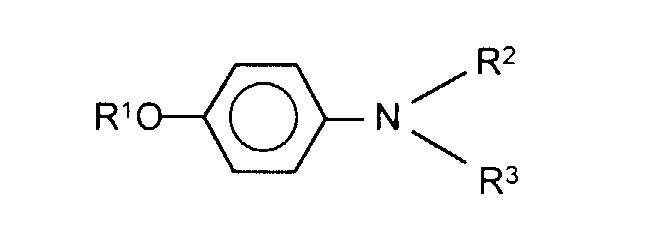
- La composition selon la revendication 1, dans laquelle R' est un groupe alkyle ayant de 1 à 6 atomes de carbone ou un groupe benzyle.
- La composition selon la revendication 1, dans laquelle la para-alcoxyaniline est utilisée en une quantité de 0,2 à 5 ppc.
- La composition selon la revendication 1, dans laquelle R2 ou R3 est choisi, indépendamment, parmi un groupe alkyle ayant de 1 à 6 atomes de carbone, un groupe cyclohexyle et benzyle.
- La composition selon les revendications 2 et 4, dans laquelle la para-alcoxyaniline est utilisée en une quantité de 0,4 à 4 ppc.
- Une composition à base de caoutchouc contenant un caoutchouc et des additifs, dont des agents de fabrication et de vulcanisation, caractérisée en ce que la composition comprend de 0,1 à 10 ppc d'une alcoxyaniline para-substituée choisie parmi la N-butyl-N-cyclohexyl-4-éthoxy-aniline, la N-éthyl-N-cyclohexyl-4-éthoxy-aniline, la N-butyl-N-1,3-diméthylbutyl-4-éthoxy-aniline et la N-butyl-N-1,3-diméthylbutyl-4-butoxy-aniline, à condition que lorsqu'une N,N'-p-phénylène diamine substituée est présente, la teneur en cette diamine représente moins de 10 % en poids de la somme des quantités de l'alcoxyaniline substituée et de la phénylène diamine.
- La composition selon la revendication 6, dans laquelle la para-alcoxyaniline est choisie parmi la N-butyl-N-cyclohexyl-4-méthoxy-aniline, la N-allyl-N-cyclohexyl-4-méthoxy-aniline, et la N-but-2-ényl-N-cyclohexyl-4-éthoxy-aniline.
Priority Applications (1)
| Application Number | Priority Date | Filing Date | Title |
|---|---|---|---|
| EP19920870129 EP0531272B1 (fr) | 1991-08-26 | 1992-08-25 | Compositions caoutchoutiques avec teintement et décoloration reduits |
Applications Claiming Priority (3)
| Application Number | Priority Date | Filing Date | Title |
|---|---|---|---|
| EP91870131 | 1991-08-26 | ||
| EP91870131A EP0529179A1 (fr) | 1991-08-26 | 1991-08-26 | Compositions caoutchoutiques avec coloration et décoloration réduits |
| EP19920870129 EP0531272B1 (fr) | 1991-08-26 | 1992-08-25 | Compositions caoutchoutiques avec teintement et décoloration reduits |
Publications (2)
| Publication Number | Publication Date |
|---|---|
| EP0531272A1 EP0531272A1 (fr) | 1993-03-10 |
| EP0531272B1 true EP0531272B1 (fr) | 1999-09-22 |
Family
ID=26130365
Family Applications (1)
| Application Number | Title | Priority Date | Filing Date |
|---|---|---|---|
| EP19920870129 Expired - Lifetime EP0531272B1 (fr) | 1991-08-26 | 1992-08-25 | Compositions caoutchoutiques avec teintement et décoloration reduits |
Country Status (1)
| Country | Link |
|---|---|
| EP (1) | EP0531272B1 (fr) |
Family Cites Families (2)
| Publication number | Priority date | Publication date | Assignee | Title |
|---|---|---|---|---|
| DE1941691C3 (de) * | 1969-08-16 | 1974-05-30 | Universal Oil Products Co., Des Plaines, Ill. (V.St.A.) | Ozonschutzmittel für Kautschuk |
| DE2540618C2 (de) * | 1975-09-12 | 1983-12-15 | Neynaber Chemie Gmbh, 2854 Loxstedt | Zusatzmittel zu Formmassen auf Basis von wärmehärtbaren Kondensationsharzen für deren formgebende Verarbeitung |
-
1992
- 1992-08-25 EP EP19920870129 patent/EP0531272B1/fr not_active Expired - Lifetime
Also Published As
| Publication number | Publication date |
|---|---|
| EP0531272A1 (fr) | 1993-03-10 |
Similar Documents
| Publication | Publication Date | Title |
|---|---|---|
| US6825282B2 (en) | Diene rubber compounds for improved rubber moldings | |
| JP3142653B2 (ja) | ジエンゴム加硫物の製法 | |
| US6329457B1 (en) | Cure parameters in rubber vulcanization | |
| KR100193491B1 (ko) | 항공기 타이어용 카카스에 쓰이는 항-리버전 고무조성물 | |
| US6201049B1 (en) | Rubber composition for tire sidewall | |
| US5939493A (en) | Pneumatic tire | |
| JP2010501660A (ja) | ゴム加硫物の網目構造安定化改善のための新規なスルフェンアミド加硫促進剤 | |
| US4119588A (en) | Reversion resistant rubber compositions with thio carbamyl sulfenamides | |
| EP0531272B1 (fr) | Compositions caoutchoutiques avec teintement et décoloration reduits | |
| EP0529179A1 (fr) | Compositions caoutchoutiques avec coloration et décoloration réduits | |
| JPH06234885A (ja) | 加工性及びゴム加硫物特性の改良されたゴム組成物 | |
| KR100505733B1 (ko) | 타이어 고무 조성물 | |
| JPS5887138A (ja) | タイヤ用ゴム組成物 | |
| JP2003514939A (ja) | ゴム配合物およびその製造法 | |
| JPH0920836A (ja) | 耐久性ゴム組成物 | |
| KR100250641B1 (ko) | 액상 epdm고무를 함유하는 고무조성물 | |
| KR100911613B1 (ko) | 폴리부텐을 함유한 타이어 고무조성물 | |
| KR100738671B1 (ko) | 블로우 아웃이 향상된 언더트레드 고무조성물 | |
| KR100233228B1 (ko) | 타이어 림부 고무 조성물 | |
| EP0864604A2 (fr) | Composition de caoutchouc | |
| US4791173A (en) | Tire tread rubber compositions | |
| US6476109B1 (en) | Rubber composition comprised of cis-1,4-polyisoprene and 4,4′-(para or meta-phenylenedilsopropylidine) dianiline and articles, including tires, having at least one component comprised thereof | |
| US4714742A (en) | Cyanamide derivatives as vulcanization rate modifiers | |
| SU1616933A1 (ru) | Вулканизуема резинова смесь | |
| JP3746368B2 (ja) | ゴム組成物 |
Legal Events
| Date | Code | Title | Description |
|---|---|---|---|
| PUAI | Public reference made under article 153(3) epc to a published international application that has entered the european phase |
Free format text: ORIGINAL CODE: 0009012 |
|
| AK | Designated contracting states |
Kind code of ref document: A1 Designated state(s): AT BE CH DE ES FR GB IT LI LU NL SE |
|
| 17P | Request for examination filed |
Effective date: 19930828 |
|
| 17Q | First examination report despatched |
Effective date: 19960507 |
|
| RAP1 | Party data changed (applicant data changed or rights of an application transferred) |
Owner name: SOLUTIA EUROPE N.V./S.A. |
|
| GRAG | Despatch of communication of intention to grant |
Free format text: ORIGINAL CODE: EPIDOS AGRA |
|
| GRAG | Despatch of communication of intention to grant |
Free format text: ORIGINAL CODE: EPIDOS AGRA |
|
| GRAH | Despatch of communication of intention to grant a patent |
Free format text: ORIGINAL CODE: EPIDOS IGRA |
|
| GRAH | Despatch of communication of intention to grant a patent |
Free format text: ORIGINAL CODE: EPIDOS IGRA |
|
| GRAA | (expected) grant |
Free format text: ORIGINAL CODE: 0009210 |
|
| AK | Designated contracting states |
Kind code of ref document: B1 Designated state(s): AT BE CH DE ES FR GB IT LI LU NL SE |
|
| PG25 | Lapsed in a contracting state [announced via postgrant information from national office to epo] |
Ref country code: SE Free format text: THE PATENT HAS BEEN ANNULLED BY A DECISION OF A NATIONAL AUTHORITY Effective date: 19990922 Ref country code: NL Free format text: LAPSE BECAUSE OF FAILURE TO SUBMIT A TRANSLATION OF THE DESCRIPTION OR TO PAY THE FEE WITHIN THE PRESCRIBED TIME-LIMIT Effective date: 19990922 Ref country code: LI Free format text: LAPSE BECAUSE OF FAILURE TO SUBMIT A TRANSLATION OF THE DESCRIPTION OR TO PAY THE FEE WITHIN THE PRESCRIBED TIME-LIMIT Effective date: 19990922 Ref country code: CH Free format text: LAPSE BECAUSE OF FAILURE TO SUBMIT A TRANSLATION OF THE DESCRIPTION OR TO PAY THE FEE WITHIN THE PRESCRIBED TIME-LIMIT Effective date: 19990922 Ref country code: BE Free format text: LAPSE BECAUSE OF FAILURE TO SUBMIT A TRANSLATION OF THE DESCRIPTION OR TO PAY THE FEE WITHIN THE PRESCRIBED TIME-LIMIT Effective date: 19990922 Ref country code: AT Free format text: LAPSE BECAUSE OF FAILURE TO SUBMIT A TRANSLATION OF THE DESCRIPTION OR TO PAY THE FEE WITHIN THE PRESCRIBED TIME-LIMIT Effective date: 19990922 |
|
| REF | Corresponds to: |
Ref document number: 184894 Country of ref document: AT Date of ref document: 19991015 Kind code of ref document: T |
|
| REG | Reference to a national code |
Ref country code: CH Ref legal event code: EP |
|
| REF | Corresponds to: |
Ref document number: 69230023 Country of ref document: DE Date of ref document: 19991028 |
|
| ET | Fr: translation filed | ||
| ITF | It: translation for a ep patent filed | ||
| REG | Reference to a national code |
Ref country code: ES Ref legal event code: FG2A Ref document number: 2137939 Country of ref document: ES Kind code of ref document: T3 |
|
| NLV1 | Nl: lapsed or annulled due to failure to fulfill the requirements of art. 29p and 29m of the patents act | ||
| REG | Reference to a national code |
Ref country code: CH Ref legal event code: PL |
|
| PLBE | No opposition filed within time limit |
Free format text: ORIGINAL CODE: 0009261 |
|
| 26N | No opposition filed | ||
| REG | Reference to a national code |
Ref country code: GB Ref legal event code: IF02 |
|
| PGFP | Annual fee paid to national office [announced via postgrant information from national office to epo] |
Ref country code: FR Payment date: 20020731 Year of fee payment: 11 |
|
| PGFP | Annual fee paid to national office [announced via postgrant information from national office to epo] |
Ref country code: GB Payment date: 20020821 Year of fee payment: 11 |
|
| PGFP | Annual fee paid to national office [announced via postgrant information from national office to epo] |
Ref country code: LU Payment date: 20020826 Year of fee payment: 11 |
|
| PGFP | Annual fee paid to national office [announced via postgrant information from national office to epo] |
Ref country code: DE Payment date: 20020830 Year of fee payment: 11 |
|
| PGFP | Annual fee paid to national office [announced via postgrant information from national office to epo] |
Ref country code: ES Payment date: 20020909 Year of fee payment: 11 |
|
| PG25 | Lapsed in a contracting state [announced via postgrant information from national office to epo] |
Ref country code: LU Free format text: LAPSE BECAUSE OF NON-PAYMENT OF DUE FEES Effective date: 20030825 Ref country code: GB Free format text: LAPSE BECAUSE OF NON-PAYMENT OF DUE FEES Effective date: 20030825 |
|
| PG25 | Lapsed in a contracting state [announced via postgrant information from national office to epo] |
Ref country code: ES Free format text: LAPSE BECAUSE OF NON-PAYMENT OF DUE FEES Effective date: 20030826 |
|
| PG25 | Lapsed in a contracting state [announced via postgrant information from national office to epo] |
Ref country code: DE Free format text: LAPSE BECAUSE OF NON-PAYMENT OF DUE FEES Effective date: 20040302 |
|
| GBPC | Gb: european patent ceased through non-payment of renewal fee | ||
| PG25 | Lapsed in a contracting state [announced via postgrant information from national office to epo] |
Ref country code: FR Free format text: LAPSE BECAUSE OF NON-PAYMENT OF DUE FEES Effective date: 20040430 |
|
| REG | Reference to a national code |
Ref country code: FR Ref legal event code: ST |
|
| REG | Reference to a national code |
Ref country code: ES Ref legal event code: FD2A Effective date: 20030826 |
|
| PG25 | Lapsed in a contracting state [announced via postgrant information from national office to epo] |
Ref country code: IT Free format text: LAPSE BECAUSE OF NON-PAYMENT OF DUE FEES;WARNING: LAPSES OF ITALIAN PATENTS WITH EFFECTIVE DATE BEFORE 2007 MAY HAVE OCCURRED AT ANY TIME BEFORE 2007. THE CORRECT EFFECTIVE DATE MAY BE DIFFERENT FROM THE ONE RECORDED. Effective date: 20050825 |