EP0536722A2 - Verfahren zur Erhöhung der Halbbildfrequenz eines aus einem HDTV-Signal erzeugten Bildes, das in Form einer Sequenz von Abtastwerken ankommt - Google Patents
Verfahren zur Erhöhung der Halbbildfrequenz eines aus einem HDTV-Signal erzeugten Bildes, das in Form einer Sequenz von Abtastwerken ankommt Download PDFInfo
- Publication number
- EP0536722A2 EP0536722A2 EP92117122A EP92117122A EP0536722A2 EP 0536722 A2 EP0536722 A2 EP 0536722A2 EP 92117122 A EP92117122 A EP 92117122A EP 92117122 A EP92117122 A EP 92117122A EP 0536722 A2 EP0536722 A2 EP 0536722A2
- Authority
- EP
- European Patent Office
- Prior art keywords
- field
- rate
- picture
- sub
- sampling
- Prior art date
- Legal status (The legal status is an assumption and is not a legal conclusion. Google has not performed a legal analysis and makes no representation as to the accuracy of the status listed.)
- Withdrawn
Links
Images

Classifications
-
- H—ELECTRICITY
- H04—ELECTRIC COMMUNICATION TECHNIQUE
- H04N—PICTORIAL COMMUNICATION, e.g. TELEVISION
- H04N7/00—Television systems
- H04N7/01—Conversion of standards, e.g. involving analogue television standards or digital television standards processed at pixel level
- H04N7/0127—Conversion of standards, e.g. involving analogue television standards or digital television standards processed at pixel level by changing the field or frame frequency of the incoming video signal, e.g. frame rate converter
- H04N7/0132—Conversion of standards, e.g. involving analogue television standards or digital television standards processed at pixel level by changing the field or frame frequency of the incoming video signal, e.g. frame rate converter the field or frame frequency of the incoming video signal being multiplied by a positive integer, e.g. for flicker reduction
-
- H—ELECTRICITY
- H04—ELECTRIC COMMUNICATION TECHNIQUE
- H04N—PICTORIAL COMMUNICATION, e.g. TELEVISION
- H04N7/00—Television systems
- H04N7/01—Conversion of standards, e.g. involving analogue television standards or digital television standards processed at pixel level
- H04N7/0125—Conversion of standards, e.g. involving analogue television standards or digital television standards processed at pixel level one of the standards being a high definition standard
-
- H—ELECTRICITY
- H04—ELECTRIC COMMUNICATION TECHNIQUE
- H04N—PICTORIAL COMMUNICATION, e.g. TELEVISION
- H04N7/00—Television systems
- H04N7/015—High-definition television systems
- H04N7/0152—High-definition television systems using spatial or temporal subsampling
- H04N7/0155—High-definition television systems using spatial or temporal subsampling using pixel blocks
Definitions
- the invention relates to a high definition television, HDTV receiver and more particularly to a method to increase the scanning rate over the original rate for a picture processed from a received HDTV signal.
- the European High Definition Television, HDTV is transmitted via satellite or cable using the MAC system, which is incompatible with all traditional television systems. Therefore the present receivers require a special decoder in order to receive a MAC transmission.
- the received compressed picture 625/2:1/50 Hz must be restored into the original HDTV format or 1250/2:1/50 Hz.
- the received analog television signal is converted into video, data and voice signals.
- the decoder could be called a bandwidth restoration decoder (BRD) and below it is briefly described with reference to figure 1.
- the description refers to the luminance signal.
- the received sampling frequency is 13,5 MHz and the output frequency of the BRD is 54 MHz.
- the coder comprises a "line deshuffler" block 1; from 3 to 6 field delays which can be field memories 2, e.g. coupled in a cascade; a sub-sampling converter 3; and three interpolator branches 4, 5 and 6. Because the transmission has a reduced line rate the received samples must be shifted so that the original line rate is obtained. This function is performed in block 1. After the deshuffling function the luminance signal is delayed in the field delays 2. The field signals are then processed in the SSPC 3 (Sub-Sample Pattern Converter), which reads the field memory contents at a frequency of 13,5 MHz and reconstructs the original sub-sampled patterns.
- SSPC 3 Sample Pattern Converter
- the sub-sampled patterns are supplied from the converter 3 to the branches 4, 5 and 6, in which the original complete HDTV fields are generated by interpolation. Controlled by the motion information added to the transmitted signal, the switch C connects one branch at a time to the output of the BRD, which then produces the original HDTV picture in the format 1250/2:1/50 Hz.
- the signal from the BRD is further processed to increase its scanning rate, because a low field rate causes detrimental white-field flicker and the 2:1 interleaving causes line flicker, which can be eliminated by increasing the scanning rate.
- the field rate could be increased e.g. to 100 Hz, whereby the format is 2:1/100 Hz, or the interleaving could be eliminated, i.e. the picture is converted into a progressive picture e.g. in the format 1:1/50 Hz.
- Increasing the field rate to 100 Hz depends on the motion contents of the picture.
- Stationary pictures are duplicated by reading the memories with the double frequency (100 Hz) and supplying the signal directly to the output, thereby providing the picture ABAB and the field rate is 100 Hz.
- the contents of the memories 21 and 22 are supplied to the vertical filter 23, which interpolates the new fields A' and B' within the field.
- a suitable control of the switches C2 and C3 produces an output AA'B'B.
- the chrominance processing can be realized by a simple field duplicating method AABB.
- the picture is converted into a progressive picture so that in stationary pictures the pictures are formed of consecutive odd and even fields.
- Both the A-fields and the B-fields are supplied to the field delay 24, which is used for the processing of stationary pictures, and to the vertical filter 25, which is used for pictures containing motion.
- the switch C4 selects the method to be used in accordance with the motion in the picture. Two fields are interlaced in the buffer 26, whereby one picture is obtained.
- the above presented BRD-part and the scanning rate conversion SRC of prior art high definition television have some disadvantages.
- the major disadvantage is that the receiver requires a high number of expensive HDTV field memories.
- This disadvantage can be eliminated according to claim 1 so that after the line "deshuffler" function the lines of at least four consecutive fields are directed by a controllable switch to the field memories so that all samples of one field are written into one field memory. Preferably there are at least four field memories, but there may more of them.
- the fields which have a field rate of 50 Hz are read from the memories to the sub-sampling restorer SSPC at the double rate, whereby the field rate is increased to 100 Hz. Only small functional changes are required in the prior art SSPC and the signal processing branches after it.
- the signal processing branches produce an HDTV picture in the format 1250/2:1/50 Hz.
- the figures 1 and 2 were described above in connection with the description of prior art.
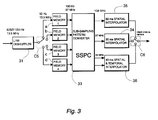
- the circuit of figure 3 used in the invention has an arrangement of the field memories differing from that of figure 1.
- Four field memories a, b, c and d are coupled in parallel so that the output signal of the line deshuffler circuit 31 is connected by the switch C5 only to one field memory input at a time.
- the format of the signal written into the field memories is 625/2:1/5 Hz, or 625 lines, interlaced scanning, 50 Hz field rate.
- the field memories are written at the frequency 13,5 Mhz.
- the fields are written into the memories a - d, preferably so that each memory will contain the lines of one field, whereby e.g.
- the memory a will contain the odd field A1 of the first picture
- the memory b will contain the even field B1 of this picture
- the memory c will contain the odd field A2 of the next picture
- the memory d will contain the even field B2 of this picture.
- the field A1 could as well be written into the memories b, c or d. This is true for all fields to be written.
- the lines are read from the memories at a frequency, which is the double writing frequency, in this case at the frequency 27 MHz, this causing the fields to be supplied to the SSPC-block at the frequency 100 Hz.
- the field rate is increased to 100 Hz already before the actual picture processing.
- the SSPC which restores the originally transmitted sub-sampled patterns also produces each sub-sampled field and picture twice during 20 ms, compared to the prior art method where the generation of one sub-sampled pattern requires 20 ms.
- the picture processing branches 34, 35, 36 now must generate the alternating even and odd fields.
- the 80 ms branch 35 which processes stationary pictures, it is rather easy to generate the odd and even fields from the same sub-sampled pictures, but the 20 ms branch 34 and the 40 ms branch 36 for processing pictures containing motion must use filtering within a field, which converts odd fields into even fields and vice versa.
- the algorithms used in the branches are not included in the scope of this invention, and any suitable method could be used there.
- the principle to increase the field rate is described above, using as an example the rate increase from 50 Hz to 100 Hz.
- the same principle can be used when the field rate is converted to 75 Hz.
- the memories are read at a rate only 25 % lower than in the case of 100 Hz.
- the method according to the invention requires 9,6 Mbit memory. Motion compensation can be added to the method without using more field memories, because the field rate conversion vectors are sent in the DATV-signal (Digital Assisted Television).
- the method is applicable both to luminance and chrominance signals.
Landscapes
- Engineering & Computer Science (AREA)
- Multimedia (AREA)
- Signal Processing (AREA)
- Television Systems (AREA)
Applications Claiming Priority (2)
| Application Number | Priority Date | Filing Date | Title |
|---|---|---|---|
| FI914783A FI89228C (fi) | 1991-10-10 | 1991-10-10 | Foerfarande foer att uppkonvertera faeltfrekvens av en bild formad fraon en i samplingsradsform ankommande hdtv-signal |
| FI914783 | 1991-10-10 |
Publications (2)
| Publication Number | Publication Date |
|---|---|
| EP0536722A2 true EP0536722A2 (de) | 1993-04-14 |
| EP0536722A3 EP0536722A3 (en) | 1993-06-23 |
Family
ID=8533275
Family Applications (1)
| Application Number | Title | Priority Date | Filing Date |
|---|---|---|---|
| EP19920117122 Withdrawn EP0536722A3 (en) | 1991-10-10 | 1992-10-07 | A method to increase the field rate of a picture generated from an hdtv signal arriving in the form of a sample sequence |
Country Status (2)
| Country | Link |
|---|---|
| EP (1) | EP0536722A3 (de) |
| FI (1) | FI89228C (de) |
Cited By (3)
| Publication number | Priority date | Publication date | Assignee | Title |
|---|---|---|---|---|
| WO1995018512A1 (de) * | 1993-12-29 | 1995-07-06 | Leica Ag | Verfahren und vorrichtung zur darstellung von stereoskopischen videobildern auf einem display |
| WO1995018511A1 (de) * | 1993-12-29 | 1995-07-06 | Leica Ag | Verfahren und vorrichtung zur aufzeichnung und wiedergabe von stereoskopischen videobildern |
| WO2004073303A1 (en) * | 2003-02-14 | 2004-08-26 | Aleksandr Sergeevich Mkrtumov | Method for displaying television image signals in a high-definition television receiver |
Family Cites Families (4)
| Publication number | Priority date | Publication date | Assignee | Title |
|---|---|---|---|---|
| FR2638310A1 (fr) * | 1988-10-21 | 1990-04-27 | Labo Electronique Physique | Procede et dispositif de conversion du rythme temporel d'images de television a haute definition, et decodeur d'images de television comprenant un tel dispositif |
| FR2644956B1 (fr) * | 1989-03-23 | 1991-06-07 | Europ Rech Electr Lab | Dispositif de conversion de frequence trame pour un recepteur de television haute definition et procede de detection du mouvement dans une image de television codee |
| FR2651402B1 (fr) * | 1989-08-22 | 1991-10-25 | Europ Rech Electr Lab | Dispositif de conversion de frequence trame et du nombre de lignes pour un recepteur de television haute definition. |
| GB2240230B (en) * | 1990-01-18 | 1994-04-13 | British Broadcasting Corp | Field-rate upconversion of television signals |
-
1991
- 1991-10-10 FI FI914783A patent/FI89228C/fi not_active IP Right Cessation
-
1992
- 1992-10-07 EP EP19920117122 patent/EP0536722A3/en not_active Withdrawn
Cited By (3)
| Publication number | Priority date | Publication date | Assignee | Title |
|---|---|---|---|---|
| WO1995018512A1 (de) * | 1993-12-29 | 1995-07-06 | Leica Ag | Verfahren und vorrichtung zur darstellung von stereoskopischen videobildern auf einem display |
| WO1995018511A1 (de) * | 1993-12-29 | 1995-07-06 | Leica Ag | Verfahren und vorrichtung zur aufzeichnung und wiedergabe von stereoskopischen videobildern |
| WO2004073303A1 (en) * | 2003-02-14 | 2004-08-26 | Aleksandr Sergeevich Mkrtumov | Method for displaying television image signals in a high-definition television receiver |
Also Published As
| Publication number | Publication date |
|---|---|
| FI89228C (fi) | 1993-08-25 |
| EP0536722A3 (en) | 1993-06-23 |
| FI914783A0 (fi) | 1991-10-10 |
| FI89228B (fi) | 1993-05-14 |
Similar Documents
| Publication | Publication Date | Title |
|---|---|---|
| KR100426889B1 (ko) | 끊김없는스위칭을갖는자동영상주사포맷변환기 | |
| KR100426890B1 (ko) | 고선명텔레비전시스템에적절한영상주사포맷변환기 | |
| US5517247A (en) | Method and apparatus for converting a video input signal of progressive scan form to an interlaced video output signal of doubled field rate and employing progressive scan to progressive scan interpolation for reduction of visual artifacts | |
| US4794447A (en) | Method and apparatus for transmitting and receiving a high definition NTSC compatible television signal over a single DBS channel in time division multiplex form | |
| US5144427A (en) | Television receiver decoder apparatus for bandwidth-compressed high definition television signal | |
| US4989091A (en) | Scan converter for a high definition television system | |
| JP2000500318A (ja) | 適応画像遅延装置 | |
| JPH05244573A (ja) | 画像信号処理装置及び方法 | |
| EP0460928A2 (de) | Vorrichtung zur Umwandlung eines Videosignals | |
| US4200887A (en) | Television camera | |
| US4974064A (en) | Apparatus for encoding television signals of different formats for transmission and decoding upon reception | |
| US4963965A (en) | Method of and arrangement for converting the temporal rate of high definition television pictures and television picture decoder comprising such an arrangement | |
| EP0372774A3 (de) | Verfahren zur Umwandlung einer Videosignalwiedergabefrequenz | |
| FI89228C (fi) | Foerfarande foer att uppkonvertera faeltfrekvens av en bild formad fraon en i samplingsradsform ankommande hdtv-signal | |
| JPH05130573A (ja) | Tv信号変換装置 | |
| EP0536721B1 (de) | Verfahren zur Verarbeitung von einem HDTV-Signal das in Form einer Sequenz von Abtastwerten ankommt | |
| JPH02224488A (ja) | 画像伝送方式 | |
| JP2642464B2 (ja) | テレビジョン信号変換装置 | |
| JP2813270B2 (ja) | 多画面テレビジョン受像機とそのメモリ装置 | |
| JP2809738B2 (ja) | 映像信号変換装置 | |
| JPH0418887A (ja) | 静止画伝送方式 | |
| JP3081060B2 (ja) | 多画面表示高品位テレビジョン受像機 | |
| JP2868783B2 (ja) | 高品位/標準テレビジョン変換装置 | |
| JP2601021B2 (ja) | 映像信号方式変換装置 | |
| Itoga et al. | MUSC/NTSC converter |
Legal Events
| Date | Code | Title | Description |
|---|---|---|---|
| PUAI | Public reference made under article 153(3) epc to a published international application that has entered the european phase |
Free format text: ORIGINAL CODE: 0009012 |
|
| AK | Designated contracting states |
Kind code of ref document: A2 Designated state(s): DE ES FR GB IT NL SE |
|
| PUAL | Search report despatched |
Free format text: ORIGINAL CODE: 0009013 |
|
| AK | Designated contracting states |
Kind code of ref document: A3 Designated state(s): DE ES FR GB IT NL SE |
|
| 17P | Request for examination filed |
Effective date: 19931125 |
|
| 17Q | First examination report despatched |
Effective date: 19951031 |
|
| 18D | Application deemed to be withdrawn |
Effective date: 19960312 |