EP0538192A1 - Neue 17beta-substituierte Aza-androstan-Derivate - Google Patents
Neue 17beta-substituierte Aza-androstan-Derivate Download PDFInfo
- Publication number
- EP0538192A1 EP0538192A1 EP92810766A EP92810766A EP0538192A1 EP 0538192 A1 EP0538192 A1 EP 0538192A1 EP 92810766 A EP92810766 A EP 92810766A EP 92810766 A EP92810766 A EP 92810766A EP 0538192 A1 EP0538192 A1 EP 0538192A1
- Authority
- EP
- European Patent Office
- Prior art keywords
- formula
- group
- phe
- compound
- aza
- Prior art date
- Legal status (The legal status is an assumption and is not a legal conclusion. Google has not performed a legal analysis and makes no representation as to the accuracy of the status listed.)
- Granted
Links
Classifications
-
- C—CHEMISTRY; METALLURGY
- C07—ORGANIC CHEMISTRY
- C07J—STEROIDS
- C07J1/00—Normal steroids containing carbon, hydrogen, halogen or oxygen, not substituted in position 17 beta by a carbon atom, e.g. estrane, androstane
-
- C—CHEMISTRY; METALLURGY
- C07—ORGANIC CHEMISTRY
- C07J—STEROIDS
- C07J73/00—Steroids in which the cyclopenta[a]hydrophenanthrene skeleton has been modified by substitution of one or two carbon atoms by hetero atoms
- C07J73/001—Steroids in which the cyclopenta[a]hydrophenanthrene skeleton has been modified by substitution of one or two carbon atoms by hetero atoms by one hetero atom
- C07J73/005—Steroids in which the cyclopenta[a]hydrophenanthrene skeleton has been modified by substitution of one or two carbon atoms by hetero atoms by one hetero atom by nitrogen as hetero atom
-
- A—HUMAN NECESSITIES
- A61—MEDICAL OR VETERINARY SCIENCE; HYGIENE
- A61P—SPECIFIC THERAPEUTIC ACTIVITY OF CHEMICAL COMPOUNDS OR MEDICINAL PREPARATIONS
- A61P3/00—Drugs for disorders of the metabolism
-
- A—HUMAN NECESSITIES
- A61—MEDICAL OR VETERINARY SCIENCE; HYGIENE
- A61P—SPECIFIC THERAPEUTIC ACTIVITY OF CHEMICAL COMPOUNDS OR MEDICINAL PREPARATIONS
- A61P35/00—Antineoplastic agents
- A61P35/02—Antineoplastic agents specific for leukemia
-
- A—HUMAN NECESSITIES
- A61—MEDICAL OR VETERINARY SCIENCE; HYGIENE
- A61P—SPECIFIC THERAPEUTIC ACTIVITY OF CHEMICAL COMPOUNDS OR MEDICINAL PREPARATIONS
- A61P43/00—Drugs for specific purposes, not provided for in groups A61P1/00-A61P41/00
Definitions
- the invention relates to new 17 ⁇ -substituted aza-androstane derivatives of the formula wherein the carbon atoms 1 and 2 are connected by a single bond or a double bond, R1 is hydrogen, methyl or ethyl, and A for a group of the formula -N (-R2) -X-, wherein R2 is hydrogen or C1-C4-alkyl, and X represents C1-C12 alkylene or C3-C6 cycloalkylidene; a group of the formula -N (-R2) -Y-Phe-, in which R2 has the meaning given above, Y is a direct bond or C1-C6alkylene and Phe denotes an optionally substituted phenylene radical; a group of the formula -OX-, in which X has the meaning given above, or a group -OY-Phe-, in which Y and Phe have the meanings mentioned above.
- the invention also relates to processes for the preparation of the abovementioned compounds, as well as pharmaceutical compositions containing these compounds and processes for their preparation; also the therapeutic use of these compounds and pharmaceutical compositions containing them in warm-blooded animals, including humans.
- C1-C4- alkyl is corresponding straight-chain or branched alkyl and means e.g. n-propyl, n-butyl, isopropyl, tert. Butyl and especially methyl and ethyl.
- C1-C12-alkylene as radical X can be linear or arbitrarily branched, where the two free valences can originate from two different C atoms or from the same C atom.
- Both linear C2-C6 alkylene radicals e.g. Tri- to hexamethylene, especially pentamethylene, and ethylene
- branched C3-C6 alkylene radicals e.g. 2-methyl-1,2-propylene and 1,1-dimethylethylene, which have the free valences on two different carbon atoms.
- linear or at most once branched alkylene radicals the two free valences of which originate from the same carbon atom, e.g.
- linear or branched C1-C6-alkylidene residues such as primarily methylene, but also ethylidene, 1,1-propylidene or 2,2-propylidene.
- alkylene e.g. 1,1-alkylidene radicals are also referred to as 1,1-alkylene radicals.
- C3-C6-cycloalkylidene is 1,1-cyclopropylidene, 1,1-cyclobutylidene, 1,1-cyclopentylidene and 1,1-cyclohexylidene.
- C1-C6 alkylene can be linear or branched.
- Linear C1-C4 alkylene e.g. Methylene, ethylene, trimethylene and tetramethylene.
- Phenylene is ortho (o-), meta (m-) and in particular para (p-) phenylene and, apart from the cyano group, can be unsubstituted or one, two or three further substituents selected from the group halogen, C1-C4-alkyl, C1-C4 alkoxy, hydroxy, nitro, cyano and C1-C4 alkoxycarbonyl.
- Halogen is e.g. Fluorine or chlorine.
- C1-C4 alkoxy is e.g. Propoxy, butoxy and especially methoxy and ethoxy.
- C1-C4 alkoxycarbonyl is, for example, propoxycarbonyl, tert. Butoxycarbonyl and especially methoxycarbonyl and ethoxycarbonyl.
- the compounds of formula I have valuable pharmacological properties.
- they are potent inhibitors of the enzyme 5 ⁇ -reductase, which is responsible for converting the androgen testosterone, which is predominantly circulating in men, into the even more potent 5 ⁇ -dihydrotestosterone is responsible.
- 5 ⁇ -dihydrotestosterone is detected in the prostate in an increased concentration and is therefore held responsible for the hypertrophy. It has now been found that the compounds of the formula I according to the invention have a strong inhibitory effect on the enzyme 5 ⁇ -reductase.
- the compounds of the formula I according to the invention are therefore suitable in warm-blooded animals (humans and animals) for the therapeutic treatment of benign prostate hypertrophy and other diseases and conditions which respond favorably to a reduction in the physiological amount of 5 ⁇ -dihydrotestosterone, such as prostate cancer, seborrhea, Acne vulgaris, female hirsutism and the like.
- the new compounds can be presented as enteral, e.g. orally, topically or parenterally administrable 5 ⁇ -reductase inhibitors, e.g. in the form of corresponding pharmaceutical preparations.
- the invention particularly relates to compounds of the formula I in which the carbon atoms 1 and 2 are connected by a single bond or a double bond, R 1 is hydrogen, methyl or ethyl, and A for a group of the formula -N (-R 2) -X-, in which R2 is hydrogen or C1-C4-alkyl, in particular methyl, and X straight-chain or branched C1-C12-alkylene, in particular C1-C6-alkylene, such as ethylene, pentamethylene, 2-methyl-1,2-propylene or 2,2-propylidene , or C3-C6- cycloalkylidene, for example 1,1-cyclopropylidene; a group of the formula -N (-R2) -Y-Phe-, in which R2 has the meaning given above, Y is a direct bond or C1-C6-alkylene, especially C1-C4-alkylene, e.g.
- Is methylene, and Phe denotes a phenylene radical which may be replaced by halogen, e.g. Chlorine, C1-C4 alkyl, e.g. Methyl, C1-C4 alkoxy such as methoxy, hydroxy, nitro, cyano and / or C1-C4 alkoxycarbonyl e.g. Methoxycarbonyl, is substituted; a group of the formula -O-X-, in which X has the meaning given above, or a group -O-Y-Phe, where Y and Phe have the meanings mentioned above.
- halogen e.g. Chlorine
- C1-C4 alkyl e.g. Methyl
- C1-C4 alkoxy such as methoxy, hydroxy, nitro, cyano and / or C1-C4 alkoxycarbonyl e.g. Methoxycarbonyl
- the invention relates primarily to compounds of formula I, wherein the carbon atoms 1 and 2 are connected by a single bond or a double bond, R1 is hydrogen or methyl, and A for a group of the formula -N (-R2) -X-, wherein R2 is hydrogen and X is straight-chain or branched C1-C6 alkylene, in particular ethylene, pentamethylene, 2-methyl-1,2-propylene or 2,2-propylidene; a group of the formula -N (-R2) -Y-Phe-, wherein R2 has the meaning given above, Y is a direct bond or C1-C4-alkylene, for example methylene, and Phe is a phenylene radical designated, which is optionally substituted by halogen, for example chlorine, C1-C4-alkyl, for example methyl, C1-C4-alkoxy, such as methoxy, hydroxy, nitro, cyano or C1-C4-alkoxycarbonyl,
- the invention preferably relates to the compounds of the formula I described in the examples.
- the compounds of the present invention are obtained by methods known per se.
- Process (a) is an acylation reaction.
- An amino compound of the formula H-A1-CN or a hydroxy compound of the formula H-A2-CN is acylated with a carboxylic acid or a reactive derivative thereof to form an acid amide (carboxamide) or an ester (carboxylate), the activation of which as an acylating agent carboxylic acid used can also be carried out in the presence of the compound to be acylated (see, for example, Haslam, E., Tetrahedron 36, 2409-2433 (1980)).
- Carboxylic acid derivatives which can be used as acylating agents are primarily reactive activated esters or reactive anhydrides, and also reactive cyclic amides.
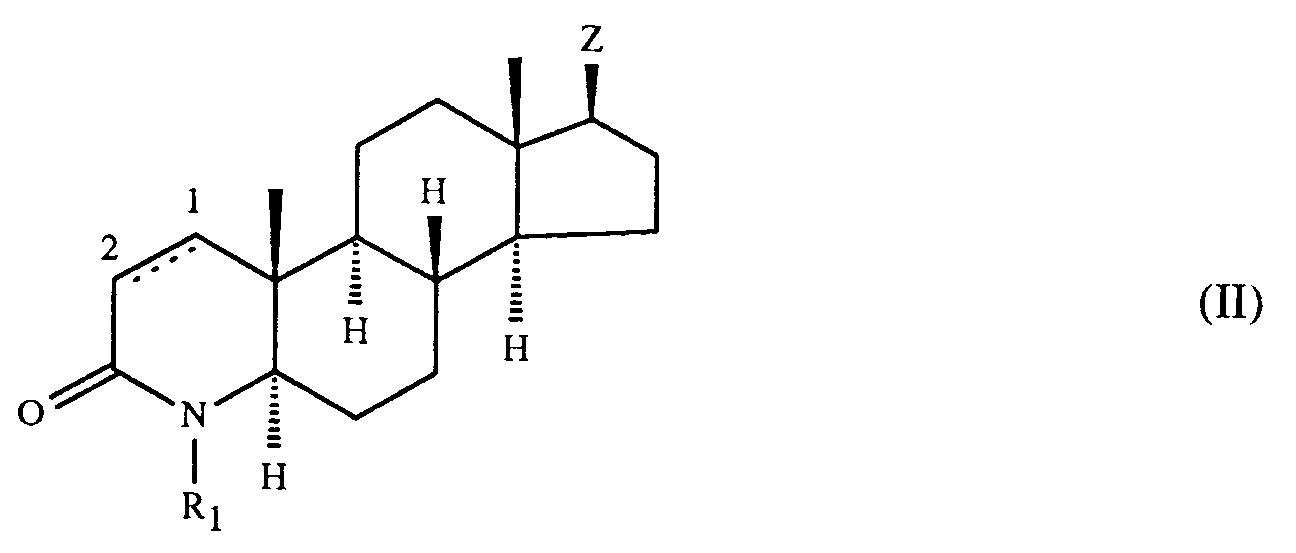
- Suitable activated esters are, for example, amidino type esters such as N, N'-disubstituted amidino esters, e.g. by treating the corresponding acid of formula II, wherein Z is carboxyl, with a suitable N, N'-disubstituted carbodiimide, e.g. N, N'-dicyclohexylcarbodiinmide can be obtained (carbodiimide method); Thioesters, especially 2-pyridylthioesters, e.g.
- N-hydroxy esters e.g. Amino esters or amido esters which can be obtained, for example, by treating the corresponding acid with an N-hydroxyamino or N-hydroxyamido compound, e.g. N-hydroxysuccinimide, N-hydroxypiperidine, N-hydroxyphthalimide or 1-hydroxybenzotriazole, e.g. according to the carbodiimide method.
- the preferred amino esters include benzotriazol-1-yl oxy derivatives.
- the latter arise, for example, when the corresponding acid of the formula II, in which Z is carboxyl, is reacted with a suitable benzotriazole derivative, in particular benzotriazol-1-yl-oxy-tris- (dimethylamino) phosphonium hexafluorophosphate (Castros reagent) or O- (1H-benzotriazole) -1-yl) N, N, N ′, N′-tetramethyluronium hexafluorophosphate.
- a suitable benzotriazole derivative in particular benzotriazol-1-yl-oxy-tris- (dimethylamino) phosphonium hexafluorophosphate (Castros reagent) or O- (1H-benzotriazole) -1-yl) N, N, N ′, N′-tetramethyluronium hexafluorophosphate.
- Suitable acid anhydrides are, in particular, mixed anhydrides of an acid of the formula II in which Z is carboxy, for example anhydrides with inorganic acids, such as acid halides, in particular acid chlorides, which can be obtained, for example, by treating the corresponding acid with oxalyl chloride, thionyl chloride or 1-chloro-1-dimethylamino Receives -2-methyl-prop-1-ene (acid chloride method).
- Suitable cyclic amides are especially amides with five-membered diazacycles of aromatic character, such as amides with imidazoles, e.g. Imidazole, e.g. can be obtained by treating the corresponding acid with N, N'-carbonyldiimidazole (imidazolide method).
- derivatives of acids used as acylating agents can be formed in situ.
- N-hydroxy esters can be formed in situ by mixing the mixture of the starting material to be acylated and the acid used as the acylating agent in the presence of a suitable benzotriazole derivative, e.g. Benzotriazol-1-yl-oxy-tris (dimethylamino) phosphonium hexafluorophosphate.
- amino or amido esters of the acids used as acylating agents can be formed in situ in the presence of the starting material to be acylated by mixing the corresponding acid and amino starting materials in the presence of an N, N'-disubstituted carbodiimide, e.g.
- N, N'-disubstituted amidino esters are formed, for example, in situ when the compound to be acylated is reacted with the acid used as the acylating agent in the presence of a suitable N, N-disubstituted carbodiimide, e.g. N, N'-dicyclohexylcarbodiimide.
- the acylation can be carried out in a manner known per se, usually at temperatures between the freezing point and the boiling point of the reaction mixture, such as in the temperature range from about -10 to about + 150 ° C., preferably from room temperature (about + 20 ° C.) to about + 70 ° C, for example in a closed reaction vessel and / or in the atmosphere of an inert gas, for example nitrogen, in the presence of a suitable solvent, preferably an inert solvent such as dimethylformamide (DMF) of an ether, for. B.
- a suitable solvent preferably an inert solvent such as dimethylformamide (DMF) of an ether
- tetrahydrofuran or a halogenated, especially chlorinated, aliphatic hydrocarbon, for example chloroform or methylene chloride, and optionally in the presence of an acid-binding agent, for example a base.
- a suitable base is, for example, an amine, for example a tertiary amine, for example a tri (C1-C4) alkylamine such as trimethylamine, triethylamine or ethyldiisopropylamine, or an arylalkylamine, for example N, N-dimethylaniline, or a cyclic tertiary amine, for example N. -C1-C4-alkyl morpholine, for example N-methylmorpholine, or a base of the pyridine type, for example pyridine or quinoline.
- Process (b) is carried out according to known methods for introducing the cyano group.
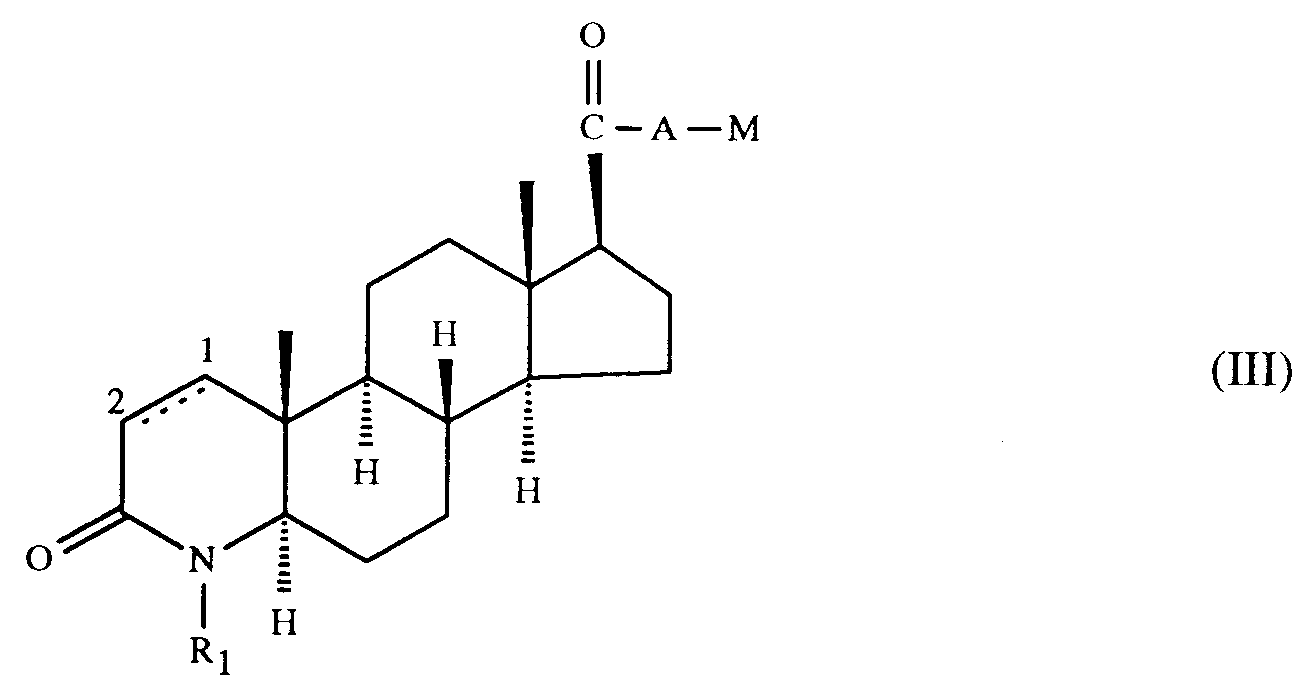
- Residues M in a compound of formula III which can be converted to cyano are e.g. Hydrogen; esterified hydroxy groups, e.g. Halogen, especially chlorine, bromine or iodine, or sulfonyloxy, e.g. Toluenesulfonyloxy, benzenesulfonyloxy or methanesulfonyloxy; Carboxy, carboxy in the form of a functional derivative, e.g. Aminocarbonyl, C1-C4 alkylaminocarbonyl, e.g. tert-butylaminocarbonyl, or formyl in the form of a functional derivative, e.g. Hydroxyiminomethyl.
- esterified hydroxy groups e.g. Halogen, especially chlorine, bromine or iodine
- sulfonyloxy e.g. Toluenesulfonyloxy, benzenesulf
- reaction of a compound of formula III wherein M is halogen, e.g. Chlorine, bromine, iodine, to a corresponding compound of formula I is e.g. using a cyanide salt, in particular sodium or potassium cyanide or copper (I) cyanide.
- a cyanide salt in particular sodium or potassium cyanide or copper (I) cyanide.
- High temperatures are preferred, in particular the reflux temperature of the reaction mixture.
- reaction of a compound of formula III, wherein M is sulfonyloxy, e.g. p-Toluenesulfonyloxy, benzenesulfonyloxy or methanesulfonyloxy means, to a corresponding compound of formula I z. B. by reaction with an alkali metal cyanide, preferably sodium or potassium cyanide. High temperatures are preferred, in particular the reflux temperature of the reaction mixture.
- reaction of a compound of formula III, wherein M represents carboxy, into a compound of formula I can e.g. by reaction with a chlorosulfonyl isocyanate in e.g. Dimethylformamide (DMF) according to the method of R. Graf in Angew. Chem. 80, 183 (1968).
- DMF Dimethylformamide
- reaction of a compound of the formula III in which M is carboxy which is in the form of a functional derivative, for example as aminocarbonyl or C1-C4-alkylaminocarbonyl, advantageously as tert-butylaminocarbonyl, in a compound of the formula I can, for example, with a strong dehydrating agent, For example, phosphorus (V) oxide, phosphoryl chloride, thionyl chloride, tosyl chloride, mesyl chloride or oxalyl chloride will.
- a strong dehydrating agent for example, phosphorus (V) oxide, phosphoryl chloride, thionyl chloride, tosyl chloride, mesyl chloride or oxalyl chloride will.
- the dehydration is preferably carried out in an inert anhydrous solvent, for example an ether, for example tetrahydrofuran or dioxane, DMF, and also pyridine, at room temperature or somewhat reduced or elevated temperature, for example at about 0 ° C. to about 80 ° C.
- an inert anhydrous solvent for example an ether, for example tetrahydrofuran or dioxane, DMF, and also pyridine, at room temperature or somewhat reduced or elevated temperature, for example at about 0 ° C. to about 80 ° C.
- reaction of a compound of formula III, wherein M is formyl, into a corresponding compound of formula I is e.g. after conversion of the formyl group into a functional derivative, e.g. Hydroxyiminomethyl (aldoxime), and conversion of this group into a cyano group by a dehydrating agent.
- a functional derivative e.g. Hydroxyiminomethyl (aldoxime)
- conversion of this group into a cyano group by a dehydrating agent.
- the implementation of the formyl group in the Hydroxyiminomethyl distr. B. by reaction with a salt of hydroxylamine, preferably the hydrochloride.
- a suitable dehydrating agent is, for example, one of the above, e.g. Phosphorus (V) oxide or thionyl chloride, the anhydride of an organic acid, e.g.
- anhydride of a C1-C4 alkanoic acid preferably acetic anhydride, oxalic acid diimidazolide (see T. Kitagawa et al., Chem. Pharm. Bull. 33, 4014 (1985)) or benzene selenyl chloride (see G. Sosnovsky, JA Rogh, Z. Naturforsch. B 34, 511 (1979)).
- the dehydration is carried out in a manner known per se, for example in the presence of a suitable solvent, preferably an inert anhydrous solvent such as an ether, e.g.
- THF tetrahydrofuran
- a compound of formula III, wherein M is formyl, can also be converted directly into the corresponding nitrile of formula I, e.g. by reaction with O, N-bis (trifluoroacetyl) hydroxylamine in the presence of a base, e.g. Pyridine, using the method of D.T. Mowry, Chem. Revs. 42, 251 (1948).
- Compounds of the formula I can be obtained according to process (c) by reduction, in particular with hydrogen in the presence of a transition metal catalyst (catalytic hydrogenation), of a compound of the formula IV.
- the catalytic hydrogenation is carried out, for example, with palladium or platinum oxide, optionally with the addition of carbon, preferably in an acidic medium, e.g. in glacial acetic acid.
- compounds of formula I wherein R1 and / or R2 is hydrogen can be reacted with a strong base, e.g. Sodium hydride or sodium amide, and a C1-C4 alkyl halide in an anhydrous inert solvent, e.g. DMF or THF, are converted into compounds of formula I, wherein R1 is methyl or ethyl and R3 is C1-C4-alkyl.
- a strong base e.g. Sodium hydride or sodium amide
- a C1-C4 alkyl halide in an anhydrous inert solvent e.g. DMF or THF
- 1,2-saturated compounds of the formula I can be dehydrogenated to the corresponding 1,2-dehydro derivatives in a manner known per se.
- Biological dehydration processes can be used, e.g. dehydrate by means of the microorganisms Corynebacterium simplex or Septomyxa affinis or their enzyme systems, or with selenium dioxide in an organic solvent, e.g. treat tert-butyl alcohol.
- aromatic hydrocarbons such as benzene or xylene
- lower aliphatic alcohols such as ethanol, propanol or tert-butyl alcohol
- lower aliphatic ketones such as acetone or 2-butanone
- aliphatic esters such as ethyl acetate
- cyclic ethers such as dioxane or tetrahydrofuran.
- the invention also relates to those embodiments of the process in which one starts from a compound obtainable as an intermediate at any process stage and carries out the missing process steps or one terminates the process at any stage, or in which a starting material is formed under the reaction conditions or in the form of a Derivatives, e.g. a salt thereof is used.
- the pharmaceutical preparations of the present invention containing a compound of formula I can be used to treat the above indications, in particular for Treatment of benign prostate hypertrophy can be used. They contain an effective amount of the active ingredient alone or in a mixture with inorganic or organic, solid or liquid, pharmaceutically usable excipients and, if desired, also with other pharmacologically or therapeutically valuable substances, and are particularly suitable for enteral, for example oral or rectal, for parenteral, for example transdermal, or for topical administration.
- the present invention relates in particular to pharmaceutical compositions comprising as active ingredient at least one compound of the formula I according to the invention in the form of a sterile and / or isotonic aqueous solution, or else in a mixture with at least one solid or semi-solid carrier.
- the present invention also relates to pharmaceuticals, and in particular pharmaceuticals in the form of dosage units, which contain at least one of the compounds according to the invention alone or in a mixture with one or more carriers, in particular those in solid form.
- the invention relates in particular to pharmaceuticals in the form of tablets (including lozenges, granules and lozenges), dragées, capsules, pills, ampoules, dry vials or suppositories containing the active ingredient defined above, alone or in a mixture with one or more carriers.
- the tablets, dragées, capsules and pills containing the above-mentioned pharmaceutical compositions according to the invention can be provided with the usual coatings and coating materials, to which dyes or pigments, e.g. for identification or labeling purposes.
- These coatings can also have a composition which enables the active ingredient to be released more slowly; for this purpose e.g. Waxes and cellulose preparations such as acetyl cellulose phthalate or hydroxypropyl methyl cellulose phthalate are suitable.
- compositions can also be processed in the form of microcapsules.
- suppositories into consideration consist of a combination of the active ingredient with a suppository base.
- Suitable suppository bases are e.g. natural or synthetic triglycerides, paraffin hydrocarbons, polyethylene glycols or higher alkanols.
- aqueous solutions of an active ingredient in water-soluble form e.g. a water-soluble salt, or aqueous injection suspensions which contain viscosity-increasing substances, e.g. Contain sodium carboxymethyl cellulose, sorbitol and / or dextran and optionally stabilizers.
- the active ingredient, optionally together with adjuvants can also be in the form of a lyophilisate and be brought into solution by adding suitable solvents before parenteral administration.
- a composition for topical application can be in the form of an aqueous solution, a gel, an oily solution or suspension or a fatty or, in particular, emulsified ointment.
- a composition in the form of an aqueous solution is obtained, for example, by dissolving the active compounds according to the invention in an aqueous buffer solution with a pH of 4 to 6.5 and, if desired, adding a further active compound, for example an anti-inflammatory agent and / or a polymeric binder , for example polyvinylpyrrolidone, and / or a protective agent.
- the concentration of the active ingredient is between about 0.1 and about 1.5 mg, preferably between 0.25 and 1.0 mg in 10 ml solution or 10 g gel.
- An oily form of administration for topical application is obtained if, for example, an active ingredient according to the invention in an oil, optionally with the addition of swelling agents such as aluminum stearate and / or surface-active substances (surfactants) which have an HLB value below 10 such as fatty acid monoesters of polyols, for example Glycerol monostearate, sorbitan monolaurate, sorbitan monostearate or sorbitan monooleate can be suspended.
- a fatty ointment is obtained, for example, if an active ingredient according to the invention or a salt thereof is suspended in a spreadable fat base, optionally with the addition of a surfactant with an HLB value below 10.
- An emulsified ointment is obtained by trituration of an aqueous solution of the active ingredient according to the invention in a soft, spreadable base with the addition of a surfactant with an HLB value below 10. All of these forms for topical application can also contain protective agents.
- the concentration of the active ingredient is between about 0.1 and about 1.5 mg, preferably between 0.25 and 1.0 mg in a basis of about 10 g.
- compositions according to the invention preferably contain from about 0.1 to about 99.5, in particular from about 1 to about 90% by weight of the active ingredient.
- the invention also relates to a method for treating the above-mentioned disease states, the compounds according to the invention preferably being used in the form of pharmaceutical preparations.
- a daily dose of about 1 mg to about 100 mg is given for parenteral or enteral administration.
- compositions and medicaments according to the invention are produced by means of conventional, known manufacturing processes in the pharmaceutical industry, e.g. by means of customary mixing, granulating, tableting, coating, dissolving and lyophilizing processes, if desired working under aseptic conditions or sterilizing an intermediate or a finished product.
- the resulting clear solution which contains 3-oxo-4-aza-5 ⁇ -androstan-17 ⁇ -carboxylic acid chloride, is added dropwise with stirring at 4 ° to a solution of 1.2 ml of 3-hydroxypropionitrile in 6 ml of chloroform and for 2 hours at room temperature touched.
- a suspension of 957 mg (3 mmol) of 3-oxo-4-aza-5 ⁇ -androstan-17 ⁇ -carboxylic acid in 6.6 ml of dimethylformamide is mixed with 1.59 g of benzotriazol-1-yl-oxy-tris (dimethylamino) phosphonium hexafluorophosphate ( Castros Reagens), 0.6 ml methylmorpholine, 2.3 ml 6-aminocapronitrile and stirred for 2 hours at room temperature.
- the resulting solution is diluted with chloroform and washed successively with sodium hydrogen carbonate solution, water and saturated sodium chloride solution.
- the organic phase is dried with sodium sulfate and evaporated to dryness in a water jet vacuum.
- N- (5-cyanopentyl) -3-oxo-4-aza-5 ⁇ -androstane-17 ⁇ -carboxamide is mixed with N, O-bis (trimethylsilyl) trifluoroacetamide and 2,3-dichloro- 5,6-dicyan-1,4-benzoquinone implemented and processed.
- N- (4-cyanophenyl) -4-aza-3-oxo-5 ⁇ -androstane-17 ⁇ -carboxamide is mixed with N, O-bis (trimethylsilyl) trifluoroacetamide and 2,3-dichloro- 5,6-dicyan-1,4-benzoquinone reacted and processed.
- the residue which contains 3-oxo-4-aza-5 ⁇ -androst-1-en-17 ⁇ -carboxylic acid chloride, is dissolved in 60 ml of chloroform, at 25 ° with stirring, dropwise in succession with 0.2 ml of tryethylamine and 1.95 ml 2-Amino-2-methylpropionitrile in 18 ml of chloroform and stirred at room temperature for 3 hours.
- the reaction mixture is diluted with 60 ml of ice water and extracted with methylene chloride.
- the organic phase is washed with saturated sodium chloride solution, dried and concentrated in a water jet vacuum.
- the residue is chromatographed on a silica gel column.
- N- (3-cyanophenyl) -3-oxo-4-aza-5 ⁇ -androstane-17 ⁇ -carboxamide is mixed with N, O-bis (trimethylsilyl) trifluoroacetamide and 2,3- Dichloro-5,6-dicyan-1,4-benzoquinone implemented and processed.
- N- (3-cyanophenyl) -3-oxo-4-aza-5 ⁇ -androst-1-en-17 ⁇ -carboxamide is obtained after crystallization from methylene chloride diisopropyl ether melts at 318-321 °.
- Tablets containing 10 mg of active ingredient for example N- (2-cyano-2-propyl) -3-oxo-4-aza-5 ⁇ -androst-1-ene-17 ⁇ -carboxamide or another compound of Examples 1-23 are as manufactured as follows: Composition for 5000 tablets Active ingredient, finely ground 50.0g Sucrose 79.0 g Arabic rubber 4.75 g Sorbitol 3.75 g Talk 2.5 g Magnesis stearate 4.9 g mineral oil 0.1 g Carboxymethyl cellulose (sodium salt) 5.0 g
- the active ingredient is mixed with powdered sucrose and the arabic gum, sieved and granulated using an approximately 35 percent aqueous sorbitol solution.
- the granules are passed through a sieve, dried, sieved again and intimately mixed with the other auxiliaries (talc, magnesium stearate, mineral oil and carboxymethyl cellulose sodium salt).
- the mixture is compressed into tablets of 10 mg in the usual way.
- Tablets containing 1 mg of active ingredient for example N- (2-cyano-2-propyl) -3-oxo-4-aza-5 ⁇ -androst-1-en-17 ⁇ -carboxamide or another compound of Examples 1-23 are as manufactured as follows: Composition for 50000 tablets Active ingredient, finely ground 50.0 g Sucrose 79.0 g Arabic rubber 4.75 g Sorbitol 3.75 g Talk 2.5 g Magnesium stearate 4.9 g mineral oil 0.1 g Carboxymethyl cellulose (sodium salt) 5.0 g
- the active ingredient is mixed with powdered sucrose and the arabic gum, sieved and granulated using an approximately 35 percent aqueous sorbitol solution.
- the granules are passed through a sieve, dried, sieved again and intimately mixed with the other auxiliaries (talc, magnesium stearate, mineral oil and carboxymethyl cellulose sodium salt).
- the mixture is compressed into tablets of 1 mg in the usual way.
Landscapes
- Health & Medical Sciences (AREA)
- Organic Chemistry (AREA)
- Chemical & Material Sciences (AREA)
- General Health & Medical Sciences (AREA)
- Medicinal Chemistry (AREA)
- Public Health (AREA)
- Veterinary Medicine (AREA)
- Nuclear Medicine, Radiotherapy & Molecular Imaging (AREA)
- Chemical Kinetics & Catalysis (AREA)
- Pharmacology & Pharmacy (AREA)
- Life Sciences & Earth Sciences (AREA)
- Animal Behavior & Ethology (AREA)
- General Chemical & Material Sciences (AREA)
- Bioinformatics & Cheminformatics (AREA)
- Engineering & Computer Science (AREA)
- Hematology (AREA)
- Oncology (AREA)
- Diabetes (AREA)
- Obesity (AREA)
- Pharmaceuticals Containing Other Organic And Inorganic Compounds (AREA)
- Steroid Compounds (AREA)
- Nitrogen Condensed Heterocyclic Rings (AREA)
- Nitrogen And Oxygen Or Sulfur-Condensed Heterocyclic Ring Systems (AREA)
- Organic Low-Molecular-Weight Compounds And Preparation Thereof (AREA)
Abstract
Description
- Die Erfindung betrifft neue 17β-substituierte Aza-androstan-Derivate der Formel

worin die Kohlenstoffatome 1 und 2 durch eine Einfachbindung oder eine Doppelbindung verbunden sind, R₁ Wasserstoff, Methyl oder Ethyl bedeutet, und A für eine Gruppe der Formel -N(-R₂)-X-, worin R₂ Wasserstoff oder C₁-C₄-Alkyl, und X C₁-C₁₂-Alkylen oder C₃-C₆- Cycloalkyliden bedeutet; eine Gruppe der Formel -N(-R₂)-Y-Phe-, worin R₂ die oben genannte Bedeutung hat, Y eine direkte Bindung oder C₁-C₆-Alkylen ist und Phe einen gegebenenfalls substituierten Phenylenrest bezeichnet; eine Gruppe der Formel -O-X-, worin X die oben genannte Bedeutung hat, oder eine Gruppe -O-Y-Phe- steht, worin Y und Phe die oben genannten Bedeutungen haben. - Die Erfindung betrifft auch Verfahren zur Herstellung der oben genannten Verbindungen, sowie diese Verbindungen enthaltende pharmazeutische Zusammensetzungen und Verfahren zu ihrer Herstellung; ferner auch die therapeutische Anwendung dieser Verbindungen und diese enthaltender pharmazeutischen Zusammensetzungen bei Warmblütern einschliesslich des Menschen.
- Die vor- und nachstehend verwendeten Definitionen haben im Rahmen der vorliegenden Beschreibung vorzugsweise die folgenden Bedeutungen:
- C₁-C₄- Alkyl ist entsprechendes geradkettiges oder verzweigtes Alkyl und bedeutet z.B. n-Propyl, n-Butyl, Isopropyl, tert. Butyl und insbesondere Methyl und Ethyl.
- C₁-C₁₂-Alkylen als Rest X kann linear oder beliebig verzweigt sein, wobei die zwei freien Valenzen von zwei verschiedenen C-Atomen oder vom selben C-Atom ausgehen können. Bevorzugt sind sowohl lineare C₂-C₆-Alkylenreste, z.B. Tri- bis Hexamethylen, insbesondere Pentamethylen, und Ethylen, als auch verzweigte C₃-C₆-Alkylenreste, z.B. 2-Methyl-1,2-propylen und 1,1-Dimethylethylen, die die freien Valenzen an zwei verschiedenen C-Atomen haben. Hervorzuheben sind auch lineare oder höchstens einmal verzweigte Alkylenreste, deren beide freien Valenzen von demselben C-Atom ausgehen, z.B. lineare oder einmal verzweigte C₁-C₆-Alkylidenreste, wie in erster Linie Methylen, aber auch Ethyliden, 1,1-Propyliden oder 2,2-Propyliden. In Übereinstimmung mit der obigen Definition des Begriffes Alkylen können z.B. 1,1-Alkylidenreste auch als 1,1-Alkylenreste bezeichnet werden.
- C₃-C₆-Cycloalkyliden ist 1,1-Cyclopropyliden, 1,1-Cyclobutyliden, 1,1-Cyclopentyliden und 1,1-Cyclohexyliden.
- C₁-C₆-Alkylen (Y) kann linear oder verzweigt sein. Bevorzugt ist lineares C₁-C₄-Alkylen, z.B. Methylen, Ethylen, Trimethylen und Tetramethylen.
- Phenylen ist ortho (o-), meta (m-) und insbesondere para (p-) Phenylen und kann abgesehen von der Cyanogruppe - unsubstituiert sein oder einen, zwei oder drei weitere Substituenten ausgewählt aus der Gruppe Halogen, C₁-C₄-Alkyl, C₁-C₄-Alkoxy, Hydroxy, Nitro, Cyano und C₁-C₄-Alkoxycarbonyl tragen.
- Halogen ist z.B. Fluor oder Chlor.
- C₁-C₄-Alkoxy ist z.B. Propoxy, Butoxy und insbesondere Methoxy und Ethoxy.
- C₁-C₄-Alkoxycarbonyl ist beispielsweise Propoxycarbonyl, tert. Butoxycarbonyl und insbesondere Methoxycarbonyl und Ethoxycarbonyl.
- Die Verbindungen der Formel I weisen wertvolle pharmakologische Eigenschaften auf. Insbesondere sind sie potente Inhibitoren des Enzyms 5α-Reduktase, welches für die Umwandlung des beim Manne vorwiegend zirkulierenden Androgens Testosteron in das noch stärker wirkende 5α-Dihydrotestosteron verantwortlich ist. Bei der benignen Prostata-Hypertrophie wird 5α-Dihydrotestosteron in der Prostata in erhöhter Konzentration nachgewiesen und deshalb für die Hypertrophie verantwortlich gemacht. Es wurde jetzt gefunden, dass die erfindungsgemässen Verbindungen der Formel I eine starke Hemmwirkung auf das Enzym 5α-Reduktase ausüben.
- Die erfindungsgemässen Verbindungen der Formel I sind daher bei Warmblütern (Mensch und Tier) geeignet für die therapeutische Behandlung von benigner Prostata-Hypertrophie und anderen Erkrankungen und Zuständen, die auf eine Reduktion der physiologischen 5α-Dihydrotestosteron-Menge günstig ansprechen, wie Prostatakarzinom, Seborrhoe, Akne vulgaris, weiblicher Hirsutismus und dergleichen. Die neuen Verbindungen können als enteral, z.B. oral, topisch oder parenteral applizierbare 5α-Reduktase-Hemmer, z.B. in Form von entsprechenden pharmazeutischen Präparaten, Verwendung finden.
- Die Erfindung betrifft insbesondere Verbindungen der Formel I, worin die Kohlenstoffatome 1 und 2 durch eine Einfachbindung oder eine Doppelbindung verbunden sind, R₁ Wasserstoff, Methyl oder Ethyl bedeutet, und A für eine Gruppe der Formel -N(-R₂)-X-, worin R₂ Wasserstoff oder C₁-C₄-Alkyl, insbesondere Methyl, und X geradkettiges oder verzweigtes C₁-C₁₂-Alkylen, insbesondere C₁-C₆-Alkylen, wie Ethylen, Pentamethylen, 2-Methyl-1,2-propylen oder 2,2-Propyliden, oder C₃-C₆- Cycloalkyliden, z.B. 1,1-Cyclopropyliden, bedeutet; eine Gruppe der Formel -N(-R₂)-Y-Phe-, worin R₂ die oben genannte Bedeutung hat, Y eine direkte Bindung oder C₁-C₆-Alkylen, insbesondere C₁-C₄-Alkylen, z.B. Methylen, ist, und Phe einen Phenylenrest bezeichnet, der gegebenenfalls durch Halogen, z.B. Chlor, C₁-C₄-Alkyl, z.B. Methyl, C₁-C₄-Alkoxy, wie Methoxy, Hydroxy, Nitro, Cyano und/oder C₁-C₄-Alkoxycarbonyl, z.B. Methoxycarbonyl, substituiert ist; eine Gruppe der Formel -O-X-, worin X die oben genannte Bedeutung hat, oder eine Gruppe -O-Y-Phe steht, wobei Y und Phe die oben genannten Bedeutungen haben.
- Die Erfindung betrifft in erster Linie Verbindungen der Formel I, worin die Kohlenstoffatome 1 und 2 durch eine Einfachbindung oder eine Doppelbindung verbunden sind, R₁ Wasserstoff oder Methyl bedeutet, und A für eine Gruppe der Formel -N(-R₂)-X-, worin R₂ Wasserstoff und X geradkettiges oder verzweigtes C₁-C₆ Alkylen, insbesondere Ethylen, Pentamethylen, 2-Methyl-1,2-propylen oder 2,2-Propyliden bedeutet; eine Gruppe der Formel -N(-R₂)-Y-Phe-, worin R₂ die oben genannte Bedeutung hat, Y eine direkte Bindung oder C₁-C₄-Alkylen, z.B. Methylen, ist, und Phe einen Phenylenrest bezeichnet, der gegebenenfalls durch Halogen, z.B. Chlor, C₁-C₄-Alkyl, z.B. Methyl, C₁-C₄-Alkoxy, wie Methoxy, Hydroxy, Nitro, Cyano oder C₁-C₄-Alkoxycarbonyl, z.B. Methoxycarbonyl, substituiert ist; eine Gruppe der Formel -O-X-, worin X die oben genannte Bedeutung hat, oder eine Gruppe -O-Y-Phe- steht, wobei Y und Phe die oben genannten Bedeutungen haben.
- Besonders hervorzuheben sind Verbindungen der Formel I, worin die Kohlenstoffatome 1 und 2 durch eine Doppelbindung verbunden sind, R₁ Wasserstoff bedeutet, und A für eine Gruppe der Formel -N(-R₂)-X-, worin R₂ Wasserstoff und X C₁-C₄ Alkylen, insbesondere 2,2-Propyliden bedeutet; oder eine Gruppe der Formel -N(-R₂)-Y-Phe-, worin R₂ die oben genannte Bedeutung hat, Y eine direkte Bindung ist, und Phe einen p-Phenylenrest bezeichnet.
- Die Erfindung betrifft bevorzugt die in den Beispielen beschriebenen Verbindungen der Formel I.
- Die Verbindungen der vorliegenden Erfindung werden nach an sich bekannten Verfahren erhalten.
- Die erfindungsgemässen Verbindungen der Formel I werden beispielsweise hergestellt, in dem man
- (a) eine Verbindung der Formel
- (b) in einer Verbindung der Formel

- (c) zur Herstellung einer Verbindung der Formel I, worin die Kohlenstoffatome 1 und 2 durch eine Einfachbindung verbunden sind, und R₁ und A die oben angegebenen Bedeutungen haben, eine Verbindung der Formel

- Bei dem Verfahren (a) handelt es sich um eine Acylierungsreaktion. Eine Aminoverbindung der Formel H-A₁-CN oder eine Hydroxyverbindung der Formel H-A₂-CN wird mit einer Carbonsäure oder einem reaktionsfähigen Derivat davon unter Ausbildung eines Säureamids (Carboxamid) bzw. eines Esters (Carboxylat) acyliert, wobei die Aktivierung der als Acylierungsmittel verwendeten Carbonsäure auch in Gegenwart der zu acylierenden Verbindung erfolgen kann (siehe z.B. Haslam, E. , Tetrahedron 36, 2409-2433 (1980)).
- Als Acylierungsmittel verwendbare Carbonsäurederivate sind in erster Linie reaktionsfähige aktivierte Ester oder reaktionsfähige Anhydride, ferner reaktionsfähige cyclische Amide.
- Geeignete aktivierte Ester sind zum Beispiel Ester vom Amidinotyp, wie N,N′-disubstituierte Amidinoester, die man z.B. durch Behandeln der entsprechenden Säure der Formel II, worin Z Carboxyl bedeutet, mit einem geeigneten N,N′-disubstituierten Carbodiimid, z.B. N,N′-Dicyclohexylcarbodiinmid erhalten kann (Carbodiimidmethode); Thioester, insbesondere 2-Pyridylthioester, die z.B. bei Umsetzung der entsprechenden Säure mit Triphenylphosphin und 2,2′-Dithio-dipyridin entstehen (Methode der aktivierten Thioester); oder N-Hydroxyester, z.B. Aminoester oder Amidoester, die man beispielsweise durch Behandeln der entsprechenden Säure mit einer N-Hydroxyamino- bzw. N-Hydroxyamido-Verbindung, z.B. N-Hydroxysuccinimid, N-Hydroxypiperidin, N-Hydroxyphtalimid oder 1-Hydroxybenzotriazol, z.B. nach der Carbodiimidmethode, erhalten kann. Zu den bevorzugten Aminoestern zählen Benzotriazol-1-yl-oxyderivate. letztere entstehen beispielsweise bei Umsetzung der entsprechenden Säure der Formel II, worin Z Carboxyl bedeutet, mit einem geeigneten Benzotriazolderivat, insbesondere Benzotriazol-1-yl-oxy-tris-(dimethylamino)phosphonium-hexafluorphosphat (Castros Reagenz) oder O-(1H-Benzotriazol-1-yl)N,N,N′,N′-tetramethyluronium-hexafluorphosphat.
- Geeignete Säureanhydride sind insbesondere gemischte Anhydride einer Säure der Formel II, worin Z Carboxy bedeutet, so z.B. Anhydride mit anorganischen Säuren, wie Säurehalogenide, insbesondere Säurechloride, die man beispielsweise durch Behandeln der entsprechenden Säure mit Oxalylchlorid, Thionylchlorid oder 1-Chlor-1-dimethylamino-2-methyl-prop-1-en erhält (Säurechloridmethode).
- Geeignete cyclische Amide sind insbesondere Amide mit fünfgliedrigen Diazacyclen aromatischen Charakters, wie Amide mit Imidazolen, z.B. Imidazol, die man z.B. durch Behandeln der entsprechenden Säure mit N,N′-Carbonyldiimidazol erhalten kann (Imidazolid-Methode).
- Wie erwähnt können Derivate von Säuren, die als Acylierungsmittel verwendet werden, in situ gebildet werden. So kann man beispielsweise N-Hydroxyester in situ bilden, indem man das Gemisch des zu acylierenden Ausgangsmaterials und der als Acylierungsmittel verwendeten Säure in Gegenwart eines geeigneten Benzotriazolderivats, z.B. Benzotriazol-1-yl-oxy-tris(dimethylamino)-phosphonium-hexafluorphosphat, umsetzt. Ferner kann man Amino- oder Amidoester der als Acylierungsmittel verwendeten Säuren in Gegenwart des zu acylierenden Ausgangsmaterials in situ bilden, indem man das Gemisch der entsprechenden Säure- und Amino-Ausgangsstotfe in Gegenwart eines N,N′-disubstituierten Carbodiimids, z.B. N,N′-Dicyclohexylcarbodiimid, und eines N-Hydroxyamins, insbesondere Hydroxybenzotriazol, oder eines N-Hydroxyamids, z.B. N-Hydroxysuccinimid, gegebenenfalls in Gegenwart einer geeigneten Base, z.B. 4-Dimethylaminopyridin, umsetzt. N,N′-disubstituierte Amidinoester entstehen beispielsweise in situ bei der Umsetzung der zu acylierenden Verbindung mit der als Acylierungsmittel verwendeten Säure in Gegenwart eines geeigneten N,N-disubstituierten Carbodiimids, z.B. N,N′-Dicyclohexylcarbodiimid.
- Die Acylierung kann in an sich bekannter Weise durchgeführt werden, üblicherweise bei Temperaturen zwischen dem Gefrierpunkt und dem Siedepunkt des Reaktionsgemisches, wie im Temperaturbereich von etwa - 10 bis etwa + 150°C, vorzugsweise von Raumtemperatur (ca. +20°C) bis etwa +70°C, z.B. in einem geschlossenen Reaktionsgefäss und/oder in der Atmosphäre eines Inertgases, z.B. Stickstoff, in Gegenwart eines geeigneten Lösungsmittels, vorzugsweise eines inerten Lösungsmittels, wie Dimethylformamid (DMF) eines Ethers, z. B. Tetrahydrofuran (THF), oder eines halogenierten, insbesondere chlorierten, aliphatischen Kohlenwasserstoffs, beispielsweise Chloroform oder Methylenchlorid, und gegebenenfalls in Gegenwart eines säurebindenden Mittels, z.B. einer Base. Eine geeignete Base ist z.B. ein Amin, z.B. ein tertiäres Amin, etwa ein Tri-(C₁-C₄)-Alkylamin wie Trimethylamin, Triethylamin oder Ethyldiisopropylamin, oder ein Arylalkylamin, z.B. N,N-Dimethylanilin, oder ein zyklisches tertiäres Amin, z.B. N-C₁-C₄-Alkyl-morpholin, z.B. N-Methylmorpholin, oder eine Base vom Pyridin-Typ, z.B. Pyridin oder Chinolin.
- Das Verfahren (b) wird gemäss bekannten Methoden zur Einführung der Cyangruppe durchgeführt.
- Reste M in einer Verbindung der Formel III, die in Cyano überführt werden können, sind z.B. Wasserstoff; veresterte Hydroxygruppen, z.B. Halogen, insbesondere Chlor, Brom oder Jod, oder Sulfonyloxy, z.B. Toluolsulfonyloxy, Benzolsulfonyloxy oder Methansulfonyloxy; Carboxy, Carboxy in Form eines funktionellen Derivates, z.B. Aminocarbonyl, C₁-C₄-Alkylaminocarbonyl, z.B. tert.-Butylaminocarbonyl, oder Formyl in Form eines funktionellen Derivates, z.B. Hydroxyiminomethyl.
- Verbindungen der Formel I können gemäss Verfahren (b) z.B. durch die folgenden Umsetzungen erhalten werden:
- Die Umsetzung einer Verbindung der Formel III, worin M Halogen bedeutet, z.B. Chlor, Brom, Jod, zu einer entsprechenden Verbindung der Formel I wird z.B. unter Verwendung eines Cyanidsalzes, insbesondere von Natrium- oder Kaliumcyanid oder Kupfer(I)cyanid, durchgeführt. Bevorzugt werden dabei hohe Temperaturen, insbesondere die Rückflusstemperatur des Reaktionsgemisches.
- Die Umsetzung einer Verbindung der Formel III, worin M Sulfonyloxy, z.B. p-Toluolsulfonyloxy, Benzolsulfonyloxy oder Methansulfonyloxy, bedeutet, zu einer entsprechenden Verbindung der Formel I wird z. B. durch Reaktion mit einem Alkalimetallcyanid , vorzugsweise Natrium- oder Kaliumcyanid, durchgeführt. Bevorzugt werden dabei hohe Temperaturen, insbesondere die Rückflusstemperatur des Reaktionsgemisches.
- Die Umsetzung einer Verbindung der Formel III, worin M Carboxy bedeutet, in eine Verbindung der Formel I kann z.B. durch Reaktion mit einem Chlorsulfonylisocyanat in z.B. Dimethylformamid (DMF) nach der Methode von R. Graf in Angew. Chem. 80, 183 (1968) durchgeführt werden.
- Die Umsetzung einer Verbindung der Formel III, worin M Carboxy bedeutet, das in Form eines funktionellen Derivates vorliegt, z.B. als Aminocarbonyl oder C₁-C₄-Alkylaminocarbonyl, vorteilhafterweise als tert-Butylaminocarbonyl, in eine Verbindung der Formel I kann z.B. mit einem starken Dehydratisierungsmittel, z.B. Phosphor(V)oxid, Phosphorylchlorid, Thionylchlorid, Tosylchlorid, Mesylchlorid oder Oxalylchlorid, durchgetührt werden. Die Dehydratisierung erfolgt vorzugsweise in einem inerten wasserfreien Lösungsmittel, beispielsweise einem Ether, z.B. Tetrahydrofuran oder Dioxan, DMF, ferner auch Pyridin, bei Raumtemperatur oder etwas erniedrigter oder erhöhter Temperatur, z.B. bei etwa 0°C bis etwa 80°C.
- Die Umsetzung einer Verbindung der Formel III, worin M Formyl bedeutet, in eine entsprechende Verbindung der Formel I wird z.B. nach Überführung der Formylgruppe in ein funktionelles Derivat, z.B. Hydroxyiminomethyl (Aldoxim), und Umwandlung dieser Gruppe durch ein Dehydratisierungsmittel in eine Cyangruppe durchgeführt. Die Umsetzung der Formylgruppe in die Hydroxyiminomethylgruppe erfolgt z. B. durch Umsetzung mit einem Salz des Hydroxylamins, vorzugsweise dem Hydrochlorid. Ein geeignetes Dehydratisierungsmittel ist beispielsweise eines der oben genannten, z.B. Phosphor(V)oxid oder Thionylchlorid, das Anhydrid einer organischen Säure, z.B. das Anhydrid einer C₁-C₄-Alkansäure, vorzugsweise Essigsäureanhydrid, Oxalsäurediimidazolid (siehe T. Kitagawa et al., Chem. Pharm. Bull. 33, 4014 (1985)) oder Benzolselenylchlorid (siehe G. Sosnovsky, J.A. Rogh, Z. Naturforsch. B 34, 511 (1979)). Die Dehydratisierung wird in an sich bekannter Weise durchgeführt, beispielsweise in Gegenwart eines geeigneten Lösungsmittels, vorzugsweise eines inerten wasserfreien Lösungsmittels, wie eines Ethers, z.B. Diethylether oder Tetrahydrofuran (THF), eines halogenierten, insbesondere chlorierten, aliphatischen Kohlenwasserstoffs, beispielsweise Chloroform oder Methylenchlorid, oder eines aromatischen Kohlenwasserstoffs, beispielsweise Benzol.
- Eine Verbindung der Formel III, worin M Formyl bedeutet, kann auch direkt in das entsprechende Nitril der Formel I umgesetzt werden, z.B. durch Reaktion mit O,N-Bis-(trifluoracetyl)-hydroxylamin in Gegenwart einer Base, z.B. Pyridin, nach der Methode von D.T. Mowry, Chem. Revs. 42, 251 (1948).
- Verbindungen der Formel I können gemäss Verfahren (c) durch Reduktion, insbesondere mit Wasserstoff in Gegenwart eines Übergangsmetallkatalysators (katalytische Hydrierung), einer Verbindung der Formel IV erhalten werden. Die katalytische Hydrierung wird beispielsweise mit Palladium oder Platinoxid, gegebenenfalls unter Zusatz von Kohle, bevorzugt in saurem Medium, z.B. in Eisessig, durchgeführt.
- Verfahrensgemäss erhältliche Verbindungen der Formel I können in an sich bekannter Weise in andere Verbindungen der Formel I umgewandelt werden.
- So können beispielsweise Verbindungen der Formel I, worin R₁ und/oder R₂ für Wasserstoff steht, durch Umsetzen mit einer starken Base, z.B. Natriumhydrid oder Natriumamid, und einem C₁-C₄-Alkylhalogenid in einem wasserfreien inerten Lösungsmittel, z.B. DMF oder THF, in Verbindungen der Formel I umgewandelt werden, worin R₁ Methyl oder Ethyl und R₃ C₁-C₄-Alkyl bedeuten.
- 1,2-gesättigte Verbindungen der Formel I können in an sich bekannter Weise zu den entsprechenden 1,2-Dehydroderivaten dehydriert werden. Man kann dazu biologische Dehydrierungsverfahren anwenden, z.B. mittels der Mikroorganismen Corynebacterium simplex oder Septomyxa affinis oder ihrer Enzymsysteme dehydrieren, oder mit Selendioxid in einem organischen Lösungsmittel, z.B. tert.Butylalkohol, behandeln. Vorzugsweise dehydriert man jedoch mit 2,3-Dichlor-5,6-dicyan- 1,4-benzochinon (gegebenenfalls in Gegenwart von Bis-(trimethylsilyl)-trifluoracetamid, wobei ein intermediäres O-Trimethylsilylimidat entsteht) oder mit Benzolseleninsäureanhydrid während mehrerer, z.B. 6-24 Stunden, und gegebenenfalls bei Raumtemperatur oder erhöhter Temperatur, z.B. Siedehitze, in organischen Lösungsmitteln, z.B. aromatischen Kohlenwasserstoffen, wie Benzol oder Xylol, niederen aliphatischen Alkoholen, wie Ethanol, Propanol oder tert.Butylalkohol, niederen aliphatischen Ketonen, wie Aceton oder 2-Butanon, aliphatischen Estern, wie Ethylacetat, oder cyclischen Ethern, wie Dioxan oder Tetrahydrofuran.
- Die Erfindung betrifft auch diejenigen Ausführungsformen des Verfahrens, bei denen man von einer auf einer beliebigen Verfahrensstufe als Zwischenprodukt erhältlichen Verbindung ausgeht und die fehlenden Verfahrensschritte durchführt oder man das Verfahren auf irgendeiner Stufe abbricht, oder bei denen ein Ausgangsstoff unter den Reaktionsbedingungen gebildet oder in Form eines Derivates, z.B. eines Salzes davon verwendet wird.
- Bei den Verfahren der vorliegenden Erfindung werden bekannte oder nach bekannten Methoden erhältliche Ausgangsstoffe verwendet (vgl. G.H. Rasmusson et al., J. Med. Chem. 29, 2298-2315 ( 1986); J. Am. Chem. Soc. (JACS) 110, 3318 ( 1988)), vorzugsweise solche, die zu den eingangs als besonders wertvoll bezeichneten Verbindungen führen.
- Die pharmazeutischen Präparate der vorliegenden Erfindung enthaltend eine Verbindung der Formel I können zur Behandlung der oben genannten Indikationen, insbesondere zur Behandlung von benigner Prostata-Hypertrophie verwendet werden. Sie enthalten eine wirksame Menge des Wirkstoffes allein oder im Gemisch mit anorganischen oder organischen, festen oder flüssigen, pharmazeutisch verwendbaren Trägerstoffen und, wenn erwünscht, auch mit anderen pharmakologisch bzw. therapeutisch wertvollen Stoffen, und eignen sich insbesondere zur enteralen, z.B. oralen oder rektalen, zur parenteralen, beispielsweise transdermalen, oder zur topischen Verabreichung.
- Die vorliegende Erfindung betrifft insbesondere pharmazeutische Zusammensetzungen enthaltend als Wirkstoff mindestens eine erfindungsgemässe Verbindung der Formel I in Form einer sterilen und/oder isotonischen wässrigen Lösung, oder aber im Gemisch mit mindestens einem festen oder halbfesten Trägerstoff.
- Die vorliegende Erfindung betrifft auch Arzneimittel, sowie insbesondere Arzneimittel in Form von Dosierungseinheiten, welche mindestens eine der erfindungsgemässen Verbindungen allein oder im Gemisch mit einem oder mehreren Trägerstoffen enthalten, insbesondere solche in fester Form.
- Die Erfindung betrifft insbesondere Arzneimittel in Form von Tabletten (einschliesslich Lutschtabletten, Granulen und Pastillen), Dragées, Kapseln, Pillen, Ampullen, Trockenvials oder Suppositorien enthaltend den oben definierten Wirkstoff allein oder im Gemisch mit einem oder mehreren Trägerstoffen.
- Die Trägerstoffe zur Verwendung in den pharmazeutischen Zusammensetzungen (z.B. Granulaten) zur Herstellung von Tabletten, Dragées, Kapseln und Pillen sind z.B. die folgenden:
- a) Verdünnungsmittel, z.B. Stärke, Zucker (wie Lactose, Glukose und Saccharose), Mannit, Sorbit und Kieselsäure,
- b) Bindemittel, z.B. Carboxymethylcellulose und andere Cellulosederivate, Alginsäure und ihre Salze (wie Natriumalginat), Gelatine, und Polyvinylpyrrolidon,
- c) Feuchtigkeitsregulatoren, z.B. Glycerin,
- d) Sprengmittel, z.B. Agar-agar, Calciumcarbonat und Natriumbicarbonat,
- e) Retardiermittel zur Verlangsamung der Aufnahme des Wirkstoffes, z.B. Paraffin,
- f) Beschleuniger der Resorption, z.B. quaternäre Ammoniumverbindungen,
- g) oberflächenaktive Mittel, z.B. Cetylalkohol und Glycerinmonostearat,
- h) Adsorptionsmittel, z.B. Kaolin und Bentonit,
- i) Fliessregulier-. und Schmiermittel, z.B. Talk, Calciumstearat, Magnesiumstearat und feste Polyethylenglykole.
- Die Tabletten, Dragées, Kapseln und Pillen enthaltend die obengenannten erfindungsgemässen pharmazeutischen Zusammensetzungen können mit den üblichen Ueberzügen und Mantelmaterialien versehen werden, denen gewünschtenfalls Farbstoffe oder Pigmente, z.B. zur Identifizierungs- oder Kennzeichnungszwecken, beigemischt werden. Diese Ueberzüge können auch eine solche Zusammensetzung haben, welche eine verlangsamte Abgabe des Wirkstoffes ermöglicht; zu diesem Zwecke sind z.B. Wachse und Cellulosepräparate, wie Acetylcellulosephthalat, oder Hydroxypropylmethylcellulosephthalat, geeignet.
- Diese Zusammensetzungen können auch in die Form von Mikrokapseln verarbeitet werden.
- Als rektal anwendbare pharmazeutische Präparate kommen z.B. Suppositorien in Betracht, welche aus einer Kombination des Wirkstoffs mit einer Suppositoriengrundmasse bestehen. Als Suppositoriengrundmasse eignen sich z.B. natürliche oder synthetische Triglyceride, Paraffinkohlenwasserstoffe, Polyethylenglykole oder höhere Alkanole.
- Zu parenteralen Verabreichungen eignen sich in erster Linie wässrige Lösungen eines Wirkstoffes in wasserlöslicher Form, z.B. eines wasserlöslichen Salzes, oder wässrige Injektionssuspensionen, welche viskositätserhöhende Stoffe, z.B. Natriumcarboxymethylcellulose, Sorbit und/oder Dextran und gegebenenfalls Stabilisatoren enthalten. Dabei kann der Wirkstoff, gegebenenfalls zusammen mit Hilfsstoffen, auch in Form eines Lyophilisats vorliegen und vor der parenteralen Verabreichung durch Zugabe von geeigneten Lösungsmitteln in Lösung gebracht werden.
- Eine Zusammensetzung für die topische Applikation kann in Form einer wässrigen Lösung, eines Gels, einer öligen Lösung oder Suspension oder einer fetthaltigen oder insbesondere emulgierten Salbe vorliegen. Eine Zusammensetzung in Form einer wässrigen Lösung gewinnt man beispielsweise durch Lösen der erfindungsgemässen Wirkstoffe in einer wässrigen Pufferlösung mit einem pH 4 bis 6,5, und, wenn gewünscht, der Zugabe eines weiteren Wirkstoffes, beispielsweise eines antiinflammatorischen Mittels, und/oder eines polymeren Bindemittels, beispielsweise Polyvinylpyrrolidon, und/oder eines Schutzmittels. Die Konzentration des Wirkstoffes liegt zwischen etwa 0,1 und etwa 1,5 mg, vorzugsweise zwischen 0,25 und 1,0 mg in 10 ml Lösung oder 10 g Gel.
- Eine ölige Verabreichungsform für topische Auftragung wird gewonnen, wenn beispielsweise ein erfindungsgemässer Wirkstoff in einem Öl, wahlweise unter Zusatz von Quellungsmitteln wie Aluminiumstearat, und/oder oberflächenaktiven Stoffen (Tensiden), die einen HLB-Wert unter 10 haben wie Fettsäuremonoester von Polyolen, zum Beispiel Glycerinmonostearat, Sorbitanmonolaurat, Sorbitanmonostearat oder Sorbitanmonooleat, suspendiert werden. Eine fetthaltige Salbe erhält man beispielsweise, wenn ein erfindungsgemässer Wirkstoff oder ein Salz davon in einer streichfähigen Fettgrundlage, wahlweise unter Zusatz eines Tensids mit einem HLB-Wert unter 10 suspendiert wird. Eine emulgierte Salbe erhält man durch Trituration einer wässrigen Lösung des erfindungsgemässen Wirkstoffes in einer weichen streichfähigen Grundlage unter Zusatz eines Tensids mit einem HLB-Wert unter 10. Alle diese Formen für die topische Auftragung können auch Schutzmittel enthalten. Die Konzentration des Wirkstoffes liegt zwischen etwa 0,1 und etwa 1,5 mg, vorzugsweise zwischen 0,25 und 1,0 mg in einer Grundlage von etwa 10 g.
- Die erfindungsgemässen pharmazeutischen Zusammensetzungen enthalten vorzugsweise von etwa 0,1 bis zu etwa 99,5, insbesondere von etwa 1 bis zu etwa 90 Gewichts-% des Wirkstoffes.
- Die Erfindung betrifft ebenfalls ein Verfahren zur Behandlung der oben genannten Krankheitszustände, wobei man die erfindungsgemässen Verbindungen vorzugsweise in Form von pharmazeutischen Präparaten verwendet. Dabei wird bei einem Körpergewicht von 70 kg eine tägliche Dosis von etwa 1 mg bis etwa 100 mg bei parenteraler oder enteraler Applikation gegeben.
- Die Herstellung der obengenannten erfindungsgemässen pharmazeutischen Zusammensetzungen und Arzneimittel erfolgt mittels konventioneller, an sich bekannter Herstellungsverfahren der pharmazeutischen Industrie, z.B. mittels üblicher Misch-, Granulier-, Tablettier-, Dragier-, Lösungs- und Lyophilisierungsverfahren, wobei gewünschtenfalls unter keimfreien Bedingungen gearbeitet wird oder ein Zwischenprodukt oder ein fertiges Produkt sterilisiert wird.
- In den folgenden Beispielen, welche die Erfindung illustrieren, ohne sie dabei einzuschränken, sind die Temperaturen in Celsiusgraden angegeben. Alle Schmelzpunkte sind unkorrigiert. Der Drehwinkel [α]D wird bei einer Temperatur von 20° gemessen.
- Eine Suspension von 638 mg (2 mmol) 3-Oxo-4-aza-5α-androstan- 17β-carbonsäure in 30 ml Chloroform (frisch über basischem Aluminiumoxid filtriert) wird unter Rühren in Argon-Atmosphäre bei Raumtemperatur mit 1,2 ml 1-Chlor-1-dimethylamino-2-methylprop-1-en in 6 ml Chloroform versetzt und zwei Stunden weitergerührt. Die entstandene klare Lösung, welche 3-Oxo-4-aza-5α-androstan-17β-carbonsäurechlorid enthält, wird unter Rühren bei 4° zu einer Lösung von 1,2 ml 3-Hydroxypropionitril in 6 ml Chloroform zugetropft und 2 Stunden bei Raumtemperatur gerührt. Das Reaktionsgemisch wird mit 5 ml Eiswasser verdünnt und zweimal mit Methylenchlorid extrahiert. Die organischen Phasen werden mit gesättigter Kochsalz-Lösung gewaschen, getrocknet und eingedampft. Durch Chromatographie des Rückstandes über 25 g Kieselgel mit einem Gemisch von Toluol-Aceton (4:1) erhält man (2-Cyanethyl) 3-Oxo-4-aza-5α-androstan-17β -carboxylat, welches nach Kristallisation aus Methylenchlorid-Diisopropylether bei 233-235° schmiltzt, [α]D = + 55.8° (c = 0,554 in Chloroform).
- Eine Suspension von 957 mg (3 mmol) 3-Oxo-4-aza-5α-androstan-17β-carbonsäure in 6,6 ml Dimethylformamid wird mit 1.59 g Benztriazol-1-yl-oxy-tris(dimethylamino)phosphonium-hexafluorophosphat (Castros Reagens), 0,6 ml Methylmorpholin, 2,3 ml 6-Aminocapronitril versetzt und 2 Stunden bei Raumtemperatur gerührt. Die entstandene Lösung wird mit Chloroform verdünnt und nacheinander mit Natriumhydrogencarbonat-Lösung , Wasser und gesättigter Kochsalz-Lösung gewaschen. Die organische Phase wird mit Natriumsulfat getrocknet und am Wasserstrahlvakuum zur Trockne eingeengt. Der Rückstand wird über eine Kieselgelsäule chromatographiert. Mit einem Gemisch Toluol-Methanol (97:3) eluiert man N-(5-Cyanpentyl)-3-oxo-4-aza-5α -androstan-17β-carboxamid, Smp 213-215°, [α]D =+ 41.0° (c = 0,488 in Chloroform) nach Kristallisation aus Methylenchlorid-Diisopropylether.
- In analoger Weise wie in Beispiel 1 beschrieben, wird 3-Oxo-4-aza-5α-androstan-17β -carbonsäurechlorid mit 3-Hydroxy-3-methylbutyronitril in Chloroform umgesetzt und weiterverarbeitet. Nach Chromatographie an Kieselgel mit einem Gemisch von Toluol-Methanol (98:2) erhält man 3-Cyan-2-methyl-2-propyl 3-Oxo-4-aza-5α -androstan- 17β-carboxylat, welches nach Kristallisation aus Methylenchlorid-Diisopropylether bei 225-227° schmilzt, [α]D = + 59.6° (c = 0,534 in Chloroform).
- In analoger Weise wie im Beispiel 1 beschrieben wird das entstandene 3-Oxo-4-aza-5α-androstan-17β-carbonsäurechlorid mit 4-Aminobenzonitril in Chloroform umgesetzt und weiterverarbeitet. Dabei wird N-(4-Cyanphenyl)-3-oxo-4-aza-5α-androstan-17β-carboxamid erhalten, Smp. > 330°, [α]D= + 120,8° (c = 0.582 in Chloroform-Methanol (1:1)).
- In Analogie zu dem in Beispiel 1 beschriebenen Verfahren wird 3-Oxo-4-aza-5α -androstan-17β-carbonsäurechlorid mit 2-Amino-2-methyl-propionitril in Chloroform umgesetzt und weiterverarbeitet, wobei N-(2-Cyan-2-propyl)-3-oxo-4-aza-5α-androstan-17β-carboxamid, Smp. 304-306°, [α]D = + 83.4° (c = 0,519 in Chloroform-Methanol (1:1)), erhalten wird.
- 372 mg (1 mmol) (2-Cyanethyl) 3-Oxo-4-aza-5α-androstan-17β-carboxylat, 1,4 ml N,O-Bis-(trimethylsilyl)-trifluoracetamid und 238 mg 2,3-Dichlor-5,6-dicyan- 1,4-benzochinon werden in 8 ml abs. Dioxan suspendiert und unter Argon zuerst 4 Stunden bei 25° gerührt und anschliessend 16 Stunden am Rückfluss erwärmt. Die während der Umsetzung entstehende dunkelrote Lösung wird anschliessend auf die Hälfte eingeengt. Zur Aufarbeitung wird der Rückstand mit 30 ml Methylenchlorid verdünnt und nacheinander mit 1 %-iger Natriumbisulfit-Lösung und gesättigter wässriger Kochsalz-Lösung gewaschen. Die wässrigen Anteile werden mit Methylenchlorid nachextrahiert, die vereinigten organischen Anteile über Natriumsulfat getrocknet und eingedampft. Das so erhaltene Rohprodukt liefert nach Chromatographie über Kieselgel (Toluol-Aceton = 9:1) und anschliessender Kristallisation der einheitlichen Fraktionen aus Methylenchlorid-Diisopropylether das reine 2-Cyanethyl 3-Oxo-4-aza-5α-androst- 1-en-17β -carboxylat mit einem Schmelzpunkt von 259-261°, [α]D= + 2.9° (c = 0,481 in Chloroform).
- Analog Beispiel 6 wird 3-Cyan-2-methyl-2-propyl 3-Oxo-4-aza-5α-androstan-17β -carboxylat mit N,O-Bis-(trimethylsilyl)-trifluoracetamid und 2,3-Dicyano-5,6-dichlorbenzochinon in Dioxan umgesetzt und weiterverarbeitet. Dabei wird 3-Cyan-2-methyl-2-propyl 3-Oxo-4-aza-5α-androst-1-en-17β-carboxylat erhalten, Smp. 211-213°, [α]D = + 6.5° (c = 0,428 in Chloroform).
- In analoger Weise wie in Beispiel 6 wird N-(5-Cyanpentyl)-3-oxo-4-aza-5α-androstan-17β -carboxamid mit N,O-Bis-(trimethylsilyl)-trifluoracetamid und 2,3-Dichlor-5,6-dicyan-1,4-benzochinon umgesetzt und weiterverarbeitet. Nach der Chromatographie des Rohproduktes an Kieselgel mit einem Gemisch von Methylenchlorid-Aceton (4:1) erhält man N-(5-Cyanpentyl)-3-oxo-4-aza-5α-androst-1-en- 17β-carboxamid mit einem Schmelzpunkt von 188-190°, [α]D = - 8.8° (c = 0,433 in Chloroform) nach Kristallisation aus Methylenchlorid-Diisopropylether.
- In analoger Weise wie in Beispiel 6 wird N-(4-Cyanphenyl)-4-aza-3-oxo-5α-androstan-17β -carboxamid mit N,O-Bis-(trimethylsilyl)-trifluoracetamid und 2,3-Dichlor-5,6-dicyan-1,4-benzochinon umgesetzt und weiterverarbeitet.Nach der Chromatographie des Rohproduktes an Kieselgel mit einem Gemisch von Methylenchlorid-Methanol (9:1) erhält man das chromatographisch einheitliche N-(4-Cyanphenyl)-3-oxo-4-aza-5α-androst-1-en-17β-carboxamid mit einem Schmelzpunkt von > 330°, [α]D= + 90.3° (c = 0,404 in Chloroform-Methanol (2:1)) nach Kristallisation aus Methylenchlorid-Diisopropylether.
- In analoger Weise wie in Beispiel 6 wird N-(2-Cyan-2-propyl)-3-oxo-4-aza-3-oxo-5α -androstan-17β-carboxamid mit N,O-Bis-(trimethylsilyl)-tritluoracetamid und 2,3-Dichlor-5,6-dicyan-1,4-benzochinon umgesetzt und weiterverarbeitet. Nach Chromatographie des Rohproduktes mit einem Gemisch von Methylenchlorid-Aceton (4:1) über Kieselgel erhält man das N-(2-Cyan-2-propyl)-3-oxo-4-aza-5α-androst-1-en-17β -carboxamid, das nach einmaligem Umlösen aus Methylenchlorid-Diisopropylether bei 289-291° schmilzt, [α]D = + 14.3° (c = 0,384 in Chloroform).
- 951 mg (3 mmol) 3-Oxo-4-aza-5α-androst-1-en-17β-carbonsäure (J. Am. Chem. Soc. 110, 3318 (1988)) werden in 50 ml Chloroform suspendiert und bei 10 bis 15°C innerhalb von 5 Minuten mit 4,8 ml Thionylchlorid in 21 ml Chloroform versetzt. Die entstandene Lösung wird eine Stunde gerührt. Das Reaktionsgemisch wird anschliessend am Hochvakuum zur Trockne eingeengt. Der Rückstand, welcher 3-Oxo-4-aza-5α-androst-1-en-17β-carbonsäurechlorid enthält, wird in 60 ml Chloroform gelöst, bei 25° unter Rühren tropfenweise nacheinander mit 0,2 ml Tryethylamin und 1,95 ml 2-Amino-2-methylpropionitril in 18 ml Chloroform versetzt und bei Raumtemperatur 3 Stunden gerührt. Das Reaktionsgemisch wird mit 60 ml Eiswasser verdünnt und mit Methylenchlorid extrahiert Die organische Phase wird mit gesättigter Kochsalzlösung gewaschen, getrocknet und im Wasserstrahlvakuum eingeengt. Der Rückstand wird an einer Kieselgelsäule chromatographiert. Mit einem Gemisch von Methylenchlorid-Aceton (9:1) eluiert man N-(2-Cyan-2-propyl)-3-oxo-4-aza-5α-androst-1-en-17β-carboxamid, das nach Kristallisation aus Methylenchlorid-Diisopropylether bei 291 -295° schmilzt.
- Analog zu dem in Beispiel 11 beschriebenen Verfahren wird N-(2-Cyan-2-propyl)-4-methyl-3-oxo-4-aza-5α-androstan-17β-carboxamid aus 4-Methyl-3-oxo-4-aza-5α-androstan-17β-carbonsäure (J. Med. Chem. 27, 1690 (1984)) hergestellt, das nach Kristallisation aus Methylenchlorid-Diisopropylether bei 233-235°schmilzt; [α]D=+49.3°(c=0,475 in Chloroform).
- Analog zu dem in Beispiel 11 beschriebenen Verfahren erhält man aus 4-Methyl-3-oxo-4-aza-5α-androst-1-en-17β-carbonsäure (J. Med. Chem. 29, 2298 (1986)) N-(2-Cyan-2-propyl)-4-methyl-3-oxo-4-aza-5α-androst-1-en-17β-carboxamid, das nach Umkristallisation aus Methylenchlorid-Diisopropylether bei 231 -235° schmilzt; [α]D= + 3.8° (c = 0,44 in Chloroform).
- In analoger Weise wie in Beispiel 11 beschrieben, wird das entstandene 3-oxo-4-aza-5α-androst -1-en- 17β-carbonsäurechlorid mit 2-Amino-2-ethyl-butyronitril in Chloroform umgesetzt und weiterverarbeitet. Dabei wird N-(3-Cyan-3-pentyl)-3-oxo-4-aza-5α -androst-1-en- 17β-carboxamid erhalten, Smp. 280-288°, [α]D= 13.7° (c = 0.467 in Chloroform).
- In analoger Weise wie in Beispiel 11 beschrieben, wird das entstandene 3-Oxo-4-aza-5α-androst -1-en-17β-carbonsäurechlorid mit 2-Amino-2-methyl-butyronitril in Chloroform umgesetzt und weiterverarbeitet. Dabei wird N-(2-Cyan-2-butyl)-3-oxo-4-aza-5α-androst-1-en 17β-carboxamid erhalten, Smp. 262-265°
- In analoger Weise wie in Beispiel 11 beschrieben, wird das entstandene getrocknete 3-Oxo-4-aza-5α-androst-1-en-17β-carbonsäurechlorid (1 mmol) in 12 ml Chloroform gelöst, bei 25°C unter Rühren tropfenweise mit 0,3 ml Triethylamin und einer Suspension aus 472 mg (4 mmol) 1-Amino-1-cyclopropancarbonitrilhydrochlorid (J. Org. Chem. 55, 4281 (1990)) und 0,73 ml N-Ethyldiisopropylamin umgesetzt und weiterverarbeitet. Dabei wird N-(1-Cyan-1-cyclopropyl)-3-oxo-4-aza-5α-androst-1-en-17β-carboxamid erhalten.
- In analoger Weise wie in Beispiel 11 beschrieben, wird das entstandene 3-Oxo-4-aza-5α-androst -1-en-17β-carbonsäurechlorid mit 1-Amino-1-cyclopentancarbonitril in Chloroform umgesetzt und weiterverarbeitet. Dabei wird N-(1-Cyan-1-cyclopentyl)-3-oxo-5α-androst-1-en-17β-carboxamid erhalten, Smp. 262-269°, [α]D= +18.8° (c = 0,54 in Chloroform).
- In analoger Weise wie in Beispiel 11 beschrieben, wird das entstandene 3-Oxo-4-aza-5α-androst -1-en-17β-carbonsäurechlorid mit 1-Amino-1-cyclohexancarbonitril in Chloroform umgesetzt und weiterverarbeitet. Dabei wird N-(1-Cyan-1-cyclohexyl)-3-oxo-5α-androst-1-en-17β-carboxamid erhalten, Smp. 292-300°, [α]D= +18.7° (c=0,486 in Chloroform).
- In analoger Weise wie in Beispiel 11 beschrieben, wird 3-Oxo-4-aza-5α-androst-1-en-17β -carbonsäurechlorid mit 2-Aminobenzonitril in Chloroform umgesetzt und weiterverarbeitet, wobei N-(2-Cyanphenyl)-3-oxo-4-aza-5α-androst-1-en-17β-carboxamid, Smp. 296-304°, erhalten wird.
- In Analogie zu dem im Beispiel 1 beschriebenen Verfahren wird 4-Aza-3-oxo-5α-androstan 17β-carbonsäurechlorid mit 3-Aminobenzonitril in Tetrahydrofuran umgesetzt und weiterverarbeitet. Dabei wird N-(3-Cyanphenyl)-3-oxo-4-aza-5α-androstan-17β-carboxamid erhalten, Smp. 299-301°.
- In Analogie zu dem im Beispiel 1 beschriebenen Verfahren wird das 4-Aza-3-oxo-5α-androstan 17β-carbonsäurechlorid mit 3-Aminobenzonitril in Chloroform umgesetzt und weiterverarbeitet. Dabei wird N-(2-Cyanphenyl)-3-oxo-4-aza-5α-androstan-17β-carboxamid erhalten, Smp. 298-306°.
- In analoger Weise wie in Beispiel 6 beschrieben, wird N-(3-Cyanphenyl)-3-oxo-4-aza-5α-androstan-17β-carboxamid mit N,O-Bis-(trimethylsilyl)-trifluoracetamid und 2,3-Dichlor-5,6-dicyan-1,4-benzochinon umgesetzt und weiterverarbeitet. Nach der Chromatographie des Rohproduktes an Kieselgel mit einem Gemisch von Methylenchlorid-Aceton (4:1) erhält man N-(3-Cyanphenyl)-3-oxo-4-aza-5α-androst-1-en-17β-carboxamid, das nach Kristallisation aus Methylenchlorid-Diisopropylether bei 318-321° schmilzt.
- Eine Lösung von 144 mg (0.3 mmol) N-(2-Cyan-2-propyl)-3-oxo-4-aza-5α-androst-1 -en-17β-carboxamid in 3.0 ml abs. Tetrahydrofuran wird mit 0,4 ml Methyljodid und 80 mg Natriumhydrid Dispersion versetzt und bei Raumtemperatur 5 Stunden unter Argon-Atmosphäre gerührt. Zur Aufarbeitung wird das Reaktionsgemisch zu 5 ml Eiswasser und 1 ml Essigsäure gegossen und zweimal mit Methylenchlorid extrahiert. Die organischen Phasen werden mit gesättigter Kochsalzlösung gewaschen, getrocknet und eingedampft. Durch Chromatographie des Rückstandes über Kieselgel mit dem Gemisch von Methylenchlorid-Aceton (95:5) erhält man N,N-(Methyl)(2-Cyan-2-propyl)-4-methyl-3-oxo-4-aza-5α-androst-1-en-17β-carboxamid, welches nach Kristallisation aus Methylenchlorid-Diisopropylether bei 218-221° schmilzt; [α]D= +25.8° (c = 0,485 in Chloroform).
- Tabletten, enthaltend 10 mg Wirkstoff, z.B. N-(2-Cyan-2-propyl)-3-oxo-4-aza-5α -androst-1-en- 17β-carboxamid oder eine andere Verbindung der Beispiele 1-23 werden wie folgt hergestellt:
Zusammensetzung für 5000 Tabletten Wirkstoff, feinst gemahlen 50,0g Saccharose 79,0 g Arabisches Gummi 4,75 g Sorbit 3,75 g Talk 2,5 g Magnesisumstearat 4,9 g Mineralöl 0,1 g Carboxymethylcellulose (Na-Salz) 5,0 g - Herstellung: Der Wirkstoft wird mit gepuderter Saccharose und dem arabischen Gummi vermischt, gesiebt und mittels einer etwa 35-prozentigen wässrigen Sorbit-Lösung granuliert. Das Granulat wird durch ein Sieb getrieben, getrocknet, nochmals gesiebt und mit den übrigen Hilfsstoffen (Talk, Magnesiumstearat, Mineralöl und Carboxymethylcellulose-Natriumsalz) innig vermischt. Die Mischung wird in üblicher Weise zu Tabletten von 10 mg verpresst.
- Tabletten, enthaltend 1 mg Wirkstoff, z.B. N-(2-Cyan-2-propyl)-3-oxo-4-aza-5α -androst-1-en-17β-carboxamid oder eine andere Verbindung der Beispiele 1-23 werden wie folgt hergestellt:
Zusammensetzung für 50000 Tabletten Wirkstoff, feinst gemahlen 50,0 g Saccharose 79,0 g Arabisches Gummi 4,75 g Sorbit 3,75 g Talk 2,5 g Magnesiumstearat 4,9 g Mineralöl 0,1 g Carboxymethylcellulose (Na-Salz) 5,0 g - Herstellung: Der Wirkstoff wird mit gepuderter Saccharose und dem arabischen Gummi vermischt, gesiebt und mittels einer etwa 35-prozentigen wässrigen Sorbit-Lösung granuliert. Das Granulat wird durch ein Sieb getrieben, getrocknet, nochmals gesiebt und mit den übrigen Hilfsstoffen (Talk, Magnesiumstearat, Mineralöl und Carboxymethylcellulose-Natriumsalz) innig vermischt. Die Mischung wird in üblicher Weise zu Tabletten von 1 mg verpresst.
Claims (11)
- Verbindungen der Formel

- Verbindungen der Formel I gemäss Anspruch 1, worin die Kohlenstoffatome 1 und 2 durch eine Einfachbindung oder eine Doppelbindung verbunden sind, R₁ Wasserstoff oder Methyl bedeutet, und A für eine Gruppe der Formel -N(-R₂)-X-, worin R₂ Wasserstoff und X geradkettiges oder verzweigtes C₁-C₆ Alkylen bedeutet; eine Gruppe der Formel -N(-R₂)-Y-Phe-, worin R₂ die oben genannte Bedeutung hat, Y eine direkte Bindung oder C₁-C₄-Alkylen ist, und Phe einen Phenylenrest bezeichnet, der gegebenenfalls durch Halogen, C₁-C₄-Alkyl, C₁-C₄-Alkoxy, Hydroxy, Nitro, Cyano oder C₁-C₄-Alkoxycarbonyl substituiert ist; eine Gruppe der Formel -O-X-, worin X die oben genannte Bedeutung hat, oder eine Gruppe -O-Y-Phe- steht, wobei Y und Phe die oben genannten Bedeutungen haben.
- Verbindungen der Formel I gemäss Anspruch 1, worin die Kohlenstoffatome 1 und 2 durch eine Doppelbindung verbunden sind, R₁ Wasserstoff bedeutet, und A für eine Gruppe der Formel -N(-R₂)-X-, worin R₂ Wasserstoff und X C₁-C₄ Alkylen bedeutet; oder eine Gruppe der Formel -N(-R₂)-Y-Phe-, worin R₂ die oben genannte Bedeutung hat, Y eine direkte Bindung ist, und Phe einen p-Phenylenrest bezeichnet.
- Verbindungen der Formel I gemäss Anspruch 1, worin die Kohlenstoffatome 1 und 2 durch eine Einfach- oder eine Doppelbindung verbunden sind, und A für eine Gruppe der Formel -N(-R₂)-Y-Phe- steht, worin R₂ Wasserstoff, Y eine direkte Bindung und Phe ein p-Phenylenrest ist.
- Verbindungen der Formel I gemäss Anspruch 1, worin die Kohlenstoffatome 1 und 2 durch eine Doppelbindung verbunden sind, R₁ Wasserstoff bedeutet, und A für eine Gruppe der Formel -N(-R₂)-X- steht, worin R₂ Wasserstoff und X 1,1-Cyclopentyliden oder 1,1-Cyclhexyliden bedeutet.
- N-(4-Cyanphenyl)-3-oxo-4-aza-5α-androst-1-en-17β-carboxamid gemäss Abspruch 4.
- N-(2-Cyan-2-propyl)-3-oxo-4-aza-5α-androst-1-en-17β-carboxamid gemäss Anspruch 1.
- N-(2-Cyan-2-propyl)-4-methyl-3-oxo-4-aza-5α-androstan-17β-carboxamid gemäss Anspruch 1.
- Pharmazeutische Zusammensetzung enthaltend eine Verbindung der Formel I gemäss Anspruch 1.
- Verwendung einer Verbindung der Formel I gemäss Anspruch 1 zur Anwendung in einem Verfahren zur therapeutischen Behandlung des menschlichen oder tierischen Körpers.
- Verfahren zur Herstellung von Verbindungen der Formel I gemäss Anspruch 1, dadurch gekennzeichnet, dass man(a) eine Verbindung der Formel
 (b) in einer Verbindung der Formel
 (c) zur Herstellung einer Verbindung der Formel I, worin die Kohlenstoffatome 1 und 2 durch eine Einfachbindung verbunden sind, und R₁ und A die oben angegebenen Bedeutungen haben, eine Verbindung der Formel
Applications Claiming Priority (2)
| Application Number | Priority Date | Filing Date | Title |
|---|---|---|---|
| CH297891 | 1991-10-09 | ||
| CH2978/91 | 1991-10-09 |
Publications (2)
| Publication Number | Publication Date |
|---|---|
| EP0538192A1 true EP0538192A1 (de) | 1993-04-21 |
| EP0538192B1 EP0538192B1 (de) | 1997-04-23 |
Family
ID=4245915
Family Applications (1)
| Application Number | Title | Priority Date | Filing Date |
|---|---|---|---|
| EP92810766A Expired - Lifetime EP0538192B1 (de) | 1991-10-09 | 1992-10-08 | Neue 17beta-substituierte Aza-androstan-Derivate |
Country Status (19)
| Country | Link |
|---|---|
| US (2) | US5304562A (de) |
| EP (1) | EP0538192B1 (de) |
| JP (1) | JPH05213989A (de) |
| KR (1) | KR930007969A (de) |
| AT (1) | ATE152121T1 (de) |
| AU (1) | AU657579B2 (de) |
| CA (1) | CA2080054A1 (de) |
| DE (1) | DE59208383D1 (de) |
| DK (1) | DK0538192T3 (de) |
| ES (1) | ES2101073T3 (de) |
| FI (1) | FI924529A7 (de) |
| GR (1) | GR3024013T3 (de) |
| HU (1) | HUT62600A (de) |
| IL (1) | IL103361A (de) |
| MX (1) | MX9205792A (de) |
| NO (1) | NO923911L (de) |
| NZ (1) | NZ244640A (de) |
| TW (1) | TW263513B (de) |
| ZA (1) | ZA927747B (de) |
Cited By (6)
| Publication number | Priority date | Publication date | Assignee | Title |
|---|---|---|---|---|
| EP0663924A4 (de) * | 1992-10-06 | 1995-10-04 | Merck & Co Inc | 17-beta-carboxanilid derivate von 4-aza-5-alpha-androstan-3-one als 5-alpha-reduktase-hemmende arzneimittel. |
| US5543417A (en) * | 1994-10-21 | 1996-08-06 | Merck & Co., Inc. | Combination method of treating acne using 4-AZA-5α-cholestan-ones and 4-AZA-5α-androstan-ones as selective 5α-reductase inhibitors with anti-bacterial, keratolytic, or anti-inflammatory agents |
| US5977126A (en) * | 1993-09-17 | 1999-11-02 | Glaxo Wellcome Inc. | Androstenones |
| US5998427A (en) * | 1998-05-14 | 1999-12-07 | Glaxo Wellcome Inc. | Androstenones |
| US6001844A (en) * | 1995-09-15 | 1999-12-14 | Merck & Co., Inc. | 4-Azasteroids for treatment of hyperandrogenic conditions |
| US6645974B2 (en) | 2001-07-31 | 2003-11-11 | Merck & Co., Inc. | Androgen receptor modulators and methods for use thereof |
Families Citing this family (11)
| Publication number | Priority date | Publication date | Assignee | Title |
|---|---|---|---|---|
| US5304562A (en) * | 1991-10-09 | 1994-04-19 | Ciba-Geigy Corporation | 17β-substituted Aza-androstane derivatives |
| AU4251993A (en) * | 1992-05-20 | 1993-12-13 | Merck & Co., Inc. | Substituted 4-aza-5A-androstan-ones as 5A-reductase inhibitors |
| HUT71484A (en) * | 1992-05-20 | 1995-11-28 | Merck & Co Inc | Process for producing of 7beta-substituted-4-aza-5alpha-cholestan-ones as 5-alpha-reductase inhibitors and pharmaceuticals compositions containing them |
| GB9210880D0 (en) * | 1992-05-21 | 1992-07-08 | Smithkline Beecham Corp | Compounds |
| GB9216284D0 (en) * | 1992-07-31 | 1992-09-16 | Erba Carlo Spa | Fluorinated 17beta-substituted 4-aza-5alpha-androstane-3-one derivatives |
| HU212459B (en) * | 1992-10-02 | 1996-06-28 | Richter Gedeon Vegyeszet | Process for producing new 17-beta-substituted 4-aza-androstane-derivatives and pharmaceutical compositions containing them |
| TW369521B (en) * | 1993-09-17 | 1999-09-11 | Smithkline Beecham Corp | Androstenone derivative |
| US5470976A (en) * | 1994-09-07 | 1995-11-28 | Merck & Co., Inc. | Process for the stereoselective reduction of steroid enelactams |
| US5595996A (en) * | 1994-10-25 | 1997-01-21 | Merck & Co., Inc. | 7-substituted 4-aza cholanic acid derivatives and their use |
| US5656613A (en) * | 1995-01-04 | 1997-08-12 | Merck & Co., Inc. | Treatment of hyperandrogenic conditions |
| AU707324B2 (en) * | 1995-09-15 | 1999-07-08 | Merck & Co., Inc. | 4-azasteroids for treatment of hyperandrogenic conditions |
Citations (1)
| Publication number | Priority date | Publication date | Assignee | Title |
|---|---|---|---|---|
| EP0271220A1 (de) * | 1986-11-20 | 1988-06-15 | Merck & Co. Inc. | Oxidierte Analoge von 17-beta-N-monosubstituierten carbamoyl-4-aza-5-alpha-androst-1-en-3-onen |
Family Cites Families (14)
| Publication number | Priority date | Publication date | Assignee | Title |
|---|---|---|---|---|
| US4377584A (en) * | 1978-04-13 | 1983-03-22 | Merck & Co., Inc. | 4-Aza-17β-substituted-5α-androstan-3-one-reductase inhibitors |
| US4760071A (en) * | 1984-02-27 | 1988-07-26 | Merck & Co., Inc. | 17β-N-monosubstituted carbamoyl-4-aza-5α-androst-1-en-3-ones which are active as testosterone 5α-reductase inhibitors |
| NZ211145A (en) * | 1984-02-27 | 1988-10-28 | Merck & Co Inc | 4-aza-5-alpha-androst-1-en-3-ones and pharmaceutical compositions |
| US5049562A (en) * | 1984-02-27 | 1991-09-17 | Merck & Co., Inc. | 17β-acyl-4-aza-5α-androst-1-ene-3-ones as 5α-reductase inhibitors |
| GB8505862D0 (en) * | 1985-03-07 | 1985-04-11 | Erba Farmitalia | Steroidic 5alpha-reductase inhibitors |
| EP0271219B1 (de) * | 1986-11-20 | 1992-07-29 | Merck & Co. Inc. | Topisches Arzneimittel enthaltend 17-beta-Methoxy-carbonyl-4-methyl-4-aza-5-alpha-androst-1-en-3-one |
| US4888336A (en) * | 1987-01-28 | 1989-12-19 | Smithkline Beckman Corporation | Steroid 5-alpha-reductase inhibitors |
| DE3888378T2 (de) * | 1987-04-03 | 1994-09-29 | Merck & Co Inc | Behandlung von Prostatacarcinoma mit 17-beta-n-monosubstituierten-Carbamoyl-4-aza-5-alpha-Androst-1-en-3-onen. |
| US5237061A (en) * | 1988-10-31 | 1993-08-17 | Merck & Co., Inc. | Methods of synthesizing benign prostatic hypertropic agents and their intermediates |
| AU5856090A (en) * | 1989-07-07 | 1991-02-06 | Endorecherche Inc. | Androgen derivatives for use in the inhibition of sex steroid activity |
| CA2023157A1 (en) * | 1989-08-21 | 1991-02-22 | Gary H. Rasmusson | 17 beta-acyl-4-aza-5 alpha-androst-1-ene-3-ones as 5 alpha-reductase inhibitors |
| US5120847A (en) * | 1990-08-27 | 1992-06-09 | Merck & Co., Inc. | Process for iodinating or brominating the α-methylenic carbon of a secondary amide |
| IE76452B1 (en) * | 1990-10-29 | 1997-10-22 | Sankyo Co | Azasteroid compounds for the treatment of prostatic hypertrophy their preparation and use |
| US5304562A (en) * | 1991-10-09 | 1994-04-19 | Ciba-Geigy Corporation | 17β-substituted Aza-androstane derivatives |
-
1992
- 1992-09-30 US US07/954,081 patent/US5304562A/en not_active Expired - Fee Related
- 1992-10-05 IL IL103361A patent/IL103361A/xx not_active IP Right Cessation
- 1992-10-07 NZ NZ244640A patent/NZ244640A/en unknown
- 1992-10-07 CA CA002080054A patent/CA2080054A1/en not_active Abandoned
- 1992-10-07 AU AU26261/92A patent/AU657579B2/en not_active Ceased
- 1992-10-07 FI FI924529A patent/FI924529A7/fi not_active Application Discontinuation
- 1992-10-08 MX MX9205792A patent/MX9205792A/es unknown
- 1992-10-08 EP EP92810766A patent/EP0538192B1/de not_active Expired - Lifetime
- 1992-10-08 KR KR1019920018464A patent/KR930007969A/ko not_active Abandoned
- 1992-10-08 ES ES92810766T patent/ES2101073T3/es not_active Expired - Lifetime
- 1992-10-08 TW TW081108002A patent/TW263513B/zh active
- 1992-10-08 AT AT92810766T patent/ATE152121T1/de not_active IP Right Cessation
- 1992-10-08 DE DE59208383T patent/DE59208383D1/de not_active Expired - Fee Related
- 1992-10-08 DK DK92810766.3T patent/DK0538192T3/da active
- 1992-10-08 HU HU9203189A patent/HUT62600A/hu unknown
- 1992-10-08 NO NO92923911A patent/NO923911L/no unknown
- 1992-10-08 ZA ZA927747A patent/ZA927747B/xx unknown
- 1992-10-09 JP JP4271226A patent/JPH05213989A/ja active Pending
-
1993
- 1993-10-06 US US08/132,399 patent/US5378710A/en not_active Expired - Fee Related
-
1997
- 1997-07-08 GR GR970401668T patent/GR3024013T3/el unknown
Patent Citations (1)
| Publication number | Priority date | Publication date | Assignee | Title |
|---|---|---|---|---|
| EP0271220A1 (de) * | 1986-11-20 | 1988-06-15 | Merck & Co. Inc. | Oxidierte Analoge von 17-beta-N-monosubstituierten carbamoyl-4-aza-5-alpha-androst-1-en-3-onen |
Non-Patent Citations (2)
| Title |
|---|
| JOURNAL OF MEDICINAL CHEMISTRY, Band 29, Nr. 7, Juli 1986, G.M. RASMUSSEN et al. "Aza- steroids:Structure-Activity Relationships for inhibition of 5 alpha-Reductase and of Androgen Recepter Binding", Seiten 2298-2315 * |
| JOURNAL OF THE AMERICAN CHEMICAL SOCIETY, Band 110, Mai-Juni 1988, A. BHATTARCHAYA et al. "Sily- lation - Mediated Oxidation of 4-Aza-3-ketosteroids with DDQ Process via DDQ-Substra- te Adducts" Seiten 3318,3319 * |
Cited By (7)
| Publication number | Priority date | Publication date | Assignee | Title |
|---|---|---|---|---|
| EP0663924A4 (de) * | 1992-10-06 | 1995-10-04 | Merck & Co Inc | 17-beta-carboxanilid derivate von 4-aza-5-alpha-androstan-3-one als 5-alpha-reduktase-hemmende arzneimittel. |
| US5977126A (en) * | 1993-09-17 | 1999-11-02 | Glaxo Wellcome Inc. | Androstenones |
| US5543417A (en) * | 1994-10-21 | 1996-08-06 | Merck & Co., Inc. | Combination method of treating acne using 4-AZA-5α-cholestan-ones and 4-AZA-5α-androstan-ones as selective 5α-reductase inhibitors with anti-bacterial, keratolytic, or anti-inflammatory agents |
| US6001844A (en) * | 1995-09-15 | 1999-12-14 | Merck & Co., Inc. | 4-Azasteroids for treatment of hyperandrogenic conditions |
| USRE39056E1 (en) * | 1995-09-15 | 2006-04-04 | Merck & Co, Inc. | 4-Azasteroids for treatment of hyperandrogenic conditions |
| US5998427A (en) * | 1998-05-14 | 1999-12-07 | Glaxo Wellcome Inc. | Androstenones |
| US6645974B2 (en) | 2001-07-31 | 2003-11-11 | Merck & Co., Inc. | Androgen receptor modulators and methods for use thereof |
Also Published As
| Publication number | Publication date |
|---|---|
| CA2080054A1 (en) | 1993-04-10 |
| IL103361A0 (en) | 1993-03-15 |
| GR3024013T3 (en) | 1997-10-31 |
| FI924529A0 (fi) | 1992-10-07 |
| NZ244640A (en) | 1994-12-22 |
| NO923911D0 (no) | 1992-10-08 |
| DE59208383D1 (de) | 1997-05-28 |
| FI924529A7 (fi) | 1993-04-10 |
| ATE152121T1 (de) | 1997-05-15 |
| IL103361A (en) | 1997-06-10 |
| ZA927747B (en) | 1993-04-13 |
| JPH05213989A (ja) | 1993-08-24 |
| TW263513B (de) | 1995-11-21 |
| AU657579B2 (en) | 1995-03-16 |
| US5304562A (en) | 1994-04-19 |
| HU9203189D0 (en) | 1992-12-28 |
| AU2626192A (en) | 1993-04-22 |
| DK0538192T3 (da) | 1997-05-20 |
| NO923911L (no) | 1993-04-13 |
| HUT62600A (en) | 1993-05-28 |
| US5378710A (en) | 1995-01-03 |
| ES2101073T3 (es) | 1997-07-01 |
| KR930007969A (ko) | 1993-05-20 |
| MX9205792A (es) | 1993-08-01 |
| EP0538192B1 (de) | 1997-04-23 |
Similar Documents
| Publication | Publication Date | Title |
|---|---|---|
| EP0538192B1 (de) | Neue 17beta-substituierte Aza-androstan-Derivate | |
| DE69113155T2 (de) | 17-beta-substituierte-4-aza-5-alpha-androstan-3-one-derivate und verfahren zu ihrer herstellung. | |
| EP0931063B1 (de) | N-substituierte indol-3-glyoxylamide mit antiasthmatischer, antiallergischer und immunsuppressiver/immunmodulierender wirkung | |
| DE2760123C2 (de) | 7-Aminothiazolyl-syn-oxyiminoacetamidocephalosporansäuren, ihre Herstellung und sie enthaltende pharmazeutische Zusammensetzungen | |
| DE68924237T2 (de) | Verfahren zur Herstellung von Verbindungen zur Behandlung der gutartigen Prostatahypertrophie. | |
| DE60215313T2 (de) | Indolderivate und deren verwendung als gnrh antagonisten | |
| CH649300A5 (de) | Ergopeptinderivate, ihre herstellung und verwendung. | |
| DE3889281T2 (de) | 6-Substituierte Alkoxy-2-oxo-1,2-dihydro-chinoxalin-Derivate. | |
| EP0421219A2 (de) | Verfahren zur Herstellung von 7-Amino-3-[(Z)-1-propen-1-yl]-3-cephem-4-carbonsäure | |
| DE602004008300T2 (de) | Thiazolinderivate als selektive androgenrezeptormodulatoren (sarms) | |
| DE69119992T2 (de) | 4-Amino-delta4-Steroide und ihre Verwendung als Inhibitoren von 5alpha-Reduktase | |
| DE2749988A1 (de) | N-substituierte imidazolcarboxamide, verfahren zu deren herstellung und dieselben enthaltendes mittel | |
| DE69119502T2 (de) | 4-Amino-delta4,6-Steroide und ihre Verwendung als Inhibitoren von 5alpha-Reduktase | |
| EP0166692B1 (de) | Substituierte Azabicycloheptane, ihre Verwendung, pharmazeutische Präparate, welche diese Verbindungen enthalten, und Verfahren zur Herstellung dieser Verbindungen | |
| EP0062919B1 (de) | Neue Indol-Derivate, Verfahren zu ihrer Herstellung und pharmazeutische Präparate, die diese Verbindungen enthalten | |
| WO1998032755A1 (de) | Purindione als phosphodiesterasehemmer | |
| CH619213A5 (en) | Process for the preparation of carbazole derivatives | |
| EP0007643B1 (de) | Oxadiazolotriazinderivate | |
| US5583228A (en) | 17-halogeno-4-azaandrostene derivatives and process for the preparation thereof | |
| DE1805280C3 (de) | Verfahren zur Herstellung von Cyclopeptiden, bestimmte Cyclopeptide und diese enthaltende pharmazeutische Zusammensetzungen | |
| EP0049683A2 (de) | Imidazo-Rifamycine, Verfahren zu ihrer Herstellung, diese enthaltende pharmazeutische Präparate sowie ihre Verwendung | |
| DE69600396T2 (de) | Anilinderivate, die einen mehrfach ungesättigten Fettsäurerest tragen und ihre Anwendung | |
| EP0539330B1 (de) | Verfahren zur Herstellung substituierter Indole | |
| WO1994022900A1 (en) | AZA-ANDROSTANE-17β-CARBOXAMIDES | |
| AT266111B (de) | Verfahren zur Herstellung neuer Indolderivate |
Legal Events
| Date | Code | Title | Description |
|---|---|---|---|
| PUAI | Public reference made under article 153(3) epc to a published international application that has entered the european phase |
Free format text: ORIGINAL CODE: 0009012 |
|
| AK | Designated contracting states |
Kind code of ref document: A1 Designated state(s): AT BE CH DE DK ES FR GB GR IE IT LI LU NL PT SE |
|
| 17P | Request for examination filed |
Effective date: 19931018 |
|
| GRAG | Despatch of communication of intention to grant |
Free format text: ORIGINAL CODE: EPIDOS AGRA |
|
| 17Q | First examination report despatched |
Effective date: 19960415 |
|
| GRAH | Despatch of communication of intention to grant a patent |
Free format text: ORIGINAL CODE: EPIDOS IGRA |
|
| GRAH | Despatch of communication of intention to grant a patent |
Free format text: ORIGINAL CODE: EPIDOS IGRA |
|
| GRAH | Despatch of communication of intention to grant a patent |
Free format text: ORIGINAL CODE: EPIDOS IGRA |
|
| GRAA | (expected) grant |
Free format text: ORIGINAL CODE: 0009210 |
|
| RAP1 | Party data changed (applicant data changed or rights of an application transferred) |
Owner name: NOVARTIS AG |
|
| AK | Designated contracting states |
Kind code of ref document: B1 Designated state(s): AT BE CH DE DK ES FR GB GR IE IT LI LU NL PT SE |
|
| REF | Corresponds to: |
Ref document number: 152121 Country of ref document: AT Date of ref document: 19970515 Kind code of ref document: T |
|
| REG | Reference to a national code |
Ref country code: CH Ref legal event code: EP |
|
| REG | Reference to a national code |
Ref country code: DK Ref legal event code: T3 |
|
| REF | Corresponds to: |
Ref document number: 59208383 Country of ref document: DE Date of ref document: 19970528 |
|
| ITF | It: translation for a ep patent filed | ||
| REG | Reference to a national code |
Ref country code: ES Ref legal event code: FG2A Ref document number: 2101073 Country of ref document: ES Kind code of ref document: T3 |
|
| ET | Fr: translation filed | ||
| REG | Reference to a national code |
Ref country code: IE Ref legal event code: FG4D Free format text: 73494 |
|
| GBT | Gb: translation of ep patent filed (gb section 77(6)(a)/1977) |
Effective date: 19970711 |
|
| PGFP | Annual fee paid to national office [announced via postgrant information from national office to epo] |
Ref country code: FR Payment date: 19970806 Year of fee payment: 6 |
|
| PGFP | Annual fee paid to national office [announced via postgrant information from national office to epo] |
Ref country code: SE Payment date: 19970815 Year of fee payment: 6 |
|
| PGFP | Annual fee paid to national office [announced via postgrant information from national office to epo] |
Ref country code: GR Payment date: 19970818 Year of fee payment: 6 |
|
| PGFP | Annual fee paid to national office [announced via postgrant information from national office to epo] |
Ref country code: DK Payment date: 19970819 Year of fee payment: 6 |
|
| PGFP | Annual fee paid to national office [announced via postgrant information from national office to epo] |
Ref country code: AT Payment date: 19970821 Year of fee payment: 6 |
|
| PGFP | Annual fee paid to national office [announced via postgrant information from national office to epo] |
Ref country code: DE Payment date: 19970823 Year of fee payment: 6 |
|
| PGFP | Annual fee paid to national office [announced via postgrant information from national office to epo] |
Ref country code: PT Payment date: 19970827 Year of fee payment: 6 |
|
| PGFP | Annual fee paid to national office [announced via postgrant information from national office to epo] |
Ref country code: GB Payment date: 19970903 Year of fee payment: 6 |
|
| PGFP | Annual fee paid to national office [announced via postgrant information from national office to epo] |
Ref country code: LU Payment date: 19970910 Year of fee payment: 6 |
|
| PGFP | Annual fee paid to national office [announced via postgrant information from national office to epo] |
Ref country code: CH Payment date: 19970916 Year of fee payment: 6 |
|
| PGFP | Annual fee paid to national office [announced via postgrant information from national office to epo] |
Ref country code: IE Payment date: 19970925 Year of fee payment: 6 |
|
| REG | Reference to a national code |
Ref country code: PT Ref legal event code: SC4A Free format text: AVAILABILITY OF NATIONAL TRANSLATION Effective date: 19970619 Ref country code: GR Ref legal event code: FG4A Free format text: 3024013 |
|
| PGFP | Annual fee paid to national office [announced via postgrant information from national office to epo] |
Ref country code: ES Payment date: 19971006 Year of fee payment: 6 |
|
| PGFP | Annual fee paid to national office [announced via postgrant information from national office to epo] |
Ref country code: NL Payment date: 19971031 Year of fee payment: 6 |
|
| PGFP | Annual fee paid to national office [announced via postgrant information from national office to epo] |
Ref country code: BE Payment date: 19971211 Year of fee payment: 6 |
|
| PLBE | No opposition filed within time limit |
Free format text: ORIGINAL CODE: 0009261 |
|
| 26N | No opposition filed | ||
| PG25 | Lapsed in a contracting state [announced via postgrant information from national office to epo] |
Ref country code: LU Free format text: LAPSE BECAUSE OF NON-PAYMENT OF DUE FEES Effective date: 19981008 Ref country code: IE Free format text: LAPSE BECAUSE OF NON-PAYMENT OF DUE FEES Effective date: 19981008 Ref country code: GB Free format text: LAPSE BECAUSE OF NON-PAYMENT OF DUE FEES Effective date: 19981008 Ref country code: DK Free format text: LAPSE BECAUSE OF NON-PAYMENT OF DUE FEES Effective date: 19981008 Ref country code: AT Free format text: LAPSE BECAUSE OF NON-PAYMENT OF DUE FEES Effective date: 19981008 |
|
| PG25 | Lapsed in a contracting state [announced via postgrant information from national office to epo] |
Ref country code: SE Free format text: LAPSE BECAUSE OF NON-PAYMENT OF DUE FEES Effective date: 19981009 Ref country code: ES Free format text: LAPSE BECAUSE OF NON-PAYMENT OF DUE FEES Effective date: 19981009 |
|
| PG25 | Lapsed in a contracting state [announced via postgrant information from national office to epo] |
Ref country code: LI Free format text: LAPSE BECAUSE OF NON-PAYMENT OF DUE FEES Effective date: 19981031 Ref country code: GR Free format text: LAPSE BECAUSE OF NON-PAYMENT OF DUE FEES Effective date: 19981031 Ref country code: CH Free format text: LAPSE BECAUSE OF NON-PAYMENT OF DUE FEES Effective date: 19981031 Ref country code: BE Free format text: LAPSE BECAUSE OF NON-PAYMENT OF DUE FEES Effective date: 19981031 |
|
| BERE | Be: lapsed |
Owner name: NOVARTIS A.G. Effective date: 19981031 |
|
| PG25 | Lapsed in a contracting state [announced via postgrant information from national office to epo] |
Ref country code: PT Free format text: LAPSE BECAUSE OF NON-PAYMENT OF DUE FEES Effective date: 19990430 |
|
| PG25 | Lapsed in a contracting state [announced via postgrant information from national office to epo] |
Ref country code: NL Free format text: LAPSE BECAUSE OF NON-PAYMENT OF DUE FEES Effective date: 19990501 |
|
| GBPC | Gb: european patent ceased through non-payment of renewal fee |
Effective date: 19981008 |
|
| REG | Reference to a national code |
Ref country code: CH Ref legal event code: PL |
|
| EUG | Se: european patent has lapsed |
Ref document number: 92810766.3 |
|
| PG25 | Lapsed in a contracting state [announced via postgrant information from national office to epo] |
Ref country code: FR Free format text: LAPSE BECAUSE OF NON-PAYMENT OF DUE FEES Effective date: 19990630 |
|
| NLV4 | Nl: lapsed or anulled due to non-payment of the annual fee |
Effective date: 19990501 |
|
| REG | Reference to a national code |
Ref country code: FR Ref legal event code: ST |
|
| PG25 | Lapsed in a contracting state [announced via postgrant information from national office to epo] |
Ref country code: DE Free format text: LAPSE BECAUSE OF NON-PAYMENT OF DUE FEES Effective date: 19990803 |
|
| REG | Reference to a national code |
Ref country code: PT Ref legal event code: MM4A Free format text: LAPSE DUE TO NON-PAYMENT OF FEES Effective date: 19990430 |
|
| REG | Reference to a national code |
Ref country code: DK Ref legal event code: EBP |
|
| REG | Reference to a national code |
Ref country code: ES Ref legal event code: FD2A Effective date: 19991113 |
|
| PG25 | Lapsed in a contracting state [announced via postgrant information from national office to epo] |
Ref country code: IT Free format text: LAPSE BECAUSE OF NON-PAYMENT OF DUE FEES;WARNING: LAPSES OF ITALIAN PATENTS WITH EFFECTIVE DATE BEFORE 2007 MAY HAVE OCCURRED AT ANY TIME BEFORE 2007. THE CORRECT EFFECTIVE DATE MAY BE DIFFERENT FROM THE ONE RECORDED. Effective date: 20051008 |