EP0539792B1 - Verfahren zum Regenerieren von Ätzmitteln - Google Patents
Verfahren zum Regenerieren von Ätzmitteln Download PDFInfo
- Publication number
- EP0539792B1 EP0539792B1 EP92117448A EP92117448A EP0539792B1 EP 0539792 B1 EP0539792 B1 EP 0539792B1 EP 92117448 A EP92117448 A EP 92117448A EP 92117448 A EP92117448 A EP 92117448A EP 0539792 B1 EP0539792 B1 EP 0539792B1
- Authority
- EP
- European Patent Office
- Prior art keywords
- copper
- etchant
- chloride
- waste
- chlorine gas
- Prior art date
- Legal status (The legal status is an assumption and is not a legal conclusion. Google has not performed a legal analysis and makes no representation as to the accuracy of the status listed.)
- Expired - Lifetime
Links
Images
Classifications
-
- C—CHEMISTRY; METALLURGY
- C23—COATING METALLIC MATERIAL; COATING MATERIAL WITH METALLIC MATERIAL; CHEMICAL SURFACE TREATMENT; DIFFUSION TREATMENT OF METALLIC MATERIAL; COATING BY VACUUM EVAPORATION, BY SPUTTERING, BY ION IMPLANTATION OR BY CHEMICAL VAPOUR DEPOSITION, IN GENERAL; INHIBITING CORROSION OF METALLIC MATERIAL OR INCRUSTATION IN GENERAL
- C23F—NON-MECHANICAL REMOVAL OF METALLIC MATERIAL FROM SURFACE; INHIBITING CORROSION OF METALLIC MATERIAL OR INCRUSTATION IN GENERAL; MULTI-STEP PROCESSES FOR SURFACE TREATMENT OF METALLIC MATERIAL INVOLVING AT LEAST ONE PROCESS PROVIDED FOR IN CLASS C23 AND AT LEAST ONE PROCESS COVERED BY SUBCLASS C21D OR C22F OR CLASS C25
- C23F1/00—Etching metallic material by chemical means
- C23F1/46—Regeneration of etching compositions
-
- C—CHEMISTRY; METALLURGY
- C25—ELECTROLYTIC OR ELECTROPHORETIC PROCESSES; APPARATUS THEREFOR
- C25F—PROCESSES FOR THE ELECTROLYTIC REMOVAL OF MATERIALS FROM OBJECTS; APPARATUS THEREFOR
- C25F7/00—Constructional parts, or assemblies thereof, of cells for electrolytic removal of material from objects; Servicing or operating
- C25F7/02—Regeneration of process liquids
Definitions
- This invention relates to a method for treating an etchant, more specifically a method for treating an etchant including copper (II) chloride.
- a conductive pattern of e.g., an integrated circuit in a substrate is manufactured by solving copper in areas other than those corresponding to conducting lines to be used with the aid of a solution of copper (II) chloride.
- CuCl in the waste is regenerated into copper (II) chloride CuCl 2 with the aid of hydrochloric acid and hydrogen peroxide.
- an excess amount of etchant is usually supplied to a disposal tank in a factory of etching and, therefore, there is a danger of pollution which eventually occurs in the course of disposal process of the excess etchant or its transportation.
- an electrolytic process is particularly well known, in which the etchant waste is decomposited in an electrolytic bath having a diaphragm between the anode and cathode cells, so that metallic copper can be obtained from copper ions deposited onto the cathode, and at the same time the ferric chloride can be regenerated by oxidition at the side of the anode.
- the etching solution after the dissolution of copper plates or copper foils in a printed circuit board contains trivalent iron ions, divalent iron ions, divalent copper ions and monovalent copper ions which result from ferric chloride and copper foils.
- the reactions of electrolytic reduction occur at the cathode of the electrolytic bath in the following sequence: Fe 3+ + e - ⁇ Fe 2+ , and then, Cu 2+ + 2e - ⁇ Cu + + e - ⁇ Cu.
- ferric chloride is first reduced to ferrous chloride in the solution, and then copper (II) chloride is reduced to copper (I) chloride, thereafter a copper metal being deposited.
- the electrolysis is continuously performed with a closely circulated apparatus for withdrawing, and at the same time if a part of copper metal deposited onto the cathode, in particular powder of metallic copper fallen out of the surface of the cathode into the solution remains at the bottom, FeCl 3 or CuCl 2 which is newly supplied into the etchant reacts as follows: FeCl 3 + Cu ⁇ FeCl 2 + CuCl CuCl 2 + Cu ⁇ 2CuCl Accordingly, the copper which has once been deposited is again dissolved into the solution, thereby reducing the efficiency of copper recovery. In addition, the dissolution provides a considerable amount of CuCl in the regenerated solution. These eventually result in a decreased efficiency of etching.
- the Japanese Patent Laid Open Sho 55-18558 has disclosed a method for continuously withdrawing copper by electrolysis from the etchant waste including ferric chloride containing copper and for regenerating the etchant of ferric chloride, in which case the electrolytic reduction process is divided into two steps: In the first step, ferric chloride and copper (II) chloride are reduced to ferrous and copper chlorides, respectively, and, in the second step, metallic copper is deposited.
- the object of this invention is to offer a method for treating an etchant in a one stage of electrolytic process, in order to avoid various troubles which are said to be, in case of closed system, occured as well as the drawbacks in the above-mentioned methods in the prior art, thereby ensuring an easy operation, a decreased cost in maintenance and installation, and a safety and effective use of chlorine gas generated in the system.
- Another object of this invention is to regenerate an etching waste with a high efficiency as well as to withdraw copper having a purity of more than 90 % from the waste by employing both the electrolysis with a diaphragm cell and the oxidation with chlorine gas.
- Another object of this invention is to provide an ease and reliable adjustment in supplying the etchant waste into only the cathode cell of an electrolytic bath, on the contrary to the prior method in which the etchant waste is supplied to both cathode and anode cells.
- the fundamental concept of this invention is that the etchant waste is treated by means of both the electrolysis with a diaphragm cell and the oxidation with chlorine gas. Especially, all the chlorine gas generated in the anode cell is used, so that the etchant can be regenerated without loss.
- the method of oxidation with chlorine gas has been regarded merely as an unverified method of regeneration, as pointed out in the Japanese Patent Laid Open Hei 2-254188.
- the present inventors succeeded in confirming its utilizability as well as in overcoming "the problems on the environmental hygiene" by employing a closed electrolytic bath accompanied with an absorbing tower, the electrolytic bath being developed for realizing the present method.
- the process for regenerating the etchant consists of a first step at which the etchant including copper (I) chloride is supplied to the cathode cell of an electrolyzer for withdrawing metallic copper, a second step at which the etchant after the removal of copper is then conducted to the anode cell in order to oxidize monovalent copper ions contained into divalent copper ions, together with the generation of chlorine gas, a third step at which the chlorine gas thus generated is supplied to an absorbing tower, and a fourth step of introducing in said absorbing tower another waste copper (II) chloride etchant including copper (I) chloride used in an etching process, thereby enabling the etchant to be oxidized and to be regenerated.
- the process consists of a first step at which the etchant is supplied to the cathode cell of an electrolyzer for withdrawing metallic copper, a second step at which the etchant after the removal of copper is further supplied to another etchant to form a mixture solution, and a third step at which the chlorine gas generated at the first step is supplied to the mixture solution to oxidize it.
- the electrolytic diaphragm used in the present invention is needed to possess the following properties; 1 the restricted mobility of complex salts of copper chlorine in the cathode cell towards the anode cell and the isolation between the solutions in the anode and cathode so as to prevent mixture of them even for a certain amount of vibration in the surface of the solution, 2 as small electrical resistivity as possible, 3 agent-proof, in particular against chlorinating, and 4 no polarity in the diaphragm itself, i.e., electrically neutral and no dipole therein.
- a diaphragm can be prepared from modoacryl (trade name), vinyl acetate, polyester, vinylidene chloride, or the like.
- the anode in the electrolytic bath is needed to possess a function of decreasing the overvoltage in the generation of chlorine gas.
- it can be prepared from platinum or a dimensional stable anode (denoted by DSA), such as (Ru-Sn)O 2 /Ti, (Ir-Pt)O 2 /Ti.
- DSA dimensional stable anode
- titan can preferably be used as a cathode.
- the etchant generated in the etching bath i.e., the etching solution including copper (I) chloride and unreacted copper (II) chloride is initially transported to the cathode cell in the electrolyzer. And then, inside the cathode cell in which a circulated cathode solution comes in and out, trivalent iron ions are reduced into divalent iron ions, after that excess divalent copper ions and monovalent copper ions are reduced and deposited on the electrode, thus enabling metallic copper to be withdrawn.
- the etchant generated in the etching bath i.e., the etching solution including copper (I) chloride and unreacted copper (II) chloride is initially transported to the cathode cell in the electrolyzer. And then, inside the cathode cell in which a circulated cathode solution comes in and out, trivalent iron ions are reduced into divalent iron ions, after that excess divalent copper ions and monovalent copper ions are reduced and deposited on the electrode, thus
- the solution leaving the cathode cell with a decreased copper concentration is now apart from the circulating system, and then conducted to the anode cell, where chlorine ions lose their own electrons so that chlorine gas generates.
- the chlorine gas is supplied to an absorbing tower.
- the solution which has a decreased concentration of chlorine due to the generation of chlorine gas and at the same time monovalent copper ions are electrolytically oxidized into divalent copper ions, is apart from the circulating system at the anode, and then returns to the etching bath as a regenerated etchant.
- the etchant generated in the etching bath i.e., the etchant including copper (I) chloride and unreacted copper (II) chloride is supplied to not only the electrolyzer, but also to the absorbing tower. With the aid of the chlorine gas which generates at the electrolyzer and then is supplied to the absorbing tower, the etchant including copper (I) chloride and unreacted copper (II) chloride is oxidized for the regeneration according to the equation of reaction, 2CuCl + Cl 2 ⁇ 2CuCl 2 .
- the copper (II) chloride thus regenerated is returned as a regenerated etchant to the etching bath.
- the solution which is reduced at a decreased copper concentration in the cathode cell and then leaves the cell can also be supplied directly to the etchant conducted to the absorbing tower.
- chlorine ions and copper chlorine complexes which travel towards the anode, passing through the diaphragm in the electrolytic bath, are oxidized, hence generating the chlorine gas.
- the etchant thus mixed is regenerated by introducing the chlorine gas into the absorbing tower, and thus returned as a regenerated etchant to the etching bath.
- the generation of chlorine gas is usually designed to be as small as possible. It must be noted, however, that in the present invention the chlorine gas is positively used in order to regenerate the etchant in a completely closed system.
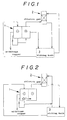
- Fig. 1 is a conceptual flow chart in the first embodiment of this invention.
- Fig. 2 is a conceptual flow chart in another embodiment of this invention.
- an etchant including a copper content of 121 g/l (8.6 g/l for monovalent copper ions) and a chlorine content of 300 g/l was supplied at a flow rate of 9.6 ml/min to a cathode cell (electrode; Cu) in electrolyzer 1 having a modoacryl diaphragm, where the bath was operated at an electrolytic voltage of 2.1 DC V.
- a cathode cell where a circulated cathode solution came in and went out, excess monovalent and divalent copper ions were electrolytically deposited after taking place reduction.
- the chemical analysis showed that the deposited metal had a copper content of 93.9 %.
- the production rate of withdrawn copper was 51.7 g/h and the power necessary for the electrolysis per 1 g copper was 2.03 Wh/g.
- the solution extracted from the circulation system had a copper content of 30.8 g/l (0.0 g/l for monovalent copper ions) and a chlorine content of 185 g/l, and was returned as a regenerated etchant to etching bath 3.
- the etching solution generated in etching bath 3 had a copper content of 121 g/l (8.6 g/l for monovalent copper ions) and a chlorine content of 300 g/l.
- the etchant was supplied not only to the electrolyzer 1 having the diaphragm, but also to the absorbing tower at a flow rate of 200 ml/min.
- the etchant was oxidized by the chlorine gas which initially generated at electrolyzer 1 and then supplied to absorbing tower 2.
- the resultant solution had a copper content of 121 g/l (0.0 g/l for monovalent copper ions) and a chlorine content of 304 g/l. Therefore, it was confirmed that the solution obtained was generated as a solution including copper (II) chloride. This solution was returned as a regenerated etchant to etching bath 3.
- an etchant including a copper content of 121 g/l (8.9 g/l for monovalent copper ions) and a chlorine content of 302 g/l was first supplied at a flow rate of 8.33 ml/min to a cathode cell (electrode; Cu) in electrolyzer 1 having a modoacryl diaphragm, where the bath was operated at an electrolytic voltage of 2.0 DC V.
- a cathode cell where a circulated cathode solution came in and went out, excess monovalent and divalent copper ions were electrolytically deposited after taking place reduction.
- the chemical analysis showed that the deposited metal had copper content of 97.5 %.
- the production rate of withdrawn copper was 45.1 g/h and the power necessary for the electrolysis per 1 gr copper was 2.3 Wh/g.
- the solution which left the cathode cell in a decreased concentration of copper was mixed to another etchant including a copper content of 121 g/l (14.2 g/l for monovalent copper ions) and a chlorine content of 302 g/l, this etchant being generated in etching bath 3.
- the mixed solution including a copper content of 117 g/l (14.5 g/l for monovalent copper ions) and a chlorine content of 297 g/l was supplied at a flow rate of 100 ml/min to absorbing tower 2.
- anode cell electrolyzer I having the diaphragm
- chlorine ions which generated in the cathode cell and flowed in the anode cell through the diaphragm was oxidized, thus generating chlorine gas at a rate of 59.7 g/h.
- the chlorine gas generated was introduced into absorbing tower 2.
- the mixed solution was oxidized by the chlorine gas.
- the resultant solution had a copper content of 117 g/l (0.0 g/l for monovalent copper ions) and a chlorine content of 304 g/l. It was confirmed that the solution obtained was generated as a solution including copper (II) chloride. This solution was returned as a regenerated etchant to etching bath 3.
Landscapes
- Chemical & Material Sciences (AREA)
- Chemical Kinetics & Catalysis (AREA)
- Engineering & Computer Science (AREA)
- Materials Engineering (AREA)
- Metallurgy (AREA)
- Organic Chemistry (AREA)
- General Chemical & Material Sciences (AREA)
- Mechanical Engineering (AREA)
- Electrochemistry (AREA)
- ing And Chemical Polishing (AREA)
- Electrolytic Production Of Metals (AREA)
Claims (2)
- Verfahren zur Behandlung eines Kupfer-(II)-chlorid-Ätzmittels mit folgenden Verfahrensschritten:- Einspeisen eines verbrauchten Kupfer-(II)-Chlorid-Ätzmittels, das Kupfer-(I)-Chlorid enthält, in die Kathodenzelle eines Elektrolyt-Bades, um elektrolytisch in der Kathodenzelle abgeschiedenes Kupfer durch Behandlung des verbrauchten Ätzmittels im Wege der Elektrolyse unter Verwendung eines unpolaren Diaphragmas mit einem geringen Widerstand abzuziehen,- Einspeisen des verbrauchten Ätzmittels nach dem Abziehen des Kupfers in die Anodenzelle, die eine Anode mit einer geringen Überspannung zur Erzeugung von Chlorgas aufweist, wodurch einwertige Kupferionen in zweiwertige Kupferionen oxidiert werden und Chlorgas erzeugt wird,- Einspeisen des in der Anodenzelle erzeugten Chlorgases in einen Absorptionsturm,- Einführen eines weiteren verbrauchten Kupfer-(II)-Chlorid-Ätzmittels in den Absorptionsturm, das in einem Ätzprozeß verwendetes Kupfer-(I)Chlorid enthält, wodurch das Ätzmittel oxidiert und regeneriert werden kann.
- Verfahren zur Behandlung eines Kupfer-(II)-Chlorid-Ätzmittels mit folgenden Verfahrensschritten:- Einspeisen eines verbrauchten Kupfer-(II)-Chlorid-Ätzmittels, das Kupfer-(I)-Chlorid enthält, aus einem Ätzbad in die Kathodenzelle eines Elektrolyt-Bades, um elektrolytisch in der Kathodenzelle abgeschiedenes Kupfer durch Behandlung des verbrauchten Ätzmittels im Wege der Elektrolyse unter Verwendung eines unpolaren Diaphragmas mit einem geringen Widerstand abzuziehen,- Erzeugen von Chlorgas in der Anodenzelle, die eine Anode mit einer geringen Überspannung zur Erzeugung von Chlorgas aufweist, durch Oxidieren von Chlorid-Ionen, die in der Kathodenzelle erzeugt und zur Anodenzelle durch das Diaphragma transferiert wurden,- Mischen des Ätzmittels nach dem Abziehen des Kupfers mit einem weiteren verbrauchten Kupfer-(II)-Chlorid-Ätzmittels, das Kupfer-(I)-Chlorid enthält, aus dem Ätzbad,- Einspeisen des in der Anodenzelle erzeugten Chlorgases in einen Absorptionsturm und Einführen der Mischlösung in den Absorptionsturm, um dadurch die Mischlösung zu oxidieren und das Ätzmittel regenerieren zu können.
Applications Claiming Priority (4)
| Application Number | Priority Date | Filing Date | Title |
|---|---|---|---|
| JP281370/91 | 1991-10-28 | ||
| JP3281370A JP2997110B2 (ja) | 1991-10-28 | 1991-10-28 | エッチング液の処理方法 |
| JP3293127A JP2698253B2 (ja) | 1991-11-08 | 1991-11-08 | 銅を含む塩化第二鉄エッチング液の処理方法 |
| JP293127/91 | 1991-11-08 |
Publications (2)
| Publication Number | Publication Date |
|---|---|
| EP0539792A1 EP0539792A1 (de) | 1993-05-05 |
| EP0539792B1 true EP0539792B1 (de) | 1997-04-16 |
Family
ID=26554156
Family Applications (1)
| Application Number | Title | Priority Date | Filing Date |
|---|---|---|---|
| EP92117448A Expired - Lifetime EP0539792B1 (de) | 1991-10-28 | 1992-10-13 | Verfahren zum Regenerieren von Ätzmitteln |
Country Status (10)
| Country | Link |
|---|---|
| US (1) | US5393387A (de) |
| EP (1) | EP0539792B1 (de) |
| KR (1) | KR100256895B1 (de) |
| CN (1) | CN1038950C (de) |
| AU (1) | AU655680B2 (de) |
| CA (1) | CA2081578C (de) |
| DE (1) | DE69219063T2 (de) |
| MY (1) | MY108734A (de) |
| RU (1) | RU2119973C1 (de) |
| SG (1) | SG46415A1 (de) |
Families Citing this family (18)
| Publication number | Priority date | Publication date | Assignee | Title |
|---|---|---|---|---|
| KR100972998B1 (ko) * | 2002-02-06 | 2010-07-30 | 신꼬오덴기 고교 가부시키가이샤 | 전해 재생 처리 장치 |
| DE10300597A1 (de) * | 2003-01-10 | 2004-07-22 | Eilenburger Elektrolyse- Und Umwelttechnik Gmbh | Verfahren und Vorrichtung zur vollständigen Regenerierung von Metallchlorid-Ätzlösungen für Kupferwerkstoffe |
| CN101988199A (zh) * | 2009-08-04 | 2011-03-23 | 章晓冬 | 微蚀液的循环再生及铜的回收装置 |
| CN102807294A (zh) * | 2011-05-31 | 2012-12-05 | 无锡尚德太阳能电力有限公司 | 处理已使用蚀刻液的再循环系统 |
| CN103422154A (zh) * | 2012-05-24 | 2013-12-04 | 叶福祥 | 电路板酸性废蚀刻液氯化亚铜(Cu+,CuCL)离子隔膜电积再生 |
| CN104591255A (zh) * | 2013-10-31 | 2015-05-06 | 孙立 | 一种利用氯化铜蚀刻废液制备微米级氧化铜的方法 |
| CN203741421U (zh) * | 2013-12-13 | 2014-07-30 | 陶克(苏州)机械设备有限公司 | 酸性蚀刻液再生设备 |
| CN104711636B (zh) * | 2015-02-11 | 2018-09-25 | 昆山市益民环保技术开发有限公司 | 印刷电路板酸性蚀刻废液处理方法 |
| CN106119852B (zh) * | 2015-08-31 | 2019-09-03 | 叶旖婷 | 一种酸性氯化铜蚀刻液的电解回收及再生工艺 |
| KR101799500B1 (ko) * | 2017-06-19 | 2017-11-21 | 인천화학 주식회사 | 염화동 폐액을 이용한 황산동의 제조방법 |
| RU2685103C1 (ru) * | 2017-11-21 | 2019-04-16 | Дмитрий Юрьевич Тураев | Реагентный метод регенерации солянокислого медно-хлоридного раствора травления меди |
| CN108425116B (zh) * | 2018-02-01 | 2019-10-22 | 深圳中科欧泰华环保科技有限公司 | 在酸性蚀刻生产线内采用三级循环吸收的处理方法及设备 |
| CN109136985A (zh) * | 2018-10-27 | 2019-01-04 | 揭阳市斯瑞尔环境科技有限公司 | 一种电解氯化铁蚀刻废液制取铁板和三氯化铁的方法 |
| RU2715836C1 (ru) * | 2019-07-23 | 2020-03-03 | Тураев Дмитрий Юрьевич | Реагентно-электролизный метод регенерации солянокислых медно-хлоридных растворов травления меди |
| CN110468417B (zh) * | 2019-09-09 | 2021-08-06 | 深圳中科欧泰华环保科技有限公司 | 一种五金蚀刻废液在线再生处理的方法及装置 |
| CN113493915A (zh) * | 2020-04-01 | 2021-10-12 | 健鼎(湖北)电子有限公司 | 酸性蚀刻废液的再生方法及系统 |
| CN114318372B (zh) * | 2022-01-18 | 2022-07-12 | 广东德同环保科技有限公司 | 一种循环电解三氯化铁吸收氯气的装置及方法 |
| CN114657566B (zh) * | 2022-05-23 | 2022-08-09 | 江油星联电子科技有限公司 | 一种电路板生产用药水再生装置 |
Family Cites Families (13)
| Publication number | Priority date | Publication date | Assignee | Title |
|---|---|---|---|---|
| US3794571A (en) * | 1971-05-10 | 1974-02-26 | Gen Electric | Regeneration of ferric chloride copper etching solutions |
| US3761369A (en) * | 1971-10-18 | 1973-09-25 | Electrodies Inc | Process for the electrolytic reclamation of spent etching fluids |
| JPS51119632A (en) * | 1975-04-15 | 1976-10-20 | Chiyuuoo Kk | Process for treating etching agents |
| JPS5518558A (en) * | 1978-07-27 | 1980-02-08 | Kagaku Gijutsu Shinkoukai | Recovering method for copper from ferric chloride etching waste solution containing copper |
| JPS55145175A (en) * | 1979-04-28 | 1980-11-12 | Kagaku Gijutsu Shinkoukai | Recovering method of copper by electrolysis of copper chloride etching solution and its apparatus |
| JPS5617429A (en) * | 1979-07-23 | 1981-02-19 | Noriyuki Yoshida | Inputting method for character and symbol to computer system with video interface |
| JPS5914097B2 (ja) * | 1980-07-30 | 1984-04-03 | 新日本製鐵株式会社 | 靭性を改良せるフェライト系耐熱鋼 |
| SU1019681A1 (ru) * | 1981-01-29 | 1983-05-23 | Предприятие П/Я В-2438 | Устройство дл травлени печатных плат с непрерывной регенерацией раствора |
| US4604175A (en) * | 1982-12-07 | 1986-08-05 | Naumov Jury I | Process for regeneration of iron-copper chloride etching solution |
| DE3303594A1 (de) * | 1983-02-03 | 1984-08-09 | Robert Bosch Gmbh, 7000 Stuttgart | Verfahren und vorrichtung zur regenerierung einer kupferhaltigen aetzloesung |
| DE3330349A1 (de) * | 1983-08-23 | 1985-03-14 | Robert Bosch Gmbh, 7000 Stuttgart | Verfahren zur elektrochemischen kompensation der luftoxidation bei der elektrochemischen regenerierung von chloridhaltigen kupferaetzloesungen |
| JPS61246395A (ja) * | 1985-04-23 | 1986-11-01 | Toagosei Chem Ind Co Ltd | 塩酸含有銅廃液の処理方法 |
| JPH02254188A (ja) * | 1989-03-27 | 1990-10-12 | Kamioka Kogyo Kk | 塩化銅溶液の電解処理方法 |
-
1992
- 1992-10-13 EP EP92117448A patent/EP0539792B1/de not_active Expired - Lifetime
- 1992-10-13 DE DE69219063T patent/DE69219063T2/de not_active Expired - Fee Related
- 1992-10-13 SG SG1996004500A patent/SG46415A1/en unknown
- 1992-10-14 US US07/960,992 patent/US5393387A/en not_active Expired - Lifetime
- 1992-10-15 KR KR1019920018956A patent/KR100256895B1/ko not_active Expired - Fee Related
- 1992-10-20 MY MYPI92001888A patent/MY108734A/en unknown
- 1992-10-20 AU AU27193/92A patent/AU655680B2/en not_active Ceased
- 1992-10-27 RU RU92004369/25A patent/RU2119973C1/ru not_active IP Right Cessation
- 1992-10-28 CA CA002081578A patent/CA2081578C/en not_active Expired - Fee Related
- 1992-10-28 CN CN92112389A patent/CN1038950C/zh not_active Expired - Fee Related
Also Published As
| Publication number | Publication date |
|---|---|
| SG46415A1 (en) | 1998-02-20 |
| EP0539792A1 (de) | 1993-05-05 |
| AU2719392A (en) | 1993-04-29 |
| CA2081578A1 (en) | 1993-04-29 |
| AU655680B2 (en) | 1995-01-05 |
| US5393387A (en) | 1995-02-28 |
| KR100256895B1 (ko) | 2000-05-15 |
| KR930008197A (ko) | 1993-05-21 |
| CN1038950C (zh) | 1998-07-01 |
| MY108734A (en) | 1996-11-30 |
| CA2081578C (en) | 2003-04-29 |
| DE69219063D1 (de) | 1997-05-22 |
| DE69219063T2 (de) | 1997-11-20 |
| CN1072737A (zh) | 1993-06-02 |
| RU2119973C1 (ru) | 1998-10-10 |
Similar Documents
| Publication | Publication Date | Title |
|---|---|---|
| US5393387A (en) | Method for treating etchant | |
| US3761369A (en) | Process for the electrolytic reclamation of spent etching fluids | |
| US4944851A (en) | Electrolytic method for regenerating tin or tin-lead alloy stripping compositions | |
| US4490224A (en) | Process for reconditioning a used ammoniacal copper etching solution containing copper solute | |
| EP0011800B1 (de) | Verfahren zum Ätzen von Oberflächen aus Kupfer oder Kupferlegierungen | |
| JPH036228B2 (de) | ||
| US5705048A (en) | Apparatus and a process for regenerating a CUCl2 etchant | |
| CA2372730A1 (en) | Electrolytic phosphate chemical treatment method | |
| JPH09195083A (ja) | ハロゲン錫組成物及び電解メッキ方法 | |
| US4604175A (en) | Process for regeneration of iron-copper chloride etching solution | |
| DE2641905A1 (de) | Verfahren zur regenerierung verbrauchter aetzloesungen | |
| EP0486188A2 (de) | Verfahren zur Regenierung von ammoniakalischen Chlorid-Ätzmitteln | |
| JP2698253B2 (ja) | 銅を含む塩化第二鉄エッチング液の処理方法 | |
| JP2997110B2 (ja) | エッチング液の処理方法 | |
| CN111333152A (zh) | 一种电解氧化处理高浓度含镍含磷有机废液的方法 | |
| Adaikkalam et al. | The electrochemical recycling of printed-wiring-board etchants | |
| Walsh | Electrochemical cell reactions in metal finishing | |
| JPS62297476A (ja) | 塩化銅エツチング廃液の再生方法及び再生装置 | |
| US3914163A (en) | Recovery of metal and sulfate values from electrochemical mining electrolytes | |
| JP2965442B2 (ja) | ニッケルを含む塩化鉄系廃液の再生方法 | |
| JP3294678B2 (ja) | 銅エッチング液の再生方法 | |
| JP3088884B2 (ja) | 銅を含む塩化鉄系廃液の再生方法 | |
| EP0244417B1 (de) | Verfahren zum beitzen von eisen- und stahlgegenständen | |
| JPH05204097A (ja) | ハロゲン化銅溶液の処理方法 | |
| CN1215099A (zh) | 再生CuCl2浸蚀剂的装置和方法 |
Legal Events
| Date | Code | Title | Description |
|---|---|---|---|
| PUAI | Public reference made under article 153(3) epc to a published international application that has entered the european phase |
Free format text: ORIGINAL CODE: 0009012 |
|
| AK | Designated contracting states |
Kind code of ref document: A1 Designated state(s): DE FR GB SE |
|
| 17P | Request for examination filed |
Effective date: 19931005 |
|
| 17Q | First examination report despatched |
Effective date: 19931029 |
|
| GRAG | Despatch of communication of intention to grant |
Free format text: ORIGINAL CODE: EPIDOS AGRA |
|
| GRAH | Despatch of communication of intention to grant a patent |
Free format text: ORIGINAL CODE: EPIDOS IGRA |
|
| GRAH | Despatch of communication of intention to grant a patent |
Free format text: ORIGINAL CODE: EPIDOS IGRA |
|
| GRAA | (expected) grant |
Free format text: ORIGINAL CODE: 0009210 |
|
| AK | Designated contracting states |
Kind code of ref document: B1 Designated state(s): DE FR GB SE |
|
| REF | Corresponds to: |
Ref document number: 69219063 Country of ref document: DE Date of ref document: 19970522 |
|
| ET | Fr: translation filed | ||
| PLBE | No opposition filed within time limit |
Free format text: ORIGINAL CODE: 0009261 |
|
| STAA | Information on the status of an ep patent application or granted ep patent |
Free format text: STATUS: NO OPPOSITION FILED WITHIN TIME LIMIT |
|
| 26N | No opposition filed | ||
| REG | Reference to a national code |
Ref country code: GB Ref legal event code: IF02 |
|
| PGFP | Annual fee paid to national office [announced via postgrant information from national office to epo] |
Ref country code: SE Payment date: 20041006 Year of fee payment: 13 |
|
| PGFP | Annual fee paid to national office [announced via postgrant information from national office to epo] |
Ref country code: DE Payment date: 20041007 Year of fee payment: 13 |
|
| PGFP | Annual fee paid to national office [announced via postgrant information from national office to epo] |
Ref country code: FR Payment date: 20041008 Year of fee payment: 13 |
|
| PGFP | Annual fee paid to national office [announced via postgrant information from national office to epo] |
Ref country code: GB Payment date: 20041013 Year of fee payment: 13 |
|
| PG25 | Lapsed in a contracting state [announced via postgrant information from national office to epo] |
Ref country code: GB Free format text: LAPSE BECAUSE OF NON-PAYMENT OF DUE FEES Effective date: 20051013 |
|
| PG25 | Lapsed in a contracting state [announced via postgrant information from national office to epo] |
Ref country code: SE Free format text: LAPSE BECAUSE OF NON-PAYMENT OF DUE FEES Effective date: 20051014 |
|
| PG25 | Lapsed in a contracting state [announced via postgrant information from national office to epo] |
Ref country code: DE Free format text: LAPSE BECAUSE OF NON-PAYMENT OF DUE FEES Effective date: 20060503 |
|
| EUG | Se: european patent has lapsed | ||
| GBPC | Gb: european patent ceased through non-payment of renewal fee |
Effective date: 20051013 |
|
| PG25 | Lapsed in a contracting state [announced via postgrant information from national office to epo] |
Ref country code: FR Free format text: LAPSE BECAUSE OF NON-PAYMENT OF DUE FEES Effective date: 20060630 |
|
| REG | Reference to a national code |
Ref country code: FR Ref legal event code: ST Effective date: 20060630 |