EP0540405A1 - Procédé d'élaboration d'une bande d'acier magnétique par coulée directe - Google Patents
Procédé d'élaboration d'une bande d'acier magnétique par coulée directe Download PDFInfo
- Publication number
- EP0540405A1 EP0540405A1 EP92402903A EP92402903A EP0540405A1 EP 0540405 A1 EP0540405 A1 EP 0540405A1 EP 92402903 A EP92402903 A EP 92402903A EP 92402903 A EP92402903 A EP 92402903A EP 0540405 A1 EP0540405 A1 EP 0540405A1
- Authority
- EP
- European Patent Office
- Prior art keywords
- strip
- less
- skin
- cylinder
- solidified
- Prior art date
- Legal status (The legal status is an assumption and is not a legal conclusion. Google has not performed a legal analysis and makes no representation as to the accuracy of the status listed.)
- Granted
Links
Images
Classifications
-
- C—CHEMISTRY; METALLURGY
- C21—METALLURGY OF IRON
- C21D—MODIFYING THE PHYSICAL STRUCTURE OF FERROUS METALS; GENERAL DEVICES FOR HEAT TREATMENT OF FERROUS OR NON-FERROUS METALS OR ALLOYS; MAKING METAL MALLEABLE, e.g. BY DECARBURISATION OR TEMPERING
- C21D8/00—Modifying the physical properties of ferrous metals or ferrous alloys by deformation combined with, or followed by, heat treatment
- C21D8/12—Modifying the physical properties of ferrous metals or ferrous alloys by deformation combined with, or followed by, heat treatment during manufacturing of articles with special electromagnetic properties
- C21D8/1205—Modifying the physical properties of ferrous metals or ferrous alloys by deformation combined with, or followed by, heat treatment during manufacturing of articles with special electromagnetic properties involving particular fabrication steps or treatments of ingots or slabs
- C21D8/1211—Rapid solidification; Thin strip casting
-
- B—PERFORMING OPERATIONS; TRANSPORTING
- B22—CASTING; POWDER METALLURGY
- B22D—CASTING OF METALS; CASTING OF OTHER SUBSTANCES BY THE SAME PROCESSES OR DEVICES
- B22D11/00—Continuous casting of metals, i.e. casting in indefinite lengths
- B22D11/06—Continuous casting of metals, i.e. casting in indefinite lengths into moulds with travelling walls, e.g. with rolls, plates, belts, caterpillars
-
- C—CHEMISTRY; METALLURGY
- C21—METALLURGY OF IRON
- C21D—MODIFYING THE PHYSICAL STRUCTURE OF FERROUS METALS; GENERAL DEVICES FOR HEAT TREATMENT OF FERROUS OR NON-FERROUS METALS OR ALLOYS; MAKING METAL MALLEABLE, e.g. BY DECARBURISATION OR TEMPERING
- C21D8/00—Modifying the physical properties of ferrous metals or ferrous alloys by deformation combined with, or followed by, heat treatment
- C21D8/12—Modifying the physical properties of ferrous metals or ferrous alloys by deformation combined with, or followed by, heat treatment during manufacturing of articles with special electromagnetic properties
- C21D8/1216—Modifying the physical properties of ferrous metals or ferrous alloys by deformation combined with, or followed by, heat treatment during manufacturing of articles with special electromagnetic properties characterised by the working steps
- C21D8/1233—Cold rolling
-
- C—CHEMISTRY; METALLURGY
- C21—METALLURGY OF IRON
- C21D—MODIFYING THE PHYSICAL STRUCTURE OF FERROUS METALS; GENERAL DEVICES FOR HEAT TREATMENT OF FERROUS OR NON-FERROUS METALS OR ALLOYS; MAKING METAL MALLEABLE, e.g. BY DECARBURISATION OR TEMPERING
- C21D8/00—Modifying the physical properties of ferrous metals or ferrous alloys by deformation combined with, or followed by, heat treatment
- C21D8/12—Modifying the physical properties of ferrous metals or ferrous alloys by deformation combined with, or followed by, heat treatment during manufacturing of articles with special electromagnetic properties
- C21D8/1244—Modifying the physical properties of ferrous metals or ferrous alloys by deformation combined with, or followed by, heat treatment during manufacturing of articles with special electromagnetic properties characterised by the heat treatment
- C21D8/1266—Modifying the physical properties of ferrous metals or ferrous alloys by deformation combined with, or followed by, heat treatment during manufacturing of articles with special electromagnetic properties characterised by the heat treatment between cold rolling steps
-
- C—CHEMISTRY; METALLURGY
- C21—METALLURGY OF IRON
- C21D—MODIFYING THE PHYSICAL STRUCTURE OF FERROUS METALS; GENERAL DEVICES FOR HEAT TREATMENT OF FERROUS OR NON-FERROUS METALS OR ALLOYS; MAKING METAL MALLEABLE, e.g. BY DECARBURISATION OR TEMPERING
- C21D8/00—Modifying the physical properties of ferrous metals or ferrous alloys by deformation combined with, or followed by, heat treatment
- C21D8/12—Modifying the physical properties of ferrous metals or ferrous alloys by deformation combined with, or followed by, heat treatment during manufacturing of articles with special electromagnetic properties
- C21D8/1244—Modifying the physical properties of ferrous metals or ferrous alloys by deformation combined with, or followed by, heat treatment during manufacturing of articles with special electromagnetic properties characterised by the heat treatment
- C21D8/1272—Final recrystallisation annealing
Definitions
- the present invention relates to a process for producing a magnetic grain oriented steel strip having a thickness of less than 5 mm and containing in composition by weight more than 2% of silicon, less than 0.1% of carbon, inhibiting elements. secondary recrystallization, the rest being iron, by direct casting on a cylinder or between two cylinders to obtain it.
- Oriented grain magnetic sheets are used for the manufacture of large size magnetic circuits, transformers and rotating machines.
- the crystallographic direction ⁇ 001> which is the direction of easy magnetization, must be parallel to the rolling direction.
- the continuously cast slabs are hot rolled on a belt train and seeds of GOSS orientation ⁇ 110 ⁇ ⁇ 001> according to the crystallographic notation of MILLER are generated during this time. rolling operation.
- inhibitors such as MnS, AlN, BN and / or Sn and Sb which are partially precipitated or segregated in the hot-rolled strip or precipitate during subsequent heat treatments (annealing of the hot-rolled strip and / or intermediate annealing between two rolling cold). If the previous thermal cycles are adequate, the dimensions of a quantity sufficient precipitates are less than 100 nanometers after decarburization.
- the final static annealing in coils allows the selective growth of GOSS germs inherited from hot rolling thanks to the inhibition, by the precipitates, of the normal growth of grains not having the desired orientation. This is the phenomenon known as secondary recrystallization, the primary recrystallization taking place during the decarburization operation.
- a new process for directly obtaining a thin strip with a thickness of less than 5mm by pouring liquid metal between two cylinders or on a cylinder eliminates hot rolling so that the germs of GOSS can no longer be generated by hot rolling as in conventional processes. It is therefore essential to determine new casting conditions which favor the existence of GOSS germs in the thin strip in the raw casting state.
- the strip in the raw casting state, which has undergone recrystallization after solidification is isotropic, that is to say of random texture, the grains having no orientation preferential. Secondary recrystallization is obtained, after a cold reduction rate greater than 80%, during a secondary recrystallization annealing.
- the objective of the invention is to propose a method making it possible to obtain GOSS germs in a thin strip without it being necessary to provide for a specific secondary heat treatment.
- the subject of the invention is a process for producing a magnetic steel strip with a thickness of less than 5 mm, containing in its composition by weight more than 2% of silicon, less than 0.1% of carbon, and elements which inhibit secondary recrystallization in suitable quantity, the rest being iron, this preparation being carried out by direct casting on a cylinder or between two cylinders, characterized in that it causes the formation of grains oriented ⁇ 110 ⁇ ⁇ 001> in skin , on the surface of at least one quenching zone, by subjecting the steel to brutal cooling by bringing the steel into contact with the or each cylinder, the surface temperature of which is less than 400 ° C.
- the invention also relates to an oriented grain sheet obtained from a strip produced by the process and which is characterized in that it comprises a columnar structure in the quenching zone and a non-columnar basalt structure comprising grains of the GOSS type. in skin.
- It also includes a central area with an equiaxed structure.
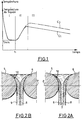
- FIG. 1 shows the variation of the temperature of the surface of the strip in contact with the cylinders and the temperature cycle of the skin at the outlet of the mold.
- Figs. 2A and 2B show in section two strip structures at the outlet of the ingot mold, corresponding respectively to a speed of cylinders allowing the casting of a strip comprising a central molten zone at the outlet of the ingot mold (2A), and at a lower speed allowing the casting of a strip without liquid central zone at the outlet of the mold (2B).
- the control of the solidification conditions makes it possible to obtain GOSS seeds in a thin strip obtained by direct casting in the case of natural cooling, that is to say without using a specific secondary cooling involving, for example, a spraying of water.
- a possible secondary cooling can take place but it is not then intended to solve a metallurgical problem related to the structure. It can for example be imposed by technological constraints of winding or by the concern of avoiding a surface oxidation, and can be carried out for example by sweeping of neutral gas.
- the seeds of GOSS are created in the mold by contact of the cast metal with the cylinders by optimizing the heat exchange conditions between the liquid metal and the surface of the cylinders and these germs are preserved. , under the center distance, and at the outlet of the ingot mold, without using a specific secondary cooling system, by controlling a specific parameter of the continuous casting process, for example the casting speed.
- the casting devices between two cylinders are not equipped with additional cooling systems, the cooling of the solidified strip taking place in ambient air.
- Fig. 1 shows the temperature of the surface of the strip in contact with the cylinder during the passage of the metal between the two cylinders of the mold in continuous casting and the cooling cycle of the skin of the band at the outlet of the mold.
- the core having a higher temperature than that of the quenching zone raises the temperature of said skin (zone II).
- zone III the skin is subjected to natural cooling with ambient air which does not require the use of an accelerated cooling device such as by spraying with water.
- Curve C1 corresponds to a casting speed V1 and curve C2 to a casting speed V2> V1.
- Figs. 2A and 2B are two diagrams representing two strip structures at the outlet of the cylinders 5 and 6, comprising respectively on the one hand a central zone 7 liquid between two quenching zones 8 and 9 (2A) and on the other hand two zones of quenching 8 and 9 juxtaposed, the central zone 7 being solidified at the outlet of the mold (2B).
- the observation of the microstructure of the Fe-Si band in the raw state of casting between two cylinders was carried out on samples so as to reveal germs of GOSS.
- the polished samples were subjected to a first attack with dilute nitric acid to reveal the grain boundaries, then to a second attack using a reagent containing hydrofluoric acid and hydrogen peroxide.
- the corrosion figures thus obtained were used for the determination of the crystal orientations of the grains and the location of the GOSS grains. It is noted that the germs of GOSS are located in the extreme skin, on the surface of the quenching zone in contact with the surface of the cylinder. It is the part solidified according to a non-columnar basaltic mode. To have GOSS grains at room temperature in the raw casting products, generate their formation during the first contact with the surface of the cylinder and preserve them by avoiding the enlargement of the adjacent columnar grains and by promoting their growth before the strip loses contact with the cylinders at the outlet of the mold.
- the metal on the strip surface undergoes rapid cooling and at the outlet of the mold the skin is subjected to heating by the core containing, if necessary, more or less liquid steel.
- the minimum temperature T min reached by the skin at the outlet of the ingot mold is less than 1400 ° C.
- the speed of natural cooling of the strip substantially equal in skin and at heart is not greater than 100 ° C / s.
- the originality of the present invention lies in the demonstration of the creation of GOSS germs in the mold, during the first contact of the liquid with the surface of the cylinder.
- Table 3 gives the experimental conditions and the structural characteristics of the strip cast between two cylinders.
- Table 4 describes the different stages of transformation of the pickled strip. Table 4 - Reduction rate of the first cold rolling 79% - Intermediate annealing 980 ° C, 1 min 30 - Reduction rate of the second cold rolling 55% - Decarburization annealing Mgo coating 870 ° C, 3 min - High temperature annealing 1200 ° C, 8 p.m.
- the quantity and the size of the manganese and copper sulphides resulting from the cooling of the strip with calm ambient air are compatible with the existence of a satisfactory inhibitory power.
- numerous precipitates identified by transmission electron microscopy have a spherical shape of approximately 10 to 100 nm in diameter.
- the inhibiting power can be reinforced by adding inhibitors, to the magnesia which is used as an annealing separator to avoid sticking of the turns of the coil during the secondary recrystallization annealing.
- the invention is applicable to the methods of direct casting of thin strips between two rolls and on a roll with a view to obtaining oriented grain sheets of conventional permeability or with high permeability. It is applicable whatever the mode of inhibition (sulphides, selenides, nitrides, segregated elements) of the normal growth of the primary recrystallization grains favoring the selective growth of the GOSS grains and whatever the downstream treatment of the band obtained by direct casting of liquid metal on a cylinder or between two cylinders.
- This downstream treatment can comprise a single cold rolling with a high reduction rate (greater than 80%) to obtain a high performance sheet or consist of a treatment classic two or more cold rolling with intermediate annealing (s).
- the strip in the raw casting state may be annealed before cold rolling, in particular with a view to optimizing the size of the inhibitors.
- Cold rolling is followed by on-line treatment, primary recrystallization and decarburization.
- the final annealing of the coils after coating with a milk of magnesia to avoid sticking of the turns, in a static oven promotes the phenomenon of secondary recrystallization which leads to the selective formation of orientation grains ⁇ 110 ⁇ ⁇ 001>.
- the conditions for obtaining the strip between two cylinders can be adapted in the case of casting on a cylinder or by lateral supply of a cylinder with liquid metal.
- the ⁇ 110 ⁇ ⁇ 001> orientation grains are obtained under the same conditions, the pressure applied per millimeter of band width being zero.
- the grains of GOSS are then only present on the face of the strip in contact with the cylinder.
- Table 5 gives an example of the number of grains of GOSS per cm of skin and the percentage of grain of GOSS on the single face of contact with the cylinder as a function of the experimental conditions of casting on a single cylinder.
- Table 5 Cylinder surface temperature (° C) 280 Casting speed (m / mm) 30 Strip thickness (mm) 1.38 Percentage of central area 0 % carbon of solidified metal 0.016 % of GOSS grains on the surface 5.8
Landscapes
- Engineering & Computer Science (AREA)
- Chemical & Material Sciences (AREA)
- Mechanical Engineering (AREA)
- Physics & Mathematics (AREA)
- Materials Engineering (AREA)
- Thermal Sciences (AREA)
- Manufacturing & Machinery (AREA)
- Crystallography & Structural Chemistry (AREA)
- Electromagnetism (AREA)
- Metallurgy (AREA)
- Organic Chemistry (AREA)
- Continuous Casting (AREA)
- Manufacturing Of Steel Electrode Plates (AREA)
- Coating With Molten Metal (AREA)
- Control And Safety Of Cranes (AREA)
- Treatment Of Steel In Its Molten State (AREA)
- Soft Magnetic Materials (AREA)
Abstract
Description
- La présente invention concerne un procédé d'élaboration d'une bande d'acier magnétique à grains orientés ayant une épaisseur inférieure à 5mm et contenant en composition pondérale plus de 2% de silicium, moins de 0,1% de carbone, des éléments inhibiteurs de recristallisation secondaire, le reste étant du fer, par coulée directe sur un cylindre ou entre deux cylindres pour l'obtention.
- Les tôles magnétiques à grains orientés sont utilisées pour la fabrication des circuits magnétiques, des transformateurs et des machines tournantes de grandes dimensions. Dans le cas des applications du type transformateurs, pour obtenir un acier aux performances magnétiques optimales, la direction cristallographique <001> qui est la direction de facile aimantation, doit être parallèle à la direction de laminage. Dans le procédé classique de production de tôles à grains orientés, les brames coulées en continu sont laminées à chaud sur un train à bandes et des germes de GOSS d'orientation {110} <001> selon la notation cristallographique de MILLER sont générés pendant cette opération de laminage. En ajoutant au métal liquide composé de fer, de silicium et de carbone, du manganèse, de l'aluminium, du bore, de l'antimoine, de l'étain, du soufre et/ou de l'azote, il se forme des inhibiteurs tels que MnS, AlN, BN et/ou Sn et Sb qui sont partiellement précipités ou ségrégés dans la bande laminée à chaud ou précipitent lors des traitements thermiques ultérieurs (recuit de la bande laminée à chaud et/ou recuit intermédiaire entre deux laminages à froid). Si les cycles thermiques antérieurs sont adéquats, les dimensions d'une quantité suffisante de précipités sont inférieures à 100 nanomètres après décarburation. Le recuit final statique en bobines permet la croissance sélective des germes de GOSS hérités du laminage à chaud grâce à l'inhibition, par les précipités, de la croissance normale des grains n'ayant pas l'orientation désirable. C'est le phénomène dit de recristallisation secondaire, la recristallisation primaire ayant lieu pendant l'opération de décarburation.
- Un nouveau procédé d'obtention directe d'une bande mince d'épaisseur inférieure à 5mm par coulée de métal liquide entre deux cylindres ou sur un cylindre, permet d'éliminer le laminage à chaud de sorte que les germes de GOSS ne peuvent plus être générés par laminage à chaud comme dans les procédés classiques. Il est donc essentiel de déterminer de nouvelles conditions de coulée qui favorisent l'existence des germes de GOSS dans la bande mince à l'état brut de coulée.
- Ainsi, dans le brevet EP-A-0 390 160, il est préconisé un contrôle de la vitesse de refroidissement secondaire de la bande mince obtenue après solidification du métal liquide, cette vitesse devant être supérieure à 10° C/s entre 1300 et 900°C pour éviter le grossissement des précipités inhibiteurs qui supprimerait la recristallisation secondaire ultérieure et la formation de grains d'orientation {110} <001>. Il est précisé que si la vitesse de refroidissement secondaire entre 1300 et 900°C est trop élevée, la structure colonnaire de la bande à l'état brut de coulée possède la texture {100} <ovw> avec un nombre de germes de GOSS proche de zéro, ce qui ne permet pas d'envisager l'obtention de l'épaisseur finale par une seule opération de laminage à froid avec un taux de réduction supérieur à 80%. En effet, dans ces conditions, la recristallisation secondaire n'a pas lieu. Si la vitesse de refroidissement secondaire est appropriée, supérieure à 10°C/s, la bande à l'état brut de coulée, qui a subi une recristallisation après solidification, est isotrope, c'est-à-dire de texture aléatoire, les grains ne présentant pas d'orientation préférentielle. La recristallisation secondaire est obtenue, après un taux de réduction à froid supérieur à 80%, pendant un recuit de recristallisation secondaire.
- L'objectif de l'invention est de proposer un procédé permettant d'obtenir des germes de GOSS dans une bande mince sans qu'il soit nécessaire de prévoir un traitement thermique secondaire spécifique.
- La demanderesse a mis en évidence que le contrôle des conditions de solidification lors de la coulée, et non la vitesse de refroidissement secondaire entre 1300 et 900°C, est un paramètre essentiel qui régit l'existence des germes de GOSS dans une bande mince obtenue par coulée directe de métal liquide entre deux cylindres ou sur un cylindre.
- L'invention a pour objet un procédé d'élaboration d'une bande d'acier magnétique d'épaisseur inférieure à 5 mm, contenant dans sa composition pondérale plus de 2% de silicium, moins de 0,1% de carbone, et des éléments inhibiteurs de recristallisation secondaire en quantité convenable, le reste étant du fer, cette élaboration étant réalisée par coulée directe sur un cylindre ou entre deux cylindres, caractérisé en ce qu'on provoque la formation de grains orientés {110} <001> en peau, à la surface d'au moins une zone de trempe, en soumettant l'acier à un refroidissement brutal par mise de l'acier en contact avec le ou chaque cylindre, dont la température de surface est inférieure à 400°C.
- Dans une forme de mise en oeuvre :
- on coule la bande entre deux cylindres refroidis à une température inférieure ou égale à 400°C,
- on applique entre les cylindres une pression inférieure à 50 Kgf/mm de largeur de bande.
- Selon d'autres caractéristiques :
- la température de surface du ou de chaque cylindre est de préférence égale ou inférieure à 250°C;
- le coefficient d'échange thermique à l'interface cylindre/peau solidifiée est supérieur à 0,10 cal/cm².s.°C,
- la peau de la bande est une zone de trempe solidifiée selon un mode basaltique non colonnaire,
- l'épaisseur de la couche de métal liquide au coeur de la bande en sortie de lingotière est inférieure ou égale à 30% de l'épaisseur totale de la bande.
- L'invention concerne également une tôle à grains orientés obtenue à partir d'une bande produite par le procédé et qui se caractérisé en ce qu'elle comporte une structure colonnaire en zone de trempe et une structure basaltique non colonnaire comportant des grains de type GOSS en peau.
- Elle comporte en outre une zone centrale de structure équiaxe.
- La description qui suit et les dessins annexés, donnés à titre d'exemple non limitatif, feront bien comprendre l'invention. Sur ces dessins :
- la Fig. 1 représente la variation de la température de la surface de la bande en contact avec les cylindres et le cycle de température de la peau en sortie de lingotière. - Les Fig. 2A et 2B représentent en coupe deux structures de bande à la sortie de la lingotière, correspondant respectivement à une vitesse de cylindres permettant la coulée d'une bande comportant une zone centrale fondue en sortie de lingotière (2A), et à une vitesse plus faible permettant la coulée d'une bande sans zone centrale liquide en sortie de lingotière (2B).
- Selon le procédé de l'invention, le contrôle des conditions de solidification permet d'obtenir des germes de GOSS dans une bande mince obtenue par coulée directe dans le cas d'un refroidissement naturel, c'est-à-dire sans faire appel à un refroidissement secondaire spécifique mettant en jeu, par exemple, une pulvérisation d'eau. Un éventuel refroidissement secondaire peut avoir lieu mais il n'a pas alors pour objectif de résoudre un problème métallurgique lié à la structure. Il peut par exemple être imposé par des contraintes technologiques de bobinage ou par le souci d'éviter une oxydation superficielle, et être réalisé par exemple par balayage de gaz neutre.
- Selon l'invention, on crée les germes de GOSS dans la lingotière par contact du métal coulé avec les cylindres grâce à l'optimisation des conditions d'échange de chaleur entre le métal liquide et la surface des cylindres et l'on conserve ces germes, sous l'entr'axe, et en sortie de lingotière, sans l'aide d'un système spécifique de refroidissement secondaire, par le contrôle d'un paramètre propre du procédé de coulée en continu, par exemple la vitesse de coulée. Dans les exemples décrits ci-après pour illustrer l'invention, les dispositifs de coulée entre deux cylindres ne sont pas équipés de systèmes de refroidissement annexes, le refroidissement de la bande solidifiée ayant lieu à l'air ambiant.
- La Fig. 1 représente la température de la surface de la bande en contact avec le cylindre lors du passage du métal entre les deux cylindres de la lingotière en coulée continue et le cycle de refroidissement de la peau de la bande en sortie de la lingotière.
- Les cylindres refroidis par circulation d'eau et dont la température de surface est maintenue inférieure à 400°C solidifient la bande en surface pour former une zone de trempe dont la peau subit une variation brutale de température matérialisée par le gradient de température de la zone I. Lors de la sortie de la bande de la lingotière, le coeur ayant une température plus élevée que celle de la zone de trempe élève la température de ladite peau (zone II). Dans la zone III, la peau est soumise à un refroidissement naturel à l'air ambiant ne nécessitant pas l'utilisation d'un dispositif de refroidissement accéléré tel que par pulvérisation d'eau. La courbe C1 correspond à une vitesse de coulée V1 et la courbe C2 à une vitesse de coulée V2 > V1.
- Les Fig. 2A et 2B sont deux schémas représentant deux structures de bande à la sortie des cylindres 5 et 6, comportant respectivement d'une part une zone centrale 7 liquide entre deux zones de trempe 8 et 9 (2A) et d'autre part deux zones de trempe 8 et 9 juxtaposées, la zone centrale 7 étant solidifiée à la sortie de la lingotière (2B).
- L'observation de la microstructure de la bande Fe-Si à l'état brut de coulée entre deux cylindres a été réalisée sur des échantillons de façon à mettre en évidence des germes de GOSS. Les échantillons polis ont été soumis à une première attaque à l'acide nitrique dilué pour révéler les joints de grains, puis à une seconde attaque à l'aide d'un réactif contenant de l'acide fluorhydrique et de l'eau oxygénée.
- Les figures de corrosion ainsi obtenues ont été utilisées pour la détermination des orientations cristallines des grains et le repérage des grains de GOSS. Il est constaté que les germes de GOSS sont situés en extrême peau, à la surface de la zone de trempe en contact avec la surface du cylindre. Il s'agit de la partie solidifiée selon un mode basaltique non colonnaire. Pour avoir des grains de GOSS à la température ambiante dans les produits bruts de coulée, il faut générer leur formation lors du premier contact avec la surface du cylindre et les conserver en évitant le grossissement des grains colonnaires adjacents et en favorisant leur croissance avant que la bande perde le contact avec les cylindres en sortie de lingotière.
- Comme représenté sur les Fig. 2A et 2B, au contact des cylindres refroidis, le métal en surface de bande subit un refroidissement rapide et en sortie de lingotière la peau est soumise à un réchauffement par le coeur contenant le cas échéant plus ou moins d'acier liquide.
- Les paramètres agisssant sur la température minimale T min. atteinte par la peau dans la lingotière sont :
- la température de surface du cylindre maintenue inférieure à 400° C grâce au pouvoir de refroidissement des circuits d'eau, à la conductibilité thermique du matériau constituant la surface du cylindre, aux caractéristiques géométriques de la surface du cylindre comme par exemple sa rugosité, son diamètre, etc ...
- l'évolution de la résistance thermique à l'interface surface du cylindre/peau en cours de solidification. Pour créer des germes de GOSS à la surface de la zone de trempe et les conserver avant de quitter le contact avec la surface du cylindre, il faut selon l'invention :
- que la température de surface du cylindre soit inférieure à 400°C,
- que le coefficient d'échange thermique à l'interface soit supérieur à 0,10 cal/cm².s. °C tout au long de l'arc de contact 10.
- Dans ces conditions la température minimale Tmin atteinte par la peau en sortie de lingotière (Zone I, Fig. 1) est inférieure à 1 400°C, et la vitesse de refroidissement naturel de la bande (zone III, Fig. 1), sensiblement égale en peau et à coeur n'est pas supérieure à 100° C/s.
- En dessous du plan P contenant les axes des cylindres (ou plan de l'entraxe), dès que la bande a quitté le contact avec les cylindres, l'extraction de chaleur n'est plus aussi intense et la progression du front de solidification selon un mode basaltique colonnaire cesse. Si la bande est constituée de deux zones de trempe et d'une zone centrale pâteuse contenant du liquide et des germes de grains équiaxes (Fig. 2A), le refroidissement de la zone centrale à travers les zones solidifiées requiert l'évacuation de la chaleur latente de la partie liquide ainsi que des calories du solide. Comme les peaux ne sont plus refroidies que par rayonnement, il s'ensuit un réchauffement de la surface. C'est au cours de cette étape que les grains de peau, et notamment les germes de GOSS, peuvent disparaître. Au cours du réchauffement, le temps passé dans le domaine de température où la mobilité des joints de grains est effective est le paramètre important. La liste des facteurs agissant sur la température de réchauffement ainsi que le temps passé dans le domaine où la mobilité des joints de grains, phénomène thermiquement activé, est effective, est :
- la proportion de zone centrale, à structure équiaxe, après solidification du liquide, rapportée à l'épaisseur totale de la bande;
- la température initiale de peau, déterminée par les différents paramètres de l'installation.
- Les observations ont montré que le nombre de grains de GOSS par unité de longueur de peau et le pourcentage de grains de GOSS en surface varient en fonction du pourcentage de zone centrale et du pourcentage en carbone du métal solidifié. Les structures de solidification ont été mises en évidence par attaque électrolytique dans une solution aqueuse contenant 10% de péroxodisulfate d'ammonium (NH₄)₂S₂O₈ qui fait apparaître les axes principaux des dendrites.
Tableau 1 Pourcentage de grains de GOSS en surface en fonction du pourcentage de zone centrale et du pourcentage en carbone (cas" d'une coulée entre deux cylindres)." Température maximale de surface du ou de chaque cylindre 250°C 240°C 300°C Pression des cylindres (kgf/mm largeur de bande) 10 7,5 10 Epaisseur de la bande (mm) 1,6 1,8 1,85 Longueur de peau observée dans le sens de la coulée (mm) 750 850 400 Pourcentage de zone centrale (%), épaisseur de la zone centrale/épaisseur de la bande x 100 0 4 19,5 % en carbone du métal solidifié 0,005 0,005 0,020 Nombre de grains de GOSS par cm de peau 1,8 0,6 3 Pourcentage de grains de GOSS en surface 2,8 1,5 8,8 - L'originalité de la présente invention réside dans la mise en évidence de la création des germes de GOSS dans la lingotière, pendant le premier contact du liquide avec la surface du cylindre.
- La limitation en proportion de la zone centrale susceptible de réchauffer les peaux et la teneur en carbone sont des moyens de conserver ces germes. D'après le tableau 1, le nombre de grains de GOSS par cm de peau et le pourcentage de grains de GOSS en surface sont beaucoup plus élevés quand le pourcentage de zone centrale est nul (Fig. 2B) et quand la teneur en carbone est plus élevée.
- La relation qui lie la recristallisation secondaire à la température maximale de surface et à la pression des cylindres, au coefficient d'échange thermique à l'interface cylindre/peau solidifiée, au nombre de grains de GOSS par cm de peau, au pourcentage de grains de GOSS en surface et à la teneur en carbone, est illustrée par l'expérience suivante de coulée directe de bande mince entre deux cylindres. Le tableau 2 donne la composition chimique du métal (pourcentages massiques).
Tableau 2 C Si S P Mn Cu Al soluble N 0,035 3,22 0,020 0,005 0,035 0,167 0,001 0,005 - Le tableau 3 donne les conditions expérimentales et les caractéristiques structurales de la bande coulée entre deux cylindres.


- Le tableau 4 décrit les différentes étapes de transformation de la bande décapée.
Tableau 4 - Taux de réduction du premier laminage à froid 79% - Recuit intermédiaire 980°C, 1 min 30 - Taux de réduction du second laminage à froid 55% - Recuit décarburation Enduction Mgo 870°C, 3 min - Recuit haute température 1200°C, 20 h - Dans ces conditions, il a été obtenu une recristallisation secondaire complète, c'est-à-dire 100% de grains de GOSS à l'épaisseur finale de 0,28 mm. Compte tenu de la teneur élevée en carbone (0,035%), le pourcentage de grains de GOSS en surface est néanmoins relativement élevé (5,6%) bien que le pourcentage de zone centrale soit supérieur à 10%. Il a été mis en évidence que l'on conservait des grains de GOSS en surface même avec un pourcentage de zone centrale de l'ordre de 30% si la teneur en carbone est supérieure à 0,035%, les conditions de température maximale de surface des cylindres et la pression appliquée à la bande entre les cylindres étant respectivement inférieures à 400°C et 50 kgf/mm, le coefficient d'échange thermique étant supérieur à 0,10 cal/cm².s.°C.
- Par ailleurs la quantité et la taille des sulfures de manganèse et de cuivre résultant du refroidissement de la bande à l'air calme ambiant, sont compatibles avec l'existence d'un pouvoir inhibiteur satisfaisant. Après recuit de décarburation, de nombreux précipités, identifiés par microscopie électronique en transmission ont une forme sphérique d'environ 10 à 100 nm de diamètre. Il est par ailleurs bien connu que le pouvoir inhibiteur peut être renforcé par addition d'inhibiteurs, à la magnésie qui est utilisée comme séparateur de recuit pour éviter le collage des spires de la bobine pendant le recuit de recristallisation secondaire.
- L'invention est applicable aux procédés de coulée directe de bandes minces entre deux cylindres et sur un cylindre en vue de l'obtention de tôles à grains orientés de perméabilité classique ou à haute perméabilité. Elle est applicable quel que soit le mode d'inhibition (sulfures, séléniures, nitrures, éléments ségrégés) de la croissance normale des grains de recristallisation primaire favorisant la croissance sélective des grains de GOSS et quel que soit le traitement aval de la bande obtenue par coulée directe de métal liquide sur un cylindre ou entre deux cylindres. Ce traitement aval peut comporter un seul laminage à froid avec un taux de réduction élevé (supérieur à 80%) pour obtenir une tôle de haute performance ou consister en un traitement classique à deux ou plusieurs laminages à froid avec recuit (s) intermédiaires (s).
- La bande à l'état brut de coulée peut subir un recuit avant laminage à froid, notamment en vue d'optimiser la taille des inhibiteurs. Le laminage à froid est suivi d'un traitement en ligne, de recristallisation primaire et de décarburation. Enfin le recuit final des bobines, après enduction par un lait de magnésie pour éviter le collage des spires, dans un four statique favorise le phénomène de recristallisation secondaire qui conduit à la formation sélective des grains d'orientation {110} <001>. Les conditions d'obtention de la bande entre deux cylindres peuvent être adaptées dans le cas de la coulée sur un cylindre ou par alimentation latérale d'un cylindre par le métal liquide. Les grains d'orientation {110} <001> sont obtenus dans les mêmes conditions, la pression appliquée par millimètre de largeur de bande étant nulle. Les grains de GOSS ne sont alors présents que sur la face de la bande en contact avec le cylindre.
- Le tableau 5 ci-dessous donne un exemple du nombre de grains de GOSS par cm de peau et du pourcentage de grain de GOSS sur la face unique de contact avec le cylindre en fonction des conditions expérimentales de coulée sur un seul cylindre.
Tableau 5 Température de surface du cylindre (°C) 280 Vitesse de coulée (m/mm) 30 Epaisseur de la bande (mm) 1,38 Pourcentage de zone centrale 0 % de carbone du métal solidifié 0,016 % de grains de GOSS en surface 5,8
Claims (14)
- Procédé d'élaboration d'une bande d'acier magnétique d'épaisseur inférieure à 5 mm, contenant en composition pondérale plus de 2% de silicium, moins de 0,1% de carbone, des éléments inhibiteurs de recristallisation secondaire en quantité convenable, le reste étant du fer, cette élaboration étant réalisée par coulée directe sur un cylindre ou entre deux cylindres, caractérisé en ce qu'on provoque la formation de de grains orientés {110} <001> en peau, à la surface d'au moins une zone de trempe, en soumettant l'acier à un refroidissement brutal par mise en contact avec le ou chaque cylindre, dont la température de surface est maintenue inférieure à 400°C.
- Procédé selon la revendication 1, caractérisé en ce qu'on coule la bande entre deux cylindres refroidis à une température inférieure à 400°C, et l'on applique entre les cylindres une pression inférieure à 50 Kgf/mm de largeur de bande.
- Procédé selon l'une quelconque des revendications 1 et 2, caractérisé en ce que la température de surface du ou de chaque cylindre est inférieure à 250°C.
- Procédé selon l'une quelconque des revendications 1 à 3, caractérisé en ce que le coefficient d'échange thermique à l'interface cylindre/peau solidifiée est supérieur à 0,10 cal/cm2.s.°C.
- Procédé selon l'une quelconque des revendications 1 à 4, caractérisé en ce que la peau de la bande, surface de la zone de trempe, est solidifiée selon un mode basaltique non colonnaire.
- Procédé selon l'une quelconque des revendications 1 à 5, caractérisé en ce que l'épaisseur de la couche de métal liquide au coeur de la bande en sortie de lingotière est inférieure ou égale à 30% de l'épaisseur totale de la bande.
- Procédé selon l'une quelconque des revendications 1 à 6, caractérisé en ce que la teneur en carbone de la bande solidifiée est supérieure à 0,01%.
- Procédé selon l'une des revendications 1 à 7, caractérisé en ce que la température minimale atteinte par la peau solidifiée en sortie de lingotière est inférieure à 1400°C.
- Procédé selon l'une quelconque des revendications 1 à 8, caractérisé en ce que la vitesse de refroidissement naturel de la bande solidifiée est inférieure à 100° C/s.
- Procédé selon l'une quelconque des revendications 1 à 9, caractérisé en ce que la bande subit en outre au moins un laminage à froid, un traitement thermique de décarburation et de recristallisation primaire et un recuit final de recristallisation secondaire.
- Procédé selon la revendication 10, caractérisé en ce que la bande est soumise à un recuit après le ou chaque laminage à froid.
- Procédé selon la revendication 10, caractérisé en ce que la bande est soumise à un recuit avant le premier laminage à froid.
- Tôle à grains orientés {110} <001] obtenue à partir de la bande produite par le procédé selon les revendications 1 à 9, caractérisée en ce qu'elle comporte une structure colonnaire en zone de trempe et une structure basaltique non colonnaire comportant des grains de type GOSS en peau.
- Tôle selon la revendication 13, caractérisée en ce qu'elle comporte en outre une zone centrale de structure équiaxe.
Applications Claiming Priority (2)
| Application Number | Priority Date | Filing Date | Title |
|---|---|---|---|
| FR9113499A FR2683229B1 (fr) | 1991-10-31 | 1991-10-31 | Procede d'elaboration d'une bande d'acier magnetique par coulee directe. |
| FR9113499 | 1992-10-31 |
Publications (2)
| Publication Number | Publication Date |
|---|---|
| EP0540405A1 true EP0540405A1 (fr) | 1993-05-05 |
| EP0540405B1 EP0540405B1 (fr) | 1997-01-22 |
Family
ID=9418534
Family Applications (1)
| Application Number | Title | Priority Date | Filing Date |
|---|---|---|---|
| EP92402903A Expired - Lifetime EP0540405B1 (fr) | 1991-10-31 | 1992-10-26 | Procédé d'élaboration d'une bande d'acier magnétique par coulée directe |
Country Status (16)
| Country | Link |
|---|---|
| US (1) | US5417772A (fr) |
| EP (1) | EP0540405B1 (fr) |
| JP (1) | JP2863679B2 (fr) |
| AT (1) | ATE148175T1 (fr) |
| CZ (1) | CZ284160B6 (fr) |
| DE (2) | DE69216994T2 (fr) |
| DK (1) | DK0540405T3 (fr) |
| ES (1) | ES2099233T3 (fr) |
| FR (1) | FR2683229B1 (fr) |
| GR (1) | GR3023079T3 (fr) |
| HU (1) | HU214854B (fr) |
| PL (1) | PL171088B1 (fr) |
| RO (1) | RO114349B1 (fr) |
| RU (1) | RU2105074C1 (fr) |
| SK (1) | SK281332B6 (fr) |
| UA (1) | UA26031C2 (fr) |
Cited By (1)
| Publication number | Priority date | Publication date | Assignee | Title |
|---|---|---|---|---|
| WO2002050318A1 (fr) * | 2000-12-18 | 2002-06-27 | Thyssenkrupp Acciai Speciali Terni S.P.A. | Procede de fabrication d'acier electrique a grain oriente |
Families Citing this family (7)
| Publication number | Priority date | Publication date | Assignee | Title |
|---|---|---|---|---|
| DE19745445C1 (de) * | 1997-10-15 | 1999-07-08 | Thyssenkrupp Stahl Ag | Verfahren zur Herstellung von kornorientiertem Elektroblech mit geringem Ummagnetisierungsverlust und hoher Polarisation |
| IT1316026B1 (it) * | 2000-12-18 | 2003-03-26 | Acciai Speciali Terni Spa | Procedimento per la fabbricazione di lamierini a grano orientato. |
| IT1316030B1 (it) * | 2000-12-18 | 2003-03-26 | Acciai Speciali Terni Spa | Procedimento per la fabbricazione di lamierini a grano orientato. |
| US7059384B2 (en) * | 2001-06-15 | 2006-06-13 | National Research Council Of Canada | Apparatus and method for metal strip casting |
| CA2459471C (fr) * | 2001-09-13 | 2010-02-02 | Jerry W. Schoen | Procede de coulee continue d'une bande d'acier electrique grace au refroidissement par pulverisation controle |
| JP4648910B2 (ja) * | 2006-10-23 | 2011-03-09 | 新日本製鐵株式会社 | 磁気特性の優れた無方向性電磁鋼板の製造方法 |
| AU2008100847A4 (en) * | 2007-10-12 | 2008-10-09 | Bluescope Steel Limited | Method of forming textured casting rolls with diamond engraving |
Citations (4)
| Publication number | Priority date | Publication date | Assignee | Title |
|---|---|---|---|---|
| US3061486A (en) * | 1957-12-30 | 1962-10-30 | Armco Steel Corp | Non-directional oriented silicon-iron |
| US3115430A (en) * | 1960-09-20 | 1963-12-24 | Armco Steel Corp | Production of cube-on-edge oriented silicon iron |
| EP0095352A2 (fr) * | 1982-05-24 | 1983-11-30 | Kawasaki Steel Corporation | Procédé et dispositif pour la production de bandes métalliques solidifiées rapidement par un système à deux cylindres |
| EP0390160A1 (fr) | 1989-03-30 | 1990-10-03 | Nippon Steel Corporation | Procédé de fabrication de tôles d'acier électrique à grains orientés par trempe et solidification rapides |
Family Cites Families (5)
| Publication number | Priority date | Publication date | Assignee | Title |
|---|---|---|---|---|
| JPS6179724A (ja) * | 1984-09-28 | 1986-04-23 | Nippon Kokan Kk <Nkk> | 高珪素鉄合金の薄板製造方法 |
| US5259443A (en) * | 1987-04-21 | 1993-11-09 | Nippon Yakin Kogyo Co., Ltd. | Direct production process of a length of continuous thin two-phase stainless steel strip having excellent superplasticity and surface properties |
| DE8816779U1 (de) * | 1988-08-13 | 1990-08-16 | Kiekert GmbH & Co KG, 5628 Heiligenhaus | Kraftfahrzeug-Türverschlußvorrichtung |
| JPH02258149A (ja) * | 1989-03-30 | 1990-10-18 | Nippon Steel Corp | 一方向性高磁束密度電磁鋼板の製造方法 |
| US5259439A (en) * | 1990-04-04 | 1993-11-09 | Ishikawajima-Harima Heavy Industries Company Limited | Strip casting |
-
1991
- 1991-10-31 FR FR9113499A patent/FR2683229B1/fr not_active Expired - Fee Related
-
1992
- 1992-10-26 ES ES92402903T patent/ES2099233T3/es not_active Expired - Lifetime
- 1992-10-26 AT AT92402903T patent/ATE148175T1/de not_active IP Right Cessation
- 1992-10-26 DE DE69216994T patent/DE69216994T2/de not_active Expired - Fee Related
- 1992-10-26 DK DK92402903.6T patent/DK0540405T3/da active
- 1992-10-26 EP EP92402903A patent/EP0540405B1/fr not_active Expired - Lifetime
- 1992-10-28 US US07/967,439 patent/US5417772A/en not_active Expired - Lifetime
- 1992-10-28 DE DE4236359A patent/DE4236359A1/de not_active Ceased
- 1992-10-29 PL PL92296412A patent/PL171088B1/pl not_active IP Right Cessation
- 1992-10-30 HU HU9203426A patent/HU214854B/hu not_active IP Right Cessation
- 1992-10-30 RO RO92-01362A patent/RO114349B1/ro unknown
- 1992-10-30 CZ CS923279A patent/CZ284160B6/cs not_active IP Right Cessation
- 1992-10-30 RU RU92004372A patent/RU2105074C1/ru not_active IP Right Cessation
- 1992-10-30 SK SK3279-92A patent/SK281332B6/sk unknown
- 1992-11-02 JP JP4294481A patent/JP2863679B2/ja not_active Expired - Fee Related
-
1993
- 1993-06-15 UA UA93002909A patent/UA26031C2/uk unknown
-
1997
- 1997-04-08 GR GR970400747T patent/GR3023079T3/el unknown
Patent Citations (4)
| Publication number | Priority date | Publication date | Assignee | Title |
|---|---|---|---|---|
| US3061486A (en) * | 1957-12-30 | 1962-10-30 | Armco Steel Corp | Non-directional oriented silicon-iron |
| US3115430A (en) * | 1960-09-20 | 1963-12-24 | Armco Steel Corp | Production of cube-on-edge oriented silicon iron |
| EP0095352A2 (fr) * | 1982-05-24 | 1983-11-30 | Kawasaki Steel Corporation | Procédé et dispositif pour la production de bandes métalliques solidifiées rapidement par un système à deux cylindres |
| EP0390160A1 (fr) | 1989-03-30 | 1990-10-03 | Nippon Steel Corporation | Procédé de fabrication de tôles d'acier électrique à grains orientés par trempe et solidification rapides |
Non-Patent Citations (2)
| Title |
|---|
| IRON AND STEEL ENGINEER. vol. 67, no. 7, Juillet 1990, PITTSBURGH US pages 51 - 55 J.A.BURGO ET AL 'Thermal design and analysis of a twin-roll caster' * |
| PATENT ABSTRACTS OF JAPAN vol. 15, no. 6 (M-1066)8 Janvier 1991 & JP-A-2 258 149 ( NIPPON STEEL ) 18 Octobre 1990 * |
Cited By (2)
| Publication number | Priority date | Publication date | Assignee | Title |
|---|---|---|---|---|
| WO2002050318A1 (fr) * | 2000-12-18 | 2002-06-27 | Thyssenkrupp Acciai Speciali Terni S.P.A. | Procede de fabrication d'acier electrique a grain oriente |
| US7198682B2 (en) | 2000-12-18 | 2007-04-03 | Thyssenkrupp Acciai Speciali Terni S.P.A. | Process for the production of grain oriented electrical steel |
Also Published As
| Publication number | Publication date |
|---|---|
| US5417772A (en) | 1995-05-23 |
| CZ327992A3 (en) | 1994-03-16 |
| RU2105074C1 (ru) | 1998-02-20 |
| DE69216994T2 (de) | 1997-06-12 |
| DE69216994D1 (de) | 1997-03-06 |
| GR3023079T3 (en) | 1997-07-30 |
| PL296412A1 (en) | 1993-07-12 |
| RO114349B1 (ro) | 1999-03-30 |
| JPH06142851A (ja) | 1994-05-24 |
| PL171088B1 (pl) | 1997-03-28 |
| SK327992A3 (en) | 1995-07-11 |
| DK0540405T3 (da) | 1997-02-10 |
| CZ284160B6 (cs) | 1998-09-16 |
| EP0540405B1 (fr) | 1997-01-22 |
| JP2863679B2 (ja) | 1999-03-03 |
| HUT71567A (en) | 1995-12-28 |
| DE4236359A1 (fr) | 1993-05-06 |
| SK281332B6 (sk) | 2001-02-12 |
| HU9203426D0 (en) | 1993-03-01 |
| UA26031C2 (uk) | 1999-02-26 |
| FR2683229B1 (fr) | 1994-02-18 |
| ATE148175T1 (de) | 1997-02-15 |
| FR2683229A1 (fr) | 1993-05-07 |
| HU214854B (hu) | 1998-06-29 |
| ES2099233T3 (es) | 1997-05-16 |
Similar Documents
| Publication | Publication Date | Title |
|---|---|---|
| CA2459471C (fr) | Procede de coulee continue d'une bande d'acier electrique grace au refroidissement par pulverisation controle | |
| KR940000596A (ko) | 알루미늄 합금 캔 본체 시이트의 제조방법 | |
| AU2002326892A1 (en) | Method of continuously casting electrical steel strip with controlled spray cooling | |
| EP1466024A1 (fr) | Procede de fabrication d un produit siderurgique en acier au carbone riche en cuivre, et produit siderurgique ainsi obtenu | |
| EP0540405B1 (fr) | Procédé d'élaboration d'une bande d'acier magnétique par coulée directe | |
| JP2004515362A (ja) | 高いマンガン含有量を有する鋼からの熱間ストリップの製造方法 | |
| KR930007312B1 (ko) | 큐브-온-에지 방위(cube-on-edge orientaion)를 가지는 규소강 스트립 및 시이트의 제조방법 | |
| JPH032932B2 (fr) | ||
| FR2511046A1 (fr) | Procede pour la production de tole ou de bande en acier electromagnetique a grain oriente et tole ou bande ainsi obtenue | |
| FR2496706A1 (fr) | Procede de fabrication d'acier au silicium oriente | |
| BE897817A (fr) | Procede de production de toles d'acier electrique a grains orientes et toles ainsi obtenues | |
| CN108486340B (zh) | 高碳高铬的不锈钢及其加工方法 | |
| CN104884643B (zh) | 方向性电磁钢板及方向性电磁钢板的制造方法 | |
| CN111318566A (zh) | 铁铬铝合金连铸板坯热轧钢卷的生产方法 | |
| FR2472020A1 (fr) | Procede de chauffage d'une brame d'acier de coulee continue pour la production de toles d'acier au silicium a grains orientes | |
| JPH075379U (ja) | 解凍装置 | |
| US7736444B1 (en) | Method and system for manufacturing electrical silicon steel | |
| JPH0713268B2 (ja) | 連続鋳造一方向性電磁鋼スラブの熱間圧延方法 | |
| JPS61143524A (ja) | 薄板状鋳片の製造方法 | |
| JPH03146646A (ja) | りん青銅合金の熱間圧延方法 | |
| JPH0430458B2 (fr) | ||
| BE555766A (fr) | ||
| JPH02263927A (ja) | 方位制御鋼帯の製造方法 | |
| JPH0366455A (ja) | 薄肉鋳片の連続鋳造装置用冷却ドラム | |
| JPH01230712A (ja) | 加工用薄鋼板の一貫製造法 |
Legal Events
| Date | Code | Title | Description |
|---|---|---|---|
| PUAI | Public reference made under article 153(3) epc to a published international application that has entered the european phase |
Free format text: ORIGINAL CODE: 0009012 |
|
| AK | Designated contracting states |
Kind code of ref document: A1 Designated state(s): AT BE CH DE DK ES FR GB GR IE IT LI LU NL PT SE |
|
| 17P | Request for examination filed |
Effective date: 19930812 |
|
| GRAG | Despatch of communication of intention to grant |
Free format text: ORIGINAL CODE: EPIDOS AGRA |
|
| GRAH | Despatch of communication of intention to grant a patent |
Free format text: ORIGINAL CODE: EPIDOS IGRA |
|
| 17Q | First examination report despatched |
Effective date: 19960401 |
|
| RAP1 | Party data changed (applicant data changed or rights of an application transferred) |
Owner name: THYSSEN STAHL AKTIENGESELLSCHAFT Owner name: USINOR SACILOR SOCIETE ANONYME |
|
| GRAH | Despatch of communication of intention to grant a patent |
Free format text: ORIGINAL CODE: EPIDOS IGRA |
|
| GRAA | (expected) grant |
Free format text: ORIGINAL CODE: 0009210 |
|
| AK | Designated contracting states |
Kind code of ref document: B1 Designated state(s): AT BE CH DE DK ES FR GB GR IE IT LI LU NL PT SE |
|
| REF | Corresponds to: |
Ref document number: 148175 Country of ref document: AT Date of ref document: 19970215 Kind code of ref document: T |
|
| REG | Reference to a national code |
Ref country code: CH Ref legal event code: EP |
|
| REG | Reference to a national code |
Ref country code: DK Ref legal event code: T3 |
|
| ITF | It: translation for a ep patent filed | ||
| GBT | Gb: translation of ep patent filed (gb section 77(6)(a)/1977) |
Effective date: 19970203 |
|
| REF | Corresponds to: |
Ref document number: 69216994 Country of ref document: DE Date of ref document: 19970306 |
|
| REG | Reference to a national code |
Ref country code: IE Ref legal event code: FG4D Free format text: 71693 |
|
| REG | Reference to a national code |
Ref country code: ES Ref legal event code: FG2A Ref document number: 2099233 Country of ref document: ES Kind code of ref document: T3 |
|
| REG | Reference to a national code |
Ref country code: PT Ref legal event code: SC4A Free format text: AVAILABILITY OF NATIONAL TRANSLATION Effective date: 19970226 |
|
| REG | Reference to a national code |
Ref country code: GR Ref legal event code: FG4A Free format text: 3023079 |
|
| PLBE | No opposition filed within time limit |
Free format text: ORIGINAL CODE: 0009261 |
|
| STAA | Information on the status of an ep patent application or granted ep patent |
Free format text: STATUS: NO OPPOSITION FILED WITHIN TIME LIMIT |
|
| 26N | No opposition filed | ||
| REG | Reference to a national code |
Ref country code: FR Ref legal event code: TQ Ref country code: FR Ref legal event code: CD |
|
| BECH | Be: change of holder |
Free format text: 19991116 S.A. *UGO;*THYSSEN STAHL A.G. |
|
| REG | Reference to a national code |
Ref country code: PT Ref legal event code: PD4A Free format text: USINOR FR Effective date: 20000216 Ref country code: PT Ref legal event code: PC4A Free format text: UGO, SOCIETE ANONYME FR Effective date: 20000216 |
|
| NLS | Nl: assignments of ep-patents |
Owner name: THYSSEN STAHL AKTIENGESELLSCHAFT;UGO |
|
| NLT1 | Nl: modifications of names registered in virtue of documents presented to the patent office pursuant to art. 16 a, paragraph 1 |
Owner name: THYSSEN STAHL AKTIENGESELLSCHAFT;USINOR |
|
| REG | Reference to a national code |
Ref country code: CH Ref legal event code: PUEA Free format text: THYSSEN STAHL AKTIENGESELLSCHAFT;USINOR TRANSFER- THYSSEN STAHL AKTIENGESELLSCHAFT;UGO Ref country code: CH Ref legal event code: PFA Free format text: USINOR SACILOR SOCIETE ANONYME;THYSSEN STAHL AKTIENGESELLSCHAFT TRANSFER- THYSSEN STAHL AKTIENGESELLSCHAFT;USINOR |
|
| REG | Reference to a national code |
Ref country code: GB Ref legal event code: IF02 |
|
| PGFP | Annual fee paid to national office [announced via postgrant information from national office to epo] |
Ref country code: DK Payment date: 20070918 Year of fee payment: 16 |
|
| PGFP | Annual fee paid to national office [announced via postgrant information from national office to epo] |
Ref country code: IE Payment date: 20070927 Year of fee payment: 16 |
|
| PGFP | Annual fee paid to national office [announced via postgrant information from national office to epo] |
Ref country code: CH Payment date: 20070917 Year of fee payment: 16 |
|
| PGFP | Annual fee paid to national office [announced via postgrant information from national office to epo] |
Ref country code: SE Payment date: 20070919 Year of fee payment: 16 Ref country code: NL Payment date: 20070618 Year of fee payment: 16 Ref country code: LU Payment date: 20071119 Year of fee payment: 16 Ref country code: ES Payment date: 20071017 Year of fee payment: 16 Ref country code: DE Payment date: 20071010 Year of fee payment: 16 |
|
| PGFP | Annual fee paid to national office [announced via postgrant information from national office to epo] |
Ref country code: AT Payment date: 20070917 Year of fee payment: 16 Ref country code: IT Payment date: 20071020 Year of fee payment: 16 |
|
| PGFP | Annual fee paid to national office [announced via postgrant information from national office to epo] |
Ref country code: BE Payment date: 20071105 Year of fee payment: 16 |
|
| PGFP | Annual fee paid to national office [announced via postgrant information from national office to epo] |
Ref country code: GB Payment date: 20071016 Year of fee payment: 16 Ref country code: FR Payment date: 20071016 Year of fee payment: 16 |
|
| PGFP | Annual fee paid to national office [announced via postgrant information from national office to epo] |
Ref country code: GR Payment date: 20070928 Year of fee payment: 16 |
|
| BERE | Be: lapsed |
Owner name: *THYSSEN STAHL A.G. Effective date: 20081031 Owner name: S.A. *UGO Effective date: 20081031 |
|
| REG | Reference to a national code |
Ref country code: PT Ref legal event code: MM4A Free format text: LAPSE DUE TO NON-PAYMENT OF FEES Effective date: 20090427 |
|
| REG | Reference to a national code |
Ref country code: CH Ref legal event code: PL |
|
| REG | Reference to a national code |
Ref country code: DK Ref legal event code: EBP |
|
| EUG | Se: european patent has lapsed | ||
| GBPC | Gb: european patent ceased through non-payment of renewal fee |
Effective date: 20081026 |
|
| NLV4 | Nl: lapsed or anulled due to non-payment of the annual fee |
Effective date: 20090501 |
|
| REG | Reference to a national code |
Ref country code: IE Ref legal event code: MM4A |
|
| REG | Reference to a national code |
Ref country code: FR Ref legal event code: ST Effective date: 20090630 |
|
| PG25 | Lapsed in a contracting state [announced via postgrant information from national office to epo] |
Ref country code: NL Free format text: LAPSE BECAUSE OF NON-PAYMENT OF DUE FEES Effective date: 20090501 |
|
| PG25 | Lapsed in a contracting state [announced via postgrant information from national office to epo] |
Ref country code: PT Free format text: LAPSE BECAUSE OF NON-PAYMENT OF DUE FEES Effective date: 20090427 Ref country code: IT Free format text: LAPSE BECAUSE OF NON-PAYMENT OF DUE FEES Effective date: 20081026 Ref country code: DE Free format text: LAPSE BECAUSE OF NON-PAYMENT OF DUE FEES Effective date: 20090501 Ref country code: AT Free format text: LAPSE BECAUSE OF NON-PAYMENT OF DUE FEES Effective date: 20081026 |
|
| PG25 | Lapsed in a contracting state [announced via postgrant information from national office to epo] |
Ref country code: BE Free format text: LAPSE BECAUSE OF NON-PAYMENT OF DUE FEES Effective date: 20081031 |
|
| PG25 | Lapsed in a contracting state [announced via postgrant information from national office to epo] |
Ref country code: LI Free format text: LAPSE BECAUSE OF NON-PAYMENT OF DUE FEES Effective date: 20081031 Ref country code: IE Free format text: LAPSE BECAUSE OF NON-PAYMENT OF DUE FEES Effective date: 20081027 Ref country code: FR Free format text: LAPSE BECAUSE OF NON-PAYMENT OF DUE FEES Effective date: 20081031 Ref country code: DK Free format text: LAPSE BECAUSE OF NON-PAYMENT OF DUE FEES Effective date: 20081031 Ref country code: CH Free format text: LAPSE BECAUSE OF NON-PAYMENT OF DUE FEES Effective date: 20081031 |
|
| PG25 | Lapsed in a contracting state [announced via postgrant information from national office to epo] |
Ref country code: GR Free format text: LAPSE BECAUSE OF NON-PAYMENT OF DUE FEES Effective date: 20090505 Ref country code: GB Free format text: LAPSE BECAUSE OF NON-PAYMENT OF DUE FEES Effective date: 20081026 |
|
| PGFP | Annual fee paid to national office [announced via postgrant information from national office to epo] |
Ref country code: PT Payment date: 20070914 Year of fee payment: 16 |
|
| REG | Reference to a national code |
Ref country code: ES Ref legal event code: FD2A Effective date: 20081027 |
|
| PG25 | Lapsed in a contracting state [announced via postgrant information from national office to epo] |
Ref country code: ES Free format text: LAPSE BECAUSE OF NON-PAYMENT OF DUE FEES Effective date: 20081027 |
|
| PG25 | Lapsed in a contracting state [announced via postgrant information from national office to epo] |
Ref country code: LU Free format text: LAPSE BECAUSE OF NON-PAYMENT OF DUE FEES Effective date: 20081026 |
|
| PG25 | Lapsed in a contracting state [announced via postgrant information from national office to epo] |
Ref country code: SE Free format text: LAPSE BECAUSE OF NON-PAYMENT OF DUE FEES Effective date: 20081027 |