EP0540799A1 - Amélioration de diodes AlGaInP à émission de lumière visible - Google Patents
Amélioration de diodes AlGaInP à émission de lumière visible Download PDFInfo
- Publication number
- EP0540799A1 EP0540799A1 EP91810848A EP91810848A EP0540799A1 EP 0540799 A1 EP0540799 A1 EP 0540799A1 EP 91810848 A EP91810848 A EP 91810848A EP 91810848 A EP91810848 A EP 91810848A EP 0540799 A1 EP0540799 A1 EP 0540799A1
- Authority
- EP
- European Patent Office
- Prior art keywords
- layer
- aigalnp
- doped
- layers
- cladding
- Prior art date
- Legal status (The legal status is an assumption and is not a legal conclusion. Google has not performed a legal analysis and makes no representation as to the accuracy of the status listed.)
- Withdrawn
Links
Images




Classifications
-
- H—ELECTRICITY
- H10—SEMICONDUCTOR DEVICES; ELECTRIC SOLID-STATE DEVICES NOT OTHERWISE PROVIDED FOR
- H10H—INORGANIC LIGHT-EMITTING SEMICONDUCTOR DEVICES HAVING POTENTIAL BARRIERS
- H10H20/00—Individual inorganic light-emitting semiconductor devices having potential barriers, e.g. light-emitting diodes [LED]
- H10H20/80—Constructional details
- H10H20/81—Bodies
- H10H20/811—Bodies having quantum effect structures or superlattices, e.g. tunnel junctions
- H10H20/812—Bodies having quantum effect structures or superlattices, e.g. tunnel junctions within the light-emitting regions, e.g. having quantum confinement structures
-
- B—PERFORMING OPERATIONS; TRANSPORTING
- B82—NANOTECHNOLOGY
- B82Y—SPECIFIC USES OR APPLICATIONS OF NANOSTRUCTURES; MEASUREMENT OR ANALYSIS OF NANOSTRUCTURES; MANUFACTURE OR TREATMENT OF NANOSTRUCTURES
- B82Y20/00—Nanooptics, e.g. quantum optics or photonic crystals
-
- H—ELECTRICITY
- H01—ELECTRIC ELEMENTS
- H01S—DEVICES USING THE PROCESS OF LIGHT AMPLIFICATION BY STIMULATED EMISSION OF RADIATION [LASER] TO AMPLIFY OR GENERATE LIGHT; DEVICES USING STIMULATED EMISSION OF ELECTROMAGNETIC RADIATION IN WAVE RANGES OTHER THAN OPTICAL
- H01S5/00—Semiconductor lasers
- H01S5/20—Structure or shape of the semiconductor body to guide the optical wave ; Confining structures perpendicular to the optical axis, e.g. index or gain guiding, stripe geometry, broad area lasers, gain tailoring, transverse or lateral reflectors, special cladding structures, MQW barrier reflection layers
-
- H—ELECTRICITY
- H01—ELECTRIC ELEMENTS
- H01S—DEVICES USING THE PROCESS OF LIGHT AMPLIFICATION BY STIMULATED EMISSION OF RADIATION [LASER] TO AMPLIFY OR GENERATE LIGHT; DEVICES USING STIMULATED EMISSION OF ELECTROMAGNETIC RADIATION IN WAVE RANGES OTHER THAN OPTICAL
- H01S5/00—Semiconductor lasers
- H01S5/20—Structure or shape of the semiconductor body to guide the optical wave ; Confining structures perpendicular to the optical axis, e.g. index or gain guiding, stripe geometry, broad area lasers, gain tailoring, transverse or lateral reflectors, special cladding structures, MQW barrier reflection layers
- H01S5/2004—Confining in the direction perpendicular to the layer structure
-
- H—ELECTRICITY
- H01—ELECTRIC ELEMENTS
- H01S—DEVICES USING THE PROCESS OF LIGHT AMPLIFICATION BY STIMULATED EMISSION OF RADIATION [LASER] TO AMPLIFY OR GENERATE LIGHT; DEVICES USING STIMULATED EMISSION OF ELECTROMAGNETIC RADIATION IN WAVE RANGES OTHER THAN OPTICAL
- H01S5/00—Semiconductor lasers
- H01S5/20—Structure or shape of the semiconductor body to guide the optical wave ; Confining structures perpendicular to the optical axis, e.g. index or gain guiding, stripe geometry, broad area lasers, gain tailoring, transverse or lateral reflectors, special cladding structures, MQW barrier reflection layers
- H01S5/2004—Confining in the direction perpendicular to the layer structure
- H01S5/2009—Confining in the direction perpendicular to the layer structure by using electron barrier layers
-
- H—ELECTRICITY
- H01—ELECTRIC ELEMENTS
- H01S—DEVICES USING THE PROCESS OF LIGHT AMPLIFICATION BY STIMULATED EMISSION OF RADIATION [LASER] TO AMPLIFY OR GENERATE LIGHT; DEVICES USING STIMULATED EMISSION OF ELECTROMAGNETIC RADIATION IN WAVE RANGES OTHER THAN OPTICAL
- H01S5/00—Semiconductor lasers
- H01S5/20—Structure or shape of the semiconductor body to guide the optical wave ; Confining structures perpendicular to the optical axis, e.g. index or gain guiding, stripe geometry, broad area lasers, gain tailoring, transverse or lateral reflectors, special cladding structures, MQW barrier reflection layers
- H01S5/22—Structure or shape of the semiconductor body to guide the optical wave ; Confining structures perpendicular to the optical axis, e.g. index or gain guiding, stripe geometry, broad area lasers, gain tailoring, transverse or lateral reflectors, special cladding structures, MQW barrier reflection layers having a ridge or stripe structure
-
- H—ELECTRICITY
- H01—ELECTRIC ELEMENTS
- H01S—DEVICES USING THE PROCESS OF LIGHT AMPLIFICATION BY STIMULATED EMISSION OF RADIATION [LASER] TO AMPLIFY OR GENERATE LIGHT; DEVICES USING STIMULATED EMISSION OF ELECTROMAGNETIC RADIATION IN WAVE RANGES OTHER THAN OPTICAL
- H01S5/00—Semiconductor lasers
- H01S5/30—Structure or shape of the active region; Materials used for the active region
- H01S5/32—Structure or shape of the active region; Materials used for the active region comprising PN junctions, e.g. hetero- or double- heterostructures
- H01S5/321—Structure or shape of the active region; Materials used for the active region comprising PN junctions, e.g. hetero- or double- heterostructures having intermediate bandgap layers
-
- H—ELECTRICITY
- H01—ELECTRIC ELEMENTS
- H01S—DEVICES USING THE PROCESS OF LIGHT AMPLIFICATION BY STIMULATED EMISSION OF RADIATION [LASER] TO AMPLIFY OR GENERATE LIGHT; DEVICES USING STIMULATED EMISSION OF ELECTROMAGNETIC RADIATION IN WAVE RANGES OTHER THAN OPTICAL
- H01S5/00—Semiconductor lasers
- H01S5/30—Structure or shape of the active region; Materials used for the active region
- H01S5/32—Structure or shape of the active region; Materials used for the active region comprising PN junctions, e.g. hetero- or double- heterostructures
- H01S5/323—Structure or shape of the active region; Materials used for the active region comprising PN junctions, e.g. hetero- or double- heterostructures in AIIIBV compounds, e.g. AlGaAs-laser, InP-based laser
- H01S5/32308—Structure or shape of the active region; Materials used for the active region comprising PN junctions, e.g. hetero- or double- heterostructures in AIIIBV compounds, e.g. AlGaAs-laser, InP-based laser emitting light at a wavelength less than 900 nm
- H01S5/32325—Structure or shape of the active region; Materials used for the active region comprising PN junctions, e.g. hetero- or double- heterostructures in AIIIBV compounds, e.g. AlGaAs-laser, InP-based laser emitting light at a wavelength less than 900 nm red laser based on InGaP
-
- H—ELECTRICITY
- H10—SEMICONDUCTOR DEVICES; ELECTRIC SOLID-STATE DEVICES NOT OTHERWISE PROVIDED FOR
- H10H—INORGANIC LIGHT-EMITTING SEMICONDUCTOR DEVICES HAVING POTENTIAL BARRIERS
- H10H20/00—Individual inorganic light-emitting semiconductor devices having potential barriers, e.g. light-emitting diodes [LED]
- H10H20/80—Constructional details
- H10H20/81—Bodies
- H10H20/822—Materials of the light-emitting regions
- H10H20/824—Materials of the light-emitting regions comprising only Group III-V materials, e.g. GaP
Definitions
- LEDs visible light emitting diodes
- the performance and reliability of these devices have to meet special requirements as there are e.g. high output power, continuous wave operation, low thermal and electrical resistance.
- Laser diodes consisting of AIGalInP/GalnP allow to fabricate lasers emitting lightwaves having wavelength lower than 700 nm.
- Different AIGalnP/GalnP device structures have been reported qualifying these types of lasers and LEDs to be the most promising ones for several future optoelectronic applications.
- AIGalnP/GalnP visible lasers and light emitting diodes are light sources which could be utilized for various optoelectronic applications including high-density optical disks, laser printers, plastic fiber com - munication, bar-code readers, pumping of solid state lasers, laser surgery and optical measurement systems which presently use He - Ne lasers.
- the following sections relate mainly to optical storage systems employing laser diodes.
- the require - ments of these laser diodes meet the requirements of laser diodes used in the other applications mentioned above.
- the semiconductor laser diode used for storing data on high-density optical disks is a key component because the wavelength of the radiation determines to a large extent the achievable storage density.
- Other requirements for these lasers are higher available optical power, which is limited by COD (Catastrophic Optical Damage) of the device, and improved reliability which is crucial for the overall system reliability.
- Known storage systems are based on AIGaAs lasers, lasing at a wavelength of 780 nm and reaching power levels of 30 mW. Laser diodes with reduced wavelength, improved optical output power and lifetime are important for future storage systems and the other optoelectronic applications mentioned.
- the quaternary AIGalnP lattice matched to GaAs, having a direct bandgap up to 2.3 eV, is presently the most interesting candidate for the above mentioned applications. Owing to advanced growth techniques, it has become possible to utilize the quaternary AIGalnP for diodes emitting in the range between 600 and 700 nm.
- One advantage of AIGalnP is the complete lattice match to crystalline quality binary GaAs substrate. In fact, almost all AIGalnP diodes reported today have been grown by MOVPE (Metal Organic Vapor Phase Epitaxy).
- DH visible light double - heterostructure
- the devices described in the above cited articles and patent applications have a simple double heterostructure.
- a comparable double heterostructure and its bandgap diagram are shown in Figure 1.
- the wavelength achieved by these lasers is typically between 670 and 690 nm. Their practical maximum output power up to now is, in lateral single mode narrow devices, less than 30 mW.
- the AIGalnP system per se is suitable for laser wavelength shorter than 670 nm.
- QW quantum well
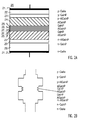
- a typical MQW (Multi - Quantum Well) structure as disclosed in the above cited article of G.L Bona et al. and similar to the MQW structure described in the article of S. Kawata et al., is illustrated in Figure 2A.
- the corresponding bandgap diagram is shown in Figure 2B.
- the main improvement of this MQW device is its reduced threshold current (I thr ) and absorption losses (a) resulting in an improved efficiency ( ⁇ ).
- I thr threshold current
- a absorption losses
- ⁇ improved efficiency
- the maximum output power is furtheron limited by catastrophic optical damage (COD).
- This MQW structure consists of GalnP quantum wells sandwiched between undoped AIGalnP quantum barrier layers together being embedded between a p-doped AIGalnP cladding layer and a n-doped AIGalnP cladding layer.
- the wavelength of QW laser diodes in general is smaller than that of comparable DH laser diodes.
- AIGalnP/GalnP QW and MQW lasers emitting wavelength of 670 nm down to 625 nm have been reported in the literature.
- the maximum output power, limited by the COD of these devices, is reported to be about 10 - 30 mW, depending of the mode of operation, cooling, and geometry of the respective structure.
- the main object of this invention is to provide a semiconductor diode emitting visible light, which does not suffer or suffer at least to a considerably lesser extent from the limitations mentioned.
- Another object of the present invention is to provide a diode structure with improved performance.
- a further object is to provide a laser structure with reduced threshold current.
- the invention as claimed is intended to meet these objectives and to remedy the remaining deficiencies of known AIGalnP or AIGalnAs diodes.
- the principle by which this is accomplished is to provide for an active layer being embedded between thin AIGalnP (AIGalnAs) barrier layers and together sandwiched between thick AIGaAs (InP) cladding layers raising the COD level, reducing the electric resistance, and improving the differential quantum efficiency.
- the following description relates mainly to AIGalnP/GalnP quantum well and double - heterostructure loser diodes and LEDs, one embodiment disclosing the inventive structure being transferred into the long wavelength AIGalnAsP/lnP system.
- a conventional DH loser diode 10 as for example disclosed in the article "Room-Temperature Pulsed Operation of AIGalnP/GalnP/AlGalnP Double Heterostructure Visible Light Laser Diodes Grown by Metalorganic Chemical Vapor Deposition", of I. Hino et al., Appl. Phys. Lett., Vol. 43 (11), December 1983, pp. 987 - 989, is illustrated in Figure 1A. Its bandgap diagram is shown in Figure 1B.
- the shown DH laser 10 consists of a GalnP active layer 14 being sandwiched between n- and p-doped AIGalnP cladding layers 15 and 13, the thickness of the active layer 15 being typically about 0,1 ⁇ m.
- the cladding layers 13 and 15 which consist of AIGalnP can be p-doped using Selenium (Se) and n-doped using Zinc (Zn).
- the cladding layers are about 1 ⁇ m thick.
- the structure is covered on one side by a p-doped GalnP bandgap matching layer 12 and a p-doped GaAs contact layer 11.
- the n-doped cladding layer 15 is situated on an n-doped bandgap matching layer 16, which consists of GaAs, and an n-doped GaAs substrate 17.
- Metal contacts 18.1 and 18.2 are situated at both sides of the device 10.
- Figure 2A shows a well known separate confinement MQW (Multi - Quantum Well) laser diode 20 being comparable with the DH diode 10 illustrated in Figure 1A.
- MQW Multi - Quantum Well
- the MQW structure 20, schematically shown in Figure 2A, consists of two undoped GalnP quantum wells 26.1, 26.2 embedded between, undoped or slightly doped AIGalnP waveguide layers 25.1 and 25.3.
- the quantum wells 26.1, 26.2 are separated by an undoped quantum barrier layer 25.1 and the whole quantum well structure is sandwiched between thick p - and n - doped cladding layers 24 and 27 consisting of AIGalnP.
- These cladding layers 24, 27 are followed by p- and n-doped GalnP bandgap matching layers 23 and 28.
- a p - doped contact layer 22 with metal contact 21.1 is situated on top of the device and an n-doped contact layer 29 with metal contact 21.2 on the opposite side.
- the bandgap diagram of the MQW layer sequence of Figure 2A is illustrated in Figure 2B.
- An example for the thickness of the layers can be given as follows: bandgap matching layers 23 and 28 about 0,1 ⁇ m, cladding layers 24 and 27 about 1 ⁇ m, waveguide layers 25.1 and 25.3 about 0,2 ⁇ m, quantum barrier layer 25.2 about 0,004 ⁇ m (4 nm), and quantum wells 0,2 ⁇ m.
- bandgap matching layers 23 and 28 about 0,1 ⁇ m
- cladding layers 24 and 27 about 1 ⁇ m
- waveguide layers 25.1 and 25.3 about 0,2 ⁇ m
- quantum barrier layer 25.2 about 0,004 ⁇ m (4 nm)
- quantum wells 0,2 ⁇ m.
- MQW lasers 23 - 24 has been shown that these MQW lasers exhibit significant lower threshold currents (I thr ) and higher efficiencies ( ⁇ ) in comparison to the DH diodes as for example shown in Figure 1A.
- MQW laser diodes emit shorter wavelength than comparable DH lasers.
- Some disadvantages of the devices known in the art are the high resistivity of the thick p - AIGalnP cladding layers caused by the low hole mobility of 10 - 20 cm 2 /Vs and large acceptor binding energy of > 100 meV. The power budget of these lasers is strongly determined by this. Growth of low resistive p-claddings requires incorporation of very high doping levels, running the risk that the pn -junction starts to displace uncontrollably due to diffusion of the dopants.
- the high thermal resistance of 17 Kcm/W of the AIGalnP layers forces to mount these lasers junction-down on a good heat sink. Even then, at a case temperature of 20 C, the junction temperature in cw (continuous wave) operation is typically already > 35 °C at threshold. In order to reduce this value, a thermally improved structure would be desirable.
- a key point of the invention is to replace a large fraction of the thick, former AIGalnP cladding layers against AIGaAs cladding layers 33 and 36.
- Very thin AIGalnP barrier layers 34.1, 34.2 are situated between these AIGaAs cladding layers 33, 36 and the active layer 35.
- the active recombination region i.e. the active layer 35
- the thickness of the former high Al - mole fraction AIGalnP cladding layers 34.1, 34.2 is reduced to a minimum, just avoiding tunneling and spill over of carriers from the active region into the AIGaAs cladding 33, 36.
- the thickness t b of the thin AIGalnP barrier layers 34.1, 34.2 can be much smaller than the wavelength ⁇ of the laser (t b « ⁇ ) such that these barrier layers 34.1 and 34.2 are not optically active.
- the quantum mechanical transmission probability T t hereinafter referred to as tunneling probability, can be described by the following equation: with where W is the thickness of the energy barrier, Eo is the height of this barrier, E is the energy of the carrier and m * their effective mass. When hW»1, the tunneling probability becomes
- the thickness of the barrier strongly effects the tunneling probability as can be seen from equation (3), which is mainly a problem of electrons (e-) because of their small m *.
- barrier thickness of at least 0,01 ⁇ m (10 nm) are required.
- the barrier thickness can be smaller according to the larger effective mass (m * ) of the holes. Good results can be achieved using quantum barrier layers with a thickness of about 0,0057 ⁇ m (5,7 nm) as reported in the article "Design and Photoluminescence Study on a Multiquantum Barrier", of T. Takagi et al., IEEE Journ. of Quantum Electronics, Vol. 27, No.
- Thin barrier layers can be grown lattice matched and strongly relaxed having a bandgap about 2,2 eV. Intentionally strained thin barrier layers could replace these relaxed layers thus allowing a modification of the barrier properties. e.g increasing their bandgap to be > 2,2 eV.
- the inventive laser diode 30, schematically shown in Figure 3A consists of a double heterostructure with GalnP active layer 35 embedded between a p-doped upper AIGalnP barrier layer 34.1 and an n-doped lower AIGalnP barrier layer 34.2.
- the thickness of these barrier layers 34.1 and 34.2 should preferably be between 0,01 and 0,1 ⁇ m.
- This layer sequence 34.1, 35, 34.2 is sandwiched between thick AIGaAs cladding layers 33, 36, the upper cladding layer 33 being p-doped and the lower cladding layer 36 being n-doped.
- Doped AIGaAs bandgap adaptation layers 32 and 37 are situated on these AIGaAs cladding layers 33 and 36 as bandgap adaptation to the outer contact layer 31 which consists of p-doped GaAs on one side and the n - doped GaAs substrate 38 on the other side.
- Broad metal contacts 39.1 and 39.2 are deposited on the top and bottom of the device 30.
- the AI - mole fraction at the contact and substrate side can be simply graded to zero, as for example shown in Figure 7B, which in addition helps to eliminate parasitic barriers.
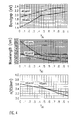
- the AI (X AI ) fraction in the AIGaAs cladding layers has to be larger than 0,45 to prevent absorption of the laser light and to guide the wave efficiently.
- the upper diagram of Figure 4 shows the bandgaps of AIGalnP and AIGaAs as functions of the AI fraction (X AI ), the middle diagram shows the wavelength in dependance of the AI fraction (X AI ), and the lower diagram shows the refractive indices of AIGalnP and AIGaAs as functions of the AI fraction (X AI ).
- Figure 3 shows a simple structure of a broad contact laser diode 30 with contact size 50 X 1000 ⁇ m 2 .
- This first embodiment can be simply modified by increasing or decreasing the thickness of the layers, inserting an unstrained MQW active structure or a strained MQW active structure replacing the active layer 35 described above.
- the inventive structure can be used in a ridge waveguide laser diode or a mesa stripe laser diode instead of the broad contact laser diode described above.
- Graded buffer layers can be employed as known in the art, replacing the bandgap adaptation layers.
- the second embodiment is a AIGalnP/GalnP separate confinement double heterostructure laser diode.
- a sketch of the corresponding bandgap diagram is shown in Figure 6.
- the undoped GalnP active layer of this embodiment is embedded between two undoped or slightly doped AIGalnP confinement layers. This active region is sandwiched between thin p - or n - doped AIGalnP barrier layers and thick p - or n - doped AIGaAs claddings, as illustrated in the bandgap diagram of Figure 6.
- FIG. 7 shows a schematic cross-section of a multi - quantum well structure and its bandgap diagram.
- This third embodiment is a MQW laser diode 70 its active region consisting of undoped GalnP active layers 76.1 and 76.2 (quantum wells) separated by a quantum barrier 75.2 and embedded between waveguide layers 75.1 and 75.3, these layers consisting of undoped or slightly p - and n-doped AIGalnP.
- This active region is embedded between an upper p-doped AIGalnP barrier layer 74.1 and a lower n-doped AIGalnP barrier layer 74.2.
- the outer layer sequences on both sides of the device is comparable to the sequence described before.
- the only difference is that the bandgap adaptation layers, layers 72 and 78 of the third embodiment, are graded bandgap layers as shown in Figure 7B.
- these graded bandgap layers 72, 78 it is possible to adapt the bandgap of the doped-AIGaAs claddings 73 and 77 to the contact layer 71 on one side and the substrate 79 on the other side.
- Exemplary details of the third embodiment are given in Table 2.
- This embodiment can be easily modified e.g. by replacing the shown active region 75.1 - 75.3, 76.1 and 76.2 against other multi-quantum well structures. Further modifications are illustrated in Figures 8 and 9. In both figures barrier layers with graded bandgaps are shown embedding the quantum well structure. A parabolic grading of optical confinment layers would be a further modification.
- FIG. 10 shows a cross-sectional view of an AIGalnP/GalnP laser diode 100 with ridge structure.
- the active region 107 shown as cross-hatched layer may consist of a double heterostructure or (multi -) quantum well structure as described before.
- This active region 107 is embedded between a thin upper p-doped AIGalnP barrier layer 106.1 and a thin lower n-doped AIGalnP barrier layer 106.2.
- the p-AlGaAs cladding 104 on top of the upper barrier layer 106.1 forms a ridge, exemplary shown having vertical sidewalls.
- a p-doped AIGaAs graded bandgap layer 103 and a p-doped GaAs contact layer are deposited on top of this cladding 104.
- the sidewalls of the ridge and the thin AIGalnP barrier are covered by a Si 3 N 4 insulating layer 105 and the whole structure is covered by a p - metal contact 101 which provides for an electrical contact to the contact layer 102.
- the whole layer sequence described above is situated on a substrate (not shown) carrying an n-doped AIGaAs cladding 108.
- the ridge structure is formed by etching, e.g dry-etching (RIE), the p-AIGaAs cladding layer 104.
- RIE dry-etching
- the thickness of the barrier layers 106.1 and 106.2 may be 0,05 ⁇ m and the thickness h of the ridge p-AIGaAs layer 104 about 2 ⁇ m.
- the ridge's width may be 5 ⁇ m and its length 500 ⁇ m. Exemplary details of the fourth embodiment are given in the following Table 3.
- a fifth embodiment is shown in Figure 11.
- a longer wavelength AIGalnAs/GalnAs/lnP laser diode 110 with ridge structure is illustrated.
- This structure is comparable to the one shown in Figure 10 but having thin AIGalnAs barrier layers 116.1 and 116.2 instead of AIGalnP barrier layers.
- the active layer 117 consists of (AI)GalnAs or GalnAsP and the cladding layers 114 and 118 consist of doped InP.
- This structure is grown on an InP substrate (not shown), the inclined surface of the ridge and the upper surface of the barrier layer 116.1 being covered by a Si 3 N 4 insulating layer 115.
- a graded bandgap layer 113, a GalnAs contact layer 112 and a Ti/Pt/Au contact 111 provides for the upper contact of the laser diode 110.
- the intensity-current curve of a conventional AIGalnP/GalnP laser diode, as described in context with Figure 2, and an intensity-current curve of a diode according to the invention are illustrated in Figure 12.
- the conventional AIGalnP/GalnP laser diode, its curve being marked with letter 'A', has a threshold current of about 50 mA and a COD level of typically 30 mW.
- the results of the inventive MQW laser diode (curve 'B') with 5 x 500 ⁇ m 2 ridge, described as one of the embodiments, has a threshold current of about 20,5 mA and a COD level about 340 mW. This COD level is about ten times as high as COD levels of known laser diodes. Both lasers were mounted junction side-up during the measurements and had uncoated mirrors.
Landscapes
- Physics & Mathematics (AREA)
- Optics & Photonics (AREA)
- Nanotechnology (AREA)
- Engineering & Computer Science (AREA)
- Chemical & Material Sciences (AREA)
- General Physics & Mathematics (AREA)
- Life Sciences & Earth Sciences (AREA)
- Biophysics (AREA)
- Electromagnetism (AREA)
- Condensed Matter Physics & Semiconductors (AREA)
- Crystallography & Structural Chemistry (AREA)
- Geometry (AREA)
- Semiconductor Lasers (AREA)
Priority Applications (2)
| Application Number | Priority Date | Filing Date | Title |
|---|---|---|---|
| EP91810848A EP0540799A1 (fr) | 1991-11-04 | 1991-11-04 | Amélioration de diodes AlGaInP à émission de lumière visible |
| CA002076605A CA2076605A1 (fr) | 1991-11-04 | 1992-08-21 | Diodes luminescentes algainp |
Applications Claiming Priority (1)
| Application Number | Priority Date | Filing Date | Title |
|---|---|---|---|
| EP91810848A EP0540799A1 (fr) | 1991-11-04 | 1991-11-04 | Amélioration de diodes AlGaInP à émission de lumière visible |
Publications (1)
| Publication Number | Publication Date |
|---|---|
| EP0540799A1 true EP0540799A1 (fr) | 1993-05-12 |
Family
ID=8208894
Family Applications (1)
| Application Number | Title | Priority Date | Filing Date |
|---|---|---|---|
| EP91810848A Withdrawn EP0540799A1 (fr) | 1991-11-04 | 1991-11-04 | Amélioration de diodes AlGaInP à émission de lumière visible |
Country Status (2)
| Country | Link |
|---|---|
| EP (1) | EP0540799A1 (fr) |
| CA (1) | CA2076605A1 (fr) |
Cited By (20)
| Publication number | Priority date | Publication date | Assignee | Title |
|---|---|---|---|---|
| EP0690536A1 (fr) * | 1994-06-29 | 1996-01-03 | AT&T Corp. | Article comprenant un laser à puits quantiques |
| EP0715380A1 (fr) * | 1994-11-28 | 1996-06-05 | Xerox Corporation | Diode laser comprenant une couche de barrière tunnel |
| DE19524655A1 (de) * | 1995-07-06 | 1997-01-09 | Huang Kuo Hsin | LED-Struktur |
| GB2308732A (en) * | 1995-12-29 | 1997-07-02 | Sharp Kk | A semiconductor laser device |
| EP0702414A3 (fr) * | 1994-09-01 | 1997-10-29 | Mitsubishi Chem Corp | Dispositif à semi-conducteurs émetteurs de lumière |
| WO1997050133A1 (fr) * | 1996-06-24 | 1997-12-31 | Philips Electronics N.V. | Diode a semi-conducteur electroluminescente et procede de fabrication de cette diode |
| US5777349A (en) * | 1996-03-22 | 1998-07-07 | Sharp Kabushiki Kaisha | Semiconductor light emitting device |
| US5793061A (en) * | 1995-08-28 | 1998-08-11 | Mitsubishi Cable Industries, Ltd. | Group-III nitride based light emitter |
| WO1998056090A1 (fr) * | 1997-06-02 | 1998-12-10 | Coherent, Inc. | Laser a semi-conducteurs a lumiere rouge comprenant des couches de compositions de gradients |
| US5987047A (en) * | 1996-04-24 | 1999-11-16 | Uniphase Opto Holdings, Inc. | Radiation-emitting semiconductor diode and method of manufacturing |
| EP0886326A3 (fr) * | 1997-06-06 | 1999-11-24 | Hewlett-Packard Company | Structure separée d'injection des trous pour améliorer la fiabilité de dispositifs semi-conducteurs émetteurs de lumière |
| GB2346735A (en) * | 1999-02-13 | 2000-08-16 | Sharp Kk | Separate confinement heterostructure laser |
| US6876006B1 (en) | 1999-04-27 | 2005-04-05 | Schlumberger Technology Corporation | Radiation source |
| EP1380077A4 (fr) * | 2001-03-19 | 2005-12-07 | Trumpf Photonics Inc | Procedes et appareils ameliorant l'efficacite de dispositifs sources de rayonnement optoelectronique |
| US7084444B2 (en) | 2001-03-19 | 2006-08-01 | Trumpf Photonics, Inc. | Method and apparatus for improving efficiency in opto-electronic radiation source devices |
| DE102007057708A1 (de) * | 2007-09-26 | 2009-04-09 | Osram Opto Semiconductors Gmbh | Optoelektronisches Bauelement |
| WO2010004454A1 (fr) | 2008-06-16 | 2010-01-14 | Philips Lumileds Lighting Company, Llc | Dispositif électroluminescent de semi-conducteur incluant une région à gradients |
| EP1923973A4 (fr) * | 2005-08-12 | 2010-04-14 | Rohm Co Ltd | Laser semi-conducteur rouge a haute puissance |
| EP2408027A4 (fr) * | 2009-03-10 | 2015-05-27 | Showa Denko Kk | Diode électroluminescente, lampe à diode électroluminescente et dispositif d'éclairage |
| JP2019062046A (ja) * | 2017-09-26 | 2019-04-18 | 株式会社沖データ | 発光サイリスタ、光プリントヘッド、及び画像形成装置 |
Citations (6)
| Publication number | Priority date | Publication date | Assignee | Title |
|---|---|---|---|---|
| US4328469A (en) * | 1979-01-15 | 1982-05-04 | Xerox Corporation | High output power injection lasers |
| US4438446A (en) * | 1981-05-29 | 1984-03-20 | Bell Telephone Laboratories, Incorporated | Double barrier double heterostructure laser |
| EP0213705A2 (fr) * | 1985-07-16 | 1987-03-11 | Sharp Kabushiki Kaisha | Dispositif laser à semi-conducteur |
| EP0348941A2 (fr) * | 1988-06-29 | 1990-01-03 | Nec Corporation | Dispositif laser à semi-conducteur |
| US5048036A (en) * | 1989-09-18 | 1991-09-10 | Spectra Diode Laboratories, Inc. | Heterostructure laser with lattice mismatch |
| US5048037A (en) * | 1989-10-13 | 1991-09-10 | Mitsubishi Denki Kabushiki Kaisha | Semiconductor laser device |
-
1991
- 1991-11-04 EP EP91810848A patent/EP0540799A1/fr not_active Withdrawn
-
1992
- 1992-08-21 CA CA002076605A patent/CA2076605A1/fr not_active Abandoned
Patent Citations (6)
| Publication number | Priority date | Publication date | Assignee | Title |
|---|---|---|---|---|
| US4328469A (en) * | 1979-01-15 | 1982-05-04 | Xerox Corporation | High output power injection lasers |
| US4438446A (en) * | 1981-05-29 | 1984-03-20 | Bell Telephone Laboratories, Incorporated | Double barrier double heterostructure laser |
| EP0213705A2 (fr) * | 1985-07-16 | 1987-03-11 | Sharp Kabushiki Kaisha | Dispositif laser à semi-conducteur |
| EP0348941A2 (fr) * | 1988-06-29 | 1990-01-03 | Nec Corporation | Dispositif laser à semi-conducteur |
| US5048036A (en) * | 1989-09-18 | 1991-09-10 | Spectra Diode Laboratories, Inc. | Heterostructure laser with lattice mismatch |
| US5048037A (en) * | 1989-10-13 | 1991-09-10 | Mitsubishi Denki Kabushiki Kaisha | Semiconductor laser device |
Non-Patent Citations (1)
| Title |
|---|
| JAPANESE JOURNAL OF APPLIED PHYSICS. vol. 29, no. 9, September 1990, TOKYO JP pages 1666 - 1668; YOSHIYASU UENO ET AL.: 'Novel window-structure AlGaInP visible-light laser diodes with non-absorbing facets fabricated by utilizing GaInP natural superlattice disordering' * |
Cited By (31)
| Publication number | Priority date | Publication date | Assignee | Title |
|---|---|---|---|---|
| EP0690536A1 (fr) * | 1994-06-29 | 1996-01-03 | AT&T Corp. | Article comprenant un laser à puits quantiques |
| US6278137B1 (en) | 1994-09-01 | 2001-08-21 | Mitsubishi Chemical Corporation | Semiconductor light-emitting devices |
| EP1263101A3 (fr) * | 1994-09-01 | 2004-07-07 | Mitsubishi Chemical Corporation | Dispositifs à semi-conducteurs émetteurs de lumière |
| EP0702414A3 (fr) * | 1994-09-01 | 1997-10-29 | Mitsubishi Chem Corp | Dispositif à semi-conducteurs émetteurs de lumière |
| US5811839A (en) * | 1994-09-01 | 1998-09-22 | Mitsubishi Chemical Corporation | Semiconductor light-emitting devices |
| EP0715380A1 (fr) * | 1994-11-28 | 1996-06-05 | Xerox Corporation | Diode laser comprenant une couche de barrière tunnel |
| DE19524655A1 (de) * | 1995-07-06 | 1997-01-09 | Huang Kuo Hsin | LED-Struktur |
| US5793061A (en) * | 1995-08-28 | 1998-08-11 | Mitsubishi Cable Industries, Ltd. | Group-III nitride based light emitter |
| EP0784361A1 (fr) * | 1995-12-29 | 1997-07-16 | Sharp Kabushiki Kaisha | Dispositif laser à semi-conducteur et méthode de croissance |
| US5828685A (en) * | 1995-12-29 | 1998-10-27 | Sharp Kabushiki Kaisha | Semiconductor laser device and a method of growing a semiconductor laser device |
| GB2308732A (en) * | 1995-12-29 | 1997-07-02 | Sharp Kk | A semiconductor laser device |
| US5777349A (en) * | 1996-03-22 | 1998-07-07 | Sharp Kabushiki Kaisha | Semiconductor light emitting device |
| CN1086249C (zh) * | 1996-03-22 | 2002-06-12 | 夏普株式会社 | 半导体发光器件 |
| US5987047A (en) * | 1996-04-24 | 1999-11-16 | Uniphase Opto Holdings, Inc. | Radiation-emitting semiconductor diode and method of manufacturing |
| WO1997050133A1 (fr) * | 1996-06-24 | 1997-12-31 | Philips Electronics N.V. | Diode a semi-conducteur electroluminescente et procede de fabrication de cette diode |
| WO1998056090A1 (fr) * | 1997-06-02 | 1998-12-10 | Coherent, Inc. | Laser a semi-conducteurs a lumiere rouge comprenant des couches de compositions de gradients |
| EP0886326A3 (fr) * | 1997-06-06 | 1999-11-24 | Hewlett-Packard Company | Structure separée d'injection des trous pour améliorer la fiabilité de dispositifs semi-conducteurs émetteurs de lumière |
| GB2346735A (en) * | 1999-02-13 | 2000-08-16 | Sharp Kk | Separate confinement heterostructure laser |
| US6829272B1 (en) | 1999-02-13 | 2004-12-07 | Sharp Kabushiki Kaisha | Semiconductor laser device |
| GB2346735B (en) * | 1999-02-13 | 2004-03-31 | Sharp Kk | A semiconductor laser device |
| US6876006B1 (en) | 1999-04-27 | 2005-04-05 | Schlumberger Technology Corporation | Radiation source |
| EP1380077A4 (fr) * | 2001-03-19 | 2005-12-07 | Trumpf Photonics Inc | Procedes et appareils ameliorant l'efficacite de dispositifs sources de rayonnement optoelectronique |
| US7084444B2 (en) | 2001-03-19 | 2006-08-01 | Trumpf Photonics, Inc. | Method and apparatus for improving efficiency in opto-electronic radiation source devices |
| EP1923973A4 (fr) * | 2005-08-12 | 2010-04-14 | Rohm Co Ltd | Laser semi-conducteur rouge a haute puissance |
| DE102007057708A1 (de) * | 2007-09-26 | 2009-04-09 | Osram Opto Semiconductors Gmbh | Optoelektronisches Bauelement |
| WO2010004454A1 (fr) | 2008-06-16 | 2010-01-14 | Philips Lumileds Lighting Company, Llc | Dispositif électroluminescent de semi-conducteur incluant une région à gradients |
| CN102067342A (zh) * | 2008-06-16 | 2011-05-18 | 飞利浦拉米尔德斯照明设备有限责任公司 | 包括递变区域的半导体发光器件 |
| US8507929B2 (en) | 2008-06-16 | 2013-08-13 | Koninklijke Philips Electronics N.V. | Semiconductor light emitting device including graded region |
| CN105355746A (zh) * | 2008-06-16 | 2016-02-24 | 飞利浦拉米尔德斯照明设备有限责任公司 | 包括递变区域的半导体发光器件 |
| EP2408027A4 (fr) * | 2009-03-10 | 2015-05-27 | Showa Denko Kk | Diode électroluminescente, lampe à diode électroluminescente et dispositif d'éclairage |
| JP2019062046A (ja) * | 2017-09-26 | 2019-04-18 | 株式会社沖データ | 発光サイリスタ、光プリントヘッド、及び画像形成装置 |
Also Published As
| Publication number | Publication date |
|---|---|
| CA2076605A1 (fr) | 1993-05-05 |
Similar Documents
| Publication | Publication Date | Title |
|---|---|---|
| EP0540799A1 (fr) | Amélioration de diodes AlGaInP à émission de lumière visible | |
| US5825796A (en) | Extended wavelength strained layer lasers having strain compensated layers | |
| Saito et al. | Ground-state lasing at room temperature in long-wavelength InAs quantum-dot lasers on InP (311) B substrates | |
| US5719894A (en) | Extended wavelength strained layer lasers having nitrogen disposed therein | |
| US4882734A (en) | Quantum well heterostructure lasers with low current density threshold and higher TO values | |
| US5719895A (en) | Extended wavelength strained layer lasers having short period superlattices | |
| US4731789A (en) | Clad superlattice semiconductor laser | |
| EP0605051B1 (fr) | Laser à injection émettant dans le bleu-vert | |
| US5010374A (en) | Quantum well laser utilizing an inversion layer | |
| EP0661782A1 (fr) | Laser à semi-conducteur | |
| EP0503211B1 (fr) | Dispositif semi-conducteur comprenant une structure en couches fabriquée par croissance sur un substrat structuré | |
| EP0760545B1 (fr) | Laser à émission de surface à cavité verticale comportant une région active exempte d'Al | |
| US5331656A (en) | Very short wavelength semiconductor laser | |
| Arefin et al. | Theoretical analysis of tunnel-injected sub-300 nm AlGaN laser diodes | |
| JPH11506273A (ja) | 最高30%のアルミニウムを含む半導体材料又はアルミニウムを含まない半導体材料から成る個別の閉じ込め層を有する放射放出半導体ダイオード | |
| EP0657977A2 (fr) | Laser à diode du type ruban et méthode de fabrication | |
| JPH04350988A (ja) | 量子井戸構造発光素子 | |
| JPH05267797A (ja) | 発光半導体ダイオード | |
| Nobuhara et al. | High-temperature operation of InGaAs/InGaAsP compressive-strained QW lasers with low threshold currents | |
| DK1800374T3 (en) | SEMICONDUCTOR DIODE LASER- | |
| CN114361935A (zh) | 一种边射型激光元件 | |
| JPH10290049A (ja) | 半導体レーザ素子 | |
| EP0207699A2 (fr) | Dispositif émetteur de lumière comportant une structure à puits quantiques multiples | |
| US7428256B2 (en) | Semiconductor laser device | |
| Olsen | InGaAsP laser diodes |
Legal Events
| Date | Code | Title | Description |
|---|---|---|---|
| PUAI | Public reference made under article 153(3) epc to a published international application that has entered the european phase |
Free format text: ORIGINAL CODE: 0009012 |
|
| AK | Designated contracting states |
Kind code of ref document: A1 Designated state(s): DE FR GB IT |
|
| 17P | Request for examination filed |
Effective date: 19930918 |
|
| 17Q | First examination report despatched |
Effective date: 19941222 |
|
| STAA | Information on the status of an ep patent application or granted ep patent |
Free format text: STATUS: THE APPLICATION HAS BEEN WITHDRAWN |
|
| 18W | Application withdrawn |
Withdrawal date: 19960409 |