EP0545085B1 - Procédé d'obtention d'acétyl-2-pyrroline-1 sous forme encapsulée, composé intermédiaire et produit final obtenus - Google Patents
Procédé d'obtention d'acétyl-2-pyrroline-1 sous forme encapsulée, composé intermédiaire et produit final obtenus Download PDFInfo
- Publication number
- EP0545085B1 EP0545085B1 EP92118834A EP92118834A EP0545085B1 EP 0545085 B1 EP0545085 B1 EP 0545085B1 EP 92118834 A EP92118834 A EP 92118834A EP 92118834 A EP92118834 A EP 92118834A EP 0545085 B1 EP0545085 B1 EP 0545085B1
- Authority
- EP
- European Patent Office
- Prior art keywords
- pyrroline
- acetyl
- ethenyl
- ethoxy
- solution
- Prior art date
- Legal status (The legal status is an assumption and is not a legal conclusion. Google has not performed a legal analysis and makes no representation as to the accuracy of the status listed.)
- Expired - Lifetime
Links
- 238000000034 method Methods 0.000 title claims abstract description 22
- 239000012467 final product Substances 0.000 title abstract description 3
- DQBQWWSFRPLIAX-UHFFFAOYSA-N 2-acetyl-1-pyrroline Chemical compound CC(=O)C1=NCCC1 DQBQWWSFRPLIAX-UHFFFAOYSA-N 0.000 title abstract 2
- 239000000543 intermediate Substances 0.000 title 1
- 239000000203 mixture Substances 0.000 claims description 32
- 229920000858 Cyclodextrin Polymers 0.000 claims description 25
- 229920002774 Maltodextrin Polymers 0.000 claims description 12
- 239000005913 Maltodextrin Substances 0.000 claims description 12
- 229940035034 maltodextrin Drugs 0.000 claims description 12
- 239000000843 powder Substances 0.000 claims description 12
- 235000013305 food Nutrition 0.000 claims description 10
- 239000000796 flavoring agent Substances 0.000 claims description 8
- 239000002253 acid Substances 0.000 claims description 7
- HFHDHCJBZVLPGP-UHFFFAOYSA-N schardinger α-dextrin Chemical compound O1C(C(C2O)O)C(CO)OC2OC(C(C2O)O)C(CO)OC2OC(C(C2O)O)C(CO)OC2OC(C(O)C2O)C(CO)OC2OC(C(C2O)O)C(CO)OC2OC2C(O)C(O)C1OC2CO HFHDHCJBZVLPGP-UHFFFAOYSA-N 0.000 claims description 7
- 239000012074 organic phase Substances 0.000 claims description 5
- FJKIXWOMBXYWOQ-UHFFFAOYSA-N ethenoxyethane Chemical compound CCOC=C FJKIXWOMBXYWOQ-UHFFFAOYSA-N 0.000 claims description 4
- 235000019634 flavors Nutrition 0.000 claims description 4
- 235000013355 food flavoring agent Nutrition 0.000 claims description 4
- UBJFKNSINUCEAL-UHFFFAOYSA-N lithium;2-methylpropane Chemical compound [Li+].C[C-](C)C UBJFKNSINUCEAL-UHFFFAOYSA-N 0.000 claims description 3
- 238000006386 neutralization reaction Methods 0.000 claims 2
- 150000001875 compounds Chemical class 0.000 abstract description 23
- 239000000243 solution Substances 0.000 description 35
- -1 (ethoxy-1-ethenyl) -2-pyrroline Chemical compound 0.000 description 28
- HEMHJVSKTPXQMS-UHFFFAOYSA-M Sodium hydroxide Chemical compound [OH-].[Na+] HEMHJVSKTPXQMS-UHFFFAOYSA-M 0.000 description 21
- 239000001116 FEMA 4028 Substances 0.000 description 17
- WHGYBXFWUBPSRW-FOUAGVGXSA-N beta-cyclodextrin Chemical compound OC[C@H]([C@H]([C@@H]([C@H]1O)O)O[C@H]2O[C@@H]([C@@H](O[C@H]3O[C@H](CO)[C@H]([C@@H]([C@H]3O)O)O[C@H]3O[C@H](CO)[C@H]([C@@H]([C@H]3O)O)O[C@H]3O[C@H](CO)[C@H]([C@@H]([C@H]3O)O)O[C@H]3O[C@H](CO)[C@H]([C@@H]([C@H]3O)O)O3)[C@H](O)[C@H]2O)CO)O[C@@H]1O[C@H]1[C@H](O)[C@@H](O)[C@@H]3O[C@@H]1CO WHGYBXFWUBPSRW-FOUAGVGXSA-N 0.000 description 17
- 235000011175 beta-cyclodextrine Nutrition 0.000 description 17
- 229960004853 betadex Drugs 0.000 description 17
- XLYOFNOQVPJJNP-UHFFFAOYSA-N water Substances O XLYOFNOQVPJJNP-UHFFFAOYSA-N 0.000 description 17
- FAPWRFPIFSIZLT-UHFFFAOYSA-M Sodium chloride Chemical compound [Na+].[Cl-] FAPWRFPIFSIZLT-UHFFFAOYSA-M 0.000 description 12
- 239000000047 product Substances 0.000 description 11
- WYURNTSHIVDZCO-UHFFFAOYSA-N Tetrahydrofuran Chemical compound C1CCOC1 WYURNTSHIVDZCO-UHFFFAOYSA-N 0.000 description 8
- VEXZGXHMUGYJMC-UHFFFAOYSA-N Hydrochloric acid Chemical compound Cl VEXZGXHMUGYJMC-UHFFFAOYSA-N 0.000 description 7
- 239000007864 aqueous solution Substances 0.000 description 7
- 235000014347 soups Nutrition 0.000 description 7
- YMWUJEATGCHHMB-UHFFFAOYSA-N Dichloromethane Chemical compound ClCCl YMWUJEATGCHHMB-UHFFFAOYSA-N 0.000 description 6
- LFQSCWFLJHTTHZ-UHFFFAOYSA-N Ethanol Chemical compound CCO LFQSCWFLJHTTHZ-UHFFFAOYSA-N 0.000 description 6
- XEKOWRVHYACXOJ-UHFFFAOYSA-N Ethyl acetate Chemical compound CCOC(C)=O XEKOWRVHYACXOJ-UHFFFAOYSA-N 0.000 description 6
- 235000002017 Zea mays subsp mays Nutrition 0.000 description 6
- 241000482268 Zea mays subsp. mays Species 0.000 description 6
- 230000008447 perception Effects 0.000 description 6
- 239000011780 sodium chloride Substances 0.000 description 6
- 238000003860 storage Methods 0.000 description 6
- 230000007062 hydrolysis Effects 0.000 description 5
- 238000006460 hydrolysis reaction Methods 0.000 description 5
- 238000002360 preparation method Methods 0.000 description 5
- RTZKZFJDLAIYFH-UHFFFAOYSA-N Diethyl ether Chemical compound CCOCC RTZKZFJDLAIYFH-UHFFFAOYSA-N 0.000 description 4
- OFBQJSOFQDEBGM-UHFFFAOYSA-N Pentane Chemical compound CCCCC OFBQJSOFQDEBGM-UHFFFAOYSA-N 0.000 description 4
- 238000004817 gas chromatography Methods 0.000 description 4
- 239000011541 reaction mixture Substances 0.000 description 4
- 238000003756 stirring Methods 0.000 description 4
- YLQBMQCUIZJEEH-UHFFFAOYSA-N tetrahydrofuran Natural products C=1C=COC=1 YLQBMQCUIZJEEH-UHFFFAOYSA-N 0.000 description 4
- RWRDLPDLKQPQOW-UHFFFAOYSA-N tetrahydropyrrole Substances C1CCNC1 RWRDLPDLKQPQOW-UHFFFAOYSA-N 0.000 description 4
- 244000215068 Acacia senegal Species 0.000 description 3
- NLXLAEXVIDQMFP-UHFFFAOYSA-N Ammonia chloride Chemical compound [NH4+].[Cl-] NLXLAEXVIDQMFP-UHFFFAOYSA-N 0.000 description 3
- UHOVQNZJYSORNB-UHFFFAOYSA-N Benzene Chemical compound C1=CC=CC=C1 UHOVQNZJYSORNB-UHFFFAOYSA-N 0.000 description 3
- QSJXEFYPDANLFS-UHFFFAOYSA-N Diacetyl Chemical group CC(=O)C(C)=O QSJXEFYPDANLFS-UHFFFAOYSA-N 0.000 description 3
- QMMFVYPAHWMCMS-UHFFFAOYSA-N Dimethyl sulfide Chemical compound CSC QMMFVYPAHWMCMS-UHFFFAOYSA-N 0.000 description 3
- 229920000084 Gum arabic Polymers 0.000 description 3
- 235000005824 Zea mays ssp. parviglumis Nutrition 0.000 description 3
- 235000010489 acacia gum Nutrition 0.000 description 3
- 239000000205 acacia gum Substances 0.000 description 3
- 235000008429 bread Nutrition 0.000 description 3
- 238000004587 chromatography analysis Methods 0.000 description 3
- 235000005822 corn Nutrition 0.000 description 3
- 238000001514 detection method Methods 0.000 description 3
- 235000019264 food flavour enhancer Nutrition 0.000 description 3
- 238000004108 freeze drying Methods 0.000 description 3
- 239000007789 gas Substances 0.000 description 3
- 206010013911 Dysgeusia Diseases 0.000 description 2
- KYQCOXFCLRTKLS-UHFFFAOYSA-N Pyrazine Chemical compound C1=CN=CC=N1 KYQCOXFCLRTKLS-UHFFFAOYSA-N 0.000 description 2
- 244000061456 Solanum tuberosum Species 0.000 description 2
- 235000002595 Solanum tuberosum Nutrition 0.000 description 2
- 238000004458 analytical method Methods 0.000 description 2
- 239000008346 aqueous phase Substances 0.000 description 2
- 125000003118 aryl group Chemical group 0.000 description 2
- 235000013330 chicken meat Nutrition 0.000 description 2
- 239000000287 crude extract Substances 0.000 description 2
- 238000000354 decomposition reaction Methods 0.000 description 2
- 230000000694 effects Effects 0.000 description 2
- 239000003480 eluent Substances 0.000 description 2
- 125000001495 ethyl group Chemical group [H]C([H])([H])C([H])([H])* 0.000 description 2
- 239000001307 helium Substances 0.000 description 2
- 229910052734 helium Inorganic materials 0.000 description 2
- SWQJXJOGLNCZEY-UHFFFAOYSA-N helium atom Chemical compound [He] SWQJXJOGLNCZEY-UHFFFAOYSA-N 0.000 description 2
- 238000002329 infrared spectrum Methods 0.000 description 2
- 238000002347 injection Methods 0.000 description 2
- 239000007924 injection Substances 0.000 description 2
- 239000013067 intermediate product Substances 0.000 description 2
- 239000007788 liquid Substances 0.000 description 2
- 238000001819 mass spectrum Methods 0.000 description 2
- 235000013372 meat Nutrition 0.000 description 2
- 238000000655 nuclear magnetic resonance spectrum Methods 0.000 description 2
- 239000012071 phase Substances 0.000 description 2
- 238000000746 purification Methods 0.000 description 2
- 229920006395 saturated elastomer Polymers 0.000 description 2
- 235000015067 sauces Nutrition 0.000 description 2
- 230000008786 sensory perception of smell Effects 0.000 description 2
- 239000002904 solvent Substances 0.000 description 2
- IAEGWXHKWJGQAZ-UHFFFAOYSA-N trimethylpyrazine Chemical compound CC1=CN=C(C)C(C)=N1 IAEGWXHKWJGQAZ-UHFFFAOYSA-N 0.000 description 2
- ZXSQEZNORDWBGZ-UHFFFAOYSA-N 1,3-dihydropyrrolo[2,3-b]pyridin-2-one Chemical compound C1=CN=C2NC(=O)CC2=C1 ZXSQEZNORDWBGZ-UHFFFAOYSA-N 0.000 description 1
- CLUWOWRTHNNBBU-UHFFFAOYSA-N 3-methylthiopropanal Chemical compound CSCCC=O CLUWOWRTHNNBBU-UHFFFAOYSA-N 0.000 description 1
- 241000723382 Corylus Species 0.000 description 1
- 235000007466 Corylus avellana Nutrition 0.000 description 1
- 241000287828 Gallus gallus Species 0.000 description 1
- UFHFLCQGNIYNRP-UHFFFAOYSA-N Hydrogen Chemical compound [H][H] UFHFLCQGNIYNRP-UHFFFAOYSA-N 0.000 description 1
- CMFWLOPIOWBYCM-UHFFFAOYSA-N N-Acetyl-2,3-dihydro-1H-pyrrole Chemical compound CC(=O)N1CCC=C1 CMFWLOPIOWBYCM-UHFFFAOYSA-N 0.000 description 1
- 240000007594 Oryza sativa Species 0.000 description 1
- 235000007164 Oryza sativa Nutrition 0.000 description 1
- PCNDJXKNXGMECE-UHFFFAOYSA-N Phenazine Natural products C1=CC=CC2=NC3=CC=CC=C3N=C21 PCNDJXKNXGMECE-UHFFFAOYSA-N 0.000 description 1
- ONIBWKKTOPOVIA-UHFFFAOYSA-N Proline Natural products OC(=O)C1CCCN1 ONIBWKKTOPOVIA-UHFFFAOYSA-N 0.000 description 1
- VYPSYNLAJGMNEJ-UHFFFAOYSA-N Silicium dioxide Chemical compound O=[Si]=O VYPSYNLAJGMNEJ-UHFFFAOYSA-N 0.000 description 1
- PMZURENOXWZQFD-UHFFFAOYSA-L Sodium Sulfate Chemical compound [Na+].[Na+].[O-]S([O-])(=O)=O PMZURENOXWZQFD-UHFFFAOYSA-L 0.000 description 1
- HEDRZPFGACZZDS-MICDWDOJSA-N Trichloro(2H)methane Chemical compound [2H]C(Cl)(Cl)Cl HEDRZPFGACZZDS-MICDWDOJSA-N 0.000 description 1
- 125000000218 acetic acid group Chemical group C(C)(=O)* 0.000 description 1
- 238000013019 agitation Methods 0.000 description 1
- 235000019270 ammonium chloride Nutrition 0.000 description 1
- 235000015278 beef Nutrition 0.000 description 1
- 230000005540 biological transmission Effects 0.000 description 1
- 230000015572 biosynthetic process Effects 0.000 description 1
- 239000012159 carrier gas Substances 0.000 description 1
- 238000010531 catalytic reduction reaction Methods 0.000 description 1
- 235000013339 cereals Nutrition 0.000 description 1
- 238000004440 column chromatography Methods 0.000 description 1
- 238000002485 combustion reaction Methods 0.000 description 1
- 235000019545 cooked cereal Nutrition 0.000 description 1
- 230000008878 coupling Effects 0.000 description 1
- 238000010168 coupling process Methods 0.000 description 1
- 238000005859 coupling reaction Methods 0.000 description 1
- 229940097362 cyclodextrins Drugs 0.000 description 1
- 230000007423 decrease Effects 0.000 description 1
- 238000004821 distillation Methods 0.000 description 1
- 238000000921 elemental analysis Methods 0.000 description 1
- 238000005538 encapsulation Methods 0.000 description 1
- 239000001257 hydrogen Substances 0.000 description 1
- 229910052739 hydrogen Inorganic materials 0.000 description 1
- 229910052500 inorganic mineral Inorganic materials 0.000 description 1
- 239000008176 lyophilized powder Substances 0.000 description 1
- 238000004519 manufacturing process Methods 0.000 description 1
- 238000004949 mass spectrometry Methods 0.000 description 1
- 239000011707 mineral Substances 0.000 description 1
- 230000003647 oxidation Effects 0.000 description 1
- 238000007254 oxidation reaction Methods 0.000 description 1
- 230000002688 persistence Effects 0.000 description 1
- 235000013550 pizza Nutrition 0.000 description 1
- 235000012015 potatoes Nutrition 0.000 description 1
- 230000002035 prolonged effect Effects 0.000 description 1
- JUJWROOIHBZHMG-UHFFFAOYSA-N pyridine Substances C1=CC=NC=C1 JUJWROOIHBZHMG-UHFFFAOYSA-N 0.000 description 1
- 150000003236 pyrrolines Chemical class 0.000 description 1
- 238000010992 reflux Methods 0.000 description 1
- 235000009566 rice Nutrition 0.000 description 1
- 150000003839 salts Chemical class 0.000 description 1
- 239000000741 silica gel Substances 0.000 description 1
- 229910002027 silica gel Inorganic materials 0.000 description 1
- 229910001958 silver carbonate Inorganic materials 0.000 description 1
- LKZMBDSASOBTPN-UHFFFAOYSA-L silver carbonate Substances [Ag].[O-]C([O-])=O LKZMBDSASOBTPN-UHFFFAOYSA-L 0.000 description 1
- 229910052938 sodium sulfate Inorganic materials 0.000 description 1
- 235000011152 sodium sulphate Nutrition 0.000 description 1
- 235000012794 white bread Nutrition 0.000 description 1
Classifications
-
- C—CHEMISTRY; METALLURGY
- C07—ORGANIC CHEMISTRY
- C07D—HETEROCYCLIC COMPOUNDS
- C07D207/00—Heterocyclic compounds containing five-membered rings not condensed with other rings, with one nitrogen atom as the only ring hetero atom
- C07D207/02—Heterocyclic compounds containing five-membered rings not condensed with other rings, with one nitrogen atom as the only ring hetero atom with only hydrogen or carbon atoms directly attached to the ring nitrogen atom
- C07D207/18—Heterocyclic compounds containing five-membered rings not condensed with other rings, with one nitrogen atom as the only ring hetero atom with only hydrogen or carbon atoms directly attached to the ring nitrogen atom having one double bond between ring members or between a ring member and a non-ring member
- C07D207/20—Heterocyclic compounds containing five-membered rings not condensed with other rings, with one nitrogen atom as the only ring hetero atom with only hydrogen or carbon atoms directly attached to the ring nitrogen atom having one double bond between ring members or between a ring member and a non-ring member with only hydrogen atoms, hydrocarbon or substituted hydrocarbon radicals, directly attached to ring carbon atoms
-
- Y—GENERAL TAGGING OF NEW TECHNOLOGICAL DEVELOPMENTS; GENERAL TAGGING OF CROSS-SECTIONAL TECHNOLOGIES SPANNING OVER SEVERAL SECTIONS OF THE IPC; TECHNICAL SUBJECTS COVERED BY FORMER USPC CROSS-REFERENCE ART COLLECTIONS [XRACs] AND DIGESTS
- Y10—TECHNICAL SUBJECTS COVERED BY FORMER USPC
- Y10S—TECHNICAL SUBJECTS COVERED BY FORMER USPC CROSS-REFERENCE ART COLLECTIONS [XRACs] AND DIGESTS
- Y10S426/00—Food or edible material: processes, compositions, and products
- Y10S426/804—Low calorie, low sodium or hypoallergic
Definitions
- the present invention relates to a process for obtaining acetyl-2-pyrroline-1 in encapsulated form, the encapsulated product obtained and a particular use of it product.
- the present invention also relates to a new compound of the family of pyrrolines, allowing obtaining acetyl-2-pyrroline-1 encapsulated, process for its preparation and a particular use.
- Acetyl-2-pyrroline has been identified as a component of the aroma of cooked rice, for example, in Chem documents. Abs. 99 , 1983, 69010; Chem. Abs. 98, 1983, 196668 and Chem. Abs. 99 1983, 37298y. Also, the document Chem. Abs. 110 , 1989, 74119 describes the effect of the addition of proline on the formation of this flavoring compound in the crust of white bread.
- acetyl-2-pyrroline-1 thus obtained has a purity of approximately 95%, but can only be prepared in small quantities at a time, this being mainly due to the step of purification of the compound, carried out by chromatography in gas phase.
- acetyl-2-pyrroline-1 is not very stable and should preferably be stored at a temperature below 0 ° C, which makes its use difficult, particularly at the industrial level.
- the present invention relates to a method for obtaining acetyl-2-pyrroline-1 in stable form, and can be stored for a certain time at temperature ambient.
- the present invention therefore has for first object acetyl-2-pyrroline-1 in an encapsulated form susceptible to be obtained by the process in which at a temperature from -10 ° C to 25 ° C, hydrolyzed (ethoxy-1-ethenyl) -2-pyrroline -1 with an acid, neutralize with an equimolar amount base, a solution of cyclodextrin is added so as to obtain a solution containing up to 20% by weight of acetyl 2-pyrroline-1 compared to cyclodextrin, then we freeze-drying said solution so as to obtain a powder may contain up to 20% by weight of acetyl-2-pyrroline-1.
- a second object of the present invention is acetyl-2-pyrroline-1 in an encapsulated form susceptible to be obtained by the process in which at a temperature from -10 ° C to 25 ° C, hydrolyzed (ethoxy-1-ethenyl) -2-pyrroline -1 with an acid, neutralize with an equimolar amount base, a maltodextrin solution is added so as to obtain a solution containing up to 10% by weight of acetyl-2 -pyrroline-1 compared to maltodextrin, then we freeze-drying said solution so as to obtain a powder may contain up to 10% by weight of acetyl-2-pyrroline-1.
- the product thus obtained can also be used in the food sector, as a flavor enhancer.
- the product, the first object of the invention, is susceptible to be obtained by the process in which, we hydrolyze (ethoxy-1-ethenyl) -2-pyrroline-1, preferably in solution at a concentration of 2 to 30%, with an acid, preferably a mineral acid such as hydrochloric acid. We can then dilute the mixture obtained, then neutralize the added acid by adding an equimolar amount of base, preferably a strong base such as sodium hydroxide. We add then in said neutralized mixture, a solution of cyclodextrin or maltodextrin. Preferably a solution of ⁇ -cyclodextrin. It is also possible to add a solution containing one or more cyclodextrins and maltodextrin.
- Cyclodextrin is added in such an amount that then obtains a solution containing up to 20% acetyl-2-pyrroline-1 with respect to said cyclodextrin. If maltodextrin is used, it is added in an amount such that we then obtain a solution containing up to 10% acetyl-2-pyrroline-1 relative to said maltodextrin.
- the different stages of this process are carried out at a temperature ranging from -10 ° C to 25 ° C, since the higher the temperature, the higher the risk of decomposition of acetyl-2-pyrroline-1 and the higher it is therefore necessary to work quickly if we want to reduce these risks.
- the solution thus obtained is then lyophilized and allows the production of an encapsulated product in the form of a powder and which may contain up to 20% by weight of acetyl-2-pyrroline-1.
- the product encapsulated thus obtained could be used to strengthen the taste of certain food products.
- the present invention therefore also relates to the use of this product encapsulated as a flavor enhancer.
- this product can be used alone or in combination with other compounds.
- the starting product is (ethoxy-1-ethenyl) -2-pyrroline-1.
- a subject of the present invention is therefore also (ethoxy-1-ethenyl) -2-pyrroline-1, of formula:
- These compounds can be obtained by a process in which the corresponding alkylvinylether compound is reacted with tert-butyllithium in organic solution, for example in pentane, tetrahydrofuran or ether, or a mixture of these solvents, and then added N-trimethylsilylpyrrolidinone-2 and allowed to react, preferably below 0 ° C., then the solution obtained is hydrolyzed, the organic phase is recovered which is dried and purified so as to obtain (1-ethoxy-ethenyl ) -2-pyrroline-1 sought.
- the hydrolysis is preferably carried out by adding water or a solution of ammonia chloride. After hydrolysis, it is possible to add a salt, such as sodium chloride, to the solution so as to saturate said solution, which makes it possible to improve the yield of the present process.
- a salt such as sodium chloride
- the final purification can be carried out by any means such as distillation and / or column chromatography.
- This process therefore makes it possible to obtain (ethoxy1-ethenyl) -2-pyrroline-1, which can be used to obtain encapsulated acetyl-2-pyrroline-1.
- one of the compounds of this type, (ethoxy-1-ethenyl) -2-pyrroline-1 exhibited certain organoleptic qualities which made it possible to use it, alone or in combination, as a flavoring agent. These organoleptic characteristics can be described as follows: toasted, fruity, hazelnuts, and recall those of pyrazine.
- (ethoxy-1-ethenyl) -2-pyrroline-1 can be used, alone, as a flavoring agent, so as to replace, for example, certain alkyl-pyrazines.
- the amount to add to a food product depends mainly on the nature of the product as well as the desired end effect.
- (Ethoxy-1-ethenyl) -2-pyrroline-1 can also be used in the preparation of a flavoring composition.
- One can for example prepare a flavoring composition containing up to 0.1% by weight of (ethoxy-1-ethenyl) -2-pyrroline-1 and having a flavor of corn, bread or potatoes.
- the composition thus obtained can be added to the final food product, at a rate of 1 to 2 grams per kilo of final product.
- Another object of the invention is therefore the use of (ethoxy-1-ethenyl) -2-pyrroline-1 as a flavoring agent capable of being added to a food product.
- Yet another object of the invention is the use of (ethoxy-1-ethenyl) -2-pyrroline-1 in a flavoring composition capable of being added to a food product.
- a final object of the invention is a flavoring composition comprising (ethoxy-1-ethenyl) -2-pyrroline-1.
- This solution is cooled to -40 ° C and a solution containing 429 ml of 1.4 N tert-butyllithium in pentane is added to it dropwise.
- This mixture is left under constant stirring at -40 ° C for 12 hours, then a solution of 47.1 g of N-trimethylsilyl-pyrrolidinone-2 in 300 ml of THF is added to it.
- the mixture thus obtained is left under constant stirring at -40 ° C for 7 hours, then 32.1 g of ammonium chloride dissolved in 300 ml of water are added to it.
- the mixture is allowed to warm to about 0 ° C, then saturated by the addition of 60 g of sodium chloride. It is left to stand so that the aqueous and organic phases separate. The organic phase is recovered, and the aqueous phase is extracted three times with 50 ml of ether.
- the nuclear magnetic resonance spectrum of the proton of the compound in trichlorodeuteromethane (CDCl 3 ) at 20 ° C shows the following characteristic signals: Signal (ppm) Signal multiplicity Coupling constant (Hz) Identification 4.73 doublet 2.6 Olefinic 4.52 doublet 2.6 Olefinic 4.02 triplet of a triplet 2.0 and 7.4 2H-5 3.87 quadruplet 7 2H of ethyl 2.73 byte 2H-3 1.93 byte 2H-4 1.42 triplet 7 3H ethyl
- the perception threshold by direct olfactory route is therefore around 5 ppm.
- the mixture is then cooled to approximately -5 ° C, and neutralized, by adding dropwise, and with constant stirring, 52.5 ml of 1N sodium hydroxide.
- An aqueous solution is then obtained containing 97% acetyl-2-pyrroline-1, or 52.40 mg, and 3% acetyl-2-pyrroline-2, or 1.62 mg (composition determined by phase chromatography gas and mass spectrometry).
- Hydrolysis of (ethoxy-1-ethenyl) -2-pyrroline-1 is carried out adding to 69.81 mg of (ethoxy-1-ethenyl) -2-pyrroline-1 at 0 ° C, 5 ml of 1N hydrochloric acid; then we leave stand at room temperature (25 ° C) for 7 days, so hydrolysis is complete.
- the mixture is then cooled to approximately -5 ° C, diluted the hydrolyzed mixture with 40 ml of water, then it is neutralized by adding 5 ml of 1 N sodium hydroxide, drop by drop, under constant agitation.
- a first sample A of 17.5 ml of this reaction mixture is diluted in 175 ml of water, then cooled to 0 ° C. 17.5 ml of 1N NaOH are then added dropwise, then an aqueous solution comprising 17.6 g of maltodextrin, 2.4 g of gum arabic and 430 ml of water.
- the solution thus obtained is lyophilized in a standard lyophilizer.
- a white powder is obtained containing acetyl-2-pyrroline-1 at a concentration of 1.0% relative to the maltodextrin / gum arabic mixture, and at a concentration of 0.94% relative to the powder.
- a 13.125 ml sample B of the reaction mixture obtained according to Example 6 is diluted in 130 ml of water, then cooled to 0 ° C. 13.125 ml of 1N NaOH is added to it dropwise, then an aqueous solution comprising 15 g of ⁇ -cyclodextrin in 400 ml of water.
- the solution thus obtained is lyophilized according to Example 6.
- a white powder is obtained containing acetyl-2-pyrroline-1 at a concentration of 1.0% relative to ⁇ -cyclodextrin, and 0.94% by compared to the powder.
- a 13.125 ml sample C of the reaction mixture obtained according to Example 6 is diluted in 100 ml of water, then cooled to 0 ° C. 15.0 g of powdered ⁇ -cyclodextrin and 13.125 ml of 1N NaOH are added thereto. The mixture is left stirring at 0 ° C. for 30 minutes, then the solution is lyophilized according to Example 6. In this case, freeze-drying is easier to perform since the volume of water is much less, in comparison with Examples 6 and 7.
- a white powder is obtained containing acetyl-2-pyrroline-1 at a concentration of 1.0% relative to ⁇ -cyclodextrin, and 0.94% relative to the powder.
- a sample D of 13, 125 ml of the reaction mixture obtained according to Example 6 is diluted in 130 ml of water, then cooled to 0 ° C. 13.125 ml of 1N NaOH is added thereto dropwise, then an aqueous solution comprising 1.5 g of ⁇ -cyclodextrin in 40 ml of water.
- the solution thus obtained is lyophilized according to Example 6.
- a white powder is obtained containing acetyl-2-pyrroline-1 at a concentration of 10.0% relative to ⁇ -cyclodextrin.
- the stability of the encapsulated acetyl-2-pyrroline-1 prepared according to Examples 6 to 9 is studied for a period of 110 days at different storage temperatures. To do this, after storage, 100 mg of lyophilized powder is taken, which is dissolved in 1 ml of water, at 0 ° C. 1 ml of ethyl acetate containing 1 mg of trimethyl-2,4,6-pyridine is added and the mixture is stirred for 30 seconds. The mixture is centrifuged for 15 minutes at -5 ° C and the organic phase is recovered which is analyzed by gas chromatography.
- acetyl-2-pyrroline-1 encapsulated at 1% on ⁇ -cyclodextrin is stable for at least 110 days if it is stored at a low temperature. This is also the case, but to a lesser extent, if the encapsulation is carried out on maltodextrin / gum arabic at 1%.
- the stability of acetyl-2-pyrroline-1 decreases when its concentration on the support (in the present case ⁇ -cyclodextrin) increases.
- acetyl-2-pyrroline-1 at 95% pure, prepared according to the prior art degrades rapidly when stored at -20 ° C. (Buttery et al., Journal of Agric. Food Chem. (1983), 31 , 823-826).
- acetyl-2-pyrroline-1 in 1% encapsulated form on ⁇ -cyclodextrin, is added to a corn soup, just before consumption.
- Acetyl-2-pyrroline-1 contributes to a rounder, more cooked and more flattering perception of the food.
- the notes "cooked cereal", “pop corn” and “very lightly toasted” are reinforced and highlighted, as well as a very fine note "butter-fresh".
- acetyl-2-pyrroline-1 1 ppm is added in encapsulated form at 1% on ⁇ -cyclodextrin, to a chicken-type sauce, just before consumption.
- the soup thus prepared, as well as a control soup not containing acetyl-2-pyrroline-1, are presented to a group of 6 trained tasters.
- Acetyl-2-pyrroline-1 helps to reduce the "chicken fat” note and strengthens the "chicken meat” and "lightly grilled” notes. The whole is more cooked and more complete, and the slightly grilled meat aftertaste is extended.
- acetyl-2-pyrroline-1 is added in encapsulated form at 1% on ⁇ -cyclodextrin, to a beef-type sauce, just before consumption.
- the soup thus prepared, as well as a control soup not containing acetyl-2-pyrroline-1, are presented to a group of 6 trained tasters.
- Acetyl-2-pyrroline-1 helps strengthen the "lightly grilled meat" note. The impression in the mouth is more round and the beef aftertaste is prolonged.
- this composition 0.1 g is added to 1 liter of previously salted water at the rate of 3 g of NaCl per liter.
- the aqueous mixture is divided into two lots.
- 0.5 ppm of acetyl-2-pyrroline-1 is added in encapsulated form at 1% on ⁇ -cyclodextrin.
- the second batch serves as a witness.
- a panel of 10 people compares the two lots.
- the first batch appears better than the second, with a reinforced note of the "cereal", "bread crust” type and a rounded “toasted” note. The whole remains in the mouth longer.
- this composition strengthens the "crust of bread” note, especially in the olfaction.
- 0.1 g of this composition is added to 1 liter of previously salted water at the rate of 3 g of NaCl per liter.
- the aqueous mixture is divided into two lots.
- 0.5 ppm of acetyl-2-pyrroline-1 is added in encapsulated form at 1% on ⁇ -cyclodextrin.
- the second batch serves as a witness.
- a panel of 10 people compares the two lots.
- the first batch presents a more typical, more complete and more powerful note of "sweet corn” and "popcorn”. The persistence in the mouth is more marked.
- 0.1 g of this composition is added to 1 liter of previously salted water at the rate of 3 g of NaCl per liter.
- the aqueous mixture is divided into two lots.
- 0.5 ppm of acetyl-2-pyrroline-1 is added in encapsulated form at 1% on ⁇ -cyclodextrin.
- the second batch serves as a witness. A panel of 10 people compares the two lots. The first batch appears better than the second and has a more complete and reinforced note of the "cooked potato flesh" type.
Landscapes
- Chemical & Material Sciences (AREA)
- Organic Chemistry (AREA)
- Pyrrole Compounds (AREA)
- Seasonings (AREA)
- Pharmaceuticals Containing Other Organic And Inorganic Compounds (AREA)
- Fats And Perfumes (AREA)
- Cosmetics (AREA)
Description
L'acétyl-2-pyrroline-1 ainsi obtenue présente une pureté de 95% environ, mais ne peut être préparée qu'en petites quantités à la fois, ceci étant dû principalement à l'étape de purification du composé, effectuée par chromatographie en phase gazeuse. De plus, l'acétyl-2-pyrroline-1 est peu stable et doit de préférence être conservée à une température inférieure à 0°C, ce qui rend son emploi difficile, particulièrement au niveau industriel.
La solution ainsi obtenue est alors lyophilisée et permet l'obtention d'un produit encapsulé se présentant sous forme d'une poudre et pouvant contenir jusqu'à 20% en poids d'acétyl-2-pyrroline-1.
La présente invention a donc également pour objet l'(éthoxy-1-éthenyl)-2-pyrroline-1, de formule :
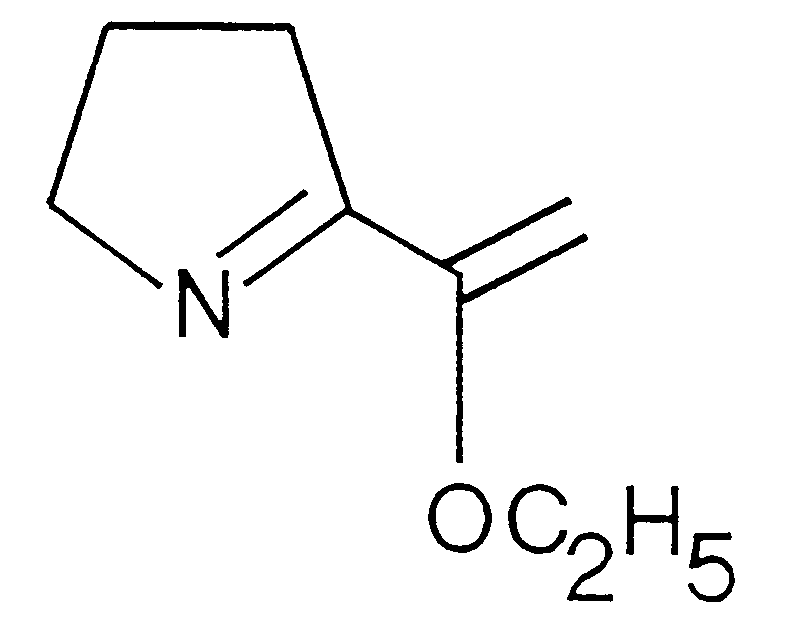
L'hydrolyse est de préférence effectuée par addition d'eau ou d'une solution de chlorure d'ammoniaque. Après hydrolyse, il est possible d'ajouter à la solution un sel, tel que le chlorure de sodium, de manière à saturer ladite solution, ce qui permet d'améliorer le rendement du présent procédé.
On a de plus constaté qu'un des composés de ce type,l'(éthoxy-1-éthenyl)-2-pyrroline-1 présentait certaines qualités organoleptiques qui permettaient de l'utiliser, seule ou en combinaison, comme agent aromatisant.
Ces caractéristiques organoleptiques peuvent être décrites ainsi: grillé, fruité, noisettes, et rappellent celles de la pyrazine.
Ainsi, l'(éthoxy-1-éthenyl)-2-pyrroline-1 peut être utilisée, seule, comme agent aromatisant, de manière à remplacer, par exemple, certaines alkyl-pyrazines.
La quantité à ajouter à un produit alimentaire dépend principalement de la nature du produit ainsi que de l'effet final souhaité.
Un autre objet de l'invention est donc l'utilisation de l'(éthoxy-1-éthenyl)-2-pyrroline-1 comme agent aromatisant susceptible d'être ajouté à un produit alimentaire.
Encore un autre objet de l'invention est l'utilisation de l'(éthoxy-1-éthenyl)-2-pyrroline-1 dans une composition aromatisante susceptible d'être ajoutée à un produit alimentaire. Enfin, un dernier objet de l'invention est une composition aromatisante comprenant l'(éthoxy-1-éthenyl)-2-pyrroline-1.
- l'exemple 1 décrit un procédé de préparation de l'(éthoxy-1-éthenyl)-2-pyrroline-1,
- l'exemple 2 décrit les tests d'identification de ce composé,
- l'exemple 3 illustre les propriétés aromatisantes de ce composé,
- les exemples 4 et 5 illustrent deux procédés d'obtention d'acétyl-2-pyrroline-1 en solution aqueuse,
- les exemples 6-9 illustrent trois procédés d'obtention d'acétyl-2-pyrroline-1 se présentant sous forme encapsulée et le produit obtenu,
- l'exemple 10 illustre la stabilité au stockage de l'acétyl-2-pyrroline-1 encapsulée,
- les exemples 11-16 illustrent les propriétés de l'acétyl-2-pyrroline-1 encapsulée, seule ou dans une composition exhausteur de goût.
On laisse ce mélange sous agitation constante, à -40°C, pendant 12 heures, puis on lui ajoute une solution de 47,1 g de N-triméthylsilyl-pyrrolidinone-2 dans 300 ml de THF.
Le mélange ainsi obtenu est laissé sous agitation constante à -40°C pendant 7 heures, puis on lui ajoute 32,1 g de chlorure d'ammonium dissout dans 300 ml d'eau.
On laisse le mélange se réchauffer jusqu'à environ 0°C, puis on le sature par addition de 60 g de chlorure de sodium.
On laisse reposer afin que les phases aqueuse et organique se séparent.
On récupère la phase organique, et l'on extrait la phase aqueuse trois fois avec 50 ml d'éther.
On obtient 37,8 g d'extrait brut se présentant sous forme d'un liquide jaune.
On prépare une colonne de chromatographie d'un diamètre de 4 cm, d'une hauteur de 80 cm et contenant 500 g d'un gel silicagel.
On utilise comme éluant une solution contenant 20 parties de dichlorométhane pour 1 partie d'acétate d'éthyle.
On introduit dans la colonne l'extrait brut dilué avec de l'éluant, puis on l'élue à un débit de 2 ml par minute.
On obtient alors 17,1 g d'un composé possédant une pureté de 99,9%, se présentant sous forme d'un liquide incolore.
| m/z | intensité relative (100=pic de base) | identification |
| 139 | 8 | [M]+ pic moléculaire |
| 124 | 21 | [M-CH3]+ |
| 110 | 5 | [M-C2H5]+ |
| 95 | 100 | [M-CH3CHO]+ |
| 94 | 66 | [M-OC2H5]+ |
| 83 | 6 | --- |
| 82 | 10 | --- |
| 67 | 18 | --- |
| 41 | 30 | --- |
| % | ||
| C | mesuré | 68,70 |
| calculé | 69,03 | |
| H | mesuré | 9,26 |
| calculé | 9,41 | |
| N | mesuré | 9,74 |
| calculé | 10,06 |
| Fréquence des bandes caractéristiques (cm-1) | % de transmission |
| 2977 | 23,8 |
| 2932 | 28,9 |
| 2862 | 34,5 |
| 1738 | 45,8 |
| 1612 | 26,9 |
| 1591 | 20,5 |
| 1370 | 29,7 |
| 1322 | 19,7 |
| 1271 | 25,1 |
| 1129 | 20,6 |
| 1068 | 25,6 |
| 979 | 34,7 |
| 819 | 30,2 |
| Signal (ppm) | Multiplicité du signal | Constante de couplage (Hz) | Identification |
| 4,73 | doublet | 2,6 | H oléfinique |
| 4,52 | doublet | 2,6 | H oléfinique |
| 4,02 | triplet d'un triplet | 2,0 et 7,4 | 2H-5 |
| 3,87 | quadruplet | 7 | 2H d'éthyl |
| 2,73 | multiplet | 2H-3 | |
| 1,93 | multiplet | 2H-4 | |
| 1,42 | triplet | 7 | 3H d'éthyl |

Le test se déroule de la manière suivante:
on présente 3 flacons à chaque dégustateur: un flacon contenant la solution aromatique et deux flacons d'eau. Le dégustateur doit humer l'espace de tête et désigner le flacon contenant la solution aromatique.
Le test est répété deux fois, pour des concentrations de 1000, 100, 10, 5 et 1 ppm.
| concentration (ppm) | 1000 | 100 | 10 | 5 | 1 |
| olfaction positive(%) | 100 | 100 | 100 | 50 | 17 |
Pour ce faire, on analyse par chromatographie en phase gazeuse des solutions du composé à différentes concentrations.
Les analyses sont réalisées selon les conditions suivantes:
- Chromatographe HP 5890 A (Hewlett-Packard)
- Colonne Capillaire DB-Wax (J et W Scientific), longueur 30 m, i.d. = 0.25 mm
- Détection FID, 250°C + Sniffing Port, 150°C Effluent splitting: 1/1
- Injection 200°C, Split (27.7 ml/min)
- Gaz vecteur Helium, 17.5 psi
- Température four 100°C - 4°/min - 180°C
- Quantité injectée: 1 microlitre d'une solution à 1000 ppm, soit 1 microgramme du composé.
- Débits gazeux: split vent = 27.7 ml/min effluent colonne = 0.6 ml/min (sniffing port)
- Quantité (éthoxy-1-éthenyl)-2-pyrroline-1 arrivant au sniffing port = 21.7 ng
- Estimation du volume d'air entraínant l'(éthoxy-1-éthenyl)-2-pyrroline-1
- Durée du pic olfactif = 5 secondes
- Débit d'air humidifié (make-up) = 0.83 ml/sec
- Volume d'air estimé à 4.2 ml d'air
On obtient alors une solution aqueuse contenant 97% d'acétyl-2-pyrroline-1, soit 52,40 mg, et 3% d'acétyl-2-pyrroline-2, soit 1,62 mg (composition déterminée par chromatographie en phase gazeuse et spectrométrie de masse).
La solution ainsi obtenue est lyophilisée dans un lyophilisateur standard. On obtient une poudre blanche contenant l'acétyl-2-pyrroline-1 à la concentration de 1,0 % par rapport au mélange maltodextrine/gomme arabique, et à la concentration de 0,94% par rapport à la poudre.
La solution ainsi obtenue est lyophilisée selon l'exemple 6. On obtient une poudre blanche contenant l'acétyl-2-pyrroline-1 à la concentration de 1,0 % par rapport à la β-cyclodextrine, et de 0,94% par rapport à la poudre.
On lui ajoute 15,0 g de β-cyclodextrine en poudre et 13,125 ml de NaOH 1N. On laisse sous agitation à 0°C pendant 30 minutes, puis la solution est lyophilisée selon l'exemple 6.
Dans ce cas, la lyophilisation est plus aisée à effectuer car le volume d'eau est beaucoup moins important, par comparaison avec les exemples 6 et 7.
La solution ainsi obtenue est lyophilisée selon l'exemple 6. On obtient une poudre blanche contenant l'acétyl-2-pyrroline-1 à la concentration de 10,0 % par rapport à la β-cyclodextrine.
Pour ce faire, on prélève, après stockage, 100 mg de poudre lyophilisée, que l'on dissout dans 1 ml d'eau, à 0°C.
On ajoute 1 ml d'acétate d'éthyle contenant 1 mg de triméthyl-2,4,6-pyridine et on laisse sous agitation pendant 30 secondes.
On centrifuge le mélange pendant 15 minutes, à -5°C et l'on récupère la phase organique que l'on analyse par chromatographie en phase gazeuse.
| Support et concentration en acétyl-2-pyrroline-1 | |||
| Température de stockage | maltodextrine 1% | β-cyclodextrine 1% | β-cyclodextrine 10% |
| 20°C | décomposition totale après 50j. | 99% | 91% après 13 jours |
| 4°C | 33% | 10% | 13% après 23 jours |
| - 20°C | 13% | 0% | --- |
Par contre, la stabilité de l'acétyl-2-pyrroline-1 diminue quand sa concentration sur le support (dans le cas présent la β-cyclodextrine) augmente. Par comparaison, l'acétyl-2-pyrroline-1 à 95% pure, préparée selon l'art antérieur se dégrade rapidement conservée à -20°C (Buttery et al., Journal of Agric. Food Chem. (1983), 31, 823-826).
L'acétyl-2-pyrroline-1 contribue à une perception plus ronde, plus cuisinée et plus flatteuse de l'aliment. Les notes "céréale cuite", "pop corn" et "très légèrement grillé" sont renforcées et mises en valeur, ainsi qu'une très fine note "beurré-frais".
L'acétyl-2-pyrroline-1 contribue à diminuer la note "graisse de poulet" et renforce les notes "chair de poulet" et "légèrement grillé".
L'ensemble est plus cuisiné et plus complet, et l'arrière-goût légèrement viande grillée est prolongé.
L'acétyl-2-pyrroline-1 contribue à renforcer la note "viande légèrement grillée". L'impression en bouche est plus ronde et l'arrière-goût boeuf est prolongé.
- 50 g d'acétyl-2-pyrazine
- 10 g d'acétyl-2-thiazole
- 30 g de diacétyle
- 5 g d'éthyl-2-méthyl-3-pyrazine
On divise le mélange aqueux en deux lots.
Dans le premier lot, on ajoute 0,5 ppm d'acétyl-2-pyrroline-1 sous forme encapsulée à 1% sur β-cyclodextrine.
Le second lot sert de témoin.
Un panel de 10 personnes compare les deux lots.
Le premier lot apparaít meilleur que le second, avec une note renforcée de type "céréale", "croûte de pain" et une note "grillée" arrondie. L'ensemble reste en bouche plus longtemps. Ajoutée à une pâte à pizza, la présente composition renforce la note "croûte de pain", surtout à l'olfaction.
- 5 g d'acétyl-2-pyrazine
- 5 g d'acétyl-2-thiazole
- 0,5 g de diacétyle
- 20 g de sulfure de diméthyle
On divise le mélange aqueux en deux lots.
Dans le premier lot, on ajoute 0,5 ppm d'acétyl-2-pyrroline-1 sous forme encapsulée à 1% sur β-cyclodextrine.
Le second lot sert de témoin.
Un panel de 10 personnes compare les deux lots.
Le premier lot présente une note plus typée, plus complète et plus puissante de "maïs doux" et "pop-corn".
La persistance en bouche est plus marquée.
- 5 g d'acétyl-2-thiazole
- 5 g de triméthyl-pyrazine
- 0,5 g de diacétyle
- 2 g d'éthyl-2-méthoxy-3-pyrazine
- 50 g de méthylthio-3-propanal
On divise le mélange aqueux en deux lots.
Dans le premier lot, on ajoute 0,5 ppm d'acétyl-2-pyrroline-1 sous forme encapsulée à 1% sur β-cyclodextrine.
Le second lot sert de témoin.
Un panel de 10 personnes compare les deux lots.
Le premier lot apparaít meilleur que le second et présente une note plus complète et renforcée de type "chair cuite de pommes-de-terre".
Claims (7)
- (Ethoxy-1-éthenyl)-2-pyrroline-1 de formule :

- Procédé de préparation d'(éthoxy-1-éthenyl)-2-pyrroline-1 selon la revendication 1, dans lequel on fait réagir à une température inférieure à 0°C de l'éthylvinyléther et du tert-butyllithium en solution organique, on ajoute du N-triméthylsilyl-pyrrolidinone-2, on laisse réagir puis on hydrolyse la solution obtenue, on récupère la phase organique que l'on sèche et purifie afin d'obtenir l'(ethoxy-1-éthenyl)-2-pyrroline-1 recherchée.
- Utilisation de l'(éthoxy-1-éthenyl)-2-pyrroline-1 selon la revendication 3 comme agent aromatisant susceptible d'être ajouté à un produit alimentaire.
- Composition aromatisante comprenant l'(éthoxy-1-éthenyl)-2-pyrroline-1.
- Acétyl-2-pyrroline-1 se présentant sous forme encapsulée susceptible d'être obtenue par le procédé dans lequel, à une température de -10°C à 25°C, on hydrolyse l'(éthoxy-1-éthenyl)-2-pyrroline-1 avec un acide, on neutralise avec une quantité équimolaire de base, on ajoute une solution de cyclodextrine de manière à obtenir une solution contenant jusqu'à 20% en poids d'acétyl-2-pyrroline-1 par rapport à la cyclodextrine, puis on lyophilise ladite solution de manière à obtenir une poudre pouvant contenir jusqu'à 20% en poids d'acétyl-2-pyrroline-1.
- Acétyl-2-pyrroline-1 se présentant sous forme encapsulée susceptible d'être obtenue par le procédé dans lequel, à une température de -10°C à 25°C, on hydrolyse l'(éthoxy-1-éthenyl)-2-pyrroline-1 avec un acide, on neutralise avec une quantité équimolaire de base, on ajoute une solution de maltodextrine de manière à obtenir une solution contenant jusqu'à 10% en poids d'acétyl-2-pyrroline-1 par rapport à la maltodextrine, puis on lyophilise ladite solution de manière à obtenir une poudre pouvant contenir jusqu'à 10% en poids d'acétyl-2-pyrroline-1.
- Utilisation du produit selon les revendications 5 et 6, seul ou en combinaison, comme exhausteur de goût, susceptible d'être ajouté à un produit alimentaire.
Applications Claiming Priority (3)
| Application Number | Priority Date | Filing Date | Title |
|---|---|---|---|
| CH3529/91 | 1991-12-02 | ||
| CH352991 | 1991-12-02 | ||
| CH3529/91A CH683995A5 (fr) | 1991-12-02 | 1991-12-02 | (Alcoxy-1-éthenyl)-2-pyrroline-1 et procédé de préparation d'acétyl-2-pyrroline-1. |
Publications (2)
| Publication Number | Publication Date |
|---|---|
| EP0545085A1 EP0545085A1 (fr) | 1993-06-09 |
| EP0545085B1 true EP0545085B1 (fr) | 2000-03-01 |
Family
ID=4257969
Family Applications (1)
| Application Number | Title | Priority Date | Filing Date |
|---|---|---|---|
| EP92118834A Expired - Lifetime EP0545085B1 (fr) | 1991-12-02 | 1992-11-04 | Procédé d'obtention d'acétyl-2-pyrroline-1 sous forme encapsulée, composé intermédiaire et produit final obtenus |
Country Status (11)
| Country | Link |
|---|---|
| US (4) | US5280127A (fr) |
| EP (1) | EP0545085B1 (fr) |
| JP (1) | JP2562267B2 (fr) |
| AT (1) | ATE190050T1 (fr) |
| AU (1) | AU659888B2 (fr) |
| CA (1) | CA2084256C (fr) |
| CH (1) | CH683995A5 (fr) |
| DE (1) | DE69230717T2 (fr) |
| NO (1) | NO178856C (fr) |
| NZ (1) | NZ245259A (fr) |
| ZA (1) | ZA928956B (fr) |
Families Citing this family (20)
| Publication number | Priority date | Publication date | Assignee | Title |
|---|---|---|---|---|
| CH683995A5 (fr) * | 1991-12-02 | 1994-06-30 | Nestle Sa | (Alcoxy-1-éthenyl)-2-pyrroline-1 et procédé de préparation d'acétyl-2-pyrroline-1. |
| US5690990A (en) * | 1994-03-04 | 1997-11-25 | Arnhem, Inc. | Process for encapsulating the flavor with colloid gel matrix |
| WO2004056202A1 (fr) * | 2002-12-20 | 2004-07-08 | Council Of Scientific And Industrial Research | Procede ameliore de stabilisation de 2-acetyl-1-pyrroline, l'arome du riz basmati |
| US6723856B1 (en) * | 2003-03-28 | 2004-04-20 | Council Of Scientific And Industrial Research | Process for the preparation of 2-acetyl-1-pyrroline, the basmati rice flavorant |
| WO2006137959A1 (fr) * | 2005-06-13 | 2006-12-28 | Cargill, Incorporated | Complexes d'inclusion de cyclodextrine et méthodes de synthèse desdits complexes |
| KR20080023684A (ko) * | 2005-06-13 | 2008-03-14 | 카아길, 인코포레이팃드 | 시클로덱스트린 포접 착물 및 이의 제조 방법 |
| US20090185985A1 (en) * | 2006-06-13 | 2009-07-23 | Cargill, Incorporated | Large-particle cyclodextrin inclusion complexes and methods of preparing same |
| US20090305943A1 (en) * | 2006-07-18 | 2009-12-10 | Sven Siegel | Cyclodextrin blends with crystal growth inhibitors |
| EP2049083A2 (fr) * | 2006-12-27 | 2009-04-22 | Cargill, Incorporated | Complexes d'inclusion de cyclodextrine, et leurs procédés de préparation |
| US20080283693A1 (en) * | 2007-05-15 | 2008-11-20 | Evans Michael J F | Propulsion apparatus and system |
| CA2772760A1 (fr) | 2008-12-23 | 2010-07-01 | President And Fellows Of Harvard College | Inhibiteurs de la necroptose de petite taille moleculaire |
| FR2947267B1 (fr) | 2009-06-24 | 2012-03-30 | Centre Nat Rech Scient | Nouvelle methode de synthese de la 2-acetyl-1-pyrroline et de son precurseur stable, marque isotopiquement ou non. |
| RU2534259C2 (ru) * | 2009-07-10 | 2014-11-27 | Фирмениш Са | Вкусоароматические композиции для пикантных продуктов |
| JP2012075350A (ja) * | 2010-09-30 | 2012-04-19 | Ogawa & Co Ltd | 豆乳又は豆乳含有飲食品の香味改善剤 |
| EP2491796B1 (fr) * | 2011-02-22 | 2015-08-26 | Symrise AG | Nouveaux articles d'extrait de pandan sous forme de poudre et leur procédé de production |
| JP2014073999A (ja) * | 2012-10-05 | 2014-04-24 | Takasago Internatl Corp | 2−アセチル−1−ピロリンの精製方法 |
| RU2662770C2 (ru) | 2013-01-22 | 2018-07-30 | Марс, Инкорпорейтед | Ароматизирующая композиция и пищевые композиции, содержащие ее |
| US9611228B2 (en) | 2013-03-15 | 2017-04-04 | The Board Of Trustees Of The University Of Illinois | Stabilized compositions and methods of manufacture |
| US9272657B1 (en) | 2015-05-12 | 2016-03-01 | Armorworks Holdings, Inc. | Multi-stage inversion tube mounting system |
| CN113543654B (zh) * | 2019-04-26 | 2022-10-14 | 弗门尼舍有限公司 | 莴苣提取物 |
Family Cites Families (9)
| Publication number | Priority date | Publication date | Assignee | Title |
|---|---|---|---|---|
| FR91265E (fr) * | 1966-11-03 | 1968-05-17 | Pechiney Saint Gobain | Dérivés de la delta-pyrroline |
| US3725425A (en) * | 1968-03-29 | 1973-04-03 | Agriculture | 1,4,5,6-tetrahydro-2-acetopyridine, its salts and bisulphite addition products, and synthesis thereof |
| US3620771A (en) * | 1970-01-21 | 1971-11-16 | Us Agriculture | 1,4,5,6-tetrahydro-2-acetopyridine and salts thereof as flavoring agents |
| JPS56125364A (en) * | 1980-03-07 | 1981-10-01 | Yuichi Kaneoka | Pyrroline derivative |
| US4522838A (en) * | 1983-06-01 | 1985-06-11 | The United States Of America As Represented By The Secretary Of Agriculture | 2-Acetyl-1-pyrroline and its use for flavoring foods |
| US5206025A (en) * | 1989-05-24 | 1993-04-27 | Rhone-Poulenc Sante | Porous pharmaceutical form and its preparation |
| US5087461A (en) * | 1989-10-02 | 1992-02-11 | Nabisco Brands, Inc. | Double-encapsulated compositions containing volatile and/or labile components, and processes for preparation and use thereof |
| EP0436481A1 (fr) * | 1990-01-04 | 1991-07-10 | RIJKSUNIVERSITEIT GENT Faculteit van de Landbouwwetenschappen Laboratorium voor Organische Scheikunde | Procédé de préparation de 2-acétyl-1-aza-cycloalkènes utilisables comme agents aromatisants du pain et du riz |
| CH683995A5 (fr) * | 1991-12-02 | 1994-06-30 | Nestle Sa | (Alcoxy-1-éthenyl)-2-pyrroline-1 et procédé de préparation d'acétyl-2-pyrroline-1. |
-
1991
- 1991-12-02 CH CH3529/91A patent/CH683995A5/fr not_active IP Right Cessation
-
1992
- 1992-11-04 EP EP92118834A patent/EP0545085B1/fr not_active Expired - Lifetime
- 1992-11-04 AT AT92118834T patent/ATE190050T1/de not_active IP Right Cessation
- 1992-11-04 DE DE69230717T patent/DE69230717T2/de not_active Expired - Fee Related
- 1992-11-19 ZA ZA928956A patent/ZA928956B/xx unknown
- 1992-11-20 NO NO924483A patent/NO178856C/no not_active IP Right Cessation
- 1992-11-20 US US07/979,293 patent/US5280127A/en not_active Expired - Lifetime
- 1992-11-20 AU AU28515/92A patent/AU659888B2/en not_active Ceased
- 1992-11-25 NZ NZ245259A patent/NZ245259A/en not_active IP Right Cessation
- 1992-12-01 CA CA002084256A patent/CA2084256C/fr not_active Expired - Fee Related
- 1992-12-02 JP JP4323397A patent/JP2562267B2/ja not_active Expired - Fee Related
-
1993
- 1993-11-29 US US08/158,934 patent/US5401521A/en not_active Expired - Lifetime
-
1994
- 1994-12-27 US US08/364,310 patent/US5512290A/en not_active Expired - Lifetime
- 1994-12-27 US US08/364,713 patent/US5446171A/en not_active Expired - Lifetime
Also Published As
| Publication number | Publication date |
|---|---|
| CH683995A5 (fr) | 1994-06-30 |
| EP0545085A1 (fr) | 1993-06-09 |
| CA2084256A1 (fr) | 1993-06-03 |
| JP2562267B2 (ja) | 1996-12-11 |
| NO924483L (no) | 1993-06-03 |
| NO924483D0 (no) | 1992-11-20 |
| NO178856B (no) | 1996-03-11 |
| ATE190050T1 (de) | 2000-03-15 |
| AU659888B2 (en) | 1995-06-01 |
| JPH05262725A (ja) | 1993-10-12 |
| NO178856C (no) | 1996-06-19 |
| NZ245259A (en) | 1995-08-28 |
| US5446171A (en) | 1995-08-29 |
| CA2084256C (fr) | 1998-10-20 |
| ZA928956B (en) | 1994-02-21 |
| DE69230717D1 (de) | 2000-04-06 |
| US5401521A (en) | 1995-03-28 |
| US5280127A (en) | 1994-01-18 |
| AU2851592A (en) | 1993-06-03 |
| US5512290A (en) | 1996-04-30 |
| DE69230717T2 (de) | 2000-08-17 |
Similar Documents
| Publication | Publication Date | Title |
|---|---|---|
| EP0545085B1 (fr) | Procédé d'obtention d'acétyl-2-pyrroline-1 sous forme encapsulée, composé intermédiaire et produit final obtenus | |
| JP2002520405A (ja) | ジカルボアルコキシジオキソラン | |
| EP1034161B2 (fr) | Nouveaux composes derives du menthol et leur utilisation en tant qu'agent rafraichissant | |
| EP0470391B1 (fr) | Utilisation de pyridines à titre d'ingrédients parfumants et aromatisants | |
| EP0482385B1 (fr) | (2E,4Z,7Z)-Décatriénoate d'éthyle et son utilisation à titre d'ingrédient parfumant ou aromatisant | |
| JPH0141623B2 (fr) | ||
| JPH05132694A (ja) | 付香剤組成物およびフレーバー付与剤組成物 | |
| EP0786248B1 (fr) | Utilisation du dithioacétate de S,S'-éthylidène à titre d'ingrédient parfumant et aromatisant | |
| EP0535713B1 (fr) | Utilisation de la carbométhoxy-2-pyrroline-1 | |
| CH619118A5 (fr) | ||
| JPH0517960B2 (fr) | ||
| JP2001149034A (ja) | 2−メチルフラン−3−チオール及び/又は誘導体及びメチレンジチオール及び/又は誘導体を含むおいしそうな風味剤 | |
| EP0222164B1 (fr) | Esters furanniques et leur utilisation en tant qu'ingrédients aromatisants | |
| EP2112135A2 (fr) | Acide et ester E2,E4,Z8-undecatriénoïque et leurs dérivés carboxamide, leurs utilisations organoleptiques et procédés de préparation | |
| FR2944790A1 (fr) | Nouveaux composes a effet physiologique | |
| EP1496042B1 (fr) | Acide E2,E4,Z8-undécatriénoique, dérivés ester et amide, leurs utilisations organoleptiques et procédé pour leur préparation | |
| JP4092380B2 (ja) | ネロリド−ルオキサイドを含有する香料組成物、およびその製造法 | |
| US20060034992A1 (en) | Flavor and fragrance compounds | |
| NZ270635A (en) | 2-(1-alkoxyethenyl)-1-pyrroline derivatives and use in food flavouring compositions | |
| EP0326869A2 (fr) | Cétones cycloaliphatiques, méthode pour leur préparation et leur utilisation à titre d'ingrédients parfumants et aromatisants | |
| NO180373B (no) | Fremgangsmåter for fremstilling av 2-acetyl-1-pyrrolin i innkapslet form, innkapslet produkt i form av et pulver samt anvendelse av produktet | |
| CH505773A (fr) | Préparation de cétones non-saturées | |
| CH563127A5 (en) | Diketones prepn - useful in perfumes, as aromatisers and as inters. for carotenoid pharmaceuticals | |
| CH540650A (fr) | Utilisation de dérivés furanniques comme agents aromatisants | |
| CH553249A (fr) | Utilisation de composes azotes heterocycliques comme ingredients parfumants et/ou aromatisants. |
Legal Events
| Date | Code | Title | Description |
|---|---|---|---|
| PUAI | Public reference made under article 153(3) epc to a published international application that has entered the european phase |
Free format text: ORIGINAL CODE: 0009012 |
|
| 17P | Request for examination filed |
Effective date: 19921104 |
|
| AK | Designated contracting states |
Kind code of ref document: A1 Designated state(s): AT BE CH DE DK ES FR GB GR IE IT LI LU NL PT SE |
|
| 17Q | First examination report despatched |
Effective date: 19960206 |
|
| GRAG | Despatch of communication of intention to grant |
Free format text: ORIGINAL CODE: EPIDOS AGRA |
|
| GRAG | Despatch of communication of intention to grant |
Free format text: ORIGINAL CODE: EPIDOS AGRA |
|
| GRAH | Despatch of communication of intention to grant a patent |
Free format text: ORIGINAL CODE: EPIDOS IGRA |
|
| GRAH | Despatch of communication of intention to grant a patent |
Free format text: ORIGINAL CODE: EPIDOS IGRA |
|
| GRAA | (expected) grant |
Free format text: ORIGINAL CODE: 0009210 |
|
| AK | Designated contracting states |
Kind code of ref document: B1 Designated state(s): AT BE CH DE DK ES FR GB GR IE IT LI LU NL PT SE |
|
| PG25 | Lapsed in a contracting state [announced via postgrant information from national office to epo] |
Ref country code: IT Free format text: LAPSE BECAUSE OF FAILURE TO SUBMIT A TRANSLATION OF THE DESCRIPTION OR TO PAY THE FEE WITHIN THE PRE;WARNING: LAPSES OF ITALIAN PATENTS WITH EFFECTIVE DATE BEFORE 2007 MAY HAVE OCCURRED AT ANY TIME BEFORE 2007. THE CORRECT EFFECTIVE DATE MAY BE DIFFERENT FROM THE ONE RECORDED.SCRIBED TIME-LIMIT Effective date: 20000301 Ref country code: GR Free format text: LAPSE BECAUSE OF NON-PAYMENT OF DUE FEES Effective date: 20000301 Ref country code: ES Free format text: THE PATENT HAS BEEN ANNULLED BY A DECISION OF A NATIONAL AUTHORITY Effective date: 20000301 Ref country code: SE Free format text: THE PATENT HAS BEEN ANNULLED BY A DECISION OF A NATIONAL AUTHORITY Effective date: 20000301 Ref country code: NL Free format text: LAPSE BECAUSE OF FAILURE TO SUBMIT A TRANSLATION OF THE DESCRIPTION OR TO PAY THE FEE WITHIN THE PRESCRIBED TIME-LIMIT Effective date: 20000301 |
|
| REF | Corresponds to: |
Ref document number: 190050 Country of ref document: AT Date of ref document: 20000315 Kind code of ref document: T |
|
| REG | Reference to a national code |
Ref country code: CH Ref legal event code: EP |
|
| GBT | Gb: translation of ep patent filed (gb section 77(6)(a)/1977) |
Effective date: 20000301 |
|
| REF | Corresponds to: |
Ref document number: 69230717 Country of ref document: DE Date of ref document: 20000406 |
|
| REG | Reference to a national code |
Ref country code: IE Ref legal event code: FG4D Free format text: FRENCH |
|
| PG25 | Lapsed in a contracting state [announced via postgrant information from national office to epo] |
Ref country code: DK Free format text: LAPSE BECAUSE OF FAILURE TO SUBMIT A TRANSLATION OF THE DESCRIPTION OR TO PAY THE FEE WITHIN THE PRESCRIBED TIME-LIMIT Effective date: 20000601 Ref country code: PT Free format text: LAPSE BECAUSE OF FAILURE TO SUBMIT A TRANSLATION OF THE DESCRIPTION OR TO PAY THE FEE WITHIN THE PRESCRIBED TIME-LIMIT Effective date: 20000601 |
|
| EN | Fr: translation not filed | ||
| NLV1 | Nl: lapsed or annulled due to failure to fulfill the requirements of art. 29p and 29m of the patents act | ||
| EN4 | Fr: notification of non filing translation in an earlier bopi is erroneous | ||
| PG25 | Lapsed in a contracting state [announced via postgrant information from national office to epo] |
Ref country code: LU Free format text: LAPSE BECAUSE OF NON-PAYMENT OF DUE FEES Effective date: 20001104 |
|
| PG25 | Lapsed in a contracting state [announced via postgrant information from national office to epo] |
Ref country code: LI Free format text: LAPSE BECAUSE OF NON-PAYMENT OF DUE FEES Effective date: 20001130 Ref country code: CH Free format text: LAPSE BECAUSE OF NON-PAYMENT OF DUE FEES Effective date: 20001130 |
|
| PLBE | No opposition filed within time limit |
Free format text: ORIGINAL CODE: 0009261 |
|
| STAA | Information on the status of an ep patent application or granted ep patent |
Free format text: STATUS: NO OPPOSITION FILED WITHIN TIME LIMIT |
|
| 26N | No opposition filed | ||
| REG | Reference to a national code |
Ref country code: CH Ref legal event code: PL |
|
| REG | Reference to a national code |
Ref country code: GB Ref legal event code: IF02 |
|
| PGFP | Annual fee paid to national office [announced via postgrant information from national office to epo] |
Ref country code: IE Payment date: 20081114 Year of fee payment: 17 Ref country code: DE Payment date: 20081103 Year of fee payment: 17 |
|
| PGFP | Annual fee paid to national office [announced via postgrant information from national office to epo] |
Ref country code: AT Payment date: 20081112 Year of fee payment: 17 |
|
| PGFP | Annual fee paid to national office [announced via postgrant information from national office to epo] |
Ref country code: BE Payment date: 20081110 Year of fee payment: 17 |
|
| PGFP | Annual fee paid to national office [announced via postgrant information from national office to epo] |
Ref country code: FR Payment date: 20081112 Year of fee payment: 17 |
|
| PGFP | Annual fee paid to national office [announced via postgrant information from national office to epo] |
Ref country code: GB Payment date: 20081029 Year of fee payment: 17 |
|
| BERE | Be: lapsed |
Owner name: SOC. DES PRODUITS *NESTLE S.A. Effective date: 20091130 |
|
| GBPC | Gb: european patent ceased through non-payment of renewal fee |
Effective date: 20091104 |
|
| REG | Reference to a national code |
Ref country code: IE Ref legal event code: MM4A |
|
| REG | Reference to a national code |
Ref country code: FR Ref legal event code: ST Effective date: 20100730 |
|
| PG25 | Lapsed in a contracting state [announced via postgrant information from national office to epo] |
Ref country code: AT Free format text: LAPSE BECAUSE OF NON-PAYMENT OF DUE FEES Effective date: 20091104 |
|
| PG25 | Lapsed in a contracting state [announced via postgrant information from national office to epo] |
Ref country code: IE Free format text: LAPSE BECAUSE OF NON-PAYMENT OF DUE FEES Effective date: 20091104 Ref country code: FR Free format text: LAPSE BECAUSE OF NON-PAYMENT OF DUE FEES Effective date: 20091130 Ref country code: BE Free format text: LAPSE BECAUSE OF NON-PAYMENT OF DUE FEES Effective date: 20091130 |
|
| PG25 | Lapsed in a contracting state [announced via postgrant information from national office to epo] |
Ref country code: DE Free format text: LAPSE BECAUSE OF NON-PAYMENT OF DUE FEES Effective date: 20100601 |
|
| PG25 | Lapsed in a contracting state [announced via postgrant information from national office to epo] |
Ref country code: GB Free format text: LAPSE BECAUSE OF NON-PAYMENT OF DUE FEES Effective date: 20091104 |