EP0549745B1 - Elements photographiques contenant des copulants a la pyrazolone et procede associe - Google Patents
Elements photographiques contenant des copulants a la pyrazolone et procede associe Download PDFInfo
- Publication number
- EP0549745B1 EP0549745B1 EP92912291A EP92912291A EP0549745B1 EP 0549745 B1 EP0549745 B1 EP 0549745B1 EP 92912291 A EP92912291 A EP 92912291A EP 92912291 A EP92912291 A EP 92912291A EP 0549745 B1 EP0549745 B1 EP 0549745B1
- Authority
- EP
- European Patent Office
- Prior art keywords
- coupler
- group
- couplers
- photographic
- dye
- Prior art date
- Legal status (The legal status is an assumption and is not a legal conclusion. Google has not performed a legal analysis and makes no representation as to the accuracy of the status listed.)
- Expired - Lifetime
Links
- 238000000034 method Methods 0.000 title claims description 24
- 230000008569 process Effects 0.000 title claims description 11
- JEXVQSWXXUJEMA-UHFFFAOYSA-N pyrazol-3-one Chemical compound O=C1C=CN=N1 JEXVQSWXXUJEMA-UHFFFAOYSA-N 0.000 title description 25
- -1 silver halide Chemical class 0.000 claims description 87
- 239000000839 emulsion Substances 0.000 claims description 31
- 229910052709 silver Inorganic materials 0.000 claims description 24
- 239000004332 silver Substances 0.000 claims description 24
- 125000000217 alkyl group Chemical group 0.000 claims description 17
- 125000004432 carbon atom Chemical group C* 0.000 claims description 14
- 239000000460 chlorine Substances 0.000 claims description 12
- 229910052739 hydrogen Inorganic materials 0.000 claims description 12
- 239000003795 chemical substances by application Substances 0.000 claims description 11
- 125000000623 heterocyclic group Chemical group 0.000 claims description 11
- 239000001257 hydrogen Substances 0.000 claims description 11
- 125000003118 aryl group Chemical group 0.000 claims description 10
- 125000001424 substituent group Chemical group 0.000 claims description 9
- 125000003545 alkoxy group Chemical group 0.000 claims description 8
- 229910052736 halogen Inorganic materials 0.000 claims description 7
- 150000002367 halogens Chemical class 0.000 claims description 7
- 125000004435 hydrogen atom Chemical group [H]* 0.000 claims description 7
- 125000005110 aryl thio group Chemical group 0.000 claims description 6
- 125000004390 alkyl sulfonyl group Chemical group 0.000 claims description 5
- 229910052801 chlorine Inorganic materials 0.000 claims description 5
- ZRHUHDUEXWHZMA-UHFFFAOYSA-N 1,4-dihydropyrazol-5-one Chemical compound O=C1CC=NN1 ZRHUHDUEXWHZMA-UHFFFAOYSA-N 0.000 claims description 4
- ZAMOUSCENKQFHK-UHFFFAOYSA-N Chlorine atom Chemical compound [Cl] ZAMOUSCENKQFHK-UHFFFAOYSA-N 0.000 claims description 4
- 125000004442 acylamino group Chemical group 0.000 claims description 4
- 125000004453 alkoxycarbonyl group Chemical group 0.000 claims description 4
- 125000005138 alkoxysulfonyl group Chemical group 0.000 claims description 4
- 125000004414 alkyl thio group Chemical group 0.000 claims description 4
- 125000004397 aminosulfonyl group Chemical group NS(=O)(=O)* 0.000 claims description 4
- 229910052799 carbon Inorganic materials 0.000 claims description 4
- 125000000449 nitro group Chemical group [O-][N+](*)=O 0.000 claims description 4
- 125000005420 sulfonamido group Chemical group S(=O)(=O)(N*)* 0.000 claims description 4
- 125000004423 acyloxy group Chemical group 0.000 claims description 3
- 125000004466 alkoxycarbonylamino group Chemical group 0.000 claims description 3
- 125000005281 alkyl ureido group Chemical group 0.000 claims description 3
- 125000005161 aryl oxy carbonyl group Chemical group 0.000 claims description 3
- 125000005142 aryl oxy sulfonyl group Chemical group 0.000 claims description 3
- 125000004104 aryloxy group Chemical group 0.000 claims description 3
- 125000003917 carbamoyl group Chemical group [H]N([H])C(*)=O 0.000 claims description 3
- 125000000999 tert-butyl group Chemical group [H]C([H])([H])C(*)(C([H])([H])[H])C([H])([H])[H] 0.000 claims description 3
- OKTJSMMVPCPJKN-UHFFFAOYSA-N Carbon Chemical compound [C] OKTJSMMVPCPJKN-UHFFFAOYSA-N 0.000 claims description 2
- VEXZGXHMUGYJMC-UHFFFAOYSA-N Hydrochloric acid Chemical group Cl VEXZGXHMUGYJMC-UHFFFAOYSA-N 0.000 claims description 2
- 125000002252 acyl group Chemical group 0.000 claims description 2
- 125000005162 aryl oxy carbonyl amino group Chemical group 0.000 claims description 2
- 125000004391 aryl sulfonyl group Chemical group 0.000 claims description 2
- 239000006249 magnetic particle Substances 0.000 claims description 2
- 239000000975 dye Substances 0.000 description 56
- 239000010410 layer Substances 0.000 description 27
- 238000005859 coupling reaction Methods 0.000 description 17
- ZMXDDKWLCZADIW-UHFFFAOYSA-N N,N-Dimethylformamide Chemical compound CN(C)C=O ZMXDDKWLCZADIW-UHFFFAOYSA-N 0.000 description 16
- 238000000576 coating method Methods 0.000 description 16
- 230000008878 coupling Effects 0.000 description 16
- 238000010168 coupling process Methods 0.000 description 16
- 230000015572 biosynthetic process Effects 0.000 description 15
- 239000000463 material Substances 0.000 description 13
- 239000003112 inhibitor Substances 0.000 description 12
- 238000012545 processing Methods 0.000 description 12
- XEKOWRVHYACXOJ-UHFFFAOYSA-N Ethyl acetate Chemical compound CCOC(C)=O XEKOWRVHYACXOJ-UHFFFAOYSA-N 0.000 description 11
- 238000006243 chemical reaction Methods 0.000 description 11
- 150000001875 compounds Chemical class 0.000 description 11
- 238000003786 synthesis reaction Methods 0.000 description 11
- WYURNTSHIVDZCO-UHFFFAOYSA-N Tetrahydrofuran Chemical compound C1CCOC1 WYURNTSHIVDZCO-UHFFFAOYSA-N 0.000 description 10
- 239000007844 bleaching agent Substances 0.000 description 10
- 239000000203 mixture Substances 0.000 description 10
- 238000012360 testing method Methods 0.000 description 10
- 108010010803 Gelatin Proteins 0.000 description 8
- 238000011161 development Methods 0.000 description 8
- 239000008273 gelatin Substances 0.000 description 8
- 229920000159 gelatin Polymers 0.000 description 8
- 235000019322 gelatine Nutrition 0.000 description 8
- 235000011852 gelatine desserts Nutrition 0.000 description 8
- 239000000243 solution Substances 0.000 description 8
- 239000000047 product Substances 0.000 description 7
- 238000011160 research Methods 0.000 description 7
- XLYOFNOQVPJJNP-UHFFFAOYSA-N water Substances O XLYOFNOQVPJJNP-UHFFFAOYSA-N 0.000 description 7
- WEVYAHXRMPXWCK-UHFFFAOYSA-N Acetonitrile Chemical compound CC#N WEVYAHXRMPXWCK-UHFFFAOYSA-N 0.000 description 6
- RTZKZFJDLAIYFH-UHFFFAOYSA-N Diethyl ether Chemical compound CCOCC RTZKZFJDLAIYFH-UHFFFAOYSA-N 0.000 description 6
- OKKJLVBELUTLKV-UHFFFAOYSA-N Methanol Chemical compound OC OKKJLVBELUTLKV-UHFFFAOYSA-N 0.000 description 6
- JUJWROOIHBZHMG-UHFFFAOYSA-N Pyridine Chemical compound C1=CC=NC=C1 JUJWROOIHBZHMG-UHFFFAOYSA-N 0.000 description 6
- 238000004128 high performance liquid chromatography Methods 0.000 description 6
- 239000002904 solvent Substances 0.000 description 6
- QTBSBXVTEAMEQO-UHFFFAOYSA-N Acetic acid Chemical compound CC(O)=O QTBSBXVTEAMEQO-UHFFFAOYSA-N 0.000 description 5
- 239000011248 coating agent Substances 0.000 description 5
- 235000019439 ethyl acetate Nutrition 0.000 description 5
- 239000004848 polyfunctional curative Substances 0.000 description 5
- 239000007787 solid Substances 0.000 description 5
- YYYOQURZQWIILK-UHFFFAOYSA-N 2-[(2-aminophenyl)disulfanyl]aniline Chemical compound NC1=CC=CC=C1SSC1=CC=CC=C1N YYYOQURZQWIILK-UHFFFAOYSA-N 0.000 description 4
- CSCPPACGZOOCGX-UHFFFAOYSA-N Acetone Chemical compound CC(C)=O CSCPPACGZOOCGX-UHFFFAOYSA-N 0.000 description 4
- WKBOTKDWSSQWDR-UHFFFAOYSA-N Bromine atom Chemical compound [Br] WKBOTKDWSSQWDR-UHFFFAOYSA-N 0.000 description 4
- KCXVZYZYPLLWCC-UHFFFAOYSA-N EDTA Chemical compound OC(=O)CN(CC(O)=O)CCN(CC(O)=O)CC(O)=O KCXVZYZYPLLWCC-UHFFFAOYSA-N 0.000 description 4
- WCUXLLCKKVVCTQ-UHFFFAOYSA-M Potassium chloride Chemical compound [Cl-].[K+] WCUXLLCKKVVCTQ-UHFFFAOYSA-M 0.000 description 4
- 230000002776 aggregation Effects 0.000 description 4
- 238000004220 aggregation Methods 0.000 description 4
- GDTBXPJZTBHREO-UHFFFAOYSA-N bromine Substances BrBr GDTBXPJZTBHREO-UHFFFAOYSA-N 0.000 description 4
- 229910052794 bromium Inorganic materials 0.000 description 4
- 239000006185 dispersion Substances 0.000 description 4
- 239000011521 glass Substances 0.000 description 4
- 230000014759 maintenance of location Effects 0.000 description 4
- 229910052757 nitrogen Inorganic materials 0.000 description 4
- 125000001997 phenyl group Chemical group [H]C1=C([H])C([H])=C(*)C([H])=C1[H] 0.000 description 4
- IOLCXVTUBQKXJR-UHFFFAOYSA-M potassium bromide Chemical compound [K+].[Br-] IOLCXVTUBQKXJR-UHFFFAOYSA-M 0.000 description 4
- BWHMMNNQKKPAPP-UHFFFAOYSA-L potassium carbonate Chemical compound [K+].[K+].[O-]C([O-])=O BWHMMNNQKKPAPP-UHFFFAOYSA-L 0.000 description 4
- AWPJRBMEBMDFGG-UHFFFAOYSA-N 4-[2,4-bis(2-methylbutan-2-yl)phenoxy]-n-[2-[[2-[4-[2,4-bis(2-methylbutan-2-yl)phenoxy]butanoylamino]phenyl]disulfanyl]phenyl]butanamide Chemical compound CCC(C)(C)C1=CC(C(C)(C)CC)=CC=C1OCCCC(=O)NC1=CC=CC=C1SSC1=CC=CC=C1NC(=O)CCCOC1=CC=C(C(C)(C)CC)C=C1C(C)(C)CC AWPJRBMEBMDFGG-UHFFFAOYSA-N 0.000 description 3
- YMWUJEATGCHHMB-UHFFFAOYSA-N Dichloromethane Chemical compound ClCCl YMWUJEATGCHHMB-UHFFFAOYSA-N 0.000 description 3
- BQCADISMDOOEFD-UHFFFAOYSA-N Silver Chemical compound [Ag] BQCADISMDOOEFD-UHFFFAOYSA-N 0.000 description 3
- HEMHJVSKTPXQMS-UHFFFAOYSA-M Sodium hydroxide Chemical compound [OH-].[Na+] HEMHJVSKTPXQMS-UHFFFAOYSA-M 0.000 description 3
- 238000002835 absorbance Methods 0.000 description 3
- 230000008901 benefit Effects 0.000 description 3
- 125000004093 cyano group Chemical group *C#N 0.000 description 3
- 230000006870 function Effects 0.000 description 3
- 238000003760 magnetic stirring Methods 0.000 description 3
- 238000004519 manufacturing process Methods 0.000 description 3
- 239000002245 particle Substances 0.000 description 3
- 125000000951 phenoxy group Chemical group [H]C1=C([H])C([H])=C(O*)C([H])=C1[H] 0.000 description 3
- 125000003356 phenylsulfanyl group Chemical group [*]SC1=C([H])C([H])=C([H])C([H])=C1[H] 0.000 description 3
- FVSKHRXBFJPNKK-UHFFFAOYSA-N propionitrile Chemical compound CCC#N FVSKHRXBFJPNKK-UHFFFAOYSA-N 0.000 description 3
- 238000000425 proton nuclear magnetic resonance spectrum Methods 0.000 description 3
- UMJSCPRVCHMLSP-UHFFFAOYSA-N pyridine Natural products COC1=CC=CN=C1 UMJSCPRVCHMLSP-UHFFFAOYSA-N 0.000 description 3
- 238000001953 recrystallisation Methods 0.000 description 3
- 230000035945 sensitivity Effects 0.000 description 3
- 238000001228 spectrum Methods 0.000 description 3
- 229910052717 sulfur Inorganic materials 0.000 description 3
- NGNBDVOYPDDBFK-UHFFFAOYSA-N 2-[2,4-di(pentan-2-yl)phenoxy]acetyl chloride Chemical compound CCCC(C)C1=CC=C(OCC(Cl)=O)C(C(C)CCC)=C1 NGNBDVOYPDDBFK-UHFFFAOYSA-N 0.000 description 2
- VWQQTZYNOQZMFN-UHFFFAOYSA-N 6-[2,4-bis(2-methylbutan-2-yl)phenoxy]-n-[2-[[2-[6-[2,4-bis(2-methylbutan-2-yl)phenoxy]hexanoylamino]phenyl]disulfanyl]phenyl]hexanamide Chemical compound CCC(C)(C)C1=CC(C(C)(C)CC)=CC=C1OCCCCCC(=O)NC1=CC=CC=C1SSC1=CC=CC=C1NC(=O)CCCCCOC1=CC=C(C(C)(C)CC)C=C1C(C)(C)CC VWQQTZYNOQZMFN-UHFFFAOYSA-N 0.000 description 2
- CIWBSHSKHKDKBQ-JLAZNSOCSA-N Ascorbic acid Chemical compound OC[C@H](O)[C@H]1OC(=O)C(O)=C1O CIWBSHSKHKDKBQ-JLAZNSOCSA-N 0.000 description 2
- HEDRZPFGACZZDS-UHFFFAOYSA-N Chloroform Chemical compound ClC(Cl)Cl HEDRZPFGACZZDS-UHFFFAOYSA-N 0.000 description 2
- 229920001174 Diethylhydroxylamine Polymers 0.000 description 2
- IAZDPXIOMUYVGZ-UHFFFAOYSA-N Dimethylsulphoxide Chemical compound CS(C)=O IAZDPXIOMUYVGZ-UHFFFAOYSA-N 0.000 description 2
- PXGOKWXKJXAPGV-UHFFFAOYSA-N Fluorine Chemical compound FF PXGOKWXKJXAPGV-UHFFFAOYSA-N 0.000 description 2
- UFHFLCQGNIYNRP-UHFFFAOYSA-N Hydrogen Chemical compound [H][H] UFHFLCQGNIYNRP-UHFFFAOYSA-N 0.000 description 2
- PXHVJJICTQNCMI-UHFFFAOYSA-N Nickel Chemical compound [Ni] PXHVJJICTQNCMI-UHFFFAOYSA-N 0.000 description 2
- 239000004698 Polyethylene Substances 0.000 description 2
- 229910021607 Silver chloride Inorganic materials 0.000 description 2
- PJANXHGTPQOBST-VAWYXSNFSA-N Stilbene Natural products C=1C=CC=CC=1/C=C/C1=CC=CC=C1 PJANXHGTPQOBST-VAWYXSNFSA-N 0.000 description 2
- YSMRWXYRXBRSND-UHFFFAOYSA-N TOTP Chemical compound CC1=CC=CC=C1OP(=O)(OC=1C(=CC=CC=1)C)OC1=CC=CC=C1C YSMRWXYRXBRSND-UHFFFAOYSA-N 0.000 description 2
- HEDRZPFGACZZDS-MICDWDOJSA-N Trichloro(2H)methane Chemical compound [2H]C(Cl)(Cl)Cl HEDRZPFGACZZDS-MICDWDOJSA-N 0.000 description 2
- GSEJCLTVZPLZKY-UHFFFAOYSA-N Triethanolamine Chemical compound OCCN(CCO)CCO GSEJCLTVZPLZKY-UHFFFAOYSA-N 0.000 description 2
- 238000010521 absorption reaction Methods 0.000 description 2
- 229960000583 acetic acid Drugs 0.000 description 2
- UZKLEUIGRDLZRP-UHFFFAOYSA-N acetic acid azane ethane-1,2-diamine Chemical compound N.CC(O)=O.CC(O)=O.CC(O)=O.CC(O)=O.NCCN UZKLEUIGRDLZRP-UHFFFAOYSA-N 0.000 description 2
- 239000000654 additive Substances 0.000 description 2
- 230000002411 adverse Effects 0.000 description 2
- 150000001412 amines Chemical class 0.000 description 2
- XYXNTHIYBIDHGM-UHFFFAOYSA-N ammonium thiosulfate Chemical compound [NH4+].[NH4+].[O-]S([O-])(=O)=S XYXNTHIYBIDHGM-UHFFFAOYSA-N 0.000 description 2
- 229940051880 analgesics and antipyretics pyrazolones Drugs 0.000 description 2
- 238000004458 analytical method Methods 0.000 description 2
- 125000003178 carboxy group Chemical group [H]OC(*)=O 0.000 description 2
- YCIMNLLNPGFGHC-UHFFFAOYSA-N catechol Chemical compound OC1=CC=CC=C1O YCIMNLLNPGFGHC-UHFFFAOYSA-N 0.000 description 2
- 230000008859 change Effects 0.000 description 2
- 238000003776 cleavage reaction Methods 0.000 description 2
- FVCOIAYSJZGECG-UHFFFAOYSA-N diethylhydroxylamine Chemical compound CCN(O)CC FVCOIAYSJZGECG-UHFFFAOYSA-N 0.000 description 2
- 230000000694 effects Effects 0.000 description 2
- 229910052731 fluorine Inorganic materials 0.000 description 2
- 239000011737 fluorine Substances 0.000 description 2
- LNTHITQWFMADLM-UHFFFAOYSA-N gallic acid Chemical compound OC(=O)C1=CC(O)=C(O)C(O)=C1 LNTHITQWFMADLM-UHFFFAOYSA-N 0.000 description 2
- 150000002431 hydrogen Chemical group 0.000 description 2
- 239000011229 interlayer Substances 0.000 description 2
- 238000011031 large-scale manufacturing process Methods 0.000 description 2
- INHCSSUBVCNVSK-UHFFFAOYSA-L lithium sulfate Inorganic materials [Li+].[Li+].[O-]S([O-])(=O)=O INHCSSUBVCNVSK-UHFFFAOYSA-L 0.000 description 2
- 239000000314 lubricant Substances 0.000 description 2
- 230000000873 masking effect Effects 0.000 description 2
- CTSLXHKWHWQRSH-UHFFFAOYSA-N oxalyl chloride Chemical compound ClC(=O)C(Cl)=O CTSLXHKWHWQRSH-UHFFFAOYSA-N 0.000 description 2
- 239000004014 plasticizer Substances 0.000 description 2
- 229920000573 polyethylene Polymers 0.000 description 2
- 235000015497 potassium bicarbonate Nutrition 0.000 description 2
- 239000011736 potassium bicarbonate Substances 0.000 description 2
- 229910000028 potassium bicarbonate Inorganic materials 0.000 description 2
- 229910000027 potassium carbonate Inorganic materials 0.000 description 2
- 235000011181 potassium carbonates Nutrition 0.000 description 2
- 239000001103 potassium chloride Substances 0.000 description 2
- 235000011164 potassium chloride Nutrition 0.000 description 2
- TYJJADVDDVDEDZ-UHFFFAOYSA-M potassium hydrogencarbonate Chemical compound [K+].OC([O-])=O TYJJADVDDVDEDZ-UHFFFAOYSA-M 0.000 description 2
- 239000002244 precipitate Substances 0.000 description 2
- 238000002360 preparation method Methods 0.000 description 2
- 230000009467 reduction Effects 0.000 description 2
- 238000010992 reflux Methods 0.000 description 2
- 230000000717 retained effect Effects 0.000 description 2
- ZUNKMNLKJXRCDM-UHFFFAOYSA-N silver bromoiodide Chemical compound [Ag].IBr ZUNKMNLKJXRCDM-UHFFFAOYSA-N 0.000 description 2
- HKZLPVFGJNLROG-UHFFFAOYSA-M silver monochloride Chemical compound [Cl-].[Ag+] HKZLPVFGJNLROG-UHFFFAOYSA-M 0.000 description 2
- JHJLBTNAGRQEKS-UHFFFAOYSA-M sodium bromide Chemical compound [Na+].[Br-] JHJLBTNAGRQEKS-UHFFFAOYSA-M 0.000 description 2
- 239000003381 stabilizer Substances 0.000 description 2
- PJANXHGTPQOBST-UHFFFAOYSA-N stilbene Chemical compound C=1C=CC=CC=1C=CC1=CC=CC=C1 PJANXHGTPQOBST-UHFFFAOYSA-N 0.000 description 2
- 235000021286 stilbenes Nutrition 0.000 description 2
- 239000012258 stirred mixture Substances 0.000 description 2
- 238000003860 storage Methods 0.000 description 2
- 239000000126 substance Substances 0.000 description 2
- 239000011593 sulfur Substances 0.000 description 2
- RBTVSNLYYIMMKS-UHFFFAOYSA-N tert-butyl 3-aminoazetidine-1-carboxylate;hydrochloride Chemical compound Cl.CC(C)(C)OC(=O)N1CC(N)C1 RBTVSNLYYIMMKS-UHFFFAOYSA-N 0.000 description 2
- 230000002087 whitening effect Effects 0.000 description 2
- 229910052724 xenon Inorganic materials 0.000 description 2
- FHNFHKCVQCLJFQ-UHFFFAOYSA-N xenon atom Chemical compound [Xe] FHNFHKCVQCLJFQ-UHFFFAOYSA-N 0.000 description 2
- GVEYRUKUJCHJSR-UHFFFAOYSA-N (4-azaniumyl-3-methylphenyl)-ethyl-(2-hydroxyethyl)azanium;sulfate Chemical compound OS(O)(=O)=O.OCCN(CC)C1=CC=C(N)C(C)=C1 GVEYRUKUJCHJSR-UHFFFAOYSA-N 0.000 description 1
- ILKZXYARHQNMEF-UHFFFAOYSA-N (4-azaniumyl-3-methylphenyl)-ethyl-(2-methoxyethyl)azanium;4-methylbenzenesulfonate Chemical compound CC1=CC=C(S(O)(=O)=O)C=C1.CC1=CC=C(S(O)(=O)=O)C=C1.COCCN(CC)C1=CC=C(N)C(C)=C1 ILKZXYARHQNMEF-UHFFFAOYSA-N 0.000 description 1
- FVRXOULDGSWPPO-UHFFFAOYSA-N 1,2-dihydropyrazole-3-thione Chemical class SC1=CC=NN1 FVRXOULDGSWPPO-UHFFFAOYSA-N 0.000 description 1
- YXIWHUQXZSMYRE-UHFFFAOYSA-N 1,3-benzothiazole-2-thiol Chemical class C1=CC=C2SC(S)=NC2=C1 YXIWHUQXZSMYRE-UHFFFAOYSA-N 0.000 description 1
- YHMYGUUIMTVXNW-UHFFFAOYSA-N 1,3-dihydrobenzimidazole-2-thione Chemical class C1=CC=C2NC(S)=NC2=C1 YHMYGUUIMTVXNW-UHFFFAOYSA-N 0.000 description 1
- 150000005208 1,4-dihydroxybenzenes Chemical class 0.000 description 1
- BAXOFTOLAUCFNW-UHFFFAOYSA-N 1H-indazole Chemical class C1=CC=C2C=NNC2=C1 BAXOFTOLAUCFNW-UHFFFAOYSA-N 0.000 description 1
- KJUGUADJHNHALS-UHFFFAOYSA-N 1H-tetrazole Substances C=1N=NNN=1 KJUGUADJHNHALS-UHFFFAOYSA-N 0.000 description 1
- JAAIPIWKKXCNOC-UHFFFAOYSA-N 1h-tetrazol-1-ium-5-thiolate Chemical class SC1=NN=NN1 JAAIPIWKKXCNOC-UHFFFAOYSA-N 0.000 description 1
- LLCOQBODWBFTDD-UHFFFAOYSA-N 1h-triazol-1-ium-4-thiolate Chemical class SC1=CNN=N1 LLCOQBODWBFTDD-UHFFFAOYSA-N 0.000 description 1
- PHCYXPLSQNMCRY-UHFFFAOYSA-N 2-[2,4-bis(2-methylbutan-2-yl)phenoxy]butanoic acid Chemical compound CCC(C(O)=O)OC1=CC=C(C(C)(C)CC)C=C1C(C)(C)CC PHCYXPLSQNMCRY-UHFFFAOYSA-N 0.000 description 1
- LRKLDHJJKJBSIP-UHFFFAOYSA-N 2-[2,4-bis(2-methylbutan-2-yl)phenoxy]hexanoyl chloride Chemical compound CCCCC(C(Cl)=O)OC1=CC=C(C(C)(C)CC)C=C1C(C)(C)CC LRKLDHJJKJBSIP-UHFFFAOYSA-N 0.000 description 1
- CDAWCLOXVUBKRW-UHFFFAOYSA-N 2-aminophenol Chemical class NC1=CC=CC=C1O CDAWCLOXVUBKRW-UHFFFAOYSA-N 0.000 description 1
- VRVRGVPWCUEOGV-UHFFFAOYSA-N 2-aminothiophenol Chemical compound NC1=CC=CC=C1S VRVRGVPWCUEOGV-UHFFFAOYSA-N 0.000 description 1
- FLFWJIBUZQARMD-UHFFFAOYSA-N 2-mercapto-1,3-benzoxazole Chemical class C1=CC=C2OC(S)=NC2=C1 FLFWJIBUZQARMD-UHFFFAOYSA-N 0.000 description 1
- GPUWDUXYXXIUCI-UHFFFAOYSA-N 3-anilino-1,4-dihydropyrazol-5-one Chemical compound N1C(=O)CC(NC=2C=CC=CC=2)=N1 GPUWDUXYXXIUCI-UHFFFAOYSA-N 0.000 description 1
- CLEJZSNZYFJMKD-UHFFFAOYSA-N 3h-1,3-oxazole-2-thione Chemical class SC1=NC=CO1 CLEJZSNZYFJMKD-UHFFFAOYSA-N 0.000 description 1
- OCVLSHAVSIYKLI-UHFFFAOYSA-N 3h-1,3-thiazole-2-thione Chemical class SC1=NC=CS1 OCVLSHAVSIYKLI-UHFFFAOYSA-N 0.000 description 1
- KWIVRAVCZJXOQC-UHFFFAOYSA-N 3h-oxathiazole Chemical class N1SOC=C1 KWIVRAVCZJXOQC-UHFFFAOYSA-N 0.000 description 1
- LUWZTXZFAZCHMX-UHFFFAOYSA-N 3h-oxathiazole-4-thiol Chemical class SC1=COSN1 LUWZTXZFAZCHMX-UHFFFAOYSA-N 0.000 description 1
- XTBFKMDOQMQYPP-UHFFFAOYSA-N 4-n,4-n-diethylbenzene-1,4-diamine;hydron;chloride Chemical compound Cl.CCN(CC)C1=CC=C(N)C=C1 XTBFKMDOQMQYPP-UHFFFAOYSA-N 0.000 description 1
- NOZWDPICYADQLV-UHFFFAOYSA-N 5-anilinopyrazol-3-one Chemical compound N1=NC(=O)C=C1NC1=CC=CC=C1 NOZWDPICYADQLV-UHFFFAOYSA-N 0.000 description 1
- VHUUQVKOLVNVRT-UHFFFAOYSA-N Ammonium hydroxide Chemical compound [NH4+].[OH-] VHUUQVKOLVNVRT-UHFFFAOYSA-N 0.000 description 1
- OYPRJOBELJOOCE-UHFFFAOYSA-N Calcium Chemical compound [Ca] OYPRJOBELJOOCE-UHFFFAOYSA-N 0.000 description 1
- 239000004593 Epoxy Substances 0.000 description 1
- WHXSMMKQMYFTQS-UHFFFAOYSA-N Lithium Chemical compound [Li] WHXSMMKQMYFTQS-UHFFFAOYSA-N 0.000 description 1
- 238000005481 NMR spectroscopy Methods 0.000 description 1
- ISWSIDIOOBJBQZ-UHFFFAOYSA-N Phenol Chemical compound OC1=CC=CC=C1 ISWSIDIOOBJBQZ-UHFFFAOYSA-N 0.000 description 1
- WTKZEGDFNFYCGP-UHFFFAOYSA-N Pyrazole Chemical class C=1C=NNC=1 WTKZEGDFNFYCGP-UHFFFAOYSA-N 0.000 description 1
- 206010070834 Sensitisation Diseases 0.000 description 1
- DWAQJAXMDSEUJJ-UHFFFAOYSA-M Sodium bisulfite Chemical compound [Na+].OS([O-])=O DWAQJAXMDSEUJJ-UHFFFAOYSA-M 0.000 description 1
- NINIDFKCEFEMDL-UHFFFAOYSA-N Sulfur Chemical compound [S] NINIDFKCEFEMDL-UHFFFAOYSA-N 0.000 description 1
- MPLZNPZPPXERDA-UHFFFAOYSA-N [4-(diethylamino)-2-methylphenyl]azanium;chloride Chemical compound [Cl-].CC[NH+](CC)C1=CC=C(N)C(C)=C1 MPLZNPZPPXERDA-UHFFFAOYSA-N 0.000 description 1
- 239000002253 acid Substances 0.000 description 1
- 125000002723 alicyclic group Chemical group 0.000 description 1
- 239000000908 ammonium hydroxide Substances 0.000 description 1
- 125000002490 anilino group Chemical group [H]N(*)C1=C([H])C([H])=C([H])C([H])=C1[H] 0.000 description 1
- 239000002216 antistatic agent Substances 0.000 description 1
- 235000010323 ascorbic acid Nutrition 0.000 description 1
- 229960005070 ascorbic acid Drugs 0.000 description 1
- 239000011668 ascorbic acid Substances 0.000 description 1
- 230000006399 behavior Effects 0.000 description 1
- 150000001556 benzimidazoles Chemical class 0.000 description 1
- 150000001565 benzotriazoles Chemical class 0.000 description 1
- 125000001797 benzyl group Chemical group [H]C1=C([H])C([H])=C(C([H])=C1[H])C([H])([H])* 0.000 description 1
- 125000001584 benzyloxycarbonyl group Chemical group C(=O)(OCC1=CC=CC=C1)* 0.000 description 1
- 239000011230 binding agent Substances 0.000 description 1
- 238000004061 bleaching Methods 0.000 description 1
- 239000011575 calcium Substances 0.000 description 1
- 229910052791 calcium Inorganic materials 0.000 description 1
- 230000015556 catabolic process Effects 0.000 description 1
- 239000003054 catalyst Substances 0.000 description 1
- 150000001768 cations Chemical class 0.000 description 1
- 229920006265 cellulose acetate-butyrate film Polymers 0.000 description 1
- 239000002738 chelating agent Substances 0.000 description 1
- 239000007795 chemical reaction product Substances 0.000 description 1
- 239000003638 chemical reducing agent Substances 0.000 description 1
- 238000012937 correction Methods 0.000 description 1
- 239000012043 crude product Substances 0.000 description 1
- 238000006731 degradation reaction Methods 0.000 description 1
- 230000003111 delayed effect Effects 0.000 description 1
- 238000013461 design Methods 0.000 description 1
- 238000009792 diffusion process Methods 0.000 description 1
- 230000003467 diminishing effect Effects 0.000 description 1
- 239000002270 dispersing agent Substances 0.000 description 1
- AFOSIXZFDONLBT-UHFFFAOYSA-N divinyl sulfone Chemical group C=CS(=O)(=O)C=C AFOSIXZFDONLBT-UHFFFAOYSA-N 0.000 description 1
- 239000002019 doping agent Substances 0.000 description 1
- 239000012992 electron transfer agent Substances 0.000 description 1
- 238000000921 elemental analysis Methods 0.000 description 1
- 238000010931 ester hydrolysis Methods 0.000 description 1
- 230000032050 esterification Effects 0.000 description 1
- 238000005886 esterification reaction Methods 0.000 description 1
- 125000003754 ethoxycarbonyl group Chemical group C(=O)(OCC)* 0.000 description 1
- 125000001495 ethyl group Chemical group [H]C([H])([H])C([H])([H])* 0.000 description 1
- 238000002474 experimental method Methods 0.000 description 1
- 238000004880 explosion Methods 0.000 description 1
- 230000004438 eyesight Effects 0.000 description 1
- 230000005293 ferrimagnetic effect Effects 0.000 description 1
- 229940074391 gallic acid Drugs 0.000 description 1
- 235000004515 gallic acid Nutrition 0.000 description 1
- 239000000499 gel Substances 0.000 description 1
- 238000007429 general method Methods 0.000 description 1
- 239000012362 glacial acetic acid Substances 0.000 description 1
- 231100001261 hazardous Toxicity 0.000 description 1
- 238000010438 heat treatment Methods 0.000 description 1
- 150000002373 hemiacetals Chemical class 0.000 description 1
- 229940042795 hydrazides for tuberculosis treatment Drugs 0.000 description 1
- XMBWDFGMSWQBCA-UHFFFAOYSA-N hydrogen iodide Chemical compound I XMBWDFGMSWQBCA-UHFFFAOYSA-N 0.000 description 1
- 239000005457 ice water Substances 0.000 description 1
- 238000005213 imbibition Methods 0.000 description 1
- 125000001841 imino group Chemical group [H]N=* 0.000 description 1
- 230000006872 improvement Effects 0.000 description 1
- 238000011534 incubation Methods 0.000 description 1
- 150000002473 indoazoles Chemical class 0.000 description 1
- 239000004816 latex Substances 0.000 description 1
- 229920000126 latex Polymers 0.000 description 1
- 125000005647 linker group Chemical group 0.000 description 1
- 239000007788 liquid Substances 0.000 description 1
- 229910052744 lithium Inorganic materials 0.000 description 1
- 230000005291 magnetic effect Effects 0.000 description 1
- 239000006224 matting agent Substances 0.000 description 1
- 238000005259 measurement Methods 0.000 description 1
- 229910052751 metal Inorganic materials 0.000 description 1
- 239000002184 metal Substances 0.000 description 1
- 150000002739 metals Chemical class 0.000 description 1
- HZVOZRGWRWCICA-UHFFFAOYSA-N methanediyl Chemical compound [CH2] HZVOZRGWRWCICA-UHFFFAOYSA-N 0.000 description 1
- 125000001160 methoxycarbonyl group Chemical group [H]C([H])([H])OC(*)=O 0.000 description 1
- 125000002496 methyl group Chemical group [H]C([H])([H])* 0.000 description 1
- 125000004170 methylsulfonyl group Chemical group [H]C([H])([H])S(*)(=O)=O 0.000 description 1
- 238000002156 mixing Methods 0.000 description 1
- 239000003607 modifier Substances 0.000 description 1
- 125000001421 myristyl group Chemical group [H]C([*])([H])C([H])([H])C([H])([H])C([H])([H])C([H])([H])C([H])([H])C([H])([H])C([H])([H])C([H])([H])C([H])([H])C([H])([H])C([H])([H])C([H])([H])C([H])([H])[H] 0.000 description 1
- AJDUTMFFZHIJEM-UHFFFAOYSA-N n-(9,10-dioxoanthracen-1-yl)-4-[4-[[4-[4-[(9,10-dioxoanthracen-1-yl)carbamoyl]phenyl]phenyl]diazenyl]phenyl]benzamide Chemical compound O=C1C2=CC=CC=C2C(=O)C2=C1C=CC=C2NC(=O)C(C=C1)=CC=C1C(C=C1)=CC=C1N=NC(C=C1)=CC=C1C(C=C1)=CC=C1C(=O)NC1=CC=CC2=C1C(=O)C1=CC=CC=C1C2=O AJDUTMFFZHIJEM-UHFFFAOYSA-N 0.000 description 1
- KUWCVCMJPABJDI-UHFFFAOYSA-N n-[2-(4-amino-n-ethyl-3-methylanilino)ethyl]methanesulfonamide;sulfuric acid;dihydrate Chemical compound O.O.OS(O)(=O)=O.OS(O)(=O)=O.OS(O)(=O)=O.CS(=O)(=O)NCCN(CC)C1=CC=C(N)C(C)=C1.CS(=O)(=O)NCCN(CC)C1=CC=C(N)C(C)=C1 KUWCVCMJPABJDI-UHFFFAOYSA-N 0.000 description 1
- DMHGRQXQTOHGRO-UHFFFAOYSA-N n-[2-[2,4-bis(2-methylbutan-2-yl)phenoxy]-3-[[2-[2,4-bis(2-methylbutan-2-yl)phenoxy]-3-(hexanoylamino)phenyl]disulfanyl]phenyl]hexanamide Chemical compound C=1C=C(C(C)(C)CC)C=C(C(C)(C)CC)C=1OC=1C(NC(=O)CCCCC)=CC=CC=1SSC1=CC=CC(NC(=O)CCCCC)=C1OC1=CC=C(C(C)(C)CC)C=C1C(C)(C)CC DMHGRQXQTOHGRO-UHFFFAOYSA-N 0.000 description 1
- 229910052759 nickel Inorganic materials 0.000 description 1
- 239000002667 nucleating agent Substances 0.000 description 1
- 238000010534 nucleophilic substitution reaction Methods 0.000 description 1
- KPCHOCIEAXFUHZ-UHFFFAOYSA-N oxadiazole-4-thiol Chemical class SC1=CON=N1 KPCHOCIEAXFUHZ-UHFFFAOYSA-N 0.000 description 1
- 150000004866 oxadiazoles Chemical class 0.000 description 1
- 150000002916 oxazoles Chemical class 0.000 description 1
- 230000001590 oxidative effect Effects 0.000 description 1
- 125000004430 oxygen atom Chemical group O* 0.000 description 1
- 150000004989 p-phenylenediamines Chemical class 0.000 description 1
- 150000002989 phenols Chemical class 0.000 description 1
- 125000006678 phenoxycarbonyl group Chemical group 0.000 description 1
- UYWQUFXKFGHYNT-UHFFFAOYSA-N phenylmethyl ester of formic acid Natural products O=COCC1=CC=CC=C1 UYWQUFXKFGHYNT-UHFFFAOYSA-N 0.000 description 1
- 125000003170 phenylsulfonyl group Chemical group C1(=CC=CC=C1)S(=O)(=O)* 0.000 description 1
- 229920001467 poly(styrenesulfonates) Polymers 0.000 description 1
- 239000011970 polystyrene sulfonate Substances 0.000 description 1
- 229960002796 polystyrene sulfonate Drugs 0.000 description 1
- BHZRJJOHZFYXTO-UHFFFAOYSA-L potassium sulfite Chemical compound [K+].[K+].[O-]S([O-])=O BHZRJJOHZFYXTO-UHFFFAOYSA-L 0.000 description 1
- 235000019252 potassium sulphite Nutrition 0.000 description 1
- 239000002243 precursor Substances 0.000 description 1
- 238000003672 processing method Methods 0.000 description 1
- 239000011241 protective layer Substances 0.000 description 1
- GZTPJDLYPMPRDF-UHFFFAOYSA-N pyrrolo[3,2-c]pyrazole Chemical class N1=NC2=CC=NC2=C1 GZTPJDLYPMPRDF-UHFFFAOYSA-N 0.000 description 1
- 239000000376 reactant Substances 0.000 description 1
- 230000009257 reactivity Effects 0.000 description 1
- 230000002829 reductive effect Effects 0.000 description 1
- 230000027756 respiratory electron transport chain Effects 0.000 description 1
- 230000007017 scission Effects 0.000 description 1
- 230000008313 sensitization Effects 0.000 description 1
- 239000002356 single layer Substances 0.000 description 1
- 239000002002 slurry Substances 0.000 description 1
- HRZFUMHJMZEROT-UHFFFAOYSA-L sodium disulfite Chemical compound [Na+].[Na+].[O-]S(=O)S([O-])(=O)=O HRZFUMHJMZEROT-UHFFFAOYSA-L 0.000 description 1
- 229940079827 sodium hydrogen sulfite Drugs 0.000 description 1
- 235000010267 sodium hydrogen sulphite Nutrition 0.000 description 1
- 229940001584 sodium metabisulfite Drugs 0.000 description 1
- 235000010262 sodium metabisulphite Nutrition 0.000 description 1
- 230000003595 spectral effect Effects 0.000 description 1
- 238000010183 spectrum analysis Methods 0.000 description 1
- 238000003756 stirring Methods 0.000 description 1
- 239000004094 surface-active agent Substances 0.000 description 1
- 239000012085 test solution Substances 0.000 description 1
- YLQBMQCUIZJEEH-UHFFFAOYSA-N tetrahydrofuran Natural products C=1C=COC=1 YLQBMQCUIZJEEH-UHFFFAOYSA-N 0.000 description 1
- 150000003536 tetrazoles Chemical class 0.000 description 1
- JJJPTTANZGDADF-UHFFFAOYSA-N thiadiazole-4-thiol Chemical class SC1=CSN=N1 JJJPTTANZGDADF-UHFFFAOYSA-N 0.000 description 1
- 150000004867 thiadiazoles Chemical class 0.000 description 1
- YGNGABUJMXJPIJ-UHFFFAOYSA-N thiatriazole Chemical class C1=NN=NS1 YGNGABUJMXJPIJ-UHFFFAOYSA-N 0.000 description 1
- 150000003557 thiazoles Chemical class 0.000 description 1
- 238000006276 transfer reaction Methods 0.000 description 1
- 150000003852 triazoles Chemical class 0.000 description 1
- 125000002023 trifluoromethyl group Chemical group FC(F)(F)* 0.000 description 1
- 238000005406 washing Methods 0.000 description 1
- 238000010626 work up procedure Methods 0.000 description 1
- 239000001043 yellow dye Substances 0.000 description 1
- 229910000859 α-Fe Inorganic materials 0.000 description 1
Classifications
-
- G—PHYSICS
- G03—PHOTOGRAPHY; CINEMATOGRAPHY; ANALOGOUS TECHNIQUES USING WAVES OTHER THAN OPTICAL WAVES; ELECTROGRAPHY; HOLOGRAPHY
- G03C—PHOTOSENSITIVE MATERIALS FOR PHOTOGRAPHIC PURPOSES; PHOTOGRAPHIC PROCESSES, e.g. CINE, X-RAY, COLOUR, STEREO-PHOTOGRAPHIC PROCESSES; AUXILIARY PROCESSES IN PHOTOGRAPHY
- G03C7/00—Multicolour photographic processes or agents therefor; Regeneration of such processing agents; Photosensitive materials for multicolour processes
- G03C7/30—Colour processes using colour-coupling substances; Materials therefor; Preparing or processing such materials
- G03C7/3003—Materials characterised by the use of combinations of photographic compounds known as such, or by a particular location in the photographic element
- G03C7/3005—Combinations of couplers and photographic additives
- G03C7/3008—Combinations of couplers having the coupling site in rings of cyclic compounds and photographic additives
- G03C7/3012—Combinations of couplers having the coupling site in pyrazolone rings and photographic additives
-
- G—PHYSICS
- G03—PHOTOGRAPHY; CINEMATOGRAPHY; ANALOGOUS TECHNIQUES USING WAVES OTHER THAN OPTICAL WAVES; ELECTROGRAPHY; HOLOGRAPHY
- G03C—PHOTOSENSITIVE MATERIALS FOR PHOTOGRAPHIC PURPOSES; PHOTOGRAPHIC PROCESSES, e.g. CINE, X-RAY, COLOUR, STEREO-PHOTOGRAPHIC PROCESSES; AUXILIARY PROCESSES IN PHOTOGRAPHY
- G03C7/00—Multicolour photographic processes or agents therefor; Regeneration of such processing agents; Photosensitive materials for multicolour processes
- G03C7/30—Colour processes using colour-coupling substances; Materials therefor; Preparing or processing such materials
- G03C7/388—Processes for the incorporation in the emulsion of substances liberating photographically active agents or colour-coupling substances; Solvents therefor
- G03C7/3885—Processes for the incorporation in the emulsion of substances liberating photographically active agents or colour-coupling substances; Solvents therefor characterised by the use of a specific solvent
Definitions
- This invention relates to pyrazolone magenta dye-forming couplers having a particular aryl thio coupling-off group that enables improved photographic properties, improved manufacturing and handling characteristics and to photographic materials and processes employing such couplers.
- Light stability refers to the ability of the element, e.g. a color print, to withstand light exposure without degradation.
- Dark stability refers to the ability of the elements to withstand dark storage, e.g. in a photo album.
- Developer retention refers to the ability of the conventional processing bath to effectively remove any remaining unreacted developer from within the film structure so that such developer will not over a period of time continue to react with the coupler and form additional undesired dye density. Sufficient dye density is essential to obtaining the desired degree of color contrast and intensity.
- Leuco-dye is an intermediate stage of dye formation all of which must have been converted to dye by the end of the development process (e.g. 90 seconds for negative-positive or 3 minutes 15 seconds for color negative) otherwise the dye density and corresponding color balance will be unstable.
- a coupler tends to form a stable leuco-dye
- a layer of finely divided silver halide (“Lippman Silver”) is often employed to oxidize the leuco-dye to its final form.
- Printability refers to the compatibility of the light absorbance curve as a function of wavelength as compared to the curve employed as a printing standard in high speed printing.
- Coupled coupling refers to the extent to which the coupler will undesirably react with oxidized developer formed in the bleach bath resulting in stain, and coupling efficiency refers to the quantity of a coupler necessary to achieve a given dye density.
- C-1 is a four-equivalent coupler
- more silver halide and coupler must be used to obtain adequate dye yield when compared to two-equivalent couplers. This increases the costs associated with this type of coupler.
- the dye light stability is less than desired and the dye dark stability is quite poor.
- the coupler itself causes substantial yellow stain in areas of minimum density, especially when kept under humid conditions.
- Examples of so-called 2-equivalent 3-anilino 4-(arylthio) pyrazolones are described in, for example, U.S. Patents 4,413,054, Japanese published patent application 60/057839, U.S. 4,351,897, U.S. 4,900,657, and U.S. 4,876,182.
- An example of such a pyrazolone coupler described in, for example, U.S. Patent 4,413,054 is designated herein as comparison coupler C-2 and is represented by the formula:
- the presence of an alkoxy group in the ortho position on the phenylthio coupling-off group of coupler C-2 has provided advantageous properties.
- this type coupler has not been entirely satisfactory due to formation of undesired stain in a color photographic silver halide element upon exposure and processing and does not provide desired printability characteristics for rapid machine processing.
- the coupler C-2 does not achieve full dye density, especially when the exposed color photographic element is machine processed without the presence of Lippman fine grain silver halide being present in the photographic element. It has been desirable to reduce or avoid the need for added Lippman fine grain silver halide without diminishing dye density in the processed color photographic silver halide element.
- the prior art coupler C-2 does not answer this problem.
- comparison coupler C-3 Another example of a pyrazolone coupler known to the art is described in U.S. Patent 4,853,319 is designated herein as comparison coupler C-3 and is represented by the formula:
- This coupler does not require Lippman fine grain silver halide in order to obtain adequate dye density upon rapid machine processing.
- this type of coupler does suffer from unwanted gains in both green and blue density in unexposed areas upon standing in the dark.
- Another problem with couplers of this type is their propensity to retain developer after processing, which can lead to an increase in unwanted density or stain upon standing. Further, although the dye light stability for this class of couplers is good, additional improvement in dye light stability is still needed.
- comparison coupler C-5 Another example of a pyrazolone coupler known to the art is described in Japanese published application 60-057839 is designated herein as comparison coupler C-5 and is represented by the formula: This type of coupler does not produce sufficient dye density, especially in a rapid access format, to be useful as a coupler in a photographic element. In addition this coupler exhibits poor hue and unwanted absorbance characteristic of the 3-acylamino type pyrazolone couplers.
- couplers and comparison couplers C-2, C-3 and C-4 all form dyes which undesirably aggregate which is of primary concern in color negative processing.
- the result of this aggregation is an unsymmetrical bulging of the dye hue curve on the hypsochromic side (shorter wavelength).
- it is important for good color reproduction to minimize the unwanted blue density in the green layer, expecially at 440 nm and 480 nm (where printers and color paper measure blue density, respectively), and to maximize green density at 550 nm (where printers and color paper measure green density).
- Comparison couplers C-2, C-3, C-4, C-6 and C-7 all show an undesirable increase of blue density because of aggregation, and this leads to poor color reproduction of the color print.
- the coupler used or useful in the invention does not exhibit this undesired blue density to such an extent and is far more satisfactory from the printability standpoint.
- a color photographic element comprising a support bearing at least one silver halide emulsion layer having associated therewith a 5-pyrazolone photographic coupler represented by the following formula: wherein
- any reference to a substituent by the identification of a group containing a substitutable hydrogen eg alkyl, amine, aryl, alkoxy, heterocyclic, etc.
- a substitutable hydrogen eg alkyl, amine, aryl, alkoxy, heterocyclic, etc.
- substituents R 1 , R 2 , R 3 and R 4 include halogen, such as chlorine, bromine or fluorine; alkyl or aryl, including straight or branched chain alkyl, such as those containing 1 to 30 carbon atoms, for example methyl, trifluoromethyl, ethyl, t-butyl, and tetradecyl; alkoxy, such as alkoxy containing 1 to 30 carbon atoms, for example methoxy, ethoxy, 2-ethylhexyloxy and tetradecyloxy; aryloxy, such as phenoxy, ⁇ - or ⁇ -naphthyloxy, and 4-tolyloxy; acylamino, such as acetamido, benzamido, butyramido, tetradecanamido, ⁇ -(2,4-di-t-pentylphenoxy)-acetamido, ⁇ -(2,4-d)-
- Coupler herein refers to the entire compound, including the coupler moiety and the coupling-off group.
- the term “coupler moiety” or “COUP” refers to that portion of the compound other than the coupling-off group and the term “COG” refers to the coupling-off group.
- COUP can be any 3-anilino-5-pyrazolone coupler moiety known or used in the photographic art to form a color reaction product particularly a magenta dye, with oxidized color developing agent.
- useful pyrazolone coupler moieties are described in, for example, U.S. 4,443,536; U.S. 4,853,319; U.S. 4,199,361; U.S. 4,351,897; U.S. 4,385,111; Japanese Published Patent Application 60/170854; U.S. 3,419,391; U.S. 3,311,476; U.S. 3,519,429; U.S. 3,152,896; U.S. 2,311,082; and U.S. 2,343,703.
- the coupling-off group, if any, on the pyrazolone coupler moiety described in these patents or patent applications can be replaced by a coupling-off group according to the invention.
- the pyrazolone coupler according to the invention can be in a photographic element in combination with any other couplers known or used in the photographic art, such as in combination with at least one of the pyrazolone couplers described in these patents or published patent applications.
- R 5 and R 6 or R 5 and R 3 optionally join to form an alicyclic or heterocyclic ring.
- the pyrazolone coupler may be a monomeric, dimeric, trimeric, oligomeric or polymeric coupler. Also, the coupler may contain alkyl linking groups between the sulfur and the acylamino group of the coupling-off group.
- R 6 is other than hydrogen so that the carbon to which R 6 is attached is a chiralic group. This feature imparts additional bulk and steric features to the compound which help to minimize the extent of dye aggregation which can have a negative effect on the dye hue.
- Illustrative couplers include:
- Q herein represents a coupling-off group according to the invention.
- Illustrative coupling-off groups ( Q ) are as follows, with the sulfur bond to the 4-carbon of the pyrazolone understood:
- the pyrazolone couplers preferably comprise at least one ballast group.
- the ballast group can be any ballast known in the photographic art.
- the ballast is typically one that controls diffusion but does not adversely affect reactivity, stability and other desired properties of the coupler and does not adversely affect the stability, hue and other desired properties of the dye formed from the coupler. Illustrative useful ballast groups are described in the following examples.
- Couplers used or useful in this invention can be prepared by reacting the parent 4-equivalent coupler containing no coupling-off group with the aryl disulfide of the coupling-off group according to the invention. This is a simple method and does not involve multiple complicated synthesis steps. The reaction is typically carried out in a solvent, such as dimethylformamide or pyridine.
- Couplers used or useful in the invention can be prepared by the following illustrative synthetic scheme, where COUP represents the coupler moiety having the coupling-off group attached at its coupling position: wherein COUP is the coupler moiety and R 3 through R 6 are as defined.
- the reaction was stirred at 25°C to completion (monitored by esterification with methanol and TLC analysis in ligroin 950:EtOAc, 2:1). Removal of solvents on a rotary evaporator furnished the desired acid chloride as a pale yellow viscous liquid.
- the acid chloride thus synthesized was dissolved in tetrahydrofuran (THF, 100 mL) and added dropwise through a pressure equalized addition funnel to a 1-L flask containing magnetically stirred solution of o -aminophenyl disulfide (24.8 g, 100 mmol) in 200 mL of THF and 75 mL of pyridine. The reaction was monitored to completion by TLC (20 min).
- the experimental set-up is the same as in previous experiments. o -(2,4-Di- tert -pentylphenoxy)-hexanamidophenyl disulfide (7.6 g, 8.4 mmol), DMF (60 mL), and the pyrazolone coupler (MW 614.6, 9.25 g, 15 mmol) were placed in the reaction flask and the resulting solution was vigorously stirred at room temperature. Bromine (1.5 g, 9.2 mmol) dissolved in DMF (10 mL) was added slowly through an addition funnel.
- the purity of the two-equivalent couplers synthesized was checked by (a) TLC in two or three different solvent systems of different polarity, (b) HPLC, (c) 300 MHz FT-NMR and (d) element analyses (C, H, N, Cl, S); some samples were also subjected to mass spectral analysis.
- the COG portion of the coupler can be easily obtained in good yield by a simple and manufacturable route amenable to large scale production. This contrasts with the hazardous route needed to produce COG's of the type disclosed in U.S. 4,853,319.
- the compounds of Table I were prepared by this general method.
- Invention A-2/Q-1 found 62.7 6.3 5.9 11.8 2.9 M-5 99.1 calc. 65.9 7.1 5.8 11.8 2.7 72-85 Invention A-2/Q-2 found 65.4 7.0 5.3 11.9 2.6 M-6 90.7 calc. 65.2 6.9 6.0 12.2 2.8 206-208 Invention A-3/Q-1 found 63.2 6.5 5.4 11.8 3.2 M-7 89.3 calc. 66.4 7.3 5.7 11.5 2.6 72-85 Invention A-3/Q-2 found 65.1 7.0 5.3 11.5 3.2 M-8 84.6 calc. 65.7 7.0 5.9 11.9 2.7 197 dec. Invention A-3/Q-3 found 63.8 6.7 5.2 11.6 2.8 M-9 na calc. na na Invention A-4/Q-1 found M-10 85.1 calc. na glass Invention A-5/Q-1 found M-11 na calc. na na Invention A-6/Q-1 found
- the coupler is incorporated in a silver halide emulsion and the emulsion coated on a support to form part of a photographic element.
- the coupler can be incorporated at a location adjacent to the silver halide emulsion where, during development, the coupler will be in reactive association with development products such as oxidized color developing agent.
- the term "associated therewith" signifies that the coupler is in the silver halide emulsion layer or in an adjacent location where, during processing, the coupler is capable of reacting with silver halide development products.
- the photographic elements can be single color elements or multicolor elements.
- Multicolor elements contain dye image-forming units sensitive to each of the three primary regions of the spectrum.
- Each unit can be comprised of a single emulsion layer or of multiple emulsion layers sensitive to a given region of the spectrum.
- the layers of the element, including the layers of the image-forming units, can be arranged in various orders as known in the art.
- the emulsions sensitive to each of the three primary regions of the spectrum can be disposed as a single segmented layer.
- a typical multicolor photographic element comprises a support bearing a cyan dye image-forming unit comprised of at least one red-sensitive silver halide emulsion layer having associated therewith at least one cyan dye-forming coupler, a magenta dye image-forming unit comprising at least one green-sensitive silver halide emulsion layer having associated therewith at least one magenta dye-forming coupler, and a yellow dye image-forming unit comprising at least one blue-sensitive silver halide emulsion layer having associated therewith at least one yellow dye-forming coupler, at least one of the couplers in the element being a coupler of this invention.
- the element can contain additional layers, such as filter layers, interlayers, overcoat layers and subbing layers.
- the silver halide emulsions employed in the elements used or useful in this invention can be either negative-working or positive-working. Suitable emulsions and their preparation as well as methods of chemical and spectral sensitization are described in Sections I through IV. Color materials and development modifiers are described in Sections V and XXI. Vehicles are described in Section IX, and various additives such as brighteners, antifoggants, stabilizers, light absorbing and scattering materials, hardeners, coating aids, plasticizers, lubricants and matting agents are described, for example, in Sections V, VI, VIII, X, XI, XII, and XVI. Manufacturing methods are described in Sections XIV and XV, other layers and supports in Sections XIII and XVII, processing methods and agents in Sections XIX and XX, and exposure alternatives in Section XVIII.
- Preferred color developing agents are p-phenylene diamines. Especially preferred are:
- magenta couplers described herein may be used in combination with other classes of magenta image couplers such as 3-acylamino-5-pyrazolones and heterocyclic couplers (e.g. pyrazoloazoles) such as those described in EP 285,274; U.S. Patent 4,540,654; EP 119,860, or with other 5-pyrazolone couplers containing different ballasts or coupling-off groups such as those described in U.S. Patent 4,301,235; U.S. Patent 4,853,319 and U.S. Patent 4,351,897.
- the coupler may also be used in association with yellow or cyan colored couplers (e.g.
- masking couplers such as those described in EP 213,490; Japanese Published Application 58-172,647; U.S. Patent 2,983,608; German Application DE 2,706,117C; U.K. Patent 1,530,272; Japanese Application A-113935; U.S. Patent 4,070,191 and German Application DE 2,643,965.
- the masking couplers may be shifted or blocked.
- the couplers may also be used in association with materials that accelerate or otherwise modify the processing steps e.g. of bleaching or fixing to improve the quality of the image.
- Bleach accelerators described in EP 193,389; EP 301,477; U.S. 4,163,669; U.S. 4,865,956; and U.S. 4,923,784 are particularly useful.
- Also contemplated is use of the coupler in association with nucleating agents, development accelerators or their precursors (UK Patent 2,097,140; U.K. Patent 2,131,188); electron transfer agents (U.S. 4,859,578; U.S.
- antifogging and anti color-mixing agents such as derivatives of hydroquinones, aminophenols, amines, gallic acid; catechol; ascorbic acid; hydrazides; sulfonamidophenols; and non color-forming couplers.
- the couplers may also be used in combination with filter dye layers comprising colloidal silver sol or yellow and/or magenta filter dyes, either as oil-in-water dispersions, latex dispersions or as solid particle dispersions. Additionally, they may be used with "smearing" couplers (e.g. as described in U.S. 4,366,237; EP 96,570; U.S. 4,420,556; and U.S. 4,543,323.) Also, the couplers may be blocked or coated in protected form as described, for example, in Japanese Application 61/258,249 or U.S. 5,019,492.
- the coupler may further be used in combination with image-modifying compounds such as "Developer Inhibitor-Releasing” compounds (DIR'S).
- DIR's used or useful in the invention are known in the art and examples are described in U.S. Patent Nos.
- DIR Developer-Inhibitor-Releasing Couplers for Color Photography
- C.R. Barr J.R. Thirtle and P.W. Vittum in Photographic Science and Engineering , Vol. 13, p. 174 (1969).
- the developer inhibitor-releasing (DIR) couplers include a coupler moiety and an inhibitor coupling-off moiety (IN).
- the inhibitor-releasing couplers may be of the time-delayed type (DIAR couplers) which also include a timing moiety or chemical switch which produces a delayed release of inhibitor
- typical inhibitor moieties are: oxazoles, thiazoles, diazoles, triazoles, oxadiazoles, thiadiazoles, oxathiazoles, thiatriazoles, benzotriazoles, tetrazoles, benzimidazoles, indazoles, isoindazoles, mercaptotetrazoles, selenotetrazoles, mercaptobenzothiazoles, selenobenzothiazoles, mercaptobenzoxazoles, selenobenzoxazoles, mercaptobenzimidazoles, selenobenzimidazoles, benzodiazoles, mercaptooxazoles, mercaptothiadiazoles, mercaptothiazoles, mercaptotriazo
- the inhibitor moiety or group is selected from the following formulas: wherein R I is selected from the group consisting of straight and branched alkyls of from 1 to 8 carbon atoms, benzyl and phenyl groups and said groups containing at least one alkoxy substituent; R II is selected from R I and -SR I ; R III is a straight or branched alkyl group of from 1 to 5 carbon atoms and m is from 1 to 3; and R IV is selected from the group consisting of hydrogen, halogens and alkoxy, phenyl and carbonamido groups, -COOR V and -NHCOOR V wherein R V is selected from substituted and unsubstituted alkyl and aryl groups.
- the coupler moiety included in the developer inhibitor-releasing coupler forms an image dye corresponding to the layer in which it is located, it may also form a different color as one associated with a different film layer. It may also be useful that the coupler moiety included in the developer inhibitor-releasing coupler forms colorless products and/or products that wash out of the photographic material during processing (so-called "universal" couplers).
- the developer inhibitor-releasing coupler may include a timing group which produces the time-delayed release of the inhibitor group such as groups utilizing the cleavage reaction of a hemiacetal (U.S. 4,146,396, Japanese Applications 60-249148; 60-249149); groups using an intramolecular nucleophilic substitution reaction (U.S. 4,248,962); groups utilizing an electron transfer reaction along a conjugated system (U.S. 4,409,323; 4,421,845; Japanese Applications 57-188035; 58-98728; 58-209736; 58-209738) groups utilizing ester hydrolysis (German Patent Application (OLS) No.
- a timing group which produces the time-delayed release of the inhibitor group such as groups utilizing the cleavage reaction of a hemiacetal (U.S. 4,146,396, Japanese Applications 60-249148; 60-249149); groups using an intramolecular nucleophilic substitution reaction (U.S. 4,248,962); groups utilizing an electron
- timing group or moiety is of one of the formulas: wherein IN is the inhibitor moiety, Z is selected from the group consisting of nitro, cyano, alkylsulfonyl; sulfamoyl (-SO 2 NR 2 ); and sulfonamido (-NRSO 2 R) groups; n is 0 or 1; and R VI is selected from the group consisting of substituted and unsubstituted alkyl and phenyl groups.
- the oxygen atom of each timing group is bonded to the coupling-off position of the respective coupler moiety of the DIAR.
- Suitable developer inhibitor-releasing couplers for use in the present invention include, but are not limited to, the following:
- the concepts used in the present invention may be employed to obtain reflection color prints as described in Research Disclosure, November 1979, Item 18716, available from Kenneth Mason Publications, Ltd, Dudley Annex, 12a North Street, Emsworth, Hampshire P0101 7DQ, England.
- Materials for use in elements of the invention may be coated on pH adjusted support as described in U.S. 4,917,994; with epoxy solvents (EP 0 164 961); with nickel complex stabilizers (U.S. 4,346,165; U.S. 4,540,653 and U.S. 4,906,559 for example); with ballasted chelating agents such as those in U.S.
- materials for use in elements of the invention may be employed in conjunction with a photographic material where a relatively transparent film containing magnetic particles is incorporated into the material.
- the materials for use in elements of this invention function well in such a combination and give excellent photographic results. Examples of such magnetic films are well known and are described for example in U.S. Patent 4,990,276 and EP 459,349.
- the particles can be of any type available such as ferro- and ferri-magnetic oxides, complex oxides with other metals, ferrites etc. and can assume known particulate shapes and sizes, may contain dopants, and may exhibit the pH values known in the art.
- the particles may be shell coated and may be applied over the range of typical laydown.
- the embodiment is not limited with respect to binders, hardeners, antistatic agents, dispersing agents, plasticizers, lubricants and other known additives.
- the average useful ECD of photographic emulsions can range up to 10 ⁇ m, although in practice emulsion ECD's seldom exceed 4 ⁇ m. Since both photographic speed and granularity increase with increasing ECD's, it is generally preferred to employ the smallest tabular grain ECD's compatible with achieving aim speed requirements.
- Emulsion tabularity increases markedly with reductions in tabular grain thickness. It is generally preferred that aim tabular grain projected areas be satisfied by thin (t ⁇ 0.2 ⁇ m) tabular grains. To achieve the lowest levels of granularity it is preferred to that aim tabular grain projected areas be satisfied with ultrathin (t ⁇ 0.06 ⁇ m) tabular grains. Tabular grain thicknesses typically range down to 0.02 ⁇ m. However, still lower tabular grain thicknesses are contemplated. For example, Daubendiek et al U.S. Patent 4,672,027 reports a 3 mole percent iodide tabular grain silver bromoiodide emulsion having a grain thickness of 0.017 ⁇ m.
- tabular grains of less than the specified thickness account for at least 50 percent of the total grain projected area of the emulsion.
- tabular grains satisfying the stated thickness criterion account for the highest conveniently attainable percentage of the total grain projected area of the emulsion.
- tabular grains satisfying the stated thickness criteria above account for at least 70 percent of the total grain projected area.
- tabular grains satisfying the thickness criteria above account for at least 90 percent of total grain projected area.
- Suitable tabular grain emulsions can be selected from among a variety of conventional teachings, such as those of the following: Research Disclosure, Item 22534, January 1983, published by Kenneth Mason Publications, Ltd., Emsworth, Hampshire P010 7DD, England; U.S. Patent Nos.
- the coupler solvents employed may be any of those know in the art, e.g. as described in Section XIV of the Research Disclosure.
- Photographic elements were prepared by coating a gel-subbed, polyethylene-coated paper support with a photosensitive layer containing a silver chloride emulsion at 0.182 g Ag/m 2 for 2-equivalent couplers and 0.278 for the 4-equivalent coupler check.
- the levels of silver and coupler were chosen to provide approximately equal dye density for the couplers.
- Gelatin was coated at 1.64 g/m 2 .
- the magenta image coupler (M-1) was coated at 0.334 mmol/m 2 .
- the 2-equivalent check couplers C-3 and C-8 were coated at 0.423 mmol/m 2 while the 4-equivalent check coupler (C-1) was coated at 0.549 mmol/m 2 .
- the invention and comparison 2-equivalent couplers were dispersed with the following addenda (weight percent of coupler): tricresyl phosphate (51.0%), Addendum-2 (10.3%), Addendum-3 (111.5%), Addendum-5 (60.2%).
- Comparison coupler C-1 was dispersed with the following addenda (weight percent of coupler): o -dibutyl phthalate (50%), Addendum-1 (42.6%), Addendum-2 (10%).
- the photosensitive layer was overcoated with a protective layer containing gelatin at 1.07 g/m 2 and bisvinylsulfonylmethyl ether hardener at 1.78 weight percent based on total gelatin.
- Photographic elements were prepared by coating a gel-subbed, polyethylene-coated paper support with a photosensitive layer containing a silver chloride emulsion at 0.172 g Ag/m 2 (or 0.2865 for 4-equivalent couplers), gelatin at 1.238 g/m 2 , and a magenta image coupler indicated below at 0.38 mmol/m 2 dispersed in an equal weight of tricresyl phosphate.
- Each coupler dispersion also contained the following addenda (weight percent of coupler): Addendum-3 (48%), Addendum-4 (29%), Addendum-5 (32%), Addendum-6 (16%), and ethyl acetate layer containing gelatin at 1.08 g/m 2 and bisvinylsulfonylmethyl ether hardener at 2 weight percent based on total gelatin.
- Triethanolamine 8.69 g
- Stilbene whitening agent 2.10 g Lithium polystyrene sulfonate 0.23 g N, N-Diethylhydroxylamine (85% solution) 5.04 g Lithium sulfate 1.83 g 4-Amino-3-methyl-N-ethyl-N-( ⁇ -methanesulfonamido) ethylanilinsulfate hydrate 5.17 g 1-Hydroxyethylidene-1,1-di-phosphonic acid (60%) 0.81 g Potassium carbonate (anhydrous) 20.00 g Potassium bicarbonate 3.59 g Potassium chloride 1.60 g Potassium bromide 10.0 mg Potassium sulfite 0.24 g Water to make 1.0 L Color Developer 2(pH 10.04) Triethanolamine 12.41 g Lithium sulfate 2.70 g N, N-Diethylhydroxylamine (85% solution) 5.40
- Single layer photographic elements were prepared by coating a cellulose acetate-butyrate film support (with a rem-jet antihalation backing) with a photosensitive layer containing a silver bromoiodide emulsion at 1.08 g/m 2 , gelatin at 3.77 g/m 2 and an image coupler dispersed in the coupler/addenda as indicated at 0.52 mmoles/m 2 .
- the photosensitive layer was overcoated with a layer containing gelatin at 2.69 g/m 2 and bis-vinylsulfonyl methy ether hardener at 1.75 weight percent based on total gel.
- Dye images of processed strips were subjected to two-week 50 Klux xenon exposure through glass at 24°C and 45% relative humidity. This test measures the stability of the image dye as a result of bright light exposure. The results of the dye density losses from a starting density of 1.0 are shown in Table II.
- Dye Light Stability Coupler Type Density Loss C-1 Check -0.32 C-3 Check -0.29 M-1 Invention -0.19 It can be seen from the data that the dye formed with the coupler used or useful in the invention has less light fade than the comparison couplers.
- a coupler employing the same type “COUP” but no “COG” (C-1) and one employing the identical "COUP” with an arylthio "COG” but without the substituted phenoxy or chiral group (C-3) exhibits a density loss far greater than the invention coupler (M-1).
- Dye images of processed strips were subjected to high temperature (85°C) dark keeping tests at 40% relative humidity for two weeks. The results of this accelerated test measure how well the images of the exposed and processed film holds up under dark storage conditions. The results are shown in Table III.
- the coatings were tested in an altered process to monitor their propensity to retain color developing agent.
- the strips were processed as described before (color developer 1, beach-fix 1), but bleach-fix time was shortened to 15 seconds and the wash time was shortened from 2 minutes to 1 minute.
- the altered process times better simulate the occurrence of color developing agent retention in a seasoned process.
- the green density of the unexposed region of the coating was recorded.
- the coatings then were imbibed in the oxidizing solution for 90 seconds to oxidize any color developing agent which might have been retained and which eventually would have produced unwanted additional dye subsequent to the development process. After washing, the green density of the unexposed region of the strips was recorded again. The differences in green density before and after imbibition are shown in Table IV.
- samples of each element were imagewise exposed for 1/10 of a second through a graduated-density test object, then processed in color developer at 35°C (45 seconds in a color developer 2, 45 seconds in the bleach-fix bath 2) washed and dried.
- Comparison 4-equivalent coupler C-1 was coated by method 1 while comparison coupler C-3 and couplers used or useful in the invention were coated by method 2. Processed strips were kept under the conditions detailed below. Dark Stability - Unwanted Blue Density Gain Coupler Type Dry Oven (D Blue Dmin) Wet Oven (D Blue Dmin) C-1 Check 0.11 0.23 C-3 Check 0.16 0.05 M-1 Invention 0.07 0.02 M-2 Invention 0.08 0.05 M-3 Invention 0.07 0.01 M-4 Invention 0.08 0.02 M-5 Invention 0.11 0.02 M-6 Invention 0.08 0.01 M-7 Invention 0.13 0.04 This is an accelerated test to show the dark stability of the couplers as measured by increase in yellow stain where there is no exposure.
- Comparison coupler C-4 and couplers used or useful in the invention were coated by method 2. Processed strips were kept under the conditions detailed below.
- Dye Light Stability Coupler Type Density Loss (D from 1.0) C-4 Check -0.53 M-4 Invention -0.42 M-5 Invention -0.35 a Light Fade Conditions: 4 weeks at 50 Klux xenon exposure through glass at 24°C and 45% relative humidity.
- the couplers used or useful in the invention produce dyes which are more resistant to light induced fade than comparison coupler C-4.
- couplers used or useful in the invention and comparison coupler C-2 were coated using method 2 and processed using method 2.
- the processed coatings were exposed to heat and the results are tabulated below.
- the large increases in density for the check coupler indicate that a stable leuco-dye was present and formed additional magenta dye upon heat treatment. Such a condition is unacceptable since the color balance of the developed image will be unstable.
- the couplers used or useful in the invention do not form a stable leuco-dye under these rapid (90 sec) access conditions. Therefore, couplers used or useful in the invention do not require Lippman fine grain silver halide for rapid machine processing, a distinct advantage over comparison coupler C-1.
- the couplers used or useful in the invention and comparison coupler C-5 were coated using method 2 and processed using method 2. The processed coatings were exposed to heat and the results are tabulated below.
- Maximum Density of the Magenta Dye Coupler Type Dmax C-5 Check 0.70 M-6 Invention 2.61 As is seen in the table, the check coupler does not form an acceptable amount of dye density, and is therefore not useful.
- the ratio of blue density at 440 nm and 480 nm to green density at 550 nm should be as low as possible.
- couplers used or useful in the invention have less unwanted blue absorption, relative to check couplers.
- the light stability and coupler efficiency to obtain equivalent sensitometry were compared for known couplers and couplers used or useful in the invention.
- the comparison and couplers used or useful in the invention were coated by Method 1.
- the samples were subjected to 24 week 5.4 Klux exposure and the dye light fade (as measured by green density loss) and unwanted density gain (as measured by blue Dmin gain) were recorded. Also, the amount of coupler laydown to obtain equivalent sensitometry was recorded. This is a measure of the efficiency of dye formation for a coupler.
- This Example measures the degree of undesired "continued coupling" obtained with the invention relative to the comparison.
- Continued coupling results when developer is carried over in the bulk sense into the bleach bath (as happens in a seasoned bath during processing).
- the developer is oxidized by the bleach to form oxidized developer (Dox). If the Coupler is readily ionized in the bleach bath, then it will react with the Dox to form non-imagewise dye or stain.
- Table XI shows the results. Samples were coated by method 3.
Landscapes
- Physics & Mathematics (AREA)
- General Physics & Mathematics (AREA)
- Silver Salt Photography Or Processing Solution Therefor (AREA)
- Crystals, And After-Treatments Of Crystals (AREA)
Claims (16)
- Elément photographique comprenant un support recouvert d'au moins une couche d'émulsion aux halogénures d'argent à laquelle est associé un coupleur photographique de type 5-pyrazolone, caractérisé en ce que le coupleur est représenté par la formule suivante :où
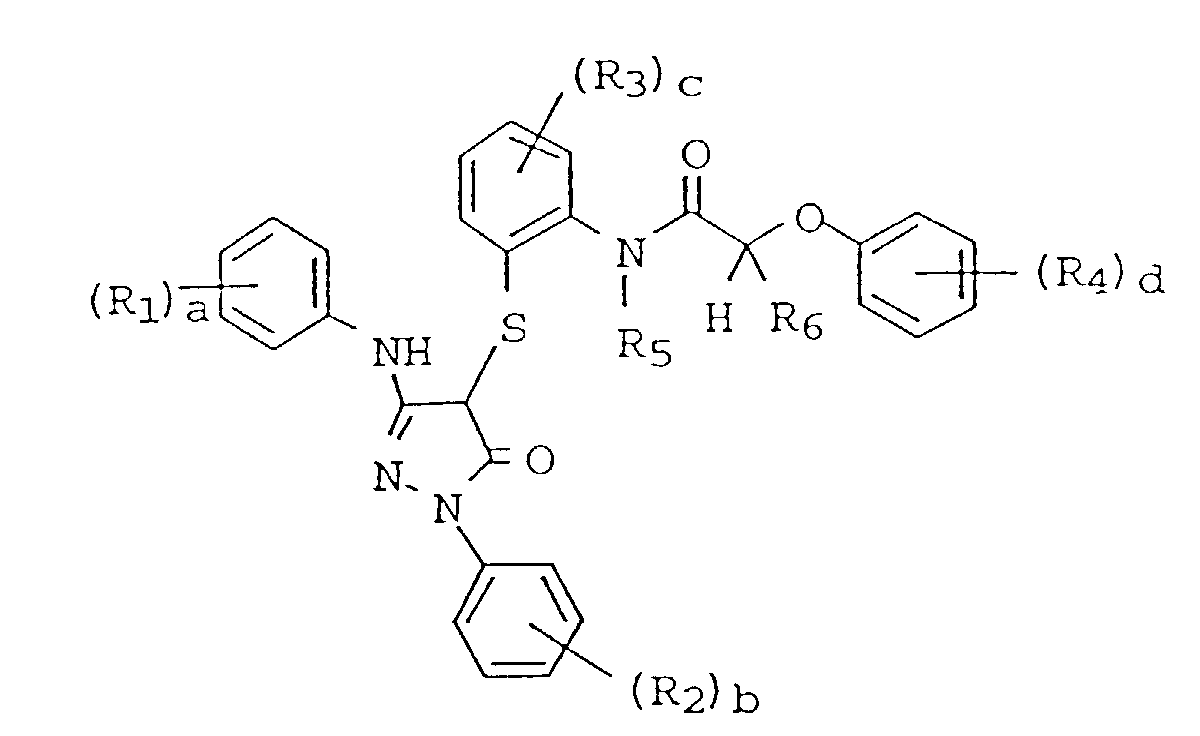 a et b sont séparément de 0 à 5, c est de 0 à 4, et d est de 1 à 5 ;chaque groupe R1, R2, R3 et R4 est choisi séparément dans le groupe constitué d'un halogène, des groupes nitro, cyano, carboxy, alkyle, aryle, alkoxy, aryloxy, acylamino, sulfonamido, sulfamoyle, sulfamido, carbamoyle, diacylamino, aryloxycarbonyle, alkoxycarbonyle, alkoxysulfonyle, aryloxysulfonyle, alkylsulfonyle, arylsulfonyle, alkylsulfoxyle, arylsulfoxyle, alkylthio, arylthio, alkoxycarbonylamino, aryloxycarbonylamino, alkyluréido, aryluréido, hétérocycliques et acyloxy ;R5 est choisi dans le groupe constitué de l'hydrogène, des groupes alkyle, aryle, acyle, et hétérocycliques ; etR6 est choisi dans le groupe constitué de l'hydrogène, des groupes alkyle, aryle et hétérocycliques ;à condition que le groupe R4 puisse aussi représenter un groupe 4-hydroxy lorsque c est égal à 0, d est égal à 2, le groupe R5 est un hydrogène, le groupe R6 est un groupe n-dodécyle et l'autre groupe R4 est un groupe 3-t-butyle ; età condition aussi que, hormis lorsque le groupe R2 est un substituant chlorure et b est égal à 4 ou 5, la somme des valeurs sigma pour (R1)a et (R2)b est inférieure à 1,3.
- Elément photographique selon la revendication 1, dans lequel R5 est un hydrogène.
- Elément photographique selon la revendication 1, dans lequel au moins l'un des groupes R2 est un halogène.
- Elément photographique selon la revendication 3, dans lequel au moins trois groupes R2 représentent un atome de chlore.
- Elément photographique selon la revendication 1, dans lequel la somme des atomes de carbone des substituants R1 est au moins égale à 8.
- Elément photographique selon la revendication 1, dans lequel au moins un groupe R1 est un halogène.
- Elément photographique selon la revendication 6, dans lequel ledit halogène est le chlore.
- Elément photographique selon la revendication 1, dans lequel au moins un groupe R1 est -NRCOR ; -SO2NR2 ; -NRSO2R ; -CONR2 ; -CO2R ou -SO2R ; où chaque R est choisi séparément parmi l'hydrogène, un groupe alkyle, aryle et hétérocyclique.
- Elément photographique selon la revendication 8, dans lequel au moins un groupe R1 est -NRCOR.
- Elément photographique selon la revendication 1, dans lequel l'atome de carbone auquel est rattaché le groupe R6 est le centre d'un groupe chiralique.
- Elément photographique selon la revendication 1, dans lequel au moins un groupe R4 est un groupe alkyle.
- Elément photographique selon la revendication 11, dans lequel ledit groupe alkyle R4 contient au moins 4 atomes de carbone.
- Elément photographique selon la revendication 12, dans lequel la somme des atomes de carbone contenus dans les groupes R3, R4, R5 et R6 est au moins égale à 8.
- Elément photographique selon la revendication 1, comprenant aussi une couche contenant des particules magnétiques.
- Elément photographique couleur adapté à la reproduction négative-positive des couleurs comprenant un support et au moins une couche d'émulsion aux halogénures d'argent à laquelle est associé un coupleur photographique de type 5-pyrazolone, caractérisé en ce que le coupleur est tel que défini dans la revendication 1.
- Procédé de développement d'un élément photographique caractérisé par la mise en contact d'un élément photographique tel que défini dans la revendication 1 avec un développateur chromogène.
Applications Claiming Priority (3)
| Application Number | Priority Date | Filing Date | Title |
|---|---|---|---|
| US689436 | 1991-04-23 | ||
| US07/689,436 US5298368A (en) | 1991-04-23 | 1991-04-23 | Photographic coupler compositions and methods for reducing continued coupling |
| PCT/US1992/003396 WO1992018903A1 (fr) | 1991-04-23 | 1992-04-23 | Elements photographiques contenant des copulants a la pyrazolone et procede associe |
Publications (2)
| Publication Number | Publication Date |
|---|---|
| EP0549745A1 EP0549745A1 (fr) | 1993-07-07 |
| EP0549745B1 true EP0549745B1 (fr) | 1998-11-18 |
Family
ID=24768460
Family Applications (4)
| Application Number | Title | Priority Date | Filing Date |
|---|---|---|---|
| EP92106789A Expired - Lifetime EP0510576B1 (fr) | 1991-04-23 | 1992-04-21 | Compositions à accouplement photographique et procédés de réduction de couplage continu |
| EP92912291A Expired - Lifetime EP0549745B1 (fr) | 1991-04-23 | 1992-04-23 | Elements photographiques contenant des copulants a la pyrazolone et procede associe |
| EP92911816A Expired - Lifetime EP0536383B1 (fr) | 1991-04-23 | 1992-04-23 | Materiau de support photographique contenant un copulant de magenta et procede associe |
| EP92913252A Expired - Lifetime EP0536387B1 (fr) | 1991-04-23 | 1992-04-23 | Copulants de magenta a la pyrazolone-3-anilino et procede associe |
Family Applications Before (1)
| Application Number | Title | Priority Date | Filing Date |
|---|---|---|---|
| EP92106789A Expired - Lifetime EP0510576B1 (fr) | 1991-04-23 | 1992-04-21 | Compositions à accouplement photographique et procédés de réduction de couplage continu |
Family Applications After (2)
| Application Number | Title | Priority Date | Filing Date |
|---|---|---|---|
| EP92911816A Expired - Lifetime EP0536383B1 (fr) | 1991-04-23 | 1992-04-23 | Materiau de support photographique contenant un copulant de magenta et procede associe |
| EP92913252A Expired - Lifetime EP0536387B1 (fr) | 1991-04-23 | 1992-04-23 | Copulants de magenta a la pyrazolone-3-anilino et procede associe |
Country Status (5)
| Country | Link |
|---|---|
| US (1) | US5298368A (fr) |
| EP (4) | EP0510576B1 (fr) |
| JP (4) | JPH05119447A (fr) |
| DE (3) | DE69221361T2 (fr) |
| WO (3) | WO1992018903A1 (fr) |
Families Citing this family (25)
| Publication number | Priority date | Publication date | Assignee | Title |
|---|---|---|---|---|
| US5447830A (en) * | 1991-04-23 | 1995-09-05 | Eastman Kodak Company | 3-anilino pyrazolone magenta couplers and process |
| US5192646A (en) * | 1991-12-09 | 1993-03-09 | Eastman Kodak Company | Photographic elements having sulfoxide coupler solvents and addenda to reduce sensitizing dye stain |
| JPH05323545A (ja) * | 1992-05-19 | 1993-12-07 | Fuji Photo Film Co Ltd | ハロゲン化銀カラー写真感光材料 |
| EP0583832A1 (fr) * | 1992-08-19 | 1994-02-23 | Eastman Kodak Company | Matériaux photographiques couleurs contenant des coupleurs polymériques 5-pyrazolone et des solvants |
| JP2807605B2 (ja) * | 1992-11-13 | 1998-10-08 | 富士写真フイルム株式会社 | ハロゲン化銀カラー写真感光材料 |
| US5468604A (en) * | 1992-11-18 | 1995-11-21 | Eastman Kodak Company | Photographic dispersion |
| US5411841A (en) * | 1993-05-24 | 1995-05-02 | Eastman Kodak Company | Photographic elements containing magenta couplers and process for using same |
| US5350667A (en) * | 1993-06-17 | 1994-09-27 | Eastman Kodak Company | Photographic elements containing magenta couplers and process for using same |
| US6365334B1 (en) | 1993-10-22 | 2002-04-02 | Eastman Kodak Company | Photographic elements containing aryloxypyrazolone couplers and sulfur containing stabilizers |
| DE69528518T2 (de) * | 1995-03-28 | 2003-06-12 | Tulalip Consultoria Comercial Sociedade Unipessoal S.A., Funchal | Photographische Silberhalogenidelemente die 2-Aquivalenten 5-Pyrazolon-Magentakuppler enthalten |
| GB9828867D0 (en) | 1998-12-31 | 1999-02-17 | Eastman Kodak Co | Photographic addenda |
| US20050224902A1 (en) * | 2002-02-06 | 2005-10-13 | Ramsey Craig C | Wireless substrate-like sensor |
| US20050233770A1 (en) * | 2002-02-06 | 2005-10-20 | Ramsey Craig C | Wireless substrate-like sensor |
| US20050224899A1 (en) * | 2002-02-06 | 2005-10-13 | Ramsey Craig C | Wireless substrate-like sensor |
| US7289230B2 (en) * | 2002-02-06 | 2007-10-30 | Cyberoptics Semiconductors, Inc. | Wireless substrate-like sensor |
| EP1702013B1 (fr) | 2003-10-23 | 2014-09-10 | FUJIFILM Corporation | Encre et palettes d'encres pour enregistrement a jet d'encre |
| US7804306B2 (en) * | 2006-02-21 | 2010-09-28 | CyterOptics Semiconductor, Inc. | Capacitive distance sensing in semiconductor processing tools |
| US7893697B2 (en) * | 2006-02-21 | 2011-02-22 | Cyberoptics Semiconductor, Inc. | Capacitive distance sensing in semiconductor processing tools |
| US7778793B2 (en) * | 2007-03-12 | 2010-08-17 | Cyberoptics Semiconductor, Inc. | Wireless sensor for semiconductor processing systems |
| TW200849444A (en) * | 2007-04-05 | 2008-12-16 | Cyberoptics Semiconductor Inc | Semiconductor processing system with integrated showerhead distance measuring device |
| US20090015268A1 (en) * | 2007-07-13 | 2009-01-15 | Gardner Delrae H | Device and method for compensating a capacitive sensor measurement for variations caused by environmental conditions in a semiconductor processing environment |
| JP5866150B2 (ja) | 2010-07-30 | 2016-02-17 | 富士フイルム株式会社 | 新規なアゾ化合物、水溶液、インク組成物、インクジェット記録用インク、インクジェット記録方法、インクジェット記録用インクカートリッジ、及びインクジェット記録物 |
| JP5785799B2 (ja) | 2010-07-30 | 2015-09-30 | 富士フイルム株式会社 | 新規なアゾ化合物、水溶液、インク組成物、インクジェット記録用インク、インクジェット記録方法、インクジェット記録用インクカートリッジ、及びインクジェット記録物 |
| JP2014198816A (ja) | 2012-09-26 | 2014-10-23 | 富士フイルム株式会社 | アゾ化合物、水溶液、インク組成物、インクジェット記録用インク、インクジェット記録方法、インクジェット記録用インクカートリッジ、及びインクジェット記録物 |
| US8987461B2 (en) | 2012-12-06 | 2015-03-24 | Quanticel Pharmaceuticals, Inc. | Histone demethylase inhibitors |
Family Cites Families (19)
| Publication number | Priority date | Publication date | Assignee | Title |
|---|---|---|---|---|
| US4047954A (en) * | 1975-04-01 | 1977-09-13 | Polaroid Corporation | Sulfinyl-sulfonyl alkane silver halide solvents |
| JPS5942301B2 (ja) * | 1975-05-13 | 1984-10-13 | 富士写真フイルム株式会社 | カラ−写真色画像耐光堅牢化方法 |
| FR2382325A1 (fr) * | 1977-03-02 | 1978-09-29 | Kodak Pathe | Produit comprenant une couche d'enregistrement magnetique transparente |
| US4419431A (en) * | 1981-11-30 | 1983-12-06 | Veb Filmfabrik Wolfen | One- or two-component diazo-type material with diphenyl diamine as light fade inhibitor |
| JPS6057839A (ja) * | 1983-09-10 | 1985-04-03 | Konishiroku Photo Ind Co Ltd | ハロゲン化銀写真感光材料 |
| JPS6139045A (ja) * | 1984-07-31 | 1986-02-25 | Fuji Photo Film Co Ltd | ハロゲン化銀カラ−写真感光材料 |
| JPH0784565B2 (ja) * | 1984-08-20 | 1995-09-13 | 株式会社リコー | ジスアゾ化合物 |
| AU4743985A (en) * | 1984-09-14 | 1986-04-10 | Konishiroku Photo Industry Co., Ltd. | Silver halide photographic material with magenta coupler |
| JPH068947B2 (ja) * | 1984-12-27 | 1994-02-02 | コニカ株式会社 | ハロゲン化銀写真感光材料 |
| JPS6289047A (ja) * | 1985-10-15 | 1987-04-23 | Fuji Photo Film Co Ltd | カラ−拡散転写法用処理組成物 |
| JPH0625861B2 (ja) * | 1985-12-17 | 1994-04-06 | 富士写真フイルム株式会社 | ハロゲン化銀カラ−写真感光材料 |
| US4853319A (en) * | 1986-12-22 | 1989-08-01 | Eastman Kodak Company | Photographic silver halide element and process |
| JPH07122745B2 (ja) * | 1987-06-25 | 1995-12-25 | 富士写真フイルム株式会社 | ハロゲン化銀カラ−写真感光材料 |
| DE3887428D1 (de) * | 1987-09-30 | 1994-03-10 | Ciba Geigy | Phenolische Thianderivate. |
| EP0310552B1 (fr) * | 1987-09-30 | 1992-05-13 | Ciba-Geigy Ag | Stabilisateurs pour des matériaux de reproduction photographique couleur |
| JPH01108546A (ja) * | 1987-10-22 | 1989-04-25 | Fuji Photo Film Co Ltd | ハロゲン化銀カラー写真感光材料 |
| JPH0339950A (ja) * | 1989-04-17 | 1991-02-20 | Konica Corp | ハロゲン化銀カラー写真感光材料 |
| GB8909578D0 (en) * | 1989-04-26 | 1989-06-14 | Kodak Ltd | Method of photographic processing |
| US5008179A (en) * | 1989-11-22 | 1991-04-16 | Eastman Kodak Company | Increased activity precipitated photographic materials |
-
1991
- 1991-04-23 US US07/689,436 patent/US5298368A/en not_active Expired - Fee Related
-
1992
- 1992-04-21 EP EP92106789A patent/EP0510576B1/fr not_active Expired - Lifetime
- 1992-04-21 DE DE69221361T patent/DE69221361T2/de not_active Expired - Fee Related
- 1992-04-22 JP JP4102794A patent/JPH05119447A/ja active Pending
- 1992-04-23 WO PCT/US1992/003396 patent/WO1992018903A1/fr not_active Ceased
- 1992-04-23 JP JP92510910A patent/JPH05508247A/ja active Pending
- 1992-04-23 DE DE69227616T patent/DE69227616T2/de not_active Expired - Fee Related
- 1992-04-23 EP EP92912291A patent/EP0549745B1/fr not_active Expired - Lifetime
- 1992-04-23 WO PCT/US1992/003362 patent/WO1992018901A1/fr not_active Ceased
- 1992-04-23 JP JP4511147A patent/JP3017288B2/ja not_active Expired - Fee Related
- 1992-04-23 EP EP92911816A patent/EP0536383B1/fr not_active Expired - Lifetime
- 1992-04-23 JP JP92511771A patent/JPH05508251A/ja active Pending
- 1992-04-23 DE DE69223582T patent/DE69223582T2/de not_active Expired - Fee Related
- 1992-04-23 WO PCT/US1992/003394 patent/WO1992018902A1/fr not_active Ceased
- 1992-04-23 EP EP92913252A patent/EP0536387B1/fr not_active Expired - Lifetime
Also Published As
| Publication number | Publication date |
|---|---|
| JP3017288B2 (ja) | 2000-03-06 |
| JPH05508251A (ja) | 1993-11-18 |
| US5298368A (en) | 1994-03-29 |
| EP0549745A1 (fr) | 1993-07-07 |
| EP0510576B1 (fr) | 1997-08-06 |
| JPH05508247A (ja) | 1993-11-18 |
| EP0510576A1 (fr) | 1992-10-28 |
| JPH05119447A (ja) | 1993-05-18 |
| DE69223582T2 (de) | 1998-06-25 |
| DE69227616D1 (de) | 1998-12-24 |
| DE69221361D1 (de) | 1997-09-11 |
| WO1992018901A1 (fr) | 1992-10-29 |
| EP0536387B1 (fr) | 1997-11-12 |
| DE69221361T2 (de) | 1998-03-12 |
| EP0536383B1 (fr) | 1997-12-17 |
| DE69223582D1 (de) | 1998-01-29 |
| JPH05508248A (ja) | 1993-11-18 |
| EP0536383A1 (fr) | 1993-04-14 |
| WO1992018902A1 (fr) | 1992-10-29 |
| EP0536387A1 (fr) | 1993-04-14 |
| DE69227616T2 (de) | 1999-06-17 |
| WO1992018903A1 (fr) | 1992-10-29 |
Similar Documents
| Publication | Publication Date | Title |
|---|---|---|
| EP0536387B1 (fr) | Copulants de magenta a la pyrazolone-3-anilino et procede associe | |
| US5677118A (en) | Photographic element containing a recrystallizable 5-pyrazolone photographic coupler | |
| US5262292A (en) | Photographic elements containing pyrazolone couplers and process | |
| US5674667A (en) | Photographic element containing pyrroloylacetamide yellow coupler | |
| US5605787A (en) | 3-anilino pyrazolone magenta couplers and process | |
| EP0548347B1 (fr) | Elements photographiques contenant des copulants de pyrazolone 2-equivalents et procede d'utilisation | |
| US6143485A (en) | Pyrazolotriazle dye-forming photographic coupler | |
| US5677114A (en) | Photographic element containing yellow dye-forming coupler comprising a dye light stability enhancing ballast and process | |
| EP1113331A1 (fr) | Elément photographique, composé, et procédé | |
| US5834167A (en) | Photographic element containing yellow dye-forming coupler comprising a dye light stability enhancing ballast and process | |
| EP1113333A1 (fr) | Elément photographique, composé, et procédé | |
| US5942381A (en) | Photographic element and process employing active, stable benzotriazole-releasing DIR couplers | |
| US5476757A (en) | Photographic element containing a novel cyan dye forming coupler and process for its use | |
| US5523199A (en) | Photographic element and process employing magenta azine dye-forming couplers | |
| US6030760A (en) | Photographic element containing specific magenta coupler and anti-fading agent | |
| EP0981070B1 (fr) | Elément photographique contenant un copulant magenta pyrazoloazole et un agent anti-altération de couleurs spécifiques | |
| US6040126A (en) | Photographic yellow dye-forming couplers | |
| EP0813111B1 (fr) | Film photographique pour négatif couleur comprenant un coupleur cyan portant un ballast contenant un groupe sulfonyl | |
| US5457020A (en) | Photographic material and process comprising a bicyclic pyrazolo coupler | |
| US6852480B1 (en) | Photographic material comprising a bicyclic pyrazolotriazole coupler with improved photographic properties | |
| EP0884639A1 (fr) | Elément photographique et procédé utilisant des copulants DIR libérant benzotriazole actif et stable | |
| EP1197798A2 (fr) | Elément photographique contenant un coupleur formateur de colorant cyan | |
| WO1993002392A1 (fr) | Copulants a teinte amelioree formant des colorants magenta pour images | |
| GB2320334A (en) | Photographic materials and process comprising an acylacetanilide yellow dye forming coupler | |
| EP1217434A2 (fr) | Elément photographique à l'halogénure d'argent |
Legal Events
| Date | Code | Title | Description |
|---|---|---|---|
| PUAI | Public reference made under article 153(3) epc to a published international application that has entered the european phase |
Free format text: ORIGINAL CODE: 0009012 |
|
| 17P | Request for examination filed |
Effective date: 19921221 |
|
| AK | Designated contracting states |
Kind code of ref document: A1 Designated state(s): BE CH DE FR GB LI LU NL |
|
| 17Q | First examination report despatched |
Effective date: 19960223 |
|
| GRAG | Despatch of communication of intention to grant |
Free format text: ORIGINAL CODE: EPIDOS AGRA |
|
| GRAG | Despatch of communication of intention to grant |
Free format text: ORIGINAL CODE: EPIDOS AGRA |
|
| GRAH | Despatch of communication of intention to grant a patent |
Free format text: ORIGINAL CODE: EPIDOS IGRA |
|
| RBV | Designated contracting states (corrected) |
Designated state(s): DE FR GB |
|
| GRAH | Despatch of communication of intention to grant a patent |
Free format text: ORIGINAL CODE: EPIDOS IGRA |
|
| GRAA | (expected) grant |
Free format text: ORIGINAL CODE: 0009210 |
|
| AK | Designated contracting states |
Kind code of ref document: B1 Designated state(s): DE FR GB |
|
| REF | Corresponds to: |
Ref document number: 69227616 Country of ref document: DE Date of ref document: 19981224 |
|
| ET | Fr: translation filed | ||
| PLBE | No opposition filed within time limit |
Free format text: ORIGINAL CODE: 0009261 |
|
| STAA | Information on the status of an ep patent application or granted ep patent |
Free format text: STATUS: NO OPPOSITION FILED WITHIN TIME LIMIT |
|
| 26N | No opposition filed | ||
| REG | Reference to a national code |
Ref country code: GB Ref legal event code: IF02 |
|
| PGFP | Annual fee paid to national office [announced via postgrant information from national office to epo] |
Ref country code: GB Payment date: 20040312 Year of fee payment: 13 |
|
| PGFP | Annual fee paid to national office [announced via postgrant information from national office to epo] |
Ref country code: FR Payment date: 20040402 Year of fee payment: 13 |
|
| PGFP | Annual fee paid to national office [announced via postgrant information from national office to epo] |
Ref country code: DE Payment date: 20040430 Year of fee payment: 13 |
|
| PG25 | Lapsed in a contracting state [announced via postgrant information from national office to epo] |
Ref country code: GB Free format text: LAPSE BECAUSE OF NON-PAYMENT OF DUE FEES Effective date: 20050423 |
|
| PG25 | Lapsed in a contracting state [announced via postgrant information from national office to epo] |
Ref country code: DE Free format text: LAPSE BECAUSE OF NON-PAYMENT OF DUE FEES Effective date: 20051101 |
|
| GBPC | Gb: european patent ceased through non-payment of renewal fee |
Effective date: 20050423 |
|
| PG25 | Lapsed in a contracting state [announced via postgrant information from national office to epo] |
Ref country code: FR Free format text: LAPSE BECAUSE OF NON-PAYMENT OF DUE FEES Effective date: 20051230 |
|
| REG | Reference to a national code |
Ref country code: FR Ref legal event code: ST Effective date: 20051230 |