EP0549967B1 - Polymere und Oligomere von Gallensäurederivaten, Verfahren zu ihrer Herstellung und ihre Verwendung als Arzneimittel - Google Patents
Polymere und Oligomere von Gallensäurederivaten, Verfahren zu ihrer Herstellung und ihre Verwendung als Arzneimittel Download PDFInfo
- Publication number
- EP0549967B1 EP0549967B1 EP92121459A EP92121459A EP0549967B1 EP 0549967 B1 EP0549967 B1 EP 0549967B1 EP 92121459 A EP92121459 A EP 92121459A EP 92121459 A EP92121459 A EP 92121459A EP 0549967 B1 EP0549967 B1 EP 0549967B1
- Authority
- EP
- European Patent Office
- Prior art keywords
- alkyl
- esters
- acid
- hydrogen
- group
- Prior art date
- Legal status (The legal status is an assumption and is not a legal conclusion. Google has not performed a legal analysis and makes no representation as to the accuracy of the status listed.)
- Expired - Lifetime
Links
- 239000003613 bile acid Substances 0.000 title claims abstract description 61
- 239000003814 drug Substances 0.000 title claims abstract description 10
- 238000000034 method Methods 0.000 title claims description 17
- 229920000642 polymer Polymers 0.000 title claims description 16
- 230000008569 process Effects 0.000 title claims description 16
- 229940079593 drug Drugs 0.000 title description 4
- 125000004432 carbon atom Chemical group C* 0.000 claims abstract description 20
- 239000000178 monomer Substances 0.000 claims abstract description 18
- WHNWPMSKXPGLAX-UHFFFAOYSA-N N-Vinyl-2-pyrrolidone Chemical compound C=CN1CCCC1=O WHNWPMSKXPGLAX-UHFFFAOYSA-N 0.000 claims abstract description 13
- 150000002148 esters Chemical class 0.000 claims abstract description 11
- 150000001991 dicarboxylic acids Chemical class 0.000 claims abstract description 6
- 125000005907 alkyl ester group Chemical group 0.000 claims abstract description 3
- 125000001797 benzyl group Chemical group [H]C1=C([H])C([H])=C(C([H])=C1[H])C([H])([H])* 0.000 claims abstract description 3
- 125000000753 cycloalkyl group Chemical group 0.000 claims abstract description 3
- 125000001997 phenyl group Chemical group [H]C1=C([H])C([H])=C(*)C([H])=C1[H] 0.000 claims abstract description 3
- 150000008064 anhydrides Chemical class 0.000 claims abstract 3
- UFHFLCQGNIYNRP-UHFFFAOYSA-N Hydrogen Chemical compound [H][H] UFHFLCQGNIYNRP-UHFFFAOYSA-N 0.000 claims description 30
- HSINOMROUCMIEA-FGVHQWLLSA-N (2s,4r)-4-[(3r,5s,6r,7r,8s,9s,10s,13r,14s,17r)-6-ethyl-3,7-dihydroxy-10,13-dimethyl-2,3,4,5,6,7,8,9,11,12,14,15,16,17-tetradecahydro-1h-cyclopenta[a]phenanthren-17-yl]-2-methylpentanoic acid Chemical compound C([C@@]12C)C[C@@H](O)C[C@H]1[C@@H](CC)[C@@H](O)[C@@H]1[C@@H]2CC[C@]2(C)[C@@H]([C@H](C)C[C@H](C)C(O)=O)CC[C@H]21 HSINOMROUCMIEA-FGVHQWLLSA-N 0.000 claims description 28
- -1 bile acid radical Chemical class 0.000 claims description 26
- 150000001875 compounds Chemical class 0.000 claims description 24
- 229910052739 hydrogen Inorganic materials 0.000 claims description 22
- 239000001257 hydrogen Substances 0.000 claims description 22
- HVYWMOMLDIMFJA-DPAQBDIFSA-N cholesterol Chemical compound C1C=C2C[C@@H](O)CC[C@]2(C)[C@@H]2[C@@H]1[C@@H]1CC[C@H]([C@H](C)CCCC(C)C)[C@@]1(C)CC2 HVYWMOMLDIMFJA-DPAQBDIFSA-N 0.000 claims description 16
- 239000000126 substance Substances 0.000 claims description 15
- 125000002496 methyl group Chemical group [H]C([H])([H])* 0.000 claims description 13
- 238000007334 copolymerization reaction Methods 0.000 claims description 12
- 125000001570 methylene group Chemical group [H]C([H])([*:1])[*:2] 0.000 claims description 12
- 125000002947 alkylene group Chemical group 0.000 claims description 11
- 150000003254 radicals Chemical class 0.000 claims description 10
- 239000002904 solvent Substances 0.000 claims description 10
- 230000010235 enterohepatic circulation Effects 0.000 claims description 9
- 125000004169 (C1-C6) alkyl group Chemical group 0.000 claims description 8
- 238000010521 absorption reaction Methods 0.000 claims description 7
- 125000000008 (C1-C10) alkyl group Chemical group 0.000 claims description 6
- CERQOIWHTDAKMF-UHFFFAOYSA-N Methacrylic acid Chemical compound CC(=C)C(O)=O CERQOIWHTDAKMF-UHFFFAOYSA-N 0.000 claims description 6
- 229910052794 bromium Inorganic materials 0.000 claims description 6
- 229910052801 chlorine Inorganic materials 0.000 claims description 6
- 239000000460 chlorine Substances 0.000 claims description 6
- 125000002887 hydroxy group Chemical group [H]O* 0.000 claims description 6
- 238000002360 preparation method Methods 0.000 claims description 6
- 125000000217 alkyl group Chemical group 0.000 claims description 5
- 229920001577 copolymer Polymers 0.000 claims description 5
- 238000006116 polymerization reaction Methods 0.000 claims description 5
- 150000002431 hydrogen Chemical class 0.000 claims description 4
- 125000006702 (C1-C18) alkyl group Chemical group 0.000 claims description 3
- 125000006273 (C1-C3) alkyl group Chemical group 0.000 claims description 3
- 229910006069 SO3H Inorganic materials 0.000 claims description 3
- 239000002253 acid Substances 0.000 claims description 3
- 229910052784 alkaline earth metal Inorganic materials 0.000 claims description 3
- 150000001408 amides Chemical class 0.000 claims description 3
- 230000001419 dependent effect Effects 0.000 claims description 3
- 229910052736 halogen Inorganic materials 0.000 claims description 3
- 150000002367 halogens Chemical class 0.000 claims description 3
- PNDPGZBMCMUPRI-UHFFFAOYSA-N iodine Chemical compound II PNDPGZBMCMUPRI-UHFFFAOYSA-N 0.000 claims description 3
- 230000000379 polymerizing effect Effects 0.000 claims description 3
- 125000006239 protecting group Chemical group 0.000 claims description 3
- HRPVXLWXLXDGHG-UHFFFAOYSA-N Acrylamide Chemical compound NC(=O)C=C HRPVXLWXLXDGHG-UHFFFAOYSA-N 0.000 claims description 2
- NIXOWILDQLNWCW-UHFFFAOYSA-N Acrylic acid Chemical class OC(=O)C=C NIXOWILDQLNWCW-UHFFFAOYSA-N 0.000 claims description 2
- WKBOTKDWSSQWDR-UHFFFAOYSA-N Bromine atom Chemical compound [Br] WKBOTKDWSSQWDR-UHFFFAOYSA-N 0.000 claims description 2
- ZAMOUSCENKQFHK-UHFFFAOYSA-N Chlorine atom Chemical compound [Cl] ZAMOUSCENKQFHK-UHFFFAOYSA-N 0.000 claims description 2
- 239000002585 base Substances 0.000 claims description 2
- 239000008280 blood Substances 0.000 claims description 2
- 210000004369 blood Anatomy 0.000 claims description 2
- GDTBXPJZTBHREO-UHFFFAOYSA-N bromine Substances BrBr GDTBXPJZTBHREO-UHFFFAOYSA-N 0.000 claims description 2
- 125000002915 carbonyl group Chemical group [*:2]C([*:1])=O 0.000 claims description 2
- 125000004185 ester group Chemical group 0.000 claims description 2
- 230000005764 inhibitory process Effects 0.000 claims description 2
- 239000003999 initiator Substances 0.000 claims description 2
- 239000000725 suspension Substances 0.000 claims description 2
- 229920001567 vinyl ester resin Polymers 0.000 claims description 2
- 229910052783 alkali metal Inorganic materials 0.000 claims 3
- 238000004132 cross linking Methods 0.000 claims 3
- 150000002632 lipids Chemical class 0.000 claims 2
- 210000001035 gastrointestinal tract Anatomy 0.000 claims 1
- 229910052740 iodine Inorganic materials 0.000 claims 1
- 230000037356 lipid metabolism Effects 0.000 claims 1
- 230000002265 prevention Effects 0.000 claims 1
- 230000009885 systemic effect Effects 0.000 claims 1
- 239000003599 detergent Substances 0.000 abstract description 2
- 150000005690 diesters Chemical class 0.000 abstract 1
- 239000002778 food additive Substances 0.000 abstract 1
- 235000013373 food additive Nutrition 0.000 abstract 1
- WYURNTSHIVDZCO-UHFFFAOYSA-N Tetrahydrofuran Chemical compound C1CCOC1 WYURNTSHIVDZCO-UHFFFAOYSA-N 0.000 description 84
- YXFVVABEGXRONW-UHFFFAOYSA-N Toluene Chemical compound CC1=CC=CC=C1 YXFVVABEGXRONW-UHFFFAOYSA-N 0.000 description 49
- 239000011541 reaction mixture Substances 0.000 description 37
- HEMHJVSKTPXQMS-UHFFFAOYSA-M Sodium hydroxide Chemical compound [OH-].[Na+] HEMHJVSKTPXQMS-UHFFFAOYSA-M 0.000 description 30
- XLYOFNOQVPJJNP-UHFFFAOYSA-N water Substances O XLYOFNOQVPJJNP-UHFFFAOYSA-N 0.000 description 29
- 239000000243 solution Substances 0.000 description 26
- OKKJLVBELUTLKV-UHFFFAOYSA-N Methanol Chemical compound OC OKKJLVBELUTLKV-UHFFFAOYSA-N 0.000 description 24
- 239000000203 mixture Substances 0.000 description 15
- OMPJBNCRMGITSC-UHFFFAOYSA-N Benzoylperoxide Chemical compound C=1C=CC=CC=1C(=O)OOC(=O)C1=CC=CC=C1 OMPJBNCRMGITSC-UHFFFAOYSA-N 0.000 description 14
- 235000019400 benzoyl peroxide Nutrition 0.000 description 13
- 238000003756 stirring Methods 0.000 description 11
- YLQBMQCUIZJEEH-UHFFFAOYSA-N tetrahydrofuran Natural products C=1C=COC=1 YLQBMQCUIZJEEH-UHFFFAOYSA-N 0.000 description 11
- 210000000941 bile Anatomy 0.000 description 9
- 230000000694 effects Effects 0.000 description 9
- 239000000047 product Substances 0.000 description 8
- 239000000700 radioactive tracer Substances 0.000 description 8
- 210000000813 small intestine Anatomy 0.000 description 8
- 238000004128 high performance liquid chromatography Methods 0.000 description 7
- 210000000936 intestine Anatomy 0.000 description 7
- 239000011347 resin Substances 0.000 description 7
- 229920005989 resin Polymers 0.000 description 7
- 125000004178 (C1-C4) alkyl group Chemical group 0.000 description 6
- WEVYAHXRMPXWCK-UHFFFAOYSA-N Acetonitrile Chemical compound CC#N WEVYAHXRMPXWCK-UHFFFAOYSA-N 0.000 description 6
- UHOVQNZJYSORNB-UHFFFAOYSA-N Benzene Chemical compound C1=CC=CC=C1 UHOVQNZJYSORNB-UHFFFAOYSA-N 0.000 description 6
- YMWUJEATGCHHMB-UHFFFAOYSA-N Dichloromethane Chemical compound ClCCl YMWUJEATGCHHMB-UHFFFAOYSA-N 0.000 description 6
- ZMXDDKWLCZADIW-UHFFFAOYSA-N N,N-Dimethylformamide Chemical compound CN(C)C=O ZMXDDKWLCZADIW-UHFFFAOYSA-N 0.000 description 6
- 239000003513 alkali Substances 0.000 description 6
- 239000000523 sample Substances 0.000 description 6
- 241001465754 Metazoa Species 0.000 description 5
- 230000009102 absorption Effects 0.000 description 5
- 230000000968 intestinal effect Effects 0.000 description 5
- WBWWGRHZICKQGZ-HZAMXZRMSA-N taurocholic acid Chemical compound C([C@H]1C[C@H]2O)[C@H](O)CC[C@]1(C)[C@@H]1[C@@H]2[C@@H]2CC[C@H]([C@@H](CCC(=O)NCCS(O)(=O)=O)C)[C@@]2(C)[C@@H](O)C1 WBWWGRHZICKQGZ-HZAMXZRMSA-N 0.000 description 5
- 125000000229 (C1-C4)alkoxy group Chemical group 0.000 description 4
- HEDRZPFGACZZDS-UHFFFAOYSA-N Chloroform Chemical compound ClC(Cl)Cl HEDRZPFGACZZDS-UHFFFAOYSA-N 0.000 description 4
- IAZDPXIOMUYVGZ-UHFFFAOYSA-N Dimethylsulphoxide Chemical compound CS(C)=O IAZDPXIOMUYVGZ-UHFFFAOYSA-N 0.000 description 4
- WBWWGRHZICKQGZ-UHFFFAOYSA-N Taurocholic acid Natural products OC1CC2CC(O)CCC2(C)C2C1C1CCC(C(CCC(=O)NCCS(O)(=O)=O)C)C1(C)C(O)C2 WBWWGRHZICKQGZ-UHFFFAOYSA-N 0.000 description 4
- 150000001412 amines Chemical class 0.000 description 4
- 238000006243 chemical reaction Methods 0.000 description 4
- 229910052731 fluorine Inorganic materials 0.000 description 4
- LEQAOMBKQFMDFZ-UHFFFAOYSA-N glyoxal Chemical compound O=CC=O LEQAOMBKQFMDFZ-UHFFFAOYSA-N 0.000 description 4
- 238000001727 in vivo Methods 0.000 description 4
- 210000004185 liver Anatomy 0.000 description 4
- 0 CC(CCC(*)=O)C(CC[C@@]1[C@]([C@](C2)[C@@](C)(CCC(**)C3)[C@]3C3)[C@@]3O)[C@@]1(C)[C@]2O Chemical compound CC(CCC(*)=O)C(CC[C@@]1[C@]([C@](C2)[C@@](C)(CCC(**)C3)[C@]3C3)[C@@]3O)[C@@]1(C)[C@]2O 0.000 description 3
- 229920001268 Cholestyramine Polymers 0.000 description 3
- RTZKZFJDLAIYFH-UHFFFAOYSA-N Diethyl ether Chemical compound CCOCC RTZKZFJDLAIYFH-UHFFFAOYSA-N 0.000 description 3
- LFQSCWFLJHTTHZ-UHFFFAOYSA-N Ethanol Chemical compound CCO LFQSCWFLJHTTHZ-UHFFFAOYSA-N 0.000 description 3
- XEKOWRVHYACXOJ-UHFFFAOYSA-N Ethyl acetate Chemical compound CCOC(C)=O XEKOWRVHYACXOJ-UHFFFAOYSA-N 0.000 description 3
- 239000000872 buffer Substances 0.000 description 3
- 235000012000 cholesterol Nutrition 0.000 description 3
- 238000001514 detection method Methods 0.000 description 3
- 238000000502 dialysis Methods 0.000 description 3
- 210000003405 ileum Anatomy 0.000 description 3
- 230000009103 reabsorption Effects 0.000 description 3
- 230000035484 reaction time Effects 0.000 description 3
- 238000012360 testing method Methods 0.000 description 3
- RYHBNJHYFVUHQT-UHFFFAOYSA-N 1,4-Dioxane Chemical compound C1COCCO1 RYHBNJHYFVUHQT-UHFFFAOYSA-N 0.000 description 2
- OZAIFHULBGXAKX-UHFFFAOYSA-N 2-(2-cyanopropan-2-yldiazenyl)-2-methylpropanenitrile Chemical compound N#CC(C)(C)N=NC(C)(C)C#N OZAIFHULBGXAKX-UHFFFAOYSA-N 0.000 description 2
- 101710172561 3alpha-hydroxysteroid dehydrogenase Proteins 0.000 description 2
- 102100024089 Aldo-keto reductase family 1 member C2 Human genes 0.000 description 2
- 206010002091 Anaesthesia Diseases 0.000 description 2
- 208000000412 Avitaminosis Diseases 0.000 description 2
- 229920002911 Colestipol Polymers 0.000 description 2
- 206010010774 Constipation Diseases 0.000 description 2
- 239000004971 Cross linker Substances 0.000 description 2
- 102000004190 Enzymes Human genes 0.000 description 2
- 108090000790 Enzymes Proteins 0.000 description 2
- IMROMDMJAWUWLK-UHFFFAOYSA-N Ethenol Chemical group OC=C IMROMDMJAWUWLK-UHFFFAOYSA-N 0.000 description 2
- DHMQDGOQFOQNFH-UHFFFAOYSA-N Glycine Chemical compound NCC(O)=O DHMQDGOQFOQNFH-UHFFFAOYSA-N 0.000 description 2
- VEXZGXHMUGYJMC-UHFFFAOYSA-N Hydrochloric acid Chemical compound Cl VEXZGXHMUGYJMC-UHFFFAOYSA-N 0.000 description 2
- MHAJPDPJQMAIIY-UHFFFAOYSA-N Hydrogen peroxide Chemical compound OO MHAJPDPJQMAIIY-UHFFFAOYSA-N 0.000 description 2
- KFZMGEQAYNKOFK-UHFFFAOYSA-N Isopropanol Chemical compound CC(C)O KFZMGEQAYNKOFK-UHFFFAOYSA-N 0.000 description 2
- 102000007330 LDL Lipoproteins Human genes 0.000 description 2
- 108010007622 LDL Lipoproteins Proteins 0.000 description 2
- NBIIXXVUZAFLBC-UHFFFAOYSA-N Phosphoric acid Chemical compound OP(O)(O)=O NBIIXXVUZAFLBC-UHFFFAOYSA-N 0.000 description 2
- FAPWRFPIFSIZLT-UHFFFAOYSA-M Sodium chloride Chemical compound [Na+].[Cl-] FAPWRFPIFSIZLT-UHFFFAOYSA-M 0.000 description 2
- QAOWNCQODCNURD-UHFFFAOYSA-N Sulfuric acid Chemical compound OS(O)(=O)=O QAOWNCQODCNURD-UHFFFAOYSA-N 0.000 description 2
- XTXRWKRVRITETP-UHFFFAOYSA-N Vinyl acetate Chemical compound CC(=O)OC=C XTXRWKRVRITETP-UHFFFAOYSA-N 0.000 description 2
- KNDHRUPPBXRELB-UHFFFAOYSA-M [4-[3-(4-ethylphenyl)butyl]phenyl]-trimethylazanium;chloride Chemical compound [Cl-].C1=CC(CC)=CC=C1C(C)CCC1=CC=C([N+](C)(C)C)C=C1 KNDHRUPPBXRELB-UHFFFAOYSA-M 0.000 description 2
- 150000007513 acids Chemical class 0.000 description 2
- 150000001298 alcohols Chemical class 0.000 description 2
- 230000037005 anaesthesia Effects 0.000 description 2
- 210000000013 bile duct Anatomy 0.000 description 2
- 230000015572 biosynthetic process Effects 0.000 description 2
- 201000001883 cholelithiasis Diseases 0.000 description 2
- 230000003312 cholesterol blood level Effects 0.000 description 2
- BHQCQFFYRZLCQQ-OELDTZBJSA-N cholic acid Chemical compound C([C@H]1C[C@H]2O)[C@H](O)CC[C@]1(C)[C@@H]1[C@@H]2[C@@H]2CC[C@H]([C@@H](CCC(O)=O)C)[C@@]2(C)[C@@H](O)C1 BHQCQFFYRZLCQQ-OELDTZBJSA-N 0.000 description 2
- 238000004587 chromatography analysis Methods 0.000 description 2
- GMRWGQCZJGVHKL-UHFFFAOYSA-N colestipol Chemical compound ClCC1CO1.NCCNCCNCCNCCN GMRWGQCZJGVHKL-UHFFFAOYSA-N 0.000 description 2
- 229960002604 colestipol Drugs 0.000 description 2
- 229960001678 colestyramine Drugs 0.000 description 2
- 239000003431 cross linking reagent Substances 0.000 description 2
- 230000003247 decreasing effect Effects 0.000 description 2
- WNAHIZMDSQCWRP-UHFFFAOYSA-N dodecane-1-thiol Chemical compound CCCCCCCCCCCCS WNAHIZMDSQCWRP-UHFFFAOYSA-N 0.000 description 2
- 150000002170 ethers Chemical class 0.000 description 2
- 238000011156 evaluation Methods 0.000 description 2
- 230000029142 excretion Effects 0.000 description 2
- 229940015043 glyoxal Drugs 0.000 description 2
- 239000003112 inhibitor Substances 0.000 description 2
- 238000011835 investigation Methods 0.000 description 2
- 230000004060 metabolic process Effects 0.000 description 2
- 239000013580 millipore water Substances 0.000 description 2
- 238000002156 mixing Methods 0.000 description 2
- ZIUHHBKFKCYYJD-UHFFFAOYSA-N n,n'-methylenebisacrylamide Chemical compound C=CC(=O)NCNC(=O)C=C ZIUHHBKFKCYYJD-UHFFFAOYSA-N 0.000 description 2
- 239000003960 organic solvent Substances 0.000 description 2
- 230000002572 peristaltic effect Effects 0.000 description 2
- 238000010526 radical polymerization reaction Methods 0.000 description 2
- 238000007127 saponification reaction Methods 0.000 description 2
- 238000001228 spectrum Methods 0.000 description 2
- 238000003786 synthesis reaction Methods 0.000 description 2
- XOAAWQZATWQOTB-UHFFFAOYSA-N taurine Chemical compound NCCS(O)(=O)=O XOAAWQZATWQOTB-UHFFFAOYSA-N 0.000 description 2
- JOXIMZWYDAKGHI-UHFFFAOYSA-N toluene-4-sulfonic acid Chemical compound CC1=CC=C(S(O)(=O)=O)C=C1 JOXIMZWYDAKGHI-UHFFFAOYSA-N 0.000 description 2
- 230000032258 transport Effects 0.000 description 2
- 239000003643 water by type Substances 0.000 description 2
- ZICNIEOYWVIEQJ-UHFFFAOYSA-N (2-methylbenzoyl) 2-methylbenzenecarboperoxoate Chemical compound CC1=CC=CC=C1C(=O)OOC(=O)C1=CC=CC=C1C ZICNIEOYWVIEQJ-UHFFFAOYSA-N 0.000 description 1
- HGXJDMCMYLEZMJ-UHFFFAOYSA-N (2-methylpropan-2-yl)oxy 2,2-dimethylpropaneperoxoate Chemical compound CC(C)(C)OOOC(=O)C(C)(C)C HGXJDMCMYLEZMJ-UHFFFAOYSA-N 0.000 description 1
- QEQBMZQFDDDTPN-UHFFFAOYSA-N (2-methylpropan-2-yl)oxy benzenecarboperoxoate Chemical compound CC(C)(C)OOOC(=O)C1=CC=CC=C1 QEQBMZQFDDDTPN-UHFFFAOYSA-N 0.000 description 1
- BHQCQFFYRZLCQQ-UHFFFAOYSA-N (3alpha,5alpha,7alpha,12alpha)-3,7,12-trihydroxy-cholan-24-oic acid Natural products OC1CC2CC(O)CCC2(C)C2C1C1CCC(C(CCC(O)=O)C)C1(C)C(O)C2 BHQCQFFYRZLCQQ-UHFFFAOYSA-N 0.000 description 1
- RUDATBOHQWOJDD-UHFFFAOYSA-N (3beta,5beta,7alpha)-3,7-Dihydroxycholan-24-oic acid Natural products OC1CC2CC(O)CCC2(C)C2C1C1CCC(C(CCC(O)=O)C)C1(C)CC2 RUDATBOHQWOJDD-UHFFFAOYSA-N 0.000 description 1
- BEQKKZICTDFVMG-UHFFFAOYSA-N 1,2,3,4,6-pentaoxepane-5,7-dione Chemical compound O=C1OOOOC(=O)O1 BEQKKZICTDFVMG-UHFFFAOYSA-N 0.000 description 1
- LGJCFVYMIJLQJO-UHFFFAOYSA-N 1-dodecylperoxydodecane Chemical compound CCCCCCCCCCCCOOCCCCCCCCCCCC LGJCFVYMIJLQJO-UHFFFAOYSA-N 0.000 description 1
- DMWVYCCGCQPJEA-UHFFFAOYSA-N 2,5-bis(tert-butylperoxy)-2,5-dimethylhexane Chemical compound CC(C)(C)OOC(C)(C)CCC(C)(C)OOC(C)(C)C DMWVYCCGCQPJEA-UHFFFAOYSA-N 0.000 description 1
- XMNIXWIUMCBBBL-UHFFFAOYSA-N 2-(2-phenylpropan-2-ylperoxy)propan-2-ylbenzene Chemical compound C=1C=CC=CC=1C(C)(C)OOC(C)(C)C1=CC=CC=C1 XMNIXWIUMCBBBL-UHFFFAOYSA-N 0.000 description 1
- QAAROLXJPVEOGP-UHFFFAOYSA-N 2-butylperoxy-2-ethylbutanoic acid Chemical compound CCCCOOC(CC)(CC)C(O)=O QAAROLXJPVEOGP-UHFFFAOYSA-N 0.000 description 1
- KRDXTHSSNCTAGY-UHFFFAOYSA-N 2-cyclohexylpyrrolidine Chemical compound C1CCNC1C1CCCCC1 KRDXTHSSNCTAGY-UHFFFAOYSA-N 0.000 description 1
- WMDUFKYEWRGPSB-UHFFFAOYSA-N 2-ethyl-2-[(2-methylpropan-2-yl)oxy]hexanoic acid Chemical compound CCCCC(CC)(C(O)=O)OC(C)(C)C WMDUFKYEWRGPSB-UHFFFAOYSA-N 0.000 description 1
- RAWISQFSQWIXCW-UHFFFAOYSA-N 2-methylbutan-2-yl 2,2-dimethyloctaneperoxoate Chemical compound CCCCCCC(C)(C)C(=O)OOC(C)(C)CC RAWISQFSQWIXCW-UHFFFAOYSA-N 0.000 description 1
- AQKYLAIZOGOPAW-UHFFFAOYSA-N 2-methylbutan-2-yl 2,2-dimethylpropaneperoxoate Chemical compound CCC(C)(C)OOC(=O)C(C)(C)C AQKYLAIZOGOPAW-UHFFFAOYSA-N 0.000 description 1
- SLRMQYXOBQWXCR-UHFFFAOYSA-N 2154-56-5 Chemical compound [CH2]C1=CC=CC=C1 SLRMQYXOBQWXCR-UHFFFAOYSA-N 0.000 description 1
- AVXWWBFBRTXBRM-UHFFFAOYSA-N 3-bromopyridine-4-carboxylic acid Chemical compound OC(=O)C1=CC=NC=C1Br AVXWWBFBRTXBRM-UHFFFAOYSA-N 0.000 description 1
- 201000001320 Atherosclerosis Diseases 0.000 description 1
- 241000894006 Bacteria Species 0.000 description 1
- SEEYREPSKCQBBF-UHFFFAOYSA-N CN(C(C=C1)=O)C1=O Chemical compound CN(C(C=C1)=O)C1=O SEEYREPSKCQBBF-UHFFFAOYSA-N 0.000 description 1
- 241000206601 Carnobacterium mobile Species 0.000 description 1
- 239000004380 Cholic acid Substances 0.000 description 1
- 206010012735 Diarrhoea Diseases 0.000 description 1
- JOYRKODLDBILNP-UHFFFAOYSA-N Ethyl urethane Chemical compound CCOC(N)=O JOYRKODLDBILNP-UHFFFAOYSA-N 0.000 description 1
- 208000018522 Gastrointestinal disease Diseases 0.000 description 1
- 239000004471 Glycine Substances 0.000 description 1
- 229940121710 HMGCoA reductase inhibitor Drugs 0.000 description 1
- 208000031226 Hyperlipidaemia Diseases 0.000 description 1
- 238000008214 LDL Cholesterol Methods 0.000 description 1
- 102000000853 LDL receptors Human genes 0.000 description 1
- 108010001831 LDL receptors Proteins 0.000 description 1
- CTQNGGLPUBDAKN-UHFFFAOYSA-N O-Xylene Chemical compound CC1=CC=CC=C1C CTQNGGLPUBDAKN-UHFFFAOYSA-N 0.000 description 1
- 229910019142 PO4 Inorganic materials 0.000 description 1
- 102000019280 Pancreatic lipases Human genes 0.000 description 1
- 108050006759 Pancreatic lipases Proteins 0.000 description 1
- 239000004793 Polystyrene Substances 0.000 description 1
- XBDQKXXYIPTUBI-UHFFFAOYSA-M Propionate Chemical compound CCC([O-])=O XBDQKXXYIPTUBI-UHFFFAOYSA-M 0.000 description 1
- 241000700157 Rattus norvegicus Species 0.000 description 1
- 206010041969 Steatorrhoea Diseases 0.000 description 1
- CIUQDSCDWFSTQR-UHFFFAOYSA-N [C]1=CC=CC=C1 Chemical compound [C]1=CC=CC=C1 CIUQDSCDWFSTQR-UHFFFAOYSA-N 0.000 description 1
- 230000003187 abdominal effect Effects 0.000 description 1
- 210000003815 abdominal wall Anatomy 0.000 description 1
- 230000001133 acceleration Effects 0.000 description 1
- KXKVLQRXCPHEJC-UHFFFAOYSA-N acetic acid trimethyl ester Natural products COC(C)=O KXKVLQRXCPHEJC-UHFFFAOYSA-N 0.000 description 1
- 230000002378 acidificating effect Effects 0.000 description 1
- 150000003926 acrylamides Chemical class 0.000 description 1
- 230000009056 active transport Effects 0.000 description 1
- 150000001299 aldehydes Chemical class 0.000 description 1
- 229910000147 aluminium phosphate Inorganic materials 0.000 description 1
- 150000001413 amino acids Chemical class 0.000 description 1
- BVCZEBOGSOYJJT-UHFFFAOYSA-N ammonium carbamate Chemical compound [NH4+].NC([O-])=O BVCZEBOGSOYJJT-UHFFFAOYSA-N 0.000 description 1
- 239000003524 antilipemic agent Substances 0.000 description 1
- 239000007864 aqueous solution Substances 0.000 description 1
- 150000005840 aryl radicals Chemical class 0.000 description 1
- 230000000923 atherogenic effect Effects 0.000 description 1
- 230000036765 blood level Effects 0.000 description 1
- 230000037396 body weight Effects 0.000 description 1
- 238000009395 breeding Methods 0.000 description 1
- 230000001488 breeding effect Effects 0.000 description 1
- CODNYICXDISAEA-UHFFFAOYSA-N bromine monochloride Chemical compound BrCl CODNYICXDISAEA-UHFFFAOYSA-N 0.000 description 1
- NSGQRLUGQNBHLD-UHFFFAOYSA-N butan-2-yl butan-2-yloxycarbonyloxy carbonate Chemical compound CCC(C)OC(=O)OOC(=O)OC(C)CC NSGQRLUGQNBHLD-UHFFFAOYSA-N 0.000 description 1
- ZGPBOPXFOJBLIV-UHFFFAOYSA-N butoxycarbonyloxy butyl carbonate Chemical compound CCCCOC(=O)OOC(=O)OCCCC ZGPBOPXFOJBLIV-UHFFFAOYSA-N 0.000 description 1
- 125000000484 butyl group Chemical group [H]C([*])([H])C([H])([H])C([H])([H])C([H])([H])[H] 0.000 description 1
- KXDHJXZQYSOELW-UHFFFAOYSA-N carbonic acid monoamide Natural products NC(O)=O KXDHJXZQYSOELW-UHFFFAOYSA-N 0.000 description 1
- 230000015556 catabolic process Effects 0.000 description 1
- 230000005779 cell damage Effects 0.000 description 1
- 208000037887 cell injury Diseases 0.000 description 1
- 230000008859 change Effects 0.000 description 1
- 239000007795 chemical reaction product Substances 0.000 description 1
- RUDATBOHQWOJDD-BSWAIDMHSA-N chenodeoxycholic acid Chemical compound C([C@H]1C[C@H]2O)[C@H](O)CC[C@]1(C)[C@@H]1[C@@H]2[C@@H]2CC[C@H]([C@@H](CCC(O)=O)C)[C@@]2(C)CC1 RUDATBOHQWOJDD-BSWAIDMHSA-N 0.000 description 1
- 229960001091 chenodeoxycholic acid Drugs 0.000 description 1
- 229940099352 cholate Drugs 0.000 description 1
- 229960002471 cholic acid Drugs 0.000 description 1
- 235000019416 cholic acid Nutrition 0.000 description 1
- 230000008602 contraction Effects 0.000 description 1
- 229920006037 cross link polymer Polymers 0.000 description 1
- KXGVEGMKQFWNSR-UHFFFAOYSA-N deoxycholic acid Natural products C1CC2CC(O)CCC2(C)C2C1C1CCC(C(CCC(O)=O)C)C1(C)C(O)C2 KXGVEGMKQFWNSR-UHFFFAOYSA-N 0.000 description 1
- 230000000994 depressogenic effect Effects 0.000 description 1
- LSXWFXONGKSEMY-UHFFFAOYSA-N di-tert-butyl peroxide Chemical compound CC(C)(C)OOC(C)(C)C LSXWFXONGKSEMY-UHFFFAOYSA-N 0.000 description 1
- 230000029087 digestion Effects 0.000 description 1
- 239000001177 diphosphate Substances 0.000 description 1
- 201000010099 disease Diseases 0.000 description 1
- 208000037265 diseases, disorders, signs and symptoms Diseases 0.000 description 1
- 239000002552 dosage form Substances 0.000 description 1
- 239000000839 emulsion Substances 0.000 description 1
- 230000002255 enzymatic effect Effects 0.000 description 1
- 230000005284 excitation Effects 0.000 description 1
- 230000007717 exclusion Effects 0.000 description 1
- 238000013401 experimental design Methods 0.000 description 1
- 229940125753 fibrate Drugs 0.000 description 1
- 238000011049 filling Methods 0.000 description 1
- 238000001917 fluorescence detection Methods 0.000 description 1
- 238000004108 freeze drying Methods 0.000 description 1
- 210000000232 gallbladder Anatomy 0.000 description 1
- 150000008282 halocarbons Chemical class 0.000 description 1
- 230000002440 hepatic effect Effects 0.000 description 1
- 229920001519 homopolymer Polymers 0.000 description 1
- 229930195733 hydrocarbon Natural products 0.000 description 1
- 150000002430 hydrocarbons Chemical class 0.000 description 1
- 239000002471 hydroxymethylglutaryl coenzyme A reductase inhibitor Substances 0.000 description 1
- 210000003767 ileocecal valve Anatomy 0.000 description 1
- 230000006872 improvement Effects 0.000 description 1
- 238000000338 in vitro Methods 0.000 description 1
- 238000001802 infusion Methods 0.000 description 1
- 230000002401 inhibitory effect Effects 0.000 description 1
- 229910052500 inorganic mineral Inorganic materials 0.000 description 1
- 210000004347 intestinal mucosa Anatomy 0.000 description 1
- 239000003456 ion exchange resin Substances 0.000 description 1
- 229920003303 ion-exchange polymer Polymers 0.000 description 1
- 210000001630 jejunum Anatomy 0.000 description 1
- 238000005259 measurement Methods 0.000 description 1
- 238000002483 medication Methods 0.000 description 1
- 210000001758 mesenteric vein Anatomy 0.000 description 1
- 239000011707 mineral Substances 0.000 description 1
- 238000012986 modification Methods 0.000 description 1
- 230000004048 modification Effects 0.000 description 1
- 230000007935 neutral effect Effects 0.000 description 1
- 238000006384 oligomerization reaction Methods 0.000 description 1
- 150000007524 organic acids Chemical class 0.000 description 1
- 235000005985 organic acids Nutrition 0.000 description 1
- 150000001451 organic peroxides Chemical class 0.000 description 1
- 230000036961 partial effect Effects 0.000 description 1
- 230000009057 passive transport Effects 0.000 description 1
- 230000010412 perfusion Effects 0.000 description 1
- 150000002989 phenols Chemical class 0.000 description 1
- NBIIXXVUZAFLBC-UHFFFAOYSA-K phosphate Chemical compound [O-]P([O-])([O-])=O NBIIXXVUZAFLBC-UHFFFAOYSA-K 0.000 description 1
- 239000010452 phosphate Substances 0.000 description 1
- 230000001766 physiological effect Effects 0.000 description 1
- 230000035790 physiological processes and functions Effects 0.000 description 1
- 229940096701 plain lipid modifying drug hmg coa reductase inhibitors Drugs 0.000 description 1
- 229920001296 polysiloxane Polymers 0.000 description 1
- 229920002223 polystyrene Polymers 0.000 description 1
- 210000003240 portal vein Anatomy 0.000 description 1
- USHAGKDGDHPEEY-UHFFFAOYSA-L potassium persulfate Chemical compound [K+].[K+].[O-]S(=O)(=O)OOS([O-])(=O)=O USHAGKDGDHPEEY-UHFFFAOYSA-L 0.000 description 1
- 238000001556 precipitation Methods 0.000 description 1
- FYPMFJGVHOHGLL-UHFFFAOYSA-N probucol Chemical compound C=1C(C(C)(C)C)=C(O)C(C(C)(C)C)=CC=1SC(C)(C)SC1=CC(C(C)(C)C)=C(O)C(C(C)(C)C)=C1 FYPMFJGVHOHGLL-UHFFFAOYSA-N 0.000 description 1
- 229960003912 probucol Drugs 0.000 description 1
- 230000002035 prolonged effect Effects 0.000 description 1
- BDERNNFJNOPAEC-UHFFFAOYSA-N propan-1-ol Chemical compound CCCO BDERNNFJNOPAEC-UHFFFAOYSA-N 0.000 description 1
- BWJUFXUULUEGMA-UHFFFAOYSA-N propan-2-yl propan-2-yloxycarbonyloxy carbonate Chemical compound CC(C)OC(=O)OOC(=O)OC(C)C BWJUFXUULUEGMA-UHFFFAOYSA-N 0.000 description 1
- 125000001453 quaternary ammonium group Chemical group 0.000 description 1
- 230000002829 reductive effect Effects 0.000 description 1
- 238000002271 resection Methods 0.000 description 1
- 230000004044 response Effects 0.000 description 1
- 150000003839 salts Chemical class 0.000 description 1
- 239000012488 sample solution Substances 0.000 description 1
- 125000000467 secondary amino group Chemical group [H]N([*:1])[*:2] 0.000 description 1
- 210000002966 serum Anatomy 0.000 description 1
- FQENQNTWSFEDLI-UHFFFAOYSA-J sodium diphosphate Chemical compound [Na+].[Na+].[Na+].[Na+].[O-]P([O-])(=O)OP([O-])([O-])=O FQENQNTWSFEDLI-UHFFFAOYSA-J 0.000 description 1
- 208000001162 steatorrhea Diseases 0.000 description 1
- 238000006467 substitution reaction Methods 0.000 description 1
- 229960003080 taurine Drugs 0.000 description 1
- KXYJPVZMZBJJBZ-UHFFFAOYSA-N tert-butyl 2-ethylbutaneperoxoate Chemical compound CCC(CC)C(=O)OOC(C)(C)C KXYJPVZMZBJJBZ-UHFFFAOYSA-N 0.000 description 1
- PFBLRDXPNUJYJM-UHFFFAOYSA-N tert-butyl 2-methylpropaneperoxoate Chemical compound CC(C)C(=O)OOC(C)(C)C PFBLRDXPNUJYJM-UHFFFAOYSA-N 0.000 description 1
- 125000001302 tertiary amino group Chemical group 0.000 description 1
- 239000012085 test solution Substances 0.000 description 1
- 235000019818 tetrasodium diphosphate Nutrition 0.000 description 1
- 230000001225 therapeutic effect Effects 0.000 description 1
- 238000002560 therapeutic procedure Methods 0.000 description 1
- 238000012546 transfer Methods 0.000 description 1
- 239000011782 vitamin Substances 0.000 description 1
- 229940088594 vitamin Drugs 0.000 description 1
- 229930003231 vitamin Natural products 0.000 description 1
- 235000013343 vitamin Nutrition 0.000 description 1
- 238000004260 weight control Methods 0.000 description 1
- 239000008096 xylene Substances 0.000 description 1
Images


Classifications
-
- C—CHEMISTRY; METALLURGY
- C07—ORGANIC CHEMISTRY
- C07J—STEROIDS
- C07J9/00—Normal steroids containing carbon, hydrogen, halogen or oxygen substituted in position 17 beta by a chain of more than two carbon atoms, e.g. cholane, cholestane, coprostane
- C07J9/005—Normal steroids containing carbon, hydrogen, halogen or oxygen substituted in position 17 beta by a chain of more than two carbon atoms, e.g. cholane, cholestane, coprostane containing a carboxylic function directly attached or attached by a chain containing only carbon atoms to the cyclopenta[a]hydrophenanthrene skeleton
-
- A—HUMAN NECESSITIES
- A61—MEDICAL OR VETERINARY SCIENCE; HYGIENE
- A61P—SPECIFIC THERAPEUTIC ACTIVITY OF CHEMICAL COMPOUNDS OR MEDICINAL PREPARATIONS
- A61P1/00—Drugs for disorders of the alimentary tract or the digestive system
- A61P1/16—Drugs for disorders of the alimentary tract or the digestive system for liver or gallbladder disorders, e.g. hepatoprotective agents, cholagogues, litholytics
-
- A—HUMAN NECESSITIES
- A61—MEDICAL OR VETERINARY SCIENCE; HYGIENE
- A61P—SPECIFIC THERAPEUTIC ACTIVITY OF CHEMICAL COMPOUNDS OR MEDICINAL PREPARATIONS
- A61P3/00—Drugs for disorders of the metabolism
- A61P3/06—Antihyperlipidemics
-
- A—HUMAN NECESSITIES
- A61—MEDICAL OR VETERINARY SCIENCE; HYGIENE
- A61P—SPECIFIC THERAPEUTIC ACTIVITY OF CHEMICAL COMPOUNDS OR MEDICINAL PREPARATIONS
- A61P9/00—Drugs for disorders of the cardiovascular system
- A61P9/10—Drugs for disorders of the cardiovascular system for treating ischaemic or atherosclerotic diseases, e.g. antianginal drugs, coronary vasodilators, drugs for myocardial infarction, retinopathy, cerebrovascula insufficiency, renal arteriosclerosis
-
- C—CHEMISTRY; METALLURGY
- C07—ORGANIC CHEMISTRY
- C07J—STEROIDS
- C07J41/00—Normal steroids containing one or more nitrogen atoms not belonging to a hetero ring
- C07J41/0033—Normal steroids containing one or more nitrogen atoms not belonging to a hetero ring not covered by C07J41/0005
- C07J41/0055—Normal steroids containing one or more nitrogen atoms not belonging to a hetero ring not covered by C07J41/0005 the 17-beta position being substituted by an uninterrupted chain of at least three carbon atoms which may or may not be branched, e.g. cholane or cholestane derivatives, optionally cyclised, e.g. 17-beta-phenyl or 17-beta-furyl derivatives
- C07J41/0061—Normal steroids containing one or more nitrogen atoms not belonging to a hetero ring not covered by C07J41/0005 the 17-beta position being substituted by an uninterrupted chain of at least three carbon atoms which may or may not be branched, e.g. cholane or cholestane derivatives, optionally cyclised, e.g. 17-beta-phenyl or 17-beta-furyl derivatives one of the carbon atoms being part of an amide group
-
- C—CHEMISTRY; METALLURGY
- C08—ORGANIC MACROMOLECULAR COMPOUNDS; THEIR PREPARATION OR CHEMICAL WORKING-UP; COMPOSITIONS BASED THEREON
- C08F—MACROMOLECULAR COMPOUNDS OBTAINED BY REACTIONS ONLY INVOLVING CARBON-TO-CARBON UNSATURATED BONDS
- C08F12/00—Homopolymers and copolymers of compounds having one or more unsaturated aliphatic radicals, each having only one carbon-to-carbon double bond, and at least one being terminated by an aromatic carbocyclic ring
- C08F12/02—Monomers containing only one unsaturated aliphatic radical
- C08F12/04—Monomers containing only one unsaturated aliphatic radical containing one ring
- C08F12/14—Monomers containing only one unsaturated aliphatic radical containing one ring substituted by hetero atoms or groups containing heteroatoms
- C08F12/26—Nitrogen
-
- C—CHEMISTRY; METALLURGY
- C08—ORGANIC MACROMOLECULAR COMPOUNDS; THEIR PREPARATION OR CHEMICAL WORKING-UP; COMPOSITIONS BASED THEREON
- C08F—MACROMOLECULAR COMPOUNDS OBTAINED BY REACTIONS ONLY INVOLVING CARBON-TO-CARBON UNSATURATED BONDS
- C08F20/00—Homopolymers and copolymers of compounds having one or more unsaturated aliphatic radicals, each having only one carbon-to-carbon double bond, and only one being terminated by only one carboxyl radical or a salt, anhydride, ester, amide, imide or nitrile thereof
- C08F20/02—Monocarboxylic acids having less than ten carbon atoms, Derivatives thereof
- C08F20/52—Amides or imides
- C08F20/54—Amides, e.g. N,N-dimethylacrylamide or N-isopropylacrylamide
Definitions
- the invention relates to polymers and oligomers of bile acids and their copolymers, a process for their preparation and their use as medicaments.
- Bile acids or their salts are natural detergents and have an important physiological function in fat digestion, e.g. as cofactors of pancreatic lipases and in fat absorption. As the end product of cholesterol metabolism, they are synthesized in the liver, stored in the gallbladder and released from it by contraction into the small intestine, where they exert their physiological effect. Most of the secreted bile acids are recovered via the enterohepatic cycle. They return to the liver via the mesenteric veins of the small intestine and the portal vein system.
- Non-absorbable, insoluble, basic and cross-linked polymers have been used for some time to bind bile acids and are used therapeutically because of these properties. All diseases in which an inhibition of bile acid absorption in the intestine, in particular in the Small intestine that appears desirable. For example, the chologic diarrhea after ileum resection or increased cholesterol blood levels are treated in this way. In the case of high cholesterol blood levels, intervention in the enterohepatic circulation can lower this level.
- LDL cholesterol low density lipoprotein
- the acceleration of LDL catabolism in this way has an effect by reducing the atherogenic cholesterol content in the blood.
- Oligomers represent both homo-oligomers and co-oligomers. Polymers stands for both homopolymers and copolymers.
- the compounds according to the invention are crosslinked or uncrosslinked. Polymerization and copolymerization also stand for oligomerization and cooligomerization.
- Z is preferably (C1-C12) alkylene, with 1-3 methylene groups, preferably a methylene group, through are replaced.
- Y is preferably -O-.
- Z is (C1-C12) alkylene or (C7-C13) aralkylene, where 1 or 2 methylene groups, preferably a methylene group are replaced.
- a methylene group of Z then means if Z itself is an aralkyl radical in which the aryl radical is meta-linked, Z on the one hand as radical A is a group carries, where R is a single bond and on the other hand one Group that is meta-linked to the aralkylene radical via a methylene group.
- Y is not directly adjacent to the group replacing a methylene group of Z and also not with is adjacent, provided that R denotes a single bond.
- Preferred comonomers of the formula IV are: (Meth) acrylic acid, (meth) acrylic acid ester, acrylamide, acrylamide derivatives.
- Carboxylic acid vinyl esters with 3-20 C atoms and N-vinylpyrrolidone and their derivatives are particularly preferred.
- the monomers are optionally used in a mixture.
- polymers or copolymers of bile acid derivatives described can also be additionally crosslinked by copolymerization with polyethylenically unsaturated monomers. Preferably two or three times ethylenically unsaturated acrylic and methacrylic acid derivatives are mentioned.
- Polymeric and oligomeric bile acids according to the invention can also be crosslinked by polymer-analogous reactions with conventional bifunctional reagents.
- the invention further relates to a process for the preparation of the polymeric bile acids.
- the free-radical polymerization or copolymerization is carried out in suspension or emulsion, if appropriate in bulk, but preferably in solution using free-radical formers at temperatures below 250 ° C., preferably at temperatures from 40 to 100 ° C.
- Suitable free radical formers are inorganic or organic peroxides, percarbonates and azo compounds, which are preferably used in amounts of 0.01 to 30 mol%, based on that of polymerizing monomers.
- potassium peroxodisulfate, hydrogen peroxide, dilauryl peroxide is preferred, or particularly preferred is azobisisobutyronitrile, tert-butylperoxydiethylacetate, dibenzoyl peroxide or tert-butyloxy-2-ethylhexanoate.
- tert-Butylperoxyisobutyrate tert.-Butylperoxyisopropylcarbonate, tert.-Butylperoxy-3,5,5-trimethylhexanoate, 2,2-bis (tert.-butyl) peroxybutane, tert.-Butylperoxystearylcarbonate, tert.-Butylperoxyacetate, tert.-Butylperoxybenzoate , Dicumyl peroxide, 2,5-dimethyl-2,5-bis (tert-butyl peroxy) hexane, tert-butyl cumyl peroxide, 1,3-bis (tert-butyl) peroxy-isopropyl) benzene, di-tert.- butyl peroxide, bis (2-methylbenzoyl) peroxide, bis (3,5,5-trimethylhexanoyl) peroxide, tert-butyl peroxyp
- the type of solvent used depends on the solubility of the monomers used. Water-soluble monomers are polymerized in aqueous solution. Monomers soluble in organic solvents can in principle be polymerized in all organic solvents in which radical polymerizations are usually carried out. For example, dimethyl sulfoxide, dimethylformamide, chloroform, methylene chloride, esters with up to 10 carbon atoms, for example ethyl acetate or methyl acetate, or hydrocarbons such as benzene, toluene or xylene are used.
- Alcohols with up to 6 carbon atoms for example methanol, ethanol, isopropanol, propanol and others, as well as ethers such as tetrahydrofuran or dioxane. If appropriate, the solvents can also be used in a mixture or in combination with water.
- the molecular weight of the polymeric products can be controlled by the type and amount of the solvents used and the radical formers used, by the reaction time and the reaction temperature.
- molecular weight control is possible by using regulators, preferably in amounts of up to 2 mol% with respect to the monomers used, e.g. Alkyl and aryl mercaptans, aldehydes, phenols and amines possible.
- the polymers can be synthesized either by generally known metering processes or by a batch reaction.
- the polymeric bile acids according to the invention have weight average molecular weights of preferably up to 250,000 g / mol. Products with a weight average molecular weight between 2000 and 100,000 g / mol are particularly preferred, and compounds with a molecular weight between 3000 and 60,000 g / mol are very particularly preferred.
- the molar ratio of bile acid units to copolymerized monomer units should preferably be between 300: 1 and 1: 300, and molar ratios of 150: 1 to 1: 150 are particularly preferred.
- Polymeric bile acids of the type according to the invention with saponifiable or transesterifiable units can be transesterified or saponified in solution to give the corresponding compounds.
- Suitable solvents are preferably alcohols with up to 6 carbon atoms, ethers such as diethyl ether, tetrahydrofuran, dioxane, halogenated hydrocarbons such as chloroform, methylene chloride, and moreover dimethyl sulfoxide or dimethylformamide.
- Water-miscible solvents which are used in combination with water are particularly preferred.
- the saponifications are carried out with the addition of mineral acids such as Hydrochloric acid, sulfuric acid, organic acids such as e.g. p-Toluenesulfonic acid performed.
- mineral acids such as Hydrochloric acid, sulfuric acid, organic acids such as e.g. p-Toluenesulfonic acid performed.
- bases such as NaOH, KOH, prim is preferred.
- the saponification is usually carried out at temperatures from 15 to 100 ° C.
- the saponified polymers can be isolated and purified by chromatographic methods such as HPLC or GPC, by dialysis and subsequent freeze drying, or by precipitation of the products from the reaction mixture.
- methyl bile acid of the general formula VI is used.
- the AX group is defined in the examples.
- Dialysis tubing from Spectrum Medical Industries, INC. was used for the dialysis. with the designation Spectra / Por No. 3 with an exclusion limit of 3500 g / mol.
- a bile acid methyl ester wherein means dissolved in 4 ml of tetrahydrofuran and mixed with 10 g of vinyl acetate and 300 mg of 75% dibenzoyl peroxide.
- the reaction mixture is heated to 80 ° C. with stirring for 6 hours.
- the reaction mixture is mixed with 15 ml of THF and concentrated to dryness on a rotary evaporator.
- the residue is taken up in 25 ml of THF and 2 ml of 10% methanolic sodium hydroxide solution are added with stirring and the mixture is heated to 40 ° C. for 2 hours.
- the reaction mixture is then diluted with 50 ml of water, dialyzed against demineralized water for 24 hours (cut off: 3500 g / mol) and freeze-dried.
- a bile acid methyl ester wherein means dissolved in 4 ml of tetrahydrofuran and mixed with 7 g of vinyl acetate and 300 mg of 75% dibenzoyl peroxide.
- the reaction mixture is heated to 80 ° C. with stirring for 6 hours.
- the reaction mixture is mixed with 15 ml of THF and concentrated to dryness on a rotary evaporator.
- the residue is taken up in 25 ml of THF and 2 ml of 10% methanolic sodium hydroxide solution are added with stirring and the mixture is heated to 40 ° C. for 2 hours.
- the reaction mixture is then diluted with 50 ml of water, dialyzed against demineralized water for 24 hours (cut off: 3500 g / mol) and freeze-dried.
- the mixture is left to react at 80 ° C. for two hours.
- the reaction mixture is then diluted with 15 ml of THF and mixed with 0.5 ml of 20% aqueous sodium hydroxide solution. After about 10 minutes, the turbidity of the reaction mixture is brought into solution by adding water. This process is repeated until the mixture no longer becomes cloudy.
- the reaction mixture is then diluted with 50 ml of water, dialyzed against demineralized water for 24 hours (cut off: 3500 g / mol) and freeze-dried.
- a bile acid methyl ester wherein means, dissolved in 4 ml of tetrahydrofuran and mixed with 120 mg of 75% dibenzoyl peroxide, dissolved in 0.4 ml of toluene.
- the reaction mixture is heated to 80 ° C. with stirring. 17.01 g of N-vinylpyrrolidone are metered in continuously into the reaction mixture in the course of 4 hours, 120 mg of 75% dibenzoyl peroxide, dissolved in 0.4 ml of toluene, being added after 2 and after 4 hours of reaction time. After the N-vinylpyrrolidone has been metered in, the mixture is left to react at 80 ° C. for two hours.
- reaction mixture is then diluted with 15 ml of THF and mixed with 0.5 ml of 20% aqueous sodium hydroxide solution. After about 10 minutes If the turbidity of the reaction mixture is brought into solution by adding water, this process is repeated until the turbidity of the mixture no longer occurs.
- the reaction mixture is then diluted with 50 ml of water, dialyzed against demineralized water for 24 hours (cut off: 3500 g / mol) and freeze-dried.
- 1110 mg of a bile acid methyl ester wherein means dissolved in 8 ml of tetrahydrofuran and treated with 150 mg of 75% dibenzoyl peroxide, dissolved in 0.75 ml of toluene.
- the reaction mixture is heated to 75 ° C. with stirring for 18 hours.
- the reaction mixture is then diluted with 10 ml of THF and mixed with 0.5 ml of 20% aqueous sodium hydroxide solution. After about 10 minutes, the turbidity of the reaction mixture is brought into solution by adding water. This process is repeated until the mixture no longer becomes cloudy.
- the reaction mixture is then diluted with 30 ml of water, dialyzed against demineralized water for 24 hours (cut off: 3500 g / mol) and freeze-dried.
- a bile acid methyl ester wherein means dissolved in 2.78 ml of tetrahydrofuran and mixed with 52 mg of 75% dibenzoyl peroxide, dissolved in 0.5 ml of toluene.
- the reaction mixture is heated to 75 ° C. with stirring for 18 hours.
- the reaction mixture is then diluted with 10 ml of THF and mixed with 0.5 ml of 20% aqueous sodium hydroxide solution. After about 10 minutes, the turbidity of the reaction mixture is brought into solution by adding water. This process is repeated until the mixture no longer becomes cloudy.
- the reaction mixture is then diluted with 30 ml of water, dialyzed against demineralized water for 24 hours (cut off: 3500 g / mol) and freeze-dried.
- a bile acid methyl ester wherein means dissolved in 2.4 ml of tetrahydrofuran and mixed with 45 mg of 75% dibenzoyl peroxide, dissolved in 0.5 ml of toluene.
- the reaction mixture is heated to 75 ° C. with stirring for 18 hours.
- the reaction mixture is then diluted with 10 ml of THF and mixed with 0.5 ml of 20% aqueous sodium hydroxide solution. After about 10 minutes, the turbidity of the reaction mixture is brought into solution by adding water. This process is repeated until the mixture no longer becomes cloudy.
- the reaction mixture is then diluted with 30 ml of water, dialyzed against demineralized water for 24 hours (cut off: 3500 g / mol) and freeze-dried.
- a bile acid methyl ester wherein means dissolved in 4 ml of tetrahydrofuran and mixed with 74.5 mg of 75% dibenzoyl peroxide, dissolved in 0.8 ml of toluene.
- the reaction mixture is heated to 75 ° C. with stirring for 18 hours.
- the reaction mixture is then diluted with 10 ml of THF and mixed with 0.5 ml of 20% aqueous sodium hydroxide solution. After about 10 minutes, the turbidity of the reaction mixture is brought into solution by adding water. This process is repeated until the mixture no longer becomes cloudy.
- the reaction mixture is then diluted with 30 ml of water, dialyzed against demineralized water for 24 hours (cut off: 3500 g / mol) and freeze-dried.
- a bile acid methyl ester wherein means dissolved in 3.2 ml of tetrahydrofuran and mixed with 62.7 mg of 75% dibenzoyl peroxide, dissolved in 0.7 ml of toluene.
- the reaction mixture is heated to 75 ° C. with stirring for 18 hours.
- the reaction mixture is then diluted with 10 ml of THF and mixed with 0.5 ml of 20% aqueous sodium hydroxide solution. After about 10 minutes, the turbidity of the reaction mixture is brought into solution by adding water. This process is repeated until the mixture no longer becomes cloudy.
- the reaction mixture is then diluted with 30 ml of water, dialyzed against demineralized water for 24 hours (cut off: 3500 g / mol) and freeze-dried.
- the appropriate daily dose is very high.
- colestyramine for example, it is 12-24 g, maximum daily dose is 32 g.
- the recommended dose is 15-20 g.
- taste, smell and the high dosage make patient compliance more difficult.
- the known side effects (e.g. avitaminoses) of the resins are due to a lack of selectivity. These side effects also need to be taken into account the dosage of simultaneously given medications are taken into account, but also in the case of bile acid depletion, which cause different gastrointestinal disorders (constipation, steatorrhea) of different degrees.
- the im enterohepatic circulation decreased bile acid concentration, so that a decrease in the cholesterol level in the serum takes place.
- Avitaminoses are then observed no more when using the compounds according to the invention than the influence on the absorption of other drugs.
- no negative effect on the intestinal flora is seen, since the binding of the polymers according to the invention to the intestinal mucosa is extremely stable and lasts very long after binding. It is also to be expected that the known side effects (constipation, sterator rhoea) will not be observed.
- the recommended dose is expediently up to 10 g per day, preferably 0.1 to 5.0 g / day, in particular 0.3 to 5.0 g / day.
- HPLC with FLUORESCENCE DETECTION Devices HPLC system from Kontron, consisting of three pumps and mixing chamber, autosampler, UV detector and evaluation unit with software MT2. Fluorescence detector from Merck-Hitachi Since the samples are sensitive to light and temperature, the autosampler is cooled to approx. 5 ° C.
- Mobile phase mobile phase A: ®Millipore water (own plant)
- Mobile solvent B acetonitrile / methanol 60:30
- Detection Excitation: 340 nm
- Emission 410 nm
- Gradient 0.00 min 66% B 7.50 min 66% B 8.00 min 76% B 12.50 min 76% B 13.00 min 83% B 25.00 min 83% B 25.50 min 91%
- HPLC system from Kontron, consisting of three pumps and mixing chamber, autosampler, UV detector and evaluation unit with software MT2.
- Mobile phase mobile phase A: ammonium carbamate buffer 0.019 M, adjusted to pH 4.0 with phosphoric acid.
- Solvent B acetonitrile Column: LiChrospher 100 RP-8, 25 mm, 5 ⁇ m from Merck Guard column: LiChrospher 60 RP-select B, 4 mm, 5 ⁇ m from Merck Flow rate: Gradient: 0.00 min 0.8 ml / min 20.00 min 0.8 ml / min 23.00 min 1.3 ml / min 51.00 min 1.3 ml / min Detection: 200 nm (for preparations additionally at 254 nm) Gradient: 0.00 min 32% B 8.00 min 35% B 17.00 min 38% B 20.00 min 40% B 24.00 min 40% B 30.00 min 50% B 45.00 min 60% B
- taurocholate and taurocholic acid or cholate and cholic acid are used synonymously.
- Wistar rats from our own breeding with an average body weight of 230-290 g are used as test animals.
- the test animals are not starved before anesthesia (urethane 1 g / kg ip).
- anesthesia urethane 1 g / kg ip.
- the animals are fixed on a temperature-controlled (constant 37 ° C) operating table (Medax), shorn on the abdominal side and then the abdominal wall is opened to the animals with an approx. 7 cm long incision.
- a Luer adapter (Feinmechanik Hoechst) is integrated into the lower small intestine approx. 8 cm from the ileocecal valve, thereby tying off the secondary small intestine.
- the small intestine is tied in and tied further 13-14 cm to the beginning of the small intestine.
- the contents of this intestinal segment are carefully rinsed out with 37 ° C warm isotonic saline.
- the test solution is later instilled in this segment, the end of the jejunum beginning of the ileum.
- the pump tubing is removed from the 2 ml instillation solution (10 mM taurocholate, preparation in a given concentration, tracer: 3.5 ⁇ Ci [3 H (G)] - taurocholic acid, NET-322, lot 2533-081, DuPont de Nemour GmbH, Dreieich, Germany. dissolved in phosphate-buffered isotonic saline solution (silicone tubing A, 0.5 mm Desaga, Heidelberg, Germany, order no. 132020), then the pump tubing is connected to the intestinal segment with two Luer adapters and the remaining solution is connected via a three-way valve ( Pharmascal K 75a) and a 2 ml disposable syringe (Chirana) are filled in.
- phosphate-buffered isotonic saline solution sicone tubing A, 0.5 mm Desaga, Heidelberg, Germany, order no. 132020
- the peristaltic pump (LKB Multiperpex 2115) is switched on and the medium is pumped at 0.25 ml / min.
Landscapes
- Chemical & Material Sciences (AREA)
- Health & Medical Sciences (AREA)
- Organic Chemistry (AREA)
- General Health & Medical Sciences (AREA)
- Chemical Kinetics & Catalysis (AREA)
- Medicinal Chemistry (AREA)
- Engineering & Computer Science (AREA)
- Polymers & Plastics (AREA)
- Bioinformatics & Cheminformatics (AREA)
- Veterinary Medicine (AREA)
- Public Health (AREA)
- General Chemical & Material Sciences (AREA)
- Nuclear Medicine, Radiotherapy & Molecular Imaging (AREA)
- Pharmacology & Pharmacy (AREA)
- Life Sciences & Earth Sciences (AREA)
- Animal Behavior & Ethology (AREA)
- Diabetes (AREA)
- Urology & Nephrology (AREA)
- Obesity (AREA)
- Hematology (AREA)
- Heart & Thoracic Surgery (AREA)
- Gastroenterology & Hepatology (AREA)
- Cardiology (AREA)
- Vascular Medicine (AREA)
- Steroid Compounds (AREA)
- Pharmaceuticals Containing Other Organic And Inorganic Compounds (AREA)
- Organic Low-Molecular-Weight Compounds And Preparation Thereof (AREA)
- Addition Polymer Or Copolymer, Post-Treatments, Or Chemical Modifications (AREA)
- Coloring Foods And Improving Nutritive Qualities (AREA)
- Medicinal Preparation (AREA)
- Detergent Compositions (AREA)
- Cephalosporin Compounds (AREA)
- Lubricants (AREA)
- Polyesters Or Polycarbonates (AREA)
Description
- Die Erfindung betrifft Polymere und Oligomere von Gallensäuren und deren Copolymere, ein Verfahren zu deren Herstellung sowie ihre Verwendung als Arzneimittel.
- Gallensäuren bzw. deren Salze sind natürliche Detergentien und haben eine wichtige physiologische Funktion bei der Fettverdauung, z.B. als Cofaktoren der pankreatischen Lipasen und bei der Fettresorption. Als Endprodukt des Cholesterinstoffwechsels werden sie in der Leber synthetisiert, in der Gallenblase gespeichert und aus dieser durch Kontraktion in den Dünndarm abgegeben, wo sie ihre physiologische Wirkung entfalten. Der größte Teil der sezernierten Gallensäuren wird über den enterohepatischen Kreislauf wieder zurückgewonnen. Sie gelangen über die Mesenterialvenen des Dünndarms und das Pfortadersystem wieder zur Leber zurück.
- Bei der Rückresorption im Darm spielen sowohl aktive als auch passive Transportprozesse eine Rolle. Im terminalen Ileum ist ein spezifisches Na⁺-abhängiges Transportsystem für die Gallensäurerückresorption verantwortlich. Im enterohepatischen Kreislauf treten die Gallensäuren sowohl als freie Säuren, aber auch in Form von Aminosäurekonjugaten, wie Glycin- und Taurinkonjugaten, in Erscheinung.
- Nicht resorbierbare, unlösliche, basische und vernetzte Polymere (Resins) werden seit geraumer Zeit zur Bindung von Gallensäuren verwendet und aufgrund dieser Eigenschaften therapeutisch genutzt. Als Therapieobjekt werden alle Erkrankungen, bei denen eine Hemmung der Gallensäurerückresorption im Darm, insbesondere im Dünndarm, wünschenswert erscheint, angesehen. Beispielsweise werden die chologene Diarrhoe nach Ileumresektion oder auch erhöhte Cholesterin-Blutspiegel auf diese Weise behandelt. Im Falle des erhöhten Cholesterin-Blutspiegels kann durch den Eingriff in den enterohepatischen Kreislauf eine Senkung dieses Spiegels erreicht werden.
- Durch Senkung des im enterohepatischen Kreislauf befindlichen Gallensäurepools wird die entsprechende Neusynthese von Gallensäuren aus Cholesterin in der Leber erzwungen. Zur Deckung des Cholesterinbedarfs in der Leber, wird dann auf das im Blutkreislauf befindliche LDL-Cholesterin (Low Density Lipoprotein) zurückgegriffen, wobei die hepatischen LDL-Rezeptoren in vermehrter Anzahl zur Wirkung kommen. Die so erfolgte Beschleunigung des LDL-Katabolismus wirkt sich durch die Herabsetzung des atherogenen Cholesterinanteils im Blut aus.
- Bislang stellten die polymeren, basischen unlöslichen und vernetzten Ionenaustauscher-Harze (Resins) die einzige Möglichkeit dar, den enterohepatischen Kreislauf hinsichtlich erhöhter Gallensäureausscheidung und daraus folgender Senkung des Cholesterinspiegels zu beeinflussen (US-A-3,383,281).
- Es war deshalb die Aufgabe der vorliegenden Erfindung, nach weiteren Möglichkeiten zu suchen, Einfluß auf den enterohepatischen Kreislauf im Hinblick auf erhöhte Gallensäureausscheidung zu nehmen, ohne die Nachteile der bisher eingesetzten Resins weiterzuführen.
- Die Aufgabe wird gelöst durch Bereitstellung von polymeren oder oligomeren Gallensäuren, herstellbar durch Polymerisation von monomeren Gallensäuren der Formel I

- G
- ein Gallensäurerest oder -derivat,
- X
- eine Brückengruppe und
- A
- eine polymersierbare, ethylenisch ungesättigte Gruppe bedeutet,
oder durch Copolymerisation mit einem, eine polymerisierbare, ethylenisch ungesättigte Doppelbindung aufweisenden Monomeren, insbesondere durch Copolymerisation mit einem Monomeren der Formel IV
- R⁹
- Wasserstoff oder Methyl und
- R¹⁰
-

- R¹¹
- Wasserstoff, (C₁-C₁₀)-Alkyl, (C₁-C₁₀)-mono-Hydroxyalkyl oder -(CH₂CH₂-O-)nR¹⁶,
- R¹, R¹³, R¹⁵ und R¹⁶
- gleich oder verschieden sind und (C₁-C₁₀)-Alkyl,
- R¹⁴
- (C₁-C₁₈)-Alkyl und
- n
- 1 bis 50
bedeuten, - Oligomere steht sowohl für Homo-oligomere als auch für Co-oligomere. Polymere steht sowohl für Homo-polymere als auch für Co-polymere.
- Die erfindungsgemäßen Verbindungen sind vernetzt oder unvernetzt. Polymerisation und Copolymerisation stehen ebenfalls für Oligomerisation und Cooligomerisation.
- Unter den Verbindungen der Formel I sind bevorzugt folgende:
- Verbindungen, in denen
- G
- eine freie Gallensäure bzw. ihr Alkali- oder Erdalkalisalz oder eine am Ring D veresterte Gallensäure, die über ihren Ring A oder B, vorzugsweise über Ring A, verbunden ist mit der Gruppe
- X,
- für die bevorzugt die Formel II gilt

- Y
- benachbart zu G steht und -O-, -NR'-,

- Z
- (C₁-C₁₂)-Alkylen oder (C₇-C₁₃)-Aralkylen, wobei einzelne, bevorzugt 1 bis 4, Methylengruppen in der Alkylenkette des Alkylen- oder Aralkylenrestes durch Gruppen wie -O-, -NR'-,


- o und p
- unabhängig voneinander null oder 1, wobei o und p nicht gleichzeitig null sind,
- A
- eine ethylenisch ungesättigte Gruppe der Formel

- R¹
- Wasserstoff oder CH₃ und
- R
-

- R' und R''
- unabhängig voneinander Wasserstoff oder (C₁-C₆)-Alkyl, bevorzugt (C₁-C₃)-Alkyl bedeuten.
- Hierunter bevorzugt sind Polymere und Oligomere, worin G der Formel III
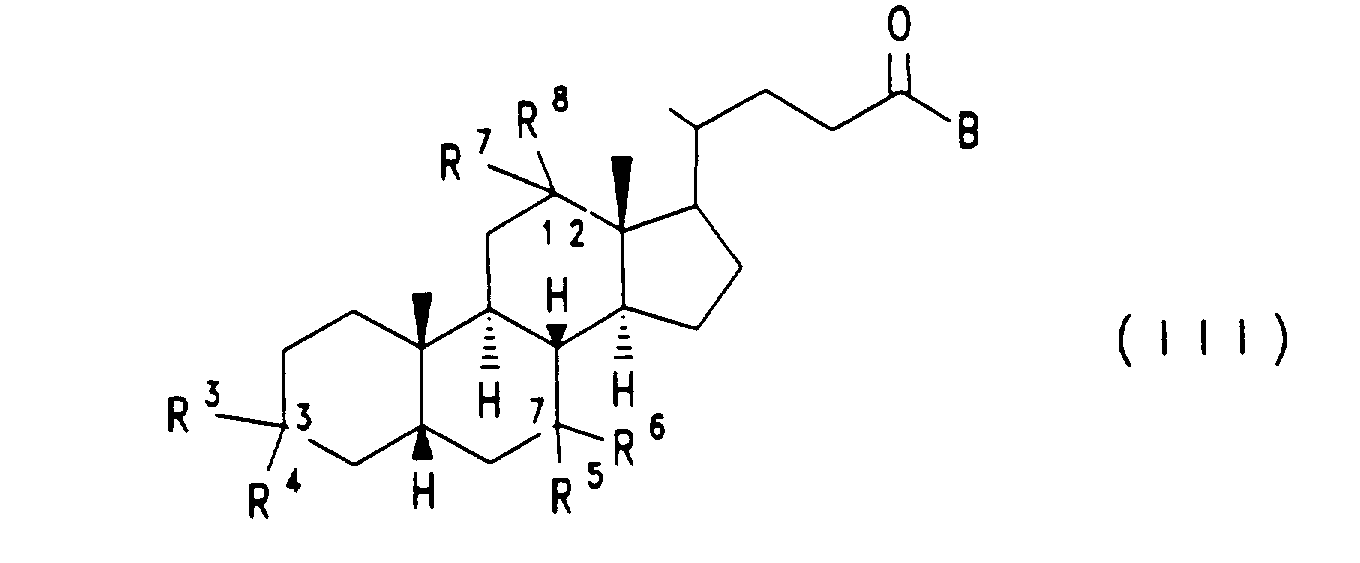
- R³ bis R⁸
- unabhängig voneinander Wasserstoff, OH, NH₂ oder eine mit einer OH-Schutzgruppe geschützte OH-Gruppe und einer der Reste R³ bis R⁶ eine Bindung zur Gruppe X bedeuten, wobei diese Bindung von den Positionen 3 (R³ oder R⁴) oder 7 (R⁵ oder R⁶), bevorzugt ist die β-Position, ausgeht und die jeweils andere Position 7 oder 3 eine OH-Gruppe oder eine geschützte OH-Gruppe trägt,
- B
- -OH, -O-Alkali, -O-Erdalkali, -O-(C₁-C₁₂)-Alkyl, -O-Allyl oder -O-Benzyl bedeutet, bevorzugt -OH, -O-Alkali, -O-(C₁-C₆)-Alkyl, -O-Allyl oder -O-Benzyl, wobei Alkyl sowohl n-Alkyl wie iso-Alkyl bedeutet und wobei die gebildete Estergruppe

- Y
-

- Z
- (C₁-C₁₂)-Alkylen, (C₇-C₁₃)-Aralkylen, wobei 1 bis 3 Methylengruppen in der Alkylenkette durch die Gruppen

- o und p
- unabhängig voneinander null oder 1 bedeuten, wobei o und p nicht gleichzeitig null sind,
- A
-

- R¹
- Wasserstoff oder CH₃ und
- R
-

- R' und R''
- unabhängig voneinander Wasserstoff oder (C₁-C₆)-Alkyl bedeuten.
- Sofern p = null und o = 1 gilt, ist Y bevorzugt

- Sofern p = 1 und o = null gilt, ist Z bevorzugt (C₁-C₁₂)-Alkylen, wobei 1 - 3 Methylengruppen, bevorzugt eine Methylengruppe, durch

- Sofern p = 1 und o = 1 gilt, ist Y bevorzugt -O-. Hierunter ist bevorzugt, daß Z (C₁-C₁₂)-Alkylen oder (C₇-C₁₃)-Aralkylen bedeutet, wobei 1 oder 2 Methylengruppen,
bevorzugt eine Methylengruppe, durch
- Weiterhin ist hierunter bevorzugt, daß eine Methylengruppe von Z dann


- Ebenso ist hierunter bevorzugt, daß, sofern Z eine (C₁-C₁₂)-Alkylengruppe bedeutet,
maximal eine Methylengruppe durch

- Besonders bevorzugt ist weiterhin, daß Y nicht direkt mit der eine Methylengruppe von Z ersetzenden Gruppe direkt benachbart ist und auch nicht mit

- Die Verbindungen der Formel I sind Gegenstand von EP-0548793.
- Unter den OH-Schutzgruppen werden verstanden
- ein Alkylrest mit 1 - 10 C-Atomen oder ein Alkenylrest mit 2 - 10 C-Atomen, wobei die Reste verzweigt oder unverzweigt sind,
- ein Cycloalkylrest mit 3-8 C-Atomen,
- ein Phenylrest, der unsubstituiert oder 1-3fach substituiert ist mit F, Cl, Br, (C₁-C₄)-Alkyl oder (C₁-C₄)-Alkoxy,
- ein Benzylrest, der unsubstituiert oder 1-3fach substituiert ist mit F, Cl, Br, (C₁-C₄)-Alkyl oder (C₁-C₄)-Alkoxy oder ein

- Bevorzugte Comonomere der Formel IV sind:
(Meth)acrylsäure, (Meth)acrylsäureester, Acrylamid, Acrylamid-Derivate. Besonders bevorzugt sind Carbonsäurevinylester mit 3-20 C-Atomen und N-Vinylpyrrolidon sowie dessen Derivate. Die Monomeren werden gegebenenfalls in Mischung eingesetzt. - Die beschriebenen Polymeren oder Copolymeren von Gallensäurederivaten können auch zusätzlich vernetzt sein durch Copolymerisation mit mehrfach ethylenisch ungesättigten Monomeren. Vorzugsweise werden zweifach oder dreifach ethylenisch ungesättigte Acryl- und Methacrylasäurederivate genannt. Erfindungsgemäße polymere und oligomere Gallensäuren können auch durch polymeranaloge Reaktionen mit üblichen bifunktionellen Reagentien vernetzt sein.
- Insbesondere kommen als Vernetzer die Säureamide der genannten Verbindungen in Frage und hierunter wiederum Säureamide der allgemeinen Formel V
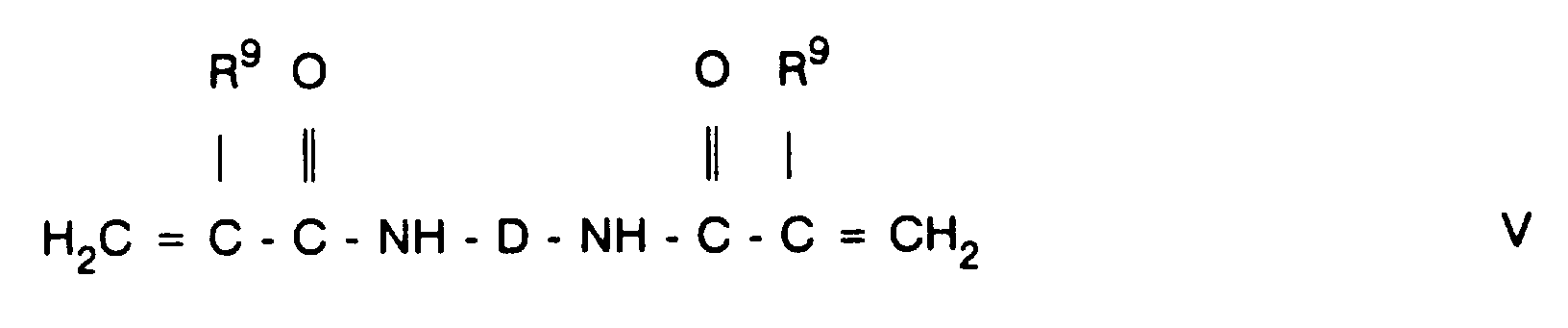
- R⁹
- Wasserstoff sowie Methyl und
- D
- -(CHE)m- bedeutet,
wobei - m
- 1 bis 10, vorzugsweise 2 bis 4 und
- E
- Wasserstoff oder OH, vorzugsweise Wasserstoff für m = 2
bedeutet. - Gegenstand der Erfindung ist weiterhin ein Verfahren zur Herstellung der polymeren Gallensäuren.
- Die radikalische Polymerisation bzw. Copolymerisation wird in Suspension oder Emulsion, ggf. in Substanz, bevorzugt aber in Lösung unter Verwendung von Radikalbildnern bei Temperaturen unter 250°C, bevorzugt bei Temperaturen von 40 bis 100°C durchgeführt.
- Geeignete Radikalbildner sind anorganische oder organische Peroxide, Percarbonate und Azoverbindungen, die bevorzugt in Mengen von 0,01 bis 30 mol-% bezgl. der von polymerisierenden Monomere eingesetzt werden. Bevorzugt ist die Verwendung von Kaliumperoxodisulfat, Wasserstoffperoxid, Dilaurylperoxid oder besonders bevorzugt wird Azobisisobutyronitril, tert.-Butylperoxydiethylacetat, Dibenzoylperoxid oder tert.-Butyloxy-2-ethylhexanoat.
- Weiterhin einsetzbar sind:
tert.-Butylperoxyisobutyrate, tert.-Butylperoxyisopropylcarbonat, tert.-Butylperoxy-3,5,5-trimethylhexanoat, 2,2-Bis(tert.-butyl)peroxybutan, tert.-Butylperoxystearylcarbonate, tert.-Butylperoxyacetate, tert.-Butylperoxybenzoat, Dicumylperoxid, 2,5-Dimethyl-2,5-bis(tert.-butylperoxy)hexan, tert.-Butylcumylperoxid, 1,3-Bis(tert.-butyl)-peroxy-isopropyl)benzol, Di-tert.-butylperoxid, Bis(2-methylbenzoyl)-peroxid, Bis(3,5,5-trimethylhexanoyl)peroxid, tert.-Butylperoxypivalat, tert.-Amylperoxypivalat, tert.-Butylperoxyneodecanoat, tert.-Amylperoxyneodecanoat, Diisopropylperoxydicarbonat, Bis(2-ethylhexyl)peroxydicarbonat, Di-n-butylperoxydicarbonat, Di-sec-butylperoxydicarbonat u.a.. - Die Art der eingesetzten Lösungsmittel richtet sich nach der Löslichkeit der eingesetzten Monomeren. Wasserlösliche Monomere werden in wäßriger Lösung polymerisiert. In organischen Lösungsmitteln lösliche Monomere lassen sich prinzipiell in allen organischen Lösungsmitteln polymerisieren, in denen üblicherweise radikalische Polymerisationen durchgeführt werden. Eingesetzt werden beispielsweise Dimethylsulfoxid, Dimethylformamid, Chloroform, Methylenchlorid, Ester mit bis zu 10 C-Atomen, beispielsweise Ethylacetat oder Methylacetat oder Kohlenwasserstoffe wie Benzol, Toluol oder Xylol. Bevorzugt sind Alkohole mit bis zu 6 C-Atomen, beispielsweise Methanol, Ethanol, iso-Propanol, Propanol u.a. sowie Ether wie beispielsweise Tetrahydrofuran oder Dioxan. Die Lösungsmittel können ggf. auch in Mischung oder eventuell in Kombination mit Wasser eingesetzt werden.
- Das Molekulargewicht der polymeren Produkte läßt sich durch Art und Menge der eingesethen Lösungsmittel sowie der verwendeten Radikalbildner, durch die Reaktionszeit sowie die Reaktionstemperatur steuern. Darüberhinaus ist eine Molekulargewichtssteuerung durch Verwendung von Reglern, bevorzugt in Mengen von bis zu 2 mol-% bzgl. der eingesetzten Monomeren, wie z.B. Alkyl- und Arylmercaptanen, Aldehyden, Phenolen und Aminen möglich.
- Die Synthese der Polymeren kann sowohl nach allgemein bekannten Dosierverfahren als auch durch Batch-Reaktion erfolgen.
- Die erfindungsgemäßen polymeren Gallensäuren besitzen gewichtsmittlere Molekulargewichte von bevorzugt bis zu 250 000 g/mol. Besonders bevorzugt sind Produkte mit gewichtsmittleren Molekulargewichten zwischen 2000 und 100 000 g/mol, ganz besonders bevorzugt sind Verbindungen deren Molekulargewicht zwischen 3000 und 60 000 g/mol liegt.
- Bei copolymeren Verbindungen sollte das molare Verhältnis von Gallensäureeinheiten zu copolymerisierten Monomereinheiten bevorzugt zwischen 300: 1 und 1 : 300 liegen, besonders bevorzugt sind molare Verhältnisse von 150 : 1 bis 1 : 150.
- Polymere Gallensäuren der erfindungsgemäßen Art mit verseifbaren bzw. umesterbaren Einheiten lassen sich in Lösung zu den entsprechenden Verbindungen umestern bzw. verseifen. Geeignete Lösungsmittel sind hier bevorzugt Alkohole mit bis zu 6 C-Atomen, Ether wie Diethylether, Tetrahydrofuran, Dioxan, Halogenkohlenwasserstoffe wie Chloroform, Methylenchlorid, darüberhinaus Dimethylsulfoxid oder Dimethylformamid.
- Besonders bevorzugt sind wassermischbare Lösungsmittel, die in Kombination mit Wasser eingesetzt werden. Die Verseifungen werden unter Zusatz von Mineralsäuren wie z.B. Salzsäure, Schwefelsäure, organischen Säuren wie z.B. p-Toluolsulfonsäure durchgeführt. Bevorzugt ist allerdings die Verwendung von Basen wie beispielsweise NaOH, KOH, prim. Aminen, sek. Aminen, tert. Aminen, Alkali-und Erdalkali-Alkoholaten u.a..
- Die Verseifungen werden in der Regel bei Temperaturen von 15 bis 100°C durchgeführt.
- Die Isolierung und Reinigung der verseiften Polymeren kann durch chromatographische Verfahren wie beispielsweise HPLC oder GPC, durch Dialyse und anschließende Gefriertrocknung oder durch Ausfällung der Produkte aus dem Reaktionsansatz erfolgen.
- Die Synthese und Eigenschaften der erfindungsgemäßen polymeren Gallensäuren werden durch die nachfolgenden Beispiele näher erläutert. Die aufgeführten Beispiele schränken den Erfindungsgegenstand in keinster Weise ein, sondern sind als Auswahl des Erfindungsgegenstandes zu verstehen.
- In den folgenden Beispielen werden Gallensäuremethylester der allgemeinen Formel VI verwendet.

- Die Gruppe A-X ist jeweils in den Beispielen definiert.
- Für die Dialyse wurde Dialyseschlauch der Firma Spectrum Medical Industries, INC. mit der Bezeichnung Spectra/Por Nr. 3 mit einer Ausschlußgrenze von 3500 g/mol eingesetzt.
- Die Bestimmung der gewichtsmittleren Molekulargewichte erfolgte mittels GPC im Vergleich zu Polystyrolstandards.
- Chromatograph:
- ALC/GPC 244 Waters Chromatographie
- Säulensatz:
- 4 Ultrastyragel Säulen
- Lösemittel:
- THF
- Durchfluß:
- 1 ml/min
- Probenmenge:
- 0,4 ml Probenlösung mit c = 0,2 g/dl
- Detektor:
- RI + 4X
- In einem Reaktionsgefäß werden unter Stickstoff 1000 mg eines Gallensäuremethylesters, wobei

- Molares Verhältnis von Gallensäureeinheiten zu Vinylalkoholeinheiten:
- 1 : 80 (ermittelt durch NMR),
- gewichtsmittleres Molekulargewicht der unverseiften Substanz:
- Mw = 34 000 g/mol (ermittelt mit GPC).
- In einem Reaktionsgefäß werden unter Stickstoff 3000 mg eines Gallensäuremethylesters, wobei

- Molares Verhältnis von Gallensäureeinheiten zu Vinylalkoholeinheiten:
- 1 : 12,5 (ermittelt durch NMR),
- gewichtsmittleres Molekulargewicht der unverseiften Substanz:
- Mw = 8 000 g/mol (ermittelt mit GPC).
- In einem Reaktionsgefäß werden unter Stickstoff 4920 mg eines Gallensäuremethylesters, wobei

- Molares Verhältnis von Gallensäureeinheiten zu N-Vinylpyrrolidon-Einheiten:
- 1 : 1 (ermittelt durch NMR),
- gewichtsmittleres Molekulargewicht der unverseiften Substanz:
- Mw = 38 000 g/mol (ermittelt mit GPC).
- In einem Reaktionsgefäß werden unter Stickstoff 3000 mg eines Gallensäuremethylesters, wobei

- Molares Verhältnis von Gallensäureeinheiten zu N-Vinylpyrrolidon-Einheiten
- 2 : 3 (ermittelt durch NMR),
- gewichtsmittleres Molekulargewicht der unverseiften Substanz:
- Mw = 16 000 g/mol (ermittelt mit GPC).
- In einem Reaktionsgefäß werden unter Stickstoff 1110 mg eines Gallensäuremethylesters, wobei

- Gewichtsmittleres Molekulargewicht der unverseiften Substanz:
Mw = 10 000 g/mol (ermittelt mit GPC). - In einem Reaktionsgefäß werden unter Stickstoff 386,8 mg eines Gallensäuremethylesters, wobei

- Gewichtsmittleres Molekulargewicht der unverseiften Substanz:
Mw = 11 000 g/mol (ermittelt mit GPC) - In einem Reaktionsgefäß werden unter Stickstoff 340 mg eines Gallensäuremethylesters, wobei

- In einem Reaktionsgefäß werden unter Stickstoff 558,8 mg eines Gallensäuremethylesters, wobei
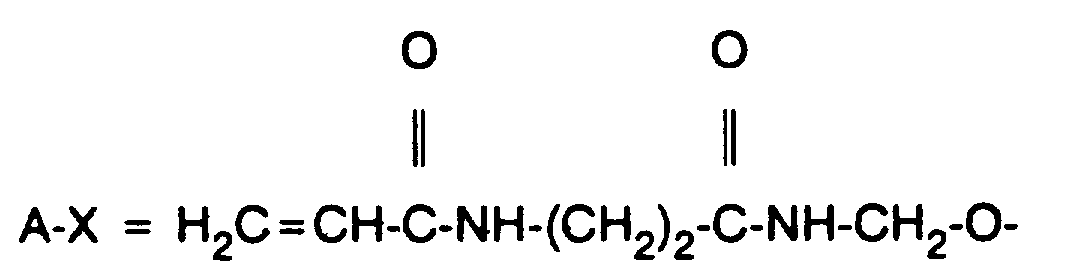
- Gewichtsmittleres Molekulargewicht der unverseiften Substanz:
Mw = 14 000 g/mol (ermittelt mit GPC). - In einem Reaktionsgefäß werden unter Stickstoff 437,4 mg eines Gallensäuremethylesters, wobei

- Gewichtsmittleres Molekulargewicht der unverseiften Substanz:
Mw = 13 000 g/mol (ermittelt mit GPC). - Das Beispiel wird entsprechend Beispiel 9 durchgeführt, jedoch werden folgende Verbindungen eingesetzt:
- 424 mg
- Gallensäuremethylester in 3 ml THF, wobei A-X =

- 0,424 mg
- Dodecylmercaptan in 50 µl THF als Regler und
- 56,52 mg
- Dibenzoylperoxid (BSO), 75 %ig, in 563,7 µl Toluol.
- Das erhaltene Produkt weist ein gewichtsmittleres Molekulargewicht der unverseiften Substanz von Mw = 6900 g/mol (ermittelt mit GPC) auf.
- Das Beispiel wird entsprechend Beispiel 9 durchgeführt, jedoch werden folgende Verbindungen eingesetzt:
- 400 mg
- Gallensäuremethylester in 2,9 ml THF, wobei A-X =

- 5,39 mg
- BSO, 75 %ig, in 53,8 µl Toluol
- Das erhaltene Produkt weist ein gewichtsmittleres Molekulargewicht der unverseiften Substanz von Mw = 8800 g/mol (ermittelt mit GPC) auf.
- Das Beispiel wird entsprechend Beispiel 9 durchgeführt, jedoch werden folgende Verbindungen eingesetzt:
- 407,3 mg
- Gallensäuremethylester in 2,95 ml THF, wobei A-X =

- 1,53 mg
- Glyoxalbisacrylamid in 74,6 µl Methanol als Vernetzer und
- 58,4 mg
- BSO, 75 %ig, in 582,4 µl Toluol.
- Das erhaltene Produkt weist ein jeweils mittleres Molekulargewicht der unverseiften Substanz von Mw = 5400 g/mol (ermittelt mit GPC) auf.
- Das Beispiel wird entsprechend Beispiel 9 durchgeführt, jedoch werden folgende Verbindungen eingesetzt:
- 409 mg
- Gallensäuremethylester in 2,95 ml THF, wobei A-X =

- 54,53 mg
- BSO, 75 %ig, in 543,8 µl Toluol.
- Das erhaltene Produkt weist ein gewichtsmittleres Molekulargewicht der unverseiften Substanz von Mw = 7500 g/mol (ermittelt mit GPC) auf.
- Das Beispiel wird entsprechend Beispiel 9 durchgeführt, jedoch werden folgende Verbindungen eingesetzt:
- 400,7 mg
- Gallensäuremethylester in 2,9 ml THF, wobei A-X =

- 1,5 mg
- Glyoxalbisacrylamid als Vernetzer in 70 µl Methanol und
- 53,4 mg
- BSO, 75 %ig, in 529 µl Toluol.
- Das Beispiel wird entsprechend Beispiel 9 durchgeführt, jedoch werden folgende Verbindungen eingesetzt:
- 416,3 mg
- Gallensäuremethylester in 2,9 ml THF, wobei A-X =

- 0,81 mg
- tert. Butylperoxydiethylacetat als lnitiator in 15,5 µl THF,
Reaktionszeit 21 h. - Das erhaltene Produkt weist ein gewichtsmittleres Molekulargewicht der unverseiften Substanz von Mw = 10700 g/mol (ermittelt mit GPC) auf.
- Bei In-vitro und In-vivo Untersuchungen der erfindungsgemäßen Verbindungen vom Typ der polymeren Gallensäuren, die eine hohe Affinität für das Gallensäuretransportsystem besitzen, wurde überraschender Weise gefunden, daß diese die Gallensäureresorption in konzentrationsabhängiger Weise hemmen. Weiterhin konnte festgestellt werden, daß die erfindungsgemäßen Verbindungen selbst nicht resorbiert werden und somit nicht in den enterohepatischen Kreislauf gelangen. Aufgrund dieser Erkenntnis kann nun mit höherer Effizienz in den enterohepatischen Kreislauf eingegriffen werden, als es mit den Resins bislang möglich war.
- Bei dem schon als Arzneimittel erhältlichen Resins, z.B. Colestyramin (enthält quartäre Ammoniumgruppen) oder Colestipol (enthält sekundäre bzw. tertiäre Aminogruppen) ist die zweckmäßige Tagesdosis sehr hoch. Sie beträgt z.B. für Colestyramin 12-24 g, Tageshöchstdosis 32 g. Die empfohlene Dosis ist 15-20 g. Weiterhin erschweren Geschmack, Geruch und die hohe Dosierung die Patienten-Compliance. Die bekannten Nebenwirkungen (z. B. Avitaminosen) der Resins gehen auf mangelnde Selektivität zurück. Diese Nebenwirkungen müssen auch bei der Dosierung simultan gegebener Medikamente berücksichtigt werden, aber auch bei einer Gallensäureverarmung, die verschiedene gastrointestinele Störungen (Obstipation, Steatorrhoe) unterschiedlichen Grades hervorrufen.
- Für Cholestyramin und Golestipol wurde eine therapeutische Bedeutung durch Kombination mit anderen hypolipidämisch wirkenden Pharmaka wie Fibrate, HMG-CoA-Reduktase-Inhibitoren, Probucol (vgl. z.B. M.N. Cayen, Pharmac. Ther. 29, 187 (1985) und 8th International Symposium on Atherosclerosis, Rome, Oct. 9-13, 1988, Abstracts S. 544, 608, 710) beschrieben, wobei die erzielten Effekte auch die Therapie von schweren Hyperlipidämien ermöglichen. Jedoch sind folgende Merkmale der genannten Präparate und insbesondere von z.B. Colestipol als verbesserungswürdig anzusehen:
- 1. Die hohen Tagesdosen, die zurückzuführen sind auf eine relativ geringe Bindungsrate bei neutralem pH in isotonen Medium und der (teilweisen) Wiederfreisetzung der adsorbierten Gallensäuren.
- 2. Die qualitative Verschiebung der Gallensäurezusammensetzung der Galle mit abnehmender Tendenz für Chenodesoxycholsäure und die damit verbundene zunehmende Gefahr für Cholelithiasis.
- 3. Das Fehlen einer dämpfenden Wirkung auf den Cholesterinstoffwechsel der Darmbakterien.
- 4. Die zu hohe Bindungsrate von Vitaminen und Pharmaka macht einen Substitutionsbedarf an diesen Stoffen und Blutspiegelkontrollen eventuell notwendig.
- 5. Die Darreichungsform ist bislang als unzureichend anzusehen.
- Durch Inhibition der Gallensäurerückresorption mit Hilfe der erfindungsgemäßen polymeren Gallensäuren im Dünndarm wird auf wesentlich effektivere Weise die im enterohepatischen Kreislauf befindliche Gallensäurekonzentration vermindert, so daß eine Senkung des Cholesterinspiegels im Serum erfolgt. Avitaminosen werden bei Anwendung der erfindungsgemäßen Verbindungen danach ebensowenig beobachtet, wie die Beeinflussung der Resorption anderer Arzneimittel. Auch wird keine negative Wirkung auf die Darmflora gesehen, da die Bindung der erfindungsgemäßen Polymeren an die Darmschleimhaut außerordentlich stabil ist und nach erfolgter Bindung sehr lang anhält. Es ist zudem zu erwarten, daß die bekannten Nebenwirkungen (Obstipation, Steratorrhoe) nicht beobachtet werden.
- Schließlich führt der Einsatz hoher Dosierungen nicht zu einer Zellschädigung. Daher kann durch Einsatz der erfindungsgemäßen Verbindungen die sonst übliche Dosierung der Resins erheblich gesenkt werden. Die empfohlene Dosis beträgt zweckmäßigerweise bis zu 10 g pro Tag, vorzugsweise 0,1 bis 5,0 g /Tag, insbesondere 0,3 bis 5,0 g/Tag.
- Folgende Methoden wurden angewendet:
HPLC mit FLUORESZENZDETEKTION
Geräte: HPLC-Anlage der Fa. Kontron, bestehend aus drei Pumpen und Mischkammer, Autosampler, UV-Detektor und Auswerteeinheit mit Software MT2.
Fluroeszenzdetektor von Merck-Hitachi Da die Proben licht- und temperaturempfindlich sind, wird der Autosampler auf ca. 5°C gekühlt.
Mobile Phase: Laufmittel A: ®Millipore-Wasser (eigene Anlage)
Laufmittel B: Acetonitril/Methanol 60:30
Säule: ®LiChrospher 100 RP-18, 25 mm, 5 µm von Merck
Vorsäule: LiChrospher 60 RP-select B, 4 mm, 5 µm von Merck
Flußrate: 1.3 ml/min
Detektion: Excitation: 340 nm
Emission: 410 nm
Gradient:0,00 min 66 % B 7,50 min 66 % B 8,00 min 76 % B 12,50 min 76 % B 13,00 min 83 % B 25,00 min 83 % B 25,50 min 91 % B 40,00 min 91 % B - Enzymatische Bestimmung der Gesamtgallensäure
- In Eppendorfgefäße werden je 900 µl des folgenden Gemisches gegeben:
6 ml Tetra-Natrium-Diphosphat-Puffer 0,1 M, pH 8,9,
2 ml NAD-Lösung (4 mg/ml Wasser),
20 ml Millipore-Wasser - Dazu werden 30 µl der Probe und 30 µl Enzymlösung pipettiert.
- Enzymlösung: 3-alpha-Hydroxysteroiddehydrogenase 0,5 units/ml
- Die Ansätze werden gemischt und 2 h bei Raumtemperatur inkubiert.
- Anschließend Umfüllen in 1 ml-Einmalküvetten und Messung im Photometer bei 340 nm.
- Für Gallenproben nur bedingt geeignet, da die grüne Farbe stört.
-
Geräte: HPLC-Anlage der Fa. Kontron, bestehend aus drei Pumpen und Mischkammer, Autosampler, UV-Detektor und Auswerteeinheit mit Software MT2.
Mobile Phase: Laufmittel A: Ammoniumcarbamatpuffer 0,019 M, mit Phosphorsäure auf pH 4,0 eingestellt.
Laufmittel B: Acetonitril
Säule: LiChrospher 100 RP-8, 25 mm, 5 µm von Merck
Vorsäule: LiChrospher 60 RP-select B, 4 mm, 5 µm von Merck
Flußrate:Gradient: 0,00 min 0,8 ml/min 20,00 min 0,8 ml/min 23,00 min 1,3 ml/min 51,00 min 1,3 ml/min
Detektion: 200 nm (für Präparate zusätzlich bei 254 nm)
Gradient:0,00 min 32 % B 8,00 min 35 % B 17,00 min 38 % B 20,00 min 40 % B 24,00 min 40 % B 30,00 min 50 % B 45,00 min 60 % B - Die in vivo Untersuchung erfolgte wie bei F.G.J. Poelma et al. (J. Pharm. Sci. 78 (4), 285-89, 1989) beschrieben mit einigen Modifikationen.
- In den Untersuchungen werden Taurocholat und Taurocholsäure bzw. Cholat und Cholsäure synonym verwendet.
- Der Gallengang wird freipräpariert und ein Katheter eingebunden (PE 50, IntramedicR). An dessen Ende wurde ein Adapter zur Aufnahme von 100 µl Einmalpipettenspitzen (Brandt) angebracht. In diesen Pipetten wird die Galle gesammelt und nach bestimmten Zeitabständen in ausgewogene Eppendorf-Reaktionsgefäße gefüllt. Nach Versuchsende wird die Galle, wie auch die Mediumproben, ausgewogen und Aliquots im Szintillationszähler vermessen. Dazu werden 10 µl Probe in ein Sarstedt Probengefäß, 58 x 22 mm, pipettiert, mit 10 ml Quickszint 212 (Zinsser GmbH, Frankfurt am Main, Deutschland) versetzt und nach 30 min Abklingzeit in einem Beckman 2800 β-Counter gezählt.
- 1. Die erfindungsgemäßen Verbindungen, Beispiele 1 bis 15, wurden zusammen mit 10 mM Taurocholat mit ³H-Taurocholat oder ¹⁴C-Taurocholat als Tracer in das Darmsegment instilliert und die Perfusionslösung mit Hilfe einer Peristaltikpumpe 2 h umgepumpt. Die Abnahme des Tracers im Darm (Medium) bzw. das Erscheinen des Tracers in der Gallenflüssigkeit (Galle) wurde mit Hilfe von Szintillationsmessungen und HPLC ermittelt. Als Kontrolle wurde 10 mM Taurocholat mit dem Tracer ohne erfindungsgemäße Verbindung instilliert und die Änderung im Darm und in der Gallenflüssigkeit ermittelt (Figuren 1a - 10a und 1b - 10b).
- 2. In vivo perfundierter Darm
- Als Versuchstiere kommen Wistar-Ratten aus eigener Zucht (Tierhaltung Hoechst) mit durchschnittlich 230-290 g Körpergewicht zum Einsatz. Die Versuchstiere werden vor der Narkose (Urethan 1 g/kg i.p.) nicht gehungert. Nach Eintritt der Narkose werden die Tiere auf einem temperierbaren (konstant 37°C) OP-Tisch (Medax) fixiert, auf der Bauchseite geschoren und anschließend wird den Tieren mit einem ca. 7 cm langem Schnitt die Bauchdecke geöffnet. Sodann wird ca. 8 cm von der Ileozökalklappe ein Luer-Adapter (Feinmechanik Hoechst) in den unteren Dünndarm eingebunden, dabei wird der weiterführende Dünndarm abgebunden.
- Nun erfolgt eine weitere Ein- und Abbindung des Dünndarms 13-14 cm zum Dünndarmanfang hin. Der Inhalt dieses Darmsegments wird mit 37°C warmer isotonischer Kochsalzlösung vorsichtig ausgespült. In dieses Segment, Endteil Jejunum-Anfang Ileum, wird später die Versuchslösung instilliert.
- Zuerst wird der Pumpenschlauch aus den 2 ml Instillationslösung (10 mM Taurocholat, Präparat in gegebener Konzentration, Tracer: 3.5 µCi [³H(G)]-Taurocholsäure, NET-322, Lot 2533-081, DuPont de Nemour GmbH, Dreieich, Deutschland, gelöst in Phosphat-gepufferter isotonischer Kochsalzlösung gefüllt (Silikon Tubing A, 0,5 mm Desaga, Heidelberg, Deutschland, Best. Nr. 132020). Danach wird der Pumpenschlauch mit zwei Luer-Adaptern an das Darmsegment angeschlossen und die Restlösung über einen Dreiweghahn (Pharmascal K 75a) und einer 2 ml-Einwegspritze (Chirana) eingefüllt. Unmittelbar danach wird die Peristaltikpumpe (LKB Multiperpex 2115) eingeschaltet, und das Medium mit 0,25 ml/min umgepumpt. In regelmäßigen Abständen wird aus einem in den Kreislauf integrierten Infusionsschlauch mittels einer Hamilton-Spritze und einer Kanüle (Termo 0,4 x 20) eine Probe für die Messung der Aktivität (Abnahme Radioaktivität im Darm = Resorptionsrate) entnommen.
- Zum Nachweis der prolongierten Wirkung der oligomeren bzw. polymeren Gallensäuren (Figuren 11a + b) wird in diesem speziellen Versuchsdesign der Abstrom (Darm) und das Anfüllen (Galle) des radioaktiven Tracers während der ersten (Inst. I) mit Inhibitor und während der zweiten Instillation (Inst. II) ohne den Inhibitor geprüft.
und/oder durch Copolymerisation mit ethylenisch ungesättigten Dicarbonsäureanhydriden und ethylenisch ungesättigten Dicarbonsäuren mit jeweils 2 bis 6 C-Atomen; deren Estern oder Halbestern, wobei als Ester Alkylester mit 1 - 6 C-Atomen, Cycloalkylester mit 5 bis 8 C-Atomen, Benzyl- oder Phenylester zu verstehen sind.
Claims (17)
- Polymere und oligomere Gallensäuren, herstellbar durch Polymerisation von monomeren Gallensäuren der Formel I
 G ein Gallensäurerest oder -derivat,X eine Brückengruppe undA eine polymersierbare, ethylenisch ungesättigte Gruppe bedeutet,
oder durch Copolymerisation mit einem, eine polymerisierbare, ethylenisch ungesättigte Doppelbindung aufweisenden Monomeren, insbesondere durch Copolymerisation mit einem Monomeren der Formel IV R⁹ Wasserstoff oder Methyl undR¹⁰oder durch Copolymerisation mit N-Vinylpyrrolidon oder dessen Derivaten und/oder durch Copolymerisation mit ethylenisch ungesättigten Dicarbonsäureanhydriden und ethylenisch ungesättigten Dicarbonsäuren mit jeweils 2 bis 6 C-Atomen, deren Estern oder Halbestern, wobei als Ester Alkylester mit 1-6 C-Atomen, Cycloalkylester mit 5 bis 8 C-Atomen, Benzyl- oder Phenylester zu verstehen sind.
 R¹¹ Wasserstoff, (C₁-C₁₀)-Alkyl, (C₁-C₁₀)-mono-Hydroxyalkyl oder -(CH₂CH₂-O-)nR¹⁶,R¹, R¹³, R¹⁵ und R¹⁶ gleich oder verschieden sind und (C₁-C₁₀)-Alkyl,R¹⁴ (C₁-C₁₈)-Alkyl undn 1 bis 50bedeuten,
 - Polymere und Oligomere nach Anspruch 1, dadurch gekennzeichnet, daßG eine freie Gallensäure bzw. ihr Alkalisalz oder eine am Ring D veresterte Gallensäure ist, die über ihren Ring A, B oder C, vorzugsweise über Ring A, verbunden ist mit der GruppeX, für die bevorzugt die Formel II gilt
 Y benachbart zu G steht und
 Z (C₁-C₁₂)-Alkylen oder (C₇-C₁₃)-Aralkylen, wobei einzelne, bevorzugt 1 bis 4, Methylengruppen in der Alkylenkette des Alkylen- oder Aralkylenrestes durch Gruppen wie
 o und p unabhängig voneinander null oder 1, wobei o und p nicht gleichzeitig null sindA eine ethylenisch ungesättigte Gruppe der Formel
 R¹ Wasserstoff oder CH₃ undR
 R' und R'' unabhängig voneinander Wasserstoff oder (C₁-C₆)-Alkyl, bevorzugt (C₁-C₃)-Alkyl bedeuten.
 - Polymere und Oligomere nach den Ansprüchen 1 oder 2, dadurch gekennzeichnet, daßG der Formel III entspricht
 R³ bis R⁸ unabhängig voneinander Wasserstoff, OH, NH₂ oder eine mit einer OH-Schutzgruppe geschützte OH-Gruppe und einer der Reste R³ bis R⁶ eine Bindung zur Gruppe X bedeuten, wobei diese Bindung von den Positionen 3 (R³ oder R⁴) oder 7 (R⁵ oder R⁶) bevorzugt ist die β-Position, ausgeht und die jeweils andere Position 7 oder 3 eine OH-Gruppe oder eine geschützte OH-Gruppe trägt,B -OH, -O-Alkali, -O-Erdalkali, -O-(C₁-C₁₂)-Alkyl, -O-Allyl oder -O-Benzyl bedeutet, bevorzugt -OH, -O-Alkali, -O-(C₁-C₆)-Alkyl, -O-Allyl oder -O-Benzyl, wobei Alkyl sowohl n-Alkyl wie iso-Alkyl bedeutet und wobei die gebildete Estergruppe
 Y
Y Z (C₁-C₁₂)-Alkylen, (C₇-C₁₃)-Aralkylen, wobei 1 bis 3 Methylengruppen in der Alkylenkette durch die Gruppen
 o und p unabhängig voneinander null oder 1 bedeuten, wobei o und p nicht gleichzeitig null sind,A
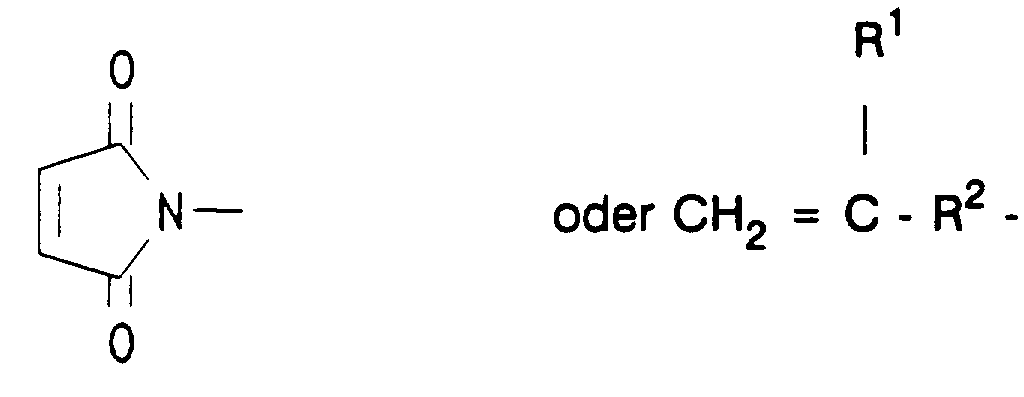 R¹ Wasserstoff oder CH₃ undR
 R' und R'' unabhängig voneinander Wasserstoff oder (C₁-C₆)-Alkyl bedeuten.
 - Polymere und Oligomere nach einem der Ansprüche 1 bis 3, dadurch gekennzeichnet, daß als Monomere Verbindungen gemäß der Formel IV (Meth)acrylsäure, (Meth)acrylsäureester, Acrylamid und dessen Derivate, Carbonsäurevinylester mit 3-20 C-Atomen oder N-Vinylpyrrolidon und dessen Derivate gelten.
- Polymere und Oligomere nach einem der Ansprüche 1 bis 4, dadurch gekennzeichnet, daß das gewichtsmittlere Molekulargewicht bei bis zu 250 000 g/mol, besonders bevorzugt zwischen 2000 und 100 000 g/mol, insbesondere bevorzugt zwischen 3000 und 60 000 g/mol liegt.
- Polymere und Oligomere nach einem der Ansprüche 1 bis 5, dadurch gekennzeichnet, daß im Falle von Copolymeren das molare Verhältnis von Gallensäureeinheiten zu copolymerisierten Monomereinheiten zwischen 300:1 und 1:300, besonders bevorzugt zwischen 150:1 und 1:150 liegt.
- Polymere und Oligomere nach einem der Ansprüche 1 bis 6, dadurch gekennzeichnet, daß die Vernetzung durch eine Copolymerisation mit mehrfach ethylenisch ungesättigten Monomeren erfolgt.
- Polymere und Oligomere nach Anspruch 7, dadurch gekennzeichnet, daß die Vernetzung mit mehrfach ethylenisch ungesättigten Acryl- und Methacrylsäurederivaten durchgeführt wird.
- Polymere und Oligomere nach einem der Ansprüche 7 oder 8, dadurch gekennzeichnet, daß die Vernetzung mit Säureamiden der allgemeinen Formel V
 R⁹ Wasserstoff oder Methyl undD -(CHE)m- bedeutet,
wobeim 1 bis 10 undE Wasserstoff oder OH bedeutet,
durchgeführt wird. - Verfahren zur Herstellung der polymeren und oligomeren Gallensäuren nach den Ansprüchen 1 bis 9, dadurch gekennzeichnet, daß man Verbindungen der Formel I oder mindestens eine Verbindung der Formel I mit einer Verbindung der Formel IV und/oder N-Vinyl-pyrrolidon oder dessen Derivaten und/oder einer ethylenisch ungesättigten Dicarbonsäure mit 2 bis 6 C-Atomen und/oder einem ethylenisch ungesättigten Dicarbonsäureanhydrid mit 2 bis 6 C-Atomen, und/oder einem ethylenisch ungesättigten Dicarbonsäurehalbester mit 2 bis 6 C-Atomen unter Verwendung von mindestens einem Radikalbildner bei Temperaturen unter 250°C polymerisiert.
- Verfahren nach Anspruch 10, dadurch gekennzeichnet, daß die Polymerisation in Suspension, in Substanz oder in Lösung durchgeführt wird.
- Verfahren nach Anspruch 10, dadurch gekennzeichnet, daß die Polymerisation in einem Lösungsmittel durchgeführt wird, in dem das oder die Monomere löslich sind.
- Verfahren nach Anspruch 10, dadurch gekennzeichnet, daß die Temperatur der Polymerisation im Bereich von 40 bis 100°C liegt.
- Polymere und oligomere Gallensäuren gemäß den Ansprüchen 1-9 zur Anwendung als Arzneimittel zur Beeinflussung des enterohepatischen Kreislaufes, der Gallensäuren, der Lipidresorption und des Serumcholesterinspiegels.
- Polymere und oligomere Gallensäuren gemäß den Ansprüchen 1 bis 9 zur zur Anwendung als Arzneimittel zur konzentrationsabhängigen Hemmung der Gallensäureresorption im gastrointestinalen Trakt.
- Polymere und oligomere Gallensäuren gemäß den Ansprüchen 1 bis 6 zur zur Anwendung als Arzneimittel zur nicht systemischen Senkung erhöhter Serumcholesterin- bzw. Blutfettwerte zur Prävention arteriosklerotischer Erscheinungen.
- Kombination von polymeren und oligomeren Gallensäuren gemäß den Ansprüchen 1 - 6 mit systemisch wirkenden, den Lipidmetabolismus beeinflußenden Wirkstoffen zur Anwendung als Arzneimittel.
Applications Claiming Priority (2)
| Application Number | Priority Date | Filing Date | Title |
|---|---|---|---|
| DE4142379 | 1991-12-20 | ||
| DE4142379 | 1991-12-20 |
Publications (2)
| Publication Number | Publication Date |
|---|---|
| EP0549967A1 EP0549967A1 (de) | 1993-07-07 |
| EP0549967B1 true EP0549967B1 (de) | 1996-03-13 |
Family
ID=6447759
Family Applications (1)
| Application Number | Title | Priority Date | Filing Date |
|---|---|---|---|
| EP92121459A Expired - Lifetime EP0549967B1 (de) | 1991-12-20 | 1992-12-17 | Polymere und Oligomere von Gallensäurederivaten, Verfahren zu ihrer Herstellung und ihre Verwendung als Arzneimittel |
Country Status (17)
| Country | Link |
|---|---|
| US (1) | US5430116A (de) |
| EP (1) | EP0549967B1 (de) |
| JP (1) | JP3292318B2 (de) |
| AT (1) | ATE135380T1 (de) |
| AU (1) | AU653658B2 (de) |
| CA (1) | CA2085831C (de) |
| DE (1) | DE59205695D1 (de) |
| DK (1) | DK0549967T3 (de) |
| ES (1) | ES2087422T3 (de) |
| FI (1) | FI108451B (de) |
| GR (1) | GR3019564T3 (de) |
| HU (1) | HUT63434A (de) |
| IL (1) | IL104166A (de) |
| NO (1) | NO301889B1 (de) |
| NZ (1) | NZ245503A (de) |
| TW (1) | TW255898B (de) |
| ZA (1) | ZA929827B (de) |
Cited By (2)
| Publication number | Priority date | Publication date | Assignee | Title |
|---|---|---|---|---|
| RU2247579C2 (ru) * | 1997-03-11 | 2005-03-10 | Джи. Ди. Сирл Энд Ко. | Комбинированное лечение с применением бензотиепинов, ингибирующих транспорт желчной кислоты в подвздошной кишке, и ингибиторов hmg co-а редуктазы |
| US11844822B2 (en) | 2014-06-25 | 2023-12-19 | Elobix Ab | Solid formulation and method for preventing or reducing coloration thereof |
Families Citing this family (69)
| Publication number | Priority date | Publication date | Assignee | Title |
|---|---|---|---|---|
| NZ245504A (en) * | 1991-12-20 | 1995-08-28 | Hoechst Ag | Bile acid derivatives containing an ethylenically unsaturated grouping |
| ATE156911T1 (de) * | 1994-03-04 | 1997-08-15 | Waters Investments Ltd | Verfahren zum nachweis von polymeren in einer lösung, detektorsystem und eine ein solches detektorsystem beinhaltende chromatographievorrichtung |
| US6642268B2 (en) | 1994-09-13 | 2003-11-04 | G.D. Searle & Co. | Combination therapy employing ileal bile acid transport inhibiting benzothipines and HMG Co-A reductase inhibitors |
| US5994391A (en) * | 1994-09-13 | 1999-11-30 | G.D. Searle And Company | Benzothiepines having activity as inhibitors of ileal bile acid transport and taurocholate uptake |
| US6268392B1 (en) | 1994-09-13 | 2001-07-31 | G. D. Searle & Co. | Combination therapy employing ileal bile acid transport inhibiting benzothiepines and HMG Co-A reductase inhibitors |
| US6262277B1 (en) * | 1994-09-13 | 2001-07-17 | G.D. Searle And Company | Intermediates and processes for the preparation of benzothiepines having activity as inhibitors of ileal bile acid transport and taurocholate uptake |
| US6107494A (en) * | 1994-09-13 | 2000-08-22 | G.D. Searle And Company | Substituted 5-aryl-benzothiepines having activity as inhibitors of ileal bile acid transport and taurocholate uptake |
| DE19633268A1 (de) * | 1996-08-19 | 1998-02-26 | Hoechst Ag | Polymere Gallensäure-Resorptionsinhibitoren mit gleichzeitiger Gallensäure-Adsorberwirkung |
| KR100313150B1 (ko) * | 1997-12-31 | 2001-12-28 | 박종섭 | 리소콜릴에시딜(메타)아크릴레이트 단량체와 그를 도입한 공중합체 수지 및 이 수지를 이용한 포토레지스트 |
| US6221897B1 (en) * | 1998-06-10 | 2001-04-24 | Aventis Pharma Deutschland Gmbh | Benzothiepine 1,1-dioxide derivatives, a process for their preparation, pharmaceuticals comprising these compounds, and their use |
| JP2002533412A (ja) | 1998-12-23 | 2002-10-08 | ジー.ディー.サール エルエルシー | 心臓血管に適用するための回腸胆汁酸輸送阻害剤およびコレステリルエステル転送タンパク質阻害剤の組み合わせ |
| KR20020002367A (ko) * | 1998-12-23 | 2002-01-09 | 윌리암스 로저 에이 | 심혈관 징후를 위한 조합물 |
| WO2000038721A1 (en) * | 1998-12-23 | 2000-07-06 | G.D. Searle Llc | Combinations of cholesteryl ester transfer protein inhibitors and nicotinic acid derivatives for cardiovascular indications |
| WO2000038727A1 (en) * | 1998-12-23 | 2000-07-06 | G.D. Searle Llc | Combinations of ileal bile acid transport inhibitors and fibric acid derivatives for cardiovascular indications |
| PT1140185E (pt) | 1998-12-23 | 2003-10-31 | Searle Llc | Combinacoes de inibidores de proteina de transferencia de ester de colesterilo com agentes sequestrantes de acido biliar para indicacoes cardiovasculares |
| AU2157400A (en) | 1998-12-23 | 2000-07-31 | G.D. Searle & Co. | Combinations of cholesteryl ester transfer protein inhibitors and hmg coa reductase inhibitors for cardiovascular indications |
| PL348503A1 (en) * | 1998-12-23 | 2002-05-20 | Searle Llc | Combinations of cholesteryl ester transfer protein inhibitors and fibric acid derivatives for cardiovascular indications |
| PT1140190E (pt) | 1998-12-23 | 2003-02-28 | Searle Llc | Combinacoes de inibidores do transporte ileal dos acidos biliares e agentes sequestrantes dos acidos biliares usadas para problemas cardiovasculares |
| US6586434B2 (en) | 2000-03-10 | 2003-07-01 | G.D. Searle, Llc | Method for the preparation of tetrahydrobenzothiepines |
| WO2001068096A2 (en) * | 2000-03-10 | 2001-09-20 | Pharmacia Corporation | Combination therapy for the prophylaxis and treatment of hyperlipidemic conditions and disorders |
| SE0003766D0 (sv) * | 2000-10-18 | 2000-10-18 | Astrazeneca Ab | Novel formulation |
| US20040077625A1 (en) * | 2001-07-25 | 2004-04-22 | Tremont Samuel J. | Novel 1,4-benzothiazepine and 1,5-benzothiazepine compounds as inhibitors of apical sodium codependent bile acid transport abd taurocholate uptake |
| BR0213501A (pt) | 2001-11-02 | 2004-08-24 | Searle Llc | Compostos de benzotiepina mono- e di-fluorada como inibidores de transporte de ácido biliar co-dependente de sódio apical (asbt) e captação de taurocolato |
| US6852753B2 (en) | 2002-01-17 | 2005-02-08 | Pharmacia Corporation | Alkyl/aryl hydroxy or keto thiepine compounds as inhibitors of apical sodium co-dependent bile acid transport (ASBT) and taurocholate uptake |
| GB0307918D0 (en) | 2003-04-05 | 2003-05-14 | Astrazeneca Ab | Therapeutic use |
| ES2552657T3 (es) | 2010-05-26 | 2015-12-01 | Satiogen Pharmaceuticals, Inc. | Inhibidores del reciclado de ácidos biliares y saciógenos para el tratamiento de diabetes, obesidad, y afecciones gastrointestinales inflamatorias |
| ES2687027T3 (es) | 2010-11-04 | 2018-10-23 | Albireo Ab | Inhibidores de ibat para el tratamiento de enfermedades hepáticas |
| DK2637646T3 (en) | 2010-11-08 | 2016-08-29 | Albireo Ab | PHARMACEUTICAL COMBINATION CONTAINING AN IBAT inhibitor and a bile acid binder |
| AU2012328526B2 (en) | 2011-10-28 | 2017-05-25 | Shire Human Genetic Therapies, Inc. | Bile acid recycling inhibitors for treatment of pediatric cholestatic liver diseases |
| US20130108573A1 (en) | 2011-10-28 | 2013-05-02 | Lumena Pharmaceuticals, Inc. | Bile Acid Recycling Inhibitors for Treatment of Hypercholemia and Cholestatic Liver Disease |
| AU2014229050A1 (en) | 2013-03-15 | 2015-10-22 | Lumena Pharmaceuticals Llc | Bile acid recycling inhibitors for treatment of Barrett's esophagus and gastroesophageal reflux disease |
| CA2907230A1 (en) | 2013-03-15 | 2014-09-18 | Lumena Pharmaceuticals, Inc. | Bile acid recycling inhibitors for treatment of primary sclerosing cholangitis and inflammatory bowel disease |
| JO3301B1 (ar) | 2013-04-26 | 2018-09-16 | Albireo Ab | تعديلات بلورية على إيلوبيكسيبات |
| EP3197459B1 (de) * | 2014-09-28 | 2025-02-12 | Huahui Health Ltd. | Polymere gallensäurederivate zur hemmung von hepatitis-b und -d-virus und ntcp-transport |
| EP3012252A1 (de) | 2014-10-24 | 2016-04-27 | Ferring BV | Kristalline Form von elobixibat |
| WO2017138878A1 (en) | 2016-02-09 | 2017-08-17 | Albireo Ab | Oral cholestyramine formulation and use thereof |
| ES2874669T3 (es) | 2016-02-09 | 2021-11-05 | Albireo Ab | Formulación oral de colestiramina y uso de la misma |
| CN108601739B (zh) | 2016-02-09 | 2022-01-04 | 阿尔比里奥公司 | 考来烯胺丸剂及其制备方法 |
| EP3664782B1 (de) | 2017-08-09 | 2025-01-29 | Albireo AB | Cholestyraminpellets, orale cholestyraminformulierungen und ihre medizinische verwendung |
| CN111032019B (zh) | 2017-08-09 | 2022-07-05 | 阿尔比里奥公司 | 考来烯胺颗粒、口服考来烯胺制剂及其用途 |
| CN112449637B (zh) | 2018-06-05 | 2024-03-19 | 阿尔比里奥公司 | 苯并硫杂(二)氮杂环庚三烯化合物及其作为胆汁酸调节剂的用途 |
| PL3810581T3 (pl) | 2018-06-20 | 2025-04-28 | Albireo Ab | Modyfikacje kryształu odewiksibatu |
| US11801226B2 (en) | 2018-06-20 | 2023-10-31 | Albireo Ab | Pharmaceutical formulation of odevixibat |
| US10722457B2 (en) | 2018-08-09 | 2020-07-28 | Albireo Ab | Oral cholestyramine formulation and use thereof |
| US11549878B2 (en) | 2018-08-09 | 2023-01-10 | Albireo Ab | In vitro method for determining the adsorbing capacity of an insoluble adsorbant |
| US11007142B2 (en) | 2018-08-09 | 2021-05-18 | Albireo Ab | Oral cholestyramine formulation and use thereof |
| TWI835997B (zh) | 2019-02-06 | 2024-03-21 | 瑞典商艾爾比瑞歐公司 | 苯并噻氮呯化合物及其用作膽酸調節劑之用途 |
| CN118852054A (zh) | 2019-02-06 | 2024-10-29 | 阿尔比里奥公司 | 苯并硫杂二氮杂环庚三烯化合物及其用作胆汁酸调节剂的用途 |
| EP3923943B1 (de) | 2019-02-12 | 2024-07-31 | Mirum Pharmaceuticals, Inc. | Genotyp und dosisabhängige reaktion auf einen asbti bei patienten mit gallensalzexportpumpenmangel |
| TWI877263B (zh) | 2019-12-04 | 2025-03-21 | 瑞典商艾爾比瑞歐公司 | 苯并噻二氮呯化合物及其作為膽酸調節劑之用途 |
| JP7696898B2 (ja) | 2019-12-04 | 2025-06-23 | アルビレオ・アクチボラグ | ベンゾチア(ジ)アゼピン化合物及び胆汁酸モジュレータとしてのそれらの使用 |
| US11014898B1 (en) | 2020-12-04 | 2021-05-25 | Albireo Ab | Benzothiazepine compounds and their use as bile acid modulators |
| WO2021110887A1 (en) | 2019-12-04 | 2021-06-10 | Albireo Ab | Benzothiazepine compounds and their use as bile acid modulators |
| IL293379B2 (en) | 2019-12-04 | 2026-04-01 | Albireo Ab | Benzothia(dia)azepine compounds and their use as bile acid modulators |
| EP4069247B1 (de) | 2019-12-04 | 2025-03-26 | Albireo AB | Benzothiadiazepinverbindungen und ihre verwendung als gallensäuremodulatoren |
| WO2021110883A1 (en) | 2019-12-04 | 2021-06-10 | Albireo Ab | Benzothia(di)azepine compounds and their use as bile acid modulators |
| WO2021110884A1 (en) | 2019-12-04 | 2021-06-10 | Albireo Ab | Benzothia(di)azepine compounds and their use as bile acid modulators |
| AR120676A1 (es) | 2019-12-04 | 2022-03-09 | Albireo Ab | Compuestos de benzoti(di)azepina y su uso como ácido biliar |
| ES2973355T3 (es) | 2019-12-04 | 2024-06-19 | Albireo Ab | Compuestos de benzotia(di)azepina y su uso como moduladores del ácido biliar |
| EP4188541B1 (de) | 2020-08-03 | 2024-12-25 | Albireo AB | Benzothia(di)azepin-verbindungen und ihre verwendung als gallensäuremodulatoren |
| WO2022029101A1 (en) | 2020-08-03 | 2022-02-10 | Albireo Ab | Benzothia(di)azepine compounds and their use as bile acid modulators |
| CA3196488A1 (en) | 2020-11-12 | 2022-05-19 | Albireo Ab | Odevixibat for treating progressive familial intrahepatic cholestasis (pfic) |
| BR112023010799A2 (pt) | 2020-12-04 | 2023-10-03 | Albireo Ab | Compostos de benzotia(di)azepina e seus usos como moduladores de ácidos biliares |
| TW202313579A (zh) | 2021-06-03 | 2023-04-01 | 瑞典商艾爾比瑞歐公司 | 苯并噻(二)氮呯(benzothia(di)azepine)化合物及其作為膽酸調節劑之用途 |
| KR20250022025A (ko) | 2022-06-09 | 2025-02-14 | 알비레오 에이비 | 간염 치료 |
| CN119487013A (zh) | 2022-07-05 | 2025-02-18 | 阿尔比里奥公司 | 苯并硫杂(二)氮杂环庚三烯化合物及其作为胆汁酸调节剂的用途 |
| AU2023390975A1 (en) | 2022-12-09 | 2025-06-05 | Albireo Ab | Asbt inhibitors in the treatment of renal diseases |
| WO2025146508A1 (en) | 2024-01-05 | 2025-07-10 | Albireo Ab | Benzothia(di)azepine compounds and their use as bile acid modulators |
| WO2025146507A1 (en) | 2024-01-05 | 2025-07-10 | Albireo Ab | Benzothia(di)azepine compounds and their use as bile acid modulators |
Family Cites Families (6)
| Publication number | Priority date | Publication date | Assignee | Title |
|---|---|---|---|---|
| US3383281A (en) * | 1961-09-22 | 1968-05-14 | Merck & Co Inc | Method for binding bile acids in vivo |
| US3709867A (en) * | 1971-11-22 | 1973-01-09 | Owens Illinois Inc | Process for lubricating vinyl polymers with sitosterol compounds and stabilized product thereof |
| SU525709A1 (ru) * | 1975-03-10 | 1976-08-25 | Московский Ордена Ленина И Ордена Трудового Красного Знамени Государственный Университет Имени М.В.Ломоносова | Способ получени полимеров |
| US4104285A (en) * | 1977-04-22 | 1978-08-01 | Hoffmann-La Roche Inc. | Taurine and glycine derivatives |
| DE3930696A1 (de) * | 1989-09-14 | 1991-03-28 | Hoechst Ag | Gallensaeurederivate, verfahren zu ihrer herstellung, verwendung als arzneimittel |
| US5250524A (en) * | 1990-12-06 | 1993-10-05 | Hoechst Aktiengesellschaft | Bile acid derivatives, process for their preparation and use of these compounds as pharmaceuticals |
-
1992
- 1992-12-17 EP EP92121459A patent/EP0549967B1/de not_active Expired - Lifetime
- 1992-12-17 DE DE59205695T patent/DE59205695D1/de not_active Expired - Lifetime
- 1992-12-17 AT AT92121459T patent/ATE135380T1/de not_active IP Right Cessation
- 1992-12-17 FI FI925735A patent/FI108451B/fi active
- 1992-12-17 ES ES92121459T patent/ES2087422T3/es not_active Expired - Lifetime
- 1992-12-17 DK DK92121459.9T patent/DK0549967T3/da active
- 1992-12-17 NZ NZ245503A patent/NZ245503A/en unknown
- 1992-12-17 AU AU30209/92A patent/AU653658B2/en not_active Ceased
- 1992-12-17 US US07/992,411 patent/US5430116A/en not_active Expired - Lifetime
- 1992-12-18 HU HU9204020A patent/HUT63434A/hu unknown
- 1992-12-18 ZA ZA929827A patent/ZA929827B/xx unknown
- 1992-12-18 IL IL10416692A patent/IL104166A/en not_active IP Right Cessation
- 1992-12-18 JP JP35485792A patent/JP3292318B2/ja not_active Expired - Lifetime
- 1992-12-18 CA CA002085831A patent/CA2085831C/en not_active Expired - Lifetime
- 1992-12-18 NO NO924922A patent/NO301889B1/no not_active IP Right Cessation
- 1992-12-29 TW TW081110422A patent/TW255898B/zh active
-
1996
- 1996-04-05 GR GR960400949T patent/GR3019564T3/el unknown
Cited By (2)
| Publication number | Priority date | Publication date | Assignee | Title |
|---|---|---|---|---|
| RU2247579C2 (ru) * | 1997-03-11 | 2005-03-10 | Джи. Ди. Сирл Энд Ко. | Комбинированное лечение с применением бензотиепинов, ингибирующих транспорт желчной кислоты в подвздошной кишке, и ингибиторов hmg co-а редуктазы |
| US11844822B2 (en) | 2014-06-25 | 2023-12-19 | Elobix Ab | Solid formulation and method for preventing or reducing coloration thereof |
Also Published As
| Publication number | Publication date |
|---|---|
| JP3292318B2 (ja) | 2002-06-17 |
| HUT63434A (en) | 1993-08-30 |
| FI108451B (fi) | 2002-01-31 |
| IL104166A0 (en) | 1993-05-13 |
| ZA929827B (en) | 1993-06-23 |
| US5430116A (en) | 1995-07-04 |
| FI925735L (fi) | 1993-06-21 |
| AU653658B2 (en) | 1994-10-06 |
| FI925735A0 (fi) | 1992-12-17 |
| TW255898B (de) | 1995-09-01 |
| ES2087422T3 (es) | 1996-07-16 |
| NO924922L (no) | 1993-06-21 |
| DE59205695D1 (de) | 1996-04-18 |
| CA2085831C (en) | 2006-05-30 |
| NO301889B1 (no) | 1997-12-22 |
| EP0549967A1 (de) | 1993-07-07 |
| AU3020992A (en) | 1993-06-24 |
| NO924922D0 (no) | 1992-12-18 |
| NZ245503A (en) | 1995-11-27 |
| HU9204020D0 (en) | 1993-04-28 |
| IL104166A (en) | 1999-04-11 |
| JPH0625354A (ja) | 1994-02-01 |
| GR3019564T3 (en) | 1996-07-31 |
| ATE135380T1 (de) | 1996-03-15 |
| DK0549967T3 (da) | 1996-07-22 |
| CA2085831A1 (en) | 1993-06-21 |
Similar Documents
| Publication | Publication Date | Title |
|---|---|---|
| EP0549967B1 (de) | Polymere und Oligomere von Gallensäurederivaten, Verfahren zu ihrer Herstellung und ihre Verwendung als Arzneimittel | |
| Matthews et al. | Tumour cell killing by tumour necrosis factor: inhibition by anaerobic conditions, free-radical scavengers and inhibitors of arachidonate metabolism | |
| DE69328741T2 (de) | Unvernetztes Anion-Austauscherharz und diesen enthaltende pharmazeutische Zusammensetzung | |
| DE19633268A1 (de) | Polymere Gallensäure-Resorptionsinhibitoren mit gleichzeitiger Gallensäure-Adsorberwirkung | |
| DE69737232T2 (de) | Ionische polymere als anti-infektiöse mittel | |
| US3963685A (en) | Alcohol soluble hydrophilic polymer via aqueous polymerization | |
| JP2535785B2 (ja) | 血管塞栓剤 | |
| DE69920497T2 (de) | Liponsaürederivate und deren verwendung bei der behandlung von krankheiten | |
| DE69721265T2 (de) | Hydrolysierbare hydrogele zur gesteuerten freisetzung | |
| Malonne et al. | Preparation of poly (N-isopropylacrylamide) copolymers and preliminary assessment of their acute and subacute toxicity in mice | |
| DE69828067T2 (de) | Kationische polymere zur bindung von toxinen | |
| EP0012804A1 (de) | Salze eines zur dauernden Bindung an die Gallensäuren fähigen nicht toxischen aktivierten Anionenaustauscherharzes mit 2-(4'-(p-Chlorbenzoyl)-phenoxy)-2-(methyl)-propionsäure und diese Salze enthaltende Arzneimittel | |
| DE68911499T2 (de) | Topisch anzuwendende Zubereitungen und Systeme zur transdermalen Verabreichung enthaltend 1-Isobutyl-1H-imidazo[4,5-c]chinolin-4-amine. | |
| US5458873A (en) | Carboxyvinyl polymer having Newtonian viscosity | |
| US20220031849A1 (en) | Nanoparticle encapsulation to target g protein-coupled receptors in endosomes | |
| EP0068453A2 (de) | Zusammensetzungen zur Behandlung von Nierensteinen | |
| SE426835B (sv) | Terapeutisk produkt bestaende av en polymer med vinylbensensulfonatenheter | |
| DE60303169T2 (de) | Kationisches (Alkyl)acrylamid, hiervon abgeleitetes Polymeres sowie dieses enthaltendes Transfektions-System | |
| CH660964A5 (de) | Arzneimittelpraeparat mit antikarzinogener wirkung. | |
| DE2461985A1 (de) | Arzneimittel | |
| EP0544321A1 (de) | Verwendung von Polymeren von substituiertes Zimtsäure zur Behandlung von AIDS | |
| US5800809A (en) | Non-crosslinked acrylic polymers and non-crosslinked anion exchange resins | |
| WO1999022745A1 (de) | Aminophosphoniumgruppen enthaltende vernetzte copolymere für medizinische verwendungen | |
| JPH11279083A (ja) | 可溶化剤 | |
| DE102018129419A1 (de) | Acrylat-Copolymer für galenische Anwendungen |
Legal Events
| Date | Code | Title | Description |
|---|---|---|---|
| PUAI | Public reference made under article 153(3) epc to a published international application that has entered the european phase |
Free format text: ORIGINAL CODE: 0009012 |
|
| AK | Designated contracting states |
Kind code of ref document: A1 Designated state(s): AT BE CH DE DK ES FR GB GR IE IT LI LU MC NL PT SE |
|
| 17P | Request for examination filed |
Effective date: 19931222 |
|
| 17Q | First examination report despatched |
Effective date: 19950126 |
|
| GRAA | (expected) grant |
Free format text: ORIGINAL CODE: 0009210 |
|
| AK | Designated contracting states |
Kind code of ref document: B1 Designated state(s): AT BE CH DE DK ES FR GB GR IE IT LI LU MC NL PT SE |
|
| REF | Corresponds to: |
Ref document number: 135380 Country of ref document: AT Date of ref document: 19960315 Kind code of ref document: T |
|
| REG | Reference to a national code |
Ref country code: IE Ref legal event code: FG4D Free format text: 67573 |
|
| REF | Corresponds to: |
Ref document number: 59205695 Country of ref document: DE Date of ref document: 19960418 |
|
| ET | Fr: translation filed | ||
| ITF | It: translation for a ep patent filed | ||
| REG | Reference to a national code |
Ref country code: ES Ref legal event code: BA2A Ref document number: 2087422 Country of ref document: ES Kind code of ref document: T3 |
|
| GBT | Gb: translation of ep patent filed (gb section 77(6)(a)/1977) |
Effective date: 19960520 |
|
| REG | Reference to a national code |
Ref country code: GR Ref legal event code: FG4A Free format text: 3019564 |
|
| REG | Reference to a national code |
Ref country code: ES Ref legal event code: FG2A Ref document number: 2087422 Country of ref document: ES Kind code of ref document: T3 |
|
| REG | Reference to a national code |
Ref country code: DK Ref legal event code: T3 |
|
| SC4A | Pt: translation is available |
Free format text: 960417 AVAILABILITY OF NATIONAL TRANSLATION |
|
| PLBE | No opposition filed within time limit |
Free format text: ORIGINAL CODE: 0009261 |
|
| STAA | Information on the status of an ep patent application or granted ep patent |
Free format text: STATUS: NO OPPOSITION FILED WITHIN TIME LIMIT |
|
| 26N | No opposition filed | ||
| PGFP | Annual fee paid to national office [announced via postgrant information from national office to epo] |
Ref country code: DK Payment date: 20011011 Year of fee payment: 10 Ref country code: NL Payment date: 20011011 Year of fee payment: 10 |
|
| PGFP | Annual fee paid to national office [announced via postgrant information from national office to epo] |
Ref country code: SE Payment date: 20011012 Year of fee payment: 10 Ref country code: PT Payment date: 20011012 Year of fee payment: 10 |
|
| PGFP | Annual fee paid to national office [announced via postgrant information from national office to epo] |
Ref country code: CH Payment date: 20011015 Year of fee payment: 10 |
|
| PGFP | Annual fee paid to national office [announced via postgrant information from national office to epo] |
Ref country code: LU Payment date: 20011023 Year of fee payment: 10 |
|
| PGFP | Annual fee paid to national office [announced via postgrant information from national office to epo] |
Ref country code: AT Payment date: 20011024 Year of fee payment: 10 |
|
| PGFP | Annual fee paid to national office [announced via postgrant information from national office to epo] |
Ref country code: IE Payment date: 20011107 Year of fee payment: 10 |
|
| PGFP | Annual fee paid to national office [announced via postgrant information from national office to epo] |
Ref country code: GR Payment date: 20011115 Year of fee payment: 10 Ref country code: MC Payment date: 20011115 Year of fee payment: 10 |
|
| PGFP | Annual fee paid to national office [announced via postgrant information from national office to epo] |
Ref country code: BE Payment date: 20011220 Year of fee payment: 10 |
|
| REG | Reference to a national code |
Ref country code: GB Ref legal event code: IF02 |
|
| PG25 | Lapsed in a contracting state [announced via postgrant information from national office to epo] |
Ref country code: LU Free format text: LAPSE BECAUSE OF NON-PAYMENT OF DUE FEES Effective date: 20021217 Ref country code: IE Free format text: LAPSE BECAUSE OF NON-PAYMENT OF DUE FEES Effective date: 20021217 Ref country code: AT Free format text: LAPSE BECAUSE OF NON-PAYMENT OF DUE FEES Effective date: 20021217 |
|
| PG25 | Lapsed in a contracting state [announced via postgrant information from national office to epo] |
Ref country code: SE Free format text: LAPSE BECAUSE OF NON-PAYMENT OF DUE FEES Effective date: 20021218 |
|
| PG25 | Lapsed in a contracting state [announced via postgrant information from national office to epo] |
Ref country code: LI Free format text: LAPSE BECAUSE OF NON-PAYMENT OF DUE FEES Effective date: 20021231 Ref country code: CH Free format text: LAPSE BECAUSE OF NON-PAYMENT OF DUE FEES Effective date: 20021231 Ref country code: BE Free format text: LAPSE BECAUSE OF NON-PAYMENT OF DUE FEES Effective date: 20021231 |
|
| PG25 | Lapsed in a contracting state [announced via postgrant information from national office to epo] |
Ref country code: DK Free format text: LAPSE BECAUSE OF NON-PAYMENT OF DUE FEES Effective date: 20030131 |
|
| BERE | Be: lapsed |
Owner name: *HOECHST A.G. Effective date: 20021231 |
|
| PG25 | Lapsed in a contracting state [announced via postgrant information from national office to epo] |
Ref country code: PT Free format text: LAPSE BECAUSE OF NON-PAYMENT OF DUE FEES Effective date: 20030630 |
|
| PG25 | Lapsed in a contracting state [announced via postgrant information from national office to epo] |
Ref country code: MC Free format text: LAPSE BECAUSE OF NON-PAYMENT OF DUE FEES Effective date: 20030701 Ref country code: NL Free format text: LAPSE BECAUSE OF NON-PAYMENT OF DUE FEES Effective date: 20030701 |
|
| PG25 | Lapsed in a contracting state [announced via postgrant information from national office to epo] |
Ref country code: GR Free format text: LAPSE BECAUSE OF NON-PAYMENT OF DUE FEES Effective date: 20030707 |
|
| REG | Reference to a national code |
Ref country code: DK Ref legal event code: EBP |
|
| EUG | Se: european patent has lapsed | ||
| REG | Reference to a national code |
Ref country code: CH Ref legal event code: PL |
|
| NLV4 | Nl: lapsed or anulled due to non-payment of the annual fee |
Effective date: 20030701 |
|
| REG | Reference to a national code |
Ref country code: PT Ref legal event code: MM4A Free format text: LAPSE DUE TO NON-PAYMENT OF FEES Effective date: 20030630 |
|
| REG | Reference to a national code |
Ref country code: IE Ref legal event code: MM4A |
|
| PGFP | Annual fee paid to national office [announced via postgrant information from national office to epo] |
Ref country code: GB Payment date: 20101215 Year of fee payment: 19 Ref country code: IT Payment date: 20101224 Year of fee payment: 19 |
|
| PGFP | Annual fee paid to national office [announced via postgrant information from national office to epo] |
Ref country code: DE Payment date: 20101215 Year of fee payment: 19 |
|
| PGFP | Annual fee paid to national office [announced via postgrant information from national office to epo] |
Ref country code: FR Payment date: 20111219 Year of fee payment: 20 |
|
| REG | Reference to a national code |
Ref country code: DE Ref legal event code: R071 Ref document number: 59205695 Country of ref document: DE |
|
| REG | Reference to a national code |
Ref country code: DE Ref legal event code: R071 Ref document number: 59205695 Country of ref document: DE |
|
| REG | Reference to a national code |
Ref country code: GB Ref legal event code: PE20 Expiry date: 20121216 |
|
| PG25 | Lapsed in a contracting state [announced via postgrant information from national office to epo] |
Ref country code: GB Free format text: LAPSE BECAUSE OF EXPIRATION OF PROTECTION Effective date: 20121216 |
|
| PGFP | Annual fee paid to national office [announced via postgrant information from national office to epo] |
Ref country code: ES Payment date: 20120116 Year of fee payment: 20 |
|
| REG | Reference to a national code |
Ref country code: ES Ref legal event code: FD2A Effective date: 20130719 |
|
| PG25 | Lapsed in a contracting state [announced via postgrant information from national office to epo] |
Ref country code: ES Free format text: LAPSE BECAUSE OF EXPIRATION OF PROTECTION Effective date: 20121218 |