EP0550011A2 - Film de polyester stratifié orienté biaxialement - Google Patents
Film de polyester stratifié orienté biaxialement Download PDFInfo
- Publication number
- EP0550011A2 EP0550011A2 EP92121904A EP92121904A EP0550011A2 EP 0550011 A2 EP0550011 A2 EP 0550011A2 EP 92121904 A EP92121904 A EP 92121904A EP 92121904 A EP92121904 A EP 92121904A EP 0550011 A2 EP0550011 A2 EP 0550011A2
- Authority
- EP
- European Patent Office
- Prior art keywords
- particles
- film
- layer
- particle size
- aluminum oxide
- Prior art date
- Legal status (The legal status is an assumption and is not a legal conclusion. Google has not performed a legal analysis and makes no representation as to the accuracy of the status listed.)
- Granted
Links
Images
Classifications
-
- B—PERFORMING OPERATIONS; TRANSPORTING
- B32—LAYERED PRODUCTS
- B32B—LAYERED PRODUCTS, i.e. PRODUCTS BUILT-UP OF STRATA OF FLAT OR NON-FLAT, e.g. CELLULAR OR HONEYCOMB, FORM
- B32B27/00—Layered products comprising a layer of synthetic resin
- B32B27/18—Layered products comprising a layer of synthetic resin characterised by the use of special additives
- B32B27/20—Layered products comprising a layer of synthetic resin characterised by the use of special additives using fillers, pigments, thixotroping agents
-
- B—PERFORMING OPERATIONS; TRANSPORTING
- B32—LAYERED PRODUCTS
- B32B—LAYERED PRODUCTS, i.e. PRODUCTS BUILT-UP OF STRATA OF FLAT OR NON-FLAT, e.g. CELLULAR OR HONEYCOMB, FORM
- B32B27/00—Layered products comprising a layer of synthetic resin
- B32B27/06—Layered products comprising a layer of synthetic resin as the main or only constituent of a layer, which is next to another layer of the same or of a different material
- B32B27/08—Layered products comprising a layer of synthetic resin as the main or only constituent of a layer, which is next to another layer of the same or of a different material of synthetic resin
-
- B—PERFORMING OPERATIONS; TRANSPORTING
- B32—LAYERED PRODUCTS
- B32B—LAYERED PRODUCTS, i.e. PRODUCTS BUILT-UP OF STRATA OF FLAT OR NON-FLAT, e.g. CELLULAR OR HONEYCOMB, FORM
- B32B27/00—Layered products comprising a layer of synthetic resin
- B32B27/36—Layered products comprising a layer of synthetic resin comprising polyesters
-
- C—CHEMISTRY; METALLURGY
- C08—ORGANIC MACROMOLECULAR COMPOUNDS; THEIR PREPARATION OR CHEMICAL WORKING-UP; COMPOSITIONS BASED THEREON
- C08K—Use of inorganic or non-macromolecular organic substances as compounding ingredients
- C08K3/00—Use of inorganic substances as compounding ingredients
- C08K3/18—Oxygen-containing compounds, e.g. metal carbonyls
- C08K3/20—Oxides; Hydroxides
- C08K3/22—Oxides; Hydroxides of metals
-
- G—PHYSICS
- G11—INFORMATION STORAGE
- G11B—INFORMATION STORAGE BASED ON RELATIVE MOVEMENT BETWEEN RECORD CARRIER AND TRANSDUCER
- G11B5/00—Recording by magnetisation or demagnetisation of a record carrier; Reproducing by magnetic means; Record carriers therefor
- G11B5/62—Record carriers characterised by the selection of the material
- G11B5/73—Base layers, i.e. all non-magnetic layers lying under a lowermost magnetic recording layer, e.g. including any non-magnetic layer in between a first magnetic recording layer and either an underlying substrate or a soft magnetic underlayer
- G11B5/739—Magnetic recording media substrates
- G11B5/73923—Organic polymer substrates
- G11B5/73927—Polyester substrates, e.g. polyethylene terephthalate
- G11B5/73931—Two or more layers, at least one layer being polyester
-
- G—PHYSICS
- G11—INFORMATION STORAGE
- G11B—INFORMATION STORAGE BASED ON RELATIVE MOVEMENT BETWEEN RECORD CARRIER AND TRANSDUCER
- G11B5/00—Recording by magnetisation or demagnetisation of a record carrier; Reproducing by magnetic means; Record carriers therefor
- G11B5/62—Record carriers characterised by the selection of the material
- G11B5/73—Base layers, i.e. all non-magnetic layers lying under a lowermost magnetic recording layer, e.g. including any non-magnetic layer in between a first magnetic recording layer and either an underlying substrate or a soft magnetic underlayer
- G11B5/739—Magnetic recording media substrates
- G11B5/73923—Organic polymer substrates
- G11B5/73927—Polyester substrates, e.g. polyethylene terephthalate
- G11B5/73935—Polyester substrates, e.g. polyethylene terephthalate characterised by roughness or surface features, e.g. by added particles
-
- B—PERFORMING OPERATIONS; TRANSPORTING
- B32—LAYERED PRODUCTS
- B32B—LAYERED PRODUCTS, i.e. PRODUCTS BUILT-UP OF STRATA OF FLAT OR NON-FLAT, e.g. CELLULAR OR HONEYCOMB, FORM
- B32B2307/00—Properties of the layers or laminate
- B32B2307/50—Properties of the layers or laminate having particular mechanical properties
- B32B2307/514—Oriented
- B32B2307/518—Oriented bi-axially
-
- B—PERFORMING OPERATIONS; TRANSPORTING
- B32—LAYERED PRODUCTS
- B32B—LAYERED PRODUCTS, i.e. PRODUCTS BUILT-UP OF STRATA OF FLAT OR NON-FLAT, e.g. CELLULAR OR HONEYCOMB, FORM
- B32B2307/00—Properties of the layers or laminate
- B32B2307/50—Properties of the layers or laminate having particular mechanical properties
- B32B2307/538—Roughness
-
- B—PERFORMING OPERATIONS; TRANSPORTING
- B32—LAYERED PRODUCTS
- B32B—LAYERED PRODUCTS, i.e. PRODUCTS BUILT-UP OF STRATA OF FLAT OR NON-FLAT, e.g. CELLULAR OR HONEYCOMB, FORM
- B32B2307/00—Properties of the layers or laminate
- B32B2307/70—Other properties
- B32B2307/718—Weight, e.g. weight per square meter
Definitions
- the present invention relates to a biaxially orientated laminated polyester film which has smooth slipping properties and running durability and is useful as a base film of a magnetic tape.
- Such high density video tape is generally produced by smoothening one surface of a polyester base film to improve electromagnetic conversion characteristics of a magnetic layer formed thereon and forming a back coating layer on the other surface of the base film to maintain good running properties.
- the back coating layer is required to have a small coefficient of friction to maintain the running properties and also to have durability such that the coefficient of friction does not increase after repeated running.
- a base film having different roughnesses on two surfaces of the film namely a dual surface film has been proposed (see Japanese Patent Kokai Publication Nos. 206042/1989 and 77431/1990).
- a large amount of minute particles are added to a running surface of the film to form a number of minute and uniform protuberances whereby the slipping property is maintained, while no particle or much smaller amount of the minute particles than in the running surface is added to a surface of the film on which a magnetic layer is formed to maintain the smoothness of the surface.
- the dual surface film intends to impart the base film itself, more precisely, the running surface with the same function as that of a back coating layer. If such film were realized, a great advantage would be achieved since coating, drying and curing steps necessary for the formation of the back coating could be neglected.
- the dual surface film has not been practically used.
- One of the drawbacks of the dual surface film is that running durability of the dual surface film is worse than the film having the back coating layer.
- the worse durability indicates that the protuberances on the running surface are scraped off so that scraped particles deposit on a magnetic head. Further, the scraped protuberances have lower height, so that the coefficient of friction increases.
- These problems are caused by the fact that the running surface is formed by the polyester which is softer than a material forming the back coating layer. These problems should be solved in order to impart the polyester base film with the same function as the back coating layer.
- An object of the present invention is to provide a dual surface polyester film having improved slipping properties and running durability.
- a biaxially orientated laminated polyester film comprising at least two layers, at least one outermost layer of which contains 0.1 to 5.0 % by weight of aluminum oxide particles (A) having an average primary particle size of 5 to 40 nm and 0.3 to 10 % by weight of particles (B) having an average primary particle size of 10 to 100 nm which are other than aluminum oxide particles, wherein an existence probability of discrete primary particles of the particles (A) and (B) in said outermost layer is not larger than 50 %, said outermost layer has a surface roughness Ra of 5 to 25 nm, and a ratio of a height Rt of the largest protuberance to Ra (Rt/Ra) is not larger than 15.
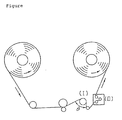
- Figure is a schematic view of an apparatus used for evaluating abrasion resistance in Example.
- the polyester to be used in the present invention is a polyester prepared from an aromatic dicarboxylic acid or its ester and a glycol.
- aromatic dicarboxylic acid are terephthalic acid, isophthalic acid, 2,6-naphthalene dicarboxylic acid, adipic acid, sebacic acid, oxycarboxylic acids (e.g. p-oxyethoxybenzoic acid, etc.) and the like. They may be used independently or as a mixture.
- the glycol are ethylene glycol, diethylene glycol, 1,4-cyclohexanedimethanol, butanediol, neopentyl glycol, and the like. They may be used independently or as a mixture.
- 80 % by mole or more of repeating units are ethylene-terephthalate repeating units or ethylene-2,6-naphthalate repeating units.
- polyester film of the present invention One of the most important properties of the polyester film of the present invention is that the aluminum oxide particles and the other particles are present in the film in the form of agglomerates of minute primary particles and contained in a comparatively thin part of at least one outermost layer (a slipping layer) (hereinafter referred to as "Layer A") of the film at a high concentration.
- Layer A a slipping layer
- the particles should be in the form of agglomerates of the primary particles and suitably dispersed in the film by an orientation stress.
- the present invention uses two kinds of the particles in the form of agglomerates, and they are piled up or mixed by the orientation stress.
- the aluminum oxide particles which improve the abrasion resistance and the other particles which form the minute protuberances are present in the formed protuberances at a significantly increased probability.
- each protuberance is hardly scraped off so that the film as a whole has improved abrasion resistance and scratch resistance, and the coefficient of friction after the repeating running is substantially the same as the original coefficient of friction, that is, the film has good running durability.
- particles which are present discretely and not in the agglomerate form are used as the other particles, they are not piled up on and mixed with the aluminum oxide particles by the orientation step. Then, the aluminum oxide particles are present in flat portions between the protuberances at a high probability.
- the aluminum oxide particles are preferably prepared from anhydrous aluminum chloride by flame hydrolysis in a gas phase, while aluminum oxide particles, which are prepared by hydrolyzing an aluminum alkoxide such as Al(OC2H7)3 or Al(OC4H9)3 in a liquid phase under suitable conditions to obtain particles having an average particle size of 1 ⁇ m or less, may be used. In the latter case, it may be possible to add an acid to a synthesized slurry to obtain a transparent sol, form a gel from the sol and heat the gel at a temperature of 500°C or higher to obtain a sintered material.
- the aluminum oxide particles prepared by the above methods often form agglomerates having a size of larger than 1 ⁇ m.
- the agglomerates having the suitable average particle size as defined above can be easily obtained by comminuting the coarse agglomerates.
- any of conventionally used apparatuses such as a rod mill, a ball mill, a hammer mill, an oscillating rod mill, an oscillating ball mill, a pan mill, a roller mill, an impact mill, an agitation grinder mill, a sand grinder mill, a nanomizer, a pearl mill and the like may be used.
- the coarse agglomerates may be comminuted by roughly grinding them by dry grinding, making a slurry in, for example, ethylene glycol, then wet grinding them and classifying (sieving) or filtrating them.
- the average particle size of the primary particles of the aluminum oxide particles is usually from 5 to 40 nm, preferably from 10 to 30 nm. This primary particle size can be achieved by selecting the conditions in the above production process.
- the average primary particle size is less than 5 nm, the particles in the agglomerates often strongly bond each other and are not separated by the orientation stress. Therefore, the specific effect of the present invention is not achieved.
- the average primary particle size is larger than 40 nm, the agglomerates themselves are too large or the number of the primary particles constituting the agglomerates deceases so that an extent of the spreading of the particles is limited when they are dispersed by the orientation stress, whereby they are not well piled up on or mixed with the other particles.
- the aluminum oxide particles are agglomerated in the slurry and their average particle size is from 50 to 400 nm.
- this particle size is less than 50 nm, the effect of the present invention is not achieved.
- this particle size is exceeds 400 nm, the magnetic characteristics of the magnetic tape using the polyester film deteriorates.
- aluminum oxide used in the present invention is ⁇ -aluminum oxide, while ⁇ - or ⁇ -aluminum oxide may be used.
- ⁇ -Aluminum oxide is not practically preferred, since it is hard and abrades apparatuses in the comminuting step of the aluminum oxide particles or melt extrusion of the polyester.
- a kind of other particle is not critical. Carbon black such as furnace black, thermal black, lamp black or acetylene black is preferred, since it is easily dispersed by the orientation stress during the film formation.
- the average primary particle size of the other particles is from 10 to 100 nm, preferably from 20 to 60 nm.
- the primary particle size of the other particles is less than 10 nm, an adhesive force between the primary particles are so strong that the agglomerates are not dispersed by the orientation stress.
- the primary particle size is larger than 100 nm, the number of the primary particles in each agglomerate with a suitable size decreases.
- Preferred examples of the carbon black having the above primary particle size are MCC, HAF, LFC, FF, LCC, LCF, ISAE and the like. FT is less preferred.
- the other particles are agglomerated in the slurry and their average particle size is from 100 to 400 nm.
- this particle size is less than 100 nm, the sliding property of the film cannot be improved.
- this particle size exceeds 400 nm, the film surface is roughened.
- the agglomerates of the other particles having the above average particle size they are dry or wet ground and optionally classified or filtrated as in the case of the aluminum oxide particles.
- the agglomerated particles are compounded in the polyester by dispersing the particles in ethylene glycol to form a slurry and then adding the slurry to a reaction system at an initial stage of the polymerization of the polyester, or by blending the agglomerated particles in the polyester resin and mixing them in an extruder.
- the agglomerates are preferably filtrated through a filter which has a large filtration area and achieves precise filtration to remove the coarse agglomerates.
- these two kinds of the particles are added to the raw material resin.
- the two kinds of the particles are contained in separate two portions of the resins and they are blended before the production of the film.
- the aluminum oxide particles and the other particles should be present in a mixed state at a high concentration in Layer A of the polyethylene film.
- the aluminum oxide particles are contained in a concentration of 0.1 to 5.0 %, preferably 0.3 to 3.0 % by weight based on the weight of the polyester in Layer A
- the other particles are contained in a concentration of 0.3 to 10 % by weight, preferably 0.5 to 7.0 % by weight based on the weight of the polyester in Layer A.
- the film has insufficient abrasion resistance and scratch resistance.
- concentration of the aluminum oxide particles exceeds 5.0 % by weight, the effect of the present invention is saturated and rather too coarse protuberances often appear.
- the concentration of the other particles is less than 0.3 % by weight, the film has the insufficient slipping property.
- concentration of the other particles exceeds 10 % by weight, the surface roughness of Layer A becomes too large to cause significant back-side transfer onto the magnetic layer.
- an existence probability of the discrete primary particles of each of aluminum oxide and the other particle should be not larger than 50 %, preferably not larger than 30 %.
- the existence probability of the discrete primary particles exceeds 50 %, the number of the particles which are present in the agglomerate form decreases so that the formation of the protuberances on the film surface is difficult and further the abrasion resistance and the scratch resistance are deteriorated.
- a balance between the dispersibility of the agglomerates and the strength of the orientation stress is suitably adjusted.
- the surface roughness of Layer A of the polyester film of the present invention is from 5 to 25 nm, preferably from 7 to 20 nm.
- Ra A is smaller than 5 nm, the good running property is not imparted to the magnetic tape.
- it exceeds 25 nm the back-side transfer onto the magnetic layer surface becomes significant and the electromagnetic conversion characteristics are deteriorated while the running property of the magnetic tape is good.
- a ratio of a height of the largest protuberance to Ra is not larger than 15, preferably not larger than 12, more preferably not larger than 10. If this ratio exceeds 15, many coarse protuberances form so that the back-side transfer onto the magnetic layer surface becomes significant and the electromagnetic conversion characteristics are deteriorated.
- the stress is concentrated at the coarse protuberances, whereby the running durability of the tape is unpreferably worsened.
- the polyester film of the present invention has the above polyester compositions in Layer A and other layer(s) (hereinafter referred to Layer B), the compositions of Layers A and B may be the same or different.
- each of the polyesters of Layers A and B has a melt viscosity of 500 to 20,000 poise when measured under a shear rate of 100/sec. at 280°C.
- melt viscosities of the polyesters of Layers A and B satisfy the equation:
- Layer A contains 0.001 to 10 % by weight of particles having an average particle size of 5 to 1000 nm in order to have a surface roughness Ra B of 5 to 40 nm.
- the polyester film of the present invention may consist of two layers (Layers A and B) or three or more layers (for example, Layer A/Layer B/Layer A).
- Layer B may be a laminate.
- Layer B is formed from a recycled polyester film, for example, slit edges, a yield of the film production can be increased.
- a thickness of Layer A or B is not critical.
- the thickness of Layer A is from 0.1 to 7.0 ⁇ m.
- the thickness of Layer A has some influence on the surface roughness of Layer A.
- Ra A decreases, while when this thickness increases, the Ra A increases.
- an amount of the other particles to be added to Layer A is increased when the thickness of Layer A is small, or decreased when the thickness of Layer A is large.
- the thickness of Layer A is smaller than 1 ⁇ m, the surface roughness of Layer A tends to increase by the influence of the surface roughness of Layer B.
- the particles having a small particle size is added to Layer B in a small amount.
- the thickness of Layer A exceeds 7 ⁇ m, to achieve the above defined Ra A and the Rt A /Ra A ratio, an amount of the other particles is made small. In this case, the effects of the present invention may not be achieved.
- Layers A and B are preferably laminated by coextrusion in view of the production cost and stability of the film quality, though they may be laminated by dry lamination.
- the coextrusion can be carried out by a per se conventional method. For example, using two or three extruders, streams of the polyester melt are joined in a two or three layer manifold or feed block to laminate them, extruded from a slot die, and cooled on a casting roll to obtain an unoriented film.
- a static mixer and a metering pump are provided in the melt line to maintain the uniformity of the film.
- polyester film of the present invention The production of the polyester film of the present invention will be explained more in detail.
- a compound for Layer A and a compound for Layer B are separately dried, if necessary, they are charged in the respective extruders and extruded at an extrusion temperature higher than a melting point and lower than a decomposition temperature to form a sheet.
- the laminate sheet is cooled and solidified on the casting roll to obtain the unoriented film.
- the laminate sheet is cooled and solidified by an electrostatic pinning method since the film having the uniform thickness is produced.
- the film is biaxially oriented.
- Either of sequential biaxial orientation and simultaneous biaxial orientation can be employed.
- sequential orientation by which the unoriented film is first oriented in a machine direction and then in a transverse direction is advantageous since the agglomerates of the particles in Layer A are dispersed and spread.
- an orientation temperature suitable for the specific polyester composition is selected from a temperature range between 50°C and 180°C, and a draw ratio is selected from a range between 3.0 and 7.0 times.
- the orientation may be carried out in one step, it can be carried out in two or more steps insofar as the orientation temperature and the draw ratio are in the above ranges.
- the multistep orientation is extremely advantageous for the dispersion of the agglomerates of the particles in Layer A.
- the orientation temperatures of the two or more steps may be the same or different.
- a orientation rate in the machine direction is preferably from 5000 to 70,000 %/min. in view of the uniformity of the film thickness.
- a tenter is used for the orientation of the film in the transverse direction.
- the film is oriented in the transverse direction at an orientation temperature of 80 to 170°C, at a draw ratio of 3.0 to 5.0 and at an orientation rate of 100 to 20,000 %/min.
- the oriented film is heat treated at a temperature of 170 to 250°C, preferably 180 to 230°C for 1 to 60 seconds. If necessary, after the orientation in the transverse direction, the film may be again oriented in the machine direction and then in the transverse direction. Thereafter, the oriented film may be again heat treated.
- a sample film of 100 nm in thickness is cut out with a microtome so that a cross section of the film in a thickness direction can be observed and embedded and fixed in a resin.
- a photograph of the sample is taken by a transmitting electron microscope (H-9000 manufactured by Hitachi Ltd., magnification of of 100,000, acceleration voltage of 300 kV, EPMA acceleration voltage of 300 kV), and particle sizes are measured.
- H-9000 manufactured by Hitachi Ltd. magnification of of 100,000, acceleration voltage of 300 kV, EPMA acceleration voltage of 300 kV
- particle sizes are measured.
- the average particle size is calculated as follow: With assuming each particle as an ellipse, its major and minor axes are measured and averaged. This averaged value is used as a primary particle size. One hundred particles are arbitrarily selected and their primary particle sizes are averaged to obtain the average particle size of the primary particles.
- a water-ethanol mixture (weight ratio of 80:20) for the carbon black particles or ethylene glycol for the aluminum oxide particles
- the particles are dispersed to prepare a slurry.
- the agglomerates are precipitated by a centrifugal sedimentation method using Disc Centrifuge-4 (manufactured by Joyce-Loebl) and their sizes are averaged to obtain the average particle size of agglomerates.
- the transmitting electron microphotograph of the sample is taken.
- the center line average roughness Ra and the largest protrusion height Rt are measured according to JIS B-0601-1976, with necessary modifications.
- the measuring conditions are the use of a contact needle having a tip radius of 2 ⁇ m, 30 mg of probe contact pressure, 0.08 mm of cutoff, and 2.5 mm of a measuring length.
- the measurement is performed at 12 points on the film and the measured values at 10 points were averaged with neglecting the maximum and minimum values.
- a composition which forms Layer A or B is dried and its melt viscosity ⁇ (poise) is measured using a flow tester (CFT-500 A manufactured by Shimadzu having a nozzle of 1 mm in diameter and 10mm in length) at 280°C, a shear rate of 100/sec.
- a flow tester CFT-500 A manufactured by Shimadzu having a nozzle of 1 mm in diameter and 10mm in length
- the cross section of the sample is observed by the transmitting electron microscope.
- the measurement is done at 10 different points in the machine direction or the transverse direction, and the thicknesses are averaged and a standard deviation is calculated. From the standard deviation, uniformity of the thickness is evaluated.
- the magnetic particles are magnetically oriented and the coated paint is dried. After super calendering the coated magnetic layer at 70°C under a linear pressure of 200 kg/cm, the magnetic layer is cured at 70°C for 48 hours. Then, the coated film is slit at a width of 1/2 inch to obtain a video tape.
- the video tape is set in a cassette and its electromagnetic conversion characteristics are evaluated using a NV-3700 video deck (manufactured by Matsushita Electric) as follows: The video tape is run and a VTR head output at a measuring frequency of 4 MHz is measured by a synchroscope. The measured value is expressed as a relative value (dB) to a VTR head output of a commercially available high grade video tape (0 dB).
- a coefficient of dynamic friction of the tape against a fixed hard chromium-plated metal pin having a diameter of 6 mm and a surface roughness of 3S is measured at an angle of contact of 135°.
- the tape is set so that the surface of Layer A contacts to the metal pin, and reciprocated with contacting the same part to the pin.
- the coefficient of friction is measured at the initial running (first time) and after repeated running (at 50th time) and compared.
- a film is run in a length of 200 m and an amount of white powder adhered to a fixed hard chromium-plated metal pin (I) having a diameter of 6 mm is evaluated with naked eyes and ranked according to the following criteria.
- the film speed is 10 m/min.
- the tension is about 200 g
- an angle of contact ( ⁇ ) is 135 °C.
- a sample film having a width of 1/2 inch is run at 4 m/sec. under a tension of 50 g with contacting to a fixed hard chromium-plated metal pin having a diameter of 6 mm at an angle of contact of 135°, one time. Then, on the contacted surface of the film, aluminum is vacuum deposited to a thickness of about 1000 ⁇ , and the scratched condition is evaluated by naked eyes and ranked according to the following criteria:
- Aluminum oxide powder prepared by the flame hydrolysis method was dispersed in ethylene glycol and wet ground by a sand grinder, followed by sieving and filtering to obtain a slurry in which agglomerates having an average particle size of 120 nm were dispersed.
- Dimethyl terephthalate (100 parts), ethylene glycol (65 parts) and magnesium acetate (0.09 part) were charged in a reactor and heated to effect transesterification while removing methanol. In about 4 hours from the start of the reaction, the temperature was raised to 230°C to complete the transesterification substantially.
- polyester Resin G a polyethylene terephthalate resin prepared by a conventional method and containing substantially no inactive particles
- HCF furnace carbon black
- Polyester Resins A and B were homogeneously mixed in a weight ratio of 2:1 and dried at 180°C under reduced pressure for 3 hours. Separately, Polyester Resin C alone was dried under the same conditions.
- the mixture of Polyester Resins A and B and Polyester Resin C were charged in two layer co-extruders and melt extruded at 280°C. In this case, they were charged in two extruders so that the mixture of Polyester Resins A and B formed Layer A and Polyester Resin C formed Layer B, and extrudates were joined and laminated in a feed block and extruded in a film from from a slot die. The film was cooled and solidified on a casting roll with applying the electrostatic pinning to obtain an unoriented two layer film. Discharge amounts were so adjusted that a thickness ratio of Layer A to Layer B was 1:14.
- the unoriented film was stretched in a machine direction at 85°C at a draw ratio of 2.4 times, and further at 92°C at a draw ratio of 1.3 times by roll stretching.
- the film was supplied to a tenter and stretched in a transverse direction at 110°C at a draw ratio of 3.8 times, followed by heat setting at 217°C to obtain a biaxially oriented film having a total thickness of 15 ⁇ m.
- the obtained film was stretched and heat set in the same manner as in Example 1 to obtain a biaxially oriented film having a total thickness of 15 ⁇ m.
- Polyester Resins D and B were mixed in a weight ratio of 1:1 and used for the formation of Layer A, and Polyester Resin C was used for the formation of Layer B.
- the coextrusion was carried out to produce a film having a three layer structure A/B/A of two kinds of the resins.
- the preparation conditions were the same as in Example 1 except that a feed block which joined and laminated the extrudates so that two Layers A surrounded Layer B was used, and discharge amounts were adjusted so that a thickness ratio of A/B/A was 0.5/14/0/5.
- the extruded film was cooled, stretched and heat set in the same manner as in Example 1. Thereby, a biaxially oriented film having a total thickness of 15 ⁇ m was obtained.
- Example 2 In the same manner as in the film preparation of Example 1 except that a thickness ratio of Layer A to Layer B was changed to 5:10, a biaxially oriented film having a total thickness of 15 ⁇ m was prepared.
Landscapes
- Chemical & Material Sciences (AREA)
- Health & Medical Sciences (AREA)
- Chemical Kinetics & Catalysis (AREA)
- Medicinal Chemistry (AREA)
- Polymers & Plastics (AREA)
- Organic Chemistry (AREA)
- Laminated Bodies (AREA)
- Compositions Of Macromolecular Compounds (AREA)
- Magnetic Record Carriers (AREA)
- Shaping By String And By Release Of Stress In Plastics And The Like (AREA)
Applications Claiming Priority (2)
| Application Number | Priority Date | Filing Date | Title |
|---|---|---|---|
| JP345960/91 | 1991-12-27 | ||
| JP3345960A JP3055278B2 (ja) | 1991-12-27 | 1991-12-27 | 二軸配向積層ポリエステルフィルム |
Publications (3)
| Publication Number | Publication Date |
|---|---|
| EP0550011A2 true EP0550011A2 (fr) | 1993-07-07 |
| EP0550011A3 EP0550011A3 (en) | 1993-10-20 |
| EP0550011B1 EP0550011B1 (fr) | 1998-02-25 |
Family
ID=18380175
Family Applications (1)
| Application Number | Title | Priority Date | Filing Date |
|---|---|---|---|
| EP92121904A Expired - Lifetime EP0550011B1 (fr) | 1991-12-27 | 1992-12-23 | Procédé de préparation d'un film de polyester stratifié orienté biaxialement |
Country Status (5)
| Country | Link |
|---|---|
| EP (1) | EP0550011B1 (fr) |
| JP (1) | JP3055278B2 (fr) |
| CA (1) | CA2086068A1 (fr) |
| DE (1) | DE69224510T2 (fr) |
| MX (1) | MX9207573A (fr) |
Cited By (4)
| Publication number | Priority date | Publication date | Assignee | Title |
|---|---|---|---|---|
| EP0638412A1 (fr) * | 1993-08-10 | 1995-02-15 | Toyo Boseki Kabushiki Kaisha | Film de polyester, feuille de métal laminée et conteneur en métal |
| WO1998007068A1 (fr) * | 1996-08-14 | 1998-02-19 | Imperial Chemical Industries Plc | Film de polyester |
| US5994360A (en) * | 1997-07-14 | 1999-11-30 | American Cyanamid Company | Fungicidal 5-alkyl-triazolopyrimidines |
| US6025056A (en) * | 1996-05-01 | 2000-02-15 | Toyo Seikan Kaisha, Ltd. | Laminate sheet and process for making a seamless can using the same |
Families Citing this family (1)
| Publication number | Priority date | Publication date | Assignee | Title |
|---|---|---|---|---|
| JP6023174B2 (ja) | 2012-03-29 | 2016-11-09 | リンテック株式会社 | ガスバリア性積層体、その製造方法、電子デバイス用部材及び電子デバイス |
Family Cites Families (2)
| Publication number | Priority date | Publication date | Assignee | Title |
|---|---|---|---|---|
| DE2428464B2 (de) * | 1973-06-14 | 1979-08-23 | Teijin Ltd., Osaka (Japan) | Biaxial verstreckte und wärmeverfestigte mehrschichtige Folie und deren Verwendung |
| JP2856283B2 (ja) * | 1989-06-02 | 1999-02-10 | 三菱化学ポリエステルフィルム株式会社 | 二軸配向ポリエステルフィルム |
-
1991
- 1991-12-27 JP JP3345960A patent/JP3055278B2/ja not_active Expired - Fee Related
-
1992
- 1992-12-22 CA CA002086068A patent/CA2086068A1/fr not_active Abandoned
- 1992-12-23 DE DE69224510T patent/DE69224510T2/de not_active Expired - Fee Related
- 1992-12-23 EP EP92121904A patent/EP0550011B1/fr not_active Expired - Lifetime
- 1992-12-24 MX MX9207573A patent/MX9207573A/es unknown
Cited By (6)
| Publication number | Priority date | Publication date | Assignee | Title |
|---|---|---|---|---|
| EP0638412A1 (fr) * | 1993-08-10 | 1995-02-15 | Toyo Boseki Kabushiki Kaisha | Film de polyester, feuille de métal laminée et conteneur en métal |
| US5498454A (en) * | 1993-08-10 | 1996-03-12 | Toyo Boseki Kabushiki Kaisha | Polyester film, laminated metal sheet and metal container |
| US6025056A (en) * | 1996-05-01 | 2000-02-15 | Toyo Seikan Kaisha, Ltd. | Laminate sheet and process for making a seamless can using the same |
| WO1998007068A1 (fr) * | 1996-08-14 | 1998-02-19 | Imperial Chemical Industries Plc | Film de polyester |
| EP2196849A1 (fr) * | 1996-08-14 | 2010-06-16 | DuPont Teijin Films U.S. Limited Partnership | Procédé pour la fabrication d'un film en polyester par coextrusion |
| US5994360A (en) * | 1997-07-14 | 1999-11-30 | American Cyanamid Company | Fungicidal 5-alkyl-triazolopyrimidines |
Also Published As
| Publication number | Publication date |
|---|---|
| DE69224510D1 (de) | 1998-04-02 |
| EP0550011B1 (fr) | 1998-02-25 |
| CA2086068A1 (fr) | 1993-06-28 |
| MX9207573A (es) | 1993-06-30 |
| EP0550011A3 (en) | 1993-10-20 |
| JP3055278B2 (ja) | 2000-06-26 |
| JPH05177795A (ja) | 1993-07-20 |
| DE69224510T2 (de) | 1998-09-17 |
Similar Documents
| Publication | Publication Date | Title |
|---|---|---|
| EP0401689A1 (fr) | Film de polyester orienté biaxialement | |
| EP0460640A1 (fr) | Film de polyester pour milieux d'enregistrement magnétiques | |
| EP0567974B1 (fr) | Film stratifié | |
| JPH07114723A (ja) | 磁気記録媒体用ポリエステルフィルム | |
| JP2925057B2 (ja) | 二軸配向積層ポリエステルフイルム | |
| EP0550011B1 (fr) | Procédé de préparation d'un film de polyester stratifié orienté biaxialement | |
| KR100255141B1 (ko) | 폴리에스테르조성물 및 그것으로 이루어지는 이축배향 폴리에스테르 필름 | |
| EP0501315B1 (fr) | Pellicule de polytéréphthalate d'éthylène pour support d'enregistrement magnétique | |
| EP0562486A1 (fr) | Film stratifié en polyester | |
| JP3413906B2 (ja) | 磁気記録媒体用ポリエステルフィルム | |
| JP2705398B2 (ja) | 二軸配向積層フイルム | |
| JP2897554B2 (ja) | 二軸配向フィルム | |
| JP2885176B2 (ja) | 配向ポリエステルフィルム | |
| JP2576321B2 (ja) | 二軸配向積層フイルム | |
| JP2530747B2 (ja) | 二軸配向積層ポリエステルフイルム | |
| JPH0584818A (ja) | 二軸配向積層フイルム | |
| JP2697360B2 (ja) | 二軸配向積層ポリエステルフィルム | |
| JP3139513B2 (ja) | 二軸配向積層ポリエステルフイルム | |
| JP3251660B2 (ja) | 磁気記録媒体用二軸配向ポリエステルフィルム | |
| JP3323409B2 (ja) | 積層二軸配向ポリエステルフイルム | |
| JP3235273B2 (ja) | 二軸配向積層ポリエステルフィルムおよびその製造方法 | |
| JPH06234907A (ja) | ポリエステルフィルム | |
| JP3123665B2 (ja) | 二軸配向積層フイルム | |
| JPH07113014A (ja) | 磁気記録媒体用ポリエステルフィルム | |
| JPH07114726A (ja) | 磁気記録媒体用ポリエステルフィルム |
Legal Events
| Date | Code | Title | Description |
|---|---|---|---|
| PUAI | Public reference made under article 153(3) epc to a published international application that has entered the european phase |
Free format text: ORIGINAL CODE: 0009012 |
|
| AK | Designated contracting states |
Kind code of ref document: A2 Designated state(s): DE FR GB IT LU NL |
|
| PUAL | Search report despatched |
Free format text: ORIGINAL CODE: 0009013 |
|
| AK | Designated contracting states |
Kind code of ref document: A3 Designated state(s): DE FR GB IT LU NL |
|
| 17P | Request for examination filed |
Effective date: 19940418 |
|
| 17Q | First examination report despatched |
Effective date: 19960617 |
|
| GRAG | Despatch of communication of intention to grant |
Free format text: ORIGINAL CODE: EPIDOS AGRA |
|
| GRAG | Despatch of communication of intention to grant |
Free format text: ORIGINAL CODE: EPIDOS AGRA |
|
| GRAG | Despatch of communication of intention to grant |
Free format text: ORIGINAL CODE: EPIDOS AGRA |
|
| GRAH | Despatch of communication of intention to grant a patent |
Free format text: ORIGINAL CODE: EPIDOS IGRA |
|
| GRAH | Despatch of communication of intention to grant a patent |
Free format text: ORIGINAL CODE: EPIDOS IGRA |
|
| GRAA | (expected) grant |
Free format text: ORIGINAL CODE: 0009210 |
|
| AK | Designated contracting states |
Kind code of ref document: B1 Designated state(s): DE FR GB IT LU NL |
|
| REF | Corresponds to: |
Ref document number: 69224510 Country of ref document: DE Date of ref document: 19980402 |
|
| ET | Fr: translation filed | ||
| ITF | It: translation for a ep patent filed | ||
| PLBE | No opposition filed within time limit |
Free format text: ORIGINAL CODE: 0009261 |
|
| STAA | Information on the status of an ep patent application or granted ep patent |
Free format text: STATUS: NO OPPOSITION FILED WITHIN TIME LIMIT |
|
| RAP4 | Party data changed (patent owner data changed or rights of a patent transferred) |
Owner name: MITSUBISHI POLYESTER FILM CORPORATION |
|
| 26N | No opposition filed | ||
| PGFP | Annual fee paid to national office [announced via postgrant information from national office to epo] |
Ref country code: FR Payment date: 20011119 Year of fee payment: 10 |
|
| PGFP | Annual fee paid to national office [announced via postgrant information from national office to epo] |
Ref country code: LU Payment date: 20011129 Year of fee payment: 10 |
|
| PGFP | Annual fee paid to national office [announced via postgrant information from national office to epo] |
Ref country code: GB Payment date: 20011221 Year of fee payment: 10 |
|
| PGFP | Annual fee paid to national office [announced via postgrant information from national office to epo] |
Ref country code: DE Payment date: 20011227 Year of fee payment: 10 |
|
| PGFP | Annual fee paid to national office [announced via postgrant information from national office to epo] |
Ref country code: NL Payment date: 20011231 Year of fee payment: 10 |
|
| REG | Reference to a national code |
Ref country code: GB Ref legal event code: IF02 |
|
| PG25 | Lapsed in a contracting state [announced via postgrant information from national office to epo] |
Ref country code: LU Free format text: LAPSE BECAUSE OF NON-PAYMENT OF DUE FEES Effective date: 20021223 Ref country code: GB Free format text: LAPSE BECAUSE OF NON-PAYMENT OF DUE FEES Effective date: 20021223 |
|
| PG25 | Lapsed in a contracting state [announced via postgrant information from national office to epo] |
Ref country code: NL Free format text: LAPSE BECAUSE OF NON-PAYMENT OF DUE FEES Effective date: 20030701 Ref country code: DE Free format text: LAPSE BECAUSE OF NON-PAYMENT OF DUE FEES Effective date: 20030701 |
|
| GBPC | Gb: european patent ceased through non-payment of renewal fee |
Effective date: 20021223 |
|
| NLV4 | Nl: lapsed or anulled due to non-payment of the annual fee |
Effective date: 20030701 |
|
| PG25 | Lapsed in a contracting state [announced via postgrant information from national office to epo] |
Ref country code: FR Free format text: LAPSE BECAUSE OF NON-PAYMENT OF DUE FEES Effective date: 20030901 |
|
| REG | Reference to a national code |
Ref country code: FR Ref legal event code: ST |
|
| PG25 | Lapsed in a contracting state [announced via postgrant information from national office to epo] |
Ref country code: IT Free format text: LAPSE BECAUSE OF NON-PAYMENT OF DUE FEES;WARNING: LAPSES OF ITALIAN PATENTS WITH EFFECTIVE DATE BEFORE 2007 MAY HAVE OCCURRED AT ANY TIME BEFORE 2007. THE CORRECT EFFECTIVE DATE MAY BE DIFFERENT FROM THE ONE RECORDED. Effective date: 20051223 |