EP0553005A1 - Plaque de matière synthétique comportant des motifs décoratifs dans la mase et son procédé de fabrication - Google Patents
Plaque de matière synthétique comportant des motifs décoratifs dans la mase et son procédé de fabrication Download PDFInfo
- Publication number
- EP0553005A1 EP0553005A1 EP93400088A EP93400088A EP0553005A1 EP 0553005 A1 EP0553005 A1 EP 0553005A1 EP 93400088 A EP93400088 A EP 93400088A EP 93400088 A EP93400088 A EP 93400088A EP 0553005 A1 EP0553005 A1 EP 0553005A1
- Authority
- EP
- European Patent Office
- Prior art keywords
- dye
- waste
- plate
- sheet
- plate according
- Prior art date
- Legal status (The legal status is an assumption and is not a legal conclusion. Google has not performed a legal analysis and makes no representation as to the accuracy of the status listed.)
- Granted
Links
- 238000004519 manufacturing process Methods 0.000 title claims description 16
- 239000002985 plastic film Substances 0.000 title description 3
- 229920002994 synthetic fiber Polymers 0.000 claims abstract description 18
- 239000002699 waste material Substances 0.000 claims description 21
- 239000000203 mixture Substances 0.000 claims description 18
- 238000000034 method Methods 0.000 claims description 13
- 238000001125 extrusion Methods 0.000 claims description 11
- 239000000155 melt Substances 0.000 claims description 6
- 239000011324 bead Substances 0.000 claims description 4
- 239000013502 plastic waste Substances 0.000 claims 1
- 238000004806 packaging method and process Methods 0.000 abstract description 2
- 238000004043 dyeing Methods 0.000 abstract 1
- 239000000975 dye Substances 0.000 description 14
- -1 polypropylene Polymers 0.000 description 10
- 239000004743 Polypropylene Substances 0.000 description 9
- 229920001155 polypropylene Polymers 0.000 description 9
- 239000003086 colorant Substances 0.000 description 8
- 239000002245 particle Substances 0.000 description 5
- 239000000463 material Substances 0.000 description 4
- 229920005989 resin Polymers 0.000 description 4
- 239000011347 resin Substances 0.000 description 4
- 239000004594 Masterbatch (MB) Substances 0.000 description 3
- 230000000694 effects Effects 0.000 description 3
- 239000008187 granular material Substances 0.000 description 3
- 125000006850 spacer group Chemical group 0.000 description 3
- 241000287107 Passer Species 0.000 description 2
- 208000024780 Urticaria Diseases 0.000 description 2
- 238000004040 coloring Methods 0.000 description 2
- 235000021183 entrée Nutrition 0.000 description 2
- 239000004033 plastic Substances 0.000 description 2
- 229920003023 plastic Polymers 0.000 description 2
- 239000002994 raw material Substances 0.000 description 2
- 238000011144 upstream manufacturing Methods 0.000 description 2
- 239000002023 wood Substances 0.000 description 2
- 239000004698 Polyethylene Substances 0.000 description 1
- 240000008042 Zea mays Species 0.000 description 1
- 239000000654 additive Substances 0.000 description 1
- 239000001045 blue dye Substances 0.000 description 1
- 238000003490 calendering Methods 0.000 description 1
- 238000009826 distribution Methods 0.000 description 1
- 239000012530 fluid Substances 0.000 description 1
- 239000006260 foam Substances 0.000 description 1
- 238000000227 grinding Methods 0.000 description 1
- 239000008240 homogeneous mixture Substances 0.000 description 1
- 238000002347 injection Methods 0.000 description 1
- 239000007924 injection Substances 0.000 description 1
- 239000000049 pigment Substances 0.000 description 1
- 229920000573 polyethylene Polymers 0.000 description 1
- 230000003252 repetitive effect Effects 0.000 description 1
- 238000003860 storage Methods 0.000 description 1
- 229920001169 thermoplastic Polymers 0.000 description 1
- 239000012815 thermoplastic material Substances 0.000 description 1
- 239000004416 thermosoftening plastic Substances 0.000 description 1
- 230000009466 transformation Effects 0.000 description 1
- 229920006352 transparent thermoplastic Polymers 0.000 description 1
- 239000012463 white pigment Substances 0.000 description 1
Images
Classifications
-
- B—PERFORMING OPERATIONS; TRANSPORTING
- B44—DECORATIVE ARTS
- B44C—PRODUCING DECORATIVE EFFECTS; MOSAICS; TARSIA WORK; PAPERHANGING
- B44C3/00—Processes, not specifically provided for elsewhere, for producing ornamental structures
- B44C3/04—Modelling plastic materials, e.g. clay
-
- B—PERFORMING OPERATIONS; TRANSPORTING
- B29—WORKING OF PLASTICS; WORKING OF SUBSTANCES IN A PLASTIC STATE IN GENERAL
- B29C—SHAPING OR JOINING OF PLASTICS; SHAPING OF MATERIAL IN A PLASTIC STATE, NOT OTHERWISE PROVIDED FOR; AFTER-TREATMENT OF THE SHAPED PRODUCTS, e.g. REPAIRING
- B29C48/00—Extrusion moulding, i.e. expressing the moulding material through a die or nozzle which imparts the desired form; Apparatus therefor
- B29C48/03—Extrusion moulding, i.e. expressing the moulding material through a die or nozzle which imparts the desired form; Apparatus therefor characterised by the shape of the extruded material at extrusion
- B29C48/07—Flat, e.g. panels
-
- B—PERFORMING OPERATIONS; TRANSPORTING
- B29—WORKING OF PLASTICS; WORKING OF SUBSTANCES IN A PLASTIC STATE IN GENERAL
- B29C—SHAPING OR JOINING OF PLASTICS; SHAPING OF MATERIAL IN A PLASTIC STATE, NOT OTHERWISE PROVIDED FOR; AFTER-TREATMENT OF THE SHAPED PRODUCTS, e.g. REPAIRING
- B29C48/00—Extrusion moulding, i.e. expressing the moulding material through a die or nozzle which imparts the desired form; Apparatus therefor
- B29C48/16—Articles comprising two or more components, e.g. co-extruded layers
- B29C48/17—Articles comprising two or more components, e.g. co-extruded layers the components having different colours
- B29C48/175—Articles comprising two or more components, e.g. co-extruded layers the components having different colours comprising a multi-coloured single component, e.g. striated, marbled or wood-like patterned
-
- B—PERFORMING OPERATIONS; TRANSPORTING
- B29—WORKING OF PLASTICS; WORKING OF SUBSTANCES IN A PLASTIC STATE IN GENERAL
- B29C—SHAPING OR JOINING OF PLASTICS; SHAPING OF MATERIAL IN A PLASTIC STATE, NOT OTHERWISE PROVIDED FOR; AFTER-TREATMENT OF THE SHAPED PRODUCTS, e.g. REPAIRING
- B29C48/00—Extrusion moulding, i.e. expressing the moulding material through a die or nozzle which imparts the desired form; Apparatus therefor
- B29C48/25—Component parts, details or accessories; Auxiliary operations
- B29C48/285—Feeding the extrusion material to the extruder
- B29C48/29—Feeding the extrusion material to the extruder in liquid form
-
- B—PERFORMING OPERATIONS; TRANSPORTING
- B29—WORKING OF PLASTICS; WORKING OF SUBSTANCES IN A PLASTIC STATE IN GENERAL
- B29C—SHAPING OR JOINING OF PLASTICS; SHAPING OF MATERIAL IN A PLASTIC STATE, NOT OTHERWISE PROVIDED FOR; AFTER-TREATMENT OF THE SHAPED PRODUCTS, e.g. REPAIRING
- B29C48/00—Extrusion moulding, i.e. expressing the moulding material through a die or nozzle which imparts the desired form; Apparatus therefor
- B29C48/001—Combinations of extrusion moulding with other shaping operations
- B29C48/0011—Combinations of extrusion moulding with other shaping operations combined with compression moulding
-
- B—PERFORMING OPERATIONS; TRANSPORTING
- B29—WORKING OF PLASTICS; WORKING OF SUBSTANCES IN A PLASTIC STATE IN GENERAL
- B29C—SHAPING OR JOINING OF PLASTICS; SHAPING OF MATERIAL IN A PLASTIC STATE, NOT OTHERWISE PROVIDED FOR; AFTER-TREATMENT OF THE SHAPED PRODUCTS, e.g. REPAIRING
- B29C48/00—Extrusion moulding, i.e. expressing the moulding material through a die or nozzle which imparts the desired form; Apparatus therefor
- B29C48/001—Combinations of extrusion moulding with other shaping operations
- B29C48/0018—Combinations of extrusion moulding with other shaping operations combined with shaping by orienting, stretching or shrinking, e.g. film blowing
-
- B—PERFORMING OPERATIONS; TRANSPORTING
- B29—WORKING OF PLASTICS; WORKING OF SUBSTANCES IN A PLASTIC STATE IN GENERAL
- B29C—SHAPING OR JOINING OF PLASTICS; SHAPING OF MATERIAL IN A PLASTIC STATE, NOT OTHERWISE PROVIDED FOR; AFTER-TREATMENT OF THE SHAPED PRODUCTS, e.g. REPAIRING
- B29C48/00—Extrusion moulding, i.e. expressing the moulding material through a die or nozzle which imparts the desired form; Apparatus therefor
- B29C48/03—Extrusion moulding, i.e. expressing the moulding material through a die or nozzle which imparts the desired form; Apparatus therefor characterised by the shape of the extruded material at extrusion
- B29C48/07—Flat, e.g. panels
- B29C48/08—Flat, e.g. panels flexible, e.g. films
-
- B—PERFORMING OPERATIONS; TRANSPORTING
- B29—WORKING OF PLASTICS; WORKING OF SUBSTANCES IN A PLASTIC STATE IN GENERAL
- B29C—SHAPING OR JOINING OF PLASTICS; SHAPING OF MATERIAL IN A PLASTIC STATE, NOT OTHERWISE PROVIDED FOR; AFTER-TREATMENT OF THE SHAPED PRODUCTS, e.g. REPAIRING
- B29C48/00—Extrusion moulding, i.e. expressing the moulding material through a die or nozzle which imparts the desired form; Apparatus therefor
- B29C48/16—Articles comprising two or more components, e.g. co-extruded layers
- B29C48/17—Articles comprising two or more components, e.g. co-extruded layers the components having different colours
-
- B—PERFORMING OPERATIONS; TRANSPORTING
- B29—WORKING OF PLASTICS; WORKING OF SUBSTANCES IN A PLASTIC STATE IN GENERAL
- B29K—INDEXING SCHEME ASSOCIATED WITH SUBCLASSES B29B, B29C OR B29D, RELATING TO MOULDING MATERIALS OR TO MATERIALS FOR MOULDS, REINFORCEMENTS, FILLERS OR PREFORMED PARTS, e.g. INSERTS
- B29K2023/00—Use of polyalkenes or derivatives thereof as moulding material
- B29K2023/10—Polymers of propylene
- B29K2023/12—PP, i.e. polypropylene
-
- B—PERFORMING OPERATIONS; TRANSPORTING
- B29—WORKING OF PLASTICS; WORKING OF SUBSTANCES IN A PLASTIC STATE IN GENERAL
- B29K—INDEXING SCHEME ASSOCIATED WITH SUBCLASSES B29B, B29C OR B29D, RELATING TO MOULDING MATERIALS OR TO MATERIALS FOR MOULDS, REINFORCEMENTS, FILLERS OR PREFORMED PARTS, e.g. INSERTS
- B29K2105/00—Condition, form or state of moulded material or of the material to be shaped
- B29K2105/0005—Condition, form or state of moulded material or of the material to be shaped containing compounding ingredients
-
- B—PERFORMING OPERATIONS; TRANSPORTING
- B29—WORKING OF PLASTICS; WORKING OF SUBSTANCES IN A PLASTIC STATE IN GENERAL
- B29K—INDEXING SCHEME ASSOCIATED WITH SUBCLASSES B29B, B29C OR B29D, RELATING TO MOULDING MATERIALS OR TO MATERIALS FOR MOULDS, REINFORCEMENTS, FILLERS OR PREFORMED PARTS, e.g. INSERTS
- B29K2995/00—Properties of moulding materials, reinforcements, fillers, preformed parts or moulds
- B29K2995/0018—Properties of moulding materials, reinforcements, fillers, preformed parts or moulds having particular optical properties, e.g. fluorescent or phosphorescent
- B29K2995/002—Coloured
- B29K2995/0021—Multi-coloured
-
- B—PERFORMING OPERATIONS; TRANSPORTING
- B29—WORKING OF PLASTICS; WORKING OF SUBSTANCES IN A PLASTIC STATE IN GENERAL
- B29L—INDEXING SCHEME ASSOCIATED WITH SUBCLASS B29C, RELATING TO PARTICULAR ARTICLES
- B29L2007/00—Flat articles, e.g. films or sheets
- B29L2007/008—Wide strips, e.g. films, webs
-
- B—PERFORMING OPERATIONS; TRANSPORTING
- B29—WORKING OF PLASTICS; WORKING OF SUBSTANCES IN A PLASTIC STATE IN GENERAL
- B29L—INDEXING SCHEME ASSOCIATED WITH SUBCLASS B29C, RELATING TO PARTICULAR ARTICLES
- B29L2031/00—Other particular articles
- B29L2031/722—Decorative or ornamental articles
Definitions
- the invention relates to a plate or sheet of synthetic material, more particularly a polypropylene plate, which has decorative patterns, preferably repetitive and this en masse.
- the invention further relates to a method of manufacturing such a plate.
- Sheets of synthetic material are already known which are of a single mass color and which are moreover printable. For example, plates from a few tenths of a millimeter to a few millimeters thick are used which are made of polypropylene for packaging, advertising and stationery. These plates are manufactured by the applicant, by introducing into a mixing hopper the components: synthetic material, dyes and additives in given quantities. The mixture is then introduced into a screw extruder, then exits through a flat die in the form of a sheet which then passes between the cylinders of a calender.
- An object of the invention is therefore to reuse the waste obtained during the manufacture and / or processing of plastic plates.
- Another object of the invention is to avoid the storage of waste. In fact, during manufacture, this waste is currently recycled by regrinding it and reintroducing it into the hopper. However, this waste is stored before reintroduction and consumed slowly.
- Yet another object of the invention is to manufacture plates having an aesthetic appearance different from the plates of the prior art, but having similar mechanical characteristics, namely impact resistance, rigidity, tear, printability, etc.
- the invention therefore relates to a plate of synthetic material comprising decorative patterns, characterized in that the patterns consist of heterogeneities in mass tints, a first series (13) of patterns being arranged on one face of the plate and a second series (15) of patterns being arranged on the opposite face of the plate.
- Document DE-A-3 334 269 describes a method and a device for the production of bands having a marbled appearance.
- a mixture extruder 1 and a distribution extruder are used 2. These extruders are connected by a central part 4.
- a granulate is introduced upstream of the extruder screw 2. This granulate is at room temperature. Then at the outlet of the extruder 2, the material is passed between two calenders 16 which crush the aggregates to give a marbled effect to the sheet.
- the decorative effect is only found on one side.
- Document JP-60 015 116 describes an extrusion process which makes it possible to obtain a color change without losing resin. A homogeneous mixture is obtained.
- Document JP-53 090 372 describes a coextrusion process. Homogeneous and regular lines are obtained on one face of the manufactured plate. We obtain a natural and parallel grain pattern. The colored resin is extruded through a conduit which has small holes.
- a plastic sheet is thus produced which has designs similar to the grain of the wood.
- the document JP 53 041366 describes a process for manufacturing synthetic beams.
- a core of thermoplastic foam is extruded and a layer of transparent thermoplastic resin is coextruded coaxially.
- a drawing similar to a wood grain is formed thanks to a die which has engravings.
- Document GB-A-617 266 describes the manufacture of a plastic sheet having a marbled appearance by calendering.
- the plate is such that on one side, the patterns consist of a background of substantially uniform color and stripes of color different from the background.
- the lines are non-rectilinear and substantially parallel to each other.
- the patterns consist of the same background and rectilinear lines parallel but perpendicular to the lines of the opposite face.
- the plate consists of a mixture of at least one synthetic material from waste obtained during the manufacture and / or transformation of a plate of synthetic material of homogeneous color and a dye.
- the plate consists of a mixture of two colored synthetic materials having a Melt Index of between 2 and 20 and of a dye suitable for non-colored synthetic materials having a Melt Index of between 1 and 10.
- the process according to the invention is such that a cross flow mixer is used between the outlet of the extrusion screw and the die, which has the function of directing the flows of synthetic material and dye.
- a cross-flow mixer consists of a tubular housing, at least one mixing element comprising two or more two spacers inclined relative to the longitudinal axis of the housing, each mixing element having spacers intersecting with adjacent spacers .
- a mixer is described for example in document EP-A-154,013, filed by Gebrüder SULZER.
- the process is also such that a bead of synthetic material and coloring mixture is formed between two rolls of the calender.
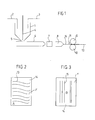
- FIG. 1 represents a device used for the manufacture of a plate according to the invention.
- a container 1 for example a hopper, a black polypropylene waste by line 2 and a mixture of polypropylene waste by line 3.
- This mixture comprises particles of all colors from the grinding of variously colored waste from manufacturing and / or processing scraps.
- the waste particles have for example a Melt Index of 2 to 20.
- a dye is introduced, more particularly a mixture of polypropylene with a white pigment, called "masterbatch".
- This dye is introduced via line 4, at outlet 5 of container 1, located at the inlet of extrusion screw 6.
- the masterbatch is suitable for homogeneous mixing with plastics having a Melt Index between 1 and 2. Because the waste particles are heated to around 200 ° C in the screw, they soften and melt and are more fluid than particles from raw materials.
- the master dye mixture mixes non-homogeneously with this waste during extrusion.
- the colored mixture is then passed in a non-homogeneous manner through a cross-flow mixer 7 which directs the different more or less colored flows of material.
- the result of the mixer is to form dark lines on the side B of the sheet F (see FIG. 3).
- the mixture is passed through a die 8 to form a sheet 14 which passes between the cylinders 9, 10 of a calender.
- a bead 11 of non-homogeneous colored material is formed upstream of the cylinders, this bead having the result of forming the welts 13 on the face Ade of the sheet F (see FIG. 2).
- the dye is introduced discontinuously to obtain an inhomogeneous coloring of the material.
- 50 parts by weight of black polypropylene waste ground with 50 parts of polypropylene waste of different colors are introduced into a hopper and 2 parts by weight of a white dye are introduced at the outlet of the hopper in the form of a masterbatch.
- the composition is extruded in an extruder screw, then it is passed through a cross-flow mixer then a die, and finally, between the cylinders of a calender.
- the welts and stripes are in the mass.
- Example 1 100 parts by weight of granules of white polypropylene raw material and 2 parts by weight of a blue dye are introduced into a hopper.
- the sheet is produced according to Example 1.
- a sheet is obtained having a light blue background, on one side of the dark blue stripes, and on the opposite side of the dark blue stripes, the stripes and stripes being in the mass.
Landscapes
- Engineering & Computer Science (AREA)
- Mechanical Engineering (AREA)
- Chemical & Material Sciences (AREA)
- Dispersion Chemistry (AREA)
- Extrusion Moulding Of Plastics Or The Like (AREA)
- Processing And Handling Of Plastics And Other Materials For Molding In General (AREA)
Abstract
Description
- L'invention concerne une plaque ou feuille de matière synthétique, plus particulièrement une plaque de polypropylène, qui comporte des motifs décoratifs, de préférence répétitifs et ce en masse. L'invention concerne en outre un procédé de fabrication d'une telle plaque.
- On connaît déjà des feuilles de matière synthétique (polyéthylène, polypropylène, etc.) qui sont d'une seule teinte en masse et qui sont par ailleurs imprimables. Par exemple, on utilise des plaques de quelques dixièmes de millimètres à quelques millimètres d'épaisseur qui sont en polypropylène pour l'emballage, la publicité, la papeterie. Ces plaques sont fabriquées par la demanderesse, en introduisant dans une trémie mélangeuse les composants : matière synthétique, colorants et additifs en quantités données. Le mélange est ensuite introduit dans une extrudeuse à vis, puis sort à travers une filière plate sous forme de feuille qui passe ensuite entre les cylindres d'une calandre.
- Lors de la fabrication d'une telle plaque, on obtient des chutes qui ont diverses couleurs et diverses formes et ce lors du démarrage de la production, du réglage des machines, des bords de laize. Ces plaques sont ensuite découpées chez des transformateurs qui sont alors en possession de chutes inutilisables. On obtient donc de multiples déchets qui grèvent la rentabilité des produits et qui en outre sont difficiles à éliminer en préservant l'environnement.
- Un but de l'invention est donc de réutiliser les déchets obtenus lors de la fabrication et/ou la transformation de plaques de matière synthétique.
- Un autre but de l'invention est d'éviter le stockage des déchets. En effet, lors de la fabrication, on recycle actuellement ces déchets en les rebroyant et en les réintroduisant dans la trémie. Cependant, ces déchets sont stockés avant réintroduction et consommés lentement.
- Encore un but de l'invention est de fabriquer des plaques ayant un aspect esthétique différent des plaques de la technique antérieure, mais ayant des caractéristiques mécaniques voisines,à savoir résistance au choc, rigidité, déchirure, imprimabilité, etc.
- L'invention concerne donc une plaque de matière synthétique comportant des motifs décoratifs, caractérisée par le fait que les motifs sont constitués par des hétérogénéités de teintes en masse, une première série (13) de motifs étant disposée sur une face de la plaque et une seconde série (15) de motifs étant disposée sur la face opposée de la plaque.
- On a décrit dans la technique antérieure des dispositifs et procédés pour obtenir des plaques à effet décoratif. Cependant les dispositifs et procédés décrits ne permettent pas d'obtenir une plaque selon l'invention.
- Le document US-A-3 148 412 décrit une vis extrudeuse pour mélanger de façon homogène un matériau thermoplastique avec un pigment.
- Le document DE-A-3 334 269 décrit un procédé et un dispositif pour la fabrication de bandes ayant un aspect marbré. On utilise une extrudeuse de mélange 1 et une extrudeuse de distribution 2. Ces extrudeuses sont reliées par une partie centrale 4. On introduit un granulat en amont de la vis extrudeuse 2. Ce granulat est à température ambiante. Puis en sortie de l'extrudeuse 2 on fait passer la matière entre deux calandres 16 qui écrasent les granulats pour donner un effet marbré à la feuille.
- L'effet décoratif ne se retrouve que sur une face.
- Le document JP-60 015 116 décrit un procédé d'extrusion qui permet d'obtenir un changement de couleur sans perdre de résine. On obtient un mélange homogène.
- Le document US-A-3 477 698 décrit un dispositif pour fournir un mélange uniforme à une vis d'injection. On effectue une turbulence cycloïdale de particules de résine.
- Le document JP-53 090 372 décrit un procédé de coextrusion. On obtient des raies homogènes et régulières sur une face de la plaque fabriquée. On obtient un dessin de grain naturel et parallèle. La résine colorée est extrudée par un conduit qui comporte des petits trous.
- On fabrique ainsi une feuille de plastique qui a des dessins semblables au grain du bois.
- Le document JP 53 041366 décrit un procédé pour fabriquer des poutres synthétiques. On extrude un noyau de mousse thermoplastique et on coextru- de coaxialement une couche de résine thermoplastique transparente. On forme un dessin semblable à un grain de bois grâce à une filière qui possède des gravures.
- Le document US-A-3 761 552 décrit un procédé pour fabriquer un fil multicolore.
- Le document GB-A-617 266 décrit la fabrication d'une feuille plastique ayant un aspect marbré par calandrage.
- La plaque est telle que sur une face, les motifs sont constitués d'un fond de couleur sensiblement homogène et de raies de couleur différente du fond. De préférence, les raies sont non rectilignes et sensiblement parallèles les unes aux autres. Sur la face opposée de la plaque, les motifs sont constitués du même fond et de raies rectilignes parallèles mais perpendiculaires aux raies de la face opposée.
- La plaque est constituée d'un mélange d'au moins une matière synthétique provenant de déchets obtenus lors de la fabrication et/ou la transformation d'une plaque de matière synthétique de couleur homogène et d'un colorant.
- De préférence, la plaque est constituée d'un mélange de deux matières synthétiques colorées ayant un Melt Index compris entre 2 et 20 et d'un colorant adapté pour des matières synthétiques non colorées ayant un Melt Index compris entre 1 et 10.
- L'invention concerne en outre un procédé de fabrication de telles feuilles. Le procédé est tel que :
- a) on broye des déchets de matière synthétique colorée,
- b) on introduit ces déchets dans un récipient,
- c) on introduit au moins un colorant dans ledit récipient,
- d) on injecte les déchets et le colorant à l'entrée d'une vis d'extrusion,
- e) on fait passer le mélange dans une filière pour obtenir une feuille,
- f) on fait passer la feuille entre les cylindres d'une calandre, le colorant n'étant pas mélangé avec les déchets dans le récipient, mais étant introduit à la sortie du récipient, à l'entrée de la vis d'extrusion et le colorant étant introduit de façon séquentielle, c'est-à-dire que le colorant n'est pas introduit en continu.
- Le procédé selon l'invention est tel que l'on utilise entre la sortie de la vis d'extrusion et la filière, un mélangeur à flux croisé qui a pour fonction d'orienter les flux de matière synthétique et colorant.
- Un mélangeur à flux croisé est constitué d'un boîtier tubulaire, d'au moins un élément mélangeur comportant deux ou plus de deux entretoises inclinées par rapport à l'axe longitudinal du boîtier, chaque élément mélangeur présentant des entretoises se croisant avec des entretoises contigües. Un tel mélangeur est décrit par exemple dans le document EP-A-154 013, déposé par Gebrüder SULZER.
- Le procédé est encore tel que l'on forme un bourrelet de mélange matière synthétique et colorant entre deux rouleaux de la calandre.
- L'invention sera mieux comprise à l'aide des dessins et exemples suivants annexés de façon non limitative.
- La figure 1 est une vue schématique du dispositif utilisé pour l'obtention d'une plaque selon l'invention.
- La figure 2 est une vue d'une face de la plaque selon l'invention.
- La figure 3 est une vue de la face opposée de la plaque selon l'invention.
- La figure 1 représente un dispositif utilisé pour la fabrication d'une plaque selon l'invention. On introduit dans un récipient 1, par exemple une trémie, un déchet de polypropylène noir par la conduite 2 et un mélange de déchets de polypropylène par la conduite 3. Ce mélange comporte des particules de toutes couleurs provenant du broyage de déchets diversement colorés provenant de chutes de fabrication et/ou de transformation. Les particules de déchets ont par exemple un Melt Index de 2 à 20. On introduit un colorant, plus particulièrement un mélange de polypropylène avec un pigment blanc, appelé "mélange maître". Ce colorant est introduit par la conduite 4, en sortie 5 du récipient 1, située à l'entrée de la vis 6 d'extrusion. Le mélange maître est adapté pour se mélanger de façon homogène avec des matières synthétiques ayant un Melt Index compris entre 1 et 2. Du fait que les particules de déchets sont chauffées à environ 200°C dans la vis, elles se ramollissent et se fondent et sont plus fluides que des particules qui proviennent de matières premières. Le mélange maître colorant se mélange de façon non homogène avec ces déchets lors de l'extrusion.
- On fait passer ensuite le mélange coloré de façon non homogène dans un mélangeur à flux croisé 7 qui oriente les différents flux plus ou moins colorés de matière. Le mélangeur a pour résultat de former des raies sombres 15 sur la face B de la feuille F (voir figure 3).
- Puis, on fait passer le mélange dans une filière 8 pour former une feuille 14 qui passe entre les cylindres 9, 10 d'une calandre. On forme un bourrelet 11 de matière colorée non homogène en amont des cylindres, ce bourrelet ayant pour résultat de former les zébrures 13 sur la face Ade la feuille F (voirfigure 2).
- On introduit le colorant de façon discontinue pour obtenir une coloration non homogène de la matière.
- On introduit dans une trémie 50 parties en poids de déchets de polypropylène noir broyés avec 50 parties de déchets de polypropylène de différentes couleurs et on introduit en sortie de la trémie, 2 parties en poids d'un colorant blanc sous forme de mélange maître. On extrude la composition dans une vis extrudeuse, puis on la fait passer dans un mélangeur à flux croisé puis une filière, et enfin, entre les cylindres d'une calandre. On obtient une feuille ayant un fond gris et des zébrures gris clair sur une face, et sur la face opposée des rayures gris foncé sur un fond gris. Les zébrures et les rayures sont dans la masse.
- On introduit dans une trémie 100 parties en poids de granulés de matière première blanche de polypropylène et 2 parties en poids d'un colorant bleu. On fabrique la feuille selon l'exemple 1. On obtient une feuille ayant un fond bleu clair, sur une face des zébrures bleu foncé, et sur la face opposée des rayures bleu foncé, les rayures et zébrures étant dans la masse.
Claims (10)
caractérisé par le fait que l'on introduit le colorant de façon séquentielle.
Applications Claiming Priority (2)
| Application Number | Priority Date | Filing Date | Title |
|---|---|---|---|
| FR9200790 | 1992-01-24 | ||
| FR9200790A FR2686544B1 (fr) | 1992-01-24 | 1992-01-24 | Plaque de matiere synthetique comportant des motifs decoratifs dans la masse et son procede de fabrication par extrusion et calaudage. |
Publications (2)
| Publication Number | Publication Date |
|---|---|
| EP0553005A1 true EP0553005A1 (fr) | 1993-07-28 |
| EP0553005B1 EP0553005B1 (fr) | 1996-12-27 |
Family
ID=9425964
Family Applications (1)
| Application Number | Title | Priority Date | Filing Date |
|---|---|---|---|
| EP93400088A Expired - Lifetime EP0553005B1 (fr) | 1992-01-24 | 1993-01-15 | Plaque de matière synthétique comportant des motifs décoratifs dans la mase et son procédé de fabrication |
Country Status (3)
| Country | Link |
|---|---|
| EP (1) | EP0553005B1 (fr) |
| DE (1) | DE69306819D1 (fr) |
| FR (1) | FR2686544B1 (fr) |
Cited By (2)
| Publication number | Priority date | Publication date | Assignee | Title |
|---|---|---|---|---|
| WO1999028110A1 (fr) * | 1997-12-04 | 1999-06-10 | Misawa Homes Co., Ltd. | Procede de fabrication d'un dispositif de moulage et de melange pour le moulage industriel |
| FR3060015A1 (fr) * | 2016-12-08 | 2018-06-15 | Chryso | Composition comprenant des pigments composites luminescents colores et objets plastiques obtenus |
Citations (15)
| Publication number | Priority date | Publication date | Assignee | Title |
|---|---|---|---|---|
| GB617266A (en) | 1945-11-20 | 1949-02-03 | Armstrong Cork Co | Improvements in or relating to the manufacture of variegated plastic sheet material |
| FR1308573A (fr) * | 1961-05-30 | 1962-11-09 | Dow Chemical Co | Procédé de mélange de masses en circulation par formation d'interfaces dans une masse fluide en circulation |
| US3148412A (en) | 1960-06-22 | 1964-09-15 | Onderzoekings Inst Res | Screw extruder for mixing plastic material with a pigment |
| US3310619A (en) * | 1963-06-06 | 1967-03-21 | American Biltrite Rubber Co | Vinyl-acrylic floor covering and process |
| GB1111054A (en) * | 1965-10-22 | 1968-04-24 | Rowland Products Inc | Method and apparatus for extruding multicolored sheet material and sheet material produced thereby |
| US3477698A (en) | 1968-04-10 | 1969-11-11 | Dow Chemical Co | Method and apparatus for additive feeding |
| US3761552A (en) | 1971-02-12 | 1973-09-25 | Chevron Res | Process for making moresque yarn from polymer film |
| US3892390A (en) * | 1973-04-23 | 1975-07-01 | Thomas J Eauclaire | Method and means for putting additive in plastic and other materials |
| FR2351776A1 (fr) * | 1976-05-19 | 1977-12-16 | Dynamit Nobel Ag | Procede et dispositif d'extrusion de bandes de matieres thermoplastiques comportant un dessin |
| JPS5341366B1 (fr) | 1970-06-29 | 1978-11-02 | ||
| DE3334269A1 (de) | 1983-09-22 | 1985-04-11 | Hermann Berstorff Maschinenbau Gmbh, 3000 Hannover | Verfahren und einrichtung zur herstellung marmorierter bahnen aus thermoplastischen kunststoffen oder kautschuk |
| JPS6015116B2 (ja) | 1977-11-28 | 1985-04-17 | 松下電工株式会社 | 光電式自動点滅器の受光回路 |
| EP0154013A2 (fr) | 1984-03-05 | 1985-09-11 | GebràDer Sulzer Aktiengesellschaft | Mélangeur statique, en particulier pour appareils de traitement des matières synthétiques fondues à haute viscosité |
| US4836814A (en) * | 1987-11-10 | 1989-06-06 | Packaging Industries Group, Inc. | Multicolored foam and method for making |
| WO1990006218A1 (fr) * | 1988-12-06 | 1990-06-14 | Schaumstoffwerk Greiner Gesellschaft M.B.H. | Preforme en dechets de matiere synthetique files ou extrudes |
Family Cites Families (2)
| Publication number | Priority date | Publication date | Assignee | Title |
|---|---|---|---|---|
| JPS5922666B2 (ja) * | 1977-01-19 | 1984-05-28 | 三菱樹脂株式会社 | 柾目模様を有する押出成形品の製造法 |
| JPS5341366A (en) * | 1977-10-07 | 1978-04-14 | Aoi Purasuchitsuku Kk | Process for manufacture of extruded double layer bar having grain pattern on surface |
-
1992
- 1992-01-24 FR FR9200790A patent/FR2686544B1/fr not_active Expired - Fee Related
-
1993
- 1993-01-15 EP EP93400088A patent/EP0553005B1/fr not_active Expired - Lifetime
- 1993-01-15 DE DE69306819T patent/DE69306819D1/de not_active Expired - Lifetime
Patent Citations (15)
| Publication number | Priority date | Publication date | Assignee | Title |
|---|---|---|---|---|
| GB617266A (en) | 1945-11-20 | 1949-02-03 | Armstrong Cork Co | Improvements in or relating to the manufacture of variegated plastic sheet material |
| US3148412A (en) | 1960-06-22 | 1964-09-15 | Onderzoekings Inst Res | Screw extruder for mixing plastic material with a pigment |
| FR1308573A (fr) * | 1961-05-30 | 1962-11-09 | Dow Chemical Co | Procédé de mélange de masses en circulation par formation d'interfaces dans une masse fluide en circulation |
| US3310619A (en) * | 1963-06-06 | 1967-03-21 | American Biltrite Rubber Co | Vinyl-acrylic floor covering and process |
| GB1111054A (en) * | 1965-10-22 | 1968-04-24 | Rowland Products Inc | Method and apparatus for extruding multicolored sheet material and sheet material produced thereby |
| US3477698A (en) | 1968-04-10 | 1969-11-11 | Dow Chemical Co | Method and apparatus for additive feeding |
| JPS5341366B1 (fr) | 1970-06-29 | 1978-11-02 | ||
| US3761552A (en) | 1971-02-12 | 1973-09-25 | Chevron Res | Process for making moresque yarn from polymer film |
| US3892390A (en) * | 1973-04-23 | 1975-07-01 | Thomas J Eauclaire | Method and means for putting additive in plastic and other materials |
| FR2351776A1 (fr) * | 1976-05-19 | 1977-12-16 | Dynamit Nobel Ag | Procede et dispositif d'extrusion de bandes de matieres thermoplastiques comportant un dessin |
| JPS6015116B2 (ja) | 1977-11-28 | 1985-04-17 | 松下電工株式会社 | 光電式自動点滅器の受光回路 |
| DE3334269A1 (de) | 1983-09-22 | 1985-04-11 | Hermann Berstorff Maschinenbau Gmbh, 3000 Hannover | Verfahren und einrichtung zur herstellung marmorierter bahnen aus thermoplastischen kunststoffen oder kautschuk |
| EP0154013A2 (fr) | 1984-03-05 | 1985-09-11 | GebràDer Sulzer Aktiengesellschaft | Mélangeur statique, en particulier pour appareils de traitement des matières synthétiques fondues à haute viscosité |
| US4836814A (en) * | 1987-11-10 | 1989-06-06 | Packaging Industries Group, Inc. | Multicolored foam and method for making |
| WO1990006218A1 (fr) * | 1988-12-06 | 1990-06-14 | Schaumstoffwerk Greiner Gesellschaft M.B.H. | Preforme en dechets de matiere synthetique files ou extrudes |
Non-Patent Citations (3)
| Title |
|---|
| CENTRAL PATENTS INDEX, BASIC ABSTRACTS JOURNAL Section Ch, Week 7821, Derwent Publications Ltd., London, GB; Class A, AN 78-37610A & JP-A-53 041 366 ((AOIP) AOI PLAS KK) 14 Avril 1978 * |
| CENTRAL PATENTS INDEX, BASIC ABSTRACTS JOURNAL Section Ch, Week 7837, Derwent Publications Ltd., London, GB; Class A, AN 78-66041A & JP-A-53 090 372 (MITSUBISHI PLASTICS IND) 9 Août 1978 * |
| DATABASE WPIL Week 8741, Derwent Publications Ltd., London, GB; AN 87-286880 & JP-A-62 198 435 (BANDO CHEM IND) 2 Septembre 1987 * |
Cited By (2)
| Publication number | Priority date | Publication date | Assignee | Title |
|---|---|---|---|---|
| WO1999028110A1 (fr) * | 1997-12-04 | 1999-06-10 | Misawa Homes Co., Ltd. | Procede de fabrication d'un dispositif de moulage et de melange pour le moulage industriel |
| FR3060015A1 (fr) * | 2016-12-08 | 2018-06-15 | Chryso | Composition comprenant des pigments composites luminescents colores et objets plastiques obtenus |
Also Published As
| Publication number | Publication date |
|---|---|
| EP0553005B1 (fr) | 1996-12-27 |
| FR2686544B1 (fr) | 2001-03-23 |
| DE69306819D1 (de) | 1997-02-06 |
| FR2686544A1 (fr) | 1993-07-30 |
Similar Documents
| Publication | Publication Date | Title |
|---|---|---|
| US6716522B2 (en) | Molded article from thermoplastic composite material and method for producing the same | |
| DE69726330T2 (de) | Verfahren zur Herstellung eines Musters auf eine synthetische Holzplatte | |
| DE69130118T2 (de) | Lamellenartig polymerer körper und verfahren zu seiner herstellung | |
| DE69524893T2 (de) | Synthetisches Holzmehl, Verfahren und Vorrichtung zu seiner Herstellung; synthetische Holzplatte, enthaltend das synthetische Holzmehl, Verfahren und Vorrichtung zum Strangpressen davon | |
| US9694529B2 (en) | Extrusion die for synthetic wood, manufacturing apparatus and method using the same, and synthetic wood manufactured by the same | |
| DE4032160A1 (de) | Vorrichtung zum aufbringen eines kunststoffueberzuges | |
| US7204944B2 (en) | Process and apparatus for creating color effects in extrudable material | |
| DE1679858A1 (de) | Verfahren und Vorrichtung zur Herstellung von massegefaerbtem Polycarbonat | |
| DE102004013201A1 (de) | Verfahren zur Coextrusion von Schmelzeströmen unterschiedlicher Zusammensetzung | |
| EP1833655B1 (fr) | Procede de fabrication d'une bande support en plastique | |
| EP0553005B1 (fr) | Plaque de matière synthétique comportant des motifs décoratifs dans la mase et son procédé de fabrication | |
| CA2617131A1 (fr) | Filiere d'extrudeuse et procede de production d'une composition polymere extrudee-chargee | |
| US10981350B1 (en) | Wood-grained polymer substrate | |
| DE19527553C1 (de) | Verfahren zur Herstellung von homogenen Bodenbelags-Kunststoffbahnen oder -platten mit nicht gerichteter Farbmusterung | |
| EP4504483B1 (fr) | Élément de sécurité ayant un corps de type carte constitué d'une pluralité de couches, et son procédé de production | |
| DE3347328C2 (de) | Kunststoff-Folie mit perlmuttartig glänzender Oberfläche, sowie Verfahren zu deren Herstellung und Verwendung | |
| KR101219975B1 (ko) | 멀티 컬러 목무늬 패턴 압출 성형 방법 및 이를 이용하여 제조된 압출 성형품 | |
| EP4234203B1 (fr) | Produit bicolore moulé par injection et procédé de moulage par injection bicolore | |
| CA3011580C (fr) | Procede, appareil et systeme servant a creer un materiau extrudable ayant des effets de couleur et produits faits du materiau extrudable ainsi cree | |
| KR101446190B1 (ko) | 투톤칼라의 플라스틱제 슬레이트 제조장치 및 제조방법 | |
| CA2442187C (fr) | Processus et dispositif de creation d'effets de couleurs dans du materiau extrudable | |
| KR101338611B1 (ko) | 줄무늬 형상을 갖는 합성목재 제조장치 및 방법과 이로부터 제조된 합성목재 | |
| US20180304516A1 (en) | Single use container with an integrated decorative pattern | |
| JPS6015116A (ja) | 着色合成樹脂成形品の製造方法および装置 | |
| US20260014748A1 (en) | Extruded board with realistic appearance |
Legal Events
| Date | Code | Title | Description |
|---|---|---|---|
| PUAI | Public reference made under article 153(3) epc to a published international application that has entered the european phase |
Free format text: ORIGINAL CODE: 0009012 |
|
| AK | Designated contracting states |
Kind code of ref document: A1 Designated state(s): BE CH DE DK ES FR GB IT LI NL SE |
|
| K1C1 | Correction of patent application (title page) published |
Effective date: 19930728 |
|
| 17P | Request for examination filed |
Effective date: 19940117 |
|
| 17Q | First examination report despatched |
Effective date: 19950418 |
|
| GRAG | Despatch of communication of intention to grant |
Free format text: ORIGINAL CODE: EPIDOS AGRA |
|
| GRAH | Despatch of communication of intention to grant a patent |
Free format text: ORIGINAL CODE: EPIDOS IGRA |
|
| GRAH | Despatch of communication of intention to grant a patent |
Free format text: ORIGINAL CODE: EPIDOS IGRA |
|
| GRAA | (expected) grant |
Free format text: ORIGINAL CODE: 0009210 |
|
| AK | Designated contracting states |
Kind code of ref document: B1 Designated state(s): BE CH DE DK ES FR GB IT LI NL SE |
|
| PG25 | Lapsed in a contracting state [announced via postgrant information from national office to epo] |
Ref country code: NL Free format text: LAPSE BECAUSE OF FAILURE TO SUBMIT A TRANSLATION OF THE DESCRIPTION OR TO PAY THE FEE WITHIN THE PRESCRIBED TIME-LIMIT Effective date: 19961227 Ref country code: IT Free format text: LAPSE BECAUSE OF FAILURE TO SUBMIT A TRANSLATION OF THE DESCRIPTION OR TO PAY THE FEE WITHIN THE PRE;WARNING: LAPSES OF ITALIAN PATENTS WITH EFFECTIVE DATE BEFORE 2007 MAY HAVE OCCURRED AT ANY TIME BEFORE 2007. THE CORRECT EFFECTIVE DATE MAY BE DIFFERENT FROM THE ONE RECORDED.SCRIBED TIME-LIMIT Effective date: 19961227 Ref country code: ES Free format text: THE PATENT HAS BEEN ANNULLED BY A DECISION OF A NATIONAL AUTHORITY Effective date: 19961227 Ref country code: DK Effective date: 19961227 |
|
| PG25 | Lapsed in a contracting state [announced via postgrant information from national office to epo] |
Ref country code: LI Effective date: 19970131 Ref country code: CH Effective date: 19970131 |
|
| REF | Corresponds to: |
Ref document number: 69306819 Country of ref document: DE Date of ref document: 19970206 |
|
| GBT | Gb: translation of ep patent filed (gb section 77(6)(a)/1977) |
Effective date: 19970303 |
|
| PG25 | Lapsed in a contracting state [announced via postgrant information from national office to epo] |
Ref country code: SE Effective date: 19970327 |
|
| PG25 | Lapsed in a contracting state [announced via postgrant information from national office to epo] |
Ref country code: DE Effective date: 19970328 |
|
| NLV1 | Nl: lapsed or annulled due to failure to fulfill the requirements of art. 29p and 29m of the patents act | ||
| REG | Reference to a national code |
Ref country code: CH Ref legal event code: PL |
|
| PLBE | No opposition filed within time limit |
Free format text: ORIGINAL CODE: 0009261 |
|
| STAA | Information on the status of an ep patent application or granted ep patent |
Free format text: STATUS: NO OPPOSITION FILED WITHIN TIME LIMIT |
|
| 26N | No opposition filed | ||
| REG | Reference to a national code |
Ref country code: GB Ref legal event code: IF02 |
|
| PGFP | Annual fee paid to national office [announced via postgrant information from national office to epo] |
Ref country code: GB Payment date: 20090109 Year of fee payment: 17 |
|
| PGFP | Annual fee paid to national office [announced via postgrant information from national office to epo] |
Ref country code: BE Payment date: 20090202 Year of fee payment: 17 |
|
| PGFP | Annual fee paid to national office [announced via postgrant information from national office to epo] |
Ref country code: FR Payment date: 20090115 Year of fee payment: 17 |
|
| BERE | Be: lapsed |
Owner name: *USIPLAST Effective date: 20100131 |
|
| GBPC | Gb: european patent ceased through non-payment of renewal fee |
Effective date: 20100115 |
|
| REG | Reference to a national code |
Ref country code: FR Ref legal event code: ST Effective date: 20100930 |
|
| PG25 | Lapsed in a contracting state [announced via postgrant information from national office to epo] |
Ref country code: FR Free format text: LAPSE BECAUSE OF NON-PAYMENT OF DUE FEES Effective date: 20100201 |
|
| PG25 | Lapsed in a contracting state [announced via postgrant information from national office to epo] |
Ref country code: GB Free format text: LAPSE BECAUSE OF NON-PAYMENT OF DUE FEES Effective date: 20100115 |
|
| PG25 | Lapsed in a contracting state [announced via postgrant information from national office to epo] |
Ref country code: BE Free format text: LAPSE BECAUSE OF NON-PAYMENT OF DUE FEES Effective date: 20100131 |