EP0557820A2 - Azinneutromethine - Google Patents
Azinneutromethine Download PDFInfo
- Publication number
- EP0557820A2 EP0557820A2 EP93102222A EP93102222A EP0557820A2 EP 0557820 A2 EP0557820 A2 EP 0557820A2 EP 93102222 A EP93102222 A EP 93102222A EP 93102222 A EP93102222 A EP 93102222A EP 0557820 A2 EP0557820 A2 EP 0557820A2
- Authority
- EP
- European Patent Office
- Prior art keywords
- cyano
- alkylamino
- alkyl
- chlorine
- optionally
- Prior art date
- Legal status (The legal status is an assumption and is not a legal conclusion. Google has not performed a legal analysis and makes no representation as to the accuracy of the status listed.)
- Granted
Links
- 0 CC(*)NNC(C)S Chemical compound CC(*)NNC(C)S 0.000 description 2
Classifications
-
- B—PERFORMING OPERATIONS; TRANSPORTING
- B41—PRINTING; LINING MACHINES; TYPEWRITERS; STAMPS
- B41M—PRINTING, DUPLICATING, MARKING, OR COPYING PROCESSES; COLOUR PRINTING
- B41M5/00—Duplicating or marking methods; Sheet materials for use therein
- B41M5/26—Thermography ; Marking by high energetic means, e.g. laser otherwise than by burning, and characterised by the material used
- B41M5/382—Contact thermal transfer or sublimation processes
- B41M5/385—Contact thermal transfer or sublimation processes characterised by the transferable dyes or pigments
-
- C—CHEMISTRY; METALLURGY
- C07—ORGANIC CHEMISTRY
- C07D—HETEROCYCLIC COMPOUNDS
- C07D213/00—Heterocyclic compounds containing six-membered rings, not condensed with other rings, with one nitrogen atom as the only ring hetero atom and three or more double bonds between ring members or between ring members and non-ring members
- C07D213/02—Heterocyclic compounds containing six-membered rings, not condensed with other rings, with one nitrogen atom as the only ring hetero atom and three or more double bonds between ring members or between ring members and non-ring members having three double bonds between ring members or between ring members and non-ring members
- C07D213/04—Heterocyclic compounds containing six-membered rings, not condensed with other rings, with one nitrogen atom as the only ring hetero atom and three or more double bonds between ring members or between ring members and non-ring members having three double bonds between ring members or between ring members and non-ring members having no bond between the ring nitrogen atom and a non-ring member or having only hydrogen or carbon atoms directly attached to the ring nitrogen atom
- C07D213/60—Heterocyclic compounds containing six-membered rings, not condensed with other rings, with one nitrogen atom as the only ring hetero atom and three or more double bonds between ring members or between ring members and non-ring members having three double bonds between ring members or between ring members and non-ring members having no bond between the ring nitrogen atom and a non-ring member or having only hydrogen or carbon atoms directly attached to the ring nitrogen atom with hetero atoms or with carbon atoms having three bonds to hetero atoms with at the most one bond to halogen, e.g. ester or nitrile radicals, directly attached to ring carbon atoms
- C07D213/72—Nitrogen atoms
- C07D213/76—Nitrogen atoms to which a second hetero atom is attached
- C07D213/77—Hydrazine radicals
-
- C—CHEMISTRY; METALLURGY
- C07—ORGANIC CHEMISTRY
- C07D—HETEROCYCLIC COMPOUNDS
- C07D215/00—Heterocyclic compounds containing quinoline or hydrogenated quinoline ring systems
- C07D215/02—Heterocyclic compounds containing quinoline or hydrogenated quinoline ring systems having no bond between the ring nitrogen atom and a non-ring member or having only hydrogen atoms or carbon atoms directly attached to the ring nitrogen atom
- C07D215/16—Heterocyclic compounds containing quinoline or hydrogenated quinoline ring systems having no bond between the ring nitrogen atom and a non-ring member or having only hydrogen atoms or carbon atoms directly attached to the ring nitrogen atom with hetero atoms or with carbon atoms having three bonds to hetero atoms with at the most one bond to halogen, e.g. ester or nitrile radicals, directly attached to ring carbon atoms
- C07D215/38—Nitrogen atoms
- C07D215/42—Nitrogen atoms attached in position 4
-
- C—CHEMISTRY; METALLURGY
- C07—ORGANIC CHEMISTRY
- C07D—HETEROCYCLIC COMPOUNDS
- C07D233/00—Heterocyclic compounds containing 1,3-diazole or hydrogenated 1,3-diazole rings, not condensed with other rings
- C07D233/54—Heterocyclic compounds containing 1,3-diazole or hydrogenated 1,3-diazole rings, not condensed with other rings having two double bonds between ring members or between ring members and non-ring members
- C07D233/66—Heterocyclic compounds containing 1,3-diazole or hydrogenated 1,3-diazole rings, not condensed with other rings having two double bonds between ring members or between ring members and non-ring members with hetero atoms or with carbon atoms having three bonds to hetero atoms with at the most one bond to halogen, e.g. ester or nitrile radicals, directly attached to ring carbon atoms
- C07D233/88—Nitrogen atoms, e.g. allantoin
-
- C—CHEMISTRY; METALLURGY
- C07—ORGANIC CHEMISTRY
- C07D—HETEROCYCLIC COMPOUNDS
- C07D249/00—Heterocyclic compounds containing five-membered rings having three nitrogen atoms as the only ring hetero atoms
- C07D249/02—Heterocyclic compounds containing five-membered rings having three nitrogen atoms as the only ring hetero atoms not condensed with other rings
- C07D249/08—1,2,4-Triazoles; Hydrogenated 1,2,4-triazoles
- C07D249/10—1,2,4-Triazoles; Hydrogenated 1,2,4-triazoles with hetero atoms or with carbon atoms having three bonds to hetero atoms with at the most one bond to halogen, e.g. ester or nitrile radicals, directly attached to ring carbon atoms
- C07D249/14—Nitrogen atoms
-
- C—CHEMISTRY; METALLURGY
- C07—ORGANIC CHEMISTRY
- C07D—HETEROCYCLIC COMPOUNDS
- C07D277/00—Heterocyclic compounds containing 1,3-thiazole or hydrogenated 1,3-thiazole rings
- C07D277/02—Heterocyclic compounds containing 1,3-thiazole or hydrogenated 1,3-thiazole rings not condensed with other rings
- C07D277/20—Heterocyclic compounds containing 1,3-thiazole or hydrogenated 1,3-thiazole rings not condensed with other rings having two or three double bonds between ring members or between ring members and non-ring members
- C07D277/32—Heterocyclic compounds containing 1,3-thiazole or hydrogenated 1,3-thiazole rings not condensed with other rings having two or three double bonds between ring members or between ring members and non-ring members with hetero atoms or with carbon atoms having three bonds to hetero atoms with at the most one bond to halogen, e.g. ester or nitrile radicals, directly attached to ring carbon atoms
- C07D277/38—Nitrogen atoms
- C07D277/50—Nitrogen atoms bound to hetero atoms
-
- C—CHEMISTRY; METALLURGY
- C07—ORGANIC CHEMISTRY
- C07D—HETEROCYCLIC COMPOUNDS
- C07D277/00—Heterocyclic compounds containing 1,3-thiazole or hydrogenated 1,3-thiazole rings
- C07D277/60—Heterocyclic compounds containing 1,3-thiazole or hydrogenated 1,3-thiazole rings condensed with carbocyclic rings or ring systems
- C07D277/62—Benzothiazoles
- C07D277/68—Benzothiazoles with hetero atoms or with carbon atoms having three bonds to hetero atoms with at the most one bond to halogen, e.g. ester or nitrile radicals, directly attached in position 2
- C07D277/82—Nitrogen atoms
-
- C—CHEMISTRY; METALLURGY
- C07—ORGANIC CHEMISTRY
- C07D—HETEROCYCLIC COMPOUNDS
- C07D285/00—Heterocyclic compounds containing rings having nitrogen and sulfur atoms as the only ring hetero atoms, not provided for by groups C07D275/00 - C07D283/00
- C07D285/01—Five-membered rings
- C07D285/02—Thiadiazoles; Hydrogenated thiadiazoles
- C07D285/04—Thiadiazoles; Hydrogenated thiadiazoles not condensed with other rings
- C07D285/12—1,3,4-Thiadiazoles; Hydrogenated 1,3,4-thiadiazoles
- C07D285/125—1,3,4-Thiadiazoles; Hydrogenated 1,3,4-thiadiazoles with oxygen, sulfur or nitrogen atoms, directly attached to ring carbon atoms, the nitrogen atoms not forming part of a nitro radical
- C07D285/135—Nitrogen atoms
-
- C—CHEMISTRY; METALLURGY
- C09—DYES; PAINTS; POLISHES; NATURAL RESINS; ADHESIVES; COMPOSITIONS NOT OTHERWISE PROVIDED FOR; APPLICATIONS OF MATERIALS NOT OTHERWISE PROVIDED FOR
- C09B—ORGANIC DYES OR CLOSELY-RELATED COMPOUNDS FOR PRODUCING DYES, e.g. PIGMENTS; MORDANTS; LAKES
- C09B23/00—Methine or polymethine dyes, e.g. cyanine dyes
- C09B23/16—Methine or polymethine dyes, e.g. cyanine dyes the polymethine chain containing hetero atoms
- C09B23/162—Methine or polymethine dyes, e.g. cyanine dyes the polymethine chain containing hetero atoms only nitrogen atoms
- C09B23/166—Methine or polymethine dyes, e.g. cyanine dyes the polymethine chain containing hetero atoms only nitrogen atoms containing two or more nitrogen atoms
-
- C—CHEMISTRY; METALLURGY
- C09—DYES; PAINTS; POLISHES; NATURAL RESINS; ADHESIVES; COMPOSITIONS NOT OTHERWISE PROVIDED FOR; APPLICATIONS OF MATERIALS NOT OTHERWISE PROVIDED FOR
- C09B—ORGANIC DYES OR CLOSELY-RELATED COMPOUNDS FOR PRODUCING DYES, e.g. PIGMENTS; MORDANTS; LAKES
- C09B29/00—Monoazo dyes prepared by diazotising and coupling
- C09B29/0025—Monoazo dyes prepared by diazotising and coupling from diazotized amino heterocyclic compounds
-
- G—PHYSICS
- G02—OPTICS
- G02F—OPTICAL DEVICES OR ARRANGEMENTS FOR THE CONTROL OF LIGHT BY MODIFICATION OF THE OPTICAL PROPERTIES OF THE MEDIA OF THE ELEMENTS INVOLVED THEREIN; NON-LINEAR OPTICS; FREQUENCY-CHANGING OF LIGHT; OPTICAL LOGIC ELEMENTS; OPTICAL ANALOGUE/DIGITAL CONVERTERS
- G02F1/00—Devices or arrangements for the control of the intensity, colour, phase, polarisation or direction of light arriving from an independent light source, e.g. switching, gating or modulating; Non-linear optics
- G02F1/35—Non-linear optics
- G02F1/355—Non-linear optics characterised by the materials used
- G02F1/361—Organic materials
- G02F1/3611—Organic materials containing Nitrogen
- G02F1/3612—Heterocycles having N as heteroatom
-
- G—PHYSICS
- G02—OPTICS
- G02F—OPTICAL DEVICES OR ARRANGEMENTS FOR THE CONTROL OF LIGHT BY MODIFICATION OF THE OPTICAL PROPERTIES OF THE MEDIA OF THE ELEMENTS INVOLVED THEREIN; NON-LINEAR OPTICS; FREQUENCY-CHANGING OF LIGHT; OPTICAL LOGIC ELEMENTS; OPTICAL ANALOGUE/DIGITAL CONVERTERS
- G02F1/00—Devices or arrangements for the control of the intensity, colour, phase, polarisation or direction of light arriving from an independent light source, e.g. switching, gating or modulating; Non-linear optics
- G02F1/35—Non-linear optics
- G02F1/355—Non-linear optics characterised by the materials used
- G02F1/361—Organic materials
- G02F1/3613—Organic materials containing Sulfur
- G02F1/3614—Heterocycles having S as heteroatom
-
- G—PHYSICS
- G03—PHOTOGRAPHY; CINEMATOGRAPHY; ANALOGOUS TECHNIQUES USING WAVES OTHER THAN OPTICAL WAVES; ELECTROGRAPHY; HOLOGRAPHY
- G03G—ELECTROGRAPHY; ELECTROPHOTOGRAPHY; MAGNETOGRAPHY
- G03G5/00—Recording-members for original recording by exposure, e.g. to light, to heat or to electrons; Manufacture thereof; Selection of materials therefor
- G03G5/02—Charge-receiving layers
- G03G5/04—Photoconductive layers; Charge-generation layers or charge-transporting layers; Additives therefor; Binders therefor
- G03G5/06—Photoconductive layers; Charge-generation layers or charge-transporting layers; Additives therefor; Binders therefor characterised by the photoconductive material being organic
- G03G5/0601—Acyclic or carbocyclic compounds
- G03G5/0612—Acyclic or carbocyclic compounds containing nitrogen
-
- G—PHYSICS
- G03—PHOTOGRAPHY; CINEMATOGRAPHY; ANALOGOUS TECHNIQUES USING WAVES OTHER THAN OPTICAL WAVES; ELECTROGRAPHY; HOLOGRAPHY
- G03G—ELECTROGRAPHY; ELECTROPHOTOGRAPHY; MAGNETOGRAPHY
- G03G5/00—Recording-members for original recording by exposure, e.g. to light, to heat or to electrons; Manufacture thereof; Selection of materials therefor
- G03G5/02—Charge-receiving layers
- G03G5/04—Photoconductive layers; Charge-generation layers or charge-transporting layers; Additives therefor; Binders therefor
- G03G5/06—Photoconductive layers; Charge-generation layers or charge-transporting layers; Additives therefor; Binders therefor characterised by the photoconductive material being organic
- G03G5/0622—Heterocyclic compounds
- G03G5/0624—Heterocyclic compounds containing one hetero ring
- G03G5/0627—Heterocyclic compounds containing one hetero ring being five-membered
- G03G5/0631—Heterocyclic compounds containing one hetero ring being five-membered containing two hetero atoms
-
- G—PHYSICS
- G03—PHOTOGRAPHY; CINEMATOGRAPHY; ANALOGOUS TECHNIQUES USING WAVES OTHER THAN OPTICAL WAVES; ELECTROGRAPHY; HOLOGRAPHY
- G03G—ELECTROGRAPHY; ELECTROPHOTOGRAPHY; MAGNETOGRAPHY
- G03G5/00—Recording-members for original recording by exposure, e.g. to light, to heat or to electrons; Manufacture thereof; Selection of materials therefor
- G03G5/02—Charge-receiving layers
- G03G5/04—Photoconductive layers; Charge-generation layers or charge-transporting layers; Additives therefor; Binders therefor
- G03G5/06—Photoconductive layers; Charge-generation layers or charge-transporting layers; Additives therefor; Binders therefor characterised by the photoconductive material being organic
- G03G5/0622—Heterocyclic compounds
- G03G5/0624—Heterocyclic compounds containing one hetero ring
- G03G5/0627—Heterocyclic compounds containing one hetero ring being five-membered
- G03G5/0633—Heterocyclic compounds containing one hetero ring being five-membered containing three hetero atoms
-
- G—PHYSICS
- G03—PHOTOGRAPHY; CINEMATOGRAPHY; ANALOGOUS TECHNIQUES USING WAVES OTHER THAN OPTICAL WAVES; ELECTROGRAPHY; HOLOGRAPHY
- G03G—ELECTROGRAPHY; ELECTROPHOTOGRAPHY; MAGNETOGRAPHY
- G03G5/00—Recording-members for original recording by exposure, e.g. to light, to heat or to electrons; Manufacture thereof; Selection of materials therefor
- G03G5/02—Charge-receiving layers
- G03G5/04—Photoconductive layers; Charge-generation layers or charge-transporting layers; Additives therefor; Binders therefor
- G03G5/06—Photoconductive layers; Charge-generation layers or charge-transporting layers; Additives therefor; Binders therefor characterised by the photoconductive material being organic
- G03G5/0622—Heterocyclic compounds
- G03G5/0624—Heterocyclic compounds containing one hetero ring
- G03G5/0635—Heterocyclic compounds containing one hetero ring being six-membered
- G03G5/0637—Heterocyclic compounds containing one hetero ring being six-membered containing one hetero atom
-
- G—PHYSICS
- G03—PHOTOGRAPHY; CINEMATOGRAPHY; ANALOGOUS TECHNIQUES USING WAVES OTHER THAN OPTICAL WAVES; ELECTROGRAPHY; HOLOGRAPHY
- G03G—ELECTROGRAPHY; ELECTROPHOTOGRAPHY; MAGNETOGRAPHY
- G03G5/00—Recording-members for original recording by exposure, e.g. to light, to heat or to electrons; Manufacture thereof; Selection of materials therefor
- G03G5/02—Charge-receiving layers
- G03G5/04—Photoconductive layers; Charge-generation layers or charge-transporting layers; Additives therefor; Binders therefor
- G03G5/06—Photoconductive layers; Charge-generation layers or charge-transporting layers; Additives therefor; Binders therefor characterised by the photoconductive material being organic
- G03G5/0622—Heterocyclic compounds
- G03G5/0644—Heterocyclic compounds containing two or more hetero rings
- G03G5/0661—Heterocyclic compounds containing two or more hetero rings in different ring systems, each system containing at least one hetero ring
-
- G—PHYSICS
- G11—INFORMATION STORAGE
- G11B—INFORMATION STORAGE BASED ON RELATIVE MOVEMENT BETWEEN RECORD CARRIER AND TRANSDUCER
- G11B7/00—Recording or reproducing by optical means, e.g. recording using a thermal beam of optical radiation by modifying optical properties or the physical structure, reproducing using an optical beam at lower power by sensing optical properties; Record carriers therefor
- G11B7/24—Record carriers characterised by shape, structure or physical properties, or by the selection of the material
- G11B7/241—Record carriers characterised by shape, structure or physical properties, or by the selection of the material characterised by the selection of the material
- G11B7/242—Record carriers characterised by shape, structure or physical properties, or by the selection of the material characterised by the selection of the material of recording layers
- G11B7/244—Record carriers characterised by shape, structure or physical properties, or by the selection of the material characterised by the selection of the material of recording layers comprising organic materials only
-
- B—PERFORMING OPERATIONS; TRANSPORTING
- B41—PRINTING; LINING MACHINES; TYPEWRITERS; STAMPS
- B41M—PRINTING, DUPLICATING, MARKING, OR COPYING PROCESSES; COLOUR PRINTING
- B41M5/00—Duplicating or marking methods; Sheet materials for use therein
- B41M5/26—Thermography ; Marking by high energetic means, e.g. laser otherwise than by burning, and characterised by the material used
- B41M5/382—Contact thermal transfer or sublimation processes
- B41M5/385—Contact thermal transfer or sublimation processes characterised by the transferable dyes or pigments
- B41M5/3854—Dyes containing one or more acyclic carbon-to-carbon double bonds, e.g., di- or tri-cyanovinyl, methine
-
- B—PERFORMING OPERATIONS; TRANSPORTING
- B41—PRINTING; LINING MACHINES; TYPEWRITERS; STAMPS
- B41M—PRINTING, DUPLICATING, MARKING, OR COPYING PROCESSES; COLOUR PRINTING
- B41M5/00—Duplicating or marking methods; Sheet materials for use therein
- B41M5/26—Thermography ; Marking by high energetic means, e.g. laser otherwise than by burning, and characterised by the material used
- B41M5/382—Contact thermal transfer or sublimation processes
- B41M5/385—Contact thermal transfer or sublimation processes characterised by the transferable dyes or pigments
- B41M5/39—Dyes containing one or more carbon-to-nitrogen double bonds, e.g. azomethine
Definitions
- the present invention relates to new azine neutromethines, a process for their preparation and their use.
- R 2 is methoxy and R 4 is cyano and the other symbols have the meaning and position indicated as being particularly preferred.
- R11 is preferably chlorine, C 1 -C 4 -alkoxy, phenoxy, mono-C 1 -C 4 -alkylamino, di-C, -C 4 -alkylamino, NC 5 -C 7 -cycloalkyl-NC 1 - to C 4 -alkylamino or N-phenyl-NC 1 - to C 4 -alkylamino and X e preferably for chloride, bromide, hydrogen sulfate, 1/2 equivalent of sulfate, methosulfate, dihydrogen phosphate, 1/2 equivalent of hydrogen phosphate , Trichlorozincate, tetrafluoroborate or perchlorate.
- R 1 to R 5 and A preferably and particularly preferably have the meaning given as preferred or particularly preferred in formula (I), and B 'preferably denotes CH-CH, and x 'preferably means zero or 1, particularly preferably zero.
- the compounds of formula (VII) and their preparation are known (see, for example, DE-PS 1 044 023, BE-PS 825 455, FR-PS 1 145 751, DE-OS 2 819 197, US-PS 3 051 697, FR -PS 1 462 723, FR-PS 1 378 853 and DE-OS 2 811 258) or can be produced in an analogous manner.
- the compounds of formula (VIII) are known reagents.
- the production process according to the invention is preferably carried out in a solvent, preferably in the presence of a base and, for example, at temperatures between 0 ° C. and the boiling point of the respective reaction mixture.
- Suitable solvents are, for example, water, alcohols such as methanol, ethanol, n-propanol, i-propanol, butanol, methoxyethanol and methoxypropanol, chlorinated hydrocarbons such as chloroform and 1,2-dichloroethane, carboxylic acids such as acetic acid and dipolar solvents such as acetonitrile, dimethylformamide, N- Methyl pyrrolidone, dimethyl sulfoxide and tetramethyl urea, as well as any mixtures of these solvents.
- alcohols such as methanol, ethanol, n-propanol, i-propanol, butanol, methoxyethanol and methoxypropanol
- chlorinated hydrocarbons such as chloroform and 1,2-dichloroethane
- carboxylic acids such as acetic acid and dipolar solvents such as acetonitrile, dimethylformamide, N- Methyl
- Suitable bases are, for example, alkali and alkaline earth metal hydroxides and oxides such as sodium hydroxide, potassium hydroxide, calcium hydroxide and magnesium hydroxide, alkali metal and alkaline earth metal carbonates and hydrogen carbonates such as sodium carbonate, sodium hydrogen carbonate, potassium carbonate and calcium carbonate, alcoholates such as sodium methylate, sodium ethylate and potassium tert-butoxide, and Amines such as triethylamine, triethanolamine, triisopropanolamine and N, N-dimethylaniline and salts of carboxylic acids such as sodium and potassium acetate.
- alkali and alkaline earth metal hydroxides and oxides such as sodium hydroxide, potassium hydroxide, calcium hydroxide and magnesium hydroxide
- alkali metal and alkaline earth metal carbonates and hydrogen carbonates such as sodium carbonate, sodium hydrogen carbonate, potassium carbonate and calcium carbonate
- alcoholates such as sodium methylate, sodium ethylate and potassium tert-but
- Preferred reaction temperatures are between 15 and 50 ° C.
- Examples of the first case are dye diffusion and dye sublimation transfer printing processes.
- a well-diffusing or sublimating dye is first introduced into a layer, which is on a thin carrier material, e.g. made of polyester. If this coloring layer is brought into contact with a receiving layer, which is also on a carrier material, the dye can be transferred from the coloring layer to the receiving layer by a thermal printhead, which is controlled by electrical signals, and forms an electrical signal there corresponding pattern.
- a thermal printhead which is controlled by electrical signals, and forms an electrical signal there corresponding pattern.
- azine neutromethine dyes according to the invention can be introduced into such a coloring layer using solvents. They are characterized by good sublimation behavior.
- solvents for this application are, for example, ethers such as tetrahydrofuran, chlorinated hydrocarbons such as chloroform, 1,2-dichloroethane and chlorobenzene, esters such as ethyl acetate and butyl acetate and dipolar solvents such as acetonitrile, dimethylformamide, N-methylpyrrolidone, dimethyl sulfoxide and tetra methyl urea, and mixtures thereof.
- ethers such as tetrahydrofuran
- chlorinated hydrocarbons such as chloroform, 1,2-dichloroethane and chlorobenzene
- esters such as ethyl acetate and butyl acetate
- dipolar solvents such as acetonitrile, dimethylformamide, N-methylpyrrolidon
- the azine neutromethine dyes according to the invention can e.g. as a strongly colored solution in a solvent, e.g. in one of the aforementioned solvents, are applied to a substrate. Allowing the solvent to evaporate, e.g. by evaporation or in a vacuum, the coating discolors. It is then colorless or only slightly colored. When exposed to heat, an intense color develops again, which is stable.
- Photochromic recording materials can contain a dye or a colorless derivative of a dye on a carrier material made of plastic, for example. They can also be applied as Langmuir-Blodgett films on a carrier material. An imagewise exposure of this coating leads to a color change or color development that can be used for optical data recordings. Such materials are described, for example, in EP-OSs 193 931 and 391 631.
- azine neutromethines according to the invention give when their solutions are applied to a substrate after the solvent has been removed is spontaneously intensely colored and stable over a long period of time when exposed to light.
- Azine neutromethines according to the invention can therefore be used as a constituent of photochromic recording materials.
- Nonlinear optical materials have a field strength dependent second order dielectric susceptibility which can result in a number of dispersive effects. For example, the frequency doubling the generation of light of half the wavelength compared to the incident light. The electro-optical effect enables the refractive index to be changed when an electric field is applied. The frequency mixing and frequency division allow the continuous tuning of laser light. Due to these effects, nonlinear optical materials can e.g. can be used as electro-optical switches, for frequency and intensity control of laser light, for holography, information processing and integrated optics. Such applications are e.g. described by D. Lupo et al. in Adv. Materials 3, 54 (1991) and in DE-OS 3 743 833.
- the azine neutromethines according to the invention When exposed to laser light, the azine neutromethines according to the invention show an emission of light of half the wavelength. They are therefore non-linear optical materials.
- Photoconductor drums containing organic dyes and pigments as photoconductors are used in electrophotography.
- a layer of a suitable photoconductive dye or pigment in a binder made of plastic is applied to a metallic carrier material.
- a layer of a charge-conducting substance is applied in an organic binder.
- the drum is charged to a few hundred volts by means of a corona discharge. An imagewise exposure of the loaded drum allows the charge to drain off at the exposed areas.
- the drum that is charged in this way now picks up the toner powder that is charged in the opposite direction and transfers it to a sheet of paper.
- Such a system is described for example by D.M. Burland and L.B. Schein in Physics Today 1986, 46.
- the azine neutromethines according to the invention initially lead to a high charge and then to a good discharge upon exposure.
- Azine neutromethines of the formula (I) according to the invention are also suitable for dyeing fibers and fabrics made of polyester and of plastics, for example polystyrene, polycarbonate and acrylonitrile / butadiene / styrene copolymers.
- the ⁇ max value of (XI) in dimethylformamide was 640 nm.
- a photoreceptor element was made according to Example 11 of U.S. Patent 4,471,041. Instead of the dye used there, the dye obtained in Example 2 was used.
- a photoreceptor element was obtained which, on an aluminum support, contained a photoconductive layer of the dye obtained according to Example 2 in a polyester binder (1 ⁇ m thick) and above it a charge transport layer comprising N, N '-diphenyl-N, N' - (3-methylphenyl) -1,1'-biphenyl-4,4'-diamine in a polycarbonate binder.
- This element was charged to -760 V with a corona discharge.
- Example 8 0.1 g of the dye obtained in Example 8 was dissolved in dimethylformamide and added in 300 ml of water to which 0.6 g of Avolan® JS, 0.3 g of sodium dihydrogen phosphate and acetic acid were added until a pH of 4.5 was reached had been given. 10 g of a polyester fabric made of Trevira® 2000 were added and dyed at 130 ° C. The fabric then had a gray-blue hue.
Landscapes
- Chemical & Material Sciences (AREA)
- Organic Chemistry (AREA)
- Physics & Mathematics (AREA)
- General Physics & Mathematics (AREA)
- Nonlinear Science (AREA)
- Optics & Photonics (AREA)
- Plural Heterocyclic Compounds (AREA)
- Nitrogen Condensed Heterocyclic Rings (AREA)
- Nitrogen And Oxygen Or Sulfur-Condensed Heterocyclic Ring Systems (AREA)
- Photoreceptors In Electrophotography (AREA)
- Thermal Transfer Or Thermal Recording In General (AREA)
- Coloring (AREA)
Abstract

bei der die verwendeten Symbole die in der Beschreibung angegebene Bedeutung haben, ein Verfahren zu deren Herstellung und deren Verwendung in thermischen und fotochromen Aufzeichnungsmaterialien, als nicht lineare optische Materialien, als Fotoleiter in der Elektrofotografie und zum Färben von Fasern und Geweben von Polyester und von Kunststoffen.
Description
- Die vorliegende Erfindung betrifft neue Azinneutromethine, ein Verfahren zu deren Herstellung und deren Verwendung.
- Es wurden nun Azinneutromethine der Formel (I) gefunden

bei denen - R1 für Ci- bis C22-Alkyl, C4- bis Cio-Cycloalkyl, C7- bis C14-Aralkyl, C6- bis C10-Aryl oder einen gegebenenfalls über C1- bis C2-Alkylen gebundenen, 1 bis 4 Stickstoff-, Sauerstoff-und/oder Schwefelatome und 4 bis 12 C-Atome enthaltenden heterocyclischen Rest steht, wobei alle diese Reste gegebenenfalls substituiert sein können,
- R2 und R3 unabhängig voneinander für Wasserstoff, Halogen, Hydroxy, Cyano, C1- bis C8-Alkyl, C1- bis C8-Alkoxy, C4- bis C10-Cycloalkoxy, C7- bis C14-Aralkyloxy oder C1- bis C20-Acylamino stehen,
- R4 und R5 unabhängig voneinander für Cyano, C1- bis C8-Alkoxycarbonyl, C4- bis C7-Cycloalkox- ycarbonyl, C6- bis C10-Aryloxycarbonyl, Aminocarbonyl, Mono-C1- bis C8-alkylaminocar- bonyl, Di-C1- bis C8-alkylaminocarbonyl, C6- bis Cio-Arylaminocarbonyl, mit N-, S-und/oder O-haltigen 5 bis 7 Atome enthaltenden Heterocyclen substituiertes Aminocarbonyl oder durch Cyano und/oder Nitro substituiertes Phenyl stehen oder
- R4 und R5 gemeinsam mit dem dazwischenliegenden C-Atom für einen gegebenenfalls bis zu 2 Stickstoff- und/oder Sauerstoffatome enthaltenden, gegebenenfalls durch Cyano, Halogen, Ci- bis C4-Alkyl oder C6- bis C10-Aryl substituierten 5 oder 6 Atome enthaltenden Ring stehen,
- A den Ring, in dem es sich befindet, ergänzt zu einem gegebenenfalls benz- oder naphthanellierten, gegebenenfalls ein weiteres Stickstoff-, Sauerstoff- oder Schwefelatom enthaltenden, gegebenenfalls durch Cyano, Nitro, C1- bis C4-Alkyl, C7-bis C12-Aralkyl, C6- bis C10-Aryl, C1-bis C4-Alkoxy, gegebenenfalls über C1-bis C2-Alkylen gebundenen bis zu 2 N-, S- und/oder O-Atome enthaltenden 5- bis 6-gliedrigen Ring, C1- bis C4-Alkylthio, C6- bis C10-Arylthio, Amino, Mono- oder Di-C1- bis C8-alkylamino, C4- bis C8-Cycloalkyl-C1- bis C4-alkylamino, C7- bis C12-Aryl-C1- bis C4-alkylamino, Mono- oder Di-C6- bis C10- arylamino, Pyrrolidino, Piperidino, Morpholino oder C1-bis C6 -Acylamino substituierten 5- bis 7-gliedrigen aromatischen oder quasiaromatischen Ring,
- B für CRB=CH mit RB= Wasserstoff oder C1- bis C6-Alkyl und
- Bevorzugte Azinneutromethine der Formel (I) sind solche, bei denen sich die Reste
- R2 in ortho-Stellung zur

und - R3 in ortho-Stellung zur = N-N = -Gruppe und in para-Stellung zu R2 befinden und
- R1 für gegebenenfalls verzweigtes und/oder durch insgesamt bis zu drei Substituenten aus der Gruppe C1- bis C4-Alkoxy, Fluor, Chlor, Brom, Hydroxy, Cyano und Aminocarbonyl substituiertes Ci- bis C22-Alkyl, Cyclopentyl, Cyclohexyl, Benzyl, Phenethyl, gegebenenfalls durch insgesamt bis zu 2 Substituenten aus der Gruppe C1- bis C4-Alkyl, C1- bis C4-Alkoxy, Chlor und Cyano substituiertes Phenyl oder Pyridylethyl steht,
- R2 für C1- bis C4-Alkyl, C1- bis C4-Alkoxy, Chlor, Brom, Hydroxy oder Cyano steht,
- R3 für Wasserstoff, Ci- bis C4-Alkyl, Ci- bis C4-Alkoxy, Chlor, Brom, Hydroxy, Cyano, gegebenenfalls durch mit bis zu neun Fluoratomen substituiertes C1- bis C2o-Alkanoylamino oder gegebenenfalls durch insgesamt bis zu zwei Substituenten aus der Gruppe Methyl, Methoxy und Chlor substituiertes Benzoylamino steht,
- R4 für Cyano, C1- bis C4-Alkoxycarbonyl, Cyclopentoxycarbonyl, Cyclohexoxycarbonyl, Phenoxycarbonyl, Aminocarbonyl, Mono- oder Di-Ci- bis C4-alkylaminocarbonyl, Anilinocarbonyl oder Nitrophenyl steht,
- R 5 für Cyano steht,
- A den Ring, in dem es sich befindet, ergänzt zu einem Pyrazol-, Imidazol-, Triazol-, Thiazol-, Thiadiazol-, Benzimidazol-, Benzthiazol-, Pyridin-, Pyrazin-, Pyrimidin- oder Chinolinring, wobei diese Ringe gegebenenfalls durch insgesamt bis zu zwei Substituenten aus der Gruppe Chlor, Cyano, Phenyl, C1- bis C4-Alkyl, C1-bis C4-Alkoxy, C1- bis C4-Alkylthio, Phenylthio, Di-C1- bis C4- alkylamino, Cyclohexyl-C1- bis C4-alkylamino, Benzyl-C1- bis C4-alkylamino, Phenylamino, Phenyl-C1- bis C4-alkylamino, Pyrrolidino, Piperidino oder Morpholino substituiert sein können, wobei die Substituenten Ci- bis C4-Alkoxy, Ci- bis C4-Alkylthio, Di-C1- bis C4-alkylamino und Cyclohexyl-C1- bis C4-alkylamino ihrerseits gegebenenfalls insgesamt bis zu zwei Substituenten aus der Gruppe Chlor, Methoxy, Ethoxy, Hydroxy und Cyano und die Substituenten Phenylamino und Phenyl-C1- bis C4-alkylamino ihrerseits gegebenenfalls insgesamt bis zu zwei Substituenten aus der Gruppe Methyl, Methoxy, Cyano und Chlor enthalten können und
- B für CH = CH und
- x für Null oder 1 stehen.
- Besonders bevorzugte Azinneutromethine der Formel (I) sind solche, bei denen sich die Reste
- R2 in ortho-Stellung zur

und - R3 in ortho-Stellung zur = N-N = -Gruppe und in para-Stellung zu R2 befinden und
- R1 für gegebenenfalls verzweigtes und/oder durch eine Chlor-, Cyano- oder Methoxygruppe substituiertes C1- bis C16-Alkyl oder für Benzyl steht,
- R2 für Methyl, Ethyl, Methoxy, Ethoxy oder Chlor steht,
- R3 für Wasserstoff, Methyl, Ethyl, Methoxy, Ethoxy, Chlor, Cyano, Formylamino, Acetylamino, Propionylamino, Butyroylamino, Octanoylamino, Stearoylamino, Trifluoracetylamino, Nonafluorbutyroylamino, Benzoylamino, Methylbenzoylamino oder Chlorbenzoylamino steht,
- R4 für Cyano, Methoxycarbonyl, Ethoxycarbonyl, Amidocarbonyl oder 4-Nitrophenyl steht,
- R 5 für Cyano steht,
- A den Ring, in dem es sich befindet, ergänzt zu einem der Ringe (II) bis (VI)


in denen - R1 die oben angegebene Bedeutung hat,
- R6 für Wasserstoff, Methyl, Ethyl, n-Propyl, i-Propyl, tert.-Butyl oder Phenyl und
- R7 für Wasserstoff, Methyl, Ethyl, Chlor oder Brom oder
- R6 und R7 gemeinsam für -(CH2)4- stehen,
- R8 für Wasserstoff, Methyl, Methoxy oder Chlor,
- R9 für Wasserstoff, Methyl, Ethyl, Phenyl, Methylthio, Phenylthio, Anilino, 4-Methylanilino, 4-Methoxyanilino, N-Methylanilino, Dimethylamino, Diethylamino, Dipropylamino, Dibutylamino, Dihydroxyethylamino, Dihydroxypropylamino, Hydroxyethylcyclohexylamino, Pyrrolidino, Piperidino oder Morpholino stehen,
- R10 für Wasserstoff, Methyl, Ethyl, Phenyl oder Hydroxypropyl und
- x für Null steht.
- Bei ganz besonders bevorzugten Azinneutromethinen der Formel (I) stehen R2 für Methoxy und R4 für Cyano und haben die sonstigen Symbole die als besonders bevorzugt angegebene Bedeutung und Stellung.
- Es wurde auch ein Verfahren zur Herstellung von Azinneutromethinen der Formel (I) gefunden, das dadurch gekennzeichnet ist, daß man eine Verbindung der Formel (VII)

in der - R1, R2, R3 und A die bei der Formel (I) angegebene Bedeutung haben,
- B' für CRB' -CH mit RB' = Wasserstoff oder C1- bis C6-Alkyl steht,
- x für Null oder 1 steht,
- R11 für Halogen, Alkoxy, Phenoxy, Monoalkylamino, Dialkylamino, N-Cycloalkyl-N-alkylamino oder N-Aralkyl-N-alkylamino steht und
- Xe für ein Anion steht,
- R4 und R5 die bei der Formel (I) angegebene Bedeutung haben,
umsetzt. - In Formel (VII) steht R11 vorzugsweise für Chlor, C1-bis C4-Alkoxy, Phenoxy, Mono-C1- bis C4- alkylamino, Di-C, -bis C4-alkylamino, N-C5- bis C7-cycloalkyl-N-C1- bis C4-alkylamino oder N-Phenyl-N-C1- bis C4-alkylamino und Xe vorzugsweise für Chlorid, Bromid, Hydrogensulfat, 1/2 Äquivalent Sulfat, Methosulfat, Dihydrogenphosphat, 1/2 Äquivalent Hydrogenphosphat, Trichlorozinkat, Tetrafluoroborat oder Perchlorat.
- In den Formeln (VII) bzw. (VIII) haben R1 bis R5 und A vorzugsweise und besonders bevorzugt die bei der Formel (I) als bevorzugt bzw. besonders bevorzugt angegebere Bedeutung, und B' bedeutet bevorzugt CH-CH, und x' bedeutet bevorzugt Null oder 1, besonders bevorzugt Null.
- Die Verbindungen der Formel (VII) und deren Herstellung sind bekannt (siehe z.B. DE-PS 1 044 023, BE-PS 825 455, FR-PS 1 145 751, DE-OS 2 819 197, US-PS 3 051 697, FR-PS 1 462 723, FR-PS 1 378 853 und DE-OS 2 811 258) oder lassen sich auf dazu analoge Weise herstellen.
- Die Verbindungen der Formel (VIII) sind bekannte Reagenzien.
- Das erfindungsgemäße Herstellungsverfahren wird vorzugsweise in einem Lösungsmittel, vorzugsweise in Gegenwart einer Base und beispielsweise bei Temperaturen zwischen 0°C und dem Siedepunkt des jeweiligen Reaktionsgemisches durchgeführt.
- Geeignete Lösungsmittel sind beispielsweise Wasser, Alkohole wie Methanol, Ethanol, n-Propanol, i-Propanol, Butanol, Methoxyethanol und Methoxypropanol, chlorierte Kohlenwasserstoffe wie Chloroform und 1,2-Dichlorethan, Carbonsäuren wie Essigsäure und dipolare Lösungsmittel wie Acetonitril, Dimethylformamid, N-Methylpyrrolidon, Dimethylsulfoxid und Tetramethylharnstoff, sowie beliebige Gemische dieser Lösungsmittel.
- Geeignete Basen sind beispielsweise Alkali- und Erdalkalihydroxide und -oxide wie Natriumhydroxid, Kaliumhydroxid, Calciumhydroxid und Magnesiumhydroxid, Alkali- und Erdalkalicarbonate und - hydrogencarbonate wie Natriumcarbonat, Natriumhydrogencarbonat, Kaliumcarbonat und Calciumcarbonat, Alkoholate wie Natriummethylat, Natriumethylat und Kalium-tert.-butylat, sowie Amine wie Triethylamin, Triethanolamin, Triisopropanolamin und N,N-Dimethylanilin und Salze von Carbonsäuren wie Natrium- und Kaliumacetat.
- Man kann, bezogen auf die jeweilige Verbindung der Formel (VII), beispielsweise eine äquimolare Menge Base oder einen Überschuß an Base einsetzen.
- Bevorzugte Reaktionstemperaturen sind solche zwischen 15 und 50 ° C.
- Es wurde auch gefunden, daß die Azinneutromethine der Formel (I) als Farbstoffe in thermischen und fotochromen Aufzeichnungsmedien, als nichtlineare optische Materialien und als Fotoleiter in der Elektrofotografie verwendet werden können. Diese Verwendungsmöglichkeiten können beispielsweise wie folgt realisiert werden:
- Thermische Aufzeichnungsmaterialien können in zwei Kategorien eingeteilt werden. In einem Fall wird der Farbstoff als solcher übertragen und gibt eine farbige Markierung. Im zweiten Fall wird eine farblose Form des Farbstoffs durch Wärmeeinwirkung in eine farbige Form überführt.
- Beispiele für den ersten Fall sind Farbstoffdiffusions- und Farbstoffsublimation-Transferdruck-Verfahren. Hierbei wird zunächst ein gut diffundierender oder sublimierender Farbstoff in eine Schicht eingebracht, die sich auf einem dünnen Trägermaterial, z.B. aus Polyester, befindet. Wird diese farbgebende Schicht in Kontakt mit einer Empfängerschicht gebracht, die sich ebenfalls auf einem Trägermaterial befindet, so läßt sich durch einen Thermodruckkopf, der mit elektrischen Signalen gesteuert wird, der Farbstoff von der farbgebenden Schicht auf die Empfängerschicht übertragen und bildet dort ein den elektrischen Signalen entsprechendes Muster. Ein solches Aufzeichnungsmedium wird beispielsweise in der EP-OS 384 040 beschrieben.
- Die erfindungsgemäßen Azinneutromethin-Farbstoffe können mit Lösungsmitteln in eine solche farbgebende Schicht eingebracht werden. Sie zeichnen sich durch gutes Sublimierverhalten aus. Geeignete Lösungsmittel für diese Anwendung sind z.B. Ether wie Tetrahydrofuran, chlorierte Kohlenwasserstoffe wie Chloroform, 1,2-Dichlorethan und Chlorbenzol, Ester wie Essigsäureethylester und Essigsäurebutylester und dipolare Lösungsmittel wie Acetonitril, Dimethylformamid, N-Methylpyrrolidon, Dimethylsulfoxid und Tetramethylharnstoff, sowie Mischungen davon.
- Die erfindungsgemäßen Azinneutromethin-Farbstoffe können gemäß dem zweiten Fall z.B. als stark gefärbte Lösung in einem Lösungsmittel, z.B. in einem der zuvor genannten Lösungsmittel, auf ein Substrat aufgetragen werden. Läßt man das Lösungsmittel verdampfen, z.B. durch Verdunstung oder im Vakuum, so entfärbt sich die Beschichtung. Sie ist anschließend farblos oder nur noch schwach gefärbt. Bei Einwirkung von Wärme entwickelt sich wieder eine intensive Färbung, die stabil ist.
- Fotochrome Aufzeichnungsmaterialien können auf einem Trägermaterial aus beispielsweise Kunststoff einen Farbstoff oder ein farbloses Derivat eines Farbstoffs enthalten. Sie können auch als Langmuir-Blodgett-Filme auf einem Trägermaterial aufgebracht sein. Eine bildmäßige Belichtung dieser Beschichtung führt zu einer Farbänderung oder Farbentwicklung, die für optische Datenaufzeichnungen verwendet werden kann. Solche Materialien sind beispielsweise beschrieben in den EP-OS'en 193 931 und 391 631.
- Die farblose oder nur schwach gefärbte Schicht, die erfindungsgemäße Azinneutromethine beim Auftragen ihrer Lösungen auf ein Substrat nach dem Entfernen des Lösungsmittels ergeben, färbt sich bei Einwirkung von Licht spontan intensiv und über längere Zeit stabil an. Deshalb können erfindungsgemäße Azinneutromethine als Bestandteil fotochromer Aufzeichnungsmaterialien verwendet werden.
- Nicht-lineare optische Materialien besitzen eine feldstärkeabhängige dielektrische Suszeptibilität zweiter Ordnung, die eine Reihe dispersiver Effekte zur Folge haben kann. So erlaubt z.B. die Frequenzverdoppelung die Erzeugung von Licht der verglichen mit dem eingestrahlten Licht halben Wellenlänge. Der elektrooptische Effekt ermöglicht eine Änderung des Brechungsindex bei angelegtem elektrischen Feld. Die Frequenzmischung und die Frequenzteilung gestatten die kontinuierliche Abstimmung von Laserlicht. Nicht- lineare optische Materialien können aufgrund dieser Effekte z.B. als elektrooptische Schalter, zur Frequenz-und Intensitäts-Steuerung von Laserlicht, für die Holographie, Informationsverarbeitung und integrierte Optiken verwendet werden. Derartige Anwendungen sind z.B. beschrieben von D. Lupo et al. in Adv. Materials 3, 54 (1991) und in der DE-OS 3 743 833.
- Die erfindungsgemäßen Azinneutromethine zeigen bei Belichtung mit Laserlicht eine Emission von Licht der halben Wellenlänge. Sie sind deshalb nicht-lineare optische Materialien.
- In der Elektrofotografie werden Fotoleitertrommeln eingesetzt, die organische Farbstoffe und Pigmente als Fotoleiter enthalten. Hierbei wird auf ein metallisches Trägermaterial eine Schicht eines geeigneten fotoleitenden Farbstoffs oder Pigments in einem Bindemittel aus Kunststoff aufgetragen. Darüber wird eine Schicht einer ladungsleitenden Substanz in einem organischen Bindemittel aufgebracht. Die Trommel wird mittels einer Corona-Entladung auf einige hundert Volt aufgeladen. Eine bildmäßige Belichtung der geladenen Trommel läßt an den belichteten Stellen die Ladung abfließen. Die so bildmäßig geladene Trommel nimmt nun entgegengesetzt geladenes Tonerpulver auf und überträgt dieses bildmäßig auf ein Blatt Papier. Ein solches System ist beispielsweise beschrieben von D.M. Burland und L.B. Schein in Physics Today 1986, 46.
- Die erfindungsgemäßen Azinneutromethine führen als Fotoleiterfarbstoffe in einem solchen elektrofotografischen Prozeß zunächst zu einer hohen Aufladung und dann zu einer guten Entladung bei Belichtung.
- Erfindungsgemäße Azinneutromethine der Formel (I) sind auch geeignet zum Färben von Fasern und Geweben aus Polyester und von Kunststoffen, beispielsweise Polystyrol, Polycarbonat und Acrylnitril/Butadien/Styrol-Copolymeren.
- a) 167 g 2-Amino-5-diisopropylamino-1,3,4-thiadiazol wurden in einer Mischung aus 400 ml Eisessig, 120 g 48 gew.-%iger wäßriger Schwefelsäure und 40 g 85 gew.-%iger wäßriger Phosphorsäure mit 272 g 42 gew.-%iger Nitrosylschwefelsäure bei -5 ° C diazotiert. Die erhaltene Lösung wurde bei 25 ° C zu einer Lösung von 156 g 4-Acetaminoveratrol in 400 ml Eisessig getropft. Nach 1 Stunde wurden 263 g Natriumacetat zugesetzt und der ausgefallene Farbstoff abgesaugt und getrocknet. Es ergaben sich 294 g eines roten Pulvers der Formel (IX)
-

- b) 20,3 g des so erhaltenen Farbstoffs wurden in 100 ml Eisessig mit 20 g Butylbromid 5 Stunden lang bei 70 °C gerührt. Danach wurde mit 500 ml Wasser verdünnt, mit Aktivkohle geklärt, mit 30 g Natriumchlorid und abschließend mit 25 ml 2-molarer wäßriger Zinkchloridlösung versetzt. Der ausgefallene Feststoff wurde abgesaugt und getrocknet. Es ergaben sich 22,6 g eines violetten Pulvers der Formel (X)

- c) 11,3 g dieses Farbstoffs wurden in 160 ml Methanol zusammen mit 1,45 g Malodinitril vorgelegt. Danach wurden bei Raumtemperatur langsam 4,24 g Natriumcarbonat eingestreut. Es fiel ein dicker Niederschlag aus, der abgesaugt und mit Methanol und Wasser gründlich gewaschen wurde. Nach dem Trocknen wurden 7,2 g (73 % d. Th.) grünlich schimmernde Plättchen mit einem Schmelzpunkt von 233 °C erhalten. Das Produkt entsprach der Formel (XI)

- Der λmax-Wert von (XI) in Dimethylformamid betrug 640 nm.
- 4,2 g einer Verbindung der Formel (XII)

wurden in 50 ml Methanol mit 730 mg Malodinitril und 2,1 g Natriumcarbonat versetzt. Nach 2 Stunden wurde abgesaugt und mit Methanol und Wasser gründlich gewaschen. Nach dem Trocknen wurden 2,3 g (70 % d.Th.) der Verbindung der Formel (XIII) in Form violetter Plättchen erhalten
- Für die Verbindung der Formel (XIII) wurden folgende λmax-Werte bestimmt: 632 nm in Dimethylformamid und 608 nm in Chloroform. Das IR-Spektrum wies eine charakteristische Bande bei 2200 cm-1 auf.
- Analog Beispiel 1c oder 2 wurden ausgehend von den entsprechenden kationischen Farbstoffen folgende Farbstoffe der Formel (XIV) erhalten


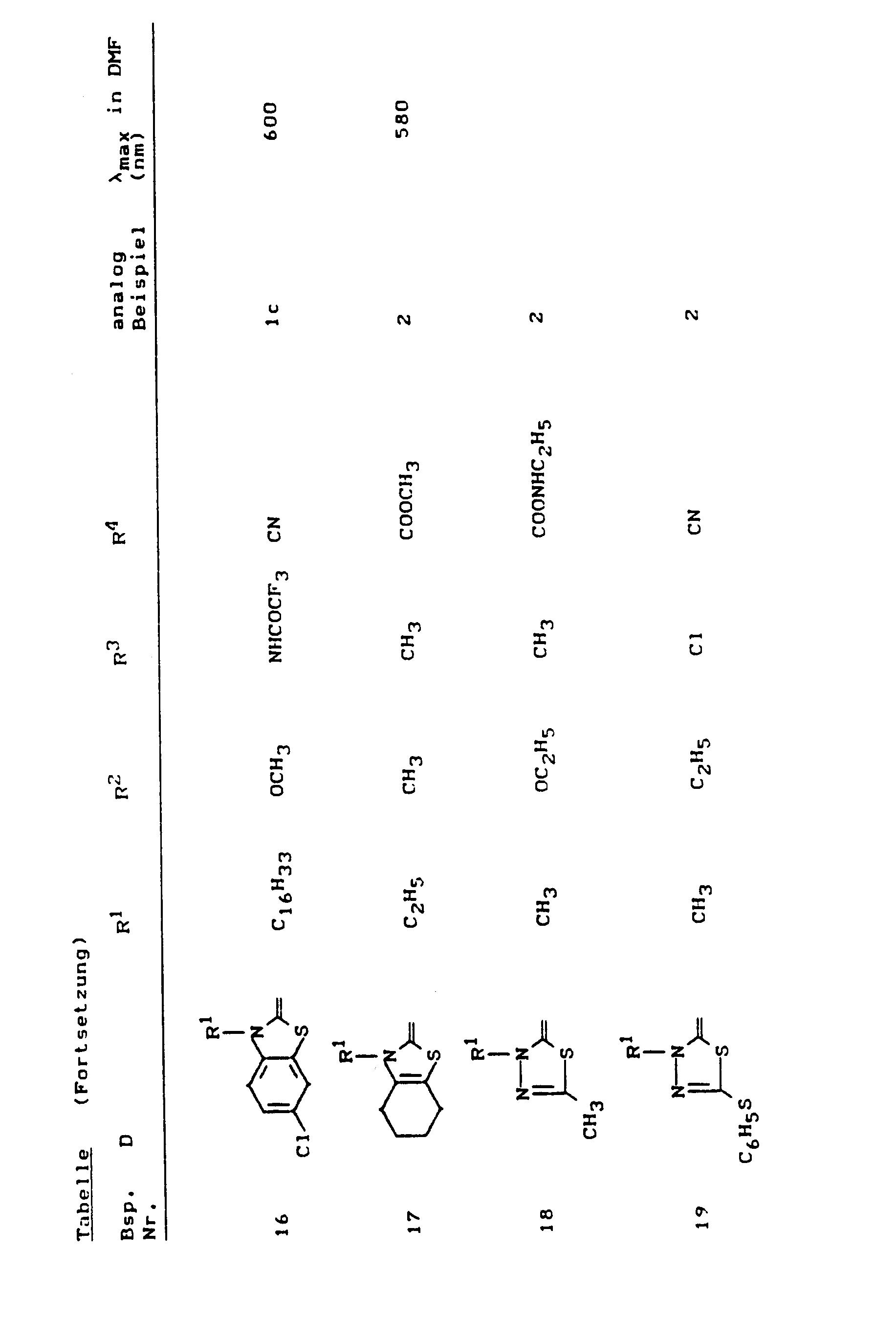


- Analog Beispiel 1c oder 2 wurden ausgehend von den entsprechenden kationischen Farbstoffen folgende Farbstoffe der Formel (I) erhalten:
- Bei dem erhaltenen Farbstoff der Formel (I) ergänzte A den Ring, in dem es sich befindet, zu

- standen R2 für OCH3 und R3 für Wasserstoff und R4 und R5 für COOC2H5. Gearbeitet wurde analog Beispiel 2.
- Bei dem erhaltenen Farbstoff der Formel (I) ergänzte A den Ring, in dem es sich befindet, zu

- standen R2 und R3 für OCH3 und R4 und R5 gemeinsam für den Rest

- Gearbeitet wurde analog Beispiel 2.
- Bei dem erhaltenen Farbstoff der Formel (I) ergänzte A den Ring, in dem es sich befindet, zu

- standen R2 für OCH3, R3 für NHCOCH3 und R4 und R5 für COCH3. Gearbeitet wurde analog Beispiel 1c. Beispiel 30 (Diffusionstransferdruck)
- Das Farbstoffgeberelement wurde folgendermaßen hergestellt:
- eine 0,5 gew.-%ige Lösung des Farbstoffs des Beispiels 1 und eine 0,5 gew.-%ige Lösung eines Binders auf Basis Styrol/Acrylnitril-Copolymerisat in Tetrahydrofuran wurden mit einer Schichtdicke von 100 um im feuchten Zustand auf einen 5 um dünnen Polyethylenterephthalat-Film aufgetragen, der vorher mit einer Schicht aus Vinylidenchlorid/Acrylnitril-Copolymerisat (2,5 um Stärke im trockenen Zustand) versehen worden war. Die gebildete Schicht wurde im Vakuum getrocknet. Die Rückseite des Polyethylenterephthalat-Filmes wurde mit einer Lösung beschichtet, die 5 Gew.-% Styrol/Acrylnitril-Copolymer und 0,1 Gew.-% einer 1 gew.-%igen Lösung eines Polysiloxan/Polyether-Copolymers (Tegoglide@ 410 der Fa. Th. Goldschmidt) enthielt. Diese Lösung wurde in einer Dicke von 100 um aufgetragen und diente zur Verhinderung des Anklebens des Farbgeberelements an den Thermodruckkopf. Das so erhaltene Farbstoffgeberelement wurde in einem Hitachi color video printer VY-100 A zum Drucken auf im Handel erhältliches Aufzeichnungsmaterial (Hitachi VY-S 100 A paper ink set) eingesetzt.
- Es wurde eine intensive cyanfarbene Aufzeichnung erhalten.
- Analoge Druckergebnisse mit violetten bis blaugrünen Aufzeichnungen wurden beim Einsatz entsprechender Farbstoffgeberelemente erhalten, welche die Produkte der Beispiele 2 bis 29 enthielten.
- Eine 0,5 gew.-%ige Lösung des Farbstoffs erhalten gemäß Beispiel 4 in Chloroform, die intensiv blau gefärbt war, wurde auf ein Blatt Papier aufgetragen. Nach der Verdampfung des Lösungsmittels verschwand die blaue Farbe und das beschichtete Papier war nur noch schwach beige gefärbt. Beim Beschreiben des Papiers mit einem erhitzten Glasstab bildete sich ein intensiver und beständiger violettblauer Schriftzug aus.
- Analoge Ergebnisse wurden erhalten, wenn statt des Blatt Papiers eine Folie aus Polyethylenterephthalat eingesetzt wurde und statt des erhitzten Glasstabs ein Thermodrucker verwendet wurde.
- Analoge Ergebnisse wurden weiterhin erhalten, wenn das Aufzeichnungselement mit Lösungen der Farbstoffe gemaß den Beispielen 1 bis 3 und 5 bis 29 hergestellt wurde.
- Eine 0,5 gew.-%ige Lösung des gemäß Beispiel 9 erhaltenen Farbstoffs in Tetrahydrofuran, die intensiv blau gefärbt ist, wurde auf eine Folie aus Polyethylenterephthalat aufgetragen. Nach der Verdampfung des Lösungsmittels war die blaue Farbe verschwunden und die Beschichtung nur noch schwach beige gefärbt. Bei der Belichtung der Folie mit einer Blitzlichtlampe färbte sich die Beschichtung intensiv türkisfarben. Diese Farbe blieb über mehrere Tage unverändert bestehen.
- Analoge Ergebnisse wurden beim entsprechenden Einsatz der Farbstoffe gemäß den Beispielen 1 bis 8 und 10 bis 29 erhalten.
- Analoge Ergebnisse wurden weiterhin erhalten, wenn statt mit einer Blitzlichtlampe mit einem Farbstofflaser (Wellenlänge 460 um, Cumarin 47 der Fa. Lambda Physik) belichtet wurde.
- In einer Apparatur ähnlich der von D. Lupo et al. in Adv. Mater. 3, 54 (1991) beschriebenen wurde der gemäß Beispiel 4 erhaltene Farbstoff in Form von kristallinem Pulver mit Laserlicht der Wellenlänge 1064 nm bestrahlt. Dabei wurde die Emission von Licht der halben Wellenlänge (= 532 nm) beobachtet. Wurde die Bestrahlung mit Laserlicht der Wellenlänge 820 nm vorgenommen, so wurde Licht mit einer Wellenlänge von 410 nm emitiert.
- Analoge Ergebnisse wurden erhalten, wenn der Farbstoff erhalten gemäß Beispiel 23 mit Laserlicht bestrahlt wurde, nachdem er in Form eines Films von einer Wasseroberfläche auf eine Glasplatte aufgebracht worden war.
- Analoge Ergebnisse wurden ebenfalls erhalten, wenn Farbstoffe gemäß den Beispielen 1 bis 3, 5 bis 22, 24 und 29 eingesetzt wurden.
- Ein Photorezeptorelement wurde entsprechend Beispiel 11 der US-PS 4 471 041 hergestellt. Statt des dort verwendeten Farbstoffs wurde der gemäß Beispiel 2 erhaltene Farbstoff eingesetzt.
- Es wurde ein Photorezeptorelement erhalten, das auf einem Aluminiumträger eine photoleitende Schicht des gemäß Beispiel 2 erhaltenen Farbstoffs in einem Polyesterbinder (1 um dick) enthielt und darüber eine Ladungstransportschicht enthaltend N,N' -Diphenyl-N,N'-(3-methylphenyl)-1,1'-biphenyl-4,4'-diamin in einem Polycarbonatbinder.
- Dieses Element wurde mit einer Corona-Entladung auf -760 V aufgeladen. Die Belichtung mit einer Intensität von 150 mJ/m2 bei einer Wellenlänge von 600 nm führte zu einer Entladung von 60 %.
- Analoge Ergebnisse wurden erhalten, wenn gemäß den Beispielen 1 und 3 bis 29 erhaltene Farbstoffe eingesetzt wurden.
- 0,1 g des Farbstoffs erhalten gemäß Beispiel 8 wurde in Dimethylformamid gelöst und in 300 ml Wasser, dem als Carrier 0,6 g Avolan® JS, 0,3 g Natriumdihydrogenphosphat und Essigsäure bis zum Erreichen eines pH-Wertes von 4,5 zugesetzt worden war, gegeben. 10 g eines Polyestergewebes aus Trevira® 2000 wurden zugefügt und bei 130°C gefärbt. Das Gewebe wies danach einen graublauen Farbton auf.
- Analoge Ergebnisse wurden erhalten, wenn die Farbstoffe, erhalten gemäß den Beispielen 1 bis 7 und 9 bis 29, eingesetzt wurden.
- 0,1 g des Farbstoffs erhalten gemäß Beispiel 2 und 2 g Titandioxid wurden in 100 g Polystyrol eingearbeitet und spritzgegossen. Man erhielt einen intensiv blau eingefärbten Kunststoffspritzling.
- Analoge Ergebnisse wurden erhalten, wenn die Farbstoffe, erhalten gemäß den Beispielen 1 und 3 bis 29, eingesetzt wurden.
x für Null oder 1 stehen.
mit einer methylenaktiven Verbindung der Formel (VIII)

in der
Claims (8)

bei denen

und


in denen

in der
mit einer methylenaktiven Verbindung der Formel (VIII)

in der
Applications Claiming Priority (2)
| Application Number | Priority Date | Filing Date | Title |
|---|---|---|---|
| DE4205632 | 1992-02-25 | ||
| DE4205632A DE4205632A1 (de) | 1992-02-25 | 1992-02-25 | Azinneutromethine |
Publications (3)
| Publication Number | Publication Date |
|---|---|
| EP0557820A2 true EP0557820A2 (de) | 1993-09-01 |
| EP0557820A3 EP0557820A3 (en) | 1994-08-17 |
| EP0557820B1 EP0557820B1 (de) | 1998-09-16 |
Family
ID=6452453
Family Applications (1)
| Application Number | Title | Priority Date | Filing Date |
|---|---|---|---|
| EP93102222A Expired - Lifetime EP0557820B1 (de) | 1992-02-25 | 1993-02-12 | Azinneutromethine |
Country Status (4)
| Country | Link |
|---|---|
| US (1) | US5328994A (de) |
| EP (1) | EP0557820B1 (de) |
| JP (1) | JPH0649374A (de) |
| DE (2) | DE4205632A1 (de) |
Cited By (2)
| Publication number | Priority date | Publication date | Assignee | Title |
|---|---|---|---|---|
| US5547727A (en) * | 1994-12-13 | 1996-08-20 | Eastman Kodak Company | Optical recording elements having recording layers containing cationic azo dyes |
| EP0884367B1 (de) * | 1997-06-11 | 2003-08-13 | Bayer Ag | Mit Licht beschreibbare Informationsspeicher, enthaltend kationische Diphenylaminfarbstoffe |
Families Citing this family (6)
| Publication number | Priority date | Publication date | Assignee | Title |
|---|---|---|---|---|
| DE4411065A1 (de) * | 1994-03-30 | 1995-10-05 | Bayer Ag | Kationische Thiadiazol-Farbstoffe |
| EP1277529B1 (de) | 2000-01-17 | 2008-05-28 | AMADA COMPANY, Ltd. | Biegeverfahren und Biegevorrichtung |
| US6610219B2 (en) * | 2001-02-06 | 2003-08-26 | Battelle Memorial Institute | Functional materials for use in optical systems |
| CA2448618A1 (en) * | 2003-09-11 | 2005-03-11 | Amer Hammami | New 2,2'-azino-bis-thiazolines as precursors to air-stable radicals |
| US7897296B2 (en) * | 2004-09-30 | 2011-03-01 | General Electric Company | Method for holographic storage |
| US20060078802A1 (en) * | 2004-10-13 | 2006-04-13 | Chan Kwok P | Holographic storage medium |
Family Cites Families (6)
| Publication number | Priority date | Publication date | Assignee | Title |
|---|---|---|---|---|
| US2951847A (en) * | 1957-10-24 | 1960-09-06 | Basf Ag | Diazacyanine dyestuffs cations |
| US3673169A (en) * | 1969-06-16 | 1972-06-27 | Eastman Kodak Co | 1,3,4-thiadiazolylazo-3-(cyclohexylamino)acylanilide dyes |
| JPS58178362A (ja) * | 1982-04-14 | 1983-10-19 | Ricoh Co Ltd | 電子写真用感光体 |
| EP0349486A3 (de) * | 1988-06-29 | 1990-12-05 | Ciba-Geigy Ag | Azofarbstoffe, deren Herstellung und Verwendung |
| GB8907311D0 (en) * | 1989-03-31 | 1989-05-17 | Ashwell Geoffrey J | Compounds usefuld in langmuir-blodgett films |
| DE4100810A1 (de) * | 1991-01-12 | 1992-07-16 | Bayer Ag | Kationische 1,3,4-thiadiazolfarbstoffe |
-
1992
- 1992-02-25 DE DE4205632A patent/DE4205632A1/de not_active Withdrawn
-
1993
- 1993-02-12 DE DE59308978T patent/DE59308978D1/de not_active Expired - Fee Related
- 1993-02-12 EP EP93102222A patent/EP0557820B1/de not_active Expired - Lifetime
- 1993-02-19 US US08/019,503 patent/US5328994A/en not_active Expired - Fee Related
- 1993-02-19 JP JP5053124A patent/JPH0649374A/ja active Pending
Cited By (2)
| Publication number | Priority date | Publication date | Assignee | Title |
|---|---|---|---|---|
| US5547727A (en) * | 1994-12-13 | 1996-08-20 | Eastman Kodak Company | Optical recording elements having recording layers containing cationic azo dyes |
| EP0884367B1 (de) * | 1997-06-11 | 2003-08-13 | Bayer Ag | Mit Licht beschreibbare Informationsspeicher, enthaltend kationische Diphenylaminfarbstoffe |
Also Published As
| Publication number | Publication date |
|---|---|
| US5328994A (en) | 1994-07-12 |
| EP0557820A3 (en) | 1994-08-17 |
| JPH0649374A (ja) | 1994-02-22 |
| EP0557820B1 (de) | 1998-09-16 |
| DE4205632A1 (de) | 1993-08-26 |
| DE59308978D1 (de) | 1998-10-22 |
Similar Documents
| Publication | Publication Date | Title |
|---|---|---|
| US5079365A (en) | Triazolopyridine dyes and thermal transfer of methine dyes | |
| EP0582579B1 (de) | N-aminopyridonfarbstoffe | |
| DE4437166A1 (de) | Farbstoffmischungen, enthaltend Methin- und Azofarbstoffe | |
| EP0557820B1 (de) | Azinneutromethine | |
| EP0659839B1 (de) | Verfahren zur Herstellung von Pyrazolazofarbstoffen | |
| EP0791034B1 (de) | Methin- und azamethinfarbstoffe auf basis von trifluormethylpyridonen | |
| EP0569784A1 (de) | Cyan-Mischungen für den Farbstofftransfer | |
| DE4215535A1 (de) | Farbstoffmischungen für den Farbstofftransfer | |
| EP0773976B1 (de) | Azofarbstoffe mit einer kupplungskomponente aus der aminothiazolreihe | |
| DE68906021T2 (de) | Wärmeempfindliches aufzeichnungsmaterial und thermographisches verfahren. | |
| EP0480252B1 (de) | Pyridonfarbstoffe und ein Verfahren zu ihrer thermischen Übertragung | |
| JPH04178646A (ja) | ピラゾロアゾールアゾメチン色素 | |
| DE19920808A1 (de) | Methin- und Azamethinfarbstoffe auf Basis von 5-gliedrigen Heterocyclen, die eine Trifluormethylgruppe aufweisen | |
| EP0727463B1 (de) | Triazolopyridinfarbstoffe und deren Zwischenprodukte | |
| EP0449109B1 (de) | Indonaphtholfarbstoffe und ein Verfahren zu ihrer thermischen Übertragung | |
| DE3630389A1 (de) | Elektrophotographisches lichtempfindliches matrial | |
| EP0745107B1 (de) | Triazolopyridinfarbstoffe | |
| DE19533026A1 (de) | Farbstoffmischungen, enthaltend Methin- und Anthrachinonfarbstoffe | |
| EP0499822A1 (de) | Bichromophore Methinfarbstoffe | |
| DE19724583A1 (de) | Kationische Diphenylaminfarbstoffe und deren Anhydrobasen | |
| EP0736575B1 (de) | Azamethinfarbstoffe mit heterocyclischen Seitengruppen | |
| EP0796297B1 (de) | Methinfarbstoffe auf basis von formylaminopyridonen | |
| EP0267467A1 (de) | Verfahren zur Herstellung von Thiophenverbindungen | |
| EP0791035B1 (de) | Azamethinfarbstoffe | |
| DE4339270A1 (de) | Azofarbstoffe mit einer Diazokomponente aus der Reihe der Aminobenzisothiazole |
Legal Events
| Date | Code | Title | Description |
|---|---|---|---|
| PUAI | Public reference made under article 153(3) epc to a published international application that has entered the european phase |
Free format text: ORIGINAL CODE: 0009012 |
|
| AK | Designated contracting states |
Kind code of ref document: A2 Designated state(s): CH DE FR GB LI |
|
| PUAL | Search report despatched |
Free format text: ORIGINAL CODE: 0009013 |
|
| AK | Designated contracting states |
Kind code of ref document: A3 Designated state(s): CH DE FR GB LI |
|
| 17P | Request for examination filed |
Effective date: 19950130 |
|
| GRAG | Despatch of communication of intention to grant |
Free format text: ORIGINAL CODE: EPIDOS AGRA |
|
| GRAG | Despatch of communication of intention to grant |
Free format text: ORIGINAL CODE: EPIDOS AGRA |
|
| GRAH | Despatch of communication of intention to grant a patent |
Free format text: ORIGINAL CODE: EPIDOS IGRA |
|
| 17Q | First examination report despatched |
Effective date: 19980303 |
|
| GRAH | Despatch of communication of intention to grant a patent |
Free format text: ORIGINAL CODE: EPIDOS IGRA |
|
| GRAA | (expected) grant |
Free format text: ORIGINAL CODE: 0009210 |
|
| AK | Designated contracting states |
Kind code of ref document: B1 Designated state(s): CH DE FR GB LI |
|
| REG | Reference to a national code |
Ref country code: CH Ref legal event code: NV Representative=s name: E. BLUM & CO. PATENTANWAELTE Ref country code: CH Ref legal event code: EP |
|
| REF | Corresponds to: |
Ref document number: 59308978 Country of ref document: DE Date of ref document: 19981022 |
|
| GBT | Gb: translation of ep patent filed (gb section 77(6)(a)/1977) |
Effective date: 19981008 |
|
| ET | Fr: translation filed | ||
| PGFP | Annual fee paid to national office [announced via postgrant information from national office to epo] |
Ref country code: GB Payment date: 19990211 Year of fee payment: 7 |
|
| PGFP | Annual fee paid to national office [announced via postgrant information from national office to epo] |
Ref country code: FR Payment date: 19990217 Year of fee payment: 7 |
|
| PLBE | No opposition filed within time limit |
Free format text: ORIGINAL CODE: 0009261 |
|
| STAA | Information on the status of an ep patent application or granted ep patent |
Free format text: STATUS: NO OPPOSITION FILED WITHIN TIME LIMIT |
|
| 26N | No opposition filed | ||
| PG25 | Lapsed in a contracting state [announced via postgrant information from national office to epo] |
Ref country code: GB Free format text: LAPSE BECAUSE OF NON-PAYMENT OF DUE FEES Effective date: 20000212 |
|
| GBPC | Gb: european patent ceased through non-payment of renewal fee |
Effective date: 20000212 |
|
| PG25 | Lapsed in a contracting state [announced via postgrant information from national office to epo] |
Ref country code: FR Free format text: LAPSE BECAUSE OF NON-PAYMENT OF DUE FEES Effective date: 20001031 |
|
| REG | Reference to a national code |
Ref country code: FR Ref legal event code: ST |
|
| PGFP | Annual fee paid to national office [announced via postgrant information from national office to epo] |
Ref country code: CH Payment date: 20020211 Year of fee payment: 10 |
|
| PGFP | Annual fee paid to national office [announced via postgrant information from national office to epo] |
Ref country code: DE Payment date: 20030124 Year of fee payment: 11 |
|
| PG25 | Lapsed in a contracting state [announced via postgrant information from national office to epo] |
Ref country code: LI Free format text: LAPSE BECAUSE OF NON-PAYMENT OF DUE FEES Effective date: 20030228 Ref country code: CH Free format text: LAPSE BECAUSE OF NON-PAYMENT OF DUE FEES Effective date: 20030228 |
|
| REG | Reference to a national code |
Ref country code: CH Ref legal event code: PL |
|
| PG25 | Lapsed in a contracting state [announced via postgrant information from national office to epo] |
Ref country code: DE Free format text: LAPSE BECAUSE OF NON-PAYMENT OF DUE FEES Effective date: 20040901 |