EP0558564B2 - Messfühler und -verfahren für ein magnetisches feld - Google Patents
Messfühler und -verfahren für ein magnetisches feld Download PDFInfo
- Publication number
- EP0558564B2 EP0558564B2 EP91920205A EP91920205A EP0558564B2 EP 0558564 B2 EP0558564 B2 EP 0558564B2 EP 91920205 A EP91920205 A EP 91920205A EP 91920205 A EP91920205 A EP 91920205A EP 0558564 B2 EP0558564 B2 EP 0558564B2
- Authority
- EP
- European Patent Office
- Prior art keywords
- coil
- magnetic
- magnet
- sensor
- sensor according
- Prior art date
- Legal status (The legal status is an assumption and is not a legal conclusion. Google has not performed a legal analysis and makes no representation as to the accuracy of the status listed.)
- Expired - Lifetime
Links
Images


Classifications
-
- G—PHYSICS
- G06—COMPUTING OR CALCULATING; COUNTING
- G06K—GRAPHICAL DATA READING; PRESENTATION OF DATA; RECORD CARRIERS; HANDLING RECORD CARRIERS
- G06K7/00—Methods or arrangements for sensing record carriers, e.g. for reading patterns
- G06K7/08—Methods or arrangements for sensing record carriers, e.g. for reading patterns by means detecting the change of an electrostatic or magnetic field, e.g. by detecting change of capacitance between electrodes
- G06K7/082—Methods or arrangements for sensing record carriers, e.g. for reading patterns by means detecting the change of an electrostatic or magnetic field, e.g. by detecting change of capacitance between electrodes using inductive or magnetic sensors
- G06K7/083—Methods or arrangements for sensing record carriers, e.g. for reading patterns by means detecting the change of an electrostatic or magnetic field, e.g. by detecting change of capacitance between electrodes using inductive or magnetic sensors inductive
- G06K7/084—Methods or arrangements for sensing record carriers, e.g. for reading patterns by means detecting the change of an electrostatic or magnetic field, e.g. by detecting change of capacitance between electrodes using inductive or magnetic sensors inductive sensing magnetic material by relative movement detecting flux changes without altering its magnetised state
-
- G—PHYSICS
- G06—COMPUTING OR CALCULATING; COUNTING
- G06K—GRAPHICAL DATA READING; PRESENTATION OF DATA; RECORD CARRIERS; HANDLING RECORD CARRIERS
- G06K7/00—Methods or arrangements for sensing record carriers, e.g. for reading patterns
- G06K7/08—Methods or arrangements for sensing record carriers, e.g. for reading patterns by means detecting the change of an electrostatic or magnetic field, e.g. by detecting change of capacitance between electrodes
- G06K7/089—Methods or arrangements for sensing record carriers, e.g. for reading patterns by means detecting the change of an electrostatic or magnetic field, e.g. by detecting change of capacitance between electrodes hand-held scanners
Definitions
- the invention relates to a magnetic field sensor for sensing magnetisable and magnetized areas on or in an authenticatable item such as a security document.
- US-A-4803949 discloses another type of sensor (essentially a metal detector) which in this case comprises a core of for example ferrite on which is wound a primary coil supplied with an alternating current and a secondary coil in which a mutual induction current is generated.
- the primary coil generates an alternating magnetic field which induces current in the secondary coil and also generates eddy currents in a metallic sheet which may or may not be of magnetizable material positioned adjacent the sensor.
- the impedance of the induction coil is changed which results in a change in the magnitude of induced currents generated in the secondary coil. This can be detected.
- the device is principally a metal detector.
- EP-A-0295229 describes a sensor for detecting the magnetic properties of banknotes having the precharacterising features of the appended claim 1 and in which a permanent magnet is positioned adjacent a detector head so as to magnetize particles carried by the banknotes which then generate local magnetic fields which, as they pass the head, induce an EMF in the head which can be detected.
- Critical to the working of this invention is the isolation of the magnetic field generated by the magnet from influencing the head. The unit is also cumbersome.
- EP-A-0467202 published on 9 July 1991 and thus forming part of the state of the art under Article 54(3) EPC describes a sensor for detecting magnetisable particles in or on authenticatable documents such as banknotes.
- the sensor includes a permanent magnet and a coil arranged such that the coil is under the influence of the magnet and defines together with the same a magnetic circuit.
- the passage of magnetic particles in or on the banknote under test perturbs the magnetic field of the magnet. These perturbations induce a voltage in the coil which can be detected.
- the coil has a rectangular cross-section.
- a method of detecting magnetisable and magnetised areas on or in an authenticatable item such as a security document comprising causing relative movement between the item and a sensor according to the first aspect of the invention: and monitoring the indicating means for an indication of induced voltage in the electrical circuit.
- the magnetic material can be placed under the surface of the item.
- the magnetic ink may be placed under a laminating film.
- the ink may be heavily overprinted with an obliterating ink.
- the invention is based on a sensing device which defines a magnetic circuit in which a steady magnetic field exists, the circuit including a coil influenced by magnetic flux from the magnet.
- the circuit including a coil influenced by magnetic flux from the magnet.
- no emf will be generated in the coil.
- the passage of magnetizable material past the magnetic circuit will perturb the magnetic field thus causing a change in magnetic flux influencing the coil and hence induce a voltage in the coil.
- the sensor is also capable of detecting magnetized particles. This approach also increases the sensitivity of the sensor as explained above.
- a further advantage of the invention which relies on detecting a perturbation on the magnetic field. is that it is much less directionally sensitive than conventional devices. This has the advantage that the authenticatable item and the compact sensor can be moved in a wide variety of different, relative directions in contrast to conventional sensors which require that the direction of relative movement is carefully controlled. This is a particular advantage where the direction of magnetization is unknown to the user.
- the magnetic circuit has an open section defined between non-facing faces of the sensing device, the authenticatable item passing through the open section of the magnetic circuit in use.
- the new sensors are sufficiently sensitive for light contact to be sufficient and in certain instances can be out of contact with the document thus reducing wear from repeated scanning.
- the dimensions of the coil can be chosen empirically but the coil diameter will lie in the range 0.1 - 3 mm, preferably 0.8 mm; typically the length of the coil will lie in the range 2-30 mm. preferably 3-10 mm, most preferably 4.5 mm on a former of slightly less diameter: and the number of turns in the coil will depend on the desired relative speed of movement between document and sensor. For very low speeds eg 1 to 3 mm/second. the numbers of turns will exceed one thousand but for high speeds eg 100 mm/second and above, ten to fifty turns can be used. In general the number of turns will be in the range 200-5000.
- the diameter of the wire chosen is dependent on the desired coil diameter. coil length and numbers of turns but in the preferred case will be less than 1000 microns.
- microcoils between 10-200 microns. generally in the range 10-50 microns. typically 15-25 microns. preferably about 20 microns. Coils falling within this definition will be termed "microcoils". Instead of using very thin insulated wires, thin film technology may be employed. in which the coil is formed as a planar spiral on a flat surface, which is held orthogonally to the surface being scanned. An example of a thin film head is described in "The Complete Handbook of Magnetic Recording" by F. Jorgensen. TAB Books Inc. 1988. pp 204-205.
- microcoils could be used by themselves to detect premagnetized particles.
- the coil need not be wound on a magnetically permeable core if the flux created by the magnet was large enough and subject to a suitable level of change when the authenticatable item passed by.
- the coil will be wound around a soft. ferromagnetic core which. in use. is unsaturated.
- the core could comprise a soft ferrite or possibly soft iron.
- the term "soft" indicates that the material does not readily retain magnetism.
- the coil would normally be directly wound on the core for compactness.
- ferrite cores are sintered ceramics. They are mouldable before sintering and thus can be moulded to special shapes.
- the coil and core are coaxial.
- the core will be longer than the coil but usually not more than three times and generally less than twice.
- a leading end of the core is pointed and used to locate the part of the item to be sensed.
- the core could either be linear or bent. for example in the form of an "L".
- the coil could be wound around one side of the "L” while the other side projects towards the authenticatable item in use.
- it is preferred that the axis of the coil extends in a direction transverse. preferably orthogonal. to the plane of the authenticatable item during relative movement.
- the coil could be planar in cross-section, similar to a tile.
- the relative movement between the device and an authenticatable item may be generated manually, for example by moving the device by hand.
- the device may further comprise oscillation means for oscillating the coil and magnet in synchronism. This oscillation may be used by itself or in addition to a manual movement.
- the oscillation means may comprise a leaf spring on which the coil and the magnet are mounted. a cam engaging the leaf spring, and a motor for rotating the cam to cause the leaf spring to oscillate. The benefit of oscillation is that the sensing head need only be pointed rather than swiped.
- the indicating means may provide an audio and/or visual indication.
- the sensor further comprises an amplifying circuit connected to the coil, the indicating means being connected to the amplifying circuit so as to provide an indication when signals from the amplifying circuit exceed a threshold, eg a voltage threshold.
- the indicating means may be adapted to provide a permanent but resettable indication as soon as the threshold is exceeded.
- the magnet is preferably a permanent magnet, eg a samarium cobalt magnet, or an AINiCo or NdFeB magnet, although an electromagnet or solenoid supplied with DC current could also be used.
- the magnet is mounted to a support to which the coil is also mounted.
- a rectangular prism samarium cobalt magnet has been effectively employed.
- the North-South direction of the magnet is substantially orthogonal to the coil axis.
- the senor is provided in sheet handling apparatus, such as banknote sorting or counting apparatus, the apparatus defining a path along which sheets are transported, and the sensor being positioned alongside the path to detect magnetic particles on or in the transported sheets.
- sheet handling apparatus such as banknote sorting or counting apparatus
- the invention is particularly suitable for use in a self-contained, hand held and portable form in which a housing is provided containing all the sensor components and power supply, such as a battery.
- the housing may have an elongate form which can be held easily in the hand in a similar manner to a writing instrument.
- the housing preferably has a nose shaped leading section which faces towards an authenticatable item, in use. This together with a pointed core where provided enables the user to position the sensor reasonably accurately at the area to be scanned.
- the hand held device is likely to be used in a swiping mode over an area supposedly carrying the magnetic or magnetisable particles.
- this may be a patch of security indicia or a serial or other number or the like.
- the sensor will pass over the area and if the appropriate material is present give a signal such as a bleep. Because the circuit will need to respond to a transient signal because of the relative motion between the sensor and the substrate, the indicating means will preferably be arranged such that the signal is caused to be latched on for a period, say one second, after the threshold of the induced voltage has been reached.
- the indicating means may incorporate signal counting means or signal integrating means and means for setting the threshold at which the device will operate.
- the magnetically induced voltage is thus arranged to cause a digital output signal.
- an analogue signal or multilevel signal could be used.
- the resulting signal may be used to operate a signalling device or any other suitable device.
- Two or more sensors may be combined, say in a linear arrangement to allow scanning over multiple zones in the authenticatable item or to allow a variety of different documents to be used.
- Individual signal outputs may be employed or alternatively the outputs may be combined in a logic circuit to give a net output which reflects the authenticity of the item.
- the senor may be employed to record a signature from the note.
- the sensor may be employed to read a magnetic bar code or the like.
- the magnetic bar code may be in the form of a tape which has bar coded magnetised domains. Alternatively there may be a series of magnetic bars printed on a non-magnetisable background.
- the sensor may be incorporated in a device which also contains sensing means for another authenticatable attribute.
- opto-electronic colour discriminating circuitry may be used to generate a colour verification signal and this signal may be used to actuate a colour verification light which is placed beside a light indicating magnetic authentication.
- the outputs form the magnetic and other attribute/s may be combined in a logic circuit to provide a net authentication indication.
- the sensor of the invention also allows the use of two sensors which have different sensitivity so as to discriminate between levels of magnetic coupling.
- the recording circuitry may be arranged to display the signal directly for example on a liquid crystal display.
- the signal may be stored and processed for further message display or it may be used for comparison with previously stored data and a resultant signal output.
- Sensors according to the invention can be used in a wide variety of applications some of which are mentioned above. They are particularly suited to the detection of magnetic inks especially lithographic inks, letter-press inks, intaglio inks, and screen inks as well as single component magnetic toners, that is toners which incorporate ferromagnetic particles. It is desirable to make use of inks which contain a small proportion of magnetic particles, for example down to 2.5% or less by weight.
- the sensor could be used with coatings of ferromagnetic particles (especially iron oxide) such as on magnetic tapes (such as used in credit cards), on tickets, on hot stamping foils (eg. for magnetic signature panels) and transferred magnetic film such as for OCR type reading on cheques.
- the sensor is small enough to be used to detect one digit of a series of symbols or alphanumeric characters having different magnetic characteristics from the rest, especially a serial number printed with say the first character (indicating the note series) magnetic and the rest in normal ink, all having the same visible appearance.
- the sensor could be used with ink/toner/tape/transferred layers on the surface of the item or concealed under the surface of the item.
- Authenticatable items with which the sensor could be used include security printed documents such as banknotes, passport pages, traveller's cheques, bank cheques, tickets including transport tickets, stadium entrance (entertainment admission) tickets, ski passes, financial or service entitlement cards, visas, lottery tickets, bonds, fiscal certificates, identity cards, permits, licences, magnetic data cards such as credit cards, vouchers, passports, parking tickets, brand identification labels, holograms having non-holographic information applied by a printing press/electrostatic printer, and the like.
- security printed documents such as banknotes, passport pages, traveller's cheques, bank cheques, tickets including transport tickets, stadium entrance (entertainment admission) tickets, ski passes, financial or service entitlement cards, visas, lottery tickets, bonds, fiscal certificates, identity cards, permits, licences, magnetic data cards such as credit cards, vouchers, passports, parking tickets, brand identification labels, holograms having non-holographic information applied by a printing press/electrostatic printer, and the like.
- the senor may be used to authenticate read printed magnetic markings on magnetically bar-coded items such as retail goods or labels, or magnetically encoded tapes affixed to price labels, ledger pages, travel tickets and financial transaction cards.
- Typical substrates for the authenticatable item comprise paper including rag paper and surface finished papers, synthetic paper including non-woven paper, spun bonded paper, metallic foil laminates, plastic film, plastic card, paper-plastic laminates, and metallised plastic.
- the magnetic material could be applied to the substrates continuously or discontinuously by printing, electrostatic deposition, pressure transfer (ambient or heated as in daisy wheel printers and magnetic hot stamping foils).
- the senor is suitable for detecting any ferromagnetic materials.
- a single coil has been envisaged.
- more than one coil could be provided, for example, wound on a common magnetically permeable core, the two coils having different numbers of turns so as to allow for the detection of different levels of magnetic perter-bation.
- a single winding could be tapped.
- different levels of magnetism could be detected downstream of the coil by detecting different induced EMFs.
- a multiple sensing assembly could be provided, comprising a number of sensors laterally spaced apart and magnetically isolated from one another.
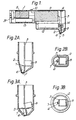
- Figure 1 illustrates a hand-held magnetic detector comprising a plastics housing 1 having a generally cylindrical cross-section with a protruding nose portion 2.
- a leaf spring 3 is suspended from a support 4 within the housing and terminates adjacent a downwardly facing opening 5 in the nose portion 2.
- the free end of the leaf spring 3 carries a microcoil 6 of enamelled copper wire wound around a ferrite rod 7 ( Figure 2) having a taped leading end 7'.
- a permanent magnet, for example a samarium cobalt magnet 8 is mounted to the opposite side of the leaf spring 3 from the micro coil 6.
- the magnet 8 has dimensions of about 4 x 4 x 2 mm with its magnetic axis running orthogonal to the axis of the coil and, as can be seen, is mounted behind the coil in a position which avoids saturation of the ferrite core. Other orientations of the magnetic axis are possible.
- PCB printed circuit board
- a push-button 10 is mounted externally of the housing 1 to activate the circuit while a battery 11 is is mounted within the housing 1 and is connected to the PCB.
- the coil 6 has 1200 turns of enamelled wire, a resistance of 480 ohms and a self-inductance of 7 mH.
- the axial length of the linearly formed coil is about 4.5 mm and the outside diameter of the coil about 0.8 mm.
- the outside diameter of the windings on the core will be less than 2 mm, preferably less than 1 mm.
- the magnet 8 and the coil 6 together form a magnetic circuit with the steady magnetic field generated by the magnet 8 passing through the turns of the coil 6 and core 7.
- the sensor shown in Figure 1 can be used for detecting premagnetized substrates, for example the magnetic track on a credit card but is particularly suitable for detecting unmagnetized but magnetizable particles.
- the switch 10 is depressed to activate the circuit and the coil is then moved to the appropriate part of the substrate, such as a banknote, which itself may or may not be stationary.
- the ferrite rod will be slightly spaced away (for example up to 1.0 mm) from the substrate.
- the relative movement between the magnetizable particles and the sensor causes a perturbation in the magnetic field which induces a voltage in the coil 6 which is then detected by the circuit shown in Figures 4A to 4C.
- the electrical voltage generated is proportional to the speed of variation of the magnetic flux. It is interesting to evaluate the order of magnitude of the flux and of the corresponding voltage which can be produced.
- the voltage produced is relatively low. For obtaining the level of a few volts which are necessary to supply a buzzer, a gain of 10 5 is required. This is achieved by using a suitable amplifying circuit which will be described below.
- the frequency of the signal depends on the speed of relative movement and the nature of the printed design. Typically, the frequency will be between 40 and 300 Hz and the induced voltage amplitude will be between 5 and 100 microvolts.
- the processing circuit mounted on the PCB 9 is shown in Figures 4A-4C.
- the coil 6 beside magnet 8 is connected to a preamplifier comprising a FET amplifier 15.
- the gain of the FET amplifier 15 is about 450 and corresponds to the ratio between the feedback resistor 16 (228k Kohms) and the resistance of the coil which is about 480 ohms.
- the level of the input signal is between 5 and 100 microvolts.
- the pre-amplifier amplifies this to 2 to 40 millivolts.
- the electronic noise at this output is about 1 mV
- the signal to electronic noise ratio is between 2 and 40.
- the offset voltage is of the same order of magnitude as the signal, i.e. typically 10 to 20 millivolts.
- this coupling is realized by means of a capacitor 17 which cuts the DC component.
- this capacitor has to be relatively high in order to obtain a quasi-DC coupling, for example 10 microfarads. Practically, this capacitor must be of the electrolytic type so as to reduce its size as much as possible. Since this kind of capacitor is polarized a negative bias of about 0.8 volt at the pre-amplifier output is necessary. This is obtained by means of the 1.2 megohm 17A resistor at the input.
- Vibration noise is eliminated by the filter constituted by a 2.2 nanofarads capacitor (18) in parallel to the feedback resistor 16.
- the cutting frequency of this filter is 330 Hz.
- a second FET amplifier 19 has to amplify the signal up to a few volts ( ⁇ 4.5 volts peak to peak) in order to render it usable for the acoustic output.
- the second FET amplifier 19 has a gain the same as for the pre-amplifier, i.e. 450. (Defined by the ratio between the feedback resistor 20 and the input resistor 21, respectively 828 Kohms and 1.8 Kohms).
- the coupling of the second amplifier 19 with the pre-amplifier output is realized by the 10 microfarads capacitor 17 in series with the 1.8 Kohm input resistor 21. This coupling constitutes a high-pass filter for all frequencies higher than 10 Hz.
- the second amplifier also contributes towards the elimination of vibration noise by means of a low-pass filter constituted by a 688 picofarads capacitor 22 in parallel with the feedback resistor 20. Its cut-off frequency is the same as for the pre-amplifier, the rate of the amplitude decrease is 12 decibels/octave.
- the amplified signal has to be converted into a DC voltage usable for the supply of the acoustic generator. This operation is ensured by a full wave rectifying circuit (Figure 4B).
- the amplified signal from the second amplifier 19 is inverted by means of an amplifier 23 with a gain of one. The unity gain is obtained by selecting the same value for the input and the feedback resistors 24,25, i.e. 22 Kohms.
- the direct and inverted amplified signals can then be used for the full wave rectification.
- This rectification is obtained by means of two transistors 26,27 mounted in inverter mode and referenced to the minimum voltage (-4.5 volts).
- the reference voltage of the signals (direct and inverted) being 0 volt, their coupling with the transistors has to be capacitive.
- This is obtained by two electrolytic capacitors 28,29 of 3.3 microfarads, the high pass frequency cut-off being about 9 Hz.
- the acoustic generator consists of a square wave oscillator, an amplifier and finally a piezoceramic buzzer 31.
- the amplification effect is obtained by using two additional NAND gates 52,53 supplied at their inputs by the oscillator in such a way as to obtain the direct and the inverted square wave oscillations.
- the differential wave has a peak to peak amplitude which is twice the DC voltage provided by the rectifying circuit. Since this voltage can attain about 8 volts, the maximum peak to peak square wave is 16 volts.
- the four NAND gates 50-53 constituting the oscillator and the amplifier are made of a quadruple 2-input NAND gate CMOS integrated circuit 30 (type HEF4011B).
- This circuit 30 is supplied by the voltage existing between the positive voltage of the battery 11 (+9 volts) and the collectors of the two rectifying transistors.
- An RC filter 54 (470 ohms and 10 microfarads) is mounted in series in order to limit the peak of current consumed by the amplifier and the buzzer.
- the buzzer 31 comprises a piezoelectric disk glued to a nickel plated membrane mounted into the casing 1 of the detector unit. Its own frequency depends not only on the membrane itself but also on the casing. It is connected to the differential output of the two NAND gates amplifier 52,53.
- the supply circuit has to create the two symmetric voltages necessary for the differential amplifiers. This is ensured by a 4.5 volt zener diode 55 mounted in series with a 470 ohm resistor 56.
- the electric source itself consists of a 9 volt battery 11 supplying the electronic circuit via the ON-OFF switch 10 hand-operated when the detection unit is employed.
- the total current consumption is about 18 to 20 mA.
- a beep is emitted. This beep, which is due to the transitory charge of the capacitors, is used to indicate the state of readiness of the detection unit.
- the high gain used in the two amplification stages makes the units very sensitive for the detection of magnetic ink.
- the relative movement required between the sensor and authenticatable item can be achieved simply by moving the sensor to and fro but this is substituted or enhanced in the example shown in Figure 1 by use of an oscillating system comprising a motor 12 powered by a battery 13 mounted in the housing 1.
- the motor 12 is also actuated upon depression of the push-button 10.
- the axle of the motor 12 is coupled to a substantially rectangular cam 14 which is rotated against the leaf spring 3 so as repeatedly to oscillate the leaf spring, the spring returning to the rest position under its inherent spring action.
- the motor 12 rotates at about 10 turns per second.
- the leaf spring 3 is non-magnetizable and non-ferromagnetic and has a length of about 65 mm, the cam being applied at a position about 15 mm from the support 4 and defining an oscillating distance of about 4 or 5 mm.
- Figure 5 represents a second example of a hand held detector for swiping use contained in a plastics housing 1 and having a sensing head 2 which contains a microcoil 32A wound on a ferrite core 32B and a magnet 33 held at a set distance from the tip of the coil.
- the coil is connected to electronic circuitry 34 and is supplied with power from a battery 35.
- a switch 36 is pressed to allow the sensor to operate and if a magnetic signal of sufficient strength is detected the circuitry causes a light emitting diode 37 to become illuminated and a piezo electric sounder 39 to operate.
- Figures 6A to 6H illustrate a number of generally preferred geometric configurations for the microcoil and magnet.
- the microcoil is indicated by reference numeral 40 and the magnet by reference numeral 41.
- the north and south pole assignments may be reversed.
- Figure 6A shows the microcoil 40 and magnet 41 mounted generally parallel with their leading faces substantially flush. In these cases the magnet has a general cuboid configuration.
- the magnetic axis may be in any rectilinear direction to the axis of the coil.
- Figures 6B and 6C illustrate variations of Figure 6A with the magnet 41 placed at mid and rear positions respectively.
- Figure 6D illustrates an annular magnet 41 positioned about the microcoil 40 with the North-South direction extending generally parallel with the microcoil.
- Figure 6E illustrates a variation of the Figure 6D example in which the North-South direction is orthogonal to the axis of the microcoil 40.
- Figure 6F illustrates a magnet 41 with a generally rectangular cross-section extending parallel with the microcoil 40 and with the leading faces of the microcoil and magnet being substantially flush.
- Figure 6G is a modification of Figure 6F in which the magnet 41 is arranged with the North-South direction at about 45° to the microcoil axis.
- Figure 6H is the currently most preferred configuration in which the elongate magnet 41 has the North-South direction orthogonal to the axis of the microcoil 40. This corresponds to the example shown in Figure 1.
- Figures 7A to 7H illustrate some further configurations which may be less preferred than the configurations of Figure 6.
- the magnet 41 is mounted behind the microcoil 40 and substantially coaxial therewith, the substrate 42 being shown in the drawings.
- Figure 7B is the reverse of Figure 7A with the magnet nearer to the substrate 42 than the coil 40.
- FIG 7C an elongate magnet 41 is shown with the North-South direction at substantially 135° to the microcoil axis.
- the linear dimensions of the magnet 41 should not greatly differ from the length of the microcoil and typically should not differ by more than one order of magnitude being usually smaller than the microcoil.
- Figure 7D illustrates a variation in which the magnet 41 is larger than the length of the microcoil 40 and is arranged parallel with the microcoil axis. With such a physically large magnet the coil may become saturated detrimentally.
- Figure 7E illustrates a generally L-shaped magnet 41 and Figure 7F illustrates a bar magnet 41 positioned with its axis orthogonal to the microcoil axis and at the rear of the microcoil.
- Figure 7G illustrates a U-shaped magnet whose poles are substantially flush with the leading end of the microcoil 40.
- Figure 7H illustrates a U-shaped magnet with short arms terminating near the rear end of the microcoil 40.
- microcoil 40 references to the "microcoil" 40 are intended to refer to a combination of microcoil and core where a core is provided, the length of the core being predominant if this is greater than the length of the microcoil itself.
- the microcoil may be wound round the edge of a disc of ferrite material. In this instance the circular surface of the disc would be placed over the magnetisable material.
- the sensitivity of the device may be increased by providing electromagnetic screening to reduce the likelihood of spurious signals of electromagnetic origin. Screening may be electrical, by providing a Faraday cage of metal foil around the device other than the sensing head. Magnetic screening may be provided by providing lossy metal covering while still ensuring responsiveness of the coil under test.
Landscapes
- Engineering & Computer Science (AREA)
- Artificial Intelligence (AREA)
- Computer Vision & Pattern Recognition (AREA)
- Physics & Mathematics (AREA)
- General Physics & Mathematics (AREA)
- Theoretical Computer Science (AREA)
- Inspection Of Paper Currency And Valuable Securities (AREA)
Claims (18)
- Meßfühler für magnetisierbare oder magnetisierte Bereiche auf oder in einem authentisierbaren Gegenstand, z.B. einem Sicherheitsdokument, während einer Relativbewegung zwischen dem Meßfühler und dem Gegenstand, mit einer Fühlvorrichtung, die einen Magneten (8) und eine elektrische Spule (6, 7) aufweist, wobei der Magnet im Betrieb ein konstantes Magnetfeld erzeugt; und einem Anzeigemittel, das in einer elektrischen Schaltung mit der Spule verbunden ist, um eine in der Schaltung induzierte Spannung anzuzeigen, die durch eine Änderung des die Windungen der Spule beeinflussenden magnetischen Flusses bewirkt wird, wobei die Spule eine Mikrospule mit kreisförmigen Querschnitt und mit einem Durchmesser im Bereich von 0,1 bis 3 mm der Magnet (8) und die elektrische Spule (6, 7) so angeordnet sind, daß die Spule unter dem Einfluß des magnetischen Flusses des Magneten steht und somit einen Magnetkreis begrenzt, so daß der Vorbeilauf eines magnetisierbaren oder magnetisierten Bereiches eines authentisierbaren Gegenstands an dem Meßfühler das magnetische Feld in dem Magnetkreis stört und dadurch den magnetischen Fluß ändert, der die Spule beeinflußt und eine elektrische Spannung in der Schaltung induziert.
- Meßfühler nach Anspruch 1, bei dem sich die Spulenachse im Betrieb in einer weitgehend senkrechten Richtung zur Ebene des authentisierbaren Gegenstands erstreckt.
- Meßfühler nach Anspruch 1 oder 2, bei dem der Magnetkreis einen offenen Abschnitt aufweist, der zwischen einander nicht zugekehrten Flächen der Fühlvorrichtung begrenzt ist, wobei der authentisierbare Gegenstand während des Betriebs durch den offenen Abschnitt des Magnetkreises hindurchläuft.
- Meßfühler nach Anspruch 3, zurückbezogen auf Anspruch 2, bei dem die Spule eine jener Flächen der Fühlvorrichtung begrenzt.
- Meßfühler nach einem der vorstehenden Ansprüche, bei dem die Spule um einen weichferromagnetischen Kern herumgewickelt ist, der im Betrieb ungesättigt ist.
- Meßfühler nach einem der vorstehenden Ansprüche, bei dem die Länge der Spule im Bereich von 2 bis 30 mm liegt.
- Meßfühler nach einem der vorstehenden Ansprüche, bei dem die Anzahl der Windungen der Spule im Bereich von 200 bis 5000 liegt.
- Meßfühler nach einem der vorstehenden Ansprüche, bei dem der Durchmesser des die Spule bildenden Drahtes kleiner als 1000 mm ist.
- Meßfühler nach einem der vorstehenden Ansprüche mit einem Oszellationsmittel, das die Spule und den Magneten synchron in Schwingungen versetzt.
- Meßfühler nach einem der vorstehenden Ansprüche, bei dem das Anzeigemittel eine hörbare und/oder sichtbare Anzeige der in der Schaltung induzierten Spannung bewirkt.
- Meßfühler nach einem der vorstehenden Ansprüche, mit einem Gehäuse, in dem die Fühlvorrichtung angeordnet ist und das so gestaltet ist, daß es in der Hand gehalten werden kann und tragbar ist.
- Verfahren zum Feststellen magnetisierbarer oder magnetisierter Bereiche auf oder in einem authentisierbaren Gegenstand, z.B. einem Sicherheitsdokument, bei dem eine Relativbewegung zwischen dem Gegenstand und einem Meßfühler nach einem der vorstehenden Ansprüche bewirkt und das Anzeigemittel zum Anzeigen einer in der elektrischen Schaltung induzierten Spannung überwacht wird.
- Verfahren nach Anspruch 12, bei dem die magnetisierbaren oder magnetisierten Bereiche mit magnetischer Farbe oder einem elektrostatisch niedergeschlagenen Einkomponenten-Magnettoner aufgedruckt oder als Überzug aus ferromagnetischen Teilchen ausgebildet sind.
- Verfahren nach Anspruch 12 oder 13, bei dem der Bereich ein oder mehrere alphanumerische Zeichen begrenzt.
- Verfahren nach einem der Ansprüche 12 bis 14, bei dem der Gegenstand ein Substrat aus Papier, synthetischem Papier, Spinnvlies-Papier, einem Metallfolienlaminat, einer Kunststoffolie, einer Kunststoffkarte, einem Papier-Kunststoff-Laminat oder einem metallisierten Kunststoff enthält.
- Verfahren nach einem der Ansprüche 13 bis 15, bei dem der authentisierbare Gegenstand ein gedrucktes Sicherheitsdokument ist, das aus der Gruppe ausgewählt ist, die Banknoten und Ausweisseiten, Reiseschecks, Bankschecks, Tickets, einschließlich Transportticket, Stadioneintrittstickets (Unterhaltungseintrittstickets), Skipässe, Finanz- oder Dienstleistungsberechtigungskarten, Visen, Lotterietikets, Bonds, fiskalische Zertifikate, Identitätskarten, Genehmigungen, Lizenzen, magnetische Datenkarten, z.B. Kreditkarten, Vouchers, Pässe, Parkscheine, Markenidentifizierungsetikette, Hologramme mit nichtholographischen Informationen, die durch einen Abdruck- oder elektrostatischen Drucker aufgebracht wurden und dergleichen.
- Blattbehandlungsgerät, das eine Bahn begrenzt, längs der Blätter transportiert werden, und ein Meßfühler nach einem der Ansprüche 1 bis 10, der in die Nähe der Bahn angeordnet ist, so daß er den Durchlauf eines Sicherheitsdokuments mit magnetisierbaren oder magnetisierten Bereichen längs der Bahn feststellt.
- Mehrfühleranordnung mit einer Anzahl von Meßfühlern nach einem der Ansprüche 1 bis 10, die seitlich auseinanderliegen und magnetisch gegeneinander isoliert sind.
Applications Claiming Priority (3)
| Application Number | Priority Date | Filing Date | Title |
|---|---|---|---|
| GB909025391A GB9025391D0 (en) | 1990-11-22 | 1990-11-22 | Magnetic field sensor and method |
| GB9025391 | 1990-11-22 | ||
| PCT/GB1991/002068 WO1992009969A1 (en) | 1990-11-22 | 1991-11-22 | Magnetic field sensor and method |
Publications (3)
| Publication Number | Publication Date |
|---|---|
| EP0558564A1 EP0558564A1 (de) | 1993-09-08 |
| EP0558564B1 EP0558564B1 (de) | 1996-05-01 |
| EP0558564B2 true EP0558564B2 (de) | 2001-08-08 |
Family
ID=10685794
Family Applications (1)
| Application Number | Title | Priority Date | Filing Date |
|---|---|---|---|
| EP91920205A Expired - Lifetime EP0558564B2 (de) | 1990-11-22 | 1991-11-22 | Messfühler und -verfahren für ein magnetisches feld |
Country Status (6)
| Country | Link |
|---|---|
| EP (1) | EP0558564B2 (de) |
| JP (1) | JPH06502943A (de) |
| DE (1) | DE69119238D1 (de) |
| GB (1) | GB9025391D0 (de) |
| HK (1) | HK143696A (de) |
| WO (1) | WO1992009969A1 (de) |
Families Citing this family (1)
| Publication number | Priority date | Publication date | Assignee | Title |
|---|---|---|---|---|
| JP6407024B2 (ja) * | 2011-09-07 | 2018-10-17 | オークランド ユニサービシズ リミテッドAuckland Uniservices Limited | 誘導電力伝達用磁界成形 |
Citations (1)
| Publication number | Priority date | Publication date | Assignee | Title |
|---|---|---|---|---|
| EP0467202A2 (de) † | 1990-07-17 | 1992-01-22 | GAO Gesellschaft für Automation und Organisation mbH | Vorrichtung zur Prüfung von mit magnetischen Eigenschaften ausgestatteten Messobjekten |
Family Cites Families (3)
| Publication number | Priority date | Publication date | Assignee | Title |
|---|---|---|---|---|
| US3508227A (en) * | 1966-08-05 | 1970-04-21 | Digitronics Corp | Information signal generation apparatus |
| US3976199A (en) * | 1975-03-17 | 1976-08-24 | Ketek Electric Corporation | Portable currency detector |
| SE458315B (sv) * | 1987-06-12 | 1989-03-13 | Inter Innovation Ab | Anordning foer detektering av dokument |
-
1990
- 1990-11-22 GB GB909025391A patent/GB9025391D0/en active Pending
-
1991
- 1991-11-22 EP EP91920205A patent/EP0558564B2/de not_active Expired - Lifetime
- 1991-11-22 JP JP4500450A patent/JPH06502943A/ja active Pending
- 1991-11-22 WO PCT/GB1991/002068 patent/WO1992009969A1/en not_active Ceased
- 1991-11-22 DE DE69119238T patent/DE69119238D1/de not_active Expired - Lifetime
-
1996
- 1996-08-01 HK HK143696A patent/HK143696A/en not_active IP Right Cessation
Patent Citations (1)
| Publication number | Priority date | Publication date | Assignee | Title |
|---|---|---|---|---|
| EP0467202A2 (de) † | 1990-07-17 | 1992-01-22 | GAO Gesellschaft für Automation und Organisation mbH | Vorrichtung zur Prüfung von mit magnetischen Eigenschaften ausgestatteten Messobjekten |
Also Published As
| Publication number | Publication date |
|---|---|
| HK143696A (en) | 1996-08-09 |
| GB9025391D0 (en) | 1991-01-09 |
| DE69119238D1 (de) | 1996-06-05 |
| JPH06502943A (ja) | 1994-03-31 |
| EP0558564B1 (de) | 1996-05-01 |
| WO1992009969A1 (en) | 1992-06-11 |
| EP0558564A1 (de) | 1993-09-08 |
Similar Documents
| Publication | Publication Date | Title |
|---|---|---|
| EP0632398B1 (de) | Verfahren und Gerät zur Echtheitskontrolle von Objekten | |
| US4764725A (en) | Apparatus for detecting counterfeit currency using two coils to produce a saturating magnetic field | |
| CN100399363C (zh) | 物品的识别与鉴定 | |
| US20090152356A1 (en) | Non-contact magnetic pattern recognition sensor | |
| US20100263984A1 (en) | Currency discrimination system and method | |
| US5473147A (en) | Method and an apparatus for checking objects to be checked for authenticity | |
| EP0897569B1 (de) | Magnetische partikel, substrat solche partikel enthaltend, sicherheitsdokument und methode zur erfassung solcher partikel | |
| US6622913B1 (en) | Security system for protecting various items and a method for reading a code pattern | |
| JP6550587B2 (ja) | 磁気ラインセンサおよびこれを用いた鑑別装置 | |
| EP0579206A2 (de) | Echtheitsüberprüfung von Objekten und Verfahren und Gerät zur Echtheitsüberprüfung dieser Objekte | |
| JP3283931B2 (ja) | 磁気質検出装置 | |
| CN112329902A (zh) | 磁性防伪元件及磁性防伪产品 | |
| JPS63317891A (ja) | 証券検査装置 | |
| EP0558564B1 (de) | Messfühler und -verfahren für ein magnetisches feld | |
| GB2130414A (en) | Security documents and verification thereof | |
| EP0589195B1 (de) | Vorrichtung und Verfahren zum Prüfen der Authentizität von Gegenständen | |
| JPH08185496A (ja) | データキャリアとその識別方法および識別装置 | |
| US5594229A (en) | Method and apparatus for checking the authenticity of a checking object by detecting magnetic flux reversals | |
| JP2019179435A (ja) | 磁気識別センサおよび磁気識別装置 | |
| GB1603553A (en) | Device for reading magnetic information | |
| JP3322729B2 (ja) | 被検出物の真偽を判別する方法および装置 | |
| JPH0896100A (ja) | 磁気記録媒体およびその情報読み取り方法 | |
| EP1755090A1 (de) | Vorrichtung zur Identifikation und Überprüfung von Objekten mit Pfand | |
| JP5534842B2 (ja) | 磁気パターン検出装置 | |
| JPH06227187A (ja) | 真偽を判別する手段を有する被検出物 |
Legal Events
| Date | Code | Title | Description |
|---|---|---|---|
| PUAI | Public reference made under article 153(3) epc to a published international application that has entered the european phase |
Free format text: ORIGINAL CODE: 0009012 |
|
| 17P | Request for examination filed |
Effective date: 19930611 |
|
| AK | Designated contracting states |
Kind code of ref document: A1 Designated state(s): CH DE ES FR GB IT LI |
|
| RAP1 | Party data changed (applicant data changed or rights of an application transferred) |
Owner name: THOMAS DE LA RUE LIMITED |
|
| 17Q | First examination report despatched |
Effective date: 19950719 |
|
| GRAH | Despatch of communication of intention to grant a patent |
Free format text: ORIGINAL CODE: EPIDOS IGRA |
|
| GRAA | (expected) grant |
Free format text: ORIGINAL CODE: 0009210 |
|
| AK | Designated contracting states |
Kind code of ref document: B1 Designated state(s): CH DE ES FR GB IT LI |
|
| PG25 | Lapsed in a contracting state [announced via postgrant information from national office to epo] |
Ref country code: LI Effective date: 19960501 Ref country code: IT Free format text: LAPSE BECAUSE OF FAILURE TO SUBMIT A TRANSLATION OF THE DESCRIPTION OR TO PAY THE FEE WITHIN THE PRE;WARNING: LAPSES OF ITALIAN PATENTS WITH EFFECTIVE DATE BEFORE 2007 MAY HAVE OCCURRED AT ANY TIME BEFORE 2007. THE CORRECT EFFECTIVE DATE MAY BE DIFFERENT FROM THE ONE RECORDED.SCRIBED TIME-LIMIT Effective date: 19960501 Ref country code: CH Effective date: 19960501 Ref country code: FR Effective date: 19960501 |
|
| REF | Corresponds to: |
Ref document number: 69119238 Country of ref document: DE Date of ref document: 19960605 |
|
| PG25 | Lapsed in a contracting state [announced via postgrant information from national office to epo] |
Ref country code: DE Effective date: 19960802 |
|
| EN | Fr: translation not filed | ||
| REG | Reference to a national code |
Ref country code: CH Ref legal event code: PL |
|
| PGFP | Annual fee paid to national office [announced via postgrant information from national office to epo] |
Ref country code: ES Payment date: 19961129 Year of fee payment: 6 |
|
| PLBI | Opposition filed |
Free format text: ORIGINAL CODE: 0009260 |
|
| PLBF | Reply of patent proprietor to notice(s) of opposition |
Free format text: ORIGINAL CODE: EPIDOS OBSO |
|
| 26 | Opposition filed |
Opponent name: GIESECKE & DEVRIENT GMBH Effective date: 19970130 |
|
| PLBF | Reply of patent proprietor to notice(s) of opposition |
Free format text: ORIGINAL CODE: EPIDOS OBSO |
|
| PLBF | Reply of patent proprietor to notice(s) of opposition |
Free format text: ORIGINAL CODE: EPIDOS OBSO |
|
| PLAW | Interlocutory decision in opposition |
Free format text: ORIGINAL CODE: EPIDOS IDOP |
|
| PLAW | Interlocutory decision in opposition |
Free format text: ORIGINAL CODE: EPIDOS IDOP |
|
| PUAH | Patent maintained in amended form |
Free format text: ORIGINAL CODE: 0009272 |
|
| STAA | Information on the status of an ep patent application or granted ep patent |
Free format text: STATUS: PATENT MAINTAINED AS AMENDED |
|
| 27A | Patent maintained in amended form |
Effective date: 20010808 |
|
| AK | Designated contracting states |
Kind code of ref document: B2 Designated state(s): CH DE ES FR GB IT LI |
|
| PG25 | Lapsed in a contracting state [announced via postgrant information from national office to epo] |
Ref country code: ES Free format text: LAPSE BECAUSE OF FAILURE TO SUBMIT A TRANSLATION OF THE DESCRIPTION OR TO PAY THE FEE WITHIN THE PRESCRIBED TIME-LIMIT Effective date: 20011119 |
|
| REG | Reference to a national code |
Ref country code: GB Ref legal event code: IF02 |
|
| EN | Fr: translation not filed | ||
| PGFP | Annual fee paid to national office [announced via postgrant information from national office to epo] |
Ref country code: GB Payment date: 20021120 Year of fee payment: 12 |
|
| PG25 | Lapsed in a contracting state [announced via postgrant information from national office to epo] |
Ref country code: GB Free format text: LAPSE BECAUSE OF NON-PAYMENT OF DUE FEES Effective date: 20031122 |
|
| GBPC | Gb: european patent ceased through non-payment of renewal fee |
Effective date: 20031122 |
|
| PG25 | Lapsed in a contracting state [announced via postgrant information from national office to epo] |
Ref country code: ES Free format text: LAPSE BECAUSE OF FAILURE TO SUBMIT A TRANSLATION OF THE DESCRIPTION OR TO PAY THE FEE WITHIN THE PRESCRIBED TIME-LIMIT Effective date: 19971130 |