EP0559108A1 - Pfropfcopolymer, Verfahren zu seiner Herstellung und Harzzusammensetzung, worin es enthalten ist - Google Patents
Pfropfcopolymer, Verfahren zu seiner Herstellung und Harzzusammensetzung, worin es enthalten ist Download PDFInfo
- Publication number
- EP0559108A1 EP0559108A1 EP93103181A EP93103181A EP0559108A1 EP 0559108 A1 EP0559108 A1 EP 0559108A1 EP 93103181 A EP93103181 A EP 93103181A EP 93103181 A EP93103181 A EP 93103181A EP 0559108 A1 EP0559108 A1 EP 0559108A1
- Authority
- EP
- European Patent Office
- Prior art keywords
- graft copolymer
- graft
- copolymer
- polymer
- ethylene
- Prior art date
- Legal status (The legal status is an assumption and is not a legal conclusion. Google has not performed a legal analysis and makes no representation as to the accuracy of the status listed.)
- Granted
Links
Images

Classifications
-
- C—CHEMISTRY; METALLURGY
- C08—ORGANIC MACROMOLECULAR COMPOUNDS; THEIR PREPARATION OR CHEMICAL WORKING-UP; COMPOSITIONS BASED THEREON
- C08F—MACROMOLECULAR COMPOUNDS OBTAINED BY REACTIONS ONLY INVOLVING CARBON-TO-CARBON UNSATURATED BONDS
- C08F290/00—Macromolecular compounds obtained by polymerising monomers on to polymers modified by introduction of aliphatic unsaturated end or side groups
- C08F290/02—Macromolecular compounds obtained by polymerising monomers on to polymers modified by introduction of aliphatic unsaturated end or side groups on to polymers modified by introduction of unsaturated end groups
- C08F290/04—Polymers provided for in subclasses C08C or C08F
- C08F290/044—Polymers of aromatic monomers as defined in group C08F12/00
-
- Y—GENERAL TAGGING OF NEW TECHNOLOGICAL DEVELOPMENTS; GENERAL TAGGING OF CROSS-SECTIONAL TECHNOLOGIES SPANNING OVER SEVERAL SECTIONS OF THE IPC; TECHNICAL SUBJECTS COVERED BY FORMER USPC CROSS-REFERENCE ART COLLECTIONS [XRACs] AND DIGESTS
- Y10—TECHNICAL SUBJECTS COVERED BY FORMER USPC
- Y10S—TECHNICAL SUBJECTS COVERED BY FORMER USPC CROSS-REFERENCE ART COLLECTIONS [XRACs] AND DIGESTS
- Y10S526/00—Synthetic resins or natural rubbers -- part of the class 520 series
- Y10S526/943—Polymerization with metallocene catalysts
Definitions
- the present invention relates to a novel graft copolymer, a process for producing the copolymer and a resin composition containing the copolymer. More particularly, it pertains to a novel graft copolymer having syndiotactic polystyrene chain as the graft component which copolymer is excellent in heat resistance, chemical resistance, electrical properties, moldability, etc., favorable in toughness, tensile strength, tensile elongation, tensile modulus of elasticity and compatibility and also useful as a raw material for composite materials, heat resistant elastomer and the like; a process for efficiently producing the aforesaid copolymer; and a resin composition comprising the aforementioned copolymer as the principal component which composition is endowed with compatibility, adhesivity, impact resistance and well balanced physical properties.
- styrenic polymers there are generally known a styrenic polymer produced by radical polymerization the stereostruction of which is of atactic configuration and a styrenic polymer obtained by the use of a Ziegler series catalyst the stereostructure of which is also of atactic configuration.
- styrenic polymers produced by the radical polymerization method have been molded to various shapes by various molding methods and widely used as domestic electrical appliances, office machines, household goods, packaging containers, toys, furnitures, synthetic papers and other industrial materials. Because of their atactic configuration in stereochemical structure, however, such styrenic polymers have suffered the disadvantages of inferior heat resistance and chemical resistance.
- the group of the present inventors succeeded in the development of the styrenic polymers having a high degree of syndiotactic configuration, and further a syndiotactic styrenic polymer formed by copolymerizing a styrene monomer with the other component. (refer to Japanese Patent Application Laid-Open Nos. 104818/1987, 187708/1987 and 241009/1988).
- the above-developed syndiotactic polymer or copolymer is excellent in heat resistance, chemical resistance, electrical properties, moldability, etc., and is expected to find new applications in a variety of fields.
- the aforesaid styrenic polymer especially the syndiotactic polystyrene (SPS) is not sufficient in toughness, elongation, impact resistance, compatibility with other type of resin and is almost devoid of adhesivity to a metal, thereby inevitably restricting the scope of application.
- SPS syndiotactic polystyrene
- the above-mentioned purpose is attained by the copolymer formed by copolymerizing a styrenic monomer in a specific proportion with a high polymer having polymerizable carbon-carbon double bonds in the side chain thereof and having a high degree of syndiotactic configuration with regard to the stereoregularity of its styrenic chain as well as a reduced viscosity and a melt index each in a prescribed range; the aforementioned copolymer is easily obtained by grafting a styrenic monomer onto a high polymer having polymerizable carbon-carbon double bond in the side chain thereof; and a resin composition comprising the aforesaid graft copolymer as the principal component can also achieve the purpose.
- the present invention has been accomplished on the basis of the above-mentioned finding and information.
- the present invention provides a graft copolymer formed by grafting a styrenic monomer onto a high polymer having polymerizable carbon-carbon double bonds in the side chain thereof to copolymerize therewith and constitute syndiotactic polystyrene chain as the graft component, said copolymer being characterized in that the stereostructure of the chain consisting of the styrenic monomer units is of high degree of syndiotactic configuration; the content of the styrenic monomer unit is 0.005 to 99.9% by weight; and it has a reduced viscosity of 0.01 to 30 dl/g as measured at a concentration of 0.05 g/dl in 1,2,4-trichlorobenzene at 135°C or a melt index of 0.001 to 500 g/10 minutes as measured at 300°C under a load of 2.16 kg.
- the present invention also provides a process for producing the aforestated graft copolymer which comprises grafting a styrenic monomer onto a high polymer having polymerizable carbon-carbon double bonds in the side chain thereof to copolymerize therewith in the presence of a catalyst comprising as principal components (1) (a) a transition metal compound and (b) an aluminoxane; or (2) (a) a transition metal compound and (c) a compound capable of reacting with a transition metal compound to form an ionic complex.
- a catalyst comprising as principal components (1) (a) a transition metal compound and (b) an aluminoxane; or (2) (a) a transition metal compound and (c) a compound capable of reacting with a transition metal compound to form an ionic complex.
- the present invention further provides a resin composition which comprises (A) the above-mentioned graft copolymer, (B) at least one member selected from a styrenic polymer having a high degree of syndiotactic configuration and a thermoplastic resin other than said polymer and/or (C) at least one filler selected from an inorganic filler and an organic filler.
- Fig. 1 is an enlarged sectional view showing the IR spectra of the graft precursor marked with "A” and the graft copolymer marked with “B” each obtained in Example 1.
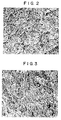
- Fig. 2 is an enlarged sectional view showing the compatible state of the resin composition obtained in Example 21.
- Fig. 3 is an enlarged sectional view showing the compatible state of the resin composition obtained in Example 22.
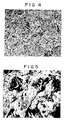
- Fig. 4 is an enlarged sectional view showing the compatible state of the resin composition obtained in Example 23.
- Fig. 5 is an enlarged sectional view showing the compatible state of the resin composition obtained in Comparative Example 2.
- Various high polymers each having polymerizable carbon-carbon double bond in the side chain thereof may be employed in the present invention without specific limitation and are each preferably constituted of an olefinic monomer unit and a diolefinic monomer unit.
- the olefinic monomer unit is exemplified by ethylene, ⁇ -olefin, halogen-substituted ⁇ -olefin and cyclic olefin.
- ⁇ -olefin includes propylene; butene-1; hexene-1; octene-1; decene-1; heptene-1; pentene-1; nonene-1; 4-phenylbutene-1; 6-phenylhexene-1; 3-methylbutene-1; 4-methylpentene-1; 3-methylpentene-1; 3-methylhexene-1; 4-methylhexene-1; 5-methylhexene-1; 3,3-dimethylpentene-1; 3,4-dimethylpentene-1; 4,4-dimethylpentene-1; vinylcyclohexane; and vinylcyclohexene.
- halogen-substituted ⁇ -olefin examples include hexafluoropropene; tetrafluoroethylene; 2-fluoropropene; fluoroethylene; 1,1-difluoroethylene, 3-fluoropropene, trifluoroethylene; and 3,4-dichlorobutene-1.
- cyclic olefin examples include norbornene; 5-methylnorbornene; 5-ethylnorbornene; 5,6-dimethylnorbornene; and 1-methylnorbornene.
- the olefinic monomer unit may be used alone or in combination with at least one unit, particularly desirably as the combination of ethylene unit and an ⁇ -olefin unit.
- ethylene unit/an ⁇ -olefin unit copolymer constituted of ethylene units and ⁇ -olefin units has an ethylene component in a ratio of 40 to 98 mol%, preferably 50 to 97 mol% and an ⁇ -olefin component in a ratio of 60 to 2 mol%, preferably 50 to 3 mol%.
- the diolefinic monomer is used for introducing double bonds in the side chain of a high polymer and exemplified by a conjugated diene compound having 4 to 20 carbon atoms such as 1,3-butadiene; chloroprene; isoprene; 1,3-hexadiene; and 1,3-heptadiene, a cyclic olefin such as vinylnorbornene and vinylstyrenic compound represented by the general formula (I) or (II) wherein R1 in the general formula (I) is a hydrocarbon group having 1 to 20 carbon atoms; R2 in the general formula (I) or (II) is a halogen atom or a hydrocarbon group having 1 to 8 carbon atoms; R3 in the general formula (I) or (II) hydrogen atom, is a halogen atom or a hydrocarbon group having 1 to 8 carbon atoms; m is zero or an integer of 1 to 4; and when m is 2 or more,
- vinylstyrenic compounds represented by the general formula (I) include p-(2-propenyl)styrene, m-(2-propenyl)styrene, p-(3-butenyl)styrene, m-(3-butenyl)styrene, o-(3-butenyl)styrene, p-(4-pentenyl)styrene, m-(4-pentenyl)styrene, o-(4-pentenyl)styrene, p-(7-octenyl)styrene, p-(2-methyl-3-butenyl)styrene, p-(1-methyl-3-butenyl)styrene, p-(3-methyl-3-butenyl)styrene, p-(2-ethyl-3-butenyl)styrene, p-(2-
- Examples of the vinylstyrenic compounds represented by the general formula (II) include those exemplified by the general formula (I) in which the ⁇ -olefin residue is substituted by a vinyl group, and specifically divinylbenzene, divinyltoluene and isopropenylstyrene.
- the diolefinic monomer may be used alone or in combination with at least one other monomer in the present invention.
- a high polymer having polymerizable carbon-carbon bonds in the side chain thereof to be employed in the present invention has graft points of styrenically unsaturated double bonds.
- Such high polymer as mentioned above can be produced by copolymerizing at least one compound selected from the olefinic monomers with at least one compound selected from the vinylstyrenic compounds represented by the general formula (I) or (II) by the use of a catalyst comprising as the principal components a transition metal compound and an organometallic compound (especially a trialkylaluminum) or a catalyst comprising as the principal components a supported transition metal compound and an organometallic compound.
- a catalyst comprising as the principal components a transition metal compound and an organometallic compound (especially a trialkylaluminum) or a catalyst comprising as the principal components a supported transition metal compound and an organometallic compound.
- graft initiation points by the use of the vinylstyrenic compound represented by the general formula (II) is susceptible to limitations in the process such as susceptibility to the formation of crosslinked product, difficulty in assuring sufficient reactivity and the monomers remaining unreacted.
- the formation thereof by the use of the vinylstyrenic compound represented by the general formula (I) is unlikely to cause crosslinkage and attains high reactivity.
- the use of an ⁇ -olefin double bond residue for graft initiation points can produce a graft polymer but makes it difficult to regulate the graft chain length or graft efficiency in a wide range.
- the high polymer having polymerizable carbon-carbon bonds in the side chain thereof obtained in the above way may be any of atactic, isotactic and syndiotactic configurations and with regard to copolymerization system, it may be copolymerized in random or block type.
- the content of unsaturated groups in the polymer is 1 ⁇ 10 ⁇ 5 to 15 mol%, preferably 1 ⁇ 10 ⁇ 4 to 10 mol%.
- the molecular weight of the polymer in terms of reduced viscosity as measured at a concentration of 0.05 g/dl in 1,2,4-trichlorobenzene at 135°C is preferably in the range of 0.01 to 30 dl/g.
- the high polymer thus produced include an ethylene/ ⁇ -olefin copolymer having graft initiation points, especially an ethylene/propylene series copolymer, an ethylene/butene-1 series copolymer and further an ethylene/diene copolymer and an ethylene/ ⁇ -olefin copolymer each having graft initiation points.
- the graft copolymer according to the present invention is that obtained by grafting a styrenic monomer onto the above-described high polymer to copolymerize therewith.
- the styrenic monomer is a compound represented by the general formula (III) wherein R4 is a hydrogen atom, a halogen atom or a substituent having at least one atom selected from carbon, tin and silicon, n is an integer from 1 to 5 and when n is a plural, each R4 may be the same or different.
- styrenic monomers III include alkylstyrene such as styrene, p-methylstyrene, o-methylstyrene, m-methylstyrene, 2,4-dimethylstyrene, 2,5-dimethylstyrene, 3,4-dimethylstyrene, 3,5-dimethylstyrene and p-tert-butylstyrene; halogenated styrenes such as p-chlorostyrene, m-chlorostyrene, o-chlorostyrene, p-bromostyrene, m-bromostyrene, o-bromostyrene, p-fluorostyrene, m-fluorostyrene, o-fluorostyrene and o-methyl-p-fluorostyrene; vinylbiphenyls such as 4-vinylbiphenyl,
- a catalyst comprising as principal components (1) (a) a transition metal compound and (b) an alumioxane; or (2) (a) a transition metal compound and (c) a compound capable of reacting with a transition metal compound to form an ionic complex.
- transition metal compounds are available as the component (a) and exemplified by the compounds represented by the general formula (IV) M1R5 --- R k (IV) wherein M1 is Ti, Zr, Cr, V, Nb, Ta or Hf atom; R5 to R k are each a hydrogen atom, an oxygen atom, a halogen atom, an alkyl group having 1 to 20 carbon atoms, an alkoxy group having 1 to 20 carbon atoms, an aryl group, an alkylaryl group or an arylalkyl group each having 6 to 20 carbon atoms, an acyloxy group having 1 to 20 carbon atoms, an allyl group, a substituted allyl group, an acetylacetonato group, a substituted acetylacetonato group, a substituent containing silicon atom, a ligand such as a carbonyl, an oxygen molecule, a nitrogen molecule, a Lewis base, an unsaturated chain hydrocarbon
- Examples of the substituted cyclopentadienyl group in the above-mentioned formula (IV) include methylcyclopentadienyl group; ethylcyclopentadienyl group; isopropylcyclopentadienyl group; 1,2-dimethylcyclopentadienyl group; tetramethylcyclopentadienyl group; 1,3-dimethylcyclopentadienyl group; 1,2,3-trimethylcyclopentadienyl group; 1,2,4-trimethylcyclopentadienyl group; pentamethylcyclopentadienyl group and trimethylsilylcyclopentadienyl group.
- R5 to R k include F, Cl, Br and I as halogen atom; methyl, ethyl, n-propyl, isopropyl, n-butyl, octyl and 2-ethylhexyl group as alkyl group having 1 to 20 carbon atoms; methoxy, ethoxy, propoxy, butoxy and phenoxy group as alkoxy group having 1 to 20 carbon atoms; phenyl, tolyl, xylyl and benzyl group as aryl, alkylaryl or arylalkyl group each having 6 to 20 carbon atoms; heptadecylcarbonyloxy group as acyloxy group having 1 to 20 carbon atoms; trimethylsilyl and (trimethylsilyl)methyl group as substituent containing silicon atom; as Lewis base, ethers such as dimethyl ether, diethyl ether and tetrahydrofuran; thioethers such as t
- titanium compounds include tetramethoxytitanium, tetraethoxytitanium, tetra-n-butoxytitanium, tetraisopropoxytitanium, titanium tetrachloride, titanium trichloride, titanium dichloride, titanium hydride, cyclopentadienyltrimethyltitanium, dimethoxytitanium dichloride, methoxytitanium trichloride, trimethoxytitanium chloride, cyclopentadienyltriethyltitanium, cyclopentadienyltripropyltitanium, cyclopentadienyltributyltitanium, methylcyclopentadienyltrimethyltitanium, 1,2-dimethylcyclopentadienyltrimethyltitanium, pentamethylcyclopentadienyltrimethyl
- vanadium compounds include vanadium trichloride, vanadyl trichloride, vanadium triacetylacetonato, vanadium tetrachloride, vanadium tributoxide, vanadyl dichloride, vanadyl bisacetylacetonato, vanadyl triacetylacetonato, dibenzenevanadium, dicyclopentadienylvanadium, dicyclopentadienylvanadium dichloride, cyclopentadienylvanadium dichloride and cyclopentadienylmethylvanadium.
- niobium compounds include niobium pentachloride, tetrachloromethylniobium, dichlorotrimethylniobium, dicyclopentadienylniobium dichloride, dicyclopentadienylniobium trihydride, and pentabutoxyniobium.
- tantalum compounds include tantalum pentachloride, dichlorotrimethyltantalum, dicyclopentadienyltantalum trihydride and pentabutoxytantalum.
- chromium compounds include chromium trichloride, tetrabutoxychromium, tetramethylchromium, dicyclopentadienylchromium and dibenzenechromium.
- transition metal compounds there may be employed the above-mentioned transition compounds each supported on a carrier such as a magnesium compound or a silicon compound and those each modified with an electron donative compound.
- transition metal compounds are particularly desirable the titanium compounds and the zirconium compounds.
- an aluminoxane (b) is employed together with the transition metal compound (a).
- the aluminoxane is obtained by bringing an organoaluminum compound into contact with a condensation agent, and includes a chain aluminoxane represented by the general formula (V) wherein R6 is an alkyl group having 1 to 20 carbon atoms, is preferably a methyl group and p is a number from 0 to 50, preferably 5 to 30; and a cyclic aluminoxane represented by the general formula (VI) wherein R6 is as previously defined and q is a number from 2 to 50, preferably 5 to 30.
- the organoaluminum compound is exemplified by a trialkylaluminum such as trimethylaluminum, triethylaluminum and triisobutylaluminum, of which is preferable trimethylaluminum.
- a trialkylaluminum such as trimethylaluminum, triethylaluminum and triisobutylaluminum, of which is preferable trimethylaluminum.
- the condensation agent is typified by water and exemplified by an arbitrary substance which undergoes condensation reaction with a trialkylaluminum such as copper sulphate pentahydrate, water adsorbed in an inorganic or organic substance and so forth.
- the contact product of an organoaluminum compound such as trialkylaluminum and water contains the above-mentioned chain alkylaluminoxane and cyclic alkylaluminoxane together with unreacted trialkylaluminum, various mixtures of condensates and further the molecules resulting from association in an intricate manner thereof. Accordingly, the resultant contact product varies widely depending upon the conditions of contact of trialkylaluminum with water as the condensation agent.
- the reaction of the alkylaluminum compound and water is not specifically limited in the above case and may be effected according to the publicly known methods, which are exemplified by (1) a method in which an organoaluminum compound is dissolved in an organic solvent and then brought into contact with water, (2) a method in which, an organoaluminum compound is first added to the reaction system at the time of polymerization and thereafter water is added thereto, and (3) a method in which an organoaluminum compound is reacted with the water of crystallization contained in metal salts and the like, or the water adsorbed in inorganic or organic materials.
- the above-mentioned water may contain up to about 20% of ammonia, alpine such as ethylamine, sulfur compound such as hydrogen sulfide, phosphorus compound such as phosphite, or the like.
- alpine such as ethylamine
- sulfur compound such as hydrogen sulfide
- phosphorus compound such as phosphite
- the above-mentioned reaction proceeds even in the absence of a solvent but is preferably carried out in a solvent.
- suitable solvent to be used here include aliphatic hydrocarbons such as hexane, heptane and decane, aromatic hydrocarbons such as benzene, toluene and xylene, and the like.
- the aluminoxane e.g.
- an alkylalumioxane is preferably obtained by a method wherein the solid residue produced after contact reaction in the case of a water-containing compound being used is removed by means of filtration and the filtrate is heat treated under atmospheric or reduced pressure at 30 to 200°C, preferably 40 to 150°C for 20 minutes to 8 hours, preferably 30 minutes to 5 hours while distilling away the solvent used.
- the temperature in the aforementioned heat treatment may be pertinently determined according to the various conditions, but should be usually within the above-described range.
- the temperature lower than 30°C fails to bring about the prescribed effect, whereas that exceeding 200°C causes thermal decomposition of aluminoxane itself, each resulting in unfavorable consequence.
- the reaction product is obtained in the form of colorless solid or solution depending upon the heat treatment conditions, and can be used as the catalyst solution by dissolving in or diluting with a hydrocarbon solvent according to the demand.
- Suitable examples of the aluminoxane that is, the contact product of organoaluminum compound and a condensation agent which is used as the component of the catalyst, especially an alkylaluminoxane are those in which the area of the high magnetic field component in the methyl proton signal region due to the aluminum-methyl group (Al-CH3) bond as observed by the proton nuclear magnetic resonance method is not more than 50% of the total signal area. That is, in a proton nuclear magnetic resonance (1H-NMR) spectral analysis of the alkylaluminoxane in toluene solvent at room temperature, the methyl proton signal due to Al-CH3 is observed in the region of 1.0 to -0.5 ppm (tetramethylsilane (TMS) standard).
- TMS tetramethylsilane
- the methyl proton signal due to Al-CH3 is measured with 2.35 ppm methyl proton signal of toluene in TMS standard.
- the methyl proton signal due to Al-CH3 is divided into two components: the high magnetic field component in the -0.1 to -0.5 ppm region and the other magnetic field component in the 1.0 to -0.1 ppm region.
- the area of the high magnetic field component is not more than 50%, preferably 45 to 5% of the total signal area in the 1.0 to -0.5 ppm region.
- (c) a compound capable of reacting with a transition metal compound to form an ionic complex together with the (a) transition metal compound.
- Lewis base represented by L1 examples include amines such as ammonia, methylamine, aniline, dimethylamine, diethylamine, N-methylaniline, diphenylamine, trimethylamine, triethylamine, tri-n-butylamine, N,N-dimethylaniline, methyldiphenylamine, pyridine, 2,2-bipyridine, p-bromo-N,N'-dimethylaniline, p-nitro-N,N-dimethylaniline and phenanthroline; phosphines such as triethylphosphine, triphenylphosphine and diphenylphosphine; ethers such as dimethyl ether, diethyl ether, tetrahydrofuran dioxane; thioethers such as diethyl thioether and tetrahydrothiophene; esters such as ethylbenzoate; and nitriles such as acet
- M2 and M3 include B, Al, Si, P, As, Sb, etc.; those of M4 include Li, Na, Ag, Cu, Br, I, I3, etc.; and those of M5 include Mn, Fe, Co, Ni, Zn, etc.
- Z1 to Z e include diaikylamino group such as dimethylamino and diethylamino, alkoxy group having 1 to 20 carbon atoms such as methoxy, ethoxy and n-butoxy; aryloxy group having 6 to 20 carbon atoms such as phenoxy, 2,6-dimethylphenoxy and naphthyloxy; alkyl group having 1 to 20 carbon atoms such as methyl, ethyl, n-propyl, iso-propyl, n-butyl, n-octyl and 2-ethylhexyl; aryl group having 6 to 20 carbon atoms, alkylaryl group or arylalkyl group such as phenyl, p-tolyl, benzyl, pentafluorophenyl, 3,5-di(trifluoromethyl)phenyl, 4-tert-butylphenyl, 2,6-dimethylphenyl, 3,5-di
- R7 and R10 are as previously enumerated.
- substituted cyclopentadienyl group in R8 and R9 include alkyl group-substituted cyclopentadienyl group such as methylcyclopentadienyl, butylcyclopentadienyl and pentamethylcyclopentadienyl, where the alkyl group has usually 1 to 6 carbon atoms and the number of the substituted alkyl groups are selected from the integers of 1 to 4.
- the compound represented by the general formula (VII) or (VIII) is preferably the compound in which M2 or M3 is boron, and enumerated, as preferably usable one of the general formula (VII), by triethylammonium tetraphenylborate, tri(n-butyl)ammonium tetraphenylborate, trimethylammonium tetraphenylborate, tetraethylammonium tetraphenylborate, methyltri(n-butyl)ammonium tetraphenylborate, benzyltri(n-butyl)ammonium tetraphenylborate, dimethyldiphenylammonium tetraphenylborate, methyltriphenylammonium tetraphenylborate, trimethylanilinium tetraphenylborate, methylpyridinium tetraphenylborate, benzylpyridin
- Examples of the compound of the general formula (VIII) include fertocenium tetraphenylborate, silver tetraphenylborate, trityl tetraphenylborate, (tetraphenylporphyrin manganate) tetraphenylborate, ferrocenium tetra(pentafluorophenyl)borate, decamethylferrocenium tetra(pentafluorophenyl)borate, acetylferrocenium tetra(pentafluorophenyl)borate, formylferrocenium tetra(pentafluorophenyl)borate, cyanoferrocenium tetra(pentafluorophenyl)borate, silver tetra(pentafluorophenyl)borate, trityl tetra(pentafluorophenyl)borate, lithium tetra(p
- an organometallic compound as component (d) may be employed, as desired, in combination with the above-described catalyst (1) or (2), and is represented by the general formula (IX) M6(R12) r (IX) where R12 is an alkyl group having 1 to 20 carbon atoms, an alkenyl group having 2 to 20 carbon atoms, a cycloalkyl group having 3 to 20 carbon atoms, an aryl group having 6 to 20 carbon atoms or aralkyl group having 7 to 20 carbon atoms, and is specifically exemplified by methyl group, ethyl group, n-propyl group, isopropyl group, n-butyl group, isobutyl group, hexyl group, 2-ethylhexyl group and phenyl group; M6 is lithium, sodium, potassium, magnesium, zinc, cadmium, aluminum, boron, gallium, silicon or tin; and r is the valency of
- an alkyllithium compound such as methyllithium, ethyllithium, propyllithium and butyllithium
- an alkylmagnesium compound such as diethylmagnesium, ethylbutylmagnesium and di-n-butylmagnesium
- a dialkylzinc compound such as dimethylzinc, diethylzinc, dipropylzinc and dibutylzinc
- an alkylgallium compound such as trimethylgallium, triethylgallium and tripropylgallium
- an alkylboron compound such as triethylboron, tripropylboron and tributylboron
- an alkyltin compound such as tetraethyltin, tetrapropyltin and tetraphenyltin.
- each component of the catalyst to be used in the present invention varies depending on the type and content each of the styrenic monomer constituting the graft chain and the polymerizable unsaturated bond and can not be unequivocally determined, however in the catalyst (1), the molar ratio of the transition metal (e.g. titanium) in the component (a) to the aluminum in the component (b) is desirably 1 to 106, more desirably 10 to 104.
- the transition metal e.g. titanium
- the molar ratio of the component (a) to the component (c) is desirably 0.01 to 100, more desirably 1 to 10.
- the components (a) and (c) may be previously brought into contact with each other, followed by separation and washing of the resultant contact product for use, or may be brought into contact in the reaction system.
- the amount of the component (d) to be used as desired in the catalyst (1) or (2) is selected usually in the range of 0 to 100 mols per one (1) mol of the component (a).
- the use of the component (d) can improve the polymerization activity, but an excessive usage does not manifest the effect corresponding thereto.
- the component (d) may be used by bringing it into contact with the component (a) or (c) or the contact product between the components (a) and (c) in advance or by the successive addition to the polymerization system.
- the proportion of the styrenic monomer to the graft precursor (high polymer having polymerizable carbon-carbon double bonds in the side chain thereof) to be used in the present invention is desirably selected in the range of 1 to 106, preferably 2 to 105 in terms of molar ratio at the graft point.
- the proportion of the styrenic monomer to the catalyst to be used is not particularly limited, but is selected usually in the range of 10 to 1012, preferably 102 to 108 in terms of the molar ratio of the styrenic polymer to the transition metal compound.
- the polymerization temperature is selected usually in the range of 0 to 120°C, preferably 10 to 80°C, and the polymerization time is desirably selected in the range of 1 second to 10 hours.
- the polymerization method any of bulk, solution and suspension polymerization is available.
- the usable solvents in solution polymerization are exemplified by aliphatic hydrocarbons such as pentane, hexane and heptane, alicyclic hydrocarbons such as cyclohexane, aromatic hydrocarbons such as benzene, toluene and xylene, among which are preferable aliphatic hydrocarbons and aromatic hydrocarbons.
- the monomer/solvent ratio by volume may be arbitrarily selected.
- the use of the vinylstyrenic compound represented by the general formula (I) as the graft point-forming monomer enables successive graft copolymerization by successive addition of the catalyst components by virtue of the high conversion efficiency in the production of the precursor as well as the low amount of the unreacted monomer at the completion of reaction.
- the vinylstyrenic compound represented by the general formula (II) it is preferable to remove the unreacted monomer by washing etc., to prevent side reactions such as crosslinkage for the purpose of successive graft copolymerization by successive addition of the catalyst components because of low conversion efficiency in the production of the precursor along with the high amount of the unreacted monomer at the completion of reaction.
- the content of vinylstyrene in the precursor is preferably limited to the range of 10 ⁇ 4 to 2 mol%.
- a low-boiling diene compound such as 1,3-butadiene or isoprene as the graft point-forming monomer enables successive graft copolymerization because of the facility in removing the unreacted monomer after the production of the precursor.
- the graft copolymer of the present invention obtained in the above-mentioned manner has a reduced viscosity of 0.01 to 30, desirably 0.05 to 25, more desirably 0.1 to 10 dl/g as measured at a concentration of 0.05 g/dl in 1,2,4-trichlorobenzene at 135°C or a melt index of 0.001 to 500, desirably 0.005 to 300 g/10 minutes as measured at 300°C with a load of 2.16 kg.
- a reduced viscosity thereof less than 0.01 dl/g or a melt index thereof more than 500 g/10 min. results in insufficient mechanical-strength, whereas the reduced viscosity exceeding 30 dl/g or a melt index less than 0.001 g/10 min. causes deterioration of moldability and workability.
- the stereostructure of the chain consisting of the styrenic monomer unit in the graft copolymer of the present invention is of high degree of syndiotactic configuration having such syndiotacticity that the proportion of racemic diad is 75% or more, preferably 85% or more or the proportion of racemic pentad is 30% or more, preferably 50% or more.
- the content of the chain consisting of the styrenic monomer unit is 0.005 to 99.9%, desirably 0.1 to 99%, more desirably 0.1 to 90%, particularly desirably 0.1 to 50%, most desirably 0.5 to 50% each by weight.
- the content in the range of usually 0.1 to 50% by weight is effective in enhancing the elasticity, strength and heat resistance of the graft precursor and enables the copolymer to be utilized as a thermoplastic elastomer and a resin compatibilizer.
- the content in the range of usually 50 to 99.9% by weight is effective in softening and toughening the SPS as the graft component and also enables the copolymer to be utilized as a resin compatibilizer.
- the content less than 0.1% by weight unfavorably results in failure to allow the chain consisting of the styrenic monomer unit to sufficiently function as the stabilizing layer and to attain sufficient mechanical-strength of the copolymer, while that exceeding 99.9% by weight leads to the copolymer that is destitute of the properties as an elastomer due to decrease in the soft phase in the copolymer.
- favorable graft copolymer as the elastomer among them is that excellent in mechanical properties, having high strength and high elongation, and exhibiting a tensile strength of 200 to 500 kg/cm2, a tensile elongation of 100 to 600% and a tensile modulus of elasticity of 1,000 to 20,000 kg/cm2.
- the resin composition according to the present invention is a thermoplastic resin composition which contains the above-described graft copolymer, maintains the characteristics thereof and is endowed with compatibility, adhesivity, impact resistance and well balanced physical properties.
- the above-mentioned resin composition comprises (A) the above-described graft copolymer, (B) at least one member selected from a styrenic polymer having a high degree of syndiotactic configuration and a thermoplastic resin other than said polymer and/or (C) at least one filler selected from an inorganic filler and an organic filler.
- the styrenic polymer in the component (B) which has syndiotactic configuration means that its stereochemical structure is of syndiotactic configuration, that is, the stereostructure in which phenyl groups or substituted phenyl groups as side chains are located alternately at opposite directions relative to the main chain consisting of carbon-carbon bonds.
- Tacticity is quantitatively determined by the nuclear magnetic resonance method (13C-NMR method) using carbon isotope.
- the tacticity as determined by the 13C-NMR method can be indicated in terms of proportions of structural units continuously connected to each other, i.e., a diad in which two structural units are connected to each other, a triad in which three structural units are connected to each other and a pentad in which five structural units are connected to each other.
- the styrenic copolymers having such syndiotactic configuration as mentioned in the present invention usually means a polymer having such syndiotacticity that the proportion of racemic diad is at least 75%, preferably at least 85%, or the proportion of racemic pentad is at least 30%, preferably at least 50% in the main chain structure of styrenic repeating units.
- the degree of syndiotactic configuration varies to some extent depending on the types of substituents and the like.
- the molecular weight of the styrenic polymer thus obtained varies depending on the polymerization conditions, and usually ranges from 5,000 to 4,500,000, preferably more than 10,000 expressed in terms of weight-average molecular weight.
- the styrenic polymer having such high degree of syndiotactic configuration is obtained by polymerizing the styrenic monomer represented by the general formula (III) by means of bulk, solution or suspension polymerization by the use of the catalyst same as that to be used for graft-copolymerizing the styrenic monomer in the production of the graft copolymer as the component (A).
- the polymerization process may be either continuous or discontinuous.
- the usable solvents when used in the polymerization are exemplified by aliphatic hydrocarbons such as pentane, hexane and heptane, alicyclic hydrocarbons such as cyclohexane and aromatic hydrocarbons such as benzene, toluene and xylene, of which at least two may be used in combination.
- the monomer/solvent ratio may be arbitrarily selected.
- the polymerization conditions are not specifically limited, but polymerization temperature shall be -100 to 250°C, preferably 0 to 80°C, polymerization time shall be 5 min. to 24 hours, preferably 1 hour or longer and polymerization pressure is not specifically limited.
- styrenic monomer represented by the general formula (III) are the same as those exemplified hereinbefore. Any of the styrenic monomers may be used alone or in combination with at least one other styrenic monomer for the purpose of copolymerization.
- the third component such as an olefinic monomer or a polar monomer may be incorporated therein insofar as the third component does not considerably impair the properties of the styrenic polymer or the syndiotactic configuration in the chain consisting of the repeating units.
- thermoplastic resins other than SPS are available and exemplified by polyolefin resin, condensation high polymer, addition polymerization high polymer, etc.
- polyolefin resins include high density polyethylene, low density polyethylene, poly-3-methylbutene-1, poly-4-methylpentene-1, straight-chain low density polyethylene obtained by the use of such a comonomer as butelle-1, hexene-1, octene-1, 4-methylpenten-1,3-methylisobutene or the like, ethylene/vinyl acetate copolymer, saponified product thereof, ethylene/acrylic acid copolymer, ethylene/acrylic ester copolymer, ethylenic ionomer, polypropylene, etc.
- polystyrene resin examples include general-purpose polystyrene, isotactic polystyrene, high impact polystyrene (rubber modified), etc.
- condensation high polymer examples include polyacetal resin, polycarbonate resin, polyamide resin such as nylon 6 and nylon 6.6, polyester resin such as polyethylene terephthalate and polybutylene terephthalate, polyphenylene oxide resin, polyimide resin, polysulfone resin, polyethersulfone resin, polyphenylene sulfide resin, etc.
- addition polymer examples include a polymer obtained from a polar vinyl monomer, a polymer obtained from a diene monomer, etc. enumerated by poly(methyl methacrylate), polyarylonitrile, acrylonitrile/butadine copolymer, acrylonitrile/butadiene/styrene copolymer, a polymer having hydrogenated diene chains, thermoplastic elastomer, etc.
- thermoplastic resins may be used alone or in combination with at least one of others.
- the types of the inorganic filler and the organic filler to be used as the component (C) of the composition of the present invention are not specifically restricted, but may be the known types having various forms such as granule, plate, lamella, fiber and whisker.
- the inorganic filler there are usable inorganic-matter type filler, metallic filler, ceramics filler, etc.
- the inorganic-matter type filler include an oxide such as silica, diatomaceous earth, barium ferrite, berylium oxide, pumice and pumice balloon; a hydroxide such as aluminum hydroxide, magnesium hydroxide and basic magnesium carbonate; a carbonate such as calcium carbonate, magnesium carbonate, dolomite and dosonite; a sulfate or sulfite such as calcium sulfate, barium sulfate, ammonium sulfate and calcium sulfite; a silicate such as talc, clay, mica, asbestos, glass fiber, glass balloon, glass bead, calcium silicate, montmorillonite and bentonite; a carbon such as carbon black, graphite, carbon fiber and hollow carbon sphere; molybdenum sulfide; boron fiber; zinc borate; bar
- the metallic filler examples include a metal element, metal compound, alloy, etc. each in the form of powder or granule, specifically exemplified by a metal element such as zinc, copper, iron, lead, aluminum, nickel, chromium, titanium, manganese, tin, platinum, tungsten, gold, magnesium, cobalt and strontium; the oxide thereof; an alloy such as stainless steel, solder and brass; metallic fiber such as aluminum fiber, stainless-steel fiber, copper fiber, bronze fiber, nickel fiber, potassium titanate fiber, other simple metal fiber and synthetic fiber and corresponding metal whiskers.
- a metal element such as zinc, copper, iron, lead, aluminum, nickel, chromium, titanium, manganese, tin, platinum, tungsten, gold, magnesium, cobalt and strontium
- the oxide thereof an alloy such as stainless steel, solder and brass
- metallic fiber such as aluminum fiber, stainless-steel fiber, copper fiber, bronze fiber, nickel fiber, potassium titanate fiber, other simple metal fiber and synthetic fiber and corresponding
- Ceramics filler examples include silicon carbide, silicon nitride, zirconia, aluminum nitride, titanium carbide each in the form of powder, granule, fiber or whisker.
- organic filler examples include shell fiber such as husk, wooden powder, cotton, jute, paper piece, cellophane piece, aromatic polyamide fiber, polyimide fiber, cellulose fiber, nylon fiber, polyester fiber, ultrahigh molecular polyethylene fiber, polypropylene fiber and thermosetting resin powder.
- shell fiber such as husk, wooden powder, cotton, jute, paper piece, cellophane piece, aromatic polyamide fiber, polyimide fiber, cellulose fiber, nylon fiber, polyester fiber, ultrahigh molecular polyethylene fiber, polypropylene fiber and thermosetting resin powder.
- the above-mentioned filler may be used alone or in combination with at least one of other fillers.
- composition according to the present invention may be subjected as desired to the addition of at least one additive enumerated by heat resistant stabilizer, weatherproof stabilizer, antistatic agent, sliding agent, anti-blocking agent, anti-fogging agent, lubricant, foaming agent, dye, pigment, natural oil, synthetic oil, wax, etc. in a pertinent compounding ratio.
- the stabilizers to be optionally compounded include phenolic antioxidant such as tetrakis[methylene-3(3,5-di-tert-butyl-4-hydroxyphenyl)propionate] methane, ⁇ -(3,5-di-tert-butyl-4-hydroxyphenyl)propionic alkylester and 2,2'-oxamindebis-[ethyl-3(3,5-di-tert-butyl-4-hydroxyphenyl)]propionate; metallic salt of fatty acid such as zinc stearate, calcium stearate and calcium 12-hydroxystearate; polyhydric alcohol-fatty acid ester such as glycerol monostearate, glycerol monolaurate, glycerol distearate, pentaerythritol monostearate, pentaerythritol distearate and pentaerythritol tristearate.
- phenolic antioxidant such as tetrakis[m
- Each of the aforementioned additives may be compounded alone or in combination with other additive/s, which combination being exemplified as the preferable one by tetrakis[methylene-3(3,5-di-tert-butyl-4-hydroxyphenyl)propionate]methane, zinc stearate and glycerol monostearate.
- the compounding ratio by weight of the graft copolymer as the component (A) to the thermoplastic resin as the component (B) in the resin composition of the present invention is selected in the range of usually 0.5:99.5 to 99.5:0.5, preferably 1:95 to 99:5.
- the compounding ratio by weight of the graft copolymer as the component (A) to the inorganic filler or the organic filler, when compounded in the composition as the component (C) is desirably 20:80 to 95:5, more desirably 40:60 to 90:10.
- the compounding ratio by weight of resin mixture of the graft copolymer as the component (A) with the thermoplastic resin as the component (C) to the inorganic filler or the organic filler, when compounded in the composition, [(A)+(B)]:C is desirably 20:80 to 95:5, more desirably 40:60 to 90:10.
- the resin composition of the present invention can be prepared by any of various procedures without specific limitation, preferably by the melt kneading that is conventionally used in a thermoplastic resin composition by the use of a known means such as Banbury mixer, single-screw or twin-screw extruder, kneader, continuous mixer or mixing roll, or by means of solution blending using a suitable solvent.
- a known means such as Banbury mixer, single-screw or twin-screw extruder, kneader, continuous mixer or mixing roll, or by means of solution blending using a suitable solvent.
- the graft copolymer according to the present invention not only maintains the inherent characteristic of SPS excellent in heat resistance, chemical resistance, electrical properties and moldability, but also is favorable in toughness, tensile strength, tensile elongation and tensile modulus of elasticity and is improved in compatibility with an olefinic or diolefinic resin, thus making itself effectively utilizable for a raw material for composite materials, heat resistant elastomer and the like.
- the resin composition comprising the aforementioned graft copolymer as the principal component according to the present invention also maintains the inherent characteristics of SPS excellent in heat resistance, chemical resistance, electrical properties and moldability and is endowed with compatibility, adhesivity, impact resistance and well-balanced physical properties at a high level, thereby rendering itself favorably utilizable as a raw material in the application field requiring heat resistance as well as impact resistance such as automobile, electric and electronics fields.
- the methyl proton signal due to Al-CH3 was measured with 2.35 ppm methyl proton signal of toluene in TMS, and the methyl proton signal due to Al-CH3 was divided into two components.
- the high magnetic field component i.e. -0.1 to -0.5 ppm was 43% of the total signal area.
- the resultant reaction product was allowed to stand to remove the supernatant liquid, incorporated with n-heptane and subjected to repeated cycle of stirring, standing and liquid removal to wash itself until chlorine ion was no longer detected, thus affording a solid catalyst component. Then, measurement was made for Ti component in the resultant solid catalyst component by means of colorimetric method. The result was 48 mg-Ti/g-carrier in terms of unit quantity supported on the carrier.
- the polymer obtained in the item (4) will be proved to be a graft copolymer.
- Fig. 1 In Fig. 1 are shown the IR absorption spectra of the graft precursor of item (3) (marked with “A”) and graft copolymer of item (4) (marked with “B”). There is observed at 1630 cm-1 in the graft precursor spectrum, the stretching vibration of carbon-carbon double bond based on p-(3-butenyl)styrene unit, but in the graft copolymer spectrum, the vibration disappears. It is proved thereby that graft copolymerization progressed via the styrene residue of the p-(3-butenyl)styrene.
- the graft copolymer as prepared in item (4) is that having SPS as the graft chain.
- the graft copolymer had a reduced viscosity of 1.9 dl/g, a content of p-(3-butenyl)styrene unit in the copolymer (precursor) of 0.15% by weight by IR absorption spectrum analysis (IR analysis), a molar ratio of ethylene unit/propylene unit of 35:65 by 1H-NMR analysis, a content of styrene unit in the graft copolymer of 60.7% by weight and melt index at 300°C and 2.16 kg load (MI) of 3.2 g/10 min.
- IR analysis IR absorption spectrum analysis
- MI melt index at 300°C and 2.16 kg load
- Example 1(4) The procedure in Example 1(4) was repeated except that copolymerization was carried out for 12 min., using 39.6 g of the graft precursor in Example 1(3), 50 ml of styrene, 2 mmol of triisobutylaluminum, 2 mmol of methylaluminoxane and 10 ⁇ mol of [Cp*Ti(OMe)3].
- a graft copolymer was obtained at a yield of 40.3 g, which had a content of styrene unit in the graft copolymer of 2.0% by weight, a reduced viscosity of 1.9 dl/g and MI of 0.74 g/10 min.
- Example 1(3) and (4) ethylene/propylene/p-(3-butenyl)styrene series graft copolymers were prepared using 600 ml of toluene and 3 mmol of isobutylaluminum. The preparation conditions and the results obtained are given in Tables 1(1), (2), (3), (4) and (5).
- Table 1 (5) Physical Properties of Graft Copolymer 3BSt Content (wt%) SPS Content (wt%) Melting Point (°C) MI Reduced Viscosity (dl/g) Example 3 ⁇ 0.01 75.5 268 2.0 1.8 Example 4 0.30 25.9 268 2.9 5.0 Example 5 0.75 19.5 248 0.6 2.6 Example 6 0.71 6.5 247 0.7 2.9
- Example 1(3) The procedure in Example 1(3) was repeated except that 8 mmol of p-(3-butenyl)styrene was used, 2.0 mmol of triethylaluminum was used in place of triisobutylaluminum, propylene was continuously fed at 7 kg/cm2G without the use of ethylene and hydrogen was introduced at 0.2 kg/cm2 prior to the propylene feeding. After the copolymerization, methanol was used for deactivation and cleaning to afford 150 g of a polymer.
- Example 1(2) The procedure in Example 1(2) was repeated except that reaction was effected for one (1) hour, using 29 g of the graft precursor in the above item (1). The reaction progressed in slurry state. As a result, a graft copolymer was obtained at a yield of 36.5 g, which had a content of styrene unit in the graft copolymer of 20.5% by weight. As a result of DSC analysis, there were observed at first a melting point of 148°C based on the isotactic polypropylene and then a melting point of 268°C based on the SPS. The graft copolymer had a boiling heptane-insoluble portion of 92% by weight and MI of 0.005 g/10min.
- Example 1(3) The procedure in Example 1(3) was repeated except that copolymerization was carried out at 80°C by the use of 400 ml of toluene, 5 mmol of p-(3-butenyl)styrene and 0.02 mmol of titanium component of the catalyst, while hydrogen was introduced at 7 kg/cm2G, followed by continuous feeding of ethylene at 3 kg/cm2G without the use of propylene.
- the copolymer was obtained at a yield of 42 g, 20 g of which was employed for performing graft copolymerization reaction for one (1) hour in the same manner as in Example 1.
- the reaction progressed in slurry state.
- a graft copolymer was obtained at a yield of 25.2 g, which had a content of styrene unit in the graft copolymer of 20.6% by weight.
- DSC analysis there were observed at first a melting point of 134°C based on polyethylene and then a melting point of 268°C based on SPS.
- the graft copolymer had a reduced viscosity of 0.92 dl/g and MI of 3.2 g/10 min.
- Table 2 Amount of graft precursor charged (g) Styrenic monomer Yield (g) ⁇ sp/c (dl/g) Melting Point (°C) MI Species Amount
- Example 9 10 p-methylstyrene 50ml 13.6 2.3 - 3.5
- Example 10 12 p-phenylstyrene 16g 14.7 3.0 350 - Reaction conditions toluene 400 ml triisobutylaluminum 3 mmol methylaluminoxane 3 mmol Cp*Ti(OMe)3 10 ⁇ m temperature 70°C reaction time 1 hour
- Pentafluorophenyllithium which was prepared from 152 mmol of bromopentafluorobenzene and 152 mmol of butyllithium was reacted with 45 mmol of trichloroboron in hexane to produce tri(pentafluorophenyl)boron as white solid, 41 mmol of which was reacted with 41 mmol of pentafluorophenyllithium to produce lithium tetra(pentafluorophenyl)boron as white solid and isolate the same.
- Graft copolymerization was carried out for 30 min. in the similar manner to Example 1, using 20 g of the graft precursor as prepared in Example 1(3), 1 mmol of triisobutylaluminum, 50 ⁇ mol of the boron compound as prepared in the above item (1) in place of aluminoxane and 10 ⁇ mol of pentamethylcyclopentadienyltrimethyltitanium (Cp*TiMe3) in place of Cp*Ti(OMe)3.
- methanol was used for deactivation and cleaning to afford 54.3 g of a graft copolymer, which had a content of styrene unit in the graft copolymer of 63.1% by weight and a reduced viscosity of 3.0 dl/g.
- the graft copolymer had a reduced viscosity of 2.0 dl/g, a boiling heptane-insoluble portion of 97% by weight and MI of 2.3 g/10 min.
- the solid catalyst as prepared in the preceding item (2) in an amount of 0.015 mmol as Ti atom to proceed with copolymerization for one (1) hour, while the reaction pressure was adjusted so as to maintain the total pressure of ethylene at 10 kg/cm2 ⁇ G.
- the unreacted gas was removed by depressurization. In order to completely remove the unreacted gas, dry nitrogen at 70°C was blown into the autoclave for 30 min, while toluene as the solvent was evaporated outside the reaction system.
- the graft copolymer thus obtained had a melting point of 266°C as determined by DSC analysis, a reduced viscosity of 3.0 dl/g, an ethylene unit/propylene unit/styrene unit molar ratio of 33.2/61.6/5.2, and MI of 1.6 g/10 min. There was not detected the absorption at 1630 cm ⁇ 1 based on p-(3-butenyl)styrene in the IR absorption spectrum of the graft copolymer.
- Example 1(2) To the saturated mixture was added the solid catalyst as prepared in Example 1(2) in an amount of 0.015 mmol as Ti atom to proceed with copolymerization for one (1) hour, while the reaction pressure was adjusted so as to maintain the total pressure of ethylene at 10 kg/cm2G. After the completion of reaction, the unreacted gas was removed and the resultant polymer was cleaned with methanol to afford 156 of white powder.
- the graft copolymer obtained in the above item (2) was subjected to (a) infrared (IR) absorption spectrum analysis and (b) analysis of graft chain in the same manner as in Example 1. As a result, it has been demonstrated that the graft copolymer as prepared in item (2) is that having SPS as the graft chain.
- the graft copolymer had a reduced viscosity of 1.9 dl/g, a content of p-(3-butenyl)styrene unit in the copolymer (precursor) of 0.15% by weight by IR absorption spectrum analysis (IR analysis), a molar ratio of ethylene unit/propylene unit of 65:35 by 1H-NMR analysis, a content of styrene unit in the graft copolymer of 45.8% by weight and melt index at 300°C and 2.16 kg load (MI) of 3.2 g/10 min.
- IR analysis IR absorption spectrum analysis
- MI melt index at 300°C and 2.16 kg load
- the resultant copolymer was hot-pressed into a film, which was measured for tensile strength characteristics.
- the film had a tensile strength of 320 kg/cm2, a tensile elongation of 380% and a tensile modulus of elasticity of 12,000 kg/cm2.
- Example 14(2) The procedure in Example 14(2) was repeated except that copolymerization was carried out for 12 min., using 39.6 g of the graft precursor in Example 14(1), 50 ml of styrene, 2 mmol of triisobutylaluminum, 2 mmol of methylaluminoxane and 10 ⁇ mol of [Cp*Ti(OMe)3].
- a graft copolymer was obtained in a yield of 41.6 g, which had a content of styrene unit in the graft copolymer of 4.8% by weight, a reduced viscosity of 1.9 dl/g and MI of 0.74 g/10 min. It had a tensile strength of 260 kg/cm2, a tensile elongation of 580% and a tensile modulus of elasticity of 3,800 kg/cm2.
- Example 14(2) The procedure in Example 14(2) was repeated except that copolymerization was carried out for 30 min., using 32.8 g of the graft precursor in Example 14(1), 200 ml of styrene, 1 mmol of triisobutylaluminum, 10 mmol of methylaluminoxane and 50 ⁇ mol of cyclopentadienyltitanium trichloride [CpTiCl3].
- a graft copolymer was obtained in a yield of 39.4 g, which had a content of styrene unit in the graft copolymer of 16.8% by weight, a reduced viscosity of 1.6 dl/g and MI of 2.8 g/10 min. It had a tensile strength of 300 kg/cm2, a tensile elongation of 420% and a tensile modulus of elasticity of 7,000 kg/cm2.
- ethylene/propylene/p-(3-butenyl)styrene series graft copolymers were prepared using 600 ml of toluene and 3 mmol of isobutylaluminum.
- the preparation conditions are given in Tables 3(1), (2), (3), and (4), and the results of physical properties measurements are given in Tables 4(1) and (2).
- Example 1(2) To the saturated mixture was added the solid catalyst as prepared in Example 1(2) in an amount of 0.015 mmol as Ti atom to proceed with copolymerization for one (1) hour, while the reaction pressure was adjusted so as to maintain the total pressure of ethylene at 10 kg/cm2G. After the completion of reaction, the unreacted gas was removed and the resultant polymer was cleaned with methanol to afford 222 g of white powder.
- Preparation Example 1(2) was repeated to obtain 40.1 g of a graft copolymer except that copolymerization was carried out at 70°C for 3 hours, using 20 g of the copolymer thus obtained.
- the graft copolymer thus obtained had a content of styrene unit of 49.8% by weight and a reduced viscosity of 1.23 dl/g.
- each of the resin compositions as prepared in Examples 21 and 22 was compounded with 30 parts by weight of glass fiber (3 m length) and talc, respectively to prepare a resin composition in a similar manner to Example 21.
- the resin composition thus obtained was compression molded into a test piece, the fractured surface of which was observed with an electron microscope. As a result, the interface between the resin and the filler exhibited favorable bonding.
Landscapes
- Chemical & Material Sciences (AREA)
- Health & Medical Sciences (AREA)
- Chemical Kinetics & Catalysis (AREA)
- Medicinal Chemistry (AREA)
- Polymers & Plastics (AREA)
- Organic Chemistry (AREA)
- Graft Or Block Polymers (AREA)
- Transition And Organic Metals Composition Catalysts For Addition Polymerization (AREA)
- Compositions Of Macromolecular Compounds (AREA)
Applications Claiming Priority (4)
| Application Number | Priority Date | Filing Date | Title |
|---|---|---|---|
| JP45626/92 | 1992-03-03 | ||
| JP04045626A JP3121095B2 (ja) | 1992-03-03 | 1992-03-03 | グラフト共重合体及びその製造方法 |
| JP04151247A JP3086328B2 (ja) | 1992-05-20 | 1992-05-20 | 樹脂組成物 |
| JP151247/92 | 1992-05-20 |
Publications (2)
| Publication Number | Publication Date |
|---|---|
| EP0559108A1 true EP0559108A1 (de) | 1993-09-08 |
| EP0559108B1 EP0559108B1 (de) | 1997-05-28 |
Family
ID=26385652
Family Applications (1)
| Application Number | Title | Priority Date | Filing Date |
|---|---|---|---|
| EP93103181A Expired - Lifetime EP0559108B1 (de) | 1992-03-03 | 1993-02-27 | Pfropfcopolymer, Verfahren zu seiner Herstellung und Harzzusammensetzung, worin es enthalten ist |
Country Status (4)
| Country | Link |
|---|---|
| US (2) | US5362814A (de) |
| EP (1) | EP0559108B1 (de) |
| AT (1) | ATE153680T1 (de) |
| DE (1) | DE69310955T2 (de) |
Cited By (11)
| Publication number | Priority date | Publication date | Assignee | Title |
|---|---|---|---|---|
| WO1996039451A1 (en) * | 1995-06-06 | 1996-12-12 | The Dow Chemical Company | Segmented multicomponent interpolymers of monovinylidene aromatic monomers |
| EP0753522A1 (de) | 1995-07-12 | 1997-01-15 | Witco GmbH | Verfahren zur Herstellung von Cyclopentadienyltitantrialkoxy-Derivaten |
| EP0860456A1 (de) * | 1997-02-21 | 1998-08-26 | Idemitsu Petrochemical Co., Ltd. | Propfcopolymer und auf Styrol basierde Harzmischung |
| US6025447A (en) * | 1997-09-19 | 2000-02-15 | Basf Aktiengesellschaft | Graft copolymers |
| EP0911346A3 (de) * | 1997-10-24 | 2000-11-02 | Idemitsu Petrochemical Co., Ltd. | Ethylen Copolymer, vinylaromatisches Pfropfcopolymer und Verfahren zu ihrer Herstellung |
| US6265493B1 (en) | 1999-07-21 | 2001-07-24 | The Penn State Research Foundation | Polyolefin graft copolymers derived from linear copolymers of alpha-olefins and divinylbenzene having narrow molecular weight and composition distributions and process for preparing same |
| WO2002062889A1 (en) * | 2001-02-07 | 2002-08-15 | Idemitsu Petrochemical Co., Ltd. | Polyolefin resin composition |
| EP1170313A4 (de) * | 1998-12-22 | 2002-10-29 | Denki Kagaku Kogyo Kk | Cross-kopolymerisierte olefin/styrol/dien kopolymere, ihre herstellungsverfahren und verwendung |
| EP1311612A4 (de) * | 2000-08-14 | 2005-04-06 | Samsung Atofina Co Ltd | Reaktorlegierung aus syndiotaktischem polystyrol mit hoher schlagfestigkeit |
| WO2012066016A1 (en) | 2010-11-18 | 2012-05-24 | Total Petrochemicals Research Feluy | Process to make diblock polystyrene materials comprising syndiotactic and atactic blocks. |
| CN107210219A (zh) * | 2014-12-23 | 2017-09-26 | 乔治洛德方法研究和开发液化空气有限公司 | 用于气相沉积含锆膜的含锆膜形成组合物 |
Families Citing this family (15)
| Publication number | Priority date | Publication date | Assignee | Title |
|---|---|---|---|---|
| ATE138668T1 (de) * | 1990-11-21 | 1996-06-15 | Idemitsu Kosan Co | Styrol-copolymer und seine herstellung |
| JP3121116B2 (ja) * | 1992-05-21 | 2000-12-25 | 出光興産株式会社 | スチレン系ブロック共重合体及びその製造方法 |
| EP0767211B1 (de) * | 1995-09-08 | 1999-04-21 | Idemitsu Petrochemical Co., Ltd. | Harzzusammensetzung auf Styrolbasis |
| JPH09111135A (ja) * | 1995-10-23 | 1997-04-28 | Mitsubishi Materials Corp | 導電性ポリマー組成物 |
| JPH09180689A (ja) * | 1995-12-27 | 1997-07-11 | Idemitsu Petrochem Co Ltd | 密閉型二次電池用電槽材料及びそれを用いた密閉型二次電池用電槽 |
| US6191197B1 (en) * | 1996-09-23 | 2001-02-20 | Bridgestone Corporation | Extended polymer compostion derived from blends of elastomers and syndiotactic polystyrene |
| US6329459B1 (en) | 1996-09-23 | 2001-12-11 | Bridgestone Corporation | Extended syndiotactic polystyrene-elastomeric block copolymers |
| EP0911349A1 (de) * | 1997-10-24 | 1999-04-28 | Idemitsu Petrochemical Co., Ltd. | Vinylaromatische Harze und geformte Gegenstände davon |
| WO2003008497A1 (en) * | 2001-07-12 | 2003-01-30 | Idemitsu Petrochemical Co., Ltd. | Polyolefin resin composition |
| KR100466201B1 (ko) * | 2002-09-19 | 2005-01-13 | 금호석유화학 주식회사 | 스티렌계 공중합체 |
| US20090198031A1 (en) * | 2004-07-01 | 2009-08-06 | The Penn State Research Foundation | One-pot process and reagents for preparing long chain branched polymers |
| US7511105B2 (en) * | 2004-07-01 | 2009-03-31 | The Penn State Research Foundation | One-pot process and reagents for preparing long chain branched polymers |
| WO2014025986A2 (en) * | 2012-08-10 | 2014-02-13 | The University Of Akron | Novel polyisobutylene-based thermoplastic elastomers |
| DE112017003997B4 (de) * | 2016-08-10 | 2025-03-20 | Resonac Corporation | Verfahren zur Herstellung eines Chloropren-Pfropfcopolymerlatex |
| CN117801292A (zh) * | 2022-09-26 | 2024-04-02 | 中国石油天然气集团有限公司 | 多元共聚物及其制备方法和应用、卤化支化丁基橡胶及其制备方法和应用 |
Citations (5)
| Publication number | Priority date | Publication date | Assignee | Title |
|---|---|---|---|---|
| EP0315431A2 (de) * | 1987-11-02 | 1989-05-10 | Mitsubishi Petrochemical Co., Ltd. | Verfahren zur Herstellung eines mit Pfropfung modifizierten Alpha-Olefin-Copolymers |
| EP0333878A1 (de) * | 1987-09-28 | 1989-09-27 | Idemitsu Kosan Company Limited | Verfahren zur herstellung eines styrenpolymers |
| EP0389981A2 (de) * | 1989-03-28 | 1990-10-03 | Idemitsu Kosan Company Limited | Verfahren zur Herstellung eines Polymers auf der Basis von Styrol |
| EP0421659A2 (de) * | 1989-09-29 | 1991-04-10 | The Dow Chemical Company | Verfahren zur Herstellung eines syndiotaktischen vinylaromatischen Polymers |
| EP0440014A2 (de) * | 1990-01-30 | 1991-08-07 | Idemitsu Kosan Company Limited | Verfahren zur Herstellung einer Stryrolpolymerzusammensetzung |
Family Cites Families (4)
| Publication number | Priority date | Publication date | Assignee | Title |
|---|---|---|---|---|
| JPS62187708A (ja) * | 1985-11-11 | 1987-08-17 | Idemitsu Kosan Co Ltd | スチレン系重合体の製造法 |
| US5166238A (en) * | 1986-09-22 | 1992-11-24 | Idemitsu Kosan Co., Ltd. | Styrene-based resin composition |
| JPH0672173B2 (ja) * | 1987-02-20 | 1994-09-14 | 日本ペイント株式会社 | グラフト重合体およびその製造方法 |
| EP0490269B1 (de) * | 1990-12-10 | 1996-02-28 | Idemitsu Kosan Company Limited | Pfropfcopolymer und Verfahren zu seiner Herstellung |
-
1993
- 1993-02-27 DE DE69310955T patent/DE69310955T2/de not_active Expired - Fee Related
- 1993-02-27 AT AT93103181T patent/ATE153680T1/de not_active IP Right Cessation
- 1993-02-27 EP EP93103181A patent/EP0559108B1/de not_active Expired - Lifetime
- 1993-03-03 US US08/025,781 patent/US5362814A/en not_active Expired - Fee Related
-
1994
- 1994-07-26 US US08/280,740 patent/US5418276A/en not_active Expired - Fee Related
Patent Citations (5)
| Publication number | Priority date | Publication date | Assignee | Title |
|---|---|---|---|---|
| EP0333878A1 (de) * | 1987-09-28 | 1989-09-27 | Idemitsu Kosan Company Limited | Verfahren zur herstellung eines styrenpolymers |
| EP0315431A2 (de) * | 1987-11-02 | 1989-05-10 | Mitsubishi Petrochemical Co., Ltd. | Verfahren zur Herstellung eines mit Pfropfung modifizierten Alpha-Olefin-Copolymers |
| EP0389981A2 (de) * | 1989-03-28 | 1990-10-03 | Idemitsu Kosan Company Limited | Verfahren zur Herstellung eines Polymers auf der Basis von Styrol |
| EP0421659A2 (de) * | 1989-09-29 | 1991-04-10 | The Dow Chemical Company | Verfahren zur Herstellung eines syndiotaktischen vinylaromatischen Polymers |
| EP0440014A2 (de) * | 1990-01-30 | 1991-08-07 | Idemitsu Kosan Company Limited | Verfahren zur Herstellung einer Stryrolpolymerzusammensetzung |
Cited By (15)
| Publication number | Priority date | Publication date | Assignee | Title |
|---|---|---|---|---|
| WO1996039451A1 (en) * | 1995-06-06 | 1996-12-12 | The Dow Chemical Company | Segmented multicomponent interpolymers of monovinylidene aromatic monomers |
| EP0753522A1 (de) | 1995-07-12 | 1997-01-15 | Witco GmbH | Verfahren zur Herstellung von Cyclopentadienyltitantrialkoxy-Derivaten |
| US5625086A (en) * | 1995-07-12 | 1997-04-29 | Witco Gmbh | Process for the preparation of cyclopentadienyltrialkoxytitanium derivatives |
| EP0860456A1 (de) * | 1997-02-21 | 1998-08-26 | Idemitsu Petrochemical Co., Ltd. | Propfcopolymer und auf Styrol basierde Harzmischung |
| US6100331A (en) * | 1997-02-21 | 2000-08-08 | Idemitsu Petrochemical Co., Ltd. | Graft copolymer and styrene-based resin composition |
| US6025447A (en) * | 1997-09-19 | 2000-02-15 | Basf Aktiengesellschaft | Graft copolymers |
| EP0911346A3 (de) * | 1997-10-24 | 2000-11-02 | Idemitsu Petrochemical Co., Ltd. | Ethylen Copolymer, vinylaromatisches Pfropfcopolymer und Verfahren zu ihrer Herstellung |
| EP1170313A4 (de) * | 1998-12-22 | 2002-10-29 | Denki Kagaku Kogyo Kk | Cross-kopolymerisierte olefin/styrol/dien kopolymere, ihre herstellungsverfahren und verwendung |
| US6559234B1 (en) | 1998-12-22 | 2003-05-06 | Denki Kagaku Kogyo Kabushiki Kaisha | Cross-copolymerized olefin/styrene/diene copolymer, process for the production of the same and uses thereof |
| US6265493B1 (en) | 1999-07-21 | 2001-07-24 | The Penn State Research Foundation | Polyolefin graft copolymers derived from linear copolymers of alpha-olefins and divinylbenzene having narrow molecular weight and composition distributions and process for preparing same |
| EP1311612A4 (de) * | 2000-08-14 | 2005-04-06 | Samsung Atofina Co Ltd | Reaktorlegierung aus syndiotaktischem polystyrol mit hoher schlagfestigkeit |
| WO2002062889A1 (en) * | 2001-02-07 | 2002-08-15 | Idemitsu Petrochemical Co., Ltd. | Polyolefin resin composition |
| US7193013B2 (en) | 2001-02-07 | 2007-03-20 | Idemitsu Kosan Co. Ltd. | Polyolefin resin composition |
| WO2012066016A1 (en) | 2010-11-18 | 2012-05-24 | Total Petrochemicals Research Feluy | Process to make diblock polystyrene materials comprising syndiotactic and atactic blocks. |
| CN107210219A (zh) * | 2014-12-23 | 2017-09-26 | 乔治洛德方法研究和开发液化空气有限公司 | 用于气相沉积含锆膜的含锆膜形成组合物 |
Also Published As
| Publication number | Publication date |
|---|---|
| EP0559108B1 (de) | 1997-05-28 |
| DE69310955T2 (de) | 1997-09-04 |
| DE69310955D1 (de) | 1997-07-03 |
| ATE153680T1 (de) | 1997-06-15 |
| US5418276A (en) | 1995-05-23 |
| US5362814A (en) | 1994-11-08 |
Similar Documents
| Publication | Publication Date | Title |
|---|---|---|
| EP0559108B1 (de) | Pfropfcopolymer, Verfahren zu seiner Herstellung und Harzzusammensetzung, worin es enthalten ist | |
| EP0570932B1 (de) | Styrol-Block-Copolymer und Prozess zu seiner Herstellung | |
| EP0490269B1 (de) | Pfropfcopolymer und Verfahren zu seiner Herstellung | |
| JP3216748B2 (ja) | 芳香族ビニル化合物重合体組成物の製造触媒及びそれを用いた芳香族ビニル化合物重合体組成物の製造方法 | |
| JP3301448B2 (ja) | 変性共重合体及びその製造方法 | |
| US5378777A (en) | Process for producing styrenic polymer and copolymer | |
| JPH08134122A (ja) | 重合用触媒及びそれを用いたスチレン系重合体の製造方法 | |
| EP0570931A2 (de) | Styrolpolymer, Verfahren zur Herstellung desselben und dieses enthaltendes mehrschichtiges Material | |
| JP3121095B2 (ja) | グラフト共重合体及びその製造方法 | |
| JPH11124420A (ja) | 芳香族ビニルグラフト共重合体及びその製造方法 | |
| JP3086329B2 (ja) | 樹脂組成物及びそれを用いた多層材料 | |
| JP3086328B2 (ja) | 樹脂組成物 | |
| JP3129341B2 (ja) | オレフィン系共重合体及びその製造方法 | |
| JP3026678B2 (ja) | スチレン系重合体、その製造方法及び該重合体を用いた多層材料 | |
| JP3121113B2 (ja) | スチレン系樹脂組成物の製造方法 | |
| JP3115944B2 (ja) | 化学変性スチレン系重合体及びその製造方法 | |
| JP3487448B2 (ja) | スチレン系重合体の製造方法 | |
| JP3121109B2 (ja) | オレフィン系共重合体 | |
| JP2966990B2 (ja) | 樹脂組成物 | |
| JPH11189620A (ja) | エチレン系共重合体及びその製造方法 | |
| JP2001354727A (ja) | スチレン系共重合体及びその製造法 | |
| JP2001206916A (ja) | スチレン系共重合体及びその製造法 | |
| JP2001206915A (ja) | スチレン系共重合体及びその製造法 | |
| JPH0770250A (ja) | オレフィン系共重合体の変性方法 | |
| JPH06172424A (ja) | 変性共重合体及びその製造方法 |
Legal Events
| Date | Code | Title | Description |
|---|---|---|---|
| PUAI | Public reference made under article 153(3) epc to a published international application that has entered the european phase |
Free format text: ORIGINAL CODE: 0009012 |
|
| AK | Designated contracting states |
Kind code of ref document: A1 Designated state(s): AT BE CH DE ES FR GB IT LI NL SE |
|
| 17P | Request for examination filed |
Effective date: 19940225 |
|
| 17Q | First examination report despatched |
Effective date: 19950622 |
|
| GRAG | Despatch of communication of intention to grant |
Free format text: ORIGINAL CODE: EPIDOS AGRA |
|
| GRAH | Despatch of communication of intention to grant a patent |
Free format text: ORIGINAL CODE: EPIDOS IGRA |
|
| GRAH | Despatch of communication of intention to grant a patent |
Free format text: ORIGINAL CODE: EPIDOS IGRA |
|
| GRAA | (expected) grant |
Free format text: ORIGINAL CODE: 0009210 |
|
| AK | Designated contracting states |
Kind code of ref document: B1 Designated state(s): AT BE CH DE ES FR GB IT LI NL SE |
|
| PG25 | Lapsed in a contracting state [announced via postgrant information from national office to epo] |
Ref country code: LI Effective date: 19970528 Ref country code: ES Free format text: THE PATENT HAS BEEN ANNULLED BY A DECISION OF A NATIONAL AUTHORITY Effective date: 19970528 Ref country code: CH Effective date: 19970528 Ref country code: AT Effective date: 19970528 |
|
| REF | Corresponds to: |
Ref document number: 153680 Country of ref document: AT Date of ref document: 19970615 Kind code of ref document: T |
|
| REG | Reference to a national code |
Ref country code: CH Ref legal event code: EP |
|
| REF | Corresponds to: |
Ref document number: 69310955 Country of ref document: DE Date of ref document: 19970703 |
|
| ET | Fr: translation filed | ||
| PG25 | Lapsed in a contracting state [announced via postgrant information from national office to epo] |
Ref country code: SE Effective date: 19970828 |
|
| REG | Reference to a national code |
Ref country code: CH Ref legal event code: PL |
|
| PLBE | No opposition filed within time limit |
Free format text: ORIGINAL CODE: 0009261 |
|
| STAA | Information on the status of an ep patent application or granted ep patent |
Free format text: STATUS: NO OPPOSITION FILED WITHIN TIME LIMIT |
|
| 26N | No opposition filed | ||
| REG | Reference to a national code |
Ref country code: GB Ref legal event code: IF02 |
|
| PGFP | Annual fee paid to national office [announced via postgrant information from national office to epo] |
Ref country code: FR Payment date: 20020212 Year of fee payment: 10 |
|
| PGFP | Annual fee paid to national office [announced via postgrant information from national office to epo] |
Ref country code: GB Payment date: 20020227 Year of fee payment: 10 |
|
| PGFP | Annual fee paid to national office [announced via postgrant information from national office to epo] |
Ref country code: NL Payment date: 20020228 Year of fee payment: 10 |
|
| PGFP | Annual fee paid to national office [announced via postgrant information from national office to epo] |
Ref country code: DE Payment date: 20020314 Year of fee payment: 10 |
|
| PGFP | Annual fee paid to national office [announced via postgrant information from national office to epo] |
Ref country code: BE Payment date: 20020418 Year of fee payment: 10 |
|
| PG25 | Lapsed in a contracting state [announced via postgrant information from national office to epo] |
Ref country code: GB Free format text: LAPSE BECAUSE OF NON-PAYMENT OF DUE FEES Effective date: 20030227 |
|
| PG25 | Lapsed in a contracting state [announced via postgrant information from national office to epo] |
Ref country code: BE Free format text: LAPSE BECAUSE OF NON-PAYMENT OF DUE FEES Effective date: 20030228 |
|
| PG25 | Lapsed in a contracting state [announced via postgrant information from national office to epo] |
Ref country code: NL Free format text: LAPSE BECAUSE OF NON-PAYMENT OF DUE FEES Effective date: 20030901 |
|
| PG25 | Lapsed in a contracting state [announced via postgrant information from national office to epo] |
Ref country code: DE Free format text: LAPSE BECAUSE OF NON-PAYMENT OF DUE FEES Effective date: 20030902 |
|
| GBPC | Gb: european patent ceased through non-payment of renewal fee | ||
| PG25 | Lapsed in a contracting state [announced via postgrant information from national office to epo] |
Ref country code: FR Free format text: LAPSE BECAUSE OF NON-PAYMENT OF DUE FEES Effective date: 20031031 |
|
| NLV4 | Nl: lapsed or anulled due to non-payment of the annual fee |
Effective date: 20030901 |
|
| REG | Reference to a national code |
Ref country code: FR Ref legal event code: ST |
|
| PG25 | Lapsed in a contracting state [announced via postgrant information from national office to epo] |
Ref country code: IT Free format text: LAPSE BECAUSE OF NON-PAYMENT OF DUE FEES Effective date: 20050227 |