EP0559142A2 - Méthode et système de conversion de format de stockage de données, méthode d'accès aux données et dispositif de contrôle d'accès - Google Patents
Méthode et système de conversion de format de stockage de données, méthode d'accès aux données et dispositif de contrôle d'accès Download PDFInfo
- Publication number
- EP0559142A2 EP0559142A2 EP93103292A EP93103292A EP0559142A2 EP 0559142 A2 EP0559142 A2 EP 0559142A2 EP 93103292 A EP93103292 A EP 93103292A EP 93103292 A EP93103292 A EP 93103292A EP 0559142 A2 EP0559142 A2 EP 0559142A2
- Authority
- EP
- European Patent Office
- Prior art keywords
- record
- track
- records
- format
- position information
- Prior art date
- Legal status (The legal status is an assumption and is not a legal conclusion. Google has not performed a legal analysis and makes no representation as to the accuracy of the status listed.)
- Granted
Links
Images











Classifications
-
- G—PHYSICS
- G06—COMPUTING OR CALCULATING; COUNTING
- G06F—ELECTRIC DIGITAL DATA PROCESSING
- G06F3/00—Input arrangements for transferring data to be processed into a form capable of being handled by the computer; Output arrangements for transferring data from processing unit to output unit, e.g. interface arrangements
- G06F3/06—Digital input from, or digital output to, record carriers, e.g. RAID, emulated record carriers or networked record carriers
- G06F3/0601—Interfaces specially adapted for storage systems
-
- G—PHYSICS
- G06—COMPUTING OR CALCULATING; COUNTING
- G06F—ELECTRIC DIGITAL DATA PROCESSING
- G06F12/00—Accessing, addressing or allocating within memory systems or architectures
- G06F12/02—Addressing or allocation; Relocation
- G06F12/04—Addressing variable-length words or parts of words
-
- G—PHYSICS
- G06—COMPUTING OR CALCULATING; COUNTING
- G06F—ELECTRIC DIGITAL DATA PROCESSING
- G06F3/00—Input arrangements for transferring data to be processed into a form capable of being handled by the computer; Output arrangements for transferring data from processing unit to output unit, e.g. interface arrangements
- G06F3/06—Digital input from, or digital output to, record carriers, e.g. RAID, emulated record carriers or networked record carriers
- G06F3/0601—Interfaces specially adapted for storage systems
- G06F3/0602—Interfaces specially adapted for storage systems specifically adapted to achieve a particular effect
- G06F3/061—Improving I/O performance
-
- G—PHYSICS
- G06—COMPUTING OR CALCULATING; COUNTING
- G06F—ELECTRIC DIGITAL DATA PROCESSING
- G06F3/00—Input arrangements for transferring data to be processed into a form capable of being handled by the computer; Output arrangements for transferring data from processing unit to output unit, e.g. interface arrangements
- G06F3/06—Digital input from, or digital output to, record carriers, e.g. RAID, emulated record carriers or networked record carriers
- G06F3/0601—Interfaces specially adapted for storage systems
- G06F3/0628—Interfaces specially adapted for storage systems making use of a particular technique
- G06F3/0638—Organizing or formatting or addressing of data
- G06F3/064—Management of blocks
-
- G—PHYSICS
- G06—COMPUTING OR CALCULATING; COUNTING
- G06F—ELECTRIC DIGITAL DATA PROCESSING
- G06F3/00—Input arrangements for transferring data to be processed into a form capable of being handled by the computer; Output arrangements for transferring data from processing unit to output unit, e.g. interface arrangements
- G06F3/06—Digital input from, or digital output to, record carriers, e.g. RAID, emulated record carriers or networked record carriers
- G06F3/0601—Interfaces specially adapted for storage systems
- G06F3/0628—Interfaces specially adapted for storage systems making use of a particular technique
- G06F3/0655—Vertical data movement, i.e. input-output transfer; data movement between one or more hosts and one or more storage devices
- G06F3/0661—Format or protocol conversion arrangements
-
- G—PHYSICS
- G06—COMPUTING OR CALCULATING; COUNTING
- G06F—ELECTRIC DIGITAL DATA PROCESSING
- G06F3/00—Input arrangements for transferring data to be processed into a form capable of being handled by the computer; Output arrangements for transferring data from processing unit to output unit, e.g. interface arrangements
- G06F3/06—Digital input from, or digital output to, record carriers, e.g. RAID, emulated record carriers or networked record carriers
- G06F3/0601—Interfaces specially adapted for storage systems
- G06F3/0668—Interfaces specially adapted for storage systems adopting a particular infrastructure
- G06F3/0671—In-line storage system
- G06F3/0683—Plurality of storage devices
- G06F3/0689—Disk arrays, e.g. RAID, JBOD
Definitions
- the present invention relates to data storage format conversion method and system for converting data stored in a variable length record format adopted in a magnetic disk system of a general-purpose computer into data of a fixed length format which is adopted in commercially available miniature type magnetic disk device as well as a data access method for making access to the data undergone the format conversion and an apparatus for controlling the access to the data.
- variable length record format type disk As an external data storage device for a general-purpose (or universal-purpose) computer system, a fixed disk drive system of a variable length record format type (also known as the count key data type or CKD-type in abbreviation) is widely used.
- variable length record format type disk or CKD-type disk it is intended to mean a magnetic disk which is formatted in such a manner that the length as well as the number of physical records to be recorded on one track of the magnetic disk is variable.
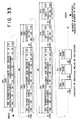
- any given one of the tracks on the disk begins with an index mark, in succession to which there are provided firstly a home address (HA) area and then a record-zero (R0) area, as is shown in Fig. 33.
- the area HA R0 are dedicated for storing in addition to the address information such as a cylinder address and a head address for that track such information as the locations of magnetic defects on the track, defectiveness of the track as a whole and control information such as an address of a candidate track which is reserved for replacing the defective track.
- These areas HA and R0 have to necessarily be provided.
- record areas R1 et seq. which are provided in succession to the areas HA and R0 are used for recording the ordinary data. These record areas can arbitrarily be formatted for use by a software running on a host computer so long as an overall amount of any given number of records of variable lengths can fall within the available recording capacity of the track.
- Each of the data record areas (R1) includes three fields. They are a count field (COUNT), a key field (KEY) and a data field (DATA). From the capitals "C”, "K” and "D” of the names of these fields, this format is also referred to as the CKD-type format.
- the count field has a fixed length and is adapted to store not only the address information such as the cylinder address (CC), head address (HA), record ID number (R), etc. but also such control information as a key field length (also referred to as KL in abbreviation), a data field length (DL), etc. of the relevant record for the purpose of allowing lengths of the succeeding key field and the data field to be arbitrarily altered or varied.
- AM address mark
- each of the records there are provided the inter-field gaps (G2) for the purpose of identifying discriminatively the individual fields within the record.
- a fixed magnetic disk device of a fixed length record type also known as the magnetic disk system of a fixed block architecture type or FBA-type in abbreviation.
- FBA-type disk one record (often referred to as the sector in the field of the FBA-type disk drive system) is ordinarily composed of an ID field for storing address information and a data field for storing intrinsic data, wherein the length of any field is fixedly or invariably determined previously. Consequently, the number of records (or the number of sectors) per track is also fixed, i.e., invariable.
- the magnetic disk of the variable length record (CKD) type and that of the fixed length record (FBA) type have been used separately or distinctively in dependence on the computer systems for which the use of the magnetic disks mentioned above are destined.
- the fixed length record type magnetic disk destined for use in the small scale computers has been limited not only in the storage capacity but also in the data transfer rate, the seek speed and other performances when compared with the variable length record (CKD) type magnetic disk.
- CKD variable length record
- FBA fixed length record
- variable length record (CKD) type magnetic disk In respect to the manufacture efficiency on a mass-production basis and hence the cost as involved, the variable length record (CKD) type magnetic disk is inferior to the fixed length record type disk which can find extensive applications in various computers inclusive of the personal computers, the office computers and so forth, because the former is limited to the use only for the general-purpose computer systems.
- the fixed length record type magnetic disk Under the circumstances, the fixed length record type magnetic disk is comparatively high in price, and thus the difference in the cost/performance ratio between the CKD type magnetic disk and the FBA type disk is increasing more and more. Consequently, there arises a strong demand for the availability of the less expensive fixed length record type magnetic disk of a high cost/performance ratio even in the general-purpose computer system.
- a servo-plane servo system in which a servo plane (or surface) for recording servo control information to be used for positioning a magnetic head is provided separately from the data surface area destined for recording the data.
- the head positioning accuracy is determined in dependence on the accuracy of the mechanical or physical positions of the data areas and the servo information area.
- a data-area servo system in which the servo control information is written in the ID field of the data area.
- a so-called disk array technique attracts attention, according to which the data are recorded dispersely or distributively among a plurality of magnetic disks while providing a redundant disk for storing and managing the parity information and the like for the distributively stored data, to thereby enhance the performance and the reliability of the magnetic disk system as a whole, in view of the fact that limitation is unavoidably imposed on the attempt for improving the performance and the reliability on a disk-by-disk basis.
- difficulty is encountered in applying the disk array technique to the variable length record (CKD) type disk system in which the length and the number of the records are variable.
- CKD variable length record
- variable length record format In the field of the general-purpose computer system where an enormous amount of software resources have been developed, it is very difficult to convert the variable length record format into the fixed length record format.
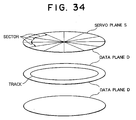
- Fig. 34 illustrates schematically a magnetic disk system in which the servo-plane servo system described previously is adopted, it will be seen that a servo plane S and data areas D are provided, wherein the servo plane S is logically assigned with a plurality of sectors (which conceptually differ from the sector employed in the FBA-type disk system).
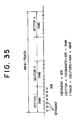
- Fig. 35 is a diagram for illustrating an array of the sectors.
- one track has a storage capacity of 48 KB (kilobytes)
- the track is divided into a plurality of sectors each having a capacity or size of 244 bytes and that each sector is divided into seven segments S1 to S7 each of which has a size of 32 bytes.
- the value or the number identifying the sector in which the data has been recorded (this value is also referred to as the sector value) is stored so that the retrieval of the data can be performed with the aid of the sector value. In this case, retrieval of the data can be performed at a high speed.
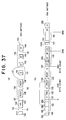
- FIG. 36 is a flow chart showing, by way of example, an access sequence performed by a software running on a host computer when data is retrieved by using the sector value defined above.
- the software running on the host computer designates the sector in which data to be accessed is recorded by issuing a set sector command "SET SECTOR".
- the magnetic disk system is disconnected from the host computer and the magnetic disk controller and then searches autonomously the designated sector.
- the magnetic disk system issues a connection request to the host computer via the magnetic disk controller, whereby the connection between the magnetic disk system and the host computer is reestablished.
- a search ID (identifier) command is issued by the software, whereby ID information of the data to be searched is sent to the magnetic disk system.
- the ID information includes, for example, a cylinder ID number, a track ID number and a record ID number of the record to be searched.
- the magnetic disk system compares the ID information as received with the ID of a record located at the start of the sector designated by the set sector command, the result of which comparison is then messaged to the host computer. Unless the comparison results in coincidence, return is made to the set sector command step from the command execution step through a succeeding transfer-in-channel (TIC) command step, whereupon the search ID command is again issued for a next or succeeding record.
- TIC transfer-in-channel
- the host computer skips the succeeding transfer-in-channel command to issue finally a read command or a write command, whereby the read or write instruction is executed for the data as retrieved.
- the software used in the general-purpose computers is prepared on the basis of the variable length record scheme, and thus an attempt for altering or modifying the software resources already developed will involve not a little difficulty.
- a technique which allows the magnetic disk of the variable length record type known heretofore to be used by a software running on a host computer by emulating the variable length record type scheme in the magnetic disk controller while using actually the fixed length record type disk.
- the set sector command described above in conjunction with Fig. 36 can not be used or supported. More specifically, when the set sector command is issued, no operation therefor is performed, but the record search is carried out in response to issuance of the search ID command. Although the record search can be accomplished with the aid of the search ID command only, it is noted that a lot of time is taken for finding out the record having the same ID as the one designated by the search ID command, by checking sequentially all the records, starting from the forefront or leading one in the track.
- the record search based on the search ID command is extremely disadvantages when compared with the search in which the set sector command designating the sector containing the record of concern is a prerequisite and in which the search is performed in response to the search ID command for the sectors which are located in succession to that designated by the sector set command, inclusive thereof.
- the CKD-to-FBA format conversion is executed while compressing the data or records by deleting all the gaps.
- the set sector command can not be supported, a lot of time is required for making access to the record of concern.
- search of a CKD record other than the leading one requires repetitive execution of a procedure of reading first the count field of the leading or forefront CKD record, determining the length of the leading record on the basis of the key field length (KL) and the data field length (DL) in the count field, then reading the key field length (KL) and the data field length (DL) of the succeeding record, and subsequently searching the count field of the succeeding record.
- a data storage format conversion system for converting records stored in a variable length format (CKD) into records of a fixed length format (FBA) for storage thereof, in which all gaps inclusive of the inter-record gaps and the inter-field gaps are deleted from variable length records of one track recorded in a variable length format employed in an external storage device of a general-purpose computer, the track data thus obtained is divided into units for management (also referred to management units) each of which has a predetermined size corresponding to an integral multiple of the size of the fixed length block of the fixed length record, and in which position information indicating the positions of all the variable length records included in the unit for management as well as position information indicating the relative positions of the variable length records from the start of the track in the variable length format are written, and thereafter the unit for management is divided into fixed length record blocks each having a predetermined fixed block size for storage thereof.
- units for management also referred to management units
- a data storage format conversion method in which gaps are deleted from variable length records prepared in a variable length record format, whereon the records are arrayed in a frame constituting a unit for management with the information for access such as position information of the data being also arrayed within the frame, and then the frame is divided into blocks each of a fixed length for storage in a fixed length format, wherein the format conversion method includes
- a data access method for making access to the data divided into blocks each of a fixed length or size through the aforementioned data storage format conversion method in response to an access instruction of a variable length record scheme known heretofore, wherein the data access method includes
- the storage capacity of a magnetic disk required for storing the data can be reduced because the inter-record gaps as well as the inter-field gaps are all eliminated from the data in precedence to the storage thereof by the gap deleting means, to an advantage.
- the record array means stores within the unit for management (management unit) the first position information indicative of the position of the variable length records and the second position information indicative of the relative positions of the records stored as the variable length records, it is possible to search the management unit for the record of concern by using the second position information indicating the relative position in the variable length record format in response to an access instruction of the variable length record scheme known heretofore, to thereby retrieve an aimed record (i.e., a record of concern) by using the first position information indicative of the position of the variable length records held within the management unit as searched.
- the number of accesses as required can be decreased to a minimum.
- the position calculation means roughly estimates the position of the management unit in the fixed length record format on the basis of the relative position information of the records which accompanies the access instruction of the variable length record scheme issued from any conventional software.
- the record search means can make access to the data recorded in the fixed length record format on the basis of the position information estimated by the position calculation means. In this manner, by providing the access control apparatus with the position calculation or computation means and the record search means according to the invention, the set sector command described previously in conjunction with the related art of the invention can be supported.
- the data storage format conversion method is characterized in that after elimination of the inter-record and inter-field gaps in the gap deleting step, the individual variable length records are arrayed in a sequential order within a frame together with the access information for these records in the record arraying step, whereon the frame is divided into blocks each of a fixed length record format.
- the position information of a record of concern stored in the fixed length record format can be estimated on the basis of the search information inputted together with the access command in the position information estimating step, which is then followed by the record search or retrieving step in which the frame is searched on the basis of the position information obtained from the estimation.
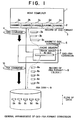
- Fig. 1 is a schematic block diagram showing a general arrangement of a format conversion system according to a first embodiment of the present invention.
- a host computer 1 has a channel system denoted collectively by a reference numeral 2.
- the channel system 2 includes a plurality of channels 2a to 2e, wherein there is connected to one of these channels, e.g., the channel 2b a magnetic disk controller 5 which incorporates a cache memory 6.
- the magnetic disk controller 5 performs data transactions, i.e., data read/write operations with a magnetic disk of a fixed byte architecture type (or FBA type in abbreviation) through the medium of the cache memory 6.
- the FBA-type magnetic disk 9 has blocks 9a to 9e each of a fixed block size or a fixed length. Data on the FBA-type magnetic disk 9 are thus adapted to be read out or written on a block-by-block basis.
- CKD-to-FBA format conversion i.e., variable length to fixed-length format conversion.
- a software is running on the host computer 1 for making access to data recorded in a CKD (Count Key Data) or variable-length format.
- CKD command 4 is issued from the software to the magnetic disk controller 5 via the channel 2b.
- the CKD command 4 is a write command, and that records 3 of the CKD format are outputted in the form of variable-length records 3a, 3b and 3c.
- the magnetic disk controller 5 stores these variable-length records 3a, 3b and 3d in the cache memory 6.
- a track image 7 in the CKD or variable length format is reconstituted on the cache memory 6. More specifically, the CKD track image 7 is constituted by an array of the variable-length records 3a, 3b and 3c disposed sequentially in this order from the start or forefront of the track. According to the hitherto known method, the inter-field gaps as well as the inter-record gaps have been generated and added or inserted into the track image. On the contrary, according to the teachings of the invention incarnated in the instant embodiment, these gaps are all removed.
- the magnetic disk controller 5 converts the CKD track image 7 formed on the cache memory 6 to a record 8 of the FBA format (fixed length or fixed byte architecture format).
- This record of the FBA format is composed of blocks 8a to 8e each of a fixed length.
- the magnetic disk controller 5 outputs a FBA write command 10.
- the blocks 8a to 8e are then recorded as blocks 9a to 9e, respectively, on the FBA type magnetic disk 9.
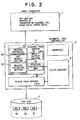
- Fig. 2 is a block diagram for explaining in more detail the concept of the CKD-to-FBA format conversion briefed above.
- a host computer 1 a magnetic disk controller 5, a cache memory 6 and a FBA type magnetic disk 9 are same as those described above in conjunction with Fig. 1. Accordingly, repeated description of these components will be unnecessary. The following description will be directed to details of operation of the magnetic disk controller 5 by reference to Figs. 3, 4 and 5.
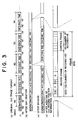
- Fig. 3, 4 and 5 are diagrams for illustrating a record storage format conversion scheme. Initially, all gaps G1, G2 and G3 including the inter-record gap, the inter-field gap and so forth are eliminated from original records or data of the CKD format shown in Fig. 3 at (a), in such a manner as illustrated in Fig. 3 at (b).
- one track data of the CKD records for example, of 48 KB (kilo bites) undergone the gap elimination processing as shown in Fig. 3 at (b) is divided into units for management (also referred to as management unit(s) for convenience of description), each of which has a size equivalent to an integral multiple of the fixed block length or size of the FBA record (i.e., integral multiple of one record) so that each management unit is realized, for example, with 12 KB or less inclusive of the control information mentioned below, as is shown in Fig. 3 at (c).
- units for management also referred to as management unit(s) for convenience of description
- each management unit has a size equivalent to an integral multiple of the fixed block length or size of the FBA record (i.e., integral multiple of one record) so that each management unit is realized, for example, with 12 KB or less inclusive of the control information mentioned below, as is shown in Fig. 3 at (c).
- variable-length records are sequentially written from the forefront of the management unit, while the position information is arrayed sequentially, starting from the rearmost end of the management unit, the number of the position information coincides with that of the variable-length records, as a result of which both the variable-length records and the position information can be accommodated within the management unit sequentially in the opposite directions, respectively, until the storage areas of the variable-length records and the position information, respectively, collide against each other.
- the area used for storing the position information is limited to a size corresponding to only the number of the records actually placed within the management unit.
- the unit for management for the record position information will be referred to as a frame
- the region or area in which the CKD records are actually held will be termed a record frame
- the area or region for recording the control information will be called a control frame
- the record position information will be referred to as a record pointer, for convenience of elucidation only.
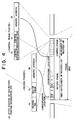
- the position information of 4 bytes is shown as the record pointers in Fig. 4 at (d), wherein each record pointer is composed of a record ID number of 1 byte, a sector value of 1 byte and a memory address of 2 bytes, respectively.
- the record ID number represents the identification number of the variable-length record as stored.
- the memory address represents an intra-frame address of the record stored within the frame.
- the sector value is utilized for comparison with a sector value designated by a set sector command (SET SECTOR Command), which will be described later on.
- the record ID number is utilized for comparison with a record number designated by a search identification or ID command.
- the memory address indicates an address of an actual record stored within the record frame.
- the sector value of the record pointer and the record ID number are compared with each other, wherein when coincidence results from the comparison, the record is read out by using the above-mentioned memory address information.
- control frame inclusive of the record pointer is also held as one of the control information, i.e., as a control frame pointer. Owing to this control frame pointer information, the control involved in the data transfer and other operations or processings can be simplified notwithstanding of the fact that the size of the control frame is variable.
- the control frame pointer which is destined to serve as the control information, as mentioned above, is recorded at the rearmost end of the frame rather than at the start or forefront thereof. Further, the record pointers within the control frame are sequentially arrayed in the direction from the rearmost end toward the forefront of the frame. More specifically, for those actual records which are located more closely to the forefront of the record frame, the corresponding record pointers are located more rearwardly within the control frame, i.e, more closely to the rearmost end of the control frame.
- the record frame of 12 KB is divided into blocks each having the block size of the FBA format, e.g., 1024 bytes (1 KB) in such a manner as illustrated in Fig. 5 at (e).
- an ID field is provided in the data field of each record, as shown in Fig. 5 at (f).
- a magnetic disk formatted in the FBA record scheme as shown in Fig. 5 at (g).
- the information which indicates a relative position of each of the records relative to or from the forefront of the track in the CKD format, e.g. segment number, is retained for each CKD record stored within the fixed block.
- the track capacity already consumed for the records in the CKD format can straightforwardly be derived on the basis of the information indicating the relative positions of the records included in the frame, so far as the positions of these records can be known.
- the magnetic disk controller 5 includes a channel path server (hereinafter also referred to as CPS in abbreviation) which is adapted to serve for the data format conversion and the data transfer between the host computer 1 and the FBA magnetic disk 9.
- the channel path server or CPS includes an input/output unit 52 which serves for receiving the commands and the data from the host computer 1 and for outputting the data from the FBA magnetic disk 9 to the host computer 1.
- a position calculation or arithmetic unit 53 Upon reception of an access command to a variable-length record from a program or software running on the host computer 1 through the input/output unit 52, a position calculation or arithmetic unit 53 equally incorporated in the CPS 51 arithmetically determines the position of the unit for management which is expected to store the variable-length record on the basis of the sector value designated, for example, by the set sector command.
- the position calculation unit 53 determines through estimation the management unit which is considered as storing the variable-length record to be accessed.
- a record search unit 54 also incorporated in the CPS 51 searches the management unit on the basis of the position thereof as arithmetically determined by the position calculation unit 53 to thereby fetch and place it in the cache memory 6, for allowing the record of concern to be retrieved.
- a management unit retrieval section 56 which constitutes a part of the record search unit 54 then compares the relative position information (sector value) of the record to be accessed with the relative position information (sector value) held by the retrieved management unit. In this way, the units for management existing on the FBA disk 9 are sequentially fetched into the cache memory until the relative position information of the record to be accessed has been detected.
- a record specifying section 57 also included in the record retrieval unit 54 responds to the retrieval of the aimed management unit by the management unit retrieval section 56 to thereby specify (or identify discriminatively) the variable-length record of concern by making use of the address information contained in the relevant management unit.
- Execution of the data transfer between the FBA disk 9 and the cache memory 6 in response to the FBA command is performed by a data path server (also referred to simply as DPS) 55 which is a manager destined to serve for the management of the cache memory 6 and the magnetic disk controller 5 as a whole.
- DPS data path server
- the magnetic disk controller DKC
- ECC E rror C homeing and C orrecting
- padding data padding data or the like which has inherently been added at the side of the magnetic disk apparatus. Accordingly, the question "which portion is to be left and which portion is to be deleted?" virtually means “which of the gaps is to be left and which of the gaps is to be deleted?".
- the control information managed by the magnetic disk controller (DKC) such as defect information exclusive of the ECC and the padding data as well as physical parameters may be considered as being included within the gaps.
- Method ⁇ Case I-1 ⁇ A method disclosed in the previously mentioned literature "IBM 4321/4331 Processor Compatible Functions", according to which all the gaps inclusive of the inter-record gaps are deleted.
- Method ⁇ Case I-2 ⁇ A known method according to which the inter-field gaps are eliminated with the inter-record gaps being left or retained.
- Method ⁇ Case I-3 ⁇ A method according to which not only the inter-record gaps but also all the inter-field gaps are left (with the ECC and the padding data being eliminated).
- each of the above-mentioned methods has to be combined with some method directed to the aforementioned point II (method of finding out the record position).
- method of finding out the record position there may be conceived several methods inclusive of the known ones, as mentioned below (refer to Fig. 7).
- Fig. 7 there do not always exist one-to-one correspondence relations between the methods ⁇ Case I-1 ⁇ , ⁇ Case I-2 ⁇ and ⁇ Case I-3 ⁇ mentioned above and methods ⁇ Cases II-I ⁇ , ⁇ Case II-2 ⁇ and ⁇ Case II-3 ⁇ which are described below.
- Method ⁇ Case II-1 ⁇ Any specific information indicating the record position is not provided at all. Upon searching a record of concern, the records on a track are all read out sequentially, beginning with the leading record located at the forefront of the track, wherein the position of the count field in any succeeding record is arithmetically determined on the basis of values of KL ( K ey field L ength) and DL ( D ata field L ength) contained in the count field of the preceding record.
- Method ⁇ Case II-2 ⁇ By adopting a known method, a part of the information indicating the record position is held separately from the record itself. According to one of the methods known heretofore, the position of the count field of the record located at the forefront of each FBA block is held or retained. Those records which are located in succession to the record the position of which is indicated are sequentially read out, starting from the record whose position is known, to thereby arithmetically determine the position of the next record on the basis of the values of KL and DL of each record.
- Method ⁇ Case II-3 ⁇ All information indicating the positions of the records are held separately from the records themselves. The positions of all the records are searched with the aid of the above-mentioned information. Concerning the means for holding the record position information, there may be conceived a method of holding or retaining the record position information en bloc at one place (e.g. at a starting area of a track) and a method of holding the record position information distributively or dispersedly (e.g. holding the information indicating the position of a record contained in a FBA block at the start of that block).
- An address mark (also referred to AM in abbreviation) is generated on a logical track image obtained as a result of the CKD-to-FBA format conversion and a record of concern is searched with the aid of this address mark or AM (i.e., an AM search is performed on the memory as well).
- AM address mark
- This method is however put aside from the consideration because no concrete means for generating the address mark in a satisfactory manner is available yet and because the operation of reading out all the data sequentially for effectuating the AM search on the memory will involve a significant increase in a load imposed on the memory, giving rise to degradation in efficiency.
- Method ⁇ Case III-1 ⁇ The track capacity already consumed in the CKD format, inclusive of all the gaps and padding data (the sizes of which have definitely been determined), is computed on the basis of the values of KL and DL of all the records, beginning with the leading record on the track.
- Method ⁇ Case III-2 ⁇ (known method): Deletion of the ECC and padding data is compensated for or filled by stretching or extending the sizes or lengths of the remaining gaps (e.g. inter-record gap according to the known method). In this manner, the relative positions of the individual records relative to or from the forefront of the track can be maintained same as they are on the original CKD track. Thus, since the positions of the individual records can be determined, the track capacity already consumed in the CKD format can straightforwardly be determined on the basis of the addresses of the memory assigned to the records, respectively.
- Method ⁇ Case III-3 ⁇ Information indicating the relative position from the start of track in the CKD format (e.g. segment number) is left or retained in each record. Accordingly, the track capacity consumed already in the CKD format can immediately be determined from the information indicating the relative position and stored in the associated record when the position of that record is known.
- the method ⁇ Case III-2 ⁇ is represented by the method ⁇ Case I-2 ⁇ in which only the inter-record gaps are left, the former may equally be represented by ⁇ Case I-3 ⁇ where all the gaps are retained. It is however noted that, in reality, the method ⁇ Case III-2 ⁇ can not basically be realized by the method ⁇ Case I-1 ⁇ where all the gaps are removed because it is impossible to maintain the relative positions of the original records intactly as the memory addresses by adjusting the gap lengths.
- the known CKD-to-FBA format conversion method is based on combination of the methods ⁇ Case I-2 ⁇ , ⁇ Case II-2 ⁇ and ⁇ Case III-2 ⁇ .
- Fig. 9 is a view showing a table listing valid combinations of the aforementioned methods or cases while omitting those combinations which are impractical and meaningless.
- the method ⁇ Case III-1 ⁇ is a track capacity check method which is meaningful only when the method ⁇ Case II-1 ⁇ of reading out all the records on the track for determining the record position is adopted.
- each of the rows shows a CKD-to-FBA format conversion which can be realized by one combination, wherein the methods adopted in the combination are identified by circular marks, respectively.
- the method listed in the table of Fig. 9 at the first row is a CKD-to FBA format conversion method in which the method ⁇ Case I-1 ⁇ is adopted as a method of leaving the gaps, the method ⁇ Case II-1 ⁇ is adopted as a record position determination method and the method ⁇ Case III-1 ⁇ is adopted as a method of checking the track capacity.
- memory areas are used in excess for holding the position information of the leading record included in the FBA block and the control information for holding the segment numbers and others of the individual records when compared with the ⁇ 1, 1, 1 ⁇ -type format conversion described above.
- the individual fields exist in continuation to one another on the memory, it is sufficient to count up only the memory address for performing the data transfer with the channel(s) on a field continuation basis.
- the data may be interrupted by the position information of the first record included in the FBA block even on the memory. Accordingly, it is necessary to perform the data transfer by skipping the position information, as is in the case of a defect skipping.
- the number of time the memory is accessed is smaller than that required in the case of the ⁇ 1, 1, 1 ⁇ -type format conversion.
- the method of arithmetically determining the position of the aimed record on the basis of the position information of the first record of the FBA block is simple and can be carried out substantially in a same manner as in the case of the ⁇ 1, 1, 1 ⁇ -type format conversion, requiring only sequential addition of the sizes of the count fields and KL and DL.
- the remaining capacity which allows the records of a given size to be written in succession is arithmetically determined on the basis of the segment number of the record which precedes to the record subjected to the format write operation (i.e., the information indicating the relative position of that record on the track in the intrinsic CKD format), and KL and DL.
- the segment number of the record undergone the format write operation must be written in that record itself.
- information indicative of the position of the count field of the leading or first record must be written in the FBA block.
- the memory capacity as required increases when compared with the ⁇ 1, 2, 3 ⁇ -type format conversion where only the position information of the first record included in the FBA block is held, because the position information of all the records have to be held separately in the case of this conversion method. Further, the segment number is held in each record similarly to the case of the ⁇ 1, 2, 3 ⁇ -type format conversion.
- the data transfer is performed in a substantially same manner as in the case of the ⁇ 1, 2, 3 ⁇ -type format conversion.
- the data may be intercepted by the record position information included in the FBA block even on the memory, if the data within a single-field exists across more than one FBA blocks. In that case, the data transfer has to be performed by skipping the position information as in the case of a defect skipping.
- the position of the record of concern can be determined straightforwardly from the position information as read out.
- the format write procedure is substantially same as the latter.
- the remaining capacity which allows the records of a given size to be written in succession is arithmetically determined on the basis of the segment number of the record which precedes to the record subjected to the format write operation (i.e., the information indicating the relative position of that record on the track in the intrinsic CKD format), and KL and DL.
- the segment number of the record is computed and written in the record itself that has undergone the format write operation.
- information indicating the position of the count field of the record of concern must be added to the control information holding the position information of that record without fail.
- This procedure is substantially same as in the case of the ⁇ 1, 1, 1 ⁇ -type format conversion method.
- This procedure is also substantially same as in the case of the ⁇ 1, 1, 1 ⁇ -type format conversion.
- the memory capacity corresponding to the track capacity in the original CKD format is required, because the inter-record gap is stretched or lengthened in order to maintain the relative position information of the individual records to be same as those in the original CKD format. Furthermore, a memory capacity for storing the position information of the first record included in the FBA block is additionally required.
- aimed record i.e., record of concern
- it is required to make access to the memory a same number of times as the number of the records which intervene between the forefront record of the FBA block and the aimed record. Accordingly, when compared with the ⁇ 2, 1, 1 ⁇ -type format conversion, the number of times the memory is accessed is small.
- the method of computing the position of the aimed record on the basis of the position information of the first record in the FBA block is simple and essentially same as in the case of the ⁇ 2, 1, 1 ⁇ -type format conversion. (Namely, it is sufficient to add sequentially the size of the count field, KL and DL and additionally the inter-record gap.)
- the relative position information of the individual records in the CKD format is also maintained even on the memory, it can easily be determined by computation in conjunction with the track capacity check how many records are allowed to be subsequently written, so far as the address of the memory for the record subjected to the format write operation can be known (from the processing step c)).
- the inter-field gaps are deleted while the inter-record gaps are left.
- the inter-record gaps are left.
- An additional or excess memory capacity is required for storing the position information of the first record included in the FBA block.
- the memory capacity increases by an amount for storing the segment number information included in the individual records. Consequently, the memory capacity is greater than in the case of the ⁇ 2, 1, 1 ⁇ -type format conversion and smaller than that required in the ⁇ 2, 2, 2 ⁇ -type format conversion.
- This procedure is utterly same as in the case of the ⁇ 2, 2, 2 ⁇ -type format conversion.
- it is required to make access to the memory a same number of times as the number of the records which intervene between the first record of the FBA block and the aimed record. Accordingly, when compared with the ⁇ 1, 1, 1 ⁇ -type format conversion, the number of times the memory is accessed is small.
- the method of computing the position of the aimed record on the basis of the position of the first record in the FBA block is simple and essentially same as in the case of the ⁇ 1, 1, 1 ⁇ -type format conversion. (Namely, it is sufficient to add sequentially the size of the count field, KL and DL and additionally the inter-record gap.)
- the segment number of the record which immediately precedes to the record to be formatted i.e., the information indicating the relative position of the aimed record on the track in the inherent CKD format
- the segment number of the record as written must be arithmetically determined and held in that record.
- information indicating the position of the count field of the first or leading record must be written in the new FBA block.
- the memory capacity required is basically same as the track capacity in the original CKD format, as in the case of the ⁇ 2, 2, 2 ⁇ -type format conversion.
- the record position information added as the control information includes not only that of a first record in the FBA block but also that of all the other records, the memory capacity increases when compared with the ⁇ 2, 2, 2 ⁇ -type format conversion. More specifically, the memory capacity required in this format conversion is maximum in all the varieties of the format conversion schemes.
- the data is broken or divided by the position information of the record included in the FBA block on the memory as well, in case the data exist across the FBA blocks even within a single field. Accordingly, it is necessary to perform the data transfer by skipping the position information as in the case of the defect skipping.
- the position of the record of concern can be determined straightforwardly from the position information as read out.
- inter-field gaps are deleted while the inter-record gaps are left as in the case of the ⁇ 2, 3, 2 ⁇ -type format conversion scheme.
- the memory capacity for the segment number information included in each record is additionally required. Consequently, the memory capacity becomes slightly greater than that for the ⁇ 2, 2, 3 ⁇ -type format conversion scheme, both of which bear a high similarity to the instant conversion scheme.
- the record position information is held, being distributed on a FBA block basis and when data exist across the FBA blocks even within a single field, the data is broken or divided by the position information of the record included in the FBA block on the memory as well. Consequently, it is necessary to perform the data transfer by skipping the position information as in the case of the defect skipping.
- the position of the aimed record can be determined directly from the record position information.
- the segment number of the record as written must be arithmetically determined and held in that record.
- the information indicating the position of the count field of that record must be additionally written to the control information holding the record position information without fail.
- inter-record gaps and the inter-field gaps are left as they are.
- For determination of the record position all the records starting from the leading or first one of the track are read out.
- For checking the track capacity all the records starting from the first one of the track are read out.
- the memory capacity as required is close to a maximum value notwithstanding of no addition of any extra control information.
- the capacity for the ECC and the padding data need not be taken into account in determination of the memory capacity.
- the significance of leaving the gaps is lessened.
- the position of the record of concern is arithmetically determined on the basis of the data of KL and DL, which can easily be carried out simply by adding serially the inter-record gaps and the inter-field gaps in addition to the KL and DL.
- This procedure is also substantially same as in the case of the ⁇ 1, 1, 1 ⁇ -type format conversion.
- the track capacity For checking the track capacity, it is necessary to make access to the memory a number of times equal to the number of the records which intervene between the first record on the track and the record of concern. In order to check the track capacity, it is necessary to take into account the capacity for the ECC and the padding data even though the gaps are left as they are. By modifying the gap length so that the same track capacity as that in the CKD format can be obtained, inclusive of those for the ECC and padding data, the remaining track capacity can straight-forwardly be determined from the memory address, as in the case of the ⁇ 3, 2, 2 ⁇ -type format conversion. In the format write operation, there exists no control information to be updated.
- both the inter-record gaps and the inter-field gaps are left.
- the position information of the first record included in the FBA block is held.
- relative positions of the individual records are maintained by adjusting the gap lengths.
- the memory capacity as required is same as in the case ⁇ 2, 2, 2 ⁇ -type format conversion and corresponds to a sum of the track capacity in the original CKD format and the position information of the first block included in the FBA block.
- the data is divided by the position information of the first record included in the FBA block also on the memory, differing from the ⁇ 3, 1, 1 ⁇ -type format conversion. Accordingly, it is necessary to perform the data transfer by skipping the position information as in the case of the defect skipping.
- both the inter-record gaps and the inter-field gaps are left.
- the position of the first record included in the FBA block is held.
- the relative position information such as the segment number, etc. is held in each record.
- the track image of the CKD format is maintained substantially as it is. Besides, the position information of the first record included in the FBA block is retained. For this reason, the memory capacity as required is close to a maximum. However, because the relative positions of the records in the CKD format are not positively to be maintained, the memory capacity for the ECC and the padding data may be put aside from the consideration. In this case, the effect of leaving the gaps is of less significance.
- the data is divided by the position information of the first record included in the FBA block equally on the memory, differing from the ⁇ 3, 1, 1 ⁇ -type format conversion. Accordingly, it is necessary to perform the data transfer by skipping the position information as in the case of the defect skipping.
- the segment number of the record as written must be arithmetically determined and held in that record.
- both the inter-field gaps and the inter-record gaps are left as they are.
- the relative position information of all the records is retained.
- relative positions of the individual records are maintained by adjusting the gap lengths.
- the memory capacity as required is basically same as the track capacity in the original CKD format, as in the case of the ⁇ 3, 2, 2 ⁇ -type format conversion.
- the record position information added as the control information includes not only that of a first record in the FBA block but also that of all the other records, the memory capacity increases when compared with the ⁇ 3, 2, 2 ⁇ -type format conversion. More specifically, the memory capacity required in this format conversion is close to a maximum in all the varieties of the format conversion schemes, as in the case of the ⁇ 2, 3, 2 ⁇ -type format conversion.
- the data is divided by the position information of the record included in the FBA block also on the memory, differing from the ⁇ 3, 1, 1 ⁇ -type format conversion. Accordingly, it is necessary to perform the data transfer by skipping the position information as in the case of the defect skipping.
- both the inter-field gaps and the inter-record gaps are left as they are.
- the relative position information of all the records is held.
- the relative position information such as the segment number, etc. is held in each record.
- the track image of the CKD format is maintained substantially as it is. Besides, the position information of all the records is held. For this reason, the memory capacity as required becomes much greater than that for the ⁇ 3, 2, 3 ⁇ -type format conversion scheme, to be close to a maximum.
- the memory capacity for the ECC and the padding may be put aside from the consideration. In this case, the effect of leaving the gaps is of less significance.
- the data is divided by the position information of the record included in the FBA block on the memory as well, differing from the ⁇ 3, 1, 1 ⁇ -type format conversion. Accordingly, it is necessary to perform the data transfer by skipping the position information as in the case of the defect skipping.
- the position of the record of concern can be determined straightforwardly from the position information as read out.
- the segment number of the record as written must be held in that record without fail.
- the information indicating the position of the count field of that record must be additionally written to the control information holding the record position information.
- ITEMS FOR COMPARISON there are listed the four items for comparison mentioned hereinbefore with five levels of grade in dependence on the degrees of importance put on the items, wherein the level or score "5" represents the most important item while the level or score "1" indicates the item of the least significance.
- the various conversion schemes are evaluated with five levels of rating, wherein scores of "1" to "5" are assigned to the conversion schemes, respectively. More specifically, the conversion scheme which is the best for a given one of the items is assigned with the score of "5" while the conversion scheme worst to that item is marked with the score "1".
- the scores are then summed for each of the format conversion schemes.
- the comparison item is multiplied with the grade value assigned to that item, whereon the total sum of the products determined for all the items of comparison is determined for evaluation of the relevant format conversion scheme.
- the format conversion scheme having a higher total score is considered to be more excellent.
- an asterisk mark "*" is inserted in a column labeled "TOTAL SCORE" for those format conversion schemes which has gained a higher total score than that of the hitherto known conversion scheme.
- the total score shown in Fig. 9 includes more or less a subjective factor and thus represents only a reasonable yardstick or reference.
- allocation of the scores and the grade values assigned to the items for comparison have been changed. It has however been found that the format conversion schemes gained the total scores higher than the hitherto known scheme remain same as those shown in Fig. 9. It is thus believed that the total score determined as mentioned above can provide a standard of high quality for the valuation, so far as the items for comparison now under consideration are concerned.
- the hitherto known format conversion scheme has not obtained a high score can primarily be explained by the fact that a large number of memory accesses is required in finding out the aimed record (or record of concern).
- the first (leading) record in the FBA block could be found at once.
- those records which succeeds to the leading one must be read out by checking one by one the count fields thereof. It is considered that the hitherto known format conversion method suffers from two undermentioned problems among others.
- each of the blocks (approximately equivalent to the sectors) of the FBA disk has the position information of the first record included in the block.
- the size of this block is in a range of 1 KB to 2 KB at the greatest.
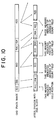
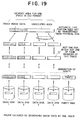
- most of the CKD records to be stored on the disk are of a size on the order of 4 KB. Consequently, it is rare that a number of CKD records are included in one FBA block. Rather, one CKD record is more likely to be stored over a plurality of FBA blocks, as shown in Fig. 10. It is thus believed that in most cases, the number of the CKD records included in one block can not exceed is one.
- the FBA block including the aimed record can be identified on the basis of the information of the sector set, the record of concern could be found out within a single memory access even in the case of the conventional scheme.
- the emulator for effectuating the CKD-to-FBA format conversion may be placed at any location between the channel processor and the FBA disk (inclusive of the DKC (magnetic disk controller)).
- the emulation is executed by the channel processor itself. In other words, it is deemed that the conventional method can not assume a large scale system based on the disk cache.
- the memory area for the track buffer which serves for developing the track image is reserved in a main memory of a host CPU ( C entral P rocessing U nit) or a local memory incorporated in the channel processor itself.
- a host CPU C entral P rocessing U nit
- a local memory incorporated in the channel processor itself.
- each block (substantially equivalent to the sector) has the position information of the first or leading record included in that block, which however means serious inefficiency or ineffectiveness.
- RAID array type disk system
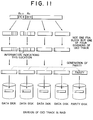
- Fig. 11 the read/write operation to the physical disks is performed on a 1/4-track basis by dividing one CKD track (e.g., of 48 KB) to the four data disks rather than on a FBA-block basis.
- the record position information should preferably be held for every 1/4-track instead of every FBA block (refer to Fig. 11).
- the position information for one track is collected at four locations, which in turn means that the number of divisions or interruptions of the CKD record by the position information on the memory is four at maximum.
- the record position information is stored for every FBA block
- the number of the interruptions of the CKD record in one track amounts to the number of the FBA blocks included in one track. Assuming, by way of example, that the size of one block is 2 KB, the number of interruptions of the CKD blocks in one track is about 24. More specifically, one CKD record of 4 KB will be interrupted at one or two points.
- the interruption of the CKD record must be processed by a firmware of the magnetic disk controller unless any dedicated hardware is provided to this end. Assuming that the processing takes several ten microseconds and that the channel transfer rate is 4.5 MB/sec., it takes about 889 ⁇ sec., for transferring the record of 4 KB, which in turn means that the data transfer performance is degraded approximately by several to ten percents for one record.
- the access to the cache memory is also performed from the disk device in addition to the channel path server (CPS).
- CPS channel path server
- the cache memory constitutes a so-called bottle neck in the system where the read/write operation is to be performed at a high speed.
- frequent access to the cache memory on a bit-by-bit basis provides by itself a cause for remarkable degradation in the data transfer capability of the inner bus.
- the read/write operation of the cache memory should preferably be accomplished with a single access even when the amount of data involved in the access increases more or less.
- Method ⁇ Case I-1 ⁇ according to which all the gaps inclusive of the inter-record gaps are deleted.
- Method ⁇ Case I-2 ⁇ according to which the inter-field gaps are eliminated with the inter-record gaps being left.
- Method ⁇ Case I-3 ⁇ according to which not only the inter-record gaps but also all the inter-field gaps are left (with the ECC and the padding data being eliminated).
- the memory capacity i.e., the number of blocks on the FBA disk
- the memory capacity i.e., the number of blocks on the FBA disk
- the memory capacity for the development of the track image is always equal to that of the original image in the CKD format when the method ⁇ Case I-2 ⁇ or ⁇ Case I-3 ⁇ is combined with the track capacity check method ⁇ Case III-2 ⁇ described hereinbefore (i.e., the method according to which the inter-record gaps are extended or stretched for a length corresponding to the inter-field gaps, and the ECC as well as the padding bytes are deleted to thereby maintain the relative position of the individual records from the starts of the track as they are in the original CKD track).
- the number of gaps depends on the number of records in one track as well as the presence or absence of the key field in the track. Thus, for evaluation of the requisite memory capacity, it is necessary to prescribe the track format factors such as the number of records contained in the track to be evaluated.
- Fig. 12 For the purpose of illustration, let's suppose four exemplary cases shown in Fig. 12, which includes extreme cases where the record numbers are greatest and smallest, respectively, and standard cases as well.
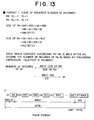
- the CKD format such as shown in Fig. 33 is presumed. Calculation of the number of records per track in each case is performed, as illustrated in Figs. 13, 14, 15 and 16.
- Format 2 and format 3 listed in the tale of Fig. 12 are defined on the basis of a work load type research of disk accesses, which is not described herein. Further, the record size of a journal file is ordinarily in a range of 200 bytes to 32 KB, wherein the most popular file size ranges from 200 bytes to 300 bytes. In the case of the example shown in Fig. 12, the journal file having a size of 200 bytes is presumed.
- the estimation will be performed on the assumption that the contents of the individual fields excluding of the gaps on the memory are such as shown in an area indicated by "X" in Fig. 33.
- the number of records per track for each case of the estimation can be determined in such manners as illustrated in Figs. 13 to 16.
- the memory capacity estimations for the various gap deletion methods are as follows.
- the inter-field gaps are eliminated with only the inter-record gap only being left (The ECC, the padding information, etc. are also eliminated).
- ECC the inter-field gaps
- spaces (X' FF') and the padding is compensated for by extending or expanding correspondingly the gap length, the memory capacity remains utterly same as in the case of the CKD format. Accordingly, no compensation for deletion of the inter-field gaps and so forth are not performed.
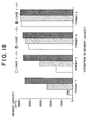
- FIG. 17 shows the memory capacities occupied when the four track formats "Format 1" to "Format 4" are developed on the memory, respectively, in conjunction with the three types of gap deletion methods ⁇ Case I-1 ⁇ , ⁇ Case I-2 ⁇ and ⁇ Case I-3 ⁇ .
- Fig. 18 is a graphical view showing the same.
- the memory capacity as required increases, as the amount of the gaps to be left increases in any one of the track formats.
- the method ⁇ Case I-3 ⁇ all the gaps are left or retained. Accordingly, a memory capacity which is approximately equal to the capacity for the original CKD format is required in any one of the formats "Format 1" to "Format 4".
- the area on the physical disk should be secured in conformance with an expected maximum quantity of data even when the memory capacity is reduced as described, because, if otherwise, the control will become much complicated.
- the track image on the memory is a half of the corresponding image in the CKD format, and that upon writing of that track image, other track data is written in an empty area.
- the track is reformatted and the data amount of the track image is thereby increased, the latter can no more be written in consecutive areas on the disk and thus an empty area anywhere on the disk must be searched for the writing, which will of course involve complication in the control procedure.
- the formatting with all the gaps being deleted is accompanied with a saving of the memory capacity several times as large as the formatting with all the gaps being retained, although it depend on the number of records involved in the formatting.
- a mode in which the position information of all the records is retained en bloc at one location e.g. at the start or forefront of the track
- a mode in which the record position information is held distributively among the individual FBA blocks e.g. a mode in which information indicating position of a record is held at the start of a FBA block which includes that record.
- distributive holding of the record position information is assumed. The reason why estimation is not made for the case where all the record position information is held en bloc at a single location can be explained as follows.
- the memory capacity is estimated which is required for storing the position information of the CKD records in conjunction with the methods ⁇ Case II-2 ⁇ and ⁇ Case II-3 ⁇ .
- Results of the estimation are as follows. ⁇ Case II-2 ⁇ : Only the position information of the leading one of the records is held or retained.
- the number of the CKD records capable of being stored in a management unit varies in dependence on the size of the latter. Besides, the number of the CKD records which can be stored in the management unit differs as a function of the size of the management unit. Under the circumstances, the estimation will be made for the method ⁇ Case I-1 ⁇ where all the gaps are deleted and where the number of the records is greatest of all the methods.
- the minimum memory capacity per record is known to be 29 bytes from the size of Rn mentioned hereinbefore in "Format 1 (the case of maximum records of ⁇ Case I-1 ⁇ )" in conjunction with the gap deletion method and evaluation of the memory capacity.
- NR (size of management unit)/33 (with decimal part being rounded off) (3)
- ⁇ can directly be determined. It should however be mentioned that the value of NR is "94" at maximum in the case of the track format shown in Fig. 33, because the number of records within one track can not exceeds "94" (inclusive of R0).
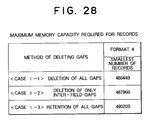
- the net memory capacity of a maximum value is required for storing the CKD record when the data field is longest in the track storing only one record (only R0). More specifically, the memory capacity as required in this case is such as shown in Fig. 23 for both HA and R0 on the assumption shown in Fig. 17.
- the memory capacity which can be reserved for storing the position information is short of about 400 bytes when compared with ⁇ Case I-1 ⁇ where the memory capacity for the records is minimum.
- Measure 1 Capacity to be reserved for each physical disk is increased. By way of example, when the capacity is increased from 12 KB to 13 KB, the capacity capable of being used for one CKD track is then 52 KB, whereby the problem of capacity shortage can satisfactorily be solved. Of course, a physical disk of 52 KB/CKD track is required, involving a useless disk area when compared with the physical disk of 48 KB/CKD track.
- Measure 2 Quantity of control information required for one record is decreased. By way of example, when the quantity of control information is decreased from 4 bytes/record to bytes/record, a total memory capacity required for the control information is 752 bytes, meaning that no shortage of the memory capacity occurs.
- Measure 3 The number of control information is decreased. By way of example, in the case of the management unit 2 (of 12 KB in size), it is contemplated that each of four management units holds position information of 94 records at maximum. However, in reality, the maximum record number of "94" represents a total sum for four management units. Accordingly, it is believed that the total capacity required for the control information can be decreased by adopting some appropriate measure.
- the storage area for the position information is secured in conformance with the maximum number of records capable of being stored in each unit for managing the position information of the CKD record (i.e., unit for holding the CKD record position information).
- the size of the management unit is 12 KB
- the position information for one record is estimated to be 4 bytes
- the position information area is of a fixed size, it is indispensably required to select the area size so as to accommodate a maximum quantity of the position information. Consequently, in the case of the example mentioned above, the position information area corresponding to 94 records must be secured for each management unit.
- Fig. 25 is a view for illustrating an improved method which is capable of making variable the size of the position information area according to an embodiment of the present invention.
- this improved method will be described by reference to this figure on the assumption that the size of the unit for management (management unit) of the record position information is 12 KB which is equal to the size of a unit of division for the data disks. This is because the efficiency is degraded when the size of the management unit is same as the block (sector) size of 1 to 2 KB of the FBA disk as in the case of the hitherto known scheme, as can be recalled from the description made hereinbefore in conjunction with the problems associated with the unit having the record position information.
- the management unit for the position information of the record is referred to as "frame”
- the area for recording or storing actually the CKD record is referred to as “record frame”
- the area for recording the control information is referred to as “control frame”
- the position information of the record is referred to as "record pointer”.
- the improved method has features mentioned below.
- the format write control can also be facilitated.
- the empty bytes (less than four bytes inclusive) thus produced should preferably be included in the control frame for management in view of easiness of the control for skipping the control frame in the data transfer involved in the procedure step (e).
- the memory address in the control frame pointer indicates the start address of the unoccupied area.
- An offset (of zero to four bytes) from the start of the unoccupied byte area to the start address of the record pointer is held as the control information in the control frame so that for acquisition of the record pointer in the procedure step (b), the start address of the record pointer can be determined by subtracting the offset value in the control frame pointer from the memory address.
- the CPS When the frame is to be reformatted utterly from the start of the track or when record is written newly in a frame containing no record through the format write procedure, the CPS creates newly the control frame. Accordingly, in this case, the procedure for establishing the orientation through acquisition of the control frame as described in conjunction with the procedure steps (a) to (c) in the section (2.1) is rendered unnecessary.
- the size of the control frame can not be determined so long as the number of frames to be recorded in that frame is unknown. Accordingly if the control frame is placed at the start of the frame, it can not be determined where the writing of the first record is to be started in the frame. This problem can be overcome by writing the records sequentially from the start of the frame while writing the control frames sequentially from the last of the frame according to the teaching of the present invention.
- management unit (or management unit) 2 shown in Fig. 22 will be considered.
- the size of the management unit (frame) is 12 KB and that the number of records is 94 records per CKD track, in which case the position information or the record pointers are greatest.
- all the records can be accommodated within a first frame when all the gaps are eliminated although it depends on the gap deleting method as adopted (as described hereinbefore in conjunction with the gap deleting methods and evaluation of the memory capacity).
- 94 record pointers and one control frame pointer are accommodated within the first control frame while any other frames have no control information of any sort (to say more properly, any other frames are rendered unnecessary).
- Fig. 27 the record position determining scheme ⁇ Case II-2 ⁇ known heretofore is shown, according to which only the position information of the record located at the start of each FBA block (each frame in this case) is retained.
- the scheme ⁇ Case II-3 ⁇ the position information of all the records is retained. What is concerned here is the case labeled " ⁇ Improved Case II-3 ⁇ ".
- the net memory capacity for recording the CKD record assumes a maximum value, when one track contains only one record (only R0) and when the data field thereof is of the greatest length.
- Fig. 28 is a view showing a table listing the maximum memory capacities in dependence on the gap deletion methods, which are recited from the table shown in Fig. 23.
- control of the control frames in the course of the data transfer with the host system and the control involved in the format write operation can be effectuated simply by checking the memory address in the control frame pointer held in the CPS. Since such control can be executed during a period corresponding to the inter-record gap, no overhead will be involved.
- control procedure involved in the track capacity check method ⁇ III ⁇ mentioned above will be described in conjunction with the method of checking the track capacity by using the segment identification (ID) number in the ⁇ Case III-3 ⁇ .
- segment numbers are absolute segment numbers (ASN) assigned serially, starting from "1", as shown in Fig. 29, and that the numerals as used are all decimal notation.
- the track overrun is checked in accordance with the conditions given by the following expressions. If the conditions mentioned below is satisfied, there is no problem and if otherwise, it is then decided that the track overrun occurs.
- the segment number of the record to be added is determined. On the basis of the value of the segment number as determined and KL and DL supplied from the host system, it is checked in accordance with the method (2) whether or not the addition of the record to be written brings about a track overrun.
- the track overrun check can always be performed by resorting to the same method without taking into account the value of SC (skip control).
- SC skip control
- the jobs performed during the gap such as the track overrun check according to the method (2) tend to become voluminous. Accordingly, what can be simplified is to be simplified.
- the method ⁇ Case III-3 ⁇ for checking the track capacity by using the segment number can be realized through relatively simple control.
- the byte positions of the individual records relative to the forefront of the track need not be maintained as they are in the original CKD track by adjusting the gap length after conversion of the track image of the CKD format to that of the FBA format.
- the method ⁇ Case III-3 ⁇ which positively utilizes the segment number is remarkably advantageous in respect to the utilization efficiency or availability of the cache memory when record size is small as compared with the method ⁇ Case III-2 ⁇ in which the gaps corresponding to those existing in the original CKD format must be retained, as suggested hereinbefore in conjunction with the gap deleting method and evaluation of the memory capacity.
- the method ⁇ Case III-3 ⁇ is excellent in respect to the number of memory access times over the method ⁇ Case III-1 ⁇ in which KL and DL of all the records are read out to calculate the remaining track capacity.
- the method ⁇ Case III-3 ⁇ is considered most preferable and profitable.
- the segment number is not used in the track capacity check method, while the relative positions of the individual records in the CKD format are maintained by adjusting the gap size as in the case of the hitherto known method. Accordingly, all the gaps can not be deleted but a part of the gaps are necessarily left.
- This conversion scheme is same as the ⁇ 1, 3, 3 ⁇ -type conversion except that the gaps are partially left. However, since the gaps as left are not used for any purpose, it is meaningless to leave the gaps. Accordingly, when compared with the ⁇ 1, 3, 3 ⁇ -type conversion, this method is not worthy to be adopted.
- the record position determining method it is preferred to transfer the data of a relatively large amount through a single bus acquisition in order to increase the transfer rate while mitigating the load imposed on the bus.
- access capability to the record position information en block is preferred over the access to the count filed on a record-by-record basis. Consequently, as the record position determining method, the ⁇ Case II-3 ⁇ method of holding the position information of all the records is preferred over the known method ⁇ Case II-2 ⁇ where only the position information of the first or leading record in the FBA block.
- the method which can render the gaps unnecessary is preferred in view of high utilization efficiency of the cache memory even in the other disk systems than the RAID system. Accordingly, the method ⁇ Case III-3 ⁇ where the relative position information of the individual records in the CKD format is held by using the segment number with no gaps being left is preferred over the known method ⁇ Case III-2 ⁇ where the relative positions of the individual records in the CKD format are maintained on the memory by adjusting the gap size.
- Sector information of one byte is received from a channel to search a sector.
- Sector information X'00' ⁇ X'DD, X'FF'
- the sector value is used for determining which of the frames resulting from division of the CKD track by four contains a record of concern (or aimed record).
- one sector consists of 224 bytes. Accordingly, on the basis of the sector value, the corresponding absolute byte address on the track in the CKD format can be calculated at once. However, since the gaps, ECC and the padding data are deleted in the frame, it can not be determined which of the frames contains the absolute byte address unless the deleted bytes are taken into account. The amount of deletion also depends on the number of records.
- the following description is directed to determination of the frame in which the record of concern is present.
- BC1 224 ⁇ sector value - 1038 - 752 ⁇ (record number - 1)
- N [(224 ⁇ sector value - 286 - 748 ⁇ record number) / 12284] where the parenthesis [ ] represents round-up of a decimal part. When N is a negative value, it is considered that N assumes "1".
- the above expression represents only a rough estimation because the number of bytes deleted in the frame differs in dependence on whether or not the key field exists in each record as well as the number of the bytes of "0s" padded to KL and DL so that they includes each a number of bytes corresponding to an integral multiple of "32".
- the ID number of the frame exhibits a tendency to occupy a position close to the forefront than the actual position.
- the sector values recorded in the record pointers are checked in a sequential order, starting from the record pointer of the leading record in the frame (note that this record pointer is located at the rearmost end in the case of the control frame), to thereby find a record pointer of a first record which has a greater sector value than that received from the channel.
- the similar search is performed for a succeeding frame.
- the processing may immediately proceed to a next command.
- a channel end (CE) signal is fed back, whereupon the channel is once disconnected.
- a device end (CE) signal is sent back, whereupon the processing proceeds to a next command.
- Search information of 5 bytes is received from the channel and compared with CCHHR of the count field (inclusive of the R0 field) read out from the device.
- discrepancy message (CE, DE) is issued if a multi-track bit is set.
- the record itself is absent, processing is switched to the succeeding track.
- the aimed record is not found after the sector designated by the SET SECTOR command (including the case where the record itself is not present) and when the multi-track bit is not set, return is made to a first record (including R0) of the first frame of the same track, whereon the comparison processing is repeated. Unless the record hitting the coincidence is nevertheless found, the message of "No Record Found" is issued.
- the comparison with CCHHR is performed for a record succeeding to that for which orientation has been established by the preceding command.
- the record to be searched should preferably be limited to the succeeding one only as in the case of the actual CKD disk, differing from the case where the command is chained from the SET SECTOR command.
- the check proceeds to the next track provided that the multi-track bit is set, while return is made to the start of the same track unless the multi-track bit is set, whereon the comparison is performed. In case the comparison process proceeds to the rearmost end of the track once again in the same CCW chain, the message of "No Record Found" is issued.
- Search operation is performed for the record found first at the current track in the case of the actual CKD disk. However, in the subsystem now under consideration, the search is always performed sequentially from the filed R0. In other respects, search operation is substantially same as in the case of the search performed when the command under consideration is chained from the SET SECTOR command.
- the staging is completed in response to this command.
- the last accessed track for the volume must always be memorized.
- the information of the data field read out from the disk is transferred to the channel.
- Rn fields (excluding R0 field).
- CCHHRKLDL of Rn is received from the channel and added with other information of the count field of R n-1 0. No writing is performed on the cache memory.
- SC skip control
- SN segment number
- PA physical address
- F flag
- the SC is set to a predetermined value in the subsystem now under consideration, since the skip control is not supported. However, the area for this SC should be secured for possible use in the future).
- the SN is also set to a value computed on the basis of the value of SC in the preceding record. (The method of computation to this end has been described hereinbefore in conjunction with the analysis in the method of checking the track capacity by using the segment number.) At the same time, the sector value is also determined on the basis of the SC value and written in the record pointer in the control frame, as will hereinafter be described in "(3) Addition of record pointer".
- PA and F may be of a same value as that of HA.
- Occurrence of the track overrun is checked on the basis of KL, DL and the segment number received from the channel. (The check method to this end has already been described in detail in conjunction with the method of checking the track capacity by using the segment number.)
- the memory address indicating the start of the control frame in the control frame pointer (held by the CPS) for the frame to which orientation is currently established is subtracted by four bytes (i.e., the control frame is extended by four bytes), and at the same time the record pointer of the Rn is added to the start of the control frame (held by the CPS).
- control frame intrudes the record frame as the result of the subtraction of four bytes, addition of record to that frame is given up, and the record pointer is added to the control frame of the succeeding frame.
- An area for the succeeding frame is secured by the manager, when it is necessary.
- the rearmost memory addresses of the individual field of Rn are calculated from KL and DL received from the channel and compared with the memory address in the control frame pointer updated through the operation (3) described above.
- the data transfer with the host system is once interrupted before the control frame, and the memory address is then advanced to the start of the succeeding frame, whereupon the data transfer with the host system is restarted. This process is controlled by the CPS.
- the frame boundary check (4) shows that a frame boundary is encountered in the course of data transfer, the latter is once interrupted. So long as the frame for which orientation is currently established is not the last frame, the CPS knows the address of the succeeding frame on the cache memory. Accordingly, the memory address for the data transfer is advanced or incremented up to the start address of the succeeding frame, whereupon the data transfer with the channel and the data write onto the cache memory are restarted. On the other hand, when the frame for which orientation is currently established is the last frame, this means that areas for the succeeding frames are not secured on the cache memory. Accordingly, the CPS issues to the manager a request for securing the memory area for the succeeding frame.
- the CPS After having received the address of the memory area as secured from the manager, the CPS restarts the data transfer. (At this juncture, it should be mentioned that the processing for securing the memory area for new frame mentioned above may be executed in the timing set in consideration of the gaps during a period for which the data transfer is interrupted.)
- an updated flag is set to the relevant FBA block in the control frame.
- the CPS messages to the channel a channel end (CE) indicating completion of the data transfer with the channel for the purpose of confirming the presence or absence of the chaining command.
- CE channel end
- the CPS pads a remaining portion of the rearmost frame of Rn field with bytes of zero, and sets an updated flag to the FBA block which corresponds to the portion padded with zero. Subsequently, the control frame of the updated frame is written onto the cache memory. Thereafter, the CPS issues a destage request to the DPS (Disk Path Server) via the manager.
- DPS disk Path Server
- the CPS informs the manager of the fact that the frame(s) succeeding to the rearmost frame of Rn are invalidated. In that case, if the last frame is located before the frame written at the rearmost end of Rn (when the former is same as the latter), no message of invalidity of the succeeding frame is issued, because the succeeding frame is intrinsically absent or invalid.
- the manager In response to reception of the message of the presence of invalidated frame, the manager erases the invalid frame of the relevant track on the cache memory (while correcting the managing information for maintenance) and issues to the DPS a command for destaging the relevant track.
- the manager informs the DPS of the address of a frame having valid data on the cache memory as an address at which data is to be written onto a physical disk.
- the manager prepares data to be written in the invalid frame at one appropriate location, and informs the address of that location to the DPS. (Thus, with the invalid frame, the data prepared for the invalid frame on the cache memory is written onto the physical disk.
- the data for the invalid frame may be prepared on the cache memory by the manager or alternatively provided in each DPS.
- the DPS In response to the command from the manager, the DPS writes the data on the cache memory to the physical disk. More specifically, the DPS performs this write operation for the FBA block for which the update flag of the frame indicated by the manager is set.
- the DPS Upon completion of write operation to the physical disk, the DPS issues a message of completion of the destaging to the CPS via the manager.
- the CPS issues a message of device end or DE indicating completion of all the processings.
- the CPS issues CE-, UCK- and SM-messages while requesting a command retry. (10)' Subsequently, the operations or processings (8) to (11) described previously are executed. (11)' When the end of write operation to the physical disk is messaged from the DPS, the CPS issues the DE-message and receives a command which the CPS requested with the command retry, to execute the received command.
- the data field of record is updated.
- the rearmost memory address of Rn is arithmetically determined on the basis of KL and DL of the count field of the record in which data is to be written and then compared with the memory address in the control frame pointer of the frame for which orientation is currently established.
- the data transfer with the host system is once interrupted in precedence to the control frame and the memory address is advanced or incremented to the start of the succeeding frame, whereupon the data transfer with the host system is restarted (under the control of the CPS).
- the CPS increments the memory address for data transfer up to the start of the succeeding frame and then restarts the data transfer with the channel and the cache write operation.
- an update flag is set for the corresponding FBA block in the relevant control frame.
- the CPS messages to the channel a channel end (CE) indicating completion of the data transfer with the channel for the purpose of confirming the presence or absence of the chaining command.
- CE channel end
- the CPS When no chaining command is present, the CPS issues a destaging request to the DPS via the manager.
- the manager informs the DPS of the address of the frame for which valid data exists on the cache memory as the address of the data to be written onto the physical disk and commands the destaging.
- the DPS In response to the destaging command form the manager, the DPS writes the data on the cache memory onto the physical disk. In the frame designated by the manager, the DPS rewrites only the FBA block affixed with the update flag.
- the DPS upon completion of data write operation to the physical disk, issues a corresponding completion message to the CPS via the manager.
- the CPS issues to the channel a device end (DE) message indicating completion of all the processings.
- DE device end
- the CPS When other command than "SEARCH” or "WRITE” command is issued in the same command chain, the CPS issues a command retry request with CE, UCK or SM. (6)' Subsequently, the operations or processings (4) to (7) described previously are executed. (7)' In response to the message of completion of the write operation to the physical disk form the DPS, the CPS issues the DE message and receives newly a command which the CPS requested with the command retry request, to execute that command.
- all the gaps inclusive of the inter-record gaps, the inter-field gaps, etc. are deleted from one track of a variable length record format, and the data of that track is divided into units for management (or management units) each having a size corresponding to an integral multiple of a fixed block size or length of a fixed length record format, wherein the control information indicating the positions of all the variable length records contained in each management unit is written in that management unit in the sequential order from the rearmost end thereof, which management unit is then divided into fixed length records each of a fixed block size, and the information indicating the relative positions of the records from the start of the track in the variable length record format is held in each of the fixed length records.
- the embodiment of the invention described above can find profitable application to a disk subsystem structured on the basis of a disk cache with the cache hit ratio being increased. Furthermore, because the size of control information storing area is variable and because it is sufficient to provide the control information areas in a number corresponding to that of the variable length records, the memory capacity as required can be decreased.
- the length of the control frame provided at the rearmost side of the management unit is made variable, as shown in Fig. 25.
- the control frame or the position information area can be provided at the start of each management unit, as shown in Fig. 24.
- the control frame is so determined as to have a fixed size which is capable of containing 94 records each of 4 bytes.
- the sector value is used as the relative position information from the forefront of the track in the variable length format. This is because the use of the sector value is desirable in view of the fact that the relative position information used in the set sector command (SET SECTOR command) is the sector value.
- the relative position may be represented by the segment value instead of the sector value.
- the sector value of the record pointer shown in Fig. 25 may be replaced by the segment value substantially to the same effect.
- the CKD records are allocated with the respective segment values for allowing the track capacity to be calculated.
- the track capacity may be managed on a sector basis instead of the segment basis.
- each of the CKD records is allocated with a sector value in place of the segment value.
- the record pointer in the control frame is assigned with the sector value, while the segment value is allocated to each of the CKD records within the record frame.
- either one of the sector value or the segment value can be employed.
- the sector value is assigned to the record pointer, it is unnecessary to store the segment value in association with each of the CKD records. In that case, the consumed track capacity can be determined only on the sector basis.
- the consumed track capacity can be determined on the basis of the segment values.
- the sector value is designated by the sector command, the sector of concern can be identified only by searching the CKD record on the basis of the memory address of the record pointer and then calculating the sector value from the segment value contained in the searched CKD record, because the record pointer has no sector value.
- the FBA disk 9 may be constituted by a single disk or an array-type disk system. It should further be added that the FBA disk 9 may be a magnetic disk or an optical disk or other media capable of recording data.
- CKD-to-FBA format conversion system is incorporated in the magnetic disk controller 5. It should however be understood that the CKD-to-FBA format conversion is never limited to the magnetic disk controller but may be carried out by the channel system of the host computer 1. Alternatively, this format conversion can be realized by or on a storage unit itself such as a magnetic disk system or the like.
- Fig. 32 is a view showing a CKD-to-FBA conversion executed by the storage unit itself such as the magnetic disk system according to the instant embodiment of the present invention.
- a CKD magnetic disk controller 200 includes a cache memory which stores variable length records.
- a CKD-to-FBA conversion unit 100 provided in association with a FBA disk 900 serves for storing the variable length records in a FBA disk 900 having fixed length blocks through the CKD-to-FBA format conversion.
- a gap deleting unit 101 reads out the variable length records from the cache memory of the magnetic disk controller to write them in a cache memory 600. In that case, all the records of one track in the cache memory 1 of the magnetic disk controller 500 is read into the cache memory 600. From the variable length records of one track, all the inter-record gaps and the inter-field gaps are deleted. A track image of the CKD format read into the cache memory 600 is thus converted to track data 7a from which all the gaps mentioned above have been deleted or eliminated.
- a record arraying unit 102 arrays the track data 7a in units for management (or management units which are also referred to as frames) 7b, 7c, 7d and 7e in a sequential order.
- the variable length records of the track data 7a are arrayed sequentially in the frames 7b to 7e, starting from the frame 7b, by the record arraying unit 104. In that case, the address information indicating the positions of the variable length records contained in each frames is also stored in the frame. Additionally, the sector information indicating the relative position (sector value) of the records from the forefront of the track in the CKD disk 10 is stored as well.
- a fixed block storage unit 103 stores the frames in a storage 200 of the FBA disk system 900. Assuming that the size of the fixed length block of the FBA disk 9 is 1 KB, one frame can contain therein 12 fixed length blocks because each of the frames 7b, 7c, 7d and 7e is 12 KB in size.
- data of one track outputted from the CKD-type magnetic disk control apparatus are stored in the FBA-type storage unit.
- Data reading from the storage 200 of the FBA disk system 100 may be carried out through the operations mentioned above but in the reversed sequence.
- the capacity of the memory for holding the track data can significantly be reduced owing to deletion of the inter-record and inter-field gaps.
- the number of times the memory access in to be performed for detecting the position of a CKD record of concern can remarkably be decreased owing to the availability of the corresponding position information.
Landscapes
- Engineering & Computer Science (AREA)
- Theoretical Computer Science (AREA)
- Physics & Mathematics (AREA)
- General Engineering & Computer Science (AREA)
- General Physics & Mathematics (AREA)
- Human Computer Interaction (AREA)
- Signal Processing For Digital Recording And Reproducing (AREA)
- Memory System Of A Hierarchy Structure (AREA)
Applications Claiming Priority (6)
| Application Number | Priority Date | Filing Date | Title |
|---|---|---|---|
| JP4983392 | 1992-03-06 | ||
| JP4983392 | 1992-03-06 | ||
| JP49833/92 | 1992-03-06 | ||
| JP9002/93 | 1993-01-22 | ||
| JP00900293A JP3175371B2 (ja) | 1992-03-06 | 1993-01-22 | データ記憶フォーマット変換方式及びその変換方法及びアクセス制御装置及びデータアクセス方法 |
| JP900293 | 1993-01-22 |
Publications (3)
| Publication Number | Publication Date |
|---|---|
| EP0559142A2 true EP0559142A2 (fr) | 1993-09-08 |
| EP0559142A3 EP0559142A3 (en) | 1996-09-04 |
| EP0559142B1 EP0559142B1 (fr) | 2001-06-13 |
Family
ID=26343642
Family Applications (1)
| Application Number | Title | Priority Date | Filing Date |
|---|---|---|---|
| EP93103292A Expired - Lifetime EP0559142B1 (fr) | 1992-03-06 | 1993-03-02 | Méthode et système de conversion de format de stockage de données, méthode d'accès aux données et dispositif de contrôle d'accès |
Country Status (4)
| Country | Link |
|---|---|
| US (1) | US5388013A (fr) |
| EP (1) | EP0559142B1 (fr) |
| JP (1) | JP3175371B2 (fr) |
| DE (1) | DE69330319T2 (fr) |
Cited By (8)
| Publication number | Priority date | Publication date | Assignee | Title |
|---|---|---|---|---|
| EP0785500A1 (fr) * | 1996-01-19 | 1997-07-23 | Hitachi, Ltd. | Dispositif de stockage et procédé de partage des données |
| EP0660323A3 (fr) * | 1993-12-27 | 1997-08-06 | Ibm | Méthode et appareil pour l'enregistrement de données. |
| EP0738954A3 (fr) * | 1995-04-13 | 1997-08-06 | Hitachi Ltd | Méthode de commande de transfert de données et appareil pour sous-système de mémoire de données externes |
| EP0827065A2 (fr) | 1996-09-02 | 1998-03-04 | Hitachi, Ltd. | Méthode et système pour partager un dispositif de stockage par deux interfaces de types différents |
| EP0845780A4 (fr) * | 1995-08-18 | 1999-06-09 | Matsushita Electric Industrial Co Ltd | Dispositif d'enregistrement et de reproduction d'informations et support d'enregistrement et de reproduction d'informations |
| WO2001022211A1 (fr) * | 1999-09-22 | 2001-03-29 | Storage Technology Corporation | Mappage de blocs de donnees de dimensions variables dans une structure a blocs fixes |
| US7120738B2 (en) | 1993-06-30 | 2006-10-10 | Hitachi, Ltd. | Storage system having data format conversion function |
| CN111512251A (zh) * | 2017-12-19 | 2020-08-07 | Abb瑞士股份有限公司 | 用于促进控制系统测试和仿真的方法 |
Families Citing this family (42)
| Publication number | Priority date | Publication date | Assignee | Title |
|---|---|---|---|---|
| US5517670A (en) * | 1992-12-30 | 1996-05-14 | International Business Machines Corporation | Adaptive data transfer channel employing extended data block capability |
| JP2580998B2 (ja) * | 1993-05-19 | 1997-02-12 | 日本電気株式会社 | 記憶制御装置 |
| JP3343990B2 (ja) * | 1993-05-19 | 2002-11-11 | ソニー株式会社 | 磁気ディスク装置 |
| JP3433978B2 (ja) * | 1993-07-30 | 2003-08-04 | 富士通株式会社 | 入出力制御装置 |
| JP3670303B2 (ja) * | 1993-09-01 | 2005-07-13 | 富士通株式会社 | データ変換方法及びデータ変換装置 |
| SG47794A1 (en) * | 1993-09-30 | 1998-04-17 | Intel Corp | Buffer memory management for a computer network node |
| JP3136036B2 (ja) * | 1993-11-16 | 2001-02-19 | 富士通株式会社 | ディスク制御装置の制御方法 |
| US5592342A (en) * | 1994-05-23 | 1997-01-07 | Quantum Corporation | Method for packing variable size user data records into fixed size blocks on a storage medium |
| US5535372A (en) * | 1994-07-06 | 1996-07-09 | International Business Machines Corporation | Method and apparatus for efficient updating of CKD data stored on fixed block architecture devices |
| US5617432A (en) * | 1994-11-09 | 1997-04-01 | International Business Machines Corporation | Common error protection code for data stored as a composite of different data formats |
| JPH08221445A (ja) * | 1995-02-20 | 1996-08-30 | Hitachi Ltd | データ検索方法 |
| JP3260999B2 (ja) * | 1995-03-03 | 2002-02-25 | 富士通株式会社 | ディスク制御装置の制御方法 |
| JPH09185551A (ja) * | 1996-01-08 | 1997-07-15 | Mitsubishi Electric Corp | 半導体記憶装置 |
| US6233660B1 (en) * | 1996-02-16 | 2001-05-15 | Emc Corporation | System and method for emulating mainframe channel programs by open systems computer systems |
| US5802557A (en) * | 1996-03-18 | 1998-09-01 | Emc Corp | System and method for caching information in a digital data storage subsystem |
| US5822759A (en) * | 1996-11-22 | 1998-10-13 | Versant Object Technology | Cache system |
| JPH10222410A (ja) * | 1997-02-06 | 1998-08-21 | Hitachi Ltd | 結合装置におけるデータ処理方法 |
| JP3671595B2 (ja) * | 1997-04-01 | 2005-07-13 | 株式会社日立製作所 | 複合計算機システムおよび複合i/oシステム |
| US5951691A (en) * | 1997-05-16 | 1999-09-14 | International Business Machines Corporation | Method and system for detection and reconstruction of corrupted data in a data storage subsystem |
| US6304940B1 (en) * | 1997-08-14 | 2001-10-16 | International Business Machines Corporation | Shared direct access storage system for MVS and FBA processors |
| US6112277A (en) * | 1997-09-25 | 2000-08-29 | International Business Machines Corporation | Method and means for reducing device contention by random accessing and partial track staging of records according to a first DASD format but device mapped according to a second DASD format |
| JP3407628B2 (ja) * | 1997-12-19 | 2003-05-19 | 株式会社日立製作所 | 計算機システム |
| JP3404289B2 (ja) * | 1998-05-22 | 2003-05-06 | 富士通株式会社 | ディスク制御装置及びその制御方法 |
| KR19990086269A (ko) * | 1998-05-27 | 1999-12-15 | 구자홍 | 다수트랙을 갖는 디스크에서의 특정위치 액세스 방법 |
| JP2000029635A (ja) * | 1998-07-08 | 2000-01-28 | Hitachi Ltd | 記憶制御装置 |
| JP2000047972A (ja) * | 1998-07-29 | 2000-02-18 | Hitachi Ltd | 入出力制御方式 |
| US6769088B1 (en) * | 1999-06-30 | 2004-07-27 | Maxtor Corporation | Sector-coding technique for reduced read-after-write operations |
| US6577460B1 (en) | 2000-03-01 | 2003-06-10 | International Business Machines Corporation | Method and apparatus for improving track format efficiency in a direct access storage device |
| US6425051B1 (en) | 2000-09-25 | 2002-07-23 | International Business Machines Corporation | Method, system, program, and data structures for enabling a controller accessing a storage device to handle requests to data in a first data format when the storage device includes data in a second data format |
| US6950900B1 (en) * | 2000-09-27 | 2005-09-27 | International Business Machines Corporation | Method and apparatus for migrating data having a format of a first type to a format of a second type |
| JP4174967B2 (ja) * | 2000-12-18 | 2008-11-05 | 船井電機株式会社 | 追記型光ディスクの記録方法 |
| JP4632574B2 (ja) | 2001-05-25 | 2011-02-16 | 株式会社日立製作所 | 記憶装置およびファイルデータのバックアップ方法およびファイルデータのコピー方法 |
| US6747829B2 (en) | 2001-06-29 | 2004-06-08 | International Business Machines Corporation | Pad eliminating decoding method and apparatus for a direct access storage device |
| US6868515B2 (en) | 2001-07-13 | 2005-03-15 | Hitachi Global Storage Technologies Netherlands Bv | Formatting method and apparatus for a direct access storage device |
| JP4008752B2 (ja) * | 2002-05-22 | 2007-11-14 | 株式会社日立製作所 | 記憶装置システムの制御方法、及び記憶装置システム |
| US7681105B1 (en) | 2004-08-09 | 2010-03-16 | Bakbone Software, Inc. | Method for lock-free clustered erasure coding and recovery of data across a plurality of data stores in a network |
| US7681104B1 (en) * | 2004-08-09 | 2010-03-16 | Bakbone Software, Inc. | Method for erasure coding data across a plurality of data stores in a network |
| EP1645963B1 (fr) * | 2004-10-07 | 2014-05-14 | TELEFONAKTIEBOLAGET LM ERICSSON (publ) | Détermination de tailles de trames de mémoire pour l'allocation dynamique limitant la fragmentation interne |
| JP4751123B2 (ja) * | 2005-07-29 | 2011-08-17 | 株式会社日立製作所 | ストレージシステム、フォーマット方法及びコンピュータプログラム |
| US20080222080A1 (en) * | 2007-03-06 | 2008-09-11 | Nitrosecurity, Inc. | Inferred index of circular tables in a database |
| US7924521B1 (en) * | 2007-04-10 | 2011-04-12 | Marvell International Ltd. | Data wedge format table synchronization |
| JP6521694B2 (ja) * | 2015-03-27 | 2019-05-29 | 株式会社バイオス | 記憶制御システム及び記憶制御装置 |
Family Cites Families (4)
| Publication number | Priority date | Publication date | Assignee | Title |
|---|---|---|---|---|
| US5034914A (en) * | 1986-05-15 | 1991-07-23 | Aquidneck Systems International, Inc. | Optical disk data storage method and apparatus with buffered interface |
| JPH01306917A (ja) * | 1988-05-20 | 1989-12-11 | Internatl Business Mach Corp <Ibm> | 記憶制御方法及び装置 |
| US5200864A (en) * | 1989-06-28 | 1993-04-06 | International Business Machines Corporation | Combining small records into a single record block for recording on a record media |
| JPH0421041A (ja) * | 1990-05-14 | 1992-01-24 | Nec Corp | ファイル形式の動的変換方式 |
-
1993
- 1993-01-22 JP JP00900293A patent/JP3175371B2/ja not_active Expired - Fee Related
- 1993-03-01 US US08/024,724 patent/US5388013A/en not_active Expired - Fee Related
- 1993-03-02 EP EP93103292A patent/EP0559142B1/fr not_active Expired - Lifetime
- 1993-03-02 DE DE69330319T patent/DE69330319T2/de not_active Expired - Fee Related
Cited By (20)
| Publication number | Priority date | Publication date | Assignee | Title |
|---|---|---|---|---|
| US7120738B2 (en) | 1993-06-30 | 2006-10-10 | Hitachi, Ltd. | Storage system having data format conversion function |
| EP0660323A3 (fr) * | 1993-12-27 | 1997-08-06 | Ibm | Méthode et appareil pour l'enregistrement de données. |
| CN1077305C (zh) * | 1993-12-27 | 2002-01-02 | 国际商业机器公司 | 把计数键数据记录映射到固定块结构的方法及装置 |
| EP0738954A3 (fr) * | 1995-04-13 | 1997-08-06 | Hitachi Ltd | Méthode de commande de transfert de données et appareil pour sous-système de mémoire de données externes |
| US5835939A (en) * | 1995-04-13 | 1998-11-10 | Hitachi, Ltd. | Data transfer control method and apparatus for external storage subsystem adapted to perform erasing after writing |
| US6223302B1 (en) | 1995-08-18 | 2001-04-24 | Matsushita Electric Industrial Co., Ltd. | Information recording/reproducing unit and information recording/reproducing data |
| EP0845780A4 (fr) * | 1995-08-18 | 1999-06-09 | Matsushita Electric Industrial Co Ltd | Dispositif d'enregistrement et de reproduction d'informations et support d'enregistrement et de reproduction d'informations |
| US6275910B1 (en) | 1996-01-19 | 2001-08-14 | Hitachi, Ltd | Storage device and method for data sharing |
| US6041391A (en) * | 1996-01-19 | 2000-03-21 | Hitachi, Ltd. | Storage device and method for data sharing |
| EP0785500A1 (fr) * | 1996-01-19 | 1997-07-23 | Hitachi, Ltd. | Dispositif de stockage et procédé de partage des données |
| US5983317A (en) * | 1996-01-19 | 1999-11-09 | Hitachi, Ltd. | Storage device and method for data sharing |
| US6598129B2 (en) | 1996-01-19 | 2003-07-22 | Motohiro Kanda | Storage device and method for data sharing |
| US6748500B2 (en) | 1996-01-19 | 2004-06-08 | Hitachi, Ltd. | Storage device and method for data sharing |
| US7117314B2 (en) | 1996-01-19 | 2006-10-03 | Hitachi, Ltd. | Storage device and method for data sharing |
| EP0827065A3 (fr) * | 1996-09-02 | 2006-06-07 | Hitachi, Ltd. | Méthode et système pour partager un dispositif de stockage par deux interfaces de types différents |
| EP0827065A2 (fr) | 1996-09-02 | 1998-03-04 | Hitachi, Ltd. | Méthode et système pour partager un dispositif de stockage par deux interfaces de types différents |
| WO2001022211A1 (fr) * | 1999-09-22 | 2001-03-29 | Storage Technology Corporation | Mappage de blocs de donnees de dimensions variables dans une structure a blocs fixes |
| US6496901B1 (en) | 1999-09-22 | 2002-12-17 | Storage Technology Corporation | Mapping variable size data blocks into a fixed block structure |
| CN111512251A (zh) * | 2017-12-19 | 2020-08-07 | Abb瑞士股份有限公司 | 用于促进控制系统测试和仿真的方法 |
| CN111512251B (zh) * | 2017-12-19 | 2024-04-16 | Abb瑞士股份有限公司 | 用于促进控制系统测试和仿真的方法 |
Also Published As
| Publication number | Publication date |
|---|---|
| EP0559142A3 (en) | 1996-09-04 |
| US5388013A (en) | 1995-02-07 |
| DE69330319T2 (de) | 2002-04-25 |
| EP0559142B1 (fr) | 2001-06-13 |
| JP3175371B2 (ja) | 2001-06-11 |
| JPH05307440A (ja) | 1993-11-19 |
| DE69330319D1 (de) | 2001-07-19 |
Similar Documents
| Publication | Publication Date | Title |
|---|---|---|
| US5388013A (en) | Data storage format conversion method and system, data access method and access control apparatus | |
| CN1097774C (zh) | 带有空闲块奇偶校验高速缓存的第五级raid | |
| US6947956B2 (en) | Method and apparatus for selective caching of transactions in a computer system | |
| US6609176B1 (en) | Disk control system and data rearrangement method | |
| US5884098A (en) | RAID controller system utilizing front end and back end caching systems including communication path connecting two caching systems and synchronizing allocation of blocks in caching systems | |
| US6192450B1 (en) | Destage of data for write cache | |
| US6119209A (en) | Backup directory for a write cache | |
| US6449696B2 (en) | Device and method for input/output control of a computer system for efficient prefetching of data based on lists of data read requests for different computers and time between access requests | |
| US6532549B2 (en) | Storage unit subsystem | |
| US5375128A (en) | Fast updating of DASD arrays using selective shadow writing of parity and data blocks, tracks, or cylinders | |
| US4875155A (en) | Peripheral subsystem having read/write cache with record access | |
| US5778426A (en) | Methods and structure to maintain a two level cache in a RAID controller and thereby selecting a preferred posting method | |
| US5530948A (en) | System and method for command queuing on raid levels 4 and 5 parity drives | |
| US5809560A (en) | Adaptive read-ahead disk cache | |
| US5551003A (en) | System for managing log structured array (LSA) of DASDS by managing segment space availability and reclaiming regions of segments using garbage collection procedure | |
| US5463765A (en) | Disk array system, data writing method thereof, and fault recovering method | |
| US6341331B1 (en) | Method and system for managing a raid storage system with cache | |
| US5613085A (en) | System for parallel striping of multiple ordered data strings onto a multi-unit DASD array for improved read and write parallelism | |
| US6295608B1 (en) | Optimized allocation of data elements among cache lines | |
| US4601012A (en) | Zone partitioning in volume recovery system | |
| US5682527A (en) | Method and apparatus for block-level auditing and database recovery in a transaction processing system | |
| JPH09231053A (ja) | 並列ソート装置 | |
| JPH0736635A (ja) | ディスクアレイ装置 | |
| US6874101B2 (en) | Storage unit subsystem | |
| US5734815A (en) | Method and apparatus for efficient cyclical redundancy check (CRC) maintenance for sub-sector writes |
Legal Events
| Date | Code | Title | Description |
|---|---|---|---|
| PUAI | Public reference made under article 153(3) epc to a published international application that has entered the european phase |
Free format text: ORIGINAL CODE: 0009012 |
|
| AK | Designated contracting states |
Kind code of ref document: A2 Designated state(s): DE FR GB |
|
| PUAL | Search report despatched |
Free format text: ORIGINAL CODE: 0009013 |
|
| AK | Designated contracting states |
Kind code of ref document: A3 Designated state(s): DE FR GB |
|
| 17P | Request for examination filed |
Effective date: 19961205 |
|
| 17Q | First examination report despatched |
Effective date: 19990825 |
|
| GRAG | Despatch of communication of intention to grant |
Free format text: ORIGINAL CODE: EPIDOS AGRA |
|
| GRAG | Despatch of communication of intention to grant |
Free format text: ORIGINAL CODE: EPIDOS AGRA |
|
| GRAH | Despatch of communication of intention to grant a patent |
Free format text: ORIGINAL CODE: EPIDOS IGRA |
|
| GRAH | Despatch of communication of intention to grant a patent |
Free format text: ORIGINAL CODE: EPIDOS IGRA |
|
| GRAA | (expected) grant |
Free format text: ORIGINAL CODE: 0009210 |
|
| AK | Designated contracting states |
Kind code of ref document: B1 Designated state(s): DE FR GB |
|
| REF | Corresponds to: |
Ref document number: 69330319 Country of ref document: DE Date of ref document: 20010719 |
|
| ET | Fr: translation filed | ||
| REG | Reference to a national code |
Ref country code: GB Ref legal event code: IF02 |
|
| PLBE | No opposition filed within time limit |
Free format text: ORIGINAL CODE: 0009261 |
|
| STAA | Information on the status of an ep patent application or granted ep patent |
Free format text: STATUS: NO OPPOSITION FILED WITHIN TIME LIMIT |
|
| 26N | No opposition filed | ||
| PGFP | Annual fee paid to national office [announced via postgrant information from national office to epo] |
Ref country code: DE Payment date: 20050224 Year of fee payment: 13 |
|
| PGFP | Annual fee paid to national office [announced via postgrant information from national office to epo] |
Ref country code: GB Payment date: 20050302 Year of fee payment: 13 |
|
| PGFP | Annual fee paid to national office [announced via postgrant information from national office to epo] |
Ref country code: FR Payment date: 20050308 Year of fee payment: 13 |
|
| PG25 | Lapsed in a contracting state [announced via postgrant information from national office to epo] |
Ref country code: GB Free format text: LAPSE BECAUSE OF NON-PAYMENT OF DUE FEES Effective date: 20060302 |
|
| PG25 | Lapsed in a contracting state [announced via postgrant information from national office to epo] |
Ref country code: DE Free format text: LAPSE BECAUSE OF NON-PAYMENT OF DUE FEES Effective date: 20061003 |
|
| GBPC | Gb: european patent ceased through non-payment of renewal fee |
Effective date: 20060302 |
|
| REG | Reference to a national code |
Ref country code: FR Ref legal event code: ST Effective date: 20061130 |
|
| PG25 | Lapsed in a contracting state [announced via postgrant information from national office to epo] |
Ref country code: FR Free format text: LAPSE BECAUSE OF NON-PAYMENT OF DUE FEES Effective date: 20060331 |