EP0560165A1 - Système de balayage d'images et méthode pour une qualité d'image de microfilm améliorée - Google Patents
Système de balayage d'images et méthode pour une qualité d'image de microfilm améliorée Download PDFInfo
- Publication number
- EP0560165A1 EP0560165A1 EP93103223A EP93103223A EP0560165A1 EP 0560165 A1 EP0560165 A1 EP 0560165A1 EP 93103223 A EP93103223 A EP 93103223A EP 93103223 A EP93103223 A EP 93103223A EP 0560165 A1 EP0560165 A1 EP 0560165A1
- Authority
- EP
- European Patent Office
- Prior art keywords
- image
- output signal
- scanner system
- processing
- important
- Prior art date
- Legal status (The legal status is an assumption and is not a legal conclusion. Google has not performed a legal analysis and makes no representation as to the accuracy of the status listed.)
- Withdrawn
Links
Images
Classifications
-
- G—PHYSICS
- G06—COMPUTING OR CALCULATING; COUNTING
- G06T—IMAGE DATA PROCESSING OR GENERATION, IN GENERAL
- G06T5/00—Image enhancement or restoration
- G06T5/90—Dynamic range modification of images or parts thereof
- G06T5/92—Dynamic range modification of images or parts thereof based on global image properties
-
- G—PHYSICS
- G06—COMPUTING OR CALCULATING; COUNTING
- G06T—IMAGE DATA PROCESSING OR GENERATION, IN GENERAL
- G06T5/00—Image enhancement or restoration
- G06T5/40—Image enhancement or restoration using histogram techniques
-
- H—ELECTRICITY
- H04—ELECTRIC COMMUNICATION TECHNIQUE
- H04N—PICTORIAL COMMUNICATION, e.g. TELEVISION
- H04N1/00—Scanning, transmission or reproduction of documents or the like, e.g. facsimile transmission; Details thereof
- H04N1/40—Picture signal circuits
- H04N1/407—Control or modification of tonal gradation or of extreme levels, e.g. background level
- H04N1/4072—Control or modification of tonal gradation or of extreme levels, e.g. background level dependent on the contents of the original
-
- H—ELECTRICITY
- H04—ELECTRIC COMMUNICATION TECHNIQUE
- H04N—PICTORIAL COMMUNICATION, e.g. TELEVISION
- H04N1/00—Scanning, transmission or reproduction of documents or the like, e.g. facsimile transmission; Details thereof
- H04N1/40—Picture signal circuits
- H04N1/407—Control or modification of tonal gradation or of extreme levels, e.g. background level
- H04N1/4072—Control or modification of tonal gradation or of extreme levels, e.g. background level dependent on the contents of the original
- H04N1/4074—Control or modification of tonal gradation or of extreme levels, e.g. background level dependent on the contents of the original using histograms
Definitions
- the present invention relates to image processing and, more particularly, to a digital image scanner system and method for improving the image quality of microfilm.
- Microfilm retrieval systems are used to display and print documents that have previously been recorded on microfilm. Although manufacturers recommend conditions for exposure and chemical processing of the film images, wide variations in these can occur in practice. This leads to variations in the contrast and optical density or opacity among documents recorded on microfilm.
- Enhancement of an image based on the shape of its histogram can be accomplished by a histogram equalization method.
- the cumulative distribution function can be calculated and used to transform the original image.
- Image statistics based on the histogram of the image values have also been used to compute a tone reproduction function, as described in U.S. Patent No. 4,642,683.
- the '683 patent discloses a method to improve the appearance of natural scene images that exhibit a bimodal tone value distribution due to back-lit, or close-up flash film exposure. A histogram of sample tone values is generated and statistical tests for the presence of a bimodal distribution is performed.
- an image scanner system comprises a microfilm transport system for locating a desired image in a film gate and a lamp for projecting the desired image through the film gate and into projection optics.
- a receiving device receives the projected desired image and generates electronic image data in response thereto.
- the image scanner system further comprises image processing and tone correction means for processing the electronic image data and generating an output image.
- the image scanner system comprises an output device for outputting the output image.
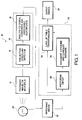
- FIG. 1 is a block diagram of the digital image scanner system of the present invention.
- the present invention provides for a method of detecting specific characteristics of an image, and making tone corrections by digital image processing to improve the image quality of the output print.
- An estimate of the contrast and exposure of the film image is made to identify important image information in the film image.
- the important image information is used to select a look up table for enhancing the useful information and suppressing the less important information.
- Fig. 1 illustrates a block diagram of a digital image scanner system 10 for digitally processing a desired image which is already converted to microfilm, as shown by block 12.
- a receiving device such as a viewing screen or a microfilm scanner system 14, locates the desired image on the microfilm, which may be any image including a journal article or other document, in a film gate.
- the scanner 14 includes a projection optics and detector block 16, for detecting and projecting the microfilm image from block 12, and associated electronics at block 18, including, typically, an analog-to-digital converter.
- the scanner 14 may be any suitable digital scanner, such as a charge coupled detector (CCD) scanner.
- CCD charge coupled detector
- a lamp 20 which may be any suitable light source including a software-controllable lamp, projects the film image from the microfilm of block 12 into the projection optics and detector block 16 as a desired image projection.
- the optics typically consist of a magnifying lens, a dove prism for image rotation, and a set of mirrors to project the image, although any suitable optics or combination may be used.
- the light from the lamp 20 shines through the microfilm image represented by block 12 and the scanner 14 then moves the microfilm image past the light to detect the image coming through the film and generate electronic image data in response thereto.
- the electronic image data, or image output signal is processed by a digital image processing and tone correction means 22.
- the digital image processing and tone correction means 22 generates an output image which is provided to an output device 24, such as a printer, or a CRT or other soft display.
- the digital image processing and tone correction means 22 includes an optional histogram circuit 26, a document exposure and contrast estimate 28, and a look up table selection capability 30.
- the digital image processing and tone correction means 22 may further include an optional windowing means 32 for improving image quality of the output image from the digital image processing and tone correction means 22.
- the histogram circuit 26 calculates a histogram of pixel values and generates a statistic based on the histogram.
- the statistic is capable of being scaled by a total number of image pixels, generating a scaled statistic indicative of central tendency of image transformation.
- the histogram circuit 26, therefore, totals the occurrences of individual signal levels across each microfilm image from block 12. This function is typically performed at pixel clock rates such that no performance or throughput degradation occurs.
- Software control of this circuit if desired, can consist of programming the pixel frequency at which samples are taken for the totals. This is generally derived from the image size, in pixels.
- the calculated image statistics are used to select the look up table at block 30.
- the image statistics can be calculated indirectly, based on the histogram circuit 26, the histogram circuit can be eliminated from the system 10 and the image statistics can be calculated directly from the actual number of pixel values as they are acquired. This would be a simpler, alternative design, if the histogram circuit 26 is not required in the system 10 for other purposes.
- the contrast of the processed image from the digital image processing and tone correction means 22 is not modified directly based on the image statistics. Rather, the contrast is changed indirectly by the selection of the previously designed transformation or look up table 30. In this way, the image processing is scene-specific, but constrained to the set of previously designed look up tables. The image quality of the processed images is, therefore, extremely consistent, particularly for documents recorded on an intermediate medium.
- the windowing means 32 can be included in the system 10 to mask off unwanted pixel data, or to crop the electronic image data. It can be programmed manually, through user intervention, or ally from an external document detection circuit.
- the windowing means 32 may provide an advantage in that it can mask data going to the histogram circuit 26, thereby making the data more representative of the important area of the document or microfilm image from block 12.
- the windowing means 32 can also improve the image quality of a printed image by masking surrounding areas, outside of the important area.
- the important areas of the microfilm image from block 12 are identified by the document exposure and contrast estimate 28.
- the document exposure and contrast estimate 28 is an estimate of the contrast and exposure of the microfilm image from block 12 and identifies important image information in the image output signal from the scanner 14.
- the image scanner system 10 is then adjusted, based on the interpretation of the image output signal by the document exposure and contrast estimate 28.
- the important information identified by the document exposure and contrast estimate 28 is used to select the look up table 30, which can enhance the useful or important information and suppress the less important information, resulting in improved image quality.
- the look up table 30 then performs a pixel-by-pixel transformation.
- the choice of table transformation can be constrained to one of a set of previously determined transformations, which are chosen after consideration of the microfilm polarity, exposure and processing, microfilm image contrast, and output device 24 imaging characteristics.
- the histogram circuit 26 calculates the histogram of pixel values.
- the scaled statistic s sc can be seen as one indicator of the central tendency of image information.
- This is then used to select the look up table 30 from the previously determined set. This can be done if each table can be identified by location over the range of pixel values. For document images, this can be done by identifying each table by, for example, its intercept, or its input value corresponding to a specified output value.
- the chosen look up table 30 is then used as a tone reproduction function for the scanned image data.
- the resulting processed image is now in enhanced form for subsequent output, such as printing, CRT display, or other storage, by the output device 24.
- the present invention provides for a digital image scanner system and method, wherein a sample of tone values from the image is used to estimate the exposure or central tendency of the recorded image. The estimate is then used to select a tone correction function used to process the image prior to printing, transmission, or CRT display.
- a scanned image is enhanced, based on its tone value statistics computed from a predetermined range of all possible values.
- the image statistics can be calculated from a sample histogram, or directly from a sample of actual pixel values as they are acquired.
- the invention may be summarized as providing an image scanner system comprising: a high-resolution image scanning means for generating electronic image data; an image processing means for processing said electronic image data and generating an image output signal in response thereto; and means for interpreting said image output signal.
- the invention may be summarized as follows:
Landscapes
- Engineering & Computer Science (AREA)
- Multimedia (AREA)
- Signal Processing (AREA)
- Physics & Mathematics (AREA)
- General Physics & Mathematics (AREA)
- Theoretical Computer Science (AREA)
- Facsimile Image Signal Circuits (AREA)
- Image Input (AREA)
- Image Processing (AREA)
Applications Claiming Priority (2)
| Application Number | Priority Date | Filing Date | Title |
|---|---|---|---|
| US84367592A | 1992-02-28 | 1992-02-28 | |
| US843675 | 1992-02-28 |
Publications (1)
| Publication Number | Publication Date |
|---|---|
| EP0560165A1 true EP0560165A1 (fr) | 1993-09-15 |
Family
ID=25290692
Family Applications (1)
| Application Number | Title | Priority Date | Filing Date |
|---|---|---|---|
| EP93103223A Withdrawn EP0560165A1 (fr) | 1992-02-28 | 1993-03-01 | Système de balayage d'images et méthode pour une qualité d'image de microfilm améliorée |
Country Status (3)
| Country | Link |
|---|---|
| US (1) | US5617223A (fr) |
| EP (1) | EP0560165A1 (fr) |
| JP (1) | JPH0654195A (fr) |
Cited By (2)
| Publication number | Priority date | Publication date | Assignee | Title |
|---|---|---|---|---|
| EP0903934A3 (fr) * | 1997-09-19 | 2002-01-02 | Eastman Kodak Company | Procédé pour la numérisation automatique dépendante de l'image et le traitement de films de petit format |
| EP1251685A3 (fr) * | 1994-09-21 | 2003-01-08 | Canon Kabushiki Kaisha | Appareil pour la détection de rayonnement X et appareil de lecture d'images |
Families Citing this family (9)
| Publication number | Priority date | Publication date | Assignee | Title |
|---|---|---|---|---|
| DE19751465C2 (de) * | 1997-11-20 | 1999-09-02 | Agfa Gevaert Ag | Vorrichtung und Verfahren zum Bestimmen von Empfindlichkeitswerten für ein Kopieren eines mit einer digitalen Kamera aufgenommenen Bildes und Vorrichtung zum Kopieren eines Bildes auf Kopiermaterial |
| JPH11203451A (ja) | 1998-01-19 | 1999-07-30 | Fuji Photo Film Co Ltd | 画像入力装置 |
| US6999202B2 (en) | 2001-03-27 | 2006-02-14 | Polaroid Corporation | Method for generating a halftone of a source image |
| US6937365B2 (en) * | 2001-05-30 | 2005-08-30 | Polaroid Corporation | Rendering images utilizing adaptive error diffusion |
| ATE303901T1 (de) * | 2001-05-30 | 2005-09-15 | Polaroid Corp | Hochgeschwindigkeitsphotodruckgerät |
| US6842186B2 (en) * | 2001-05-30 | 2005-01-11 | Polaroid Corporation | High speed photo-printing apparatus |
| US6906736B2 (en) * | 2002-02-19 | 2005-06-14 | Polaroid Corporation | Technique for printing a color image |
| US7283666B2 (en) | 2003-02-27 | 2007-10-16 | Saquib Suhail S | Digital image exposure correction |
| US8773685B2 (en) | 2003-07-01 | 2014-07-08 | Intellectual Ventures I Llc | High-speed digital image printing system |
Citations (5)
| Publication number | Priority date | Publication date | Assignee | Title |
|---|---|---|---|---|
| EP0258740A2 (fr) * | 1986-09-02 | 1988-03-09 | Fuji Photo Film Co., Ltd. | Procédé et appareil de traitement d'images avec correction de gradation du signal d'image |
| US4774569A (en) * | 1987-07-24 | 1988-09-27 | Eastman Kodak Company | Method for adaptively masking off a video window in an overscanned image |
| US4903145A (en) * | 1986-08-06 | 1990-02-20 | Canon Kabushiki Kaisha | Image quality control apparatus capable of density-correcting plural areas of different types |
| EP0442054A2 (fr) * | 1990-02-12 | 1991-08-21 | International Business Machines Corporation | Procédé et appareil de traitement adaptatif d'images |
| WO1991012540A1 (fr) * | 1990-02-06 | 1991-08-22 | Eastman Kodak Company | Procede de production d'echelles de tonalites et dispositif permettant de produire des images numeriques a rayons x |
Family Cites Families (9)
| Publication number | Priority date | Publication date | Assignee | Title |
|---|---|---|---|---|
| US4636845A (en) * | 1985-05-06 | 1987-01-13 | Eastman Kodak Company | Digital image processing method for over and under exposed photographic images |
| US4642683A (en) * | 1985-05-06 | 1987-02-10 | Eastman Kodak Company | Digital image processing method for images with bimodal tone value distribution |
| US5042077A (en) * | 1987-10-02 | 1991-08-20 | General Electric Company | Method of highlighting subtle contrast in graphical images |
| US4977521A (en) * | 1988-07-25 | 1990-12-11 | Eastman Kodak Company | Film noise reduction by application of bayes theorem to positive/negative film |
| JPH06101799B2 (ja) * | 1988-10-28 | 1994-12-12 | 富士ゼロックス株式会社 | 画像形成装置のグレイバランス制御方式 |
| JPH0787587B2 (ja) * | 1990-02-16 | 1995-09-20 | 松下電器産業株式会社 | 階調補正装置 |
| US5081529A (en) * | 1990-12-18 | 1992-01-14 | Eastman Kodak Company | Color and tone scale calibration system for a printer using electronically-generated input images |
| US5133022A (en) * | 1991-02-06 | 1992-07-21 | Recognition Equipment Incorporated | Normalizing correlator for video processing |
| US5255085A (en) * | 1991-10-25 | 1993-10-19 | Eastman Kodak Company | Adaptive technique for providing accurate tone reproduction control in an imaging system |
-
1993
- 1993-02-24 JP JP5035616A patent/JPH0654195A/ja active Pending
- 1993-03-01 EP EP93103223A patent/EP0560165A1/fr not_active Withdrawn
-
1995
- 1995-06-28 US US08/496,276 patent/US5617223A/en not_active Expired - Lifetime
Patent Citations (5)
| Publication number | Priority date | Publication date | Assignee | Title |
|---|---|---|---|---|
| US4903145A (en) * | 1986-08-06 | 1990-02-20 | Canon Kabushiki Kaisha | Image quality control apparatus capable of density-correcting plural areas of different types |
| EP0258740A2 (fr) * | 1986-09-02 | 1988-03-09 | Fuji Photo Film Co., Ltd. | Procédé et appareil de traitement d'images avec correction de gradation du signal d'image |
| US4774569A (en) * | 1987-07-24 | 1988-09-27 | Eastman Kodak Company | Method for adaptively masking off a video window in an overscanned image |
| WO1991012540A1 (fr) * | 1990-02-06 | 1991-08-22 | Eastman Kodak Company | Procede de production d'echelles de tonalites et dispositif permettant de produire des images numeriques a rayons x |
| EP0442054A2 (fr) * | 1990-02-12 | 1991-08-21 | International Business Machines Corporation | Procédé et appareil de traitement adaptatif d'images |
Cited By (3)
| Publication number | Priority date | Publication date | Assignee | Title |
|---|---|---|---|---|
| EP1251685A3 (fr) * | 1994-09-21 | 2003-01-08 | Canon Kabushiki Kaisha | Appareil pour la détection de rayonnement X et appareil de lecture d'images |
| EP0703699B1 (fr) * | 1994-09-21 | 2003-12-03 | Canon Kabushiki Kaisha | Appareil pour la détection de rayonnement X et appareil de lecture d'images |
| EP0903934A3 (fr) * | 1997-09-19 | 2002-01-02 | Eastman Kodak Company | Procédé pour la numérisation automatique dépendante de l'image et le traitement de films de petit format |
Also Published As
| Publication number | Publication date |
|---|---|
| JPH0654195A (ja) | 1994-02-25 |
| US5617223A (en) | 1997-04-01 |
Similar Documents
| Publication | Publication Date | Title |
|---|---|---|
| US8369650B2 (en) | Image defect map creation using batches of digital images | |
| US7536060B2 (en) | Automated statistical self-calibrating detection and removal of blemishes in digital images based on multiple occurrences of dust in images | |
| US7536061B2 (en) | Automated statistical self-calibrating detection and removal of blemishes in digital images based on determining probabilities based on image analysis of single images | |
| US6845181B2 (en) | Method for processing a digital image to adjust brightness | |
| US7340109B2 (en) | Automated statistical self-calibrating detection and removal of blemishes in digital images dependent upon changes in extracted parameter values | |
| US7206461B2 (en) | Digital image acquisition and processing system | |
| US7327390B2 (en) | Method for determining image correction parameters | |
| US7676110B2 (en) | Determination of need to service a camera based on detection of blemishes in digital images | |
| EP1583356B1 (fr) | Dispositif de traitement d'images et programme de traitement d'images | |
| US7106371B1 (en) | Pixel defect detector for solid-state imaging device | |
| US7315658B2 (en) | Digital camera | |
| US7310450B2 (en) | Method of detecting and correcting dust in digital images based on aura and shadow region analysis | |
| US7034878B2 (en) | Camera apparatus and method of taking pictures including simplified processing | |
| US7308156B2 (en) | Automated statistical self-calibrating detection and removal of blemishes in digital images based on a dust map developed from actual image data | |
| EP1668886A1 (fr) | Detection statistique a auto-etalonnage et elimination d'imperfections dans des images numeriques | |
| EP0460193A1 (fr) | Procede pour accroitre la plage lineaire des images fixees sur un film. | |
| US6670988B1 (en) | Method for compensating digital images for light falloff and an apparatus therefor | |
| US5617223A (en) | Image scanner system and method for improved microfilm image quality | |
| EP0903934A2 (fr) | Procédé pour la numérisation automatique dépendante de l'image et le traitement de films de petit format | |
| US5710828A (en) | Method and apparatus for converting a threshold matrix which is then used to binarize image signals | |
| US7176965B1 (en) | Method of adjusting the brightness of an image, digital camera and image processor using the method | |
| US7319544B2 (en) | Processing of digital images | |
| JPH09181918A (ja) | デジタルプリンタの画像データ変換方法 | |
| IE20040604U1 (en) | Automated statistical self-calibrating detection and removal of blemishes in digital images based on multiple occurrences of dust in images | |
| JPH1039432A (ja) | 画像判別方法、画像階調変換方法、画像処理方法、画像判別装置、画像階調変換装置及び画像処理装置 |
Legal Events
| Date | Code | Title | Description |
|---|---|---|---|
| PUAI | Public reference made under article 153(3) epc to a published international application that has entered the european phase |
Free format text: ORIGINAL CODE: 0009012 |
|
| AK | Designated contracting states |
Kind code of ref document: A1 Designated state(s): DE FR GB |
|
| 17P | Request for examination filed |
Effective date: 19940315 |
|
| 17Q | First examination report despatched |
Effective date: 19960305 |
|
| STAA | Information on the status of an ep patent application or granted ep patent |
Free format text: STATUS: THE APPLICATION IS DEEMED TO BE WITHDRAWN |
|
| 18D | Application deemed to be withdrawn |
Effective date: 19960917 |