EP0442054A2 - Procédé et appareil de traitement adaptatif d'images - Google Patents
Procédé et appareil de traitement adaptatif d'images Download PDFInfo
- Publication number
- EP0442054A2 EP0442054A2 EP90122606A EP90122606A EP0442054A2 EP 0442054 A2 EP0442054 A2 EP 0442054A2 EP 90122606 A EP90122606 A EP 90122606A EP 90122606 A EP90122606 A EP 90122606A EP 0442054 A2 EP0442054 A2 EP 0442054A2
- Authority
- EP
- European Patent Office
- Prior art keywords
- document
- image
- type
- information
- processing
- Prior art date
- Legal status (The legal status is an assumption and is not a legal conclusion. Google has not performed a legal analysis and makes no representation as to the accuracy of the status listed.)
- Withdrawn
Links
Images


Classifications
-
- H—ELECTRICITY
- H04—ELECTRIC COMMUNICATION TECHNIQUE
- H04N—PICTORIAL COMMUNICATION, e.g. TELEVISION
- H04N1/00—Scanning, transmission or reproduction of documents or the like, e.g. facsimile transmission; Details thereof
- H04N1/00962—Input arrangements for operating instructions or parameters, e.g. updating internal software
- H04N1/00968—Input arrangements for operating instructions or parameters, e.g. updating internal software by scanning marks on a sheet
-
- G—PHYSICS
- G06—COMPUTING OR CALCULATING; COUNTING
- G06F—ELECTRIC DIGITAL DATA PROCESSING
- G06F16/00—Information retrieval; Database structures therefor; File system structures therefor
- G06F16/90—Details of database functions independent of the retrieved data types
- G06F16/93—Document management systems
-
- G—PHYSICS
- G06—COMPUTING OR CALCULATING; COUNTING
- G06Q—INFORMATION AND COMMUNICATION TECHNOLOGY [ICT] SPECIALLY ADAPTED FOR ADMINISTRATIVE, COMMERCIAL, FINANCIAL, MANAGERIAL OR SUPERVISORY PURPOSES; SYSTEMS OR METHODS SPECIALLY ADAPTED FOR ADMINISTRATIVE, COMMERCIAL, FINANCIAL, MANAGERIAL OR SUPERVISORY PURPOSES, NOT OTHERWISE PROVIDED FOR
- G06Q40/00—Finance; Insurance; Tax strategies; Processing of corporate or income taxes
- G06Q40/02—Banking, e.g. interest calculation or account maintenance
-
- G—PHYSICS
- G06—COMPUTING OR CALCULATING; COUNTING
- G06V—IMAGE OR VIDEO RECOGNITION OR UNDERSTANDING
- G06V30/00—Character recognition; Recognising digital ink; Document-oriented image-based pattern recognition
- G06V30/40—Document-oriented image-based pattern recognition
- G06V30/41—Analysis of document content
- G06V30/414—Extracting the geometrical structure, e.g. layout tree; Block segmentation, e.g. bounding boxes for graphics or text
-
- H—ELECTRICITY
- H04—ELECTRIC COMMUNICATION TECHNIQUE
- H04N—PICTORIAL COMMUNICATION, e.g. TELEVISION
- H04N1/00—Scanning, transmission or reproduction of documents or the like, e.g. facsimile transmission; Details thereof
- H04N1/32—Circuits or arrangements for control or supervision between transmitter and receiver or between image input and image output device, e.g. between a still-image camera and its memory or between a still-image camera and a printer device
- H04N1/32561—Circuits or arrangements for control or supervision between transmitter and receiver or between image input and image output device, e.g. between a still-image camera and its memory or between a still-image camera and a printer device using a programmed control device, e.g. a microprocessor
-
- H—ELECTRICITY
- H04—ELECTRIC COMMUNICATION TECHNIQUE
- H04N—PICTORIAL COMMUNICATION, e.g. TELEVISION
- H04N1/00—Scanning, transmission or reproduction of documents or the like, e.g. facsimile transmission; Details thereof
- H04N1/32—Circuits or arrangements for control or supervision between transmitter and receiver or between image input and image output device, e.g. between a still-image camera and its memory or between a still-image camera and a printer device
- H04N1/333—Mode signalling or mode changing; Handshaking therefor
- H04N1/33307—Mode signalling or mode changing; Handshaking therefor prior to start of transmission, input or output of the picture signal only
- H04N1/33315—Mode signalling or mode changing; Handshaking therefor prior to start of transmission, input or output of the picture signal only reading or reproducing mode only, e.g. sheet size, resolution
-
- H—ELECTRICITY
- H04—ELECTRIC COMMUNICATION TECHNIQUE
- H04N—PICTORIAL COMMUNICATION, e.g. TELEVISION
- H04N1/00—Scanning, transmission or reproduction of documents or the like, e.g. facsimile transmission; Details thereof
- H04N1/32—Circuits or arrangements for control or supervision between transmitter and receiver or between image input and image output device, e.g. between a still-image camera and its memory or between a still-image camera and a printer device
- H04N1/333—Mode signalling or mode changing; Handshaking therefor
- H04N1/33369—Storage of mode or retrieval of prestored mode
-
- H—ELECTRICITY
- H04—ELECTRIC COMMUNICATION TECHNIQUE
- H04N—PICTORIAL COMMUNICATION, e.g. TELEVISION
- H04N1/00—Scanning, transmission or reproduction of documents or the like, e.g. facsimile transmission; Details thereof
- H04N1/38—Circuits or arrangements for blanking or otherwise eliminating unwanted parts of pictures
-
- H—ELECTRICITY
- H04—ELECTRIC COMMUNICATION TECHNIQUE
- H04N—PICTORIAL COMMUNICATION, e.g. TELEVISION
- H04N1/00—Scanning, transmission or reproduction of documents or the like, e.g. facsimile transmission; Details thereof
- H04N1/40—Picture signal circuits
-
- H—ELECTRICITY
- H04—ELECTRIC COMMUNICATION TECHNIQUE
- H04N—PICTORIAL COMMUNICATION, e.g. TELEVISION
- H04N1/00—Scanning, transmission or reproduction of documents or the like, e.g. facsimile transmission; Details thereof
- H04N1/41—Bandwidth or redundancy reduction
-
- H—ELECTRICITY
- H04—ELECTRIC COMMUNICATION TECHNIQUE
- H04N—PICTORIAL COMMUNICATION, e.g. TELEVISION
- H04N1/00—Scanning, transmission or reproduction of documents or the like, e.g. facsimile transmission; Details thereof
- H04N1/00127—Connection or combination of a still picture apparatus with another apparatus, e.g. for storage, processing or transmission of still picture signals or of information associated with a still picture
- H04N1/00204—Connection or combination of a still picture apparatus with another apparatus, e.g. for storage, processing or transmission of still picture signals or of information associated with a still picture with a digital computer or a digital computer system, e.g. an internet server
-
- H—ELECTRICITY
- H04—ELECTRIC COMMUNICATION TECHNIQUE
- H04N—PICTORIAL COMMUNICATION, e.g. TELEVISION
- H04N2201/00—Indexing scheme relating to scanning, transmission or reproduction of documents or the like, and to details thereof
- H04N2201/0077—Types of the still picture apparatus
- H04N2201/0081—Image reader
-
- H—ELECTRICITY
- H04—ELECTRIC COMMUNICATION TECHNIQUE
- H04N—PICTORIAL COMMUNICATION, e.g. TELEVISION
- H04N2201/00—Indexing scheme relating to scanning, transmission or reproduction of documents or the like, and to details thereof
- H04N2201/0077—Types of the still picture apparatus
- H04N2201/0082—Image hardcopy reproducer
-
- H—ELECTRICITY
- H04—ELECTRIC COMMUNICATION TECHNIQUE
- H04N—PICTORIAL COMMUNICATION, e.g. TELEVISION
- H04N2201/00—Indexing scheme relating to scanning, transmission or reproduction of documents or the like, and to details thereof
- H04N2201/0077—Types of the still picture apparatus
- H04N2201/0086—Image transceiver
-
- H—ELECTRICITY
- H04—ELECTRIC COMMUNICATION TECHNIQUE
- H04N—PICTORIAL COMMUNICATION, e.g. TELEVISION
- H04N2201/00—Indexing scheme relating to scanning, transmission or reproduction of documents or the like, and to details thereof
- H04N2201/0077—Types of the still picture apparatus
- H04N2201/0087—Image storage device
Definitions
- the invention disclosed broadly relates to data processing systems and more particularly relates to improvements in the storage manipulation and retrieval of digitized images.
- a digitized image requires a large amount of storage, e.g., a simple binary coded 8-1/2x11 typewritten page requires 3.74 million bits of storage when scanned at 200 lines per inch in both dimensions. In the usual terminology of computer storage, this is 467.5 kilo bytes. This compares with approximately 3 kilo bytes of character data that is required to store a typical typewritten page of text.
- Coders in which the data is reduced while allowing a perfect reproduction of the information are referred to as information preserving encoders.
- Compression in the spatial domain usually is a run length type of encoding which maps the sequence of picture elements; a(1), a(2), a(3)...into a sequence of pairs (c(1),1(2)), where c denotes the color, black or white for binary, and 1 represents the length of the sequence.
- the number of bits required to store 1, obviously has to be greater than 1 for this method to be useful.
- we reserve two bits, using standard binary counting to describe run lengths that is we can describe lengths up to four bits. Then, it is required to have three bits of storage, per run length transition.
- the sequence 1111000110011001 that requires 16 bits would be represented by the following pairs (1,11),(0,10),(1,01),(0,01),(1,01),(0,01),(1,00); 111010101001101001100.
- the approach does not compress the data, but rather expands the data.
- the compression significantly reduces the data, e.g., 1111111111110000 reduces to (1,11),(1,11),(1,11),(0,11) or 111111111011.
- the problem indicates that compression may not reduce data if there are a large number of transitions, but may in fact expand the data.
- the problem is acute in valuable documents, e.g., checks, stock certificates, and negotiable instruments of all types. These documents are designed to make it difficult to copy, or reproduce for the obvious reason of decreasing the probability of fraud.
- the source documents may be kept in a remote low cost storage facility, in case of legal issues, or the document may be required as a reference for some period of time but is not critical enough to require perfect reproduction.
- a personal check for a small amount is an example.
- the bank may want a readable image in its archives for two or three billing cycles, but safekeeping is the responsibility of the person who wrote the check and reference to a readable picture in the archive is sufficient to resolve any minor balancing concerns.
- This invention addresses processing of these documents when preserving all the information is not necessary.
- the invention addresses large volume efforts where it is desirable to process documents without operator intervention and it is necessary to adjust the processing automatically as a function of a key characteristic of the document or control card.
- Various characteristics of the document can be used, including, but not limited to: color, mark sense characters, MICR, OCR, bar code and text recognition.
- the invention includes the step of storing in the system a plurality of document templates.
- Each document template defines locations of a first type and second type information blocks on a corresponding one of a plurality of document types.
- the document templates are accessible by an indicium value.
- the invention further includes storing in the system a table relating the first type information block to first type processing parameters and a second type information block to second type processing parameters.
- the invention further includes the step of capturing an image of the document and storing the image in an image buffer. Then, a characterizing indicium associated with the document is recognized by the system.
- one of the plurality of document templates is accessed in response to a value of the recognized characterizing indicium associated with the document.
- a first type block of information is selectively accessed from the image of the document in the image buffer, at a location defined by the document template.
- first type processing parameters are selectively accessed from the table corresponding to the first type information block.
- This adaptive processing can include a selected image compression algorithm suited to the particular type of image in the data block.
- the adaptive processing can further include the preparation of an output image data object file which is routed to a recipient or to a work flow in response to the particular document type represented by the indicium associated with a document. In this manner, the image of the document can be adaptively processed by the system.
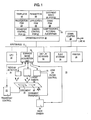
- Fig. 1 illustrates a system block diagram of a workstation in which adaptive image processing can be carried out in accordance with the invention.
- the system 10 of Fig. 1 includes a system bus 12 which interconnects CPU 14 with the random access memory 16.
- a scanner image acquisition unit 18 acts as an interface between the system bus 12 and several document transport components including the transport control 20, the document transport 22, the indicium detector 24, the front camera 26, the lens or filter control 28, and the back camera 30.
- the system 10 of Fig. 1 further includes a display/ keyboard 32 connected to the system bus 12, a bulk storage 34 and a printer 36 also connected to the system bus 12.
- the communications adapter 38 connected to the system bus 12 will handle communications over the communications link 40.
- the memory 16 stores document templates 48, such as is shown in Fig. 3 and a processing parameter table 50 such as is also depicted in Fig. 3.
- the document image buffer 52 will store the captured image of a document such as the type A document shown in Fig. 2.
- the recognition program 54 can be a conventional program to convert a two-dimensional pixel image of a document containing alphanumeric text, to an alphanumeric character string.
- the application program 56 will include, among other things, this code for executing the sequence of operational steps depicted in Fig. 4 and also the sequence of operational steps depicted in the flow diagram of Fig. 7.
- the communications program 58 will handle data communications through the communications adapter 38 over the link 40.
- the transport control 20 controlling the document transport 22.
- the camera control program 62 will control the front camera 26, the back camera 30, and the lens or filter control 28.
- the compression and filtering algorithms 64 are selectively designated by the parameter table 50 in accordance with a particular image type and document type being processed on the document transport 22, and consists of various selected standard data compression and filtering algorithms.
- the operating system 66 provides the overall operational control for the CPU 14 and the various I/O components connected to the system bus 12.
- Fig. 2 illustrates two different document types, a type A document and a type B document, to illustrate the operation of the invention.
- the coordinates for the text portion 44 and the coordinates for the location of the pictorial portion 46 can be stored in a document template 48, such as is shown in Fig. 3.
- Fig. 3 shows the document template 48 for a type A document and a type B document.
- block 1 which is the pictorial block 46
- block 2 which is the text block 44 for document type A
- block 2 which is the text block 44 for document type A
- block 3 which is the text block 44 for document type A
- block 3 which is the text block 44 for document type A
- block 3 which is the text block 44 for document type A
- block 4 has its position coordinates also stored in the template 48.
- the system shown in Fig. 1 will read the indicium 42 for a particular document and characterize this document type and will then access the corresponding template 48 as being a type A document or a type B document, as indicated by the indicium.
- the system will then access processing parameters in Table 2 of Fig. 3, corresponding to the particular type of information being either a pictorial or text information, and will perform appropriate processing on the information in response to the value of the processing parameters so accessed from the processing parameter table 50.
- FIG. 4 The sequence of operational steps for carrying out the process of adaptively processing images in the system of Fig. 1, is shown in Fig. 4.
- document templates 48 can be stored in the memory 16, as is shown in step 72.
- Processing parameter tables 50 can be stored in the memory 16 of Fig. 1, as is shown in step 74.
- a document 25 will pass down the document transport 22 and its image will be captured by the front camera 26 and optionally the back camera 30, and those digitized images will then be stored in the memory 16 in the document image buffer 52.
- the scanner/image acquisition unit 18, under control of the CPU 14, will control the cameras 26 and 30 and will exercise additional control as necessary, for the transport control 20 and the lens or filter control 28.
- step 78 The next step in the flow diagram of Fig. 4 is the recognition of the document indicium in step 78, which is carried out by the indicium detector 24 in Fig. 1.
- the image of the document captured by the camera 26 or the camera 30, which is stored in the document image buffer 52 can be subjected to a soft character recognition routine by the recognition program 54, in order to identify and evaluate the indicium 42 on the document.
- the next step in the flow diagram of Fig. 4 is to access the document template in step 80, in response to the value of the indicium 42.
- the document templates 48 shown in Fig. 3 are accessed by the value of the indicium 42 which is read from the document or at least is associated with the document. Assume, for example, that the document indicium indicates a type A document.
- the type A document template will be accessed from the template storage 48 of the memory 16 in order to identify the type and location of the various information blocks in the document.
- a type A document as can be seen in Fig. 2, there is a text portion 44 and a pictorial portion 46. The location of the pictorial portion is indicated in the template and the location of the text portion is also indicated in the template.
- step 82 a first block information type is identified for the document from the template 48.
- block type 1 is pictorial block 46 whose location is designated by the coordinates specified in the template.
- Step 84 of the flow diagram of Fig. 4 gets the coordinates of the first block from the template.
- Step 86 of the flow diagram of Fig. 4 then accesses the first block image which is the image portion 46 stored in the document image buffer 52.
- the image portion 46 which is the pictorial portion will then be subjected to processing as follows.
- Step 88 of the flow diagram of Fig. 4 accesses the processing parameters for the pictorial type data block 46, as is specified in the processing parameters table 50 of Fig. 3.
- the processing parameters are accessed from the memory 16 and can, for example, designate the type of image compression algorithm which is to be applied to the pictorial data in the block 46.
- step 90 processes the first block of pictorial data 46 using the accessed process parameters for the selected compression algorithm.
- the selected compression code is then accessed from partition 64 of the memory 16 and the CPU 14 will then execute the compression algorithm to compress the pictorial data in block 46, thereby producing an optimized compressed rendering of the pictorial block 46.
- the compressed image object data for the pictorial block 46 can then be assembled into a document image object data file as is illustrated in Fig. 8.
- the document image object data file will have a header 112 for the file which will include the file name, and can also include the indicium value 42', and other file characteristics such as routing information, a text note, document orientation, block count for the file, and other file information.
- the block count will correspond to the number of different image blocks which are appended to the file 110.
- the image object data portion 114 will store the compressed image data for block 1 which is the pictorial block 46. Also included in the portion 114 will be the identity of block 1, the compression algorithm type selected for the compression, the image resolution and other optional parameters such as the original color of the image. All of this information is then assembled into the section 114 of the document image object data file 110.
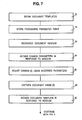
- the document indicium 42 will be recognized in step 78' prior to the document image capture step 98, in order to enable the document indicium to specify initial camera parameters for the document image capture.
- This is shown in step 94 of the flow diagram of Fig. 7, wherein camera parameters which also may be stored in the parameter storage partition 50 of the memory 16, will be accessed in response to the value of the indicium which was read in step 78'.
- the front camera 26 and optionally the back camera 30 can be adjusted by means of the lens or filter control 28 in order to move a different lens or different filter in front of the camera in response to a particular color or other characteristic of the document type being scanned.
- the scanner/image acquisition unit 18 acts as an interface between the CPU 14 and the lens or filter control 28 to carry out the control of the front camera 26 and the back camera 30.
- FIG. 5 An example of lens control for the front camera 26 is shown in Fig. 5.
- the transport 22 will transport the document 25 under a color sense light source 68 which will illuminate the document with an appropriate wavelength light so that light reflected from the document is detected by the color detector 24'.
- Color detector 24' can be an alternate form for the indicium detector 24 shown in Fig. 1.
- the signal from the color detector 24' will then be passed through the scanner/image acquisition unit 18 to the CPU 14 which has accessed the camera control program 62.
- the camera control program 62 will then adaptively control the lens or filter control 28 through the acquisition unit 18, to thereby actuate the motor controller 28 moving one of the three lenses 70, 70' or 70'' in front of the camera 26.
- the company can control the form of the input document 25 by requiring claims adjusters to use a standard form with well-defined locations and fields for information.
- the type of form may vary depending on the line of business, e.g., automobile, household goods, or personal articles of high value.
- the characterizing indicia 42 can be set as a standard. When this is read, it can call the appropriate templates 48 and table values 50 for subsequent processing.
- the input device 26 lifts the image and sends it to the recognition program 54. If it is a type B it recognizes this as an automobile claim and knows where to look for information and how to process it. Based on the ID 42 it selects the templates 48 shown in Fig. 3 and the associated parameters 50.
- the example illustrates that one field is text 46' and the other pictorial 44. This determines subsequent processing.
- the text field 46 would contain information on the driver, the cost of the damage, and the policy number.
- This data will be used to update policy information and rates in addition to handling the claim. Since it is text, it can be compressed using a standard text oriented compression algorithm C2.
- the picture data on the other hand will be handled by a different algorithm C1, since it is gray scale. The appropriate compression is used to minimize the record size for storage and transmission.
- the indicium 42 for subsequent processing could also be obtained from a separate control card on the transport 22 depending on how the office operates. If all of one document type go to a certain place this may be a more efficient method of operating.
- a type A document as shown in Fig. 2 may be, for example, a claim for high risk personal effects, where the pictorial information 46 may be in a different location. This may, in fact, not be a picture, but could also be an image of the last appraisal of the item and would require a higher resolution than the rest of the document to get an accurate verification of the appraiser's signature.
- the system could also do a recognition of the entire document and then search the data for a field that has the requisite code that indicates what the indicium 42 is, i.e., the location of the indicium is not known a priori.
- the pictorial data 46 shown in the type A document of Fig. 2 may have underlying scroll work on the form, to discourage counterfeiting, and is no longer needed in the processing.
- the data in that field could be processed by a digital low pass filter to suppress the scroll work background prior to compression. Data compression of the filtered data would increase.
- the indicium 42 could be used to set the threshold of an analog or digital device on camera 26 and the number of bits used to represent the image, to decrease the record size.
- the indicia 42 could also be used to select a transfer function or a dithering mask from the stored filtering algorithms 64 to decrease the amount of data required to represent the picture.
- Fig. 5 illustrates the input mechanism, in which a color sensor 24' can be used to detect the color of the document. Based on this input, a filter 70 can be selected in the optical path of camera 26 to enhance the contrast. The data is thresholded and compressed. The compressed image size is decreased because the document background has been suppressed by the color filtering thresholding. The selection of the filter 70 is made prior to the lifting of the image by camera 26.
- the correct filter 70 can be chosen on the basis of the color sensor 24' or alternately, it can be selected based on a value associated with an indicium 42 on the stock certificate.
- FIG. 5 illustrates a physical movement of filters 70, 70', and 70'', but other methods can be used including the use of an electro-optical material whose light transmission can be altered by means of an electric or magnetic field.
- the indicium 42 can be part of the document, or indicated by a separate control card prior to processing a batch of the same type of documents.
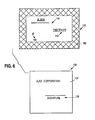
- Fig. 6 illustrates a stock certificate.
- a corporation has control over the appearance of its shares and can determine where the indicium 42 is to be placed.
- the certificates 100 will be scanned and the indicium 42 recognized. This may be a two stage recognition lift by detector 24 and image lift by camera 26 or a single stage lift of both by camera 26. Assume for this example that the data for recognition as well as the images of both sides of the document are available in buffers 52.
- the information on the front of a certificate is normally presented in a horizontal fashion. That is, the printed information 104 is displayed in rows parallel to the long edge of the document 100.
- the back side has the information 104' displayed parallel to the short edge. Therefore, in most cases, depending on the table values 50, the back side information 104 will be rotated 90 degrees prior to being sent to the compression algorithm 64. This significantly decreases the image record size, because the compression is extremely inefficient if applied in the direction perpendicular to the row direction as there are too many transitions and long run lengths are not attainable.
- the index 42 could also be used to decide if both sides, one side or neither side image is to be captured. The no side option is most likely if the share being processed is not in the correct batch or sequence. If a single recognition and image lift is made by camera 26, the same decision process is used, but in this case, the action is not to store the image in permanent storage.
- the processing of the document 100 can be aborted based on the indicium 42, because a certificate is out of sequence. That is while processing AJAX shares, a share of ACME is inserted into the input incorrectly. In this case, the incorrect share will be sent to a different output hopper on transport 22. Also, in some cases, it may not be necessary to capture, or store both sides of the document 100. Based on the indicium 42, it may be decided that only the front side of the certificate 100 is scanned, as the endorsement information is not required for the application.
- special routing information can be placed in the output record 110, to allow the information to be automatically routed to a work queue for further examination.
- This queue could be local or remote, for example certain stock images may be automatically routed to the transfer agent as part of the processing, or may be routed to a research assistant in the same complex.
- This header 112 information can be used in real time during processing of the document 100 or may be used during subsequent retrievals of the document image file 110 from storage.
- a unique key can be generated for each image and placed in the image header 112 and another coded data base which can be used to retrieve the document image file 110.
- These header fields 112 are illustrated in Fig. 8.
- the resulting adaptive image processing system and method provides an improved image handling capability for documents having pictorial and text image components, having a different information density or characteristics.
Landscapes
- Engineering & Computer Science (AREA)
- Multimedia (AREA)
- Signal Processing (AREA)
- Physics & Mathematics (AREA)
- Business, Economics & Management (AREA)
- Theoretical Computer Science (AREA)
- General Physics & Mathematics (AREA)
- Computer Vision & Pattern Recognition (AREA)
- General Business, Economics & Management (AREA)
- Finance (AREA)
- Databases & Information Systems (AREA)
- Accounting & Taxation (AREA)
- Artificial Intelligence (AREA)
- Development Economics (AREA)
- Geometry (AREA)
- Computer Hardware Design (AREA)
- Microelectronics & Electronic Packaging (AREA)
- Computer Graphics (AREA)
- Data Mining & Analysis (AREA)
- General Engineering & Computer Science (AREA)
- Economics (AREA)
- Marketing (AREA)
- Strategic Management (AREA)
- Technology Law (AREA)
- Processing Or Creating Images (AREA)
- Character Input (AREA)
- Image Processing (AREA)
- Storing Facsimile Image Data (AREA)
Priority Applications (1)
| Application Number | Priority Date | Filing Date | Title |
|---|---|---|---|
| EP96108728A EP0734146A3 (fr) | 1990-02-12 | 1990-11-27 | Procédé et appareil de traitement adaptatif d'images |
Applications Claiming Priority (2)
| Application Number | Priority Date | Filing Date | Title |
|---|---|---|---|
| US07/478,325 US5038392A (en) | 1990-02-12 | 1990-02-12 | Method and apparatus for adaptive image processing by recognizing a characterizing indicium in a captured image of a document |
| US478325 | 1995-06-07 |
Publications (2)
| Publication Number | Publication Date |
|---|---|
| EP0442054A2 true EP0442054A2 (fr) | 1991-08-21 |
| EP0442054A3 EP0442054A3 (en) | 1992-12-16 |
Family
ID=23899470
Family Applications (2)
| Application Number | Title | Priority Date | Filing Date |
|---|---|---|---|
| EP19900122606 Withdrawn EP0442054A3 (en) | 1990-02-12 | 1990-11-27 | Method and apparatus for adaptive image processing |
| EP96108728A Withdrawn EP0734146A3 (fr) | 1990-02-12 | 1990-11-27 | Procédé et appareil de traitement adaptatif d'images |
Family Applications After (1)
| Application Number | Title | Priority Date | Filing Date |
|---|---|---|---|
| EP96108728A Withdrawn EP0734146A3 (fr) | 1990-02-12 | 1990-11-27 | Procédé et appareil de traitement adaptatif d'images |
Country Status (3)
| Country | Link |
|---|---|
| US (1) | US5038392A (fr) |
| EP (2) | EP0442054A3 (fr) |
| JP (1) | JPH06139325A (fr) |
Cited By (15)
| Publication number | Priority date | Publication date | Assignee | Title |
|---|---|---|---|---|
| EP0507527A3 (en) * | 1991-04-01 | 1993-03-03 | Canon Kabushiki Kaisha | Image storage control apparatus |
| FR2686435A1 (fr) * | 1992-01-16 | 1993-07-23 | United Carriers Group Ltd | Perfectionnements concernant la transmission et la memorisation d'images de documents. |
| EP0560165A1 (fr) * | 1992-02-28 | 1993-09-15 | Eastman Kodak Company | Système de balayage d'images et méthode pour une qualité d'image de microfilm améliorée |
| EP0568140A1 (fr) * | 1992-04-27 | 1993-11-03 | Koninklijke Philips Electronics N.V. | Système automatisé de traitement et de génération de formulaires, et formulaire associé à ce système |
| EP0731596A1 (fr) * | 1995-03-06 | 1996-09-11 | Kabushiki Kaisha Toshiba | Appareil de traitement d'image |
| EP0750426A3 (fr) * | 1995-06-22 | 1998-09-30 | Canon Kabushiki Kaisha | Appareil de traitement d'image, appareil de traitement de donnée et méthode attenante |
| EP0929183A3 (fr) * | 1998-01-09 | 2000-05-10 | Canon Kabushiki Kaisha | Appareil et procédé de traitement d'image |
| WO2001071571A1 (fr) * | 2000-03-23 | 2001-09-27 | Virpack.Com | Systeme et methode pour creation de paquets virtuels d'informations |
| WO2002082799A3 (fr) * | 2001-04-03 | 2003-02-13 | Tsvi H Lev | Procede d'acquisition et de transmission selectives d'images |
| WO2003090096A1 (fr) | 2002-04-19 | 2003-10-30 | Toshiba Tec Kabushiki Kaisha | Systeme de gestion de documents |
| US7111024B2 (en) | 2002-04-19 | 2006-09-19 | Kabushiki Kaisha Toshiba | Document management system for automating operations performed on documents in data storage areas |
| US7478316B2 (en) | 2002-04-19 | 2009-01-13 | Toshiba Tec Kabushiki Kaisha | Document management system for transferring a plurality of documents |
| US7532340B2 (en) | 2002-04-19 | 2009-05-12 | Toshiba Tec Kabushiki Kaisha | Document management system rule-based automation |
| US8127217B2 (en) | 2002-04-19 | 2012-02-28 | Kabushiki Kaisha Toshiba | Document management system for transferring a plurality of documents |
| US20140093166A1 (en) * | 2011-03-28 | 2014-04-03 | Fuji Xerox Co., Ltd. | Image processing apparatus, image processing method, and computer readable medium |
Families Citing this family (77)
| Publication number | Priority date | Publication date | Assignee | Title |
|---|---|---|---|---|
| US4907283A (en) * | 1987-03-13 | 1990-03-06 | Canon Kabushiki Kaisha | Image processing apparatus |
| US5410642A (en) * | 1989-08-23 | 1995-04-25 | Dai Nippon Printing Co., Ltd. | ID card issuing system |
| JPH03223966A (ja) * | 1989-12-26 | 1991-10-02 | Fuji Xerox Co Ltd | ファイリング装置およびそれを用いたファイル検索方法 |
| US5396588A (en) * | 1990-07-03 | 1995-03-07 | Froessl; Horst | Data processing using digitized images |
| JPH0457570A (ja) * | 1990-06-27 | 1992-02-25 | Dainippon Screen Mfg Co Ltd | 画像処理装置 |
| US5138459A (en) | 1990-11-20 | 1992-08-11 | Personal Computer Cameras, Inc. | Electronic still video camera with direct personal computer (pc) compatible digital format output |
| JPH04274552A (ja) * | 1991-02-28 | 1992-09-30 | Brother Ind Ltd | 文書処理装置 |
| US5258855A (en) * | 1991-03-20 | 1993-11-02 | System X, L. P. | Information processing methodology |
| US5293429A (en) * | 1991-08-06 | 1994-03-08 | Ricoh Company, Ltd. | System and method for automatically classifying heterogeneous business forms |
| US5452379A (en) * | 1991-09-13 | 1995-09-19 | Meadowbrook Industries, Ltd. | Image capture and storage techniques in association with optical mark reading |
| US5926565A (en) * | 1991-10-28 | 1999-07-20 | Froessl; Horst | Computer method for processing records with images and multiple fonts |
| US5987149A (en) | 1992-07-08 | 1999-11-16 | Uniscore Incorporated | Method for scoring and control of scoring open-ended assessments using scorers in diverse locations |
| US5672060A (en) * | 1992-07-08 | 1997-09-30 | Meadowbrook Industries, Ltd. | Apparatus and method for scoring nonobjective assessment materials through the application and use of captured images |
| US5386482A (en) * | 1992-07-16 | 1995-01-31 | Scan-Optics, Inc. | Address block location method and apparatus |
| US5420974A (en) * | 1992-10-15 | 1995-05-30 | International Business Machines Corporation | Multimedia complex form creation, display and editing method apparatus |
| US5437554A (en) | 1993-02-05 | 1995-08-01 | National Computer Systems, Inc. | System for providing performance feedback to test resolvers |
| US5848184A (en) * | 1993-03-15 | 1998-12-08 | Unisys Corporation | Document page analyzer and method |
| JP3388829B2 (ja) * | 1993-03-23 | 2003-03-24 | 株式会社東芝 | 文字読取装置 |
| US5530907A (en) * | 1993-08-23 | 1996-06-25 | Tcsi Corporation | Modular networked image processing system and method therefor |
| US5424945A (en) * | 1993-08-31 | 1995-06-13 | Xerox Corporation | System for evaluating a psychological effect of a document |
| US5428694A (en) * | 1993-10-14 | 1995-06-27 | International Business Machines Corporation | Data processing system and method for forms definition, recognition and verification of scanned images of document forms |
| EP0654746B1 (fr) * | 1993-11-24 | 2003-02-12 | Canon Kabushiki Kaisha | Système d'identification et de traitement de formulaires |
| US5748780A (en) * | 1994-04-07 | 1998-05-05 | Stolfo; Salvatore J. | Method and apparatus for imaging, image processing and data compression |
| US5544255A (en) * | 1994-08-31 | 1996-08-06 | Peripheral Vision Limited | Method and system for the capture, storage, transport and authentication of handwritten signatures |
| US6091835A (en) * | 1994-08-31 | 2000-07-18 | Penop Limited | Method and system for transcribing electronic affirmations |
| DE19681266T1 (de) * | 1995-04-04 | 1998-02-05 | Base Ten Systems Inc | Verfahren und Vorrichtung zum Archivieren von Ultraschallbildern |
| EP0901283A4 (fr) | 1996-05-17 | 1999-06-30 | Matsushita Electric Industrial Co Ltd | Procede de multiplexage de donnees, procede et dispositif de reproduction de donnees multiplexees, et support d'enregistrement contenant les donnees multiplexees selon ledit procede |
| JPH10240550A (ja) * | 1996-12-26 | 1998-09-11 | Canon Inc | 情報処理装置及びその方法 |
| JPH10240658A (ja) * | 1996-12-26 | 1998-09-11 | Canon Inc | 情報処理装置及びその方法 |
| US6173154B1 (en) * | 1997-07-31 | 2001-01-09 | The Psychological Corporation | System and method for imaging test answer sheets having open-ended questions |
| US6000612A (en) * | 1997-10-10 | 1999-12-14 | Metanetics Corporation | Portable data collection device having optical character recognition |
| AUPP424798A0 (en) * | 1998-06-19 | 1998-07-16 | Canon Kabushiki Kaisha | Apparatus and method for copying selected region(s) of documents |
| TW548572B (en) * | 1998-06-30 | 2003-08-21 | Sony Corp | Image processing apparatus, image processing method and storage medium |
| EP0984349B1 (fr) * | 1998-08-31 | 2008-11-05 | Sony Corporation | Traitement d'image |
| US6563948B2 (en) * | 1999-04-29 | 2003-05-13 | Intel Corporation | Using an electronic camera to build a file containing text |
| US6456740B1 (en) * | 1999-07-26 | 2002-09-24 | International Business Machines Corporation | System and method for identifying form type in a handwriting recognition based form completion system |
| US7422150B2 (en) | 2000-11-20 | 2008-09-09 | Avante International Technology, Inc. | Electronic voting apparatus, system and method |
| US7461787B2 (en) * | 2000-11-20 | 2008-12-09 | Avante International Technology, Inc. | Electronic voting apparatus, system and method |
| CA2469146A1 (fr) * | 2000-11-20 | 2002-09-12 | Amerasia International Technology, Inc. | Dispositif, systeme et procede pour le scrutin electronique |
| US6810232B2 (en) | 2001-03-05 | 2004-10-26 | Ncs Pearson, Inc. | Test processing workflow tracking system |
| US6961482B2 (en) * | 2001-03-05 | 2005-11-01 | Ncs Pearson, Inc. | System for archiving electronic images of test question responses |
| US6751351B2 (en) | 2001-03-05 | 2004-06-15 | Nsc Pearson, Inc. | Test question response verification system |
| US6675133B2 (en) | 2001-03-05 | 2004-01-06 | Ncs Pearsons, Inc. | Pre-data-collection applications test processing system |
| US7828215B2 (en) * | 2001-10-01 | 2010-11-09 | Avante International Technology, Inc. | Reader for an optically readable ballot |
| US7077313B2 (en) | 2001-10-01 | 2006-07-18 | Avante International Technology, Inc. | Electronic voting method for optically scanned ballot |
| US7635087B1 (en) | 2001-10-01 | 2009-12-22 | Avante International Technology, Inc. | Method for processing a machine readable ballot and ballot therefor |
| US7007303B2 (en) * | 2001-10-10 | 2006-02-28 | Xerox Corporation | Systems and methods for authenticating documents |
| CN100525386C (zh) * | 2002-09-24 | 2009-08-05 | 佳能株式会社 | 图像摄取装置 |
| US20040064472A1 (en) * | 2002-09-27 | 2004-04-01 | Oetringer Eugen H. | Method and system for information management |
| JP4131180B2 (ja) * | 2003-03-12 | 2008-08-13 | オムロン株式会社 | 顔認証装置 |
| US6993818B2 (en) * | 2003-03-17 | 2006-02-07 | Memx, Inc. | Multi-fixture assembly of cutting tools |
| US8032831B2 (en) * | 2003-09-30 | 2011-10-04 | Hyland Software, Inc. | Computer-implemented workflow replayer system and method |
| ES2585891T3 (es) | 2004-04-28 | 2016-10-10 | Headwaters Heavy Oil, Llc | Métodos y sistemas de hidroprocesamiento en lecho en ebullición |
| US10941353B2 (en) * | 2004-04-28 | 2021-03-09 | Hydrocarbon Technology & Innovation, Llc | Methods and mixing systems for introducing catalyst precursor into heavy oil feedstock |
| US8950673B2 (en) * | 2007-08-30 | 2015-02-10 | Symbol Technologies, Inc. | Imaging system for reading target with multiple symbols |
| US8034232B2 (en) | 2007-10-31 | 2011-10-11 | Headwaters Technology Innovation, Llc | Methods for increasing catalyst concentration in heavy oil and/or coal resid hydrocracker |
| US8142645B2 (en) * | 2008-01-03 | 2012-03-27 | Headwaters Technology Innovation, Llc | Process for increasing the mono-aromatic content of polynuclear-aromatic-containing feedstocks |
| US8066184B2 (en) | 2008-04-30 | 2011-11-29 | Avante International Technology, Inc. | Optically readable marking sheet and reading apparatus and method therefor |
| US8261985B2 (en) * | 2009-04-07 | 2012-09-11 | Avante Corporation Limited | Manual recount process using digitally imaged ballots |
| US8261986B2 (en) | 2009-10-21 | 2012-09-11 | Kevin Kwong-Tai Chung | System and method for decoding an optically readable markable sheet and markable sheet therefor |
| KR20110074166A (ko) | 2009-12-24 | 2011-06-30 | 삼성전자주식회사 | 디지털 컨텐츠 생성방법 |
| US9152617B2 (en) * | 2010-03-11 | 2015-10-06 | A2iA S.A. | System and method for processing objects |
| US9790440B2 (en) | 2011-09-23 | 2017-10-17 | Headwaters Technology Innovation Group, Inc. | Methods for increasing catalyst concentration in heavy oil and/or coal resid hydrocracker |
| US9644157B2 (en) | 2012-07-30 | 2017-05-09 | Headwaters Heavy Oil, Llc | Methods and systems for upgrading heavy oil using catalytic hydrocracking and thermal coking |
| CN103903291B (zh) * | 2012-12-24 | 2017-05-31 | 阿里巴巴集团控股有限公司 | 一种自动修改图片的方法和装置 |
| JP5841297B1 (ja) | 2013-10-25 | 2016-01-13 | 株式会社ワコム | 手書きデータ出力方法及びコンピュータシステム |
| US9235748B2 (en) | 2013-11-14 | 2016-01-12 | Wacom Co., Ltd. | Dynamic handwriting verification and handwriting-based user authentication |
| US10032065B2 (en) | 2013-10-25 | 2018-07-24 | Wacom Co., Ltd. | Dynamic handwriting verification, handwriting-based user authentication, handwriting data generation, and handwriting data preservation |
| US11414607B2 (en) | 2015-09-22 | 2022-08-16 | Hydrocarbon Technology & Innovation, Llc | Upgraded ebullated bed reactor with increased production rate of converted products |
| US11414608B2 (en) | 2015-09-22 | 2022-08-16 | Hydrocarbon Technology & Innovation, Llc | Upgraded ebullated bed reactor used with opportunity feedstocks |
| WO2017113124A1 (fr) | 2015-12-29 | 2017-07-06 | 华为技术有限公司 | Serveur et procédé de compression de données par serveur |
| US10102206B2 (en) | 2016-03-31 | 2018-10-16 | Dropbox, Inc. | Intelligently identifying and presenting digital documents |
| US11421164B2 (en) | 2016-06-08 | 2022-08-23 | Hydrocarbon Technology & Innovation, Llc | Dual catalyst system for ebullated bed upgrading to produce improved quality vacuum residue product |
| MX2018002577A (es) | 2017-03-02 | 2018-11-09 | Hydrocarbon Tech & Innovation Llc | Reactor de lecho en ebullicion mejorado con menos sedimento de ensuciamiento. |
| US11732203B2 (en) | 2017-03-02 | 2023-08-22 | Hydrocarbon Technology & Innovation, Llc | Ebullated bed reactor upgraded to produce sediment that causes less equipment fouling |
| CA3057131C (fr) | 2018-10-17 | 2024-04-23 | Hydrocarbon Technology And Innovation, Llc | Reacteur a lit bouillonnant ameliore sans accumulation liee au recyclage d'asphaltenes dans des residus de tour sous vide |
| US12497569B2 (en) | 2022-05-26 | 2025-12-16 | Hydrocarbon Technology & Innovation, Llc | Method and system for mixing catalyst precursor into heavy oil using a high boiling hydrocarbon diluent |
Family Cites Families (21)
| Publication number | Priority date | Publication date | Assignee | Title |
|---|---|---|---|---|
| JPS5682983A (en) * | 1979-12-10 | 1981-07-07 | Fujitsu Ltd | Optical information reader |
| JPS5870376A (ja) * | 1981-10-21 | 1983-04-26 | Sumitomo Electric Ind Ltd | 光学式文字読取装置 |
| JPS59112369A (ja) * | 1982-12-20 | 1984-06-28 | Fujitsu Ltd | 情報入力装置 |
| US4493108A (en) * | 1982-12-30 | 1985-01-08 | International Business Machines Corporation | Video image field cut processing |
| JPS59211173A (ja) * | 1983-05-17 | 1984-11-29 | Nec Corp | 光学文字読取り装置における筆記具切替え読取り方式 |
| US4568983A (en) * | 1983-12-07 | 1986-02-04 | The Mead Corporation | Image data compression/decompression |
| JPH07107694B2 (ja) * | 1984-08-31 | 1995-11-15 | 株式会社日立製作所 | 文書処理装置 |
| JPS61112282A (ja) * | 1984-11-07 | 1986-05-30 | Canon Inc | 画像処理システム |
| JPS6275778A (ja) * | 1985-09-30 | 1987-04-07 | Hitachi Ltd | 図形および文字読取装置 |
| JPS6281164A (ja) * | 1985-10-04 | 1987-04-14 | Hitachi Ltd | 光学情報読取装置 |
| JPS62135968A (ja) * | 1985-12-10 | 1987-06-18 | Canon Inc | 画像フアイルシステム |
| JPH0785248B2 (ja) * | 1986-03-14 | 1995-09-13 | 株式会社東芝 | デ−タフアイルシステム |
| US4760606A (en) * | 1986-06-30 | 1988-07-26 | Wang Laboratories, Inc. | Digital imaging file processing system |
| JPS6395588A (ja) * | 1986-10-13 | 1988-04-26 | Mitsubishi Electric Corp | 光学文字読取り装置 |
| JP3038344B2 (ja) * | 1987-02-24 | 2000-05-08 | 株式会社東芝 | 郵便物読取処理装置 |
| JPS63228268A (ja) * | 1987-03-17 | 1988-09-22 | Mitsubishi Electric Corp | イメ−ジデ−タ蓄積装置 |
| JPS63253477A (ja) * | 1987-04-09 | 1988-10-20 | Canon Inc | 画像登録方式 |
| JPS6442776A (en) * | 1987-08-10 | 1989-02-15 | Hitachi Ltd | System for registering image data |
| JPS6470882A (en) * | 1987-09-11 | 1989-03-16 | Fuji Electric Co Ltd | Document input device |
| US4949392A (en) * | 1988-05-20 | 1990-08-14 | Eastman Kodak Company | Document recognition and automatic indexing for optical character recognition |
| US5291592A (en) * | 1989-05-15 | 1994-03-01 | Sharp Kabushiki Kaisha | System having document scanner for optically scanning information whereby a first information contains control information indicating a number of sheets to be scanned |
-
1990
- 1990-02-12 US US07/478,325 patent/US5038392A/en not_active Expired - Fee Related
- 1990-11-27 EP EP19900122606 patent/EP0442054A3/en not_active Withdrawn
- 1990-11-27 EP EP96108728A patent/EP0734146A3/fr not_active Withdrawn
-
1991
- 1991-01-11 JP JP3013877A patent/JPH06139325A/ja active Pending
Cited By (22)
| Publication number | Priority date | Publication date | Assignee | Title |
|---|---|---|---|---|
| EP0507527A3 (en) * | 1991-04-01 | 1993-03-03 | Canon Kabushiki Kaisha | Image storage control apparatus |
| US6208432B1 (en) | 1991-04-01 | 2001-03-27 | Canon Kabushiki Kaisha | Image storage control apparatus |
| FR2686435A1 (fr) * | 1992-01-16 | 1993-07-23 | United Carriers Group Ltd | Perfectionnements concernant la transmission et la memorisation d'images de documents. |
| US5617223A (en) * | 1992-02-28 | 1997-04-01 | Eastman Kodak Company | Image scanner system and method for improved microfilm image quality |
| EP0560165A1 (fr) * | 1992-02-28 | 1993-09-15 | Eastman Kodak Company | Système de balayage d'images et méthode pour une qualité d'image de microfilm améliorée |
| EP0568140A1 (fr) * | 1992-04-27 | 1993-11-03 | Koninklijke Philips Electronics N.V. | Système automatisé de traitement et de génération de formulaires, et formulaire associé à ce système |
| US5923788A (en) * | 1995-03-06 | 1999-07-13 | Kabushiki Kaisha Toshiba | Image processing apparatus |
| EP0731596A1 (fr) * | 1995-03-06 | 1996-09-11 | Kabushiki Kaisha Toshiba | Appareil de traitement d'image |
| EP0750426A3 (fr) * | 1995-06-22 | 1998-09-30 | Canon Kabushiki Kaisha | Appareil de traitement d'image, appareil de traitement de donnée et méthode attenante |
| US6101282A (en) * | 1995-06-22 | 2000-08-08 | Canon Kabushiki Kaisha | Apparatus and method for image data encoding |
| US6411731B1 (en) | 1998-01-09 | 2002-06-25 | Canon Kabushiki Kaisha | Template-based image recognition and extraction |
| EP0929183A3 (fr) * | 1998-01-09 | 2000-05-10 | Canon Kabushiki Kaisha | Appareil et procédé de traitement d'image |
| WO2001071571A1 (fr) * | 2000-03-23 | 2001-09-27 | Virpack.Com | Systeme et methode pour creation de paquets virtuels d'informations |
| WO2002082799A3 (fr) * | 2001-04-03 | 2003-02-13 | Tsvi H Lev | Procede d'acquisition et de transmission selectives d'images |
| WO2003090096A1 (fr) | 2002-04-19 | 2003-10-30 | Toshiba Tec Kabushiki Kaisha | Systeme de gestion de documents |
| EP1502197A4 (fr) * | 2002-04-19 | 2006-03-29 | Toshiba Tec Kk | Systeme de gestion de documents |
| US7111024B2 (en) | 2002-04-19 | 2006-09-19 | Kabushiki Kaisha Toshiba | Document management system for automating operations performed on documents in data storage areas |
| US7478316B2 (en) | 2002-04-19 | 2009-01-13 | Toshiba Tec Kabushiki Kaisha | Document management system for transferring a plurality of documents |
| US7532340B2 (en) | 2002-04-19 | 2009-05-12 | Toshiba Tec Kabushiki Kaisha | Document management system rule-based automation |
| US8127217B2 (en) | 2002-04-19 | 2012-02-28 | Kabushiki Kaisha Toshiba | Document management system for transferring a plurality of documents |
| US20140093166A1 (en) * | 2011-03-28 | 2014-04-03 | Fuji Xerox Co., Ltd. | Image processing apparatus, image processing method, and computer readable medium |
| US9042668B2 (en) * | 2011-03-28 | 2015-05-26 | Fuji Xerox Co., Ltd. | Color-information based image compression method and apparatus |
Also Published As
| Publication number | Publication date |
|---|---|
| US5038392A (en) | 1991-08-06 |
| EP0442054A3 (en) | 1992-12-16 |
| JPH06139325A (ja) | 1994-05-20 |
| EP0734146A2 (fr) | 1996-09-25 |
| EP0734146A3 (fr) | 1997-01-29 |
Similar Documents
| Publication | Publication Date | Title |
|---|---|---|
| US5038392A (en) | Method and apparatus for adaptive image processing by recognizing a characterizing indicium in a captured image of a document | |
| JP2575539B2 (ja) | 書類上の金額フィールドの位置特定方法および識別方法 | |
| EP0113410B1 (fr) | Processeurs d'images | |
| AU769381B2 (en) | A method and apparatus for processing documents in an image-based document processing system | |
| US7092561B2 (en) | Character recognition, including method and system for processing checks with invalidated MICR lines | |
| US5689579A (en) | Rule-based circuit, method and system for performing item level reconciliation | |
| US8879846B2 (en) | Systems, methods and computer program products for processing financial documents | |
| EP0063454A2 (fr) | Méthode pour la reconnaissance de caractères codés par machine | |
| US20090116736A1 (en) | Systems and methods to automatically classify electronic documents using extracted image and text features and using a machine learning subsystem | |
| US20080247605A1 (en) | System and method of sorting document images based on image quality | |
| US20020184151A1 (en) | Method and system for processing images for a check sorter | |
| US7593600B2 (en) | Black white image scaling for optical character recognition | |
| US20130112748A1 (en) | Method and system for exception processing of micr documents | |
| JPH07200720A (ja) | 脱落書式文書画像圧縮 | |
| JPH06507033A (ja) | グレースケール画像データの適応的しきい値処理を行なうための方法および装置 | |
| EP0920188A3 (fr) | Appareil de traitement d'image | |
| JPH07282253A (ja) | 文書イメージのしきい値処理方法 | |
| JPH0879536A (ja) | 画像処理方法 | |
| WO1981000319A1 (fr) | Reconnaissance de caracteres de typographies differentes | |
| JP4859054B2 (ja) | 画像処理装置、画像処理方法、プログラムおよび記録媒体 | |
| HU225439B1 (hu) | Eljárás kitöltött nyomtatványok adatainak kigyûjtésére | |
| EP0917089A2 (fr) | Appareils et procédé de reconnaissance d'images | |
| JPH04348475A (ja) | 画像情報検索方法及びその装置 | |
| JP2917396B2 (ja) | 文字認識方式 | |
| US7054486B2 (en) | Image processing method, system, computer program and data carrier |
Legal Events
| Date | Code | Title | Description |
|---|---|---|---|
| PUAI | Public reference made under article 153(3) epc to a published international application that has entered the european phase |
Free format text: ORIGINAL CODE: 0009012 |
|
| AK | Designated contracting states |
Kind code of ref document: A2 Designated state(s): DE FR GB IT |
|
| 17P | Request for examination filed |
Effective date: 19911211 |
|
| PUAL | Search report despatched |
Free format text: ORIGINAL CODE: 0009013 |
|
| AK | Designated contracting states |
Kind code of ref document: A3 Designated state(s): DE FR GB IT |
|
| 17Q | First examination report despatched |
Effective date: 19960202 |
|
| STAA | Information on the status of an ep patent application or granted ep patent |
Free format text: STATUS: THE APPLICATION IS DEEMED TO BE WITHDRAWN |
|
| 18D | Application deemed to be withdrawn |
Effective date: 19980324 |