EP0562353A2 - Méthode pour transférer des programmes et données de haute priorité dans un système de communications - Google Patents
Méthode pour transférer des programmes et données de haute priorité dans un système de communications Download PDFInfo
- Publication number
- EP0562353A2 EP0562353A2 EP93103759A EP93103759A EP0562353A2 EP 0562353 A2 EP0562353 A2 EP 0562353A2 EP 93103759 A EP93103759 A EP 93103759A EP 93103759 A EP93103759 A EP 93103759A EP 0562353 A2 EP0562353 A2 EP 0562353A2
- Authority
- EP
- European Patent Office
- Prior art keywords
- processes
- data
- message
- buffer memory
- programs
- Prior art date
- Legal status (The legal status is an assumption and is not a legal conclusion. Google has not performed a legal analysis and makes no representation as to the accuracy of the status listed.)
- Withdrawn
Links
Images

Classifications
-
- H—ELECTRICITY
- H04—ELECTRIC COMMUNICATION TECHNIQUE
- H04L—TRANSMISSION OF DIGITAL INFORMATION, e.g. TELEGRAPHIC COMMUNICATION
- H04L45/00—Routing or path finding of packets in data switching networks
-
- G—PHYSICS
- G06—COMPUTING OR CALCULATING; COUNTING
- G06F—ELECTRIC DIGITAL DATA PROCESSING
- G06F11/00—Error detection; Error correction; Monitoring
- G06F11/07—Responding to the occurrence of a fault, e.g. fault tolerance
- G06F11/16—Error detection or correction of the data by redundancy in hardware
- G06F11/1608—Error detection by comparing the output signals of redundant hardware
- G06F11/1625—Error detection by comparing the output signals of redundant hardware in communications, e.g. transmission, interfaces
-
- H—ELECTRICITY
- H04—ELECTRIC COMMUNICATION TECHNIQUE
- H04L—TRANSMISSION OF DIGITAL INFORMATION, e.g. TELEGRAPHIC COMMUNICATION
- H04L45/00—Routing or path finding of packets in data switching networks
- H04L45/28—Routing or path finding of packets in data switching networks using route fault recovery
Definitions
- the invention relates to a method according to the preamble of patent claim 1.
- Complex communication systems are mostly implemented as multiprocessor systems. They have advantages over conventional monoprocessor systems, e.g. a drastic increase in processing speed. This is achieved by processing several tasks in parallel, each of which is a sub-task of a higher-level task; Each processor works on a subtask and the resulting subtotals are put together to form an overall result.
- system-internal processes must be controlled and monitored by a large number of processes. This increases the complexity of the processes and processes in a communication system drastically. This means that a complex interplay of software processes is necessary.
- priority levels are assigned to the individual processes. This means that only such a process may be run that currently has the highest priority level. Processes of a lower priority level are prevented from running until the processes of higher priority levels have expired.
- the software of a communication system consists of task-related modular structured software processes. These are divided into processes in switching technology, security technology and operational technology.
- the processes are assigned to the respective processors that take over the processing.
- the processes of switching technology and security technology generally have high priority levels.
- the security technology processes should run when units of the communication system have failed. In this case, measures must be taken immediately to rectify errors that have occurred and to restore the functionality of the units concerned. For this reason, the security technology processes are assigned higher priority levels than switching technology processes. Processes that are already running are interrupted by security processes.
- the central units in particular are duplicated in a communication system.
- a central unit failure it is thus possible to switch over to the redundant unit immediately without any significant loss of dynamic.
- the peripheral devices of a communication system Because of the large number of peripheral modules that represent interfaces to end devices, a possible duplication would be uneconomical. Since the peripheral devices are not duplicated, they must be monitored all the more closely and a total failure reported immediately to the central units. These then in turn immediately initiate countermeasures, which consist in transferring safety programs / data from the external storage units connected to central units to the periphery.
- the present invention is based on the object of specifying a method for transmitting programs and data of high priority from central units to peripheral units at high speed, without influencing the current sequence of processes of lower priority.
- buffer memories are set up in a memory.
- the buffer memories are accessible both from the central unit and from the peripheral units.
- the programs / data of high priority can thus be written into the buffer memory by the central units and can be read out and forwarded by processors of the peripheral units which are less busy.
- the control processes required for this are carried out via conventional communication channels.
- a particularly advantageous embodiment of the invention can be seen in the fact that two additional message paths are set up with correspondingly assigned buffer memories. This is associated with an interplay of the read / write processes and thus a drastic increase in the transmission speed. It is taken into account that the programs are transferred first and then the data.
- the switching processes generally run undisturbed by the safety-related processes and, on the other hand, in the event of a total failure of the communication system, the processes responsible for restarting are transferred to the periphery much faster, which drastically shortens the overall startup time for the communication system becomes.
- FIG. 1 shows the units of a communication system KS involved in the transmission process.
- the central component of a communication system KS is the coordination processor CP. All signaling / switching processes in the communication system KS are controlled and monitored by the latter.
- Peripheral units LTG1 ... LTG63 with subscriber terminals T connected to them, are also shown. In the present exemplary embodiment, a total of 63 peripheral units LTG1 ... LTG63 are present. They are connected to the message distribution units MB (MB0, MB1) via two channels MCH0, MCH1.
- the coordination processor CP and the message distribution units MB are duplicated for security reasons.
- the message distribution units MB are connected to the coordination processor CP via the interface unit IOP: MB.
- the communication of the coordination processor CP with the interface IOP: MB and the associated peripheral units LTG1 ... LTG63 takes place with the help of special programs EAVT, PIO: MB, which are combined in software processes, whereby an output list AL is available in the program EAVT.
- external storage devices SP are connected to the coordination processor GP via interface elements IOP. This contains, among other things, programs and data relating to security technology, switching technology and procedures for calculating fee data or fee data per se.
- the messages from the switching technology are sent by the coordination processor CP via the message path N to the process EAVT.
- There the logical addresses are converted into physical addresses for addressing the peripheral units LTG1 ... LTG63.
- Process EAVT also stores these messages and addresses in output list AL.
- the processes of the interface unit IOP: MB access the output list AL and pass on the messages contained in the output list AL to the message distribution units MB. These in turn then forward the messages to the peripheral units LTG1 ... LTG63 using the addresses.
- a failure of a peripheral unit LTGX is communicated directly to the coordination processor CP via appropriate procedures.
- Control procedures ST1 immediately initiate countermeasures there.
- Additional buffer memories HEAP1, HEAP2 with two additional message paths N1, N2 are set up in the memory of the coordination processor CP.
- the buffer memory HEAP1 is assigned to the message path N1 and the buffer memory HEAP2 to the message path N2.
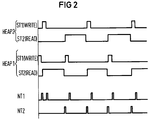
- the buffer memories HEAP1, HEAP2 can be addressed both by the coordination processor CP and by the interface unit IOP: MB. If a countermeasure is to be initiated, the control procedures resort to those located on the external storage device SP Programs / data of the security technology, convert them into data packets and write them into the buffer memory HEAP1. At the same time, a message NT1 is sent to the interface unit IOP: MB via the message path N.
- This message NT1 contains information about the address of the buffer memory HEAP1, the size of the data packets to be transmitted, the length of the message header, etc.
- the message NT1 is recorded and evaluated by control procedures ST2 of the interface unit IOP: MB.
- the control procedures ST2 then begin to read out the data packets stored in the buffer memory HEAP1 and to forward them to the associated peripheral units LTG1 ... LTG63.
- the control procedures ST1 describe the buffer memory HEAP2 with further data packets. If the reading out of the first data packet from the buffer memory HEAP1 has ended, a message NT2 is immediately sent via the message path N to the control procedures ST1, whereupon these describe the buffer memory HEAP1 again with further data packets.
- the data packets read out by the IOP: MB interface unit are forwarded to the respective peripheral units LTG1 ... LTG63.
- the time cycles characteristic of this read / write process are shown on the basis of the control pulses shown in FIG. 2.
- the cyclic writing and reading of the buffer memories HEAP1, HEAP2 alternates until all data packets have been transferred from the coordination processor CP to the interface units IOP: MB.
- the procedure is such that first the data packets of the programs and then the data packets of the actual data are transmitted.
- a total failure of the communication system KS is assumed below.
- programs / data from processes provided for this case are transmitted via the buffer memories HEAP1, HEAP2 to the peripheral units LTG1 ... LTG63.
- the method according to the invention is carried out several times in parallel. In practice, this means a drastic reduction in the total startup time of the communication system.
Landscapes
- Engineering & Computer Science (AREA)
- Computer Networks & Wireless Communication (AREA)
- Signal Processing (AREA)
- Theoretical Computer Science (AREA)
- Quality & Reliability (AREA)
- Physics & Mathematics (AREA)
- General Engineering & Computer Science (AREA)
- General Physics & Mathematics (AREA)
- Hardware Redundancy (AREA)
- Communication Control (AREA)
- Multi Processors (AREA)
Applications Claiming Priority (2)
| Application Number | Priority Date | Filing Date | Title |
|---|---|---|---|
| DE4210138 | 1992-03-27 | ||
| DE4210138 | 1992-03-27 |
Publications (2)
| Publication Number | Publication Date |
|---|---|
| EP0562353A2 true EP0562353A2 (fr) | 1993-09-29 |
| EP0562353A3 EP0562353A3 (fr) | 2004-08-18 |
Family
ID=6455256
Family Applications (1)
| Application Number | Title | Priority Date | Filing Date |
|---|---|---|---|
| EP93103759A Withdrawn EP0562353A3 (fr) | 1992-03-27 | 1993-03-09 | Méthode pour transférer des programmes et données de haute priorité dans un système de communications |
Country Status (2)
| Country | Link |
|---|---|
| US (1) | US5581791A (fr) |
| EP (1) | EP0562353A3 (fr) |
Families Citing this family (7)
| Publication number | Priority date | Publication date | Assignee | Title |
|---|---|---|---|---|
| KR0183748B1 (ko) * | 1995-10-30 | 1999-05-15 | 김광호 | 씨디-롬 구동 시스템의 고속 메모리 제어회로 및 그 방법 |
| US5768256A (en) * | 1995-12-29 | 1998-06-16 | Mci Corporation | Communications system and method providing optimal restoration of failed-paths |
| US5933590A (en) * | 1996-04-18 | 1999-08-03 | Mci Communications Corporation | Restoration of multiple span cuts with priority hand-off using SHN |
| US5781535A (en) * | 1996-06-14 | 1998-07-14 | Mci Communications Corp. | Implementation protocol for SHN-based algorithm restoration platform |
| US5748611A (en) * | 1996-06-27 | 1998-05-05 | Mci Corporation | System and method for restoring a telecommunications network using conservative bandwidth reservation and selective message rebroadcast |
| US5819108A (en) * | 1996-10-17 | 1998-10-06 | Acer Peripherals, Inc. | Programming of software into programmable memory within a peripheral device |
| US12034570B2 (en) | 2022-03-14 | 2024-07-09 | T-Mobile Usa, Inc. | Multi-element routing system for mobile communications |
Family Cites Families (13)
| Publication number | Priority date | Publication date | Assignee | Title |
|---|---|---|---|---|
| US4181934A (en) * | 1976-12-27 | 1980-01-01 | International Business Machines Corporation | Microprocessor architecture with integrated interrupts and cycle steals prioritized channel |
| US4229790A (en) * | 1978-10-16 | 1980-10-21 | Denelcor, Inc. | Concurrent task and instruction processor and method |
| BE876025A (nl) * | 1979-05-04 | 1979-11-05 | Bell Telephone Mfg | Signaleringsstelsel |
| US4517561A (en) * | 1982-07-28 | 1985-05-14 | Motorola, Inc. | Selective call, paging and priority signalling system |
| US4922416A (en) * | 1984-12-14 | 1990-05-01 | Alcatel Usa, Corp. | Interface device end message storing with register and interrupt service registers for directing segmented message transfer between intelligent switch and microcomputer |
| US4833599A (en) * | 1987-04-20 | 1989-05-23 | Multiflow Computer, Inc. | Hierarchical priority branch handling for parallel execution in a parallel processor |
| US5163132A (en) * | 1987-09-24 | 1992-11-10 | Ncr Corporation | Integrated controller using alternately filled and emptied buffers for controlling bi-directional data transfer between a processor and a data storage device |
| US5193189A (en) * | 1987-10-07 | 1993-03-09 | Allen-Bradley Company, Inc. | Programmable controller with multiple priority level task processing |
| US5038282A (en) * | 1988-05-11 | 1991-08-06 | Massachusetts Institute Of Technology | Synchronous processor with simultaneous instruction processing and data transfer |
| US5138615A (en) * | 1989-06-22 | 1992-08-11 | Digital Equipment Corporation | Reconfiguration system and method for high-speed mesh connected local area network |
| DE59010273D1 (de) * | 1989-09-26 | 1996-05-15 | Siemens Ag | Schaltungsanordnung für eine zentralgesteuerte Fernmeldevermittlungsanlage, insbesondere PCM-Fernsprechvermittlungsanlage, mit zentralem Koordinationsprozessor und dezentralen Anschlussgruppen mit Teilsteuerwerken |
| US5313590A (en) * | 1990-01-05 | 1994-05-17 | Maspar Computer Corporation | System having fixedly priorized and grouped by positions I/O lines for interconnecting router elements in plurality of stages within parrallel computer |
| US5452452A (en) * | 1990-06-11 | 1995-09-19 | Cray Research, Inc. | System having integrated dispatcher for self scheduling processors to execute multiple types of processes |
-
1993
- 1993-03-09 EP EP93103759A patent/EP0562353A3/fr not_active Withdrawn
- 1993-03-23 US US08/035,976 patent/US5581791A/en not_active Expired - Fee Related
Also Published As
| Publication number | Publication date |
|---|---|
| EP0562353A3 (fr) | 2004-08-18 |
| US5581791A (en) | 1996-12-03 |
Similar Documents
| Publication | Publication Date | Title |
|---|---|---|
| DE3689052T2 (de) | System und Verfahren zur Busübertragungssteuerung für eng gekoppelte Nachrichten zwischen verteilten programmierbaren Steuergeräten. | |
| DE2908316C2 (de) | Modular aufgebaute Multiprozessor-Datenverarbeitungsanlage | |
| DE3041600C2 (de) | Verfahren und Schaltungsanordnung zum Übertragen von Datensignalen zwischen an Datenvermittlungseinrichtungen einer Datenvermittlungsanlage angeschlossenen Datensignalsendern und Datensignalempfängern | |
| EP0141247B1 (fr) | Multiprocesseur de commande, en particulier unité de commande contrôle à processeurs multiples d'un système de commutation téléphonique | |
| EP0466948B1 (fr) | Système de communication avec un système multiprocesseur servant comme contrÔle central | |
| DE3016452A1 (de) | Steuereinrichtung, insbesondere fuer fernsprechvermittlungsanlagen | |
| EP0509114B1 (fr) | Méthode pour la transmission de données à plusieurs stations | |
| EP0141246B1 (fr) | Méthode pour l'exploitation d'un multiprocesseur de commande, en particulier pour l'unité de commande centrale d'un système de commutation téléphonique | |
| EP0680238A2 (fr) | Dispositif à commande programmée, en particulier dispositif de réseau RNIS à large bande, avec au moins un processus de commutation actif dans celui-ci | |
| EP0135931B1 (fr) | Unité de commande centralisée d'un système de commutation en particulier un système de commutation téléphonique | |
| DE3338341A1 (de) | Mehrfachbusanordnung fuer die verbindung von prozessoren und speichern in einem mehrprozessorsystem | |
| EP0690635A2 (fr) | Procédé de chargement de programmes dans des systèmes de communication avec des équipements décentralisés et non-redundants | |
| CH656276A5 (de) | Verfahren und schaltungsanordnung zum uebertragen von datensignalen zwischen datenvermittlungseinrichtungen einer datenvermittlungsanlage. | |
| DE2034423C3 (de) | Verfahren zur Fehlersuche in einem programmgesteuerten Vermittlungssystem | |
| EP0631449A2 (fr) | Procédé pour la mise en service de dispositifs redondants et décentralisés dans des systèmes de communication | |
| EP0160300B1 (fr) | Procédé et circuit pour établir des liaisons et pour transmettre des signaux de communication entre des postes d'abonné respectivement des groupes de lignes dans un central de télécommunication, en particulier un central de données, pourvu d'un montage en boucle | |
| EP0763952B1 (fr) | Procédé pour le stockage de données relatives aux abonnés dans des systèmes de communication | |
| CH656274A5 (de) | Schaltungsanordnung zum uebertragen von datensignalen zwischen jeweils zwei datenendgeraeten einer datenuebertragungsanlage. | |
| EP0365905B1 (fr) | Procédé pour contrôler centralement des centraux de télécommunication | |
| DE102022202427A1 (de) | Betriebsverfahren und Anlagensteuerung | |
| EP0952523B1 (fr) | Unité fonctionnelle pour une commande programmable par mémoire avec une fonction de redondance | |
| EP0496927A1 (fr) | Procédé pour le redémarrage d'un ordinateur à multiprocesseurs d'un système de commutation de télécommunication après une panne | |
| DE2909151C2 (de) | Festkörper-Großspeicher | |
| EP0528060B1 (fr) | Procédé d'exécution d'operations d'entrée/sortie dans des systèmes de traitement de données | |
| EP1334432A1 (fr) | Systeme de communication pour echanger des donnees au moyen d'un processeur supplementaire |
Legal Events
| Date | Code | Title | Description |
|---|---|---|---|
| PUAI | Public reference made under article 153(3) epc to a published international application that has entered the european phase |
Free format text: ORIGINAL CODE: 0009012 |
|
| AK | Designated contracting states |
Kind code of ref document: A2 Designated state(s): AT BE CH DE FR GB IT LI NL SE |
|
| PUAL | Search report despatched |
Free format text: ORIGINAL CODE: 0009013 |
|
| AK | Designated contracting states |
Kind code of ref document: A3 Designated state(s): AT BE CH DE FR GB IT LI NL SE |
|
| RIC1 | Information provided on ipc code assigned before grant |
Ipc: 7H 04Q 3/545 B Ipc: 7G 06F 9/46 B Ipc: 7G 06F 13/12 A |
|
| 18D | Application deemed to be withdrawn |
Effective date: 20041001 |