EP0565219A2 - Kompression und Dekompression von Bildern - Google Patents
Kompression und Dekompression von Bildern Download PDFInfo
- Publication number
- EP0565219A2 EP0565219A2 EP93300034A EP93300034A EP0565219A2 EP 0565219 A2 EP0565219 A2 EP 0565219A2 EP 93300034 A EP93300034 A EP 93300034A EP 93300034 A EP93300034 A EP 93300034A EP 0565219 A2 EP0565219 A2 EP 0565219A2
- Authority
- EP
- European Patent Office
- Prior art keywords
- activity
- information
- signal
- variable
- bits
- Prior art date
- Legal status (The legal status is an assumption and is not a legal conclusion. Google has not performed a legal analysis and makes no representation as to the accuracy of the status listed.)
- Granted
Links
Images

Classifications
-
- H—ELECTRICITY
- H04—ELECTRIC COMMUNICATION TECHNIQUE
- H04N—PICTORIAL COMMUNICATION, e.g. TELEVISION
- H04N19/00—Methods or arrangements for coding, decoding, compressing or decompressing digital video signals
- H04N19/10—Methods or arrangements for coding, decoding, compressing or decompressing digital video signals using adaptive coding
- H04N19/169—Methods or arrangements for coding, decoding, compressing or decompressing digital video signals using adaptive coding characterised by the coding unit, i.e. the structural portion or semantic portion of the video signal being the object or the subject of the adaptive coding
- H04N19/179—Methods or arrangements for coding, decoding, compressing or decompressing digital video signals using adaptive coding characterised by the coding unit, i.e. the structural portion or semantic portion of the video signal being the object or the subject of the adaptive coding the unit being a scene or a shot
-
- H—ELECTRICITY
- H04—ELECTRIC COMMUNICATION TECHNIQUE
- H04N—PICTORIAL COMMUNICATION, e.g. TELEVISION
- H04N19/00—Methods or arrangements for coding, decoding, compressing or decompressing digital video signals
- H04N19/85—Methods or arrangements for coding, decoding, compressing or decompressing digital video signals using pre-processing or post-processing specially adapted for video compression
- H04N19/89—Methods or arrangements for coding, decoding, compressing or decompressing digital video signals using pre-processing or post-processing specially adapted for video compression involving methods or arrangements for detection of transmission errors at the decoder
-
- H—ELECTRICITY
- H04—ELECTRIC COMMUNICATION TECHNIQUE
- H04N—PICTORIAL COMMUNICATION, e.g. TELEVISION
- H04N19/00—Methods or arrangements for coding, decoding, compressing or decompressing digital video signals
- H04N19/10—Methods or arrangements for coding, decoding, compressing or decompressing digital video signals using adaptive coding
- H04N19/102—Methods or arrangements for coding, decoding, compressing or decompressing digital video signals using adaptive coding characterised by the element, parameter or selection affected or controlled by the adaptive coding
- H04N19/103—Selection of coding mode or of prediction mode
- H04N19/105—Selection of the reference unit for prediction within a chosen coding or prediction mode, e.g. adaptive choice of position and number of pixels used for prediction
-
- H—ELECTRICITY
- H04—ELECTRIC COMMUNICATION TECHNIQUE
- H04N—PICTORIAL COMMUNICATION, e.g. TELEVISION
- H04N19/00—Methods or arrangements for coding, decoding, compressing or decompressing digital video signals
- H04N19/10—Methods or arrangements for coding, decoding, compressing or decompressing digital video signals using adaptive coding
- H04N19/102—Methods or arrangements for coding, decoding, compressing or decompressing digital video signals using adaptive coding characterised by the element, parameter or selection affected or controlled by the adaptive coding
- H04N19/124—Quantisation
- H04N19/126—Details of normalisation or weighting functions, e.g. normalisation matrices or variable uniform quantisers
-
- H—ELECTRICITY
- H04—ELECTRIC COMMUNICATION TECHNIQUE
- H04N—PICTORIAL COMMUNICATION, e.g. TELEVISION
- H04N19/00—Methods or arrangements for coding, decoding, compressing or decompressing digital video signals
- H04N19/10—Methods or arrangements for coding, decoding, compressing or decompressing digital video signals using adaptive coding
- H04N19/134—Methods or arrangements for coding, decoding, compressing or decompressing digital video signals using adaptive coding characterised by the element, parameter or criterion affecting or controlling the adaptive coding
- H04N19/136—Incoming video signal characteristics or properties
- H04N19/14—Coding unit complexity, e.g. amount of activity or edge presence estimation
-
- H—ELECTRICITY
- H04—ELECTRIC COMMUNICATION TECHNIQUE
- H04N—PICTORIAL COMMUNICATION, e.g. TELEVISION
- H04N19/00—Methods or arrangements for coding, decoding, compressing or decompressing digital video signals
- H04N19/10—Methods or arrangements for coding, decoding, compressing or decompressing digital video signals using adaptive coding
- H04N19/134—Methods or arrangements for coding, decoding, compressing or decompressing digital video signals using adaptive coding characterised by the element, parameter or criterion affecting or controlling the adaptive coding
- H04N19/146—Data rate or code amount at the encoder output
- H04N19/147—Data rate or code amount at the encoder output according to rate distortion criteria
-
- H—ELECTRICITY
- H04—ELECTRIC COMMUNICATION TECHNIQUE
- H04N—PICTORIAL COMMUNICATION, e.g. TELEVISION
- H04N19/00—Methods or arrangements for coding, decoding, compressing or decompressing digital video signals
- H04N19/10—Methods or arrangements for coding, decoding, compressing or decompressing digital video signals using adaptive coding
- H04N19/169—Methods or arrangements for coding, decoding, compressing or decompressing digital video signals using adaptive coding characterised by the coding unit, i.e. the structural portion or semantic portion of the video signal being the object or the subject of the adaptive coding
- H04N19/17—Methods or arrangements for coding, decoding, compressing or decompressing digital video signals using adaptive coding characterised by the coding unit, i.e. the structural portion or semantic portion of the video signal being the object or the subject of the adaptive coding the unit being an image region, e.g. an object
- H04N19/172—Methods or arrangements for coding, decoding, compressing or decompressing digital video signals using adaptive coding characterised by the coding unit, i.e. the structural portion or semantic portion of the video signal being the object or the subject of the adaptive coding the unit being an image region, e.g. an object the region being a picture, frame or field
-
- H—ELECTRICITY
- H04—ELECTRIC COMMUNICATION TECHNIQUE
- H04N—PICTORIAL COMMUNICATION, e.g. TELEVISION
- H04N19/00—Methods or arrangements for coding, decoding, compressing or decompressing digital video signals
- H04N19/10—Methods or arrangements for coding, decoding, compressing or decompressing digital video signals using adaptive coding
- H04N19/169—Methods or arrangements for coding, decoding, compressing or decompressing digital video signals using adaptive coding characterised by the coding unit, i.e. the structural portion or semantic portion of the video signal being the object or the subject of the adaptive coding
- H04N19/17—Methods or arrangements for coding, decoding, compressing or decompressing digital video signals using adaptive coding characterised by the coding unit, i.e. the structural portion or semantic portion of the video signal being the object or the subject of the adaptive coding the unit being an image region, e.g. an object
- H04N19/176—Methods or arrangements for coding, decoding, compressing or decompressing digital video signals using adaptive coding characterised by the coding unit, i.e. the structural portion or semantic portion of the video signal being the object or the subject of the adaptive coding the unit being an image region, e.g. an object the region being a block, e.g. a macroblock
-
- H—ELECTRICITY
- H04—ELECTRIC COMMUNICATION TECHNIQUE
- H04N—PICTORIAL COMMUNICATION, e.g. TELEVISION
- H04N19/00—Methods or arrangements for coding, decoding, compressing or decompressing digital video signals
- H04N19/10—Methods or arrangements for coding, decoding, compressing or decompressing digital video signals using adaptive coding
- H04N19/169—Methods or arrangements for coding, decoding, compressing or decompressing digital video signals using adaptive coding characterised by the coding unit, i.e. the structural portion or semantic portion of the video signal being the object or the subject of the adaptive coding
- H04N19/18—Methods or arrangements for coding, decoding, compressing or decompressing digital video signals using adaptive coding characterised by the coding unit, i.e. the structural portion or semantic portion of the video signal being the object or the subject of the adaptive coding the unit being a set of transform coefficients
-
- H—ELECTRICITY
- H04—ELECTRIC COMMUNICATION TECHNIQUE
- H04N—PICTORIAL COMMUNICATION, e.g. TELEVISION
- H04N19/00—Methods or arrangements for coding, decoding, compressing or decompressing digital video signals
- H04N19/30—Methods or arrangements for coding, decoding, compressing or decompressing digital video signals using hierarchical techniques, e.g. scalability
- H04N19/37—Methods or arrangements for coding, decoding, compressing or decompressing digital video signals using hierarchical techniques, e.g. scalability with arrangements for assigning different transmission priorities to video input data or to video coded data
-
- H—ELECTRICITY
- H04—ELECTRIC COMMUNICATION TECHNIQUE
- H04N—PICTORIAL COMMUNICATION, e.g. TELEVISION
- H04N19/00—Methods or arrangements for coding, decoding, compressing or decompressing digital video signals
- H04N19/60—Methods or arrangements for coding, decoding, compressing or decompressing digital video signals using transform coding
-
- H—ELECTRICITY
- H04—ELECTRIC COMMUNICATION TECHNIQUE
- H04N—PICTORIAL COMMUNICATION, e.g. TELEVISION
- H04N19/00—Methods or arrangements for coding, decoding, compressing or decompressing digital video signals
- H04N19/60—Methods or arrangements for coding, decoding, compressing or decompressing digital video signals using transform coding
- H04N19/61—Methods or arrangements for coding, decoding, compressing or decompressing digital video signals using transform coding in combination with predictive coding
-
- H—ELECTRICITY
- H04—ELECTRIC COMMUNICATION TECHNIQUE
- H04N—PICTORIAL COMMUNICATION, e.g. TELEVISION
- H04N19/00—Methods or arrangements for coding, decoding, compressing or decompressing digital video signals
- H04N19/10—Methods or arrangements for coding, decoding, compressing or decompressing digital video signals using adaptive coding
- H04N19/102—Methods or arrangements for coding, decoding, compressing or decompressing digital video signals using adaptive coding characterised by the element, parameter or selection affected or controlled by the adaptive coding
- H04N19/13—Adaptive entropy coding, e.g. adaptive variable length coding [AVLC] or context adaptive binary arithmetic coding [CABAC]
-
- H—ELECTRICITY
- H04—ELECTRIC COMMUNICATION TECHNIQUE
- H04N—PICTORIAL COMMUNICATION, e.g. TELEVISION
- H04N19/00—Methods or arrangements for coding, decoding, compressing or decompressing digital video signals
- H04N19/10—Methods or arrangements for coding, decoding, compressing or decompressing digital video signals using adaptive coding
- H04N19/134—Methods or arrangements for coding, decoding, compressing or decompressing digital video signals using adaptive coding characterised by the element, parameter or criterion affecting or controlling the adaptive coding
- H04N19/146—Data rate or code amount at the encoder output
-
- H—ELECTRICITY
- H04—ELECTRIC COMMUNICATION TECHNIQUE
- H04N—PICTORIAL COMMUNICATION, e.g. TELEVISION
- H04N19/00—Methods or arrangements for coding, decoding, compressing or decompressing digital video signals
- H04N19/10—Methods or arrangements for coding, decoding, compressing or decompressing digital video signals using adaptive coding
- H04N19/134—Methods or arrangements for coding, decoding, compressing or decompressing digital video signals using adaptive coding characterised by the element, parameter or criterion affecting or controlling the adaptive coding
- H04N19/146—Data rate or code amount at the encoder output
- H04N19/149—Data rate or code amount at the encoder output by estimating the code amount by means of a model, e.g. mathematical model or statistical model
-
- H—ELECTRICITY
- H04—ELECTRIC COMMUNICATION TECHNIQUE
- H04N—PICTORIAL COMMUNICATION, e.g. TELEVISION
- H04N19/00—Methods or arrangements for coding, decoding, compressing or decompressing digital video signals
- H04N19/10—Methods or arrangements for coding, decoding, compressing or decompressing digital video signals using adaptive coding
- H04N19/134—Methods or arrangements for coding, decoding, compressing or decompressing digital video signals using adaptive coding characterised by the element, parameter or criterion affecting or controlling the adaptive coding
- H04N19/146—Data rate or code amount at the encoder output
- H04N19/15—Data rate or code amount at the encoder output by monitoring actual compressed data size at the memory before deciding storage at the transmission buffer
-
- H—ELECTRICITY
- H04—ELECTRIC COMMUNICATION TECHNIQUE
- H04N—PICTORIAL COMMUNICATION, e.g. TELEVISION
- H04N19/00—Methods or arrangements for coding, decoding, compressing or decompressing digital video signals
- H04N19/90—Methods or arrangements for coding, decoding, compressing or decompressing digital video signals using coding techniques not provided for in groups H04N19/10-H04N19/85, e.g. fractals
- H04N19/91—Entropy coding, e.g. variable length coding [VLC] or arithmetic coding
Definitions
- the present invention relates to a method and apparatus for compressing and decompressing a digital image signal using variable-length coding.
- VLC variable-length coding
- FLC fixed-length coding
- the fixed-length coding method for coding a coefficient according to an adaptive quantizing by assigning a code having a constant length since there is no influence between the coding units, the possibility of error is low during reconstructing, but since the recorded information is limited, the image quality when reconstructing is lowered. That is, if the length of the fixed length code is long, the image quality is good during general reconstructing, but the image quality is bad during trick playing. On the other hand, if the length of the fixed length code is short, the image quality is bad during general reproducing but the image quality is good during trick play. However, when the length of the FLC is long, the image quality during general reproducing is lower than that of the VLC method.
- the region of a recording medium where the FLC and the VLC can be recorded is limited, during recording of the information onto the fixed length coding region and the VLC region assigned to the respective blocks, if the number of bits of the VLC information in the previous block is more than that of the corresponding region, the VLC is recorded onto the region where the VLC of the next block would otherwise be recorded, while, if the number of bits is less than that of the corresponding region, the VLC of the next block is recorded next to the region where the previous VLC was recorded. Accordingly, the image quality is improved compared to the case which adapts the two coding methods separately.
- Preferred embodiments of the present invention aim to provide a digital image compression and decompression method and apparatus for performing VLC upon the principle and remaining information (as defined above) in a predetermined block respectively, and controlling the record format to alternatively record the information on recording media by a constant interval, thereby improving the coding efficiency.
- an image compression coding method for compressing a supplied digital image signal, performing a discrete cosine transform of the signal, linearly quantizing the signal, and performing variable length coding, in order to improve recording efficiency, comprising the steps of: detecting regions of principle information and remaining information of the digital image signal by counting a number of bits generated by performing the variable length coding; and controlling a record format to alternately record onto a recording medium in equal intervals the principle information and the remaining information among the information generated by performing variable-length coding in units of a block of a predetermined size according to the regions detected in said region-detecting step.
- said record format controlling step is carried out by processing the bits output by performing the variable-length coding according to a counted number of bits via separate transmission paths with respect to the principle information and the remaining information.
- said record format controller outputs a signal for controlling the format recorded by counting a number of coded bits.
- said first transmission path and said second transmission path respectively comprise a buffer.
- An image compression apparatus as above may further comprise a motion-estimator for estimating motion between a current supplied image and a previous image in a frame unit formed by restoring a quantized coefficient in the quantizing unit, and supplying a difference of the previous image and the current image into the discrete cosine transform unit, to be coded.
- an image compression coding method for compressing a supplied digital image signal, performing a discrete cosine transform of the signal, linearly quantizing the signal to provide a quantized coefficient, and performing variable length coding, in order to improve recording efficiency, said method comprising the steps of: first extracting an activity by dividing the digital image signal into subframes and then detecting activities of each of the subframes; second extracting an activity by accumulatively operating a result extracted in said first activity extracting step and then extracting the activity in units of a frame; first bit allocating to allocate a number of bits in units of the subframe by the activities extracted in said first and second activity-extracting steps; third extracting an activity to extract activity of a predetermined block by the quantized coefficient; and second bit allocating to allocate a number of bits corresponding to the block based on the activity of the block extracted in said third activity-extracting step and on the number of bits assigned in said first bit-allocating step.
- An image compression method as above may further comprise the step of controlling a quantization step size of a current frame based on a number of coded bits of the variable-length coding corresponding to a previous frame after performing said second activity-extracting step.
- the invention extends to an image compression method comprising the steps of the different preceding aspects of the invention, in combination.
- an image compression apparatus including a discrete cosine transform unit for performing a discrete cosine transform of a supplied digital image signal to provide a transform coefficient, a quantizing unit for linearly quantizing the transform coefficient generated from the discrete cosine transform unit, and a variable-length coding processor for performing a variable-length coding of the quantized coefficient generated from the quantizing unit, said apparatus further comprising: a first activity-extractor for dividing the digital image signal into subframe units and then detecting activity of each subframe unit; a second activity-extractor for accumulatively operating a result extracted in said first activity-extractor and then extracting the activity in units of a frame; a first bit allocator for allocating a number of bits in units of the subframe by the activities extracted in said first and second activity extractors and; a third activity-extractor for extracting activity of a predetermined block by the quantized coefficient; and a second bit allocator for allocating a number of bits corresponding
- An image compression apparatus as above may further comprise a quantization step size controller for generating a signal used for controlling a quantization step size corresponding to a present frame based on a number of coded bits of the variable-length coding corresponding to a previous frame in said second activity-extractor and outputting the signal to said quantizing unit.
- a quantization step size controller for generating a signal used for controlling a quantization step size corresponding to a present frame based on a number of coded bits of the variable-length coding corresponding to a previous frame in said second activity-extractor and outputting the signal to said quantizing unit.
- the activity of said third activity-extractor is extracted by counting non-zero AC coefficients among the quantized coefficients output from said quantizing unit.
- the invention extends to an image compression apparatus comprising the features steps of the different preceding aspects of the invention, in combination.
- an image decompressing apparatus for performing variable-length coding of a digital image signal according to, respectively, principle information and remaining information, and decoding the information recorded on separate regions
- said apparatus comprising: a merging unit for merging the reproduced signal to restore the information allocated and recorded on the separate regions, in units of predetermined blocks according to a number of coded bits of the predetermined block units; a variable-length decoder for variable-length decoding according to a merging order in said merging unit; and a restoring unit for restoring the bits decoded in said variable-length-decoder by inverse-quantizing the restored bits and by performing an inverse discrete cosine transform.
- FIG. 1 Shown in Figure 1 is a color signal separator and block divider 10 for separating a supplied composite signal into luminance and chrominance component signals, and dividing a block by a predetermined size, a DCT processor 30 for performing DCT upon the signal output from the color signal separator and block divider 10 by a coding unit, a quantizer 40 for quantizing a DCT coefficient generated from the DCT processor 30, a motion-estimating unit 60 for reducing the redundancy between a neighboring frame by the DCT coefficient quantized in quantizer 40 and the signal output from color signal separator and block divider 10, an adder 20 for obtaining the difference of the output signal of the motion-estimating unit 60 and the currently input signal output from color signal separator and block divider 10, a bit-allocating unit 70 for allocating coding bits on the bases of the outputs from the color signal separator and block divider 10 and the quantizer 40, a quantizer interval controller 80 for controlling the quantization interval of quantizer 40 in response to the extracted amount of activity of a frame unit output
- the motion-estimating unit 60 includes an inverse quantizer 61 for inversely quantizing the quantized coefficients output from quantizer 40, an inverse discrete cosine transform (IDCT) processor 62 for inversely performing DCT upon the inversely quantized coefficients generated from the inverse quantizer 61, and a motion estimator 63 for outputting to the adder 20 a signal indicative of a motion estimate between a previous frame output from a frame memory (not shown) that stores the restored signal output from the IDCT processor 62 and a supplied present frame generated by the color signal separator and block divider 10, and for outputting an estimated motion vector into the VLC processor 50.
- IDCT inverse discrete cosine transform
- the bit-allocating unit 70 includes a first activity extractor 71 for dividing one frame signal output from the color signal separator and block divider 10 into subframes (slice units) on a basis of 16 lines, and then extracting the activity of each subframe by employing an edge-detection mask, a second activity-extractor 72 for adding the information extracted from first activity-extractor 71 in a frame unit, extracting the activity of the frame, and then outputting the quantization step size information by means of a control signal indicative of the number of previous coded bits from the record format controller 90, a first bit-allocator 73 for outputting the number of the allocated bits corresponding to the slice unit by means of the output signals from the first and second activity-extractors 71 and 72, a third activity-extractor 74 for extracting the activity of the block unit within the predetermined coding unit from the signal output from the quantizer 40, and a second bit-allocator 75 for outputting into the VLC processor 50 the number of bits allocated to the block by means of the signals
- the recording information classifying unit 100 includes an IDC buffer 120 for buffering the principle information among the coded information output from VLC processor 50, a DDC buffer 130 for buffering the remaining information (i.e. the information other than the aforementioned principle information), a first selector 110 for selectively outputting the signal output from the VLC processor 50 and controlled by the output signal of the record format controller 90 into the IDC buffer 120 and the DDC buffer 130, and a second selector 140 controlled by the record format controller 90 to alternately select the signals output from the IDC buffer 120 and the DDC buffer 130 to alternately record the signals onto a recording medium.
- IDC buffer 120 for buffering the principle information among the coded information output from VLC processor 50
- DDC buffer 130 for buffering the remaining information (i.e. the information other than the aforementioned principle information)
- a first selector 110 for selectively outputting the signal output from the VLC processor 50 and controlled by the output signal of the record format controller 90 into the IDC buffer 120 and the DDC buffer 130
- a second selector 140
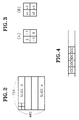
- Figure 2 shows the unit for extracting the activity in the first activity-extractor 71. If the size of the block for coding is 8x8, the slice unit (subframe) becomes 16x720. Namely, eight pixels in the vertical direction of the frame become one line, and the next eight pixels become another line, so that the first and second lines become the first slice unit (slice 0). The region included in the next slice unit is for the aforementioned second line and the next or third line.
- the activity is extracted by slicing one frame according to the above method.
- Figures 3A and 3B show an edge-detecting operator used during extracting an activity according to a slice formed in the first activity-extractor 71 of the bit-allocator 70, and a partial image where an operator is applied.
- the operator corresponds to one pixel.
- the color signal separator and block divider 10 separates the input video signal into luminance and chrominance signals according to a commonly known process. That is, after the signal is separated into blocks having a predetermined size, luminance and chrominance signals are output sequentially. Here, the chrominance signal is sub-sampled, as discussed above, during the separation process.
- the signal output from the color signal separator and block divider 10 is a digital signal.
- the adder 20 obtains and outputs the difference of the output signal of the color signal separator and block divider 10 and the motion estimated signal detected from the motion-estimating unit 60 (described later). At this time, since the recording unit is two frames in the present embodiment, if corresponding to a first frame period, the output signal of the color signal separator and block divider 10 is output into the DCT processor 30 (described later) via the adder 20, but if corresponding to the next frame period, the adder 20 detects the difference of the output signal of the motion-estimating unit 60 and the output signal of the color signal separator and block divider 10 and outputs that difference into the DCT processor 30.
- the video signal processed in correspondence with the first frame period is an intraframe
- the video signal processed in correspondence with the next frame period is a predicted frame
- the intraframe is the signal consisting of only the frame information output from color signal separator and block divider 10, when motion estimating unit 60 is not operated.
- the predicted frame is the signal of the difference between the information of the aforementioned next one frame and the motion-estimated signal output from motion estimating unit 60 (i.e., the difference signal between video information corresponding to the aforementioned intraframe and video information supplied to the next frame; which will be explained in detail with respect to the motion estimating unit 60).
- the output signal of the color signal separator and block divider 10 is supplied to the motion estimator 63 of the motion-estimating unit 60 as well as to the adder 20.
- the signal input to the DCT processor 30 is obtained by finding out the image of the past frame which is most similar to that of the current frame and operating on the difference between the two, the information amount of the signal is very small.
- This signal is also coded via the quantizer 40 and the VLC processor 50.
- the activity is extracted using an edge-detection operation which adopts the edge-detection mask as shown in Figure 3A. That is, the supplied digital image signal is partitioned in a slice unit as shown in Figure 2, and the pixel within the block sliced by the slice-unit is partitioned again as shown in Figure 3B in order to apply the mask shown in Figure 3A, and then the gradient can be calculated as below.
- Gxy
- the values x1, x2, x3, and x4 shown in Figure 3A are the gray level at an arbitrary position (x,y).
- the first activity-extractor 71 carries out an edge-detection operation upon the sliced pixel in the slice unit per frame, followed by accumulative summing for obtaining the slice activity as in the following equation.
- Sx and Sy are the size of the slice.
- the second activity-extractor 72 extracts the activity in the frame unit and compares it with the activity extracted in the previous frame, thereby determining the quantization interval which most closely matches the number of output bits.
- the second activity extractor 72 allocates a predicted number of output bits for fixing bits by a forward control method.
- the quantization step size is determined with respect to only the intraframe, and the same quantization step size obtained in the intraframe is used for the predicted frame.
- the quantization step size is controlled to be as near as possible to the objective output bit rate.
- the value of quantization step size is incremented when the frame activity is high since the picture is then complicated and the output bit rate is high.
- the value of quantization step size is decremented when the frame activity is low, since the picture is simple and thus the output bit rate is low.
- the first bit-allocator 73 outputs the number of allocated bits for each slice according to the slice activity extracted in the first activity-extractor 71 with respect to the frame activity extracted in second activity-extractor 72, where the output bits are fixed at intervals of two frames.
- the intraframe is an original image and the predicted frame is the frame by motion compensation.
- the encoding of the intraframe is carried out by the quantization step size obtained by approximation without fixing the bits, while the permitted amount of bits is fixed for the predicted frame while carrying out VLC. Therefore, while coding the predicted frame, the permitted number of bits is allocated in accordance with the result of activity extraction. Then, upon exceeding the permitted number of bits during encoding, the bit-coding stops, thus fixing the number of bits.
- the record format controller 90 controls the record format on the recording medium in accordance with the output signal of the variable-length coder 50. Specifically, it counts the number of bits from the variable-length coder 50 and supplies the amount of bits detected by the counting to the second activity-extractor 72 as a reference value for determining the scaling factor. Also, a control signal is output to the recorded information classifying unit 100 to classify the principal information and the remaining information.
- Figure 4 illustrates the record format of the IDC and DDC to the coded unit.
- the coded amount during intraframe coding is greater than that during a predicted frame. Therefore, the DC coefficient and AC coefficients of the low frequency component within the intraframe are recorded on the IDC region. An ID number and remaining information such as quantization step size are also recorded to be played back, even though they are read out independently of the recorded order during the trick playing.
- the AC coefficients of those frequencies remaining after recording in the IDC region are recorded on the DDC region.
- the predicted frame which can be dependently restored only after the information of the intraframe is restored, is recorded in the DDC region.
- the coded amount is small since the coding is performed by considering the time-base correlation. As a result, only the IDC is decoded and played back on the screen while performing the trick playing, and both the IDC and DDC are decoded and a detailed image is played back while performing normal playing.
- the recording information classifying unit 100 is controlled by the selecting control signal from the record format controller 90 via the first selector 110, thereby supplying, in the case of principal information, the coded information to the IDC buffer 120 of the next stage, and otherwise outputting to the DDC buffer 130 for the remaining information, as described above.
- the IDC buffer 120 and the DDC buffer 130 are respectively operated as general buffers, so that the supplied signal is temporarily stored and then output to the second selector 140 of the next stage.
- the second selector 140 selects signals from the buffers 120 and 130 of the previous stage, to allow the output signal to be recorded according to the above-described record formation.
- first selector 110 may be comprised of a demultiplexer and second selector 140 may be comprised of a multiplexer.
- the playback signals are merged to form the divided and recorded information as a block unit.
- an intraframe is variable-length-decoded, and then restored by performing inverse quantization and IDCT.
- the motion vector of the predicted frame is decoded to compensate for changes from the previous frame, and the motion vectors are added to completely restore the coordinates of its position.
- each information signal (IDC and DDC) is recorded together with ID information, so that even if the order of recording on the recording medium in units of two frames is carried out randomly, playback can be carried out normally.
- the principal information and the remaining information are recorded in each predetermined region by processing VLC, so that the coding is performed by employing one encoding method. Also, a greater amount of information can be played back not only during normal reproduction but also during trick playback. Moreover, the circuitry can be simplified by using one encoding method, which lowers the price of the end product. Furthermore, the output bit amount is controlled by extracting the activity using two steps for slice and block activity before coding, thereby preventing the partial impairment of picture quality due to the coding.
Landscapes
- Engineering & Computer Science (AREA)
- Multimedia (AREA)
- Signal Processing (AREA)
- Compression Or Coding Systems Of Tv Signals (AREA)
- Signal Processing For Digital Recording And Reproducing (AREA)
- Compression, Expansion, Code Conversion, And Decoders (AREA)
- Image Processing (AREA)
- Television Signal Processing For Recording (AREA)
Applications Claiming Priority (2)
| Application Number | Priority Date | Filing Date | Title |
|---|---|---|---|
| KR578492 | 1992-04-07 | ||
| KR1019920005784A KR0160610B1 (ko) | 1992-04-07 | 1992-04-07 | 가변장부호화에 의한 영상압축방법과 신장방법 및 그 장치 |
Publications (3)
| Publication Number | Publication Date |
|---|---|
| EP0565219A2 true EP0565219A2 (de) | 1993-10-13 |
| EP0565219A3 EP0565219A3 (en) | 1994-08-24 |
| EP0565219B1 EP0565219B1 (de) | 1999-05-19 |
Family
ID=19331494
Family Applications (1)
| Application Number | Title | Priority Date | Filing Date |
|---|---|---|---|
| EP19930300034 Expired - Lifetime EP0565219B1 (de) | 1992-04-07 | 1993-01-05 | Kompression und Dekompression von Bildern |
Country Status (5)
| Country | Link |
|---|---|
| US (1) | US5301032A (de) |
| EP (1) | EP0565219B1 (de) |
| JP (1) | JP2931732B2 (de) |
| KR (1) | KR0160610B1 (de) |
| DE (1) | DE69324958T2 (de) |
Cited By (4)
| Publication number | Priority date | Publication date | Assignee | Title |
|---|---|---|---|---|
| WO1995011571A1 (fr) * | 1993-10-22 | 1995-04-27 | Thomson-Csf | Procede et dispositif de codage inter-trame avec regulation de debit pour l'enregistrement d'images sur magnetoscope |
| DE19524808A1 (de) * | 1995-07-07 | 1997-01-09 | Thomson Brandt Gmbh | Verfahren, Encoder und Decoder zur Resynchronisierung auf einen fehlerbehafteten Datenstrom |
| FR2738441A1 (fr) * | 1995-08-28 | 1997-03-07 | Samsung Electronics Co Ltd | Dispositif et procede de codage de signal d'image |
| WO2010005360A1 (en) | 2008-07-08 | 2010-01-14 | Scalado Ab | Method for compressing images and a format for compressed images |
Families Citing this family (64)
| Publication number | Priority date | Publication date | Assignee | Title |
|---|---|---|---|---|
| GB9405914D0 (en) | 1994-03-24 | 1994-05-11 | Discovision Ass | Video decompression |
| EP0576749B1 (de) | 1992-06-30 | 1999-06-02 | Discovision Associates | Datenpipelinesystem |
| SG45281A1 (en) * | 1992-06-26 | 1998-01-16 | Discovision Ass | Method and arrangement for transformation of signals from a frequency to a time domain |
| US6330665B1 (en) | 1992-06-30 | 2001-12-11 | Discovision Associates | Video parser |
| US6079009A (en) | 1992-06-30 | 2000-06-20 | Discovision Associates | Coding standard token in a system compromising a plurality of pipeline stages |
| US7095783B1 (en) | 1992-06-30 | 2006-08-22 | Discovision Associates | Multistandard video decoder and decompression system for processing encoded bit streams including start codes and methods relating thereto |
| US6067417A (en) | 1992-06-30 | 2000-05-23 | Discovision Associates | Picture start token |
| US6112017A (en) | 1992-06-30 | 2000-08-29 | Discovision Associates | Pipeline processing machine having a plurality of reconfigurable processing stages interconnected by a two-wire interface bus |
| US5784631A (en) | 1992-06-30 | 1998-07-21 | Discovision Associates | Huffman decoder |
| US6435737B1 (en) | 1992-06-30 | 2002-08-20 | Discovision Associates | Data pipeline system and data encoding method |
| US5809270A (en) | 1992-06-30 | 1998-09-15 | Discovision Associates | Inverse quantizer |
| US6047112A (en) | 1992-06-30 | 2000-04-04 | Discovision Associates | Technique for initiating processing of a data stream of encoded video information |
| US5768561A (en) | 1992-06-30 | 1998-06-16 | Discovision Associates | Tokens-based adaptive video processing arrangement |
| US5663763A (en) * | 1992-10-29 | 1997-09-02 | Sony Corp. | Picture signal encoding method and apparatus and picture signal decoding method and apparatus |
| US5726711A (en) * | 1993-01-13 | 1998-03-10 | Hitachi America, Ltd. | Intra-coded video frame data processing methods and apparatus |
| JPH06274612A (ja) * | 1993-03-17 | 1994-09-30 | Matsushita Electric Ind Co Ltd | 画像処理装置 |
| DE69416717T2 (de) * | 1993-05-21 | 1999-10-07 | Nippon Telegraph And Telephone Corp., Tokio/Tokyo | Bewegtbildkoder und -dekoder |
| US5768629A (en) | 1993-06-24 | 1998-06-16 | Discovision Associates | Token-based adaptive video processing arrangement |
| US5861894A (en) | 1993-06-24 | 1999-01-19 | Discovision Associates | Buffer manager |
| US5699544A (en) | 1993-06-24 | 1997-12-16 | Discovision Associates | Method and apparatus for using a fixed width word for addressing variable width data |
| US5805914A (en) | 1993-06-24 | 1998-09-08 | Discovision Associates | Data pipeline system and data encoding method |
| JPH0723389A (ja) * | 1993-06-28 | 1995-01-24 | Toshiba Corp | 画像処理装置 |
| CA2145379C (en) | 1994-03-24 | 1999-06-08 | William P. Robbins | Method and apparatus for addressing memory |
| CA2145365C (en) | 1994-03-24 | 1999-04-27 | Anthony M. Jones | Method for accessing banks of dram |
| CA2145361C (en) | 1994-03-24 | 1999-09-07 | Martin William Sotheran | Buffer manager |
| KR970010533B1 (en) * | 1994-06-30 | 1997-06-26 | Samsung Electronics Co Ltd | Recording and reproducing method of dvcr for trick play |
| US5719961A (en) * | 1994-07-22 | 1998-02-17 | Apple Computer, Inc. | Adaptive technique for encoder and decoder signal transformation |
| JP3046224B2 (ja) * | 1994-07-26 | 2000-05-29 | 三星電子株式会社 | 固定ビット率の符号化方法および装置とこれを利用した高速探索のためのトラッキング方法 |
| GB9417138D0 (en) | 1994-08-23 | 1994-10-12 | Discovision Ass | Data rate conversion |
| US5506686A (en) * | 1994-11-23 | 1996-04-09 | Motorola, Inc. | Method and device for determining bit allocation in a video compression system |
| US5627601A (en) * | 1994-11-30 | 1997-05-06 | National Semiconductor Corporation | Motion estimation with bit rate criterion |
| US5886743A (en) * | 1994-12-28 | 1999-03-23 | Hyundai Electronics Industries Co. Ltd. | Object-by information coding apparatus and method thereof for MPEG-4 picture instrument |
| US5825313A (en) * | 1995-08-01 | 1998-10-20 | Sony Corporation | Information signal encoding apparatus, encoding method thereof, information signal decoding method, and information signal record medium thereof |
| US5786856A (en) * | 1996-03-19 | 1998-07-28 | International Business Machines | Method for adaptive quantization by multiplication of luminance pixel blocks by a modified, frequency ordered hadamard matrix |
| US6192073B1 (en) | 1996-08-19 | 2001-02-20 | Samsung Electronics Co., Ltd. | Methods and apparatus for processing video data |
| JPH10200892A (ja) * | 1997-01-10 | 1998-07-31 | Mitsubishi Electric Corp | 画像符号化装置 |
| US20030012445A1 (en) * | 1997-05-08 | 2003-01-16 | Nekka Matsuura | Image processing system for compressing image data including binary image data and continuous tone image data by a sub-band transform method with a high-compression rate |
| US6816618B1 (en) * | 1998-03-03 | 2004-11-09 | Minolta Co., Ltd. | Adaptive variable length image coding apparatus |
| JP3097665B2 (ja) * | 1998-06-19 | 2000-10-10 | 日本電気株式会社 | 異常検出機能を備えたタイムラプスレコーダ |
| US6801668B2 (en) * | 2000-12-20 | 2004-10-05 | Telefonaktiebolaget Lm Ericsson (Publ) | Method of compressing data by use of self-prefixed universal variable length code |
| WO2002091282A2 (en) * | 2001-05-07 | 2002-11-14 | Summus, Inc. | Color video codec method and system |
| US20040005003A1 (en) * | 2002-07-02 | 2004-01-08 | Koninklijke Philips Electronics N.V. | Quality improvement for FGS BL coding with U/V coarse quantization |
| KR20040022697A (ko) * | 2002-09-09 | 2004-03-16 | 한국전자통신연구원 | 영상 데이터 압축을 위한 움직임 추정 장치 |
| KR100501933B1 (ko) * | 2002-11-21 | 2005-07-18 | 삼성전자주식회사 | 멀티미디어 데이터 암호화 압축방법 및 장치 |
| US7212681B1 (en) * | 2003-01-15 | 2007-05-01 | Cisco Technology, Inc. | Extension of two-dimensional variable length coding for image compression |
| US7194137B2 (en) * | 2003-05-16 | 2007-03-20 | Cisco Technology, Inc. | Variable length coding method and apparatus for video compression |
| US7373004B2 (en) * | 2003-05-23 | 2008-05-13 | Silicon Integrated Systems Corp. | Apparatus for constant quality rate control in video compression and target bit allocator thereof |
| WO2005043915A1 (ja) * | 2003-10-31 | 2005-05-12 | Kddi Media Will Corporation | 映像解析装置及び映像障害検出装置 |
| US7098928B2 (en) * | 2003-12-23 | 2006-08-29 | Kabushiki Kaisha Toshiba | Code processing circuit |
| US7492956B2 (en) * | 2004-08-18 | 2009-02-17 | Cisco Technology, Inc. | Video coding using multi-dimensional amplitude coding and 2-D non-zero/zero cluster position coding |
| US7499596B2 (en) | 2004-08-18 | 2009-03-03 | Cisco Technology, Inc. | Amplitude coding for clustered transform coefficients |
| US7454073B2 (en) * | 2004-06-15 | 2008-11-18 | Cisco Technology, Inc. | Video compression using multiple variable length coding processes for multiple classes of transform coefficient blocks |
| US7454076B2 (en) * | 2004-06-15 | 2008-11-18 | Cisco Technology, Inc. | Hybrid variable length coding method for low bit rate video coding |
| US7471841B2 (en) * | 2004-06-15 | 2008-12-30 | Cisco Technology, Inc. | Adaptive breakpoint for hybrid variable length coding |
| US7499595B2 (en) * | 2004-08-18 | 2009-03-03 | Cisco Technology, Inc. | Joint amplitude and position coding for photographic image and video coding |
| US7471840B2 (en) * | 2004-08-18 | 2008-12-30 | Cisco Technology, Inc. | Two-dimensional variable length coding of runs of zero and non-zero transform coefficients for image compression |
| US7620258B2 (en) * | 2004-08-18 | 2009-11-17 | Cisco Technology, Inc. | Extended amplitude coding for clustered transform coefficients |
| US7680349B2 (en) * | 2004-08-18 | 2010-03-16 | Cisco Technology, Inc. | Variable length coding for clustered transform coefficients in video compression |
| US7242328B1 (en) * | 2006-02-03 | 2007-07-10 | Cisco Technology, Inc. | Variable length coding for sparse coefficients |
| US20080002899A1 (en) * | 2006-06-30 | 2008-01-03 | Curt Paul Breswick | Dynamic Compression Method for Use in Compressing Image Data |
| US8634668B2 (en) | 2011-02-25 | 2014-01-21 | Sony Corporation | Method of compression of digital images using a fixed number of bits per block |
| US10136141B2 (en) * | 2014-06-11 | 2018-11-20 | Qualcomm Incorporated | Determining quantization parameter (QP) values and delta QP values for palette coded blocks in video coding |
| WO2016113585A1 (en) * | 2015-01-16 | 2016-07-21 | Intel Corporation | Encoder slice size control with cost estimation |
| KR102601732B1 (ko) | 2016-05-31 | 2023-11-14 | 삼성디스플레이 주식회사 | 영상 부호화 방법 및 영상 복호화 방법 |
Family Cites Families (9)
| Publication number | Priority date | Publication date | Assignee | Title |
|---|---|---|---|---|
| DE3702490A1 (de) * | 1987-01-28 | 1988-08-11 | Thomson Brandt Gmbh | Verfahren und vorrichtung zur digitalen nachrichtenuebertragung und/oder -aufzeichnung und -wiedergabe |
| JPH031662A (ja) * | 1989-05-30 | 1991-01-08 | Fuji Photo Film Co Ltd | 画像信号圧縮符号化装置 |
| JP3085465B2 (ja) * | 1989-10-31 | 2000-09-11 | オリンパス光学工業株式会社 | 画像データの符号化装置および符号化方法 |
| US5063608A (en) * | 1989-11-03 | 1991-11-05 | Datacube Inc. | Adaptive zonal coder |
| US5107345A (en) * | 1990-02-27 | 1992-04-21 | Qualcomm Incorporated | Adaptive block size image compression method and system |
| US5021891A (en) * | 1990-02-27 | 1991-06-04 | Qualcomm, Inc. | Adaptive block size image compression method and system |
| EP0475251B1 (de) * | 1990-09-10 | 1997-03-26 | Mitsubishi Denki Kabushiki Kaisha | Kodiervorrichtung für digitale Bilddaten |
| EP0482888B1 (de) * | 1990-10-25 | 1997-06-04 | Matsushita Electric Industrial Co., Ltd. | Aufzeichnungs- und Wiedergabegerät für Videosignale |
| JP3147475B2 (ja) * | 1992-03-24 | 2001-03-19 | 株式会社東芝 | 可変長符号の記録再生装置 |
-
1992
- 1992-04-07 KR KR1019920005784A patent/KR0160610B1/ko not_active Expired - Fee Related
- 1992-12-04 US US07/986,061 patent/US5301032A/en not_active Expired - Lifetime
-
1993
- 1993-01-05 EP EP19930300034 patent/EP0565219B1/de not_active Expired - Lifetime
- 1993-01-05 DE DE69324958T patent/DE69324958T2/de not_active Expired - Fee Related
- 1993-02-04 JP JP1734093A patent/JP2931732B2/ja not_active Expired - Fee Related
Cited By (8)
| Publication number | Priority date | Publication date | Assignee | Title |
|---|---|---|---|---|
| WO1995011571A1 (fr) * | 1993-10-22 | 1995-04-27 | Thomson-Csf | Procede et dispositif de codage inter-trame avec regulation de debit pour l'enregistrement d'images sur magnetoscope |
| FR2711879A1 (fr) * | 1993-10-22 | 1995-05-05 | Thomson Csf | Procédé et dispositif de codage inter-trame avec régulation de débit pour l'enregistrement d'images sur magnétoscope. |
| DE19524808A1 (de) * | 1995-07-07 | 1997-01-09 | Thomson Brandt Gmbh | Verfahren, Encoder und Decoder zur Resynchronisierung auf einen fehlerbehafteten Datenstrom |
| US5838265A (en) * | 1995-07-07 | 1998-11-17 | Deutsche Thomson Brandt Gmbh | Method, encoder and decoder for resynchronization to a data stream which contains errors |
| FR2738441A1 (fr) * | 1995-08-28 | 1997-03-07 | Samsung Electronics Co Ltd | Dispositif et procede de codage de signal d'image |
| WO2010005360A1 (en) | 2008-07-08 | 2010-01-14 | Scalado Ab | Method for compressing images and a format for compressed images |
| EP2294826A4 (de) * | 2008-07-08 | 2013-06-12 | Mobile Imaging In Sweden Ab | Verfahren zum komprimieren von bildern und format für komprimierte bilder |
| US8600181B2 (en) | 2008-07-08 | 2013-12-03 | Mobile Imaging In Sweden Ab | Method for compressing images and a format for compressed images |
Also Published As
| Publication number | Publication date |
|---|---|
| JP2931732B2 (ja) | 1999-08-09 |
| DE69324958D1 (de) | 1999-06-24 |
| KR930022882A (ko) | 1993-11-24 |
| JPH05292463A (ja) | 1993-11-05 |
| EP0565219B1 (de) | 1999-05-19 |
| US5301032A (en) | 1994-04-05 |
| DE69324958T2 (de) | 1999-12-09 |
| EP0565219A3 (en) | 1994-08-24 |
| KR0160610B1 (ko) | 1999-01-15 |
Similar Documents
| Publication | Publication Date | Title |
|---|---|---|
| EP0565219B1 (de) | Kompression und Dekompression von Bildern | |
| EP1370087B1 (de) | Codierungsvorrichtung und decodierungsvorrichtung für bewegliche bilder | |
| EP1863295B1 (de) | Kodierung und Dekodierung kodierter Blockmuster mit räumlicher Prädiktion | |
| US5251028A (en) | Apparatus for reducing quantization artifacts in an interframe hybrid coding system with motion compensation | |
| US20040125204A1 (en) | Moving picture coding apparatus and moving picture decoding apparatus | |
| EP0559982A2 (de) | Bildkompression | |
| EP0542261A2 (de) | Verfahren für die Ausführung einer hochwirksamen Bildsignalkodierung und System dafür | |
| JPH09182084A (ja) | 動画像符号化装置および動画像復号化装置 | |
| JPH06125543A (ja) | 符号化装置 | |
| US6987808B2 (en) | Transcoding method and transcoding apparatus | |
| EP0622961A2 (de) | Verfahren und Vorrichtungen zur Kodierung/Dekodierung von Bildsignalen | |
| US6295624B1 (en) | Data compression system for concealing errors in compressed data | |
| WO2004010708A1 (en) | Advanced method of coding and decoding motion vector and apparatus therefor | |
| EP0927954B1 (de) | Vorrichtung und Verfahren zur Kompressionskodierung von Bildsignalen | |
| KR0160621B1 (ko) | 영상 압축 및 신장방법과 그 장치 | |
| JPH07288809A (ja) | ディジタル画像信号の符号化装置 | |
| JPH10174101A (ja) | 画像圧縮符号化および復号化装置、画像圧縮符号化および復号化方法 | |
| JPH0686257A (ja) | 画像符号化装置 | |
| JPH06245203A (ja) | ディジタルビデオ信号の符号化装置 | |
| HK1152430A (en) | Motion picture encoding and decoding apparatus | |
| HK1152429A (en) | Motion picture encoding and decoding apparatus | |
| HK1152428A (en) | Motion picture encoding and decoding apparatus | |
| JPH06197326A (ja) | 画像信号符号化方法および復号化方法並びに画像信号符号化装置および復号化装置 | |
| JPH06245190A (ja) | ディジタルビデオ信号の符号化およびフレーム化装置 | |
| HK1126336A (en) | Motion picture encoding and decoding apparatus |
Legal Events
| Date | Code | Title | Description |
|---|---|---|---|
| PUAI | Public reference made under article 153(3) epc to a published international application that has entered the european phase |
Free format text: ORIGINAL CODE: 0009012 |
|
| AK | Designated contracting states |
Kind code of ref document: A2 Designated state(s): DE FR GB |
|
| PUAL | Search report despatched |
Free format text: ORIGINAL CODE: 0009013 |
|
| AK | Designated contracting states |
Kind code of ref document: A3 Designated state(s): DE FR GB |
|
| 17P | Request for examination filed |
Effective date: 19950203 |
|
| 17Q | First examination report despatched |
Effective date: 19970407 |
|
| GRAG | Despatch of communication of intention to grant |
Free format text: ORIGINAL CODE: EPIDOS AGRA |
|
| GRAG | Despatch of communication of intention to grant |
Free format text: ORIGINAL CODE: EPIDOS AGRA |
|
| GRAH | Despatch of communication of intention to grant a patent |
Free format text: ORIGINAL CODE: EPIDOS IGRA |
|
| GRAH | Despatch of communication of intention to grant a patent |
Free format text: ORIGINAL CODE: EPIDOS IGRA |
|
| GRAA | (expected) grant |
Free format text: ORIGINAL CODE: 0009210 |
|
| AK | Designated contracting states |
Kind code of ref document: B1 Designated state(s): DE FR GB |
|
| REF | Corresponds to: |
Ref document number: 69324958 Country of ref document: DE Date of ref document: 19990624 |
|
| ET | Fr: translation filed | ||
| PLBE | No opposition filed within time limit |
Free format text: ORIGINAL CODE: 0009261 |
|
| 26N | No opposition filed | ||
| REG | Reference to a national code |
Ref country code: GB Ref legal event code: IF02 |
|
| PGFP | Annual fee paid to national office [announced via postgrant information from national office to epo] |
Ref country code: GB Payment date: 20080102 Year of fee payment: 16 Ref country code: DE Payment date: 20080104 Year of fee payment: 16 |
|
| PGFP | Annual fee paid to national office [announced via postgrant information from national office to epo] |
Ref country code: FR Payment date: 20080108 Year of fee payment: 16 |
|
| GBPC | Gb: european patent ceased through non-payment of renewal fee |
Effective date: 20090105 |
|
| PG25 | Lapsed in a contracting state [announced via postgrant information from national office to epo] |
Ref country code: DE Free format text: LAPSE BECAUSE OF NON-PAYMENT OF DUE FEES Effective date: 20090801 |
|
| REG | Reference to a national code |
Ref country code: FR Ref legal event code: ST Effective date: 20091030 |
|
| PG25 | Lapsed in a contracting state [announced via postgrant information from national office to epo] |
Ref country code: GB Free format text: LAPSE BECAUSE OF NON-PAYMENT OF DUE FEES Effective date: 20090105 |
|
| PG25 | Lapsed in a contracting state [announced via postgrant information from national office to epo] |
Ref country code: FR Free format text: LAPSE BECAUSE OF NON-PAYMENT OF DUE FEES Effective date: 20090202 |